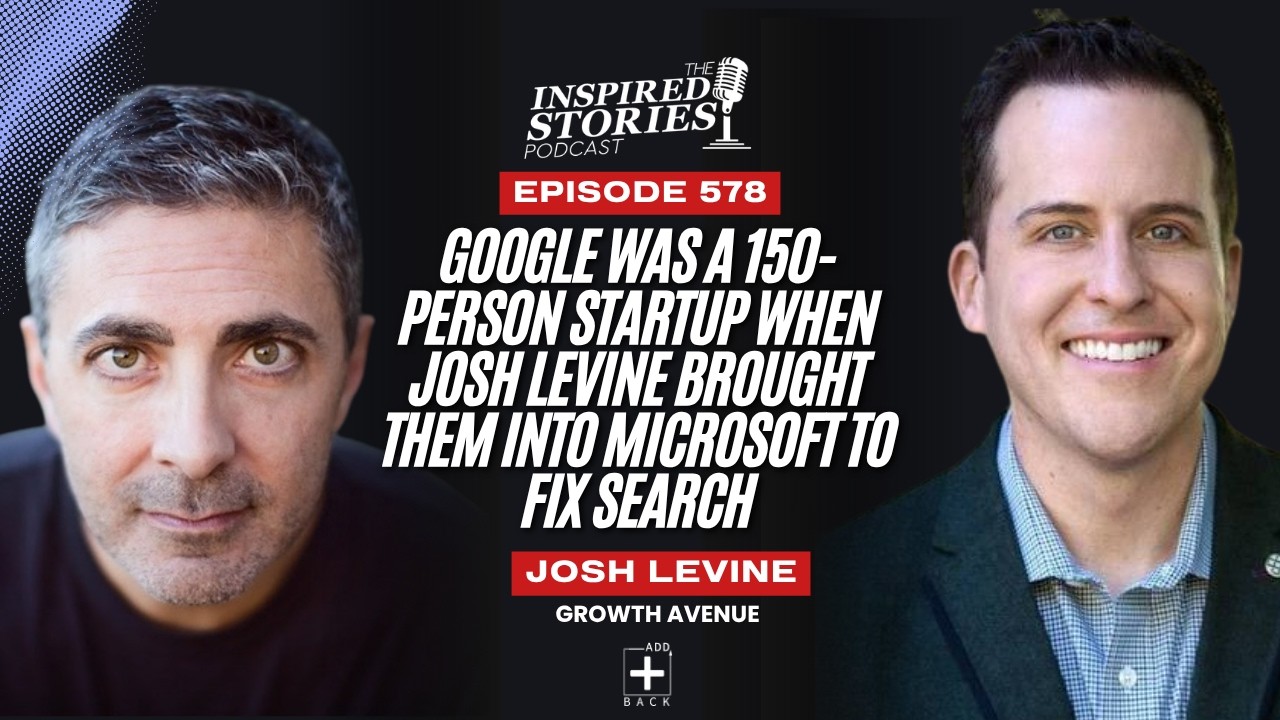
🎙️ From the White House Press Corps to Building an Amazon Growth Agency: Josh Levine's Journey
In this episode, Josh Levine shares a career that spans the White House press corps, Microsoft's early discoverability partnership with a small startup called Google, a mobile social network wiped out by the 2008 financial collapse, and a business partnership derailed by falsified books. Josh opens up about what those setbacks taught him about trust and incentives, and how those lessons shaped the performance-based, full-service model behind the Amazon growth agency he built.
✨ Key Insights You'll Learn:
Got an early, formative look at media incentives while observing the White House press corps as a kid
Worked at Microsoft during a period when the company quietly partnered with a young startup called Google
Co-founded a mobile social network that raised $7.2 million from Sand Hill Road investors
Lost the company and years of work when a VC fund collapsed during the 2008 financial crisis
Discovered a business partner's books had been falsified during a fundraising round
Learned firsthand how quickly trust and reputation collapse once financial numbers are compromised
Built an Amazon growth agency around a full-service model instead of single-channel services
Prices services on performance-based alignment rather than flat retainer fees
Structures client engagements so the agency effectively fires itself if results don't show within 30 days
Emphasizes preparation and timing as decisive, often uncontrollable factors in business success
🌟 Josh's Key Influences:
Early White House Press Exposure: Shaped a lasting skepticism about incentives and integrity in institutions
Microsoft Colleagues: Introduced him to an early, discoverability-focused partnership with Google
Sand Hill Road Investors: Backed his mobile social network and shaped his understanding of venture-backed risk
A Business Partner's Failure: The discovery of falsified books became a defining lesson in trust and accountability
👉 Hear how a career shaped by media pettiness, Microsoft's Google partnership, a lost venture, and a business betrayal led to a performance-based Amazon growth agency.
Listen to the full episode here
Transcript
Anthony Codispoti (00:00)
Welcome to another edition of the Inspired Stories podcast, where leaders share their experiences so we can learn from their successes and be inspired by how they've overcome adversity. As you listen today, let one idea shape what you do next.
My name is Anthony Cotuspodi, and today's guest is Josh Levine. He started his career in the West Wing of the White House under Press Secretary D.D. Myers, an early exposure to high-stakes decision making that still shapes how he operates today. From there, he drove growth, partnerships, and enterprise deals across Microsoft, Disney, and multiple technology companies. He then founded Color More Lines, an Amazon growth agency helping brands grow faster on Amazon and Walmart.
He scaled the business to a 50-plus person team, driving over $720 million in client revenue, helping 20 brands go from zero to $100,000 a month in under a year, and building a net promoter score of 88. In 2024, he successfully merged the master agency into Color More Lines. And today, Josh is the chief revenue officer of Color More Lines and the managing partner at Growth Avenue.
Where he works directly with CEOs in an advisory capacity to help their companies scale smarter and exit faster. He sits on several advisory boards across early stage growth and pre-exit companies. But before we get into all that good stuff, today's episode is brought to you by my company, Adback Benefits Agency. And you'll want to hear this because it's hurting almost every business owner you know. See, health insurance costs go up every single year, and businesses are furious about it. They're paying more.
Claims are getting denied, employees are opting out because they can't afford it, and it hurts turnover and morale. It's one of the most maddening problems in running a business, and everyone just accepts it. But you don't have to anymore. Now there's a program from Bain Capital Insurance that gives your employees unlimited access to doctors, therapists, and prescriptions with no co-pays or deductibles to meet. And here's the part that really shocks most people. Unlike every other employee benefit out there,
Our program increases your net profits. We recently helped a client add, let's add $900 per employee per year to their bottom line. Results vary, but gains like that change how a business is valued. You can be the hero advisor that introduces this to your clients today. They'll be so happy they refer their friends to you. Adbackbenefits.com. Okay, back to our guest today, the managing partner of Growth Avenue, Josh Levine. Thanks for making the time to share your story today.
Josh Levine (02:39)
You're welcome, thanks for having me.
Anthony Codispoti (02:41)
So I want to start with the the West Wing, Press Secretary Dee Dee Myers during the Clinton administration. I my first curiosity is how because I fell in love with the West Wing, the TV series that was on years ago,
Josh Levine (02:54)
Yeah.
Anthony Codispoti (02:55)
and I just re-watched it on Netflix recently. How closely
Josh Levine (02:59)
Nice.
Anthony Codispoti (03:00)
does real events in there compare to what I saw on the show?
Josh Levine (03:05)
I I I think, you know, obviously things are a little a little bit more like a telenovela on that show, right? But real life is also like that too, right? I mean, physically it's completely different. I mean, that looks like this this massive, you know, operation, buildings, the whole thing. I mean, the West Wings quite small actually. And then there's obviously the old executive office building next door, so maybe they were trying to get a little bit of that. But it it's it's quite different than than the show itself.
Anthony Codispoti (03:31)
Okay. What was the work that you were doing there?
Josh Levine (03:34)
I mean, I was part of the I was still in college. I was a junior in college and I was super excited. I got an opportunity to be part of the UC DC program from the University of California. So that was where they allowed you to be an intern. You apply, got the internship. I started off in the old executive office building and then ended up working for Didi, who was absolutely incredible. And had really the time my life, I was just a kid back then, maybe I was twenty years old or something like that.
And it was an amazing experience. I got to basically work on communication between her and the general public, you know, typical stuff that interns do, right? But you know, you got to see the complete agenda for POTUS and kind of where he's going and what he's doing, and you know, see some incredible things during that time. I mean, my my highlight was seeing the swearing in of Ruth Bader-Ginsburg in the Rose Garden, which was just super cool, right? Back when there was a Rose Garden, but that's another topic.
Anthony Codispoti (04:27)
And so you say typical intern stuff, you're working on communications, but what does that mean? Like are you actually writing press releases? Are you working on speeches that different folks within the White House are gonna give? What's it look like?
Josh Levine (04:39)
No, I mean it's like it's more intern work. I mean, that'd be higher level at the time, right? So it's like what whatever whatever that's needed. I mean, yeah, revising memos, you know, calling meetings together for, you know, different stakeholders. I mean, it every day was different, right? And it depends what's going on, right? Budget bill needs to pass, it's crisis, all hands on deck, crazy hours, right? So it was just every week was frankly a little bit different. but it was just another hand on deck for the press secretary in terms of what needed to get done.
Anthony Codispoti (05:08)
Can you give us a fun story from the inside? Something that might surprise folks.
Josh Levine (05:14)
I mean, won't won't mention names, but you know, the media are supposedly the guardians of our democracy, right? and I do remember a very prominent media person in the front row, actually in the press in the press office, who wanted to give the president a cake on his birthday. And, you know, I was given the cake, right? And then it went back to Didi and then it was supposed to go the president. But truth is, president had bigger fish to fry than on than take that cake at the time. I mean, I don't know what the crisis de jour was.
But we knew that this press person was writing a positive spin on a specific policy that the administration was doing. But she got pissed off that she couldn't personally give the president a cake on his birthday. And so she changed her pol her her her slant on the story and kind of wrote
Anthony Codispoti (05:59)
Wow.
Josh Levine (06:00)
a negative article. And I'm thinking as a little kid, they are going, Gosh, are these really the guardians of our democracy? Right. So that's crazy.
Anthony Codispoti (06:08)
Petulant. There's a word that sort of pops to mind. Okay. So
Josh Levine (06:09)
Very Yeah, it's a five dollar word.
Anthony Codispoti (06:15)
you moved from government and to corporate world, eventually landing at Microsoft, where you got recognized with the Gold Star Award for top talent in your first year. What kind of work were you doing there? And what were you doing to actually earn that award?
Josh Levine (06:31)
Yeah, sure. I mean, I thought, you know, I I did, I think it's worth just mentioning. I did psychology and political science in college because I thought that, you know, with politics, maybe you could help a small amount of people move super far. But maybe with politics, you could help a large population move just a little bit, right? And I was just in betwixt in between in terms of where to go between those two. And that's why I went to DC and had this incredible opportunity. And I was like, let's go see this. And then, you know, that one story I gave you plus a bunch of others realized, you know what?
Doesn't matter your political background, at the end of the day, it's a political machine, right? And I thought that real change happened in business. Like you really want to make social change, cut a check, right? To the cause, charity, whatever it might be that that you want to forward. And that really kind of that was my thesis. And I was learning as a young kid. And so that that really inspired me. And that's why I went into business. So to to to answer your question, when I finished business school, I got recruited by my Microsoft and I I joined the Windows XP Launch team. And
That was that was an absolutely incredible experience. I I don't think I will ever have an opportunity in my life to be in that type of organization with the scale and sheer size of budgets and people and magnitude of a launch, right? And that was the first time Microsoft ever sim shipped an operating system at the same time in I don't know what it was, 150 countries, 50 plus languages. simultaneously shipped, right? Like literally live.
Anthony Codispoti (07:52)
When you say sim shipped, simultaneously shipped in a hundred and fifty countries.
Josh Levine (07:58)
Just like Blink, like I dream of genie blink, right? All of a sudden, products out in stores, on shelves, online, 150 countries, 50 languages, all at the same time, right? This was, you know, a rollout in previous versions. So that was like a really, really big deal. yeah, and I got I I I did get that Gold Star Bonus Award, which was which was super flattering and I was really excited about that. I was at the time working on this, I was doing business development in Windows Group and I was working for this little
working with this little company nobody heard of in 2001, 2002. And there are 150 people in Mountain View, and they're an alternative to Alta Vista, Akamai, Blue Mountain. They were called Google. And, you know, this is just little, little nothing company, right? And, you know, Microsoft at the time, you know, had huge egos, frankly. And I can say that being on the inside, especially relating to search, right?
And Microsoft had a lot of problems in search at the time. I mean, this is you know 20 years ago, right? So there there's nothing that is that everything's disclosed, everything's out there now. But if you remember the Linux Compete days, Microsoft was quite concerned when Linux came out what that was gonna do for a closed ecosystem in Windows. So one of the critical things for Windows Right, exactly.
Anthony Codispoti (09:14)
'Cause this was open source, free. Yep.
Josh Levine (09:17)
Exactly. That's when Linux was just first starting and it was scary for a closed operating system company, right? Because gosh.
What would happen? And Linux had huge ambitions, as we all knew, and some things grew, some things didn't. But at the time, it was kind of all hands on deck, you know, sound the alarm, what are we gonna do? And Microsoft had some serious issues with discoverability on MSDN and Technet, which were the development platforms for IT professionals and developers, respectively, right? Developers went to MSDN, IT professionals went to Technet to get their information. And the reality, if those platforms aren't discoverable.
How can you expect developers to develop on the Windows platform? Right. It's a big problem, right? So kind of quietly found this little startup that had this cool algorithm that was pretty wild. Nobody had this whole page rank system. And you remember back then, like I said, there was Akamai, Blue Mountain, Ask G's. I mean, there were 17 flavors. Yeah, and they were all
Anthony Codispoti (10:13)
Lycos, yep.
Josh Levine (10:15)
the same and you know, competing. And why was one better than the other? But but this one seemed to be a little better. So let's dive in. So
you know, brought them in quietly and they came in and fixed MSDN and Technet. and so things could be discoverable on the Windows platform. And we created a vertical search which was publicly available on Google, meaning Google dot com slash Microsoft, which doesn't exist anymore, but it was an ability for Windows developers, or maybe it was slash Windows, I forget. It was an ability to put a complete lens on the internet for all things Windows. And it allowed developers to be able to develop faster.
Anthony Codispoti (10:52)
And so Google came inside of Microsoft to fix search specifically on on which platform, which website, which interface. Okay.
Josh Levine (11:00)
MSDN and Technet. MSDN and Technet,
which were two platforms at the time. MSDN is the Microsoft Developer Network, which is specifically for developers coding on the Windows platform. And then Technet was for IT professionals, right? Looking for similar documentation, things more for an IT professional, right? Again, if your stuff isn't discoverable, how how are people gonna write to your platform, right? And Microsoft's value add in the value prop was obviously
The strength of the platform is the strength of the development and the s applications that are built, obviously, on your platform. And so if people are leaving for Linux and not developing, your platform becomes weaker, and then the opposite is true, it becomes stronger if you lean in, right? So started with discoverability. So it was a dual deal. I mean, the first part was from a BD perspective, having them come in and fix things, frankly. And then on the other end, we struck the first deal between Microsoft and Google on the advertising side of things, which
which was wonderful. it was an a it basically Microsoft got crazy discounted rates for advertising on Google. I don't remember when they acquired AdMob, which turned into AdWords, Google AdWords, but it was all around, you know, you know, this time period. And then Microsoft was able to also advertise. And so and it was a very small company. I mean, I worked with some incredible people over there. it was like a hundred and fifty at the time.
Anthony Codispoti (12:24)
And you were the one basically making these deals happen. You're the conduit for Microsoft into yeah, into Google. Yeah.
Josh Levine (12:27)
On the Microsoft side. Yeah. Exactly. Yeah.
Yeah. I mean, yeah. I mean I got a lot of shout outs to the people over there. It was a lot of fun, but it was a long time ago, right?
Anthony Codispoti (12:36)
Yeah.
What was something you saw inside of Microsoft? it's been twenty years now, it would surprise people.
Josh Levine (12:45)
I don't know about surprise people. I just actually just just how distributed it was at the time in terms of its own individual almost fiefdoms, if you will, right? you know, the Windows group on its own was its own massive company. If it had its own GDP, I wonder where it would be rank on the country side of things and just how how big that that that beast was. Office its own thing, right? Microsoft Office and then
Then you kind of go. I almost went to go work for Xbox when I got recruited, which would have been an amazing experience. I had some buddies that went over there. But each one, I mean, it was just amazing that each one obviously can be its own massive corporation in and of itself, right? and I really did enjoy the whole campus feel, right? and that was before Microsoft pretty much took over Redmond, Bellevue, and and Seattle. It was pretty much mainly concentrated in in Redmond at the
Anthony Codispoti (13:39)
Okay. So let's talk for a moment about your stop at DXC, where you managed the
Josh Levine (13:44)
Yeah, sure.
Anthony Codispoti (13:45)
partnership with Amazon Web Services. What did DXC do? Who did they do it
for? What was your role there?
Josh Levine (13:50)
So
yeah, that was really interesting actually. And it was originally with a company called ServiceMesh in Santa Monica. We were a 200 person startup specifically designed to be able to port workloads between AWS, Azure, you know, Oracle, all this stuff. Because you know that the pain cave that companies get in, specifically relative to these platforms, is, you know, once you're in, good luck getting out, right? There's a lot of switching costs are huge, right? And so
This was a kind of amazing little startup that came up with a software solution where you could literally port a workload. I'm talking the environmental layer all the way up through the application layer, everything in between, literally, like, you know, you're not happy with Anthony and you want to switch to Josh, copy, paste, move. No switching costs. So if you get a better price, you can move in three seconds. That didn't exist. So we were actually purchased. I was VP of business development
Anthony Codispoti (14:43)
Smart.
Josh Levine (14:44)
at the time. We we were purchased by a computer science company.
Which was about an 80,000 person body shop at the time. And, you know, like most companies in the cloud days, as cloud was starting, you know, they're trying to figure out how to stay relevant in the world. And they got an 80,000 person body shop doing implementations. So they bought this hotshot startup out of Santa Monica. And that software kind of made that organization relevant. And they could use that software to deploy in their organizations. Well, about the same time, Meg Whitman sold off Hewlett-Packard Enterprise, which was about a 100,000-person body shop, right?
And so you took an 80,000 person shop and a hundred thousand person shop, merged, informed DXE technology, which is a new ticker symbol, right? And I was still vesting, I had some golden handcuffs, so I was there for a few years. very different culture, going from a couple hundred people to 180,000 people. And I think one of the points of the merger obviously was efficiency. So it was rough for a period of time when it came to layoffs and fighting for your job. And a lot of the typical stuff happens with acquisitions, right?
but I ended up running the AWS practice for the newly formed entity at DXC Technology, which is great. And Mike Lowry was the CEO, former head of IBM, and was great to work for. And I learned a ton. I got to work with Andy Jassy's entire team at Amazon, all all exec executives. Shout out to Mike Claville and the whole team there. It was Peter O'Sullivan and all these people. Actually, that was way back at gosh, now Peter, I think it was back at Google, man. This is this is this is going back there. But
There's some incredible people I've worked with, you know, in my career and Amazon. Amazon was a special place to work with, frankly. and so DXC was like, I don't know, maybe number two partner for Amazon, AWS specifically, Amazon Web Services, and number one in certain verticals. My Amazon had like, you know, whatever, 20,000 partners or something like that. So it was a great experience. and I was there for three years, learned a ton, got to know Amazon super well, and then
I started my own agency.
Anthony Codispoti (16:46)
But your own agency didn't really have anything to do with the AWS side, if I understand correctly. Okay, so how did this unfold?
Josh Levine (16:50)
Nope. Not at all. No, I was I don't
what'd you say?
Anthony Codispoti (16:55)
How did this unfold?
Josh Levine (16:57)
I mean it's just life happens. I met my partner at Entrepreneurship Conference, and it was one of those things where there's just a lot of discussion on gosh, you know, how broken Amazon is. And I knew a lot of the people over there, but on on the AWS side, of course, to your point. but when we looked at the retail side of the business, it was kind of a broken model, right? There was a lot of eight
Anthony Codispoti (17:18)
What year are we talking about, just to give some context?
Josh Levine (17:21)
gosh, about eight years ago. so
know, twenty eight twenty eighteen or so ish, twenty seventeen, eighteen. So when the company was founded, I forget the exact the exact date, but yeah, it was interesting because you you had it's a very antiquated space, kind of old school industry agency models where, hey Anthony, let me give you a a two-year contract and I don't have to do any kind of performance whatsoever, right? And there's a lot of Charlot Charlatans in the space and
You know, there's white hat, which is all the legal stuff you do, and then there's gray and black hat, which can get you kicked off Amazon. And it was crazy to see the amount of kind of weird stuff that was going on in that space. It's just like, gosh, you know what? Wouldn't it be amazing if you could just start a company, you know, make it month to month, performance-based after onboarding, right? And you actually do what you say you're gonna do. Like it just it felt like this there was an opportunity to disrupt an industry that was frankly pretty broken, right?
not that there aren't some good players out there, because there absolutely are, but you know, when you hear the stories from a lot of these sellers, and these are either startups with no revenue or omnichannel brands that are just getting to Amazon, or they could be eight figure sellers, right? You you consistently hear the carnage and turnover and pain of working with these agencies, right? I think the the biggest thing you hear is, I was sold by the A team and fulfilled by the C team, right? And here, you know, you know, and they pound their chest. I'm a two hundred and fifty person agency and like
You know, and of course the A player, usually the founders, you know, can talk a good game. And then once once you start, you're handed to the C team, typically offshore, and good luck to you, right? And then you just kinda bait and switch.
Anthony Codispoti (19:02)
So the broken part of the industry that you're talking about wasn't necessarily the Amazon e commerce platform itself, but the agency world that surrounded supporting the brands that wanted to sell on top.
Josh Levine (19:14)
I mean, both have their issues. We'll just leave it at that, right? you know, if you talk to people inside Amazon, they will tell you very clearly that, you know, part of Amazon is held together with, you know, chewing gum and duct tape in certain areas, right? And, you know, built an incredible juggernaut of a company, which is great, but yeah, it's challenging too. I mean, they've got their growth pains and you know, policy inconsistencies, all the fun stuff, staying up with AI, giving proper response times to customers, especially in
Critical things that affect families' revenue, right? So it's, you know, there's issues on both sides. And and it's hard as an entrepreneur to be able to manage the beast of Amazon. And then when you're trusting to give the work to an agency, you expect them to good do word good work, but you know, the whole trust but verify thing, right? And then a lot of these people find themselves locked into contracts or, you know, a lot of talk and a not a lot of do, right?
Anthony Codispoti (20:08)
So I don't often talk about myself and my background on this show, but I was a a pretty good sized Amazon seller for a number of years. Around the time that you were
Josh Levine (20:17)
What are you selling?
Anthony Codispoti (20:19)
I had multiple brands. big exit that I had was in the organic tea space, other other
Josh Levine (20:24)
nice.
Anthony Codispoti (20:25)
brands as well. So I know that pain very well. And I know that it took a long time to really learn and understand how the platform worked and how to interact with Amazon and
deal with all the craziness that was there. And I'm curious, as somebody coming from the outside, you got great experience working at high levels in tech and great experience in business development, but you didn't quite have your fingers dirty in the day to day. Did you have partners that you brought in that had that experience of what it was like to actually interact with the platform and and Amazon in general is the 800 pound gorilla that doesn't talk to anybody?
Josh Levine (21:06)
Exactly. No, that's exactly right. And my business partner that I launched with had that deep experience and was a seller on Amazon s literally since the beginning and kind of cut her teeth, building that, you know, you know, getting beat up by Amazon like everybody does, and knowing where all the bodies are buried and which buttons you push and which ones you don't push and all that stuff, and then worked to hire a team of frankly ex-Amazonians. As much as we could hire ex-Amazonians, we did, meaning people in customer service, people in
Crisis management, people in listings, people in advertising. So they really know kind of the chewing gum, gum, and duck, duct tape situation on the back end. Like, okay, where are all the bodies buried? If I need help, where can I actually go? and and how and how the beast works on the inside, because it's easier to then operate from the outside if you know if you've been on both sides of the equation. So I think that's one of the key differentiators of the business is really ensuring we have domain experts and then
Yeah, for me, I mean I I was on a massive steep learning curve curve, especially in the last in the first, I'd say four or five years. And then, you know, eight, nine years into this now, you know, we st it's all you you see the same stuff, lather, rinse, repeat, come through all the time in terms of issues on Amazon, all that. So you pretty much learn the business. But I also think it's important to note that I don't think anybody says they're an expert on all things Amazon today. It's just not being straight up.
I'm not, and and most people aren't. It's way too specialized. Like in twenty fifteen, you know, there were three things you need to do on Amazon, right? And if you could do two of the three things right, you could close your eyes, throw a dart, you could literally resell vitamin C from Shenzhen with your white label, Anthony C, and make money, right? Now that's over. Now there's 25 things you need to do on Amazon. Half of them are things you need to do off Amazon, by the way. And if you don't have a highly differentiated product with a unique selling proposition, you know.
May the force be with you. It's usually a commodity, a race to the bottom or you're done, right? So it's just a totally different beast, right?
Anthony Codispoti (23:06)
So take me back to the early days. You guys are hiring some ex Amazon folks, which I think is brilliant. Learn, you know, folks who already understand how the inside works. They've got contacts there, right? They know the put buttons to push, the folks to contact when your site goes d your listing goes down. Were you guys taking on funding or were you growing all of this organic?
Josh Levine (23:27)
No, I mean that we were really I mean, I I've raised venture money in my past at other startups and I've raised private equity, I've raised, you know, from angels, I've done the whole thing. good, bad, and ugly, right? You know, great stories, bad stories. For this one, we bootstrapped it a hundred percent. And that was hard, right? Really hard, right? Landing first client, cutting checks, making payroll, all that stuff. but yeah, we this was bootstrapped from the beginning. We were the only investors.
Anthony Codispoti (23:54)
How how were you getting your first call it three clients? How did those come to you?
Josh Levine (23:57)
Begging.
Anthony Codispoti (24:00)
Knocking on doors, did you have relationships already in the space?
Josh Levine (24:03)
Yeah, it was relationship.
I mean, at the end of the day is relationship based, like everything in life, right? I think you're only as good as, you know, your brand reputation at the end of the day. And so leveraging my frankly, leveraging some of my relationships with people that knew me, trusted me, knew my integrity, knew my ability to execute in business, and just saying, Hey, this is my next deal, right? you know, would love for you to come on board. And then offering a sweetener, right, for them to come on board, right?
you know, as a first or second client, you know, this is, you know, what we're gonna do for you. And it worked great. And and we did incredible work for them and they became great reference accounts and then landed the next client and the next client and just kinda snowballed from there.
Anthony Codispoti (24:44)
And I think your strategy, the billing approach that you took was probably a big help to you, right? It's there's some sort of a fee to do the initial onboarding because there's all big lift, there's a lot of work that takes place there. But then if I hear you correctly, you were doing a month to month performance based. And so they can yank
Josh Levine (25:00)
Yeah.
Anthony Codispoti (25:02)
the cord at any time.
Josh Levine (25:03)
Absolutely. I mean, we're not gonna hold people they don't wanna be here, right? I mean that's ridiculous, right? It's amazing to me when you hear the kind of scuttle butt in the industry around agencies trying to chase, you know, shake down clients for like a last payment or you signed a year two contract. And you know, it's like really like you know, you should just perform every month. If somebody doesn't want to be with you, are you that desperate? Like, go get a new client, right? It's crazy. So, like it's actually there's two separate avatars in terms of that business. The first one is
You know, the omnichannel brand or startup that's not on Amazon, so they will have a retainer. Why? Because there's real work to do, right? Pretty simple. Anybody doesn't get that is not a fit. Anybody expects something for free? Great way to to pass on them and find a real client, right? So, you know, but once they get to a hundred grand a month, there's no retainer, st strictly commission, right? And so as they grow, our commission tiers pop down as as their revenue grows. And so that's really important because you know
I really believe that a lot of business and I've been a lot of industries in my career. I think that a lot of the most fundamentals are ever green. Like I think the worst thing you can do in business is hope for behavior A and reward behavior B, right? Like I I I I really want your team totally focused on my business, but I'm only gonna pay your retainer. And if you blow it out of the water or work work late at night and you know, burn the midnight oil, there's zero incentive for you, right? So that
That becomes, hold on one second while I plug in my computer, otherwise you will go away. Hold on, there we go. Now we got power. So I'd say, you know, that becomes an incredible incentive to break that that that habit of hoping for behavior A and rewarding behavior B. Meaning, like if I told you I was gonna take, let's say 5%, it could be 3%, 10%, the the number doesn't matter, but just round numbers. Let's just say it's five percent, right?
If I told you, hey, Anthony, for every hundred dollars, I'm gonna take five, right? How many hundred dollar bills do you want? Like, why would you not do a deal like that? Right.
Anthony Codispoti (27:10)
Hundred dollars in top line or gross pro.
Josh Levine (27:12)
Yeah, yeah,
exactly. And I'm not saying five's the number. It could be three, one, two, five, ten. It doesn't matter. I'm just trying to say if you you have to align incentives where whoever you're working with in a partnership has some skin in the game and an incentive to work late, burn the midnight oil, and drive sales. Now, if that if that shop's taking twenty-five, fifty percent of every dollar, that just doesn't work, right? But if they're there if if is if a shop is taking a single digit digit number to help you grow, for me as a seller.
All day long, go for it, right? Because I know that for every hundred dollars that go in the bank, I I'm getting, you know, ninety seven of those or ninety five of those. So go bring me a whole boatload of those, right? And I build it into my model.
Anthony Codispoti (27:54)
So you're not talking about you're
not talking about the the sales number, you're talking about the the profit that comes out. Because you could
Josh Levine (27:59)
No sales.
Anthony Codispoti (28:01)
'cause you could run the the PPC, the the the advertising at a super high cost just to drive more sales, and that wouldn't benefit the the client necessarily if it's running at a loss.
Josh Levine (28:13)
No, totally agree. But again, if you're month to month, that would be not a very smart move because guess what? You get 30 days notice in three seconds. So that's the benefit of being month to month, is that clients don't have to look over the back and go, gosh, you what? Does Josh really have my best interest at heart? Of course he does. The minute he does some idiot move, he's gonna be fired. So why would he do that? You know, yeah, if he's trying to goose himself to get, you know, a high, let's say, commission this month, guess what? You get that once and then you're gone. So the cool thing is that you're totally aligned and then
Yeah, with clients, they set budgets and less about budgets, more about Roas A cost, like ROAS return on advertising spend, right? So it's like, you know, if you have a client that's a cash cow and wants, you know, let's say a Ford Auto ROAS for every dollar we manage for them on Amazon that we give Amazon, we bring them four dollars back, right? So do you wanna so don't give me a budget? That's kind of an idiot move, right? Like, why would somebody give me a budget? It'd just be like, just
Tell me the ROIS you want and I'll hit it. So the idea is that, you know, do you want to give me $1 and get $4 back? Or do you want to give me $100,000 and get $400,000 back? Right? It's like, now, I'm being a bit cheeky because I like to have fun in life. It's not that easy. You know, Amazon does limit what you can spend. How do you find the keywords? Not so easy to go spend $100,000 in a second versus spend a dollar, but you get the idea. The goal is to do that as best you can, whether the goal is
Break even, we're not looking to make money on advertising, just throw that back in for organic rank. Or let's say the goal is really a cash cow business that just wants to maximize profit on ad dollars, right? But if you again, it's all about alignment. If you set the metric, look, I got a business, I'm selling, you know, this widget, and I know that these are my margins and these are the tolerances. And if you work within those, go blow it out. Like I would never tell an agency, give them a cap on spend.
Anthony Codispoti (30:06)
Yeah. So give us an idea of the breadth of the services that you offer inside this Amazon agency because I think folks who are outside the space don't understand all the intricacies that are involved.
Josh Levine (30:20)
Yeah, sure. I mean, we screwed up so many times I can't even tell you, right? Like I joke around, like now we're kind of like silver back gorillas with a lot of scar tissue, right? And you know, stepped in a lot of potholes. You know, and frankly now can help clients avoid those, right? Not make the stupid mistakes we've made, right? Not just as you know, business owners and agency, but as brand owners. So
I do I will talk about the merger in a minute because it it goes back to the brand owner and owning our own eight-figure brands now, which is I think really important. But before we do that, let's just answer your question directly there. in the beginning, we were hungry like any person, right? So it's like if there's food on the table, eat, right? Didn't matter what the food was. You know, somebody coming, hey, can you do this? Give me one second. Yeah, sure, we can do this. And you know, if there's money there, we're gonna do it because look, we got mouths to feed.
And we learned some hard lessons. Like we do not do a la carte services anymore, right? We offer one thing. It is a white club service. We do 100% of everything that is required to be successful on Amazon. So what does that mean? Customer service, advertising, inventory management, listings, front end of listings, back end listings, market intelligence, SEO, AEO. you know, if we're doing DSP, fine. If it's just PPC advertising, fine.
We don't do, we actually don't do the video and actual photography is separate because the truth is you don't need that every month, maybe once or twice a year. But why am I saying we offer all those things as a white glove service versus a la carte? A la carte doesn't work. Like, for example, there are thousands of PPC only shops. And Anthony, you probably know that having your brand back in the day, right? Like I could close my eyes, throw a dart, and like hit 30 shops, right? Not too far from
In our opinion, that model's broken. And the reason why it's broken is I like to give the analogy like the helicopter. So it's like you kind of got the main blade here and then the rotor blade, right? And it's like if all you're doing is PPC, you're just controlling the little rotor back here, and you're never gonna be successful, right? And and we screwed up trying to do that. Here's why. If you're not controlling the main blade, which are the listings and the creative and the market intelligence and the keywords and all the critical things that really need to be fed into the PPC team.
So they know creative that's working. They know what market intelligence is saying competitors are doing. They know which keywords are rising and which one are falling. They know there's been split testing of images and copy and listings to increase conversion for the traffic being driven by PPC. If these are out of sync, guess what happens? That thing cra the whole helicopter crashes. And that's typically what happens. You get this PPC only shop.
Out on an island trying to communicate with a client around all the weird stuff they're doing, right? And meanwhile, something goes haywire and ad spend goes wild or they don't get results, it's a broken model. So we stop that. And now, and if you don't want to do business with us, that's fine. Here's 20 PPC only shops you can go talk to. So it's just and that and that's also better because it's one throat to choke. And again, if you're month to month, you have
one group that is an extension of your team at a fraction of the cost of what it would take you to build out a team of W-2 employees that's fully aligned with your business and that's how you roll. And that's been the best model. It's kind of like you kind of go like this over the years and then you net on something that just works.
Anthony Codispoti (33:45)
Do you get involved on any level with the product development or making suggestions on, ooh, we're seeing this and sort of a keyword trend, we think you guys should go this direction?
Josh Levine (33:56)
I mean, answer is yes, because that's part of the service we offer. I mean, we have a whole market intelligence team. You know, it's so funny when you sometimes come talk to a new client of like, well, we need you to sign an NDA before we tell you our revenue numbers and which keywords we're going after and what our ROAS is and all this. And guess what? It's all available, right? If you're willing to pay for it, there are a ton of third party shops that'll tell you exactly what people there's no surprises on Amazon anymore. Like all the data is the data set available to buy.
So first of all, it it's it's all out there. And now I totally lost your question. So can you go back to yeah, yeah. So why do I say that?
Anthony Codispoti (34:34)
product development because the the insights that
you guys get is really helpful for folks as they're trying to figure out how to take the brand forward.
Josh Levine (34:40)
Yeah.
Absolutely. So the point I was making earlier is just the fact that if you're willing to pay for the data, which we do, you know who are your top five competitors, what are the revenue they're doing, how many units they're moving, what keywords are they bidding on, what are they winning on? What are they not? What is the average customer acquisition cost by keyword? By you know all this data. So to answer your question, yes, based on all that data we buy, we're then able to say, Hey Anthony, I know you're thinking about launching this new product.
Here's how concentrated the category is. Here's the ad density. Here's the number of competitors. This is their respective market share. Here's how competitive it is to bid or not bid. And it gives you, you know, what's that expression? Like if you are trying to chop down a tree in a forest and you have one hour, what do you do? Well, you spend 55 minutes sharpening the axe. Okay. And then chop, chop, goodbye, right? It's down. That's about sharpening the ax. Like in this example, before Anthony launches his new product.
Better damn well sharpen the axe. And if you spend that time, you know, you might come back, gosh, this is ridiculous. I'm trying to launch a blue jean where Levi's owns the category, or I'm trying to go into energy drinks and I didn't think through what Red Bill's doing and the 30 other competitors, and the fact that, geez, this is like super heavy product and it's going to be very expensive to ship. And I better get my margins right. So there's so much to think through before launching a new product.
And yes, we do a lot of that work for clients, saves them a ton of money. Because otherwise, what happens is a lot of entrepreneurs or even companies, you know the game. And by the way, they they get out there to launch products and then they're screwed. They print tens of thousands of labels, have a bunch of product they send in that's expiring at Amazon, they get long-term storage fees, and they're screwed. So we do a lot of that pre-work and also a lot of split testing work ahead of time. Like if I if you knew.
That red was the wrong color for your label for whatever reason the market's telling you, why'd you just print ten thousand labels?
Anthony Codispoti (36:40)
I'll tell you a really dumb mistake that I made during my time. And I think you'll you'll you'll get a laugh out of this. Your services would have been really helpful. because as part
Josh Levine (36:48)
Yeah.
Anthony Codispoti (36:48)
of my organic tea brand, we were gonna launch a line of organic coffee nespresso pods. And
Josh Levine (36:54)
Hmm.
Anthony Codispoti (36:54)
they were fully compostable and there wasn't anything else like it on the market. We were so excited, did a big investment, rolled the product out, and then realized that when you type in the word Nespresso,
They had some kind of an arrangement with Amazon so that the only products that actually show up in the search result, and this was years ago, so maybe it's changed, were
Josh Levine (37:15)
Yeah.
Anthony Codispoti (37:15)
Nespresso branded products. So the only way
Josh Levine (37:17)
Well
Anthony Codispoti (37:18)
for me to get any results was I I had
Josh Levine (37:20)
Yeah.
Anthony Codispoti (37:21)
to buy the search term. It just got to be really expensive.
Josh Levine (37:25)
No, for sure. And I think, look, it's a great lesson because I think in my career, I'd say 30 years later, half a business is timing. And every anybody that's not willing to admit that part of their success is based on the timing of when they did that business. Microsoft had an expression when we were doing MBA recruiting that if the ego to talent ratio is off, it's a no hire. Right? Meaning if someone's got such a huge ego, they can't be I care how smart they are, they can't be humble enough to realize, my gosh.
I got really lucky here too. Yeah, we're smart people. We also got lucky timing-wise. And I bring that up for you because you know, and I've had this happen to me in business many times. If the timing's off, it doesn't matter how good your product is. Your timing was off, frankly. And you didn't control it. Fast forward today, we actually have a client called Love Grown, and you can look them up. They're incredible. And Katie's the CEO, so shout out to Katie. She has a compostable, compostable, right? For Cureg, Nispread, she has her own.
Right? Product where you can pop in and it doesn't have all the junk in it and plastics and all this stuff. And she's killing it. She just launched a whole line of of cold brew, which is my favorite, where you literally take a bag and you put it in their thing, you know, their glass thing, it goes in the fridge the next day, it's ready to go and it's like clean label certified, and there's no pesticides and glyphosates and all this drama, right? And she's killing it now. But you know, maybe she would have run into challenges years ago when just like you did, right?
Back in the day. And you know, yeah. Anyway, I could go on about clients and the great work they're doing, but like I think half of it is timing.
Anthony Codispoti (38:58)
So who is a good client fit for you? Describe them for us.
Josh Levine (39:02)
I mean, we've done we've been in every category over nine years or whatever. We've d we sold everything from bioethanol fuels to women's organic skincare to to a dermatologist selling an anal itch cream to compete with Preparation H, which is on the one hand funny, on the other hand, had an incredible product that was ten times better than that, all natural, right? So like we've been in literally every category. So it's like we know where all the bodies are buried and which ones and the most c I'll give you a question. First.
What do you think are the two most cutthroat categories on Amazon?
Anthony Codispoti (39:35)
Supplements.
Josh Levine (39:37)
Bingo, there's one. Yep.
Anthony Codispoti (39:39)
boy, I've been out of the space for a minute. What's the other one?
Josh Levine (39:41)
Health and
wellness is one of the top most cutthroat competitive categories, yep.
Anthony Codispoti (39:47)
I give up on the second one, protein.
Josh Levine (39:50)
Right now I was we were we have a lot of clients exhibit at Expo West. It's so funny walking around it's protein everything. we're selling protein cotton candy and protein popcorn.
Anthony Codispoti (39:55)
Yeah.
Josh Levine (39:57)
It's like, my God, half these guys are gonna be out of business in a year. But anyway, it's protein everything now. Actually, pets. Because people
Anthony Codispoti (40:05)
Mm. Yeah.
Josh Levine (40:06)
spend unlimited dollars on their on their animals, right? So now I lost your original your original
question. yeah. Yeah, it's good.
Anthony Codispoti (40:12)
who's a good fit for you? Like where where are they in the growth
cycle? Is this a start up brand? Is this somebody that's on
Josh Levine (40:17)
Yeah.
Anthony Codispoti (40:17)
retail store shelves? Where where are they?
Josh Levine (40:20)
I mean, it it it goes back to what I was saying earlier. There's like two avatars we like to work with. One is the funded startup, right? That is either omnichannel, maybe started D to C, then kind of moving over to you know, starting their own Shopify and then then move moving over to Amazon. And as long as it's a highly differentiated product with unique selling proposition and it is a manufacturer, like they own the product or they're making it for themselves. Like we don't work with any resellers.
That's a race to the bottom. Then yeah, that's a great avatar, right? The other one is more the corporation that's stuck at four or five hundred, eight hundred thousand dollars a month in revenue and doesn't know how to double, right? And we've worked with those clients as well. we actually worked with an incredible company that was doing close to I don't remember, close to a half million or so a month in revenue in the hair care space that
You know, with stock couldn't grow. And literally within 18 months, we doubled their revenue. And unfortunately,
Anthony Codispoti (41:19)
Wow.
Josh Levine (41:20)
we did so well that they were sold to private equity several years later. which is fine. That that that's that's a positive outcome, right? But so it's either the bigger company that that needs a team of experts, right? Ex-Amazonians to come in there and and and augment their we don't come in there like for a big company and replace the team. There's no risk there.
But it's just providing that domain expertise on how to grow faster, frankly. And then for the startup, yeah, it's augmenting a team that they can't afford to build on their own.
Anthony Codispoti (41:52)
That hair care brand that you mentioned that doubled in 18 months, how much of that was growth in their existing product set versus new SKUs that they rolled out?
Josh Levine (42:02)
I'd say about seventy percent of it or more was existing optimization of the catalog. This catalog had a lot in it. I don't know, remember if there were forty or fifty ASINs and then all the children underneath that, right? for blonde hair, brown hair, right? And small, medium, large sizes, and like it was a pretty good size catalog when you add all that up. and then part of it was new new product launcher, sure. But I I think the other part of it too, and we're very proud of this, again
A lot of the A9 algorithm is really rewarding the work you do off Amazon now as well. So, you know, how are you doing on your TikTok shop? How many influencers do you have on Instagram? how many, you know, how are you going on Instagram and Facebook? Like, are you doing SEO? Are you in the New York Times holiday gift guide ahead of Black Friday? Do you have a PR strategy? Like all these things in terms of because at the end of the day, Amazon's a business, right? And they don't want to lose money.
So if they're realizing there's a hotshot startup that's kicking ass over here and doing great and it's easily discoverable, but it's not discoverable on Amazon, guess who's gonna lose? Amazon. Right? So we also have an ecosystem of partners that we work with that we're more than happy to refer our clients to because we know, again, back to hoping for behavior A and rewarding behavior A, we know if we give them the best PR firm or the best TikTok shop, and they kick ass over there, guess what's gonna happen?
There's gonna be a spill over Amazon and we're gonna make more commissions ourselves too, so it's a win win for every
Anthony Codispoti (43:31)
Tell me about Growth Avenue. What is this? How'd the opportunity come?
Josh Levine (43:36)
yeah, so I started Growth Avenue at the same time as Color More Lines, and it is really a CEO advisory shop that is designed to help companies scale smarter and exit faster. I mean, I love I love coaching, partnering, working with CEOs on how to grow, avoiding all the potholes I've I've stepped in, mistakes I've made in my career, frankly, and really helping them collapse time. So they started really at the same time and actually
one of Growth Avenue's clients was the first client at Color More Lines. So do you answer your question of, you know, how'd you get that first client? Well, I pulled them over from a trusted client that really loved the work we did at Growth Avenue and then boom, Color More Lines. So so that was that. And Growth Avenue has always been there, just a couple clients and that's the way it was. And then about three years ago, we merged another agency into Color More Lines. That's the master agency. And we brought in Maggie and John who are incredible to the business and their whole group, right? And
Maggie and Maggie Masterson and John Durkitz are both ex-Amazonians, literally in the belly of the beast. John has his own eight-figure brand on Amazon called Meat Huggers, which has like 34,000 reviews, 4.8 stars, you know, for butcher paper, freezer paper, all that. And we manage that brand as well. and so when we kind of merged, and it was a beautiful thing, I mean, we all we all dated for gosh, almost a year before deciding to do the merger, because I think the most important thing is cultural fit, right?
And me and my partner dated them basically and got to a point where like, you what, this is gonna make a lot of sense. Let's do this, right? But the benefit of having amazing smart brains on board and a bigger team was, you know, you know, the ability not to, you know, do everything. You know how it goes as a younger company, you're doing everything, right? And so I was able to move, you know, into a role where I wasn't having to do as much as I needed to do, right? So there's opportunity to be able to work with some other clients at Growth Avenue. So
So that's what I do today, which is great. I work at CML, I work at Growth Avenue, and I really enjoy both. And they're, you know, it's been a really nice feeder as well for the Amazon business to send some clients from Growth Avenue. So I mean, what we do there is just CEO advisor work, like I said, like how do you scale a business? And the needs, obviously, there's like three phases, you know, really like the plant, like starting a business, growing a business, and selling a business. And obviously, there's different needs there.
So we offer different types of services, but it's, you know, you know this. It's like the job of a CEO is a really lonely job, right? Everyone's pulling on you, everyone's got an agenda. You don't know who's being honest and truthful with you. If you have a trusted confidant in your corner that is an exited founder, that's been there and knows where all the bodies are buried, that's that's pretty valuable. So that's the kind of services we
Anthony Codispoti (46:24)
So is it a similar client profile then for Growth Avenue?
Is it tech? Is it e com? That seems
Josh Levine (46:32)
It's all over the map.
I mean, we have in an all over the map we have clients. So, you know, yeah, there's some there's some e-commerce brands. There's also, you know, brands in every industry. We have an entertainment company, we have a travel company. travel company's super fun. I'll give a shout out to Ascend. And they do basically international business class tickets for coach plus pricing, which is insane. I just got back from a a trip and you know, got like an eight thousand dollar business class one-way ticket from Europe for like
I think it was twenty s twenty five hundred and fifty dollars in the height of summer, which is insane, right? So that that they they they don't sell they're they're not selling something on Amazon. That's a service based business. So I'm just saying we work with product and service based businesses.
Anthony Codispoti (47:19)
Any like old school like non tech services or
Josh Levine (47:23)
Yeah, absolutely.
I I've one of my original clients is is in the old school manufacturing space, has been in that space for since I think nineteen forty-nine the company started. So an incredible company called the Knox Company. And if you notice, there'll be a little black box on the front of your your building right now where you're working, and it's a box. And in that box is the key to the front door, and the only person that has that box is the fire department.
So they have like fifteen thousand cities across the US standardized on the system. So let's say LA Fire where I live can open up every door in the entire city by getting into that box. So it's a it's a beautiful, incredible business and it's been a lot of fun working with them and and helping them scale. We've been advisors to them, gosh, for twelve years now.
Anthony Codispoti (48:09)
You know, you mentioned this before and I want to highlight it because I think it's a big deal. You know, and maybe you do this at both growth and with Color More Lines, is
Josh Levine (48:18)
Yeah.
Anthony Codispoti (48:19)
the the idea that you get to work with the top level folks, right? You're not getting sold by the big guy and then getting handed off to somebody overseas. but I want to hear you say more about that. Cause I think this is a really important delivery method.
Josh Levine (48:31)
Yeah, no, it's it's really important. I mean, if y you wanna know how that is relative to each business. I mean, I I would say in the Amazon business, I mean, we take best to breed talent no matter where they are, right? We have people that work for our company all over the world. but they're best in breed in what they do, right? And we have clients all over the world, so that's great for following the sun, right? And making sure people are serviced properly.
And so that's that model. At Growth Avenue, you know, same thing. There's just a couple partners. That's it. Right. And you know, you you end up working with that company. There's nobody to hand off to. there's not even an admin layer. There, there's like one, like, there's one small layer to help, like on operation stuff. But at the end of the day, there's a few partners there. And if you hire that company, you're working directly with a partner. I mean, you're you're you're working with me, you're working with Mike Norris, who's been in business now, gosh, 35, 40 years. You're working with
The Honorable Alex Wagner is the former assistant secretary of the United States Air Force, literally only one of twelve people congressionally approved by Congress, that's alive today. So you're working directly with him. Like you're not, there's no B teams, there's no C teams.
Anthony Codispoti (49:40)
No, I think that's amazing. I I think I heard you mention that you also own your own eight figure brands now. You have you guys gotten into that space?
Josh Levine (49:47)
well we when
when at at Color More Lines, we manage our own eight figure brand, specifically John's brand is the one I mentioned to you, the the company called Meat Huggers, which is like the butcher paper, freezer paper, and he has almost a Harvard business school style, incredible heroes journey case story, case study of growing that, right? And you know, where all the bodies are buried and get beaten up and starting the business and
failing and restarting and you know, iterating it over the years and doing FBA and doing FBA. And here he is today with an eight figure brand with thirty four thousand reviews, average review score four point eight stars. I mean that's like a mic drop. I mean kudos to John, right? So we manage that at Color More Lines, but it's you should definitely talk to him sometime. It's a beautiful story.
Anthony Codispoti (50:38)
So what's the future look like? CML, Growth Avenue, what are you excited about? Where's the growth gonna come from?
Josh Levine (50:42)
I mean, the future's bright, right? I mean, it's
having fun, it's getting out there, right? It's a short life. So it's like, you know, you gotta work with people you wanna work with and you know, work on challenging projects with fun people. I mean, that's what kind of motivates me. So Color More Lions is is going strong. Actually, just they just launched brand new website, which just went live. you know, continually investing in the software solution. That's a big piece of CML, Color More Lions.
You know, there's 83 reports in Seller Central, and I always like to say, good luck trying to take data and turning it into real information. I was giving a a talk to a group of sellers actually, and it the talk was called Driving Data Driven Decisions. and so what we've done over the last eight years is built a full software solution called Prism, which has API connections into Seller Central, and you never need to go to Seller Central. So it gives you a dashboard like a cockpit here plane. Imagine when you were running your business, Anthony, and you could literally see revenue down to EBITDA.
Buy box percentages, illegal resellers, inventory management, crisis management, like advertising, PPC, DSP, and you literally sliced by large, medium, small, red, green, everything refreshes profitability-wise. That's been a massive investment. So we're going to continue to invest in that because it helps us kind of triage issues faster and identify opportunities faster. So
CML is just, you know, growing, growing and life is good there. I think the negative with a with a boutique agency of 40, 45 people or so, I think that's where the exact number is, but you know, changes by a couple as as the company grows and morphs. can't take on everybody, right? So again, I just gave this whole t this this principle around only having an A team. Well, it's gonna limit the number of people you have. And that's fine. That was a hard decision that was made, right? Not interested in having 500 clients, right?
So, you know, we have to be careful who you take on. Like this year, we can take out, I think, two new clients between now and the end of the year. That's it. And that's okay. Right. We also don't onboard in December and Jan and November, which is a fool's move. Anybody
Anthony Codispoti (52:46)
Q four. Yeah.
Josh Levine (52:48)
that starts with an agency in November, Defem, December, run for the hills. You know, it's so expensive, it's crazy time. It's not bad data, right? I would never never do that. So that's kind of what's going on there. At Growth Avenue, I mean, we're kind of happy life's going along. We
maybe pick up one or two more clients if that. you know, depending who's there. But if it's if it's interesting and compelling and we think we can add real value and help them collapse time towards an exit, we'd of course consider it.
Anthony Codispoti (53:16)
What's the hardest thing you've had to overcome personally, Josh? What are going through that teach you?
Josh Levine (53:21)
man, so many things. I mean, you know, how do I distill that down? I've made so many mistakes and had so many failures. And I think in life you learn most from your failures than your successes. I'll give you two quick failures actually. hardest things I'd say. I think the first one was left Microsoft with two guys from Corporate Strategy, and you know, we launched
At the time, what became the fourth largest mobile social network on the planet in 2006. So remember prior to the smartphone days, there was the Motorola Razor clan shell, right? And you know, we were coding in WAP and Tinder stole our idea years later. Literally the swipe light, left, right, like it was called Crusher Flesh. Crush them if you like them, flush them if you don't like them, right? And we were the fourth MySpace was number one, Facebook was number two, Bebo was acquired by AOL for $850 million.
And we were getting ready for exit. We took 7.2 million from Sand Hill Road, Lightspeed Venture Partners, and a VC in the Pacific Northwest. back to the timing thing we talked about, right? What we didn't predict was the worst financial collapse in 50 years. And when Lehman Brothers went belly up, what was that 2007 or eight, right? man, we had one of our vont funds literally went belly up. It was done, right? And then all the finger pointing starts, and then you might have remember a little company called Silicon Valley Bank.
They were the debt holder. We took a couple million dollar line of credit from them. And we learned a really hard lesson around preferred share class and how you can get screwed, right? So they separated the marionette from the puppet, right? The preferred from the common. And those of us that literally helped start the whole company, like we walked away with nothing, man. The company was sold out from underneath us, you know, four or five years of work. You know, I was gonna be done financially. It was just like, woohoo, you know. And we walked away with nothing.
You know, all the contractual arrangements with Vodafone, Cricket, Altel, Singular, Boost Mobile, ATT, Verizon. We literally, you remember the internet back then, it was, you know, literally HTML links like chat and date, click, weather, click. You know what I mean? We had Rev share deals. It was really hard to get on deck. It was amazing, gone. Right? So that was a really hard lesson. since then, personally, I've never raised, not to say there's anything wrong venture. I've helped clients raise venture funds fine.
But at the right stage, right? Also, let's not beat ourselves up too much. it was the worst financial collapse in 50 years, right? So
Anthony Codispoti (55:47)
When did
it what happened to that company?
Josh Levine (55:49)
It's dead, it's gone. It was it was piecemealed and sold to a Japanese company. Two million unique and validated mobile registered users. In 2006, for mobile, we were fourth largest. It was huge, right? contractual agreements, all the carriers, you know, everything was just piecemeal sold out from underneath us. And you kind of watched your company just go away, right? So it was it was a hard lesson. I'd say the other kind of critical thing I learned is
Trust but verify. You know, I was I was working, you know, in another tech startup for years on a company, and come to find out, the numbers were not what they were supposed to be. And I'll just leave it like that. We were fundraising on fake numbers. Nobody knew that, right? the books were being cooked. And and that hit me really hard internally because I didn't know. I was head of business development, I was running business, CFO didn't know. Like
Head of sales didn't no nobody knew how bad things actually were.
Anthony Codispoti (56:47)
Who was cooking the books then?
Josh Levine (56:50)
it's a longer story. I'm not gonna get out and publicly, but let's just say it was a really bad experience. and I think ultimately, you know, when greed takes over and people don't realize that you have one brand reputation and if you screw that you're done. this person was done. We're pretty much done. But a lot of people got screwed and
lot a lot of people lost a lot of money and it was really hard to watch that because you wanted to do right and you wanted to do the right thing, but you realized this is, you know, I I one thing I say, which I really believe in is control the controllables, right? This was out of my control and I had no this is nothing to do with me. But I was impacted by it and I saw people impacted by it. And, you know, it's just again a lesson that, you know, be careful of your brand because you have one brand reputation, period.
Anthony Codispoti (57:40)
So in that particular case, looking back, is there anything you could have done to verify? I mean, if the CFO was even in the dark, like what would have been your verification step?
Josh Levine (57:54)
I mean, it's a great question. I don't know at that stage because it was it was pretty cancerous what happened, right? And so, you know, I think it's continually talking amongst your executive team and continued conversations with your board and making sure that everything's kind of super aligned. you know, I i also a bit of a fluke. I mean, in thirty year career, that's happened once to me, right? And you know, that's I'll be grateful that that's only once. I know lots of people have been in a situation.
thought they were investing in something and you know, well they kind of fudged the numbers. Or, you know, I had one friend that was like, you know, you know, where the where they were stuffing the channel and they were counting revenue that didn't exist. And I got I got told a crazy story from a friend of mine on that, right? And so they invested on the thought that, yeah, revenue's up here. Well, no, there's no sell through. They just sold a bunch of stuff to distributor. It's sitting in their warehouse. Count there's no sell through to customer, right?
Right. So I mean, people do all sorts of things. I think for me, even as an angel investor today, I mean, LLMs are wonderful for that. It's a different world now, right? But I think one of the things you can do today is throw all that kind of stuff in it. When you get access to a data room doing due diligence, throw it all in. Your local LLM of choice, right? you gotta sign NDAs and figure out what you can and can't do, obviously. But that really helps ferret out stuff quite quickly. and typically where there's smoke, there's fire, right?
And and just paying attention to the brand, the credibility of the people, people that you're working with. And you you can find out stuff quickly. The other way to hedge against that, I I would say personally as as an angel is you know be an LP in funds, right? Where the where the fund's total job is to do that. It's hard as an individual angel for those of us that do that kind of stuff to kind of really do the deep level due diligence. I mean, do you have your own due diligence team, right? It's like it's a lot of work. But if you're investing through a fund, yeah, you pay a tax, you're gonna pay the fund their fee.
But there's a level of security that comes with that.
Anthony Codispoti (59:55)
Josh, I want to do three quick things before we wrap up with our last question. how do folks get in touch with you?
Josh Levine (1:00:03)
best way they can reach out if there's Amazon related things we could help with to just Josh at colormore lines dot com. And if it's, you know, advisory stuff, Josh at Growth Avenue, hap happy to hop on a call and see see if we can help in any way. That's probably the best way.
Anthony Codispoti (1:00:16)
Great. We'll put both of those links in the show notes. And if you're enjoying the show today, please take a moment to subscribe wherever you're listening. It also sends a signal that helps others discover our podcast. So thanks for taking a quick moment to do that. And as a reminder to all business advisors out there, your clients are bleeding money on health insurance. Do them a favor so big they'll tell their friends about it. Show them how to give their employees access to therapists, doctors, and prescription meds that counterintuitively increases. It increases the company's net profits.
Real gains that can change how a business is valued. Learn more about this product from Bain Capital Insurance at adbackbenefits.com. So last question for you, Josh. As you think about the work that you're doing now, what is it that you most want to be remembered for?
Josh Levine (1:01:02)
man, that's a killer question. I think it's a great question. I I for me it goes back to being the kid, right? Doing politics. And before I got my my MBA, I was like, it was clinical psych and psychology clinical psych and politics. I talked about this, right? The idea that, like, maybe in politics you could help a population move just a little bit, or the idea in psychology you could help maybe one person take leaps and bounds, right? And I'm still a kid at heart. And so I guess.
What I'd want to be remembered for is just helping people. Yeah. Cause I feel like I get a lot of pleasure when I see somebody succeed, like an Amazon brand take off, right? And the excitement of that and watching the entrepreneur or the company just absolutely grow or helping a client through an exit or whatever it and that gives me a lot of pleasure. And so that's the thing I most want to be remembered for is just knowing that I had a piece in someone else's journey.
Anthony Codispoti (1:01:55)
Love it. Josh Levine, I want to be the first to thank you for sharing both your time and your story with us today. Appreciate you being here.
Josh Levine (1:02:01)
Thank you and Arigata Gozai Mashta, thank you very much.
Anthony Codispoti (1:02:05)
Hey
folks, that's a wrap on another episode of the Inspired Stories Podcast. Thanks for learning with us. And if one thing stood out, put that into action today.
Connect with Josh Levine:
Website: https://www.growthavenue.com/