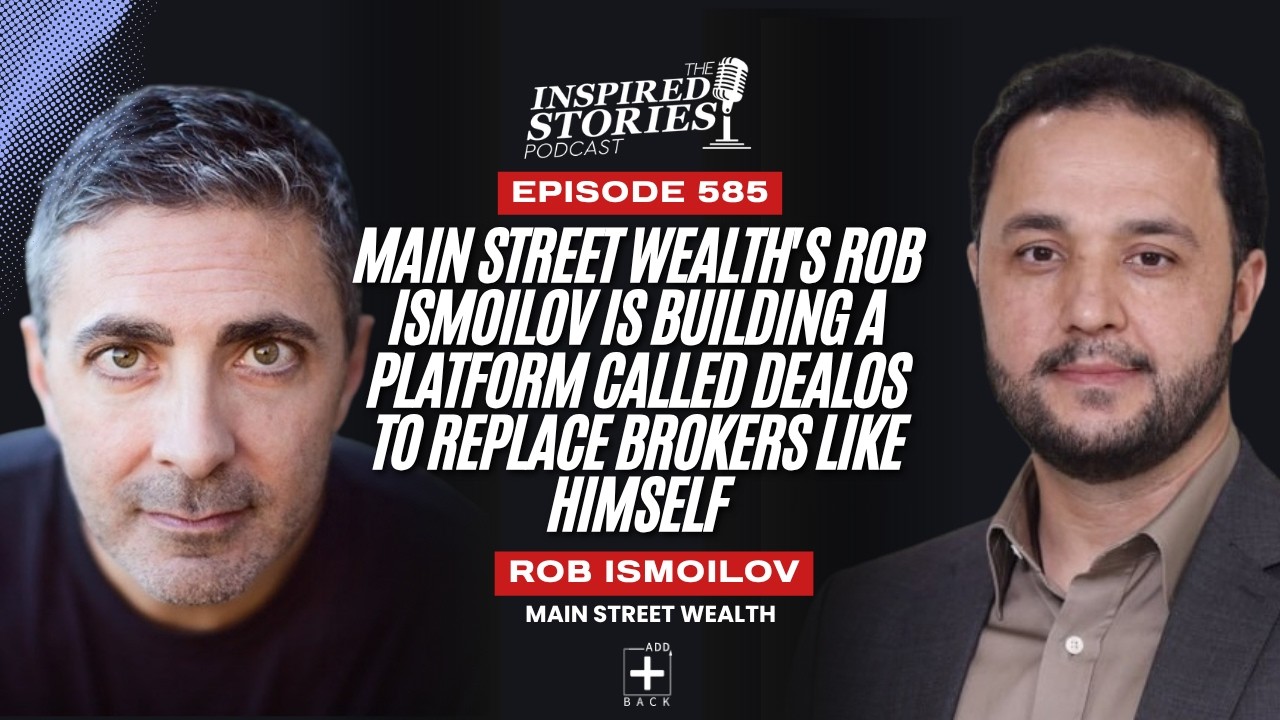
🎙️ From Trucking Company Owner to Business Broker: Rob Ismoilov's Journey Representing Sellers
In this episode, Rob Ismoilov shares a career that began near the Afghan border in Uzbekistan, moved through corporate law and insurance sales, and eventually led him to building and losing a 150-person trucking company before becoming a business broker representing sellers exclusively. Rob opens up about the twenty-million-dollar deal he had to talk off the ledge, why he only represents sellers, and how he's now building a platform designed to cut brokers, including himself, out of the process.
✨ Key Insights You'll Learn:
Grew up near the Afghan border in Uzbekistan before beginning his career in corporate law
Left law for insurance sales, qualifying for the Million Dollar Roundtable in his first year
Built his early client base almost entirely through in-person door knocking
Built and later unwound a 150-person trucking company during the post-COVID freight recession
Spent nearly six months personally managing the shutdown to protect employees and drivers
Pivoted into business brokerage, choosing to represent sellers exclusively rather than buyers
Focuses on preparing businesses to operate independently of their owners before a sale
Helped resolve a deal nearly derailed by a seller's twenty-million-dollar last-minute demand
Identifies recurring revenue and customer retention as key drivers of premium valuations
Is building a platform intended to cut brokers, including himself, out of the deal process
🌟 Rob's Key Influences:
Early Insurance Mentors: Modeled a patient, education-first sales approach that shaped his door-knocking strategy
His Trucking Company Team: Employees and drivers whose wellbeing guided how he handled the company's difficult shutdown
Buy-Side Deal Professionals: Their strategic sophistication convinced him sellers needed dedicated representation
Clients Who Trusted Him Through Difficult Deals: Shaped his belief that honesty is the deciding factor owners value most in an advisor
👉 Hear how a career that spans law, insurance, and trucking led Rob Ismoilov to build a business brokerage focused entirely on protecting sellers, and a platform meant to cut brokers out altogether.
Listen to the full episode here
Transcript
Anthony Codispoti (00:00)
Welcome to another edition of the Inspired Stories Podcast, where leaders share their experiences so we can learn from their successes and be inspired by how they've overcome adversity. As you listen today, let one idea shape what you do next. My name is Anthony Kotusbodi, and today's guest grew up in a village on Uzbekistan's border with Afghanistan, earned a law degree from Colombia, and helped advise on financing for a $3.8 billion.
natural gas pipeline connecting Central Asia to China. Then he left corporate law behind to sell insurance. Within his first year at New York Life, he qualified for the Million Dollar Roundtable, a top producer benchmark in the insurance industry. He then moved into transportation, growing energy trucking's fleet from 30 drivers to 240 and doubling revenue in a single year. His name is Rob Ismoilov, founder and CEO of Main Street Wealth.
Which helps owners of essential AI-resistant businesses sell for maximum value while preserving what they build. He also founded Fuel Connections, a petroleum and commodities trading firm, and the Uzbek American Trucking Associations, which supports Uzbek trucking professionals in the United States. But before we get into all that good stuff, today's episode is brought to you by my company, Adback Benefits Agency.
And you'll want to hear this because it's hurting almost every business owner you know. See, health insurance costs go up every single year, and businesses are furious about it. They're paying more, claims are getting denied, employees are opting out because they can't afford it, and it hurts turnover and morale. It's one of the most maddening problems in running a business, and everyone just seems to accept it. But you don't have to anymore.
Now there's a program from Bain Capital Insurance that gives your employees unlimited access to doctors, therapists, and prescriptions with no co-pays or deductibles to meet. But here's the part that really shocks most people. Unlike every other employee benefit out there, our program increases your net profits. We recently helped a client add that's add $900 per employee per year to their bottom line. Results vary, but gains like that change how a business is valued.
You can be the hero advisor that introduces this to your clients today. They'll be so happy they refer their friends to you at backbenefits.com. All right, back to our guest today, CEO of Main Street Wealth, Rob Samoilov. Thanks for making the time to share your story today.
Rob Ismoilov (02:37)
Thank you for the invite, Anthony. It's a pleasure.
Anthony Codispoti (02:39)
Rob, how'd I doin' pronouncing your last name?
Rob Ismoilov (02:42)
you're doing great. You're you're saying it like in a shorter way, some oil of. most of my American friends say it this this way. It's it's much easier. But yeah, you can also say Ismail of it's it's the same same core. It's like Arabic, Middle Eastern, Jewish, all all mixed up. It is.
Anthony Codispoti (03:02)
Okay. Quite the melting pot there, right in your name.
Rob Ismoilov (03:06)
Yeah.
Anthony Codispoti (03:06)
So you started your career at Asher Law, which was a a Tashkent law firm. Am I saying that right? What is Tashkent?
Rob Ismoilov (03:13)
Correct.
Yeah. Tashkent is a capital city in Uzbekistan. Correct. Yeah.
Anthony Codispoti (03:16)
Okay.
You were advising on project financing, merger deals, three point eight billion dollar deal to get a pipeline from Central Asia to China. Tell me about that. What what role were you playing there?
Rob Ismoilov (03:28)
Sure, yeah. It is a boutique law firm. it it still operates. I was one of the founders. it it was founded by a group of classmates from our first law school back in Tashkent. I graduated from there and with a few of my classmates we founded this firm. it's a small operation, all focused on international clients doing business in Uzbekistan and other Central Asian countries.
We also have offices in neighboring Tajikistan, in Kazakhstan, and in Mongolia. And so it happened that we focused we started focusing from the first day on the clients who invest in natural resources, on commodities businesses in in these countries. As you know, the region is very rich in all types of minerals, including oil and gas, gold, rare earth materials.
all of that sort of stuff. So our clients were mostly international companies who did both exploration, drilling, and development. And sold and products and products. And in most cases, the projects or the project financing work that we were involved in on the legal side was agreements called production sharing agreement or PSA.
This is what when an international investor with both capital and technology and resources and experience in certain fields, they come, they do the whole process from A to Z, including exploration, drilling, development, and final production stage, and then they share the profits, the proceeds with the government or with their host country who is allowing them to do this.
So we were mostly providing legal advice on these types of projects and the project you mentioned in terms of the pipelines from Central Asia to China was also part of this.
Anthony Codispoti (05:33)
So did any of the work that you were doing at that time influence or set you up for the work that you would later do at Main Street well?
Rob Ismoilov (05:41)
Of course, yeah. I would say that was very highly influential, mostly in terms of the corporate finance, how you assess the deals, how you allocate equity and ownership, including dividend distribution rights to the parties involved in any project. So that was very fundamental for me. I was also grateful for that experience in
Upgrading my skills in the contract law because a lot of stuff we did were contracts and agreements between different parties, sometimes multi parties, many, many parties involved in in in the same project in different roles. So that also like helped me to become very good in contract law, in drawing different types of contracts and agreements between involved parties. So all of this are is coming very handy at my current role at Main Street Wealth.
Anthony Codispoti (06:36)
So you've done a lot of really interesting things between the law firm days and what you're doing at Main Street Wealth. And I don't want to spend the bulk of our time there, but there is one thing I want to call out before we talk about Main
Rob Ismoilov (06:48)
Sure.
Anthony Codispoti (06:49)
Street, because you took a job selling insurance at New York New York Life. And
Rob Ismoilov (06:54)
Yeah.
Anthony Codispoti (06:55)
you ended up qualifying for the million dollar roundtable in your first year there, which is pretty impressive. What what was your secret? What were you doing that allowed you to be so successful so quickly?
Rob Ismoilov (07:05)
Yeah, I would say I was mostly working with b business owners. my clients to whom I was selling insurance products and some investment advice were business owners. I really dived very deep into their businesses, into their their employee benefits, into the key person protection, like all the good things that the company can offer.
To attract and retain good people, strong people, including health insurance. I I I I noticed you rem you mentioned in the beginning the health insurance benefits program, which could certainly boost the businesses and what they offer to their employees. So that was also what I did, but mostly on the life insurance and financial advice side. And the reason I was successful to
write up so many policies and bring so many clients to to the company I was working back then for was I was mostly focusing on business owners, small and medium business owners who are in most cases are not covered by financial planning, unfortunately.
They they and the main reason for that is like they're mostly busy with running their operations, they're very busy at the business, so they don't have any any any time in most cases thinking outside the box and taking care of their their financial planning, their own financial well well being. So that was like my core focus and I think I landed at the right target and
Also, I started my career back in the day in New York City. New York City offers a lot of stuff to business owners, to small business owners. So I was also in the right environment. So I think like it's a combination of factors. And also the company I was working for is very strong. It has been around more than 180 years. So it has a lot to offer to its clients.
Anthony Codispoti (09:05)
So right place, right time, right niche. But what about your sales process? Because even still, like, you know, this is a longer sales process than the products you're talking about. So to get get to that million dollar round table in your first year, you're
Rob Ismoilov (09:14)
It is, yeah. Yeah, yeah.
Anthony Codispoti (09:19)
you're doing something that goes beyond sort of right place, right time, right niche.
Rob Ismoilov (09:23)
Yeah, I would say a lot of door knocking. I did a lot of cold outreach in the beginning, at least like I I worked with this company for almost four years. But in the first year I did a lot of walking, like physically, door knocking and introducing myself to people, to their businesses, to their offices. And I also utilized a lot of social media. I would become friends, follow, engage with their posts.
social media, stories, etc., etc., and DM them, introducing myself, offering a discovery call, sit down, analyze their situation, asking a lot of questions, bunch of questions to understand it better and then come up with solution. I would never rush the process. I would usually dedicate the first meeting or call to fully understanding the client's position
priorities, expectations, any gaps. And then I would take a few days, I would work on the solution, I would get help or advice from my mentors or managers if I need to. and New York Life also offered a lot of resources in this regard, and then I would come up with a very comprehensive plan for that particular client, which like covers almost any everything, like it's it's very comprehensive.
And also, I think another thing is which helped me to sell a lot was not not becoming greedy. if I saw that the person wasn't right, wasn't ready right now for the solution I was offering, I would just put it on the back burner. I would always like check in from time to time. I would give the person enough time and capacity to
to to to take a look at it, including getting other advisors advice and look at the at the offer I'm bringing. I love like
Anthony Codispoti (11:24)
So it sounds like you
Rob Ismoilov (11:25)
working with other people's advisors. If needed, like I I always invite them to bring in their own advise advisors so we can work on it together.
Anthony Codispoti (11:33)
It sounds like you struck a balance between like you were grinding hard, you were knocking on doors, you're doing the social media, you're getting out there and giving yourself enough opportunities to meet folks. But then you're you're walking this line where you're taking the client's interest to heart. And so you're not
Rob Ismoilov (11:51)
Yeah.
Anthony Codispoti (11:51)
pushing, pushing, pushing the sale if they're not ready. So you got aggressive in the lead generation part, but you know, once you've got that relationship started, then
You're going as fast as sort of the client situation would dick.
Rob Ismoilov (12:05)
To the to the reasonable degree. If the client is not like, you know, cannot pull the trigger up to the certain point, I would I would walk away. I mean I I I I respect myself and I think any business owner must respect themselves enough to to walk away too from the opportunities which are not right. wh when there is no respect. To the to the certain degree. Yeah, I was patient. I've I'm always patient, but again at the same time when when the time comes
When we know both that they've had enough time to think about it. Again, I always like I mean, I'm not shy of asking like tough questions and saying like what it takes to to to to to get to yes, like what is holding you, like what is there to think about? and again, like I I'm never shy also if I know for sure that that's gonna help the client, I'm I'm never shy of saying so. even like to the degree that
This is the best decis decision, one of the best decisions you'll ever make. You will say me, thank you later. I'm confident in that. I mean, what is that to think? Like, let us pull the trigger. So, yeah, to the certain extent, I would give them enough room. And if they wanted to bring on their own advisors, I mean I'm always open to that too, including answering their questions. yeah. Yeah.
Anthony Codispoti (13:18)
But then when you get to that moment, you're not afraid to pull the trigger and say,
All right, let's do the deal or not.
Rob Ismoilov (13:23)
Yeah. Yeah, because at the end of the day I also expect the same thing from the person if they're engaging. I expect like when the time comes, when they've like thought enough, they will be able to to pull the trigger.
Anthony Codispoti (13:35)
Okay, so we're gonna skip over some stuff that you bunch of work that you
Rob Ismoilov (13:37)
Sure.
Anthony Codispoti (13:38)
did in the energy trucking fleet that we mentioned in the intro. How did the idea to start Main Street wealth come about?
Rob Ismoilov (13:45)
It was all natural, I would say Anthony. so I practiced law for about like eleven years. and then that was like right after after school, after law school, after my first law school. then I decided to take a break for for continuing my graduate graduate studies, master's degree, then I came to Colombia.
I decided to take time off from work and just focus on myself, on my education. that also meant I relocated to the United States from my home country, from Tashkent. And I studied for about two years for my master's degree. Then I had different choices. I I I I wanted to become part of a bigger law firm if I wanted, like most of my classmates after Columbia.
big corporate law, 3,000, 5,000, 6,000 lawyers in one firm, very like straightforward career. You you work you join as an associate, hustle very hard, you become like senior associate in some firms, then you become partner if you get to that level, or you get kicked out. I mean, because like they they churn people like really fast, those big firms.
you have always to produce, expected to produce, and as soon as you stop producing, like you're out. Because there's always new blood joining from fresh from law schools, ready to do the same amount of work for less salary, less pay. So it's like really harsh environment. So that was one choice. some of my classmates joined investment banks. that was another choice, which I I would love to do. But again, the environment was very competitive. I
ended up sending a lot of resumes and attending a lot of interviews I couldn't then I I was invited to join the New York Live career by a friend of mine who has worked there for almost like eight years. Quite successful, very successful financial advisor. So I I I took the first interview and I I liked it. I decided to join New York Live. This is how my career changed. And then at New York Live, again I wanted to do something different than most agents were doing
I wanted to mostly focus on business owners because of bigger capacity of what I could do for them, not just like selling to regular families and and to to to to regular folks, like nothing wrong with that. So I I wanted to focus on on the on the entrepreneurs. And that opened me up to from a different side to their books of business, to their bank statements, to their financials, to their tax returns. And that opened up
my perspective to doing business. I saw that like if you stop working for someone but you start working for yourself, own your own business, like the it's like a totally different level. So that brought me like to the end of my career after like almost like four years was New York life, quite successful. I was also invited to management role, was like really good salary and bonuses on top to train other people like me. But I decided to say no and I switched to business consulting.
I set up my own firm consulting business owners, mostly at the growth stage, helping them how to how to grow their companies, how to scale. And this like brought me gradually to to advising people who own businesses at selling their businesses, at exit opportunities. And this is
Anthony Codispoti (17:24)
It's
Rob Ismoilov (17:25)
this is when I started mainstream wealth.
Anthony Codispoti (17:27)
And so when you started consulting with businesses on how to grow their companies, tell us about the pool of knowledge and experience that you were drawing from to help these folks.
Rob Ismoilov (17:38)
Yeah, I would say mostly legal, legal experience, legal practice, that would be one side. And also I found myself like quite good, successful in helping people raise funds, both equity and cap that debt capital when they need it for for their businesses, for expansion goals, for new projects in their businesses. So I I helped a lot of people with that too.
Including a few startup companies, technology companies. and then I also ended up advising a few people selling their businesses to strategic buyers. And that brought me to the idea of setting up my own firm, advisory firm, brokerage firm, helping only sell side. So right now, this is what we do. We are a hundred percent sell side focused firm.
We work and represent only we work for and represent only sellers, the business owners. And there is a a deliberate, like purposeful intention here while we do so, because that's also like the core mission of our firm. we feel that from all our experience, the buy side is very powerful, very strategic, resourceful.
has hundreds of hundreds of combined experience under their belt. But the cell side, the poor guy, the poor entrepreneur, all all all who knows is just one business building it like almost whole life, after many struggles. That's the only thing they they hold in most cases. They are like very, very underrepresented. they lack resources, they lack experience, they lack knowledge. So
We decided on purpose to represent the cell side, was the only mission to empower them, to bring more value, highest top dollar value for them if they start thinking about egg exit opportunities. That is that is on purpose because we feel that like they're not being like they're not playing the equal game.
Anthony Codispoti (19:48)
Yeah, like you said, the buyers, in most cases, these are very sophisticated buyers. They've done lots of transactions.
Rob Ismoilov (19:53)
Yeah, exactly.
Anthony Codispoti (19:54)
They've got the MA experience behind them. The folks that you're representing, they're coming into this probably for the first and only time in their life. They got
Rob Ismoilov (20:01)
Yeah, yeah.
Anthony Codispoti (20:03)
really good at running their business, but now they're entering a whole new sandbox where they just don't know
Rob Ismoilov (20:08)
Yeah.
Anthony Codispoti (20:09)
what the rules of the game are. They don't know the questions to ask. They don't know the clauses in the contract that should be there. And so this is where
you guys step in.
Rob Ismoilov (20:16)
Yeah, that's
one thing. That's one thing. Getting to the contract, getting to the time like when they say goodbye to their businesses, right? But the other the whole different thing is like being ready for that process when the day comes, making sure your business is exit ready, exit proof, making sure you have all the right systems and processes and people in the place, making sure your business is at least dependent on you, like if you like step away today or walk away.
It can still operate and function. So an another thing is like being being ready with all of that. Because ultimately these are all the things which will guarantee them the high highest value, top value. If the business is not ready, you you you cannot sell it for for for high value because like it it's a business which is very much dependent on the owner. And no one likes to buy such businesses because you will end up buying a job instead of a business if you buy such businesses.
So yeah, the ho the the the different level of the game is also preparing them well in advance to become exit proof, exit ready, to have all the right systems, including good looking financials, KPIs, management team in place. So the the the the value of the business is the highest when is time.
Anthony Codispoti (21:35)
So
it sounds like you are not just the person who takes the company to market and helps them sell it, negotiate the deal. You're also the person that gets involved earlier than that and you're helping to prep the build the business for exit.
Rob Ismoilov (21:49)
Yeah, if we see a need for that, we are very open for the with with the owners. again, like same approach, we never rush them to sell because again, like it's just purely our mission to to maximize value for themselves, but also for us too. if you if you sell the deal like at the highest value, that means our commission is also highest. But again, if the business is not ready, ultimately we cannot sell it that quick. We will struggle.
It's not ready or it will go like for very cheap. That's why when we do like the discovery call with the owners, we ask a lot of questions, we also try to dig deeper, like trying to understand if they have all the right systems installed in place, how much the business is dependent on the owner. So we really take our time and then if we identify that the business is not ready right now, we are very op open, honest about it. We
tell them right away. and instead of evaluation report that we usually produce after discovery calls for the owner before taking it to the market, we'll produce an exit readiness like a checklist or roadmap. Something like that, a very comprehensive list of recommendations that we make for them to upgrade their business. And if they need help with implementation, we're ready to help. If not, like in most cases, if they're like diligent enough, they can do it without us too.
Anthony Codispoti (23:17)
So what are the top three most common things that go into that exit readiness report? I obviously it's dependent upon each individual client and their situation, but I'm sure
Rob Ismoilov (23:27)
Yeah.
Anthony Codispoti (23:27)
that there are some really common things that you see over and over again.
Rob Ismoilov (23:30)
Yeah. I would say the number one thing would be business
should be able to operate without the owner. The owner's role in the business should be minimum. It should be mostly geared towards financial oversight, people development, supervision, general general oversight of supervision. That's it. But if the owner is like, let's say like in in the in the example of home services business, like roofing company or landscaping company, if the owner is the one who is going with the crew to the field,
checking everything and taking the tools into his hands and like being part of the crew. And if the owner is like spending all day like seven hours, eight hours supervising the crew, like that's not a good business. I mean it's it's very much dependent on the owner. But if the owner has managers of crew managers, if the owner has sales department, separate sales department, sales manager or business development manager, if the owner has a CPA or accounting
person who is like fully responsible for financial oversight. And the owner's only job is setting metrics, attending weekly meetings, double checking everything on the highest level, if the metrics are being followed, and doing a little bit like a financial control, financial oversight, and working like mostly on the highest accounts in terms of business development, if it needs like owner's pitch or just a phone call or meeting or visit.
To the customer to gain this business, yeah, then that that business is like very good. It's it's autonomous, it has systems management people in place, and it can function without the owner. Yeah.
Anthony Codispoti (25:14)
Okay, so that's number one, less owner dependence. Number two.
Rob Ismoilov (25:18)
Years in business. that means also the business is more established. so we have seen in our practice the businesses which are really successful in terms of exit is like at least like four years old.
That also means financial financials are they're like historical. You can track there is track record of financials, you can track the IBIDA, the revenue, the net profit, all of this. Yeah, yeah.
Anthony Codispoti (25:51)
Yeah, the buyer wants to see some stability over a period of time. Sure.
Rob Ismoilov (25:55)
And number three is the highest again, the highest contributor to to the value would be I would say
existing recurring revenues, repeat revenues, repeat customers, versus one-time project revenue, one time project jobs. Again, like you can you can sell one time businesses which are based on one time revenue as well but the value would be like totally different the multiple of the valuation would be totally different so the the third biggest factor I would say recurring revenue or repeat customers
Anthony Codispoti (26:30)
'Cause again, there it there's that stability. When you've got that recurring revenue, a new owner knows they can
Rob Ismoilov (26:33)
Yeah, yeah, predictability.
Anthony Codispoti (26:35)
step in and I'm probably gonna have a very similar foundation in revenues. If it's
Rob Ismoilov (26:40)
Yeah.
Anthony Codispoti (26:41)
I've got to go out and get a new roofing job, you know, every time to keep that revenue stable, okay, that's a little more risky. 'Cause
Rob Ismoilov (26:48)
Yeah.
Anthony Codispoti (26:48)
what if I what if I can't close the deals the same way that the previous owner did, right? That's
Rob Ismoilov (26:53)
Yeah,
yeah. And I would also mention another very important factor, Anthony, because like w we come w we come across this like all the time. when you preparing the business for selling, right? And when you're working with the owner, there is always like two things, two different numbers. There is a fantasy number in the owner's head that they set themselves, like this is like how much my my business is worse.
Or this is how much I want at exit. I mean, which is fine totally. I mean, they deserve it. They they built this thing like whole life and probably that would be one of the biggest decisions in their lives. I mean, equal to getting married, equal to a career choice and stuff like that. So very, very important decision. But again, then there is like one fantasy number in the owner's mind, and then there is a real number that a realistic buyer, strategic buyer who does it like for a living.
They are ready to pay. And again, like it doesn't mean like anything wrong with the business, but the strategic buyer who does it for a living, they know how to value businesses. They know exactly if the business would be capable of paying back the debt that the buyer is spending on to to buy the business. it's it's called like debt service ratio. So how much free cash flow will be a business generating in order to pay the debt back?
If the buyer is using other people's money to buy this business in the first place, which is in most cases, right? no one like keeps the cash, even like biggest buyers on the side to buy businesses. They always like use a lot of debt capital, hoping that the business will have enough cash flow to to service it there. So that there are two numbers. one fantasy number in the owner's head, another one is like that the real buyer is ready to pay.
Anthony Codispoti (28:46)
Have you ever seen the buyer's fantasy number be lower than yeah? It's always the other way around. Yeah.
Rob Ismoilov (28:51)
No. It's always higher. Yeah,
it's always higher. That's why another very important part of job that we do is like educating in the process. We do a lot of education from day one, from the first call, from the first discovery sit down. We always like educate a lot. We tell them about how the buyers work, what is debt service and all of that.
Anthony Codispoti (29:15)
So here's the question that comes up a lot as I talk to business owners. and I've been in this situation myself when I've exited previous businesses too. It's like, okay, you want it less owner dependent. But I spend all day, every day putting out fires and like taking this call and taking that call and making this client happy. Like I don't have the time or the headspace to think about ways to start extracting myself.
What
Rob Ismoilov (29:40)
Mm-hmm.
Anthony Codispoti (29:40)
advice can you offer for listeners who are in that exact same boat?
Like I would love to do that. I don't even know where to get started. What's low hanging
Rob Ismoilov (29:48)
Yeah.
Anthony Codispoti (29:49)
fruit something simple they can do today to get that ball rolling?
Rob Ismoilov (29:52)
Yeah. We usually start if we were to determine that the business is not ready yet, right? And if we were to like provide them some comprehensive plan in terms of making business more exit, exit ready, exit proof. among those recommendations, among the first one of them would be always, do you have any KPI systems in place, any metrics?
How do you how do you measure your business? How do you measure the efficiency of each each one of your departments, the sales department, accounting department, or whatever, like customer service? So we always start with this because these are very key milestones that helps the owner at the end of the day to free up some time. If all these KPIs are being reached like head
The owner like always can free up some time. That also means if you build the KPIs right, there would be the middle management team established in in your company. Because every department will have its own KPIs, and there must be someone responsible in that department who who who watches everything, who makes sure like everyone in this department is heading their KPIs and metrics. And that person is usually the department lead.
The department head. And that person is your one of your middle management teams, and he reports directly to you. So if you if you build that KPI system, metric system, very core ideas and milestones for each individual department, making sure they're they're very specific, achievable, measurable. So these are like key identities of KPIs, then you'll you you you also got your middle management team, people who are responsible for.
watching all these goals are being reached and who report back to you. That allows it to free up some time. We always start there. And in most cases we also always make sure that there is a a an operations officer, chief operations officer who is responsible for ops other than the CEO or president of the company, the owner of the company. So that person is usually the fireman that you told. He puts up puts out the fires. He
He he deals with everything escalating, everything emergent which is emergency. Not not taking it to the owner in each case. And then the owner has more time to do people development, to focus on new business development, on the core accounts if needed, his level of participation. So that that frees up a lot of time. So we we usually try to teach these sites.
Anthony Codispoti (32:36)
So give us the top three KPIs somebody should be doing in their business. They're like, Okay, I love this idea. Where do I get started? What are the first three ones I should put in place? What which I'll
Rob Ismoilov (32:47)
Okay. For example, again, if you're talking about landscaping, right? Let's say we have a landscaping and irrigation company based out of Florida, in Orlando. So the the key KPIs for for that team would be if the accounts they have are they project based or recurring? If it's project based, like there are also always like upside and downside. If it's project based, it's very good pay one time.
when the project is finished, when the project is completed, but then you again have to go out and find a new client. Yes, your your same client might order you like another project in a in a while, after after a few months, you you can get repeat business, but it's not recurring, it's not every month, every, every, every every week. So your task could be seeing like how many of your current clients are ready.
to start hiring your services on a recurring basis. Is there like fertilization need, is there like irrigation need? Is there like
Anthony Codispoti (33:52)
So is this the
KPI we're talking about? Is it some percentage of revenue that's recurring? Is that what you're tracking? Okay. So that's the first one.
Rob Ismoilov (33:56)
Yeah, yeah. Exactly. Yeah. The the pr the
recurring revenue percentage. is it like pest control near? Because a landscaping company can also offer pest pest control services, which are like mostly subscription basis. It's either every month for most clients and for sometimes smaller residential clients, it's bi bi monthly, but still like recurring, repeating. So this could be one one revenue, one one KPI. Another KPI could be your your cost.
per service and your rate per service that the customer is paying the the margin so how much you you spent let's say for servicing one household if it's a residential client or servicing one commercial property how much you spent out of your pocket as a company, as a business, including everything, including salaries, what else, the materials, chemicals, equipment, machinery.
And then how much this account is paying you. The difference between the rate per service and cost cost of the service, cost per service. So that would be another like big KPI in terms of the profitability.
Anthony Codispoti (35:10)
So for let's use the landscaping company since you pulled that out as an example, what would be some good target metrics for them to have for these KPIs? 'Cause they're gonna be more industry specific.
Rob Ismoilov (35:22)
Yeah, if it's the landscaping, I would say in terms of the margins, the healthy margin that we have said in most of the companies we sold which were successful in terms of highest value in the deal, the the margins of the difference between the rates of the service, how much they get paid by the customer, and the cost of the service, the difference was like almost like forty, forty-five percent.
Anthony Codispoti (35:48)
Okay. And then the percentage of
Rob Ismoilov (35:49)
Yeah, these are like really high value companies.
Anthony Codispoti (35:52)
re recurring revenue, what would you like to see that be?
Rob Ismoilov (35:56)
I would always love to see it higher than the project based revenue. It's very rare for the companies to be all recurring. There is always like project-based job always in in most home services. But we have seen the highest values comp value companies will do at least like sixty-five, seventy percent of recurring clients.
Anthony Codispoti (36:15)
Okay.
Rob Ismoilov (36:15)
And the rest is project based.
Anthony Codispoti (36:18)
And then how about a third KPI?
Rob Ismoilov (36:20)
The third KPI would be, I would say, the retention of the churn of the accounts. So in most cases, once you sign up the client in the ideal world, you always like do more upsell, you add more services, you you you you keep increasing the volume with that client. But
Anthony Codispoti (36:40)
And where would you like to see that be?
Rob Ismoilov (36:43)
I would I would love to see like in the in the most in the in the highest value deals we have done.
The lifetime value of the customer, one account, LTV, was like the the healthiest was like three to four years. Three to four years, one client will stand will stay with your company and will will serve will get service only by your company before they think of
Anthony Codispoti (37:05)
Okay.
Rob Ismoilov (37:06)
changing the companies. So three to four years is very healthy.
Anthony Codispoti (37:10)
Got it. And the companies we've been talking about so far, these sounds like their home services. You mentioned roofing, we mentioned landscaping,
Rob Ismoilov (37:16)
Yeah.
Anthony Codispoti (37:17)
pest control. Is that the niche that you specialize in?
Rob Ismoilov (37:21)
Yeah, we we have sold a lot of transportation companies in the beginning. We're still selling a few of them now. We're selling a freight brokerage, we're selling a freight forwarder, we're selling two really large trucking companies with eight hundred and twelve hundred trucks each one of them. We're selling fuel diesel distribution company two transportation companies, very high revenue company, seven hundred million dollars annual revenue.
these are some of the company other other businesses that we sell in. But last three years, Anthony, we have taken like a deliberate approach to focus mostly on home services, trade-based trade skills-based businesses. these are landscaping companies, roofing, home HVAC, plumbing, pest control, pool c pool builders and pool cleaning companies, electricians' businesses.
so we have we have built a lot of practice around the last three years. And the only reason is we see a lot of demand for such businesses among buyers, institutional buyers. And also another reason we see is the market is very fragmented. There are a lot of operators, mom and pop shops, small businesses which operate in that space, which means there is a big need of consolidation.
Consolidating several businesses, making one bigger business by the by the strategic buyers. So because of all of these needs, we decided to focus mostly on such businesses last three years, which we're doing. Right now we're selling a roofing business out of Chicago, we're selling a plumber, plumbing company out of Chicago, we're selling electricians' business servicing Long Island, New York, we're selling commercial HVAC companies servicing New Jersey and New York.
just listed a pest control business out of Saint Port Lucie and Boca Raton, Florida. So these are the businesses we're focusing a lot lately. And there is another thing that moved us towards this direction. All these businesses are
AI resistant. they're recession proof. But also like most out of most of all there they they would be AI resistant. I mean w I cannot imagine any any AI or technology or and then robots, robotics replacing these businesses, these trades any time sooner. So there is always demand for such services and the market is very fragmented, a lot of small operators and we see a a lot of need
to represent those sellers, the business owners, to do the right choice and to to get the highest value.
Anthony Codispoti (40:10)
What's the range of multiples that you're seeing in these industries right now?
Rob Ismoilov (40:14)
Multiples depends on several key factors. but the range would be any anywhere from four to seven, eight for privately owned companies. Yeah.
Anthony Codispoti (40:26)
E beta times e beta.
Rob Ismoilov (40:30)
And again the multiple depends on several factors. there is of course Ibn A as one of the determinants. other than Ibina, the revenue size is also another big factor.
The smaller the revenue, the lower would be the multiple because it's a small business. The higher the revenue, the multiple will go higher as well. the presence of recurring revenue is another big factor in terms of multiple. businesses with recurring revenues, repeat clients, always go for higher multiple versus project base. We can sell project base base too, like we we sold many, but recurring revenue multiples are always higher. And
Another thing is which affects a lot, a lot of the times the value, the evaluation multiple would be the the team in place. Is their management team, is their separate sales team, how sophisticated are they? Do they use like special CRMs? do they keep track of lifetime value of their customers, the churn of the customer pipeline, all of that.
So the the book of business value. That means a lot in terms of raising raising the valuation multiple two. So the sophisticated buyers they always look at the book of business value of the of the client, of the buyer, of the seller.
Anthony Codispoti (41:58)
So anybody who's been through this process, Rob, and I've been through it as somebody selling a business, you've been through it a lot more as a broker. It's pretty common that most deals do not go smoothly, right? They on on the way there, they they die a thousand deaths before they actually get to the finish line,
Rob Ismoilov (42:12)
Always, yeah. Yeah.
Anthony Codispoti (42:16)
if they get to the finish line. So
Rob Ismoilov (42:19)
Yeah.
Anthony Codispoti (42:19)
take us through, think about one particular example, client that you took through, something
particularly noteworthy, crazy, out of the ordinary that happened, how you navigated it and how you ultimately got them to the finish line.
Rob Ismoilov (42:36)
Yeah, it's it's very it's very funny you asking this question. So here is what a good advisor would do. Again, we talk about being the representative only to the one side, being one size advocate, one size advisor, fiduciary duty, and all of that. But in practice, in practice, if you know that the the the offer is being made is a really good offer.
That the client, the the seller is being foolish. You can see it, you can tell it based on all your experience. They're being unrealistic. I train my my people to be like very, very good intermediary and try to bring both sides.
as close as possible to to the solution, to the common denominator, to the common solution, which is very fair and acceptable to both sides. I usually try to do this a lot in deals. I communicate with both parties. I communicate openly, I never hide anything. For example, just one example. There was a yeah, yeah,
Anthony Codispoti (43:55)
Yeah, give us an example. This is what people want to hear, something specific.
Rob Ismoilov (43:59)
there was a deal when the seller
Has invested over the years into his business around $12 million, like real cash from his other business. He has other businesses too. So he he financed his new venture when he first started, the venture that we selling we sold at that time. He financed it from his different business.
And over the years he ended up like fine funding like infusing almost like up to twenty million dollars from his other business to that business that we we were selling at the time. So we reached like a really good understanding with the buy side on the deal structure in general. The deal structure was 62% cash at closing. then
One part almost ten million dollars in escrow account released in twelve months, and another like thirty-three million dollars in earnout released in twenty four months, tied up to a certain milestones that the buyer side and the seller side will determine together and should be mutually acceptable in the final definitive agreements, which they agreed on. So they're good on all these three parts of the deal structure.
The only thing is now now like when when what when like like they're almost like ready to close. The seller is bringing up this twenty million dollars idea and saying we need to be paid this on top too, because this is the money we spent like on the business, it is like working capital in the business, etc, etc. And then they started arguing. They started arguing, we were on a Zoom call. Yeah, yeah,
Anthony Codispoti (45:47)
I mean you can't just come to the finish line and ask for an extra twenty million dollars.
Rob Ismoilov (45:51)
yeah.
And the the the seller mentioned this in the beginning, like to to be fair, but I was telling them, okay, you know what, again, it depends on how we determine it. And let's let's get let's discuss it like when we get there, when we start like talking the final numbers after the confirmative due diligence. And he he also mentioned it to the buyer. The buyer heard this in the beginning. But again, when when the time came and we started discussing the final terms.
They were like really adamant of these twenty million dollars, which is a huge amount of money, of course. And they they have spent this money from other business, it is real. They can show all the proofs and records, but again, it's it's like a lot of money on top, especially for the for the buyer. And it's the the the deal is like huge numbers. it was a huge huge business. So then I am seeing that they're going nowhere in the Zoom call.
Then I decided to text the buyer. I texted the buyer because I always like to keep in touch with everyone. again, like that buyer is in the first place. I brought I brought him from my different deal. I I sold him a trucking company before. So I texted the buyer and I said I I advised him like just ask one simple question. If if this cash that they say can it be taken?
away from the business without choking the business. If they take it away from the business, if they pull it out, would the business die? or would the business keep going as it's going? Just ask them this simple question. He said, brilliant idea. that's that's right. It could be operating capital, which is necessary for the business. You cannot take it out, like business will die. Or it could be like cash asset. Okay, let me ask this. Then he asked this like as we as we were on the Zoom call he said like okay let me ask a simple question
Can you take it away without hurting the business? Like is it like cash asset or is it operating operating capital? We need to determine. And then the owners started thinking, they said no, I mean they said like it's it's it's a working capital. If you take it out, you have to put that much money for the business to continue. And he said, like the sell the buyer is saying, bingo, okay, you see, it's not cash asset. Like if it was a cash asset, like easily available, you can pull it out anyway.
without hurting the business, I understand. I'm ready to pay it for on top. But if it's like operating capital that is necessary for the for the bloodstream of the business, it c it should keep going, then you cannot. And you you're getting paid for it already. That's that's the premium you're getting paid for, like that much on top, because you you built this business. So that was like one situation which was crazy, which all almost like made the deal die.
Anthony Codispoti (48:35)
And did it end up happening? Because I've got a follow-up question here. Okay, the deal so the deal ends up going through.
Rob Ismoilov (48:38)
Yeah, yeah, it happened, yeah.
Anthony Codispoti (48:41)
because the I think the first time I went to sell a business, I ran into this. And there there's some cash sitting in the the bank accounts, and I'm thinking that I'm walking away with that as is part of the deal, right? As the as the seller. And they're like, no, we expect you to keep a certain amount of cash in the bank for operating cap working capital.
Rob Ismoilov (48:59)
Working capital. Yep.
Anthony Codispoti (49:02)
And you
Rob Ismoilov (49:02)
Yep.
Anthony Codispoti (49:02)
know, I was young, I was in my twenties, what did I what did I know? It was my first time doing that. But for the listeners who maybe haven't gone through
Rob Ismoilov (49:09)
Yeah.
Anthony Codispoti (49:09)
that themselves, walk us through a little bit. How do you determine like what's a cash asset that can be pulled out versus what needs to be left in as working capital?
Rob Ismoilov (49:20)
Sure. Yeah. Let me explain in a very like simple example. Let's say someone owns and selling a transportation company, trucking company, which is like very popular business. A lot of people know and see trucks on the on the roads every day. So trucking business is very capital intensive. It requires a lot of capital all the time. You need to make down payments, you need to make security payments, security deposits, you need to
Pay off some accounts in advance, like insurance, for several months ahead, or sometimes for a year ahead. So that involves a lot of capital. It's very capital-intensive business. So someone wants to buy a trucking company. So they always determine how much money the trucking company and how often does it receive on a weekly basis. Because the financial cycle in trucking is very short. It's on a weekly basis. They invoice their customers.
through the factory companies on a weekly basis several times a a week and they get paid the same day it's very short cycles and this way there is a lot of cash coming in but also a lot of cash going out because expenses are also very high. The margin in this business is like the healthy margin is like seven eight percent. That's that's top. So a lot of money comes in millions literally even for smaller companies but also millions go out because a lot of expenses. So
For something like this, there is always a very clean distinction between operating capital and for how much it should be enough. That's also another part of the question. Do we live to operating capital for a year? Do we live on operating capital which is enough for just one month or for just a few weeks? It also depends on the nature of the business and on which space the business is, and also how frequently the business is invoicing its customers to get paid. If the frequency is high, the
period for how much for how long the working capital should be enough should be should should last will be shorter. Why? Because the money is coming often. Frequency is high. For something like trucking, the frequency in most deals that I we've done is they usually like leave operating capital enough to last for one month. This is like the the most like handsome offer.
Sometimes it's two weeks if the seller can negotiate like very hard. But that's enough. That's more than enough because they invoice their customers almost every day and they get paid almost every day. But then again, this is working capital. Then there is cash asset too. There are cash assets in the business available for pulling out without hurting the business. So, in the example of the trucking company, that would be if they paid in advance for.
Let's say cargo insurance or auto liability insurance or physical damage insurance for several months ahead or for a whole year. Sometimes you need to put like a lot of down payment to the insurance company. So that's cash asset. You already paid up and you're not using it. The new owner will use it. So they have to reimburse this. Or you have put security deposits to get a certain number of trucks and trailers from providers.
The security deposit is company's money. When you return the truck, it gets returned to you. So again, this is cash asset. So all these things are determined on this basis and if they can be pulled away or if you prepaid something that the new owner will use, they have to reimburse you.
Anthony Codispoti (53:05)
Super helpful. Okay, so let's close the open loop. How did you get that deal across the finish line? Did the sellers suddenly realize, okay, this is operating capital. I need to back off of it. That's what happened.
Rob Ismoilov (53:13)
Yeah. Yeah. Yeah.
And they also they also got the idea that they are already being paid really good premium for that twenty million dollars invested plus time and plus efforts they've built this business for. That's like that's a whole premium that they they're getting paid at the purchase price.
Anthony Codispoti (53:31)
Rob, how are you using AI and what you do now?
Rob Ismoilov (53:35)
I use it a lot in our website. mostly I have a CTO, Chief Technical Officer, who is my partner. We're utilizing all technologies which we can for now technically to match our buyers and sellers through our website. We
Anthony Codispoti (53:52)
What does that mean?
So like a a lead comes in through your website and and
Rob Ismoilov (53:56)
Yeah.
Anthony Codispoti (53:57)
and what do you do then?
Rob Ismoilov (53:58)
Yeah. First of all, our website has a lot of resources for sell side because we are like first of all the the seller side representative, right? Seller side advisor. We have a lot of resources on our website which allows the business owners to run valuations which are pretty ac accurate based on our deal experience, and gives out g gives out like pretty accurate numbers if they feed it right with with the right information.
And it also has a lot of blog posts which are regularly updated about the latest industry trends. It has the exit proof readiness roadmap that the owners can use without our help on their own. Again, they can feed the all the like basic information about the company, how they're doing, what system they have, and the the website will generate a specific recommendation for them, helping them to become more exit proof, exit ready.
So we we try to use a lot of such data and always like update it, make it like
Anthony Codispoti (55:00)
And so AI is helping
you to collate this data and to produce these articles. Okay.
Rob Ismoilov (55:04)
Yeah, yeah.
And also AI is helping us to provide accurate assumptions in evaluation reports to the owners if they wanna use the website resources. But another thing we're working right now at the lead for the last almost like six, seven months is we are launching our own platform, only home services, trade skills based services, businesses focused.
And that platform will match the sellers, the owners of the businesses who are ready for exit directly with buyers. We wanna cut all brokers, all intermediaries. we wanna replace them with a platform which is much faster, more much much smarter, and has a lot of matching capacity for both sides. So we wanna we want the whole deal process happen on one platform from the time
Anthony Codispoti (56:02)
What does that mean? Like
you your you and your traditional role will go away?
Rob Ismoilov (56:08)
Yeah, I want it go away. Why? Because I see this as a big bottleneck. a lot of times the traditional brokerage is holding everything much, much behind. it it's making the process very, very long. In most cases the brokers just take the listing, they create a listing, it was a video or presentation, they throw it out on a website, most like bizbycell.com.
If they have their own company website, they post it there. And then that's it. They just sit there and they they they hope someone will come and buy. And this way they end up attracting a lot of time wasters, tie kickers, people with intention to buy the business but with no money, with no capacity to close deals, or at least to raise funds, and they end up wasting everyone's time. That's why the deals drag a lot. most of most of the times they take eight months, twelve months, fifteen months.
So it's a lot of stress and pressure for the business owner because it's a lot of distraction for them. Yeah. Yeah.
Anthony Codispoti (57:11)
So what does the vision look like going forward? I'm a business owner, I want to
sell my business, I come to your platform and take me through the steps.
Rob Ismoilov (57:17)
Yeah. You open it,
you you set up your own dashboard, you feed all the data about your business, you know it's hundred percent confidential. We put the confidentiality on the first place. we we we never list anything online, especially on the websites like bizmy sell dot com. especially with mentioning the business's name. So the seller will have their own dashboard, they feed all the data about their business.
The dashboard the the system will generate a simp confidential deal memorandum with deal offer structure, giving the owner the estimate, how much the business is worth, the evaluation, and also giving the recommendation on what the highest value deal structure could look like for him, for the owner. So the the owner if if if the owner is fine with it, he approves it. Or if he needs
in the back end our help, we can get in touch with the owner and guide him to reach like more individual, more customized result. We can do that in the back end. But in most cases we're like almost hundred percent sure that the system will be very accurate because of a lot of data feeding and the experience the data from the previous deals also uploaded into the system's brain. So then after the owner approves it, he agrees to make it available to
Matching buyers in the system. And we will also have the similar part of the system with the buyers with their own dashboards. They feed all the data, they have search criteria, what is the minimum IBIDA, minimum revenue they're looking for, what are the other specifics of the deal or target they're looking for? How they're gonna finance the deal, how they're gonna fund the deal, equity, debt capital, committed fund, etc. etc.
Anthony Codispoti (59:10)
So you're betting these potential buyers.
Rob Ismoilov (59:12)
The the the buyer's profile, yeah.
And then the system will match the sellers and the buyers and it will be all off market. We don't want the deals like circulating on hundreds of different websites with no result and with a lot of time wasted for both sides because the same pain is experienced by the sellers too. They are very eager, they're wasting a ton of time looking for the right deals. And in most cases they they don't find the right deals, but they have the capital to buy.
So we wanna do the filtering for both sides and do the do the right matching for both sides to consummate the deal much faster. And also we would like to shorten the deal process. Our ideal timeline is 75 to 90 days for smaller deals.
Anthony Codispoti (1:00:05)
It's fast.
Rob Ismoilov (1:00:05)
For yeah, for bigger deals with much larger revenue, which usually requires
quality of earnings analysis and stuff like that, sometimes reviewed financials or audited financials. It can be like up to six months, but this is also real, really fast.
Anthony Codispoti (1:00:20)
Yeah.
Rob Ismoilov (1:00:21)
And we all we we want to attract all the resources to help the deal making, like quality of earnings providers, CPAs, what else, forensics in in in financials, all of that.
Anthony Codispoti (1:00:34)
How how do they factor into the platform then? Or do they just come in after you've matched the buyer and the seller together?
Rob Ismoilov (1:00:41)
We we we do it in the process. if the system identifies that the data that is being fed by the owner is not enough or it's it's not representing the business in the best picture, then we we can pull in some specialists as a a separate service and offer it proposal to the owners if they wanna like bring everything into order and clean up their financials.
Anthony Codispoti (1:01:09)
So when do we expect this new platform to be launched?
Rob Ismoilov (1:01:13)
So it has seven features. three features are already live. we're testing it with some pilot members of the platform. We are expecting to launch it from early next year, I would say February. Yeah, yeah.
Anthony Codispoti (1:01:26)
February of twenty twenty seven.
And as you think about, because there's two giant inputs here, right? You need the sellers and you need the buyers. Which
Rob Ismoilov (1:01:37)
Yeah.
Anthony Codispoti (1:01:37)
one is more critical for you to get the momentum?
Rob Ismoilov (1:01:41)
Sellers, we don't have any problem with buyers. We have developed like very close relationship with buyers over the years. We have right now an off-market email list. It works like a newsletter. We have an email list, off-market email list with 400 plus qualified buyers. These are all institutional strategic buyers with committed capital. They are the first to receive our emails with new deals, among the first before it goes to the market.
We don't have any problems with spyers at capital. We can sell up to you know fifty, sixty, eighty deals a year. Right now we're selling like twelve to fourteen a year. But we can be we can be yeah, yeah, yeah.
Anthony Codispoti (1:02:22)
Because of this bottleneck that you're hoping to solve with the new platform. It's really
interesting. And so how do you go after more sellers? Once you've got the platform and the tech working, how do you get more deals into the form?
Rob Ismoilov (1:02:36)
I would say mostly educating because what we have noticed is there is a lot of skepticism among sellers, among business owners, on several things. First of all, they're very, very afraid of the idea that someone else will come and own their business, especially private equity. Private equity has really bad rap among them. They are like very afraid of this word. The moment they hear like, hey, I have a private equity buyer, they try to like stay away. And without
Being able to explain to themselves like the reason. What's the reason for you? I've asked this question many times. What's the reason? Like, can you explain? No idea. Just just a wrap, like heard somewhere from someone that said it's it's bad. But again, I don't see them having any other choice. Yeah, there are several independent operators trying to do the same thing that the private equity buyers are doing. They're buying smaller businesses, they're consolidating, they are intending to keep it.
For as long as possible, private, privately run, maybe family business. But again, at the end of the day, almost like all of America is owned by private equity, except a few public companies. The best businesses are owned by private equity. And there are different types of private equity buyers and family fund buyers. There are the ones who are not strategic, they have money, they're financial buyers, but they don't have any past experience or past successful exit or
portfolio companies in the similar space. They want to do it for the first time. And we don't know if they would be good players. But there are also guys, buyers with a lot of experience, with really greatest stories of exits and with existing portfolio companies in the same space. I think those strategic ones are the best fit for any owner who cares about legacy, about what they have built. And these are the types of the buyers we engage with, strategic buyers.
Anthony Codispoti (1:04:31)
So I'll tell you one of the horror stories that I hear over and over again about certain PE firms is that, you know, deals now almost always they're structured with some kind of an earnout, something held in escrow
Rob Ismoilov (1:04:42)
Yeah.
Anthony Codispoti (1:04:42)
for, you know, some later point. And I I hear of all these creative ways that PE firms are weasling out of making those future payments. How often have you
Rob Ismoilov (1:04:53)
Yeah.
Anthony Codispoti (1:04:54)
come across that kind of thing?
Rob Ismoilov (1:04:56)
Always, always. We always try to explain the difference between the seller note and earnout. If the owner is very confident of the business they selling, if they know that with the right ownership, with a continued legacy, it is gonna perform and perform even better because the strategic buyer usually puts in more working capital.
brings more people, increases sales team, branding, marketing, budget, all of that, then we always like recommend that recommend them to go with earnout because earnout gives them more upside. Especially if the owner is staying with smaller equity rolled over into the business, they have some control, some decision making power, we always recommend earnout because earnout gives more upside to them. If they want some guarantees
stability, some fixed payment, then we always recommend selling loan. Whenever we see that the owner has energy and admissions and gross ideas for the next stage of the growth and expansion and scaling, we always recommend them to roll over some equity, stay on, get together with a strategic partner and keep growing, keep building and getting to the second exit together. This is always good.
Anthony Codispoti (1:06:17)
Second bite of the apple, as they call it. Yeah.
Rob Ismoilov (1:06:17)
It yeah, yeah, take a bite of the apple, yeah.
Anthony Codispoti (1:06:21)
So I want to completely shift gears on you, Rob. Let's explore, because these painful life episodes can be really helpful learning experiences, not only for ourselves, but when we share them with other people. What's the hardest thing that you've had to overcome? And what did going through that teach you?
Rob Ismoilov (1:06:38)
Yeah. I would say my own experience of owning a transportation company. I used to own a trucking company with almost like 150 employees, both drivers and office back office people. And the company did really good, almost five years, and then at the peak of the post-COVID freight recession.
we were one of the first to go under like many other companies. we were based out of Miami and I had to struggle really hard. I it was the first phase of the recession. a lot of companies were still optimistic the market will turn up, you know, this is just temporary. Keep going, kept going. And again, like I mean, that's the only thing you can do when you own the business, you keep going.
even if you're bleeding like most of the times it's really hard to to to cut the bleeding and to to stop it because many many families and workers depend on you. So that's what I did. I I star decided to stay as long as possible athlete. looking back, I don't think that was the right choice, right decision.
But at that time my my thinking was like different, like maybe just just as as most business owners would think. So I kept the company as long as I could. I also ended up trusting that the market will turn up and talking with a lot of people. I ended up getting some new laws on the company to keep it uploaded, especially the laws based on the revenue, revenue revenue-based lows or merchant lows.
Which are the worst forms of the loans, if you think about it.
Anthony Codispoti (1:08:29)
Really high interest, yeah.
Rob Ismoilov (1:08:31)
Yeah, yeah, very high interest. so we had this going like almost like three months, but again, like it was never enough. As I said, in this type of business in transportation, the financial cycles are very short and expenses are very high. So we couldn't keep it up. And there came a day when I had to sit down to everyone in the office.
first of all tell them about my decision. And they knew it to, like it was coming to this. And I I gave them like some advanced payments to give them some the financial cushion and gave them the notice and we gave them gave the driver's notice too. We did all we could possible to get them finished their loads because they're always on the move.
to get them to somewhere safe, back to their families, cover all the final expenses and then let them go. But that was really painful. That was painful. It took almost like that stage, almost like six months of my life to unwind everything and get it done. But yeah that was really painful to to to see that company with so many people employees go down.
Anthony Codispoti (1:09:50)
How many did you employ at the peak?
Rob Ismoilov (1:09:53)
Hundred fifty.
Anthony Codispoti (1:09:54)
Yeah. Six
Rob Ismoilov (1:09:56)
Yeah.
Anthony Codispoti (1:09:56)
months to unwind all of that. How long did it take you to
Rob Ismoilov (1:09:59)
Yeah.
Anthony Codispoti (1:09:59)
get your mojo back? Get your confidence.
Rob Ismoilov (1:10:03)
I would say a month, one month. I usually yeah, I usually
Anthony Codispoti (1:10:06)
Well that's fast. You bounce back quick.
Rob Ismoilov (1:10:10)
I usually try to bounce back quick. I I don't see I mean if I if I stay at home and just do nothing or keep thinking, I I feel more depressed. I I I I have to be on the move always.
Anthony Codispoti (1:10:21)
Before I ask my last question here, Rob, I want to do three quick things for the audience. First of all, anybody who wants to get in touch with Rob, visit his website, mainstreetwealth.ai. And is that where people are going to eventually see this new platform? Or is it going to be at a different URL?
Rob Ismoilov (1:10:35)
No, the the platform
will be called deal OS, Deal Deal Operation System. It will be on a different domain, but it will be yeah, it will be ready so.
Anthony Codispoti (1:10:45)
Okay. Well, Main Streetwealth.ai for now. You can get in contact with Rob. You can he'll let you know when the new site and the new service, the new platform is live. Also, if you're enjoying the show, please take a moment to subscribe wherever you're listening. See, it also sends a signal that helps others discover our podcast. So thank you for taking a quick moment to do that. And as a reminder to all business advisors out there, your clients are bleeding money on health insurance. Do them a favor so big they'll tell their friends about it.
Show them how to give their employees access to therapists, doctors, and prescription meds that counterintuitively increases it increases the company's net profits. These are real gains that can change how a business is valued. Learn more about this product from Bain Capital Insurance at adbackbenefits.com. So, last question for you, Rob. As you think about the work that you're doing now, what is it that you most want to be remembering about?
Rob Ismoilov (1:11:47)
I I love this question. I love this question. And it also makes me think: what is my end goal? What is one thing that I could look back, let's say in 10 years, 20 years, and I I can I can feel very, very proud and accomplished. I would say my core mission at this stage of my my life is building that platform, being able to
empower, help get one of the toughest decisions, one of the biggest decisions in their lifetime for the business owners, right in the in the in the most possible way. So that is my core mission. So if we are able with my team to build and lock this platform successfully and help as many business owners, as many sellers
Exit at the highest value and at the same time keep all the best legacy they've built to remain in place, to to keep doing what they're doing in the best way possible to flourish, to thrive. I think like that would be the best accomplishment for myself, something to be very, very proud of. the end goal is to turn this platform
Into the place where the owners can come with confidence without any skepticism, knowing that they can come to this platform, they can get the best deal and can get the most honest buyers. Honesty, I found out is a main factor for all these business owners. They, they, they value honesty in anybody they're dealing with, including advisors.
Anthony Codispoti (1:13:32)
Rob Smonwall from Main Street Wealth dot AI. I wanna be the first to thank you for sharing both your time and your story with us today. Thanks for being here.
Rob Ismoilov (1:13:42)
Thank you, Anthony, for the invite. My pleasure.
Anthony Codispoti (1:13:44)
Hey folks, that's a wrap on another episode of the Inspired Stories Podcast. Thanks for learning with us. And if one thing stood out, put that into action today.
Connect with Rob Ismoilov:
LinkedIn: Main Street Wealth