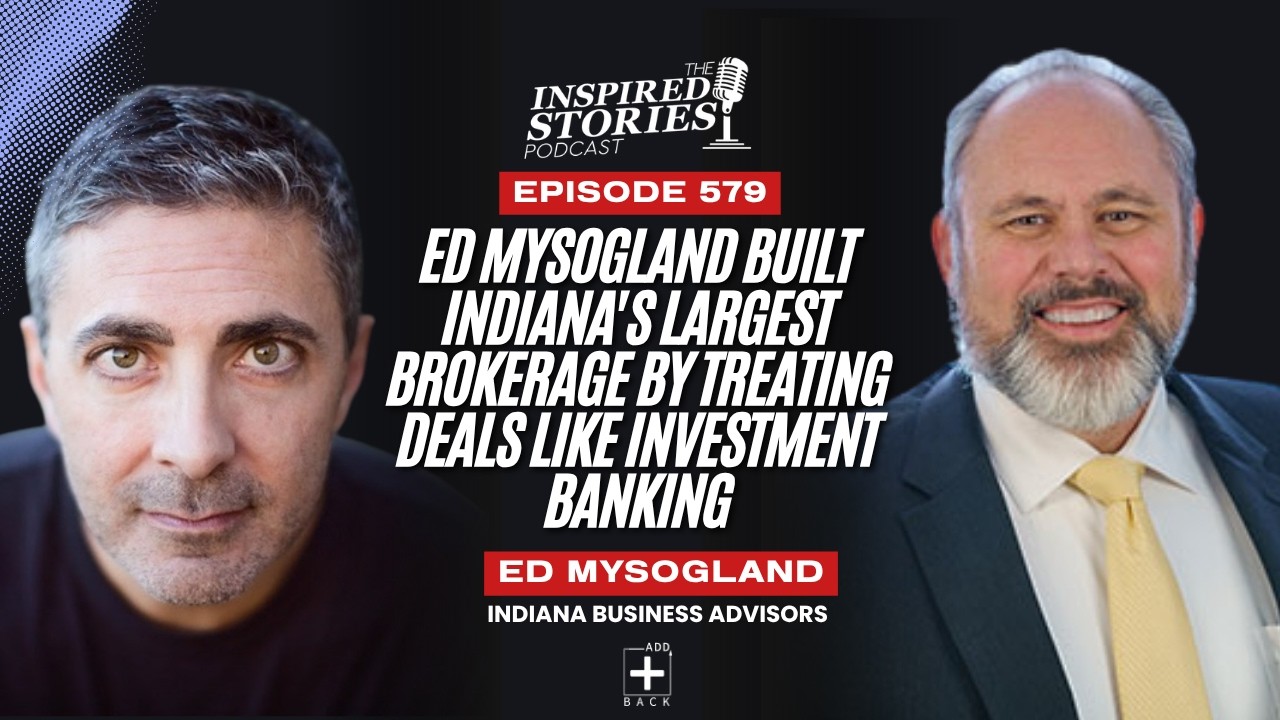
🎧 2,400 Deals and Counting: Ed Mysogland’s 30-Year Journey Inside Indiana Business Advisors
Ed Mysogland, managing partner at Indiana Business Advisors, walked into a business brokerage at 22 with no experience, got turned away, and came back four hours later with a better argument. Three decades later he’s overseen more than 2,400 business transitions, valued companies in 28 states, testified as an expert witness in valuation disputes, and is weeks away from releasing his first book. His thesis: most business owners will only sell once, and they show up completely unprepared. He’s built his career making sure that doesn’t happen.
✨ Key Insights You’ll Learn:
Showing up at Indiana Business Advisors at 22, getting rejected, and returning four hours later with a single argument: it’s commission only, what do you have to lose?
How his father’s death at 21 redirected his Wall Street dreams toward staying close to home in Indianapolis
Teaching himself FrontPage to build the firm’s first website when the partners thought the internet was a fad
Why IBA does valuations on every deal before going to market — and how that separates them from the competition
The three reasons 80% of businesses never sell: value gap, due diligence failure, and wrong motivation
Why selling in a divorce is bad and retiring is good — and how motivation shapes deal success
The “take a vacation and don’t call” stress test for identifying where a business depends too much on its owner
How AI is changing valuations — and why it still can’t replace the wisdom of 2,400 completed deals
The quality of earnings analysis trend that may surpass traditional business valuation
Done Deal — the book coming in August that is a playbook for selling a business whether you use a broker or go it alone
🌟 Ed’s Key Mentors:
Dick Hester and Larry Metzing (IBA Founders): took a chance on a 22-year-old with nothing to offer but tenacity, then stepped aside and let him build — never once slowed him down
His Father: instilled an early sense of responsibility and urgency that shaped Ed’s approach to work and legacy
John Warrillow (Built to Sell Author): Value Builder framework became a core tool for identifying the eight drivers of business value in every deal
His Expert Witness Experience: hundreds of courtroom cases across divorce and dispute valuations that sharpened his ability to defend and challenge any number
His 2,400 Clients: every deal taught something the last one didn’t — the cumulative reps that no AI model can replicate
👉 Don’t miss this conversation about what it actually takes to sell a business — and why most owners don’t find out until it’s too late.
Listen to the full episode here
Transcript
Anthony Codispoti (00:00)
Welcome to another edition of the inspired stories podcast where leaders share their experiences so we can learn from their successes and be inspired by how they've overcome adversity. As you listen today, let one idea shape what you do next. My name is Anthony Cotus Bodie and today's guests spent nearly three decades watching business owners make the same costly mistake. They wait too long to sell, prepare too little,
and
walk away leaving serious money on the table. He's seen it hundreds of times and he's built his career around making sure it doesn't happen to the people he works with. The path to where he sits today wasn't a straight line. There were years of grinding through valuations, courtrooms as an expert witness, and deals that taught hard lessons about what actually drives value and what destroys it. His name is Ed Meisoglant, managing partner at Indiana Business Advisors.
Indiana's largest business brokerage firm. Since 1981, IBA has guided owners, buyers, and advisors through more than 2,000 completed business transitions. Ed brings nearly 30 years of appraisal and pre-sale consulting experience, having valued companies in 28 states. He holds credentials as a Certified Merger and Acquisition Advisor, Certified Valuation Analyst, and Certified Exit Planning Advisor, and
hosts his own podcast, Defenders of Business Value. Most business owners will only sell once. Ed has done it over 2,000 times. But before we get into all that good stuff, today's episode is brought to you by my company, Adback Benefits Agency. Listen, if you run a business, you are likely stuck in a cycle of rising insurance premiums. You're paying more, but your team is getting less. And many people can't afford coverage at all. We do things differently.
We offer a solution that provides your employees with unlimited access to doctors, therapists, and prescriptions that's always free for them to use. But here's the part that surprises most people. Unlike every other employee benefit out there, our program puts more money into your company's bank account. As an example, we recently helped a client increase net profits by $900 per employee per year. Gains like that can change how a business is valued.
Results vary, but the consultation is free. Imagine being the advisor that becomes a hero by introducing this to your clients. See if they qualify today at addbackbenefits.com. All right, back to our guest today, the managing partner of Indiana Business Advisors, Ed Misa-Glant. Thanks for making the time to share your story today.
Edwin Mysogland (02:41)
anthony i've been looking forward to this and thanks for having me
Anthony Codispoti (02:45)
So Ed, Indiana Business Advisors has been around since 1981. Before we get into your work there, though, take us back how you got involved in this world. What were you doing before IBA? What pulled you towards business brokerage and valuation in the first place?
Edwin Mysogland (03:03)
to be honest with you, this has been my only job ever. I walked out. I, I had, you know, I know we were going to get to it a little bit later, but it seems as though the question prompts it now is that, so when I was 20 in, in college, my, dad died and I, I had big dreams of being an investment banker. I was going to go to New York. I was going to go, you know, all these places and, know, I was going to be the deal guy, like, on pretty woman.
kind of thing. And, and then my dad died and my, my mom was up near Chicago and I'm here in Indianapolis. and I was, I came to, to Butler university to play football. And so I just couldn't bring myself to leave. I was afraid, I was afraid that, something would happen to her and I just needed to stay closer to home. And so I, I was trying to decide what, am I going to go to law school?
Right. And I was accepted and my mom's like, look, I don't, I don't have the money to, to, fund your law school. And at the time there was no apprenticeship programs that they have now, you know, in private equity and investment banking, you there's a trajectory. You start as an analyst, then you move into, to a, a director, then a partner, then, and so on and so forth. So, so I just started knocking on doors.
because a professor of mine said, you're going to have to figure out something, um, how to get in the industry because no, was 22 years old. No one was ever going to give me a, an opportunity to, um, you know, to, to, to learn the trade. So I came to business brokerage and I showed up at these, this, this office and I'm like, yeah, will you give me a shot? And they're like, you're too young and inexperienced. What, what?
On what planet is anybody going to entrust their business to a 22 year old? And I'm like, so anyway, I, so I've left disenchanted. was working as a bouncer and a bartender at night trying to just stay alive. And, and so I came back the following Wednesday and I, and I'm like, I sat in the, the, lobby waiting for the two owners and I waited probably four hours and they finally show up.
I'm like, this is an all commission gig. What does that say about me? If you're not even willing to give me a, give me a chance. I just need a desk and a phone. And so as a result, that's how I, how they gave me, they gave me that chance. And I will tell you, I was, they were right. There is not a soul on the planet that would, uh, interest their, their net worth to a 22 year old. And so, but the interesting thing was they, uh,
As bad as I was at 22 being a deal guy, they were equally as bad as, you know, the valuation, the management, you know, technology was coming out. Yeah. Computers. There was no computers here. I was the only guy at 22 to have a computer. And so, so I'm running circles around all the other guys. And so we flip flopped, they went into full-time production. took over oversight of the company at 24. And from there, you know,
Anthony Codispoti (06:26)
What experience
did you have to take over those roles though?
Edwin Mysogland (06:29)
Well, the industry was changing a lot where, where more, there was more focus on the analytics as opposed to the emotional side of buying a company. So the valuation, anything related to numbers, I was your guy. All right. The inbound process is documenting, making sure how, how this operation actually worked. The guys are, competent and capable of doing deals, but they, the
But there was just bottlenecks everywhere because there was no technology behind it. so the mechanics of an operation like ours are fairly is, I don't say simple, but it's fairly straightforward. My, my job was just to improve the bottlenecks and to get us into a position where we had more empirical evidence on what companies would sell for and why. that's led led through my career is starting with the valuation.
Then then we move, you know, that's 32 years ago. Then we move into equipment appraisal, you know, when, when 2007 rolled around and, people were, you know, downsizing and closing shopped as a result of the recession. Well, other people were buying, so we were valuing equipment and helping people buy excess capacity. Then we moved into exit planning and value growth.
And then &A, mean, and that was the trajectory. That's how I did it.
Anthony Codispoti (07:58)
So I want to go back. Why were you so headstrong about focusing on Indiana Business Advisors? Why was this the place where they turned you away and you came back to?
Edwin Mysogland (08:07)
because they, they, two reasons. One, they were just good humans. were, they, they, they, were kind enough to hear me, right? They, they, and over the years, I mean, it's, it's, it's turned more paternal, right? They were, you know, like I said, I had a tragedy in my life and, and they just, yeah, it just kind of came together where
Yeah, there was a, there was a home here and in focusing on how do we, they never treated me. I guess that's the best way they never treated me. like I was 24 and I knew nothing because I had something to offer that they didn't have. then by let's move fast forward a little bit. Internet shows up and these guys are like,
You gotta be kidding me. Do you really believe we are ever going to use the internet to sell anything? And I'm like, yeah, I think, I think we might be. And so, you know, I taught myself front page, know, we first website, first newsletter, first domain for all of that. And had I not, mean, this place would look a lot different without me.
Anthony Codispoti (09:25)
Yeah. Did you knock on a lot of doors in addition to Indiana Business Advisors or?
Okay. Okay.
Edwin Mysogland (09:30)
Yeah, there's like five or six here in here, here in town and,
and, in our industry, you know, we're, we're a pretty large shop. We're probably in the top 10 in the country as far as size goes. Um, there's not a lot of people that it's normally one in two man bands and, most of them are, you know, just doing one or two deals a year. So I, while I did knock on their doors, most of them either weren't there. They were in the same camp up. You gotta be kidding me. No.
Anthony Codispoti (10:01)
So let's go back a little further. There was a family tragedy that ultimately led to this door opening up because your father passed. Mom didn't
Edwin Mysogland (10:12)
Mm-hmm.
Anthony Codispoti (10:12)
have the funds to send you to law school, so had to figure out plan B. Take us back to the passing of your father. Was this, had he been sick for a while? Was this something that was sudden?
Edwin Mysogland (10:23)
Yeah.
Yeah. No, it, and, and, and again, the, one of the challenges of my youth is somebody was always ill. Right. So my dad, my dad at seven, I think six or seven, he lost a lung to cancer. And, and from then on, I mean, it was, you know, cause I can remember it. I mean, it was, he dropped me off at baseball and he's like, he's like, man,
This may be the last time we see each other and you need to take care of your mother. And it's like, now, now, granted, told you, I'm married to a therapist. That's probably one, one of the best thing to say to a seven year old, but you know, different time. so, so any rate we went and, know, he had the lung taken, taken out and they gave him six weeks and he lived 12 years. And, and then at 17, 18.
My mom had a brain aneurysm and that, that can trip you up a little bit. Right. And so, so at any rate, she
Anthony Codispoti (11:32)
She survived that.
Edwin Mysogland (11:33)
did believe it or not. She, um, she came out better than when she went in there, her, the aneurysm was behind her optic nerve improved her vision.
Anthony Codispoti (11:44)
Get out.
Edwin Mysogland (11:45)
telling you, wouldn't lie you about my mother.
Anthony Codispoti (11:50)
Okay, so your dad, when you're at the age of seven, is going to get his lung removed because there's cancer in it, drops you off at baseball, says, I might not see you again.
Edwin Mysogland (12:01)
Yep.
Anthony Codispoti (12:01)
Take care of your mother. He tells this to a seven year old boy.
How did you carry that with you going forward?
Edwin Mysogland (12:11)
Well, I mean, yeah.
Anthony Codispoti (12:13)
That's quite a weight to put onto anybody, let alone a seven-year-old child.
Edwin Mysogland (12:17)
Yeah, but you know, in retrospect, I mean, I think it, I mean, I think there was a little dramatic kind of thing. Like, it was, I think, you know, half empty versus half full, right? That, you know, he was just kind of braced, I think, back in those days, because he was significantly older than
than like most, both my parents, my mom was 40 when she had me, my dad was 49. So, so they had some miles to them both, right? So that was a, you know, that's putting the weight on, you know, in retrospect, could have been, could have been handled a little bit better, but at the same time, that's just kind of the way he was. He was just kind of old school matter of fact, right? That, you know,
I mean, you, you're the boss now. You're going to have to take care of your mother and whatever that meant to a seven year old. That's what I had to do.
Anthony Codispoti (13:18)
So your father passes away when you're how old?
Edwin Mysogland (13:22)
21.
Anthony Codispoti (13:24)
21.
And so how did you and your mom navigate those first several months?
Edwin Mysogland (13:30)
Well, and I had my sister and as far as I mean, you know, again, the, the, the guy had lost his, his lung. So he was limited in what he could do. Okay. So, I mean, it's not as terrible in it. This comes out bad. And I mean, it, the, the absence, right? While tragic, there wasn't like a, a massive
because he, because he had that, kinds of health problems. So my mom was, was already accustomed to operating, you know, in a different way.
Anthony Codispoti (14:11)
Got it. Okay. So you find yourself at IBA.
Edwin Mysogland (14:15)
Mm-hmm.
Anthony Codispoti (14:16)
They eventually decide to bring you in. Nobody's buying anything from a 24 year old with any experience, but you guys flip roles and you start taking over kind of some of the back office stuff, the internet stuff, the technologies,
Edwin Mysogland (14:28)
Yep.
Anthony Codispoti (14:29)
the computers, and then kind of walk us through the progression of your career there over the past 30 plus
Edwin Mysogland (14:36)
Yeah.
Anthony Codispoti (14:36)
years.
Edwin Mysogland (14:37)
Well, like I said, it as the industry changed, and one of the the the blessings that that this place is provided, right? And, you know, now I'm a partner and things like that. And we've got younger people coming up. The blessing was that they facilitated my professional curiosity, right? I, I, no matter what came out, if I wanted to do it,
they they were kind enough to say, yeah, let's give it a shot. They didn't know when they never slowed down. They never said no. They all you know, there were some times where I was like, man, you probably should have said no on that. But at the same
Anthony Codispoti (15:18)
Hahaha
Edwin Mysogland (15:19)
time, you know, we we did it. And you know, there's a lot of things that we were the first and first movers on a lot of different tools and things. Yeah.
Anthony Codispoti (15:30)
Can you give me an example where you guys were a first mover?
Edwin Mysogland (15:34)
Yeah, I mean, I mean, we had we had email newsletters going out. We had the website that was designed. We we went to I went to I'm dating myself. There was a a Microsoft app and that they call them apps now. But there was a Microsoft program called Frontpage and we programmed all of our you know, we program. I wrote it. We didn't have the money to pay somebody. Right. We could I mean, we could have but
And it was so expensive. I'm like, hell, I can do this. I can do this in a weekend. And that's how, you know, that those were first movers the, um, the email, we were the first shop to start to offering valuations at scale. We were the first ones that did equipment appraisal. were the first ones that did exit planning. We were the first ones that offered value growth. And, and again, and I'm talking in, in our market and here in the Indiana and contiguous States.
So, I mean, that, that was, those were all, all things that they just kind of let me just let her rip.
Anthony Codispoti (16:41)
What do you mean by the first one is to do valuations at scale?
Edwin Mysogland (16:45)
Yeah. So every, every deal that came through here, whether you were, whether you were going to sell or not, we were going to do valuation work. Our position was we're not going to enter the market unless we have some alignment on value, right? This is how the buyer should behave toward an investment like yours. And we wanted that alignment as opposed to, you know, spray and pray where you sit there and let's just put it, it doesn't matter what the value is. Let's just go.
see what happens. just, you know, that no one, we always wanted to, we wanted to be more like investment bankers than real estate professionals, right? There was nothing, nothing against them, but as far as how we operate, the only similarity we have is that we have a success fee, right? Outside of that, the analytics and positioning and all the other stuff,
that we have to do that's, that's, that's how we were out in front. wanted to make sure that the valuations, right. And we were doing probably a couple hundred a year. mean, yeah. So yeah, because the SBA,
Anthony Codispoti (17:54)
Wow. That's a lot. So we're you.
Edwin Mysogland (17:58)
mean, we got, so we, we started getting hit up by banks to do them, you know, attorneys to do them. So things like that.
Anthony Codispoti (18:06)
No. You,
you mentioned that Indiana Business Advisors, probably like a top 10 firm in the country. Is that
Edwin Mysogland (18:12)
Mm-hmm.
Anthony Codispoti (18:13)
today? Is that when you started? Is it both?
Edwin Mysogland (18:16)
well back then you had no idea because you didn't have much of the internet now you have a pretty good idea of where you stack up you know when you go to the association meetings and things like that
Anthony Codispoti (18:27)
So it's present day, you guys are top 10. And you have an idea of how you stack up just because you go to these meetings, other people are sort
Edwin Mysogland (18:33)
Hmm? Hmm?
Anthony Codispoti (18:35)
of talking about the number of deals that they're doing. That's sort of what the yardstick is.
Edwin Mysogland (18:38)
Yeah. Yeah. Yeah.
Anthony Codispoti (18:42)
What is it that you guys are doing that's different, that's allowed you to grow to the size that you
Edwin Mysogland (18:48)
Well, I think we're, I think we've added, you know, we've got, we've added the right talent, right? Our position is not just adding bodies. It's, it's, it's truly talent. Right? So we've got five CPAs, two JDs and everyone else has had, you know, has either owned or owned and exited or owned passively another business. So they can, the empathy of got, you know, shepherding somebody through a, through a sale.
That's, that is how, how we, we operate, right? That we want to be, yeah, we want to be, you know, the shepherds of guiding you through this. And it will be an emotional sale. The X's and O's are one thing, but the journey to close is, is, it's fraught with all kinds of landmines.
Anthony Codispoti (19:39)
Talk to us about that emotional journey, because I think that doesn't get talked about enough.
Edwin Mysogland (19:44)
Yeah, so the...
so much of a business owner's identity is wrapped up in their business, right? And, and there, there was a, you know, there was a psychologist that said, I can't remember what his name was, but it escapes me. But it was, what do put on your business card the day after closing? Right? And that's a big issue.
And you know, the exit planning Institute has some stats that say 75 % of people regret selling their businesses. Now I can tell you after, you know, the 2,400 deals that we've done, I haven't found too many sellers that regret selling. Now the difference is you, you, when you plan your exit, the emotional side, are you go, are you going to something? What are you going to do after this?
And it, and it doesn't matter what it is, but golf tennis pickleball is probably not, is probably not litmus test of whether or not you're going to have a successful post sale life. Right. Instead it's, it's something more meaningful. Lots of people come, you know, they move into consulting. Lots of people move into the thing, working with the church. Lots of people, you know, move into something that gives them.
meaning now we talk a lot of people out of selling their business too that you know what if you want to die with this and you want to get carried out it does as long as your family knows what you your wishes are it's your business let her rip who cares and and i think the emotional side is that
A lot of sellers feel as though that someone's coming to take something from them. Right. And all my hard work is not recognized because they probably there's probably a value gap versus what they, you know, the value gap, meaning what they, they think it's worth versus what the buyer thinks it's worth. That likely there's some of that. If to a seller, feels predatory, right? You, you don't know what I sacrificed. You don't know.
how many games I missed. You don't know the, the, personal guarantees of what that did. You don't know the stress that it put my wife and I under, you don't know the divorce I had as a result of it. You don't know that, you know, and pick the, don't know. Right. And.
Anthony Codispoti (22:23)
all the emotional strife that it took to get to where
they are. Unfortunately, that doesn't show up on evaluation
Edwin Mysogland (22:30)
No,
Anthony Codispoti (22:31)
report.
Edwin Mysogland (22:32)
no, not at all. And, and, and the, and the seller wants to be rewarded for that. And it, and it takes some reconciliation to, you know, and we always say, you know, look at it through as if you're the buyer. Would you do this deal that you're asking them to? Are you, do you really believe that this kind of leverage in order to do the deal is the, in the, in the best interest of that buyer?
hell, I never do that deal. And, and you expect him and you know, and, and it's a, the emotional side is really, really interesting for them to, to, grapple with. And I keep
Anthony Codispoti (23:14)
And so
the times that you have talked people out of selling their business, is it traditionally because you've seen that they don't have that next thing to go to?
Edwin Mysogland (23:27)
it. I mean, there's there's some tools out there that that will facilitate that. All right. There's a a question there called pre score, which will kind of assign whether or not you're are you truly emotionally ready to sell. But the the
I think the biggest thing that you see with the sellers when we, when we're having, know, are you really wanting to sell? Right. The biggest ones have to do with the greatest value, right? They come in and, and there's such a disconnect between fair market value and what they want. Right. And they, they are that reconciliation. If, there's no movement, right. It's it's, it's a
sense of that. And, so when we're talking people out of it, it has a lot to do with value and has a lot to do with financial condition, meaning that their books, you know, no one can rely on it. Um, you know, there's owner centricity where you are the business. You're going to have to diversify that in order for someone to come along and figure out how to, how to get in a better position to,
mitigate the risk of you, Mr. Seller.
Anthony Codispoti (24:52)
Yeah, variety of reasons. So I think there's a banner you guys have that says 80 % of businesses don't sell. What's the single
Edwin Mysogland (25:01)
Yeah.
Anthony Codispoti (25:02)
biggest reason that a business goes to market and then fails to find a buyer?
Edwin Mysogland (25:06)
Yeah. It's value gap, due diligence or motivation. Those are the three, the three things and, and, and I, it's funny you said that because I'm, I'm hell bent to get that off. I've been squabbling about that banner because as an industry as a whole, when you think of all the businesses that transact, that's true. 80 % don't. And I, and I look at our own practice, we're about a 70 % success ratio.
right now. And
Anthony Codispoti (25:36)
that's a big flip.
Edwin Mysogland (25:37)
yeah, it is. And, and to me, it means a lot more that you're selling 70%, as opposed to 80 % don't sell. But it but from a the whole messaging behind that was look, you got it, you have to understand what it is you have to sell before you get to the market and someone tells you that that's what we're trying to do.
Anthony Codispoti (26:00)
there's
got to be a lot more prep work. when should an owner start preparing to sell?
Edwin Mysogland (26:07)
I mean, some people say years. I think the biggest...
Yeah. I think the, for, for optimal, if you can, if you can put a couple of years in advance, you know, just understanding what the process is and that, because, know, let's talk exit windows. know you didn't, you didn't ask for it, but I'm going to give it to you. Anyway, you have, you know, it's takes a couple of years. Let's just say the couple of years works a couple of years to prep. It's going to take six months to a year to sell. And it's going to take six months to a year on the, on the way out. Right.
meaning transition the business into the next owner's hands. mean, that's like four years, right? That's a long time to be doing the wholesale process. And let's say you're mid 70s. Do you have that kind of runway or do you want to do that? A lot of people aren't. And that's what they work until
Then all of a sudden it's like, I need to sell. They show up at our doorstep. You know, we got to be the bearers of bad news. And at times that's where the 80 % comes from. It's just, you're just not prepared or, know, it may die with you and that's okay too.
Anthony Codispoti (27:30)
And when they come in and they're not prepared and there isn't the time to do what it is that needs to be done to prep it, what
Edwin Mysogland (27:37)
Mm-hmm.
Anthony Codispoti (27:38)
are those things? Why do you want a couple years advanced runway? What is it that you're going to do in those two years?
Edwin Mysogland (27:44)
Well, you're going have to align. Number one, you got to figure out valuation. What do you have? How's it going to be sold? To whom it's going to be sold? You have three different types of buyers. You have individuals, strategic and private equity groups.
Who do you want to sell to? Who is going to be attracted to a business like yours? So you need to understand who the buyer is. Then you move into, right, once I'm past those two, we have value alignment. All right, now let's talk about books and records. How am I going to, how am I going to, to,
mitigate the risk, right? The, cause now the buyer, now the leverage as you move through a transaction, the leverage at first is to advantage seller. The closer you get through the deal, that whole leverage moves over to the buy side. And now the buyer is saying, all right, Anthony told me and shared with me in the deal, the deal room, which is the repository for documents.
He told me this, this, this, this, and this, and now I got to go verify it. Right. And I'm hoping I can verify it, but if not, I got to rely on, I'm going to have to rely on Anthony. Right. And yeah, I, you know, I've only spent a few days in total with Anthony. Am I really willing to bet my house on Anthony? And, and so, so when I, when you ask about what, about deals, you know, how to prep it's
having having books and records that are in good condition that you're in a position that that you know, an accountant or another financial advisor can jump in and they can they can easily see and you as the seller can defend
Anthony Codispoti (29:40)
You've got to have that documentation to back up the valuations, basically allow the buyer to be able to connect all the dots and verify everything.
Edwin Mysogland (29:49)
Yeah. I mean, it's an, it's an earning stream. The buyer it's like any other investment. The buyer is buying an earning stream. Whether you're buying a stock or you're buying a closely held business, what you're buying is that earning stream. And, and the buyer is trying to make sure that that earning stream is going to be there in order to pay themselves, pay the debt and get a return of and on their investment. That's, that's the mechanics of what they're looking for.
Anthony Codispoti (30:16)
Now in that hopefully two year ramp up time that you get before
Edwin Mysogland (30:20)
Mm-hmm.
Anthony Codispoti (30:21)
you take the business to market, I see you guys are also certified exit planners. Are there some operational levers that you traditionally like to help your clients pull to improve that valuation?
Edwin Mysogland (30:34)
Well, a lot, shouldn't say a lot, a growing number segment of our business is turning into almost steel mediation, right? When I, cause you're talking about operations where I'm heading to answer the question is that the sellers might be, might have their buyer already in their business, right? Number one, number two or number three, maybe the candidate.
They just don't know it. They don't know how to put the deal together. And that's why I saying that a growing number of our, our business that our business is moving into refereeing and coaching the two of them to, get to a deal, but operationally, you know, that's one way, one way to solve it is, is a lot of the owner centric decisions, right? If you're the guy or the woman that, you know, everything flows through.
that buyer is looking, can I be that? Can I be Anthony when I grow up? I'm going to buy this. I'm going to risk my house. Can I really do this? And the, know, so operationally, whatever, however you need to, to handle it in order to figure out where those chinks in the armor are, right? That's, those are the operational levers. We use a, a tool called value builder and value builder is just that.
There's eight drivers of value and it rank G it's a self assessment. You, you answer the questions and, it's from a friend, John Warillo. He wrote a book called built to sell. and, and that we use that on just about every one of our deals that we want ourselves to understand here's, here's where the buyer is going to start poking at. Right. And that's, that's what we use.
Anthony Codispoti (32:28)
Is
there a part of your philosophy around business valuation that other advisors in your space might push back on something that's, I don't know, a little counterintuitive, perhaps?
Edwin Mysogland (32:38)
Well, I think given technology these days, I think I think valuations, I don't say easier, but I think AI is and the vast amount of information that's available to to anybody, you know, that knows how to prompt it. I think you'll you're you're you're gonna see that valuations are easy. I shouldn't say easy valuations are you're going to be able to take
Anthony Codispoti (33:07)
easier.
Edwin Mysogland (33:07)
get in
the box. Yeah, you're going to get be able to get in the in into the ballpark. So to me, I think that the evolution, the quality of earnings analysis is going to surpass the need for business valuation. think business valuation. And again, that that's just my Ed's two cents, I whether it happens or not. I think there's always a home for business valuation. I think you have to have it.
I just think it's going to make it easier and you're not going to necessarily have to have for sale purposes. I don't think you're going to need credentialed appraisers to at least help you understand where you're at. Now, I will always say you need to talk to somebody that's versed in it because there's a difference between knowledge that AI gives you and the wisdom that someone that's done it a few thousand times can help you with.
But I think for those business owners lurking around, just thinking about, yeah.
Anthony Codispoti (34:09)
Just kind of kicking the tires, you think that
dropping all the data into an AI model, a large language model is going to be enough
Edwin Mysogland (34:17)
Yeah.
Anthony Codispoti (34:17)
to get them kind of in the right ballpark of what the value on their businesses.
Edwin Mysogland (34:20)
Well, it's funny. mean,
yeah, I mean, people are showing up now and said, look, you know, and they did it in front of me. Yeah, I'm doing $2 million in revenue. I'm, an HVAC company. What do think my company's worth? And I mean, they're not precise, but it's enough to say whether I'm holding or going right or
Anthony Codispoti (34:40)
And you said a bigger focus you think is gonna be more on the quality of earnings analysis. Can you explain what that means to the audience?
Edwin Mysogland (34:47)
Yeah, the quality of earnings is is is if you recall, I was talking about the earning stream and the likelihood that the earning stream stays over the course of the holding period for the buyer holding period mean however long that they're going to own it.
Quality of earnings is digging into that, figuring out, what if I look at this earnings and how these earnings and how they were created, what's the best, know, is it, what's the likelihood that these customers, these 15 customers of which, you know, there's very little customer concentration, but how did we get those? Right. And they're looking into, all right, so do we, do we have a mastery of client acquisition?
Do we have, you know, what regulatory issues perhaps could capsize my earning stream? And just basically ascertaining what are the risks to maintain that earning stream? That's what quality of earnings are.
Anthony Codispoti (35:51)
No,
that makes sense. Let's say that
Edwin Mysogland (35:52)
Well.
Anthony Codispoti (35:53)
somebody is five years out from selling. What are some of the biggest operational levers that they can do to improve their valuation?
Edwin Mysogland (36:00)
Take a vacation, don't call the office and you're going to find out what all just take two weeks. You might be able to pull it off in a week. Don't call, just come on back and wait till waiting for hear about the fires, right?
Anthony Codispoti (36:14)
You're
to see everything that broke and that is the indication of all the places where you need to find a place, a way to replace yourself.
Edwin Mysogland (36:21)
Yeah, those are the, that there's a lot of stress testers, know, that you stress test your company, right? If you, you don't, it's hard, I I'm with you. I want to be, I want to be here. I want to make sure that every, you know, I want to micromanage it because I, that's what I do. And as a business owner, same, they're in the same camp. If, if I'm not doing it, I sweat that the quality control will deteriorate and things like that. Right.
But, know, with tools like, you know, I was just talking to somebody else, you know, like loom where you can record the, you know, the SOPs for your business, you know, different, you know, you've got the voice memos that you can walk somebody through. mean, there's just so many ways to accelerate the knowledge of what's in the owner's mind. Right. And how to get how, you know, how to diversify the risk of you is, is really, is really the
the goal and I will tell you, you know, it's hard. I mean, as a, as a business owner, you know, that that's really hard to delegate. And, but I think there's the good news about exit planning is that there's so much more talk about that. It really is a thing that you're, really are going to have to, if you want maximum value, it needs to be able to operate, you know, without you. but I,
And between us, I don't know if that's realistic, right? People have lifestyle businesses, right? They've had lifestyle businesses forever. And I think that they are, are saleable. And, you know, it's just, you have to set expectations on value, right? You may think you just don't understand the risk associated with your business, but once you do, then we have an entirely different conversation.
Anthony Codispoti (38:20)
Sometimes
these discussions on valuations can turn into downright disputes. You've actually
Edwin Mysogland (38:26)
yeah.
Anthony Codispoti (38:26)
served as an expert witness in some valuation disputes. Can
Edwin Mysogland (38:29)
bunch done.
Anthony Codispoti (38:31)
you pick out one fun, crazy story, walk us through where you needed to be an expert witness in one of these cases?
Edwin Mysogland (38:40)
Well, I mean, regretfully, mean, typically they're in divorces, right? Where, people are, you know, it's, we, try, we don't, we, don't
Anthony Codispoti (38:49)
That's not a fun story.
Edwin Mysogland (38:50)
know. It's not, we're, we're totally into the happy ending stories, right? And the expert witness information has more opportunities has more to do with that. The, the parties believe that someone like me, right. Will, will.
And my position and, since we're friends now, my position is look, it's not, it's not about fair in Indiana. It's a, a 50, 50 marital property state, right?
how a buyer behaves toward a business once we get it to market may be entirely different than the fair market value standard that an appraiser would have. while it's great that you can have, want to drag old Ed into the court until I take it, run full process. That's market value. That may not be fair market value. Those two different things, maybe two different things.
Anthony Codispoti (39:56)
Yeah, you don't really know what a private business is worth until you find a buyer who's willing to pay something for it.
Edwin Mysogland (40:03)
Yeah, I mean, you need to be you need market feedback in order to send to know and, and we have, we're seeing a lot, I should say a lot, but a lot of courts, you know, we take it through, we take we in fact, we have a couple of them right now where we take where we're taking them through a process. And there's a first right or refusal from either party that can buy it, right? And
That's okay. You know, the buyers are aware that, you know, there's a first right or refusal out there and, and, and they're okay with that. But, that I, it's like I said, it's, it's, it's not, it is, it's
Anthony Codispoti (40:40)
It's a messy situation, yeah.
Edwin Mysogland (40:42)
not happy ending work and we're, we're about happy endings.
Anthony Codispoti (40:46)
Well, so let's let's talk about the happy endings. Let's let's sort of package it up. You know, we've been talking a lot about your different areas of expertise and getting your viewpoints on things. But tell us who Indiana Business Advisors is, what you do and who you do it for.
Edwin Mysogland (41:02)
Yeah. So we're, we're a business brokerage. know, micro M and A is another term for what we do. help buyers and sellers, buyers and sellers, buy and sell companies. The bulk of our practice, probably about 70 % is sell side where we represent sellers and, and in our space, we're typically one to 25 million in revenue. So.
So the smaller businesses, there's probably about 15 % on the buy side where buyers engages to go find deals for them. Like for example, there was a company that's looking at growing through acquisition, right? So it's easier for them to buy a company than it is to go try to hire people. So we've established a list of targets. Now we're gonna go out and chase them.
find deals for them. And then the balance is advisory work, right? So valuation, deal mediation, that kind of thing.
Anthony Codispoti (42:12)
You also host your own podcast called Defenders of Business Value. Tell
Edwin Mysogland (42:17)
Yeah.
Anthony Codispoti (42:17)
us about that show. What do you talk about there? Who's it for?
Edwin Mysogland (42:21)
Well, it's the funny thing is it, and just because again, we're friends now it's, it's original premise was I wanted to talk to other deal guys that they, know, about their deals, right? What, what did they learn from the deals? Well, being in it's one thing now you could probably pull it off because you're not in the space. Me. I'm I'm in the space and they, they perhaps thought of me as competition. was
I'm sitting here saying, well, I just want to educate the public. And so it did not, you know, 150 episodes ago, it didn't, that was the premise, but it turned more into. Right. Oh yeah.
Anthony Codispoti (43:00)
You had trouble getting guests. There are people who didn't want to come on because you were the competition.
Edwin Mysogland (43:04)
Yeah. And that's what they, they, they, viewed it as a threat and it's like, yeah, welcome to my industry. So, so I.
pivoted and we're talking about things that create value. What makes a saleable company? What makes a successful exit? We have all kinds of people that come on and just talk about things like that. And the interesting thing is most business owners are lurkers for me. They are hiding in the, before they raise their hand, right? They want to hear what's going on. They want to...
I don't say vet me, for lack of better word, yeah. Yeah.
Anthony Codispoti (43:44)
Yeah, they want to know who Ed is, they want to get a sense
of what you believe what kind of person you are. But what a great
Edwin Mysogland (43:49)
Right.
Anthony Codispoti (43:50)
way to understand that by watching your podcast.
Edwin Mysogland (43:52)
Yeah.
Yeah. And, and, and again, it's, it's been good. It's really interesting. Like you, I mean, you know, so many people have, have heard your podcast and when they bump into you, you don't have a whole lot of warmup conversation, right? Because they feel like they, but like they know you and same thing with me. Um, you know, there's been a few, you know, recent LinkedIn posts from people that have, I had, I had some buyers on.
on here, um, that, that the, seller heard about the buyers called the buyers and did the deal. And I'm like, well, how did I get cut out of this? Right. And so they found each other. No, no,
Anthony Codispoti (44:35)
got an agreement in place, right? They can't do that.
Edwin Mysogland (44:37)
no, no, that there was no agreement. They just were, they were just listeners to subscribers that, that found each other in the
Anthony Codispoti (44:42)
Okay
Edwin Mysogland (44:44)
night and they did a deal together. And I was, and it made my day. mean that, I mean, that's
There's, there's plenty of money to go around. I was, it was just awesome that, that the podcast made that happen for
Anthony Codispoti (44:56)
Yeah, it was the conduit for all that.
Edwin Mysogland (44:59)
Yeah.
Anthony Codispoti (44:59)
Now, you're also working on a book not quite out yet. Tell us the title. What's it about? Who's it for?
Edwin Mysogland (45:06)
Done deal. It's a, that's the name of the book. exit without regret and what that, helps you prepare, promote and protect your business. Right. The, the, the premise of the book is there's just not enough awareness of how to sell a business, right? There's lots of people that are talking about how to build it, how to scale this, you know, things to that effect. Very few people.
And that's what, that's what I want to this book dish to, to demonstrate is this industry that I, that I reside in it's there's very, there's, there's very little regulatory oversight, no sec, know, sometimes in certain States, there's some real estate oversight, but as a, a profession, it's up, it's incumbent upon, you know, folks like me in my office to be quality control.
Other than that, it's kind of the wild west and there's no barriers to entry. And that to me is the greatest risk to the business owner is that they just don't know enough about the process, before they get there. And so this book is intended to be that playbook that whether you choose to do it yourself or you choose to engage a third party to, you know, a deal shopper, accountant, attorney, or whomever to help facilitate that sale.
This is, this is how this, this whole world operates that you don't know anything about. So that's the book. should be out in August.
Anthony Codispoti (46:43)
Okay, fun stuff. Is this your first book? Have you done one before?
Edwin Mysogland (46:44)
Yeah. It,
nope. It's my first book and it's funny that it took, cause I was looking back when I started, I started it in 2018 and, um, you know, cause there was like, did you use AI? I'm like, there wasn't, there wasn't, there wasn't AI back then. Well, I mean, it was, but not accessible to you and me. And so, anyway, it's been, it's been.
I don't know if you've ever written anything like that, but I, I have, I gave it to a publisher and they're like, this thing's a, this thing's an encyclopedia. You got to reduce it down. And, and then I, so, you know, I'm thinking I wrote the greatest book ever and
Anthony Codispoti (47:28)
Ha
Edwin Mysogland (47:29)
they, and they just obliterated. And so, so I had to go back to the drawing board and finally, finally it's out, but it, I mean, it's still gonna, I think it's 300.
I didn't, I didn't realize that, you know, I'm working on an eight and a half by 11 sheet of paper. Well, until you put it in book form and then it's six by nine. So things change. yeah. yeah. It'll, it will.
Anthony Codispoti (47:53)
And so where will folks be able to find it? it on the Indiana Business Advisors website? Will it be on Amazon when it comes out?
Edwin Mysogland (48:01)
any place that you can buy a book, that's the, that's the intent. Yeah. Yeah.
Anthony Codispoti (48:04)
Okay, stuff. So
what does a business look like that sells fast at full price versus one that doesn't?
Edwin Mysogland (48:16)
motivation, right? You have the right motivation of why you're getting out. Retirements, good, divorce is bad. You have earnings that can support a loan, right? Meaning that a fair two, well, a couple things. One, you have to be the person that is buying the company has to be able to have compensation that will induce them to leave something or is replacing something.
And the typical proxy is, you know, it's got to be 100, 150 grand at least, right? For somebody to take that risk in this day and age. The next thing is it has to provide, it has to be able to pay for itself through the earnings of the business. It has to be, and the SBA is doing remarkable things as far as providing capital, but you you're talking 90 % leverage, right? And that's a, that's a big number for a lot of small businesses. So
Anthony Codispoti (49:16)
Are they still doing 90 only 10 % down? Okay. Sorry. Go ahead.
Edwin Mysogland (49:16)
So, mm hmm. Yeah. So you've got,
no, no, you're good. So, so again, motivation, then you, then the mechanics, can it pay for itself? And then, and then lastly, are you op, you know, can this business be done by somebody else? I was just talking to a, to a masonry, a masonry guy and you know, he's the craftsman, right? It's like, all right. Well, if he wants to sell, how are we?
I mean, you've got 50 years of experience laying bricks, right? It's not like that can be just dropped in somebody else's bucket, right? And they learn it. So where the risk is, can it be easily mitigated to the next buyer? So that's what will move the fastest.
Anthony Codispoti (50:09)
What is the future of Indiana Business Advisors look like? Where are you guys growing?
Edwin Mysogland (50:13)
You
know, interesting you asked that because I do believe that historically the business brokerage industry, not just IBA is, been an old man's game, right? Where, you know, you had to have the street cred, right? To have had the experiences in order to work with those business owners. Well, now you've got these young little whippersnappers that, know, are coming, you know, the 30, 35 to
40 years old, that are coming from all places that are that are coming into the industry. And that's what I was talking about knowledge versus wisdom, right? So the median age, which I'm super stoked about that the median age is coming down, which is really good for our industry. So more people are entering it. But at the same time, you got to come up with some sort of quality control. So we're at IBA we're at inflection point two.
Right. We've got our legacy guys that at some point they're going to come and say, yeah, it's time to hang up on my business brokerage cleats. It's like, all right. And, and, but at the same time I've got, I've got a bullpen that that's, that's coming up. So I'm, I'm curious. I'm, really curious in the next two to three years, what it looks like. not that I'm dodging the question. I'm curious to know whether the AI agents and different.
technology? Is it going to help or hurt me? And when I say hurt me? Does it? Does it lessen the, you know, the, you know, the, the
Anthony Codispoti (51:51)
the value of what you provide.
Edwin Mysogland (51:53)
secret sauce, right? You know, does, will it change? I don't know if it will. I and can't lie. I don't think it will. I think you're still going to need somebody that has has the street cred and the chops, regardless of how quickly you can
put marketing books together and all the, all the things that AI might do at some point, there's a 75 year old business owner that's not going to say, yeah, that's pretty cool AI stuff you do now. How am I? Yeah. I, I'm not certain I can sell this business now who the, who is it? Who are they going to believe? Right? You can, you can ask AI, how do I be my thought partner and help me with this business owner. But at the end of the day,
Are you really going to be able to do that? And so I think the tools of the trade will change. I think it's a really good time for IBA as far as the composition of the people that are coming versus the people that are mentoring, I guess is the best way to say it.
Anthony Codispoti (52:58)
Well, as you think about your role, managing partner at Indiana's
Edwin Mysogland (53:02)
Mm-hmm.
Anthony Codispoti (53:02)
largest brokerage, what do you most want to be remembered for,
Edwin Mysogland (53:07)
That I did the same as, um, you know, Dick, Dick Hester and Larry Metzing did for me, right. That, know, I'm, I'm not going to light your fire, but I will fan your flame. So where, where you want to go, um, I'll, I'll support it. I, I'm, I don't have that much of an ego that, you know, you may have an idea that, that, that I don't understand, but you know what?
I'll let it rip. I hope that I carry on that, that same from that they that they provided me that I didn't, I didn't, they didn't slow me down, right? They didn't, they didn't tell me it was a stupid idea. A couple of times, but, that was after the fact. And, but, yeah, I hope that that that's, that's what I'm remembered by that, that I took from them, that, that I paid it for.
Anthony Codispoti (54:02)
Now you want to give other folks a chance to spread their wings.
Edwin Mysogland (54:05)
Absolutely.
Anthony Codispoti (54:06)
Ed, I've just got one more question for you today, but before I ask it, I want to do three quick things for the audience. And the first is I want to let them know how to get in touch with you. So we've got a couple of options here. First of all, the company website is indianabusinessadvisors.com. Couldn't be easier to remember. They're in Indiana. They are business advisors. So their website is indianabusinessadvisors.com.
We've also got Ed's personal site, is EdMysogland.com. And the last name is spelled M-Y-S-O-G-L-A-N-D. So EdMysogland.com. And we'll have that in the show notes in case you missed it. And if you're enjoying the show today, please take a moment to subscribe wherever you're listening. It also sends a signal that helps others discover our podcast. So thank you for taking a quick moment to do that right now.
And as a reminder, you can be the hero advisor that helps clients give their employees access to therapists, doctors, and prescription meds while paradoxically increasing their net profits. Real gains that can change how a business is valued. Contact us today at addbackbenefits.com. So last question for you, Ed. A year from today, what is one very specific thing that you hope to be celebrated?
Edwin Mysogland (55:24)
I hope that the book resonates. hope that, lots of people, when I say lots of people, I hope somebody reaches out and said, you know what your book, your book helped me get across the finish line. And so yeah, a year, a year from now, that's the, that's, that's the hope that it resonated with someone. suspect that based on the beta test, beta readers, that, that, that it'll resonate with a few more, but if it just does it with one, it's a, it's a win for me.
Anthony Codispoti (55:54)
on stuff. We'll have to keep track of that book coming out. Ed Mysoglian
Edwin Mysogland (55:55)
Yeah. Thank you.
Anthony Codispoti (55:58)
from Indiana Business Advisors. I want to be the first to thank you for sharing both your time and your story with us today. I really appreciate you being here.
Edwin Mysogland (56:06)
Anthony, again, being a fellow podcaster, I know what goes into the show prep and you're an awesome host. Thank you for having me.
Anthony Codispoti (56:17)
Appreciate your kind words, folks. That's a wrap on another episode of the Inspired Stories podcast. Thanks for learning with us. And if one thing stood out, put that into action today.
Connect with Ed Mysogland:
Website: indianabusinessadvisors.com
Personal site: edmysogland.com
Podcast: Defenders of Business Value