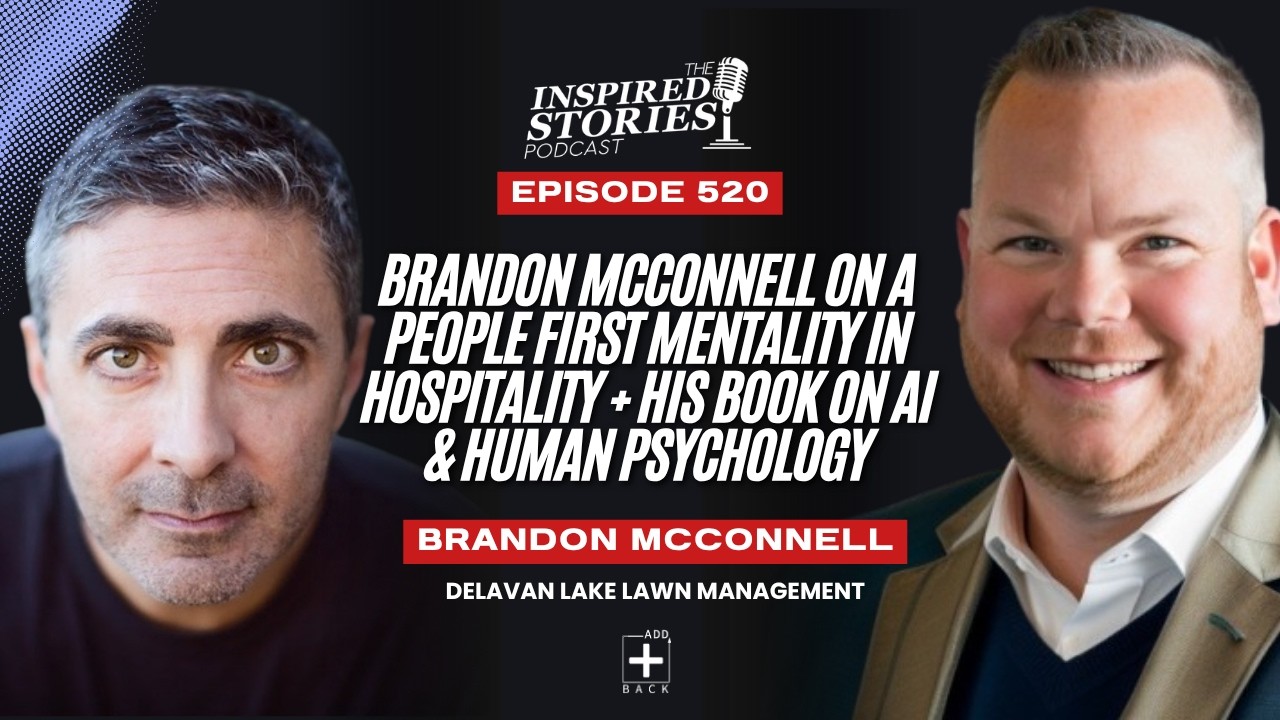
Brandon McConnell, corporate executive at Delavan Lake Lawn Management, learned hospitality before he learned long division — garnishing plates at his mother’s diner at age six, stripping hotel beds in middle school, and eventually turning a TQM class on a Tuesday night into a professional philosophy that followed him through Disney, Grand Geneva, and now Lake Lawn Resort. He’s also finishing a 330-page book on AI psychosis through a Johns Hopkins research cohort.
✨ Key Insights You’ll Learn:
Diner childhood: learning hospitality through food, family, and 4:45 AM wake-ups
Skipping class to vocational school: how TQM lit up Brandon’s mind and redirected his career
Disney at scale: timing housekeepers with a stopwatch to save $40K per property annually
Grand Geneva turnaround: diagnosing a four-diamond property in 30 days and moving the needle in 90
Hire for aptitude first, attitude second, availability third
Lake Lawn Resort: Wisconsin’s oldest resort spanning golf, spa, marina, and residential real estate
Night golf and short courses: where the sport is headed and what Lake Lawn is building
Imposter syndrome as a reminder of the journey rather than a reason for fear
AI psychosis research: what LLMs are doing in suicide prevention that surprised even Brandon
Why the AI moment mirrors where social media was a decade ago
🌟 Brandon’s Key Mentors:
His Mother: Introduced him to hospitality through her diner and modeled hard work and human connection
TQM Instructor (Vocational School): Gave Brandon the process framework that redirected his entire professional life
Disney Leadership Teams: Taught alignment, scale, and people-centric operations at an institutional level
COO of Development (Former GM, Delavan): Hired Brandon twice and shaped his long-term trajectory
Johns Hopkins Research Cohort: Challenged Brandon to think rigorously about AI from a non-clinical standpoint
👉 Don’t miss this conversation about what hospitality actually teaches you about people, why imposter syndrome belongs on the table not buried underneath it, and how a resort executive ended up writing one of the more unusual books on AI and human psychology.
Listen to the full episode here
Transcript
Anthony Codispoti: Welcome to another edition of the Inspired Stories Podcast, where leaders share their experiences so we can learn from their successes and be inspired by how they've overcome adversity. As you listen today, let one idea shape what you do next. My name is Anthony Codispoti, and today's guest learned hospitality before he learned long division. He grew up in the back of his mother's diner in Madison, Wisconsin. Garnishing plates at 4:45 in the morning as an elementary schooler. Then stripping hotel beds and unclogging drains as a kid who had no idea he was being trained for a career. He was the kid who skipped class to go to bowling. Now he holds postgraduate credentials from Cornell, Notre Dame, and Johns Hopkins, sits on more than 10 national advisory boards, and is finishing a 330-page book on a psychological phenomenon. Most people have never heard of. His name is Brandon McConnell. He is a corporate executive for Delavan Lake Lawn Management, which oversees Lake Lawn Resort, Wisconsin's oldest operating resort, a 250-acre lakefront property founded in 1878, that once served as the corporate retreat for Commonwealth Edison, and is credited edit and is credited as the birthplace of pink lemonade. Now, Brandon oversees its ongoing renovations and a growing portfolio that spans golf, spa, marina, residential real estate, and multiple dining concepts. But before we get into all that good stuff, today's episode is brought to you by my company, AddBack Benefits Agency. And you'll want to hear this because it's hurting almost every business owner you know. Health insurance costs go up every single year, and businesses are furious about it. They're paying more. Claims are getting denied, employees are opting out because they can't afford it, and it hurts turnover and morale. It's one of the most maddening problems in running a business, and everyone just accepts it. But you don't have to anymore. Now there's a program that gives your employees unlimited access to doctors, therapists, and prescriptions with no co-pays or deductibles to meet. And here's the part that really shocks most people. Unlike every other employee benefit out there, Our program increases your net profits. We recently helped a client add $900 per employee per year to their bottom line. Results vary, but gains like that change how a business is valued. All right, folks, let's get into our conversation today. Corporate executive Delavan Lakelawn Management, Brandon McConnell. Thanks for making the time to share your story today.
Brandon McConnell: it's my pleasure. Thank you for the time.
Anthony Codispoti: So, Brandon, your mom ran a damn a diner in Madison, Wisconsin. You were there at four forty-five in the morning as a little kid, pushing dishes through the washer, pouring coffee. How old were you exactly when you started? And what do you remember thinking about those early mornings as a little kid?
Brandon McConnell: Well, I think it's important to just level set for the safety of everyone, including my my mother, that this was long before the child child labor laws that we have in place now. but yeah, it was it was early mornings. Yeah, we're we're we're good now, right? six, seven, eight years old. and what I think the beauty of it that I sometimes remind myself now as a father of two boys is that
Anthony Codispoti: We're outside of statue of limitations anyway. It's all good. Yeah.
Brandon McConnell: Sometimes those kids, you know, what which you live every single day, that that's what they know. They don't know any different. And for me, it was fun. And to experience that, the you've been in the diner, a a great restaurant, there's a buzz, there's a feel. And to learn that at such an early age, and more importantly, to learn the beauty of of connecting with people through food and hospitality. it it was training me certainly for what has turned out to be a lifelong venture and I wouldn't trade those early mornings for anything. Plus, I got more time with my mom and not many kids who have parents in this industry can say that. It's it's a it's a very intensive industry that takes time away. And I got to to spend it with my mom every single morning. So I loved it.
Anthony Codispoti: But did you really as a six, seven, eight year old, enjoy getting it up at, you know, before five AM?
Brandon McConnell: I I loved free breakfast and scones, I can tell you that. so you know, maybe a little payoff food-wise was in order. But yeah, I mean it it's even to this day, and and I'm sure we'll touch on it, you know, my leadership style talks a lot about if you wake up and that alarm goes off and you're like, I don't want to go to this place today, I don't want to go to work, I don't want to have this interaction, then we've kind of failed in in culture. And I learned very early that when that alarm went off that I was going to to hang out with my mom and and see the same faces at that diner every morning that come in for their coffee or a a quick pastry on their way to work and they were friends. And I I know that's kind of a a weird take on it, but as I look back on it, as much as I had my my cohort there at school, right? My friends at school in my class, I really had friends at the diner. And the the workers there and the people that join.
Anthony Codispoti: So I wanna ask you about the comment that you made that you know, if we're getting up you know, out of bed in the morning, god, I really don't wanna do this. We failed as a culture. So dad to dad, how do I get my kids to get out of bed and want to go to school?
Brandon McConnell: Yes. You know, this is probably bad timing to ask me. It's the first week of summer, so I've been really lax on bedtime and when we're waking up this week. But I mean, overall, I'm I'm very blessed I I got kids who love to go to school, who love the structure, who love being involved in forensics and sports and all those things. You know, it dad to dad, I think it all comes down to just giving them every opportunity to to learn and explore. And I'm sure you do that. And that's certainly something I strive to do as well.
Anthony Codispoti: All right. Well, I'm not doing it as well as you are 'cause yeah, they don't get excited and what's the forensics? Your kids are they do they have like a forensics program in the school?
Brandon McConnell: Ha ha. They do. My my oldest Rory won forensics at school, went to regionals and did really, really well. He came to me one day after school and he, you know, as they do, give you the piece of paper, like, hey, my teacher wanted me to give you this. And I looked down and I'm like, okay, first grade forensics. I don't know how that's gonna roll. And he looked at me and he said, Dad, I want to do nocturnal animals. And it became a family project. Myself, his younger brother Bo. we came into my my office and we were cutting out. We we made a board that had lights and all of his different animals. And I'll tell you the the biggest takeaway, it's it's not that he did so well. I'm very proud of that, of course. But I had I caught it on video and a video I will keep with me until I die. Rory stepped away to go grab a snack, get a drink of water. Bo, who is two years younger, right? He's in 4K, walks up to the board. No prompting, nobody around, just me holding my phone. And Bo off memory changes it to Hi, my name's Bo McConnell. I'm and he starts doing the spiel just off of his off of his head. He's he's in 4K. And that's that was as a dad the biggest win and takeaway is how it brought the family unit together. And Rory loves it. He wants to do it. Bo when he's probably two years out. Well, one year out now. but he wants to do forensics and it again, it's what I was just saying, like give him any opportunity and then when you can bring the family unit together and and get that fulfillment, man, that was that was a great dad moment.
Anthony Codispoti: help me understand the meaning of forensics in this context then.
Brandon McConnell: It is very much the forensics that you and I grew up with. It's they're picking either at first grade, they can do a original creative poem or reading. They can come up and do an educational piece up to three minutes of their choosing. and it it's the same as what you and I would remember. It's getting up in front of a judge and and teaching. And like I said, Rory came, he knew exactly what he wanted to talk about, and he got up there and Got up in front of parents and rooms full of his peers and and judges and and presented. So it it it puts him on the path.
Anthony Codispoti: okay, so it's forensics in the context of a a speech delivery, not in terms of like fingerprinting and finding who done it. Okay. Okay. okay, so let's get back to like early days, right? Because at some point your mom made a decision to move from the food and beverage side into lodging. did you kind of make that, you know, transition with your kind of, you know, take that ride along with her?
Brandon McConnell: Not yet. Not yet. Mm-hmm. Naturally, right? Absolutely made that jump. And only in hospitality do you get out of food and beverage and go to lodging as as the the the break or or so it it was awesome. It was going from as you mentioned, you know, filling coffee and cleaning plates and garnishing dishes to now you're running up and down hallways and helping strip the sheets off of beds, you know, to help the laundry and housekeeping team. my dad is is in the facility side. So it was great for him that I got to come home and talk about snaking drains to clear and learning about light bulb changing and HVAC systems. And again, this is all this is all elementary and middle school age. I mean, the when I look back on it, I mean, there are people who spend a great deal of apprenticeship time or classroom time or internship time trying to gain what I did over a span of, you know, five or six years growing up. And The lodging sector is very unique, right? F and B is more celebratory. It's sharing culture and moments through food and what's on the plate. naturally there's theming and all that fun stuff of of where you go. But lodging is lodging's very different, right? Lodging falls really at the center of providing safety and comfort to to your fellow humans. And it was it was a fun place to learn and and a whole new new set of tools and tricks to put in the bag.
Anthony Codispoti: And you were still excited to go there?
Brandon McConnell: I was. I was I didn't get as much free food. I'll I'll be honest. So that wasn't as great. But I got to meet a lot of celebrities, and that as a as a teenager is pretty cool too. So the vice president came in. We had members, so that was Al Gore came in for that. we had gosh, Pink Floyd was there. I got to meet Brett Favre and Mark Tmur and all these Green Bay Packers and the UW
Anthony Codispoti: Who'd you get to meet? Which one?
Brandon McConnell: Madison football team and the coach Barry Alvarez at that time. I think he's the A D now. you know, these were all larger than life people to me. so it it was fun. It was fun to look up and literally look up at these guys and they were all so nice. Yeah.
Anthony Codispoti: That's really cool. So it's clear that you had, you know, a level of work ethic from a a pretty young age. But what strikes me is that you weren't really into school. You were the kid who skipped class, right? That's just this wasn't a priority for you. But at some point the light switch flipped. I think this was after high school when you took something out of the classroom, applied it, and it worked. And that was kind of this light bulb moment. Walk us through the first time that happened for you.
Brandon McConnell: Yeah, my my mom would appreciate you bringing up about skipping class and her catching me about to leave school by the ear, dragging me down the hall in front of all my friends. yeah, I you are right. I mean, school was for me in high school, it was about sports, it was about business classes, and it was about music. And if it didn't fall into one of those three categories, I could really care less at that point in life, to be honest. I and Being as as transparent as I can right there. it it came after school. I think a lot of people get lost at this point in my career because I've been so fortunate. in especially in in graduate and postgraduate education, you see these big names and and pieces of paper up on the wall, right? With with these diplomas, and what really saved me professionally is that after high school, because I I didn't apply myself fully. I ended up going to a local tech community school. And this is why I'm so passionate about yeah, four-year education is great, but today I talk a lot about the value of of tech and and vocational schools and and and trade schools because I went after high school and in in that first year I I went and I was going at night, I was working full time, and I took a class that at that point was kind of novel uh-ish. and it was about TQM, total quality management and Six Sigma and and those type of things. And lo and behold, the old saying is true of what's in it for me, right? When it comes to adult learning. And that that's what it was. I was frustrated. I was coming from work. I won't share where I was working at that point because I I don't want anybody to to look back at it and be like, no. But I was really frustrated with the management team and their decisions. And who was I, right? A recent college grad. And thinking I I knew the world. And I went to class one night and it was it was TQM. And it was like, here is structure, here's how you look at processes and understand and and find where the breakpoints are. Well, now my mind was engaged and it really took the emotion out of it in many ways. It it's not, especially as a younger kid getting into the workforce, I think we're all guilty at some point of of finger pointing, right? I know this, they don't. I can do better than them. Or, hey, look, they messed up. Look, look, look, look. It you know, the these aren't great traits, right? These are leadership traits I think we learn along the way. And TQM taught me the process of finding that. And it it didn't become personal. It's like, hey, here's where you can make an impact. And that aha moment came out of a class on a Tuesday night at 7 30 at night, in the middle of the winter. And I jumped in my my cold car after class and and I was I was hooked.
Anthony Codispoti: So were you able to take some of what you'd learned there in the classroom and then apply it where you were currently working or did it did that opportunity not present itself until later?
Brandon McConnell: it did. and it's still the same function I use today in in many cases, but importantly it was taking it back and then repositioning myself even within the company as okay, you're still the young leader and you've gone through this couple of weeks, couple months of hey, look at me, you know, I know this, I know this. So there was this buffer where I had to prove out that what I was saying was based in in and functional process and not just Brandon wanting to get ahead or hey, look at Brandon, here's the spotlight. So it was something I went back and I applied it to what I thought initially was wrong, only to find out, guess what? Brandon, you gotta look in the mirror because you're wrong. You don't understand the whole process. And once you start asking questions and understanding why decisions are made, now it all makes sense. So it it's funny, I I took it back and it ended up self educating and kind of regulating me first. And then I started applying it to other pieces. And then once the team and my managers understood better where I was coming from and how I approached things, man, it it sure made life a lot easier and it made the job a lot more fun.
Anthony Codispoti: So you eventually make your way to Disney, where you were working as a certified trainer, specifically in resort management and recruiting. You know, people talk a lot about Disney and their reputation in hospitality, and like it's just a a great place to learn because they're considered such innovators. For most of us who've never been on the inside.
Brandon McConnell: I do.
Anthony Codispoti: Tell us what that was like and what it taught you about hospitality that may have been really difficult for you to pick up anywhere else.
Brandon McConnell: I think it's it's twofold here with Disney. One is what you what you learn and two is what you take out. So let's let's talk about the the front part. Disney is where I learned the business of hospitality, not the operation, not the face to face interaction. I've talked a lot about Disney is the place where I learned how you take IP, how you take distinct theming. How you work your your yield and revenue management systems and how you kind of coalesce it into something very, very unique. And when I look at Disney, we treated the Grand Floridian right there by by Magic Kingdom, the one you see in all the commercials, right? The beautiful Grand Floridian, the same way that you treated your your value resorts. It's the difference of scale. It's a difference of application and it's the difference of of who you're hiring. So at scale, let me give a great example of that. At Grand Floridian at that point, you know, you may have 200 to 225, 250 checkouts, room flips, right? People checking out, people checking in. When you look at the all-star or all-star music movies and and and sports, it was not uncommon that at that time to have over 2200 in a day. So the base function is the same. You're still cleaning rooms, you still have to staff, you still have to get things from A to B, and you're still at a time crunch. That doesn't change based on your value tier. In the same way today, Britz Carlton has to flip the same room as your local, you know, value property off the interstate. The function is still the same. So learning some tricks of the trade on on bringing that at scale and learning how to take staffing and and and supply and par levels and and doing that in a much larger feature. That's what you learn at Disney at a level that I'm not sure you get the hands on training anywhere else, even to this day.
Anthony Codispoti: I wonder if it's possible, Brandon, to pull out a specific example of something that you learned from Disney to do at scale.
Brandon McConnell: Yeah. so great example. So we're looking at PLs one day and housekeeping payroll is through the roof. And it was, hey Brandon, you know, can you connect with the leaders and and more importantly, you know, our frontline staff and see what the challenge is. Well, that was that was great. That was absolutely I'll I'll run down there and you start pulling the thread. What what seems very easy becomes something big, but the The the channel or the answer was simple. What we were adapting was single property kind of mentality and leadership when it comes to something as simple as stocking a housekeeper's cart and housekeeping closets. So what we were doing at our big value resorts, where housekeeping is just an elevator down, you know, a quick trip, it's easy. Easier, I should say. Maybe not easy, easier to to restock or grab something when you need it. Send a send the support person, hey, I need this. Can you run it to me? Well, when we looked at that at our value properties, when it's so intensely spread out, it's just massive. It's not that easy. So it it came down to it. Let's go back to TQM and and process. I literally sat and I timed with a stopwatch how long, how many steps, how much time it took to get. For leaving the your cart in your room to go to a s a closet. Well, what if that closet wasn't properly stocked? Well, now we're adding time from going from your room to the closet that you think get an answer. Now you got to go back to to central office, get your stuff. Now we're bringing things back. You can imagine the amount of wasted time. Right? These are things that now we get to automate with AI and figuring all this out. But back in the day, you're counting steps and and you're making notes on the clipboard and timing. I will tell you I won't give you the exact number, but I will tell you that we saved that that that group of properties over forty thousand dollars just in lead time by changing par levels and by adding a cycle of someone restocking closets.
Anthony Codispoti: Forty thousand dollars per per property per year. Okay.
Brandon McConnell: For property. Per year. Per year. Just in stocking closets in a manner that that allows your frontline staff to do their job effec effectively and efficiently. So sometimes the answers aren't that hard. But you gotta justify them. You gotta look at them. We did the same thing with TMI that and I actually use that same example at TMI and that property saved over thirty thousand dollars. We it's an easy thing in our business that when you don't have the tools to do your job, it directly not only affects your guest, but it really affects the people doing the job and their their satisfaction and and their you know at the end of the day, their passion and and their happiness in their own vocation. If you're not giving the right people to do the right tools to the right people to do the job, excuse me, it's a gap. It's a massive gap that that you have to fix. And this was a great example again. to take something that worked in one property and realize that as you stretch and you scale, it doesn't work, it's gonna break. And how do you fix it? Well, sometimes even at scale, the answers are pretty, pretty efficient and easy.
Anthony Codispoti: Any sense of how long it took you to diagnose the problem and implement the solution? I I'm trying to wrap put a wrapper around the the value prop there.
Brandon McConnell: Yeah, so it it was pretty easy to to identify, right? Identification you're talking total value prop and bringing it together. The identification, which sometimes is the hardest in this case was the easiest. and and quantifying that. And after you quantify that with even three or four people, you're looking at again at scale of your team and and now the numbers seem to very easily fall in place. Now, to order enough supplies, determine a good profitable power level that makes sense. to reallocate, you know, one or two people a shift to just go around and and help restock. That takes time, especially in union environments, right? Where schedules are already out and you can't make the changes immediately in that case. so I I think from from the day of stopwatching clipboard to fully implemented, wasn't that that long, maybe about two, two and a half weeks once supplies were ordered, supplied arrived and restocked. So but but identification happened probably before lunchtime. We we we knew what was going on.
Anthony Codispoti: Okay. Okay. Okay. Okay, so let's move after Disney. You go to Grand Geneva Resort and Spa, which is a very large upscale resort in the Lake Geneva area. any examples of how you applied what you learned at Disney to your new role there?
Brandon McConnell: Absolutely. So I joined Grand Geneva at a time where a a new managing director and resort manager were coming in the property as well. Grand Geneva has quite an extensive history. It was founded actually as the original Playboy Club by Hugh Hefner. so it it dates back a long ways. And we came in and this property had been and maintained four diamond status for years. I'm talking over 10 years straight. processes, SOPs, things had had shifted a little bit, just due the changes in leadership, maybe some inconsistencies across certain areas, key areas, rooms division, F and B. so I was part of a group that came in. I was given a director of guest relations roll over the entire property. And I mean that in much larger than just the main lodge. We had an HOA water park, we had Spa and Fitness Center, we had villas that we worked with IHG with the the Global Hotel brand. we had stables full of plenty of live animals, which was very new. I went from from Mickey Mouse and Pluto to to real animals down on on the stables. We had multiple golf courses, a ski hill. Yeah, full full on working stables.
Anthony Codispoti: Was it like a petting zoo? What was why why the live animals?
Brandon McConnell: on that property. So it there were at that point, I believe there were 13, 14 full grown horses, bunch of babies that were running around. We ran during people could ride the trails, people we would do hair hay barrel rides. during Halloween, my gosh, during Halloween was the best. You would do the hay wagon rides out into the the wooded area parts
Anthony Codispoti: People could ride the trails.
Brandon McConnell: And you can imagine the jump scares and the fun stuff we would do during Halloween time. But it also had a ski hill and a working airport. So it it it was a really dynamic property. And when we got there, you had a lot of different pieces working independently, not so much cohesively. And it was very much based on some of these guest scores when we arrived, it was very clear that the the four diamond award was, I'll say in jeopardy. we had about 30, 30 days to initially diagnose where we needed to move and how quickly and prioritize. And we had about a 90-day window to actually start moving the needle. I'm really proud that we did. You asked about what Disney taught and what the the application was. One thing that Disney does better than anyone, in my opinion, and I I think it's shared. Because what Disney does at its base level is what all of us should do at any any resort, any restaurant, customer service is customer service. The point of interaction is the point of interaction. but what Disney does really, really well is nothing moves independent of one another within the the respective silo. Yes, film and TV do something different than than resorts and FB which operates different than amusement parks, but within the park or within the hotel or the resort, housekeeping front office, guest services team, you know, your recreation teams, everyone's rowing in the same direction. Everyone's going same goals. Everyone understands the strategy and more importantly, the mission of what you're trying to accomplish. And Disney does that better than anybody. You either fit that mold or you don't. And if it's not something that that really works for you, Disney's not gonna be the place. You gotta remember Disney is a multi-billion dollar operation that they're Day-to-day operations, they hand over to college interns. Right. When when you go to the parks or you go up and meet Mickey or or you jump on Space Mountain or or wherever you go, more than likely it's a it's a college student. It's an intern who's standing there, right? You we've all seen the the college names on their name tags. Well it it's crazy.
Anthony Codispoti: Y you know, and and you bring up yeah, you bring up a great point here. Cause I think what you're gonna say is, you know, Disney taught you you got to get everybody rowing in the same direction. And it's one thing to do that with folks who are this is my career, I'm here for years. I mean, there's still a challenge there, but and you're gonna speak to this, I I'm sure, but also speak to y these college kids. You know, they're sort of transient, they're here for the summer. Like, how do you get them on board and bought into the mission?
Brandon McConnell: You know, thankfully that a lot of the kids that we brought on, whether it was through the college program or culinary or international programs, you know, the Disney brand itself, not to not to steal from from your podcast here, but breeds inspiration, right? globally. There's a story, there's emotional connection, there's a feeling. That's also what Disney does really, really well. That's what other industries and and other companies, such as you know, the Ritz-Carltons, the Four Seasons, St. Regis in food and beverage Chick-fil-A, right? That's a great example of you have an emotional connection. There's consistency. You feel respected. Well, thankfully that at Disney there is a pretty rigorous process, right? You're you're not just walking in off the street and and boom, you're you're on Main Street the next day. There are are people in in in processes and and people or I'm sorry and and kind of an emotional intelligence a little bit to where you get placed. There are some people who are great within the Disney framework of rowing in the right direction that are great at the front desk. That interaction, there is no challenge you can give them that they can't solve, right? And you hire for that. I often say the first thing sometimes you get crossed up and you start hiring for availability first, right? Because you got to plug a hole. Not Disney, not the best companies out there. The best cultures hire for aptitude first. Aptitude first, attitude second, availability third. Those are your three A's. So hire someone who wants to learn and who can learn but may never have had the shot. Disney does that in in spades. That's the college program we talked about. If you have a desire to learn or You grew up watching the Disney movies with your your parents, your grandparents, and just love Disney and you have that magical feel and you just won the shot, let let's go. Let's go. If you have the aptitude and the desire to learn. And I think that a lot of people in in this day and age, outside of the Disney bubble, right? our our companies included, you you really have to put that at the forefront and understand that we are a people centric business first. And the interactions that you have with individuals are that's the secret sauce. It's it's not some new tech platform we bring in. It's not some new amenity that we dump you know, a water slide or or a boat out on the lake. It's people centric and Disney Disney owns that and they will give people the opportunity to be them true their true selves in those moments.
Anthony Codispoti: You know, it it occurs to me that this parallels your own story in some ways, right? Like you were not interested in going to class during high school. but you know, we mentioned in the intro, you know, now you've got these you know, post-high school degrees from multiple prominent institutions. You know, you took a class, the total quality management came up and like really lit up your brain. And I hear a lot of people in the hospitality space talk about it as being an industry of opportunity. Somebody who didn't have sort of a natural path to what we're gonna, I'm gonna put an air quotes traditional success. Now here's a door that opens if you're willing to work hard, if you're willing to open your mind and learn, you don't have to be pigeonholed into who you were as a high schooler or as a college student. Or et cetera.
Brandon McConnell: Yeah, absolutely. And I appreciate and I'm humbled by that that parallel to my own life because if there's one thing, not just as a father, right, that I I'm teaching my boys, but as I go speak at conferences, as I go speak inside the classrooms throughout the country, it's okay to be different, you know, three, five, ten years from now. It's okay to not Achieve that dream you think that you really are going to do today because life changes, situations change, your desires change. I I think that one piece that I I wish that we would have learned more growing up is how we change as individuals personally, right? Take the professional side out, how our desires change as we grow, how the the stresses and demands change our approach to life and You know, I I think you hear some people claim that as we get older, we get jaded, right? Where we all become the hey, get off my lawn, people. But it's it's it's not that. It it's as we learn more about ourselves and the world around us, we learn where our passions really lie and where fulfillment comes. And for me, fulfillment, you know, in high school came from going bowling and hanging out with friends, not going to class. That certainly is not where I get fulfillment today, right? it's it's going to my kids' baseball games and forensics we talked about earlier and doing homework at night with them. And and and that's okay. And from a professional standpoint, hospitality now is so different because my generation and the plenty of people you speak to now, we talk about that hard work being the driver. And you have to work hard now, don't get me wrong. But we were a a really a group that was 90 hundred hour work weeks, low pay. I mean, we were known as an industry you didn't want to work in because the the conditions were, I'll say less than great. You know, travel was great, the the perks were great, but to get there was was different. Now the the world has changed. Hospitality has thankfully changed too. Wages are are now as competitive with with The management is you would go to a bank or any financial institution or manufacturing or anything of that nature. Plus, if you do, and we did this with American Hotel Lodging Association, we went out and we asked as many GMs, and I mean we got thousands of responses back throughout the country. Over 98% of GMs, general managers of properties, started in frontline roles. And now their earning went from that that hourly wage or entry to mid-level management salary to over six figures, and they're running their own properties. And that path happens, it can happen as quick as three to five years. That can happen seven, eight, nine, ten years, depending on what type of property you're looking at. So pay has gotten better, benefits sure have gotten better, work-life balance has gotten better. the way that you apply yourself has changed, right? just like we talked about this people change, our business has changed, and a lot of people have some great opportunity and hospitality and tourism throughout the country now.
Anthony Codispoti: Love that. I'm gonna kind of skip over your time at TMI Hospitality, which was a hotel management company that you had you know, you were in a role of corporate learning and development. because I I really want to focus more on on present day and what you're doing now. Why don't you talk us through how the opportunity to join Delavan Lake Lawn Management came about?
Brandon McConnell: Yeah, so I first got involved with this group when we reopened the historic Lakeland Resort in Delavan, Wisconsin. And I was the AGM and I met the GM and I remember the property had just come out of receivership, and we really got blessed with owners because not only did they get it out of receivership, they cleared all the debt. So you got handed an opportunity as as operators to not be saddled by trying to hit a debt equity ratio year one. what was supposed to be a half hour conversation turned into over two hours. we walked the lakefront, we walked around this property that was in dire need of of some refresh older property and and had not been renoed for for quite some time. And my first opportunity came that way. It's funny that now Delavan Lakelawn Management is a full fledged management group, part of a larger holdings group. And that GM who hired me is now the COO of development and hospitality side. And I'm now the corporate executive that works directly with him and our operations group and our team throughout the portfolio. So a lot of people, you know, in interviews or or just, you know, when they're talking, they're like, yeah, I totally have great rehire status. Well, thankfully I I got to prove it because I went from from operations, I I left the company for a while, did some really fun things and now have come back in this corporate executive role just with a a new optic and some some bigger day to day challenges that we get to to do and I get to work with my old boss again, which is awesome.
Anthony Codispoti: So tell us more about Delavan, the what's in the portfolio, what's the vision, what where are you guys geographically?
Brandon McConnell: Yeah, so Delavan is really perfect location. Well and I'm I know I'm biased, but it really is. We're we're an hour away from downtown Madison, Wisconsin, which state capital, everybody knows Wisconsin. If you don't know anything about Wisconsin outside of probably the Packers, cheese, beer, you know, you know Madison. we are seventy five minutes door to door from the Mag Mile in downtown Chicago, and we're forty five minutes out from downtown Milwaukee. So we are really geographically right on this cusp of whether you are a city person or a country person, whether you just want to get out to the lake and and turn off all the you know the cell phones and the email notifications. we are far enough but close enough where you can really enjoy it. Now our our flagship property is Lake Long Resort, and it was established back in 1878. It's got over two miles of lakefront, over 270 acres. golf course, multiple F and B award winning spa. And where we're going is the exciting part because we have a a lot of interest naturally in in the area around our resort for growth opportunities. And one of the opportunities that we saw that that we could help affect just with any city right now. I I don't think I've gone anywhere where I haven't heard from an economic forum or panel where we haven't talked about, you know, the housing crunch. Well, we started as a hospitality company saying, let's really diversify, right? We're we're into the recreation stuff, we're into food and beverage, we're we're all into that. But what about real estate and and specifically residential? So we have very successfully now we're through phase three opening of the Harbor Club at Lake Lawn Resort. And we took a piece of that property that was just it was just green space, non-utilized, but certainly taxed, and and turned it into something that can really help the community and those who've been coming to the resort for many years who want a a a different type of stay and and started building several homes. Now we're also getting ready to redo the golf course. it's a a great, great run right now has won best golf course in in the county for multiple years and why now? Well, there's some exciting stuff on on the way coming with that, including night golf, which is really cool and a short course, which is really where golf is going right now, right? What you don't have 18 holes or time for 18 holes. and you know, we're always tweaking the F and B concepts and we have great culinary teams who are changing menus seasonally and we're really proud to be our local neighborhood's living room. And what I mean by that is, you know, we're gonna shoot off fireworks here you know, over the summer and people are from the community are gonna come out. I have not met one person in the community that they themselves or a family member hasn't worked at Lakelawn at some point. And we're really proud of that. So the the portfolio continues to grow. What our our focus in in and development is is strong and is moving forward as well. And at the end of the day, we we just love creating experiences and being a place where you know, memories are made and stories are relived. That's that's what it's about.
Anthony Codispoti: So I don't play the sport, so forgive me if this is a thing, but I've not heard of night golf before. Is this new? Am I living under a rock? What
Brandon McConnell: No, it's all good. No, I would never say you're living under a rock, Anthony. night golf is is very cool and a lot of fun. so gosh, the couple members on the PGA tour did this thing a number of years ago. and I believe TNT was the one who aired it. And it was they were doing 12, 15 holes of of night golf down in Florida and they They put up the big stadium lights, so the fairways, the greens, everything was lit, like you were playing daytime. And it started really this this movement that, well, why are we stuck, you know, playing golf just during the day? And and this was a global movement. This wasn't just regional. This wasn't just here in America. And yes, the the traditional co courses, you know, you're never gonna see the big lights at Augusta doing night golf, right? For the masters. Well, that's not gonna happen. But for really high-end courses, good regional courses, courses like ours, Majestic Oaks, we have an opportunity to take two of the most emerging trends and trends that are there right now in golf and bring them together. And that's that's night golf. So expanding the hours. I don't have to leave the office. I don't have to, you know, come up with an excuse of, hey, I need to, I can't be at this meeting because I want to go golf. we're taking that. We're taking the short course, so you're not doing the the three, four, five hundred yard holes, you're doing holes that in some cases are 78-82 yards in length to maybe 170, 190 at the most. and you're throwing out maybe nine, ten, eleven holes. for us, short course, night golf, we're gonna have music playing throughout. We're doing a craft cocktail and and really cool you know, handheld bites F and B program. And we're doing a lot of family golf stuff too, and which is a a fun trend. So no, you are not under a rock. There are just a lot there's a lot of movement.
Anthony Codispoti: It sure sounds like it though, because you said this has been going on for a while. Well, hopefully some of the listeners were living under that rock with me and they found this interesting and new. so we introduced you as a corporate executive there at Delavan. What does that actually mean? Like what is your day-to-day role?
Brandon McConnell: You know, I I I've learned in my career, I I've been, again, very fortunate enough to to hold VP roles, E VP roles, president of a company. And you know what I loved more and more is that I learned that as as you move up in in the org chart and you get these, you know, fancy spancy titles, y you make some really critical decisions day to day, but you get a chance to do something that You don't often get to do, even as a GM of a property. my role now, not only in the development piece, but is to go out and work on strategic partnerships and tell the story of Lakeland and the amazing men and women we have working at the property and and to talk about the history. And does it cultivate new business? Absolutely, right? There's new partnerships that that come in and new groups, local, state, regional, and national, that that come and visit our property because I may go speak at a panel or or go do a a partnership with them and maybe we do some consulting and and talk about our best practices and all those things. But I get to be the big supporter. I I think if if we could shorten up or change the job title, it would be Brandon McConnell, big cheerleader. I think that would be the the the title. yeah, I'm I'm involved in budgets, I'm involved in P and L's, I'm involved in you know, operations, you know. doing from a commercial line and serving as a an industry kind of expert, you know, that we may have properties that say, hey Brandon, we want to do this. What are you seeing nationally? Whether you involved in nationally seeing and hearing what are those trend lines? And I get to bring that back on a very local local output. So it the job title can be whatever it is on the email signature or the business card. at the end of the day, I'm I'm really just I get blessed to be a big supporter of of the people and and the story of of our company.
Anthony Codispoti: Wanna shift gears on you now, Brian, and would appreciate the opportunity to explore with you one of the hardest things that you've had to overcome personally and what that taught you.
Brandon McConnell: You know It's something I I still live with. So if if you would indulge me just for a moment, it's not something that I've necessarily conquered yet, but it's something I fight every day. regardless of the amount of piece of paper up on the wall, regardless of the certifications and all the alphabet suit behind my name with with this sort of professional certification and that certification, something that I still struggle with, even to this day. I think is best described, you know, in in 101 terms as imposter syndrome. I still in to this day will walk into the walk into rooms, sit down at board tables that I've been invited to with people I know or or if or have looked up to in business. And I still have that fleeting moment of do I belong in this chair? Why am I why am I here? And I I think it's it's really proof that that things in life things are just that. They're things. You know, money comes and goes, titles change. You know, I just mocked my own title, right? About about what I do. I I I recently have have had people close to me pass and you know, you go through stuff and you see their plaques and certifications and know that things were important to them, you know, in those moments. Just like to all of us, to all the listeners, we all have those things that we're really proud of. Those ribbons, the medals, whatever it is. But at the end of the day, I I don't go back and look at, you know, those family members or friends and think of, well, they won that award. They got this medal. and I I I sit there and I think of how how did they make an impact in the world? And How do I make an impact in the world every day? So how I've I've I navigate it is I've learned not to be scared of those moments. I've learned it's okay to to question it because in the moment I'm not questioning myself. I'm not questioning my skills. I'm not questioning my my my talents or do I belong there. What what that moment is. The imposter syndrome moment is a moment of of realization that the kid at the diner who was zip tied in sinks, who was skipping school, who didn't know what they would turn out to be, worked really hard. And that moment is simply the realization of you do belong. You just need to remind yourself of the journey. And the journey has met so much more than you know the end result in so many cases in my life that that's the reminder moment that I still love it, I'm still passionate about it, and there's still more to go. And it's it's an interesting dichotomy for someone who on the outside a lot of people view as as successful. You get those titles thrown at you. but the real person, the real Brandon, still has those moments. every time I sit down. So it's up my work through but I'm I'm sure glad that I still get that that little rub every now and
Anthony Codispoti: Yeah. You know, I really appreciate you sharing that. It's something that comes up on the show a lot. and for, you know, every one person who does have the courage to talk about it, you know that there's a bunch more who are stuffing it down inside and trying to admit, you know, not admit that it's there. one guest in particular that I had on many, many months ago, he actually framed his imposter syndrome as his superpower. And I said, Well, I gotta hear this. you know, because he's really turning the frown upside down on that. And what he does is when he gets that feeling every morning when he gets out of bed, he's like, This is good. He says, This is the kick in the pants that I need to get myself out of bed and to go improve myself every day, to go out and continue to do the best job that I can and look for ways to improve myself, the business, etc. And so he took this thing that had felt like this weight that was holding him down, this knot, you know, in the middle of his stomach. And he's like, that's just kind of my little alarm bell saying, Yeah, time to keep going. Like don't hit cruise control.
Brandon McConnell: I I love that because what's really scary and for those listeners out there that may be in that that hey, we're still suppressing that feeling, right? I think you you really have to understand that the suppression of it and not really acknowledging it or or working towards. I'm not at the full frown upside down superhero level yet, but I I'd sure love to work to that level. But what I'm not in is a state of fear, right? 'Cause the the the imposter syndrome can lead to when am I gonna get fired? I can't make a wrong decision, I can't go outside the box. And life just in general becomes very, very difficult. And from a human psyche standpoint, just from overall happiness. So hopefully you know, between that amazing superhero story, kinda us talking about it today, for those of you out there listening, I mean it's you gotta take it out of the suppression mode and really look at it and And understand that there's more to life and and more importantly, you matter and you deserve happiness and you deserve the opportunities. Don't let the fear of rejection or I shouldn't be here. don't don't lose great opportunities in life because it could certainly happen if if you allow it to.
Anthony Codispoti: I love that. Yeah. It's one thing to have the feeling, it's another thing to live in fear because of it. and that fear can be even more crippling. So great messages there, Brandon. I want to shift gears again because we've talked about you know, the bulk of your career really spent in an industry that's built entirely on in-person experiences, right? But One of your most significant and current projects is a 330-page book on AI psychosis. this is coming out of an international research cohort at Johns Hopkins. How was this an area that you became interested in? And what led you to devote so much time to it?
Brandon McConnell: Well, it's not just time. I think if you and I talked many, many months ago, my hairline probably would have been a little further down, not as much gray. You know, the bigger AI question, let's start there, because cause that's truly the jump-off point. there is so much talk about AI and so much misunderstanding of AI. And, you know, i I talked to my own parents and about AI and what they
Anthony Codispoti: Yeah.
Brandon McConnell: They tie the AI as is, you know, the big LLMs, Claude, Gemini, Chat GPT. That's what AI is. There's the machine learning concept, all the technical pieces that fall under artificial intelligence. And there are not many times in a life where something is just new and evolving so quickly around us that it affects literally everywhere you turn. You know, we we can say that. yeah, I saw it here. I saw it. No, AI is is that and it's it's permeating into everyone's daily lives, whether they agree to it or not, whether they fight it or not. And it's it is a a really interesting spectrum of of adapta I I don't even want to say adaptability, but I it's it's a spectrum of Are you for it? Are you against it? Why and why not? And these are fascinating, fascinating conversations. So why I became interested? Probably because I'm a nerd in the sense of I love to understand how people think. I love to understand what drives people. I'd love to understand how decisions are made. You know, let's go back to TQM and the process, right? You you're you're trying to map that process. So that's where it started. was just genuine curiosity of the world around me. How I've advanced all the way here to to writing a book and calling for additional true well-funded research that would bring the medical community, psychiatry, psychology, tech, calling on on those key areas to come together and really start putting the framework to this. It's a it's a big jump, especially for a guy who does not come from a clinical background, right? And that was the biggest hurdle is when I started and and approached others, especially even within my cohort, of hey, I I gotta start interviewing the the people who are are tied to this and and that matter. And you can imagine the way Johns Hopkins University teaches AI from a global understanding, it's it's the good, the bad, the ugly, and everything in between. Between, right? It's an institute and then an institution, excuse me, that is founded on research, especially medical research. So approaching this from a non-clinician standpoint was challenging. It was part of that that journey that was fun. my optics on on certain pieces of AI changed, some were reaffirmed. I'm a big believer that the world deserves good AI. but where we stand right now. with AI adoption and the human psychology is where we were as a a global community a decade ago with social media. We knew that there would be some effect. We didn't know what those effects would be. and what my research and and and call for at the end of that kind of dissertation in that book is for us to to really put a focus on the people this time around and identify early and identify where we can navigate putting people in in positive mental states, especially those members of our communities that are already pre susceptible to psycho psychosis like phenomenon or depression or or things where it could really go sideways.
Anthony Codispoti: So give us one or two big takeaways from the research that you've done, what you've learned, or what recommendations you have for folks.
Brandon McConnell: Yeah, I think there's a there's a couple pieces there. I let me briefly talk about where something for me changed, right? Because I like telling these stories. It's it's like the TQM experience. I I thought I knew the example. I went in and guess who was wrong? It was me. I like those moments. Not everybody does, but but I do. here was here was a really big aha moment. I I had a conversation with multiple psychiatrists and even folks from Suicide Hotlines. And For me, I I just said, I just I think the world deserves good AI. There's really good applications, especially in the the medical field of AI. But suicide prevention and and you know preventing manic episodes, I very much entered the the the world here as we you know we have trained people and the people-to-people connection is is what prevents those type of things. And while The folks who I interviewed did not disagree with that. Because your chat GPT or or your Claude, your Gemini, whoever, right? This isn't platform specific. You're your LLM agent. Let's just say it that way. It learns you, right? It learns all of us, right? And there's a sicko fancy element to this where these LLMs are built to be gratifiers. Well, to do that successfully, they're changing. The the mathematical weights and everything on the back end to give you positive things. And we've seen LLM models that have trained themselves to really keep people safe. It's a long way of saying it was shared with me that there were multiple instances where someone was having a manic episode or they were in a suicidal track and they couldn't get to their psychiatrist. They couldn't get to their medical medical professional. And they go to that that LLM agent, hey, you know, where are where's the tallest bridges within 10 miles? Well, the LLM knows they've been trained through some of these manic episodes, the change in language. Why are you asking me about tall bridges at 2 30 in the morning? Based on some of the other things you're saying, it's all throwing up red flags. The LLM agent comes back and says, Hey, you know, I Be more than happy to tell you about those bridges. But first, let's talk about this, this, this. They're they're de-escalating. They're they're they're delaying. And if you talk to, and I'm sure you have over the course of these podcasts, medical professionals, especially in suicide prevention, that's all about delay, right? It's all about let's get somebody back off the both literal and proverbial edge into a spot where we can reset. So I learned that these AI agents are doing that. in numerous situations and saving lives. That changed my perspective. Now am I one that AA AI is incorporated in every single thing I do in my world, even as an AI guy? No, there's not. but we need to understand there are levels of dependency, especially within as I mentioned, certain certain clusters of individuals who maybe are more conditioned and preconditioned. Whether that be through trauma, whether that be through, you know, just your genetically coded and predisposition to easier belief and and not questioning, right? When you when you ask these LLMs a question, in many times you're you're looking to them as the authoritative voice. And that answer, even if it was presented and and is factually incorrect, it's always presented correct, you're taking as as the authority. How does that change our our own human psychology of check and balance and our own independent verification of of what's right and wrong and what's true and false? We're seeing some of those things change, but we are are so early in in this cycle that now's the time for the the the people who have not only created this tech, but the individuals who truly understand the the clinical aspects of it to come together. Lay out a framework and say, hey, if you're a member of this type of predisposition, I I did a section on LGBTQ because I didn't enter my my research thinking I would do this, but it it came up that you know high schoolers in this section are looking for validation, looking for friends, looking for outlets, and they're turning to tech at a higher rate than other sections. That's just one example. But Now's the time that we can stop or interject or or educate so we don't get to these Hollywood-like stories of falling in love with AI robots and and you know talking to to Alexa like she's your your best friend. there we have to establish what those those levels are, those flags are. and and we need to do that soon, because if All we're doing is focused on growth of of the tech itself, which is important, don't get me wrong. but leaving the human element out, we're we're gonna look very different five years from now than than we stand today.
Anthony Codispoti: So if I understand your position correctly, Brandon, you're saying that AI has a place, oftentimes a helpful place in things like mental health, right? You n the chat situation that you talked about, somebody asking, you know, where are the nearest tall buildings? The LLM knows that person's personality to some extent. It it delays, it helps to sort of, you know, talk them down from that manic state that they're in. Having said that, the human human connection is is probably some of the best medicine that exists. and so I think what you're saying is how do we allow these two worlds to come together in a way that are supportive and not dangerous or fighting against each other? Because, you know, I've certainly read stories of people who, you know, they were having a bad episode and the LLM was like, Yeah, you should probably, you know. End your life. That's that's the good route here. And they end up doing that. And so it kind of put a wrapper on this for us. Where where you think I'm trying to think of the question I'm trying to package up here, Brandon? I think what I want to ask is how do we get from where we are to where you think we should be?
Brandon McConnell: You know, that that question is very hard to bundle. so I appreciate appreciate you putting it that way. I I I was on I did another interview a a number of months ago and they they said, you know, where's AI gonna be? Where are we gonna be in five years? And I gave three very different roadmaps. And one of them is is very much coming true because I talked about the environmental aspect and and the community pushback on data center builds and you know, taxation and all these things. Where where do we go to get from A to B? You know, when when you have the founders and developers saying this is either gonna be the best thing in the world or it certainly has the potential to end it, I mean that's pretty extreme like thinking. And I'm not sure that's what we really need to hear on on the main stages at this point. what we need to do is focus on again the people. We need to remember that this tech learns from us. And there are human natural in human biases that we're going to learn. As a global human community, that our biases are incorrect. This is the next frontier to this understanding, right? when we think of how do we position tech to to better support people, we need to also understand that it's going to make us look ourselves in the mirror and and question sometimes the the our beliefs. So I I think we are on the frontier of that in in many cases. how do we get this adoption into kind of a co-cognitive model and co-continuum of understanding of of everyone. I think it's a lot of people, not just myself, there's a lot of people now starting to dive into now I'm gonna be the guy with the air quotes AI psychosis study of of how we bring the the right players to the table. How do we fund the research? And also understand that the genie's out of the bottle. we're not trying to you can't break AI and make it go away. but it it's human-based and human-centric still. Let me give you a great example and I'll I'll stop rambling here because I could go on forever. Johns Hopkins, we talked about the the medical research. Well, there's a Institute of Assured Autonomy, right, with JHU and they're working with the medical school and and robotics and and actual Precision surgery. This is again, this is great use of AI. But it's all based on you got a series of MDs around this teaching of the model. That that robotic doesn't know the where to go without the person. And I think we need to remember that with us as well, that as we clean up and and remove bias and and become a a better global community, that it's still us, it's still still the human element. at this point in the process that that gets to dictate where this goes.
Anthony Codispoti: Brandon, I've just got one more question for you today, but before I ask it, I want to do three quick things for the audience. First of all, if you want to know more about Brandon McConnell's work and where he's working at, go to lakelawnresort.com. Lakelawnresort.com. And if Brandon gives us the permission, we'll include a link to his LinkedIn profile so you can check him out individually. I I see the thumbs up coming, so we'll have that in there. Brandon McConnell. Delavan Lake Lawn Management, if you want to search for it right now. Also, if you're enjoying the show, please take a moment to subscribe wherever you're listening. It also sends a signal that helps others discover our podcast. So thank you for taking a quick moment to do that right now. And as a reminder, you can finally get your hotel employees access to therapists, doctors, and prescription medications that counterintuitively actually increases your company's net profits. There's no co-pays, there's no deductibles to meet, plus net profit increases that change how a business is valued, and you can keep your broker. Would you like happier employees and a stronger bottom line? Contact us today at addbackbenefits.com. So, last question for you, Brandon. In this role, what you're doing with Delavan, or even perhaps in the AI work that you're doing, what do you most want to be remembered for?
Brandon McConnell: Professionally, professionally I'd I'd love to just be remembered as somebody who wasn't afraid to try something new, who wasn't afraid to to go off the beaten path. And when the when the path was was different from my friends and those around me, that it was it was okay to to travel that path a little bit, learn and come back and and give back. And I think that speaks to the the larger question of how I would want to be remembered just in life. A great father, number one, first and foremost, you know, my my two boys are my legacy more than anything else. but as someone who not only was blessed with great opportunities, but leveraged those opportunities to give back and and bring that next generation forward to not only meet where I'm at, but certainly surpass anything I could ever imagine.
Anthony Codispoti: that. Brandon McConnell from Delavan Lake Lawn Management. I want to be the first to thank you for sharing both your time and your story with us today. I really appreciate you being here.
Brandon McConnell: Thank you, sir. I appreciate you.
Anthony Codispoti: Folks, that's a wrap on another episode of the Inspired Stories Podcast. Thanks for learning with us. And if one thing stood out, put that into action today.