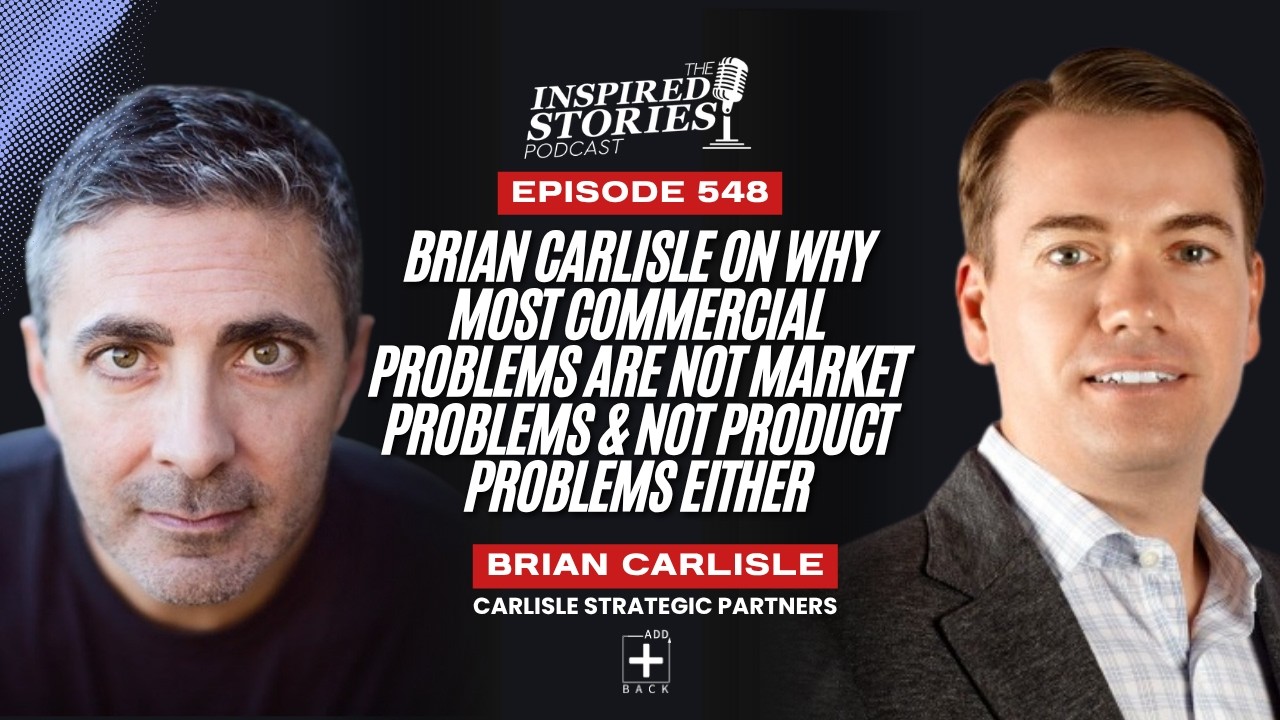
Brian Carlisle, managing partner of Carlisle Strategic Partners, was 18 years old when his throttle stuck on a jump at Buds Creek Motocross Park in Maryland, five days after 9/11, and he woke up seven days later in the ICU with a broken pelvis, lacerated spleen, bruised kidney, bruised lung, and a left side brain injury. The career he had planned in orthopedic surgery was eventually closed by four rejection letters he didn’t appeal. The career he actually built — in operating rooms, boardrooms, and eventually a CEO seat at a regenerative medicine company — took three decades to understand as a plan rather than a detour.
✨ Key Insights You’ll Learn:
Racing motocross competitively from age seven and the throttle malfunction that ended it at eighteen
The identity crisis that follows when the thing that defined you is taken away in a single moment
Applying to four medical schools, getting rejected by all four, and walking into an operating room three months after graduating anyway
Eleven years at Integra Life Sciences spanning field sales, operations, and a million-dollar commercial transformation project
The optics lesson that came with a great hotel rate nobody saw as a great hotel rate
Moving the family to New Jersey, starting a new job, going back to grad school, and welcoming their first child in the same three-month window
Becoming CEO of Nova Bone and learning for the first time how lonely that chair actually is
Eighteen-week road stretches that made leaving a dream job the obvious right call
The growth acceleration scorecard: seven pillars, weighted scoring, and two quick wins designed to generate ROI within six months
Why most commercial problems are not market problems and not product problems — and what they actually are
🌟 Brian’s Key Mentors:
His Parents: Gave him work ethic and values instead of things — his first car was bought with money he earned, and his dad helped him put a new motor in it
Division President at Integra: Identified Brian at 32, told him to move his family, go back to school, and take a corporate role — then walked him through exactly why that plan was right for him
VP of Sales at Integra: The mentor who taught him that a great result presented with bad optics is still a bad result
His Executive Coach (Penn State, PhD in Psychology): Helped Brian develop the framework of leading with courage and faith that guided his CEO tenure
Neighbor Who Worked for DePuy Orthopedics: The first person who showed him what a career in medical devices actually looked like after medical school fell through
👉 Don’t miss this conversation about what it means to build a career from a series of closed doors, why the hardest part of faith is applying it in the present moment rather than in hindsight, and how a motocross racer who never made it to the pros ended up building one of the more unusual advisory practices in healthcare.
Listen to the full episode here
Transcript
Anthony Codispoti (00:00)
Welcome to another edition of the Inspired Stories Podcast, where leaders share their experiences so we can learn from their successes and be inspired by how they've overcome adversity. As you listen today, let one idea shape what you do next. My name is Anthony Kotosbodi, and today's guest almost died when he was 18 years old, lying on a motocross track, not breathing, his pupils unevenly dilated, when paramedics reached him.
After 11 days in the ICU, he pivoted away from racing and toward a different kind of high-stakes world. Two decades later, that path ran through operating rooms, executive boardrooms, and a CEO seat at a regenerative medicine company. Before a string of 18-week stretches on the road pushed him to walk away and build something of his own. Brian Carlyle is the managing partner of Carlyle Strategic Partners.
A Philadelphia-based consulting firm he founded in 2023 to help early and growth stage healthcare and life sciences companies match the right capital plan to their growth and exit goals. He has led businesses to annual growth rates as high as 116%, and sales lifts reaching 373%.
Drawing on more than 18 years as an operator and investor. An executive MBA from Penn State is also his, and FINRA series 82 and 63 licenses as well. You know, there's something universal in building a career and a family at the same time, learning as you go and figuring out what you're willing to trade for that next mile. But before we get into all that good stuff, today's episode is brought to you by my company, Adback Benefits Agency.
And you'll want to hear this because it's hurting almost every business owner you know. Health insurance costs go up every single year, and businesses are furious about it. They're paying more, claims are getting denied, employees are opting out because they can't afford it, and it hurts turnover and morale. It's one of the most maddening problems in running a business, and everyone just accepts it. But you don't have to anymore.
Now there's a program that gives your employees unlimited access to doctors, therapists, and prescriptions with no co-pays or deductibles to meet. But here's the part that really shocks most people. Unlike every other employee benefit out there, our program increases your net profits. We recently helped a client add $900 per employee per year to their bottom line.
Results vary, but gains like that change how a business is valued.
You can be the hero advisor that introduces this to your clients today. They'll be so happy they refer their friends to you. Adbackbenefits.com. All right, back to our guest today, managing partner of Carlisle Strategic Partners, Brian Carlisle. Thanks for making the time to share your story today.
Brian Carlisle (02:56)
Thanks Anthony for having me. Glad to be here.
Anthony Codispoti (02:58)
So, Brian, take me back to the day of your motocross accident when you were just eighteen years old. What do you
Brian Carlisle (03:05)
Yeah.
Anthony Codispoti (03:05)
remember most clearly about that day?
Brian Carlisle (03:08)
actually I don't remember waking up that day. My first memory is waking up in the ICU. and I think I'd already been there for seven or eight days at that point. I know I remember my mother, you know, being there by the bed and you know, dealing with it was a left side brain injury was one of my injuries. And so with that
You know, that that was the hardest part to overcome, you know, broken bones, dislocated joints, you know, all those things. the it was the brain injury that was the hardest, a lot of, you know, disorientation, confusion, things like that. But but yeah, actually don't, you know, in terms of, you know, the actual accident itself, you know, to me it didn't hurt because I have no memory of that day. I do remember the day before. And just to give you a little bit of background and context, you know.
This was when I was 18. The date was September 16th, 2001, five days after 9-11. my first semester of college. And, you know, this goes back to my career that began when I was seven years old, you know, racing motocross. So I did it from seven years old competitively and getting more competitive as I got through high school. the track that we were at was Buds Creek Motocross Park in Southern Maryland. It's about an hour away from our house where we grew up in in Annapolis, Maryland. And I had raced thousands of laps.
on this track. I knew it cold. And the jump that I crashed on, I had done that jump again thousands of times. I could do it in my sleep and and yeah, that day was was a different day. talking to folks that saw the accident, it sounds like my throttle stuck. And so when I went to shut off the throttle that you know so that so I could, you know, jump this jump the right way, the throttle stuck.
And I overshot this jump by like fifty feet. And and that's kind of how the accident occurred. Wow. What was the aftermath like? You talking about
Anthony Codispoti (05:05)
What was the aftermath like? You talk about you didn't wake
up until six, seven, eight days later, and the physical
Brian Carlisle (05:11)
Yeah.
Anthony Codispoti (05:12)
part of it's one thing, but how did you recover from the brain injury? Is this just lots of PT?
Brian Carlisle (05:18)
That was so I I was in physical therapy, occupational therapy, and speech therapy for a month. I was supposed to be in all three for six months, but you know, this is the beauty of being eighteen years old. You you recovered, you know, quickly. I was fit and I was in good shape. the injuries from that day, I had a broken pelvis, lacerated spleen, bruised kidney, bruised lung, left side brain injury. Like I said, I also had a two millimeter bleed in my brain.
and I'm probably forgetting a couple of the other smaller things. But you know, the good news was the broken pelvis, where my fracture was, it was not a weight bearing portion of the pelvis. So it on the left side, which is where I fell. it was the ileum, so like the iliac crest. And so there was not a terrible fracture there. So I could weight bear. so that that was helpful. But it was the it was the head injury that was the hardest thing. You know, weeks, you know, months after being out of the hospital, you know, especially in the beginning, I would take like
long naps every single day. I was just constantly tired and generally irritable. you know, my mom would tell you that, you know, before this accident, you know, I was the the happy kid and, you know, always smiling and and I like to think I still am. but but that was tough. And I would say, you know, outside of the physical injuries, the hardest part was, you know, I was 18 years old, you know, I was my plan was to I wasn't going to make money as a
professional, but I did want to earn my pro card and qualify for a pro race. And I think that was within reach for me, you know, within the next couple of years. The year prior to this accident, I just competed at the amateur national championships, which is, you know, a feat just to qualify for that race. and I I was a good rider. I wasn't, you know, a top guy nationally. I was probably mid pack nationally, but I was a top guy, you know, locally and regionally. That's how I would characterize myself. And in that sport,
You've got to be the top two guys in your class if you're really going to make it as a professional. It's just such a such a small sport at the end of the day. But but yeah, the hardest thing for me was was the identity crisis that I kind of went through. Is if I'm not a motocross racer, you know, who am I? So, you know, I all of a sudden I'm into my first semester of college. My mom withdrew me from all of my classes because I was I spent, you know, a week and a half in the ICU.
So, and you can't miss that time in college. It's not like, you know, when you're in, you know, sixth or seventh grade. so I'm I'm withdrawn from all my classes. and the one thing I love is now gone. I could have gone back to it, but I think the writing was on the wall that, you know, we need to think differently about our hobbies. you know. and this was after a string of other orthopedic injuries, I could tell you separately. There's been plenty of them. But but yeah, that was the hardest one.
Anthony Codispoti (08:02)
Also from Mordocross?
Brian Carlisle (08:04)
Yeah, yeah.
And I'd say that, you know, we can get to it later, Anthony, but the tie there is if you can get the link between motocross and orthopedics, like for me it's it's what you think it is. So you know, all those days and trips to the orthopedic surgeon's office is what kind of got me interested in that as a career. And you know, timing and transition didn't happen like I thought, but you know, I found myself there pretty quickly.
Anthony Codispoti (08:26)
So I want to get into that
career transition, but you
highlighted something that I talked to a lot of athletes about, a lot of business owners about, high-level business executives. And it's this idea of the identity crisis, right? Like you had anchored yourself so firmly at a very young age to the sport that you've been doing for most of your life up to that point. And you knew that you weren't gonna make a living from it, but this was a big part of who you were going forward.
And now all of a sudden that gets taken away from you. And somebody who hasn't been through that before doesn't realize just how unsettling and disorienting that can be. Talk to me about what that process was like for you at at you know, just the ripe age of eighteen.
Brian Carlisle (09:12)
Yeah. Happy to, Anthony. And I think, you know, the other thing is and I I have a lot of friends that I still keep in touch with. We grew up racing motorcycles together. My brother, believe it or not, still races. He's a few years older than me. And, you know, there are a lot of people like my brother that will continue on in some fashion, not doing it to the intensity or frequency like we did growing up where we're racing, you know, all over the eastern half of the US every single weekend.
You know, so they kind of get to like ease into that, if that makes sense, Anthony. And and as they're doing that, they're building their career, they're building their f you know, family. And they you get this kind of like natural evolution to, you know, your your identity as an individual. I think two things for me that was one one was really hard is I didn't realize how firmly rooted, you know, that was in me until it was taken away. And it was taken away so swiftly. Now, the one thing I'll add is
You know, my parents, like I was 18, they gave me the choice. They said, Listen, you know, it was such a big part of me. They said, We're not going to tell you what to do, but this is what we think you should do. And for me at the time, I was so frustrated because, you know, I was coming off a year prior where I, you know, competed at the amateur nationals. and it seemed like for me in the sport, about every six months I had a pretty significant setback from an injury perspective. And so
And now I find myself in the ICU and I'm like, I'm I'm getting tired of this, you know, and I'm only 18. You know, what's it gonna be like when I'm 25, 30, you know, and I can't imagine, you know, guys that still do it at my age and they do. but I think, you know, having it taken away so abruptly, that was one part of it. And I wasn't aware how deeply, you know, rooted in me it was. I'd say the other thing was, you know, I'm dealing with this change while also recovering from a left side brain injury, which generally makes you grumpy.
and tired. And so, you know, doing all of those things abruptly at the same time, you know, it it takes the wind out of you, if that makes sense. And so, you know, at the age of 18, you know, looking back now, I look at all I gained from that, right? I mean, you know, you're gaining skills at dealing with things that are challenging mentally and emotionally. And, you know, if you can harness those skills and figure out a way to
I talk to my boys about this all the time, but if you can figure out a way to, you know, thrive in an environment when you are mentally stressed or uncomfortable, and I mean that's a heck of a skill. And so I didn't realize it when I was 18. but but there's a lot of good things that I got from that.
Anthony Codispoti (11:52)
Any lingering
effects of that brain injury today?
Brian Carlisle (11:57)
Well, it would depend on what day you ask my wife. but no, I I say that jokingly. No, there's no there's no lingering effects that I know of. I mean, I'd say the other thing is, you know, the accident was in 2001. You know, my motocross career was largely through the nineties. And so, you know, think back to the nineties, you know, Troy Aikman gets concussed, he goes back in the game. You know, so so we didn't know a lot about concussions in the nineties. And I'd say
I don't even know how many I've had that were just undiagnosed. You got your bell rung. And as soon as you're not nauseous, maybe it's okay to r race, you know. And so, you know, I think I think I did the right thing of getting getting out while I was ahead, if you will, right. And so, I would say no lingering effects from it. but you know, if I was actually properly evaluated, somebody could probably say, Hey, you know, there's a handful of things here or there, but I mean, I'm able to.
I'm able to get up and get going every day with without any any lingering effects. And I think I think for my my mom, I'll just share the the lighthearted part of it. Like when I went back to college the next semester, I took calculus and general chemistry and I think a couple of other classes and I got A's and B's and everything. And when my mom saw that, she's like, Okay, I think I think he's okay.
Anthony Codispoti (13:16)
That was the litmus test. So you end up going
Brian Carlisle (13:18)
Exactly.
Anthony Codispoti (13:19)
back to college.
and then now you've got this interest in the orthopedic world because you've gone through it yourself as a patient. how does that transition from college into I think maybe your your first job foray was an internship at Biomet, am I right?
Brian Carlisle (13:39)
That's correct. Yeah. And so, you know, the one thing that I was I was always successful with, you know, even, you know, in high school racing motocross, I was always if there's a goal that I wanted to accomplish, I was always able to put together a plan that I thought would have a high likelihood of of me resulting in in achieving my goal. And once I had that plan identified, I could could
You know, it's one thing I got from my father is, you know, being able to focus on something and and work extremely hard at it, maybe a little bit too determined at times. And so, that's one thing I gained from motocross. People only see the the the trips to the ER and the injuries and the think, my God, what a terrible sport. Just to share on a quick side note, every weekend we got into our R V. It wasn't the nicest RV in the world, but it's what we could afford. And myself, my brother, my dad, my mom, and our dogs, we would travel
Three, four, five, six, you know, seven hours plus together on a weekend. And we it was the family sport. We all went together every single weekend. And it was an expensive sport. So at the age of like 16, actually excuse me, 14, I started working full-time in the summers. And every paycheck I got, and this is back when you actually got the paper check. I remember when I was 14, every check I gave it to my mom on Friday.
At the end of the summer, I'd made $2,000 working full time doing construction. We sold my bike at the end of the at the end of the summer and we bought a brand new motorcycle because I had between the money we got selling my bike and the money I made over the summer, that's how I afforded my next bike. And so if you if this makes what sense, Anthony, like, you know, there was a need to do it. So I worked summers full time every summer in high school. When I had my driver's license, I had a job in the restaurant industry part-time after school.
And it taught me how to work hard. And so I was able to harness that when I find myself in college. I'm like, all right, now I got to think about a career and really think about a career. So here I am. And when I decided on orthopedics, you know, I was one semester into college, and I'll just share this briefly and we can pause. I was one semester in the college and I did the math and I had like a three point one GPA from that one semester. And I did the math and I said, okay, here's the average incoming GPA from a medical student.
for me to get my GPA up to I think it like 3.75 or something like that. I'm like, I have to get an A in pretty much every single class until I graduate, which I'd never done before. I'd never gotten I was always a good student, but I was never a straight A student. And so I'm like, okay, here we go. this is the this is the plan. This is what I'm gonna have to do. And man, I put I put every ounce, I did not have the normal college experience because I was working so hard trying to achieve this goal. but I did it. And my net my last
three years I I got one B in anatomy one. I got a B plus in anatomy one. And my last five semesters at Towson I was a four GPA. And so it was it was it was a heck of an effort. more than I anticipated, but
Anthony Codispoti (16:48)
Do you think that drive was innate? Like were you born with it? Or do you think some of what you went through in terms of the physical hardships of motocross brought it out in you or somehow stirred it up?
Brian Carlisle (17:01)
I think it's probably a little bit of both. I mean, you got I think there's something that is kind of like hardwired into you. And I I s what makes me say that, Anthony, as I look at my brother, he's exactly the same way. He's exactly the same way. he built a construction side company that he started when he was nineteen years old. And now he's one of the top custom home builders in Annapolis, Maryland. I think he does his business probably I don't know, his business, it's a large business. He has like 50 employees. He's been very successful.
And no one gave him anything. He had to earn it all. And it's always been the same way for me. So I think I think some of it is innate. I think some of it's how our parents raised us. they did not give us anything. And when I say that, I mean they gave us, you know, a house and, you know, but they they gave us work ethic and values and helped us build character. They didn't hand us things, right? Our first car, we, you know, worked and we made enough money to buy our first car. And then my dad helped me put a new motor in it because he was a mechanic.
And so, you know, I got plenty of help from my parents, don't get me wrong, but they taught me how to earn things. And that was the biggest gift. And but I think to your point, I think some of it was innate. And then I think part of it is, you know, you've got these characteristics and you're put in certain situations where, you know, you've got to lean on those strengths. And and for me, you know, my dad would tell you there's been and we're gonna talk about them today, Anthony, but there's been several times where I've had to pick myself up off the ground and and I'll joke sometimes and say I can take a punch, you know,
and not
Not not, you know, literally, but but I can I can take a hit and I can get back up because I've had to do it before and I know I've got it in me to be able to do it. So you
Anthony Codispoti (18:39)
So you've had some success
in your career, and we'll kind of get into talking about that. And
Brian Carlisle (18:43)
Sure.
Anthony Codispoti (18:44)
n now you're a parent with, you know, you've got your own kids that you're trying to raise. How do you think about
raising them in a way that they'll have that same drive, right? Like
Brian Carlisle (18:58)
Yeah.
Anthony Codispoti (18:58)
maybe a certain level of it is innate in them. But in my experience, and this, you know, bears true in hearing your story, a lot of that gets sort of stirred up or kicked up in somebody by going through really hard stuff. And as a parent, you don't want to see your kids suffer, right? Like you try to protect them, but at the same time, you know that there is value in that struggle.
How do you balance
Brian Carlisle (19:24)
Yeah.
Anthony Codispoti (19:24)
that? How do you think about
Brian Carlisle (19:26)
I mean, I think it it I this is a great question, Anthony. And my older son is eleven years old. He plays a lot of baseball, very competitive baseball. And where we live outside of Philadelphia, baseball is a very big deal. one of the things I like about it outside of the sport and the outlet and the things like that that he gets is baseball is a game of failure. And if you cannot grind, it is the wrong sport for you.
if you're looking for immediate results, it is the wrong sport for you. If you're successful three out of 10 times or in the Hall of Fame, that's the way that sport is. And that's one of the things I love about it. Even though my, you know, youth was all spent at a motocross track. You know, there's a sport I really gravitate to today. It's baseball, and it's for a lot of those reasons. And so that's what I'm trying to teach him is I'm trying to teach him how to grind. And I'm trying to teach him to place focus on the process.
And put faith in the process and put in the work. And I also try to remind him, and I said, listen, like you're not going to get the result every time you go out. You're not going to have good game every time you go out. But I I'll remind him, I'll say, Jackson, and I'll point back to a game where he just had an amazing day. And I'll say, Remember this game and remember those two hits. How did you feel when you're standing at second base? And he'll tell me, he's got a great memory. He's like, It was it was amazing. And I said, The reason that felt amazing.
is because of the work you put in and how you were grinding to make those adjustments into to get better at the sport. And that's what I hope he gains from it is is that, you know, perseverance. And so, you know, some of that's, you know, I'm gonna have to, you know, teach him and kind of guide him there. it sucks watching your kid have a bad day, you know, whether it's, you know, something at school or sports. but I I think about Anthony, I think about it all the time. And
And that's really why I made
the change leaving my last business. I mean, I I had a dream job for me. And you know, but I was tr I was on the road every week and I was yeah, I was gonna miss everything. And, you know, they they need their dad, and it was my job to be there for them more than to run the company, and so that's why we made the the pivot. Sure.
Anthony Codispoti (21:37)
So let's get into the career path a little bit. so we talked briefly
about the internship at Biomet, the fourth largest orthopedic device manufacturer in the world at that time. You end up spending nearly 11 years in sales at Integra Life Sciences, medical equipment manufacturer. Eventually became the director of sales, two years as commercial chief commercial officer for Max Tech, which was acquired by
PermaPure. These are both also medical device companies. You're mastering the process of selling. You're building sales infrastructure in the medical device space. Before we get into, you know, what you you eventually became the CEO of Nova Bone and, you know, then end up making a pivot. But before we get there, highlight for me maybe a powerful mentor that you experienced along the way that really helped to.
Define your approach to business and sales.
Brian Carlisle (22:36)
Yeah, that's a great, great question, Anthony. And I'll say one of the things, so when I was at Integra, just to you know, quick clarification, I was there for eleven years, variety of commercial and operations roles. That last director role you were were speaking at was in operations, actually, not in the in the sales department. And so, you know, for me being a commercial guy in the field, in the operating room with surgeons and patients every single day.
When I took that role, the quick backstory is and I knew the leadership team at Integra very well. And and I still know the many of the folks that are still there. but I was 32 years old. I'd been with the company for let's call like seven or eight years, and the division president I was with, you know, reached out to me and said, Hey Brian, he's like, How'd you like to come out of field sales leadership? We'd like you to come work out of the corporate office in Plainsboro. We'd like you to move your family to New Jersey.
And we think you should go back to school and get an MBA. You know, how's all that sound? And I said, I said, that sounds terrible. I I don't want to do any of that. and, you know, but he kind of walked me through like, hey, these are the he knew where I wanted to go in my career. And he said, you know, these are the things that you don't have that you're gonna need. And it's really about a learning perspective, not a checking of the box. And so you know, I kinda again gained faith in that plan. I said, This is this is a good f plan. So
Within a three month period, my wife delivered our first child. she quit her job. We moved our family to New Jersey. I started a new job and I went back to grad school all at the same time. so yeah, you're like it was it was a it was a mess. it look you know, it's a thirty-two year old, never been a parent before, like, yeah, what could possibly go wrong? but but we did it and you know, God bless my wife for for her strength and and endurance as well. But
it when I when I moved into that internal role again, that was a huge pivot for me. I mean, you know, for a sales guy, you know, that's used to being in the field with the customer every single day. Again, sales job can be a grind, which I I loved. I I I've learned how to grind in my life. now I'm inside at the corporate office, you know, and we're meetings all day and and stuff like that. And, you know, I kind of felt like a caged animal like being inside there all day and
It was a different environment. And it was it was a good thing for me. Don't get me wrong. When I moved on from Integra, I could not have done those roles without the lessons I gained in that role. But getting back to your point on mentors, Anthony, I developed, I would say, a bench of mentors. And this was the one thing that I valued. Our VP of sales at the time was a phenomenal mentor, and he there's a couple of things where
You know, I remember a project I led and and there was a specific question I had and I was like, I did this, you know, this good thing and this is the return we got. And without getting too deep in the weeds, he was like, Yeah, but the optics of it was different. And I was like, I didn't I didn't think about it from someone else's perspective. and so he was an amazing mentor to me. The chief commercial officer of the company was an amazing mentor. Yeah.
Anthony Codispoti (25:47)
Sorry, sorry, Brian, go back to that. The optics
of it were different. Say more about that.
Brian Carlisle (25:52)
So I'll just share with you the the story. We were doing a a project that should have been run through the sales training department. And for a variety of reasons, the division president, you know, pointed at me around all of his staff in his boardroom and he said, you know, you're gonna lead this project. It was to deploy a customized sales process and methodology across all of the channels across the division. so completely transformed the way we operated commercially.
And I'm by far the most junior guy in the room. And I've got to align stakeholders all the way up to the executive leadership team on how we're going to do this. And so, but you know, division president at the time, you know, pointed at me and he said, You're gonna do it. He said, Go build me the plan. And so I did. And but the getting back to your point around the optics, you know, he was this is an unbudgeted project, right? So
And I built the plan and my budget was a million dollars. So I went back to him and I said, Here's the plan. I need a million dollars to do it. And he he gave me a million dollars to go do it, but it was not in the budget. So an unbudgeted million dollar project is not something people, you know, say yes to easily, right? And so there were a lot of eyes on this project and me across the company. And so the first phase of it, I had to I had to take a bunch of people out to Chicago for this event.
And we were able to, it's kind of a funny story, but we were able to get a contact at, you know, Hilton Corporate and was able to get a great rate at the Hilton on Michigan Avenue, south of the river. great historic property and and we got a phenomenal rate at this property. And we come back and you know it was a great, it was a great event. everybody had great things to say about it.
And the division president made a couple of comments about like, I I heard you guys had a good weekend at the Ritz. And I was like, I was like, I was like, you know, basically the point was normally projects like that were are done at like airport hotels, you know, because it's you're trying to be budget friendly, get in and out, that type of thing. And for a variety of reasons, I chose this location in downtown Chicago, but really because I got an amazing deal. And the feedback from my mentor was he's like, Well, he's like, Brian, it like, I get that you got an amazing deal, but like
think about the optics where you've got this unbudgeted project and you take everybody to this fancy hotel for the weekend.
Anthony Codispoti (28:17)
Not everybody is seeing
what the bill was. Everybody saw that you guys went to the fancy hotel on Michigan Avenue.
Brian Carlisle (28:22)
They they only
saw the optics and I was like, it's like man, that's actually like a good deal, you know. but it was it was a valuable lesson learned, right? And so you gotta you gotta be mindful of others' perspective.
Anthony Codispoti (28:35)
So you
eventually become CEO of Nova Bone, which was a regenerative medicine company owned by Homa. as you're stepping into the big boss role for the first time, what's something that really surprised you?
Brian Carlisle (28:51)
boy, that's a great question. you know, I I think a couple of things. One is there there were a couple of things that
I I would I had an executive coach that I'd worked with since my days at Penn State. also had a Penn State executive MBA and a PhD in psychology. So he was like the perfect coach for me. And we together came up with this concept of leading with courage and faith.
courage that, you know, I am making the right decision or the decision that I feel like is the right decision and faith that what we're doing will lead to the result that we're trying to achieve. I'd say the biggest thing that I realized is, you know, people you're not gonna please everybody in that type of role. And no matter what path you choose, you're gonna have people that that disagree.
And there were a couple of instances that came up that kind of surprised me, like people that were on my leadership team that I thought really highly of that I learned down the road were, you know, not supportive, even though they were appearing to be supportive. And so that was that was the first time in this sp specific instance where I realized how lonely that job can be. and it's one of these things I feel like when you're at, you know.
mid-level management and senior level management, and maybe on the executive team, you're working so hard to get to that role. and I, I, I liked that role. I I was very passionate about that company. and I'm still passionate about that business today. but it wasn't all it was cracked up to be, I'll tell you. I mean, it wasn't, it wasn't sunshine and rainbows. it was it was it was a challenge, and I love a challenge.
But I would say that's that's probably the thing that surprised me the most.
Anthony Codispoti (30:43)
And so you alluded
to this before. You were sort of doing these eighteen week stints on the road and you finally kind of reach the breaking point. Enough's enough. You decide, I'm gonna you know, this was your dream job, but you know, you weren't getting to spend time with the family. And so you decide to pivot. You jump ship, you're gonna go do your own thing. This is a big leap. Tell tell me about what's going on at this time.
Brian Carlisle (31:07)
Yeah, I mean, and and my wife stayed, you know, home with our boys when we moved to New Jersey, you know, that that kind of, you know, life kind of naturally gravitated that way for our family. So I was the only source of income for the family. And so to make that pivot, that was again a huge leap of faith. But one of the things I realized, Anthony, was, you know, both at Halma and Integra, both highly acquisitive organizations.
And then also, you know, completing the executive MBA program, I had a lot of buy-side MA experience. And, you know, early in my career at Integra, I was maybe, you know, a member of the commercial team doing diligence, working on the integration, but I was on the deal team, even at it early in my career and getting later and later in my career to the point where I could actually build these models myself and run the return analysis and things like that. and I I loved it. And, you know.
a lot of people that it knew me well, like man, they would refer to me as a deal guy. And I I kind of am, right? It's my commercial roots. I love I love, you know, the deal process. And so, you know, that in my
Anthony Codispoti (32:07)
And sorry, Brian, they're
calling you the deal guy because you're the one putting the deal together. You're the one analyzing the deal. Like, what's your strong suit?
Brian Carlisle (32:17)
I'd say a handful of things. One specific example, and this is something I have today. I have a thesis in regenerative medicine, and it's around building a diverse regenerative medicine business. And I've got the market opportunity there, the product opportunity, the the comps, you know, how you would build it, the value creation model, all of it. And it is it is my IP. And so when I've shared this with other, you know, PE sponsors, for example.
You know, one in particular said he's I can tell you're a deal guy, you know, because we we'll walk through the whole thing and you can see that I can visualize the lack of something in the marketplace, but the opportunity for it. And here's how we would build it, and here's how we would run all the financials, here's the value creation model, here's what the five-year period would look like while we would hold the asset, you know, so on and so forth. So if you can, you know, follow the through from this example. I mean, I really gained the tools throughout my career.
all of these deals I did at Integra and Halma and then with my MBA, I kind of built the tools to be able to do this. And so as I was starting my advisory business out, you know, what I learned was that operational lens and that deal experience is a unique combination. And that was when I realized that that was the genesis of Carlisle Strategic.
Anthony Codispoti (33:34)
Okay, so that's where this whole idea comes from. Too much time on the road. I'm the deal guy. I've got these skills. I'm gonna go off and do it on my own. So tell me about pulling that band aid off. What was it like in those first days, weeks, and months? How are you getting clients? What are you doing when there's no cash flow?
Brian Carlisle (33:53)
Yeah, great question. I mean it was just it was a constant learning journey. You're never comfortable. Never. because y you know you have a general idea of what direction you want to go, but you don't know exactly how to get there. And so the way it started was I had this thesis and I was working with a PE sponsor on it. And that kind of helped kind of jump me forward. And and I'll just say, you know.
At a very high level, Anthony, you you find something that is is the thing that moves you forward. And then that leads you to the next thing, to the next thing, to the next thing. And then two, three, like where I am now three years later, I look back and I'm like, man, I made like a million mistakes. And, you know, I would reflect on the learning journey a lot. And I look at I look at how much it's evolved and matured and and where I am now. And it was
It's been a heck of a journey, right? And so just to give you an example, in the beginning, we're working on working on this, you know, this this thesis with a PE sponsor. again, I know how to run these models. And we backed away from this deal because we could not wrap our arms around the right purchase price with the founder. And we all agreed that it wasn't the right time. We we backed away. And so as I was starting that, I formed a relationship with an investment bank.
kind of started me down this process of, you know, maybe I should get registered because some of the things I was going to be advising on you know were around the realm of requiring a registration a
Anthony Codispoti (35:33)
What type of registration?
Brian Carlisle (35:35)
FINRA registration as a registered representative. So a securities license. And and obviously as you shared previously, I did commit to going down that path and getting
registered and that led me to my relationship with Blackpoint Capital Markets, which is is thriving today, where my registration is held and and, you know, folks that I partner with on on the vast majority of of clients and projects. it's been a constant it's been a constant learning journey for sure.
Anthony Codispoti (36:03)
How did you get the first client for Carlisle?
Brian Carlisle (36:07)
yeah actually, you know what? it was it was through my network. and so as I was building this, I started talking to people that I I know and trust for my career. There's mentors I had at Integra, I talked to all of them frequently. And I developed new mentors as well. And all of all of my clients came to me through referrals. Many of them were people I had either worked with at Halma or or Integra.
And one of my first, you know, referrals was through from a colleague that I had known for years, an individual that actually worked for me in the past. And he said, Hey, I've I've got this former colleague. and he could use some some advisory support. So I connected with him. He was an AI technology focused on revenue cycle management, supporting hospitals and healthcare systems in automating denials management. I mean, and think about that for a minute. I mean, huge value creation opportunity.
gifted founder. And this was my first success story over a year later. We probably worked together for a year and a half. And he eventually sold his company to KKR. so that was my first exit. And it was a great one going to a brand name sponsor and still keep in touch with Eric the these
today. but that was a great one. And so it was it was good to get one over the finish line within I'd say the first, you know, 18 months. So depending on what I'm working on
Anthony Codispoti (37:33)
So distill it down for us, Brian. What does
Carlisle strategic partners do and who do you do it for?
Brian Carlisle (37:40)
So great question. My client focus is a mix of med tech and biotech. And the advisory services are, you know, really around, you know, strategic planning, capital formation, value creation, growth acceleration, and exit planning at MA. so we we do I I don't want to have a big stable of clients. We want to have long-term partnerships. And so
whatever the right number of clients is to where we get involved early enough to where there's some amount of traction. So if it's a medical device client, you know, for example, they would likely already have, you know, an FDA clearance for their first product. but there's a lot of opportunity to shape that strategic plan, the value creation you know narrative that's going to be needed, helping them accelerate growth commercially and then really firm up.
You know what that that exit pathway looks like. on the exit pathway, we start those conversations from the very beginning because the whole goal here is with our processes, I want my clients to be very intentional about what they want to build for when they want to exit. Right. And so if they know they want to exit to this type of sponsor, to this type of company, what are some of the characteristics we'll want the company to have to achieve that exit? We start thinking about that from the very, very beginning.
you know, as as you know, Anthony, many founders are only looking at that next step. They're not looking 25 steps into the future. So that's kind of what we bring is that end-to-end process of putting together that strategic plan that will get them the desired exit and helping them in the value creation and the capital needed along the way. The whole point of the FINRA registration was we want to be there to support them on the transactions that are needed along the way. And we wanted to be able to do that in a regulatory
in the in the in a regulated and compliant manner. there are a lot of people that do what I do and don't actually get a registration. And my thought there was I've worked in a highly regulated industry my entire life. Why would I skirt the regulation now? so it's a lot of tests to take, but I've always been good at taking and passing tests. So what was three more of those? And so that's that's a little bit about what we do. I'd say our our client mix is a mix between biotech and med tech though.
So yeah, that's that's a little bit about it.
Anthony Codispoti (40:03)
So take us back to that one client that you were mentioning, the first one, where you took them into an exit
Brian Carlisle (40:10)
Que
Anthony Codispoti (40:11)
to KKR within eighteen months. What do you think along the way was the biggest thing that you did operationally or strategically that helped to make that transaction become a reality?
Brian Carlisle (40:25)
Yeah. great question. you know, for for my clients specifically, one is matching with the right sponsor, right? And so that that's going to be a key thing. you know, based on the size of his company, you have to think about it. If you're selling the private equity, is this gonna be a platform asset? Is it gonna be a tuck in or a bolt on to another platform based on the revenue and profitability? You can quickly answer those things. And then it just comes to
you know, matching them appropriately. And I'd say the last thing is, you know, for my client, you know, did not have a background in private equity. And so as we were working through the negotiation process, being able to translate how all of that works. Like versus if you sell to a corporate, you know, you're likely getting a check at close. I'm kind of, you know, paraphrasing specifically, you're getting a check at close and maybe an earnout if they want you to stick around.
The private equity model is a little bit different. They're gonna want their founders to roll in part of equity from the first closing into the deal. And so, you know, the the narrative is you get two bites of the apple, right? You get a you get, you know, take some chips off the table with that first closing, then you're a part of the value creation with them and that platform for the next five years. When they sell it, you get that second bite of the apple. Maybe you get a third and a fourth bite if you keep if you continue to stay on. So if you follow me, it's a very unique model.
And based on my background in private equity, I able to guide my client throughout all of it and kind of work with him to align on what was the right approach for him. And so, again, you know, kind of looking back, you know, that that PE sponsor that I worked together on that regenerative medicine thesis, it was that when I really gained, you know, deep insight into how the PE model works. every, every organization's got a different model.
You know, Hulma had a different model than what most PE sponsors have. And once you like for me, I was always able to figure out what that model is. And once you understand what that model is, you can figure out how to how to maximize it. And so that's what I help my client with in this instance.
Anthony Codispoti (42:29)
Without getting too far into the weeds,
can you give me an example of the different models that you might run into? What might be different?
Brian Carlisle (42:38)
So I'll give to a good example. Halma is a holding company, right? And so they tend to buy and hold assets and they hold almost an it's like a Berkshire Hathaway. You know, they very rarely divest and you have all these decentralized operating companies with their own brand, you know, reporting up their financials to, you know, the parent company. You know, your value creation model in that instance is gonna be very different than in the PE model.
In the PE model, you're thinking about typically like a five-year hold. And so when you're thinking about organic growth and MA, how can you maximize the value creation plan for within a five-year window? Knowing that, like I'll give you example, new product development in medtech in a regulated industry can be expensive and lengthy. You're probably not going to invest as much of that in years four and five because you're not going to see the return from it. So you have to balance the value creation.
approach based on the model. In the Hulma model or a holding company, you know, you don't have that that window. And so it's it's a different way of approaching it. And so you just have to think about what some of those guardrails are
so that you can you can be effective.
Anthony Codispoti (43:50)
Tell us about
the growth acceleration scorecard, Brian.
Brian Carlisle (43:55)
Yeah, happy too. So the genesis of the growth acceleration scorecard is, you know, really, you know, just sharing with you, you know, how I support my clients today. I'm I'm working at the CEO and the board level, really around strategy, operations, high-level value creation. and I wasn't getting into the weeds as much on the commercial side. And
You know, as we talked about my career, you know, my my background is I'm I'm a commercial guy at at heart. And so the projects I ran at Integra, that first, you know, chief commercial officer role at Halma, you know, I got to build it at Integra and then deploy it at Halma, if you make sense. And so, I look back and I said, you know, there there's a lot of muscle here that I'm not flexing, if you will, around the commercial side here. I'm like, what's a good way for me to offer?
You know, these services, the clients that could benefit from them. and that's how the genesis of the scorecard came. I said, I thought to myself, if I could make this a product, it could be something that I could do that would be relatively time efficient for me and for the client, but also capital efficient. I wanted to create something that would be reproducible, not an organic, heavy lift every single time. I wanted to have kind of like an infrastructure built, if that makes sense, Anthony.
And so part of this comes from, again, I was thinking about the first HOMA company I was with. You know, you've got a budgeting process every year. Let's say you're forecasting a couple million of EBIT of growth. You're if you're forecasting a couple of million EBIT of growth and you're an executive leader in that company, you're not going to get four or five hundred thousand dollars to go run a project with a McKinsey around your commercial organization. You're just not going to get that. and so I thought about companies like that that could use those resources.
And the need to be able to do something that was capital efficient, time efficient, and also help them generate a return within the first year. And that's how I came up with the growth acceleration scorecard. and that's that what I just shared with you, Anthony, that's kind of how the process started for me mentally. And so I started to build it. I didn't know what it would look like when I was done. I just kind of, it was almost like you're gonna build your first house and you just start laying the foundation and
And start sanding up walls and going from there. And that's really how I built it. It was very organic. It was around the things I believed in. we talked about those mentors that I developed. I shared it with all of them and I got their feedback along the way and I made edits. And I would have a revision, I would share it with them again, I'd get feedback, I'd make edits. And and what I ended up with in the end was a a tool that is based on seven pillars.
And within set each pillar, there's a variety of different questions the client would answer. And they're all scored and weighted independently. And at the end, they get a score across all seven of these pillars. and I'll share with them what their score is. I'll share them a radar so they can see their various strengths and and weaknesses. And out of that information, we'll generate an implementation plan for the next 12 to 18 months for them to go scale their organization.
And it's really around putting together the right commercial infrastructure so they can execute on growth. Rarely is it a market problem, rarely is it a product problem. What I see frequently is a process problem. And so if you can align, you know, even simple things, sales targets, compensation plans, do they have a process? How do they forecast? Right. When I look at many companies, when I get introduced to prospective clients.
Most often these things are disjointed. Frequently they're broken. And they're just trying to muscle through and get growth. And they're saying, we should be growing 20%. Why aren't we getting it? And there's no one and you say, Well, where talk to me about 20%. Where did that number come from? And they'll say, Well, that's the number the board gave us. And it's like, okay, well, let's backtrack from there. And so if if you can imagine, Anthony, once we go through the scorecard process, we build this customized inf implementation plan for them.
But then I highlight two quick wins where I say, go execute on these quick wins within the first three to six months, and we'll get the return on the investment. And then we're off and running from there. And so I've got a case study on my website, and there's even a free snapshot they can take to kind of get a high level view of what their score would be. and so if somebody wants to go on my website, they can take that free version of the scorecard and see the case study as well.
Anthony Codispoti (48:26)
So this is
Carlisle Strategic dot com. I see a menu choice right there at the top called scorecards. there's a comprehensive diagnostic labeled as level two, the free snapshot, 10 minutes, two or ten questions, two minutes. that's what you're talking about there. So Carlisle Strategic dot com, go to scorecards, and you can see the free snapshot there.
So somebody can get kind of a high-level overview of here's my score, here's where I'm strong, here's where I'm weak. And if they kind of like where that's heading, then they can reach out to you and get that comprehensive diagnostic. you know, you'll lay out for them here's a a plan to get you to where you want to be in the next 18 months. you talk about highlighting two quick wins for them so that, you know, they've made a little investment to.
to do that diagnostic, let's start to get a little momentum, a little revenue back from that. Can you give me an idea of some of those
quick wins that you've prescribed for your clients?
Brian Carlisle (49:30)
Yeah, for sure. even just around like the compensation plans. I've seen some crazy things. And you know, I this I'll just give you this one briefly. and we did this at the first Halma company I was with. We we we redesigned, I redesigned all of the compensation plans immediately. and it was around a couple of things. One is I wanted them to be very simple.
we wanted them to be purely focused on growth. one that I see frequently is you you dive into their their comp plans and there's all of these MBOs, management by objective, and they've got these, you know, things like, hey, book five meetings, do three of these, four of those. They got to document it. it's never documented properly, so it doesn't stand up to an audit. That's one problem. The second thing that I always had an issue with them is, well, why are we paying somebody a bonus for doing these things that are
just their job, right? And so if we've got a bucket of money to pay these people, let's pay them on growth. And so there's a handful of things that I I've done with with many clients to simplify their compensation plans, make them easier for the sales team to understand, but then also incent them to perform above quota. One of the key principles here is you're always going to have, you know, the top 20% in any commercial organization.
That if you got a a growth number for the organization, let's say it's 12%, you've got, you know, the top couple of folks are gonna way overachieve their plan. And you need them to way overachieve to make up for some of the ones at the bottom at the organizational level. What I've seen with a lot of comp plans is it caps out at a certain amount. And, you know, one thing I'm I'm convinced of at this point in my career is if you put a plan in front of a commercial person.
They will find their way to maximize their benefit from that plan, not always the company's benefit, right? And so if you follow me, Anthony, I try to align some of these things. Give a plan that will be uncapped for your top performers, for everybody, quite frankly. And so you can enable them to make more money and and and continue to sell. Like you want those people making the call on Friday afternoon, the last day of the quarter, even though they're 150% of the quota.
If they're already capped about how much money they make, they're on the golf course. Right. And so it's just an example of a quick win. Those aren't hard to do, quite frankly. and I've got an approach that that it's a a bit of a structure that I've kind of shared with you just now. And so that's that's one that I see frequently, Anthony, just because it's one of these things. And and and I the reason I know how to do this is because the projects I did at Integra, we got to use the big box consultants to help us build some of these tools.
And so I was able, I was able to kind of learn what did I like as a commercial leader? I carried a bag one day, what would motivate me? What works at the at the board level? And what are some of the principles that I've learned from working with these big box cons big box consultants? And I bring all of that to the table to try to, you know, put something together for my clients that is unique. But I tell you what, like if you go to a a a a sales leader and say, What do you think about your comp plan?
Ninety nine times out of a hundred is hey duh it's not good. This is this is wrong, it's not fair, whatever. I when I revise them with my teams, most of the often, the majority of them were like, Yeah, it's a good plan. I'm making good money and I'm being paid for, you know, the wins I'm pulling in. That's what you want to see, and it's not that hard to do.
Anthony Codispoti (53:09)
You know, I had to laugh as you were telling that story. I've
got a good friend who's in medical device sales, and the story you tell exactly mirrors, you know, his experiences. He's one of the top performing salespeople in the company. but he hits his quota and there's no incent they won't pay him extra for going beyond that. In fact, he gets penalized because the then next time, you know, they come around at the same time next year, you know, they're gonna move his his.
base based on what he had hit before. And so he does exactly that. He hits his quota and he's all on the golf course the rest of the quarter. He's he's not putting in the effort. So yeah, I had to kind of chuckle at that one.
Brian Carlisle (53:47)
Exactly. And that's crushing. So
when I when I made them uncapped, so the first Halma company, that's one of things we did. We made the the the compensation plan uncapped. There's some things you have to do so that somebody doesn't get like some crazy bonus. But the bigger thing is, you know, I I was a commercial leader. I had to go to the CFO and work intensively with the CFO and show him that, like, by the way, in any budget, in any operating model with a company.
Dollars above quota drop to the bottom line faster than any other dollars because you've already exceeded the budget. Right. And so if your gross margin is 70%, then 70% of the dollars should be dropping almost down to net profit. Doesn't always work out exactly that way. But as the company scales above quota, those are the most profitable dollars. And I had to sit down with our CFO and say, we're not gonna, someone's not gonna make this egregious bonus check that is gonna bankrupt the company for one. I had to show them how the plan would mitigate that.
But then I also to show him like we want to be in this range in the above, you know, a budget dollars where they're the most profitable. And so if you don't have that business acumen, and for my clients, I help them, I help them navigate this, right? If it's and usually I'm at the CEO level anyways with my clients, but you have to give them that those those pieces as well, not just the pieces that the commercial team's gonna like. But again.
If it's if it's good for the commercial team, it should be good for the business because they're the revenue heart of the company. And so that this so this is just one example of a quick one that it appears a lot and a lot of times we'll we'll dive in there first.
Anthony Codispoti (55:22)
Hmm.
Brian, I wonder if we've already touched on the answer to this question, but longtime listeners
to the show realize this is one of my favorites. What's the hardest thing you've had to overcome? And what did it teach you?
Brian Carlisle (55:36)
boy, a couple of times. I mean, I'd say it's been a principal, you know, several times throughout my life. And we talked about it in the beginning, you know, going from, you know, motocross, career, life pivot number one, you know, to college. And then, you know, all the work I put in trying to take, you know, a pathway towards, you know, medical school. And it for me, there's just been points in my life where
I'm heads down. I'm grinding, trying to get to a goal. And then I get there or close to there. And then life shows me that that's actually not what I'm supposed to do. And I should be doing something else. so I'll give you I'll give you one example. You know, I I was dead set on on becoming an orthopedic surgeon. Dead set. And I had the grades to get into medical school.
And the first four schools that I applied to, I didn't get into any of them. Now, granted, they say you're always supposed to have like a safety selection. I did not. I applied to really good schools and I didn't get into any of them. and it was it was devastating. I'm like, you know, I've been I've been grinding for four years. All my friends were out partying on the weekends. I was studying and working. And I'm like, why did I do why did I put in all of this sacrifice to to just be met with a closed door is what it felt like at the time.
I could have I could have, you know, reapplied for the next year. And I know there's schools I could have gone into, but it if if you follow me, Anthony, this was a devastating period. I'm like twenty-three years old, twenty-two years old. And I f I learned about the medical device industry at the time. And I say, Well, that sounds interesting. I get to actually be in the orthopedic industry and I get to be in the operating room. And it was a neighbor of my parents worked for Depu orthopedics.
And he was a mentor to me and he kind of guided me in, you know, this is what the industry is like. This is your best way of getting into the industry. he introduced me to folks at his organization. I actually interviewed there as well. turns out one of my professors, I had her for two classes my senior year at Towson, her husband worked for Biomed Orthopedics. And the jump to the end, I ended up getting hired by them. I think it was like three months before I even graduated. And
I needed an internship to satisfy my degree. And so I graduated on a Saturday. The following Monday I was in the operating room with Biomet. I think I saw eight total knee replacements that day. And I was hooked. And I said, Guys, I'm staying on. And I did. And so, you know, I share I share, you know, this one because it was really hard at the time. But I I tell this to my boys today when they have a setback, it's like, look.
You know, that to me at the time was a massive setback, not getting into one of those four schools I applied to and and realizing that maybe medical school's not the right path for me. Maybe it's something else. But I met my wife working at Integra. And so if I didn't get in the medical device, I never would have met my wife. My two boys wouldn't exist. And so, you know, and and there's other instances, you know, leaving Nova Bone to start my advisory business.
You know, like like we talked about it, that was my dream job.
Anthony Codispoti (58:50)
is there something that you could have said to Brian Carlisle at the moment that he got rejected from those four medical schools that could have helped bridge that huge disappointment and that pain?
Brian Carlisle (59:04)
Well, it's it's what I tell this is what I tell both my boys and and James is younger, he's eight years old, so he doesn't he hasn't experienced this as much, but Jackson's eleven and he has a little bit. And I tell them the same thing that I learned, and I'm pretty sure my mom probably told it to me a bunch as well. But, you know, I've learned that God has a plan for me and it's a good plan. And at times that plan involves some pain, sometimes physical pain, like we talked about at the beginning of the podcast. And, you know, you're shown that.
You thought you were going in this direction, but that's not actually the direction you're gonna you should be going. But the pivot that you're about to make is actually gonna be a part of the process that's gonna get you there. And so I think about, you know, motocross to a pathway to medical school, to the medical device industry, you know, now to my advisory business. And, you know, it was all it was all a part of a plan. I'm convinced. I have, I have no doubt. And that's the one thing I've learned is, you know.
Now I can I can be shown challenge and adversity like that and I can lean back on I have faith that it's gonna learn to some point to something good, even though I might not know what it is yet. And that's the key thing.
Anthony Codispoti (1:00:15)
I think that's the hardest thing right there, right? Because it
it's one thing for me to sit where I am now and I can look back on my career and my life at things that I thought were huge mistakes, diversions, waste of time. And I can connect the dots. I can put the pe pieces of that puzzle together and say, actually no, I have a lot of gratitude for what happened because without this, that wouldn't have happened. Without X, Y doesn't take place.
Brian Carlisle (1:00:40)
It's good.
Anthony Codispoti (1:00:41)
and I think we're all sort of, you know, in that with that hindsight.
benefit, we're able to do that and think appreciatively for some of those hardships. But man, when you're going through the hardship in the present moment, that's where it's hard to really assign any value to it. It's like, man, this just feels like suffering for suffering's sake.
Brian Carlisle (1:01:01)
Yeah. Yeah. And and that's why I talked about, you know, being able to grind and, you know, endure suffering, whatever you want to call it. But that's when you if you've got that capability, you know, and that's kind of what I think probably my greatest skill is at this point. I can be I and as I shared, my dad said I've had to pick myself up a number of times. And I I know I have the ability to pick myself up, to grind, and have faith that it's gonna lead to something good.
even even when it might feel, you know, catastrophic in the moment. And I've had enough examples where I can look back with that hindsight and see it. And and that's what I try to try to teach to my boys. If they can harness that, you know, when they're, you know, in in you know, their school years, then what a what a tremendous skill set that'll be for them.
Anthony Codispoti (1:01:49)
Yeah, I love that. Just one more question for you today, Brian, but before I ask it, I want to do three quick things for the audience. First of all, if you want to get in touch with Brian Carlisle today, go to his website, Carlisle Strategic.com. We'll have it in the show notes, but super easy, Carlisle Strategic.com. Or you can email him directly at Brian at Carlisle Strategic dot com. Carlisle, by the way, is spelled C-A-R-L-I-S-L-E. So Brian at Carlisle Strategic.com.
Also, if you're enjoying the show, please take a moment to subscribe wherever you're listening. It also sends a signal that helps others discover our podcast. So thanks for taking a quick moment to do that right now. And as a reminder, all business advisors out there, your clients are bleeding money on health insurance. Do them a favor so big they'll tell their friends about it. Show them how to give their employees access to therapists, doctors, and prescription medications that counterintuitively increase the company's net profits.
These are real gains that can change how a business is valued. Contact us today at adbackbenefits.com. So last question for you, Brian. As you think about the work that you're doing now,
as you think about your role, what is it that you most want to be remembered for?
Brian Carlisle (1:03:04)
boy, that's a great question. you know, it's interesting. Earl early in my career, I developed the target of the CEO level pretty early into my career. And it's as I got higher and higher in my career, I had less and less of a desire for credit, acknowledgement, you know, things like that.
and so for me, the one thing I really that that makes me the happiest is when I see one of my clients have that breakthrough, achieve that exit. I mentioned the one that we sold to KKR. It was a good thing for Eric and his wife. And so that was just so rewarding to see him have that. And so, you know, for me, what I what I'd be remembered for is, you know, my hope would be that, you know, my clients look back on our time working together and say,
that was that was a a time and experience and a cost that was invaluable to to me and my business and getting us where we wanted to be for for not just you know the founder but for the shareholders as well. And so it it's probably that on the business side. on on the parent side and I'll just throw that side in there as well because it's it's more important to me quite frankly. I'm raising two young boys and
You know, I think somewhere along the line in the world, manners got lost and and things like that. And so, you know, when we're on a plane, for example, we'll be sitting down. I'll just show this briefly, Anthony. You know, a a woman will come in with a heavy bag, I'll jump out of my seat and and help them put that bag up. Or maybe it's an it's an older gentleman, you know, perhaps. And I'll always do things like that. And every now and then somebody will ask me, they're like, you know, that was very nice of you. Why'd you do that?
And I'll tell them it's like, well, I'm raising two young boys, and if I want them to do it one day, they need to see me do it. And one of the coolest experiences we had, we were going, I don't know if we're going to the airport, we're going somewhere, and there was an older woman going to the door, and my eleven year old ran forward to grab the door and open it for her. And I was just I was just so proud. but if I'm remembered for raising two polite boys that are well mannered and
you know, that'll that's just gonna be extremely rewarding.
Anthony Codispoti (1:05:31)
But Brian
Carlisle from Carlisle Strategic Partners. I want to be the first to thank you for sharing both your time and your story with us today. Really appreciate you being here.
Brian Carlisle (1:05:41)
Thank you, Anthony. It was a pleasure.
Anthony Codispoti (1:05:42)
Folks, that's a wrap on another episode of the Inspired Stories Podcast. Thanks for learning with us. And if one thing stood out, put that into action today.
Connect with Brian Carlisle:
Website: carlislestrategic.com
Email: brian@carlislestrategic.com