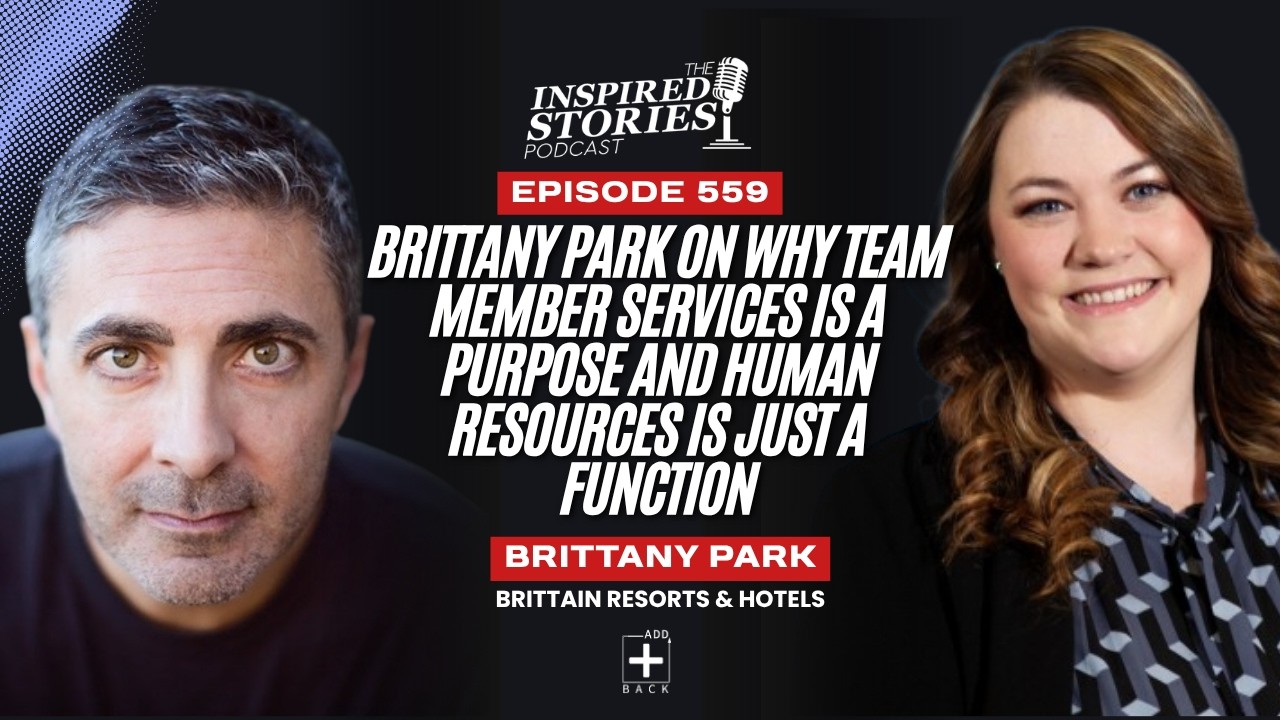
Brittany Park, Director of Team Member Services at Brittain Resorts and Hotels, started as a barista at a Starbucks licensed store inside a Myrtle Beach resort in 2012 when she was 19, moved to assistant store manager of a frozen yogurt shop the same year, got put at the front desk to fill the off-season, and never looked back. Thirteen years later, she holds a SHRM-SCP designation, oversees HR operations and compliance across 30-plus resorts and 4,700 rooms, manages one of the most complex foreign labor programs in the Southeast, and runs a Women’s Leadership Alliance that she credits with changing how she shows up in every meeting she has ever walked into since.
✨ Key Insights You’ll Learn:
Starting as a barista at 19 and never imagining the company would become a 13-year career
How a seasonal frozen yogurt shop and an off-season front desk shift started everything
The drunk golfer who called her a five-year-old and what she said back
Growing up with small business owner parents and what watching the 2008 financial crisis at a young age did to her work ethic
Why Brittain Resorts calls it team member services instead of human resources and what the difference actually means
The Women’s Leadership Alliance: what it taught her about pauses, healthy debate, and not over-explaining why she was in the room
H-2B visa program explained: what it is, why it exists, who it serves, and why the misconceptions are wrong
Blue Rewards: how peer-to-peer recognition changed what stories actually make it back to leadership
Using AI responsibly in HR and the real risk of a chatbot inventing legal precedents that do not exist
What keeps her up at night as an HR leader and why hospitality is always a little behind the curve
🌟 Brittany’s Key Mentors:
Monty Morrow (Regional Manager, Brittain Resorts): The first leader who saw something in Brittany and asked her to step up from barista to assistant store manager — still a mentor today
The Former Director of HR at Brittain Resorts: The woman who invited Brittany to co-develop a training session on effective interviewing and gave her the first taste of what HR could be
Matthew Brittain (CEO, Brittain Resorts): The leader whose answer to every hard question — what’s the right decision — set the culture Brittany has worked inside ever since
Her Husband: The steady outside voice who reminds her regularly of how she got to where she is and pushes back on the imposter syndrome when it shows up
👉 Don’t miss this conversation about what it looks like to grow up inside one company for thirteen years without ever feeling stuck, why the H-2B program is misunderstood by almost everyone outside of seasonal hospitality, and what a Women’s Leadership Alliance in Myrtle Beach taught one HR director about not over-explaining why she deserved to be in the room.
Listen to the full episode here
Transcript
Anthony Codispoti (00:00)
Welcome to another edition of the Inspired Stories Podcast, where leaders share their experiences so we can learn from their successes and be inspired by how they've overcome adversity. As you listen today, let one idea shape what you do next. My name is Anthony Codespodi, and today's guest started her career making lattes. Thirteen years later, she's responsible for the people strategy behind over 30 resorts, 4,700 rooms, and 45 restaurants.
The
path between those two points included a leap from frontline hospitality into resort leadership, a pivot into corporate training, and the kind of steep learning curve that comes with inheriting one of the most complex workforce challenges in the industry: managing foreign labor programs at massive scale. Brittany Park is the director of team member services at Britain Resorts and Hotels.
An 80-year-old hospitality management company headquartered in Myrtle Beach, South Carolina. She holds a SHERM Senior Certified Professional Designation and oversees HR operations, compliance, and the associate experience across the entire portfolio. Her story is an example of how sometimes the people who understand an organization best are often the ones who grew up inside it. But before we get into all that good stuff.
Today's episode is brought to you by my company, Ad Back Benefits Agency. And you'll want to hear this because it's hurting almost every business you know. See, health insurance costs go up every single year, and hotels and restaurants are furious about it. They're paying more, claims are getting denied, employees are opting out because they can't afford it, and it hurts turnover and morale. It's one of the most maddening problems in running a business, and everyone just seems to accept it. But
You don't have to anymore. Now there's a program from Bain Capital Insurance that gives employees unlimited access to doctors, therapists, and prescriptions with no co-pays or deductibles to me. It works for your part-timers and you don't change your broker. But here's the part that really shocks most people. Our product actually increases your net profits. We recently helped a client add $900 per employee per year to their bottom line. Results vary, but
Imagine what could be done with the extra cash flow. Get your free consultation today at adbackbenefits dot com. All right, back to our guest today, the director of HR at Britain Resorts, Brittany Park. Thanks for making the time to share your story today.
Brittany Park (02:40)
Thanks, Anthony. Thanks for having me.
Anthony Codispoti (02:42)
So Britney, take me back to your very first role at Britain Resorts, because you've been there a long time. You were a barista. So I'm curious, when you started there, did you have any visions at all of this becoming a career path for you?
Brittany Park (02:56)
not even a chance. I was 19. I was looking for a job. I was working at a coffee shop here locally that was closing and I had a friend that worked for the company. I called her up and said, hey, I know you're doing coffee. Can you get me an interview? And she said, absolutely. Come into the Breaker Starbucks store and meet my boss. And I did. And if you had told me in 2012,
that I would be where I am today, I would have laughed at you, honestly.
Anthony Codispoti (03:29)
So
talk us through the ascension just a little bit here, right? So you started out as a barista, you were there for
Brittany Park (03:34)
Mm-hmm.
Anthony Codispoti (03:35)
you know you in that role for eight months, and and then what was the next opportunity that unfolded for you?
Brittany Park (03:41)
It was a blend. the company has several Starbucks stores. So I would move between them. I wasn't necessarily tied to one. But when I was at the Caribbean Starbucks store, they had a frozen yogurt shop right next to it. They were actually connected through an inner door. And they needed a store manager. So through my time as a barista, had gotten to know the
regional at the time his name was is money morrow he's actually still a mentor to me and He asked me hey, would you be interested in in doing this? Would you be interested in helping run this yogurt shop? So I my title then was assistant store manager I went and Met with him. I kind of reviewed the the role itself and Immediately what stuck out was that the yogurt shop was seasonal and I was working
a full-time role as a barista. I had a job year-round. So I said, well, you're going to have to find something for me to do in the off season because my barista job is year-round. And he said, no problem. I'll put you at the front desk. And that's really where my hotel growth started was come October, I started doing both as the hours at the yogurt shop slowed down, I would pick more up at the front desk and it really just changed from there.
From there it was evening manager, assistant guest service manager, front office manager twice, resort manager twice, and then director of training and director of HR.
Anthony Codispoti (05:21)
my goodness. Okay. So a couple of things that I wanted to ask about. One, Starbucks. So you guys were actually the ones staffing Starbucks. They weren't doing it themselves? Was this like a franchise? License doors.
Brittany Park (05:31)
No, we have licensed stores.
we have, most of them are within resorts, but not all. I don't know if you're familiar with Myrtle Beach, but we have one at Broadway at the beach and that's a standalone. And then we have one at 14th Avenue as well as a standalone, but the others are within one of our locations, resort locations.
Anthony Codispoti (05:56)
And this isn't a story about Starbucks, but I guess I never really thought I just assumed that they were all corporate owned stores, but it clearly that's not the case. They're licensed
Brittany Park (06:02)
No? Yeah.
Anthony Codispoti (06:05)
stores, which is a bit different than a franchise.
Brittany Park (06:07)
Some are corporate stores, but others are licensed. So it just, yeah, and it just depends.
Anthony Codispoti (06:14)
And so the opportunity to work your way into the hotel space came about because they put you in charge of this yogurt place, but this is seasonal and you needed work and they liked your work, so they put you there. and once you started working at the hotel, did you ever go back to the yogurt shop?
Brittany Park (06:33)
No, briefly for a really short period of time when it opened the following season. But in 2014, in July, I moved to what used to be called Long Bay Resort, it's now Grand Cayman Resort, as the evening manager. So that was my first official management role within a resort operation. So not in food and beverage, not...
kind of an outside venue. I was at a resort and being an evening manager is a really great test of whether or not you can survive the hospitality industry. Because you are a
Anthony Codispoti (07:14)
Why is that?
Brittany Park (07:15)
one man show, you are the only manager on duty most of the time. So that was a really fun experience for me. And I loved the chaos and the fast paced nature. Every single day was different. And honestly, Anthony,
Even today in the hospitality industry, every single day is different.
Anthony Codispoti (07:36)
So give me a great story from one of these times as the night manager, something you ran into and had to deal with.
Brittany Park (07:44)
Okay, I'll do a funny one. So I was quite young, right? I started with the company when I was 19. I think I was 20 or 21 when I moved into the evening manager role. We had a golf group coming back from their rounds for the day and they had had a D &D sign on their door all day.
Anthony Codispoti (08:05)
Do not disturb.
Brittany Park (08:06)
Yeah, do not disturb. It was around, I think 5.30 PM when they came to the front desk and
you could tell that they had been drinking on the golf course all day long. And they were pretty mad that their room did not get cleaned. And I tried to just gently explain, well actually my front desk agent tried to explain that because the do not disturb sign, we could not have housekeeping come in the room, but we were happy to send someone now. This gentleman was just not having it. So they asked for a manager, they asked the front desk agent for a manager and
I step up to the desk and he takes one look at me. Anthony, I'm five foot nothing. So he says to me, I wanted a manager. Yep.
Anthony Codispoti (08:50)
You're small, you're young, yeah.
Brittany Park (08:53)
He says, I wanted a manager, not a five year old. And
you know, I could have gotten mad. I could have laughed in his face, right? But I took a moment and I, you know, I knew that alcohol was involved and, just,
you know, trying to deescalate. So I took a step back and I said, I understand that I may not have been what you were expecting, but I'm here to solve the problem, right? So can we just work through this? And
Anthony Codispoti (09:22)
Great
response.
Brittany Park (09:23)
we got housekeeping there. He was happy at end of the day and he did later come back and apologize. So I think there's a lot of that, right? Where guest interactions start out really heated. And then you have the opportunity to change the course and the direction of.
Anthony Codispoti (09:42)
I think you handled that so well. I mean, what a great response. You know, I'm not what you expected. I understand that, but I'm here to solve the problem. Right? Just took all the emotion out of it.
Brittany Park (09:51)
Yep. Yep.
Anthony Codispoti (09:54)
so I mean, and what did you say? You were twenty, twenty-one, twenty two at the time?
Brittany Park (09:59)
Yeah, I was probably 21 at the time of that interaction. Yeah.
Anthony Codispoti (10:03)
So that's
pretty young to be in a leadership role, certainly not completely unheard of, but I'm curious, let take a step back, kind of rewind a bit. Like what was your upbringing like? You know, did you have parents who were, you know, had similar kinds of roles, or just want to get an understanding of what kind of put you in a position that young to be doing what you were doing?
Brittany Park (10:27)
Sure. I grew up with both parents. However, I grew up going through financial, you know, 2008 and seeing what that did, right? So early on, I saw them work very hard and that really has impacted my work ethic along the way. Sometimes too much, maybe, if I'm being honest. But they...
When we moved to Myrtle Beach, they bought a Curves and so they were small business owners. And they both, my dad and my mom both worked the business. My dad not so much on the front end because it was a fitness center for women, but my mom and dad were both involved every single day with that business. I didn't grow up in the hospitality industry, but part of them being a business owner meant I had to learn customer service very early.
and I started working at the Curves when I was 14. So when I graduated high school, they sold the business and that's really what led me into the coffee path was I thought it was gonna be the coolest first job ever to be able to make my own lattes. So.
Anthony Codispoti (11:42)
Okay, so let's let's go back closer to present day. You're you know you're moving between these different management roles at Britain Park. Britain Resorts. Sorry, you're Brittany Park, you were at Britain Resorts.
Brittany Park (11:55)
Britain Resorts, yes.
Anthony Codispoti (11:58)
but at what point did you feel like you were getting pulled towards the HR side of things? Because you're more frontline up until this point.
Brittany Park (12:06)
Yes. When I was evening manager, I had the opportunity to work with the director of HR at the time to develop and facilitate a training session. I had expressed interest to her just kind of in passing and she said, well, I have this class that I need to work on. It's about effective interviewing. Would you be willing to partner with us? She had an admin at the time. And I said, absolutely. I would love that.
It was in the slower months and Myrtle Beach does kind of, you know, die off. So I had extra time to work on their, you know, research and the legal side of interviewing and all of those things before I was, you know, an expert per se. And that was where I really got the first taste of what HR could be. But I loved training and development. I...
actually love public speaking. I'm one of the weird ones, but getting in front of a class and sharing knowledge is always so exciting to me. And I think that's really what set things in motion was not only having the opportunity to build the relationship with her early on in my career, but also getting to see what training can do to help leaders grow and that not everyone is an expert in everything.
So it gave me the opportunity to really understand training and development before that was my role and responsibility. And then over time, as different opportunities came up, I would always volunteer myself.
Anthony Codispoti (13:46)
It's a great way to get noticed. It's a great way for especially for people in other departments to start to see, you know, the skills that you have.
Brittany Park (13:53)
Mm-hmm.
Anthony Codispoti (13:54)
So you've now been with this one company for over 13 years, rare in any industry, let alone hospitality. Is there something in particular that kept you from leaving? You know, it I would assume that there have to have been moments where maybe you were getting a little restless, you know.
Other offers are coming in, maybe it's interesting to consider a different opportunity somewhere, but what made you stay?
Brittany Park (14:25)
few things. I think the unique part about Britain is that we are so large in such a small area. So when I was growing as a person and starting a family, every major milestone in my life has happened while I've been employed with Britain, right? So I grew up around the people that I work with.
got married, I bought my first house, I had my daughter, right? I didn't have to move my whole life every time I wanted a new opportunity. So that was a huge draw. Up until I joined the HR team, I think the longest I stayed in a role was about 14 months. And so I was able to really continue to jump and grow without having to do that. And that is a huge bonus.
for anyone really. And I think we still do a really good job of that today. That is one thing. And I'll probably talk about this over and over again because I love that about this company that we focus on our internal people and giving them the opportunity to grow without literally having to pick their life up and move it to a new city or state to do so. Outside of that, you the company believed in me probably before I believed in myself.
the leadership team with Britain has always been a fan of developing the little person per se, right? The people that have the skill and the drive and they're hungry to help others. And our company has always revolved around people. We put people first. I will absolutely never forget the first time I heard Matthew say,
well, what's the right decision, right? It didn't matter what the bottom line was saying. It was what's the right decision to do for our people, for our guests, right? Like that was so impactful for me at a young point in my career. And it has definitely drawn me in and kept me in. You know, outside of that, I think the company does a really good job at still allowing people to grow even when there might not be a role above open.
I have been in my role since 2022, but I'm still growing every single day. Still getting new opportunities to do new things every single day. And that's what keeps me here.
Anthony Codispoti (17:03)
I loved all that. who is Matthew? It said this go that's okay.
Brittany Park (17:06)
Sorry, I should have explained that.
Matthew Britton is our CEO. He is a founding member of the business. His dad and several other family members are really who founded Britton Resorts. And their family feel is still very, very prevalent. People know who he is, that he is accessible to
just your everyday associate. We have the Sea Captains Restaurant, is kind of the maybe flagship, I guess you could say. And it is not uncommon for you to go and be eating dinner and Matthew and his family are there and help make time to say hi. Same with his brother Clay, right? He always makes time to say hi, see how you're doing, making sure that
you are taken care of as well. And I think that is so impactful. I think sometimes as companies grow, you lose that touch and that hasn't happened here.
Anthony Codispoti (18:17)
You know, you said something else that I wanted to highlight. You know how much you really love being at Britain Resorts because it's a place that allows people to grow, to advance in their career, you know, combine sort of the personal and the professional development together. Say more about how that is such a cool thing that wraps itself around the hospitality industry.
Brittany Park (18:45)
Yeah, hospitality in general is hard and time consuming, right? It's a 24 hour, 365 day a year business. And I think the companies that understand that you as a person matter too, and that they develop you as a person, not just as a
a function of the business is incredibly important. So at Britain, we've made sure that there's opportunities to both expand your technical skills, right? The job required skills, the leadership skills to where if you manage people, you can manage effectively and make an impact. But then also the portions of your life that are outside of professional, right? Whether that be
um, financial classes, whether that be mental health awareness, um, whether it be just personal development in general. Um, I will say the really cool part that I got to experience, um, as a participant, but now also as somebody that helped shape the program is in 2019, we launched what's called the women's leadership alliance and that focused on, um, women who were up and coming within the company.
And it wasn't entirely leadership development. So what it did was it highlighted the areas that women typically, I don't want to say struggle, but I'll use that word today. We focused on imposter syndrome. We focused on reputation and personal branding. How do we want to come across at a meeting and how do we make our voices effective?
Because in some cases, especially here in the South, you can get into a room of mostly men and sometimes it's hard or you feel like you can't speak up as much. And so that was, the program was built to develop those skills where women might often be a little shyer or not as confident or comfortable, both personally and professionally.
And I thought that that was incredible. My experience as a participant was probably life-changing, but my experience as a program leader has honestly been more rewarding because now I get to watch the next generation of leaders experience that same
life-changing moment.
Anthony Codispoti (21:43)
So it's really cool that you now get to see it. It's almost like through the eyes of a parent, like a parent and a child, right? How excited
Brittany Park (21:49)
Right, right.
Anthony Codispoti (21:50)
you get for the other person to be able to
Brittany Park (21:52)
Yes.
Anthony Codispoti (21:53)
learn and grow and and to see that happen. But
Brittany Park (21:55)
Yes.
Anthony Codispoti (21:56)
take me back to how this program was so life changing for you, to use your words.
Brittany Park (22:03)
I
am a people pleaser by nature. And I would like to think that this program, that the WLA helped me shift from going along to get along to being comfortable enough to make impactful contributions and changes, right? Sometimes the loudest voice in the room isn't the one making
the biggest impact. And learning that helped me navigate future meetings, right? Understanding that I didn't have to speak the loudest. I just had to say it in the right manner, explain it, and also not justify why I was there. I think that sometimes as a young leader, you feel like you have to over explain why you're in the room giving this advice.
Right? Cutting that out, honestly, learning how to do that, learning how to cut that portion out. I didn't need to justify why, I just needed to show the results and how we can get there. And that without W.A., I don't think that I would have learned that or at least not as quickly as I did.
Anthony Codispoti (23:24)
I'd love that.
Brittany Park (23:24)
Yeah.
Anthony Codispoti (23:26)
Sorry, had something else you were gonna add there.
Brittany Park (23:28)
No, think the thought was probably finished, right? just, I guess to close, right? I think that's so incredible to look back now and see, almost compare myself now in meetings versus where I was when I started and know that that's why.
Anthony Codispoti (23:51)
What would be let's say that I looked at you a few years ago and in a meeting and I look at you today in a meeting as just a impartial observant. What's the biggest thing that I would notice?
Brittany Park (24:04)
I think comparatively, right, would be back then I would...
continue to talk almost like beating a dead horse, right? Now I understand pauses are important. Allowing healthy debate is not a defeat and that it's okay to press pause and then come back after the meeting and say,
hey, I really wanna make sure we're on the same page because I'm not sure in that room we were, right? And then maybe the next meeting goes a lot more smooth.
Anthony Codispoti (24:55)
Like that. So let's talk about the transition into your current role. When you stepped into the director of HR position in twenty twenty two, what was the biggest thing that surprised you?
Brittany Park (25:08)
I would have to say the complexity.
I was used to one resort at a time or one location, right? So stepping into the HR position, right? Director of HR, but also director of training, both of them. I had to learn the organization as a whole. And to go from one resort with a hundred and...
80 max, maybe 200 depending on on property associates to now a thousand plus. And understanding that standards are important, but discovering and learning each individual location's operational needs was way more complex than I originally thought. We are a condo tell primarily, so.
Every unit is individually owned by homeowners. We operate like a normal hotel, but that does add a lot of complexity. And some resorts, because of different HOAs, can't do exactly the same thing. So understanding that we do have standardized processes, but sometimes those have to be modified. And that can get really complex. So taking the time to learn all of that, but then also giving myself grace when I
didn't quite understand certain things and allowing myself to ask more questions and do a little bit more research, right? I think that was what surprised me the most.
Anthony Codispoti (26:49)
condotel, that's a new term for me. So every
Brittany Park (26:52)
Okay.
Anthony Codispoti (26:52)
one of the rooms inside of Britain Resorts is owned by somebody else. And you are like the the property manager.
Brittany Park (27:01)
Property management
company, yeah. So not all of them. We do have some locations where we own and operate exclusively, but the majority of our resorts are condo, hotel resorts, yes. So sometimes it feels like you have 300 bosses because every homeowner wants something different, right?
Anthony Codispoti (27:21)
Yeah, I was gonna how much does that play into your role in HR?
Brittany Park (27:27)
Um, a lot less now. There are some where I get copied on an email thread where the board, the HOA board is on it and they're talking about an associate, right? So sometimes I see pieces of it, but certainly much less than it was when I was on the operations side.
Anthony Codispoti (27:48)
Okay. So Brittain Resorts calls the role team member services instead of what I've been calling it human resources. Why that name?
Brittany Park (27:59)
Anthony, think words matter. think human resources describes a function and team member services describes a purpose. We are here to serve those that serve our guests and owners. And I think when you look at it from an associate standpoint, I don't have to be the scary HR person, right?
I am here to support you. I'm here to serve you. And that, I think, is a huge distinction between us and other companies.
Anthony Codispoti (28:38)
I want to say, I want to hear you say more about that because this is something that I run into a lot when talking with folks in the human resources world or sorry, the team services world. is, you know, this idea that so many people in the organization have this default reaction to thinking that HR is the enemy, right? They're coming to, you know, wag their finger at you because you violated section twelve, you know.
Brittany Park (29:07)
Right.
Anthony Codispoti (29:07)
Subsection 3. About not
turning in your TPS reports on time. So, you know, how do you overcome that? How do you convince all the people that you're there to support that that is actually your primary?
Brittany Park (29:23)
Yeah, I will say that having an operations background certainly helps me understanding exactly what the boots on the ground are going through. Absolutely helps me relate to people better. I would say that one thing that I've always done, one goal of mine has always been to connect with our associates as a person on their level, right?
I am no better, no worse than they are. I have good days, I have bad days, and I'm not perfect. I don't pretend to be. When I have a situation where I have to go talk to an associate about whatever might have happened, Understanding what led to that is incredibly important. And connecting with them to understand their decision-making process is absolutely...
something that should happen in every associate interaction. But even on the good days, right? It's not always about the bad. It's connecting with them on the good ones too, right? We have a huge associate recognition program. We call it Blue Rewards and it's about bringing the blue. And we focus on peer-to-peer recognition versus just your manager, you know, hoping that your manager caught you doing something right that day, right?
Anthony Codispoti (30:47)
What does that mean to bring the blue?
Brittany Park (30:49)
So, Bring the Blue focuses on
teamwork and service excellence. So anytime you do one of those two things, which covers a plethora of, you know, of topics, you can be recognized by not only your manager, but your peers, every which direction, up, down, sideways, it doesn't matter. And it has allowed us to hear about more stories of teamwork, of somebody going above and beyond, of
you know, an associate helping another guest or an associate helping another associate and being able to capture those situations, those stories, those experiences has certainly changed the way we do recognition, right? I don't know that all of those would have made their way back to the GM, the vice president, my team, right? Without that program and it's
it is something that we focus very much on because hospitality is hard. And sometimes if your boss didn't just walk in at the right time, you never would have been acknowledged. And I think that is a huge piece of hospitality burnout is when you're not acknowledged, right? And so this,
this recognition program, it helps me hear about the stories and that's a win, but it's not the purpose, right? The purpose is to make sure that our people are recognized, are heard, are valued, right? And so this helps me celebrate their wins when I might not have heard about it ordinarily.
Anthony Codispoti (32:42)
How do they know that you've heard about?
Brittany Park (32:45)
Anytime we have an opportunity to get out to a property, I'll stop by, I'll see the associate, right? But also we have situations where we can post it on our social media depending on what it is, right? And so we're sharing it to the broader audience to say, look at what this person did, right? Additionally, when we do our leadership conferences, we can recognize those that have gone above and beyond consistently throughout the year and they'll get nominated for
maybe the team member of the year award, right? We focus on who's had the blue rewards, recognitions throughout the year. So, you all of those give an opportunity, not just for me to be a touch point with them, but other leaders within the organization too.
Anthony Codispoti (33:29)
That's
really cool. I want to shift gears now, Brittany, and I want to talk about the H two B Visa program.
Brittany Park (33:37)
Yeah.
Anthony Codispoti (33:38)
foreign labor program. A lot of people probably outside of hospitality have never heard of. Can you walk us through for the unfamiliar what the H two B program is and why it's so critical for a company like Britain?
Brittany Park (33:52)
Absolutely. I will do my best to stay out of the weeds on this one. The program is a little complex. But the HGV program is a visa program. It focuses on temporary or seasonal non-agricultural roles. So for us, this is most utilized for our housekeeping room attendance. It's a program where employers can bring in foreign workers
to cover roles where the local workforce does not meet the actual workforce demand. So in Myrtle Beach, are a seasonal area. Our season is typically April through October. We do get some holiday business, but outside of that, right, we don't have the occupancy to support year-round roles.
that does make an impact to what candidates are available, right? Local workforce is looking for a steady full-time job. They wanna make sure they're getting 40 hours a week every single week. And this program allows us to offset that difference, right? Additionally, the Myrtle Beach workforce is shifting. We're getting a lot more retirees down here, a lot more remote work.
post COVID, we've seen a lot of people from the North move down and now they're working from home. So that has impacted our available workforce. then housekeeping is a tough job. So roles like this allow us to bring in or programs like this allow us to bring in and still support the needs of the guests and the business.
Anthony Codispoti (35:39)
And so how does this work exactly? You're figuring out, okay, I know that my busy season in this particular location is April to October. I normally have a hundred people during the slow season. I need 200 people during the busy season. I can only probably hire an extra 25 locally just from experience. So I'm going to need another 75 from somewhere else. How do I how do you go about getting those other 75? Where do they come from?
Are you housing them? Is that kind of up to them? Kind of walk me through the particulars.
Brittany Park (36:12)
sure. So it starts with identifying your need, just like you said, right, understanding your numbers. It's, it is incredibly heavily regulated. We have to provide a lot of reports to the government, both to the Department of Labor and to USCIS. And through that, it's justifying your need that there aren't enough local workers, right. So that's kind of the starting point is understanding
your ability to hire. From there, we do use a few different countries primarily. We have a large group from Jamaica. We also have El Salvador, Honduras. Let's see, we do some J1s from other countries, but that's kind of separate from the H-2B program. once we've
Anthony Codispoti (37:05)
What is the J one?
Brittany Park (37:07)
J1 their student visas, so they
our college students in different areas of the world and they participate in what's called the work and travel program. So they get to come and experience the United States and our culture, learn about our culture, but also work while they're here. So similar to the H2Bs, it is a foreign labor program, but the J-1 program is not as heavily regulated as the H2B program.
The HGV program only has a certain number of available visas each year. Those visas applied for are not enough for all of the employers in the US that apply for the program. And so what happens each year right now is that a lottery system happens. So everyone gets put into a bucket and you hope for group A or B. Sometimes that doesn't happen and then you have to strategize from there.
The numbers for the H2B program, like the available visas were set in, I want to say the last change was the 90s. So as workforces have expanded and US expectations on the worker side have shifted and some of these hands-on entry-level roles are just really not a priority for the average US worker anymore, the need has grown exponentially. you know, because it's...
it's a visa program. It tends to get a little bit of a reputation tied to immigration and things like that. And I think the biggest, yeah, yeah.
Anthony Codispoti (38:46)
So it's become a bit of a lightning rod. Yeah.
Brittany Park (38:50)
And it's kind of led to some really huge misconceptions about the program. People often think that the H2B workers are replacing American jobs. And I can assure you that we do extensive
US recruitment before we're even allowed to go out and recruit foreign workers, right? So the reality is that the program exists because we is as employers have demonstrated that there just isn't enough seasonal workers in our area to be able to operate our business. And without them, it would create a huge financial burden on the business. And so then comes things like cap relief and a lot of other
government red tape, that has really put a burden on the hospitality industry as a whole.
Anthony Codispoti (39:42)
What is cap relief?
Brittany Park (39:43)
Cap Relief is essentially where the Department of Homeland Security can authorize another set of visas on top of what the program baseline is.
But that still, even when they do that, doesn't cover the demand, the full demand. So even if you made it into the lottery, if you got a group below, let's say, D, your options are incredibly limited.
Anthony Codispoti (40:13)
Hmm. Interesting. You know, my family has spent some time in both Myrtle Beach and then just north of there in Ocean Isle Beach, North Carolina. And I have noticed in the past the some places I'll go into, you know, like a retail store, we were in an ice cream shop, and several of the workers that are younger, as you would expect, had Eastern European accents. And I just thought, wow, that's a little curious in a little town like, you know, Ocean Isle Beach, North Carolina, that there would be
people, you know, several people with a and so now it makes sense that we're probably part of this H D B program that is helping to staff these places that normally don't need as as many folks during the off season.
Brittany Park (40:55)
Yeah, I would say that if they were like college age, it's likely that they were J1s, but
Anthony Codispoti (41:01)
okay.
Brittany Park (41:02)
H2Bs are a blend of ages, right? It could have been H2Bs, absolutely, but it's not uncommon for us to get every age group out there, right, with the H2B program. I have some as young as, I think, 20.
this year and then some as old as 50, 60.
Anthony Codispoti (41:29)
And when they come here, are you helping them find a place to live? Have they done this before for the most part? So they're kind of familiar with the routine.
Brittany Park (41:37)
With Britain, this isn't the case for everyone, but with Britain in particular, we do have a few different housing locations that we operate, we manage. And so that really takes the burden off of the worker to try and find housing. Affordable housing is a little bit of a pain point for everyone in the US right now, right? So the ability for us to do that. It is shared housing, so they are living with roommates and things like that, right? And it's optional.
If they don't want to stay, can absolutely go find their own apartment or home, rental home, things like that. But primarily most of them do use our housing. And this year we have about 250 total between the J-1 and the H-2B program.
Anthony Codispoti (42:27)
Okay.
So in a group your size, I mean that's a lot of people, but it's not like a this giant percentage of the the workforce. Yeah.
Brittany Park (42:34)
Right, right.
We absolutely prefer hiring local first, right? That is absolutely our goal is to get local talent and retain them. But when that's not feasible, we still have to clean rooms. We still have to service the business.
Anthony Codispoti (42:51)
Yeah, I mean it sounds like without the H two B and maybe the J one to a lesser extent for you guys, it would just be difficult or or impossible to operate the resorts. No.
Brittany Park (43:01)
Yeah, I would say that
that's an accurate statement.
Anthony Codispoti (43:05)
So, you know, another big problem, we're we're talking about workforce, is the turnover, right?
Brittany Park (43:09)
Yeah.
Anthony Codispoti (43:10)
Hospitality industry, notoriously high turnover rates. You know, so even if we're taking H2B out of it, you know, those folks that you want to have them there year-round, there, you know, there there is this revolving door that you have to deal with. What have you guys tried? What have you found success with when it comes to being able to recruit good folks? And then once you've got them to hold on.
Brittany Park (43:34)
Yeah, we absolutely do our best to prioritize full-time employment where possible, right? So anytime we can come up with project work or shift them from one resort to another to keep them year round, we have absolutely made that a priority. I do think that that has impacted our turnover. And because we have so many different locations in Myrtle Beach in particular, we have a leg up.
per se, to be able to do that, where maybe some other single location hotel chains wouldn't be able to. Additionally, we've really focused on the associate experience. So we've added touch points. We do a new hire check-in at the 10-day mark and the 30-day mark with all of our new associates to really understand how they're feeling.
Have they gotten the experience that we expect? Do they know about all of the benefits that we have, that we offer? What are their needs, right? Or are there any challenges that they're facing early on that we can help address? So, team member services handles that. Oftentimes, it's more of just an educational conversation, right? They might not have fully understood something at orientation and,
If we hadn't made that call, they might not have asked a question and that could have impacted their overall expectation or thought about the business, right? So that gives us the opportunity really early on to get them on track and make sure that they're on track. Throughout the year though, we think that feedback matters. So we always do associate engagement surveys. We're making sure that we take that feedback and we utilize it.
It's not just another survey that someone fills out, right? So it's taking the feedback, creating impactful plans with the feedback, and then making sure that we do something with it. So it's not just, okay, I filled out my third survey for the year, right?
Anthony Codispoti (45:45)
So let's take a step back for a moment, Brittany. Tell me more about the company itself from the guest perspective. And I know that's a little bit difficult because Britain Resorts, you've got to tell me how many locations, how many units do you have, how many keys? Sort of paint the big picture first and then tell me a little bit more about what would be similar in terms of the guest experience, regardless of which property they visit.
Brittany Park (46:12)
Yeah. So it's over 27 business locations. Please don't ask me to name them all right this second. Over 4,000 keys. We have locations in Florida too that we manage and that is newer to us. That was 2020, late 2024 when Florida came on board. And so some of that is newer for Florida for us, but
I think as a guest, they see consistency no matter which location they stay at, right? We've really tried to focus on, for as much as variation might have to happen, we want the experience to be similar, right? So expectations from a guest perspective are exceptional service, amenities being available to them.
almost all of our locations have a water park type aspect to them. And it's about, for a guess, right? They are creating memories and we want to help with that, right? So we focus on what little things can we do to help create those memories that a 10 year old is going to remember and 20 years later come back and tell their kids about.
I think the really cool part about our business here in Myrtle is that we have so many families that have created traditions here. And some of our team members have become part of that tradition. have an associate named Mary at Ocean Reef and she every year gets the same groups that come in and they want to have breakfast in her section.
and they want to talk to her about all the things that she's done that year. And they take pictures with her. They sent her cards throughout the year, you know, and that family was once here as a child, but now they're here as an adult. And she gets to see that whole transition, right? They were here as a baby. Now they're having babies, right? We have associates that have worked for us for 30 plus years and they tell me these stories all the time. And I don't think this makes goosebumps. Like I love it.
And I think that's what I loved from the operations side was getting to be a part of that. I do think I experienced that a little bit on the associate side where I get to see people grow up just like I grew up. But I think we as an organization focus on what can we do to make memories and then bring back the next generation of travelers.
Anthony Codispoti (49:06)
while you were talking there, I was clicking around on your website, which for folks are interested, it's BritainResorts.com. went to your portfolio page, tons of properties. And so most of these are in South Carolina.
Brittany Park (49:16)
Yeah. Yes.
Anthony Codispoti (49:19)
Okay, and then recent additions in Florida. I forget which one I clicked on, but it actually shows a picture of a of a little roller coaster on property. Like this is crazy. or or maybe that's just something like that's in the area nearby. I don't
know if that's on.
Brittany Park (49:35)
I say it may
just be a local attraction. I'm like, no, I'm curious. I know we have,
Anthony Codispoti (49:35)
property. Okay. yeah. Sunset sunset vistas.
Brittany Park (49:42)
that's in Florida.
Anthony Codispoti (49:43)
Okay. and then people so people can just go to BritainResorts.com, excuse me, click on any of these individual properties and then book right on your site, correct? That that's the easiest way for them to do that.
Brittany Park (49:54)
Yes. Yep. Yep.
Anthony Codispoti (49:57)
So kind of going back to a bit of your career path, you we mentioned this in the intro, you earned your Sherm SCP
certification in 2023, which is one of the toughest credentials in the HR world to get. And you did this while running HR for this massive organization. What does that certification actually mean? What does it indicate? And why was it important for you to pursue that at that point in your career?
Brittany Park (50:26)
Sure. Shurm is kind of the, you know, the...
central example of HR across all industries, right? It's the HR standard. And when I was early in my role, I wanted to make sure that I had the knowledge on the business legal side, the strategic day-to-day pieces, understanding a little bit of, you know,
complex operations because we were talking about other states at the time. Florida wasn't quite here yet, but I knew it was on the horizon, right? And I wanted to make sure that I was knowledgeable enough to feel confident talking in any business situation. So it became really important for me to challenge myself and go for my sherm. I waffled quite a bit on
whether to do just the CP or to shoot for the SCP role or designation. And it wasn't necessarily about the, you know, adding the letters to my name or, you know, what that certification would do for me. It was about making sure that I was a
a better leader by getting all of the necessary business information and growing my expertise on that side of things, right? Coming up through the company, I knew everything about Britain, but I didn't necessarily know everything about employment law or building culture or things like that, right? And so the SHRM certification really helped me understand that.
Sherm does a great job about educating you as a learner on how to learn and how to know your workforce, right? So being able to identify with people a little bit better came out of that too. So I would say that I did it honestly more for the associates that I was serving versus myself, although I did feel very good when I got, when I achieved it.
Anthony Codispoti (52:54)
It's yeah, a good feeling of satisfaction there. What is something that you've been able to offer to the associates now that maybe wasn't possible before that certification?
Brittany Park (53:05)
I want to say understanding workforce challenges, I think.
That's maybe a harder question. I think understanding how to deal with employment situations, right? A little bit better and being more confident allows me to serve them better, right? in any case, it's understanding what a business can and cannot do, right?
the boundaries are. I do think that SHRM does a great job at teaching HR professionals what those boundaries are and how to navigate them. I think when a complex situation has arisen, it has helped me explain what those boundaries might be to an associate better and it makes their experience better. Does that quite answer the question?
Anthony Codispoti (54:12)
I
think so. I think what you're saying is now you understand more about what the guardrails are. And since you're confident in those guardrails, you feel better about the direction and the decisions that you're making and you're better able to explain that to an associate.
Brittany Park (54:27)
Yes. Yep.
Anthony Codispoti (54:28)
So
as you think about the next few years in hospitality workforce development, what's the problem that keeps you up at night? The one maybe the industry isn't moving fast enough to solve?
Brittany Park (54:44)
That one's hard. There's so many answers to that question. I would say,
Anthony Codispoti (54:49)
Can you pull just one?
Brittany Park (54:50)
yeah, the world is changing so fast and businesses are having such a challenge to keep up with it. Staffing changes, technology changes, workforce changes, right? The expectations of your average worker today.
are so different than they were five years ago, 10 years ago, 20 years ago, right? And having to constantly evaluate and evolve that really quickly, I think is what keeps me up at night, right? I think the easy answer from an HR professional is probably staffing, but I don't think actually that that is what exclusively would be my number one. I do think...
I love data and I love utilizing data to make educated changes, right? Educated impact in an organization. And when technology is changing so quickly, sometimes your data gets outpaced really fast. And so even if you're trying to be proactive, sometimes it still feels a little reactive. And I would say as an industry,
hospitality is sometimes a little harder to implement immediate change, right? So once we're confident in what direction we need to go, it's being comfortable that that solution is gonna last longer than six months.
Anthony Codispoti (56:25)
Let
me pull on one particular thread that you touched on. The this idea that you love data, and sort of the you know, the things that we're seeing happen with the explosion of AI technology right now. How are you using it in your role today?
Brittany Park (56:47)
in many different ways, the, easiest is to create, you know, dashboards and, real time live statistics on our associate life cycles. Right. And that's really my priority, in 2026 has been to determine what data is needed to, get this at the fingertips of our leaders. Right.
for them to be able to see their turnover quicker, identify any pain points or problem areas, right? Be able to drill down on it to department or even position level, right? I think that's super important to understand. know, six months ago, your turnover was great, but this month we saw a huge spike. What happened, right? Understanding that without those tools, they may not have ever identified that area. I wanna say that,
it's hard because sometimes in HR we have to make sure that we're using AI responsibly and ethically. So there are some lines and boundaries to it, right? You can't just plug anything you want into chat GPT and expect an answer. And honestly, sometimes it lies to you, right? So you have to be really careful about the use of AI. And I think the
The greatest thing it can do for anyone is to help you ensure that your message is coming across clearly, right? Making sure that if you had a situation where you needed something proofread, it is a great tool for that, right? But in other aspects, especially in the HR world, we and I have to make sure that it's ethical and responsible.
Anthony Codispoti (58:39)
Can you say more about that ethical and responsible part? What does that mean? Like you're not gonna put like an associate's name into Chat GPT and say, How do I deal with this crazy guy, Bob Smith, and here's what he did today?
Brittany Park (58:51)
Yeah, I mean that's part of it, right? But also making sure that any anytime you use it, you're fact checking it, right? You can't just take the answer it spits out and run with it, right? There are cases that are out there now where they have shown that Chatchat P.T.
provided a legal precedent, but then when you go research that legal precedent, it actually doesn't exist, right? And so in an HR world, in an HR legal world, that is critical. And I mean, that could be career ending for some HR leaders if you aren't responsible.
Anthony Codispoti (59:35)
Understood.
Brittany, what's one of the hardest things you've had to overcome personally and what did going through that teach you?
Brittany Park (59:43)
Sure.
I probably imposter syndrome. And I don't know that I fully overcome all of it. I think that that's still something that comes up here and there. I will say that...
As a young leader, there were a lot of times that I thought to myself, I don't deserve to be in this room, right? How did I get here? I'm not supposed to be here. And it took a long time for me to convince myself, tell my brain, hey, shut up, stop talking, right? Like, you know the topic, you've done the work.
you absolutely deserve to be in this room. I think that I do owe a lot of overcoming that to participating in the Women's Leadership Alliance program, but I also think personally, I spent a lot of time reflecting on how I got to where I was today.
My husband does a great job at reminding me of it frequently, so he's a huge help. And I think that leaning on somebody outside of your career is critical. have my husband who's fantastic. I also have really valuable mentors that I call constantly, some within the organization still and others that aren't. And without them, I'm not sure that I would have overcome some of that.
when I did. Now, I think it's completely natural for that to pop up here and there as people progress through their career. But sometimes I just have to step back and remind myself, you got this, you know the answer is it's okay. And if you don't, you'll find it, right? And then that puts me right back on track.
Anthony Codispoti (1:01:51)
Have you ever seen the Disney movie called Luca animated film about a
Brittany Park (1:01:55)
No,
but I've heard about it's the spider one, No? the fish.
Anthony Codispoti (1:01:58)
No, this is the the fish. Like th
they're they're like underwater creatures, but when they come onto shore
Brittany Park (1:02:04)
Okay.
Anthony Codispoti (1:02:04)
they look like people and y there's like this whole tension. Anyways, there's two young characters in there, and one of them is a very bold, confident guy who just he does first and thinks later, and the other one's like very thoughtful but also very timid, and and so the the very confident one says to the main character Luca, he says, I know what's your problem is you got a you a Bruno in your head.
So what's a Bruno? Well, it's that negative voice that tells you that you can't do something or this isn't gonna
Brittany Park (1:02:31)
Can't do it. Yeah.
Anthony Codispoti (1:02:32)
work. He's like, So you just gotta yell at yourself. You gotta yell at that voice and silencio Bruno, silence,
Brittany Park (1:02:37)
Hahaha
Anthony Codispoti (1:02:38)
silence Bruno. And so sometimes I I remember that part of the movie because we all have that. We have
Brittany Park (1:02:43)
Yeah.
Anthony Codispoti (1:02:43)
that negative voice in our head that's holding us back, that's telling us things that aren't necessarily true. So you got to learn to say silencio bruno. That's that's the point of me sharing all that, you know, and this.
Brittany Park (1:02:54)
I love that.
Anthony Codispoti (1:02:55)
This idea of imposter syndrome, this comes up a lot in the conversations
Brittany Park (1:02:58)
all the time.
Anthony Codispoti (1:02:59)
that I have. Yeah. So, you know, even people who are much older, people who have built their own businesses, very successful
Brittany Park (1:03:05)
Yeah.
Anthony Codispoti (1:03:05)
businesses, will admit to me that, you know, hey, even coming on this show today, I had imposter syndrome. And like, why did he invite me? Why does anybody want to hear my story? and so I think it's just this really common thing that so many of us deal with, and we don't talk about it. So I'm really
Brittany Park (1:03:21)
Yeah.
Anthony Codispoti (1:03:22)
grateful that you gave
Voice to your experience today. And if you don't mind, I'd like to share from one of my other guests who actually talked about how imposter syndrome is a superpower for him. Because maybe this will help reframe it for you or for some others that are listening. Yeah.
Brittany Park (1:03:38)
I would love that, absolutely.
Anthony Codispoti (1:03:40)
So he looks at it as this thing that kicks him in the butt every morning to get out of bed and to continue to do a better job, look for ways to improve every day.
So once he was able to kind of reframe it from being this thing that was holding him back, holding him down, there's like this weight around his shoulders to, no, this is the thing that's telling me you gotta get up and you gotta do better than you did yesterday, right? Always
Brittany Park (1:04:05)
Yeah.
Anthony Codispoti (1:04:06)
working, always improving. I don't know how that lands with you.
Brittany Park (1:04:10)
I love that. I'm going to use that. I think that that shifts your mindset and when you can do that, anytime you can do that, I think it'll help with your success.
Anthony Codispoti (1:04:21)
Yeah. just one more question for you today, Brittany. But before I ask it, I want to do three quick things for the audience. First of all, if you want to learn more about what they're doing at Britton Resorts, go to their website. It's fantastic. Lots of resources there. BrittonResorts.com. And Brittany, is there an area on the website for folks to apply?
Brittany Park (1:04:41)
There is, yep, if you go to the website, there is a careers portion of the site. It'll show you all of the open roles that's under our company and then careers. It'll show you all of the open roles and also give you a little bit more background about who we are and what we have to offer.
Anthony Codispoti (1:05:02)
Great. So BritainResorts.com, look for the menu item called Our Company, and then underneath that you'll find careers. And then if you're enjoying the show today, please take a moment to subscribe wherever you're listening. See, it also sends a signal that helps others discover our podcast. So thank you for taking a quick moment to do that right now. And as a reminder, you can finally get your hospitality employees access to therapists, to doctors, and prescription meds that
Counterintuitively
actually increases your company's net profit starting in the very first month. There's no co-pays, no deductibles to meet. A lot of your part-timers, seasonal folks are going to qualify too, and you can keep your broker. So learn more about how to have happier employees and a stronger bottom line with this Bain Capital Insurance product. Excuse me, Adbackbenefits.com. So, last question for you, Brittany.
As you think about the work that you're doing in this role today, what is that you most want to be remembered for?
Brittany Park (1:06:04)
I would love to be remembered.
as somebody that helped others.
be more than what they thought they were capable of. I want to guide our future leaders to be their best. And I don't necessarily want the credit for it. I don't need the credit for it, right? But I truly, that gives me the most satisfaction is when I can look at somebody that started maybe a little bit after me and silently guide them throughout their career.
Anthony Codispoti (1:06:46)
I love that. Brittany Park from Britain Resorts, I want to be the first to thank you for sharing both your time and your story with us today. I really appreciate you being here.
Brittany Park (1:06:55)
Thank you. I appreciate you.
Anthony Codispoti (1:06:58)
Folks, that's a wrap on another episode of the Inspired Stories podcast. Thanks for learning with us. And if one thing stood out, put that into action today.
Connect with Brittany Park:
Website: brittainresorts.com
Careers: brittainresorts.com/our-company/careers