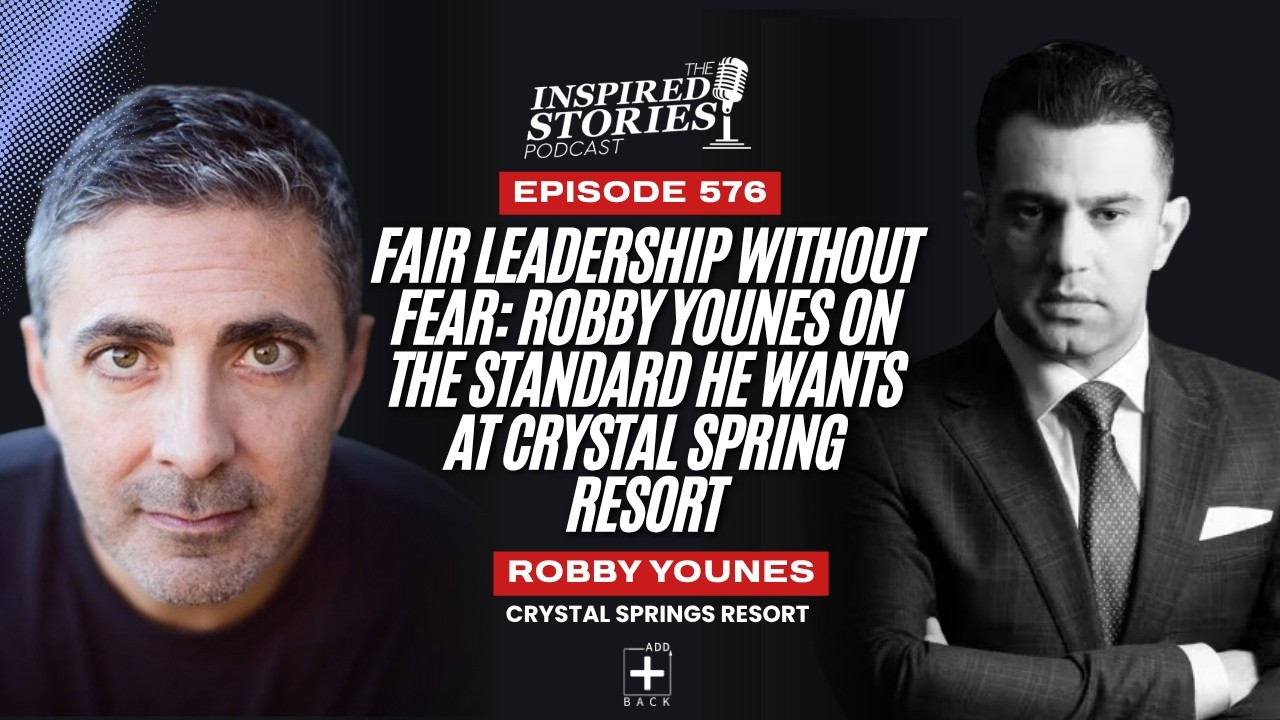
🎙️ Robby Younes on COVID, the Board That Tried to Fire Him, and Taking Crystal Springs Resort From $10M to $26M
Robby Younes, President of Crystal Springs Resort, grew up in Beirut during the war, came to the United States, got humiliated at a social gathering for not knowing wine well enough, walked into Barnes & Noble the next morning, and never stopped. Twenty years later he runs a resort with a wine cellar worth over $32 million, 438 rooms across two properties, and a EBITDA he tripled from 10 million to 26 million — despite a board that tried to fire him multiple times for keeping the property open, renovating with his own staff, and charging $1,200 a night during COVID while everyone else was closed.
✨ Key Insights You'll Learn:
Growing up in Beirut during the war and what a life of survival taught him about risk
Being humiliated over wine at a social gathering and the Barnes & Noble morning that followed
How founder Gene Mulderhill let him taste millions of dollars of wine that built his palate and his career
Building a wine cellar with 135,000 bottles across 9,100 labels and why it was always a marketing vehicle
Deciding not to close during COVID while the board prepared his termination paperwork
Renovating four properties with his own hotel staff, broken into 12 teams, during 11 weeks of COVID shutdown
Opening in June 2020 at $700 a night, closing at $1,200, and running at 100 percent occupancy
Reinvesting 60 percent of profits back into the property and growing customer return rate from 28 to 58 percent
Taking the company from $10.9 million to $26 million EBITDA over five years and what that made it worth at sale
The $54 million investment plan with the new ownership group, South Street Capital
🌟 Robby's Key Mentors:
His Father (Army General): A man who scared everyone in life and had thousands of people at his funeral — including soldiers whose weddings he secretly paid for — who never raised his voice
Gene Mulderhill (Crystal Springs Founder): Gave Robby access to wine that money rarely buys and the mandate to build the best cellar in the world
The Person Who Humiliated Him Over Wine: The moment that sent him to Barnes & Noble and started everything
The Retirees He Calls Weekly: Not in his industry, not in his company — just successful, humble people who tell him when he's wrong
👉 Don't miss this conversation about what happens when you refuse to close during the worst crisis in hospitality history, why the dollar chases you if you stop chasing it, and what a general's funeral in Beirut taught a resort president in New Jersey about what leadership actually looks like.
Listen to the full episode here
Transcript
Anthony Codispoti (00:00)
Welcome to another edition of the Inspired Stories Podcast, where leaders share their experiences so we can learn from their successes and be inspired by how they've overcome adversity. As you listen today, let one idea shape what you do next. My name is Anthony Codus Bodi, and today's guest spent his first eight years managing hotel portfolios for two of the biggest names in hospitality, then walked into a wine cellar and in some ways never left.
From there, he moved into food and beverage leadership, then an executive role over an entire lodging division, before eventually taking the top operating seat at a resort spanning 15,000 acres. Along the way, he became a certified saumonier and helped build one of the world's most valuable wine collections. Robbie Eunice is the president of Crystal Springs Resort in Hamburg, New Jersey. They are the Northeast's
Largest four season golf spa and culinary destination. He oversees two hotels, six golf courses, 10 restaurants, and a wine cellar honored with the Wine Spectator Grand Award every year since 2006. Wine enthusiasts named him one of its 40 under 40 tastemakers as well. But before we get into all that good stuff, today's episode is brought to you by my company, Adback Benefits Agency.
And you'll want to hear this because it's hurting almost every business you know. Health insurance costs go up every single year, and hotels are furious about it. They're paying more, claims are getting denied, employees are opting out because they can't afford it, and it hurts turnover and morale. It's one of the most maddening problems in running a business, and everyone just seems to accept it. But you don't have to anymore.
Now there's a program that gives employees unlimited access to doctors, therapists, and prescriptions with no co-pays or deductibles to meet. It works for your part-timers and you don't change your broker. But here's the part that really shocks most people. Our product actually increases your net profits. We recently helped a client add $900 per employee per year to their bottom line. Results vary, but imagine what could be done with the extra cash flow.
Get your free consultation today at adbackbenefits.com. All right, back to our guest today, the president of Crystal Spring Resort, Robbie Eunice. Thanks for making the time to share your story today.
Robby E. Younes (02:33)
Thank you for having me.
Anthony Codispoti (02:35)
So, Robbie, you spent your first four years at Hilton Worldwide, one of the largest hotel companies in the world, project portfolio manager. What did that early role teach you about how big hospitality operations run behind the scenes?
Robby E. Younes (02:52)
it taught me a lot. I think the first lesson that that I've learned is to take advantage of smart lazy people and work harder so you can take control and grow within the company. So my job was to leave at two in the morning when everybody's left at five in the afternoon. But the second day I knew everything. They didn't.
And that what taught me in a big box company or a big hotel chain, how could you scale up is you learn on your own and overwrite smart people that organically they're smarter than you.
Anthony Codispoti (03:36)
So when you say take advantage of lazy people, you don't mean actually taking advantage of them. You mean outworking them to provide yourself that advantage. Got it.
Robby E. Younes (03:47)
Hundred percent. And I did not
plan for it. I just start witnessing it organically. That wait a second, if I'm staying late and I'm learning the system, learning what's happening, taking an incident that take place at the hotel and try to handle it. Day after another, I was like, wait, I'm leading right now my stand up meeting in the morning where they all have to listen, what happened yesterday. And from there, organically, I start growing without planning for the growth that way.
Anthony Codispoti (04:17)
Where did this instinct come from? Was this something that you were just born with? Were you your parents raised you this way? Did you have an early teacher?
Robby E. Younes (04:27)
No, I think life, survivor, try to be better, push yourself for for the best. there's always I have here in my office a picture of the movie Ratatouille and the editor of Ratatouille, the food editor that I have a food editor or a editor that always exists over my shoulder and
I always say, What if this person came in and can do better than me? What can I do? So I'm chasing against a goal that I I don't know how reachable is. So that may be what pushed me.
Anthony Codispoti (05:09)
So you've got this little person on your shoulder that's always checking on you. That's sort of the the food editor, the food critic that's checking on your work. And you
Robby E. Younes (05:19)
Yeah.
Anthony Codispoti (05:20)
feel like you're always answering to that person.
Robby E. Younes (05:22)
Yeah, in in and everything you do, in my decisions, are they ethical? In in my responsibility in how to handle staff. there is always that one person that doesn't exist that I always will say, will he do it? And that person obviously is a person of high standard, is a person that stayed away from trouble,
Anthony Codispoti (05:45)
Yeah.
Robby E. Younes (05:46)
is a person of g good leadership, is a person of pride.
So I put a very high level editor or a food critic or a critic overall that doesn't exist, but I created that person.
Anthony Codispoti (05:59)
Interesting. Was this something Robbie cooked up in his youth? did you read this in a book, this sort of mental tactic?
Robby E. Younes (06:07)
No, I did not know I'm gonna be in the hospitality. And it's weird because you go back and say, Well, what just happened? growing up, I wanna be an Air Force pilot like my father. I was living on Air Force Base, I dream about everything. I was reading and admiring every airplane that exists between Phantom, Hawker Hunter, Fuga, you name it. and then but I remember in my which is weird, very weird by the way. If I see right now a child who does that, I was like something's wrong with that child.
I had a table in my bedroom. I had a big bedroom. Lucky me, I took the bigger one than my brother, and I had a table with four seats that every day I had a pitcher of either water, orange juice. Back then it was tank, which is a fake orange juice, just because we did not know better, or a milk with four glasses and on a tray. What if one of my friends came in that will be my style of hospitality? That was so weird.
I had no idea. But that I was only twelve, thirteen years old. So little things in life, who why will I have my bedroom perfectly done? My bed is perfect every morning. It was always what if that person came in? But I did not know that person existed.
And from there, I stuck, you know what? Let me put that person's picture everywhere I go. Maybe I keep myself checked. Because you do need sometimes, you don't have sometimes every time a mentor. You don't have a good leader. Well, could you create one?
To keep you in line.
Anthony Codispoti (07:50)
And so that picture that you put up now is it's this Anton Ego character from the from Ratatouille. Yeah.
Robby E. Younes (07:56)
Indeed. Yep, right there, right sitting in front of me.
Anthony Codispoti (08:00)
So what happened to you the first time you saw the movie? You were like, that's the guy that I've been picturing in my head.
Robby E. Younes (08:07)
Yes, because obviously gastronomy, food and all something I so inspire about. And this is you pushing yourself to the extreme of how can you make a simple dish ratatouille to be perfect? And what's a ratatouille? It's a squash, couple eggplant. I mean things we you and I would not inspire to just eat it and say, Wow, what a complexity of a dish could be and a rat is doing it, which is could be the worst, of a creature that cooking a ratatouille. and then
You have a Chateau Latour, I remember Il La Tour or Lafitte, it was, I believe Lafitte, matter of fact. in front of this beautiful food critic that tell you classic, that tell you classic will never die, that tell you history, that that tells me a lot in that simple episode. And I was like, I shocked, I was like, wait a second, that's the guy. That's the guy that as much we go with AI, we enhance, we do, and all.
But there's certain things should never change. This is our ethic, push ourselves for the best and enjoy every single thing that nature give us.
Anthony Codispoti (09:16)
And so is there like a a dialogue going on with this person? Is there a critique always coming in? How does that interaction work?
Robby E. Younes (09:24)
Yeah. I do a lot of meeting in my office. Some of them could be intense. sometimes I don't look for that person, but sometimes you have to be careful on making certain decisions. I also, you as a leader, can make some bad decisions. some of them based on excitement, passion, and thriving. That is the time that I look at it and say, Will he do that decision? The second thing is.
The verbiage that go between us, which is again I'm gonna seem like psychic, but it's just the verbiage that go between us, it's usually at night before I sleep. I usually go back to every single decision I made today. And some of them, which is eighty percent of my decision are wrong usually, and only twenty are good, which is I'm a
Anthony Codispoti (10:18)
You're hard on yourself.
Robby E. Younes (10:19)
realistic person. But the best part is tomorrow I'm not doing these mistakes.
And some of them are just sometimes you can send smarter people than you. They're faster in making come back on you that you did not catch to it. So the second day I was like, okay, I go back, everything happened. I go back to the editor or the critic. What can I do? Adjust, and second day I'll go back and fix things and then up to the next one.
Anthony Codispoti (10:53)
Mm-hmm. So let's, yeah.
Robby E. Younes (10:55)
it is psychological, yes.
Anthony Codispoti (10:57)
It's fascinating to me. I appreciate you giving us a little window into the mind of Robbie. so let's kind of step through the career a little bit. You, you know, you were at Hilton, you moved to Starwood Hotels and Resorts, another major global hotel company, still working in portfolio management. And, you know, in my experience, Robbie, a lot of the most powerful learning experiences happen from one of two things.
One can be a really good mentor. the other can be a really challenging work experience. Maybe pick a mentor that you've had along the way that was helpful in your development and talk about that.
Robby E. Younes (11:36)
Hm. I have many. some of them everybody say, Well, my father was a mentor. Okay, he was one of them. well, my father's colleague was a better mentor. Okay, he was one of them. So I took from every person, I observe and I keep it in my head, of certain quality behaviour. And some of them could be as well a relative that failed in his life after the great success story. I do not want to do that person.
what this person have done so I don't fall to that same trap. But there is one thing that I tell every young kid, it seemed like a lot of new generation are chasing the dollar. And that it goes back as well to nouveau cuisine and cooking. I tell that to chef. They want to go right away to modern cuisine without knowing the classic. So it goes back to the same I never chase a dollar.
The chart the dollar will chase you. And that's a very complicated statement. Meaning is if you chase the dollar, you're never gonna catch it easily. But if you let the dollar chase you, you're always gonna get that. And what's that? Yes.
Anthony Codispoti (12:46)
What does it mean to have the dollar chase you?
Robby E. Younes (12:49)
Put your goal first. Your goal should never be only financial driven. They're either driven by passion, where you wanna be in the next 10 years, are you enjoying what you're doing? Are you learning? Are you getting better?
Do you want to be the best of what you do? Even if you're picking garbage. Any job, by the way, it's a great job for me. Could you do be the best at it? Could you have a robotic setup for garbage pickup? Could you do certain schedule that go right away on an app? What can you do by just a simple job like that? And if you drive yourself to that perfectionist, the dollar will come after you. But you as long as you have a goal, a vision, and a passion.
Anthony Codispoti (13:30)
So it should be trying to do the best at whatever it is that you're engaging in. The dollars will flow. Don't make the dollars the carrot in front of you, make the pursuit of perfection the carrot.
Robby E. Younes (13:44)
And a dream job doesn't exist. You make that job dream. Any job should be a dream job. You're only gonna get to the dream job is when you are hundred percent financially situated, that you can live a year or two without a job, and then you pick the dream job. Yeah, that's very rare. Every job should be a dream job. Is now you try your best, sometimes environment can stop you, sometimes.
But if you don't give up, your dream job will come true. Cause you're gonna create that dream job. I don't think there's such a thing of a dream job.
Anthony Codispoti (14:24)
Robbie, share with us now a hard work experience that you went through that taught you something powerful.
Robby E. Younes (14:30)
Hmm. Well, took the company in 2019, December thirteenth, of thousand. This is one of them, by the way. or this is my latest life lesson, and I'm gonna teach that to every kid because I did not know if I'm doing it right or wrong. Or I didn't pay attention that's what I'm doing. Sometimes I tell everybody don't do every single step of it, because some of them were very painful and could be avoided.
But to tell you, I put a goal 2019, in December 13, I took this company to restructure. A company that's been great profit, but it's not growing at a ten million dollar year over year, maybe a hundred thousand here and there of growth. But eventually it's gonna stale if you continue that way. I took this company in December 2013 and so happy we just closed a refinance with Deutsche Bank and then COVID hit.
That's the beautiful
Anthony Codispoti (15:28)
So December of twenty nineteen, you do the refinance and then covet hits, yeah.
Robby E. Younes (15:33)
COVID hit in Mars, if you remember. We we we avoided it, what's happening in Italy and Switzerland, although everybody told us it's coming to you. We're like, no, it's just a cold. well, COVID hit. Government told us you need to shut down. I was like, okay. I'm gonna be I was in something called the CMBS loan, which is you would eventually could be defaulting the loan because there's no revenue stream. which is supported bond, and I understand all that. Meaning, okay, there's no revenue.
You're in default. Before I get to that point, or to get to the default, I decided while I'm restructuring the company, there were only five people left in the hall from 1800 people, one in each hotel, one of my directors just being the security closing the doors, my CFO who's just started with us, and couple of our executives just coming to work here, and we're all not seeing each other, each one is in the office. I decided
That the world just began. And people go, What's wrong with you? I was like, you know what? We have no customers. We have clean all our mistakes. Let's take advantage, clean this company, renovate during COVID. Renovate during COVID, which is the board told me you need to be fired. We're not gonna spend five, six million dollars on each property. We're losing money, we're putting money from our pocket. I was like, guys, this is the perfect time. We have no customers.
No business interruption. It's naturally happening. So I took a very negative, scary experience. While I'm scared in the same time, because you know, you get COVID, you're seeing people dying every day. I was like, this is just life threatening. But instead, I said, we are going to restructure in that timing. The whole world went against me. The whole world, including the board, and I don't blame them by the way. My employee, you're killing us, you're doing that. I was like, guys, I'm gonna not make it mandatory at all.
It's a volunteer. You wanna come, you're getting paid. We're gonna separate each one of you in a different team. You're never gonna see each other. We're not gonna bring stranger. Let's renovate the problem.
Anthony Codispoti (17:40)
So let me understand
this, Robbie. You were inviting your hotel staff to come back, or
Robby E. Younes (17:45)
To renovate the property with me.
Anthony Codispoti (17:47)
so your hotel staff was gonna do the renovations, not like an outside construction company.
Robby E. Younes (17:51)
Exactly.
Anthony Codispoti (17:52)
Okay, and p the people had this kind of experience?
Robby E. Younes (17:56)
So except of installing carpet, electrician, which is the only two skills we need from the outside, and we made sure with the hotels empty when they come in. The rest is moving equipment, moving furniture, get rid of the old furniture and on. Yes, I broke them in twelve different teams. Each team have a floor. We're innovated
Anthony Codispoti (18:15)
Okay.
Robby E. Younes (18:16)
despite all the animosity that happened in the whole world against me.
Anthony Codispoti (18:20)
And so what happened how many of these eighteen hundred employees opted to come back and do this?
Robby E. Younes (18:25)
Couple hundred.
Anthony Codispoti (18:26)
Okay. And how did it go?
Robby E. Younes (18:28)
But at the same time,
the remaining 1600 were always in my heart. How can I protect them? How can I get them money? Because there's no way you can survive without money coming to your house. but I couldn't push them. I needed to open. I need to get money so I can bring them all in. It was always a mission. Well, we renovated the property. Our ADR or room rate that day.
before closing was $300. I went downstairs to Centre Reservation. I started bringing my staff under all the protection needed. Flew masks from overseas, flew linen. Because remember, all my supplier as well had no choice. So I started buying from overseas containers of linen, of any supply, shampoo, conditioner, you name it, towels. I brought everything from overseas, took another risk because I'm dealing with over people in overseas that I never met.
In Turkey, in China, and Pakistan, in Bangladesh. It's risky matter. Did all that, opened the place. I went to Central Reservation. I was like open the rate at seven hundred dollars.
You are crazy. The $300 was before COVID. I was like, open at 700 right now. That night we closed the rate at $1200. We were 100% occupied.
Anthony Codispoti (19:52)
Wow. And and tell me the date that you guys opened and did this.
Robby E. Younes (19:55)
June.
Anthony Codispoti (19:57)
June of 2020.
Robby E. Younes (19:58)
Yes.
Anthony Codispoti (19:59)
So you did this pretty fast. I mean, within
Robby E. Younes (20:01)
Exactly 11 weeks renovation open in June. And if I tell every single team member, I even paid my team member that stayed home for the days that they stayed. I give them back retroactive. I want everybody here. And then I went to the market and said, Wait a second, who's the best player that was in my competition? They have no job. Let's bring them in. So for you to charge $800, there's mistake you can make. Don't give them the service.
You created a nightmare. So you need to bring that service to the $800 and give that service and give them the safety, the robotic cleaning, the spray of the COVID, the mask, the shield. Let them feel comfortable. Coming here to another world of safe, non-COVID world mentally. And we did that. And boy, we filled it. We filled it. Not one case traced back to us. We all got COVID.
Five, six times. I remember I used to have a bed in the office. Whenever I get COVID, tell my wife I'm gonna stay here for two more days. And then back to normal. And then then we got used to it. Then what I did, I took all my comparative set. Now, there's certain limitations. I couldn't do wedding more than 150 people, whatever governmental law gave us, we had to obey to it. but I remember that day, one of the
reasoning is the bride, the groom, I'm sorry, the bride and her father, no one's allowed to dance on dance floor. If you remember one of the ruling COVID and wedding. All right. If you if anybody got caught dancing with close to each other, it's a $25,000 fine. So I used to meet with the father of the bride's like, you want to dance with your daughter? Yes of course. I was like that's their $25,000.
We're gonna add it to your bill. We both have to stick with it. The law is the law. But dance with her for 15 minutes, get that smile going, and let's life move on. And that's how we got every wedding from New York City. They can dance.
Anthony Codispoti (22:14)
Wild.
Robby E. Younes (22:15)
So obviously was tent, was open side, you know, following all the rule that remember the rule we're changing every minute. Remember the one of the rules is after five o'clock you cannot gather because
COVID, I think, showed up after five. But before five disappeared. So so we followed the rule. And and you know, we did not challenge it. Some people made a mistake, they challenged the law. We didn't. We just adjusted to the law.
Anthony Codispoti (22:46)
So if the law permitted you to be open during this time, why were some of your competitors closed?
Robby E. Younes (22:53)
that's interesting. Scared. No supply. I went to farms and started buying cow to get beef. I mean it was crazy things. But there was no rules. I did not have meat suppliers. Meat if you remember. Remember in supermarkets you go in, if you see a piece of steak, it was like wow, it's magic. So I was buying direct from a butcher shop or buying from a farmer, sending it to a slorehouse, bringing it back to the resort or freezer, and obviously created the production kitchen. So there were supply problems.
staffing problem because hey I can sit home and get paycheck. Why will I go risk myself? So I had to pay over what the government was paying.
Anthony Codispoti (23:36)
Yeah. So going into the COVID year, prior to COVID becoming a thing, what kind of financial goals did you have for yourself?
Robby E. Younes (23:46)
For the company.
Anthony Codispoti (23:47)
For the company, yeah. Sorry.
Robby E. Younes (23:50)
so we were at ten million dollar. somebody gave me a five years, we had a broker. They said, What's your five year projection? I was like eighteen million eighteen point six. We did the forecast obviously for five years. They start laughing. It's like this guy's an idiot. fast forward, there was many strategies obviously, ingredients to get to that point, and we followed these ingredients. Some are good, some are bad, but we did these we made this decision. Took the company to twenty six million dollars.
In that five years from 10.9 million dollars, double and a half. And how? Again, bringing the revenue, create bringing quality systems, controlling the cost, and crazy enough, my staff made way more money than any time before. So the cost cutting wasn't cutting my staff. No, we were all growing together, but we grew the right way.
We didn't grow in a vulgar way. We didn't pick up bad habits and took us with us on growth. We didn't spend money that we should not spend.
Anthony Codispoti (25:00)
When did you see things return to some level of normalcy from covet?
Robby E. Younes (25:06)
Twenty twenty because remember we had Delta and we had Omicron. They came back and they're like, here we go again. twenty twenty three.
Anthony Codispoti (25:17)
So part of the this huge increase in your revenue came from you being proactive about your thinking and planning, you know, producing these really high room rates that people were happy to pay because nobody else was open, nobody else had the supply or the staff. And then in twenty twenty three, things kind of come back to a certain state of normalcy. What did
What did the revenue look like from then up until say the end of twenty twenty five or you know, here we are in twenty twenty six? Did it kind of come back down to earth a little bit?
Robby E. Younes (25:50)
Yeah, a lot of my competitive
indeed, a lot of my competitive did so well in twenty twenty two. They start seeing a drop in twenty three, 'cause twenty twenty two was crazy. No one's flying, no one's traveling, so you killed it. When I say comparative in the hospitality business. And then in twenty twenty three flat or a little drop and twenty twenty four flat. I went from twenty nineteen to twenty twenty five going close to seventy degree angle.
Anthony Codispoti (26:18)
So why were you still going up after that post COVID bump?
Robby E. Younes (26:23)
Because the money I we made, I reinvested it in the company. I told this company, you've been on a dry mode for years. Now that I'm having all the money, owners can do two things by mistake pocket everything, which is that's a short lift, or be sh be jinxy on the investment to the property and to the customer.
what they should deserve to receive. I decided the opposite. I decided to take 60% of my profit, which is insane. People take 30, 40%. I took 60 and reinvested it in the company and on the staff and on the structure. So my customer was sh we went from 28% loyalty to 58% customer return experience. So my customer right now are my biggest fan.
But I kept investing on them and investing on the property and making the property better. Meaning is when you're doing so well, don't say, Let me take advantage of it. No, no, no. Keep spending on it. It can keep growing. There is no I don't believe in limit of growth.
Anthony Codispoti (27:40)
And so what kind of investments were you making? More paint jobs, more carpet replacements?
Robby E. Younes (27:47)
Staffing, generous on the staffing, very important, paid the best, but expected Allah. That's always together, as I do to myself. Property condition, everything in the property needs to be up to standard from the landscape, heartscape, painting, gutters, windows, carpet, renovation, chandelier, lights cones, anything that's outdated, change it. In the same time, systems. We had systems.
for years. I was like, no, no, no. We're gonna right now start switching every year two, three new systems, but they all need to interface to each other. So I did both infrastructure and front of the house structure customer that the customer can see. So I did both. And I start hiring high quality executive that they need to be paid well. I couldn't afford that before.
Anthony Codispoti (28:40)
Okay. you're talking about systems. What are you guys doing with AI today? What are you excited about on that front?
Robby E. Younes (28:49)
I think it's a great tool. I think it's gonna make people better. People are scared that I hear it. It's gonna replace our job. Let me tell you one thing. No one can replace your job if you're the best at it. No one. no AI, no nothing. No. What you can do is you can be better but more efficient. Meaning a perfect example. And we have policy obviously in how to use AI as a company. Because you don't want as well.
information that to be shared in AI and all because we don't know what could be shared. So no names, no financial, no social security or information or any customer data. But if you want to sit down and strategize with AI and provide me a good study that you challenge AI and this is what you came up, I really appreciate that. I love that. And I have seen a 30 to 40 percent of productivity by utilizing AI the right way. Now
When I say that, we're all still learning AI and AI is learning us. But we in the meantime start putting training in place of how's the best way what to ask the question, how to ask it to AI, and what could you do in return without being lazy? Meaning, if somebody sent me just an AI reply or an AI study without reading it, which has happened, that's a big no-no for me. But if you challenge yourself.
And you went back with AI for an hour or two, and you end up with an amazing presentation and study or an RD, instead used to be three, four days or two weeks of doing it and could be crappy. I respect that. I love that. And I tell sometimes my team hey, take these five studies, put in AI, let the AI summarize it for you, challenge AI on these things, and come back to me. Let's look at what AI comes through. That I like.
It make you more productive, but should not be replacing you. It AI will only replace lazy, sloppy people that only hear for a paycheck. Then you know what? They deserve it. But hard workers, people with integrity that take loyalty, no, let them use AI. Now, AI, as well, of course, from a resort standpoint, yes, from a CRM, from customer standpoint of organizing the customer behavior.
So I give an example, Anthony comes to the resort, Anthony likes Scotch, Anthony likes one cube of ice, Anthony. So AI can help me by taking all Anthony spend with not breaching Anthony's privacy by creating a nice gesture. So when Anthony comes to the bar, the bartender will ask Anthony, of course, if Anthony's by himself to protect Anthony's privacy. What if Anthony does not want to show that he was here before? Anthony, would you like a bourbon?
I can lead you to the question, but I will get you the bouillette with two cubes of ice in two seconds instead of five minutes without telling you, Hey, this is your drink, you had it here last time. You're like, Okay, thank you for my embarrassment. I just told my partner this is the first time I'm here. Yeah, yeah.
Anthony Codispoti (31:55)
There's a tactful way to do it. Yeah, of course.
So we're kind of jumping around a little bit, but I want to go back to how you became so interested in wine. That's actually how you joined Crystal Springs Resort was at a as a wine director back in 2008. Prior to that, you had been in, you know, portfolio roles, finance focused roles. What prompted the switch?
Robby E. Younes (32:17)
Yeah. We go back a little bit. Father loved making in overseas we call it uzu. It's called Arak or Raki or Grappa. All the names from the same grape.
Anthony Codispoti (32:30)
Where does your family health from?
Robby E. Younes (32:32)
Lebanon Beirut. I always say the good side. So I don't know if there's a good or bad, but there's a good side. So my father loved to make spirit and he did both cognac and he did both I'm sorry, brandy cognac.
And then crapa or arach. And then it was always to get the best Moscato grapes, to ferment it, to crush it, ferment it, distill it, bring the best anise, and then blend it together and do the distillery. Okay, that's sticking your mind, that's happening organically. He's shopping for the best grapes, he's tasting it, he's teaching you by mistake how fermentation works, got it. Then during the war, my mom and my aunt.
We're sitting having if you remember back in the days this old wine from Tuscany with the ash wrapped around the bottle, like a Chianti or whatever. It was like two dollars at the point. Yeah, yeah, yeah, yeah. Yeah. I remember the bottle. They were having
Anthony Codispoti (33:25)
with like the palm wrapped around it. Yeah, yeah, okay. Yeah.
Robby E. Younes (33:30)
sausage, making sausage. There was bomb outside, like you can't believe, and they were drinking wine and they allow me to have a couple sips just so I can sleep, so I'm annoying them. I was only like eleven, twelve years old.
Was like, okay, that's stuck in my head. Now I came to United States. I'm sitting in a crowd, and I'm sorry, where I was born, it's a it's where wine was been done big based on the Romanian and the Phoenician. That's how old. One of the third oldest winery in the world. Where, if you know, back then there was a god called Bacchus. It was in that where I was born. I'm talking.
Anthony Codispoti (34:11)
Okay.
There's some lineage there. Yeah.
Robby E. Younes (34:14)
Thousands
years ago. Yes. so in a in a social in a social setting, I was speaking about wine. Hey, I'm an FMB. The person challenged me put me down and put me in my place. I was so numbed of insulting how I was and how shame on me to allow that.
Yet this is the person that speaks three language, this is the person that knows geography very well, this is the person that came from the best wine in the world to be challenged that way. Shame on me. I went to Barz and Noble. I broke every single wine for dummy you can ever have. Book. Start with that. Then it went up fast forward two years. I told myself. But then I learned book is one thing.
I got the geography part, which is many people mean people lack, meaning people say, Burgundy in France. Do you where Burgundy in France? No idea. Do you know the you know, like meaning how could you accept not know the geographic part? So, anyhow, I know that, but I didn't care much about the label. Because many of some of you fall to that. this wine is made by this, this is the label, and the winemaker's name, that name, and the cat is the I don't give a shit about that.
I care about the wine from an agricultural standpoint, from history, from culture. I took a different approach. And I start drinking as much as I can to train my palate. But again, you go back, I know what apricot tastes like, I know what time tastes like. I know what licorice tastes like. I know what everything tastes like because I had good food in my childhood, or ate everything I can eat.
That's when you start bringing your memory, it's like, wait, I taste apricot. Well, if you never had apricot before green, how will you know green apricot from how it tastes? So by doing that, I created a good knowledge. Then I came to Crystal Spring Resort. Founder was Gene Mulderhill, who drank Lucky Me, 1945 mouton with a burger.
Or a forty seven La Fleur de Pomerole with a with a with a turkey sandwich. He was at an age like I wanna drink before I die.
Anthony Codispoti (36:41)
So he helped to elevate this interest you were already cultivating in yourself.
Robby E. Younes (36:45)
He made me
taste three, four million dollar of wine that I will never taste of my life. That was the only lucky part I have. So I went from eighteen hundred, eighteen ninety, all the way through that I tasted and grew my palate and humbled me in the same time that I never spend more than thirty dollars for a bottle of wine in the wine store.
Anthony Codispoti (37:07)
So you end up going on to get your Sommelier certification, and you proceed to build a seller that holds more than 135,000 bottles across 9,100 labels. The value is north of $32 million. I mean, this is impressive by any measure. Tell me what this translates into in terms of the guest experience.
Robby E. Younes (37:33)
Hmm. First it started where he told me the sky is the limit and I want the best seller in the world. I was like, Do you really mean it? Like everybody wants the best cellar in the world. He's No, I want the best seller in the world. So buying wine at that level is a very different animal, by the way. And to for a resort, it does not make economic sense because you're not moving them any bottle, anyhow, to start with. And you need to be careful what wine you bring, because there's only three to four percent of wine that's meant to be collected and aged.
The 97% meant to be drank within three to four years, five, seven years max. So you have to be careful on that investment. So that I learned through the trading of wine and how to buy one and where to buy wine. Because we when we were buying wine, I believe Rudy was one of the they called the billionaire vinegar, if you heard about it. He was faking wine as much wine is being made in in California, I believe, and on an FBI could not catch him right away, but they were all over him. He was buying empty bottles from Samolier in the city, recorking them.
He was doing so perfection in ring.
Anthony Codispoti (38:34)
He was
putting somebody else's wine into a different label to promote it as being a v my gosh. Okay.
Robby E. Younes (38:38)
He faked a billion dollars of collective wine.
And and then how are you gonna catch him? Because he was faking wine from like teen forty five. Well, everybody who'd made that wine died already. So so I mean they call him at the end, good for them, but it it took time. So you have to be careful because fake wine was all over the place. So with that saying, from a customer experience, it's a museum. You go in, we take you through the museum.
But there's one important rules that follow. My team is so humble. That is the day that I was intimidated and was put down by another individual. Because what's some only make a mistake? One, they tell you what to drink based on what you're eating. They don't know that you don't like that. They never know that you may not like that. They don't let you choose instead of guiding you what to choose, they tell you what to drink. And secondly, they always seem or
Not all not all of them, but majority come based on insecurity, cocky. Because they were trained to be a Samalia, you need to be cocky. No, no, no, no, no. That was wrong. Where's your hospitality into this? Where is your where's your way of teaching without putting the other person down? The customer's paying a thousand dollars for a bottle of wine. You better let them feel that they paid ten thousand instead. Don't put them down. So that's where my team.
made that seller. So the energy of my team made that seller where the seller needs to be. Yes, we have the bottle of wine, but if I take this energy and put bad energy in it, I think and it doesn't look like a good wine seller.
Anthony Codispoti (40:22)
You want to make wine accessible to your guests.
Robby E. Younes (40:25)
Very.
Anthony Codispoti (40:25)
Yeah. And it's interesting, if I'm understanding you correctly, Robbie, it sounds like a big part of the investment in the wine collection is more like a marketing investment because a lot of these wines aren't intended to be consumed. They're intended to be a showpiece.
Robby E. Younes (40:46)
Yes, we built back then, thirty years ago, we invested forty million dollars. You're in New Jersey. So, okay. If I tell somebody from New York, hey, let's go to New Jersey, it's like telling myself going to Pennsylvania. So you're not gonna go that way. So it's tough to tell somebody let's go to New Jersey for vacation. although I'm right now a big fan of New Jersey, but people do not know New Jersey is a turnpike, is Newark, is this they do not know. So with that saying
For us to bring a quality customer or a quality corporate customer or on, you must give them something that they can say, Wow, no, no, the wine cellar. So, yes, the wine cellar was the marketing vehicle to get you to the resort. The same with Restaurant Latour, which is of extremely high-level fine dining cuisine that can bring you up to that sophisticated client that you're trying to attract to come to New Jersey.
Anthony Codispoti (41:45)
So I want to talk a little bit about your career progression there at Crystal Spring Resort. So from wine director, you go to regional food and beverage director, vice president of hospitality and lodging. In 2017, you become the COO. And then just a few months ago, you stepped into the role of president. As you think back to each of those steps along the way, which one of them was most difficult for you and why?
Robby E. Younes (42:16)
Sio
It's so easy to hide if you're third. The best job for anybody who wants to hide and not be responsible for anything but make money, you'll always be second or third or fourth man in command. Because you always can blame it on the second and the first. they're making a mistake. And everybody believes you, believe it or not. And the team will believe you as well, because you're one of them, let's say. But when you're the general, and I go back to an army style to chain of command and
When you're the last say, that's where the you can't blame on anybody, blame on yourself. So you better stand for it. Now, I wasn't never like that, but then I've learned that wait a second, when I was third man in command, I did my job. But if there is a mistake, I always look up and say, hey guys, why you made that decision? I always blame somebody on it, indirectly or on. When you're a first man in command.
People's like, you're the no specifically if you take ownership, if you specifically if you live and breathe your job for a successful career, it's not easy. Now, through the years in the same position things get easier because you're a high going from a third man in command to second man in command to first man in command.
is a very similar to a farmer. If I'm a farmer, I'm planting tomato. My job is this tomato to have beautiful grown and on and try to work around the weather. I have zero knowledge of how to sell the tomato and I have zero knowledge how to market the tomato and to be distributor. That's why sadly farmers are always the the poorest of the chain because distributors take advantage of them always.
And then the end consumer like supermarket and on get the best of it. Well
To as well be, let's go back to that chain of farming. If I'm a supermarket, I don't care. Yes, I would like to know how he growed it, but I am not gonna be good growing a tomato. So when you're a president versus a vice versus a VP, VP's job is very differently. VP's job is maybe three feet above the grass. A president will fail if he goes down to that level.
But a president that does not want to have the knowledge of what the farmer and the distributor is doing and how to do better will fail as well. So it's a balance between being on a high level, which is all president CEO are and should be, to take the company to another level. You cannot go to the minutiae. But if you do not want to touch the minutiae and do not want to be knowledge about it, that's where bureaucracy gets created.
And that's where prima donna leaders can take place. Usually take three to four years the company will fail. I blame it on the leader.
Anthony Codispoti (45:35)
So if I'm understanding what you're saying correctly, Robby, as a COO, as a president type of role, you have to have the ability to not only manage and take responsibility for the entire operation, the entire big picture, but also have the ability to zoom in on particular details so that you can ensure that they're being attended to.
Robby E. Younes (46:00)
Yes, the detail are the foundation. You always want to go down to the basement, check your foundation. And again, not by floor, not by level, not by up and down. But your foundation is the most important thing. When the foundation is shaking, or it's there is a problem in the foundation, you can't keep building floors on a bad foundation. So every floor I want to go up, I go down to check my foundation. Is my foundation well? Can they handle one more step up? Yes.
I go up and build the floor. I'm always on the fifth, sixth floor, but there is always an eye on the foundation. How much can this foundation have? Or should that foundation before growth need to be reinforced, then you grow up. But you must always check your foundation. Who's your foundation? Is your staff? Is your is your core team? If your core team is not found sounded, you can't build a company on a on a pool on a
on a disqualified team or on a team that doesn't believe in the horizon.
Anthony Codispoti (47:06)
So I want to talk about some recent events that have happened, very exciting things, and where you see Crystal Spring Resort going. There's been a recent change in ownership that has coincided with your elevation role from COO to president. Talk to us about that transition, how you're navigating it, what makes you excited for the future of the resort?
Robby E. Younes (47:31)
So to going from the basement to the fifth floor, it was already a task, which is the last six years. I'll tell every person there's one thing I've learned, do not give up. I went through and everybody's like always want to hear the beautiful story. it was not a beautiful story. It was hardship. I did miss my doctorate appointment for two years. I didn't have the time to even go for my medical check, regular check, annual check. did not do any vacation for five, six years. But yet
I was so happy every day because I had a goal to achieve. So don't give up. And I got punched every single day with different punches. Some are internal punches, some punches from your colleague, some are just because human they're not always going to wish you the best. So don't give up. Do not give up under any circumstances. And leader that don't give up, deliver. I swear to you, even my family at a point said.
He's wasting his time. He's wasting his time and hurting us because he's chasing a dream that he's not gonna achieve. They start disbelieving in me. Even my son. He's like, I don't know what you're doing. You're not gonna you're not gonna get it. You're not gonna get it done.
Anthony Codispoti (48:46)
And get what done specifically were they doubting you? Okay.
Robby E. Younes (48:48)
The sale, preparing the
company, ownership, God bless them, great ownership, held the property for 45 years together, two partners. One partner was 98 years old, God bless him as well. And no sibling wanna take over after them. So it's like generation get to a cap. Either two choice, management buyout, which is was a great choice for me. But when you make your company super successful, I couldn't afford it anymore. So
Which is I'm happy for it. That's okay. Or let's go get a qualified buyer that only will fit to what we have built the last four years. Not a buyer who's gonna flip it in four years, not a buyer who's gonna kill it, not a buyer who's gonna tank it, which is you know 90% of private equity. They're very known to how to tank a business. So so God bless them, they're very smart in their Excel sheet and financial.
But they're very smart as well how to thank businesses because they s not every business. There's some great stories. We did.
Anthony Codispoti (49:50)
And thankfully you guys found the right partner, it sounds like.
Robby E. Younes (49:53)
We went through four years of due diligence to find for to be ready to go to the market. Then we went to the market, we have entertained more than twelve different buyers. Look lucky you when you're very success when you're successful, two things will come true. You're not desperate to sell.
You have the choice to pick who you want and the price you want. That's what success gives you. Where six years ago, we tried to sell it before 2019. We couldn't sell it. Matter of fact, I went to beg, a very big developer in New York City. If he heard us right now, he will know. He kicked me out from the office, like, get out, I'm done with you guys. I'm not interested. Kicked me out. So, anyhow, fast forward, we triple the value, we chose the right customer.
That they held there and the the pla the I'm sorry the right buyer South Street Capital. South Street Capital, three young partners who started the business. I believe they were in one article they called them three children bro akiwa island. they hold their property since 2009, they've been never flip. They are known for a certain recipe, they're very strong on golf.
They know how to enhance golf and membership to another level. We like them a lot. The personnel, the three partner and the two principal, they were superbly we were the New Jersey player, the aggression and on. I was one of them. I don't know why they would hire me after this transition because we were aggressive on that. And they handled it in a such a elegant, sophisticated way. So they were the right one. And we picked them
Anthony Codispoti (51:38)
That's awesome.
Robby E. Younes (51:40)
and I'm so happy for them.
to take this baby that we built. I built, I've been here for 20 years almost. So I I so what's gonna be next is we reach the fifth floor, we need a very big fund coming in to take it to another level or to build another fifth floor, five floor above that. That fund is a good north of fifty million dollar of developments gonna take place is adding more facility, enhancing existing facility.
renovation of room, renovation of common area and expansion in the same time. The next three years, that's our goal to invest fifty four million dollars in the company. And enhancing
Anthony Codispoti (52:20)
Wow.
Robby E. Younes (52:21)
the golf course, which is the important
Anthony Codispoti (52:23)
How many rooms currently and how many rooms do you see yourself growing to in the next five years?
Robby E. Younes (52:29)
A room we're not growing. We're add well, we are in indirect way. We're adding we have four hundred and thirty eight we are four hundred and thirty-eight rooms with two properties. But what we want to add is a very unique villas around the golf course that can take foursome, they can take two couples, they can take a family, a beautiful villa experience around the golf course on certain prime location. That's what we're gonna add as far as rooms.
But as far as other experience, yes, there's restaurants, there's bars, there's cafe, there's bakeries, there is going to be beautiful event space for wedding that's we're gonna build this fall. So yeah, I have prepared the five years plan and now it's time for executing this five year plan.
Anthony Codispoti (53:14)
Hmm. Let me shift gears on you. And Robbie, what's the hardest thing that you've had to overcome personally? And what did going through that teach you if we haven't already covered it?
Robby E. Younes (53:28)
Yeah, yes, I need to be cautious on it, but
Don't trust anybody beside yourself first.
you I get I get hit a couple of time with people that I trust dearly. Your success is can can put you in a better position into a better situated hardship. Things happen. It's how you handle things. And I've seen it all. Well, I've seen as much as I need as I say that's enough.
it's not easy. Any leadership, work-related, not work-related, a person with ambitions need to be careful how you're growing. An entrepreneur needs to be superbly careful by surrounding himself with people that they're not entrepreneur because they're the one who's gonna tell them you're making too wrong, you're making right wrong, and they maybe keep you in check. people that don't get scared.
should be with people that get scared a lot. I am not a person I take every risk, calculated risk, don't take me wrong. But I do have certain players that stop me. And sometimes they're not in my career. I always have mentor in different kinds of businesses, the retiree, and I call them every week and I like to listen what they say. Be a listener. Don't be cocky. Don't create an ego. But things can happen in between, yes.
The tr and I'm a person that trusts a lot of now don't take me wrong, I'm a very I can read people superbly well, but sometimes you can get bluff. Sometimes you want to best better for others, and they're the one who usually screw you the most. Now I'm not saying coming to you from a perspective like, I was butchered, I was true. No, no, no. I'm not a victim of anything. But what I tell a young entrepreneur first, what I tell any entrepreneur.
Think twice if you want to be an employee, because I'm the worst employee earthmaid. Why? Entrepreneurs are not good employees. Now, 99% of people are great employees. We need that. That's great. But an entrepreneur is a person that takes ownership.
Anthony Codispoti (55:54)
So I hearing you say a couple of different things here, I want to try to tie together. part of it is you need to be careful who you let into your inner circle. There are people who will take advantage of you, especially as you become more successful and they see opportunities to better themselves. but at the same time, you're also saying you've got to find a way to build a inner circle of folks that you trust so that you've got people that can be a sounding board and they can check you and
Maybe rein you back in in those instances where you're going a little bit too hard too fast. And trying to balance each of those two things, right? Build that safe inner circle while at the same time protecting yourself, not exposing yourself to people who might take advantage of you, those, you know, can kind of run counter to each other. How do you think about trying to achieve both of those things?
Robby E. Younes (56:51)
Live humble. I always tell that to everybody. I look for the most successful people, which is very close of my a friend of mine's, they're retired, but super successful. There's one thing in common between all of them. They're very humble in their life. They're not showy. Now you're gonna tell me what's the hell to do. It's getting there. There are five to no more than six people in their inter circle that they trust.
But these five people, you're not gonna find them in a minute. These five people that wish you the best when you need, when you deserve it. They're not telling you, good job, but at the same time, it's like, screw him. How did he get that lucky bastard? That's not the people you want in your life. You want people life that when you're in need with them, they're the first who will jump in. And trust me, as powerful as you are, you could be the weakest human being on earth when you need somebody. And there's always a a
Part of your life that you're gonna hit the butt, the you're gonna hit the ground. I will not say the bottom, because you dig your own hole only. So handful people you need in your life from that perspective, and importantly, how your lifestyle is can avoid the bad people that usually show off showy attention, magnet, bad influence of individual in your life. Stay away from that.
What are you trying to achieve? I do know I met a person billionaire. Fair. He's wearing a Casio that is a broken in the left hand side, upside down, driving a Subaru nineteen seventy one that you look at it, he's like, I don't know how this car is driving.
That's the face.
Anthony Codispoti (58:37)
Humility.
Robby E. Younes (58:38)
But guess what? He has every single sailboat on earth that you can dream of. That's his private life. That's his passion. But he doesn't care to show it. Point to you is I see in law, specifically lately the new generation on TikTok, on Instagram, and all there's that showy part, which is driven by high insecurity.
To show off in front of others. Now, don't take me wrong. I'm not saying it's right or wrong on that. But when you're dressed with the clothes of a brand top to bottom and on, you look like a billboard. And is that $7,000 bags gonna make you better? Because no, that's gonna make you a nouveau riche, grabbing bad influence and attention to you in the wrong way. Instead, live a humble life where you can afford anything you want in life.
Because you enjoy it, not to show it to others. That can affect your job if you're a successful president, CEO, and on. Flying private jets, driving to work with your Ferrari or your Porsche of six, seven hundred thousand dollars and on. You're not you're not a good picture.
Anthony Codispoti (59:49)
And so are you saying that as you build this inner circle of people that you trust, humility is one of those characteristics that you should look for?
Robby E. Younes (59:57)
Extremely important. And always humble yourself down to the line employee and say, is this line employee able to live and send his kids to school? And the answer is no, shame on you. Try to see how you could make that employee in be in their shoes always, once or twice a week. Your decision will be better.
Anthony Codispoti (1:00:24)
So as you think about the work that you're doing now, Robbie, what is it that you most want to be remembered for?
Robby E. Younes (1:00:33)
Hmm. That's the day that my father was a great general in the army. And I did not know that by the way till he died, or the day he died. So he died young, just incident, 67 years old. But I always thought that he was scaring everybody because he was a scary human being. Like you do not want to talk to him more than twice. General in the army, yes, no, you name it, facial so scary.
Very serious a human being. But I thought he led by fear, and everybody got scared from him because he had the biggest air bears, army, and everybody, and he will be home at two o'clock. Everything's perfect. So I was like, okay, everybody's scared of this guy. Simple. Like I am. When he died, I had thousands of people who who came to his funeral that never seen in life. All his soldiers, everybody, never seen in during during COVID. I have learned stories.
Where he furnished somebody's wedding, where he went and asked for somebody's how to you should marry that person because he was not a soldier, not up to that tier and on. How he stood with people when they're when they had disease or they were their medical arm, but all secretly, and he was not a wealthy man, but whatever he could help his team as a leader, he did. And he never yelled at one person, which is so couldn't I could not believe it. I was like, he, no way.
He did not. But guess what? You did not make a mistake with him. But he did it with a smile and a fair leadership. Fair leadership, very rare. Extremely rare. I want to be that leader. I want to be that leader. Yes, I yes, I will be successful. Yes, I'm gonna raise good family. Yes, I'm gonna live humble. But I wanna be that leader. That when my your only thing in life you take with you is your name. Protect that name. But
Protect it not by putting it in an office and closet, by helping others, by leading others to the right direction. That's the leader I want to be.
Anthony Codispoti (1:02:41)
Robbie, I've just got one more question for you today, but before I ask it, I want to do three quick things for the audience. First of all, if you want to learn more about what Ravi Eunice is doing at Crystal Spring Resort, go to their website, CrystalGolfResort.com. It'll be in the show notes, but CrystalGolfresort.com. And if you're enjoying the show today, please take a moment to subscribe wherever you're listening. It also sends a signal that helps others discover our podcast.
So thank you for taking a quick moment to do that right now. And as a reminder, you can finally get your hotel employees access to therapists, doctors, and prescription medications that counterintuitively actually increases your company's net profits starting in the very first month. There's no copays, no deductibles, a lot of part-timers qualify, and you can keep your broker. Learn more about how to have happier employees and a stronger bottom line at adbackbenefits.com.
Okay, Robbie, so last question for you. A year from now, what is one very specific thing that you hope to be celebrating?
Robby E. Younes (1:03:46)
And a year from now?
I don't know.
Now, one thing, Anthony, I'm in the middle of transition, which is I'm trying to figure my life. when I say that, it's the first time in my life that I do not know what I'm doing next. I'm putting it together. I'm in the middle of planning my goals or five years goals. I always do five year goals. if you ask me a year ago, I will tell you immediately what I was doing. I do not know what I am, what's my next step.
If you're unless I misunderstood your question, but if your question is career wise
Anthony Codispoti (1:04:29)
Career
or personal, anything that you would be excited to celebrate a year from today.
Robby E. Younes (1:04:35)
Health, physics, learn how to balance. That's the one thing I tell my team, don't be like me. Then I keep saying that. I was like, shame on me. Why I keep telling everybody, don't be like me, because I'm a workaholic. I think a life balance, you still can achieve all the results if you I need to learn how to do, I'm learning how to.
do a life balance. I don't have a life balance right now. And there's nothing wrong or bad about it, by the way. I don't, I just don't have it.
Anthony Codispoti (1:05:11)
It's the next goal, it's the next objective for you.
Robby E. Younes (1:05:12)
Yeah, yeah,
we should always have improvement in our life. That's the one improvement is taking care of myself and balance my work life. And doesn't mean like okay, I'm staying home more right now. No, no, no, no, no, no. You need to fix your chain of command, let the business be safe first, and you start able to let somebody else step up. Give not retired again, restructuring. So your lifestyle is always around your work.
my perspective. So by me to do a balance, I need to balance it for work. Because I cannot just sit home because I want to sit home. That's called life balance. That's not life balance. that's what I'm looking for.
Anthony Codispoti (1:05:56)
Robbie Eunice from Crystal Spring Resort, I want to be the first to thank you for sharing both your time and your story with us today. Really appreciate you being here.
Robby E. Younes (1:06:02)
Anthony, you're amazing.
As always. Thank you for giving me the opportunity.
Anthony Codispoti (1:06:07)
My pleasure. Folks, that's a wrap on another episode of the Inspired Stories Podcast. Thanks for learning with us. And if one thing stood out, put that into action today.
Connect with Robby Younes:
Website: crystalgolfresort.com