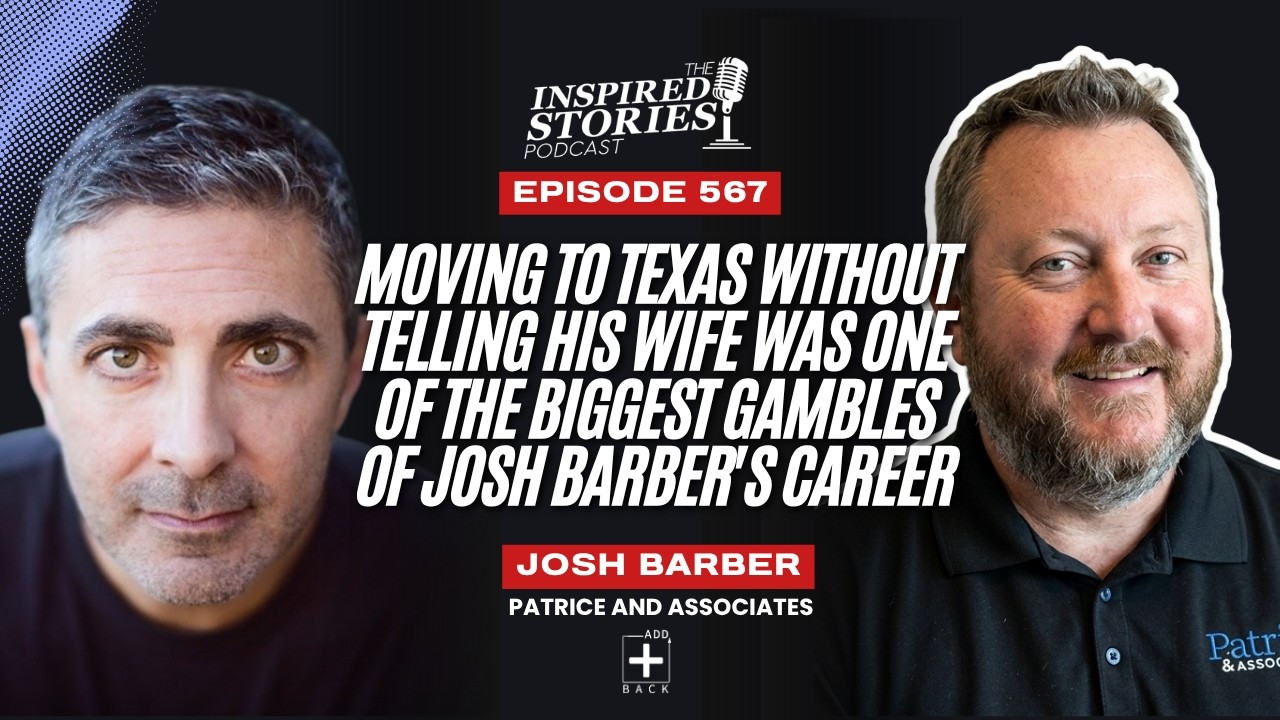
🎙️ From Chef Whites to IT to Recruiting: Josh Barber's Journey Building Patrice and Associates
In this episode, Josh Barber, franchise owner of Patrice and Associates in Dallas-Fort Worth, shares how a chef's career, two decades in corporate IT, and a sudden 2024 layoff led him back to hospitality — this time as a recruiter and owner. Josh opens up about hiding a career-changing move from his own wife, the failed business ideas he talked himself out of, and how he now helps overlooked chefs turn thin resumes into job offers.
✨ Key Insights You'll Learn:
Trained as a chef and worked his way into fine dining before burning out on the hours
Retrained in IT after realizing he couldn't be a present father in restaurant hours
Rejected a UK job offer over a fifteen-minute ultimatum and moved his family to Texas instead
Didn't tell his wife they were relocating to America until the night before disclosure
Hid a December 2024 layoff from his wife for a full week
Talked himself out of both an IT consultancy and a kitchen remodeling franchise
Launched Patrice and Associates with his wife in May 2025
Builds AI-driven outreach campaigns himself using his IT background
Repackages chefs' work into visual portfolios instead of standard resumes
Believes AI can source candidates but can't replace human interview coaching
🌟 Josh's Key Mentors:
Early Restaurant Manager Friend: Got him his first job in hospitality at eighteen
Andy (Dell Europe CTO): Modeled a direct, evidence-based communication style he still uses
His Wife: Talked him out of two bad business ideas and became his business partner
Zig Ziglar's Sales Framework: Shapes his twelve-touch outreach system for cold prospecting
👉 Hear how a former chef and IT executive rebuilt his career around hospitality recruiting — and why he still thinks presentation beats a resume every time.
Listen to the full episode here
Transcript
Anthony Codispoti (00:00)
Welcome to another edition of the Inspired Stories Podcast, where leaders share their experiences so we can learn from their successes and be inspired by how they've overcome adversity. As you listen today, let one idea shape what you do next. My name is Anthony Cloduspodi, and today's guest started his career in a kitchen, trained as a chef, then spent years climbing into senior IT leadership roles at companies like Dell Technologies and Line Data.
Then
in December 2024, a layoff wiped the slate clean. Instead of chasing another corporate IT position, he made a sharp turn back toward the industry where he started. But this time he came back as an owner. His name is Josh Barber, and he's the franchise owner of Patrice and Associates in the Dallas Fort Worth market. They're a national hospitality recruiting firm with hundreds of offices across the country.
He launched his franchise in May of 2025, bringing together two decades of experience across hospitality and technology into a business built on connecting great people with great restaurants, hotels, and hospitality brands. But before we get into all that good stuff, today's episode is brought to you by my company, Adback Benefits Agency. And you'll want to hear this because it's hurting almost every business you know. See, health insurance costs go up every single year.
And hotel operators are furious about it. They're paying more, claims are getting denied, employees are opting out because they can't afford it, and it hurts turnover and morale. It's one of the most maddening problems in running a business, and everyone just seems to accept it. But you don't have to anymore. Now there's a program from Bain Capital Insurance that gives employees unlimited access to doctors, therapists, and prescriptions with no copays or deductibles to meet.
It works for your part-timers. And here's the part that really shocks most people. Our product actually increases your net profits. We recently helped a client add, add $900 per employee per year to their bottom line. Results vary, but imagine what could be done with the extra cash flow. Get your free consultation today at adbackbenefits.com.
All right, now back to our guest today, the founder and COO of the Dallas Fort Worth Market for Patrician Associates, Josh Barber. Thanks for making the time to share your story today.
Josh Barber (02:28)
Thank you, Anthony. It's a pleasure to be and I look forward to speaking.
Anthony Codispoti (02:31)
So Josh, take me back to the beginning. What first drew you into the culinary world? How did you end up in a professional kitchen?
Josh Barber (02:38)
more fluke and accident than skill. I had a friend of mine at eighteen when I graduated high school that was already working in culinary industry as a restaurant manager. And like all eighteen-year-old men, I wanted to earn more money and wanted to make millions and thought that catering was the way to do it. So I joined the equivalent in Europe of a Chili's, which probably wasn't the beginning of a million dollar career. and
I enjoyed it. I I I learned a great work ethic. I you spend a lot of time with people that are essentially your friend group and similar to family because you're spending eighty, ninety hours a week with people that you're very close with and working tightly with. And it became a passion as opposed to something that I'd accidentally fallen into. I really enjoyed doing it. I enjoyed learning more about food, started going through culinary courses and earned my culinary degree whilst on the job.
Anthony Codispoti (03:32)
And so how long were you in the hospitality, culinary f food restaurant space?
Josh Barber (03:37)
ten years in total. I moved on from the equivalent of chilies into fine dining fairly quickly as I wanted to be good at what I was doing. it's one of those personality flaws is I'm a perfectionist. Nothing's ever good enough. I've worked with people that are f relatively famous, Ramsey's one of them, another guy's Jean Michel Roux. fairly well known catering people. And that was massively a passion of mine.
And I wanted to be the best of the best. I wanted to be, if you like, the next Gordon Ramsay. because that was where I thought that the evolution of my career would be.
Anthony Codispoti (04:10)
And so you were back a house guy, you were a chef, right? You were working in the kitchen.
Josh Barber (04:13)
Yes, always a chef, yeah.
I had no intro I s I still and this is humorous now because I've spent after catering the next twenty something years in front of house being customer serving and customer facing. I'm a miserable old commudge and I hate people with a passion, which is probably 'cause I deal with them all day.
Anthony Codispoti (04:31)
Okay, so walk me through this bridge from culinary to IT. How does that happen?
Josh Barber (04:37)
Pregnancy. So, my wife became pregnant with our now eighteen year old daughter, it's her birthday today. so I was working probably eighty, ninety hours a week with an hour commute one way, so two hours so I was away from home more than I was at home and when I was at home I was asleep. on my days off I would try and catch up on the rest of the sleep that I'd missed. And I remember a Friday evening after we'd finished work
just at the end of service thinking I can't do this and be a dad. I I want to be involved with my daughter and I can't do this. And it was a w well what the hell are you going to do thing. And the only other thing I had any passion or interest in and again bear in mind I'm a I mean I'm a still a young man at this point was video games. So I thought I know I can do IT. a and that is as logical as it got. That was quite literally the conversation I'd had with myself. So
I'd I'd retrained and got certificates in the IT field and thought this is this is where I'm gonna go because I love video games, I'm gonna learn to do IT. I I didn't really know what that meant and I still don't really kind I know what that means because IT is a generic overbearing beast of everything. but that was how I'd
Anthony Codispoti (05:46)
But you started to get some
education. You said you were getting these certifications in some different areas.
Josh Barber (05:50)
Yes.
So a and again this is twenty something years ago. I did cyber security twenty years ago, which is now a huge buzzword in the industry. I did networking, which I still I I know nothing about to this day. and basically your foundation certificates in yes you can turn a computer on and you can work on a computer. and then I I I I went from there. It was kind of like okay, well I can I can figure it out from here. and the the big thing that I'd learned from catering and hospitality is work ethic.
is that I was gonna try harder than everyone else because most and this is true to this day because I have kids kids today don't have a work ethic. It's like I I'm just gonna turn up and tick a box, whereas I was there to make a living.
Anthony Codispoti (06:29)
Right. And so what was the opportunity that came about that brought you to the States? How'd you hop across the pond?
Josh Barber (06:37)
so
this is a as a long story and it's quite a humorous one. I was working for a company in England called Blue Source and I was working on a contract that they'd won in the States for a bank doing compliance software, because obviously banking industry is hugely regulated. and I was getting paid pennies on the dollar and I knew roughly what I was making the company. So I'd I'd established that my my worth should be around about double where it is.
and the company disagreed. Which is bi business is business. So I left them to join Dell. and I worked at Dell for two years, which was was the best and the worst job I've ever had. Inasmuch that I got a huge tick on my resume saying that I've worked for Dell, which is a conglomerate massive giant, but I didn't do anything for two years. because they couldn't get out of first gear. It was just at the time that Michael Dell was buying Dell back.
so I had the opportunity to meet Michael Dell in London, a fascinating guy. but the company itself was stagnant for two years, and then Dell was about to buy Dell back and the entire division that I was working for, probably two or three thousand people, was about to get laid off when he acquired it. So the company I was working for prior to that said, we've got an opportunity for you to come back and we've got an opportunity in the US and back in London.
And the London opportunity they were gonna pay me the money that I'd wanted and a little bit more, or I could move to the US. so I did the safe thing. I've got two young children at this point, decent mortgage, I was happy with where I was living. It's like I'm I'm all over the London job. So I'd interviewed for both positions. and for this is again, this is perfect timing. The London MD, the managing director of London, I did the interview with him and his
Closing statement was you've got fifteen minutes to decide if you want the job or not. So in thirty seconds I decided I did not want the job. And that's pr whether that's a good or a bad thing, that's my reaction to almost anything. If if you're gonna apply that, I don't want it.
Anthony Codispoti (08:36)
So
and and so that was the reason that you pushed back was because they were pushing so hard for you to make the decision right away. You were like, Sot off.
Josh Barber (08:44)
Yeah, I I d and whether or not he listens to this podcast or not, I'd entirely accepted that job. I was it all in until it was that he said, You've got fifteen minutes to decide. and the guy I would have been working for was in that interview and phoned me as he'd said that and said, I'm so sorry, this is embarrassing. and it's like, Well, I'm I'm now a hundred percent out and let's explore the US. I hadn't told my wife that part, that we were exploring the US. so
I was still working at Dell, waiting to get laid off, waiting to get severed. and I'd been to the embassy for the in Mayfair in London at the time, d done my preliminary interviews, spoken to a lawyer about my visa and immigration, s was speaking with my chief technology officer in the States, and then it c became Yeah
Anthony Codispoti (09:25)
All this is going on behind the scenes without your wife having any idea.
Josh Barber (09:30)
Which is which is a smart way to deal with things.
Anthony Codispoti (09:32)
Yeah.
Josh Barber (09:34)
so
And then it got to the point where it was that she had to get a visa. so then she had to know, and then it became a very difficult way of like how do I figure this one out? So I I I did the mature thing, which is a a running theme in my life, is I I went to a bar, had one or two drinks, too many, went home at about eleven o'clock and said, by the way, we're moving to America Which landed as well as you think it did.
So I woke up the following morning and she had a face like thunder and was like, What what do you mean we're moving to America? We've got kids, we've got family, we've got all of this. It's like, yeah, I I'm pretty sure I'm gonna get laid off and I'm pretty sure I'm not gonna get another job in London easily. so I think we're gonna move to the States. And and we moved to the States on a non immigration visa. So we we weren't supposed to be here permanently. which is all exactly how you should bring up a young family.
Anthony Codispoti (10:19)
Ha ha.
Josh Barber (10:20)
So
Anthony Codispoti (10:20)
Lots of
good decisions you're making here. Great great communication skills on display. Yeah, go ahead, Josh.
Josh Barber (10:22)
Brilliant decision making. Yes.
I'm excelling at this. So and she had never been to Texas either at this point, and we d we then again I remember this vividly. Well we're landing in DFW with my eighteen month old and my three year old and my wife, and it's it was twenty twelve, so it was the year where there was a hundred deg a hundred days of a hundred degree weather, so it's like the surface of the sun. we land at the airport.
I get a phone call on my cell phone saying, by the way, the cab that you've ordered, the suburban, has broken down. We're gonna send you a different car. it's like, okay, this is this is landing brilliantly. I'm I'm I'm really crushing this one. So they set they sent a Lincoln Stretch limo to pick us up and we're moving into a neighbourhood and we've had funny accents. I've got all of like the six cases of luggage and we turn up in a stretch down car and you think this is just perfect.
So yes, that that's right.
Anthony Codispoti (11:15)
Welcome to the neighborhood. You're you're really presenting yourself
Josh Barber (11:18)
Yes, I I looked unique is probably the best way to put that and but that's that's kind of how we ended up here is n again, no skill of my own. It was more of a I fell into decisions that w I ran with and fortunately my wife backed them and fifteen years later we're now US citizens very, very happily living in the middle of nowhere, Texas and doing okay.
Anthony Codispoti (11:42)
Yeah. well, welcome to America. Happy to have you.
Josh Barber (11:45)
Thank you.
Anthony Codispoti (11:45)
your wife sounds like a saint and a very patient and understanding woman. I I know because I I'm I'm similar and and I've got a I've got a a wife cut from the same cloth. so you must have ended up developing some pretty good IT skills along the way. Did you have any really good mentors or was this just sort of like stubbing your toe and kind of figuring it out as you go?
Josh Barber (12:06)
Some of both. So while I was at Dell, I worked very closely with the now CTO of Dell Europe, guy called Andy. he was similar to me in a sense that he was a perfectionist and demands the best. So I would have conversations with him with he would challenge every single thing that I said and demand that I prove it, which some people find abrasive and unproductive. Whereas I used it in a different fashion and said, actually yes, let's get all of the information and make it a polished
This is the presentation and this is why and d I don't want you to have choices, this is it. and that was quite a good relationship for me because I was never given the chance to say, Well, I think this, but maybe this and maybe that, it was just this is it or not. and I enjoyed that. And then my
Anthony Codispoti (12:50)
And sorry, you're
you're learning this this style as a way to communicate with coworkers or with clients or both?
Josh Barber (12:57)
Both. I I find for me, and this is a me thing rather than a suggestion for anyone else, if I bring you the solution and explain why it's the solution, I don't expect much in the way of challenge because I've already explained why it is that I've solved the problem. it's it's one of my side gigs as I do software development on the side at the moment. if you explain the problem and articulate the problem, I will solve it in the way that you've explained the problem. And I ex and and again this isn't meant to be arrogance or whatever it's.
if you tell me your problem, I will say I can I can fix that or I can't. and I'll explain the why I can't fix it and or or how I did fix it. And I find that to be quite a useful way to construct in my brain to say this is the problem, this is the solution, and this is why it's the solution. So that's just my way of thinking.
Anthony Codispoti (13:41)
So I could see that being a
a very effective approach for a client, right? You're the expert,
Josh Barber (13:48)
Mm-hmm.
Anthony Codispoti (13:49)
they've come to you because you know what you're doing. And so they don't want guessing or theories, right? They want to know that you're confident in your approach. But talk to me about how that same communication style is effective with a coworker, because maybe there needs to be a little bit more dialogue or brainstorming about what the right solution is.
Josh Barber (14:09)
So I started especially in the IT world, at the bottom of the ladder, as it were, I started answering phones and saying, Have you rebooted it yet? and then developed my way all the way through to leading consulting engagements across Dell Europe, as the big one. So I find that being direct in communication, and that's not meant to be rude or aggressive, if you say, I think we should do this, why is a good answer? If you don't explain to me this is why we're going to do this
I find why and then challenging every part of the why. So you'll draw out the information faster. and then the more you work with the same person repeatedly, they'll learn that okay, Josh is going to ask why about every minute detail until it is that I've explained everything to him. So the best way to do this is to say this is what we're doing, this is why we're doing it and this is how we're doing it. and I find that draws out conclusion much faster because I want to get to and this is an IT term that I'd not heard outside of IT, I want to fail fast.
I think it's the best way to succeed is to fail as quickly as possible so you can get to the solution as quickly as possible.
Anthony Codispoti (15:15)
No, I I like that. That makes a lot of sense to me. So you're with Blue Source. That is what brings you to the States. after several years there, you end up working for about six years for line data, still
Josh Barber (15:27)
Mm-hmm.
Anthony Codispoti (15:27)
in the IT, the tech field. was there anything in the back of your mind that wanted to pull you back towards hospitality, back towards restaurants, or were you happier with the hours, the money, like, you know.
Lots of headaches and hassles that you had before have gone away.
Josh Barber (15:47)
so it's still customer service, and and that's the one of the most boring things that I think that everyone forgets that we all work in a customer service world. my customer just happens to be hedge funds, private equities, and it the the product was information technology. in hospitality, your client is a someone that wants to have dinner and drinks, and the product is food. I still think that it's just customer service that you have to dress up with a bow and a smile. so
Did I regret and or did I miss it? I was doing the same job, just with a different front. and I and I firmly believe that. I I made pretty good money leading IT teams across the world for line data. the hours were fine, the customers were difficult because obviously it's financial traders, and when they have bad days, I have really bad days.
Anthony Codispoti (16:37)
Take it out on you, huh?
Josh Barber (16:38)
Yeah.
And that's part of the gig, right? It's the same in restaurants, is that if you have you're the GM or you're the head chef and someone has a bad experience, you're gonna get chewed out or you're gonna get a terrible review. it's part of the gig. so I didn't have a lingering desire or angst about missing out. I it was just something I had done and something that I knew and I was grateful for the experience growing up, and that makes me sound a lot older than I am. but the the one thing that I really did learn
was work ethic. A and and I stand by that. To this day in any field, if someone says, I've started in hospitality, I've attended bar, I've done weight service, I've done kitchens, if they've done it for any length of time, I know full well that they're prepared to work their guts out. Because it's a hard grind.
Anthony Codispoti (17:26)
That makes sense to me. So you feel like some of your skills from working in the back of a house in a restaurant were really transferable over to the tech field. You've got the work ethic,
Josh Barber (17:37)
Yeah, it it's
Anthony Codispoti (17:38)
you've got the customer service skills, you know how to work long hours and you know how to deal with difficult people.
Josh Barber (17:45)
Yeah. That that's exactly it. It I think that all of that is foundational from my catering background. and definitely didn't hurt. Because again, especially starting a career is in your early twenties, you're not gonna get the preferential treatment. You're gonna be the one that's phoned in the middle of the weekend saying, by the way, you've got this boring, tedious, menial thing to do because someone that's now my age isn't doing it because they've got kids and they've got
commitments elsewhere. It's part of the deal, right? Is that when you're young, you you're expected to work or at least I think and there's probably an ism somewhere, is that you're expected to work harder to prove it and to earn it.
Anthony Codispoti (18:25)
So Josh, tell me about the layoff that changed the direction of your career in twenty twenty four.
Josh Barber (18:31)
This is gonna paint me in yet another stellar light. so my my decision making being brilliant is is again gonna come to my forefront here. so I I got laid off and I did what every mature married man would do and I didn't tell anyone for an exact a week. I went back to my desk because I worked from home.
Anthony Codispoti (18:50)
Including your wife.
Josh Barber (18:52)
yeah, no one knew. Not a single soul, other than the company that had taken me off. So
So again, this is a pat yourself on the back, Josh, you did well here. so I went back to my desk, started looking at jobs and started thinking I could do that, but I don't wanna do that. I spoke to a former client, they phoned me up and said, by the way, we've got a great opportunity for you to come and do some stuff with us on a contract basis. and then none of it was like the thing. None of it bit and I thought I I really wanna get back into this. I'd I'd w I'd w I I'd worked and burnt out and felt
aggravated and begrudged and I felt like I'd worn out the corporate machine and I'd been chewed out and spat out by it. and then after a week I I finally got over myself, which is impressive at my age that it took me a week to get over myself. And I told my wife, by the way, I got canned. Which was my exact words. and
It didn't go very well. And she's like, Well, what do you mean you got canned? It's like, Well, I've g I've been given severance, I missed out on my bonus, I missed out on my stock, and I'm now gainfully unemployed. And so so the first question out of her mouth, which is probably the correct question, is what are we going to do? as I was the sole breadwinner. And my answer was as usual Stella is like, I have no idea. so then it's like, Okay, well now I need to figure out what we are going to do.
So I'd spoken to an a different former client and he said, like I'm prepared to back you, and this is a private equity. I'm prepared to back you and you can form a consultancy specializing in private equity, hedge funds, cybersecurity, all of this stuff that I'd been doing for the last twenty something years. did some exploring in it, got quite far down the path and just thought, I don't want this. This isn't for me. I I'm not excited. This is more I'm just gonna go to work.
Anthony Codispoti (20:32)
It's just a way to get a paycheck, basically. Wasn't something that
Josh Barber (20:34)
Yeah, it was it it was very much just a
Anthony Codispoti (20:36)
moved your soul.
Josh Barber (20:37)
Yeah, I I was I was totally unexcited about launching my own IT firm. and that was an odd feeling because it's the only thing that I'd really been successful at that made money. So th then I have a and and this time I did well. This is this is a patty about Silver Bank moment. I said to my wife, I don't want this. I don't want to do it. And she's like, Okay, well then what are we going to do? I said, Well I
I d I don't know that yet, but I don't want this. I don't see a way to make me happy other than to just get paid. A and that's not a bad thing, right? Getting paid is a good thing. So I then did what and this is a LinkedIn thing, I had one of several hundred people that said, like you should launch your own business, talk to us and I had a day where it was that I hadn't had anything to do and spoke to a a franchise consultant and they said, like you should get a
Well, I think it was a kitchen remodelling company. Patrice and Associates franchise and I forget what the third option was. So I decided, I'm gonna get a kitchen remodelling company, because I'm full of brilliant decisions. And
Anthony Codispoti (21:41)
'Cause you've got a lot of experience in that field.
Josh Barber (21:43)
Exactly, it's it's exactly what I know, and it's it it gets better yet still. So I go all the way through having all these conversations and I say to my wife, this is what I'm gonna do. I'm gonna get a van, I'm gonna go and show people how to do tiles, I'm gonna show show flooring, we're gonna do
app appliances and she sat there and said, You're colour blind. You don't know anything. I dress you. and then it occurred to me that actually, yeah, I'm really colour blind and she does dress me because I don't often wear matching clothes. So being a consultant in something that where people are having homes and redecorated and there's me with pink and orange tiles and someone looking at me like I've just had a seizure wasn't probably the best move. So
Then I got back and thought, well I'll I'll do something different. And it's like, well, why don't I do hospitality? It's like I know people, I've I've recruited hundreds, if not thousands, of people over the last twenty something years with IT backgrounds. I know how to do this, I know how to get the right people, I know how to interview people, I know how to prepare people, I know what people want. Yeah. So
Anthony Codispoti (22:41)
'Cause you were like I you were a team leader in in these roles, yeah. Okay.
Josh Barber (22:45)
I I know all of this, I can tick all of those boxes, I know all of that, and I come from a hospitality background.
I still have friends that work in hospitality on both sides of the Atlantic now. But I I know this industry. so I dismissed it again and thought, nope, we're gonna go back to IT. and then spent another couple of weeks figuring out what I was going to do with IT. And then my wife said, like, well, you and I both come from hospitality backgrounds. she was a hotel manager before I got her pregnant, which is probably not great, and and she ran zoos.
So very much customer facing, very people person. and said, like, this is a business that we can do together. Because the kids are now old enough that my oldest is going to college next week, my youngest is about to graduate high school. so it's like, Well, why don't we do that? And then you look at the numbers and it's like, Well, this is quite a lucrative business. and we know the industry, it's not like it's a we've never worked in a restaurant. I've worked from
chilies all the way up to fine dining. and it's like, well this makes some sense. So it's like, okay, well let let's not rush into this, let's think about it. because I I want to poo poo it because I'm an IT nerd. And then it's like, okay, well why don't I do recruitment? So then it was like, okay Yeah. And
Anthony Codispoti (24:04)
You're having to recalibrate your identity here. Yeah.
Josh Barber (24:07)
I and I'm thinking this is a bad idea because I wanted it to be a bad idea. because it's not what I know anymore. and
It it's an industry that whilst it revolutionizes itself, that doesn't materially change. Like all industries that nothing materially changes. So then it became a okay, well it's
Anthony Codispoti (24:28)
And so hospit sor
sorry to interrupt, John. So for you hospitality just seemed kind of boring and stagnant. I a and and it was this n okay. Well okay.
Josh Barber (24:33)
It just seemed like the old woman that I knew. And it's kind of like well, why
go back? and then it's and it was speaking to a friend of mine who is a bar owner and his his statement that he probably doesn't remember is, Well if you know it and you're good at it, then why wouldn't you do it? It's like, Well I don't really have a good answer to that. and I didn't I still don't have a good answer. If you're good at it you know it and you can make money at it, why don't you do that?
So okay, well let's do it then.
Anthony Codispoti (25:02)
And actually,
if if you're okay, Josh, I want to pause on this for a second because I've heard and I've been through this same question myself a lot with entrepreneurs, with high performers. It it feels like, you know, when you're trying to figure out the next stage in life, you're asking yourself, like, what am I meant to do? Like, is there some bigger purpose? Like, I'm looking for something that like really makes me excited. And, you know, I think it's great when that
thing that makes you excited that lights up your soul, it can also be the thing that makes you money. But, you know, when you're a dad, you're a husband, you're the sole, you know, earner in the house, sometimes you've got to do the thing that just makes economic sense, that maybe doesn't immediately light up your soul. And it sounds like this is the sort of tug-awar in the conversation that you're having with yourself.
Josh Barber (25:49)
Yeah. I mean I I I'm I'm not anti or was not anti the idea of doing it. It was just that but why? and then it became if it again, if you're if you know it, you're good at it and you can make money at it. And it it's a fun job. Making people getting people new jobs is always fun because if you someone's looking for a new job and you get them their dream job, they're happy, customers happy, I get paid, I'm happy. It it's a win quadruple.
So a a bad day for me in my IT world is that I get screamed at, yelled at because someone's lost money, they can't trade, they can't get email, they can't access internet, so on and so forth. A bad day for me now is saying at the interview you didn't do great. That here's why you didn't do great, let's get this is what we're gonna fix, this is how I'm gonna prepare you for the next one better, and we're gonna get you the next job, let's go. is a much nicer conversation than being cussed out, screamed at and
attacked constantly. it's because there's always a solution to you didn't get the job but we're gonna get you this job. I had a similar thing last week with someone that didn't get a job that they really, really wanted because they didn't do great at their interview. It was a stress test for a chef. but the solution to that was the same company has a subsidiary where they do want to employ you because it's slightly less fine dining and more suited to your wheelhouse and they're gonna pay you the same money you wanted.
So the problem became the solution.
Anthony Codispoti (27:15)
Yeah.
Josh Barber (27:15)
and that's a good day for me and a good day for them.
Anthony Codispoti (27:18)
So break it down for us. What specifically do you do at Patrice and Associates and who do you do it for? Who's your
Josh Barber (27:26)
so we are hospitality focused and and that's a cop-out in in the answering that question. We'll recruit for any industry. I've I've done IT placements because I know that world. but very, very hospitality focused. so we have any number of hospitality clients. We have quick service restaurants, so stuff like Popeye's Wendy's, Burger King, McDonald's, all the way through to Michelin Star restaurants and everywhere in between. we will place executive positions
so exec chefs, head chefs, sous chefs, execs of all the variations of that, general managers, assistant managers, finance physicians. we're recruiting currently for fairly well-known steakhouses on the East Coast. I'm DFW based as mentioned earlier. So we're trying to break into this market a little more. we have country clubs, golf clubs. There's a number of very famous golf clubs in the DFW Metro.
And we're focused on the hospitality side of that. Trying to break into the IT world a little bit more, but there are huge players in the IT recruitment, whether you like them or not, such as Robert Half, who I didn't have great experiences with when I was recruiting from them. but that's a personal thing. again, they're good at what they do because they do it on volume that I can't I would love to touch.
Anthony Codispoti (28:44)
And
so for you, your client is the restaurant and they're coming to you and they're saying, Hey, I need this position filled. You go out and find that person, right? Or is it work
Josh Barber (28:54)
Yes.
Anthony Codispoti (28:54)
the other way as well, where somebody, an executive in the restaurant field, comes to you and says, I'm looking for a new opportunity. Can you help?
Josh Barber (29:01)
It's some of both, but it's much, much easier when the restaurant or the client comes and says, I need an exec chef in Fort Worth for me to go and find an exec chef. if if an exec chef comes to me, it tends to be a harder conversation because why are they looking? People are always anxious about people that have left jobs, don't have jobs. so it's much easier for me to go out and do what traditionally is called head hunting. I'll find someone that's happily employed and then I'll build a presentation package. We do
using the exec chefs as an example, we'll build an entire portfolio so PowerPoint because I come from a IT background. I'll build a PowerPoint of all of the presentation that they've done, buffets, restaurant placings. the resume is like the last of of the important things. I'd rather show people in pictures this is how great this guy or gal is, look at what they can do for you. Make things so beautiful. by the way, they've spent ten years here. They they're gonna kill this job. so we do build custom resumes
but for the most part it's presentation of how they do their job because that's what people want to see.
Anthony Codispoti (30:06)
That's
interesting. And that would you do this same approach in any field or is this specific to hospitality? Because what they're producing in that role is is a very sensory thing. It's a very visual thing.
Josh Barber (30:20)
I would do it in every world. So using IT as the other example, one of the things that is again, it's much more boring than food, right? Food is a useful thing and we all like looking at food. I would I would send people to GitHubs and say, This is someone's code, this is someone's method of working. it's a lot more boring and binary. I'd I would much rather look at someone's plating of a steak dinner than I would at someone's coding. But same beast, different animal.
Anthony Codispoti (30:45)
So one of the reasons it sounds like you got nudged in this direction is your wife said, Hey, this is something we could do together. Has it played out that way? Are the two of you building this business together? Are you working together?
Josh Barber (30:56)
Very much. So she is more the customer facing side now, and I am the IT nerd in the background. and this is of I'm sure you hear this on everyone in your podcasts. AI is is now the biggest thing in the world. we have models that do all of the scraping and finding people in the background and contacting people in the background. So she says, I I this is the job I want to look for today.
And an AI model goes out and says, Okay, I found fifteen people in the Metro and this is their score out of one hundred. Here's their phone number, here's their email. and let's get hold of them. And by the way, I've texted John to see if he's interested, and John Yeah, I'll have the conversation. and and that's
Just the way of the world, right? AI is is it's going to do it anyway, and if I don't do it someone else will do it. So I I we do do all of the warm stuff in person, but the cold outreach is very much automated.
Anthony Codispoti (31:53)
And
are these tools that you built in-house or are these third party tools that you're leveraging?
Josh Barber (31:57)
th stuff that I built. 'Cause that's one of the advantages of spending twenty years in the IT world is that I actually like my wife has no interest. She looks at stuff and goes, This is I have no idea. I said, We'll just paste stuff into this box and off it goes. So that's one of the advantages from spending twenty years in corporate world of IT, that I can build stuff and say to her, This is how it works and then she has warm outreach.
Anthony Codispoti (32:20)
And so who's actually interfacing with the corporate client? Is that a combination of the two of you? And then who is working with the candidates? Also both of you?
Josh Barber (32:33)
yes but no but so the client is probably ninety percent my wife. because she's a much nicer person than me. She's a much more
Anthony Codispoti (32:42)
I know I've heard you say you don't really like people, so
Josh Barber (32:45)
she's so she's quite c talkative, she's quite conversational, and she's much friendlier. I'm very blunt and direct and it's either character flora is just the way I've grown up. so she tends to draw more of the warm
story out of people, whereas I tend to just be this is it, this is it, this is it. with customers, it's some of both, and then I will do the closing because I've spent years in corporate world closing sales, closing deals, doing contract stuff. and I'm more comfortable doing that than she is. And so she's the woman fuzzies and I'm the miserable old fart.
Anthony Codispoti (33:19)
So
you started this back in May of twenty twenty five. How did you get your first three clients?
Josh Barber (33:25)
Network is i is the most boring and probably accurate answer ever. my first client was a former employer of mine, in the IT world. And that was just the case of again, it's it's good decisions by Josh. My wife said, Why don't you just ring them and say that we want to employ people for you? and I thought that was a terrible idea and I phoned them and the next day I had three job orders. So So again, well done on my part. and then
Another was just a referral from a friend of ours that said, I know that this company's looking desperately for people. They can't seem to find anyone. and then again another referral from that same company that we networked out to there and said, Desperate for people.
Anthony Codispoti (34:03)
So were all three of those clients in the IT field?
Josh Barber (34:06)
No, two restaurants and a one IT. So we had a local restaurant that knew someone that couldn't find people. we live fairly remotely, we're an hour north of Fort Worth. and we had a restaurant that we frequent, said, by the way, I know John is looking for people that he c he can't find anyone. Maybe you can help. and it's it's much easier from our side because we dedicate hours to it rather than a restaurant's gonna say
I've got ten minutes spare, I'm gonna go and find someone. so we found the right person and then that person said, by the way, I know another restaurant that's desperate for people, slightly closer to Fort Worth, but they can't find anyone. They don't wanna pay big recruitment firms twenty five, thirty percent. maybe you can do a deal with them and within two weeks we've got them a new chef. So it that that it was it's all networking. we do cold outreach and do
chambers of commerce and all kinds of other things. The the best way is still network. it's it's not the perfect answer because it's the hardest thing to build is referral clients. but it's the safest way because you've already got the deal mostly closed if you've got a referral.
Anthony Codispoti (35:18)
So most of your business today is just coming from word of mouth. Folks that you've worked
Josh Barber (35:21)
Yeah.
Anthony Codispoti (35:21)
with refer their friends who've got a restaurant in need.
Josh Barber (35:25)
Yeah.
Anthony Codispoti (35:25)
Yeah.
Josh Barber (35:26)
And people with testimonials, right? So if I can say I've got fine dining restaurant, one in Dallas, that says we did a great job and they're happy for me to b use their testimonial, I can go to the restaurant next door and say, by the way, we're finding them the right staff. You're missing out, do you want to do a deal?
Anthony Codispoti (35:43)
Mm.
Josh Barber (35:45)
whether it's right or wrong, that's a sleazy sales tactic, but if if it works, it works, right? So
Anthony Codispoti (35:50)
I
don't think there's anything sleazy about it. I mean, it's a genuine testimonial, right? Yeah.
Josh Barber (35:54)
Yeah.
Anthony Codispoti (35:55)
And this is a a place that's probably in need of your services because, like you said, restaurants are so busy, the best they can do is carve out maybe 10 minutes to try to, you know, post something in online on Indeed. and that's just not going to get it done. So you're coming in with a solution. so
Tell
me what your cold outreach looks like. Is it a phone call? Is it an email? 'Cause I'm curious with a a guy with the IT background that you have, are you automating some of that as well?
Josh Barber (36:27)
So yes to all of the above. so I do LinkedIn is a fairly good source of data and then people on Indeed, ZipRecruiter, there's a number of other job boards. If a job sits for thirty days that's unfilled, one of my AI robots will pick that up and say, restaurant hasn't had job for thirty days open
Let's find out who the to contact and email them and say we can do X, Y, and Z. And then Zig Ziggler comes into play for the twelve touches. So I I will automate email outreach and then my Outlook calendar will pop up and say, by the way, ring John at this restaurant and say in a friendly fashion, Hi, I emailed you. I've got a position I've got a person, sorry, to fill your position. Let's make a deal. Let's talk.
fifty fifty shot as to whether I get told to pound sand, but I'll still t
Anthony Codispoti (37:20)
Yeah.
Josh Barber (37:21)
again, email them again, phone them again, and it's the twelve touches that's the Zig Ziglar model. and if I get to twelve, my conversion rate probably ups to about seventy five percent. If they'll talk to me the twelfth time I've probably got them. and that's part of having done sales on a large level, is that if my conversion rate gets high enough, I'll take lots of losses because I can make money
doing the conversion at a high level on the e other side.
Anthony Codispoti (37:49)
And so what does that outreach look like? Is it once a month email and then at the month six it's a phone call and month twelve is a phone call? Is it are is there some
Josh Barber (37:58)
So it'll be
Anthony Codispoti (37:59)
LinkedIn outreach? Are you poking them other ways?
Josh Barber (38:02)
so LinkedIn is a difficult platform because they loathe automation. unless you pay for I think it's Navigator, which is a couple of hundred bucks a month. so I try and avoid LinkedIn as much as possible. which isn't always successful because the the world is much like Facebook, LinkedIn lives together. but it'll be an email week one, and I I run it seven days a week, the email outreach. So I have seven different campaigns that will run
You'll get an email week one, a phone call week two, an email week three, rinse, repeat until you get to week twelve. So it's alternate weeks of email and phone call and occasional text in there.
Anthony Codispoti (38:40)
sorry, twelve weeks, not twelve months.
Josh Barber (38:42)
Yeah.
Anthony Codispoti (38:43)
Got it. Okay. Yeah. And then for you say a lot of your business still comes in as referrals. Is that happening naturally and organically, or is there anything that you're doing to stay connected to those previous clients and remind them that you appreciate introductions?
Josh Barber (39:02)
It is both. it's if you place someone, it's always good to say that a week after they place we to do it to the candidates as well. Are you happy? Is everything going great? Can we do any more? we're really glad that you found the right person, so on and so forth. and then you get Google business reviews, you get testimonials written for you that you can use on your website and index against for Google. so it's it's just staying in touch. It's
It's the nice thing to do, right? If if I give you a person or a I place you a job, I wanna make sure that you're happy and the next time it is that you're looking either as a person or as a client that I'm the first person you reach out to because I wanna help. And I do mean that. That's that's not just a sleazy sales tactic. I do want people to be happy in their jobs and I wanna make sure that I've got happy clients.
Anthony Codispoti (39:53)
So
when you're talking to a restaurant group for the first time, what's the biggest hurdle that you typically have to overcome?
Josh Barber (40:00)
we already wa we already have internal recruiters.
There's a reason you took my call. Because they're not doing it right. and recruit especially at restaurant groups. recruitment tends to be one of the least important functions, especially for giant groups, because people will apply to giant groups. we do it differently. If if you apply via an indeed job listing, you're gonna send a fairly bland generic resume to a very high end chef job.
I'll do it a different way. I'll send over a presentation package of all of your presentation of foods, picture of your headshot with you in Chef Whites against the stove, a doled up, glammed up resume, huge introduction cover letter. I'll I will make you into the guy that they should be talking to just by talking to you. Whereas you sent over a generic resume. So you're gonna be in the week and the chaff, whereas I'm gonna make sure that you are the guy that they need to talk to.
Anthony Codispoti (41:00)
How are you finding your candidates? Are restaurant operators, chefs, et cetera, are they prominent on LinkedIn as well?
Josh Barber (41:08)
LinkedIn is pretty decent, especially for the higher end positions. because i it has become like Facebook. Whether I I I mean I'm not a LinkedIn lover, but it's become Facebook. you'll have people that post pictures of their family and kids on LinkedIn now, whereas twenty years ago it was very much business is business. Now it's just another social media platform.
so it's becoming the de facto place for people to advertise themselves. and then you can find them using various other tools such as like Zoom info and stuff like that and say, Okay, I need Anthony's phone number. He's advertised it somewhere else or accidentally left it in a signature somewhere, I can scrape his details out and get hold of him.
Anthony Codispoti (41:54)
So part of what I love about your story here is all the ways that you're using AI to help you with a lot of this behind the scenes grunt work, right? Stuff that just you know, with the two is it just the two of you, you and your wife?
Josh Barber (42:08)
we have a employee as well. We have a sourcing
Anthony Codispoti (42:10)
Okay.
Josh Barber (42:10)
employee.
Anthony Codispoti (42:11)
So it's still a small team. You wouldn't be able to have the reach that you do or be able to do what you do nearly as efficiently. So present day AI is very supportive of what you're doing. You've got a strong background in technology. You've seen sort of the trends as they've evolved. Is there any concern that at some point AI could replace the work that you're doing? Like do you view AI as a potential future threat?
Josh Barber (42:40)
it's that's a really interesting question. so I never saw it, and this is ignorance on my part again, replacing my corporate IT job. and I'm fairly confident that's essentially what happened, and and I may have aided that situation. With what I do, I don't think so, because AI finds the person for me, but I have the conversation with them, I get them ready, and I I build their person's con that person's confidence and make sure that they are
the guy for the interview rather than another number on a spreadsheet. and that that's a very much personal interaction. I don't think that AI currently can replace that personal interaction and that level of preparation. It it it does a lot of my work for me and saves me weeks of effort. but I don't think it can close out the human connection part.
Anthony Codispoti (43:27)
Hmm. I tend to agree with you. You know, I talk with a lot of folks in hospitality, hotels, restaurants on this show, and you know, especially since the pandemic, massive changes in the workforce makeup. and especially for frontline workers, just big labor shortages, right? They've got huge turnover problems. I think that was the case even before well, before the pandemic. But I'm curious if you're seeing these same sort of
shortages in talent available at the higher level positions that you're recruiting.
Josh Barber (44:02)
It depends on the metro. New York is particularly difficult at the moment. which is odd, because New York is the beacon of whatever is. I love Manhattan. I think it's a stunning place. I don't want to live there and don't think I can afford to live there. but you should be able to find numbers of needles in haystacks there and it's it's proving to be the opposite of that.
Dallas, again, similar. It's proving to be quite difficult to find the right people because the right people have moved to more remote areas. I managed to find someone, I forget which state it is, but the city was smaller than the city I live in and it was remote remote. That there wasn't a highway nearby. and we managed to find a Michelin style chef that had moved there in twenty twenty because he was trying to get away from the world. and now in a city that I think it had a population of of round about five thousand.
And there's some high end restaurant in the middle of nowheresville. and he's making six figures a year, doing forty hours a week, doesn't work Sundays, just because he ha happened to fall upon that sleepy little town, and you think like that that's never gonna happen again. But it's more and more common that that that all of the high end guys are moving away from the metros.
Anthony Codispoti (45:21)
And so that's why New York's become so challenging. People have just moved out of the city.
Josh Barber (45:24)
Yeah, I think a lot of COVID damage resides because when you move out, it's really difficult to go back from being in a what five hundred square foot apartment that you pay three grand for a month and you move to remotesville, USA and get a three thousand square foot house for the same money with land and a garden and less stress, less traffic. it's it's difficult to go back.
Anthony Codispoti (45:51)
So you're in Dallas Fort Worth, but it sounds like you can work across the entire country. You're not locked into a specific geography.
Josh Barber (46:00)
Correct, yeah. we we focus on DFW, w which is the opposite of what's happening at the moment. I'm placing people in the northeast, mainly in New York at the moment, funnily enough, having just panned that market. So we work all over the states and some of Canada. we do perm staffing and temp staffing as well.
Anthony Codispoti (46:21)
interesting. Tell me about the perm and the temp staffing.
Josh Barber (46:25)
so permanent is bread and butter. again, very focused on hospitality
Anthony Codispoti (46:29)
record what you do.
Josh Barber (46:30)
b because that's the in quote mark safe way to do things, right? You get benefits, W two, etcetera. temp staffing is is a new thing we're exploring at the moment. we live as mentioned, I live in DFW. So we've got a number of regional airports. We've got Amazon Hubs, Walmart hubs.
lots of factories, lots of trucking distributions. We've got one of the biggest train stations in the States. so temp staffing there is a lot of factory workers. just because it I don't want to leave anything unexplored. I don't want to leave markets that are undeveloped. If I can get into something and make a quick buck at it, I'm not against it. and it's a good market because there's lots of people that just want much like Uber drivers just after COVID.
Uber driving went through roof and then Uber fixed that problem for them. But it it's better to have than to not have. I I would rather not see something and say, I I'm not interested in that. I'd rather just say, Well, let's at least explore it and see it.
Anthony Codispoti (47:33)
So with the temp staffing, are you the employer of record?
Josh Barber (47:37)
I use a third party for that. a partner there, because I I I want to avoid being the partner of record because it's it's so much paperwork. Yeah.
Anthony Codispoti (47:43)
That's a whole nother business. Yeah.
Okay. I want to shift gears on you now, Josh. I want you to think back across your life, what are the most difficult things that you've had to overcome and what going through that taught you?
Josh Barber (48:02)
So we touched on it earlier and I made fun of myself for it. moving to the States was a was a massive decision point. I was still relatively young, I was in my thirties ish. a point in my career where I wasn't sure that I had one, 'cause I was still fairly new at it. and young enough that I was arrogant that I thought I was the best at everything in the world. so thinking I'm about to get laid off wasn't an ideal situation.
Thinking that my solution was to run away from the world probably wasn't a mature decision. And then hiding it from everyone that was part of my inner circle also wasn't a great decision. so that that was really quite difficult in as much that I hadn't told my wife. I'd agreed to things that I wasn't sure I could agree to f on behalf of my wife and children, hadn't mentioned anything to my family, all of my family is still in the Europe in the UK.
And it was it was challenging in as much as that I I was completely upside down in my entire world and my family's world and my children's world. my oldest was just about to start school, and and then I moved her to the States. She started kindergarten in the States. we hadn't seen the house we were moving into, we moved into a house that we'd seen on FaceTime. and and it was terrifying. And then as as mentioned earlier, when we arrived in the States, it was like the surface of the sun.
Instead of getting the suburban and we a stretch town car, which i is funny fifteen years later at the time it was more of a man, what else? but it that was a really, really difficult thing to do and coming on a non immigration visa. my my original visa was what's called an E two. so every two years we had to leave to get a new I ninety four, I think it is. and you can't go to Mexico or Canada to do that, you have to go further afield.
So it was expensive, w having young kids. Th there was lots of I think I'm going to and I'm I'm I'll I won't cuss deliberately, I think I'm gonna screw this up, but I'm gonna do it and take a chance.
Anthony Codispoti (50:04)
Is that just kind of the way that you're wired? Like just a bold personality that's like, the heck with it. I'm just gonna roll the dice and just throw myself into this.
Josh Barber (50:14)
Yeah, I I'm glad I did, inasmuch that it it's worked out brilliantly. I'm not sure that I'd make the same decision again twice, because it was a massive gamble on maybe.
Anthony Codispoti (50:26)
What were some of the biggest cultural shocks to you as you came to year?
Josh Barber (50:31)
s
I'm lucky. I grew up in Mutt. so I grew up in the Middle East, in the US school system. my dad is an investor or was an investment banker. he's retired now. so I grew up with American kids, mainly Air Force and military brats. so I grew up with the American school system, I know a lot. So I was fairly culturally intertwined. and it's one of those things that I I it wasn't a huge culture shift for me.
But my wife had only been to the States once before we moved here, and that was to California, to San Francisco. And San Francisco is not like Dallas on any level, and that's a good thing for both sides. so again, when we were landing in Dallas, she had the vision of Texas being essentially what Arizona is a desert and so cactus everywhere.
And it's not, it's it's quite pretty. We've got grass everywhere, it's trees. it's it's not cactuses and deserts. but it it's also not California, right? We haven't got mountains, we haven't got the ocean in Dallas, it's it's it quite bland. It's it's flat where in the prairie lands. so culture wise for her was quite a shock. And she's quite close with or was quite close with her family. so I took that
That's the and this is a quote that's has been used when we bick her. I took that away from her. so sh I moved her five thousand miles away from everything she'd ever known. So that that was a challenge.
Anthony Codispoti (51:51)
Has she fas
forgiven you yet?
Josh Barber (51:54)
well so her mum passed three years ago and we moved her father here 'cause he had no fa 'cause she's an only child. So he now lives on our ranch, in a bando. So I I think I bought forgiveness.
Anthony Codispoti (52:09)
What's the future of Patrice and Associates look like? What do you want to do going forward?
Josh Barber (52:16)
I I think the future's quite positive. and I I would say that 'cause it's been a good month for my wife and I. And the next month looks good as well, revenue wise. so it's it's continued growth and sustained growth. I d I I I don't want to become too busy to care, right? I I wanna stay then then she's bland salesy speak. but I do mean it. I I wanna stay small enough to care. I make enough money that I'm comfortable.
But I also want to make enough influence and direction to people that it still matters. I d I don't want to become just another generic volume salesperson.
Anthony Codispoti (52:54)
As you think about the work that you're doing now, Josh, what is it that you most want to be remembered for?
Josh Barber (52:59)
it's the same thing it always. It's the s same thing I started at when I was eighteen. It's customer service, right? It's what I'm good at. I w I wanna help people. And that that's a really boring bland answer, but it's true. I wanna make sure that h people are happy with what I did.
Anthony Codispoti (53:16)
Just got one more question for you today, Josh. But before I ask it, I want to do three quick things for the audience. First of all, if you want to get in touch with Josh Barber, go to the website, patriceandassociates.com. We'll have all of this in the show notes. Or you can email him jbarber at patriceandassociates.com. Again, it'll be in the show notes in case you missed it. And if you're enjoying the show today, please take a moment to subscribe wherever you're listening. See, it also sends a signal that helps others discover.
So thank you for taking a quick moment to do that right now. And as a reminder, you can finally get your restaurant employees access to therapists, doctors, and prescription meds that counterintuitively actually increases your company's net profits starting in the very first month. No co-pays, no deductibles, a lot of part-timers qualify. So learn more about how to have happier employees and a stronger bottom line with this Bain Capital Insurance product, adbackbenefits.com.
So Josh, last question for you. A year from now, what is one very specific thing that you hope to be selling?
Josh Barber (54:25)
be s I'll be easy on that. I wanna I want to make sure my daughter is happy in college. she leaves for college next week. It's her eighteenth birthday today. It would make me the happiest person in the world that she's had a successful launch to her college career. I'm anxious that she's quite a homebody, she's quite a sensitive soul, so I'm anxious that she's launching into a completely unknown thing. I'm not a college grad. she'll be the first person in my family that goes to college. so I'm
Anxious, excited, nervous, terrified, excited, and all of the things about her going to school, and it's it's in Texas terms, four hours away isn't far, but four hours is still seems like the other end of the earth for me. so that's gonna be in a year's time the most important thing to me. it's not money, business or anything like that. I just want my daughter to be happy and excited for her future.
Anthony Codispoti (55:16)
Sounds like a great opportunity for her to spread her wings.
Josh Barber (55:19)
Yes.
Anthony Codispoti (55:19)
No. Well, Josh Barber from Patrice and Associates, I want to be the first to thank you for sharing both your time and your story with us today. I really appreciate you being here.
Josh Barber (55:29)
Thank you, it's been a pleasure. I've enjoyed the conversation.
Anthony Codispoti (55:31)
Folks, that's a wrap on another episode of the Inspired Stories Podcast. Thanks for learning with us. And if one thing stood out, put that into action today.
Connect with Josh Barber:
Website: patriceandassociates.com
Email: jbarber@patriceandassociates.com