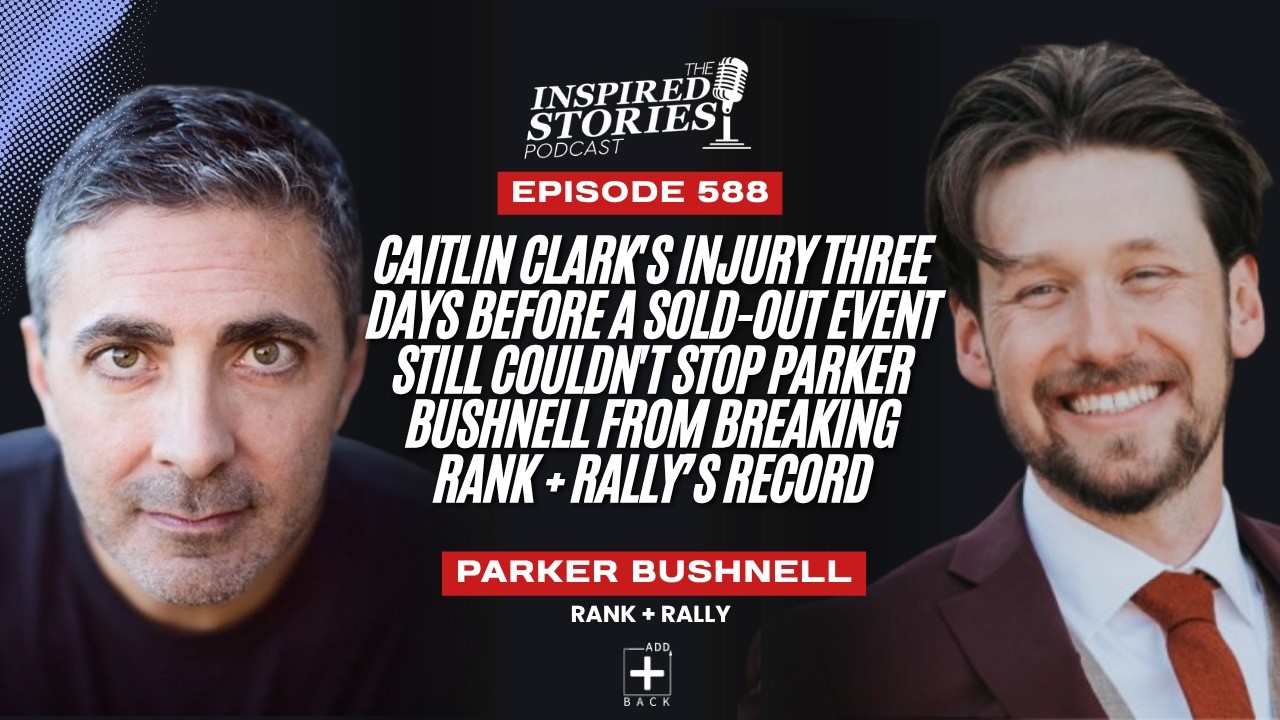
🎙️ A Store Manager's Bold Email to Corporate Bought Parker Bushnell a Buyer Job Instead of a Reprimand: His Journey to Rank + Rally
In this episode, Parker Bushnell, Divisional Director of Special Events and Partnerships at Rank + Rally, shares how a candid email to a head buyer while working a cash register launched a career that now spans the NBA All-Star Game, the Grammy Awards, and the PGA's RBC Canadian Open. Parker opens up about betting big on one jersey early in his career, the patience he had to learn during a six-month promotion wait, and surviving eighteen months of long-distance dating during a global shutdown.
✨ Key Insights You'll Learn:
Started as a part-time sales associate at a mall retailer while attending school full time
Sent an unsolicited email critiquing product selection that led directly to a buyer interview
Learned that buying is a balance between art and science under mentor Britton Maughn
Moved to the Utah Jazz in 2018 as purchasing manager, shifting from mall retail to a captive arena audience
Requested 13,000 units of a retro jersey, backed entirely by data, and nearly sold out before COVID hit
Promoted to senior director of retail in 2022 as the Jazz's retail operations transitioned to Rank + Rally
Identified 19 variables affecting game night sales, only seven of which are controllable
Still broke a merchandise sales record at the 2025 WNBA All-Star Game despite Caitlin Clark's injury days before
Helped a PGA client nearly beat a sales record by 50% by expanding store size and vendor mix
Believes staying personally engaged with fans on the sales floor matters as much as data and forecasting
🌟 Parker's Key Mentors:
Britton Maughn: First hired him as a buyer after his unsolicited email and taught him the balance of art and science in buying
His Analytics and Planning Team at Fans: Talented colleagues who shaped his early data-driven approach to buying
His Wife: Provided the foundation of patience and commitment through an 18-month long-distance relationship during COVID
His Close Salt Lake City Support Network: Helped carry him through the uncertainty of long-distance dating and career waiting periods
👉 Hear how one bold email from a part-time retail associate led to a career shaping merchandise strategy for some of the biggest events in sports and entertainment.
Listen to the full episode here
Transcript
Anthony Codispoti (00:00)
Welcome to another edition of the Inspired Stories Podcast, where leaders share their experiences so we can learn from their successes and be inspired by how they've overcome adversity. As you listen today, let one idea shape what you do next. My name is Anthony Codespodi, and today's guest has helped decide what fans take home from nights like the NBA All-Star Game and the Grammy Awards. Before any of that, he was working a cash register at a mall in Salt Lake City.
He spent nearly five years at FANS, a fan merchandise retail chain, rising from sales associate to buyer. That led to a decade with the Utah Jazz Organization, climbing from purchasing manager to senior director of retail. In February of 2025, he left that single market for a national role. His name is Parker Bushnell, now Divisional Director of Special Events and Partnerships at Rank and Rally.
The retail solutions company founded by Levy in 2017 that partners with more than 30 sports and entertainment brands across North America. He runs the purchasing and financial strategy behind events like the NBA All-Star Game, the Grammy Awards, the NWSL Championship, and the 2026 PGA's RBC Canadian Open, as well as the WNBA All-Star Game, three of which set revenue records.
But before we get into all that good stuff, today's episode is brought to you by my company, Ad Back Benefits Agency. And you'll want to hear this because it's hurting almost every business you know. See, health insurance costs go up every single year, and businesses are furious about it. They're paying more, claims are getting denied, employees are opting out because they can't afford it, and it hurts turnover and morale. It's one of the most maddening problems in running a business, and everyone just seems to accept it. But you don't have to anymore.
Now there's a program from Bain Capital Insurance that gives employees unlimited access to doctors, therapists, and prescriptions with no copays or deductibles to meet. It works for your part-timers, and the part that really shocks most people is our product actually increases your net profits. We recently helped a client add, that's right, add $900 per employee per year to their bottom line. Results vary, but imagine what could be done with the extra cash flow.
Get your free consultation today at atbackbenefits dot com. All right, back to our guest today, the Divisional Director of Special Events and Partnerships at Rank and Rally, Parker Bushnell. Thanks for making the time to share your story today.
Parker Bushnell (02:35)
Yeah, happy to be here. Thanks for having me.
Anthony Codispoti (02:37)
So you you started in retail as a sales associate at a mall in Salt Lake City. This is back in twenty thirteen. How did that job end up turning into a a buyer role at fans, a fan merchandise retail chain?
Parker Bushnell (02:50)
Yeah, I mean, I I think it it started with me, I mean, I was going to school full time. at the same time I was working that part time job and frankly I just needed a little extra money to buy some jerseys or, you know, the whatever sport collection that I had going on. And as I started progressing through my career I started to investigate, you know, an opportunity of, you know, how can I turn retail into something that is gonna be lifelong or, you know, something that I can really put my passion to. And
Oddly enough, sent an email after I'd moved into a store manager role to our head of the buying department saying, Hey, I I don't think I'm getting the right product. I'd like to see this, this, and this. I'd like to, you know, I think I'm getting too much Dodgers product. I need little bit more localized. Like, can you send me some of these things? And I got an email back thinking, Okay, man, I I maybe I went too far. I pushed too hard on an apartment that's not mine. And he sent me a note back saying, Hey, would you like to come interview for this associate buyer position? And I
like, all right, yeah, like that that sounds interesting. I you know, it fit with my economics background and as a what I was going to school for and still was like half convinced that he was calling me into the home office just to, you know, either ream me or, you know, something else and Yeah,
Anthony Codispoti (04:02)
Smacky on the knuckles.
Parker Bushnell (04:04)
something like that. And ultimately that that, you know, I guess well fated interview or excuse me, well fated email led to an interview and then a job and a very, very long career so far. And so
hopped into that s role and have haven't looked back.
Anthony Codispoti (04:20)
So that email, I'm gonna guess it was professionally worded. It wasn't like, you guys suck, you're giving me the wrong stuff. You had the right tone to it. So, you know, this guy,
Parker Bushnell (04:23)
Yeah. Yes, yes, very much.
Anthony Codispoti (04:30)
yeah, he he recognized, this guy's got an eye for things. He's recognizing what's going on, taking a step sort of above and beyond what your defined role was. So he's like, okay, this guy's got the the the stuff. He's got he's got what we're looking for.
Parker Bushnell (04:45)
Yeah, I was very fortunate to to have, you know, found somebody and or that email had found somebody that was willing to listen and and hear what I had to say. it like you said, did my best to make sure it was professionally worded. It was I I remember scrolling on the email and there was a lot of you know, breakdowns and analytics. It wasn't just me spouting an unfounded opinion, it was
Here's my educated opinion. It's we've got 17 different Dodger styles in the store. I'd like to see more of a variety because I'm getting customers coming and asking for XYZ, you know, different teams or anything like that. Or, you know what, I think if we invested that in local teams instead, we'd probably see a higher conversion rate. And so did my best to take the emotion out of it. Even if there were times that it was frustrating that I was working through something, it was it was time to, you know, communicate it in a way that hopefully would be n would not fall on deaf ears. And I was very fortunate it did not.
Anthony Codispoti (05:37)
So I'm trying to figure out which came first, the chicken or the egg here, because I I'm looking people who are on the audio only version and the video version, you'll see behind Parker, he's got this massive sneaker collection. off screen, he's told me he's got like a hundred and fifty sports jerseys that he's collect like he's big, you're big into the collecting space.
So
Parker Bushnell (05:55)
Yes.
Anthony Codispoti (05:56)
was that part of your personality first, or did that come later after kind of getting more involved with the industry?
Parker Bushnell (06:04)
Yeah, great question and something I mean I could talk this entire podcast about, so I'll do my best to make sure it's just the one question. But collecting's been kind of in my blood or in my family's blood really for as long as I've been alive. My dad's probably got two hundred, three hundred thousand s football, basketball cards.
And its closets full, it's awesome and just I think that ran through the genetics in some capacity and as I started, you know, getting a little bit of my own spending money in high school and junior high, I'd start buying jerseys and things along those lines and then as I worked my way into the basketball space, the shoe game, the sneaker game exploded for me.
Anthony Codispoti (06:39)
Okay. So you came in already being a collector, kind of having an an appreciation or understanding of what's cool, what you liked. But I'm wondering what the buyer roles there at fans taught you more about trends and what drives fans to spend their money on X instead of Y? What additional insights were you gaining?
Parker Bushnell (07:00)
Yeah, I think I mean it it was a unique experience to be at fans. Obviously, you know, they were in our backyard in in Salt Lake City, so I was familiar with them. but
really only as a customer for a long time. And then as I moved through the stores, to be able to then service a hundred and twenty stores rather than just the local Utah market or to interact with more than just that fan that I grew up knowing, right? And the the people that were in that Salt Lake City was probably the biggest challenge, but also taught me so much about okay, what are people's spending habits? Okay, what's the the threshold of trade up, trade down versus the quality of jersey and all those different types of things. And so I think the balance and
the the gentleman who hired me that I referenced earlier, Britton Mann, now with the Larry H. Miller group, he communicated it perfectly. Buying is the a balance between an art and a science. And I think as I got to balance that out and understand truly where the analytics should, you know, take over and where the the art should take over was
probably the thing that I loved the most about those roles, but also the education that I got from it. The the fans are communicating through a lot of data and that's a lot of what you have. But as a fan yourself being in this space, you need to understand when to take that leap and make a bet on something that you know, feels right or that it's gonna catch fire before everybody else sees it.
Anthony Codispoti (08:19)
And so what kind of data analytics tools were you using at the time?
Parker Bushnell (08:24)
Yeah, so we we used quite a few different spaces. we use Domo, Tableau. I mean there there's quite a few different programs out there that we would utilize depending on the the different stop of my career, I'd say. that being said, I think, you know, we had a very talented allocations team and distribution team, planning t I mean, really great, great group if you follow each of their careers. I think they're all in bigger positions than they were when we were all together. And so very excited, I mean, to
to have spent the time with them. I was very young, still going to school full time when I was buying. And so I I learned a lot from the individuals and a lot of who I still keep in touch with, whether they're at Lids or, you know, with professional sports teams or even some of the larger retailers across the country. I think there was a a great unit of talent there that we were able to tap into and
maximize not only the sports element of it, but also be able to understand how this scales too, whether it's larger sports business, but also just retail as a whole. And I'm not sure that I answered your question. If you wouldn't mind repeating it again, if I didn't quite get to it, I'd I can get off on a tangent
Anthony Codispoti (09:27)
That's right. We're
Parker Bushnell (09:29)
or two.
Anthony Codispoti (09:30)
we're all good, Parker. I want to move on to the next role that you took, because in 2018 you moved from fans into a purchasing manager role with the Utah Jazz, an NBA team, and the Salt Lake Bees, a minor league baseball team. what made this the right next step for you and how was the work different that you were doing there?
Parker Bushnell (09:50)
Yeah, I think it I mean it was interesting, right? W fans being local, there was some changes going on with the the structure of of fans itself and the Utah Jazz
had moved retail in-house to operate it by it by themselves. And it was an opportunity for me to kind of show what I had learned at fans, but also expand upon that. fans, I had primarily been an apparel buyer and supported in the headwear and novelty categories, moving to the jazz while focusing only on one team. The business was substantial and it was able it it provided me an opportunity to to get into the headwear space deeper, into the novelty and hard good space a little bit more.
To extend that art and science that we talked about on the apparel side, but really to the entire customer base. And not only the the challenge and the the change that really appealed to me was moving from you know mall-based retail, where you've got folks that are casually coming by and stopping by. Maybe it's not even on their radar that they want to shop, where you've got captive audience at at Delta Center, right? You've got 20,000 people.
that are ready to buy immediately. And you've got to do your best to make sure that number one, as many of them buy as possible. They buy as much as possible. But also in this day of kind of digital and, you know, intangible content, there's a real necessity for merchandise to speak to that fan.
you can't take your tickets home, you're eating your food at the game. The only thing that you can really associate these memories with if you were looking for something physical and tangible is that product. And so there's a lot of pride, but also a lot of pressure in a lot of ways to make sure that you're delivering that product and those in some ways those memories back to the fan.
Anthony Codispoti (11:29)
So you made an interesting point there. I hadn't really thought about, you know, everything's gone digital now, so we don't have the paper tickets to take home and, you know, hang up on the mirror or whatever we used to do. And so as you saw that transition take place, was there a new class or a sector of product that you guys introduced to help replace that specific thing? Or is it just like, no, they're just gonna replace the ticket with the the jersey or the hat or
Things that we were already offered.
Parker Bushnell (12:00)
Yeah, I think there's some of both. I think the gradual replacement of the physical ticket ended up taking some time for the fan to to rewant that. First it was a massive convenience thing, right? Like as soon as the ticket was gone, it was, man, I don't have to worry about leaving them at a car. It's on my phone. Like we're all good. It was a huge win. And now we're seeing throughout the entire sports space that if you can provide these, you know, one of one unique memorable attachments to a specific game and the game generally has to be meaningful. Like I can't sell a specific, you know
random,
you know, we'll call it Tampa Bay Rays ticket and call it a a you know a massive retail mover. But if these all star games or these special events or unique retirement nights or anything like that have something unique associated with them and you want to have that quote unquote I was there moment, that's where those retail plays come back in where you could truly sell a physical ticket now that is more of a memorabilia piece than it is anything that is truly tangible or like wearable.
Anthony Codispoti (12:59)
Is that
something that's being done now?
Parker Bushnell (13:00)
yeah, yeah, yeah, for sure. Rankin' Rally, our company that I work for now, operates the Chicago Bulls. and they just did a Derek Rose retirement night this last year. And the amount of Derek Rose retirement night dated, all that kind of stuff that we sold was astronomical. It was an incredible night. Correct.
Anthony Codispoti (13:17)
But like somebody gets like an actual physical printed ticket 'cause
Parker Bushnell (13:20)
And they're purchasing it. They're spending even
Anthony Codispoti (13:21)
now it's retro.
Parker Bushnell (13:22)
more money. They're they're buying a ticket that that has Derek Rose on it. And, you know, usually what we'll do on the seat numbers is we'll end up putting like the date in some capacity. So it would be, you know, the
date of the game would be
Anthony Codispoti (13:32)
So you can print the same
ticket and sell it to twenty thousand people, you're not actually stamping it with their unique seat number and row.
Parker Bushnell (13:39)
Correct.
There are some opportunities to do, you know, unique packages of one of whatever, or if you know, if you're doing a s season ticket member program or something like that, there's an opportunity to do that unique kind of one of one type stuff. But generally depending on the the scaling of of the project, sometimes it's just hey, you what, it's opening night, we're gonna bring in a hundred of these tickets just so people can say they've got it, that kind of thing. It and then you could bring in thousands for an all-star game.
Anthony Codispoti (14:05)
Mm-hmm. So you're later promoted to director of purchasing and analytics with the jazz. Can you give us a specific example of a time where you used analytics to provide an insight on what fans wanted that wasn't immediately obvious or expected?
Parker Bushnell (14:24)
Yeah, I think this is probably I mean, maybe it's not this is immediately obvious in terms of the demand, but in terms of the volume, I think this is one of the my favorite stories to tell. previously, like we had a record breaking year with Utah Jazz where we sold a couple thousand of one jersey. This was super exciting. It was my gosh, wow, this is an incredible time. but we sold out early in the season and with the Jersey timelines it's near impossible to get back into, especially a specific color.
Anthony Codispoti (14:54)
You couldn't just reorder and have back in time,
is what you're saying.
Parker Bushnell (14:56)
No, most of
the time our jersey timelines are about six to nine months. And so
Anthony Codispoti (15:01)
Yeah.
Parker Bushnell (15:01)
yeah, it it puts us in a tough spot trying to forecast out for the year. And so that year before, I want to say this was twenty eighteen or nineteen that we had broken that record. And then the following year we were going to bring back the Purple Mountain, like the nineteen nineties Stockton Malone jersey for the first time ever.
And I remember taking my forecast and, you know, running it through every possible model that I could think of to make sure that this thing was gonna be as accurate as possible. And I went to our CFO and the the VP of retail at the time came with me and I like, Hey, I like
We'd sold a couple of thousand, like I said, of that previous jersey and I went into that office and I asked for I think thirteen thousand units of this jersey. And I backed it up with data and I said, Here's why I think we need to do this and you know, at the time I can't remember exactly what the conversation
you know, how the conversation went back and forth. I think I'd probably whacked out because I was so early in my career speaking to the CFO about
Anthony Codispoti (15:54)
Ha ha.
Parker Bushnell (15:54)
it. But I remember vividly the the one line that he gave me. He's like, Parker, you're asking me to spend a second round pick salary on just one jersey. And I was like, Yeah, John,
Anthony Codispoti (16:02)
Ha ha ha ha.
Parker Bushnell (16:04)
I am. I'm I'm asking for a second round pick salary on a jersey. And you know, it
Anthony Codispoti (16:11)
It's a way to frame it, huh?
Parker Bushnell (16:12)
and the only reason I tell this story, I probably wouldn't tell it if it didn't work out, but I think we ended up
it was the COVID year unfortunately, but we ended up selling I wanna say about eighty percent of the way through until the you know, everything shut down. And so just it couldn't have I mean, if if there's a buy that I could hang my hat on and, you know, if you could retire on one thing in your career, that would be the early part. I'd I'd like to say that I've done some cool stuff since then, but that that one really stood out.
Anthony Codispoti (16:36)
You didn't peak then. You so
I wanna understand this a little bit better. What are the data points that you're looking at that tell you that this jersey that you sold what did you say, two thousand the year before, that you now wanna six X that if I got the math right, if I remembered your numbers?
Parker Bushnell (16:50)
Yeah, yeah,
pretty pretty dang close. I mean, really the the conversation that w we had was okay, how frequently was that jersey actually in stock? Because what we'll do is we'll bring the jerseys in blank and then we'll decorate with specific players and things like that. But the decoration time takes time. The shipping from Nike is often spread out throughout the year, all that kind of stuff. And so how many games did we go with either low stock or you know, middle stock, and then we blow out of it the game it came back in stock, that kind of thing. And so
took a lot of these scaling points and saying, okay, what if we had this consistently throughout the year? What would our average be? What our median? Like all these different points to try and identify what is a consistent in stock season going to look like for what we would consider the best jersey of all time. And
that was the primary driver, but also, you know, I keep mentioning the art and the science of this thing. We hadn't had this jersey since the nineties. It's, you know, collectively been on every, you know, top jerseys of all time list or whatever it is across the NBA, across sports, that kind of thing. So we knew it was gonna be big, but trying to really balance out what that looks like was
Okay, let's put together three plans. An aggressive plan, a medium, like a moderate plan, and then a conservative plan of what we'd like to see here. And fortunately, you know, we had the buy-in to be able to go and do that middle plan, and that's exactly how it ended up shaking out. And so there's there's a lot of different analytical points, but even within a game space, there's a lot that we could do.
Anthony Codispoti (18:13)
Okay, so you gave us an example of something that worked out really well.
Parker Bushnell (18:16)
Right.
Anthony Codispoti (18:17)
Now I'm gonna ask you to be, you know, pull back the credit, like give us one that didn't work out. Because you know, there's there's powerful lessons in those too.
Parker Bushnell (18:24)
Yeah, absolutely. I mean I think one of the unique pieces, and I'm gonna fast forward a little bit, but in into the the special event space. when you're working in sports and you're in an arena, you've got at least a number of games to be able to to operate off of and you know, if there's a a bad buy, you've got time to work your way out of it. For special events, you've got maybe ten days to sell everything you've got.
And so wanna rewind to a record breaking all-star is still a great event, but some of the things that maybe impacted our business that we couldn't control. We're gonna go back to twenty twenty five WNBA All-Star in Indianapolis. Kaylin Clark got hurt about three days before the game in her home city.
that's not an ideal scenario, and I can tell you I was sitting at dinner, we were watching the Liberty Fever game, and we watched her pull up with I think sixteen seconds left in that game, and everybody at the table turned their heads sideways and looked at me and I was like, We're we're gonna be fine, guys, we're gonna be okay. and you know, like I said, we still broke the record, but being able to approach an event like that where you have
In theory, the perfect storm a home market for one of the most marketable players in all of sports right now and Caitlin Clark, have her go down and get injured and now not wear the jerseys that she brought and not, you know, be associated nearly as much with the event because she's not going to be participating.
I can tell you we we almost sold out of everything that we had except for Caitlin Clark merchandise. And so that was a a huge challenge and maybe uncontrollable to a certain extent, but it also kind of re-emphasized the necessity for caution within the special event spaces. As much as you'd love to go and grab every record and smash the record, there may be a scenario where being conservative to a certain extent and you know, nudging over the top of the record is the way to go.
Anthony Codispoti (20:09)
So when you end up with overstock like that, what do you do with it?
Parker Bushnell (20:12)
Yeah, I mean there are a couple of different solutions in especially in the special event space, whether that's you know, it's just straight up liquidation where you talk to different liquidation partners, you work with the teams, the leagues. I mean, there there's a a a plethora of avenues to try and identify different solutions for it. oftentimes it'll be written off or, you know, there's other avenues to sell it at, you know, wholesale cost or anything like that to try and get it off the books, but
It's part of the risk that you take in doing these massive events to make sure that you know, it makes sense for everybody involved, but also in a way that again, you can try and capture every dollar that's coming through those doors.
Anthony Codispoti (20:47)
And those liquidators, are they going and just reselling them on the open market, or are they going and selling them overseas to sort of protect what's what you're trying to do here domestically?
Parker Bushnell (20:57)
I mean in theory it's both, right? And so ultimately it's usually a dialogue with the league or the team, whoever you're working with, to see where that avenue makes the most sense. If it's you know, if we're getting rid of some Chicago Cubs product, we don't want that sitting in Chicago, right? We don't want somebody competing with us directly at a discount. But if it's all star product, it's usually a little bit more time sensitive. And so within the market there's not a huge cannibalization rate because it's event driven rather than team specific. And so oftentimes we can let that stay domestically or at least with
you know, around the market. So truly w case by case and oftentimes it's dictated by the team or the partner themselves.
Anthony Codispoti (21:34)
Mm-hmm. So in twenty twenty two you were promoted to senior director of retail. And I wanna understand this because you actually shifted from working directly for the jazz to working for Rankin Rally, your current employer. And that's the company that was running the retail operations at the time. And and so how did that transition take place?
Parker Bushnell (21:55)
Yeah, so I mean as I mentioned in twenty eighteen when I left the Utah Jazz or left fans, I moved to the Jazz and they were in an in house retail operation. So everything from operations all the way down to the purchasing and and, you know, cashiers were all in house employed by the Jazz.
from there in 2022, the jazz business had grown fortunately to the size of or a pretty robust size that we needed additional support and that Rankin Rally was the the greatest avenue to be able to do that. And so finding an opportunity within Rankin Rally to come in and support and build upon the al the already
tremendous growth that we'd seen over the last four years or the previous four years or so. Rankin Rally came in and was able to provide a plethora of additional support across our portfolio and into the Utah Jazz specifically.
Anthony Codispoti (22:44)
Say more about that. What does rank and rally actually do for a team that they couldn't do for themselves?
Parker Bushnell (22:49)
Yeah, I mean I think there there's some really simple things as to not having the inventory on the books of a team. That's that's a really nice win to to have, you know, the liquidity there. But in in a more real sense, like having you know, e-commerce support where we can provide additional like the home office support, I think, is the the largest thing here. that you've got resources now, such as myself in in a partnerships role, you've got e-commerce support, you've got leadership support, operational support, and then
the the unique aspect of rank and rally is that the parent company Levy is food and beverage. And so a lot of the times we're in these buildings together where it's food and beverage and retail aligned as one where you're able to tap into the food and beverage HR resources or, hey, you what, I needed a couple extra folks tonight. Do you guys have any extra on staff that are looking for hours? And so there's this horsepower as we would c probably call it as we, you know, pitch ourselves in different spaces that really separates rank and rally, to be able to do both of those things or
independently provide support across the country. And then finally, I think the thing that continues to make Rank and Rally the most unique provider in this third party provider space is that it's the localization aspect. The majority of whether it's the competitors or across the scope are all doing purchasing for the most part centralized out of, you know, different locations throughout the country, but somebody in Jacksonville, Florida is making a decision for somebody in Utah, right, in terms of the purchasing and
as it comes to rank and rally, all the purchasing is done on site and by our local leaders and directors. So they can feel the heartbeat of that city, of that town, making sure that, you know, we're capturing those moments for those fans.
Anthony Codispoti (24:31)
So I wanna dig into I wanna pull that thread just a little bit. Like how much extra insight are you getting by having those local folks make the decisions versus you've got somebody really smart using spreadsheets and all the data analytics tools that you have? Like, are you gonna trust the gut or you gonna trust the math?
Parker Bushnell (24:51)
Yeah, so I think in in a general sense, th I I hate to say that it's both, but in some ways it's both, right? Like our home office is gonna provide the analytical support in addition to you know, the know-how and insights that our local providers are gonna have, but our local teams are still gonna make that buy. They're gonna understand the market and understand what
you know, designs are gonna work best for this market. What are the, you know, different cuts of T shirts even to a certain extent are gonna work better in one market or another? The size scaling that can come from our anal analytics department. Like is the size scale in Salt Lake City, Utah gonna be different than in Arizona or California or wherever our different properties are, like
What is that gonna look like? And so those are the kind of things that help enhance, but then we rely deeply on the localization to be able to participate in with local artists and find these creative solutions to make sure that it feels like rank and rally is synonymous with whatever team they're representing that we're representing. That's why you won't ever see a rank and rally team store.
Anthony Codispoti (25:49)
Local artists meaning like putting some
taking an artist's work and putting it on the jersey somehow? Is that what you're talking about?
Parker Bushnell (25:55)
Maybe not quite a jersey. I mean, occasionally there's there's some opportunities there, but you know, we'll do collaborations with local companies, we'll do l collaborations with local artists where they can design a hat or a t-shirt or whatever it is that's gonna feel very authentic to the cities that we're representing, to r to the teams that we're representing. We did a a collection when I was with the Utah Jazz and rank and rally that was we had a 50th anniversary season. We partnered with local graffiti shop and five different artists, one for each decade that the Utah Jazz
Have been around and had a blast doing that with them. And so there's a a lot of opportunity there, but that's one of the elements that, you know, in terms of what ranking rally can provide, feels very localized, but also in a way, because there's so much home office support, because there is this additional layer, we're able to allow these things to kind of grow in a more natural sense rather than 800 different things having to be done by one in-house operator.
Anthony Codispoti (26:54)
And that additional layer that you're talking about, it's the relationship with Levy. Levy's the parent company or they're both owned by the same group. Somehow they're related. Okay.
Parker Bushnell (27:01)
Yeah, so Levy's the parent company directly.
so Levy's probably in two hundred plus buildings across, maybe even more than that, across the the nation in, you know, cultural spaces, food and bever or and sports, racetracks, like I could name a million different things. Yeah.
Anthony Codispoti (27:15)
And they do food and beverage. That's the thing.
They're they're doing the concessions.
Parker Bushnell (27:18)
Correct. And then in twenty seventeen and even earlier than that, for ranking rally was born in twenty seventeen, Levy Retail was born earlier than that. But it was okay, if we're already doing food and beverage, how do we start to enhance and, you know, develop a if almost a full arena operation for people? And so retail was that next step to feel that same localization that Levy provides, but also in the merchandise space. And so we've been able to tap into that and really in the ten years or so that it ranking rally or Levy Retail's been around, it's
grown tremendously and we're still growing pretty aggressively over and we're excited about it.
Anthony Codispoti (27:51)
And so are both rank and rally and levy staffing or are they just holding the inventory and then the staffing comes from the local venue?
Parker Bushnell (28:02)
No, it is top to bottom our staff. so
Anthony Codispoti (28:06)
fully
like th this is the white glove, like we out of the box, we handle everything for you.
Parker Bushnell (28:11)
Yeah, in in some form or fashion. I mean, a lot of the partners like to be involved because of how localized we are to make sure that, you know, that we're hiring the right director. And so we we have our folks that we'll bring and we'll present to the clients and say, Hey, here are our top candidates. We like these person this person for this reason, this person for this reason. you know, who do you think is is the right fit for your organization and we'll kind of give our suggestions and whatnot and we'll like to do it as a collaborative process.
Anthony Codispoti (28:36)
Okay. So what is your role now, Parker, with Rankin Rally?
Parker Bushnell (28:39)
Yeah, so in February of twenty twenty five or January, February, I think the the the lines get blurred a little bit because I started doing both as I was exiting the Utah Jazz. but ultimately my role is in partnerships and new business. I work with a lot of our, you know, new business as we acquire it and basically take it from contract to set up and work directly with our leadership team. you know, on our regional directors to set up new properties and so
As we get that stuff ready to go, it's making sure that everything that was pitched is being delivered on and everything in between, to hiring new people to ordering shopping bags. It's making sure that when we finally do open for business that it feels like a rank and rally property. And then in addition to that, I've got the special events that we've touched on a little bit. And those are a ton of work for 10 days of deliverance and hopefully a a very positive outcome.
Anthony Codispoti (29:32)
So let's talk about the new business. Traditionally when you're bringing in a new group, are you taking them from a competitor or are they mostly doing it in-house and they're ready to graduate?
Parker Bushnell (29:44)
Yeah, I think sometimes it it really depends. This is such a unique space where, you know, the new business opportunities are presented only every so often because it is all generally contracted. Unless it's in house, you're waiting for either a contract to expire with a competitor, to renew with a a a current provider or anything like that, and then expand upon what they're doing. But
Really, for the most part it it's a lot of w we'll call it infighting between a lot of the major players within the third party space. all, you know, professional of course, but I think that there's a as we try and differentiate ourselves and identify what we're bringing to the table compared to our competitors, it it puts us in a spot where, we feel like we've got a nice competitive edge. That localization is a huge piece for us, but that home office horsepower we'll call it is also a a big win for us and so
Taking it from competitors, I don't know that we like to look at it that way. It's more so just providing a new service to the the brands or teams that we're representing, but that that's kind of how we go.
Anthony Codispoti (30:43)
So when somebody chooses rank and rally over another option, why are they doing it? They're like, you guys have this, this is what we
Parker Bushnell (30:51)
Yeah, I think I mean there are two different there's the I keep coming back to it, but the horsepower between the food and beverage aspect, but also I think the localization aspect is something that we've really, really cornered the market on in some extent. Like everybody has their their versions of this and everything like that, but
Like you're never gonna see that rank and rally team store. It's never gonna be rank and rally or you know, the Utah Jazz powered by Rankin' Rally. It's going to be Jazz Team Store or, you know, right now we're the operator for the Vegas Golden Knights. the Golden Knights Team Store is called the Armory. Like it it's got a little extra flavor to it to a certain extent that we think speaks really well to our ability to localize and just live and breathe whatever the brand is. We look at ourselves as an extension of the team, not an independent organization.
Anthony Codispoti (31:36)
So are all of your clients sports based?
Parker Bushnell (31:40)
no, we've got cultural space, so like we do Cirque du Soleil. you know, all of the different shows in Vegas, those types of things. We're in zoos and museums as well. And so we definitely get our hands dirty in a lot of different things, but I think if you have the the the simplest way I can describe is if there are a lot of people gathering in a spot, we'll probably be there selling some merchandise.
Anthony Codispoti (32:00)
So how does the revenue model work for rank and rally then? Is it a like a fixed retainer monthly and then a percentage of sales so that goals are aligned?
Parker Bushnell (32:09)
Yeah, I think I mean really there there's some flexibility within that model. a lot of the times the teams are dictating how they'd like to see or what's gonna be the most important and impactful piece for us. that being said, I think that we have our preferred models, but ultimately there's an avenue for us to be flexible, which again kind of gives us that edge of here's how we think this is gonna work or why this is gonna work for both parties here.
ultimately you find some properties that are interested in h using retail as a marketing arm. And then there are some that are like, this needs to squeeze every possible penny out of this thing is possible. And so really being able to be flexible there allows us to to fit with a lot of different people from massive volume like the Chicago Cubs all the way to, you know, maybe some smaller, you know, entry level teams or leagues that are just starting up and need somebody to help support and build an infrastructure because they either can't support it on their own at this point, but also or
You know, just need some expertise to help guide it.
Anthony Codispoti (33:04)
So when a group is ready to make a change, either from a competitor to you or they're ready to graduate just from what they're doing internally, how do you guys find each other? Like are you always out there networking with all the different teams and facilities around the country? Is it typical that they send out an RFP that you'll be notified about and that's where the relationship starts, or something else I haven't envisioned?
Parker Bushnell (33:29)
Yeah, I mean I I think it's some of both. The RFP is definitely something that I mean, you know, it it makes it a little bit more formal in that sense, but there's always rumblings and I I'd say that sports is a very, very small industry to a certain extent. And so if you've been in it a long time and you know, we can d debate whether or not twelve years is or thirteen years or however long it's been at this point is a long time. you build enough connections that you start to hear things one way or the other of, Hey, you know what, there may be an opportunity here or anything like that. And so whether they come to fruition or whether it's just conversation, I think
think, you know, genuinely, whether it's competitors or otherwise, like this industry is so awesome. Like I mean genuinely like the I wake up maybe two weeks a year that I don't like my job and every other day it's like, this is pretty cool. This is pretty dang cool.
Anthony Codispoti (34:14)
That's pretty good ratio, I gotta tell ya.
Parker Bushnell (34:16)
Yeah. but I I think really, I mean to to round up this question, I think that there's a tremendous amount of
collaboration and connection within this industry of whether that's sports retail or just sports in general, that
Once you meet and make genuine connections with folks, it's not even like a hey, we want you to do this 'cause these guys suck or anything like that. It's more so like, okay, like I I see what you're doing. Like there's a lot of recognition within the space of, I saw this at this building. Do you guys do this? Or what have you tried this? And so like even within our competitors, there's so much collaboration and communication that it feels very core to, you know, how people operate and just in sports. Everybody knows it's competitive, but also that kind of brings the fun out of it.
Anthony Codispoti (35:01)
So I want to talk a little bit about the special events that you do, right? WNBA All-Star Game Grammys, PGA events. And I think you sort of touched on this. The challenge of those is that you're gearing up for a very short-term thing. Right.
Parker Bushnell (35:17)
Yeah.
Anthony Codispoti (35:17)
When when you've got like a more stable thing, like a long basketball season, a long, you know, baseball season, like there's more planning. There's, you know, here it is, like you've got to ramp up the staffing, you've got to ramp up
the the product production with longer lead times. How do you sort of think about managing a special event like this as opposed to one of those longer term relationships?
Parker Bushnell (35:42)
Yeah, I think I mean, it's interesting 'cause th even the special events, if we look at it, are are truly longer term relationships in some capacity, right? Like if we are looking to bid on the WMBA contract to have All-Star Game multiple years in a row, we've got to treat it as a long term relationship even if it is only a ten day period. That being said, you know, the preparation is extensive. Like I'm planning for WMBA All-Star that we just wrapped up in in July, was planning for that. Call it
as soon as MBA wrapped up at the end of February. Like we were at meetings in March immediately to start walking spaces and working through the logistics and everything like that. And I think the piece that's probably the most challenging is is each building is so uniquely different. And so you may have had a ton of success in one arena doing suite level sales or anything like that. And then you go to the next place and they have nowhere for you to set up on suites. And so you've got to be able to pivot. And of course everybody's looking to set that next record or at least beat the year prior. And so
How are you capitalizing growing and building upon the revenue that opportunities that exist while also understanding that you're walking into something completely new? It's obviously easier when we've got a building that's ours, but at the same time, you're walking into a lot of buildings that are run by competitors or in-house or anything like that. And so it puts us in a spot where we feel confident that we can go in and, you know, accomplish these things, but there's so much work to do.
Anthony Codispoti (37:06)
What do you mean that you're walking into a building that's run by a competitor? Why would you be in that building if the competitor has the contract?
Parker Bushnell (37:13)
Great great question. so a lot of these special events are individual contracts with the league. So the teams are contracting for their own individually buildings, but like an all star game, great example. the Clippers are an in house operated team. and they
don't contract out for NBA All-Star. The NBA does that. And so NBA contracted with Rankin Rally to operate the NBA All-Star game in LA this last February. And that's something that we would go into the Clippers Arena because it's an NBA specific event and then operate for in that space.
Anthony Codispoti (37:46)
So you want to break the record, you wanna bait you wanna beat what happened the year before, right? You want sales to be higher, but you're coming in and I don't know, it feels to me like so much of it is outside of your control. What are the dials that you guys can actually turn to try to make that happen?
Parker Bushnell (38:03)
Yeah, I mean, I think in in the special event space there's having the right product, having the right product in the right places. and then again, the localization aspect I think makes it feel different. if it's in a market that we have access to or, you know, we run the LA Lakers, and so being able to tap into our local staff there saves us. I mean, it transparently like saves us on temp labor, saves us on these different avenues that, you know, would be more expensive in a city that's not something that we operate in.
And so there there's an opportunity for us to to scale easily depending on where we're located. but then also if we zoom out to just general sports retail in ch in general. In twenty twenty I spoke at Willamette College with a friend of mine that was a professor there about this exact thing, about the controllable variables and the uncontrollable variables.
There were nineteen, I think I sat down in this data analytics class and I said there are nineteen variables that impact how well we're gonna sell anything on any given game night. Of those nineteen, I can control seven. And so there's so much that you know you go ahead, sorry.
Anthony Codispoti (39:04)
What are they? What what are those seven? So what what are those seven?
Parker Bushnell (39:11)
So I the the real question is if I can remember all of them off the top of my head, but
Anthony Codispoti (39:14)
All right, rattle
off the ones that you remember. I won't hold you to all seven.
Parker Bushnell (39:17)
Yeah, no, I mean it it's
really preparation is what we can control. If we have the product in stock, making sure we have the right product in the right places to a certain extent. making sure that, you know, are we sized appropriately? Like it it's really just preparation in a lot of different ways that we can roll through it. but the things that cannot control is even the jersey color that the teams are wearing impacts what how well we're gonna sell. The court that's on the floor, the time the game starts, like there's so many different things that impact
how this business operates within the space that you've got to do your your job to make sure that the stores are well stocked, that you have the right product, and make sure that, you know, you're well prepared in a sense of having I I'm sure I could find the presentation and send it to you at some point. It's been, you know, six
Anthony Codispoti (40:01)
It's okay.
Parker Bushnell (40:01)
years buried, but it's that there's a lot that goes into these events and the special events specifically just heighten all of it.
Anthony Codispoti (40:08)
So I think in the the kind of thing that you do, any retailer would like to achieve this thing that I'm making up a term. Maybe this is a real term. I maybe I just came up with a perfect supply. So you want every single person who wants that thing to be able to buy it. And you won't you don't want a single extra item, especially when we're talking about a special event like this. Now that's impossible to do, but as you think about trying to strike strike that balance.
Which way do you err towards in terms of caution? Would you rather sell out? No extra inventory, no extra holding costs, no cash burned there, or would you rather end up with a little bit extra because you know the margin on the product was so healthy that it's okay that we've got some overstock that we've got to liquid?
Parker Bushnell (40:58)
Yeah, I think I we'd prefer to be on the conservative side. I think that there have been a number of events that the uncontrollables, like an injury to Caitlin Clark or anything like that. I wouldn't say have burned us, but have put us in a spot where it's man, okay, like if we approach this more conservatively or if we, you know, operate in
a more conservative fashion while still breaking the record. Like it's not like we're walking away and saying, Hey, we're gonna, you know, be down ten percent or anything like that. It it's how do we strategically align to be breaking a record, but also making sure that we're being healthy with our inventory position. And so, it it's something that, you know, we debate every single event and often it depends on the deal structure too.
Anthony Codispoti (41:36)
how how your incentives are aligned. Right. Yeah.
Parker Bushnell (41:38)
Correct. Yeah. And it
oftenti like even to the point of like the PJ event in Canada this last year, they're like, We need to break the record and we don't even want to be close. Like And so it's like, All right, load it up. We're bringing an extra inventory and all that kind of thing and it paid off and we you know, we beat the record by almost fifty percent. And so Yeah, it was it was a blast. Yeah.
Anthony Codispoti (41:55)
my gosh. Okay, you gotta tell that story. I mean obviously
you load it up on the inventory, that helps, but that doesn't necessarily guarantee that product turnover.
Parker Bushnell (42:05)
Yeah, and I think this was an opportunity for us, you know, we have a very willing client to listen and understand that like the retail expertise that we can bring to the table is not like, Hey, we're telling you you've been doing it wrong, but let's hey how here's how we can do it better.
And so bringing into the space, it was okay, we want a much larger store than what you guys have had in the past. How do we make this happen? And so, you know, in the in the PGA events, it's large tents and things like that. And so it's relatively scalable as long as you've got the square footage on the course to be able to do it. from there it's okay, what kind of pricing model are we looking at? How are we addressing, you know, maybe an opportunity to cap capture a little bit more margin, but also those higher cart values and things. And so each event is so uniquely different that it's difficult to say, like, hey, here's the the the end I'll be on.
all
this is gonna work for every single event or every single clientele or anything like that. But you look at the the PGA event and I think we had the exact right partner to do this. They were very willing to say, yes, let's figure this out. Let's find a way to to make this work to make it bigger and better than ever.
We went to a much larger vendor mix than they had ever done in the past to try to diversify the portfolio as well. And so just a tremendous amount of success from the entire team. I can't sit on this call and and try and take credit for everything there. We've got a great group great group in Canada that was able to pull this thing off. And I I try and defer as much as I possibly can to make sure that those guys get some credit 'cause they're not on the call of being able to speak for themselves, but they they deserve a tremendous amount of congratulations and support for sure.
Anthony Codispoti (43:35)
Right on. I would be curious to hear about a little trick of the trade, like something that you've learned where, if we do this instead of that in terms of displaying a product, or just some kind of like little nuance to what it is that you guys do, that you're like, this has moved the needle for us, and it wasn't something that was obvious or expensive.
Parker Bushnell (43:59)
Yeah, I mean it somet i it's funny, maybe not obvious or expected, but I think it's just what's that next little piece of effort? Like is it something that's gonna be not cumbersome on the cash rep, but that you can add and make that units per transaction move from a you know, a two to a four? Is there something that you can do that and just
add a little bit more to that element, but also being willing to just be a person. Like I know that sounds crazy, but like a lot of these massive events, especially whether it's, you know, food service, retail, even just guest services inside these, you know, twenty thousand people running around doing everything, everybody's just trying to get to their seat or they're trying to, you know, do XYZ things so they don't miss the game or miss the event or anything like that. And so I think
taking a step back and taking a breath of, hey, here's what needs to happen to be able to elevate this. Like perfect I mean, one of my favorite examples is from that PGA event is
We were on the last day and it was an absolute downpour. Like just an unbelievable amount of rain. We thought they were going to call the the tournament or postpone it at some point. And we had boxes of ponchos, which is the most volatile item of all time. You don't have a speck of rain and you'll have those things for three years. And then you get rain and you can sell them all. But that was one thing I, you know, posted up at the front of the store, and basically as people were running in from the rain, I said, You want to buy a poncho? And I just started handing things out. And so being willing to do the
things that, you know, maybe aren't the sexiest in the world or like the the most exciting things in the world, but being willing to be a person and understand and relate to people where they are, I think oftentimes you'll see within professional sports retail or just large event retail that you lose some of the customer service aspects that
you would get it like a mall base or something, a little bit slower pace and those types of things. And I don't think it needs to be that way. Like you can be a person, you can be a human on the floor selling and saying, hey, you know what? Like, here's where the jerseys are, let me help you find a size, rather than like, yeah, it's over there and pointing over there and anything like that. Like I think those are the elements that yes, it's chaotic. Yes, there's so much going on. But if you can just take a breath and understand that
you can actually maximize these things by being a human is is something that I would shout out and wish upon anybody in this industry.
Anthony Codispoti (46:14)
What is Rankin Raleigh's version of McDonald's do you want prize with that? Like what's the what's the easy upsell at the cash register?
Parker Bushnell (46:22)
The
easy upsell. I guess it depends on the sport, right?
With the hockey it's gonna be, hey, we've got a matchup puck from tonight's game, you want something like that. for basketball it's gonna be, Hey, you got a jersey, you want the shorts. Like there there's gotta be a different ways and you know, if there's baseball, it's everybody's already wearing a hat, it's hey, they're actually wearing this one today. Do you want that one? Like or hey, here's a baseball, go see if you can get a sign type thing. Sharpies are a huge deal of these special events as well of, Hey, everybody forgot a Sharpie but they're getting a chance to meet the players. Hey, can I buy a Sharpie from you guys? Do you have sell Sharpies or anything like that? And so
So
maybe that's a trick of the trade. I don't know. Maybe that's what you were looking for. Yeah.
Anthony Codispoti (46:59)
That's good stuff. Yeah. That's fun. How are
you guys using AI in your work? Or how specifically are you using it?
Parker Bushnell (47:05)
Yeah, I think it's been interesting to watch because, you know, it feels like there was this mad rush for AI, call it, over the last six to twelve months, right? And I think that one of the things that I pride myself on, whether it was in any any of the roles that I've had and even back to that first store manager job where I sent that email at fans is
Efficiency. trying to identify ways for our partners, our properties, our buys, anything to be more efficient. And AI is a truly efficient tool or efficiency-based tool if you know how to utilize it. And so our analytics team is heavily involved in that. That's part of our home office support. As far as what I'm using it for, it's a lot of okay, hey, I'm looking to accomplish this, or I want to be able to like run through a buy or anything like that and just make sure that I'm poking holes in my own data.
I'm very conversational in a sense of like I want to be able to talk through it with somebody. Working from home, my dog doesn't give me too much feedback. but I think that in a general sense, being able to to kind of bounce ideas back and forth with, whether it's AI specifically or anything like that, it helps us kind of keep ourselves grounded and also, you know, identify some immediate things that are easy for us to do.
Anthony Codispoti (48:15)
So as a fan, obviously you're you live in Salt Lake City, so you're a jazz fan, I'm assuming. Yes.
Parker Bushnell (48:21)
Yes.
Anthony Codispoti (48:21)
Okay, when it comes to sports that you don't have, like a local team right there, d do you follow those sports? Do you have teams? How did you pick
Parker Bushnell (48:29)
Yeah, if I had to pick a sport that I would hang my hat on, I'm actually a big NFL fan, big Tennessee Titans fan. oddly enough. But I made a bad
Anthony Codispoti (48:38)
How did that happen? How the Titans?
Parker Bushnell (48:40)
decision when I was five. no. no, I mean grew up my dad was a Lions fan growing up again from Salt Lake City. and so didn't necessarily want to curse me with that. The Lions weren't very good when I was growing up and the Oilers had just moved to Tennessee, and switched to the Titans when I was a kid and
thought the fire logo was sweet and I was like, that's my team. They ended up making the Super Bowl that first year that I kind of invested in them. And here we are many, many years later. And that apparently was the peak back then. So
Anthony Codispoti (49:10)
Yeah.
Well, if it makes you feel any better, I'm a Cleveland Browns fan, so d yeah, decades of misery here. Yeah. And we're we're
Parker Bushnell (49:15)
all right. Well then I should not be complaining. man.
Anthony Codispoti (49:20)
a house divided. My w my wife's a Steelers fan. And
Parker Bushnell (49:23)
man.
Anthony Codispoti (49:24)
my oldest son started out as a Browns fan and then decided he couldn't take it anymore and he defected. and so it there's he's
Parker Bushnell (49:30)
Wow. So is he a Steeler fan then?
Anthony Codispoti (49:32)
a he's a Steelers fan now. And and so part like as a dad, I'm like, Well, he passed the IQ test, but like still
Parker Bushnell (49:37)
Ha ha ha.
Anthony Codispoti (49:38)
there's a hole in my heart.
what is it that you Yeah,
Parker Bushnell (49:42)
I'm sorry to hear that, but happy for him, I suppose.
Anthony Codispoti (49:45)
thank you. what is it you want to be able to do with AI? Say six months, twelve months, eighteen months down the road? What do you what do you think would be like a really cool like, if it gets to this point, if I could figure out how to make this happen?
Parker Bushnell (49:57)
Yeah, I think
Being able to utilize AI within maybe one of those variables that I was talking about of, you know, sports contracts and things like that, of players getting traded, that's nothing that's well w well out of our pay grade in this space, but it impacts our business significantly. Is watching a player like LeBron just left the Lakers, that's that's impactful to our business one way or the other. and so being able to utilize AI to I don't know, necessarily predict a pattern there. Like you can't predict necessarily human behavior in a way, especially within the the contract space of
Who knew that LeBron was going to take an eight million dollar deal kind of thing? except for him. but to a certain extent, like being able to utilize AI to maybe reduce some of the risk of those variables and identifying trends and patterns on how that inventory should be purchased of okay, as the contract is moving through, if we're at the end of our if he's in the last year, last two years of the deal, and AI is analyzing, okay, how many trade rumors are actually existing within, you know, the the
sports news base out there, that means there's some smoke to this fire. We need to start reducing that down. And so those are things that it probably can be doing now for us. But formalizing that process to address the variables was that we've discussed earlier is something that I think will continue to enhance and improve some of those, you know, art or art aspects and make them a little bit more science for us.
Anthony Codispoti (51:21)
Yeah. Sometimes deals as lemons. We've got hard things
Parker Bushnell (51:25)
Yeah.
Anthony Codispoti (51:26)
we gotta overcome, Parker. What's what are the hardest things you had to overcome and what did going through that teach you?
Parker Bushnell (51:31)
Yeah, you know, when we were chatting about this before we I think jumped on formally here, I I was trying to pinpoint some specific moments where I had a challenge and I I've always, you know, tried to communicate to myself or to my wife or to really anybody that is willing enough to listen to my advice, is just that every opportunity, whether it's positive or negative, if it's
making you the better best version of yourself or helping you get to that point, i is okay. And like you can work through something like that. And so I think there are two moments that really stand out to me in my career or I guess in my life. first one would be in twenty twenty two, I guess twenty twenty one. my boss left the V P of retail or senior director of retail at the time, when I was working for the Utah Jazz and I was director of purchasing and analytics. I'm
relatively young for my role and that's not meant to be like look at me kind of thing, but also very eager to continue to progress. And as soon as he left, I was like, I want that job. And I want it like as soon as possible kind of thing. And at the time, the Jazz were taking their time and understandably so to to make that positional move and to to identify who they wanted in that role to evaluate the retail business as a whole. And there were some times that
Either I was feeling that I was overlooked or not being considered or anything like that. And, you know, it's easy to sit back with and hindsight as 2020, but obviously things ended up working out. But I think that through that time, it was a big confidence hit to me of like, man, I feel like I'm doing everything right, like we're breaking records, we're doing all this stuff. And if I could t go back and talk to myself, it would be
Confidence is not the same thing as patience. And patience can lead to con confidence. And I was being impatient. And I had no reason necessarily to to look at it as a lack of confidence. I had no reason to look at it as, hey, they don't believe in me or anything like that, except for in that raw emotion that I was feeling at the time of Took six months to fill the position. I ended up being the one that got the position, but
As I've talked to the people that have been on my teams and I've tried to develop folks and they've either not gotten a promotion or we've moved on or, you know, even friends that are looking to to continue to develop in their career, they've I've always tried to breach patience of remind yourself where you are in your career. You've got
the appetite to continue to grow just because you're not there yet or because the opportunity isn't there yet for you doesn't mean it won't be and doesn't mean that you shouldn't keep trying just as hard. But those six months were long. I remember working through those and trying to do what I could to lead the team without leading the team and definitely, you know, fell on my face a couple of times and I I can look back on that time and
Think about how much I grew during that six months without maybe even realizing it to a certain extent because I was feeling so impatient and it felt like a lack of confidence when it was that impatience.
Anthony Codispoti (54:41)
And
so the the growth for you came in just learning that patience and that sometimes these processes just take a while to work themselves out.
Parker Bushnell (54:50)
Yeah, I think it was that, but also that like the the patience is I I guess my confidence needs to exist from what I put on the table. It doesn't need to exist from the validation of somebody saying, Yeah,
you got this job or anything, but that
Even if I didn't get the job or even if, you know, in different scenarios where I've considered applying for something or maybe have pulled myself back, it's because of that patience that I that I've I I wouldn't say that I taught myself that I learned during that time. It it was definitely something that I was like, No, no, no, I'm I'm ready, I'm gonna try and do this, this and this to get them to speed up the process or anything like that. And it was, you know, a challenge. And so I think that taking the patience and separating out that I can be patient and still confident was something that
was not something that I was used to in my career at that point.
Anthony Codispoti (55:38)
Mm.
But you had a second one for us.
Parker Bushnell (55:41)
Yeah, the second one I think is definitely more of a I mean, patience to a certain extent, maybe it's because I I learned from this, or I wish I'd learned more from it, but during COVID, my wife and I ended up having to I guess at the time she was my just my girlfriend at the time. we'd been dating for about 18 months. she's a Canadian citizen. And so when we were dating, COVID hit, her visa had expired, and so she had to go move back to Canada and we're like,
you know, we'll see each other every, you know, a couple months or whatever, it won't be a big deal. We'll do long distance or whatever. And we ended up she left January thirty first of twenty twenty. So before everything got real crazy, and the world shut down and all that kind of stuff. And so it was every couple of weeks or every month or so we'll come see each other, that kind of thing. And the world got shut down and we didn't see each other in person for eighteen months.
So the same amount of time that we had dated in person, we had call it dating whatever you want to do, but had to, you know, date via video chat or Zoom or whatever the hell you want to call it. And that was
Anthony Codispoti (56:51)
Was there a moment where you thought
this isn't working, this isn't worth it?
Parker Bushnell (56:55)
Oddly I mean not really. And I think that's why I knew she was gonna be my wife, if we're being honest. like it was th there were times where it was like, Man, this is hard, this sucks, like but I have a very, you know, tight n group at home and i within Salt Lake that were kind of carrying me through any of the hard times of when is this gonna end type thing and
You know, as soon as the the borders opened up a an easier way, we were engaged and married pretty quick after that. Like we
Anthony Codispoti (57:25)
Yeah.
Parker Bushnell (57:25)
knew pretty confidently and one of the most confident things that I've ever done in my life. But I think as we talk about both of those options being me needing to be patient, I think that was a good takeaway on on either side, but would not recommend eighteen months of long distance just for all of those people listening out there.
Anthony Codispoti (57:45)
Did you
have a sense that you wanted to marry her bef before you guys had to to split
for eighteen
Parker Bushnell (57:52)
Yeah.
Anthony Codispoti (57:52)
months?
Parker Bushnell (57:52)
Yeah, for sure. I mean transparently I probably would have married her to keep her from leaving if I could've. we've got very traditional family set up, in in a sense of like I I hadn't met her parents at that point, or at least not i in a way that would be respectful enough for us to be able to kind of make that decision col collectively and everything there and so
We knew that we needed to take a little bit more time. I think we were both ready in some sense, but I think that the eighteen months of time that we spent together or we'll put t together in air quotes where we were, you know, thousands of miles away and unable to see each other helped put things in perspective and allowed us to build on a very strong foundation. And so we've been together for eight years and married for five, so
Anthony Codispoti (58:36)
As you think about the work that you're doing now, Parker, what is it that you most want to be remembered for?
Parker Bushnell (58:42)
You know, I I always people tease me for this because I it's one of the first things that I bring up whenever I talk about, you know, the things that I'm proudest in my career is my teams and the people that I I've I've got and it's of the work that I've done and the
I I enjoy the events. I love breaking the records. Like those are great resume building things. Like those those are awesome LinkedIn profiles. But the the folks that I can look back on that have been on my team that I've been able to develop and have them go somewhere else or, you know, continue to grow into into higher level positions are the things that
make me tremendously proud. Like I I did my best to to build the same thing that I the same service that I was offered early in my career fans of was a nineteen year old kid moving into a buying role. Like generally probably no business being in that spot, but I sent one email and I was very fortunate to have the mentor Britton Maughn is his name. that
was willing to listen to me and and groom me and hold me pretty accountable a lot of the time to make sure that I was growing in the way that was going to be successful for my career. And I've tried to do a lot of the similar things for for the people that have worked for me and with me. And those are the things that if I could be remembered for it'd be, you know, if we're using a sports analogy, Parker's coaching tree would be what I'd like to to be remembered for, but
Just fortunate enough to to have had worked with and continue to work with so many great people.
Anthony Codispoti (1:00:10)
Parker, before I ask my last question, I want to do three quick things for the audience. If you want to get in touch with Parker, you can visit his LinkedIn page, which we'll have in the show notes. If you just look for Parker, Bushnell, Rank and Rally, you'll find him. But again, that link will be in there. And their website, rankandrally.com. It'll also be in the show notes, rankandrally.com. Also, if you're enjoying the show today, please take a moment to subscribe wherever you're listening.
See, it also sends a signal that helps others discover our podcast. So thanks for taking a quick moment to do that. And as a reminder, you can finally get your employees access to therapists, doctors, and prescription medications that counterintuitively actually increases. It increases your company's net profit starting in the very first month. There's no copays, there's no deductibles, a lot of part-timers qualify. So you can learn more about how to have happier employees and a stronger bottom line with.
this Bain Capital Insurance product at adbackbenefits.com. So Parker, last question for you. A year from now, what's one very specific thing that you hope to be celebrating?
Parker Bushnell (1:01:21)
man, that's a good question. One year from now, if it's celebrating, I think it's, you know, success at a sp special event, it's success at, you know, new partners, new business or anything like that. But I'd like to continue the trajectory that I'm on. that we're on is rank and rally. I think I I don't know that there's a specific moment because I'm relatively new to this leadership position within rank and rally space.
over the last eighteen months, but I think what I've seen in those eighteen months has provided a ton of optimism for what we can be and what we are. and if I had to pick one thing that I'd be celebrating, it'd be probably a Titans Super Bowl, but that's not career related. and that's unfortunately probably not super likely this year. And so that being said, I just continued
Anthony Codispoti (1:02:10)
We can always dream.
Parker Bushnell (1:02:11)
success for the people that I've worked with.
Anthony Codispoti (1:02:14)
Love it. Parker Bushnell from Rankin Rally. I want to be the first to thank you for sharing both your time and your story with us today. Appreciate you being here.
Parker Bushnell (1:02:21)
appreciate you, Anthony. Really have enjoyed my time here and really looking forward to, you know, whatever's next for you, but fan of the show.
Anthony Codispoti (1:02:29)
Thank you. Folks, that's a wrap on another episode of the Inspired Stories podcast. Thanks for learning with us. And if one thing stood out, put that into action today.
Connect with Parker Bushnell:
Website: rankandrally.com