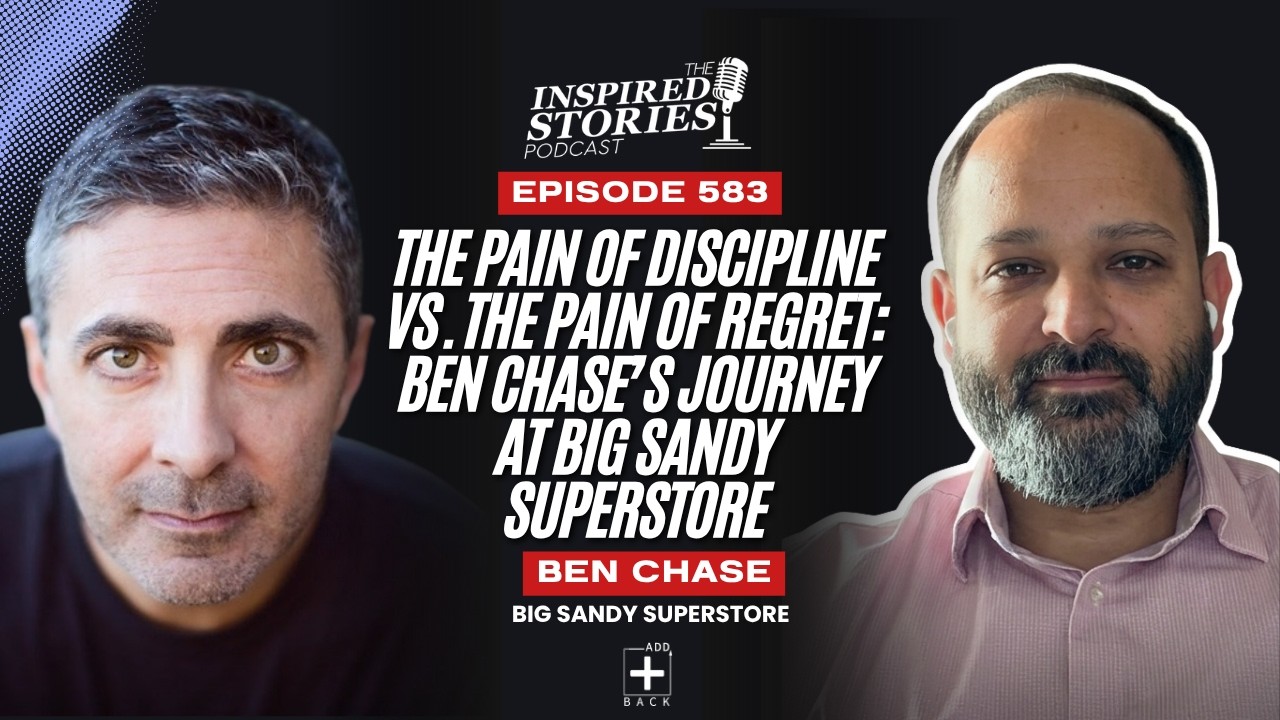
🎙️ From Six Retail Careers to Sales Director: Ben Chase's Path at Big Sandy
In this episode, Ben Chase, sales director at Big Sandy Superstore, shares how he turned down a job offer, came back on a 30-day proving period, and sold $150,000 against a $70,000 goal. He walks through the light-bulb moment that changed how he sells, what he learned about culture training teams across six states, and the two kinds of pain he hopes his kids never have to choose between.
✨ Key Insights You'll Learn:
Worked six different retail careers before finding his footing
Turned down Big Sandy's initial offer, then returned on a 30-day plan
Sold $150,000 against a $70,000 goal in his first 30 days
Learned to focus on the customer's story, not the sale itself
Coaches teams across 30 stores in six states
Carried $20,000 in credit card debt before finding Art Van
Uses AI to visualize furniture inside customers' actual homes
Big Sandy named fastest-growing home furnishings retailer in 2024
Believes culture is set in a store's first 30 minutes of the day
Teaches his kids the difference between the pain of discipline and regret
🌟 Ben's Key Mentors:
Martin (GM at Art Van): Asked the question that changed how Ben sold
Robbie Van Hoos: Big Sandy leader behind "without a story to tell, you have nothing but price to sell"
Chad Sanchagrin: Trainer who reframed what it means to sell furniture
Every GM He's Worked Under: Taught him what to do, and what not to do
👉 A candid look at what it takes to rebuild culture store by store, and why Ben measures success in the pain his kids choose to avoid.
Listen to the full episode here
Transcript
Anthony Codispoti (00:00)
Welcome to another edition of the Inspired Stories Podcast, where leaders share their experiences so we can learn from their successes and be inspired by how they've overcome adversity. As you listen today, let one idea shape what you do next. My name is Anthony Codispodi, and today's guest helped lead a regional furniture and appliance chain through one of the most disruptive periods in retail history.
Starting his role in April 2020, as stores across the country were shutting their doors. Big Sandy Superstore has already survived seven decades by the time Ben arrived. What happened next? A run of aggressive expansion, back-to-back recognition as the fastest growing home furnishings retailer in the country, and a culture built entirely around employee ownership is a story about what retail can look like when the people running the floor.
Also own a piece of the outcome. He is Ben Chase, sales director at Big Sandy Superstore, a 30 location chain founded in 1953 in Ashland, Kentucky, now operating across six states and earning over 53,000 five-star reviews from customers. Ben leads sales teams from his base in Columbus, Ohio, blending a design-first philosophy with a relentless focus on people and process.
But before we get into all that good stuff, today's episode is brought to you by my company, Ad Back Benefits Agency. And you'll want to hear this because it's hurting almost every business Health insurance costs go up every single year, and retailers are furious about it. They're paying more, claims are getting denied, employees are opting out because they can't afford it, and it hurts turnover and morale. It's one of the most maddening problems in running a business, and everyone just accepts it. But you don't have to anymore.
Now there's a program that gives employees unlimited access to doctors, therapists, and prescriptions with no co-pays or deductibles to meet. You don't change your broker, and here's the part that really shocks most people. Our product actually increases your net profits. We recently helped a client add $900 per employee per year to their bottom line. Results vary, but gains like that change how a business is valued.
Get your free consultation today at adbackbenefits.com.
Back to our guest today, Ben Chase of Big Sandy Superstore. Thanks for making the time to share your story today.
Ben Chase (02:34)
It's absolutely my pleasure. Thank you for having me.
Anthony Codispoti (02:37)
So Ben, before we get into the work that you're doing at Big Sandy Superstore, give us a quick tour through some of the work that you were doing prior.
Ben Chase (02:47)
Prior to I was really developing my skills in the retail space. I was working for a few different retail companies, Eddie Bauer, Art Van Furniture, and and building a family. So that was really, right before COVID happened, I was on my way to growing to the sales manager and general manager positions in the companies I led.
Anthony Codispoti (03:07)
And tell us a little bit about were they also in the furniture space? Were they different areas of retail?
Ben Chase (03:14)
So Eddie Bauer is a clothing retailer, actually went out of business in April this year, and Art Van Furniture was a 250 plus store chain who dominated the Michigan market primarily. Art Van Ellslander began that company about as long ago as Big Sandy did, and R Robbie Van Hoos and Art Van actually were close friends for quite a while.
Anthony Codispoti (03:35)
And so at Eddie Bauer, was this kind of your first introduction to retail? Was this where you were first learning sales?
Ben Chase (03:41)
not necessarily. That was probably one of my sixth career, sixth retail
careers.
Anthony Codispoti (03:46)
okay. So you had a lot of stops along the way. Any particular mentors that were helpful to you?
Ben Chase (03:53)
I'll tell you every GM that I've worked underneath taught me something else. in most cases what to do, in s in several cases what not to do, to make things successful for its team.
Anthony Codispoti (04:04)
Okay, so give me one example of something you learned from a mentor on what to do.
Ben Chase (04:10)
To do is to be inclusive, to think about the culture, to think about the people around you, and to be succession plan minded. who will take my job? who can I prepare for the next steps? I find that GMs that think that way and have growth in their mindset, allow others to have that mindset too. So being passionate.
Anthony Codispoti (04:28)
But that's a challenging
thing, right? 'Cause it doesn't it feel threatening to your position there?
Ben Chase (04:35)
That's a great point. I think that's what I learned is that if you are willing to replace yourself, you are willing to step to the next level. And that's my goal is to help someone become as as great as possible. If that means replacing me, that's that's what I've created.
Anthony Codispoti (04:51)
And that's that growth mindset that you were talking about. Not only do you want that for other people, but you've got to be ready to step up to the next level yourself.
Ben Chase (05:00)
Absolutely.
Anthony Codispoti (05:01)
Yeah. Okay, give me an example of something you learned not to do.
Ben Chase (05:07)
to be absent, to just focus on yourself entirely. to assume that everything's working perfectly fine, not checking with your team, or, simply to not care and just focus on the numbers. the the building is the the people in the building are the brick and mortar. that's the blood life of the store. And if you're disengaged with your team, there's it's not long before your team is no longer there.
Anthony Codispoti (05:32)
So what does it look like to be engaged with them? Are you just going to the store periodically, asking, how's the wife and kids? tell me what your routine, your process feels like.
Ben Chase (05:43)
You check in first. how are you doing? what are you working on personally? what what's upcoming for you that's important to you? And when you focus on them and what's important to them, all the other stuff comes out naturally. They'll bring it back to their struggles at work. they'll talk about their struggles outside of work or they'll talk about the excitement they're having. And you can use those opportunities to think about how to set their goals with them, not for them. and they as long as you're checking in with them on a personal level.
they'll share where they're at and you can find a way to help them get to the next plateau.
Anthony Codispoti (06:15)
Can you give me an example, not using any names, but you're having a conversation with somebody on the sales floor and you hear that they're having an issue. What's that issue? What's the help that you're able to offer?
Ben Chase (06:27)
not being able to afford childcare or, make some kind of arrangements for child care. And, that's tough. That's a tough thing. You obviously can't do anything about it personally, but you make your best strides to give them advice or give them suggestions and ultimately it leads back in our industry to doing a great job with your customer. So you'd really have to get those problems out there in the air and they make a mental recognition of the solution.
And that changes their mindset, which allows them to be a little more productive, while they're on the sales floor working with customers because the customer already has a problem and you can't be thinking of your own at the same time. So I think the take away that distraction is helpful and it starts with mental, mental shift.
Anthony Codispoti (07:07)
Mm. Okay. So let's come a little bit closer to present day. How did the opportunity to join Big Sandy Superstore come about?
Ben Chase (07:15)
Well,
COVID. So, Art Van Furniture had been in business about fifty six, fifty-seven years at the time and was purchased by a third, a an outside company. And usually things don't go very well at that point. from what I understand, bills stopped being paid and a bankruptcy was looming and then COVID put the nail into that coffin. So I had people in the industry in the market that said, Hey, you should check us out and see what Big Sandy could offer and go from there. So they set up an interview for me and
the rest is history. So I first sat down for that interview and it first walked away from the table, but came back quickly and made an agreement. So it was a good experience from a bad experience.
Anthony Codispoti (07:53)
You first walked away from the table.
Ben Chase (07:55)
Yeah, I really had to support my family and the role that I was looking for really wasn't available. so just to make it simple, they said prove it. they said prove prove to us that you can do what we say that you can do. And I did just that.
Anthony Codispoti (08:09)
walk me through a little bit more about what you're talking about. What was the role being offered? Why was it not suitable? what what happened from there? How did that
Ben Chase (08:15)
So, in
income was important. it was more than just title. It was in income was important and I wanted to grow. I, I wanted to be in a manager position, in a a leading position. So when I came in, I had been a sales manager. I was looking to be a sales manager or a general manager again, and they didn't have that position. So sales management really just wasn't something they were focused on. Their general managers did a lot of that.
And for them, it took a long time to become a general manager. It took, years of learning the business and how things go, drinking the Kool-Aid, doing things the right way. And that just wasn't on the table. They could see that I had the skill set. So they decided to put me on more or less a 30 day action plan. So they said, Okay, let's have you write sales for 30 days and see what you can do. the goal was I think seventy, seventy thousand dollars. I did a hundred and fifty thousand dollars, So they said, Okay, we're we're gonna push into the next chapter.
And those affiliates that had been of our been part of Art Band of Furniture had lost their home. So they came onto Big Sandy as affiliates. And so my next job became to train and develop them as quickly as possible to learn the POS system, to learn our background, information and to really get the culture going in those stores because each company does things a little bit differently.
Anthony Codispoti (09:32)
When you use the term affiliates, you mean must like a sales associate, somebody who's on the floor.
Ben Chase (09:37)
Actually, I should be more clear. It's a company who's doing business as Big Sandy Superstore. So let's say that you had your own furniture company and you didn't have a warehouse. you used another company to provide you with your real your warehousing, your merchandise, your your plan for business, your advertising campaigns, all of those things come from an outside store. So you simply pay for the building and pay royalty.
To be a part of the business that you're joining. So imagine yourself with just a retail store, maybe two or three, but really having no place to store merchandise and not having the capital to store merchandise. I think that's what sets Big Sandy apart in many markets is having merchandise deliverable next week. If I ordered the merchandise the same day you purchased it, you'd be waiting three to four weeks at a minimum. And so Big Sandy can deliver you immediately. And that's that was a core difference that helped those businesses grow.
Anthony Codispoti (10:30)
But are these businesses carrying the Big Sandy superstore name? Are they franchises? What's the okay? Got it. Okay, so it's a franchising type relationship.
Ben Chase (10:34)
Yes, and prior franchises. That's the best way to think of it. Yes. Absolutely. Yeah, we call them affiliates. That's absolutely correct.
Anthony Codispoti (10:42)
So how many of the stores are corporate? How many are franchised, or is it all franchised?
Ben Chase (10:47)
So it was roughly six locations. There are two at this ch at this time. The other ones had moved into different made different plans over the past couple of years. But at that time there was roughly five or six of them. So I was traveling to Michigan. I was traveling to Indiana. I was traveling to Cape Garado, Missouri, as a matter of fact. So
Anthony Codispoti (11:07)
And so your job was to get these new franchise locations up to speed, get them trained, get them know the ropes, how how how to do things the big Sandy Superstore way.
Ben Chase (11:16)
Yeah.
Our Artvin and Big Sandy had some very similar philosophies. That doesn't mean that the behaviors were exactly the same. And so just in ways that we would help customers find our product assortment or capture a customer's lead information, if they did not purchase, how to follow up with them properly, and ultimately how to take them through how to take the customer through a sales process was a little bit different. The merchandise and the focus were the same. so if it's
chairs, beds, et cetera. But how we show the customer the value of those products was a little bit different for each company.
Anthony Codispoti (11:53)
Got it. Okay. And so today out of the thirty locations, two of them are franchised, twenty-eight are corporate owned.
Ben Chase (12:00)
Absolutely.
Anthony Codispoti (12:00)
So for those people who aren't familiar with Big Sandy's super superstore, tell us what it's known for. What's the customer experience like? What am I going in there to do?
Ben Chase (12:10)
So for those that don't know Big Sandy Superstore, it's funny. They're walking looking for a woman, a big woman named Sandy. it's a one of those inside jokes. And you'll see the commercials with Robbie. it's ironic. So the Big Sandy River, where this company was founded, is why it's called the Big Sandy Superstore. And that river divides West Virginia and Kentucky. Ironically, the second CEO of this business, his wife's name is Sandy, but has absolutely no affiliation with that.
and so that's people come in expecting to learn, expecting to be, shocked or amazed perhaps, and they are. The way our showrooms look, the way that we take our customer through the sales process is different, and ultimately our our ownership mentality and our experience that we create is what sets us apart. So I think that's the the number one differentiator is just the way we create the experience for the customer. we know that has to be extraordinarily different because everybody can sell furniture.
Anthony Codispoti (13:05)
So is this furniture? Is this appliances? Is this other stuff? What do you got there?
Ben Chase (13:10)
Yeah, Big Sandy Superstore, the superstore piece comes in because we do offer appliances, both, low, mid and and luxury, furniture obviously, and then bedding as well. So mattresses, sleep solutions, sleep systems, you name it from the adjustable base all the way to the pillows and sheets. We s we own that process too.
Anthony Codispoti (13:29)
So tell me more about what the full scope of the customer experience looks like. Because you're saying anybody can sell furniture. What is it that you guys are doing differently?
Ben Chase (13:39)
We can provide transparency in in what the product is and what it does for the customer. we have something called the frame story, which shows the innard of a product. We have a sleep test that we take customers through so they can explain which mattresses would be best for them, not based on price, but based on support and comfort. And we have appliances that are geared to help somebody who is extraordinarily savvy with technology all the way down to your most basic product.
So really explaining the product to the customer, learning how they use their products. And so we can make good recommendations. And then finally, to be able to service those products by our our own hand. So we have our own emplo employee owned service team. And that's a big difference because when you use something, it naturally breaks down. We provide much better support when the customers need a support with something like that.
Anthony Codispoti (14:30)
So what, my kitchen table breaks or my bed frame breaks and you guys are gonna come and help with that?
Ben Chase (14:36)
It could be something as simple as, putting a new leg on a dining room table to as complicated as fixing an electronic device inside of a a range or an oven. and one of the things that stands out for our customers is being a one-stop shop and a one monthly payment so they can use our financing options to secure their products without having to burden themselves without by depleting, their bank account.
Anthony Codispoti (14:58)
Hmm. You mentioned being employee owned, and I think this is something we called out in the intro, too. Big Sandy has been fully employee owned since 2006. Obviously, well before you arrived there, but was this your first experience working at a company that was employee owned? And how do you think it impacts the way that people show up to work?
Ben Chase (15:24)
Yes, it was my first time working for an employee owned company. And that's probably, outside of the decorative taste, I think that's the biggest thing I noticed was that feeling of people who really cared very much about the the way that their customers felt before and after the sale. so being employee owned is a huge difference because we have a vested interest in it's not a one and done. I want to see you again and again and I want to be here for you even after the purchase has been made.
Anthony Codispoti (15:56)
Now you stepped into the sales director role. We touched on this. you came in right in COVID, the sales director role, specifically at Living Inspired, which is under the big Sandy Superstore umbrella. You originally turned down the position. You came back because they put you on this 30 day pip, right? Show us what you can do. And you blew it out of the water. And I want to hear a little bit more about that experience.
Why do you think you were so successful right out of the gate?
Ben Chase (16:28)
Well, to back that up a little bit, I think that a lot of retailers or people are approached by people that say, I can do a great job for you, pay me a ton of money, and are they gonna get what they pay for? and that's the question mark. the reason I was so successful, I really truly believe because art band furniture really changed the course of my life. it's something that I really think.
I was going down a different path in my life. I just thought I'd take job after job and just work through it. When I got to Art Van was the first time I watched some buddy or something pour into its people. And what I learned from that was you could hire people and have a fear of training them because they may leave. Or you could train them or you excuse me, you could not train them and they could stay.
And that would be even worse to have a person who's under trained and under cared for and is still part of your business because who knows what's going on there. So I think that's the the largest thing that Art Van taught me was to to learn and to grow. And so when I found that opportunity, I realized that I could make something of my life. And that was f much further, that was in two thousand fifteen at that time I met some really wonderful people.
Anthony Codispoti (17:43)
Wow. I would love to hear more about this experience, right? You said it's really changed the direction of your life. You were just bouncing from job to job, but y you really had your eyes opened here.
Ben Chase (17:55)
Yeah, I in 2015 I probably had close to eighteen to twenty thousand dollars for the credit card debt. I was not affording my life whatsoever. And when I came in Art Van and I learned about commission sales and I watched these people, with wonderful vehicles, with wonderful paychecks. I thought to myself, where have I been this whole time? And I watched and I listened and I learned and I grew. and for to be honest with you, my first ninety days in this sales position with Art Van, they had found me as a manager at
B at Eddie Bauer. And they said, Well, you understand KPIs and metrics, so let's let's see what this thing is about. We'll give you a 90-day plan. For 30 days you'll sell. For 30 days, you'll learn this management routine. And for 30 days you'll you'll take on some other role. and the first 90 days of my life at R van, I probably cried every single night when I left work. It was so frustrating to not understand the computer system, the sales process.
I just didn't get it. And there was an aha moment one day when my GM said, how are things going? I said, You know what? Not good, Martin. Not not good at all. I haven't made a sale for twenty plus days. I don't know what I'm doing wrong. He said, Well, what do you know about your customer? And that's when the light bulb went off. I just I wasn't curious. I was just, hey, welcome in. Can I help you? Okay. You're just looking. I'll just let you look. And that was that was a huge turning point for me was you gotta get to know the people you're trying to help.
Anthony Codispoti (19:14)
So you just described what your interaction with the customer initially looked like previously. Now, once the light bulb went off, how did that interaction with the customer look like going forward?
Ben Chase (19:27)
You focus on not the sale. I know it sounds counterintuitive. You focus on them. Where are you from? What's your family like? What do you do in your home? take me through what you're doing this year. Tell it take me through what the last five years were like. Where do you want to be in another five years? You talk about them and before you know it, they're just like you. And they have the same goals and ambitions. And you can see yourself inside their space and see what product you can align to make them feel more happy, more organized, more secure, more safe.
Just enjoying their space more. And that's, I think, what has taught me the most about sales is it's not about the sale, it's about the customer.
Anthony Codispoti (20:05)
Hmm. I'm curious, this process of getting to know the customer, there's a portion of that there, which is creating a bond, right? And they, you want to them to know, and trust you. And then there is a percentage of that where you're genuinely trying to figure out how to help them craft their space. You're doing these two things at once. Which of those do you think is more powerful?
is it a fifty-fifty split? Is it it's maybe seventy percent like you're just creating a a stronger bond with them and thirty percent that you understand how to craft their space better? How do you think about that?
Ben Chase (20:45)
I think it depends on how much support they need, but I do think the f the value of customers don't really care how much Customers care how much you care. And when they can feel that frequency or that vibe, I think that's when their mind shifts and the wallet no longer becomes the issue. there's always money to borrow, there's always
an option you can substitute at a lower price. But if they really truly feel like something is shifting and someone cares about what they're looking for, when you can when you can get to the why behind it, that's when everything changes. And then that was something I learned at Art Band. There was a gentleman named Chad Sanchagrin who was part of a training and development team they brought in had brought in and he had a really cool explanation for how you shop for furniture
It's not really about the brown leather chair. It's about sitting in that brown leather chair with your son watching the baseball games as long as you can until they're old enough to get out of that chair with you. So, that was the paradigm shift for me.
Anthony Codispoti (21:56)
Mm, that's the big light bulb moment. Have you had the experience of helping others get to their own big light bulb moments?
Ben Chase (22:05)
Yeah, I have helped other people, they tell me I've been there for six years and they'll say, Hey, remember that thing you told me that one time that changed everything for me? it could be something as simple as explaining financing to somebody who doesn't get it, something keeping it simple for them so they can see that this isn't designed to hurt them and how they can use this product to benefit themselves and and and do something responsible. there's been so many examples where people are
telling me something I told them sometimes I forgot. It's just, these are the things that I share on a regular basis. But it makes me feel good to know that I've changed someone's life and help impact their success.
Anthony Codispoti (22:41)
Can you recall one or two of those examples, something you shared with somebody that was the big light bulb moment for them?
Ben Chase (22:50)
yeah, I think sharing with them, one instance was simple, it's just explaining what special financing is. It's one percent a month. they looked at this special financing thing like it was taking advantage of customers and I said if you give them this choice to make and they can afford thirty six months of payments and can pay it off more quickly, they actually save money. And so that that was a light bulb bone for them. They could actually help customers achieve a greater purchase, which normally you'd think you've taken advantage of somebody.
when they spend more money. The reality is they have something better to offer themselves. They have a better experience and they're they usually come home to their space and are much more happy or calm or peaceful or whatever the term is to describe their enjoyment with what they manage to purchase. I also taught people to not judge books by their covers. there's been so many times when a a guest will walk in and we just assume based on the way they dress or speak that they
aren't serious or they don't have the funds or they come from a place where they wouldn't spend enough energy or time with the consultant. And it turns out that that sale is much greater than we ever imagined because we showed we cared and we listened.
Anthony Codispoti (23:59)
Hmm. So Ben, you are responsible for managing the sales teams across thirty stores. What's the single biggest thing that in your experience that separates a high performing store from one that is struggling?
Ben Chase (24:18)
Culture.
Culture is everything. When everybody is aligned, if you think about a a sh a ship with r rowing teammates, a r a a cruise ship, everybody's in sequence. That paddle's hitting the water and striking backwards at the exact same time. You can feel that when you're in a store, when
the what we call the point, where the customer comes in the building, is covered, somebody's there, ready to greet. There's excitement, there's energy, there's enthusiasm in that. People are talking about how to solve problems and not complaining about problems. People are talking about the success they're having and why. And to to be completely honest, when you walk into a store's huddle, their first 30 minutes when they're getting ready to open a store, that's where you can tell things are different, is how you get ready for the day.
And what things you're talking about in that 30 minutes. Is it a full 30 minutes? Is it 10 minutes? Is it, all right, everybody, do your job, have a good day, or is it someone telling a story? Is someone giving some feedback? Is someone asking people to grow? And is someone setting goals? that's when you can tell there's a difference. It's even before the store opens, you can see there's a huge difference between other stores.
Anthony Codispoti (25:26)
Is there this rah, rah energy to it or not necessarily?
Ben Chase (25:31)
like a calm, it's just ri a river current. you can just feel that this is what happens every day. That these these teammates were looking forward to this injection, if you will, this moment in time where someone tells them that they can do it and tells them how and then gives them the goal to go after. I think that that, that moment shifts your mindset from all the things you're thinking about outside of work to what you gotta get done today. It's just like when a
NFL coach or a N C double A coach is talking to his team and then you can tell they're listening.
Anthony Codispoti (26:06)
So for stores that don't have that, right, they're missing all those elements that you just described there, how do you begin to coach them up?
Ben Chase (26:14)
Well, you start with, how do you think we are setting expectations? what what are your thoughts on what your team thinks that their job is to do? What's the three most important things that they have to accomplish today? If that leader can't speak to those things and has really no, action plan, you can tell if there's some opportunity there and they they can think, then you can say, Well, what would you do if you were going to create those three three goals? how would you start your day?
And they start to think of the the ideas on their own. You really don't want to tell people what to do. You want to tell them how to do it and get them thinking about how to do it.
Anthony Codispoti (26:53)
Then is AI playing a role in either what the company is doing big picture or in your own role currently?
Ben Chase (27:02)
both, with all the different tools that are out there, Claude, ChatGPT, Gemini, Deep Seek, all these different platforms. we experimented with Chat GPT. We we are now working with Claude to answer your question, yes, on both sides. for me, I use it a lot for design, and I've shown my teammates how you can go to a realtor website, find the images of someone's home.
plug those in and replace the furniture in those pictures. It's like going to a firework show versus hearing about a fireworks show. if I if I told you how cool these fireworks were, you're probably like, that's neat. Sounds fun. Or if I take you and you can feel the boom in your chest, that's the difference between seeing the product in the showroom and then going back to your home or actually seeing your home change in front of your eyes with these products. I've used it, to write emails to speed up, the things I'm trying to do or say.
I let it work in the background for me on, something as simple as getting the skeletal part of an SOP or a go-to business strategy. And obviously you add your own flavor. but it's like the boiling water. You just keep it running and put things in it to cook them. So it's a huge part, I think, of what we're trying to accomplish. And it takes data and it makes it a chart and it makes it visual for for a person. And I think that's helpful. It also
Helps with cadence. when you're trying to look at a teammate's progress and you can see where they're cycling toward the middle of the month instead of waiting for three months to go by and say, hey, the quarterly review is here, we can say, here's your mid month review. here's what this tells us about what the end of the month will look like look like. Let's find the levers to pull on so we can, change direction here a little bit. And I learned from Art Van, the difference between a good shot, good golf shot.
And a bad golf shot is millimeters. It's it's literally a club grip, it's a footing, it's just a simple balance in your swing. if you can make small changes along the way, you'll have much greater success more quickly. to fly a plane from New York to Hawaii, if you saw the pilot doing swinging sweeps with the steering wheel, you'd be scared, right? So, to stay on success, it doesn't require much effort. You just have to change directions just a little bit sometimes.
Anthony Codispoti (29:20)
So when you see that data and you see an employee that's going a little bit the wrong direction mid month, how is it that you know what kind of coaching to provide to them? Like you said, the difference can just be millimeters. Is it I don't know, are you coaching on something like voice inflection or body language or talk to me about what you're looking for it so that you can coach these folks up?
Ben Chase (29:47)
Sometimes it does have to be that granular, I there are times when I have to be very honest with somebody and tell them that their outfit doesn't suggest that they're professional. that's that's a huge people judge you within seven seconds. we could look at each other and say, that's not the kind of person I trust. that's that's never gonna help you. So being honest about that. and then, really looking at what their sales process is. If I don't have a customer's name, if I don't know what product, what project
brought them in and I don't know what they have right now, I'm not gonna be able to help them. And it doesn't matter what I'm selling. It could be Q tips, it could be plane tickets. If I don't know what their last experience was like, I can't help them with the next experience. And if I don't have answers to those questions, there's a very good chance that I'm not building any rapport, which means the trust isn't there yet.
Anthony Codispoti (30:36)
And so are you do
you do you go sit in a corner, and observe them while they're interacting?
Ben Chase (30:42)
I have a drone that hovers right over their head.
it's it's checking in, to be honest. It's it's coaching in the moment. It's it's being aware. And when I know a person's struggling, and I know the numbers and I'm watching that person, I take my hands off the keyboard, I just pay attention to what they're doing, and I try to imagine, if I can't hear them, I try to imagine what it is they're saying. And I can tell by how quick the interaction is with the guest after they break away. I'm I'm right up to them. Hey, how'd that go? What's their name? What's their project? What do they have now?
Ooh, I don't have that piece. Those pieces of information. Great. That's the next step. Let's let's get back in there once they stop in the next set. Give them some information versus ask them if they're doing okay and then talk to them. And find out who they are, start over from square one. That's that's usually the best advice is just start over, just reapproach it and begin again.
Anthony Codispoti (31:30)
What do you mean start over? You're in the middle of a conversation with somebody. What's it look like to start over?
Ben Chase (31:34)
You just have these aha moments. my God, I totally forgot to share with you something. It's really important. Come with me. and just make it just this sudden burst of energy that changes things. The customers, we all have fight, flight, freeze, or fawn instincts, right? that's just what happens. Customers walk in, they say they're just looking. We know that's not true. They just don't trust us. And that's the bottom line. If I can take my energy and show them I'm here to bring them value and clarity, they're gonna f start to fall in love with the sales process. Not at first, but as time goes on, the customer realizes.
This doesn't hurt that bad. it's kinda like getting in a cold water. You get used to it.
Anthony Codispoti (32:09)
So that's a a great thing I would like to explore with you, right? Because I do the same thing. I go into a store, can I help you? No thanks, just looking.
Ben Chase (32:17)
Mm-hmm.
Anthony Codispoti (32:18)
and so what is the appropriate response to that?
Ben Chase (32:22)
You need to understand that that is a knee-jerk response. It's similar to like when you see your postman, Hey, how's it going? We don't necessarily really care how it's going. It's just what people say, hey, how's it going? When people say, Hey, just hey, I'm just here to look, that's great. That's awesome. What brought you in? Right? what what is it that made you think you needed to step foot in a furniture store in the first place?
And that what do you have now is always a good segue. But hey, well, I'm Ben. It's great to meet you. I'm just gonna tell you a few things about us and we can definitely let you look around. And that brings those guards down and begins the conversation. So I think just treating it like you met somebody for the first time, if if I met you at a restaurant, I wouldn't be asking what's in your wallet. I would be asking you, What do do for fun? What's your name? keep it simple, keep it f light. I think that's the best way to start. It's just trying to develop a friendship or a commonality at first.
Anthony Codispoti (33:12)
That. Now I got to go back to one of the really interesting ways you talked about using AI. You're getting pictures of people's homes and you're putting furniture in the homes. So I'm thinking to myself, how would you get the pictures of the homes? Like Google Street View, you get the outside of the house. And I guess if the house is for sale, you could find the interior room pictures. But what's the process you're actually using there?
Ben Chase (33:39)
So it's always best if the customer has images already, right? So some people all are already using this. they've seen the apps or they've seen someone else do this and say, I'm gonna try that. when this first came out, back back in the day with IKEA, for example, where you could just, float a piece of furniture using augmented reality was like the beginning of this. And now you can literally take
an image and remove things and add things to it. those rules and garbrails are getting tighter, obviously. But to get an image, sometimes the customer has it. Sometimes they have to go home and get it. Maybe, maybe sometimes I'm just not sure. And they'll text me a picture and then I'll screen, I'll save that image and then use that image on the in the app. But you can go to realtor.com, Redfin, Zillow and find our homes are 60, 70 years old in most cases and most places. So you can find an image of the interior somehow and just
plop something in there and get them started to think about how a sectional would fit. The irony is like a sectional is exactly the same shadow or footprint as a sofa in a love seat. they're really not that different, but the way that we it visualize these things, it just blows us away.
And there's also the flip side of that where people will buy this massive monster truck of a truck and not realize it doesn't fit in their garage. so there yeah, it goes it goes both ways. But to answer your question, using websites and getting the customer to send them to you are the two best tactics.
Anthony Codispoti (35:01)
So
I wasn't even thinking that of course it makes sense that the customer's gonna provide you with images sometimes, but are you saying that if my house has ever been for sale in the past, that those
Ben Chase (35:12)
Mm-hmm.
Anthony Codispoti (35:12)
images of the interior are still available online? It doesn't have to be an active listing.
Ben Chase (35:15)
Yes, correct.
In most cases. Yeah. There are a few I've ran into where there's it was just street view, but in most cases you have some kind of image somewhere that's still on the web on the on the internet.
Anthony Codispoti (35:25)
So Big Sandy was named the fastest growing home furnishings retailer in the country by furniture today in two thousand twenty-four. What actually drove that kind of growth?
Ben Chase (35:38)
So Big Sandy is very focused on making great decisions and not wasting money or time. And it brings better value to itself, obviously, but the biggest focus is to the customer. So we wait sometimes for things to shift. And when businesses need to liquidate merchandise, we'll step in and purchase that for very low prices.
And we do something called a closeout or a buyout, where we can share really, really great pricing of extraordinarily good quality products with our customers, which helps them see value. So, waiting and being intelligent about our purchasing decisions. We're very disciplined when we go to market. We know exactly what holes we're trying to fill. and where this all comes from is feedback, not just from the customer, which is extraordinarily important, but from our team on the floor. So each night, every single employee in the company.
We'll fill out a feedback form and share what opportunities and wins they had for the day. And this has probably been the largest jettison for us to go from A to B, meaning how do we know what's going on the floor? We can't just make decisions from a white office somewhere. We have to understand what our team is feeling on the floor and then learn whether this is a coaching and development opportunity. Did we have this product in our lineup? We just didn't know it, or do we not carry something?
like this that would help our customers. It helps us be more competitive and gives us a much more accurate target to hit when we're thinking about inventory and merchandising our our products.
Anthony Codispoti (37:18)
So Ben, I'm looking at your website here, big sandy
Ben Chase (37:20)
Mm-hmm.
Anthony Codispoti (37:21)
superstore dot com and checking out the locations. It appears you are primarily in West Virginia, Kentucky, Ohio, Indiana. what what am I missing? Is there any others?
Ben Chase (37:35)
That
is primarily true. The one store that's just off then distances, the Cape Garado, family owned company store, which which is doing business with us for about six years now. we are we're not in Tennessee yet. That's a a a target that we're working toward. And we have several stores opening in Kentucky this year and probably one or two more in Indiana in the next couple of years. So there's that's been the focus is moving west and south.
Anthony Codispoti (38:04)
that's significant growth. and maybe this is not in your purview, but do you have any sense of how that growth is being funded?
Ben Chase (38:14)
it's it's by being efficient with our we're most of the time your proceeds, your profits, go to some executive somewhere who sits on a yacht most of the time. the the team that helps us, Robbie Van Hoos has stepped into the board member position and his son Trey and son Steven have stepped into the CEO and president roles. And when you think of the term maniacal, you would find their faces in the dictionary. So
being efficient, effective in asking, the tough questions and and making great decisions. I I think our leadership team has helped us guide us to where we are today.
Anthony Codispoti (38:54)
and and just frame that for us, maniacal in what sense? In terms of just attention to the the the goal, attention to detail.
Ben Chase (39:03)
they have been at this since they could since they could get out of their stroller, they've been in the business. So they know what's going on before they even ask the question, right? They ask for confirmation, but they have such good instincts because of how long they've been at this. It's it's, what product should we buy, what market should we enter, what busin or what companies should we use for delivery, all of those things are based on a simple scale of questions and
as and looking at the history of of those opportunities and making changes where needed. And sometimes those changes are hard. sometimes you have to drop a vendor because it's not looking at how a vendor treats you is very important. are they willing to work with you on marketing and returns and things of that nature? And if they are not, then sometimes you have to sever the relationship and sometimes that happens.
Anthony Codispoti (39:55)
again staying here on your website. looks like it's you've got a shopping cart here, it's e commerce enabled, so I can actually buy a chair, buy a couch right from the website.
Ben Chase (40:04)
Yeah, and you can ask AI Steve a lot of questions too. There's a little AI bot on there that allows you to ask different questions and ultimately acts like a intermediary between them and the real live support agent. but that is another area that AI has changed our business model is to allow our customers to communicate with us from a Asian perspective.
Anthony Codispoti (40:25)
That's really cool. Why do you call him Steve?
Ben Chase (40:28)
Superstore Steve is Steven Van Hoost, that's our president. So they use his avatar to to be cute and funny. But he wears a tracksuit sometimes when he's really excited about sales opportunities, and that's one of those things. If you look at our TikTok and Instagram and social media pages, you'll see videos of him doing funny things in a tracksuit. So it's just his his second personality.
Anthony Codispoti (40:49)
Okay. So Big Sandy participates in events like KBIS, which is a major kitchen and bath industry show, Homerama, a regional showcase of newly built homes. What do these industry shows do for the brand that the thirty plus stores in growing cannot do on their own?
Ben Chase (41:10)
Well, you meet some wonderful people, you develop and deepen relationships further with those businesses and and other partners in the business. you get your name out there and you develop an understanding for what is selling and what's new to come. So I think it helps us stay ahead of the curve as well as getting a little more recognition or familiarity, in the marketplaces. The Big Sandy superstore doesn't resonate as well as something that says I'm a furniture store.
So I think this helps us be even more relevant in a way because it's the title of our business is somewhat confusing at first, more of a curiosity than an understanding.
Anthony Codispoti (41:48)
Mm. And in your regional markets, what does the advertising look like? Is this television ends, online, driving people through Facebook? What do you do?
Ben Chase (42:01)
We we focused on that question in our feedback form. What brought you in isn't just the product or the problem. It's where have you seen our ads because it's expensive to to market. Where some companies are spending millions of dollars using an agency, we save millions of dollars by being intentional. So rather than just throwing the same money at the same targets every single quarter or year, we're focused on where was the ROI. So we are on
Pandora right now. We're on a local Columbus station. We use the Cahill family, which is a influencer from Columbus, I believe, on TikTok. We are on Facebook. We use something called a Facebook win your purchase promotion, which allows you, if you purchase something, to try to win your purchase back for free by posting it online, which or excuse me, on on Facebook and Instagram, which drives an organically interesting message. if I shop there
My brother might think about shopping there, right? Or, this is a this is a genuine post. This isn't sponsored. this is this is literally posted by a person who had a great experience. It makes you a little more trusting and curious when someone in your family posts that they bought something somewhere. I think that stands out a little differently. and then we use your normal cable, and streaming platforms as well.
Anthony Codispoti (43:22)
So as you guys are opening up lots of new stores this year and next, in new markets, so you're going in without maybe real strong name recognition. How does that change your approach?
Ben Chase (43:36)
it lets us know how we need to greet our customer. welcome to Big Sandy. Have you been in before? Is a rhetorical question. And they're gonna say no, and then we're gonna explain who we are, because it doesn't really matter until you have a story. Robbie used to say, still says to this day, without a story to tell, you have nothing but price to sell. And that's a very short story, right? If it's just about the price, then people can click online. If I tell you that we're 73 years old.
We were we're employee owned and we were family owned before that. that we have twenty-eight stores in five states and that we service what we sell. And not only that, we have great promotions and financing offers to help you take care of your project. People shift the minute you tell them you're employee-owned. They go, really? That's interesting. That that makes me feel good about being here. Or they have a personal reflection of that where they worked for or know somebody that worked for an employee-owned business.
there's a comparison of a young man who worked for us and his mother worked for Walmart and nothing against Walmart, but for forty years she poured into a four one K and within seven years he had as much in his retirement as she did hers. it just shows you where the money goes and it shows you that people stay and want to become better people and salespeople for their customers when they feel like they've got some skin in the game.
Anthony Codispoti (44:55)
Yeah. with you guys opening up so many new locations, I have to imagine being in the seat that you are in, Mr. Ben Chase, is both exciting and probably exhausting, right? you are
Ben Chase (45:09)
For sure.
Anthony Codispoti (45:10)
the guy that is responsible for going into each of these new locations, helping to seed that culture amongst the sales team, and really get them trained up and ready for the opening.
while at the same time still visiting and supporting all of the existing stores. Do you feel stretched thin? is there a time where we need to duplicate Ben Chase to be able to be in more places places than than he can at once?
Ben Chase (45:41)
I think that that opportunity probably is coming to a head. to train and develop the legacy market, meaning that stores that we're already running, is important. But we have great general managers.
regional managers and our, our our leadership team above them do a great job of setting standards and holding the line. so I think I can trust them to help support that initiative. I think that it would, it will become more important to have a second me once we have even more stores open because culture is everything. think about the blood in your body. It gets colder toward the fingertips. So the further from the heart that you can get,
the colder that's gonna be. And I think that if you aren't r cognizant of the fact that things are not going to be the same in your Portsmouth location as they are in your Clarksville location, you you've got a lot to learn. And I think we we knew that the culture needs to be the most important focus. And I think it may require a possibly hiring a second person, but to to get the, drinking the Kool-Aid, to really have a
artfelt focus on what needs to happen is so important. So we don't want to waste that opportunity. We want to make sure the person that we might pick to fill that role really does understand our game plan. So we recently had one of our furniture trainers had a newborn child. So she's, taking a leave and that has caused a deficit. So we may look at fulfilling that role as we grow.
Anthony Codispoti (47:11)
Hmm.
You talked about in different locations, different geographies, acknowledging that the culture may need to be different. Can you give me a specific example there of what you mean and how you would train for it?
Ben Chase (47:28)
when you have never seen a customer being taken care of by an employee owned service team, you just don't have the genuine feeling in your bones that selling a protection plan is good for the customer. On the flip side, being me being here for six years and watching GMs and regionals say, How that's our golden rule rule, treat others as you would wish to be treated. We put ourselves in our customer shoes every single time.
If it's minor, we have to we have to treat it like it's minor. But if it's a refrigerator that goes down, a house full of children, a person who has insulin, any of those things, we'll make a trip to Walmart to get a mini fridge to take care of that customer. We'll rip a condenser out of a brand perfectly new unit to replace it on a unit that went down. We prioritize our service calls in, more of a health first than satisfaction second thought process. So
The golden rule is everything in in regards to how we think about our business model.
Anthony Codispoti (48:29)
That's tremendous. but I'm not sure that I I see how you would want that culture be different from one store to the next. Like what you're describing there is groundwork principles that you would want instilled everywhere, right?
Ben Chase (48:45)
Mm-hmm. from a cultural standpoint, it's I think it's everything. It's believing that they're just looking. if we believe that statement, we're never gonna close a sale. it just doesn't happen. we have to really inspect what we expect and get granular with our customer and our sales opportunities. culturally, are we going to show up early and stay late? Are we going to follow up with the customer? Are we gonna let that problem ride? it's it's it's a matter of
speed wins and have s having seen it before or coming from a previous culture where the customer wasn't as important or we just did the laziest, easiest thing, those are the differences I think you see. You see it in the reviews. if you people buy the review before they buy a single product from you, right? So you can see it in those reviews, whether or not the store is taking care of the customers.
Anthony Codispoti (49:38)
So, Bet, you describe your work as centered on people, process, and spaces that serve those who use them. If you had to choose one of those three to anchor everything else to, which one is it?
Ben Chase (49:53)
People. people are they are the they're the moment that things happen. that's the connection to the customer. It's the last touch at delivery. It's the person you hand your money to at the counter. there's I focus there I think there's seven Ps in in business. The three that I think are most important are people, process, and product. If you don't have the right people, nothing works. nothing works at all. If it's the wrong person buying the merchant in the wrong
The wrong people buying the merchandise, the wrong people delivering the merchandise, the wrong people selling the merchandise, everything's going to fall apart. You can fix the product problems, you can improve your process. But if the people don't want to win, then you will not win.
Anthony Codispoti (50:41)
Ben, what's the hardest thing you've ever had to overcome personally and what did going through that teach you?
Ben Chase (50:50)
Well, quite a few chapters there, but I think the answer is, not valuing valuing myself enough. I think was was the hardest chapter. I think things started to change when I found Art Van and I started to recognize my worth, that I was enough. That kind of mentality wasn't there before that. And I think that was the shift for me. realizing that I had value and that I could learn.
I didn't go to college. it wasn't like a I've got a plan kind of thing. Once I saw that you could grow yourself, I was pretty powerful. and I now I use social media to do a lot of the learning that I need to do. Obviously you have to trust who you're paying attention to there. But from working out to sales process efficiencies to, big picture mindset, you can teach yourself. You don't have to go to school for that. You can you can grow by surrounding yourself with good things and good people.
Anthony Codispoti (51:50)
I have a lot of folks on this show that are in the restaurant industry. And one of the things I hear over and over again is how much they love that that industry is a place where people without college education, maybe with a rough background, rough upbringing, can step in. And if they're willing to work and they're willing to learn, there's opportunities for advancement and quality of life that
was unimaginable to them. As I hear you talking, Ben, about your own experience coming up through retail, I feel a little bit of that sense as well. Am I picking up on that correctly? Do you view the retail space in a similar way?
Ben Chase (52:38)
I absolutely do. You find people that are just getting by and you find people that have recognized this as their shot. I I agree wholeheartedly that the service industry is a place where you can make yourself known and you can create the next version of yourself.
Anthony Codispoti (52:58)
And are there opportunities for folks like that within Big Sandy?
Ben Chase (53:02)
Yeah, I think if you have, we look for somebody who is gritty, right? who will, pull hair to win, if you will. somebody who's really just determined not to give up. and I think that when you surround yourself with people like that, there's nothing you can't achieve. but Big Sandy is absolutely a place that you can make you c you can make life changing money and you can make, great things happen for people around you and your own family.
And I think Big Sandy is a place for that for sure.
Anthony Codispoti (53:35)
Ben, as you think about the work that you're doing, what is it that you most want to be remembered for?
Ben Chase (53:42)
I think that I would like my legacy to be
There are two kinds of pain that you'll find in life, the pain of discipline or the pain of regret. And I I would like, my kids to remember that I taught them to be disciplined.
Anthony Codispoti (54:06)
So I'd like
Ben Chase (54:06)
That's I think that's
the that's the most heartball thing, I think, for me.
Anthony Codispoti (54:09)
Yeah, I want to hear more about that selfishly, because I'm a father. Two boys, they're 10 and almost twelve. and I haven't heard it put quite that way before. You're either gonna know the pain of discipline or the pain of regret. I how old are your kids, Ben? Okay,
Ben Chase (54:25)
Twelve and fourteen.
Anthony Codispoti (54:26)
so just a little bit older. do you have you been able to find language that you think they're able to hear or receive that message?
Ben Chase (54:37)
Yeah, usually when I tell that story, I give them examples or drag it out a little further, than just giving them the answer. but I, I tell them as much as I can about some of those troubles that I had. And I also I called my son the other day while I was talking to a group of of new hires. they were green as green could be.
And I said, there's two pains in life. Do you guys know what those pains are? And they struggled with it because it's not common to ask people that question. I said, let me let me give you an example. And I gave them that. And I said, when you think about what other whether I want to go to the gym or eat that healthy food or ask for the sale or whatever that is, that's the difference between winning and losing sometimes. And if you never make that decision to try, to do something hard and just always do the easiest thing.
You end up being sick, you end up without money, you end up, wishing you had more time to fix the problems. The best time is now to to start something. And sometimes I ask people, when is the best time to plant a tree? And they struggle with the answer spring or summer or they start thinking about it like that. And I say the answer is thirty years ago. It was the best time to plant a tree because you want to reap the benefits of the shade and the fruit. So, thinking about that, when's the best time to start? And it's right now.
So that's what I hope my kids can see.
Anthony Codispoti (56:03)
Do you think it's landing?
Ben Chase (56:05)
Yeah, I th my son has started to work out. he's twelve years old and he's already going to the gym and and and he's bringing me snippets from educational videos that he's finding through YouTube content where he's like, Hey, I saw that thing dead or this guy did this thing and it made me think of that thing you talked about. So I think they're they're finding their own way. they still have what's important to them, whether it's Fortnite or Roblox or, going to the pool, but they still see some things I think that have some maturity to them, some value.
Anthony Codispoti (56:33)
All right, we're both here in Columbus, Ohio. I'm bringing my kids over. We're gonna hang out with you guys. I want a little bit of this magic to rub off. Yeah.
Ben Chase (56:40)
Let's do it. Let's do it.
Anthony Codispoti (56:42)
What's your favorite thing to do outside of work, Ben?
Ben Chase (56:44)
it's definitely being active. today, went on a bike ride in the sweltering, Louisiana summer heat we have going on. I did a quick little lift session before this call. so it's it's really just being active. we have a we have breath in our lungs, we have feet under our bodies, we have to take advantage of that. So I think just being active is the most important thing for me. Going fishing with my son has been fun.
Anthony Codispoti (57:13)
Where do you go?
Ben Chase (57:14)
Right down the road. I'm right by Alam Creek and there's quite a few little reservoirs and man made ponds. Just, fun to catch and throw back.
Anthony Codispoti (57:22)
Nice. Ben, I've just got one more question for you today. But before I ask it, I want to do three quick things for the audience. First of all, if you want to learn more about what we've been talking about today, find BigSandy Superstore.com online. We will have that website address in the show notes if you missed it. But Big Sandy Superstore.com, very easy to spell, easy to remember. Also, if you're enjoying the show today,
Please take a moment to subscribe wherever you're listening. It also sends a signal that helps others discover our podcast. So thanks for taking a quick moment to do that right now. And as a reminder, you can finally get your retail employees access to therapists, doctors, and prescription medications that counterintuitively actually increases your company's net profits. There's no co-pays, there's no deductibles to meet.
A lot of part-timers qualify, and there's net profit increases that boost the value of the business. Keep your broker and happier employees stronger bottom line, addbackbenefits.com. So, last question for you. Then a year from now, what is one very specific thing that you hope to be celebrating?
Ben Chase (58:41)
that all the people we just hired are still working with us. I would like to see, four more stores opened. however many associates that means could be 12 per store or more, all really seeing the value of being part of an eSOP company and an employee shareholder ownership program type of company. that would be
the best thing for me in a in my professional life and obviously in my personal life to, see a a stronger, more healthy family.
Anthony Codispoti (59:13)
Love it. Ben Chase from Big Sandy Superstore. I want to be the first to thank you for sharing both your time and your story with us today. Really appreciate you being here.
Ben Chase (59:23)
Pleasure. Thanks the opportunity.
Anthony Codispoti (59:25)
Folks, that is a wrap on another episode of the Inspired Stories podcast. Thanks for learning with us. And if one thing stood out, put that into action today.
Connect with Ben Chase:
Website: bigsandysuperstore.com