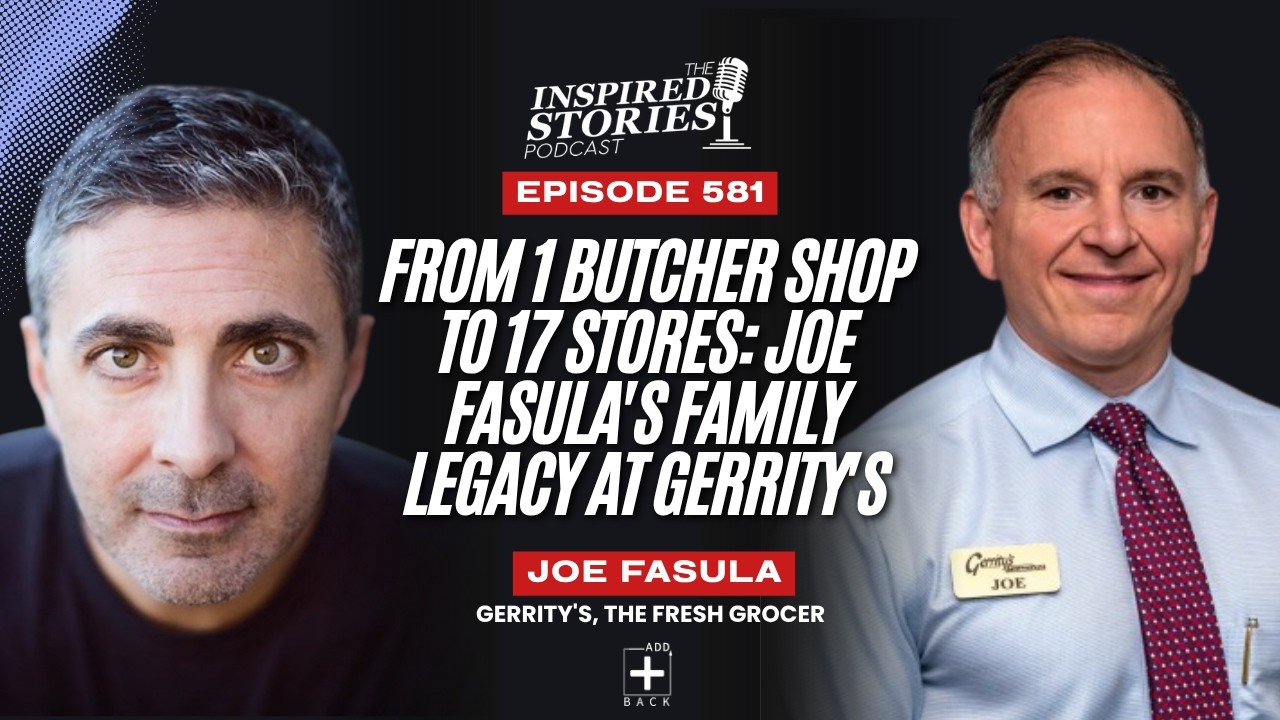
🎙️ From Butcher Shop to Ten Supermarkets: Joe Fasula's Family Legacy at Gerrity's
In this episode, Joe Fasula, co-owner of Gerrity's, The Fresh Grocer, shares how a family grocery chain founded in 1895 survived his father's sudden death, a chaotic co-op conversion, and the chaos of COVID-era retail. Joe opens up about the parking lot moment that made him question everything, and how his mother stepped in from teaching to run a nine-store supermarket chain almost overnight.
✨ Key Insights You'll Learn:
Turned down a New Jersey supermarket job after his father passed away
Watched his mother step in as CEO with no prior business management experience
Learned to solicit feedback after a manager was afraid to correct the boss's son
Joined Wakefern, the co-op behind ShopRite, and rebranded in 2022
Lowered cost of goods seven to ten percent and passed most of it to customers
Watched one store's sales drop twenty percent mid-transition
Operates on razor thin margins of about three percent before taxes
Refused to raise egg prices above eight dollars during the 2023 shortage
Expanded into Ace Hardware, now with seven locations
Expects an 80 percent refrigeration energy savings from adding cooler doors
🌟 Joe's Key Mentors:
His Father: Built the company from a small meat shop into a multi-store chain before his sudden death
His Mother, Joyce: Stepped in as CEO from a teaching career and still advises the business today
Ron Gadowski: Longtime center store supervisor who mentored him early in his career
Mark Braddon: Director of operations who now runs the day-to-day business alongside him
👉 Hear how a family grocery chain founded in 1895 survived a father's sudden death, a chaotic co-op conversion, and the razor-thin margins of the supermarket business.
Listen to the full episode here
Transcript
Anthony Codispoti (00:00)
Welcome to another edition of the Inspired Stories Podcast, where leaders share their experiences so we can learn from their successes and be inspired by how they've overcome adversity. As you listen today, let one idea shape what you do next. My name is Anthony Cotusbodi, and today's guest was a college senior with a job offer from a New Jersey supermarket chain when his father passed away. And that changed the course of his life in many ways. He turned the job down and stayed home instead.
What followed was decades of decisions that could have threatened a small family grocer, including a full rebrand, a leap into hardware retail, and a partnership with one of the largest grocery cooperatives in the country. Joe Fasula is co owner of Garrity's, The Fresh Grocer, a family owned chain of 10 supermarkets across northeastern Pennsylvania, with more than 1,400 employees. He runs the business alongside his mother Joyce.
Who
serves as president and CEO? And the family has also grown into hardware retail with seven Garrity's Ace Hardware locations. Hard to believe their roots trace back to a small meat shop that opened on Railroad Avenue in West Scranton in 1895. But before we get into all that good stuff, today's episode is brought to you by my company, Ad Back Benefits Agency. And you'll want to hear this because it's hurting almost every business you know.
Health insurance costs go up every single year, and retailers are furious about it. They're paying more, claims are getting denied, employees are opting out because they can't afford it, and it hurts turnover and morale. It's one of the most maddening problems in running a business, and everyone just seems to accept it. But you don't have to anymore. Now there's a program from Bain Capital Insurance that gives employees unlimited access to doctors, therapists, and prescriptions.
With no co-pays or deductibles to meet. It works for your part-timers, and here's the part that really shocks most people. Our product actually increases, increases your net profits. We recently helped a client add $900 per employee per year to their bottom line. Results vary, but imagine what could be done with the extra cash flow. Get your free consultation today at adbackbenefits.com.
All right, back to our guest today, VP and co-owner of Garrity's Supermarkets and Garrity's Ace Hardware, Joe Fasula. Thanks for making the time to share your story today.
Joe Fasula (02:33)
Thanks for having me. Very excited.
Anthony Codispoti (02:35)
So Joe, who started? How was it started? When was Gerrity's started?
Joe Fasula (02:41)
We have a a long story and a great story to tell. It started way back in 1895 with a guy named William Gerrity. He opened up a little butcher shop here in West Scranton and it grew into what today is is ten supermarkets, seven and seven hardware stores. he passed it to his son Joe, and Joe never had any kids. However, my my father started working for Joe Gertie when my father was fourteen, worked his way through high school and college.
after he graduated from college, my dad went to work for a big accounting firm in New York City. And after he was there about a year, my dad was getting a little homesick. He was still dating my mom who lived here, and as fate would have it, Joe Gary's business burned down. Now Joe wasn't ready to retire, but Joe was, overwhelmed by the thought of starting his family business over from the ashes.
Joe and my father had a conversation and they decided to become partners. My dad came back. They both threw in two thousand dollars and they kept the name Gary's because at the time it was over eighty years old in the meat business. It was it was very well known as the butcher shop in West Granton. And so a few years later Joe retired and sold his half of the business to to my father and it's been in our family ever since.
Anthony Codispoti (04:02)
So did you say they both threw in two thousand dollars? What year was this?
Joe Fasula (04:06)
Yep, that was the investment.
That was nineteen seventy four.
Anthony Codispoti (04:10)
Mean, even then that's really cheap to be able to open up a grocery store. Do you understand the economics of how they pulled that off?
Joe Fasula (04:18)
I've always wondered about that, but I imagine they they were probably leasing the building and and so the cost to get into it was probably not, tremendous. to to open up a butcher shop back then I'd imagine it was it was, pretty economical. Yep.
Anthony Codispoti (04:36)
So it wasn't
the the big sprawling grocery store that you've got today. It was a much more modest okay.
Joe Fasula (04:40)
just just a little butcher shop. They probably
had one service case that was small and refrigerated and then, the the back butcher area area. Probably wasn't much.
Anthony Codispoti (04:50)
So then when you were a young kid, you started working in the store, bagging oranges, stamping food stamps for your dad. What do you remember about those early days? And did you have any sense when you were a kid like that that you were gonna work in the family business as you got along?
Joe Fasula (05:07)
Absolutely. I always I always enjoyed working in the family business. I loved I loved being with people. I loved waiting on customers. I loved standing at the checkout and bagging people's groceries and interacting with the customers. so I always knew that it it was gonna be whether it was gonna be my entire career or at least what I was gonna do throughout high school and college, I knew that I was gonna be working.
Anthony Codispoti (05:30)
And so what do you remember about the early days of working there? Some lessons that maybe your father impressed upon you or your mother as well.
Joe Fasula (05:37)
I I y you learn a lot of lessons as a kid working up in a retail business, interaction with customers, interaction with employees. I I learned a lot about how people look at you when you're the the the the boss's kid, and how to how to eventually how to try not to be a a little snot nose that everybody you know just rolls their eyes at. you you try to
to to empathize with their position and and you understand that they're probably not gonna tell you what you're doing wrong and they're probably not going to yell at you when you're when you're getting in their way. so you have to be very sensitive to that as the a a a kid growing up in a family business.
Anthony Codispoti (06:23)
And so was there a point where you became aware of that and actually actively started seeking out feedback?
Joe Fasula (06:30)
yeah, for sure. Yeah. Throughout high school I I definitely came to that realization. And that was the advice I gave to my kids too. you're I always say you're not going to you're not gonna be getting that feedback. You have to solicit it and you have to be looking for it. And the story I always tell them was when I was learning to cut meat, the assistant meat manager in that store was showing you how to cut it, and I'm left-handed. So
I do some things right handed, but I cut left-handed. So that means that when you're doing it, you have to turn the piece of meat completely around. And I was learning how to cut top round, and and which is is what you make London broils out of. And it it's a complicated piece of meat when you're looking at it. And so, he cut it and showed me what he was doing, and then I had to turn it around and I had to cut it the complete opposite way, and and halfway through I'm like, this is this isn't looking right. These
These roasts are not looking how they should look. And I I after I ruined the, the piece of meat by cutting into it that far, I said to him, I said, Yeah I said, Am I doing this the right way? He said, Well no. And I said, I said, Why didn't you just stop me? I didn't know if I should. I didn't feel right about it. So that was a big eye opener for me.
Anthony Codispoti (07:44)
Okay. Isn't that funny? he he was so afraid to tell the the boss's kid what he was doing wrong for fear of some kind of retribution, but it it's not
Joe Fasula (07:53)
Right, right.
Anthony Codispoti (07:54)
the kind of people that you are, right?
Joe Fasula (07:56)
Yeah, no, and and you you try to be sensitive to that and I try to carry that through to today because I I even now even if now I I am I am still the boss's kid technically, but it but but at least I I have I have more authority now than I I did then. But I'm still try to be sensitive to to knowing that if I'm making the wrong decision I gotta look for those nonverbal cues to see if if everybody's on the same page.
Anthony Codispoti (08:22)
Any tells that you can share with the audience that you've picked up on over the years?
Joe Fasula (08:28)
it's just learning how to read people and and whether it's the hesitation in their voice or the the look on their face and following back up with them to make sure that are we okay with this? This is this the right move? You you you you like this idea, Just drawing it out of them, especially if you're doing it in a meeting versus a one on one. You're you're gonna get a lot more honesty one on one. There when you're in a a boardroom of, ten, fifteen people sitting there,
they're gonna be a lot less apt to speak up and and tell you they disagree with you.
Anthony Codispoti (09:01)
Yeah, it makes sense. So you continued working there through high school and then you go to University of Scranton afterwards to study management. But there's also this pull towards biology and anatomy. Was there a tug of war going on there? Were you thinking about post college? how is this gonna apply to me working in the grocery business or what's going on through your head?
Joe Fasula (09:25)
Well that was more in high school when I considered the the medical route. I I I loved biology and anatomy in high school and I was I was an athletic trainer in in high school or would go to the sporting events and so on and and tape up the the athletes. I really enjoyed that. But, after after my father and I sat down my probably junior year of high school and
And he he opened up the books to me in and I saw that it was, what a successful family business he had built. it was it was pretty much a no brainer at that point. It really helped me make my decision knowing that I was gonna be stepping into a family business that that had a good future. And because again I I loved it. I really enjoyed the business. I I to this day I tell people all the time I love I love food and I love people. And both the grocery business and the hardware business, the hardware business because of grilling.
they they that puts it all together. I I love it.
Anthony Codispoti (10:21)
No. So I think this was post college. You get a job offer from Kings, right? This was a a New Jersey
Joe Fasula (10:28)
Right. Mm-hmm.
Anthony Codispoti (10:30)
supermarket chain. And this job offer ends up coming right around the time your father passed away your in your senior year of college. before we talk about the pain and difficulty of your father passing and and what that meant, why at the time were you looking at going to work for I don't know if you would call them a competitor?
Instead
of coming back to the family business.
Joe Fasula (10:53)
Yeah, well, for the same reason my my middle son is no longer working right now for us. he graduated college from Penn State and and he and I both agreed that he go he should go work somewhere else. I I want him I want him to go and and find out things that maybe I can't tell him, things that our company isn't doing. And that was the intent that we had at the time was, we I think we had four stores, maybe well, I guess my father probably had the nine stores at that point.
And but but we didn't know what we didn't know. so here's a a larger organization that I could go to in a different market and and maybe I would have learned things that that our supermarkets weren't doing, but I certainly would have learned things that I wouldn't have learned as the boss's kid. which is which is I think the the big thing that my son is is learning out there, which is great. I want him to I want him to work for people that could be mean to him. I want him to I want him to to work for somebody that is gonna yell at him.
He he came home from work one day and he was working for one of our managers who was, she was she was very she had a a reputation of being very firm and very a stickler. And one of the while he was working in that department, one of the employees said to him the one day, God, I love when you're working here because so-and-so is just she's just so nice to everybody when you're working here. And so I think I think that was his eye-opening moment.
I think that was when he thought, okay, so so my dad was right. They they do treat me differently.
Anthony Codispoti (12:24)
Yeah, it's so interesting. I've had so many family business owners on the show, multi-generation. And maybe with no exceptions, i every family has the same pattern. if you decide you want to if you decide you want to work here, you first need to go somewhere else. Spread your wings on your own a little bit. You get a little bit of taste of the world outside of here. Maybe you can bring back some good ideas into the business.
And I ha I hadn't had somebody put it exactly the way that you did just now, but I really appreciate that. Go somewhere where people are gonna be mean to you, right? Let let you get a little taste of what that's like.
Joe Fasula (13:05)
That's right, exactly. And it gives you the perspective on when, once once you are in that authority position, how people are underneath you and in that you want to make sure that you respect them as a person. And obviously there's times where you do have to reprimand or give negative feedback, but you wanna make sure that you were in a position to know how that could be received and how
it should be
Anthony Codispoti (13:28)
No.
Joe Fasula (13:28)
delivered.
Anthony Codispoti (13:30)
So you had this job offer from the New Jersey supermarket chain, and then your father passes away. Walk me through what's happening at that time, personal and professional. What was that that aftermath?
Joe Fasula (13:43)
Yeah, well, I was I was a senior in college. I was just focused on graduation at that time and I'd had conversations with my father about, what I should be doing to prepare and what I should expect and where where I would be going and what I would be doing if if I came in directly into the family business. And my mother was a teacher at the time, so she wasn't really in the picture from a business standpoint. And so when he passed away, my mother was left with a very difficult decision of what to do.
we had about five hundred employees at the time and but it but a a large and growing business. My dad had already signed a deal to purchase five more stores, one of which he had already opened as a as a Garretties. they the the stores that he opened were a limited assortment grocery operation. They had no fresh bakery, they had no prepared foods, limited assortment on produce. So he had to start remodeling those stores and turning them into a Garretties. And after he opened the first one,
passed away. So, that there was all of that work that had to be done to convert to convert those remaining four stores into our model. But my mother, having been a teacher, was was familiar with the front lines of the business because she had worked in the summers, the weekends, the holidays, and knowing the responsibility she had to all of those people who had, counted on us for job security and a paycheck.
And then knowing that I did eventually want to come into the family business, she stepped in and here we are over thirty years later. So she's almost thirty years later, I should say. She's she's done a lot of things right. She did a lot of things right.
Anthony Codispoti (15:24)
you're both because you you ultimately make the decision not to take that position and you gotta come home to the the family business, but and both of you have familiarity with the business, but not to the extent that your dad did, right? You guys were more the front lines, right? And y you don't know what's going on behind the scenes. I can't imagine you're dealing with the death of your father, slash, for your mother, her husband. And on top of that emotional toll.
Now you've got to step into a part of the business that you've got limited to no exposure to and figure out how to grab the reins.
Joe Fasula (15:59)
Yeah. The great thing was is that my father had put together just a wonderful team of people. They were caring, they were, they were conscientious, they were extremely skilled, very knowledgeable people. we were fortunate in the growth of our business. while my father did, a tremendous job of growing our business right around this time when when he had added the four stores in the previous few years and then the nine stores.
the other major supermarket chains in the area had been declining. the one store, the one one chain was called Giant, not the giant that's around the there's some other giant stores around the United States now and in the Northeast. the the one that's here is a foreign owned company out of Austria. But this giant had around 15 stores. the owners were getting older, the kids weren't involved, their sales were declining, and my dad started buying these stores up.
So so he had then also been able to to get a lot of the really top-tier employees out of those those chains as well. so he had built just a really incredible talented team of people. And and they were the ones that that helped my mother, they were advisors to my mother, they were mentors to me, and they they helped carry us through.
Anthony Codispoti (17:20)
That that's so tremendous.
I talk again, I talked to a lot of business owners on this show, and there's a challenge that founders slash owners go through. they're the strong personality that got the business off the ground, that got the momentum going, that figured out a whole lot of things. And it can be really hard for them to step away and start handing some of those responsibilities, delegating those responsibilities, building that infrastructure around them.
It sounds like your dad had foresight and the vision to do that, which positioned you guys, to be in a much better position than you would have been when he passed. You you talk about some of those mentors that were really great at showing you the ropes as you're coming up through the business. Can you point to one or two of them and some of the important lessons that they taught you?
Joe Fasula (18:13)
Yeah, well and and some of them still work here. I I would say R Ron Gadowski w was our original center store supervisor. I learned a lot from him over the years. and then Mark Braddon, who's our director of operations now.
he joined the company right as I was coming into the family business full time. but as his career track has has grown over the years, I I've just watched him and learn from him and and he and I have a terrific working relationship at this point. And he does handle the day to day business of the company. just just an incredibly talented person. And and I also, want to make sure that I I I don't undersell the contribution my mother had to my development, but
but also to the success of our company. she stepped in really green in the management of a of a business let alone a nine store supermarket chain she finished off the remodels that we had going on and and my mother was very conservative and and very thoughtful and and cautious about about how she grew the business and how she spent the money.
and and she did a fantastic job. She really and and especially back then, while there were there was obviously a lot of women in the in the business, there was not a whole lot of female females in leadership positions like that. so she had to contend with that as well. And she did a fantastic job. she ended up being on the board of our main wholesaler at the time, which was AWI. She ended up being board president at one point for them.
so she'd done a tremendous job in her career too.
Anthony Codispoti (19:57)
Let's talk about your mom for a second, because you're right. A lot of credit goes there. a school teacher, she'd worked the front lines, but she didn't have the the back office management experience. I wonder as you look back at the work that she did, especially in the immediate aftermath, did she surprise you? Do you think she surprised herself and what she was able
to do?
Joe Fasula (20:21)
I think she certainly surprised herself. to some extent she surprised me, but but my mom was always, very I don't wanna say tough, it's not the right word. Tenacious maybe and able to to handle curveballs and things being thrown at her. sh she raised me that way. she certainly made me into someone who who can handle
lot of difficult decisions and difficult situations. I definitely learned that from her.
Anthony Codispoti (20:55)
So paint a picture for us of what Gardies looks like today. Somebody comes into one of your stores, what are they seeing? Or is each location different?
Joe Fasula (21:05)
Well, all of our locations are are legacy locations from some other supermarket chain. the only one we really truly did from the ground up was a our our one store in Hanover. It was a it was a vacant Kmart. We went in and and and gutted that store and turned it into a supermarket. But but we don't have a a boilerplate supermarket layout, 'cause they're all the the buildings are all configured differently. but
What you're gonna find is you're gonna find a heavy focus on perishables and freshness, baked goods, our meat departments, that you our butcher shop is still as the cornerstone of our business, our delis and what what our chefs do every day. those are the things that really, describe our presence to the customer and and of course fresh produce as well.
Anthony Codispoti (21:55)
Mm. And going back to your month, 'cause she's still actively involved in the business today, right?
Joe Fasula (21:59)
She is, yes, she's seventy nine, but she's still she's still actively involved. She she is in the office at least once a week, mostly to to to critique what her son is doing, like any good mom would.
Anthony Codispoti (22:12)
Yeah, walk me through a little bit what that dynamic looks like today. Cause she's this stepping back a bit, but still there. w how would you describe your working relationship?
Joe Fasula (22:22)
it's it's it's always been good. i and and I think I've I've built confidence in her of of my capabilities over the years and so really it is just her stopping in the office, catching up, understanding all the big developments, anything new that's going on. And then if we have any large expenditures that we might be doing, any big projects, I'll I'll make sure she's fully in the loop on those and what the budget is and and what what our goal is with that project.
Anthony Codispoti (22:51)
You have any siblings, Joe?
Joe Fasula (22:53)
I do have one brother. he came and worked in the business for a few years and then decided he wanted to go pursue the wine industry. So he moved to California. He's been out there about about eight years now in the wine business.
Anthony Codispoti (23:06)
Nice. And how many kids do you have and are they showing interest in the business?
Joe Fasula (23:12)
I have three kids. My oldest is my stepson Greg. he has two grandkids now, two kids now. We have so we have we have grandchildren. and he's in our ace operation. He works in ACE. He's been he's been with us now for about a year in ACE. he was in criminal justice field before that. And finally finally I talked to five talked him into coming back to the family business. So he's he's he's learning his way through that.
now as we speak. And then I have a middle son, his name is Joe. he is working for a a large bank firm right now and just finding his way in his own career. He wants to make it make it out there himself first. And and then he definitely does want to come back to the family business though. He's extremely driven, very talented, smart kid. in in he he does want to come back to the family business at some point. And then
Anthony Codispoti (24:08)
And chip off the old
block, it sounds like.
Joe Fasula (24:11)
may maybe maybe you're a bigger than chip. We'll see. We'll see.
Anthony Codispoti (24:15)
So
in 2022, something pretty transformative happened. Garretties joined the Wake Fern Wake Fern Food Corp. this was the co-op that we mentioned before that owns ShopRite. And in you guys did a rebrand into Garrity's the fresh grocer. Tell me about this time period, what's going on, what drove this decision?
Joe Fasula (24:39)
Sure, but I I don't want forget my daughter. I do have a daughter who's who's that's
Anthony Codispoti (24:42)
sorry I cut you off.
Joe Fasula (24:43)
okay. No, that's okay. She her name is is Bella. She's she's a a junior in in college down there at High Point University and loving it. I don't know if she'll come back to the family business, so we'll see. She's in graphic design and video game design, so I I don't know. that career track can cross with us, in in our our graphic design and marketing department, but I don't I don't think it will.
But to to answer your question, so yeah, we j we joined Wake Fern. we were under a different marketing banner. We've always been known as Gardies, but as an independent, one of the things you want to do in the supermarket business is is join forces with other other family owned supermarkets. And we used to market under a different name. and then we had this opportunity to join Wakefern. Wakefern is the largest supermarket co op.
in the United States. They're a $20 billion a year company. They are unbelievable in what they provide to us as the retailer. but they are a co-op, as you said. and and I love that because we grew up our business grew up in a co-op and then that that co-op went out of went out of business. They they got bought up. And now that we're back to a co-op the the advantages of that are are just amazing. first of all, we own them.
as a co-op, all the retailers that buy from them are are owners. So we know that they always have our best interest at heart. but that transition was very difficult. It was it was everything in our business that got changed in in the matter of a couple of days to a couple of weeks.
Anthony Codispoti (26:22)
Before we talk about
that difficult transition, tell me about the benefits of being part of the co op. You say that you're owners in them. I think that's part of the deal, right? You have to buy stock in Wake Fern, but what's the benefit? What's the advantage to you?
Joe Fasula (26:35)
Well, that that is a big part of the advantage. So, they they do do a a dividend each year, because, whatever profit is left over that they don't use for for operating expenses and capital expenses, they they do send back to the the stores that own them. and then they provide technology training platforms, because they have the economies of scale. They service over three hundred stores. So so the things that they can they they can do and have access to
10-store supermarket chain would never be able to achieve on its own. but then the the the best part of it is the cost of goods. They give us a cost of goods that is unbelievable. it was really like a pipe dream. And and we knew going into it that we were probably going to achieve this, otherwise we wouldn't have done it, but we knew going into it that we were going to lower our cost of goods, we were going to
lower our prices to our customers and yet make more margin. And we were able to achieve that.
Anthony Codispoti (27:39)
Give me an idea across the board how much you reduced your cost of goods, how much that translated into savings for your customers, and then what you saw improve at the bottom.
Joe Fasula (27:53)
So we were able to lower our cost of goods by about seven to ten percent, which is tremendous in the supermarket business. that is just unbelievable. And we passed about eighty percent of that along to our customers in the form of either better promotions or or lower prices on the shelf.
Anthony Codispoti (28:11)
Is that typical when somebody joins a co-op like you guys did to pass the bulk of that savings on to the customer? Or was there a different thinking that you had in mind here?
Joe Fasula (28:24)
I don't know. I can't say. I think a lot of it comes down to the competitive environment that you're in. And we are in an extremely competitive environment here. We have every major chain in the northeast is here. of course we have Walmart, we have all the all the the the those big large national chains. so we feel a huge competitive pressure every single day. I always I always get a kick out of customers who who, they think that
you you're price gouging them or th or when when the price of eggs, a year and a half ago went went through the roof and it was eight dollars a dozen where they think that you're just you're just taking advantage of it and you're you're making bank on There was there was several times, especially once the price got to eight dollars where we were actually selling eggs below cost because we didn't want to we didn't want to cross that eight dollar threshold and and and validate the impression that we were trying to take advantage of the situation. But it was
it it was it was a point where I I I tell them all the time, we're looking at each other constantly. We're constantly price checking our competition just to make sure we're in line and and to make sure that we're not getting outmaneuvered or beat. that just so much pressure to be the right price all the time.
Anthony Codispoti (29:38)
Because the grocery business is notoriously very low margin. What like a a successful grocery business, what are you guys hoping to have as your margin at the end of the year?
Joe Fasula (29:47)
Three percent before taxes is a phenomenal year. That is a unbelievable year. we did achieve that last year because of our joining Wake Fern and because of all the the systems that we put in place and and because of how well my staff performed, they get all the credit for that. we were able to achieve that. Now now after taxes, you're you're back down to about the the one, one and a half percent range at that point.
Anthony Codispoti (30:15)
that is razor thin, that just doesn't give a whole lot of margin for error.
Joe Fasula (30:19)
No, it doesn't. It is. It's a little scary when you if you're looking at a week last week our sales were down a little bit because the the the snap benefits move each year, week to week, depending on what day of the month falls on, what day of the week. And so, you'll be looking at a week like like last week where where sales are down and and you that the snap benefits are gonna drop this coming week. So you're hoping you're gonna make that back up, but you don't know. You don't know until the end of the next week,
Anthony Codispoti (30:49)
Wow. Okay, so take me through that difficult transition. You guys make the decision that you're gonna switch over and become a member of Wake Fern this co op. is it just like flipping a switch, switch over the software and the next day you're up and running?
Joe Fasula (31:06)
Flip flipping a switch if you're talking about the one at the nuclear power plant. When
Anthony Codispoti (31:10)
Yeah.
Joe Fasula (31:11)
they turn on a new a new reactor, it for us it was just it was monumental undertaking every single day. the the one of the challenges we had was that all of our stores are very close in proximity to one another. And we have we had at the time we had basically three main markets based on the counties that we operate in.
one store that's off by itself and then the other nine stores that are really close to each other. So so within those two markets, it was hard to change one store over to the new brand when all the rest were still lagging behind. And then you'd have customers coming in and they'd say, Well how come you won't honor this ad? And we're like, well, because this store has is converted over to the new ad. Here's our new ad and and you had customers walking into the old store saying the opposite thing.
So it was there was confusion, there was frustration, and and that made it hard. So it's so you're dealing with the marketing component. The the the speaking to the customer was very difficult. But then on the back end, you had to retrain all of the employees, you had to reset all the shelves because there were some differences in assortment. We brought in a lot of new products, you had to change all the price tags over, our our time clocks changed, our our our
Timekeeping changed, our accounting software changed. there wasn't a single piece of our business that didn't get touched during that transition. And we did it in the span of eleven weeks with ten stores.
Anthony Codispoti (32:47)
So I guess I was just thinking now you've got the buying power of this big co op. So when you order your food you're getting a better price on it. But why all these other changes, the time clock, the accounting software, all this back end stuff? Why did that have to change?
Joe Fasula (33:04)
Well,
because to their credit, Wakefront tries to run their their organization and all the stores that are part of it as as one chain. So you're you're you're you're getting a lot of efficiencies by making sure that everybody has the same register system by some by the everybody has the same ordering system, everybody has the same pricing system. So we had to implement all of that. All again, so for one store you're you're doing that all in the span
some of it in one night, you're changing over some of that stuff in one night. Some of the stuff is getting changed over in in one week and some of it's getting changed over with in terms of resetting all the shelves in the span of about three weeks.
Anthony Codispoti (33:45)
And the shelves have to be reset. Why? Is it that you're I got a whole new product mix or just a handful of things are different?
Joe Fasula (33:52)
so there's a new product mix. obviously you still have all the main national brands, but Wakefront has a huge assortment of products. So, you might be able to carry two or three or four more flavors of Heinz ketchup that that you didn't have before, the the lower sugar one or maybe it's the the one that has no sugar added and and so we we added all those product in and and and then what you end up doing eventually is is once you add maybe four or eight feet to
for serial, for example, if your serial set grows by eight feet, well, there was something else in that aisle that was taking up those eight feet. Well, now that eight feet might need to move to a different aisle. Now once that aisle is being impacted, you end up having to reset the whole thing. And then the other thing too was that they have computer generated ordering. We didn't have that before. We did hand ordering. So because of the computer generated ordering, every single item in the store had to be counted and and and entered into the system. So if you had
twelve boxes of golden grams, you had to make sure that the the computer knew that. so all of that had to be done as well.
Anthony Codispoti (34:58)
And those hand counts are never a hundred percent accurate. And so then you're dealing.
Joe Fasula (35:04)
no they're not. No they're not. especially
Anthony Codispoti (35:06)
Yeah.
Joe Fasula (35:06)
if you have a a secondary display somewhere else in the store that you forgot to count. You could you could
Anthony Codispoti (35:10)
So
Joe Fasula (35:11)
be off by four cases or five cases of product.
Anthony Codispoti (35:14)
So you talked about making this switch over in the span of eleven weeks for how many stores at the time? Ten. it does sound like a lot of work. but even after the switchover has happened, there's still the growing pains with the new systems and et cetera, et cetera. When did you feel like, okay, we're finally settled into
our
Joe Fasula (35:37)
Huh.
Anthony Codispoti (35:37)
new normal?
Joe Fasula (35:39)
geez, probably probably a year and a half in. there's
Anthony Codispoti (35:42)
Okay.
Joe Fasula (35:42)
there was a point where we were doing the the transition and I pulled into our store. It's our depending on the week, could be our second or third highest volume store. And I pulled into that parking lot and it was a Friday afternoon and and the store, the parking lot should have been jam-packed with cars. And I think there's maybe 20 cars in the lot. And I just sat there and I said, what did I do?
Where God, what what have I done to my family business? and sh slowly but surely we went over the customers and went over our employees and and grew our business back. we I there were stores that were down twenty percent during these transactions or transitions,
Anthony Codispoti (36:22)
Wow.
Joe Fasula (36:23)
which in the supermarket business, we're we're happy if we get a two percent increase in a given year. to be down twenty percent is was terrifying.
Anthony Codispoti (36:33)
And it was down because customers were upset about the bumpiness of the transition. So I'm going across the street, forget this.
Joe Fasula (36:40)
Yep.
Yep, exactly. Or or or the customers who will were were willing to stick with you couldn't find things. because it was moved somewhere else or maybe it was in a shopping cart because it was being transitioned to another part of the the store. so so and then of course, that leads to the frustration too.
Anthony Codispoti (36:59)
Yeah. and so how did you win the clients back?
Joe Fasula (37:03)
Well, I think we finally proved to them that, why we did this. And I run into customers all the time now that tell me that, this is the best thing you ever did. because we're saving the money. we're we're significantly lower than we would have been. and it's important to say that because customers say, we were going of course at the time was with all that food inflation was hitting too. So so that was another obstacle we had to overcome because customers saw prices increasing.
And unless they went somewhere else to see that our price was not increasing as much or was more competitive than what they would have gotten somewhere else, they were looking at us like, you did this transition and your prices went up. But I'd actually have to go back and and and and while we were doing the transition, it was good because I could say, Well, if you go to my other store over here, the price is higher. our price is higher over here because here w we have a lower cost of goods. But I think once the customers
understood what we were doing and why we did it and they saw the great value that we were bringing to them, th they they started to believe us. And the good thing was too going in, we had over decades and decades and decades, we had we had built a lot of trust with our customers. And I think to a large extent that that carried us through so that once we did work through all that chaos, the customers came back and and and gave us another shot and said, okay, all right.
This is this is the this is the Garries that I I knew.
Anthony Codispoti (38:34)
What
was COVID like in the grocery business for you guys at Garretties?
Joe Fasula (38:38)
Yeah, that was wild. That was absolutely insane. I I spent probably eight to ten hours a day, just walking through the stores trying to help in any way I could. It was I'm almost ashamed to say it. It was it was it was a it was a really good time in my life as a as a person in the supermarket business because it was the first time that I didn't worry about sales, because sales were just
it it out of control. and I never thought I'd ever say we had too much sales. In the supermarket you'd never think that you could have too much sales and we we definitely crossed that threshold a few times. but I I I wasn't worried about the finances of the company. It was great because you just knew the the customers were coming in, the business was there.
But but but the main reason why I say that is because I got to go back to my roots. I got to spend so much time in the stores. I didn't have anybody calling me for appointments or meetings. nobody nobody wanted to come and meet face to face for sure. so I got to be out in the stores and I I spent, just lots of time stocking shelves and merchandising and interacting with customers and interacting with employees face to face. And and that's why I got into the business. I I didn't come into this business to read contracts all day and and and
be on podcasts or anything like that. I I got into this business because I I love being out there with our our customers and our associates.
Anthony Codispoti (40:07)
Were there any operational changes that you had to make during COVID that you've held on to that you found had a long lasting positive impact for the business?
Joe Fasula (40:17)
Hmm, that's a good question. it's it's hard to answer because at this point it's baked in. I try to remember, what we changed or what we did differently. I I could tell you that it definitely gave us a newfound respect for what our people do and in terms of what we do for the community. back then, the whole essential employee.
phrase came out. And we certainly were that and I'll never let anybody dispute that and and here's why. so at one point I walked into one of our stores and one of our bakery managers who's been with us for 30 years walked up to me and she said, are you scared? And this was right after the whole thing hit. This is right after our shelves were decimated and empty. the meat case was empty except for Beyond Burgers. That was the only thing we still had left to sell.
but but yeah she said are are you scared? And I said the only thing that scares me is that you won't show up for work tomorrow. Because and and not necessarily meaning her specifically, but certainly her for sure. But but if you think about it, and this is why we're essential employees, if going from the farm to the processing facility to the truckers to the distribution.
facilities to the supermarket. If any one of those links in the chain broke, imagine what would have happened to the country. Imagine what would happen if the you walked to your your local supermarket and there's a a sign hung on there that said closed, for whatever reason. Or if the the truckers stopped delivering to our stores or the the farm stopped picking or the manufacturing facility shut down. If if if the food chain broke during that time and that was the only thing that scared me.
I was just I was so terrified that my employees would not come to work because they were they were fearful or because they just threw in the towel because of the stress. and and so so to get back to your original question, I think just knowing how important our people are to the country and what it means to make sure that we have a very solid, sustainable supply chain in the food business. that that's that's that's an important thing.
Anthony Codispoti (42:45)
So during this same time, twenty twenty, you make the decision to expand into an entirely different business with Ace Hardware. You're now up to seven locations. What made you decide that hardware was the next right move?
Joe Fasula (43:02)
There was other supermarkets that had done it over the years. I had been in their stores and I loved the complimentary business that hardware is to the supermarket business. I always tell people when that asked me, well, why why'd you get into the hardware business? I well, we sell meat and they sell grills, so it it it works. but there was other stores that had done it. I wish I could say I invented this concept, but I didn't. But I I had in say it was 2018, I had gone to a
convention, a supermarket convention and Ace Hardware had a booth there. and they were trying to enlist supermarkets because they know that if you can if you can run the supermarket, you could probably figure out the hardware business. obviously there's a technical difference in the product but retail is retail and a supermarket is probably the most complex retail you can get because you have all the production
of the meat department of the deli of the bakery, the perishability that you have to deal with. and hardware really doesn't have any of that. so at that point it's just back to basics. It's keeping the the shelves full, training your employees, keeping store conditions good.
Anthony Codispoti (44:15)
And I imagine the margins are probably better than in grocery.
Joe Fasula (44:19)
The margins are much better. Now the sales, the top line is much, much lower. a supermarket does ten times the sales that a a hardware store does, but the margin in hardware stores is much higher. Yep.
Anthony Codispoti (44:30)
And so are you placing the hardware locations inside of the grocery stores or next to or near or no? Doesn't have anything to do.
Joe Fasula (44:40)
Next to we
we have two that are next to our stores, but we don't want to be limited by what opportunities there are next to our existing stores. Most of our stores are either in in filled out shopping centers or are in or standalone. So there's there's really no no option there. But two of the stores that are in shopping centers do have aces next to them. One is connected. That was our first store.
Anthony Codispoti (45:06)
And and I imagine it's a lot cheaper to open up an ace hardware than it is a grocery store.
Joe Fasula (45:11)
Yeah, the capital requirement is a fraction of what it is. I I'm pricing out a new supermarket now. it's probably eleven million dollars, very conservatively, to walk into a building that used to be a supermarket. and that's just to outfit it with equipment and to do some minor remodeling. You're you're easy easily at eleven million dollars. And that's not again, that's not the four walls. for the four walls you have to tack on another probably
$8 million. So an ACE Hardware, we can get into that for a few hundred thousand dollars. And an ACE has a tremendous program for new store openings that are there are new ACEs that are in new markets where you get about eighty percent of your opening stock, you get a credit on that after six months, and get that money back.
Anthony Codispoti (46:03)
Wow, that's fantastic.
Joe Fasula (46:05)
Yeah, Ace is an unbelievable company.
Anthony Codispoti (46:08)
And
so as you look to the future and what growth looks like, is there you think more of a focus on this model, the hardware store?
Joe Fasula (46:16)
Well, I I certainly don't have more of a focus on the hardware store operationally, but from a growth standpoint, there's more opportunity there. finding a a supermarket that's again, it's it's almost impossible to do ground up now. So you have to find a building that's forty five, fifty thousand square feet that can be outfitted as a supermarket that doesn't have a tremendous amount of competition already around it and that has
solid, stable, large population of households, they just don't exist. so for us it's really on the supermarket side gonna be looking for those, diamond in the rough locations or or maybe trying to do some acquisitions. But on the hardware side, you're finding a fifteen thousand square foot box out there, and and you're don't really have much hardware competition or if you do, it's a,
a home depot that's five miles away and congested traffic. there's so much opportunity there. Tons.
Anthony Codispoti (47:21)
So interesting that you mentioned that because I've got an Ace hardware that's probably a six minute drive from my house. I've got a Lowe's that's probably a 15-minute drive from my house. But there's something psychologically when I'm thinking about, okay, I need something, where am I going to go? I'm like, man, I hope Ace has this because
Joe Fasula (47:41)
Yeah.
Anthony Codispoti (47:41)
I don't want to the extra nine minute drive, the parking, the wandering up and down the aisles,
looking for somebody that can help me because I'm not a handy guy, so I gotta ask for advice. Man, I walk into an ACE hardware. And maybe this is just my local one. You tell me if this is the standard.
Joe Fasula (47:59)
shouldn't be.
Anthony Codispoti (48:00)
But I walk into an Ace Hardware and somebody's like, Hey, can I help you? Do you need help finding something?
Joe Fasula (48:05)
Yep. Yep.
Anthony Codispoti (48:07)
Well, thank God. Yes, of course I do. I don't know what I'm doing here. and it's great.
Joe Fasula (48:10)
Yep. Well, and that's why we run
yeah, we run double the payroll of what a Lowe's or a Home Depot does, at least double the payroll. And and that's why, because we have the associates there and that's the model. That's that's what you're supposed to execute. So I'm glad to hear that. Your a your local ACE is doing the the the good job that they should be on the service side. Because, for us
we want to jam as much as we can into that into that little store to make sure you we have all the essentials for you. And then we want to make sure that we can get you there, get you in and get you out. And so, we're pretty price competitive with the big boxes, but th they they are gonna be able to to to sell and and buy a little bit cheaper than than a store that has double the payroll of them. But where your savings is gonna be is in your time.
And especially if you're a contractor, somebody who who's in the the commercial side, we try to sell and to them all the time and we we continue to grow our business on the commercial side because for them time really is money. if if you're kinda messing around on a Sunday afternoon or a Saturday afternoon, you might not mind walking around a big store and and looking at all the things that they have. But certainly for a commercial contractor, they want to get in and get out because they're they're probably doing,
eighty to a hundred dollars an hour. They they wanna they wanna get back on the job.
Anthony Codispoti (49:32)
I
wonder if we've hit on the answer to this question already, Joe, but I'm gonna ask it because it it tends to be one of my favorites. What's one of the hardest things you've had to overcome personally? What did going through that teach you?
Joe Fasula (49:46)
well, so you've touched on the the the the hardest three things that were in my life, my my father's passing, COVID, and our conversion to wake from. all of them have taught me to compartmentalize my problems. and by that you you worry about something when you're focusing on it and when you're trying to solve it.
And then once you either resolve it or you bring it as far as you can, you you put that back in its box until you can either come back and work on it again, or or and until you have new new ways to to to work on it and and you basically put it out of your mind. I I don't worry about the things that I I can't solve and and don't have
ability to to address in in terms of eating me up i i don't i don't bring my problems home i i never come home stressed out even if i had a stressful day because i i just look at it like it's it's not going to benefit you in any way it it's only going to ruin your overall attitude my my employees several of them have said that have worked here for 10, 20 years they they can count on on their hand
one hand the number of times they've seen me upset or mad or stressed out because it I just I don't let it show. and and all those different adversities that I've gone through over my life taught me
Anthony Codispoti (51:24)
I was gonna ask, is that something you do you think this is just your personality, you were born this way, equipped for this? Or you weren't, and because you went through so many hard things, it just forced you into this method of compartmentalization to use your word, where if you hadn't been able to do that, you just would have fallen apart.
Joe Fasula (51:49)
I think it has to be a little bit of my DNA, I do. but but I think it was definitely challenged and honed with the the different impediments that I've had to overcome in my life for sure. it's they were they were pretty pretty steep.
Anthony Codispoti (52:09)
And as you think about some of those real big challenges that you went through, who was your rock? Who could you lean on? Who could you go to for support?
Joe Fasula (52:18)
Well, before I met my wife, definitely my mother and my family, and and then once I met my wife, it it would be definitely her. she's she's certainly my rock, and and definitely the the person that is most apt to tell me when I'm doing something wrong. So, she'll she'll she'll she'll never hold back on that.
Anthony Codispoti (52:39)
Yeah. How are you using AI in your work today, Joe?
Joe Fasula (52:45)
well AI again, because of ACE and Wakefern, what they offer to us, AI is really being implemented on their side more than on mine. we're we're the benefit the beneficiaries of what AI is doing behind the scenes. So when it comes to primarily ordering, both ACE and Wakefern are using AI software for ordering on their back end and then
on the Wake Fern side on our front end. So there's a there's a a company called Blue Yonder that Wake Fern and Ace both use. And Blue Yonder does most of our ordering at this point. Our role in ordering is making sure that if if if we need to scale up for special promotions that that's correct. And then making sure that the count in the system is correct. But after that, AI is really taking it taking over from there. and then
within our organization we're using AI, I think most small businesses are probably using, Google Gemini or Chat GPT to, write some good letters or or good emails or maybe refine a spreadsheet or something.
Anthony Codispoti (53:54)
So I'm curious to learn a little bit more about the AI and how it's helping with on the ordering side. Give me an idea of how many mana hours were spent prior to the current AI tools being in place versus what is spent now.
Joe Fasula (54:11)
Well on our side, within a department our our department managers probably spent, ten hours a week focusing on orders, and and placing orders, depending on the department. center store is probably more like sixteen hours a week or more of of of the the the grocery manager's time placing those orders and now that's almost
almost all gone away. Maybe maybe an an hour is still spent with that. And then again now though their their focus now is making sure that the counts are correct, making sure that that the the product is on the shelf. Because a lot of times now what it does is is it was a little bit of a a learning curve for everybody because it they'll the the the software will jam the store with product and and often it doesn't fit on the shelf initially because it's giving you extra product it knows you're gonna need before your next order comes in.
And so you just have to make sure you're maintaining that flow coming from the back room or or coming from the top stocks shelves up above.
Anthony Codispoti (55:16)
So as you think about maybe how their time usage has shifted to now have to handle other things that the the tasks, the AI inadvertently created for them, what would you guess is the net time savings overall?
Joe Fasula (55:36)
it's probably a few hours a week per department. i is is what the savings is net, where they get to focus more on their customers and more on store conditions. the the savings is much more so in in making sure that we have or maybe not even savings, the the sales increase is is where the real benefits.
Anthony Codispoti (55:56)
You want to make sure you're never out of stock.
Joe Fasula (55:58)
Right, yeah. Yep.
Anthony Codispoti (56:00)
And you want to make sure you're not holding too much stock because there's carrying cost with that. But it sounds sounds
Joe Fasula (56:03)
Correct, correct.
Anthony Codispoti (56:04)
like the bigger issue is making sure that you don't run out of stock.
Joe Fasula (56:07)
Yeah, yeah, but but for sure perishability is part of it. It does it does allow us to maintain the right stock level on items that are perishable, and make sure you're not ordering too much.
Anthony Codispoti (56:19)
Joe,
as you think about the work that you're doing now, what is it that you most want to be remembered for?
Joe Fasula (56:26)
I think the impact that we have on the community, that's how I want to be remembered. I what we what we focus on, whether it's with our Ace Hardware stores or our supermarkets, is the fact that we're providing a service to the community, one that is essential, 'cause even the hardware stores were essential at the time, even though we didn't have one open until later during COVID. I wanna be remembered for someone that was that was fair to our customers and fair to our our associates, both in terms of,
prices we charged and the wages we paid and how we treated our people and and I I think to a large extent we're accomplishing that. We have lots of very long tenured employees, people that are here, one person's here forty three years. And he's he's edging toward retirement, but he's still got a few years to go. So, we'll see if we could hit fifty. I don't know. I don't know. We'll see.
Anthony Codispoti (57:17)
Joe, I've just got one more question for you today. But before I ask it, I want to do three quick things for the audience. First of all, if you want to know more about what Joe and the Garritys family is doing, go to their website, Garritys.com. And Garritys is spelled with two Rs. So it's G-E-R-R-I-T-Y-S. Garretties.com. It'll be in the show notes, but G-E-R-R-I-T-Y-S.com. And if you're enjoying the show, please take a moment to subscribe wherever you're listening.
See, it also sends a signal that helps others discover our podcast. So thank you for taking a quick moment to do that right now. And as a reminder, you can finally get your retail employees access to therapists, doctors, and prescription medications that counterintuitively actually increases. It increases your company's net profit starting in the very first month. There's no co pays, there's no deductibles to meet. A lot of your part-timers will qualify.
So learn more about how to have happier employees and a stronger bottom line with this Bain Capital Insurance product at adbackbenefits.com. So, Joe, last question for you. A year from now, what is one very specific thing that you hope to be selling?
Joe Fasula (58:35)
well I I hope to be celebrating continued growth in the hardware stores. there's a few locations we're looking at right now. I'm hoping to continue to add to the chain.
on the supermarket side, we are having a big focus right now on energy efficiency. Putting putting doors on all of our open deck cases can save a tremendous amount of of money and and also improve your shrink, improve your losses because the the
temperatures held more consistently behind them. So I'm hoping that we can continue that. We're remodeling several of our stores that haven't been remodeled in a number of years. so, I I guess I guess the main measuring stick for all that is is increased sales. so I'm hoping that with all those things we we continue to improve our bottom line and and continue to grow and allow our employees to grow.
Anthony Codispoti (59:28)
One follow up on that, 'cause I've often wondered in grocery stores I walk into and the coolers are open, I always wonder how much energy is being lost here? what do you guys expect to save by making that transition?
Joe Fasula (59:40)
80%. You save about 80% on refrigeration. And unlike most businesses, the vast majority of a supermarket's energy consumption is refrigeration. we we changed all of our lighting over to LEDs, and of course, you're saving roughly 50 to 70 percent on your electricity that goes into lighting by doing that, but it's a small
portion of your overall electricity bill because the the refrigeration is so enormous. There's just giant motors, big thirty horsepower motors running behind the scenes constantly, twenty-four hours a day, seven days a week.
Anthony Codispoti (1:00:20)
And as you think about the cost to do that remodel, to do that replacement, what's the ROI? How long does it take you to get your money back on the energy savings?
Joe Fasula (1:00:28)
Less than two years. Yeah. And those cases aren't cheap either. So there's a huge amount of electricity being saved by doing that.
Anthony Codispoti (1:00:36)
Yeah. All right. Joe Fasula from Garretties. I want to be the first to thank you for sharing both your time and your story with us today. Appreciate you being here.
Joe Fasula (1:00:44)
Yeah, my pleasure. Thank you. This was great.
Anthony Codispoti (1:00:46)
Hey folks, that's a wrap on another episode of the Inspired Stories Podcast. Thanks for learning with us. And if one thing stood out, put that into action today.
Connect with Joe Fasula:
Website: gerritys.com