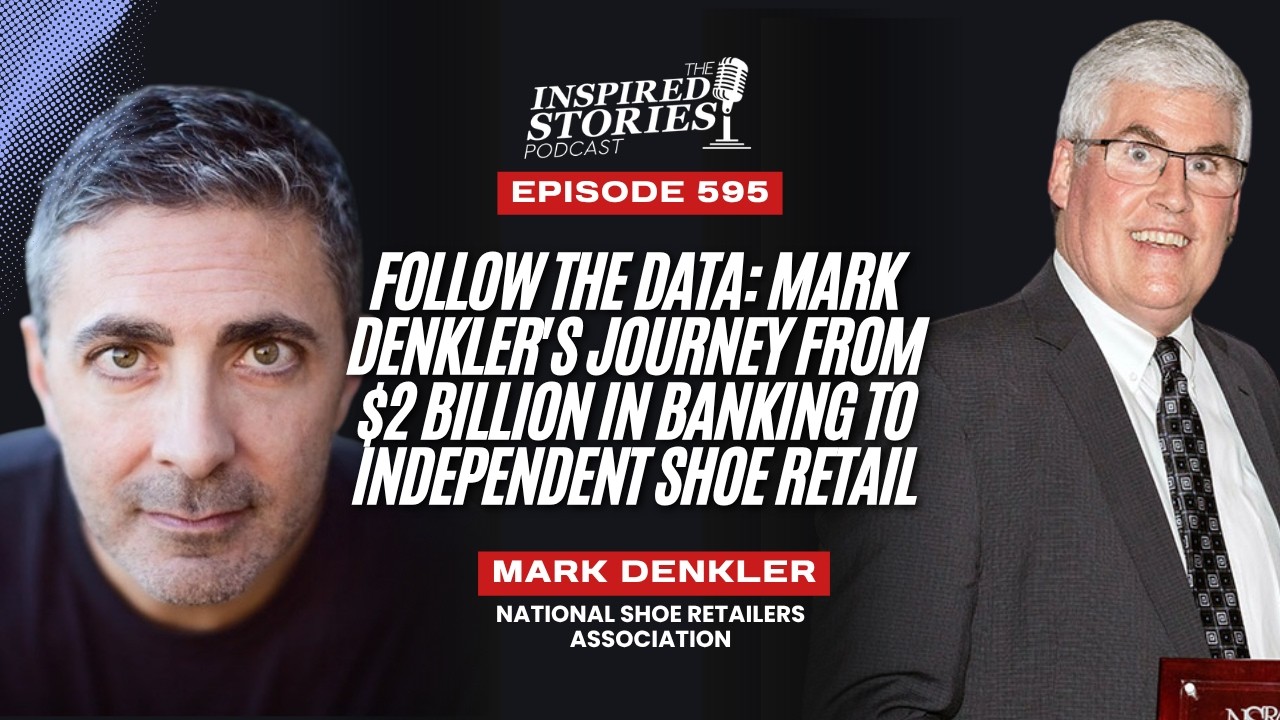
🎙️ Keeping Independent Shoe Stores Alive: Mark Denkler's Leadership at the National Shoe Retailers Association
In this episode, Mark Denkler, president of the National Shoe Retailers Association, shares how he turned down a $50,000 job managing his uncle's shoe stores for a $19,000 banking role at Fuji Bank, rose through corporate finance working on billion-dollar deals, and eventually walked away to run his family's shoe store instead. Mark opens up about being passed over for promotion, misjudging his own uncle's business as a young banker, and the rent increase that ultimately forced him to close the store his grandfather opened in 1952.
✨ Key Insights You'll Learn:
Turned down a $50,000 job managing his uncle's three shoe stores for a $19,000 banking job at Fuji Bank
Was blindsided by an annual review revealing fee income, not client satisfaction, was the real measure of his job
Was the only one of four peers not promoted to vice president in his cohort
Worked on billion-dollar leveraged buyout deals, including financing $4 billion for a Kroger dividend recapitalization
Left banking in 1994 to take over Vince Canning's Shoes in Delray Beach, the store his grandfather opened in 1952
Bought a second store, Tootsie's, entirely with cash rather than financing it through debt
Watched his original store's rent jump from $150,000 to $300,000 a year, forcing a decision to close
Underestimated the 2008 financial crisis, planning for a 10% sales decline that turned into 40 to 50%
Closed his stores in 2019 and 2020 rather than sign a new $1.5 million, five-year lease
Now leads an organization representing roughly 2,800 of the 6,000 remaining independent shoe stores nationwide
🌟 Mark's Key Mentors:
His Uncle: Ran a successful shoe store business for 45 years, a longevity Mark initially doubted as a young banker
His Wife, LaOnda: Shared his financially conservative instincts, enabling the couple to buy a second store entirely in cash
His Grandfather: Opened Vince Canning's Shoes in 1952, the store Mark would later run for over two decades
His City's Local Leaders: Redeveloped downtown Delray Beach in a way that ultimately reshaped the retail environment Mark's stores operated in
👉 Hear how a banker who once doubted his own uncle's shoe business ended up running that same store for decades, then built a second career keeping the entire independent shoe industry alive.
Listen to the full episode here
Transcript
Anthony Codispoti (00:00)
Welcome to another edition of the Inspired Stories Podcast, where leaders share their experiences so we can learn from their successes and be inspired by how they've overcome adversity. As you listen today, let one idea shape what you do next.
My name is Anthony Codespodi, and today's guest once turned down a $50,000 salary to manage his uncle's three shoe stores, taking a $19,000 banking job instead. A decade later, he was a vice president managing $2 billion in assets and loans for one of the largest banks in the world. Then he walked away from it to run his family's shoe store instead. He and his wife Laonda took over Vince Canning's shoes in Delray Beach in 1994.
The store his grandfather opened in 1952. They bought a second store, Tootsie's, after a chance conversation with a competitor across the street took place. They ran both for years and closed the original after nearly seven decades in business. Along the way, he joined the board of the National Shoe Retailers Association, served as chairman twice, and eventually stepped into the presidency. So Mark Denkler is the president of the National Shoe Retailers Association.
A nonprofit founded in 1912 that represents roughly 2,800 independently owned footwear stores across the US and Canada. He was named NSRA Retailer of the Year in 2016 and has led the organization full-time since January of 2021. But before we get into all that good stuff, today's episode is brought to you by my company, Adback Benefits Agency. And you'll want to hear this because it's hurting almost every business you know.
See, health insurance costs go up every single year, and shoe stores are furious about it. They're paying more, claims are getting denied, employees are opting out because they can't afford it, and it hurts turnover and morale. It's one of the most maddening problems in running a business, and everyone just seems to accept it. But you don't have to anymore. Now there's a program from Bain Capital Insurance that gives employees unlimited access to doctors, therapists, and prescriptions.
With no copays or deductibles to me. It even works for your part-timers. And here's the part that really shocks most people. Our product actually increases your net profits. We recently helped a client add, that's add $900 per employee per year to their bottom line. Results vary, but imagine what could be done with the extra cash flow. Get your free consultation today at adbackbenefits.com. All right, back to our guest today, the president of the National Shoe Retailers Association.
Mark Denkler, thanks for making the time to share your story today.
Mark Denkler - NSRA President (02:44)
happy to be here today.
Anthony Codispoti (02:47)
All right, so Mark, you
Mark Denkler - NSRA President (02:46)
Okay.
Anthony Codispoti (02:48)
graduated from the university in Texas in 1984 and you spent your first few years as an auditor at First City Bank in Houston before moving to Fujibank. This is where you end up managing $2 billion
Mark Denkler - NSRA President (02:59)
Yeah, it's
Anthony Codispoti (03:00)
in assets and loans. Finding your way to that kind of responsibility, even over that time period, doesn't happen by accident. What do you think you were doing differently in your work compared to some of your peers that got you noticed?
Mark Denkler - NSRA President (03:15)
I think I've always been a hard worker, never been afraid of you know spending the time to get things done and and just learning along the way. when I started out as an auditor, it was because there was no lending training program that they had for the executive training program at First City because times are tough in the oil patch. for three years there wasn't a program. Once they opened it up, I was able to do it. But you're always proving yourself along the way. and it's either hard work.
learning from your mistakes, but just doing whatever needs to get get the j job done. And I I'd say probably the biggest thing is having a great network. You know, the reason I got the Fuji bank job is because somebody asked that girl if she would like to take the job and she said no, but I'd recommend Mark Dancler. So it was just a chance thing. I didn't know anything about the bank, but the the timing for me just kind of happened to work out. But it's
always having a relationship that you can fall back on. I mean, I got my job at First City from my sister in law who knew somebody in the auditing department. So it it's always a contact that you have here. Even where I am in NSRA, it's it's through contacts.
Anthony Codispoti (04:28)
So contact got you got your foot in the door, but once you were inside, do you still credit the network that you built inside of the company for being one of the reasons why you're the one who advanced to the level that you did?
Mark Denkler - NSRA President (04:42)
Yeah, I I I I think so because everybody, you know, there's people that work hard, there's people that just kind of coast by. one of my the song I hate the most is take this job and shove it. If you don't like it, get out of there. You know. So I I've always enjoyed my job. I mean, the auditing wasn't my favorite thing, but it I totally learned how to the whole processes it. So it taught me about processes and procedures.
So when I got into the lending side, you knew the background of how these other departments work because I'd audit the credit department, I'd audit the mortgage banking department, you know, different things. So you're always learning. so I think that auditing gave me a great background. And even today I use it when people want to know about accounting and what things do. I'm not an accountant, I'm a finance guy, I know how to analyze, but I I know how to produce those items
from
Anthony Codispoti (05:36)
Hmm.
Mark Denkler - NSRA President (05:36)
the accounting side.
Anthony Codispoti (05:38)
So I want to move to your time at Fuji Bank. you first get started there, you have the six-month review, they're like, Everything's going great, you're doing well, and then your annual review rolls around and you were told you weren't bringing in enough fee income. and something you hadn't realized was the real measure of your job. And along with this news came the delivery that, hey, you're gonna be the only one in your cohort that's not getting
to promote it. How did that
Mark Denkler - NSRA President (06:06)
Right.
Anthony Codispoti (06:07)
land?
Mark Denkler - NSRA President (06:08)
well i it was terrible. I mean, it's emotional. You know, I go home and I mean, I'm sure I kind of teared up once my performance review came out. I didn't know that was the rules. So when they tell you, you're not bringing enough fee income, and it's like, okay, when you then I learned, okay, when I got into the bank, everybody kinda has to give you some accounts so they can work on other things. Well they gave me all the triple A rated, all the highly rated companies that don't bring in fee income. They knew the game. I did know the game.
So in that six month review, yeah, your clients love you, you're helping them, you're doing a few loans, but risk and reward. So when you're dealing with a triple A rated company, they're not paying a lot of money and fees or or income interest rate. So the problem is, is I had those accounts. So then I had to realize, okay, if that's what the deal is, then that's what I need to do. But you know, first thing I do, I go home, you know, kinda crying to my wife, you know, God man, I'm a failure. I've never
Been like this before. You know, I thought everything was great. And now they they put this on me. And there is some shaming of okay, three other we four guys started about the same time, three get promoted to vice president, and I stayed at assistant vice president. Nobody ever asked me about it, but you know, it was like, okay, why is why is Denkler only AVP? You know, is he
Anthony Codispoti (07:24)
Mm-hmm.
Mark Denkler - NSRA President (07:25)
not cutting it? But then that's where you have to change your whole thought process. Okay, if this is what
the if the rules are you need to bring in fee income, then that's what I need to do. And so you have to pivot on what you're doing. Okay. So it it's kind of interesting, a lot of people don't understand the banking side. So when you do get a a a lower rated credit, you make more fee income because they're paying more interest rates, they're paying upfront fees for that. So then I just searched for those type companies that would be a s an acceptable risk.
But that would make the bank money.
Anthony Codispoti (08:05)
Okay. So I want to talk a little bit about this difficult, like doubting yourself, period. Right. You're like y you've been doing well in your career, you'd been advancing very well. You thought that everything was great, and you get blindsided by this news that nope, you're not getting
Mark Denkler - NSRA President (08:21)
Mm-hmm.
Anthony Codispoti (08:21)
promoted, you're not meeting the standards, the standards that hadn't been communicated to you. Was there any thought to throw
Mark Denkler - NSRA President (08:26)
Right.
Anthony Codispoti (08:27)
in the towel? Like move on, like maybe I'm not cut out for this?
Mark Denkler - NSRA President (08:31)
No,
no, I I knew I was cut out for it, but I just didn't know what the rules are for advancement in the bank. So it it's kind of like with everything in life, you got to realize, okay, what what is the ultimate goal to get to and what do I need to get there? So, like even running the NSRA, you put policy policies and procedures in so you can do the most for your clients, which is our members and then our vendor partners.
the the brand. So it it's always learn what the rules are and you and policies and procedures to get to where you want to go.
Anthony Codispoti (09:09)
So when you had this realization, you're like, Okay, now I get what the rules are. you went out and you start looking for new clients that are likely to generate higher fees. How are you finding those folks? How are you drumming that up that business?
Mark Denkler - NSRA President (09:22)
Well, it it in the bank, like we were I was with Fuji Bank. They're the biggest bank in the world. So we weren't a necessarily you you you make your calls to different companies and get to know them, and then hopefully when they I was during the high LBO, highly leveraged decade of with with Michael Milken and getting those type clients, you were just finding. So I would get my contacts at Chase, my contacts at Citibank that were
You know, they they had the bigger relationship and so they would syndicate a deal. So then I would find out, okay, they're they're gonna syndicate this deal and just make sure and have the good relations with those salespeople that were selling at debt of the companies. I mean, most people don't realize, okay, a company went private, Citibank would commit one billion dollars to do it, but then they wanted to only hold 200 million, so they'd sold off the remaining eight hundred million. And that's where you you would find those deals.
Anthony Codispoti (10:21)
Gotcha. Okay, so ten years before you took that first banking job, this is what we mentioned in the intro, your uncle offered you fifty thousand dollars to manage his three shoe stores. You turned it down for the nineteen thousand dollar banking job instead. You saw a real good career path there. You know, you started low, you could you work your way up. And at the time, over the you know, the 10 years, that worked out really well for you. But then in 1994, you're working long nights.
Your wife is now newly pregnant. And so you and your wife LaRonda, you end up coming back and you took over Vince Canning's shoes, the Delray Beach store that your grandfather opened in nineteen fifty two. So walk me through how that whole thought process and decision came together.
Mark Denkler - NSRA President (11:06)
Well, part of it I I guess I I loved buildings and stuff. So, you know, I wanted to work downtown in corporate America. So I here I am in Houston. I want to go take the bus or drive downtown and work in a tall building and and deal with high finance. And that was kind of what I was looking for. And you know, when I turned down the job for my uncle, here's my twenty-two year old self. He's not in malls. This guy's never gonna make it because as a twenty-two year old, where do I go to shop? I go to the malls.
And
so I thought he wasn't gonna survive, but then he had been in business for forty five years or the store, whatever whatever the the number was. So you think, okay, no, we things are different. So it's kind of you you look at different perspectives. Then when my wife gets pregnant, we're like, Man, I will never see my son if I'm leaving the house at seven every day and getting home at ten or eleven at night. And so you're just like, What do I want out out of life? And that's where
Highly seasonal down here in Florida. Yes, I'd work those 15 hour days from January through April. but then the other months, I didn't have to put in that time. So I could spend time with my kids. I end up having a daughter in nineteen ninety-seven as well. but you you could do more family time. But you know, just the money was great. you're managing all these assets, it's it's great when all a sudden you
You get that call and like, okay, we have a deal for you, but you have to sign the non-disclosure act because this company is going to buy this other company and nobody needs nobody can know about it until then. You know, until it's announced and okay, the merger is done, Wall Street goes up, the stock goes up this, you know, much you know, so you have to send do these non-disclosure acts. So it's really thrilling to be working on these these type projects. You know, some of them are a company acquiring one, so you have to sign the non-disclosure, and then others are.
Okay, like Kroger was one of my biggest clients, and they were gonna be taken over by a company that just wanted to break up the company. And they didn't want to break up what they had acquired, and so they paid a high dividend. Well, we financed, I think, four billion dollars with other banks to have them give the dividend to the shareholders of Kroger, but then you had to work through, okay, here's a company that has four billion dollars in debt that it didn't have. So
Then it it's kind of looking at the analysis of will they be able to pay it back. And I remember my first credit meeting, it was one of the officers in the small business that really relies on you knowing the personality and this and that. He's like, How are they gonna pay it back if they have a negative equity? It's like it's through cash flow. So banking taught me to look more at cash flow versus assets. And if okay, you look at the balance sheet, Kroger was had a negative equity of four point
five billion or whatever. So how how are they going to be able to pay it back? So it's through cash flow. So let's bring it back to
Anthony Codispoti (14:01)
So let's bring it back to how
did this actually lead to you taking the dis making
Mark Denkler - NSRA President (14:06)
Yeah, yeah.
Anthony Codispoti (14:07)
the decision to come back into the shoe store? Not come back, but take over the shoe store that was first offered to you years before.
Mark Denkler - NSRA President (14:14)
Well it w it was a lifestyle change. My I'm lucky my wife was a buyer for a department store. So
Anthony Codispoti (14:19)
So So you sat down with
your uncle and you were like, okay, I think this is the time or
Mark Denkler - NSRA President (14:23)
Yeah, my wife and I actually it's always I'd I'd spent summers here. I was one of eight kids, but I was the one that stayed with my aunt and uncle who was running the store. Everybody else stayed with my grandparents, but by the time I was going there when I was eleven years old, they are in their eighties. So I I got to develop a relationship with my aunt and uncle who didn't have any children. so we s I I got engaged here. So my aunt and uncle got to know LaRhonda and
just
develop that relationship and then with her buying skills of being a buyer and my financial expertise, we just thought this is the better way for our future.
Anthony Codispoti (14:57)
Okay. What did the state of the industry look back back then? Excuse me, look like back then.
Mark Denkler - NSRA President (15:04)
Tons of mom and pops. I th I think you said it. There were sixteen thousand stores when I started in nineteen ninety-four. it's now contracted to about six thousand stores. So over ten thousand stores have closed in the last thirty two years. but it's it's been tough. You know, you can build a nice livelihood with it, but if if kids don't want to take over, people aren't necessarily buying new stores. So it's you know, there's
Anthony Codispoti (15:31)
But back then it was
a good business. It was strong. The demand was there.
Mark Denkler - NSRA President (15:33)
it it was a very good business.
Anthony Codispoti (15:35)
The big boys hadn't really taken over the way that they have now.
Mark Denkler - NSRA President (15:39)
the big boy you back then it was the Sears catalog. it was catalog companies were the big killer for people. Then it became the internet, then it became the big box, then it became, you know, Amazon, people selling on Amazon. And on the internet a shoe is just a commodity. But in a retail store, it's helping somebody solve a problem. Okay, I went in there and the shoe's killing me. Then you measure their feet and you're like, You're wearing a size eleven, but you measure size twelve. Well, I've always gotten a twelve.
Or they're wide. So they got a shoe that's a medium and a ten, but they're really an eight. So it it's solving the problem for those people.
Anthony Codispoti (16:17)
As you and your wife are taking over the store and kind of learning the ropes for the first time, take me through a a bump in the road, mistake that was made, something about the industry that surprised you.
Mark Denkler - NSRA President (16:28)
I'm not sure if there's really a mistake. I I guess the biggest thing that we did, my uncle did everything the old way. And we we after one year, my wife's like, Can we do the buying? I mean, we've been here a year. I was buying $35 million of product at Foley's and now I'm only buying $200,000 for a shoe store. I think we can handle it ourselves. and we were lucky because we had money from my salary and hers in the in the banking business. We were able to buy the company and then not pay ourselves for a year and a half.
so we we we did got the computer system because we had to keep up with the competition. Everybody was starting to get computer systems, so we feel that's what we need, and that's what we needed to run the company. My uncle did need that. He was at the twilight of his career. So it wasn't necessarily a bump, but it was avoiding the bump by by getting a computer system. We didn't have to I'm not sure if you know shoe stores, but you you'd look in the wall and
you'd like, okay, I see all these missing. You take sizes, and one person would tell you, okay, eight and a half, two eight and a half, one nine, one nine and a half, two tens. And I didn't have to do that anymore. So it's it's a time saver. So the computer saved time and those things, and you always had your data right there. You had your sales data, your turnover data, your gross margin data, and your inventory. You knew exactly where it was.
Anthony Codispoti (17:49)
And so by computerizing back in nineteen ninety-four, that allowed you to run your inventory faster, allowed you to do your ordering faster, it allowed you to understand like what product lines had better margins.
Mark Denkler - NSRA President (18:01)
yeah, because beforehand my uncle might okay, we need some they're running a special fifty cents off this shoe. Let's buy a bunch. So he would when we got there, he would the way he was running it, there was an old generation where you never gave up profit. So he would buy eight shoes in a size eight medium. Well you only need two because the company has them in stock. So you increase your turnover, increase your you can work with less cash if your turnover is if you if your turnovers
Four times, that means every three months you're turning over that one shoe. Granted, being in a tourist area, I needed more shoes up front. But the rest of the years, he he would carry too much inventory. So that takes up cash. And then if you're not generating that cash, you're not marketing property, it's just sitting in the wall. and you don't want shoes sitting in the wall.
Anthony Codispoti (18:52)
So later on you end up buying excuse me a competing store called Tootsie's.
Mark Denkler - NSRA President (18:57)
Yes.
Anthony Codispoti (18:58)
and it started kind of an interesting story here I wanna hear because your store manager got into a confrontation with their store manager and your wife LaRonda goes across the street to apologize. Tell me what happened.
Mark Denkler - NSRA President (19:10)
Well, he wasn't my store manager. It was just one of my younger employees. He was working at the gym and the store manager of the Titsie stores was twenty two. I think he was twenty one or twenty at the time. So they were just talking and they kind of he he maybe said some incorrect things to her or you know, it could have been sexist. I don't remember. But then when we heard that they had this argument, my wife just felt this this isn't right. Let's take the high road and go over there and apologize. And then it came up,
it was by chance. She got a phone call and she the ladies start talking and she goes and my wife goes after is like yeah the the Delry Beach planning and zoning is so so tough on regulation 'cause no, I'm building a house forty five miles north. And Lauron is like, how you gonna do the store? She's like, it'll be tough but she's like, Well, if you ever wanna sell, let me know and then the next day we got a call. I'd like to sell. And that that
Anthony Codispoti (20:05)
Okay.
Mark Denkler - NSRA President (20:05)
was around Christmas time.
And then we bought the store February first or February February 15th. So within two months, we did our due diligence, bought the store, paid more than what we should have. because I but I we had a good offer, and then she raised it, I think 30,000 at the last minute. really wasn't justified, but we also didn't want our competition coming into our street. I mean, we we'd ruled the avenue. When I took over, my uncle said I've outlasted 34 shoe stores on the street.
And
for us, we'd outlasted a a few others of people coming in and realizing, this is a lot of work, not making it. And we were the dominant store in our town. I mean, even now we always say be the dominant force within fifteen miles. Own own your your area. And so we didn't want somebody else coming in to be able to take that store across the street and be in competition with us.
Anthony Codispoti (21:01)
Smart move it seems like. So how were you and how was your uncle for so many years being that dominant force there in the area? What were you guys doing bitter, differently, et cetera?
Mark Denkler - NSRA President (21:11)
You know, it it's interest I mean, I know what I did. When my wife and I look back on my uncle, I think he was just a he was smart. I mean, he was one of the first people to get Nike in Florida, one of the first to get like Rockport, another brand, Bionic. We are the second store in town. So he had a great eye, which is good because there there's competition. Okay, if I get Nike in my store, I don't want anybody in my town to have Nike. So you have to buy enough to be important enough to Nike. Eventually
We we couldn't last. His his three stores could buy it. But then as Nike grew, okay, you gotta buy fifty thousand and shoes this year, you gotta buy a hundred thousand. And it just if it's not the bread and butter of your store, you just can't buy that much inventory. So then you just get passed over. I mean, independent retailers always hate we build the brands and then they abandon us. as they become bigger, then they go to the department stores, the big box dicks or these others, like, Wait, we're the ones who you started with.
And then now you're abandoning us because you found bigger sales growth.
Anthony Codispoti (22:16)
No. So as you make that s switch very quickly within two months you buy the other store.
Mark Denkler - NSRA President (22:23)
Right.
Anthony Codispoti (22:23)
Now you're running two stores. Math changes on staffing, buying,
Mark Denkler - NSRA President (22:26)
No, yeah.
Anthony Codispoti (22:27)
cash flow. What's the first thing you noticed that got harder once you had two locations instead of
Mark Denkler - NSRA President (22:34)
Well, the biggest part when we bought the store, we thought, this is great. and then I forgot this from my banking. This was a lesson I had to learn. From a banking perspective, the people that we were doing business with over there did not know us. So I'm also not no credit. They want you to pay up front and develop the credit relationship with them. Even some knew us, so they they did open our account just because it was across the street. So a
Anthony Codispoti (22:58)
So you were dealing with different vendors than you were?
Mark Denkler - NSRA President (23:01)
lot of yeah, we were more of a mature fashion store.
That was a little bit more contemporary fashion. And when we bought it, we figure, okay, maybe twenty-five percent of our customers go over there. Then when we bought it, we'd have people, got what are you guys doing in here? It's like, we own the store now. We didn't realize that the and it was a woman's store. That woman, she would come to our store, but she still wanna go across the street to see what they had. So we s we had a hundred percent, but maybe fifty percent or seventy-five percent, we're much bigger store.
They
were buying at our store and they maybe buy in at our store, they're buying three or four or five items, then across they were buying that look that they had there. But we didn't realize that our customer base was somewhat the same. But having the same store is great because it's across the street, not everybody can do this. We could make a phone call. my gosh, the store is full of people. Can you send an employee over? Or if I was working in the back at my desk, they could call me and go, Mark, we need you on the floor. Excuse me.
So it would help from an employee standpoint, and only because we're across the street, but some people do it. They we have other independent stores, they'll have a running store next to their store, and then they might have a kids' store. So they have three different storefronts. Not everybody knows, but they're like, let's go to this this strip center or wherever their store is located, because there's three stores for us to choose from. I can go get my kids' shoes, and then I get myself shoes at this store, and then I can run next door and go get an athletic shoe.
Anthony Codispoti (24:33)
Interesting. So the staffing actually was a little
Mark Denkler - NSRA President (24:34)
Yeah.
Anthony Codispoti (24:36)
bit easier, a little better because you had some flexibility
Mark Denkler - NSRA President (24:39)
I'm thinking
Anthony Codispoti (24:40)
in moving s folks around, but you had the banking sort of the credit issue right out of the gate where some of the vendors didn't know you. So they wanted you to pay all cash up front. How'd you navigate that?
Mark Denkler - NSRA President (24:48)
Cash up front?
luckily because as I said, my wife and I were able to buy our store. We didn't pay ourselves for a year and a half. We had cash flow at Vince Canning. And I guess I'm lucky my wife and I always had the vision to we're very conservative with money, even though I was a banker, I'm very dead averse, you know, in unless you really think like I was able to buy the Tootsie store all with cash that we had saved up.
So for us it was an investment. I wasn't paying a bank, okay, I need to get a hundred thousand dollar loan to buy part of the store. We paid for it all up front, because we're very conservative and say and used it from our investment portfolio. And to you know, if you're an investment guy, it was just a diversification of our portfolio. You own real estate, your house, you own your stocks. Now I was just putting it into another store.
Anthony Codispoti (25:40)
Mm. And then at some point the rent at the original store was set to jump from about fifty dollars a square foot to a hundred dollars, which was gonna push your annual rent past one hundred fifty thousand dollars. What went?
Mark Denkler - NSRA President (25:54)
Went from a hundred and fifty to three hundred thousand.
Anthony Codispoti (25:56)
okay.
Mark Denkler - NSRA President (25:57)
So a hundred and fifty thousand dollar jump in one year. It in in my town, when I moved in ninety four, we were called Dulray. We're I'm in Delray Beach, we were Dulray because nothing was going on. You know, people the the the myths, you could put a bowling ball and never hit anybody, you know, and or if the fish are running, everybody went. So it was kind of sleepy, but then Delray became we luckily our city leaders had the vision, we
There's a mall in the town north of us, mall in the town south of us. We need to make a downtown cute. They buried all the cables, they put up nice street lines and made the attraction be the downtown. What is nobody goes to malls anymore. Where are they going? They're going to downtowns and more strip centers. So our luckily our leaders, they had the vision, but they they were trapped because they you couldn't put another mall in Delray.
So we invested in our street and it was very tough. I know my uncle, the only way you could get in the store was go in the back of the store because the street was being worked on. There was nobody working. So for a year and a half, he was a total destination store because you had to drive, go into the back door of the store, and then leave through the back parking lot. You couldn't walk the street, which you know made our place great. what's that? yeah,
Anthony Codispoti (27:11)
Had to kill business during that time. Had to kill your business during the time.
Mark Denkler - NSRA President (27:16)
it it killed his business, but
As a owner, you do whatever you have to do. It's just like during the financial crisis. We had in 2008, I guess we could see that things are going. We bought like 10% less product, knowing okay, we're gonna go down probably 10%. Well, we went down forty to fifty percent. So that was tough. And then you have COVID. Okay, same thing. How do I reach my customers? I didn't have that problem because I knew I was closing my store.
where everybody else was like, I have all this product sitting on my shelves, how do I get it? So the independent retailer had to do FaceTime, they had to build their websites and things.
Anthony Codispoti (27:50)
So take
me through the sequence of closing stores, right? You get the notice that your rent is gonna double on the original location.
Mark Denkler - NSRA President (27:58)
Right.
Anthony Codispoti (27:59)
And so what's the timeline for closing that
store? And then what happens with the the second store?
Mark Denkler - NSRA President (28:05)
Well, I guess yeah, it was October of two thousand nineteen and knowing that our lease was coming up in June of the next year and our lease at the Tootsie store was coming up the January of the following year. you know, I I had to do a I had to guarantee some stuff. So I'd done a net worth statement. So I'd kind of kept that up. just being the the banker and financial guy, I always wanted that and kind of went to my wife, This is what we have, we can retire.
Or do you want to sign a $1.5 million lease for the next five years? And we just like, you know, I think we we we should close the store and then find something else, work for somebody else. It's great working for yourself, but you know, if I can last like here I've been at the NSRA almost six years since I've closed the store. So I I had that second career. my wife thought maybe I'll become a buyer for a a local chain or something like that, but she
didn't she's enjoying retirement. She does a lot of forwarding of imports for first cost, pri building private label brands, but just on a not not on a big business. We we go to Europe a two or three times a year and so she helps stores build a private label or or first cost business.
Anthony Codispoti (29:21)
What is first cost? I haven't heard that term before. Is it just synonymous with private label?
Mark Denkler - NSRA President (29:22)
Well first costs you Yeah,
it it it's you you go directly to the factory. I'll I'll just give for the listeners, okay, say I the shoe costs twenty-five dollars, they'll show it in Italy, or it could be German, Turkish, Spanish. Okay, it's twenty five dollars there. If you buy it from a brand, they're buying it for twenty-five, they're kind of doubling it, they'll sell it to me through their brand for fifty, and then we sell it for a hundred to our
customer. So you're really getting rid of the middleman. So rather than paying the $50 from that brand, I'm building my own brand, but I'm getting a $75 profit there versus just a $50 profit. So it's so it's called first cost because you're just buying it directly from the factory versus buying it from a brand.
Anthony Codispoti (30:10)
Is that a term that's specific to the shoe industry? Private label I know, I know well, but I hadn't heard that term before. It was new for me.
Mark Denkler - NSRA President (30:17)
No,
well well but also as a smaller store, a kind of thing, you know, we we talked about the rent going up. Well, my rent went up fifty thousand in two thousand fifteen. So my wife and I had how do how do we keep our lifestyle? She's already great with the sales. I have expenses low. The only other thing we can do is increase our margin. So we went to the the show in Germany and then went to Italy.
and I call it first cost because we don't we don't have enough we can't buy enough product to create a brand. So we're doing we're using that factory's name. so that's why it's called first cost. But then if you can build that business up, then next thing you know, you can build a private label. You know, Dillard's and North's,
Anthony Codispoti (31:05)
Got it.
Mark Denkler - NSRA President (31:06)
all the Macy's, they all have their private label because they have the volume. As an independent store doing a couple million dollars or and and
only doing or maybe doing half a million in first cost, I don't have the volume because most of are like I need three hundred to five hundred pairs to build a private label for you. I might be buying two hundred and fifty or so.
Anthony Codispoti (31:25)
Okay. And so that when
that shoe gets shipped to you it has the factory's brand name on it. Got it.
Mark Denkler - NSRA President (31:30)
to have the factory's brand
name on it. So that's why it's called first cost versus private label, where you put your store name on it or make one up. you know, like we have s some stores they put two uncles together to make that the name of the shoe or we had one we gave it to another Milani or something like that. You just make something that sounds sexy for the the consumer to want to buy. But then
Anthony Codispoti (31:53)
Yeah, yeah.
Mark Denkler - NSRA President (31:53)
not knowing it's really yours. And but it also helps because you don't have the competition.
You can sell that shoe. So as I said, it might be a f hundred dollar shoe, but maybe it's a hundred and fifty dollar shoe that I buy for 25 because it looks that rich. The quality's there. So then you can make more margin. And that just helps you. it's not something you can do all yourself. Some people do it, but it it's maybe you want 10% of your business. Ours was almost 20% or 10 to 20% of our store was private label, which allowed us that extra income.
Anthony Codispoti (32:29)
So take me back to the decision to close these stores.
It seems like it was just became very practical, very common sense, like, hey, do we want to keep doing this? We want to sign this much bigger lease, or you know what? I think we're maybe one of us is ready for retirement anyways. Like was it is an emotional decision because this is a a store that has been in your family's name for over sixty years.
Mark Denkler - NSRA President (32:52)
For me, it wasn't emotional. yes, it was sad that okay after sixty-nine years, Vince Canning shoes will no longer be there. we've been the the store in town. then once we closed, another store came in town. We still had our Tootsie store across the street. We were able to sell that to somebody else. I I couldn't sell Vince Canning because it was during COVID. And I didn't have a lease. I mean, how do you say, okay, I want to buy this store for
you know, a few hundred thousand dollars, but then I have no lease. So all they're doing is buying my inventory and having a going out of business sale. So you you have to have a a lease. Like when I bought the Titsy store, she had she had was in the middle of her lease. So I extended I said I w as a new owner, I want a a new three year lease with with another three year term. So you're you're just trying to protect yourself there. So it was sad to close the what my grandfather, my uncle had done. but
I wasn't emotional about it and ha happy it was it was the right decision for us, a as a family, my wife and I, to do that.
Anthony Codispoti (34:02)
So you had already served as chairman of the NSRA board twice
when the sitting
Mark Denkler - NSRA President (34:07)
Yeah.
Anthony Codispoti (34:08)
president called you to tell you he was retiring and thought you should take his place. What were you feeling when you got that call? Where were you in terms of closing the stores or how long had the stores been closed?
Mark Denkler - NSRA President (34:20)
Well, nobody knew but we're be closing our Tootsie store in seven months. This was June of 2020. And I was the chairman. So the president's actually I was the chairman at that time. I was also there in 2011 and twelve. but he calling me, say, Mark, I'm gonna retire. But I said, I think you should do it. Now, as a president, it's a full time job, and then you really don't want somebody to have ownership that maybe they're asking for benefits for their store that
would conflict with what the organization has. So I think it's great that myself, you know, kudos to me. I think as a retailer, I've added a lot to the NSRA, seeing it from that perspective. Our last person was a wholesaler, the the person before that, he had some stores. I mean, even me now, I'm six years out of owning a business. Computer systems are better, AI is there, there there's a lot more hurdles.
So it it was very beneficial the first few years, but I always have that mentality. so it it it is there that I know what our our members want because of my experience. But you know, it was in June of 2020. So he asked me and I'm because he since I wouldn't be having stores, I confided in him that I was closing this store and then seven months later because I w I would have to give up my chairmanship and
January 'cause when we our lease ended at the end of January in two thousand twenty one. I was chairman until two thousand t October of two thousand twenty one. Or or that's our fiscal year. So I was kinda telling them, Hey, for nine months you're gonna have to get an interim because part of organization you have to be an owner operator and I wouldn't have a store.
Anthony Codispoti (36:04)
So
you had to be an owner or operator in order to be the chairman, but in order to be the president, it
Mark Denkler - NSRA President (36:07)
Right.
Anthony Codispoti (36:09)
was required that you didn't own stores because there could be a conflict of interest there. Okay.
Mark Denkler - NSRA President (36:12)
Right. Right. Yeah.
'Cause you don't want you know, you you guys sponsor us. I mean, I know one guy, he he uses his leverage in the store to make people help his his organization. And so we it you just want to have a lot of integrity and I can say after you know, NSR A since nineteen twelve, it's a long standing organization and we have a lot of integrity and want to do things right. So that's where with that
closing the stores, I could do this full time, not have any conflicts of interest, and just do what our independent members need.
Anthony Codispoti (36:47)
And so what was that process? Was there like a committee review that had to take place, or was it just like here's the job?
Mark Denkler - NSRA President (36:53)
Well yeah, I I told him give me a week to think about it, talk to my wife that night. She's like, this is a blessing. I mean, here we went from not having any a job and not knowing where we're gonna go and we're gonna have this before we cl because he's gonna retire at the end of the year. So there would be a one month gap. My wife just closed the well, she's worked to to sell the store and and do that. But it's you just have to get the conflicts of interest for myself. Okay, here I want the job. So I I
Told her that night, yes, let's do it. So then the next day I called him and said, yes, this is something that we do want to do. But as the chairman, I need to set the committee. I can't be on the committee, conflict of interest. So I had to appoint, I I got three ex-chairmen together. You guys do the initial work. if they should hire me or if she they should go on a a big search, you know, a national search to find somebody for the organization. And they interviewed me.
talk to me and then they went to the board and I wasn't invited to these meetings. I was as the chairman and then I had to get off. So it's a little tough. You're like, okay, what are they saying about me? What's going on? but then they they prepared that I would be the best person for the job. but then they had to get the whole board to agree with them. And I I know there's discussions, you know, hey maybe we do do a national search and others like, well we have a guest course, you know, right here. We we have the the perfect leader for us. Thank God I have the confidence of
almost all of the board. so then they made the decision. Then I get the call later that night, okay, they've accepted you to be the next president. But you had to take all the conflicts of interest out of it. so I had to be the chairman to help tell the president what to currently do, but stay out of the discussion about hiring myself.
Anthony Codispoti (38:44)
So we mentioned before, NSRA represents 2,800 of the currently 6,000 independently owned footwear shoes stores today.
Mark Denkler - NSRA President (38:54)
Yeah.
Anthony Codispoti (38:56)
what does the association do for the stores that are members that they can't do on their own?
Mark Denkler - NSRA President (39:02)
Well, the biggest thing we do we use the volume of those twenty eight hundred stores to get better benefits. I mean, like you talked about healthcare before. I mean, that's been one of the things I've tried to work on for our members because I you look at what are the biggest costs, and one of the biggest costs is shipping. So we have a shipping program of all of our members altogether. So they're getting over fifty percent off of what you can get.
normally from UPS. So as a single store doing a million dollars in or a million dollar store doing 20,000 in shipping, now you have 600 million dollars of of stores doing fifty million dollars in shipping. So we're able to be more attractive as a group. So we get discounts for shipping. Do same thing with credit cards. We have six hundred million dollars that we're processing so the companies can pass on better
better rates to our members because and also when I I did it, we had it, you read those agreements, like a credit card agreement's 41 pages. And you're like, I don't want to do it. Well, we vetted that agreement. Same thing with our UPS agreement. We vetted those, have agreements to help our members that they they couldn't get by themselves. And then there's part of the organization we just do a lot of education.
teaching them. We had over a hundred and sixty people at our last education seminar at the Atlanta Shoe Show. and it was on AI. You know, AI is that transformational program kind of like computers were in the late 80s and 90s. Everybody needed to get a computer system like my wife and I did. You know, the big boys had them, but it was it got cost effective for the lower guys. so we do education and then have networking opportunities for people. Cause the biggest, as I said earlier in banking, I got it from my networkers.
networking group. So the same thing on this side, you get store owners together. We have an annual conference. You get about two hundred people there and we we have round tables and they discuss what the issues are. So we provide venues for them to talk with other retailers.
Anthony Codispoti (41:11)
So I hear what you're saying, like better pricing on shipping, better pricing on credit card processing. You get them these speakers that come in and educate them about things. Are they getting better prices on things like their inventory shoes? Like is it sort of like a buying co op in a way?
Mark Denkler - NSRA President (41:27)
No, I mean it's a lot of people approach me to that. It's something that people used to do in the old days. But it just think if you're a say say you're Nike. Well, if if we had a buying group, I don't want you to be in the competitor next door. So the brands want to ship to who they want to ship. Now we have relationships with us, they help prov they help sponsor us for education, but I can't help them get a brand because it's really the brand's decision.
Okay, we're the hottest brand going, and every there's 20 stores in your town that want it, and we're only going to ship it to two. If you had a buying group, then all 20 would have that. And so that you do get that more in apparel, where you get emerging brands. You know, maybe we could do that with some emerging shoe companies, but you know, the the big boys, your Hokas, your Birkin stocks, and New Balance, they
Clarks, they want to control who they ship to. So we we can't really do a brine group. We had them 40 years ago when buying groups were real popular, but then it's kind of you don't have that, but you do have that a little bit more in apparel because you can get some of those emerging brands that people don't know about, that the department store hasn't done. And then guess what? Then the department store does it, okay. We need we're we're gonna buy most of that, and we're dropping your brine group.
Anthony Codispoti (42:48)
'Cause there's an element of exclusivity that goes on in
Mark Denkler - NSRA President (42:50)
Right.
Anthony Codispoti (42:51)
the shoe industry. And so and sometimes that exclusivity is planned, right? It helps to when the
Mark Denkler - NSRA President (42:55)
Yeah.
Anthony Codispoti (42:56)
the demand is much higher than the supply, then it just gets a sort of a feeding frenzy going. So
Mark Denkler - NSRA President (43:01)
Yeah, I mean,
as I said, for the the bigger brands, that's important, but for the it could maybe work on the smaller brands. We we did we tried this in the late 90s, having a buying group, and then it just kind of we were hosting it, but then we found out we were excluding the reps. So my Florida rep who might sell me a pair of shoes through the Ed SRA buying group, we're that the discount they gave us was really
getting rid of the rep on their side. So it became a conflict of interest and we kind of stopped it because we saw how it goes. You hear you hear from the the representatives, the independent representative that's buying or who's doing that brand who would come to my store, give me tech advice, this and that. I was just buying a commodity through the buying group and and eliminating that person who was really very important. Like when I
Las Vegas was becoming a show back in the early nineties. I would go there. Well, my Florida reps weren't going there. They know Florida. So I would get some well, California, they're they're kind of like you. We'll have you talk to the California rep, but he just doesn't understand the I have a four month window to sell shoes in Southern California. It's you know sunny in Southern California all year round. where it's it's you know, it's a hundred degrees out you know, last week here. And so nobody so
Yeah, our our business dies because nobody wants to be sitting at the beach at a hundred degrees. They want to be there when it's seventy degrees. And so being a tourist town with snowbirds, just a little bit different. So it's fine groups are great, but they just they're almost non existent.
Anthony Codispoti (44:43)
So tell me more about how you support members on the technical side. You're talking about how you bring folks in to talk about AI, but there's something deeper that you're actually doing.
Mark Denkler - NSRA President (44:53)
Well, you ha you have to teach everybody about the next you know, that's technology. So our recent panel we had two people from the retail side that are retail buyers. Then we had one person who's worked with a company management one that does is a consulting group, but he built all their AI platforms for them to help analyze the independence business that belonged to their consulting group. And then we had somebody from the brand side to give the the brand an an
influence what the how they use AI to help you do it. It's it's everything I do is how I can make retailers better. And so you get that AI could be it, but it could also be okay, how do you improve your vendor buyer relations because there's so much more than just buying product. Okay, how can you get technical things? How can you get specs? How can you get co-op, you know, for you to build their brand inside your store.
So there's all these other intricacies. So we're always just trying to help the the retailer there with knowledge of things that they might not be able to do. Once again, we we we're seeing what the trends are, so we try to bring that to it. And then our evaluations from our last AI panel. Guess what? They all want AI again. So I need to get version five point because we've done versions one, two, three, that la last one was four. So I need to get more technical because people, some people are.
afraid of AI. They don't, my gosh, if I put my information in there, it's open source. Everybody will know what my sales are, what my inventory, but they need to learn how to that it's private and just the obstacles of how to operate your business.
Anthony Codispoti (46:36)
So you're showing them how to use AI in their business. I wonder if any element of this involves how to get their store to show up as a result when people are typing in questions about where to find particular shoes.
Mark Denkler - NSRA President (46:49)
Well, and that's part of it. Back in the early days you had to have your computer system and then the next transformational period was the two thousands when everybody started getting websites and the internet became a a buying a retail source. So you have to if you like right now, my store, we didn't have a we had a buying site, but then it got hacked and had to had declined to close that. So we just
Head or site. We wanted to be the experiential store where you come into our store, have the great experience. We have the shoes for you. We we make it a fun time. We train you on your the best shoes for you. with AI and other things, you need to get those things to get ahead. You know, how how do you use this to get ahead? And like people are like, okay, you're coming, you're a buyer here. You could get your 30-page line sheet of items from that shoe company, put it into AI. Here's my sales.
and what what do I need to do? You know, so and then it will come out and give you an eight page analysis of you should buy this, you should buy this. Then as the buyer, you figure out what you want.
But but there's AI is gonna save time. You know, my wife hates all the the resources of electricity and water. we need to figure out a better better way. But it is the the future and so you have to learn the technologies that will make you one of ahead of your competition and ahead of maybe the department store or the big box that has more money to spend on those things.
Anthony Codispoti (48:18)
And this is really my question, and I'm sure everybody's wondering that's listening, is how do the little guys continue to compete? You know, the big you got the big box stores, they've got the scales, economies of scale, they you know, you've got the internet and the Amazons of the world, like how d how does the little guy stay relevant? What can you guys do better that the the other folks can?
Mark Denkler - NSRA President (48:39)
Well, it's kind it's let's let's use that twenty two year old Mark Dankler. you're not in a mall and you're not gonna make it. Then as I got older, realized I don't go to malls. Then as my customer aged, okay, they have a bunion now or they've gained weight. We as as my store, our mantra was if you like it, buy it in every color. Well, being in Florida, I can sell twelve colors all year round. Well the store, say in New York City, no, in the fall they're selling the brown and
Navy blue and black shoes, but I could sell color. So my store was known for this. So every independent store goes to what their customer base is. What does that customer want? So for me, okay, people want a lot of color, they want casual, they want decent fashion at a at a good price. So the independent can really go what their customer is. I I know when I first moved down here and I go to Macy's and they'd have gloves and sweaters in the middle of the air aisle.
Piled on, so you'd buy those, but I'm like, it's 90 degrees in at Thanksgiving. But the buyer in New York, let's just send this out to our 150 stores, and they they can't curate, I say, the assortment that is necessary for a Florida store. We used to have Birdines was our department store, and it's called the Florida store. And they sold pastels and pinks and things like that that Macy's buyer just would not look at and see. So we can buy what our customer does.
We being on the store, we were on the floor. So we could listen to our customers what they'd say about a product. I want I'm looking at this brand. And then you'd hear that, okay. And then you go to the market looking for that brand that they said that they did well with. Or you see a customer, you're helping them, and you're like, this is a nice shoe. What what what brand is this? And where'd you get it? I mean, this we've got a brand. She's like, I got it in Carmel, California. So we called the company, where'd you get that? We thought it was a great shoe.
Next thing you know, we're selling a thousand pair of the shoe that we just asked the customer where you got it. Called the company in California, said, it's from a local girl here in Oakland, California. And we developed a great relationship and sold thousands in the last five years of of our store. J so you're you're able to see and know what your customer wants more. That that's why all the small guys exist. Yeah, the Macy's can get the big discounts.
tell you that you have to have a certain growth promise gross margin, get markdown money. Okay, you didn't perform how you said you're doing, you can get that. A small independent can't do that, but they know their customers better. Excuse me.
Anthony Codispoti (51:15)
I wonder if you have access to any kind of like aggregated industry data that would show the percentage of folks by age bracket who are shopping in-store versus online. Common sense would tell me that the younger the audience, the more that they're shopping online. But I'm wondering if the data would actually support.
Mark Denkler - NSRA President (51:40)
there is data there. Yeah. I think online is still thirty percent of the actual buys. So seventy and I I could be wrong on that number, but seventy percent are still buying in stores. But then you're hearing, okay, Gen X now they grew up buying on their phone. You know, let me get my phone and I'm gonna buy this shoe. Well, guess what? Now they want that experience. And that's where I I said earlier my uncle wasn't in malls.
How d how did he compete? He competed on services. People knew what they're doing. Okay, you know, what's the biggest complaint? I went to the department store, I had the shoe up and I couldn't even find a person to get it to me. Then you like it. I can't get anybody to check out. You gotta go to the checkout lane three departments over because they don't have a checkout booth in the shoe department. So it's very frustrating experience. So in a smaller store.
Yeah, we we have the more comfortable chairs, we have carpet that matches our area, we have the shoes that match our area, we have people that know the technical aspects of why you should buy this shoe. I mean, running is become after COVID, running athletic shoes be went from maybe fifteen percent of our independent stores business to thirty five to forty five percent.
Anthony Codispoti (52:55)
Yeah, I'm gonna give a a similar example, something, but in a different industry, the the hardware industry. So this was two weekends ago, our garbage disposal goes out. I'm like, man, I've never replaced a garbage disposal before. I don't know what I'm looking for, I don't know what to get. I've got a Lowe's that's about fifteen, twenty minutes for me. I've got an ace hardware that's seven minutes. I'm like, I'm going to ace hardware because I know the moment I walk in the door, there's gonna be somebody that says, Can I help you?
Mark Denkler - NSRA President (53:23)
Right.
Anthony Codispoti (53:23)
And that's
gonna be a guy or a woman that has probably replaced 20 garbage disposals themselves. And they're gonna they're gonna know the okay, okay. Well, tell me about your sink. You know, they had the right questions to ask me. They got me the right product the first time. I didn't have to go back. And it's i I imagine it's the exact same thing what you're talking about in shoes.
Mark Denkler - NSRA President (53:42)
Exact same
thing. And that person, maybe he was a contractor or worked for a contractor. He has all this knowledge, but guess what? He doesn't want to be in the 90 degree heat or up on a roof or something. So he's like, I okay, I want to be to where I can come home and smell nice when I I come see my wife or my w you know woman for her husband or something. You know, so their change in life wanted them to go there. So yes, we get the period people
that are experienced. I mean, one of the people that we hired in our stores that we found successful were flight attendants.
So we had we got a good friend of ours, she was a retired flight attendant. just call me whenever you need me. It's like it's not that easy. You can't just come in. You have to learn about the shoes, learn what's, you know, how to fit shoes and stuff like that. Then I think we had three or four more flight attendants, but they made great salespeople because what is it? You're stuck in a plane with somebody for three hours and if they get rowdy, you have to be able to diffuse the situation. You have to okay, here's here's a
free bottle of liquor because you know for your troubles because you moved seats or whatever. So they're great at sales. but it's not something I mean, once they all they they kind of are a group of friends once they left, but they they were the great salespeople that I would have never figured would be the the proper people for an independent shoe store. But they love shoes. so it just worked out. I mean we hired one customer, she came and she's like, I just love the vibe of this. She bought like 10 pair of shoes and my we needed somebody, Meyer. So well
If you wanna come work, do it. And so I carried her shoes out. You know, she couldn't she could have done herself, but this is what we did. I got her three bags of shoes and took them out to the car. And she's like, Man, I I think I'm gonna call you. I'd I'd like to work here. And then she became a great employee for us. And she owned, I don't know, perfume company. She was the CEO of this companies. I mean, actually, her family's like, What are you doing working in a shoe store as a salesman? That's beneath you. But she she liked it. And she
Anthony Codispoti (55:35)
She love doing it.
Mark Denkler - NSRA President (55:37)
was a great salesperson and she spoke five languages. She spoke German, Italian, Spanish, English, Creole. She had her companies were in Haiti. So you if we needed somebody to speak a French customer came in, guess what? She took that. Okay, you need German. She could she is Swiss. She could talk to the German person. And that's what said you you can't go to a department store and go, okay, what what's the language of the day? So we always never did it, but I always wanted to put in if you need French, German, go to Ingrid. If you need
Espanyol go to this person, because we had another person who's from Quebec, so he was
Anthony Codispoti (56:11)
Yeah.
Mark Denkler - NSRA President (56:12)
he spoke fluent French. But we always had that there. You know, you could tell you're from France, you're from Quebec. Okay, l let's let Max take care of you because he's he speaks French and if if you're more comfortable, it's just part of the customer experience. You can independent small stores like that ace, you can give a much better experience, customer experience than the big box people were
They they're really competing on price.
Anthony Codispoti (56:40)
Mark, what's the one rule that you would never break in business no matter what it costs you?
Mark Denkler - NSRA President (56:46)
well in in well the let's say there's two things. One is always integrity. You know, be a you know, la don't lie to customers, you know, keep your integrity, give them the right thing. But then also data. You know, being a banker, I had to look at companies with only data. You know, when you're gonna okay, we're gonna add Kroger, they're gonna add four billion dollars in debt, they're gonna have a negative equity in their store. How are they gonna pay that back? You can't get
too emotional in things. And and this is what we we tell our people, you gotta look at you gotta make your decisions based off the data that's provided versus going, you know, I really like this store or this brand and I think I think I want to do it. I've known the salesman. We we had our biggest it was our leading brand. They closed the it was part of Nine West. They decided to close it. And how do you go from selling two thousand pair of shoes to zero?
Well, we we just had to find something else and find what's better. That's kind of what I said as far as as the people there. But we when he went to another place, we looked at the data and the data wouldn't support buying his brand, even though he was my best salesman for the last five years, because he had our top performing brand. So but you have to go, this is really my data doesn't support me buying your comfort stuff versus it used to be dress shoes.
Anthony Codispoti (58:14)
What is the next gen programme?
Mark Denkler - NSRA President (58:16)
The NextGen program started it in 2009 with the NSRA and it's training the leaders of tomorrow. so we we had a class, I think I don't know, 30 or 40 people that came kind of came in from 2009 to 2015. They'd meet once a year. They become you kind of have a mentor that you can go to or just talk to each other. So our current program, when I started, we have about 15 next gens.
So
they're the kids of the owners. and anywhere from twenty two to forty years old. We help them one to buy the store from their parents, show that and that's kind of where some of my expertise comes in. And we have a a business coach as well. we teach them, okay, you need to start getting stock, you need to you take a lower salary, you make sure you get stock for that. Don't
You know, you build your company for twenty years and then you buy it. Your dad wants to sell it for the top dollar. You're like, but wait, I started when you were only doing three million dollars in business and now we're seven million dollars. You know, I don't want to pay off a seven million. I was part of that growth, but but it's also there's a lot of family dynamics to to go about. Okay, my parents need this income to make it. How can I buy the store and do it? So we we teach a lot about succession.
having to have those hard conversations with your your parents. because yeah, you're you're working there and you're relying on them. I mean, we found that one of our conversations, the kids were in their 30s, they'd never seen a financial steet sheet. Their parents had always that was very private to them. But if I mean my uncle, I was a finance guy, let me see the numbers. You know, so I I I made my decision off off the numbers. Yeah, this is something my wife and I
can do, then you think, okay, I can own a car and it's kind of on the business, but drive it or so, you know, that there's a lot of advantages of being the owner were expenses. Okay, we we're taking out some friends, but it's a business thing, you know, that you can learn how to put it on there. But then we also go over the problems. How how are you dealing with things? So we teach them how to do an open to buy, future planning on on buying, we we teach them or some of the problems. How do you do lease negotiations? Because they've never done that before.
So the program is just for that next generational leaders. and then it's also the some that want to sell it to maybe a manager. We haven't really had many managers come in through there that are gonna buy it because it's the same thing. You're making a manager salary. How do you buy a company that has half a million dollars in product? So you're you're gonna spend a half million dollars or seven hundred thousand dollars to buy this store. You know, so yeah, yeah.
Anthony Codispoti (1:01:03)
Sounds like a pretty rich program. There's a lot
of information.
Mark Denkler - NSRA President (1:01:06)
Yeah,
it it's just a need that the board I I got on the board in two thousand and five and we were just thinking about it. And mine was like, Well, you also need how to buy a store because I'm thirty two years old and I want to buy a store so but I don't my kids are young, they're not gonna take over my company. That was that was back in two thousand five, but it's also teaching how do you value your store from the parent side and then
in in getting both people. So it's it's teaching a lot of different facts about business, but it's also to the younger twenty year old, the thirty year old, maybe lower forties, that's wants to take over their parents' business.
Anthony Codispoti (1:01:46)
Mark, before I ask my last question, I want to do three quick things for the audience. First of all,
if you want
Mark Denkler - NSRA President (1:01:51)
Okay.
Anthony Codispoti (1:01:51)
to learn more about what Mark Denkler is doing at National Shoe Retailers Association, go to their website. Four letters you need to remember. N-s-R-A. It's nsra.org. It'll be in the show notes, but one
Mark Denkler - NSRA President (1:02:02)
Or guess that.
Anthony Codispoti (1:02:04)
more time, nsra.org. Also, if you're enjoying the show, please take a moment to subscribe wherever you're listening. See, it also sends a signal that helps others discover our podcast.
So thanks for taking a quick moment to do that. And as a reminder, you can finally get your retail employees access to therapists, doctors, and prescription medications that counterintuitively actually increases, it increases your company's net profits starting in the very first month. There's no co-pays, no deductibles, a lot of part-timers qualify too.
So you can learn more about how to have happier employees and a stronger bottom line with this Bain Capital Insurance product at adbackbenefits.com. Mark, last question for you. As you think about the work that you're doing now, what is it that you most want to be remembered for?
Mark Denkler - NSRA President (1:02:57)
Just helping the, well, I mean, there's lots of different, you know, father, good citizen, but you know, with the NSRA, just making independent retailers more successful. Through the the the different programs, counseling people. I mean, I get calls every week, I need a problem with this, or what's the trend on this? but just using all the knowledge that I've acquired over a 43 year history of working, full time as an adult.
to to help them and if I don't know it, give give, you know, know the resource for them to do it. And yeah, I'm I'm just hopefully changing lives to the better of the people that have chosen independent shoe retailing as their career.
Anthony Codispoti (1:03:41)
Mark Denkler from National Shoe Retailers Association. I want to be the first to thank you for sharing both your time and your story with us today. I appreciate you being here.
Mark Denkler - NSRA President (1:03:49)
it's it's been a great experience. Thank you.
Anthony Codispoti (1:03:53)
Folks, that's a wrap on another episode of the Inspired Stories Podcast. Thanks for learning with us. And if one thing stood out, put that into action today.
Connect with Mark Denkler:
Website: nsra.org