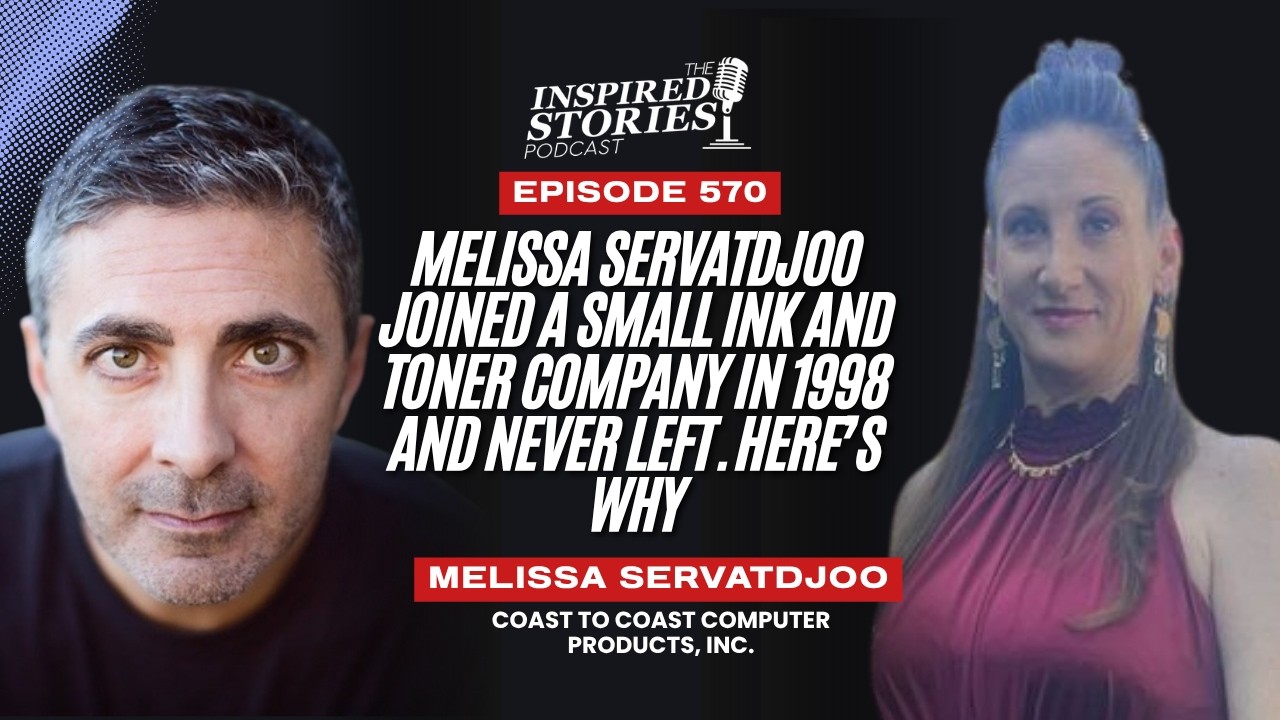
Melissa Servatdjoo, VP of Strategic Partnerships at Coast to Coast Computer Products, walked in as a cold caller in 1998 when the company still used paper leads, three-part forms, and impact line printers. Twenty-seven years later, she sits on the executive team, holds certifications from a dozen manufacturers, forged exclusive programs with Lexmark and Brother, and just launched the Customer Solutions Group — a division she first pitched fifteen years ago and never stopped believing in.
✨ Key Insights You’ll Learn:
What it was like to join a 100% commission sales floor as the youngest employee and one of the few women
How the sales approach at Coast to Coast evolved from scripted cold calling to consultative solutions work
What the shift in buyer behavior from phone to email and text has meant for building loyal relationships
How Coast to Coast’s second-chance hiring philosophy works and what it actually produces in people’s lives
Why the ESOP ownership structure changed the conversation with clients more than it changed day-to-day culture
The exclusive programs Melissa built with Lexmark and Brother that give Coast to Coast pricing and product access competitors can’t match
Why she created the Customer Solutions Group and how she is getting buy-in from territorial sales reps
How Coast to Coast pivoted into PPE during COVID and stayed viable when print collapsed
The letter from children’s court that led Melissa to adopt her younger half-sister
Why she went from crafting to Krav Maga
🌟 Melissa’s Key Mentors:
Stacey Schulman (Former VP of Sales, Coast to Coast): Refused to let Melissa walk out and saw something in her she didn’t yet see in herself
Rick Russen (Founder, Coast to Coast): Built the second-chance hiring culture and AA-informed values that have defined the company since 1985
Peer Executive Group: Monthly roundtable with competitors that shaped her thinking on AI, industry trends, and the future of the business
Her Husband: The steady voice who said they weren’t ready to raise a kid and then helped her clear out his office and paint it purple anyway
👉 Don’t miss this conversation about what happens when someone bets their entire career on one company, what it actually takes to serve clients instead of just sell them, and the letter that showed up at Melissa’s door and changed her family forever.
Listen to the full episode here
Transcript
Anthony Codispoti (00:00)
Welcome to another edition of the Inspired Stories Podcast, where leaders share their experiences so we can learn from their successes and be inspired by how they've overcome adversity. As you listen today, let one idea shape what you do next. My name is Anthony Codus Bodi, and today's guest joined a small ink and toner company in 1998 and never left. Over 27 years, she worked her way from inside sales to the executive team.
Building new divisions along the way. What makes her story especially compelling is the company she chose to grow with. Coast to Coast Computer Products is a 100% employee-owned business and a second-chance employer that hires people most companies overlook. Melissa, and I'm gonna get this name right. Servachu, how'd I do?
Melissa (00:53)
You did great, thank you.
Anthony Codispoti (00:55)
All right, Melissa Servachu is now Vice President of Strategic Partnerships at Coast to Coast, where she oversees vendor relationships and recently launched the Customer Solutions Group to drive customer success across the organization. She holds certifications from HP Logitech Cyberpower and was recognized in Cyber Power Systems first ever reseller customer spotlight.
This is a story about what happens when someone bets on one company for an entire career, and that bet keeps paying off. But before we get into all that good stuff, today's episode is brought to you by my company, Ad Back Benefits Agency. And you'll want to hear this because it's hurting almost every business you know. Health insurance costs go up every single year, and manufacturers and light industrial companies are furious about it. They're paying more.
Claims are getting denied, employees are opting out because they can't afford it, and it hurts turnover and morale. It's one of the most maddening problems in running a business, and everyone just accepts it. But you don't have to anymore. Now there's a program that gives employees unlimited access to doctors, therapists, and prescriptions with no co-pays or deductibles to meet. You don't change your broker, and here's the part that really shocks most people.
Our product actually increases your net profits. We recently helped a client add $900 per employee per year to their bottom line. Results vary, but gains like that change how a business is valued. Get your free consultation today at Adbackbenefits.com. All right, back to our guest today, the VP of Strategic Partnerships of Coast to Coast Computer Products, Melissa Servacio. Thanks for making the time to share your story today.
Melissa (02:44)
Well, thanks so much for having me.
Anthony Codispoti (02:47)
So Melissa, take me back to nineteen ninety-eight when you first started. What was Coast to Coast computer products like when you first walked in the door?
Melissa (02:57)
Well, I I would say it was a bit overwhelming. I had come from a competitor where I worked as a room closer. So I walked around. I helped coach sales reps on closing new business opportunities. So when I came to Coast to Coast, I had to do everything. cold call, open the call, close the deal, fully service the account, which included the customer service, the reorders, and sometimes collecting
On unpaid invoices. And we weren't using email or the internet yet. It was the 1900s. So it was paper leads, a phone, a telemagic software where we entered our orders and kept track of our customers. And we were using impact line printers with three-part forms. So you'd print your order, you'd keep one sheet as your record, and you'd turn in the other to you to make sure the order got processed. And then you had to make sure that you got that.
pink sheet back to make sure that you actually got paid. So we called them our pinks.
Anthony Codispoti (04:02)
Wow. So yeah, you really were in the dark ages back then. And you'd
Melissa (04:06)
Yeah.
Anthony Codispoti (04:06)
come from a company where it sounds like there were a lot of more siloed roles, right? Like you were the closer.
Melissa (04:15)
Yes.
Anthony Codispoti (04:15)
You were helping to to cl help other people close their deals. Now you came in and sounds like you were handling the the vast majority of the customer life cycle there from start to finish.
Melissa (04:27)
That's right. It was a big big change.
Anthony Codispoti (04:30)
Yeah.
yeah. And so what did they bring you in specifically to do? Were you just kind of filling like another role there or based on the previous experience that you had, did they want you to come in and help to modernize things?
Melissa (04:47)
they just brought me straight into sales. They I was really just a cold calling machine. I was making over a hundred calls a day. I was trying to open as much new business as I could and I was one of the few women in the company at the time and the youngest employee on the floor. So I felt like I really had something to prove and that drove me.
Anthony Codispoti (05:13)
Over a hundred calls a day. And are you calling businesses? Are you calling like end consumers? What's that call list look like?
Melissa (05:21)
just business to business. So all small, medium, enterprise, state, local education, and even the federal space.
Anthony Codispoti (05:34)
And these call lists are provided to you by the company?
Melissa (05:37)
Yes, they sure are.
Anthony Codispoti (05:40)
And then what was it that you developed in your process that allowed you to be so successful?
Melissa (05:46)
I'm such a rule follower. You know, they give us a presentation to follow and I used it and of course my own personality, you know, would would come into that and I really just listened to all the people around me who had more experience and I took a a little bit from each person and incorporated that into my practice and it's just continued to evolve and I went from, you know, just
you know, following this presentation, making a sale to now, you know, being more proactive and and working with people and and providing more of a solution instead of just selling someone. So it's a lot different today than it was back in the nineties.
Anthony Codispoti (06:33)
Tell me what the big differences are. You I is it what you were saying that like now it's more of like a consultative thing rather than just follow like a wrote script?
Melissa (06:42)
Yeah, I would say it's definitely more consultative. I mean, I I'm working with the clients, you know, what what are their pain point pain points? Excuse me. You know, what are they running into? What's going on? Are they not happy with their current vendor or the current process? How can we improve that? And what can I do to make their job easier and just, you know, ease ease their daily life and what it is that they're doing.
as far as ordering or figuring out what technology is gonna best be suited to help drive growth in their company.
Anthony Codispoti (07:17)
I'm curious as we think about that transition that's taken place over the last 25 plus years. Was it a gradual change, or were there particular inflection points along the way where you noticed that either naturally your style just changed, or there was something about the customer dynamic that led you towards that?
Melissa (07:42)
I'm gonna I'm gonna say both. It was gradual as well as just the industry changing and the buyer habits changing. And that has to do not only with the capabilities of what's what information is available to buyers today, with you know, just the wealth of information on the internet, but also the age differences as we see some of the baby boomers starting to go into retirement and you've got, you know
Gen
X getting older and now you've got the millennials who buy just completely differently than any other generation does.
Anthony Codispoti (08:23)
And what does it look like when a millennial buys? Tell me the big differences that you see.
Melissa (08:28)
they don't really get on the phone as much, you know. They wanna work by email, they wanna work by text, they wanna do things electronically, and they are not as apt to just hop on a call and chop it up on the phone for, you know, thirty minutes. And that's not everyone, but it's becoming more and more common in my practice from what I'm seeing. So a lot of things are now handled by email.
Anthony Codispoti (08:54)
Email and text messages? Are you texting a lot of your clients too?
Melissa (08:56)
Y I do.
I yeah, a lot of my clients just t they take a picture of something, they text it over, This is what I need. Can you get it?
Anthony Codispoti (09:04)
Yeah. Very transactional. The the relationship maybe doesn't feel quite as well forged as it did in the past, huh?
Melissa (09:14)
And I try to change that. You know, my personality just kind of comes through in a way where even by text or email, I just can't help it. You know, I really believe that relationship is a big part of building a loyal customer database. So you can't just go by I need this, here is your part number, here's your price, I'm moving on. You're not gonna build a loyal clientele by doing that.
Anthony Codispoti (09:44)
So Melissa, you've been with Coast to Coast for over twenty-seven years now. I'm curious to know if there was a moment early on where you realized, this is the place I'm gonna stay for a long time, or did it grow on you gradually?
Melissa (10:03)
I would say it it grew on me. I definitely tried to walk out a couple of times. I grabbed everything off my desk and said, I'm done with this company. And my boss at the time, who was the VP of sales, Stacey Schulman, he would not let me leave. He he saw something in me that I guess I didn't see in myself and he told me to sit my butt back down at my desk and get back to work. And that is what I did. And I would say it was a few years later that I did make a decision.
against the feelings of my family who thought that telemarketing was not a career, that this was my career and this is what I wanted to do. And I went back to school full time while I worked and I earned two degrees, one in business management and one in marketing, because I believe heavily in education and I really wanted to have a foundation under my feet, even though you really don't need a degree to succeed in sales.
Anthony Codispoti (11:04)
What was going on those times where you almost walked out?
Melissa (11:09)
You know, at that time in California, you were allowed to pay commission only. So, you know, sometimes we're rough, you know, because if you didn't make a sale, you weren't getting paid. And so I had come from my previous company. As I said, I was a a room closer and I was a salary employee. It was my job to, you know, walk around, help these other sales reps. I was paid a salary and then a a quarterly bonus based on their production. And
The salary, of course, was a little bit easier lifestyle than hustling to make a a commission. And so, you know, some some days were tougher than than others. It it could be a a bit mentally stressful at times.
Anthony Codispoti (11:56)
Yeah. When you're only able to eat what you kill and you're having, you know, a little bit of a dry spell, that is really hard on the pocketbook. It it creates a lot of stress. I get that. So I understand almost walking out a couple of times. but I'm guessing looking back, your your boss, you're glad that he was a little aggressive and encouraged you to stay.
Melissa (12:20)
I I think that everyone is here.
Anthony Codispoti (12:27)
So Coast to Coast started in nineteen eighty-five as an ink and toner specialist. Over time, it's grown into a much broader technology solutions provider. Help me understand what Coast to Coast does today and who you're serving.
Melissa (12:44)
Sure. yeah, nineteen eighty-five, the day of, you know, dot matrix and line printers, you know, before laser printers even really started to evolve and come into the market. So, you know, as the industry has evolved, we've had to grow and evolve with that.
And even though print has always been the core and the heart of our business, we're capable of so much more today. And as I stated earlier, we serve such a wide range of customers from small and medium business up to enterprise, from state and local education to to federal government. And we've become really a full technology solutions partner. And our that's our focus now is just to become that one stop shop for our our clients.
Anthony Codispoti (13:34)
And describe your typical client to me. Who's a good fit for you? Whether it's industry
or size or geography.
Melissa (13:42)
You know, we'll we can serve a a mom and pop all the way up. So I would say, you know, we treat all of our our clients the same regardless of their size. They're all, you know, respected and and valued exactly the same. And so we really just focus on the customers who are going to be loyal, who aren't, you know, hopping around online shopping on Amazon. We're looking for those who are looking for an actual partner to work with them that know that
You know, if when we do make a mistake they know we're gonna clean it up, we're gonna make it right and make sure that, you know, we make them happy. And and that's really the intention is to build a a mutual relationship.
Anthony Codispoti (14:28)
Actually you hit on a really good point. When folks work with coast to coast instead of Amazon, why are they making that choice?
Melissa (14:35)
You know, because you get personal service. You you know, we we still have a live receptionist that actually answers the phone and and transfers you transfers you over to your dedicated sales rep. So you're not hitting just some call center. You're speaking with the same person every single time that you reach out to our company and and that is your representative and it is their job to ensure your satisfaction, make sure that you're taken care of, whether it's good or bad, you know.
Things sometimes don't go always the way we want them to and we have to take care of it. It doesn't matter.
Anthony Codispoti (15:13)
You know, and I want to highlight that for a second. What a big deal it is to to be able to call a place, excuse me, and get a human being to answer the phone. That happened to me once about 18 months ago. And I I almost dropped the phone. I you know, I was getting ready
Melissa (15:31)
Ha ha
Anthony Codispoti (15:31)
to, you know, press one for this and seven for that, and you know, zero for a callback. And and I was like, wait a minute, you're not a robot.
so the fact that you guys are doing that, like I like I said, the one time that sticks out to me in probably the last seven or eight years is about eighteen months ago. So the fact that you guys are answering your phones, man, hats off to you.
Melissa (15:52)
Yeah,
we're we're not gonna change that. Diane is our receptionist, she's incredible, she's been with us almost the entire length of the company and I'm not sure if we're gonna let her retire.
Ha ha
Anthony Codispoti (16:07)
so y another interesting thing about coast to coast is you guys are a hundred percent employee owned through an e-shop. How does that ownership structure change the way that people show up to work every day?
Melissa (16:20)
Honestly, it didn't change that mentality all that much. Our people have always really taken ownership of their roles, especially in sales, and that culture was really baked in long before we became an Aesop. What really has changed is the conversations with our clients. Becoming an Aesop has become, you know, part of how we introduce ourselves to our potential clients. And we really want them to understand that every decision we make.
every relationship that we build, it affects every single person in this company. And I think that that is just a really powerful thing to be able to say.
Anthony Codispoti (17:01)
that's really interesting. And what's the response you typically get from customers when you talk about that?
Melissa (17:08)
I I think that they feel more taken care of. They know that, you know, every step that we take, every decision that we make, everything that we do with the client, because that affects everyone, it shows just more passion and care into what we're doing.
Anthony Codispoti (17:25)
How long ago was the ESOP set up?
Melissa (17:29)
I think it was about five years ago. So it's ki I mean fairly recent,
Anthony Codispoti (17:33)
Okay, so it's been somewhat recent.
Melissa (17:35)
yeah.
Anthony Codispoti (17:36)
Yeah. And during your time, so you were with the company for a long time before. So you were able to see sort of the difference. And like you said, it didn't really change the day to day. People were invested in their work even prior to this. But it helps to send that message to your customers that, hey, everything we do here, we're all owners, right? We're all acting like owners, not just somebody, you know, here for a paycheck.
And I could see how that would land, especially as you're talking to business owners. Like they really get that. They appreciate that kind of dedication that comes with ownership.
So another one of the things that I I find really interesting about Coast to Coast is the second chance hiring philosophy that you guys have. You're giving opportunities to people with criminal records or maybe past dependency issues. And you know, a lot of companies don't wade into those waters because it seems just fraught with risk. Why do you think it works for coast to coast?
Melissa (18:40)
Well, it our founder, Rick Russen, is a proud member of the AA program. And so many of our employees and sales reps have been recruited through those meetings. And while I'm not one of them, I deeply believe that people do deserve a second chance. And I think that our company has proven that that does work. We've had people who have started that, you know, maybe we're living in
a halfway house. They've they've lost everything. They've had their children taken away from them and we give them a chance. And it's not just a job. It's a it's a real career. some of them have, you know, got their children back. They've bought houses and they've learned to become mentors to other people. And and I think here's the thing, you know, we don't just teach people the basics of sales. We teach them how to set goals.
how to use affirmations that they're valued and that they have something real to give back. And you know, could this work for other employers? Absolutely, but only if they're willing to offer more than just a paycheck.
Anthony Codispoti (19:50)
So say more about that. You're kind of touching on the employee onboarding education process. You're like you said, you're not just teaching them the job skill. Talk to me more about how you're introducing them to some of these life skills.
Melissa (20:04)
So we're really a goal driven company and we sit down with our new reps and all of our reps yearly. And we sit down, we go through how to properly set goals for themselves, both business and personally, and then how to take those goals and turn them into an affirmation that, you know, they we ask them to, you know, repeat to themselves in the mirror every morning, every night, and really, you know, sink those in so they become
a part of themselves because once you're, you know, telling your mind that you're already doing something, you find a way to make it happen. And that's what we're seeing every day. And we really push continual motivational education. And we have our own online library available to the reps so they can listen to different motivational speakers as well as internally recorded phone calls of different sales reps who have
had some, you know, excellent phone calls working with customers.
Anthony Codispoti (21:07)
that's really cool. and this program has been around since as long as you've been there? That's
Melissa (21:14)
Yes, it has.
Anthony Codispoti (21:16)
fantastic.
Melissa (21:17)
Except for the online part that came that came later.
Anthony Codispoti (21:19)
Yeah. W when
did you guys first bring computers into the office?
Melissa (21:25)
we had computers when I started, but it was very basic. Like I said, I mean, we didn't even have email, we didn't have access to the internet. And I would say a few, maybe five or so years after I was with the company, we started beta testing a different CRM that is an in-house homegrown made program. And we implemented email that was a big deal, and started using the internet.
And
I think it was a really scary time for some of us 'cause we were so used to having to print these leads up and we did not want to let go of these pinks 'cause that's how we got paid and everything went electronic. And it was really scary for a lot of us at first.
Anthony Codispoti (22:05)
I get it. Changes hard. Yeah. And if you've got those physical pink slips in your hand as, you know, this is what I know I'm gonna get paid. And now it's sort of quote unquote invisible, right? Like it it
Melissa (22:15)
Yes.
Anthony Codispoti (22:15)
sort of goes into the digital ether. Yeah, I get that.
Melissa (22:18)
Yeah, we weren't
trusting it at first. It was you know, 'cause we couldn't see the process and it it almost became a threat like, Okay, you better now shred those pinks or you're gonna be written up. Like we don't want any of this paper around anymore.
Anthony Codispoti (22:33)
Okay. Yeah, they had to play hardball. So
Melissa (22:35)
Ha ha
Anthony Codispoti (22:36)
what's the approach and and the thought process to AI now as we talk about another, you know, big technological shift that's going on today?
Melissa (22:44)
You know, we're we're looking at that right now and we're working with I would one of my peer review partners that's in a group that I am in with some other executives from competing companies where we meet monthly and we kind of just discuss the landscape of the future. And one of the gentlemen there is really highly focused on AA and he's gonna come in and do a whole overview of how
We could implement that into our daily processes and streamline any workflows, but we're not going to be using it to get rid of any departments or people. We're going to use it to enhance what we're doing now and hopefully, you know, make our lives a little bit easier on maybe some of the things that could be streamlined and that where AI could really be effective. So we're we're just starting that process right now.
Anthony Codispoti (23:41)
it'll be fascinating to talk to you again in about six months, 12 months to see where you guys are. You guys are about to enter a whole new world.
Melissa (23:50)
We are
Anthony Codispoti (23:52)
Speaking of whole new worlds, just last year, late 2025, you created the Customer Solutions Group. And I know you're really excited about this. Walk me through the problem that you're addressing when you built this department.
Melissa (24:09)
So this was an idea I had probably fifteen years ago, and it was just kind of brushed over like, that's never gonna happen. but since that time, our our sales went a little bit flat since COVID and the print landscape continues to shift. but you know, here's what we also have. We've got over a hundred sales reps, we've got long-tenured relationships, and we have clients who
genuinely love and trust them. So really it only made sense to take our most technically capable reps and use those relationships to introduce everything else we have to offer. You know, stop leaving capabilities on the table. as an eSOP, I'm really pushing for exponential growth. And I believe that our customer solutions group is the vehicle that's going to get us there.
Anthony Codispoti (25:05)
What does it look like? How is this different from what's been done in the past?
Melissa (25:08)
So what's different is our our reps have always felt like, you know, this is my account, this is my relationship, and I own this and no one else is gonna touch it. And we can't train a hundred plus reps to be, you know, hyper focused on all these different categories within the range of what's available in technology. And being that our core product has always been in print and and that is what they're taught is printers, ink and toner.
We do there's a group of us who have always kind of grown outside of that and done our own self-learning in different areas, whether that is in UPS power, custom configuring servers, computers, cyber security, whatever it may be. So what I wanted to do was take that small group of us and build this new division where we go in, we're introduced by our reps to their existing clients.
And we do a discovery call and we discuss with these other partners and customers of ours what our other capabilities are and you know what are they doing now, what are the challenges that they're seeing and how they can use us as a one stop shop and you know stop looking around at all these, you know, numerous companies where maybe they're having to call five people a day to get to
The end result of what it is that they need to keep their business continuity. And I think that, you know, besides being able to really better serve our clients, that's where we're also gonna be able to see growth. like I said, that print landscape has changed and since COVID, print has gone down, and since everybody has gone.
gone more electronic in their daily processes and what they're doing. I think that we're gonna continue to see that change of less print happening or more defined print. And so that really presents a big gap in our business where we have to pull in what else can we do? How else can we serve our clients? And so so that's the intention of the group.
Anthony Codispoti (27:26)
Really interesting approach. it makes sense, you know, what you were talking about before, really sort of evolving into being more of a consultant to your clients than in the past. I'm curious with the existing sales reps who have, you know, in the past understandably been kind of territorial of their clients, how are you getting their buy-in to this?
Melissa (27:50)
It's it's been a little tough for them and it's been a little scary because they're very concerned with, you know, well, they don't want us to damage any relationship, but we're not doing a a high pressure hard sale. You know, we're working with the client and we're not, you know, pressuring them that they need to go with us for, you know, this, that or the other. And so I think as more and more reps are
working with us on doing these discovery calls or e you know, just emailing us, hey, customers interested in, you know, modernizing the technology they're using in their warehouse. And maybe they're interested in some barcode scanners and some zebra label printers or what have you. Once they see what we're able to do, once we hop on the phone with this client and that word starts buzzing around the office, it's really changing that outlook.
And it comes down to, you know, these customers are buying these products from someone. They might as well be buying it from us. And if if that person doesn't understand that product or technology and is incapable of presenting it and selling it to that client, why not let someone else in the company handle that? Because they're still getting a a a piece of the pie. You know, they're still reaping benefits, even though we're doing the work.
Anthony Codispoti (29:07)
the existing
rep with with that relationship, they're there's they're getting to share in that commission.
Melissa (29:13)
Correct. So we're not just yes.
Anthony Codispoti (29:14)
sorry, we had a little glitch there. I I apologize
for talking over you. So just just to clarify, so the
Melissa (29:21)
Yeah, they're still they're still getting a piece of the commission. We're not taking their
Anthony Codispoti (29:25)
Sorry.
Melissa (29:25)
client away from them.
Anthony Codispoti (29:34)
Got it, that makes a big difference. That you know, that way everybody's goals are aligned.
Melissa (29:40)
That's right.
Anthony Codispoti (29:43)
And you know, you you mentioned that what a big shift happened post-COVID. There was less printing going on. sounds like it, you know, it it's it's probably a long-term change. Outside of COVID, were there other moments in the 27 years that you've been there where you've seen
Other scary inflection points where you weren't sure if the company was gonna make it or maybe there wasn't the concern about the company making it, but just, you know, the overall trajection trajectory of the company because of some other big seismic shift.
Melissa (30:24)
Really, COVID was our hardest period. You know, everyone was either working from home or not working at all. So print dropped significantly. I mean, it it basically hit the bottom of the bucket there. And we had to pivot and we had to do it fast. And so at that time we moved into PPE supplies and we mastered it. And not only did we stay viable, but we helped a lot of other businesses, especially state and federal offices that
you know, had PPE mandates to fulfill. And, you know, as we continue to see that print landscape is just continually shifting, even though it's bounced back quite a bit. And and that is also what helped prompt this idea for the customer solutions group.
Anthony Codispoti (31:16)
So, Melissa, you hold certifications from, we mentioned this in the intro, HP, Logitech, TD Cinex, Proof Point, APC, and others, you know, too many to list here. Most people in sales leadership roles don't go that deep on the technical side. But you mentioned earlier, like you're really about bettering yourself through education. I'm curious, what does having that level of product knowledge let you do?
That you couldn't otherwise.
Melissa (31:49)
I feel that, you know, I need to be confident in what I'm proposing as a solution to my client. And I also need to be able to back up my reps when they need it. So beyond that, the certifications open up doors with the manufacturers. It provides deeper discounts. It gives us a name to rep at that OEM that that manufacturer for pre- and post-sales support gives us a a badge that we can use.
to show our clients that we're competent and that we're an authorized partner. So it really expands what's possible for us with both our manufacturers as well as with our clients.
Anthony Codispoti (32:33)
And in August of 2025, Melissa, you moved into the VP of strategic partnerships role. is that trying to think of the question I want to ask here because we haven't really talked about what I consider to be strategic partnerships. Or is this when I would you guys use the term strategic partnerships? Is that more in terms of you consider each of your clients to be a strategic partnership? Or are you looking for like
relationships with other folks that can make introductions to your end partners, your end customers.
Melissa (33:11)
think that it crosses all of those areas internally and externally. So it's working strategically, you know, with our reps, with our customers, as well as with our manufacturers and our distribution partners. So it kind of encompasses all of it.
Anthony Codispoti (33:33)
Got it. So for you, strategic partnership is client, vendor, manufacturer, your employees, everybody that's kind of involved.
Melissa (33:43)
I'm like the everything person.
Anthony Codispoti (33:46)
Got it. Okay. That makes more sense now. because I was gonna ask, you know, a little bit more about how you forge those strategic partnerships, but it just sounds like you are the go-to for I don't want to say everything, but for a lot of what goes on there.
Melissa (34:04)
Yeah, I you know, I've been here a long time and so I really understand how our company works. I've really found my ways in and out of working with the manufacturers as well as our distributors and forged some really great programs with some of our manufacturers. I would say two notable ones are are Lexmark and Brother.
with Brother, we're what's called a a VPP reseller. So that gives us lower pricing on consumables so that we can be more competitive in the market against our competition, as well as access to product lines that are not available through big box retailers. We have access to equipment that other people do not have access to resell that you can only get from us and a few other named resellers that work with Brother.
And with LexMark, we've developed some special programs that are built specifically for the pharmacies across the United States, the auto dealerships, and the Marriott Hotels nationwide. So that provides us deep discounts on their branded toner and printer for those verticals and some other, you know, sp special things that that they're able to offer to us that we can pass on to the clients that help us.
be able to save them money and provide them with different level of service that they may not be able to get from our competition.
Anthony Codispoti (35:37)
this is really interesting. Let's explore this for a moment. you mentioned LexMark and Brother in particular, where you've got these really good relationships. So we were I was asking before about, you know, why does someone come to you rather than go to like Amazon, right? You know, which is really easy to use. And
Melissa (35:53)
Sure.
Anthony Codispoti (35:53)
obviously there's the customer service, you guys answer the phone, and that's a big deal. But now we're talking about, you know, in a lot of cases, you guys can offer lower prices because of the the deeper relationships that you have with the manufacturers.
And there's inventory. There there are SKUs that you've got access to that a lot of the big box retailers don't.
Melissa (36:13)
Yeah, and and one of the other benefits that's huge with with Brother in particular is when a customer does buy the printer or the multifunction device from us and they're also buying that Brother branded toner, with Brother, we're able to provide a free three year extended warranty that has a special technical service department phone number. So it's not the standard, you know, eight hundred number that everyone else would call. It's a different
department that we call that where they pick up the phone faster, the service level is different. So those are the things that that I've been able to help put in place that help us really ensure a better, you know, buying pattern for our customers. Just the whole process is easier and the service is better.
Anthony Codispoti (37:04)
That's a
Yeah, that's a really big deal. These are huge differentiators. Talk to me more about what you were saying you have were there special products that the pharmacies, auto dealers, Marriott, branded hotels are using that you guys have some kind of a limited access to.
Melissa (37:30)
So that would be with with Brother, we have access to equipment that other dealers don't have access to that are just a different more robust line of MFP devices. And with Lexmark, the programs that we've been able to develop are discounted supplies on the brand name toner cartridges and printers for those certain customers.
And and the discounts are so deep that they are comparable to buying a remanufactured toner cartridge or re or refurbished printer.
Anthony Codispoti (38:14)
What does MFP mean?
Melissa (38:16)
that would be a multi function printer so it can scan and fax and print.
Anthony Codispoti (38:28)
What is the future of Coast to Coast look like? Where are you guys going that we can't see from the outside yet?
Melissa (38:36)
Gosh,
I'm not sure if we can see that yet. You know, and that and that is another reason for this customer solutions group. it's really the possibilities are are infinite, you know. We're because we're still considered a small company, we're very flexible and that gives us a lot of capabilities.
to work with our customers, manufacturers and distributors any way we need to bend, whichever way it is. So whatever we need to do, we just make it happen. You know, maybe it's not something that's in our arsenal of products or capabilities right now. That doesn't mean that we can't do it and we find a way to do it. And we're all we're constantly changing almost every day. If the customer says they need this, that or the other, maybe it's not something that we're doing today. We're gonna do it tomorrow if that's what they need.
Anthony Codispoti (39:28)
Hmm. Shifting gears on you now, Melissa, I'd like to explore what's the hardest thing you've ever had to overcome personally, and what did that teach you?
Melissa (39:39)
that's such a tough question. because there's really a a a couple of things that that come to mind. I would say, you know, one in particular that's not really business related would be I met my half sister when she was five and I took legal guardianship of her when she was eight.
And then my husband and I fully adopted her and now she's thirteen. And so that's really taught me a lot of patience and how to show love, which was challenging for me. I would say not something I've always been the best at. And I think that that's really helped shape me into being also a better leader within my organization.
Anthony Codispoti (40:33)
Are you comfortable saying more about that? How did it unfold that you met her for the first time when she was eight?
Melissa (40:40)
So unfortunately our father ha is homeless and is not in the picture and fortunately he was using my address and a letter came to my home one day for children's court for him and her mother to attend and I looked at my husband and I said, This is my chance to finally meet my sister and I'm taking the day off work and I'm going to court.
And he said, Are you sure? Like we can we can't raise a kid. What what are you thinking? And I said, I'm doing this. You know, a kid, they can't protect themselves that they can't take care of themselves. And I know my dad's not gonna be around. He wasn't around for me and I I have to do this. And and that's what I did. I sorry, I took the day off of work and I went to court and at the children's court, they come out and they say the child's name and whoever is there has to
approach that social worker and I walked up and they were like, Who are you? And I explained who I was and they were really shocked. they hadn't ran into someone doing that before. And I said, you know, what do I gotta do to to meet this kid? That's my family and I need to be there for her. I'm sorry, it's a little emotional. And so I did. I went and I did the background check and the live scan and the fingerprinting
And I waited for the social worker to call one day who allowed me to have a phone call at first with her. And then we had to go meet at the social worker's office, which was a little scary because I felt like that's like where all the bad parents go to to be able to meet their children and that's where I was, you know. And so that's what I did. I went there and I met with her and her guardian at the time and
I brought her a little kit and we made little dolls together and we had a great time and her guardian was a really nice man who was a a friend of her mother and he was very comfortable with the relationship. And so he said, you know, we don't need to come back here. We can we can have our own relationship. And so I would meet with them weekly at the park and I would play with her at the park. And he was an older gentleman and he became ill one day and he was in the hospital and I couldn't reach her and I was
really getting concerned and and finally he called me and I said, Well, where is she? And he said, Well she's she's with my my roommate. And I said, Well your your roommate really doesn't speak a lot of English. I'm gonna go pick her up. And I picked her up and I picked up all her clothes and and I told him I said, I'm not giving her back. And I cleared out my husband's office and you know, we weren't really ready. And I I went on Craigslist that day and I found a bunk bed with the had the desk underneath and
My friends came over, we went and picked that up. We cleared out the office. We threw the bed in there. the next week we painted the room purple for her and started decorating it. And a couple of years later, I lost a couple of friends in a car accident. And I watched what their families went through and I said, my god, if something happens to me, what's gonna happen to her? I don't want her to, you know, be in the system.
And so I my husband and I decided that we would adopt her so that she would officially be our daughter. And we had her birth certificate changed to our last name and we're a family.
Anthony Codispoti (44:15)
cry with you. That's a
Melissa (44:16)
Hey.
Anthony Codispoti (44:17)
that's a beautiful story. Thank you for sharing that. wow. So you knew that your do we say daughter or sister? Daughter. Yeah,
Melissa (44:29)
Yeah, I say daughter. Yeah, I call her my daughter.
Anthony Codispoti (44:32)
at the time you before you had met her, you knew that she existed. You just hadn't had okay, you hadn't had the chance
Melissa (44:35)
Yes. I I did. Yeah.
Anthony Codispoti (44:40)
to meet her.
Melissa (44:40)
Yeah, I couldn't find her. her mom and dad were homeless. They were on the streets and it's really tough to find someone who doesn't have an address. I had worked with child services and the police and attempted to find her at the different addresses that I had that I knew of and I wasn't able to find her and I gave up because I didn't have a choice.
I didn't know what to do. And so that letter coming to my house was a blessing.
Anthony Codispoti (45:13)
Wow. And so how much time transpired between you going to court that day and her you making that decision you were going to pick her up, get the bunk bed, you weren't taking her back?
Melissa (45:29)
well I it took about six months after doing the background check and all to finally get connected with a social worker to meet her. She was five at that time. And by the time she was turning eight was when I brought her into our home. And that was during COVID. And she had turned eight at our house. We couldn't really have a birthday party because it was COVID. So she was really into the little LOL dolls at that time.
time. So I had printed up a a little background thing. I had fancy little cupcakes made and I threw our own little party in the backyard with with just the three of us. And it was kind of a celebration of her turning eight and and becoming part of our family. And and once I had that guardianship, I told my husband I said, We're getting family pictures done. Go get your hair cut. And we went to Sears because
Anthony Codispoti (46:20)
Ha ha ha.
Melissa (46:21)
I didn't know where to go. I never did family pictures. We went to Sears and had a
A family picture done and he said, Okay, that's the only one we're doing, so treasure that
Anthony Codispoti (46:34)
I bet you do. I wouldn't be surprised if you sleep with that next to your heart. That's an incredible story. Thank you for sharing that with us, Melissa. what a giant heart you have to, you know, be able to stretch your lives like that and bring her into your home.
Melissa (46:49)
Thank you.
Anthony Codispoti (46:51)
Now, as you think about the work that you're doing with Coast to Coast, what is it that you most want to be remembered for?
Melissa (47:03)
that's you we keep coming at me with these tough questions.
You know, I'm always challenging myself, I would say, you know, professionally and personally. And I think what I wanna be remembered for is trans transforming this company. You know, we're not just telemarketers. We're not just here to to make a sale and and and make a paycheck. We're we're professional salespeople. We train hard like athletes and we invest in our craft so that
every client we work with is genuinely taken care of. you know, our industry is not a loved industry. People really look down on telemarketers and I want coast to coast to change that story. And the customer solutions group is a big part of that. It's proof that we have the knowledge, we have the resources, the relationships and and the drive. I mean, we're a powerhouse and I think I I just want the world to know that.
Anthony Codispoti (48:09)
I love it. What's something fun you like to do outside of work?
Melissa (48:15)
Well, I've always enjoyed crafting. but the past few years I've found a new love of Krav Maga. So I've really been enjoying enhancing my skills in self-defense and tactical weapons training. So that's what I've been doing the past few years and I'm really having a a fun time with it and I think it's just making me tougher
every day, physically and mentally and and you know, helps me in everything that I do.
Anthony Codispoti (48:50)
So from crafting to kicking butt. That's quite a transition in your extracurriculars.
Melissa (48:53)
Yes.
Anthony Codispoti (48:57)
I like that. Melissa, I've just got one more question for you today, but before I ask it, I want to do three quick things for the audience. First of
Melissa (49:05)
Okay.
Anthony Codispoti (49:06)
all, Melissa's had a great story here. Great, you know, all all kinds of wonderful things happening at their company. If you want to learn more about them, their website is super easy, coastcoast.com. Coastcoast.com. It's
So nice they said it twice. Just CoastCost.com. It'll be in the show notes, but super easy to remember. Also, if you're enjoying the show today, please take a moment to subscribe wherever you're listening. It also sends a signal that helps others discover our show. So thank you for taking a quick moment to do that right now. And as a reminder, you can finally get your light industrial employees access to therapists, doctors, and prescription meds that counterintuitively actually
Increases your company's net profits. There's no copays, there's no deductibles, and net profit increases that change how the business is valued. You get to keep your broker. So would you like happier employees on a stronger bottom line? Go ahead, reach out to us at adbackbenefits.com. So last question for you, Melissa, a year from now, what is one very specific thing that you hope to be celebrating?
Melissa (50:14)
I I wanna be celebrating the success of our customer solutions group. You know, we have a incredible team working to build this new division and I wanna see the sales in that new division really soar into the millions, the tens of millions, so that my boss knows that approving my idea was the right call.
Anthony Codispoti (50:37)
I love that. I look forward to checking back in with you in a year, not only to hear about that, but also the AI that you guys are about to scratch the surface on. It's some fun stuff coming.
Melissa from Coast to Coast, I wanna be the first to thank you for sharing both your time and your story with us today. Appreciate you being here.
Melissa (50:56)
Well,
thank you so much for having me. It was great. Really appreciate it. Thank you.
Anthony Codispoti (51:04)
Folks, that's a wrap on another episode of the Inspired Stories podcast. Thanks for learning with us. And if one thing stood out, put that into action today.
Connect with Melissa Servatdjoo:
Website: coastcoast.com