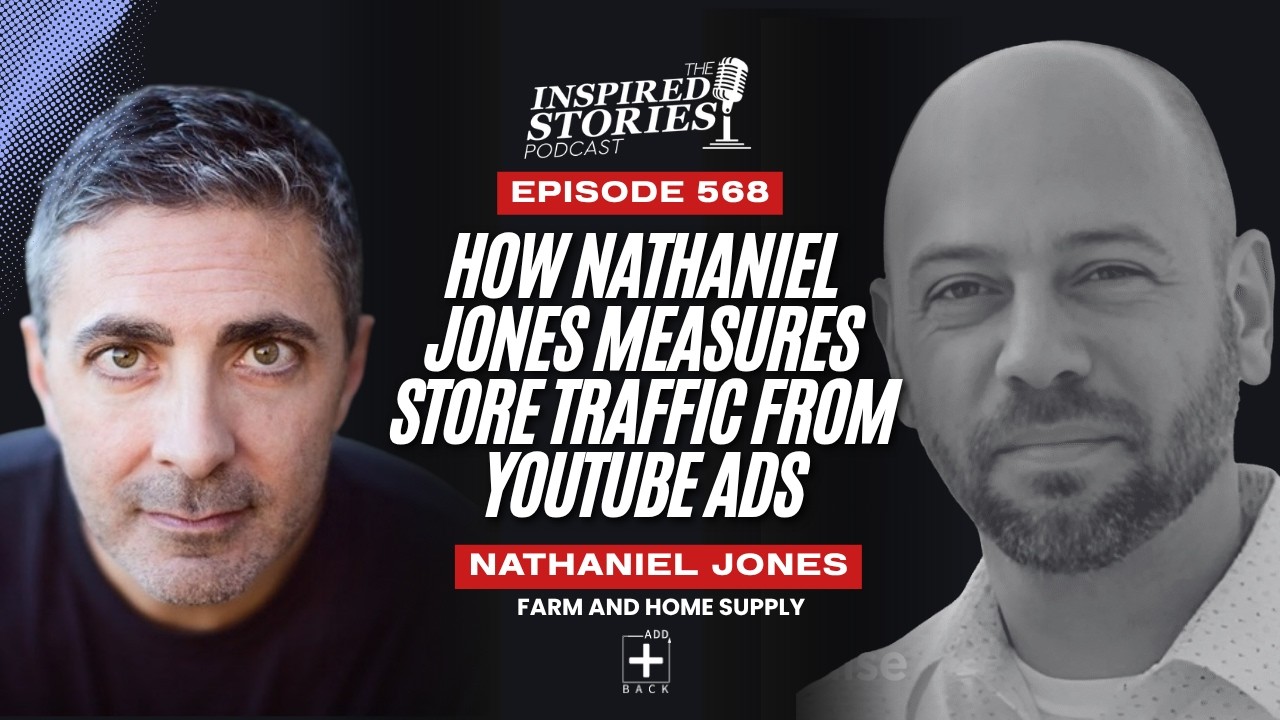
🎤 From Century Farm to Connected TV: Nathaniel Jones at Farm and Home Supply
Nathaniel Jones, Director of Marketing at Farm and Home Supply, grew up working a 120-year-old cattle farm alongside his father and grandfather before spending nearly a decade in television and print media. That full loop from stockroom to strategy shapes everything about how he leads now — helping a 66-year-old family-owned retailer compete against giants through experiential content, connected TV, and a refusal to be anything other than exactly what they are.
✨ Key Insights You’ll Learn:
Century farm upbringing shaping work ethic and leadership approach
ESPN dream redirected into news production and content management
One Direction x Oreo campaign winning National Grocers Association award
Becoming one of the first 15 brands on Hulu’s Beta Ad Manager
Measuring YouTube and CTV ad exposure against in-store foot traffic
Dropping newspaper inserts for digital distribution without traffic decline
Experiential content series driving viral engagement on a retail budget
Bluetooth beacon experiment that was a decade too early
Jab-jab-jab content strategy building Black Friday record online sales
AI tools including Google Flow, NanoBanana, and 11 Labs in current production workflow
🌟 Nathaniel’s Key Mentors:
His grandfather: taught family values, work ethic, and daily presence before passing in 2012
His father: modeled what it meant to work the land and lead with integrity
Ron Cook (Neiman Foods): first marketing boss who took a chance on a news guy and taught retail content from the ground up
Gary Vaynerchuk: gave permission to make different content and always chase underpriced attention
👉 Don’t miss this conversation about how a 15-store Midwest retailer is outmarketing national chains, why relatability beats budget every time, and what it looks like to build a brand that genuinely connects with its community.
Listen to the full episode here
Transcript
Anthony Codispoti (00:00)
Welcome to another edition of the inspired stories podcast where leaders share their experiences so we can learn from their successes and be inspired by how they've overcome adversity. As you listen today, let one idea shape what you do next. My name is Anthony Cotis-Bode and today's guest grew up on a century cattle farm passed down through generations, working alongside his father and grandfather long before he ever entered marketing.
He later spent nearly a decade in television and print media before eventually bringing those storytelling and audience building skills into the rural retail world he understood from the beginning. He moved through a morning show producer chair, a newsroom content desk, and years inside one of the Midwest's largest grocery chains before returning to the place where he began. That full loop from stockroom to strategy shapes everything about how he leads now.
His name is Nathaniel Jones, and he is the Director of Marketing for Farm and Home and Supply. The family owned retail chain serving farm and rural lifestyles across Illinois, Missouri, and Iowa. Founded in 1960 and now operating 15 stores, Farm and Home Supply has built its reputation on fair prices and genuine service. Under Nathaniel's leadership, it has expanded into digital campaigns, connected TV,
and record-breaking online holiday sales. But before we get into all that good stuff, today's episode is brought to you by my company, Ad Back Benefits Agency. And you'll want to hear this because it's hurting almost every business you know. Health insurance costs go up every single year, and retailers are furious about it. They're paying more, claims are getting denied, employees are opting out because they can't afford it, and it hurts turnover and morale.
It's one of the most maddening problems in running a business and everyone just accepts it. But you don't have to anymore. Now there's a program that gives employees unlimited access to doctors, therapists and prescriptions with no co-pays or deductibles to meet. And here's the part that really shocks most people. Our product actually increases your net profits. We recently helped a client add $900 per employee per year to their bottom line.
Results vary, but gains like that change how a business is valued. Get your free consultation today at addbackbenefits.com. All right, back to our guest today, the Director of Marketing of Farm and Home Supply, Nathaniel Jones. Thanks for making the time to share your story today.
Nathaniel Jones (02:36)
Sure, thanks for having me.
Anthony Codispoti (02:38)
So you grew up on a century cattle farm that had been in your family for generations. What does the century part mean? Just that it had been in the same family for that many years?
Nathaniel Jones (02:49)
Correct, yeah, same farm, same family for over 100 years.
Anthony Codispoti (02:52)
And what kind of farm just just cattle.
Okay.
Nathaniel Jones (02:54)
Just cattle, yeah, so beef
and dairy. So it switched back and forth between those over the course of 120 years now.
Anthony Codispoti (03:01)
Okay, and what did that environment teach you growing up?
Nathaniel Jones (03:05)
Well, as most farmers know, mean, it's hard work. You have to work in order to get any kind of results. so growing up on a farm, working with my dad and my grandpa, it's like you can't get anywhere unless you put your back into it. And it's the value of that work too. So sometimes it's lost in modern day workplaces. I have to put in quality work and the hours of the work in order to make a difference.
And so I think being ingrained in that at an early age really helped me in my career, but also as a boss now of a new generation of saying, hey, you got to put in the work to learn the things that you need to learn in order to succeed.
Anthony Codispoti (03:43)
Okay. And when you were getting older and decided to leave the farm and pursue your own path, what did that look like? Where did you go first?
Nathaniel Jones (03:53)
Sure, well my initial dream job was gonna be on Sports Center for ESPN, because I wanted to be a sportscaster. I watched that every single morning. I'm a huge sports buff. that was where I initially leaned into going into journalism in college. And that's my first job whenever I got to the Quincy Market for WGEM and Quincy Newspapers Inc. So initially the dream job was ESPN.
Anthony Codispoti (04:13)
Okay, but you started out, like you said, at the local NBC affiliate there in Quincy, Illinois. And you thought that this would be a stepping stone to your dream job at ESPN.
Nathaniel Jones (04:24)
Yep.
Anthony Codispoti (04:25)
Tell us about the work that you were doing there.
Nathaniel Jones (04:28)
Sure, I mean, it started from the bottom. So they had a radio station, so I was a radio board operator. I was a camera operator. I worked in sports and helping getting sports highlights and stuff like that. So you started at that really low entry level. Of course, it's minimum wage work, essentially, in doing what you got to do straight out of college. So I worked my way up to a morning producer after that on the news program.
I learned very quickly that on camera it's really, really tough to do sports because you got to ad-lib a lot. And I wasn't ready for it at the time. I didn't do a lot of camera work. And so again, you put in the work and you get results. At that time, I didn't necessarily put in the work. It was more about the writing. So I also wrote for the newspaper writing some sports articles. And so I of fell in love with writing more than on camera work at that time. And so that's what led me to being a news producer and a content manager.
Anthony Codispoti (05:17)
Why did sports require more ad libbing than other parts of the new segment?
Nathaniel Jones (05:22)
yeah, most news is, local news especially, is all scripted out. I mean, you have the reporters on the scene who are live, but everything else is typed out and is written on scripts and you got teleprompters, right? Sports isn't that way. You have to look at the highlights, ad-lib as the highlights go through. And sometimes this might be an insider secret, the sports guesters don't see the highlights before they go on TV. So sometimes
Anthony Codispoti (05:45)
What?
Nathaniel Jones (05:45)
they are literally looking at it for the first time as it's going on TV.
Anthony Codispoti (05:50)
just because of busy schedules, they don't have time.
Nathaniel Jones (05:53)
and you're trying to be the first to get highlights, all those different things.
Anthony Codispoti (05:55)
And this applies to local news. I'm presuming that the dream job that you were hoping to get to, ESPN like sports center, that's gotta be more scripted.
Nathaniel Jones (06:05)
Not always. Sometimes they're getting the results back, say an NBA finals game just got over five minutes ago. They're going to try to get the highlights as soon as possible.
Anthony Codispoti (06:12)
Okay, sure.
Nathaniel Jones (06:13)
So they have what's called a shot sheet, right? Of like, here's Donovan Mitchell making a layup or whatever the case is. They have that little information to go off of, but they're watching the highlight in real time with the audience for the first time.
Anthony Codispoti (06:23)
Okay, so you decided at that point you weren't quite ready for that level of ad-libbing, you being on camera. You were a lot more interested in the writing part of things. What changed in how you thought about communicating to the audience when you shifted from broadcast to...
Nathaniel Jones (06:41)
Yeah, I think it's both of being aware of who the audience is, right, of understanding what are they getting out of the conversation that you're having with them.
Because anybody who consumes content, whether it's this podcast or reading a newspaper article or a blog or a TikTok, it doesn't matter. It's a piece of content that you're consuming. You have to relate to it to be interested in it. And so if you're not a person who can produce that content, then why are you doing your job that you're doing? So to me, it's trying to understand what are people trying to get out of it and entertainment. I think, especially with newspaper, it's really tough to have entertainment out of a newspaper article. So you have to learn how to adjust to that and make it interesting.
whether that's funny, puns, poems, whatever the case.
Anthony Codispoti (07:24)
Okay, and then at some point you decided that you wanted to go into a different direction. You found your way to Neiman Foods. What was behind the decision to leave?
Nathaniel Jones (07:35)
Yeah, I mean, this is called inspired stories. So it's based off of family. So me and my wife learned that we're going to have our first child and working in news. It never stops. It's 24 seven. You're always on call. You always have to go in if something happens, especially as I was a content manager and helping manage the 6 p.m. and produces a 6 p.m. newscast. So we learned that we need to do something lower stress level, not always on. And so I decided to go into marketing and probably the best decision that I've ever made.
Anthony Codispoti (08:01)
Why do you say that?
Nathaniel Jones (08:03)
The freedom in order to pursue something different. know, news puts you in, it's a very rough schedule, very close-knit family. So it's really tough to leave those people that you built relationships with in a workplace because you're there together all the time and you're going through the crap all the time. So it's tough to leave there, but I say it's the best decision because it really opened up for my family, the creative freedom to get outside of the scope of just doing news.
to then do something more flexible, more entertaining, and hopefully more helpful to people. Because sometimes it's hard to be helpful when writing news or doing news.
Anthony Codispoti (08:45)
Did you find that transition to be difficult? mean, it occurs to me that a lot of the skills would transfer over, right? It's
a method of communication, but it's
Nathaniel Jones (08:53)
Mm-hmm. Right.
Anthony Codispoti (08:56)
in bit of a different realm.
Nathaniel Jones (08:58)
Yeah, it helped me, you know, more than it hurt me coming from news.
Nothing against most marketers, but if you grow up doing marketing, come out of college doing marketing, especially graphic design or video production or anything like that, you have to set schedule of what I need to put out content. I get assigned content and I do it and it is a linear process, right? Coming from news, it's always changing. You're always on, you're always producing and it always refreshes. You have to produce a newscast every single day full of 30 different stories. So that helped me as a marketer to, hey, I want to
I need to produce content all the time across 30 different pieces of content all the time. So that helped me in marketing because you're able to produce for different people, whether that's you, whether that's a 16 year old at home, whether that's an 80 year old who has 40 grandkids, it doesn't matter because I need to reach them. So produce content for them. And that helped me come in from news and marketing.
Anthony Codispoti (09:56)
Now, so we mentioned Neiman Foods, we did mention it's a regional grocery and convenience chain based in Quincy, Illinois.
Nathaniel Jones (10:03)
Mm-hmm.
Anthony Codispoti (10:05)
Did you have anybody there who was a particularly helpful mentor as you were learning how to take the skills that you had developed in the broadcast world and bring them into retail marketing?
Nathaniel Jones (10:18)
For sure. My first boss, Ron Cook, he took a chance on me because I had zero marketing experience. I was a news guy, right? And they were looking for a consumer engagement producer to help manage social media. And so I gave him my resume. I've been working on WGM newscasts and I've done some internet content, but I didn't have any retail experience a lot other than my first few jobs of working at restaurants and some chains. But he took a chance on me and he really brought me up of like, this is how you produce an ad flyer. This is how you relate
to
an audience talking about food and it just kind of ingrained in me. So yeah, he really helped me along that path to understand what was different between news and marketing.
Anthony Codispoti (10:58)
Can you talk us through one particularly interesting project that you took on there? Maybe it went really well, maybe it didn't,
Nathaniel Jones (11:06)
Mm-hmm.
Anthony Codispoti (11:06)
but either way you learned something really powerful from it.
Nathaniel Jones (11:11)
Yeah, so to the attention standpoint, right? Do you remember One Direction, whenever they were really big, the boy band? Okay. No, you don't remember.
Anthony Codispoti (11:18)
Yeah. Or wait, no, definitely not. No.
Nathaniel Jones (11:22)
So we partnered with Oreo and Nabisco, a model is now to give away tickets to the One Direction concert in Chicago.
That was the biggest campaign that we've ever run because you had to make either make a purchase for Oreo fill it an online form and you talk about over a hundred thousand entries and Oreo sales were through the roof because of it and then we end up winning a National Grocers Award Association best marketing project of the year for it So it really learned a lot that was in my second year of doing marketing that these big names Can really attract attention and if you try to blend in to what's happening in pop culture?
that can help you in your communication channels.
Anthony Codispoti (12:02)
Did you leverage what you learned there in any future campaigns, either there at Neiman Foods or in the work that you're doing now at Farm and Home Supply?
Nathaniel Jones (12:12)
Yeah, every single day. I mean, I think anytime that you can double down on the conversation that people are already having. So whether that be One Direction as the band, Taylor Swift, obviously, eventually talking about the weather, talking about this new food or whatever the case is, if you can grab on to the conversation at the time, that's where you're to have the most success. Regardless, again, if it's in pop culture or in news or in sports or in food, social media in general, be a part of the conversation helps.
Anthony Codispoti (12:43)
And so maybe give us an example. Part of the conversation you might want to be a part of today as we're recording
Nathaniel Jones (12:49)
Mm-hmm.
Anthony Codispoti (12:49)
this in May of 2026 would be.
Nathaniel Jones (12:52)
I'm a huge weather nerd, so right now everybody is talking in the Midwest about being a cooler ahead of moral.
weekend, right? We're based in Quincy, Illinois, close to St. Louis. So that high today is going to be around 70 degrees, which is the unofficial kickoff to summer. That's very cool. So to play on top of that conversation of just waiting to get inside of the pool, it's way too cold right now. Most pools are opening up, but there's not going to be anybody in them, right? So we have a few posts planned for this weekend to kind of take a jab at where summer is supposed to be.
Anthony Codispoti (13:24)
And how would you connect that into what it is that you guys do?
Nathaniel Jones (13:28)
Sure, so we sell pool supplies and shorts and fans and AC, coolers, about everything you can think of that you might need going into summer. But it's just put on pause just a little bit until the weather warms up for it right now.
Anthony Codispoti (13:41)
Got
it. Okay. Okay. So you were with Neiman Foods for six and a half years before making the switch over to farm and home supply. What was behind that transition? What was driving that?
Nathaniel Jones (13:56)
Sure, obviously again called Inspired Stories to kind of tell my story that I got to a place of a plateau from where I thought I could go as far as making content and standing out and what in order to achieve, right? I had achieved of building that, I'm a builder. So I built that platform from a marketing department. I thought the highest that I could go. So I needed a new challenge in order to redeem myself, I guess as a creator, I need to do something different. So then I came across
locally both family-owned companies are based in Quincy, Illinois. So it came across town here to farm a home supply two weeks before the pandemic in 2020.
Anthony Codispoti (14:34)
boy. Okay. So you went
in there thinking, this is awesome. I'm going to get to, I had all kinds of ideas, you know, noodling
Nathaniel Jones (14:41)
Mm-hmm.
Anthony Codispoti (14:42)
up there and then the rug gets pulled out. What was that?
Nathaniel Jones (14:46)
Well, the good news, bad news, right? I was in e-commerce. So I came here as the e-commerce manager. And of course, the pandemic took e-commerce in every retail chain from this to this. And so it was a challenge. But I will say the timing of making that change forced me to learn under pressure. You've heard of like drinking the fire hose, right? Of trying to learn so much at one time. That's what that was. And I had to adapt to it very fast or else we wouldn't be successful because everybody else was getting a piece of the pie. So a challenge.
a good one.
Anthony Codispoti (15:17)
what maybe pull out one particular challenge that you had to overcome during COVID.
Nathaniel Jones (15:24)
Yep. So inventory is huge because during COVID, obviously the shipping process
was delayed from manufacturer in order to retail our lack ourselves. So it's hard getting product very hard when the worldwide supply chain was put on pause. So we had to manage that very closely. Could people get the products that they were looking for? I'll use one example. I don't remember blue shop towels were as masks were starting to run out of supply. Blue shop towels were put as their replacement for that. And this came out from nationwide press conferences and the W Health organization said you could use those as potential masks. And we carried
those things. Even though we sold out of mass, we had plenty of blue shop tiles. And so we blew out of like 2,000 units in shorter than two hours because we had a really good price on that. So managing inventory became huge for all e-commerce retailers and we were one of those.
Anthony Codispoti (16:16)
So let's take a step back. Can you tell us about farm and home supply, what the company sells, who it serves, and what makes it different from the big box competitors in the Midwest market?
Nathaniel Jones (16:27)
Sure, so we carry everything from pet food to mowers to clothing. We just got done with our garden centers, which are live plants. You have power tools, about everything again you would need for a farm or a home.
What we're trying to be different is offering up one place that you cannot go anywhere else in the local communities that we serve. So big box retailers from Walmart and Home Depot and everything else. It's really hard to find the variety that we might carry. And obviously we're very close to the customer base because we only have 15 stores. So the communities that we're in, might offer something different in each store that you may not find anywhere else.
Anthony Codispoti (17:11)
How many stores are we talking about?
Nathaniel Jones (17:13)
So we have 15 locations in Illinois, Iowa, and Missouri.
Anthony Codispoti (17:16)
Okay. So setting COVID aside, those first two weeks where you come in, you know, before the shutdown, you had some ideas, like what would you describe was the state of the marketing department at that time, the digital operations specifically that you're going to focus on? What were the ideas that you had in mind before you got thrown the COVID curveball?
Nathaniel Jones (17:38)
Sure, and I think the long-term marketing departments, and it's tough to say this now at 2026 versus what it was in 2020, right? Digital marketing in general was kind of a...
And if you do that, not necessarily win. So I had a lot of ideas to transition a lot of the old school marketing into new school marketing. But obviously, as the e-commerce manager, there was only a few strings that I could pull. And then when the business exploded, it had to divert the attention away to that. So maybe I could kick down the road a little bit from where I originally planned. But any retailer has to evaluate cost of what they're putting into marketing to attract that audience more traditional versus the new age and how
How do you spend that in the new age?
Anthony Codispoti (18:25)
So when do you feel like you kind of got through the thickest part of COVID and you were able to, I don't know, kind of look at the bigger picture like you had helped to when you originally joined?
Nathaniel Jones (18:39)
Sure, I mean it got to like say late 2021, 2022, know, after you got past the stimulus money as well, we'll call, right? I think the last stimulus checks went out in 2022 and that's when you start to see e-commerce kind of level off. It went through this huge ramp up and then it kind of leveled off.
to stage. And so that's when you can start prioritize what you want to do with your money from a marketing perspective, whether that's Google Ads or Meta or CTV or email or however you want to divert your attention to your audience to really focus in and get the most efficient because business isn't easy anymore as it had been for retailers who stayed open during the pandemic and able to get supplies in 2021 and 2022.
Anthony Codispoti (19:17)
Did you find yourself having to tighten your belt or twist certain dials into that efficiency mode then?
Nathaniel Jones (19:24)
Oh yeah, you look at opportunities, right? And I think the hunt and peck method of, let me try this and see what happens. Let me try that and see what happens. It's important, especially in economic downturns or questions of, should we be doing this? 2022 was one of those of like, money's starting to run out. What should we do? So that's what began the experimental stage.
Anthony Codispoti (19:48)
Tell me about the experiments and if there's anybody that you looked to for inspiration on new ideas to try.
Nathaniel Jones (19:57)
Sure. Gary Vaynerchuk, Gary Vee, was one of the ones that I first started watching content in 2016 and kind of gave that reassurance that trying new things is okay and to make content that's different, to make things that you yourself would watch. And so back then is when I kind of started making videos and felt more comfortable on camera, vice versa of what I first started in the news industry where I wasn't comfortable.
of like, if I do something that is a passion behind me, my enthusiasm shows that it helped connect with the audience. And so I started doing food and drink reviews with Neiman Foods. I carried over to here at Farman Home Supply and just making content that me myself would watch and making content that I hope others would watch at the same time to join me in the experience called experiential content to follow along the journey because you feel a part of it.
Anthony Codispoti (20:48)
Can you give us an example of some experiential content that you've made there?
Nathaniel Jones (20:52)
Sure, well at Neiman Foods, of course it was a grocery store chain. So food and drink reviews. We did a series called Two Bald Guys, where it's me and another guy that did reviews of say the best tasting barbecue sauce, or wearing blindfolds and try to guess the canned meat that we're eating. So it's more entertainment and infotainment at the same time to join on that journey. I kind of started a similar thing when I got here of ranking different items inside the store.
But it's more or less trying to make selling more enjoyable for not only producing the content, but then watching the content.
Anthony Codispoti (21:28)
And so the content now that you're making their farm at home supply, is it you that's going and reviewing, I don't know, some dog food or, know, yeah.
Nathaniel Jones (21:38)
Yes, yes. So
yeah, best tasting peanut butter dog treat is one that we've done here. We just got done reviewing a new popcorn flavor. Of course, we carry snacks and drinks at Farm and Home Supply. Got a really good relationship with nationwide retailers like Pepsi, new flavors. So we'll get those like two months before they come out. So the new Mountain Dew cream soda that came out. We had that two months before it was actually in store. So you give a teaser to the audience. I like this is what it tastes like, right?
But think about the different aspects of the stuff that we carry inside the store. Clothing, like, hey, let's do an outfit of the week and put together an outfit for the audience and invite them to, hey, what's your style, right? Questions to the audience, I think, are huge in order to get the feedback. Just as you're doing the podcast interview with me and you have a tune in to what people will give you the feedback from that podcast, we do the same thing with all of our content. What feedback do we get from our audience to make more informed decisions?
Anthony Codispoti (22:33)
And so you make these reviews, this experiential content, and then how are you distributing it?
Nathaniel Jones (22:39)
across every place that is video content. YouTube has been a huge growth platform for us. I'm gonna get into the weeds a little bit for the marketers who might be watching, especially for the retailers who have brick and mortar, you're actually able to measure foot traffic.
So you produce a YouTube commercial, let's say one about fishing that ranks the best reels. You're able to measure them, people going inside of your store who watch the YouTube commercial. And that's very unique. We've been able to measure that on YouTube for about four five years. And now that's converting to CTV actually. So measurement to me is a huge, important to know the efficiency of where you're spending your money. And you're able to measure how long people actually watch the content on YouTube too, which is nice to know if it's engaging content. So one, are they interested? Two, do they take action to go inside
store and purchase again.
Anthony Codispoti (23:25)
And how is it exactly that you're able to track that they watched the YouTube video and then came to your store?
Nathaniel Jones (23:30)
Yeah, so that's all embedded inside of Google Ads. So if you're a part of Google My Business locations, you're the owner of Google My Business. They take that data from this device whenever you walk inside one of the stores, right? And you're able to correlate that. Hey, this IP address boxed this YouTube video, this IP address, this device then went inside one of your store locations through Google My Business. So make sure those two are tied together to have that attribution.
Anthony Codispoti (23:52)
Walk us through what connected TV is, how that came together and what it's produced for you.
Nathaniel Jones (23:57)
Sure. I'll throw it back to you. What's a show you're currently watching on streaming TV? Do you have a favorite?
Anthony Codispoti (24:05)
I do. It's an old show that just came into reruns on Netflix. West Wing.
Nathaniel Jones (24:10)
Okay, so West Wing would be an example. Netflix is an example of streaming TV or CTV. It's connected TV. So Netflix and HBO Max and Paramount Plus, Disney Plus, Hulu, all those are the major streaming platforms. obviously pay a subscription service in order to watch. Things like Filo and other free TVs or Fastcast channels are also part of streaming TV. So that's where they watch on the big screen and it's connected via Wi-Fi or internet to watch something and that is connected TV.
Anthony Codispoti (24:40)
Okay, and so how are you leveraging connected TV?
Nathaniel Jones (24:43)
Yeah, so I saw the trend probably started about seven to eight years ago to know that's where cord cutters were going. Hey, broadcast TV isn't necessarily as prevalent as it used to be. So I need to move. I know that's where the attention is going. Again, something I learned from Gary Vee is always go after attention, underpriced attention. And that's where I felt it was going from watching on a big screen TV was to connected TV. And so we moved some of the budget towards that in order to be there. And actually we're in the first of the 15 in the USA to be on
the Hulu Beta Ad Manager, which allowed you to book ads directly inside of Hulu when it came out about five years ago.
Anthony Codispoti (25:20)
You guys were on the first 15 list. How did you
Nathaniel Jones (25:22)
Correct, yeah.
Anthony Codispoti (25:23)
pull that off?
Nathaniel Jones (25:25)
Just paid attention of like, this is available and open and can I request that? Can we get on it? And thankfully they approved and we produce a lot of content. So it wasn't hard for us to say, hey, we're gonna do a different 30 second spot every single week and beyond who we constantly detest it out.
Anthony Codispoti (25:41)
and how did it work for you?
Nathaniel Jones (25:43)
Really well. mean, CTV, again, for the marketers in the room who might be watching it, there is now measurement that you can measure. Somebody who watched a CTV commercial then went inside the store. They're now starting to connect those dots via the IP address and the device number connection. So to me, that's important again to know, hey, they watch this and they're going inside the store, but the amount of channels can be overwhelming. So you have to think about where do I want my content displayed and how do I get to the customer that
I want to reach.
Anthony Codispoti (26:15)
And as you think about your store and your audience, what are the types of channels that make the most sense for you?
Nathaniel Jones (26:22)
Well, all of them. I kind want to change the perception of who farm and home supply is. Most farm channels, you would consider that an older generation of, they do the same old, same old, but I want to change that. So I want a five-year-old to come inside the store because a new toy came in here or because a family saw that we carry clothing from grandpa to toddlers.
I want those people to come inside the store. So my goal is to reach as many different people as possible in the way that they want to be reached. So TikTok, YouTube, Meta, email, we try to be everywhere that we can.
Anthony Codispoti (27:02)
of it. About three years in, you were promoted to director of marketing. What shifted in your thinking about the brand when your responsibility expanded beyond just e commerce?
Nathaniel Jones (27:15)
Yeah, so we were still doing a print ad flyer. I know maybe in the urban.
maybe something that has been heard for a long time, but in the rural markets that we were in, we were still doing newspaper distribution. So we inserted inside the newspaper. But obviously the attention is moving away from that just like it did with broadcast TV. So we need to adapt. And so we moved away from doing a printed ad flyer that people have in their hands to a digital ad flyer that can visit on the website and obviously through their mobile devices too. So that was a major change. One of my first ones that I made when I was director of engagement, but then obviously increasing
content. So I don't think any other retailer produces as much native content as we do. They might rely on influencers, which is great. I think that's a huge opportunity, but we do a lot of stuff in-house to make sure that we have control of the messaging and we produce good content.
Anthony Codispoti (28:05)
And I'm curious, when you removed those newspaper inserts, did you concurrently put the budget into something else or was there a little bit of a gap? Like what I'm trying to understand is did you have enough time to measure if there was any sort of traffic decline to the stores because you stopped doing the newspaper inserts?
Nathaniel Jones (28:29)
For sure, that's a huge fear for a lot of people is change, right? If I change the way I'm doing things or change the way that I'm reaching people, if you're a marketer, right? What effect will this have? I think that it's good to go in there with research to know. And I was very comfortable knowing, hey, we take this money that we used to use for a print distribution and let's use 75 % of it. It doesn't cost as much from a CPM or a cost to reach a thousand people basis in order to do digital marketing that is for print. So let's use 75 % of that money towards investing that inside the digital.
distribution, but frame it differently. Because I think it's very important of going from something that's in your hands and tangible that you're viewing that you keep to something that is just passing as you're scrolling through and watching content. So we have to frame it differently. So I think that's another important piece too. But I had enough knowledge to know that I think I believed in it.
And as long as the products were good, the prices were good, and the audience targeting was good along with our content, that it would work. So there is always a fear, but I think as long as you have education to go with it, make the leap. And we made the leap and we didn't see any downturn. And so, you know, I'm proud to say that that gamble, I'll call it that, an educated gamble was worth it.
Anthony Codispoti (29:38)
I'm probably misattributing this. remember a story I heard years ago might have been on Freakonomics where they talked about a company that might've been a grocery store had done inserts into the local newspapers for years. And when they did a review, they realized that there were a couple of markets where they forgot to re up the contract.
Nathaniel Jones (30:03)
Mm-hmm.
Anthony Codispoti (30:03)
And, you know, they ended up saving a bunch of money and
in terms of not doing that type of advertising. And they noticed no changes, no declines. But because they were so locked into the way that they've always done things, when they didn't use that data as an opportunity to say, well, let's go and try removing it from other markets, see if we save ourselves some money there and see results stay the same. Instead, they went back to those markets that they had that oversight and they reintroduced the.
the inserts.
Nathaniel Jones (30:38)
Yeah, it's always key to learn from either an oversight or a new venture. To me, that's how you prove that it works. Because as a marketer or anybody starting a new career, you have to prove what you're doing matters. To me, that's ingrained in me from the very get-go. I talked about the hard work on a farm. You have to work hard in order to get results.
I need to see the results. So for me, seeing the results of what we're doing from a digital standpoint is very important. So I have it on myself to prove to not only to me, but also to my company and marketing in general that this can be done. Because I want to take the learnings that I have and hopefully share with others to make their lives easier.
Anthony Codispoti (31:19)
Can you share an example with us of a time where you had an idea, you tried it, and it did not work? I want to help communicate to the audience that even the best and brightest minds in marketing try a whole bunch of things and they don't always work. And it's okay
Nathaniel Jones (31:37)
Sure.
Anthony Codispoti (31:37)
to have those types of experiences because it's a learning point, it's a data point.
Nathaniel Jones (31:42)
Yep. I'll call it too early. Are you familiar with beacons, Bluetooth beacons or Wi-Fi beacons?
Anthony Codispoti (31:49)
Let's say that I'm not. I've got a
Nathaniel Jones (31:51)
Okay.
Anthony Codispoti (31:51)
rough idea of what it is, no, let's say that I'm not. Then get a full explanation of it.
Nathaniel Jones (31:54)
Okay,
so I have an example here of, okay, so say you have a beacon in a store. This is a Bluetooth beacon. about the size of a card, playing card, right? They're placed around the different places of the store. And we experimented at Neiman Foods with putting those beacons across different places in the store in our app.
would shoot you personalized offers to your phone based on where you were inside the store. So you're in the frozen aisle and it shoots you coupon to get something in the fresh aisle, it shoots you in dairy, something to get you inside of cereal, right? So we were trying to correlate and try to build the basket based on where your location was inside the store. Correct.
Anthony Codispoti (32:31)
try to get them to move into another section of the store that maybe
they weren't planning to go to, okay?
Nathaniel Jones (32:35)
Correct. And
that was the strategy behind it. And this was back in 2015. So this was 11 years ago. It was too early. And especially in the rural markets where we were from a grocery store standpoint, it was too early. I think it will still come to fruition. I think it's still coming, but it might've been 20 years ahead of its time. But for places that have a lot of space, you want to get them to explore different areas of the store and actually Major League Baseball initiated that in their ballparks.
in order to try to get that about three years ago of beacon technology and we're trying to get them different areas of the ballpark. So if you have the MLB ballpark app, they're using beacon technology now to do it. We were just too early and we didn't see usage out of it whenever I kind of got that started. So that was an idea that I thought was very innovative and had a chance to success, but it just didn't materialize and I think it was too early.
Anthony Codispoti (33:25)
When you say it was too early, were people creeped out that this thing was popping up on their phone? Was that the issue?
Nathaniel Jones (33:32)
A little bit, yeah. And of course their apps have now went to app fatigue. We might have too many apps, right? At that time it's still kind of a learning phase of what do I get out of it? So there was a innovative and a learning curve that we weren't prepared for for the audience. They weren't there quite yet, even though we were ready to take the jump.
the audience wasn't there yet. So I've kind of learned that of like how to massage that and maybe be just at the cusp of it really taking off or to the point we're talking about being inside of pop culture, play on what's happening now. Maybe don't try to start the trend and maybe try to get on that upper ramp of the trend.
Anthony Codispoti (34:11)
It sounds like this Bluetooth Wi-Fi beacon idea is something you still believe in. What do you think would need to happen in order for people to be comfortable and ready for
Nathaniel Jones (34:23)
I think one, offer, is it attractive enough?
and the location of where you're at. has to be big enough in order to move you to different areas of the store. So I don't want to say it too loud because if big box stores are watching, they might creep up on the idea and try to steal it. And then obviously, it's money from our pocketbook. So I do still think it happens in tourist areas. I think it's coming. The Running Man was a movie that kind of hinged on this of like you're going by a bus stop and it changes because it recognizes your faces. We were working on that technology in order to show different things to different people based on their device and location via signage. So I do think that's coming very
soon too. Wearable technology, it hasn't quite caught on yet, but I think with the growth of AI that it's inevitable that it comes and personalized messaging is coming based on wearables too.
Anthony Codispoti (35:08)
do mean by wearables like a Fitbit or an Apple Watch or okay.
Nathaniel Jones (35:10)
So glass,
that's where it starts, right? But I believe within say two or three years, wearable glasses become more fashion forward and used. Bluetooth headphones are obviously already being used, but I think the combination of those, we've seen some with meta using and Google has done the same thing. I think those wearables are coming very soon to have mass consumption because the price will drop.
Anthony Codispoti (35:34)
And so your idea is that when more people are wearing the meta glasses that this will be an advertising platform. A visual ad can be displayed
Nathaniel Jones (35:44)
Yeah,
Anthony Codispoti (35:44)
right there in front of them.
Nathaniel Jones (35:46)
it's inevitable. Yeah, I mean, that is the first one. It comes to glasses, then you have obviously contacts and it gets nuts after that. But yeah, it's only a matter of time before the wearable glasses become an ad platform for whoever launches them.
Anthony Codispoti (35:59)
So Nathaniel, last year's holiday season produced record online sales for you guys, and most people would assume that kind of result comes from just having a really big budget or a major platform push. Looking behind the scenes, what was actually driving it?
Nathaniel Jones (36:17)
Yes, strategy. Take the learnings from what I've learned over the past 15 years in marketing and apply it. So distribution models, whether that's print, whether that's YouTube, whether that's email, are being efficient to reach that audience. So take a Black Friday ad for us. It goes across a wide array of categories, everything from footwear to toys to clothing. And I go after specific genres of people.
those niche products to those niche audiences and over and over and over and over again, hit them and make sure they know before Black Friday that this is the deal so that we feel comfortable whenever you're shopping on Black Friday that we're going to have that deal. So I think it's the ramp up and the strategy behind it in order to hit people multiple times with that same message.
Anthony Codispoti (37:00)
I'm trying to think which direction I want to go here because you know, 60 year old family owned retailer, you guys are competing in some of the same categories as giants like tractor supply and Amazon. How is it that you think farm and home supply wins? Let's do that. Let's do that question first. How do you think you guys win against those much bigger competitors with deeper pockets?
Nathaniel Jones (37:30)
Yeah, I think we're nimble. First, to change strategy if we see something moving. Obviously, right now, we're in the midst of rising gas prices. Iran.
There's a bunch of different things that are affecting the retail landscape. We're adjusting on the fly right now to that landscape of knowing that, hey, we need to focus on lower cost goods, home essentials to make sure people know that they can get those rather than a $13,000 mower. That might have been the case two years ago. That's not the case now. We need to adjust. So we're able to adjust and be nimble with that.
But I think the relatability to me is key to and all the marketing content that we produce. I want it to be relatable to people, not preach down to people to be there with them. And that's something that I think big box stores have a hard time with because they got to go through so many different hoops to create the content. You got to go through legal. You got to go through your executive team. You got to go through everybody in order to get something approved to make sure that message is right to whoever your target audience is. Well, we have a million different target audiences, so I'm to make sure that we try to get something each for each one of those.
and not necessarily a watered down version of who we think our audience is. No, we know who Sam is. We know who Marsha is. We know who Frank is and produce content for them. So that's how from a marketing standpoint, we reach them where I don't think big box stores can.
Anthony Codispoti (38:48)
Nathaniel, do you, I have my own thoughts on this, but curious to hear your opinion. Do you feel like a farm and home supply is kind of punching above its weight in terms of its marketing chops?
Nathaniel Jones (39:01)
Well, that's my goal. I mean, I wouldn't be here with you unless I wasn't, right? My goal is to try things that are different and hopefully give others the freedom in order to think, I can try something different. We have a series currently to where I'm telling...
Another marketing gal jokes. It's dad jokes because I'm a huge dad joke fan and I'm corny. I know that and that's part of who I am, right? But she's very serious and I try to make her laugh, but it relates to things inside the store. So that's kind of the connection that we're looking for and those things have gone viral over the past few weeks because we're inviting people to enjoy the content and yeah, we sell this stuff too, but it's not a hard
A right hook is what Gary B says, right? Jab, jab, jab, right hook. It's not a right hook. It's a little jab at the time of like, Hey, watch this. Hey, watch this. Hey, watch this. And more of that we can do that those touch points, the more that it matters. So I hope to inspire others of like, Hey, even though you work for the bigger companies, if you have an idea that you think will relate to your audience, please try it because it does matter. whether that's me watching at home or a five year old who's watching a cartoon, something that is enjoyable will be remembered. And that's what we can.
only hope to do as marketers is to be remembered for something.
Anthony Codispoti (40:15)
Where do you feel the greatest risk comes in as you guys are competing against those really big bucks?
Nathaniel Jones (40:22)
mean, the greatest risk is to not be existing anymore. We've been lucky to be there for 61 years now throughout the generations, or 66 years, sorry, throughout the generations. And I think any retailer's fear is that they're gonna become, not just shut the stores, but not remember who they are, right?
And to me, that's a very dangerous time. So the only thing that we can do in those times where it feels like, we're trying to fight for every dollar that we have is try to be different. And so where I feel that we will struggle is where we try to be a big box store, try to be the watered down version, or try to be something that we're not. And that's what I won't do. I refuse to do that because I'm me.
Anthony Codispoti (41:09)
Prior to starting our interview today, I asked if you prefer Nathaniel, Nate, and you told me most people call you Jones.
Nathaniel Jones (41:18)
Yeah.
Anthony Codispoti (41:19)
And here we are several minutes into our interview and I'm finally feeling comfortable enough to call you by your last name, as you said most people do. So with that permission given, and I appreciate that, Jones, you guys at Farman Home Supply, you have a 4H and
an FFA discount program and a community giving initiative called Farm and Home Cares. And sometimes I see these programs and they can feel like window dressing, like just there for appearances. I get the sense from you guys that this, these programs are genuine. What makes these ones real?
Nathaniel Jones (42:04)
Sure, mean, we've talked a lot about what's connecting with the audience on this episode. And that's a way for us to connect with the community. Obviously, 4-H and FFA are huge from the farm community to future farmers, right? We're trying to build that in the different areas that we serve. And so we're trying to connect with them on that by offering them a discount at a very young age to come inside the store and buy what they might need for their show sheep or the pig or whatever the case is. So that basis...
helps us in the future to be around longer from a retail standpoint. It not only has feel goods, but it is a business standpoint too. I'll talk about Farm and Home Care's briefly the initiative where we give time back, volunteer a paid time off to employees who donate their time to local causes. So just next week and actually we have a Fishing for Freedom event where veterans come in and fish on the Mississippi Riverfront free of charge and we're a proud sponsor of that. And we give a volunteer time back for those who volunteer to either help take the veterans out, help put together the supplies,
or the tear up, put up and tear down of those events, give volunteer paid time off for those. And I'm very proud that right now we're actually supporting honor flight, we're collecting donations at the register to send veterans to see the War Memorials of Washington DC. So we're doing that on a local level to send those local veterans to Washington DC. So it's very true because we wanna connect with that audience. And I think that passion speaks. I mean, you can hear it in my voice as we talk about those things. The causes that you're behind will relate to your audience
connect with it. I think that's very important as retail, a generational store that we are to make sure that we are behind the communities that we're in.
Anthony Codispoti (43:41)
What is the future of farm and home supply look like? What is coming for you, particularly in the marketing field? What are you excited about?
Nathaniel Jones (43:50)
I'm always excited about something new. So I hate getting inside of a rut of doing the same thing over and over again. So that's not only my challenge to me and my marketing team, but also us as a company. We have to do something different in order to keep on surviving in order to get that attention. So right now the experimental stage, I'm going to talk about CTV in order to measure that traffic coming inside the store.
How can I produce more engaging content, QR codes that you can scan while watching the commercial? We have something happening on the right side of the screen while ads are going on the left side of the screen. Quizzes, you name it. We're trying to be more experiential with the content that we make. And to me, that is always exciting and will always be the challenge, regardless of the technology that's available. How can you do something different?
Anthony Codispoti (44:36)
Speaking of technology that's available and you guys are clearly very interested in trying new things and being on the cutting edge, how are you currently utilizing AI in your marketing efforts?
Nathaniel Jones (44:48)
Sure, I'm in a wide range. It's come a long way in the past two years, I will say, from a graphic generation and a video generation landscape. know, Google V03 to me is the most...
crazy video creation tool that there is of giving it a prompt and it creates something. They now evolved in the past two or three days to have a new model that's outstanding. They know banana from a graphic generation standpoint. It is insane. So that's greatly helped us produce more content. And given that creative freedom of like, I think of something, I want to try it. It's very easy now with a, I know where to do it. But I will say from a marketing standpoint, being an evaluation tool from analytics, put an agent on the case and it spits out the numbers without you having to dive into
and spend three hours doing it in a hope and then the idea creation standpoint of like, hey, I got this concept. I want to sell this water cup. Give me five ideas in order to help sell the water cup that is meant for engagement on TikTok. You spit that and then go back and forth with it. And it's another brain outside of your own brain.
Anthony Codispoti (45:48)
As we're talking about VO3 and NanoBanana, the image generation tool, have they progressed to the point yet where they give you a file that is easily editable?
Nathaniel Jones (46:03)
It's getting better. So now with Google's agent, what I've kind of been playing around with for the past couple of days, you can have a conversation and going back with them and edit things on the fly. It's becoming a lot easier. Ask me a year ago if we would have had this conversation in 2025, I would said no. But it's getting a lot better in order to have those on the fly edits and manipulate it to exactly what you want to see.
Anthony Codispoti (46:25)
That's an interesting perspective. It's been a while since I've tried the image or video generation editing capabilities, and they were not very good. You kept getting further away from what you wanted. The actual core of my question was, is it possible to take that content and then put it into your own video or image editing tool and make your own changes to it in the way that you
Nathaniel Jones (46:50)
Gotcha. Not yet. CapCut is still kind of evaluating with its AI video generation tools. It's getting somewhat closer, still a little bit off. What I find advantage of creating something, say with Google Flow, put a voice behind it from 11 labs and do an image generation from Nano Banana and marrying those all together. Right. You have a concept of the first screen that you want to see. Hey, I throw out the Nano Band. I get that image to the Google Flow to then produce the video behind it. Now I put a voice over behind it. So I use 11.
in order to write that. That's where I think the evolution is coming and where we are in a good spot right now but it'll become better in the next few months.
Anthony Codispoti (47:29)
Jones, what's the hardest thing you've ever had to overcome personally and what did that teach you?
Nathaniel Jones (47:35)
Yeah, I so I grew up on that generational farm where I work with my dad and my grandpa every single day since I was like 13. So my grandpa passed away in 2012 and that was tough on the whole family. Losing somebody that close and you work together, everything like that.
So that was a rough time to go through, but it kind of gave me a new perspective on life, obviously, to try to live every day as fullest as I can. Shortly after I got this tattoo that you see on my arm here, that is an hourglass. And so to know that the sand is always running out. So that was one of those life changing moments to, know, hey, I need to appreciate every day because you never know when the last one that you have with your loved ones is. And that kind of spurred the conversation of the career change too. I was embedded inside of news and then we learned
we're gonna have a baby. Like, hey, my time is important. I can't be doing something that I don't enjoy or that I feel is giving benefit to somebody else. So I need to make a change. So that helped open up my eyes a little bit on that.
Anthony Codispoti (48:36)
Can you say a little bit more about the impact that your grandfather had on you growing up?
Nathaniel Jones (48:42)
Sure, mean growing up on a farm, everything from how to change a tire to how to fish and playing basketball with me when, know, after a long days of work and again, I'm a huge sports buff and played basketball in college. So that was supremely impactful in my life of family matters, you know, the friends and loved ones matter and he instilled that me in a very young age. And now as I'm a father and you know, say 10 more years, I'm a grandfather, I know that I have to make that a priority.
or else my time on earth isn't worth anything.
Anthony Codispoti (49:16)
Sounds like a great role model.
Nathaniel Jones (49:17)
Yeah, he was.
Anthony Codispoti (49:19)
As you think about the work that you're doing now, Jones, what do you most want to be remembered for in this role?
Nathaniel Jones (49:30)
I think that's to put yourself on a pedestal. think intrinsic motivation is one thing of like, hey, I want to do this because I get rewarded out of it.
to say for other people to remember me for, hopefully it's kindness and entertainment and laughing or whatever the case is. I kind of view career and personal, they do kind of marry up because people see me in real life in the communities and like, hey, you're the YouTube guy or you're on the TV commercials or I like your jokes, whatever the case is. It is nice to feel, but will I say will I be remembered for it? Probably not.
So I think it's a little bit self-serving to think of, hey, people will think of me after I die. All I can hope to do is make sure that when I'm with them or they watch a piece of content that they don't feel bad, that I'm not a jerk while doing it, right? Hopefully they feel the freedom and a little bit lighter mood whenever they maybe see a commercial one of ours or when I'm spending time with my family that they're in a better mood because of it, right?
Anthony Codispoti (50:28)
Well, and we're going to make sure that we link to your social media platforms in the show notes here today so that folks can come to our website, inspired stories podcast.com and find some of the fun videos that you've made consume that content. What's the your favorite thing to do outside of work? Any hobbies, special areas of interest?
Nathaniel Jones (50:49)
Sure, I'm a huge sports guy, so I'm a St. Louis Cardinals baseball fan. Of course, I'm watching the NBA playoffs right now. Fanning suit football is in there. We kind of talked about the family though. My girls are in dance and tumbling, so getting behind them 100 % is really important.
Anthony Codispoti (51:03)
How old are they?
Nathaniel Jones (51:04)
So I've got a 12 year old and a 10 year old.
Anthony Codispoti (51:06)
nice. I've just got one more question for you today, Jones. But before I ask it, I want to do three things for the audience. First of all, if you want to learn more about what they're doing, go to their website, farm and home supply dot com. Very easy. Farm and home supply dot com. We'll have it in the show notes along with links to their social media platforms so you can check out all these funny videos that Jones has been making. And if you're enjoying the show today, please take a moment to subscribe wherever you're listening.
It also sends a signal that helps others discover our podcast. So thank you for taking a quick moment to do that right now.
And as a reminder, you can finally get your retail employees access to therapists, doctors, and prescription medications that
counter intuitively actually increases your company's net profits. No co-pays, no deductibles, and net profit increases that change how a business is valued. Would you like happier employees and a stronger bottom line? Reach out to us today at addbackbenefits.com. So Jones, last question for you, a year from now, what is one very specific thing that you hope to be celebrated?
Nathaniel Jones (52:13)
Sure, I mean I hope that we're still in business obviously and succeeding. So whether that's online from a sales standpoint, in store from a sales standpoint, but no bigger yet I guess from a marketing standpoint that you're still getting attention. And so it's finding a new channel. I think if you had to set a hard goal within next year, find a new channel that we can explore and succeed with.
Anthony Codispoti (52:36)
Any ideas on what it could be?
Nathaniel Jones (52:38)
whatever the next TikTok is, TikTok's overdue for having a massive leave and there's something new that's gonna get attention. Whether that happens in the next year or so or 18 months, I would say there's a high likelihood I just don't know what it is.
Anthony Codispoti (52:52)
When you say they're overdue, just because you've sort of seen this cycle of Facebook becomes huge and then something else kind of pushes it a little bit to the side. And so TikTok has had a good run and now it feels like it's time for something else disruptive to come in. see you nodding your head.
Nathaniel Jones (53:08)
Yeah, and I think you've seen other social media go into the interest graph with like what TikTok has done. Obviously, you see similar content than when you consume. So I think whatever comes next has a different algorithm, something different that we haven't seen before that's maybe not the interest graph, it's something else. So that's what I'm most interested in learning of what is next, this evolution of community. What is next for that on the digital front?
Anthony Codispoti (53:32)
That'll be fun to follow. Nathaniel Jones from Farm and Home Supply. I want to be the first to thank you for sharing both your time and your story with us today. I really appreciate you being here.
Nathaniel Jones (53:41)
Sure, thanks for having me.
Anthony Codispoti (53:42)
Folks, that's a wrap on another episode of the Inspired Stories podcast. Thanks for learning with us. And if one thing stood out, put that into action today.
Connect with Nathaniel Jones:
Website: farmandhomesupply.com