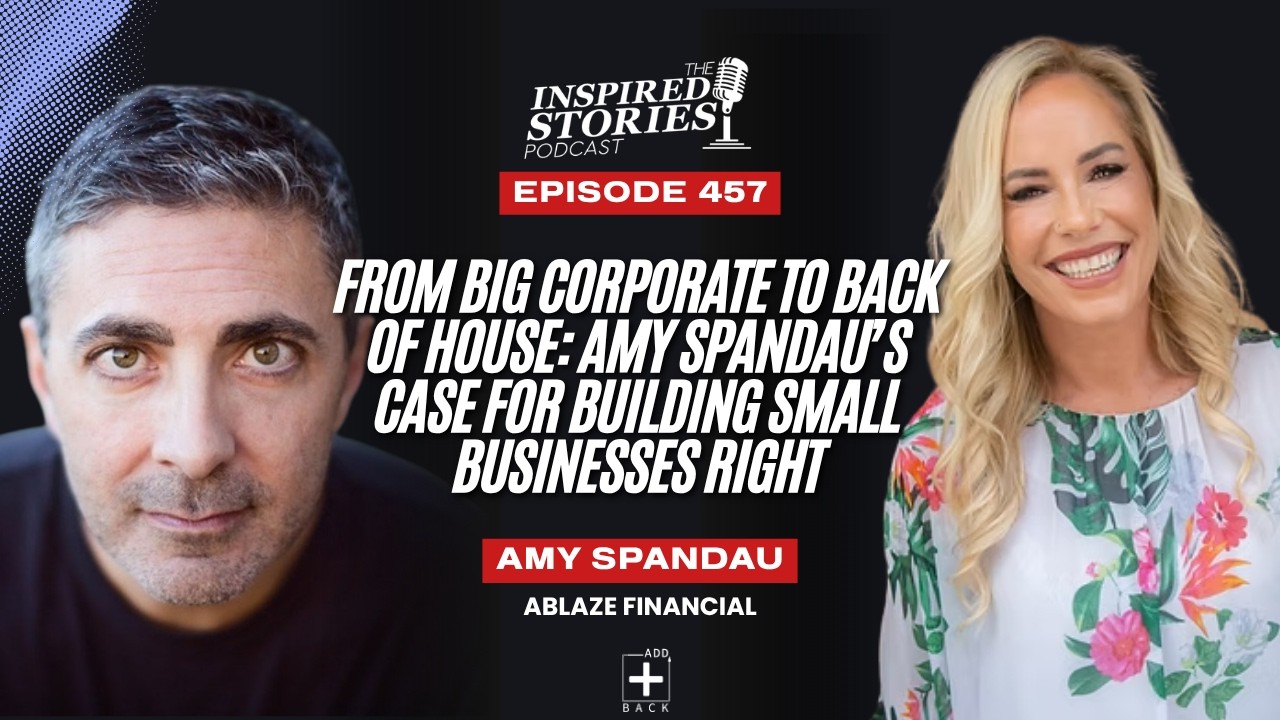
🎙️ From Startup Rebuild to Boutique CFO: Amy Spandau’s Path to Ablaze Financial
Amy Spandau, founder of Ablaze Financial, has spent 25 years solving problems most small business owners don’t even know they have. She rebuilt a company that was about to implode, got promoted to CFO mid-crisis at Tendril, endured the verbal culture of EchoStar, lost everything on a swindled ranch deal, and came out the other side with a clear mission: build back-of-house infrastructure for founders at the one-to-five million revenue mark before it’s too late to do it right.
✨ Key Insights You’ll Learn:
Promoted from controller to CFO mid-restructuring — how she learned on the job and led through it
December 6, 2012: the mass layoff that cost 135 jobs and created a company worth exiting
Why the CFO seat at EchoStar taught her what abuse of power looks like at the highest levels
Walking away from MediaKind when the board wouldn’t do the right thing
The ranch deal that drained her savings, retirement accounts, and nearly everything she had built
How a Craigslist sale became her first Ablaze client
Why fractional CFO paired with a bookkeeper is not enough — and what the gap actually costs founders
The back-of-house suite: accounting, finance, tax coordination, HR structure, insurance, and legal translation
Personal books for every client — because commingled finances are the default at this stage
The alligator closest to the boat: how Amy helps founders prioritize the right fights
🌟 Amy’s Key Mentors:
Chip (CEO at Tendril): Backed Amy’s CFO promotion when she had never done it before, threw out her first board deck, and taught her through every revision
Her CFO Mentor (Who Went to EchoStar): Spotted her readiness before she did and gave her the platform to prove it
Her Head of HR at Tendril: Co-architect of the five values — led with ‘do the right thing’ — that still guide Amy today
Her Partner During the Ranch Years: Steady support through the most devastating financial and personal loss of her career
Her College-Aged Team Members: The living proof that the next generation of accountants, given the right environment, can punch well above their weight
👉 Don’t miss this conversation about what it costs to do the right thing, why the smallest businesses deserve the most rigorous financial infrastructure, and how someone who lost everything built a firm that has grown to over a million in revenue without a single dollar of marketing.
Listen to the full episode here
Transcript
Anthony Codispoti: Welcome to another edition of the inspired stories podcast where leaders share their experiences so we can learn from their successes and be inspired by how they've overcome adversity. My name is Anthony Codispoti and today's guest spent nearly six years as CFO of a growing energy startup, helping take it from early stage chaos to the edge of something real and then watch the company wind down anyway. That kind of experience changes how you see numbers. It stops being about spreadsheets and starts being about survival. She carried that lesson through a corporate detour at a satellite communications giant, then walked away from a CFO seat to build something she could fully own. What she built punches well above its weight. Her name is Amy Spandau. She is the founder and fractional CFO of Ablaze Financial, a boutique advisory firm she launched in January 2022. that brought enterprise-grade financial discipline to the founders who need it most. A dual-licensed CPA with experience spanning Big Four, biotech, SaaS, and global media, Amy has spent 25 years solving problems that most small business owners don't even know they have. She has proof that the best financial advisors are the ones who have already been in the room where everything almost fell apart. But before we get into all that good stuff, Today's episode is brought to you by my company, AddBack Benefits Agency. Listen, if you run a business, you're likely stuck in the cycle of rising insurance premiums. You're paying more, but your team is getting less. And many people can't afford coverage at all. So we do things differently. We offer a solution that provides your employees with unlimited access to doctors, therapists, and prescriptions that's always free for them to use. But here's the part that really surprises most people. Unlike every other employee benefit out there, our program puts more money into your company's bank account. As an example, we recently helped a client increase net profits by $900 per employee per year. Results vary, but gains like that can change how a business is valued. And the consultation is free. So imagine being the advisor that becomes a hero by introducing this to your clients. See if they qualify today at addbackbenefits.com. All right, back to our guest, the CEO of Ablaze Financial, Amy Spandau. Thanks for making the time to share your story today.
Amy Spandau: Thank you so much for having me. I'm looking forward to the conversation.
Anthony Codispoti: So you started at a company called Tendril. You were a controller, stayed there nearly seven years, eventually becoming the CFO. Walk me back to the moment you realized the company was not going to make it. What was going through your mind?
Amy Spandau: So that actually happened at the beginning. So I was hired to take the company public. So this was back in 2011-ish. And so this was when we'd made it out of the 2008 financial crisis. Startups were really having big ticket. starting to have big ticket exits again. And my background in audit and then controller ship at a big billion dollar public company really positioned me to take another company public. And so that's why I was recruited. And within that first six months, the team, the executive team, which I was part of realized that there wasn't any there there. So we had a lot of clients, we had a software platform, we were being courted by Wall Street to do the go public, but there wasn't any real recurring business there. So I was part of the team that looked at that, figured out how to restructure the business. The CFO at the time, this will make sense of why I went to the satellite company later. He was courted to come in and take them public as a CFO. CFO and when we realized that there wasn't any there there, he said, you know what you need to promote her. She's ready to be promoted to CFO. I'm going to go back to EchoStar. This will come back later. And we restructured the business. So 50 clients to 15, about 200 employees to 65 over two reductions. And then we focused on rebuilding the software platform. That six years that I was there is the work that we did. The first six months was to realize the business needed to be restructured. We weren't ready to go public. And then myself, the CEO and the COO transformed the business. Tendril ended up being renamed Uplight and they did a double exit to private equity. And so the CEO, COO and I were the ones that rebuilt that company and got it ready. And so...
Anthony Codispoti: Wow. So you thought you were walking into one thing. Turns out you were walking into a rebuild, right? Kind of a tear down and rebuild, right? You're losing clients, you're letting staff go, you're kind of reimagining what the company become. What a powerful set of lessons that you must have learned in that seven years.
Amy Spandau: Mm-hmm. absolutely. Yes. Yes, and I'll never forget it was we did this the really large reduction in force on December 6, 2012. And we the 65 people that stayed, right, all of us, the executives, we fired people that we had never worked with. It was horrible. It was one of those days in your career that you'll never forget. We had to then move into a smaller part of our real estate. So, you know, the 65 people we moved into what was effectively the kitchen and break room. And we put all of our desks together. was a fire hazard. I mean, we had cords everywhere. It was so sad because we had to move from one building to this small space in another. But if we didn't do that, we wouldn't have made it. Right? So it was.
Anthony Codispoti: Talk to me about December 6th, having to let all those people go. I just talked about this in a recent interview. For folks who have never had to let somebody go, it is one of the hardest things, it's one of the hardest experiences, I think, in life. And for you to have to do that, not just for one person, but for dozens of them, takes a real toll on you.
Amy Spandau: Yeah, it had to be very coordinated. There's a lot of rules when you're doing a significant reduction in force. So we had security on site, just in case. Then everybody had a list of people. So obviously, you let go of the people on your team first, but then there was just not enough leadership. to the number of people that had to be reduced. So then you just, you had to work a list. So you're letting go, even though you know the person, they work in a different department, but you're all working together to do it. You have a script. And then once that's all done, and then you have a group of people that get to stay that don't really understand what just happened. So you have to communicate through that. And then what I remember is literally pushing my chair with my monitor on it. I don't remember what was on my chair, but literally had to push my chair because I was on the third floor of building number one, down the elevator, across to the new place, you know, the kitchen, what was effectively the kitchen and cafeteria, and setting up my desk in the corner.
Anthony Codispoti: As you look back, obviously that December 6th, a painful day, something you hope to never have to repeat, but as you look back at the work that came in the months and years that followed, how do you feel about that? What you guys were able to do?
Amy Spandau: Pride? because we worked really hard at it. We weren't perfect by any stretch of the imagination, but we anchored on one concept, which was do the right thing. So the head of HR, who was also the executive assistant to the CEO, her and I sat in a room and we were like, what are our values gonna be? And we came up with five of them. And as an executive team, we led with those. And the first one is do the right thing. And do the right thing is still my core value. That integrity still drives every decision that I make. And I think that while we made a lot of mistakes, that wasn't one of them. And it was just a pivotal time in my life. Going from controller to CFO, is very difficult. 15 % of accounting and finance profession, very few accountants make it to the CFO role. Most, most CFOs come from a finance background. So I was in a very small minority and was very lucky that the CEO plus the board backed that transition. I had never done an investor call. I had never done a budget. I had never done so many things that were required for my role. And so to do that and have the financial stewardship while you're going through a very difficult transition, right? wasn't, you know, our investors supported us, but we really had to work it. And we raised several rounds of very tough capital. And I had never done any of that before. Right. I remember. The CEO is like, do your board slides. I had done accounting board slides. That's not the same thing as the finance and operational board slides. And I remember, I don't remember how many it was in the first deck. He threw out every single one of them. I see one survive.
Anthony Codispoti: So how were you learning? Who was kind of shepherding you through all of this?
Amy Spandau: The CEO and I had one of the one of the independent board members. I'm also very smart, but I had just never done these things, some of these things before. So I probably worked three times as hard as everybody else, but I, was a really trance, you know, really pivotal experience. And I had a great board, great investors was hard. Don't get me wrong. It was really hard, but I looked back and realized what support I really did have. So.
Anthony Codispoti: So talk to me about the transition that happened from tendril into EchoStar.
Amy Spandau: Okay, so the CFO at EchoStar was the CFO at Tendril and he went back to EchoStar and he had me come to help him do some transformational work inside of EchoStar. So I didn't know where Tendril was ultimately gonna make it. I had done... pretty much everything that I could do. And he kept asking, he asked me every six months, will you come work for me? Will you come work for me? Will you come work for me? And I eventually just said yes. And so I went to be his global controller and effectively chief accounting officer. And I worked there for a couple of years to really help him do some stuff there that he hadn't been able to accomplish yet. It was really hard.
Anthony Codispoti: Talk to me about something that was really hard there and what it taught you.
Amy Spandau: So Echo Star is owned by Dish Corporation. were sister companies. They used to be one, and then they were split. They're owned by a billionaire, Charlie Ergen, who is known for being one of the most awful people in business. Billionaires that make it to be billionaires from starting their businesses and their garages are the back of their trucks. I've worked for two of them.
Anthony Codispoti: Okay.
Amy Spandau: are very difficult and so what made it really difficult was it was very hard for people to stand up to Charlie. And so for example, I had to spend half of my time about 45 minutes north of DC. I was not allowed to travel during business hours. So I had to spend every other week going back and forth between Denver and DC effectively. It would have been easier if it was in DC. That would have been easier, but it was north of DC. So I left every Sunday and came home. late late Friday night every other week. That was really really awful.
Anthony Codispoti: You weren't permitted to travel during office hours. Okay, because they didn't, they thought you were wasting the company's time by doing that. Right? Yeah, yeah.
Amy Spandau: business hours. because that's what fairly does. Not me. mean, that was like a policy for the entire company, right? And it's just, was policies like that. Changes that needed to be made that weren't made because for lots of different reasons. And so I'm a change agent. And while I was brought in to make changes, those changes were fought. And so it just, was really, really difficult. And it was also an environment of yelling. So Charlie Ergen would yell so loud in the boardroom, I was five off, I don't know, four or five offices down and my windows would shake. And so like my, they would rattle, right, the outside windows. And so that was also really challenging. And it's really made me realize how much trauma exists in the corporate world. And how, you we talk a lot about
Anthony Codispoti: Hmm.
Amy Spandau: relationships and abuse and trauma and that's all the new buzzwords today. And while I've been really lucky in my personal life that I haven't experienced a ton of that, I have in corporate. I have in the business world. And so I realized that, you know, when I left EchoStar to go to MediaCon, part of that was I just didn't want to work in relation in situations like that. We get to choose where we work. And even though I worked with someone I cared about, a lot. just couldn't, I'm too sensitive maybe. That was just too hard for me.
Anthony Codispoti: So when you talk about trauma in the workplace, you're talking about these kinds of very difficult coworkers, or in your case, the ultimate, the boss, the founder, loud, I don't know, you put it in category of verbal abuse?
Amy Spandau: Yeah, absolutely.
Anthony Codispoti: So you decide, go ahead, got more you wanna say there, Amy?
Amy Spandau: Yeah, just. Yes, it's abusive power. And I look, I love people. I love the men that I've worked with and for, you know, I'm not, I don't believe that everyone is treated that way. But I do believe that there are certain people and they get away with it. The more power that they have, people get used to it. And just like a bully, mean, Charlie was effectively a bully. And you have enough power.
Anthony Codispoti: Mm-hmm.
Amy Spandau: then your only choice is to walk away. Yeah. Yep.
Anthony Codispoti: Which you did, and you joined MediaKind. You were CFO, but only for eight months, and then it was over. What happened there?
Amy Spandau: So the CEO and I decided to leave at the same time. We wanted to make changes that the investors didn't want to make. And so this happens. A lot of people don't talk about it, but the company had some real financial issues. It had been a spin out. spin out from a larger company and a lot of the infrastructure needed to do accounting and finance wasn't done. That made managing a global operation hard and instead of fixing, really making some really significant decisions that would have positively benefited the organization, the investors wanted to kind of play it safe. And so we had a choice. Did we want to stay in that environment or move on? and the CEO and I decided to move on. And this happens a lot more than people think. If there's just not a meeting of the minds between the investors and the board and the executives, then you have to find a better solution. And so we just were change agents, and so we wanted to make changes. And if that wasn't possible, then the right thing to do was move on. I think that, you know, what we thought was going to happen happened. We, and I still stay in communication, but at the end of the day, really what it was, was the universe or God, whatever you believe in was like girlfriend, like you're not supposed to be in corporate anymore. We've given you two really hard things back to back. And are you going to listen and do what you're being called to do, which is build your own business? So here I am.
Anthony Codispoti: So for you, there wasn't any thought of maybe I just, sort of bend to the board and, I follow the path that they want us.
Amy Spandau: capable of doing that to my own detriment, right? I have a very specific, I'm going to call it my integrity, my dividing rod. If something is not do the right thing, then I can't bend to it. I'm not your person that can tow the line. I just can't. I've always been that way. I'm sure I'm a hard
Anthony Codispoti: Got it. Never a consideration for you. When you got to the point where you're like,
Amy Spandau: No, I'm a hard, I was probably a hard child to raise, yeah.
Anthony Codispoti: When you got to the point where it was clear that you were butting heads with the board, you're like, I'm out. I'm going to go do my. Did you know that when you left there, you were going to go do your own thing or did it take a while after you left?
Amy Spandau: No, I mean, it was really painful. It was really, really painful. I knew it was gonna happen. We agreed so that we would leave together, but it was really painful. Matt and I didn't agree that it was the right thing. They did, we didn't, right? And it was just, was awful. I wouldn't go back. I wouldn't... I wouldn't wish that kind of thing on my worst enemy. It's really painful. so, because when you see what the right thing is and you can't get other people there, that's really hard, right? And so I wouldn't wish that on my worst enemy.
Anthony Codispoti: Mm-hmm. Okay. So at what point did you come up with the idea for a blaze financial?
Amy Spandau: So I had the first idea for a business that could help founders in 2015. So one of the massive things you do in startups is cashflow management. And there's lots of different names for it, but you have a down scenario forecast, which basically it marches week by week what your cash flows are. And so I had developed a tool when I was at ArrayBioPharma and then continued it at Tendril and I had a friend that was like, can you help me? I can't figure this out. So she did my, she used my tool for the first time and I was like, do I have a business here?
Anthony Codispoti: What specifically couldn't she figure out? What her cash flows were?
Amy Spandau: She couldn't figure out her cash flows. Her cash flows had gotten too complicated. She had debt balances that she wanted to start paying off. She was investing in her coaching business and there was just too many ins and outs for her to figure out on a spreadsheet. And so my cash flow tool... was something that I was like, well, why don't we try this for you? This is how I manage my personal finances. This is how I manage the business finances. Let's try it. Let's see if it'll work for you. And it did. And then I did it for a couple other people in my life. And I was like, hey, I will do this for you. I just want to see if it works. And so We did it and I literally at that point could have started a coaching business, but we were in the middle of an upswing at Tendril and I just couldn't, it just wasn't the right time.
Anthony Codispoti: And when you say this tool worked for them, be more specific. What did it do? What were they able to accomplish?
Amy Spandau: It gave them clarity on the cash they had today, how long it would last, and how they could pay off the obligations that they owed. So for the first time in their life, it's like a mini budget in a way. It helped them understand where they were at and how to make changes. It also helped them understand, if I reduce this line item, it helps my cash flows x. If I I always use the example, if I trade in my Corolla for a Range Rover, crap, I run out of money in four weeks. it gave them, mm-hmm. so it helped them do that. And I said, you know, man, can I do a coaching business here? And I wrote out a coaching strategy.
Anthony Codispoti: Got it. Okay, super helpful. Yeah. So you could have had a sorry, go ahead.
Amy Spandau: And I named Ablaze and there was a group of us at Tendril that we met every Wednesday night, a couple of us, and we were working on our little side hustles. And I was like, this is going to my side hustle. And one of them was in creative, one was in marketing and the marketing gal and I are still working together today. She's building her business finally. And just like I'm building Ablaze, but the Ablaze logo comes out of that. that work in 20, I was like 2015, 2016. And the name, we named it at that point, and then it just sat on the shelf.
Anthony Codispoti: What was behind the name?
Amy Spandau: It really helps you launch yourself where you're going to go. Like you want to be on fire in the best way possible.
Anthony Codispoti: Yeah. So sort of the bones of it, you put together in 2015, then it set on the shelf is, you had some other corporate stops along the way. And then when you're at MediaKind, and you're finding like, I'm out, this isn't working. Did you know, hey, this is what I'm doing next, I'm going to take a blaze back off the shelf.
Amy Spandau: Mm-hmm. Yep. No, no, because my corporate identity was a huge part of my life. I you know, and I was like, okay, God, this is not where I'm supposed to be. I'm listening. It's very clear. And it took me a couple of months I had gotten. I had separated from my husband. During that time, I had a house in Denver. I spent the summer, you know, I spent time in California just kind of checking things out. So it was just this huge time of transition for me and I was figuring out what I wanted to do. And I was like, you know. I kept getting this in like this just high level just interest. People were like, you need to go out on your own. You need to build something. And I was like, okay. And in January of 2022, I was at the Langham in Pasadena, which is a nice hotel. And I said, what the hell, let's just do it. And I wrote my engagement letter. I wrote my first pitch deck. And I was like, okay, I'm going to offer boutique bookkeeping, cash flow management and fractional CFO services. And I, right. And then I went back to Denver and, and that my first client came from a woman that bought some stuff I was selling on Craigslist and I was loading it into her car and she was, and I was like, what do you do?
Anthony Codispoti: And how did you get that first client?
Amy Spandau: And she said, I'm an interior designer. And I said, well, if you ever need finance help, just let me know. And she became my first client. She called me a week later.
Anthony Codispoti: How much of a conversation did you have about what you could do when she was there loading up her car with this Craigslist stuff? That was the extent of it.
Amy Spandau: I just told you what it was. And then we went out for coffee. We went out for coffee. And then my second client was a real estate agent who I had reached out to to sell my house. And she's like, and she's sitting at my dining room table, and we're talking about selling my house. And I was like, was like, if you ever need help with accounting and finance, just let me know. She's like, I actually need that. And and so I think really when when you're doing what you're supposed to be doing, you get these little magical Easter eggs. Those Easter eggs are, they, the clients just start to show up.
Anthony Codispoti: Interesting. Okay, so tell me what a blaze looks like in practice today. What are you doing for founders that maybe they're not getting from their accountant or their bookkeeper?
Amy Spandau: Yep, so we are about ready to do a rebrand. We're dropping the word financial actually just to be a blaze, the legal name has already changed. We haven't changed the rest of it. And that's because we offer a full suite of back of house services. Accounting and finance is critical to every founder. But one of the interesting things I ran into Anthony was that no one understands what any of the back of houses. So much so that most of my clients, I didn't understand that. Like I've spent 30 years doing this and luckily my clients all raised their hand and they're like, we have no idea what
Anthony Codispoti: What are you talking about? What do you mean by back of house?
Amy Spandau: So back of house, so if you think, everybody knows front of house. Front of house is sales, marketing, and operations, client operations. Back of house is everything else. So it's your accounting, finance, tax, legal, HR, insurance, and then making sure the bathroom gets cleaned, right? Like, you know, back of house does everything else. It might be office management. It just depends on the business. But back of house is every...
Anthony Codispoti: So you're cleaning your clients bathrooms. That's what, okay. Okay.
Amy Spandau: they really need it. are remote. So, you know, we're at least cleaning ours. But the idea is this back of house is really everything that's not sales, marketing and client success. And for businesses that are in the process of scaling that usually typically falls to the founder. And then they realize they can't do something so they start outsourcing it in piece parts. But that's the reason why I came out with Boteak Bookkeeping, Cash Loans, and Fractional CFO. I thought that everybody knew what that was. And over the course of the last four years, we realized that we had to put together all of those services, and we had to put them together in one place. And for me to feel confident as a CFO, I needed to make sure that all of that infrastructure was there, because this was the massive problem I saw. Bookkeeping doesn't do it because bookkeeping is probably only 50 % of accounting. Tax doesn't just do it. Tax is just a small piece of compliance. And if I don't have really good accounting, Then I need finance because finance is what gives you the infrastructure to make decisions. I had to put it all together. And then I started to see that they had problems with their teams and how to compensate them. They had problems with insurance and they were taking on all this unnecessary risk. And so my services evolved over time to be staged and then to cover all of those things. Because without all of those things, then the front of house is going to fall over because you're going to grow to a point and if you don't have that infrastructure built and if that infrastructure isn't built when you're small, it's very, very hard. Because I looked back at my career and I said, why have you been hired all those times? And I was always hired to make significant changes when it was already too late. Right. And then no one's happy, right. Because you can't get the data. basically when you change, the plane is flying and I got to change out the engines. That is not an easy feat. So I built my practice to build all that infrastructure when it's small so that it can scale. Good infrastructure should stand for 10 to 15 years. And so, so which allows a lot of change and a lot of growth. Right. And so I built a firm so that you can build it right the first time.
Anthony Codispoti: So as you start expanding these services, Amy, you're kind of branching out into areas that you understand, but maybe aren't your specific areas of expertise. HR, maybe insurance. And so as you're moving into those areas, how did you level up so that you could be the expert that your clients needed?
Amy Spandau: So I partner with experts. So depending on what the area is, I partner with experts. So in accounting and finance, I am an expert. Right? Not tax, which always is so interesting to my clients is no. Accounting includes tax. And it would be the same thing as having your brain surgeon do your foot surgery or your podiatrist doing your open heart surgery. They're all doctors. They're just a different expertise. My expertise is financial reporting, accounting and financial reporting. There's always a tax team. And so there's a lot of education there. But what I do is I partner with really like, so on the HR side, I've done a lot of people management as a CFO. do, because what, people are looking for in back of house is not how do I necessarily deal with employee that's using drugs or are dealing with an executive that's sleeping with the intern like HR. What, what they need is team structure. design, compensation, and compensation would be how do you do base comp and then how do you structure incentive compensation, whether it be a bonus commission equity program. And I've done a tremendous amount of work in that area. And so the HR is really about team structure and design and compensation. And if we need HR, then I typically partner with PEOs and other HR experts. On the legal side, we always have really great legal counsel. But the thing is, is that most founders don't know how to talk to their lawyer, right? And a CFO talking to a lawyer, we speak a different language than most of our founders. And the founders really need kind of someone that can translate that information. And I would say the biggest thing that I do, and you're going to laugh, but I'm going to show you this, is I help you prioritize. They call it alligators closest to the boat. So my team got me an alligator in a boat. But the idea is, as a founder, there's so many alligators in the swamp. Someone needs to help you figure out which one we need to kill today. Which one is crawling into the boat? Just because you can see it doesn't mean we're going to deal with it today. So really what I do as leadership to my clients is what are the priorities, where are going to focus, and then who are the experts we need to bring on that are not inside my team to coordinate those services for you. And so the service coordination for us is really with who's your financial providers, who's your payroll company and PEO, who is your insurance broker, and then who are your lawyers. And then we coordinate those services and are really the bridge for our founders so that they know. how to interact with them. Most of our founders just want to not worry about.
Anthony Codispoti: They want to focus on the thing that they built their business for, the product or the service that they're passionate about delivering. Is the business model that you have, Amy, there at Ablaze, is it typical? Are there a lot of other companies that provide this breadth of services?
Amy Spandau: I don't believe so. the services, a lot of them are in the different pillars. And some will do accounting and tax. Some will do accounting, tax and finance. But I don't run into many that do the rest of the coordination. Now that said, a lot of fractional CFOs will do some of the coordination. But the gap that I've walked into is that The fractional CFOs, if there's a bookkeeper, that really is not a strong dynamic because you're fractional. That's why I won't do it. I ran into that. I tried that. Doesn't work. And it doesn't. A fractional CFO paired with a bookkeeper. And the reason being is because there's too much ancillary work that needs to be done.
Anthony Codispoti: what doesn't work specifically.
Amy Spandau: For me to be powerful as a CFO, I need to make sure the books are closed timely and accurately and I have the financial models that I need. A bookkeeper is not sufficient to give a CFO truly what they need. There's a lot of gaps in the middle. So what ends up happening is the CFO is forced to step down and do more roles like accounting manager, controller. financial analyst and once you do that, once an executive comes down that far, then you can see seeing things at the 30,000 foot view. It's harder to be strategic. I'm not saying that there aren't ones that are successful. The most successful CFOs that are fractional bring in a controller with them. They bring in a high level accounting person so they don't have to worry about the numbers. They also then bring in a junior financial analyst so that they don't have to do the numbers, but that's more expensive. And so what I've been really pushing for and my team is working to build is how can I build a cost efficient model, still more expensive than most of my competitors? We are a boutique service, we are more expensive, but still how can I use tools to bring the cost of service down while providing the highest level of value that we can? So we're still working through that software tools mostly.
Anthony Codispoti: What kind of tools are we talking about? Yeah.
Amy Spandau: But to be clear, I'm a firm supporter of AI. I love technology, working at Tendril really embedded in me, software and technology and how it can move things forward. But there is really a human element to back of house that can't be replaced. That said, there are things that we're working to automate. How can we use best in class processes? How can I train the most junior staff to punch above their weight? And that's what we're working
Anthony Codispoti: Can you give me a specific example of how you're working to use AI in a way that's gonna free your folks up for more of that human touch component?
Amy Spandau: And it's not just AI, it's software tools. for example, what we're doing right now is we're practicing with tools that exist inside of QuickBooks, automation tools, rules, so that more transactions go clear the banking feed more accurately. Now, where most accounting firms get it wrong is letting the software do that without human intervention. And we are figuring out the human intervention. We are also standardizing processes and procedures across our client base. What is the best in class way to manage ARM voicing and collections and how much of that can be automated. But to be clear, the software tools we're really leveraging are project management tools, things like video, like loom, looking at video, looking at training technology to make our staff faster. what they do. But one of the things I'm really proud of is my junior staff are all college kids. Right? And because I think so many people, so many people that are our age, Anthony, say that the younger generation aren't hard workers. They're not worth investing in. And I think, pardon my French, that's absolute fucking bullshit.
Anthony Codispoti: Why are you really proud of that? us.
Amy Spandau: That my college kids are amazing. And that's where I'm going to be investing. so I, you know, part of my business model is investing in them and building a services firm that is competitive with big four, right, where they can get that much experience. Because if you graduate and go into big four accounting, you will accelerate to your other students to X. So like if two people graduate and one goes into big four, and one just goes to work at Coca-Cola, this one will get promoted twice as fast. So in the same amount of time, they're going to come out at a much higher level and skill set. And that's what we're working to build. then I want my younger generation to be here in the US.
Anthony Codispoti: Amy, describe the ideal client for a blaze.
Amy Spandau: Okay, so our ideal client has made it to a million dollars of revenue. There's somewhere between one and five million of revenue. So they've made it to that first major revenue milestone. That's one. And the revenue milestones for small business is zero to one, one to two, two to three, three to five, five to 10. So you're somewhere between one and five, but most of our clients come in between one and three and they have a desire to run a successful business. Now, what does that mean? That means that they don't just want to have a practice. They want to establish a business that will eventually run without them. Now. Not everybody at a million knows that. Most people at a million haven't figured out that language, but most people that want to make it is an entrepreneur. That's what they want to do. They want to go from idea to exit. And we want to take them through the messy middle of not being appropriately capitalized, not being profitable, and creating a sustainable business. Now that's going to happen somewhere between three and five million, hopefully, because you want to build a business that's not. And when I use the word sustainable, that it has the right metrics, it's generating 20 % net income profit and it's paying the founder at least 250 a year. And those metrics for us come from when you're going from one to five, it's really hard. You've probably put everything that you have in the business. You have commingled your business and personal finances. You have used your personal credit. And we work with our clients to untangle all of that. Another, so in addition, there are two critical differentiators that we have found in the market is we do personal books for all of our clients. So in addition to doing their business books, we take care of their personal finances as well because they typically come to us all commingled. They've also leveraged their personal credit because when you're a new business, it's very hard to get business credit. And we work with them, there's a path to go from leveraged personally and to leveraged in the business. So we work through that difficult transition. And then we work with them on building the infrastructure in their business to stabilize the business and drive towards 20 % profitability. And so, but they come to us. with a desire for it to be better, a desire to build a business that will eventually exit and they're at a million dollars. We predominantly do services companies, but we in our intake process will look at everyone.
Anthony Codispoti: So the thing that strikes me here, Amy, is given the experience that you've had in corporate America, bigger companies and the kinds of things that you were doing there, I had expected that the types of clients that you'd be servicing would be a lot bigger. It seems to me that these smaller companies, know, this one to three, one to $5 million, they don't typically get to work with an Amy Spandau, you know, somebody of your level of Expertise. Why did you focus on this part of the market?
Amy Spandau: because this is where I was led. These are the ones I'm in love with and passionate about. And I think really what my purpose is, is using that big company structure and process and experience to build better businesses sooner and to make more people independent of the bigger machine. because it's really hard for people right now. And if you work for someone else and that someone else doesn't have financial stewardship, that's really scary. So the more financial independence I can create for business owners by building strong, small businesses, this country runs on small business. There's literally hundreds of thousands and millions of businesses that we don't even know exist. And I just want to make more of them successful. And so that's one. And then the second thing is when you get above 10 million, you're placing your first in-house team. And by 20 million, you have your first full-time CFO. Sometime between 10 and 20, you have a full-time CFO. And so what's really hard in the 10 to 20 space, if I'm not careful, I can only serve two or three of them. And I want to serve more of them when they're smaller to help them grow. Now,
Anthony Codispoti: Yeah.
Amy Spandau: Anthony, I have so many challenges. I've learned so many things about these businesses and how to serve them and what is the demogra... It's not even demographics, the personality types and the archetypes of the founders that we actually really can help. It's not easy. It's not easy to serve this market. However, I'm really passionate about this market. And I...
Anthony Codispoti: Yeah.
Amy Spandau: I say my clients are humans, my humans have companies, and my job is to make those humans as financially independent as I can.
Anthony Codispoti: Yeah, it is I was just thinking about the size of groups that you're working with, like these are the types of companies in my experience. And maybe this is narrow minded. They're traditionally not getting access to this level of expertise. You know, they've got a bookkeeper, you know, they've got an account, they've got a CP, they've got somebody that, you know, files their taxes for them. But they don't have this strategic level of thinking that's also helping them with, you know, a lot of these other back office components. That's It's quite a suite of services to be able to offer to businesses of this size.
Amy Spandau: And that's where we feel our niches. And we continue refining our service offering to bring as much value day one as possible. The hardest part of my job is they don't understand the back of house. They don't know what good looks like. They're just in pain. And so we are constantly evolving our model, constantly evolving our communication strategies so that we can meet them where they are day one, which is, I know it's really hard. I'm really sorry, right? We are here to help you and give you the medicine that you need to build this business that you're truly passionate about and stand with you as you build it. And that is the biggest challenge. this market has been underserved because there's so much price pressure. Below five million, the founder's probably not taking out an adequate amount of compensation. Adequate kind of starts at 250 to be worth it. Once my clients get to 250, the temperatures come down. At 500, they start to breathe. And that might sound like a lot to those of you that are listening that might work for other people. And it's not that founders work harder than people that work for other people necessarily, but there is so much difficulty in being a founder and bringing your purpose to life that somewhere between 250 and 550, start, 250 and five, they start to breathe.
Anthony Codispoti: Well, there's a lot more risk for a founder, right? You've made investments, yep. And you've got folks that depend on you for making payroll every week and it's just a lot of extra pressure and extra financial risk.
Amy Spandau: Yeah, that too. They carry one. and family pressure, friend pressure. No one understands what you're doing unless they're a founder. One of the first questions I ask when I start working with clients is who's supporting you? Who do you have that's in your corner?
Anthony Codispoti: What do people typically tell you? Who do they have in their corner? Yeah.
Amy Spandau: Right? No, they don't have anybody.
Anthony Codispoti: Yeah, I hear that. I hear it a lot, too. And I hear the other side. I hear, you know, lot of founders who have, you know, found a support group of types, you know, like a mastermind or like a I forget some of the professional networking groups, you know, where they get to meet, you know, once a month and everybody takes a turn kind of talking about that. And there's support in that, you know, other people who are going through similar things in, you know, their own businesses.
Amy Spandau: Right. Not totally. Totally. that's the hardest part about it. But what I tell people is if you are blessed enough to be called into a purpose to bring something into the world, there's like, I never worry when I wake up that I'm not doing the right thing. Like I know that my, like I never worry about that. I never know how it's gonna all work. But I, you know, that's a beautiful thing to not worry why you're on the planet.
Anthony Codispoti: You know, so speaking of challenges, Amy, what is one of the hardest things personally that you've had to overcome and what did it teach you?
Amy Spandau: So probably the biggest thing in business was I bought a ranch in 2009 and I did business with a crook. So I bought a very large piece of property in Northern Colorado, a beautiful 340 contiguous acres. I should have bought something smaller with the amount of money that I had, but I fell in love with this huge piece of property and the owner did an owner carry loan on it. And for those of you that don't know what that is, it means that the owner carries the promissory note instead of the bank. And what I didn't realize is he had sold this property to several people before me using the same structure. He had a long standing relationship with a ranch manager who I was bound to keep on. and the ranch manager. It took me a long time. Everyone like this was 2009 so it's what 2026 a long time ago. So I have had a lot of hindsight, a lot of conversations, a lot of a lot of things, but there was a balloon payment due. The ranch manager managed, so we did boarding operations and hay production. So the boarding operations, we boarded a hundred horses at capacity. We grew 20,000 bales of hay a year. Most of that hay went into the horse operations. But what the ranch manager would do is when we would lose someone, he just wouldn't tell anybody that called for new boarding that we had openings. So slowly just because there's just normal attrition as people move and stuff like that. And I made some mistakes. I wanted to change some stuff. I was not perfect in this either. He managed the boarding down so that our revenue matched the debt payment and plus payroll and no more. And so I drained my savings accounts. I drained my retirement accounts trying to keep it. I begged the owner when the balloon, two-year balloon came up. I said, can you extend it a year? He said, yes. Typical to the men yelling at me, like Charlie Ergen. I had to meet with him at least monthly and there would be times and we would meet at a restaurant in town and he would just yell at me and tell me how stupid I was. and how I was ruining his investment and he was so helpful and he was so benevolent and I was the young, I was the young woman that was an idiot. At the same time I managed three ditch companies. I knew nothing about water rights, but I overhauled three ditch companies and changed them from unprofitable to profitable. I was on a Larimer County board to rezone horse regulations. Like I, this was my dream. I loved this property. I wanted to shepherd it. I wanted to protect it. It was in a conservation easement. I wanted to own it for like the entirety of my life and live there and like And it was, and granted, made mistakes. Don't get me wrong. Business owners always make mistakes. But I was treated very unfairly. so the extension on the balloon came up. I negotiated with him. I tried really hard to extend it. And I was like, OK, in order for us to keep it, we need to do this. He said no. But the... The worst part about it is I had found an investor, was one of the other board members to pay the balloon payment. And I wanted this person to manage the day-to-day operations with a ranch manager because I knew that something was wrong. I didn't fully know, but I knew something was wrong. We had it. We were about ready to sign. had been papered. We were about ready to sign the agreement. And then the investor disappeared. Lo and behold, the owner went to the investor and said, I'll just give it to you.
Anthony Codispoti: just give you the property.
Amy Spandau: Yeah, you can buy the property direct from me. She's going to default. You can have it right at better terms. And so he disappeared. And so he comes to me and he says, you know, he said, I'm not going to extend it. You need to figure it out. And I said, you can have it. And I walked away and I lost everything. I was several hundred thousand dollars in debt by the time I was done. I had to go back into my parents house because I had nowhere else to go. And it was single-handedly still the most painful thing that I've ever experienced because it was everything I had ever wanted. I made mistakes, but I didn't do anything that wrong. And I was just swindled. And later... People in town came and told me that I was number four or five that this had happened to. It was predominantly women it had happened to. The investor tried to buy it. He took it away from him. So it was just doing business with someone that just really was a terrible person.
Anthony Codispoti: So these other people that he was swindling, he was doing it to one person at a time. There wasn't multiple people that thought that they owned the property at the same time. And he just, he had...
Amy Spandau: Yeah. Yeah. And it was serial and you're so devastated, everybody moves away, right? So.
Anthony Codispoti: Wow. so, I mean, there's multiple levels to this, right? You lose your home, you lose this property, you lose this business that you were, you you really thought that you could make work. You have to move back in with your parents, you're in financial debt. there's just so many parts of this that are just a giant gut punch. How are you getting through this emotionally? Like, where's your support coming from?
Amy Spandau: So, okay, then like, let's back up the train. like that happened, I started at Tendril in July of 2011. At the same time, I know that something's happening. like, just like intuitively I know that something's happening at the ranch, right? And so, yeah, 2011. Yeah. And... Sorry, it's just like, was a long time ago. But, and then I meet the, I'm in the CFO at EchoStar, who's the CFO at Tendril, right? It took us some time. And, you know, and then I move in with my parents, right? And then 10 months later, we do the reduction at Tendril and I get promoted to CFO. So, you know, I was heart sick. I mean, I was heart sick. Like I can't even express it. was a walking zombie. I was so devastated. And like to any of you that ride horses, like I couldn't ride my horse. I was so stressed out and so depressed. I could only like groom him because he was a performance horse and any nervous energy and knee goes right through their spine and into them. And I couldn't ride, I didn't want to ride, didn't want to see anyone. So it was just, it was awful. It was truly awful. And like the universe is funny. Like I take my horse to a barn and if I had met the owner of that barn before buying the ranch, I would have never bought the ranch. I would have just boarded with her. She was so great. And you you just taken in another direction. And so I really believe that that whole experience taught me how to be financially resilient. I used all my tools to get up to it. I can look at a founder and say, I understand. I put down businesses as much as I grow them. And I can sit with them and say, I understand. I understand how hard it is. I understand if it's the worst, because I've had the worst. The only thing that would have been worse is if I had to declare bankruptcy. Luckily, I was able to keep working. And I didn't have to, though I was instructed that I could have.
Anthony Codispoti: At what point did you feel like the cloud started to lift?
Amy Spandau: Probably like 2014, 2015. It took a while. Took a while.
Anthony Codispoti: And how did you get from point A to point B? What was something helpful that you did along the way? I want listeners to kind of have a takeaway from this, you know, maybe they're in their pit of despair right now. And they're like, like, I see no light at the end of the tunnel. I don't know what to do.
Amy Spandau: So I was lucky that my partner at the time was very supportive. My parents were very supportive and the people at work were very supportive. Right? And the CFO said to me, Amy, it's not the last time you're gonna lose money. It's just the first one. And the first one is always really, really painful. And I was able to throw myself into my work and then have success in that work. And so one of the things that I tell people is you have to have action towards a result. The best thing that I've done with my depression is create an action plan and actually make action. It doesn't towards that, whatever that desired result is. And that's really hard when you're depressed. It's really hard to move, but you have to. take small steps towards that desired outcome. And that's what helped me through. And the other thing is, is you have to build a robust life. It's not that like, work is a huge part of my life. Don't get me wrong, I'm a workaholic. I work on that all the time. But work is also a solace for me. And so for me to continue my work was really an important part of that process. but, but. If you're in a very, very dark place, there are people that are there to help you. Find them. And then every day, do a handful of actions towards the life that you want.
Anthony Codispoti: I love that.
Amy Spandau: even though you don't want to and you're never going to want to. wish I tell people if I ran the world, if I ran the world, the first thing I would change is that we would want to do the things that would help us feel better. That would be the one universal law that I would change. Just do it anyway.
Anthony Codispoti: love it. Amy, I've just got one more question for you today. But before I ask it, I want to do three quick things for the audience. Anybody who wants to get in touch with Amy Spandau, you can find her on LinkedIn, we'll have that in the show notes on Instagram to also will be in the show notes, ablazefinancial.com in case you're traveling right now, just easy to remember ablazefinancial. want to be on fire, she wants to help you, you know, find your fire ablazefinancial.com And if you're enjoying the show today, a quick comment or review on your favorite podcast app goes a long way towards helping others discover our show. So thanks for taking a quick moment to do that right now. Also as a reminder, you can be the hero advisor that helps give clients their employees access to doctors, therapists, and prescription meds that counterintuitively actually increases their net profits. Real gains that can change how a business is valued. So contact us today at addbackbenefits.com. Last question for you, Amy. A year from today, what is one very specific thing that you hope to be celebrating?
Amy Spandau: I have been in the trenches of my business for four years now. My business operates because of me. Now, I have a wonderful team, everyone, but every founder goes through this. What I want to celebrate, so I turned 51 in a couple of weeks. So on my 52nd birthday, what I want to be celebrating is that I am not as directly involved with client service as I am today. Every founder goes through this. I'm working, you want to work on your business, not in your business, but for early founders, we work in our business every minute of every day. And so I want 50 % of my time a year from now to be on my business, not in it.
Anthony Codispoti: And so what are you putting in place today to help make that bridge possible?
Amy Spandau: The first is the team that's around me. So I really have my first true leadership team. I have a head of finance, I have a head of accounting, and I have a head of client operations, and I have a head of internal operations. So I have four people who's basically taking myself and splitting myself out into four. I am taking myself partially out of client operations to focus on sales and marketing. So we have grown to the size that we are today. So we are over a million in revenue with zero marketing, Anthony. haven't I, I have not everything has been inbound. I am so blessed. But to get to two and then to three, I have to focus on sales and marketing. So that's actually one of the reasons why I'm saying yes to things like And so I'm going to take half my time for sales and marketing, half my time for client operations, and a year from now, I want it to be 25-25. So 25 % client operations, 25 % sales and marketing, and 50 % really being a CEO working on strategic partnerships and what's next for Ablaze.
Anthony Codispoti: Amy Spandau from Ablaze Financial. I want to be the first to thank you for sharing both your time and your story with us today. I really appreciate you being here.
Amy Spandau: Thank you. I really appreciate being here. Thank you.
Anthony Codispoti: Folks, that's a wrap on another episode of the Inspired Stories podcast. Thanks for learning with us. And if one thing stood out, put that into action today.