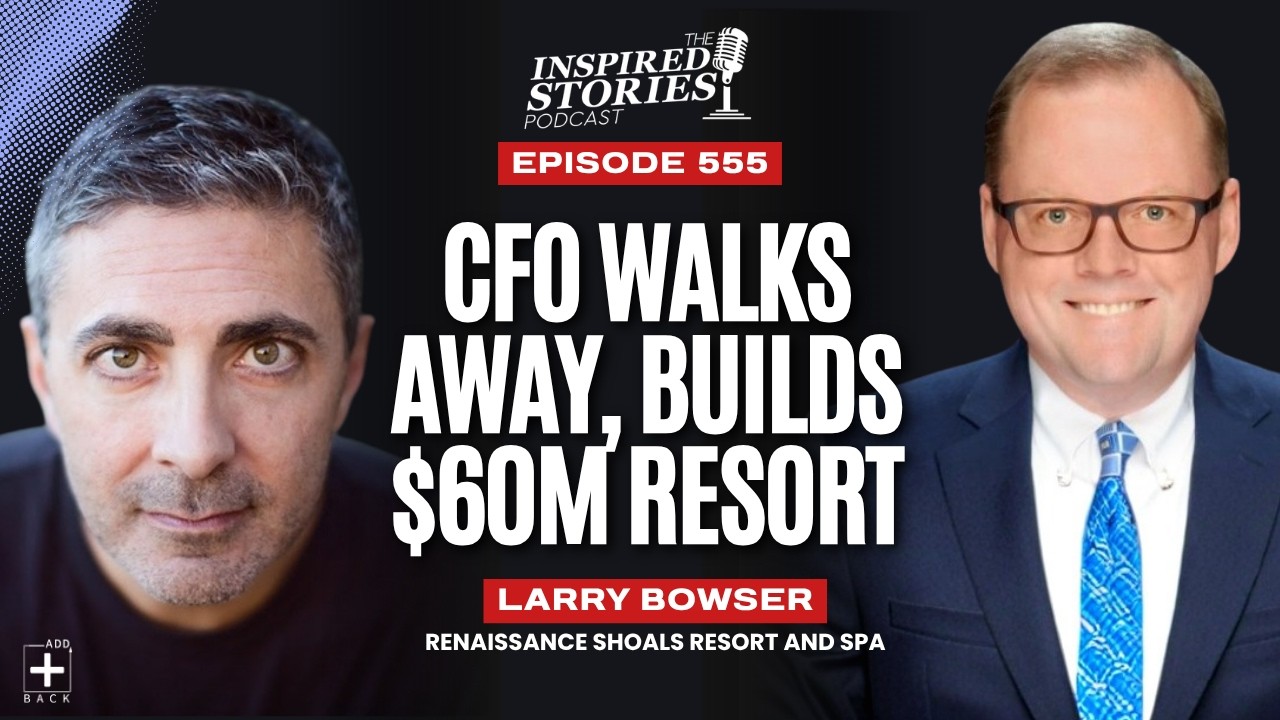
🎙️ From CFO to General Manager: Larry Bowser's Twenty-Year Journey Building the Renaissance Shoals
In this episode, Larry Bowser, General Manager of the Renaissance Shoals Resort and Spa in Florence, Alabama, shares how a personal crisis led him to walk away from a CFO track and spend over two decades building a $60 million resort in a town most people had never heard of. Larry opens up about the book that changed his priorities after his father's death, the guest who donated his Rolling Stones collection to the hotel, and why he's stayed at one property while the industry pushed him to keep climbing.
✨ Key Insights You'll Learn:
Chased a girl to Tampa and stumbled into hospitality by accident
Promoted to hotel controller at 23 after one late-night conversation
Read "Seasons of Life" while his father battled lung cancer
Stepped down as CFO to open a resort in Florence, Alabama
Built the resort in partnership with Alabama's state retirement system
Turned a guest's donated collection into a Rolling Stones museum
Promoted 28 of his 40 managers up from hourly positions
Renovated under the Renaissance brand to preserve the music theme
Uses the "hungry, humble, hospitable" hiring framework
Now pursuing a Sam Phillips experience to rival Graceland
🌟 Larry's Key Mentors:
Sterling Howard: First GM who promoted him to controller at 23
Ed Lee: Taught him that guest satisfaction is a pathway, not a stool
Dr. David Bronner: Gave him the purpose-driven vision behind the resort
Tim Gramble: Taught him hospitality is an industry measured in pennies
👉 Hear how a CFO walked away from the corporate ladder to spend twenty years building a music-soaked Alabama resort from the ground up.
Listen to the full episode here
Transcript
Anthony Codispoti (00:01)
Welcome to another edition of the Inspired Stories Podcast, where leaders share their experiences so we can learn from their successes and be inspired by how they've overcome adversity. As you listen today, let one idea shape what you do next. My name is Anthony Codespodi, and today's guest spent the first decade of his hospitality career buried in spreadsheets and balance sheets, never imagining he'd one day run an entire resort.
But a pivot from finance to operations put him on a path that kept him leading the same waterfront property for over two decades. From controller roles at Marriott Properties across the Gulf Coast to vice president of finance and accounting, his trajectory took a sharp turn when he moved to Florence, Alabama in 2004 to take the helm of a resort sitting on the banks of the Tennessee River. His name is Larry Bowser.
And he's the general manager of the Renaissance Shoals Resort and Spa, a full service Marriott property operated by PCH Hotels and Resorts. The resort features a revolving rooftop restaurant, a full service spa, and deep ties to the legendary Muscle Shoals music scene.
Larry also serves on the University of North Alabama Foundation board, reflecting his roots in the community he's called home for more than 20 years. But before we get into all that good stuff, today's episode is brought to you by my company, Ad Back Benefits Agency. And you'll want to hear this because it's hurting almost every business you know. See, health insurance costs go up every single year, and hotel operators are furious about it. They're paying more, claims are getting denied.
Employees are opting out because they can't afford it and it hurts turnover and morale. It's one of the most maddening problems in running a business, and everyone just seems to accept it. But you don't have to anymore. Now there's a program from Bain Capital Insurance that gives employees unlimited access to doctors, therapists, and prescriptions with no copays or deductibles to meet. It works for your part-timers and you don't change your broker.
But here's the part that really shocks most people. Our product actually
Larry Bowser (02:16)
Okay.
Anthony Codispoti (02:16)
increases your net profits. We recently helped a client add $900 per employee per year to the bottom line. Results vary, but imagine what could be done with the extra cash flow. Get your free consultation today at adbackbenefits.com. All right, back to our guest today, the general manager of Renaissance Shoals Resort and Spa, Larry Bowser. Thanks for making the time to share your story today.
Larry Bowser (02:41)
Good morning. Thank you for the opportunity.
Anthony Codispoti (02:44)
So Larry, take me back to growing up in Pennsylvania. I'm curious what your upbringing looked like. What did your parents do for work? Was there anything in how you were raised that pointed you toward business or finance?
Larry Bowser (02:57)
actually not. you know, I I chose accounting as a degree because I always wanted to go into the Secret Service as a kid growing up. I w wanted to do white collar crime investigation. I don't you know, look back now and I can't really remember why, but you know, Secret Service only takes law degrees and accounting degrees and you know, so I was the first person in in my family to go to s to college and you know, I have two older brothers and an older sister and you know, my family all grew up in the railroad industry. My grandfather and my mother and my father
you know, they all worked at d to different aspects of the railroad business. you know, I grew up in, you know, Butler County, Pennsylvania, very rural area. It's it's very known home home of the Amish. most infamously made famous by the the assassination attempt on Donald Trump. You know, so I was watching that live and you know, of course that was surreal for me to, you know, Butler become famous for that. But anyway, yeah,
Anthony Codispoti (03:48)
That's right in your hometown.
Larry Bowser (03:50)
it was you know, it was literally ten minutes away from where I grew up at and, you know, where my house was and
you know, from that. But it was it was nice. like I said, I had two older brothers. my oldest brother's ten years older than I am and he went into the Air Force early on when I was still growing up, so I was sort of the last one there. But you know, high school football, you know, played sports in high school, you know, went into like I said, chose accounting, has a degree, Edinburgh University is where I studied at. it was a small division two school, you know, no home for wrestling and and whatnot. So it was it was exciting. Like I said, you know, you know
graduated that but yeah, never really had intentions on, you know, be being an accountant or or anything else. And, you know, just as fate would have it, my my senior year I met a girl, her f her family was from Buffalo so and sh her family relocated. They sold their business in Buffalo and moved to Tampa, Florida. So I, you know, stuck it out my senior year and after I graduated I packed everything up in my Honda Civic and chased her down to Tampa. That's where I ended up getting in the hotel business at. So you know, it's kinda how fate would happen.
Anthony Codispoti (04:49)
Okay. Okay, so you
got right into the hospitality industry after graduation. And you initially the idea
Larry Bowser (04:57)
Yeah, I worked for
Anthony Codispoti (04:58)
for finance and accounting was you wanted to do the Secret Service. They only took accountants and law lawyers. so that was the in initial inspiration, but the world had different plans for you. So you ran down to Tampa to chase this girl. And and then how did that first opportunity in the hospitality industry come?
Larry Bowser (05:15)
Well my first job was I worked for a wholesale company for roofing, roofing and sheet metal supplies named Eagle Supply and it was a lot of inventory controls, of course warehouses in in Florida counting sixteen gauge sheet metal and different things. It wasn't very a a very fun job at that. So, you know, after I I stuck it out a year and after that I was looking for a position and I opened up the Tamper Tribune and was looking for ads and and this ad caught me because, you know, every other ad, employment ad was always
you know, seeking this title, here's requirements in order to qualify for. this ad was written, it was big bold letters, come help us grow. You know, we're looking for outstanding people to join our team to help us through a hundred and twenty room edition. And it was just written in a in a format it was like, you know, it was more like, hey, come be one of the cool kids kind of thing. And at the time I knew nothing about the hotel business. You know, my my family, we always vacationed every year to Myrtle Beach. You know, parents had a camper trailer that we would
dragged down there everywhere so never really stayed in hotels much growing up but you know went over, interviewed you know, got the position as accounting clerk and, you know, was promoted quickly after that to the controller of that Sheraton. it was actually owned by the Seminole Tribe of Florida. And it was that was a great introduction for the hotel business 'cause it was it was a wonderful hotel. They were wonderful owners. it was, you know, great location there in Tampa. you know, and again i i it's you know, it was just a great introduction. But they they only had that one property, so I was looking for
you know, advancement opportunities and was recruited out to Orlando for an a company called Interstate Hotels Corporation. I spent a year with them and then I joined Storm I Trice and, you know, I was a company out of Atlanta. But it was yeah.
Anthony Codispoti (06:53)
So that that
first role that you had there, you said you were promoted very quickly to the controller role or the assistant controller role, right? d or did you
Larry Bowser (07:03)
Now I was a controller
there, yeah. I was I was I was actually hired as an accounting clerk. I was doing payroll and benefit administration, and general ledger reconciliations and you know, cutting A P checks, you know, and processing invoices and the GM of the hotel resigned and moved on and the new GM came aboard as a gentleman by the name of Sterling Howard, which I'll never forget because I really owe my whole career to him and you know, he you know, he was a he was a very distinguished southern gentleman and you know, he lived in the hotel during the week and went home on weekends and he would have dinner every night and
you know, you know, the position was open, the controller position was open and he came in after dinner one night and sat in my office and he smoked a pipe inside and you know he's just like Larry, tell me a little about yourself and and it was you know, it was just kind of you know, told him my story how I ended up in Florence and he promoted me the next day to to the controller, I think at twenty three years old and you know, sort of in Florida. In Florida. Yeah, down in Tampa. So
Anthony Codispoti (07:53)
Wait, in Florence or was this still in Florida? In Florida. Yeah. Okay. Yeah.
okay. And so what do you think that he saw in you that he liked?
Larry Bowser (08:03)
I don't know. I th I I think he you know, definitely saw my passion. I mean it was like eight o'clock at night and I was still w at work there and you know, and you know, just trying to hold things down, you know, wh through the transition of his leadership team. He you know, he came aboard and he brought his whole senior leadership team aboard, you know, the director of food and beverage, you know, all the other positions except his, you know, controller. And I don't know if he was just looking to make a change there or if he he saw something in me, but you know, he gave me the opportunity and it was, you know, I'm
Forever indebted to him. So it was you know, it was great.
Anthony Codispoti (08:34)
And so you end up holding
the controller role at a variety of different properties through the nineties, right? Grand Hotel, golf club and spa and bay point resort. And so roughly how many years were you in this controller role in in these properties before you moved to Florence? And tell me about some of the things that you were learning about what it takes for a hotel to run and be successful.
Larry Bowser (08:58)
Yeah, most of my positions, yet again we're with the same company. I mean, I spent most of my years with Stormont Trice Corporation. Now they were Atlanta based firm and they managed multiple properties. you know, and I would move from hotel to hotel and get things set up and move on to the next one, get things cleaned up. I'd, you know, hire my replacement. And I I relocated, I think, my first ten years of marriage to my first wife. I think we lived in seven different cities and, you know, five different states, you know, that we kinda moved around quite a bit.
you know, it just and just it's in the hospitality business, that's the way that you advance. You know, you move to bigger and bigger hotels and you know, sort of advance your career and that's what led me to Alabama. you know, I w I was working at Bay Point Resort and you know, it and loved that hotel, loved the property, had some dear friends there and you know, but I was told you know, hey, we're taking over property in Alabama and you know, you know, come on over and get to get things set up. I was expecting to be promoted to a regional position, you know, in the finance area.
with Storm at Rice, and that's when, you know, the PCH properties, you know, opportunity came around and, you know, it's yeah,
Anthony Codispoti (10:00)
And so this is a different company now that you're moving towards. Yeah.
Larry Bowser (10:04)
so, you know, s originally so the hotels in Alabama that I work for are owned by the retirement systems of Alabama. So the four hundred thousand teachers, you know, state workers, firemen, police officers that contribute their pension. Dr. David Bronner, who's the CEO of r the retirement systems
he initially in nineteen ninety two started the Robert Trent Jones Golf Trail and then in September of ninety nine is when he purchased the Grand Hotel and started the Robert Trent Jones Resort Trail. You know, so that's when I came aboard. He originally hired my company, Storm at Trice Corporation, who I was with, you know, to take over and manage the property. And then shortly after that he wanted to form his own corporation, you know, his own management company and and launched this resort trail through in Alabama. So it was just intriguing. I'll never forget the first time that I met him that he came in and you know and
and talked about, you know, this, you know, you know, taking the retirement systems, you know, investment funds and investing it back into the state, you know, creating economic growth. And I believe there was a study done at that time where millions of people were driving through the state of Alabama, either down the sixty five corridor or across the I ten corridor. And his his idea was to give them a reason to stop and spend a little money in Alabama to create economic growth to help change the perception of you know of Alabama. I think at that time there was only two four diamond hotels in the state and
You know, so it's just it's so intriguing. But I I remember just hanging on every word because, you know, up until that time I always knew what to do and how to do it, but I seldom understood why. And then, you know, the purpose that retirement systems gives you is that, you know, we're here to make the state, you know, a better place to live, work and play. You know, I'm here we're here to make impact in our communities. you know, and again, I love the fact that, you know, I don't work for some billionaire that's just trying to get rich.
you know, off the labor of our backs. We're here to make Alabama a better place. I work for the four hundred thousand teachers and state workers and you know, that to me is it's now been with the company now thirty years and it just gives us purpose. And that that to me is
Anthony Codispoti (12:00)
So is this some sort of a a public
private kind of mix of what's going on? So this is the folks that are behind the retirement system there in the state of Alabama saying we are gonna go and start and build hotels and resorts in the state.
Larry Bowser (12:16)
Yes. Dr. David Bronner's idea to cre to change Alabama and create economic impact in the in the state through tourism. You know, which is again just the great way to invest, you know, in your state money. It creates economic growth, it creates jobs. you know, the impact from tourism is is profound and you know, and it's you know, it's now twenty five billion dollar industry in the state of Alabama. You know, it's grown over almost three hundred percent since
since the inception of the Robert Chin Jones, you know, golf trail. So it's it's been a this amazing story. He's the CEO, president, CEO, yeah. So yeah. And
Anthony Codispoti (12:50)
And his idea, what was his position with the retirement system? He's the head of it? He's the CEO. Okay. wow.
And so now the company that you have been working for for the past several years, this is wholly owned by the state retirement system. Okay. All right.
Larry Bowser (13:07)
That's correct. Yeah. Retirement systems of Alabama. And
yeah, and it it's like I said, it it's been a blessing. So, you know, you know, again there I was, you know, that's when I became the vice president of finance and CEO CFO for the company and you know, Dr. Bronner, you know, the the Scholes community is unique because if you look at a picture of our resort, the tower was built first in nineteen ninety-one as a standalone project. you know, and then the conference center was built in nineteen ninety five by the city by the city of Florence and both operated independently.
for years and then in two thousand five is when the Scholes community reached out to Dr. Bronner, r you know, brought him up here and and you know, recruited him to build this hotel and partnered with the retirement systems. So this this you know, you know this community actually wanted this facility here and the you know to again create economic growth and and you know, and I just fell in love with the project. I think I I first came up here a week after Doctor Bronner visited and started working on the feasibility study and like I like I said, I was told to go to Florence, Alabama to
start studying a know hotel and, you know, again, discover the story of the shoals and really you know, it took several years. It was a pretty complicated project, you know, 'cause it was a partnership by all four cities, you know, that make up the shoals, the two counties. and then in conjunction with the T VA who owns all the land that, you know, the hotels are built on. So it was pretty complicated. It involved a two cent gas tax and, you know, very else. But yeah, it was it was, you know, pretty intriguing. And, you know, the community didn't really understand it at that time. There's th they still
You know, I don't think they understood the value of of in investing in this facility and what the facility would do for the for the local economy, but it's been amazing.
Anthony Codispoti (14:43)
So maybe there was a little
bit of pushback on that two cent gas tax that was coming in initially, huh? Yeah.
Larry Bowser (14:47)
Yes, I you know, I think the perception
is that the hospitality jobs are minimum wage jobs and you know, that you know, nobody you know n who you know, everyone in the comments would be who would want a vacation in Florence, Alabama and you know, the place is gonna just be empty and you know, it's gonna fail and it's just, you know, when you look at, you know, the potential of us as a destination, you know, and there were three things that I sort of latched onto when I was doing a feasibility study that really made me fall in love with this project was first and foremost was the true authentic story of the shoals. I mean
You know, you know, the the Musle Shoals music story and legacy, the impact that that's had.
Anthony Codispoti (15:20)
I don't know the story of the shoals. Yeah, can you share that with us?
Larry Bowser (15:23)
Yeah, so what the shoals is, is an eighty mile section of the Tennessee River that drops two hundred and twenty one feet in elevation. So pre Civil War it was the northernmost point that you could sell your ship. And if you wanted to go upstream to Chattanooga or Knoxville, you literally had to muscle your boat over the shoals. So this region has been known as Muscle Shoals long before Alabama was even a state. If you look back at maps from the late seventeen hundreds, you'll see
mussel shoals, you know, on the on those maps and you know Yeah. And so much of our history is is trying to tr
Anthony Codispoti (15:49)
'Cause the water is so shallow that you've gotta pull, push, drag your
Larry Bowser (15:54)
yeah, trying to transcend that eighty mile section. The Tuscumbia Railroad is one of the first railroads, you know, you know, you know, in the country was to to offload goods at the Tuscumbia port and get them upstream, you know, things like that. The Trail of Tears, which is no n one of our most proudest moments, but the reason why all the Indians, you know, after eighteen sixteen, the Indian Removal Act
you know, they were all marched here to Discumbia and put on ships to take over to Oklahoma and everything else. But that eighty mile section. One of my favorite stories is you know Captain George Washington Gothels, who was commissioned to come here post Civil War to build a series of eleven locks and dams. he constructed the Muscle Shoals Canal and basically invented the high lift lock, the idea of using the the river's flow to, you know, raise a ship, you know, so it could transcend. And he built
you know, the Muscle Shoals Canal and the lessons that he learned here, you know, he left and built a Panama Canal. You know, just, you know, kinda really kinda cool stories like that. Then of course, the music legacy itself, you know, 1873, you have WC Handy, the father of the blues, who was born right here in Florence. Fifty years later in nineteen twenty three, you have Sam Phillips, the father of rock and roll, you know, born right here in Florence. The two most influential people in American music today, father of the blues and father of rock and roll, you know, born right here in the shoals.
You know, you fast forward that to the seventies and the founding of Fame Studios and you know, s stories of like Wayne Allman being a session guitarist at fame and you know, the impact of we had on Aretha and you know, all that aspect, you know, the birthplace of Southern Rock and the you know, all the recordings that were here that brought the Rolling Stones here and you know, it's just amazing music legacy itself, you know, which is really what everybody knows us for.
Anthony Codispoti (17:34)
And and what's the
what's the popular song that references the most of shoals? What what's the what's the birds? Yeah. And and what did they say? It remind me
Larry Bowser (17:40)
Sweet Hunt, Alabama, Leonard Skinner. So the third verse is
Anthony Codispoti (17:44)
what they say, yeah.
Larry Bowser (17:44)
in the third verse they say Muscle Shoals has got the swampers, they've been known for a song or two. You know. You know, so
Anthony Codispoti (17:50)
Okay.
Larry Bowser (17:51)
it it's you know, that whole third verse that everybody's been singing for, you know, forty, fifty years of, you know, not not even knowing what it is. So it's it's just amazing.
Anthony Codispoti (18:00)
And so but
speak so I get it, like there's this rich history there, but still like it wasn't a tourist destination at the time. Why do you think the vision included specifically Florence?
Larry Bowser (18:16)
Well, and so the again that you know, this aspect and this legacy that we have, no other community could recreate. We still have so many attractions that we have yet to even develop and but if you look at us from a geographical standpoint, we're within five hundred miles of a hundred and thirty four million people. I mean one third of the US population lives within a drive time destination of that. Included in that, you know, is is probably three of the busiest international airports in Atlanta, Nashville and New Orleans that are dropping off just millions of international guests.
in the southeast looking for auth authentic things to see and do. And, you know, if you look at a map, we're right in the heart of that. And, you know, so to me you have this authentic story, you have this, you know, great geographic location, this natural beauty of the Tennessee River Valley and and everything there. But the third thing was it to me was the people. you know, the the the the people that live here, the work ethic, the core values that they possess. And, you know, obviously you've been in being in hospitality and realizing what it takes to to provide good service. you know, I knew that that recipe
you know, would just be that, you know, it just you know, be I knew it would be a success. And I there was very few people that believed in that that this hotel would be as successful as it has been. I was one of those few. I was, you know, leading up to the time of me making the decision to step down from CFO, there was a lot going on in my life. I was I loved absolutely loved my job. you know, w you know, traveling a lot, we're you know, working on different feasibility studies, bidding on different hotels and
whatnot, but it w it was taking quite a toll on my personal life. My you know, my wife was home, my my daughter was two at the time, I was, you know, always gone. you know, at that same time my father back in Pennsylvania was diagnosed with lung cancer and, you know, I was trying to struggle with, you know, his battle there and, you know, trying to support that. And and I in that that time the you know, I say the good Lord, you know, he put a a book in front of me. It was called The Seasons of Life. I read that book and it really talks about what is your purpose in life. What is
you know, why why why do you do what is what's the true essence of masculinity? And it was a it was a great book for me to re read at that time because it really changed my whole perspective. You know, you know, in in really a brief synopsis, the book talks about, you know, how men grow up competing, you know, early in our childhood. It's who can run the fastest, who can kick the ball the furthest. And, you know, we translate that into high school, like who's the football stars and you know, and as we get into our adult lives and our business lives, we we take real very little time and
developing relationships and you know, we always think that our our true measure as as a man is based on our sal salary, based on our titles, based on how nice a car we have and and everything else. And obviously, you know, in the end of that none of that really matters. You know, it it's you know, at the end of your life, you know, it's the people that, you know, that depended on you that, you know, that, you know, mattered most to you. And you know, and that and that the hopefully the
the world is a little bit better placed because you lived and you loved and you laughed and you know and it it's it's you know that's what it is. And so you know, that whole time and I was actually working in New York City at fifty five Water Street Building, which is another asset the retirement systems owns, at the time when I got my call about my dad and I flew from New York to Pittsburgh and I got to say, you know, my goodbyes to my father and I flew then from Pittsburgh to Atlanta and the CEO of the company picked me up at the Atlanta airport.
And this gentleman by the name of Ed Lee and it was on that hour long car ride from the Atlanta airport, we were going to our Auburn property for a budget meeting, you know, where I told him, I said, Ed, listen, I'm thinking about posting for the shoals. I really believe in this project, here's my vision and you know, you we we talked for that hour long car ride and at the end of the car ride he's like, All right, you're my guy So I stepped down as CFO and came up here to you know the shoals and you know, again, just really it's
been a blessing to me.
Anthony Codispoti (21:58)
You wanted to run the whole property
then. And and a lot of this was through the this struggle, this challenge that you were going through personally. Your father passed, things are rough at home because you're gone all the time. You pick up this book and this opens your eyes, opens your heart in a new way, to the point where like, Okay, I'm I I've got these finance skills, but I'm gonna pivot in a bit of a different direction. Am I understanding that this is kind of how it all unfolded?
Larry Bowser (22:22)
Yeah. Yeah,
it really changed my whole life. I mean, it made me look at, you know, what was truly important to me, what mattered most to me, and that it wasn't about, you know, my salary or my title or anything else, it was about making an impact. And I felt the greatest opportunity d for me to be able to make an impact was come up to the shoals and and invest myself into this project and nobody believed in, you know, th and and really make it try to try to make an impact. And it it's it's you know, now and the blessing t that I have is that
being here now twenty three years I can see that you know the impact that it's had on the shoals and just, you know, what the ho what the whole resort has done for the shoals community. I mean it's been twelve new hotels built, you know, in you know, in the shoals since we've been built. I mean, we really have made great strides in making the shoals a destination. And I mean the economic impact for just the shoals now in hospitality is is nearly five hundred million dollars. You know, it it's just gr it's grown over three hundred percent since the hotel's been built. You know, one in eight jobs in the shoals are now hospitality jobs and
You know, and and there's three, you know, beautiful hotels in under development. We have a new reverb coming to downtown, there's a new tapestry hotel being developed and you know, so it's really it's just it that's the blessing of it is being able to see, you know, how this community has changed because of of that decision.
Anthony Codispoti (23:36)
Is this a big spring break destination?
Larry Bowser (23:38)
it is not, no. you know, we don't you know the Tennessee River is beautiful, and that's one of the things that we're trying to work on is you know, unless you bring your own boat, it's really difficult to get on the river itself. you know, so we're trying to, you know, continue to work on attractions and you know and you know different things to reasons to come to the shoals. But you know, the right now our you know, our bread and butter is con groups and conventions. you know, it's it's trying to attract groups and conventions to come here.
we're a great leisure we have a resort pool and, you know, slide and you know, there's a splash pad that's r that's operated by the city that's here. So we have a great resort feel to us. You know, we're we're kind of an urban resort 'cause we're not, you know, with our golf course is eight miles away from us, but you know, it it's still it's just a you know, great little s place to come in and spend a couple couple of weekends and you know, again we opened in five and you know, it was one of the things that you know is so happened that Katrina was the same year, which closed
our grand hotel and you know, and we really took it and benefited from that. You know, there were a lot of a lot of groups that were displaced from the Gulf Coast and you know, that we were come up here to because we're you know, we were a brand new facility and, you know, I think that really kinda helped us but you know
Anthony Codispoti (24:49)
You you said a
big reason that you wanted to go and open this property was you wanted to have an impact. Who is it that you wanted to have an impact on?
Larry Bowser (24:59)
to me the community, you know, and the you know, to me there's you know, there's probably a thousand reasons why people come and stay at this hotel. You know, and that's you know, to me the blessing of working in hospitality is we get to serve, you know, and it it's just you know, whether it be just the you know, guys want to come a get away for a weekend and have a relaxing golf weekend, you know, as as precious as free time is now, I mean, if we're able to accomplish that, you know, that's it's helping those gentlemen r you know, relax and then, you know
rejuvenate, that's great. But there's you know, imagine a family that's here visiting a sick relative in the hospital, or imagine, you know, somebody that's here for, you know, a death in a family or bereavement and you know, or imagine, you know, even the you know, the confidence that a father gives us, you know, when he chooses our location to have his little girl's wedding. You know, we get to be part of that family's life for the rest of their you know, rest of their memories, you know, every picture they look at, you know, will be our facility and that's just that's the blessing of hospitality.
the blessing in my role is that I get to invest in my associates too. And that that's that to me is really the fulfillment is, you know, being able to take, you know, a Bellman, you know, and see potential in that individual and and instill enough self esteem and teach him the skills, you know, in order to be able to him to advance through the career. You know, so like I said, you know, I think have forty managers here at the resort and twenty eight of them have come from hourly positions. You know, so I have, you know, restaurant servers that, you know, that you know have
worked our way up through the ranks and been promoted and and my director of operations is you know bas started with me as a banquet setup guy, just setting up tables and chairs and we moved him over to Bellman and then got him on a career path where now he's he's basically my my number two and hopefully will take over the reins whenever I, you know, choose to move on to greener pastures. But you know, that to me is the the best part of my job is I get to, you know, you know, see these potential and you know, in s in these kids really and then encourage them and still that
That's self-confidence. And you know, we've always had the you know, the mantra is hire the attitude, train the skill, you know, and what the attitude, what we look for is is hungry, humble, and hospitable. You know, y do you like to work, you know, or do you you want to advance, do you want to grow? You know, are you humble? What do you put your team's needs before your needs, you know, and then hospitable? Or do you have that spirit to serve? Does it please you to please others? Does it you know, can you recognize nonverbal communication skills and
recognize when somebody's lost or needs directions or ne when somebody's cold and you know, it's just those different that type of skill. But you give me those you give me that attitude, I can train any skill. So
Anthony Codispoti (27:31)
So this opportunity for advancement that exists at the Renaissance shoals, is this something that is directly coming from Larry Bowser and or is there a more formal training and development system that exists within the organization?
Larry Bowser (27:50)
I I would say it's both. I mean PCH hotels to me is the best thing going. I mean, we we have all the resources to us from Marriott Corporation, the digital learning zone and all the trainings that Marriott has as as an organization, one of the the largest hospitality companies in the world, you know, all those resources are available to us as a as a franchise, but we are a small Alabama based company. You know, we you know, we've two thousand employees, you know, twenty seven hundred employees. We're one of the best places to work in in Alabama.
you know, so that's the blessing of it is that, you know, you have these resources that Mary God provides, but yet you still have the values and the core values that of the the leaders of the company that really want to put people first. And again, it has this purpose that, you know, granted, we have final expect expectations, I have budgets that I'm held accountable to, but you know, it's not it's more about making an impact on our communities than it is, you know, making a bottom line. Dr. Bronner spoke to us one time and said, you know, he knows that if he built this hotel
in Orlando or if he built this hotel on the beach that he would have a much higher rate of return. But by building it in the shoals and creating that economic impact, you know, and the growth, it it's a greater impact to the state. You know, oddly enough, when I worked in Orlando at the Orlando Marion, that was owned by the state of Illinois's teacher retirement funds. You know, that that's a great example of them taking their money investing in Orlando, you know, by us, creating the jobs here in in Alabama and creating that economic impact. It's just I don't understand why it's not a model
that every state should follow, taking taking their investment, investing it back in the state.
Anthony Codispoti (29:22)
It was
why I was asking so many questions about that. I hadn't heard of that kind of s now I don't deal in retirement funds and I'm not in the hospitality space, so maybe it's more common than I thought, but it sounds like no, this is not entirely unique, but a little more unusual.
Larry Bowser (29:38)
Yeah, I mean you know t you know, retirement funds they invest in multiple of assets. Real estate is one of one of the aspects of it. you know, to me I I think you know when you look at the just the natural beauty of Alabama and you know, and Dr. Bronner definitely has a passion for golf and you know, that that whole Robert Chen Jones golf trail, it's it's known worldwide. you know, I'll go on golf tr you know, missions to Scotland and I'll wear my retirement my RTJ shirts and you all the caddies in Scotland will know
you know, what the RT J trail is and it it's just it's known worldwide. It's got a great reputation and that that's that's one of our primary purposes to help change that perception of Alabama.
Anthony Codispoti (30:15)
So tell us a little bit more about the property itself. You've got this revolving rooftop restaurant that we mentioned in the intro, the three sixty grill that sits on top of the resort tower. Tell us about the view, tell us about some of the other amenities that listeners might be interested in.
Larry Bowser (30:29)
Yeah, it really it all started with the tower. That you know, this community, you know, back in ninety nine nineteen ninety one chose to, you know, hey, let's create let's create an attraction. And they built this three hundred foot tower that you can see three states from. You know, where where the shoals is is you know, you can see Mississippi, Tennessee and Alabama and it it's the the most beautiful sunsets and of course overlooks the whole Tennessee River Valley and you know, it's just amazing a tr you know, amenity for us to have and
you know, so, you know, there was always a restaurant up top. It had various things at the bottom until we took it over and o opened it up into what its current state is. And then of course the the conference center on the city built this thirty thousand square foot facility, you know, with the same sort of ideas, like, you know, hey, but let's build a convention facility and people come from all over and you know, and may have conventions and you know and whatnot. And it wasn't really until we tied the two assets together and then added the golf course element to it, you know, that really what's made it
to the next level. you know, the conference center did about four hundred, fifty five hundred thousand dollars a year in revenue prior to us taking it over, and that was in proms and social gatherings, cancer galas and heartballs, things like that, weddings. but you know, it it will now do in three weeks what it used to do in a in a whole year. It's we you know when nearly four million dollars in in revenue that we're doing in the conference center, you know, that's that's the impact of what the hotels had on. So and my facility again it's it's a
two hundred room. I oftentimes I wish I had two hundred more rooms 'cause, you know, with the meeting facilities that I have, I I know w we could keep filled up. But it it's, you know, very intimate property. It's got a again, single loaded corridor, so it means all my rooms, none of them have a bad view. They all have a private balcony that overlooks my resort pool and slide and fountains and also ha everybody can see the T you know the historical Wilson Dam and the Tennessee River and you know, so again it's just got a resort feel to it, but, you know
Anthony Codispoti (32:23)
Are there any thoughts on expansion?
Larry Bowser (32:25)
I I don't think so, no. I mean, right now again the the the thought is to get these new hotels up and running. the Reverb Hotel, which will be opening I think in late of twenty twenty eight, is n is under development now. And the the he's we'll be managing that property as well. So we'll have the ability to sell into both properties and you know and you know, take care of that. It's gonna be a hundred and fifty four room facility there. that's a hard rock brand. It was again sort of the music aspects of it, but that you know, it it's I think obviously
I don't think hard we'd be on Hard Rock's radar if it wasn't for the success of the Renaissance and you know, it it's it's that's you know, that's kind of the cool thing.
Anthony Codispoti (33:01)
Who would have thought ten or twenty years ago a hard rock would be in Florence, Alabama, right? How far you've come?
Larry Bowser (33:05)
I know. Yeah. Yeah. It it's it's a new brand
for them. You know, it's it's like Courtyard by Marriott, this is Reverb by Hard Rock and but you know, oddly enough, you know, when I work for the Seminole Tribe of Florida down in Tampa, they they own the Hard Rock brand, so that's all won the Seminole Tribe of Florida. And you know, it's just kind of coming full circle here.
Anthony Codispoti (33:24)
So
I'm a married father of two boys, ten and twelve. If I come to Florence, Alabama, more specifically the Renaissance shoals, what is there for us to do?
Larry Bowser (33:34)
wow. I mean well there's a great dining downtown. I mean it the nightlife really is taking on. There's you know, we're a university town, the University of North Alabama is here. So it's just the you know, we did a lot of music events, a lot of festivals, different things. But of course, you know, the hid the two studios, fame studios and muscle shoals sound studios are are are sort of our main attractions, you know, to to really come and go sit in the place. You can, you know, I think, you know, probably next to Motown music, you know, Muscle Shoals music is
you know, is world renowned. I mean, when Motown moved from Detroit to LA, I mean, there's nothing left. I mean we're blessed to have this story of Muscle Shoals music, but we're even more blessed that, you know, the studios are still here, they're still active. You know, we're creating new history. There's being you know, I think there's more Grammy winners per capita in the shoals than there is any other city in the country. 'Cause it's it's like you'll go into a restaurant downtown and there'll be five Grammy winners, you know, just in the restaurant and like, Okay, you know, it's just you know, it's just an amazing story, you know.
yeah, it's just a lot of different magic. There's a lot of great outdoors here, a lot of hiking great hiking trails, T VA reservations, you know, there's just you know, a lot of outdoors biking, e biking, you know, there's you know, a lot to see and do. you know, of course the golf facilities, I mean yeah, it's you know and then the resort itself. I mean there's so many of our leisure guests, you know, they'll come from really within an hour drive time and I'll see people that I've known from Rotary, you know, that's like, you know, at at my pool with
Bob, what are you doing here? He's like, Well, I just wanted to get away. It's like, you live over in Wood Avenue, man. What are you doing?
Anthony Codispoti (35:04)
Ha ha ha.
Larry Bowser (35:06)
It's like it's like and everyone always says when they're at the resort they don't feel like they're in Florence. And it's just you know, it's just kinda really kind of magical spot. Yeah.
Anthony Codispoti (35:14)
That's really cool. One of the things that
I think really helps with that is you guys keep up in terms of the maintenance of the property. You guys recently went through an extensive renovation. Talk to me about the vision behind that and the hardest parts of pulling off that kind of renovation while you still keep the property open and running.
Larry Bowser (35:32)
Yeah, it was that was a challenge for sure. It's you know, obviously construction workers and hotel guests do not get along, you know, and rightfully so. We we we try to be strategic about it and try to, you know, do the work in areas and close down the hotel work you know, and you know, move our guests into different areas as we sort of move through. It's it's easy enough to do when you do rooms. You can you can close off floors at a time or you can close off, you know, you know, sections of of the hotel.
you know, and to really minimize that impact. But once you get into the public space areas, the restaurants and the you know, the hallways and restaurants, that's really where it gets a to be a painful pro process. But you know, we operated twenty years as a Marriott as a Marriott hotel, Marriott franchise of course, and we were you know, our twenty year franchise agreement was up and we had the decision would you we you we either renew as a Marriott or do we choose a different brand and
one of the things when Marriott has bought Starwood hotels, which includes the Sheratons and Westons and W's, you know, they they so many brands now that they're really trying to create what is the difference between a Marriott and a Sheraton and a Weston and a W and a Renaissance and you know and you know, so they've created two classifications of of franchises. One is the the classic brands, which is like your Marriott's, your Sheratons, your Westons, and then they have the distinctive brands, which are your autograph hotels, your renaissances, your Ws.
With the classic brands they want a time honored experience. They want, you know, consistency with that. So you wanted the same music, the same scrambled eggs, bacon. You know, your standards are much more apple when you when you're a Marion hotel. if we had stayed a Marion, we would have lost our musical aspect of it, you know, our Swamper's Bar and Grill, you know, which tells a story of that. And you know, by so becoming a Renaissance, when I brought the Renaissance design team here and introduced them, took them around to the area and and you know, we were
took them over to the studios, they were you know, tour, they were so enthralled by the the legacy of Muscle Show's music that really became the theme of our renovation was rock and roll retreat. You know, and they they were able to incorporate so much of the music design, like the light switches look like amplifier switches, and you know, my entry light into the room is recording and pro process light and my my desk, you know, light looks like a drum symbol and, you know, just different aspects of it.
of of the music design. You know, if you go into my restrooms and my public space, you know, the sinks are shaped like fender guitars and you know, so they just so embraced that that aspect of the music and you know it's just it was just we just love being Renaissance because they you know that we're more one of the distinctive brands. I really think it's a step up, you know, from Mary Hot from a from an elevation standpoint of what what our service standards are and what we're able to provide.
Anthony Codispoti (38:11)
It's so cool that they came in and they had a lot of fun with
the music tie-in, the music history that's such a part of the area. I and I've gotta
Larry Bowser (38:19)
Yeah. I mean
Anthony Codispoti (38:20)
imagine that, you know, when your customers come in, when the guests come in, they're like, my gosh, this is so cool. And part of the reason why even the locals come in there and they're like, Man, I I feel like I'm I've stepped into another world. I don't feel like I'm in Florence anymore.
Larry Bowser (38:33)
yeah. And and a a cool story which I again attribute to the magic of Muscle Shoals is you know there was a guest and I was actually up at the Ryman Hotel, the Ryman at at a concert in Nashville and I get a call from a six one five number on my cell phone and so I stepped out, I thought it was my hotel call and something, you know, wr was wrong, so I stepped out and took the call and it was a guest in my hotel. He's like he's like, Are you the general manager of the of the Marion Shoals? I'm Yes sir I am you know, can what can I do for you?
He's like, Well, I'm a guest in your hotel and I'm in my guest room right now and I thought he was gonna yell me about my pillows or something and you know and I'm like he's like, Well, I'm looking at this picture of Mick Jagger on the wall. One of the our signature items is we have this mural, you know, which with Renaissance is really designed to tell what the theme is. And so, you know, the shoals it you know sort of a historical map of the of the Shoals River, this eighty mile section, but it has like fame studios and it has a picture of Bob Dylan and Mick Jagger and Aretha Franklin and Edit James in it and you know
So that you know, this he's like, I'm looking at this picture of Mick Jagger on the wall and I just happen to have one of the largest private collections of Rolling Stones memorabilia and I was wondering if I lent it to you, would you want to display it in your hotel? And that was that was two and a half years ago. And now we're we're about to open Caution Stones ahead. It's the world's largest public exposition of of Rolling Stones memorabilia. So we actually have a Rolling Stones museum in my hotel. You know, it's yeah.
Anthony Codispoti (39:55)
Get out of town. What
a cool thing.
Larry Bowser (39:58)
Thousands of items in it. I mean it's just you know just a cool story. It's just again, this the magic of muscle shoals. It's you know yeah yeah.
Anthony Codispoti (40:06)
And my first
question as you started to tell that story was who gave one of the hotel guests your cell phone number? But now you're like, my gosh, like I'm hugging the person who did, 'cause what a cool opportunity for you guys.
Larry Bowser (40:17)
yeah. Well I have it on my business cards. I mean again and I like to be accessible. So, you know,
Anthony Codispoti (40:21)
Okay.
Larry Bowser (40:22)
anytime guests complain, you know, it's it's you know it to me, you know, that's the thing about service is you know, when if a guest comes in and has an experience in the hotel and if if it's you know, if check in and have no problems at all, you know, if you know, as opposed to a guest that comes in and has an issue, that you have that opportunity to show that customer how important they are to you.
You know, so me oftentimes you can drive a greater customer loyalty if you're able to overcome a challenge or a problem. You know, if you if you look at it as a true opportunity of as a as opposed to somebody calling me at ten o'clock at night because their pillows are too soft or the ice is too cold or something. I mean, it's it's just an opportunity to show that guest. So yeah, I always have always had my cell phone on my business cards and encouraged the front desk to to pass out and I I love to talk to customers as as much as I can.
Anthony Codispoti (41:11)
That's incredible. here's something I else I want to better understand though. You were making the point before, Larry, about how in your industry, like the way to advance is you move, right? There's an opportunity at a bigger hotel, bigger resort somewhere else. And so you move to take that career advancement. But here you are, you've been the GM at the same property for over 20 years. And I get that like you were really excited about this place, you wanted to see it.
come to fruition, you wanted to be the one who opened it and brought the opportunity there. And you've done that. And, you know, you've continued to have opportunities to advance what's going on there and do the renovations and, you know, convert from a Marriott to a renaissance. I see all of that. But certainly in the time that you've been there, there had to have been opportunities for you to take positions at larger hotels. Probably would have been a fun new challenge, probably come with a bigger paycheck. Why have you stayed so
Larry Bowser (42:11)
it's the purpose. You know, to me the d the the opportunity to make an impact and to really make this hotel successful and and and really change the face of the shoals. I mean, it's you know, it's been like I said, it's been a blessing to me. you know, working for a different owner, I like you know, in like I said, you know, opportunities at that point, it you know, the titles don't you know, none of that really matters to me anymore now. It's it's just, you know, where can I make the most impact? And I still think you know
what we're doing here in the shoals and e even the opportunity that, you know, for the future, these new hotels coming aboard and, you know, that that's just gonna be true profound. But that's what's that's what's kept me here. Yeah, we get I get quite a few calls from headhunters and w you know, and you know, looking at our rankings and our success and, you know, it it's it's that's it's been a blessing. But to me, you know, the purpose that Dr Bronner gives us in, you know, to make our state the best it can be and make the shoals a better place to live, work and play. I mean that that's what keeps me here.
Anthony Codispoti (43:09)
Love that. so you've spoken very highly of Dr. Bronner. I'm curious as you think back over your work career, are there other very influential folks, maybe mentors in fact, that have been really impactful for you on the way that you think about life and business?
Larry Bowser (43:28)
yes, I mean yeah, I I try to really learn as much as I can. Great advice, you know, I was given one time is from Ed Lee. He was one of our our our first CEO of PCH when we formed the company. he was a great mentor to me. I you know, just I really enjoyed working for him. He's the one that really spoke to me about what culture is and you know, and that you know, Marion speaks of the three legged stool, talks about owner satisfaction and guest satisfaction and associate satisfaction. And what Ed taught me was it's not really a stool, it's a pathway.
Like you cannot have happy owners until you have happy guests and you cannot have happy guests until you have happy associates. So our job as leaders is to be able to create an environment and create a culture that, you know, the associates can thrive in because how we treat our associates is how they're gonna treat the customers and how the customers are gonna treat the owners. So it's it's to me it's more of a pathway. that was profound to me, 'cause then you start talking about what my job is, you know, isn't really to take care of the customers. We have maybe a hundred thousand guests that come through this building every year and
You know, I deal with quite a f you know, a few of them, the one the ones that are really angry and you know wanna wanna speak. But, you know, to me I deal with more of my associates and getting them what they need and you know, providing, you know, what the expectations are. And to me so much of it starts with just hiring the right people, you know, hiring that attitude, you know, training the skill and whatnot. you know, another great mentor of mine was the GM that I had down in Orlando, a gentleman by the name of Tim Gramble, you know, who taught me this and what's funny, I'm I'm gonna
pull a a jar of pennies that I'll show you. I've kept on my desk now for thirty some years. and what he taught me is that th this is a really an industry of pennies. We don't you know we we don't mm hosp hospitality works with a flex budgeting system. That means that our our budgets fluctuate with the amount of revenues that we have. So we don't budget a thousand dollars in guest supplies a month. We we budget thirty two cents an occupied room. So if occupancy goes up we get more to spend. If occupancy goes down
you know, is that. So we but we literally measure pennies. And if I'm the what what if I'm able to save what I have in this jar, you know, for every food and beverage cover that I have that that's, you know, hundreds of thousands of dollars over the over the, you know, course of a year and you know, and again it's just how that sort of adds up. But pr you know, probably the again I go back to Sterling Howard, he was the first GN that took the chance on me, you know, again seeing that same potential. And I've I've always wanted to pay that forward. you know, again, and so much of that is is what drives me is when I recognize
that potential in somebody and trying to encourage them to to you know get into hospitality and you know it it's you know I great you know, we just promoted a wonderful gentleman. I'll call him a kid, but you know, he was a bellman y really just a a year and a half ago and I was out talking to him and you know, working the door with him and I was like, Johnny, how come you're not running this place? And he said, Because you are and I'm like like Johnny, I'm an old man, man. Come on, I need somebody to take over the reins for me, you know. But since then he he enrolled back in college. He's getting his
working towards his degree. We've promoted him probably three times since then. He's now my director of housekeeping, you know, so he's a department head at the ripe age of twenty three years old and, you know, just doing a great job. And, you know, it's just when you when you see that and that's that to me is what keeps me fulfilled and be able to, you know, provide those opportunities. You know, and then and you know, as people move on, they they advance their career. I mean I'm not gonna be able to to keep Johnny forever. He's gonna want to move on and it's just people line up. So hospitality does have like a natural turnover but
You know, if you look at the industry from the US Department of Labor statistics, I mean it we have been the fastest growing industry the last thirty years. I mean, there is a job creating hospitality every two and a half seconds. You know, so literally what I love about it is it it is a global industry. You could spin the globe, put your finger down, and you can find a job in hospitality. So if you love snow skiing, you know, you can go get a job in Vale and ski for free. You know, when I worked in Orlando, you know, I I went to Disney World so many times that year.
They actually made it in years resolution not to go to any theme parks for a year. You know, so it if you love the beach, you can go work in the Bahamas and the St. Thomas. If you l love Europe, you can get a work visa and go work your way through Europe and work in France and you know Germany and you know, s sort of move on. That's that's what I love most about the industry.
Anthony Codispoti (47:41)
I think this is a really cool
part of about the industry that you're in is this opportunity for folks to come in at the ground level. And if you've got the attitude and you've got the willingness to learn, there is the room, there's the ability for you to advance yourself that might not be present in so many other industries. You touched on one of the key challenges
Larry Bowser (48:01)
Right.
Anthony Codispoti (48:04)
though, is you know, in your industry there is a lot of turnover. It's just natural, it just sort of comes with the game.
You you guys have done a lot in terms of being able to hold on to folks when it comes to showing them that there's that room for opportunity, there's that room for advancement. What are some other things, Larry, that you guys have done you found success with that has been really helpful to retain those good folks that you
Larry Bowser (48:31)
Well, and again, I to me I would stack our statistics up against any manufacturing or anything else. The benefits that we provide, you know, you know, from medical benefits, retirements, you know, vacations sick, all that. But even, you know, we have college tuition reimbursements. We're one of the few in s industries in you know, in the the state, you know, in the area that will actually pay for you to go to college. And you don't even have to study business or you know, you know, or hospitality. You can come in if you're
you know, pursuing a nursing degree. We just kinda wanna wanna see you invest in yourself and grow. you know, so I again our benefits are really you know, what we pay our medical benefits, you know, it it's you know, it's just a great place to work. And I I think PCH for now four four years running is ranked one of the best employers in the state of Alabama and you know, so it it's to me it's the culture and the work environment and, you know, again, you cannot have happy customers until you have happy associates. So we try to make it fun and do a lot of different fun aspects to it and
You know, it's yeah, it's to me the work culture and the environment itself. Yeah. Yeah.
Anthony Codispoti (49:33)
That's really cool. You also serve
on the University of North Alabama Foundation Board. Tell me about the work that you're doing there, why this was something you wanted to get involved.
Larry Bowser (49:43)
Well UNA has been a great partner for us. I'm you know, I've just recently rolled off of that board. My term has expired. I've served on countless boards throughout the shoals. but you know, the the University of North Alabama has been a great partner for us. you know, one they have a hospitality school, which again we try to help. We get a lot of our our students from. There's you know a lot of folks that you know that work in my front office are also you know hospitality students. John Johnny, who we just promoted, my director of housekeeping.
So it it's just a natural partnership over there. It's a great program that they have, you know, over there. So that it helped me, you know, get that partnership going. we've established I former executive chef of mine, Jeff Eubanks. he actually passed away in in January of twenty twenty here at the at the resort and we were able to name the culinary program after him, you know, and the Jeff Eubanks Culinary Management Art program. And, you know, we've actually created a scholarship fund now.
So it just it's been a just a great partnership between the two, you know, for us and that and again getting that hospitality program rolling. So but yeah, to me then, you know, I've served on United Way boards and, you know, chamber boards and you know, I try to, you know, be as active in the community as I have. I'm still the treasurer of the Muscle Shoals Music Association, which again keeps me close to the music, you know, and that that's that's a lot of fun. So on you know, one of one of the greatest stories I had was Caitlin, who's the our
president of of her chamber calls me up one day and you know says hey Larry can you do me a favor? I'm like, yeah, Caitlyn, I can you know what what do you need? She said, Can you have breakfast with Jonathan Cain tomorrow? I'm like, Jonathan Cain from Journey? Jonathan Cain? I'm like, yeah, he's in town working on something and you know, he wanted to talk to somebody about doing some festival or something. I'm like, yes, Kaylin, I can have breakfast with Jonathan Cain tomorrow.
And and it was just it's so cool when you see somebody of this caliber and you know, same thing happened when Steven Tyler came from Aerosmith and you know, when they get here and they just feel that magic and the the you know, what the shoals is and they they get it and you know, he was here working with gentleman by the name of Gary Baker, who's local song songwriter, another Grammy winner, you know, here in the Shoals and you know, he has his his own studio here and but but yeah, he was he has so inspired by the area he wanted to create this music festival and that was all sort of all pre COVID but
you know, yeah, I would love to get that dusted off. But yeah, that's just a cool aspect of my job. You know, we had, you know, Greg Allman stay with us for two weeks when he was recording his last album here and, you know, Chris Stapleton's, you know, has been here. It's just it's just yeah, it's really cool, you know, being able to this close to the music scene.
Anthony Codispoti (52:16)
Yeah, Jonathan
Cain, keyboardist and rhythm guitar for for Journey. One of my favorite bands growing up. So what yeah, what a what
Larry Bowser (52:21)
Yeah. yeah.
Anthony Codispoti (52:23)
a what a neat perk of the job that you've got there.
Larry Bowser (52:27)
Yeah, and written ri I think written a lot of the journey hits. I mean, yeah, it was just
Anthony Codispoti (52:30)
Is that right?
Larry Bowser (52:31)
yeah, it was just amazing. So but yeah, it it's
Anthony Codispoti (52:34)
Tell us about
the the music festival that's upcoming and probably will have happened by the time that folks are hearing this.
Larry Bowser (52:42)
yes, the so the Sky Dog Festival. But it's it's a Southern Rock festival. Sky Dog was the name of Dwayne Allman. that's what everybody sort of called him his nickname. So it it's it's really try to, you know, celebrate his his legacy and his success. But you know, Muscle Shoals was the birthplace of Southern Rock. I I like to to claim that. You know, Leonard Skinner's first recording was here. Dwayne Allman was a session guitarist and the formation of the Allman Brothers band really happened here, Muscle Shoals. So again it's just that that kind of legacy, so it's it's there.
Taking advantage of the aspect of the of the the resort where all the pro all the rooms face the river, we're actually gonna set up a stage. you know, we have some gr some great acts, Maggie Rose, you know, and this is our first year kicking off. But yeah, you're gonna be able to sit on your balcony and enjoy this music festival, this three day festival here. you know, so we're we're excited about that. So
Anthony Codispoti (53:32)
Hopefully the first of many to come.
Larry Bowser (53:34)
Yeah, Scott Gerard, you know, Wetwilly, I it's just a great lineup of of acts and and then company to you know, company with VIP different experiences if you stay here at the resort and so yeah, i it's it's it's exciting. Again, if this if this format can work then, you know, hopefully we can do three or four of these a a year and you know, it's just sort of naturally suited for us. Yeah.
Anthony Codispoti (53:54)
I love it. We're gonna have to check back in to see how that unfolded.
let's talk about AI a little bit. How big picture are you using it in your company and then a little bit more narrowly, specifically in your
Larry Bowser (54:07)
Yeah, AI, I'm intrigued by it and in a sense, you know, again from a from a standpoint of productivity. you know, I was, you know, I did a presentation where a system that, you know, w it's a process called breaking out your house, which, you know, if you can imagine, you know, two hundred rooms, people arriving different times, checking out different times and you know how many rooms need to be cleaned. So one of the processes that we do daily is called breaking out the boards and it's basically assigning wit rooms to clean to different housekeepers.
and this this process, this AI did all that. And you know, it takes probably an hour or two every morning to to break out the boards and assign the different sections to the housekeepers and AI of course did it automatically, but it didn't just do it, you know, okay, here's the rooms to clean. It would actually measure like to how to minimize the number of steps of a housekeeper, which room they should clean first and and everything else. So there's there's that aspect from from a productivity and and process standpoint that sort of intriguing to me.
I mean I I hopefully n I never see the day in my lifetime that you know, a robot checks you in, you know, and I don't I think you know, I don't think a robot can cook a good steak yet and you know, so you know, I like I'd like to say that these jobs, you know, can't be replaced by AI. There's there's aspects now. You can check into on your phone and not even go to the desk. You can go right to your room and you know, use your use your phone as your key and you know, aspects like that of technology. I think where AI is gonna impact hospitality is is
helping us sort of troll our customers that pre arrival experience of, you know, you know, know if you went to the University of Kentucky and, you know, getting that information, like going out and searching all the social media platforms and giving us as much information on a client at, you know, pre arrival can allow us to prepare and and customize that experience. As I know there's there's hotel aspects out there too that, you know, are tracking preferences. So if you check into your room and the first thing you do is turn the air conditioner down to sixty eight and
turn on the channel to CNN News or Fox News. You know, the next time you check in, you know, AC will automatically be adjusted down to sixty-eight. When you turn your TV on, it'll automatically go to Fox News. And there's sort of that sort of technology that's gonna allow us to sort of personalize those experiences, you know, for guests. But you know, it hasn't really reached me yet. I don't I don't use it. My my assistant has a Chat GPT subscription and, you know, she uses it for certain various graphic design, but we don't we don't utilize it a lot in the hotel.
Anthony Codispoti (56:30)
Okay. well, more good things to come. we talked before about how you were fortunate enough to learn from some great mentors along the way. Another really powerful learning mechanism, if you want to use that word, can be learning through hard work experiences, things that didn't go very well at the time, but taught you something really powerful that you carried forward. Can you think about
One specific instance like that that you can share with us.
Larry Bowser (57:03)
Well again, the renovation, you know, it did not go very well. that was one one aspect of it. But I mean to me, you know, when you deal with personal relationships and when I'm I'm trying to explore the the the difference between perception, you know, and you know, what your perception is and perspective. you know, and w with when you deal with human interactions. And you know, there's 'cause so much of my job is handling conflict not only with guests but also with different associates and whatnot and
learning that aspect of of perspective and being able to see something from other other persons perspective, you know, and you know, point of view. and not not just, you know, what is your what is your perception of the of the of the issue and, you know, how do you perceive what what happened, but trying to really dive into the i the idea of being able to see something from a other person's perspective and you know, and how they see things. And that that to me is kind of intriguing to me. there's so many different human reactions that, you know, I
replay in my head that I wish I'd said something different or, you know, you know, done something different, you know, and then of course, the the the most I think any leader could have is it being a humility, being able to ability to apologize and, you know, be able to maintain those relationships. I mean I recognize as you know as general manager I'm responsible for all the relationships, you know, at this hotel and I try to do proactively try to avoid, you know, in and squash conflict and as I can and establish relationships.
you know, and and to have that foundation of trust, you know, you know, with my teammates and, you know, even even with people that I work with, you know, daily. But yeah, there's there's probably too many to mention of things I wish I'd done differently or said things differently.
Anthony Codispoti (58:40)
Can can you maybe pick one out though?
Like talk us through it. Like here's how it unfolded. Man, I wish I would have done this differently, but now I know better.
Larry Bowser (58:48)
Yeah. let me think of one. I mean it's you know, probably my you know it was a customer interaction actually. this was years ago, but this gentleman, you know, so my phone when you can call my d my extension directly from your room or you can call the desk and they can transfer you. so I was actually having a meeting with my director of housekeeping at the time and we're going over some some things and you know, my phone rings. I look at it and it was the front desk, you know, but when I reached for my handset I picked up
you know, and I answered the phone and the guest, you know, when when I put my headset to your ear, I saw that it was a guest, you know, they switched over and guests that they transferred to me. I answered the phone and said, This is Larry, may I help you? And the guest, you know, immediately just went in and just like, What kind of hotel are you running? This thing is just some kind of pig sty and everything else and I thought it was somebody playing a joke on me, really. You know, I chuckled, I I I laughed and man he scored
Anthony Codispoti (59:44)
That's the wrong
response.
Larry Bowser (59:46)
He schooled me so bad. Like yeah, you know, like I went up to his room and, you know, he was, you know he was he was he had some legitimate concerns. I mean the room wasn't clean to the s you know our standards and you know whatnot, but it was, you know, that that initial reaction of you know, of you know, facial expressions and that's the that's the thing you learn. Like you know, I you know, when I was a CFO and you know, and in finance, you know, y the I the famous I roll, you know, where you you know, you know, and fa non verbal c communication skills, some
You know, you have to be so conscious about, you know, what facial expressions you have and and everything and just the initial reactions. I Ed Lee actually was one when camera phones first came out, you know, 'cause I used to always be lean forward and always had this look on my face and my finger was all crunkled and he said, Bows don't move and he took a picture of me with his phone and he's like, Would you wanna talk to that? And he showed me this, you know, and that's when I became more aware of my expressions and, you know, and and just, you know, how I look at things and you know, and and
No matter what have you know what's going on in my mind and I if I'm walking through the lobby, you know, people are observant of me and and you know, so always be conscious of, you know, what what people see and do. And it's it's not just the things that you say, you know, it's also the tone that you say them in and you know, and the facial expressions you have and you know, and then you really having that true empathy of, you know, being able to connect with folks and you know, using those ears and mouth proportionately.
Anthony Codispoti (1:01:09)
Yeah, I like that.
as you think about the work that you're doing
Larry Bowser (1:01:11)
Yeah.
Anthony Codispoti (1:01:14)
now, Larry, what is it that you most want to be remembered for?
Larry Bowser (1:01:19)
well. and again, it's you know I read a great book, it was written by Jim Lear, The Power of Story. he talks about, you know, you know, one, y we're all made up of our stories and whatnot, but he also talks about, you know, that we're not some, you know, guided path. And he he says he encourage you to pick imagine yourself at your own funeral, you know, and sitting in the audience and what do you want people to say about you. And of course Jim Lear is the founder of the Human Performance Institute. He always works with
top tennis players and top athletes and everything else and it is everyone's like, you know, you know, I want to be known as the greatest golfer that ever lived and it's like, no, that's you know, to me it to me it gets back to impact and, you know, again, you know, it it's you know, how I helped, you know, other folks, I guess. It's to me that's the you know, for people to to remember those opportunities that I provided them, the same peop opportunities that have been provided to me, you know, be able to pay that forward and and whatnot and
You know, it just again, just, you know, I I go back to you know, again, that seasons of life book that really changed my life is that, you know, at the end of the day, you know, you know, you hope that the world's a better place because you lived and you loved and you laughed and you know, and you know, and the people that matter most to you. You know, that's that's the thing. I don't ever I don't ever really want to lose sight of those priorities, you know, of get caught up in the day to day and you know, all of the priorities and all the pressures that come at you and and everything else.
You know, the the other aspect in that book that talks about is the idea of managing energy versus time, you know, and knowing yourself well enough to understand where you get your energy levels from. Because as leaders you have to maintain high high energy levels, you know, in order because you will you know, the customers will drain them throughout the day, you know, associates will drain you. You know, you have to find a way to make sure that you're always maintaining those energy levels. And for me it it's it's music, fire and water. I mean, I I'm fortunate enough to live on the lake. If I can
get home and go watch a beautiful sunset and listen to some music or if I can build a fire in my fire pit and, you know, sit there and enjoy a cigar and maybe a brown liquor drink. I mean, you know, those things that kinda just reset me for the day and, you know, I try to instill that in all my leaders to understand that, you know, it's the John Maxwell theory, the law of the lid, that you know, you know, your steam energy levels will never be greater than yours. So if you're you know, if you're burnt out and you're drained, you know, then your team will be you know will live off of you and then it really starts with you.
maintaining those energy levels and you know, i it's
Anthony Codispoti (1:03:44)
Using fire water.
Larry Bowser (1:03:46)
yeah, music and fire and water. Yeah. It's it's you know, now that my daughter's now twenty five, you know, she lives in Birmingham on her own and we're sorta empty nesters, we like to just travel and eat, you know, and we try to you know, I I'm in in with this group that we try to do too. it sorta hatched at you know, two thousand nine I went on this golf trip to Myrtle Beach and we were played the T P C Myrtle Beach and we're sitting around that night and drinking some bourbon and
have a cigar and we hatch this idea of playing the the top hundred courses in the world and you know we've we've been on that quest ever since. We try to do an international trip every year and try to do a domestic trip and you know, just trying to check off that list of, you know, the top hundred courses. We've been to Ireland and Scotland and Spain and Australia and you know, it's just really just kinda cool. And you know, this group of friends that have that I've gotten in in with and, you know, just wonderful men and, you know, and it it's it's nice to be able to go and you know, especially for something, you know, the
the industry that I'm in to be able to go through travel the world and see Sun Yun Estate, some of the the nicest facilities to play all these top golf courses and, you know, it's just just a wonderful way to spend my time. But yeah, we
Anthony Codispoti (1:04:49)
It's a rich life.
Larry Bowser (1:04:50)
people ask me what I like to do and it's travel and eat. So
Anthony Codispoti (1:04:53)
Yeah,
you're in the right industry. just one more question for
Larry Bowser (1:04:55)
Yeah.
Anthony Codispoti (1:04:57)
you today, Larry. But before I ask it, I want to do three quick things for the audience. First of all, if you want to learn more about what Larry's doing there at the Renaissance Shoals Hotel in Florence, Alabama, go to their website. It's real easy. Renshoals.com. R-E-N-S-H-O-A-L-S. Renshoals.com. It'll be in the show notes in case you missed it. Also, if you're enjoying the show today, please take a moment to subscribe.
wherever you're listening. It also sends a signal that helps others discover our podcast. So thank you for taking a quick moment to do that right now. And as a reminder, you can finally get your hotel employees access to therapists, doctors, and prescription medications that counterintuitively actually increases your company's net profits starting in the very first month. There's no copays, no deductibles, a lot of your part primers are going to qualify too.
And you can keep your broker. Learn more about how to have happy employees and a stronger bottom line with this Bain Capital Insurance product at adbackbenefits.com. So last question for you, Larry. A year from now, what is one very specific thing that you hope to be selling?
Larry Bowser (1:06:11)
Well. Well well, the opening of the Reverb Hotel would be a great accomplishment, you know, that would with that. another thing that we formed here was we formed our tourist improvement district here in the shoals and that's to me is providing a wonderful opportunity to really change the change the shoals. And you know, we didn't really speak about that, but it it's r it's a great resource for us to sort of leverage and create attractions.
So, you know, another goal of mine is to create a Sam Phillips experience, you know, here in the shoals. I've been working with the Phillips family. Hallie Phillips was just the granddaughter of Sam Phillips and Jerry Phillips, which is Sam Phillips' son. You know, they've they own a radio station here and and you know, so I have set a goal to create a Sam Phillips experience. If you think about Graceland, there's still a million people that go to Graceland every year. Mm Memphis is only two hours away from us. you know, there's probably seven hundred fifty, eight hundred thousand people that go to Sun Studios every year.
So if I can create an attraction, you know, sort of highlighting the Sam Phillips story, which is such a compelling story, if you read his autobiography and you know, the impact of what the shoals had on him as a young man to go out and discover Elvis and which is really like the birthplace of of of rock and roll, you know, is is you know, right here. so yeah, that that would yeah to me is it's one of my primary responsibilities is try to get a Sam Phillips experience. Jerry Phillips hates the word museum.
So we're we're calling it a sample of experience, but yeah it you know that
Anthony Codispoti (1:07:39)
What could that
what would that look like? Like a smaller Dollywood?
Larry Bowser (1:07:44)
no, not really. I think you know, it it's would have a museum aspect to it. you know, s if you look at there's a area in in the shoals called North Florence. It's a small community and that's where Sam Phillips grew up at. His childhood home is still there. It's it's it's a rental house now. It's not really an attraction in right now. But in his autobiography he talks about the Armstead Chapel and Sam grew up, you know, his brother was the
pastor at the Highland Baptist and, you know, he would go to his leave his brothers service and walk across the street to this little Armstead chapel with you know this this black church that was in the middle of this white neighborhood and how even that happened in, you know, Alabama nineteen twenties, you know, you know, how did a black church end up in a this prominently white neighborhood in Alabama? But he would hear the passion of the choir, hear the passion of the congregation and and that's what inspired him to get into music. And you know, he
went off in course discovered Elvis and which influenced the Beatles and the Rolling Stones. So it's to me it's just a magic story. We had Snel Haynes here and Tim Reese from the Rolling Stones band, when we did the opening of the Rolling Stones Museum here at the at the resort. And we took them into the Armstead Chapel and just the energy that you feel, you know, in that church. It's still an active church today. But, you know, I I think it would be there's so many s great stories to tell, the Sam Phillips story. It's not just Sam himself but his wife who's like one of the first pin
women radio. you know, Sam started off as a disc jockey, you know, here in the shoals and it's just a great story to tell about, you know, of that. And there's so much content of Sam Phillips too, that I think you you could really create an interactive experience telling all these the story, this legacy of what what this is. And if again, if you if I could just get fifty thousand of those million people that are going to Graceland every year to make that two hour trek to come to the shoals, that's us that's another hotel built here in the shoals. So
Anthony Codispoti (1:09:33)
But Larry Bowser from Renaissance Shows Hotel, I want to be the first to thank you for sharing both your time and your story with us. Thanks for being here today.
Larry Bowser (1:09:43)
thank you again for this opportunity.
Anthony Codispoti (1:09:45)
Folks, that's a wrap on another episode of the Inspired Stories Podcast. Thanks for learning with us. And if one thing stood out, put that into action today.