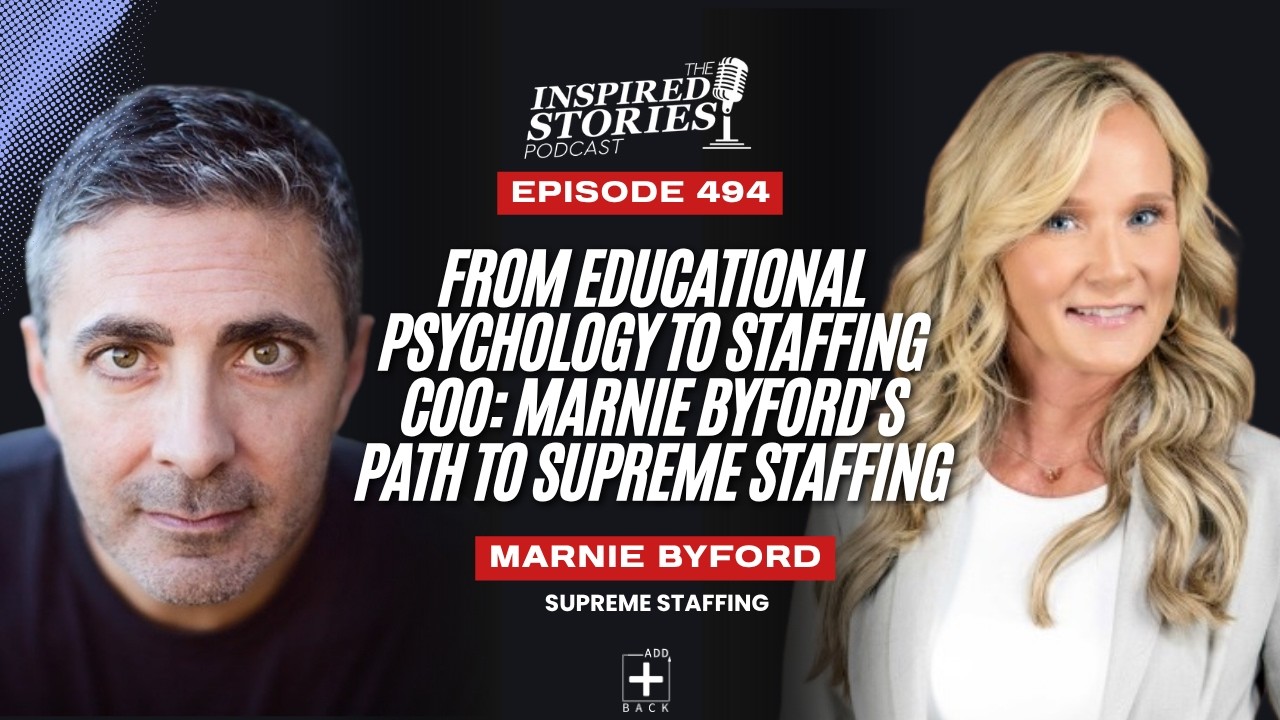
Marnie Byford is Chief Operating Officer at Supreme Staffing, a national employment agency connecting workers to opportunities in manufacturing, logistics, customer service, and office support across 22 locations. She came to the role through an unlikely path: a degree in educational psychology, nearly five years in disability day services, and a career in workforce management that her industry repeatedly told her she wasn't right for. Under her leadership, Supreme Staffing launched its own forklift training center, built a travel recruiting team, and achieved 7% turnover in an industry that averages over 400%.
✨ Key Insights You'll Learn:
Degree in educational psychology, early career working with adults with disabilities at Open Arms Care
Transition into workforce management through a Nike warehouse staffing role focused on training and development
Five years at SIMOS Insourcing Solutions, rising from safety and training manager to executive director of recruiting
Joining Supreme Staffing in February 2020, two weeks before COVID changed everything
Keeping doors open during COVID while competitors closed, providing grocery money and flexible schedules to retain workers
Growing organically through the pandemic and beyond through word-of-mouth customer referrals
Launching a forklift training center after four years of planning to address a critical driver shortage
Deploying a travel recruiting team to stabilize client sites across the country, including onboarding 200 workers in three weeks
Phone system automation that cut response time from four hours to one hour and grew Memphis walk-in traffic from 50 to 200 per day
Expanding to 22 locations with plans for Pennsylvania, Boston, Canada, and beyond
🌟 Marnie's Key Mentors:
Eduardo Sanchez (Owner, Supreme Staffing): Saw Marnie's potential, handed her the operational mandate, and gave her the private-company flexibility to build something the corporate world wouldn't allow
Open Arms Care Leadership: Grounded Marnie in humanization, patience, and learning people before judging them, skills she brought directly into staffing
Jason Nunez (Director of Operations): Started at the front desk at 18 and grew into the role under Marnie's mentorship, representing the internal development model she champions
Her Four Daughters: Daily motivation to model what it looks like to push past nos and build something in spaces where women are told they don't belong
Her Staffing Teams Across 22 Locations: Young, hungry, and eager to learn, they have been both the proof of her leadership philosophy and the engine behind Supreme's growth
👉 Don't miss Marnie's account of being told repeatedly that the industrial world wasn't for women, how she kept Supreme Staffing's doors open during COVID when everyone else closed, and the moment a former colleague called to say they had underestimated her.
Listen to the full episode here
Transcript
Anthony Codispoti (00:02)
Welcome to another edition of the inspired stories podcast where leaders share their experiences so we can learn from their successes and be inspired by how they've overcome adversity. As you listen today, let one idea shape what you do next. My name is Anthony Cotaspodi and today's guests spent nearly five years working in day services with adults who had disabilities holding a degree in educational psychology.
Not the obvious path toward running a national staffing operation, but that foundation in human development turned out to be exactly what the work required. She moved into an industry that often treats workers as interchangeable and decided to run it differently. Getting from that nonprofit environment to leading one of the region's most recognized staffing firms required some unconventional stops along the way. She is Marnie Byford.
Chief Operating Officer at Supreme Staffing, a national employment agency connecting workers to opportunities in manufacturing, logistics, customer service, and office support. Under her leadership, the company has launched mobile forklift training, low-cost healthcare for associates, and a service model that earned her recognition as Top COO of the Year and a spot on the Memphis Business Journal's Super Women in Business list.
Marnie started by caring for vulnerable people and ended up with the influence to shape how an entire organization treats its workforce. But before we get into all that good stuff, today's episode is brought to you by my company, Ad Back Benefits Agency. And you'll want to hear this because it's hurting almost every business owner you know. Health insurance costs go up every single year and staffing companies are furious about it. They're paying more, claims are getting denied.
Employees are opting out because they can't afford it. Their contract workers can't get coverage and it hurts turnover. It's one of the most maddening problems in running a business and everyone just accepts it. But you don't have to anymore. Now there's a program that gives employees unlimited access to doctors, therapists and prescriptions with no co-pays or deductibles to meet. But here's the part that really shocks most people.
Unlike with every other benefit on the planet, your net profits will actually increase. We recently helped a client add $900 per employee per year to their bottom line. Results vary, but gains like that can change how a business is valued. Get your free consultation today at addbackbenefits.com. All right, back to our guest today, the COO of Supreme Staffing, Marnie Beiford. Thanks for making the time to share your story today.
Marnie Byford (02:50)
Thank you for having me, Anthony.
Anthony Codispoti (02:52)
So Marnie, you spent close to five years at Open Arms Care, working in day services with adults with disabilities. Not the typical starting point for someone who ends up running operations at a national staffing firm. Let's talk about what first drew you into that work and what it ended up teaching you about how people actually develop.
Marnie Byford (03:12)
Yeah, absolutely. I get that asked a lot. My focus was just getting out in the world and helping people. I was actually supposed to go into forensic psychology. I actually was working with Department of Corrections here in Memphis. ⁓ So I was dealing with criminals and all that fun stuff. ⁓ I just happened to come across something that gave me a lot of teachings of
humanization. And I think that's really important to understand people understand, you know, what, what is it that people are looking for? Sometimes we have to slow down and just listen. ⁓ and I think that is the biggest thing that I have learned from that experience that allowed me to go into the realm that I'm in today.
Anthony Codispoti (04:00)
Say more about the humanization piece. What do you mean by that?
Marnie Byford (04:04)
⁓ I think sometimes we stigmatize a lot. It's automatically understood. If you see ⁓ a particular person in a situation, that's just what it is versus taking the time to get to know somebody, understanding their body language, maybe taking the time to build the rapport and just, I don't want to say study them, but learn them and allow them to be vulnerable with you. So you can understand maybe what can I do to help them to be better?
Anthony Codispoti (04:32)
And then at some point you decide to make a transition out of the nonprofit work into ⁓ corporate operations. What made you decide to make that move?
Marnie Byford (04:45)
⁓ I took some time off ⁓ and was focusing on my daughters and then I came across a great opportunity ⁓ in warehousing and ⁓ you know there's a burnout level in mental health and health care services and in the criminal side of the world ⁓ and so I was like you know what change is okay I'll do that.
And I ended up getting on boarded with Nike and a staffing agency and doing training and development and bringing people in and building up programs. Well, from there, it just kept going. And I just kept working more and more in depth in the staffing industry and started realizing that there was a tremendous gap between bringing in staff that need to complete, you know, labor and
How do we find those people? And I was like, ⁓ that's interesting. I love projects. And I got a great opportunity and I jumped on it.
Anthony Codispoti (05:47)
What do you think are some of the more unique insights that you're able to bring to the field based on some of the earlier work that you were doing in open arms care?
Marnie Byford (05:59)
⁓ I think it's just trying to be patient, understand behavioral processes of, people, humans, you know, ⁓ yes, are we looking for people to, ⁓ you know, get employed with the job we are, but I think we have to understand who they are and getting them matched to the right position. ⁓ and sometimes people automatically assume that if they have a bad background or if they're just not dressed appropriately.
Maybe they don't know how. And so I've taken the initiative to try to coach, you know, the teams that I've worked with on, Hey, let's guide them. Let's give them some, you know, teachable moments and some advice of, Hey, I know you want this job. This is what needs to happen. This is how we need to focus and, and tell me, know, what do you have going on? Cause in order for you to be successful at this job, you got to be able to do this. You know, do you have childcare issues? Right? If you do, then maybe this position is not it.
I think it's an educational piece and I think we miss that mark a lot when we're trying to find people ⁓ in the workforce. know, some people just don't know. I think we on the other side who are experts need to help educate and show them the way. There's always great people out there, but sometimes we have to teach them to get there.
Anthony Codispoti (07:20)
more almost more of a consultative approach or like you become like a mini life coach in the moment for them.
Marnie Byford (07:26)
That's a great way to put it, yes.
Anthony Codispoti (07:28)
Yeah. So kind of following the progression, you worked at ⁓ SIMOS. Is that SIMOS? SIMOS Insourcing Solutions. So this is a workforce management company that handled large scale staffing for manufacturing and distribution clients. You went into that not starting out in recruiting, but in the safety, quality and training manager. Why was that an area that you wanted to focus on to start?
Marnie Byford (07:36)
Seamos, Seamos.
Mm-hmm.
Because it was a high need ⁓ at the time it was a startup company and so kind of wanted to go in there and help develop the teams that needed to be to allow everybody else to be successful. ⁓ And so I was writing programs. I was training staff to what we need to do to make it right. And it gave me a lot of teachings to, you know, the dynamics of everything. The people that need to be in there, how the operation needs to work.
⁓ What are the good behaviors and the bad behaviors of people that can be in certain positions? Not everybody. You can say, know, Jane Doe, she has the skills, but is she really the right person for that position? Maybe not. And I try to study people to understand that so we can make the right set up.
Anthony Codispoti (08:49)
And how long were you at ⁓ CMOS?
Marnie Byford (08:53)
five years.
Anthony Codispoti (08:54)
Five years. And did you stay in that role the entire time?
Marnie Byford (08:58)
No, I actually started in the training safety world and then I moved up to regional director of recruiting, executive director of recruiting and then from there that's when I transitioned out after the business was acquired from a corporate company.
Anthony Codispoti (09:17)
Okay, so you transitioned out and you found your way to present day supreme staffing. How did that come about?
Marnie Byford (09:23)
Yes. ⁓
the owner, Eduardo Sanchez, ⁓ I worked with him closely in my peak seasons. And so he helped me with some of my highest staffing needs, ⁓ in the surrounding area. And we just built a great relationship from there. And so his company was, ⁓ is privately owned and he had one office in Memphis and, ⁓ he just sat me down one day and he says, Marnie, this is what I kind of want to do with the company.
And I just feel like this is the things that you have to bring to us that we can do that. And I was like, wow, change. I don't know. This is a big task, but I like projects and I sat on it for two weeks. And I was like, you know what? I think someone's actually listening to what I really want to do. have an opportunity to be able to kind of maneuver it and it not be corporate. It's privately owned. We're building it from scratch.
Why not? And I just kind of jumped on it and it has been the most amazing journey ever since.
Anthony Codispoti (10:29)
building it from scratch, but he already had something in place. It's just really wanted to do something much bigger and better with it. Okay.
Marnie Byford (10:33)
Yes.
Yes. Yes.
He was, he was looking to grow the company. ⁓ like I said, it was just maybe, maybe 20 clients, one office space, maybe 10 internal people. are now at, we are in our own established headquarters. That's a year old. ⁓ and we're in 22 different locations. We have over, ⁓ 90 customers, ⁓ and we're steady growing. Yeah.
Anthony Codispoti (11:04)
Wow. It's
interesting when he sat you down and had this conversation. In so many ways, this really spoke to you and what you enjoy and what you wanted to do, but it took a couple of weeks of kind of marinating with it. What was the hesitation early on?
Marnie Byford (11:24)
Change really, you know, I was like I'm a loyal person and I like giving my dedication to wherever but at the same time ⁓ There was a lot of things I still wanted to accomplish I think I I got to dive into an arena that wasn't originally where I started my career But I was loving it. I love projects. I love educating. I love teaching. I love building ⁓ and This opportunity with supreme staffing was going to give me that at a hundred percent
Whereas I was set in a certain platform, you know, where I currently was at that time. And I really couldn't make those kind of moves. And I wanted to, because I was like, Ooh, we need to do this to be able to better to do that. And, you know, it's kind of hard doing that in the corporate world. So giving the opportunity in a private sector and given the range, it's like, you know what, Marnie, this is your opportunity. You better grab it.
sometimes those doors only come one time. And so I did it.
Anthony Codispoti (12:27)
So distill it down for us, Marnie. What does supreme staffing do and who does it serve best?
Marnie Byford (12:34)
Sure. ⁓ We're a staffing agency. Light Industries is our primary focus of customer service, ⁓ but we have extended ⁓ a lot of different programs within the company. We have our forklift training center. We have our direct hire services. We have our lumping services. So ⁓ we service to the community and helping ⁓ our customers meet to the demands of their staffing labor.
And we really focus in strongly on our customer service and investing in people. That is probably the biggest and best thing we've ever done and allows us to have the organic growth that we have. ⁓ I always say when you invest in your people and you take care of them, they're always gonna take care of you. They're always gonna take care of the business. And that's what we do. It's like a family-based unit. We operate.
on the business, we also keep in the mindset as a family.
Anthony Codispoti (13:35)
⁓ We've mentioned the forklift training a couple of times once in the intro. You just brought it up now. Tell us about this and why in particular this is such a big deal.
Marnie Byford (13:45)
⁓ because forklift drivers are such a high demand, especially since COVID came across. ⁓ it changed the directory of the market, right? Everybody learned what e-commerce was and staying home and ordering versus going into a store. Well, that changed how, you know, warehouses operate. And so that means they need to do more unloading, loading, stocking, palletizing, ⁓ putting back in racks. And so forklift driver positions just.
you know, they blew up and there's not really any trainings around the cities that ⁓ give the people that they need the tools to be the forklift drivers that they need. ⁓ And so trying to find people with experience is very hard, especially in a market that's so heavily saturated. And there's just not a lot of programs out there that teaches people that.
You know, listening to our customers, listening to the community, like, we can give back to the community, investing in people. We're going to open up a program and it's going to service to our customers. And we're going to train people who have no experience and maybe current experience and need refreshers. And it has been the best move we've ever made.
Anthony Codispoti (15:02)
And so who pays for this?
Marnie Byford (15:04)
So we invested in it, we paid out at 100%, and then we give to our customers what they need. And so it ends up being a return for us.
Anthony Codispoti (15:13)
wow. Okay, so you've got, you know, 90 customers, bunch of them need a bunch of forklift operators. You can't find them. So you're recruiting people, you know, from each of these local jurisdictions, and you're putting them through the program, no cost to them, no cost to your client. And but now everybody wins because you found this person a job, you know, your client has filled their need. And you know, you guys have satisfied your customer.
Marnie Byford (15:38)
Yep.
Yep. Investing in people.
Anthony Codispoti (15:42)
Yeah. So I'm interested to hear, let's sort of stick with this theme for a bit, the investing in people and the forklift training is a great example of that. And, you know, when you guys were really small, it's easier for you to, you know, kind of put your thumbprint on this is how we invest in people. This is how we take care of our folks at every level. You guys have grown to what did you say? 22 locations? Yeah.
Marnie Byford (16:09)
Yes.
Anthony Codispoti (16:13)
How do you think about putting systems in place that ensure that that same level of investment in people is taking place at all those 22 locations?
Marnie Byford (16:25)
Great question. It really has taken a really hardcore team that we've developed internally. The operations team is just magical. ⁓ They're young. We have a very young team, but they're hungry and they're eager to learn. know, Eduardo has always taken pride in, let's teach people, let's educate them, let's build them. And that's how I like to think. And so that has been the greatest thing that we've ever done is
We bring people in and if they're interested, let's teach them. And we've just grown. They've always learned every piece of the business. They'll start at our front desk, they'll go to recruiting and then they build up. One, my director of operations has been here since he was 18 years old and he started out as front desk and here he is today, director of operations and he is the greatest gift that we've ever had. ⁓ So we're teaching them. Absolutely. His name is Jason Nunez.
Anthony Codispoti (17:18)
What's his name? Let's give him a call out.
Love it. So no surprise, you've been in the industry for a long time. The staffing industry has a reputation for really high turnover and really tight margins. Not a lot of room margin for error there. So I hear you talk about the investing in people, which is a huge part of what has led to your success. Are there other things you found that have worked? First, let's talk about reducing the turnover, then we'll go to the margins.
Marnie Byford (17:54)
Yeah, think, you know, one of the things and we actually had this conversation the other day, overall staffing percentage turnover is about 414%. And we just went with one of our customers for our ⁓ QBR and we're at 7 % turnover. That's very hard to have. ⁓ But what we do is we have a lot of people on our team. It's all hands on deck.
⁓ We take pride in customer service, talking to our customers. So where some companies may have five people, we have 20. So the employees are always touched and spoken to, our customers are always touched and spoken to. ⁓ We're always sitting inside ⁓ at our headquarters and talking about and planning. If there's a miss, what do we do? How do we improve it? ⁓ And so we're always on it. There's never a gap.
One of the things that we get the greatest feedback on our customers is customer service. We're responsive, we're timely. We have an army that will service to them at any moment. ⁓ We may have one recruiter, ⁓ but we have 10 other people that support that recruiter so they can continue to focus, but they're touching all different dynamics within the warehouse sector of whatever the need may be.
Anthony Codispoti (19:13)
So that is a great lead in then to how do you guys address the really tight margins? Because I'm hearing you say that one of the things that sets you apart is you just, know, one staffing firm might have five people to support, you've got 20. Well, that's great from a customer service perspective, but now you've got additional labor costs. So talk to me about the margins component of all this, Marnie.
Marnie Byford (19:39)
Yep. We really focus in and we hired our CFO three years ago to help us kind of look at how did these numbers work and how do we focus in building our sales team? ⁓ We educate our customers on, you know, what does the markup look like to be able to make this work for them and ensure they're winning and we're winning at the same time. And so we really just sit down and make the math work between the customers and I in service to them.
and ensuring that, you know, if there's a budget need savings over here, but we still need to be able to manage here, we sit down together and just say, this is the happy meeting to make it work. And we understand that sometimes partnerships are not always going to be what they can be. And the financial aspect is we're always being very transparent with our customers of saying, hey,
This is what we can do for you. Here's our markup. Here's how we're going to give you some cost savings. We'll take some things off your plate and be able to still make the mark where you need to be. And it's always been in our favor. We're transparent, we're open, and we educate them even on the financial side.
Anthony Codispoti (20:49)
Marnie, your academic background is educational psychology. When you're working through a complex operational problem, does that training show up in how you think? And if so, can you give a specific example?
Marnie Byford (21:06)
Absolutely, all the time. My team actually says to me, Marnie, you're always thinking ahead and your gut is never wrong. And I think it's because I just truly try to analyze the situations. ⁓ I guess a good example would be probably last year, I think it was in October, we just had ⁓ a situation where a customer is trying to ramp up and how they were doing the ramp up was not gonna work with how the community is and what labor was out there.
And so I just started studying the market, did some researches, ⁓ did some interviews with some employees or potential employees. And I just went back to the customer and said, hey, in order for us to make this work, this is what we're going to need to do. And we're going to need some partnership behind that. ⁓ I'm going to ask for an increase on the side for you guys to be able to service to us so we can make it happen. And then at the end, we'll we'll give a bonus at no cost to you.
⁓ so we can, you know, close, close the gap of where you got to go for, for this, ⁓ holiday season. And so, ⁓ it worked. ⁓ we were able to bring employees in. We had a staff over 200 people within three weeks and, ⁓ we were able to get them in. We had some people fall off, but we always kept our pool moving so we can backfill quickly.
Anthony Codispoti (22:11)
give a bonus to the employee, to the worker.
Marnie Byford (22:33)
And then at the end, ended up rewarding every employee and came out to a total of $32,000 in bonuses given. And you just don't see that in the standard staffing agencies, but it worked and there was no loss.
Anthony Codispoti (22:47)
Wow. Sounds like a very creative solution or is this is it is it ⁓ a tried and tested approach that you were using there?
Marnie Byford (22:59)
No, it was really just, is a gut feeling. And I think we really should try to do this. I've seen how there's failures in the past of what doesn't work when you're trying to onboard in such high volume peak seasons. And we need to steer away from that. And we always go back to investing in people. And sometimes you have to spend the money to make something happen. And it ends up coming back for us always.
Anthony Codispoti (23:26)
What's something about running a staffing operation that would surprise most outsiders?
Marnie Byford (23:33)
⁓ I think a lot of people think staffing agencies just make all this kind of money and it's not like that at all. It really requires a lot of mindset of having the right partnerships, having the right team, and being able to truly ⁓ be able to keep the applicants that you have coming in employed ⁓ because that's truly where the magic happens. ⁓ And I think the other thing is a lot of people think it's really easy just
hey, there's people out there, they need jobs. It's not that easy. It really takes a lot of grit and grind to find the right people and get them onboarded and to keep their jobs. So the day to day is nonstop. There's never really a pause. You just gotta keep moving.
Anthony Codispoti (24:19)
Can you give a specific example, Marnie, of a time where your team went well beyond what either a client or a candidate expected and what that interaction told you about the culture that you guys had built there at Supreme?
Marnie Byford (24:35)
Sure. ⁓ We actually had a new customer that was actually going through a transition. so internally, they had a lot of management shifts and changes. And so some communication on their side was broken. ⁓ And we were given an order of what we need to fill. Didn't go so well. And so what we decided to do and what we did about three years ago was build what we call a travel recruiting team. And we saw it.
kind of going to the left and we immediately deployed our travel recruiting team to the site. And because they were having so many changes with management, we decided to say, hey, let's educate our customer and say, this is what we're seeing. This is what's happening. This is our feedback. And we helped kind of take over the floor for a little bit, get it restructured, reorganized, set up while they're focusing on their business. And we ended up hitting every volume goal, KPI, and it
And all it did was we stood up, we invested in our customer and we sent out a whole team to go in and take over, stay there until it was fixed, make sure that everything was aligned. Then we hired in people locally so they can be there full-time, train them up. And then we pass the reins off to everybody. The customer was not anticipating that, didn't ask us for it. But that's what we wanted to do and give to them, the customer service experience.
⁓ We didn't want to fail because our failure is their failure. And so if they need to focus on what they got going on, that's what we're here for. That's what we do. And it worked. ⁓ And we are able to send ⁓ anybody anywhere at any time.
Anthony Codispoti (26:20)
What do mean by that? Send anybody anywhere at any time.
Marnie Byford (26:23)
We have developed a ⁓ travel recruiting team ⁓ that is pocketed in Memphis, but we have enough people that ⁓ if there's a need, we send them out and travel. And then my ops team, if they need to go, they'll go. It's always an all hands on deck if there needs to be.
Anthony Codispoti (26:44)
So what does that look like for recruiter based in Memphis and I'm going to make up a city you've got, you know, client in Lexington and they need, you know, 150 employees right away. So what do you do? You send somebody into that city and are they knocking door to door? Like, what's, what's your process?
Marnie Byford (26:52)
Mm-hmm.
so we start here. We start with, you know, all of the job platforms that we have to be able to do our postings. ⁓ we have a marketing and advertising manager that creates flyers, ⁓ you know, digitally, ⁓ hard copies, create, ⁓ yard signs, and then we send out to the team. do a market study, ⁓ seeing what we have going on, where is the strong points, the weak points, and we just deploy the team and they are deployed until we get what we need to do.
And in the same time, we are also interviewing to get the right people in place locally. And we just manage it from there. At any time, if there needs to be more people going, we'll look at our teams dynamically across the United States. And if we have the availability, we'll pull from different locations to have them go out there until we stabilize it.
Anthony Codispoti (27:53)
So I want to dig in a little bit if you don't mind and tell me if we're getting too far into the secret sauce here because I'm thinking to you say that some people say, it must be easy. So many people are looking for jobs. From my perspective, you know, having owned a business and hired people before, it's hard to find the right fits for things. And you're talking about going into geographies where you don't have the home base. And so I hear you saying that use the digital platforms, the different job boards, you know, that other people are leveraging. But then you're
Marnie Byford (27:58)
You're okay.
Anthony Codispoti (28:23)
physically printing things out and yard signs. And so how are you distributing those things in the local market that you're heading into?
Marnie Byford (28:31)
Yep,
our recruiting team that goes out and travel, they'll get out there and they'll just hit the ground running. ⁓ We will do it until we get it right and get it done. And then we try to, you know, recruit and source different people while we're out in the community. And some people want to, hey, we'll help. Hey, we'll do this. So we just try to make sure we're ⁓ touching everything we possibly can and just investing into the area.
as much as possible.
Anthony Codispoti (29:02)
Does that mean like you're going to churches and like community centers? You're just knocking on like doors like going, you know, through a neighborhood?
Marnie Byford (29:10)
We go through grocery stores, laundry mats, we go to job centers that maybe, you know, they may do job fairs. We look and see if there's any available ⁓ career fairs going on. We go to schools if they're local universities, maybe high schools, if it's like now it's May, so people are graduating. So we try to target as much as possible.
Anthony Codispoti (29:34)
And then once you have found folks and you know, we're talking about an industry that you said, I think it's over 400 % annual turnover. Sorry to laugh. It's not funny. It's just such a ridiculous number. Uh, and you know, with that one particular client, you guys were in the single digit, you know, percentage, which is insane. Like what are some things that you have found that once you've got some folks that you do a better job of retaining them? How do you hold on to?
Marnie Byford (29:46)
It's high.
We talk, there's a lot of conversation with AI, right? AI kind of removes the human person. We have to deal with AI, AI is inevitable, it's here, we're dealing with it, has some great resources to it. But we never want as Supreme Staffing to lose the humanization part of our business. And so we're always going to be that live person in real time, communicating with those employees, communicating with our customers.
We don't want them feeling like they're just calling and calling and calling and they're never talking to somebody. We always want to make somebody available to the employee, to the customer at any moment, at any time. ⁓ My phone rings all kinds of hours. I have specific emails so they can have immediate touch to me as well. So we're making sure that human touch is always there.
Anthony Codispoti (30:53)
You've been building and developing teams for close to two decades now, Marnie. What's one thing that most managers get wrong about growing the people around them and how do you approach it differently?
Marnie Byford (30:57)
Mm-hmm.
I think where it falls is communication and having that consistency of communication. We get busy in our day to day and we always have a lot on our plate. But people like feedback. People like to understand where do they stand? know, is it good? Is it bad? What can I do better? And people still sometimes need special tools. You have to understand how does a person learn? How does a person ⁓
How are they able to retain the information needed to be successful? And I think what we do differently, and what I like to teach my teams differently is to approach it with a one-on-one stance of understand that person, ask questions, understand their body language, and understand how they learn. Some are hands-on. Some need a book. Some need to take notes. Some need to have visual tools. Some need a reference book to carry around with them.
Let's understand that and let's give them the tools that they need to be successful. ⁓ And I always train my staff to be patient, be patient, listen, ⁓ and be open to learn at all times. But communication and consistency is very, very important for people to be able to be successful. If I'm going out there and I'm pushing a chair around in different places, because that's where I think people need to sit, but that's not where they need to sit, but nobody tells me, I can't fix what I don't know is broken. So tell me.
so I can fix it and make it right.
Anthony Codispoti (32:36)
Marnie, you started at Supreme Staffing, ⁓ a very ominous time, February of 2020, ⁓ right as we're headed into the COVID pandemic. Talk to me about what the arc was like for you guys in COVID. Every business, every industry was different. And I see the sort of the body language on your side. There's a story to be told there. Walk us through it.
Marnie Byford (32:43)
Hehehe
Mm-hmm.
Wow, that was a learning curve. I don't think anybody was prepared for what we were coming at and what we were gonna deal with. And it required, especially myself, really learning and understanding what are the laws, what are the regulations, what are we gonna do? And our line of business was a required business that still had to maintain and keep open. How are we gonna do this? And... ⁓
And the irony behind it was where so many places were shutting the doors, ours were opening. Ours were opening and we had to figure out how are we going to meet to the demands of the customers because nobody else was. And so it was also an advantage point for us as well to say, ⁓ let's grab this, let's figure it out and let's run with it. ⁓ And so what we decided to do was we did not close our doors, but I got myself
quickly abreast to what were the regulations, the laws, the guidelines everywhere that we were. And I still traveled. ⁓ And if we needed employees to work remotely, we allowed them to do that. We also, though we knew that businesses were closing grocery stores and stuff, we were actually investing in our employees and giving them grocery money so they can go to the grocery store, have food that they need, still be able to work and still service to our customer.
And we were probably the only staffing agency in the local areas that was nonstop. And that's how we actually were able to obtain more customers in that arena is we just said, you know what? This is what we're going to do. We're going to keep our doors open, but accommodate to our employees so they don't feel overwhelmed and scared because they have children. Schools were closing. People need to be at home. Well, we're going to make it work. And so we kind of met to what everybody needed at the moment to still be able to operate.
And then listening to the applicants needing to come in that still wanted jobs, needed jobs, and we gave some incentives to them as well. Listen, we know it's gonna be hard, but we need this. And in order to make that work, this is what we're gonna do for you. And I stayed very closely with the team ⁓ on the different changes that were happening every day and actually speaking very closely with the applicants. ⁓
Marnie, I'm a little worried. I'm scared. I can't come in. My child has this. What do I do? And I educated them on it. And we were able to just meet to every customer's demand. It was not easy. It was probably the hardest arena we ever walked through. But we just did not take the time to sit down and overthink it. We just did it. And it was in our favor.
Anthony Codispoti (35:47)
You guys grew during this time period.
Marnie Byford (35:50)
That is when we really grew because we took our customer service level to a different space. And I think that's also where our staff really started trusting us because we invested in them to allow their personal life to still be met, but still at the same time having the business part of the world met as well. So if they need to be home and they could still work, we allowed that to happen. Grocery stores were shutting down, but they were working. Here's some grocery money. We did rotation schedules so they can go to the grocery store.
and then they can still come back to work. No penalizations. If their child was sick or if they were sick, we allowed them to be at home and still get employed, still be able to staff to our customers. And we found the people that were still thriving to work and we hit the mark.
Anthony Codispoti (36:37)
So in the early stages, you guys grew because you did things the right way. You rolled up your sleeves. You're just like, we're going to figure this out in a hard time period where some of the other staffing firms were maybe pulling back. What was it like for you guys coming out of COVID? Did you continue to grow? A lot of staffing firms I've talked to, they leveled off. A lot of them declined afterwards. What did you guys see?
Marnie Byford (37:01)
We actually continued to grow. had a lot of customers that I think took pride in the customer service we gave and start communicating to their partners or to people they may know saying, hey, we are recommending. A lot of our growth has been organic. Word of mouth. Hey, we know this staffing company that'll probably be, excuse me, a great fit for you. And that's been probably our greatest asset. So we didn't slow down. We actually kept getting busier.
Anthony Codispoti (37:30)
And, you know, since COVID, largely because of COVID, the labor markets really shifted significantly. Where do you see the staffing industry heading? And what are you guys at Supreme Staffing doing right now to be positioned for
Marnie Byford (37:37)
Mm-hmm.
Yeah. The market, the markets are challenging. I think we're all seeing it. We're all feeling it. You're seeing massive layoffs across the United States. ⁓ But at the same time, we're trying to stay engulfed in understanding what does the market look like? What is the pay rates happening? How are the laws changing? And that's where I come in and I take pride in the education piece of it. I stay in tune of learning and I educate our customers. I probably do more market researches than I have ever.
in years. ⁓ I pump out two or three a week for our customers and saying, hey, I think we really need to look at this. Though I know the COVID pay rates may have ⁓ come off, you still have some neighbors paying this. And in order for us to hit your needs, how can we partner? Let me show you, let me give you the data, let me educate you. And that's been a great tool for us is just keeping our customers educated and staying in tune to what's happening in the market so we don't fall off too far.
and we end up struggling.
Anthony Codispoti (38:46)
In that market research that you're talking about, Marnie, you're specifically referring to what's the going pay rate.
Marnie Byford (38:53)
What's the going pay rate? What is the turnover rates? What are some competitors doing? What is it that is coming? There may be new things coming or maybe what's going? Is there a layoffs coming and we may have a new pool of people coming in that were at this pay rate and maybe the customer can invest in adjusting some things to meet to their demands. So it can vary from a variety of different aspects.
Anthony Codispoti (39:21)
Are you guys leveraging AI at all? It's supreme staffing right now.
Marnie Byford (39:25)
We do, yes.
Anthony Codispoti (39:27)
How does that come into play for you?
Marnie Byford (39:30)
We utilize it to help build some things that ⁓ are required in our business. ⁓ But we don't want to go full force into AI and take away the human piece of our business either. There's a lot of people out there that everything is online, you do everything online, you communicate email, we still have the phones, we're still picking up phones, we're still meeting people, we still tell people come in and see us to complete your application. We don't want to do everything, you know, online. We need to see you.
understand you so you can see who we are and what we can provide.
Anthony Codispoti (40:03)
Are there any, whether it's AI specifically or just bigger technology umbrella projects that are underway that you're particularly excited about?
Marnie Byford (40:14)
⁓ I think right now we in the last two years we implement implemented a lot of new technology within you know to meet to the high push demands we have and remove some of the manual work. So we're pretty we're pretty we're pretty good place right now with that but we're still keeping in tune to some little small niches here and there of technology we need to add on but not too too crazy.
Anthony Codispoti (40:40)
And so some of those earlier automations that you put into place in the last couple of years, maybe pull one out and talk about it. Tell us ⁓ what it was that you guys did and the pain point that it's solved.
Marnie Byford (40:50)
Sure. ⁓ Our automated phone services, ⁓ our call volume just went through the roof. We just could not keep up with answering the phones, returning phone calls. And so we put in a call service that allowed us to put a call tree that allowed us to do some ⁓ push of ⁓ links for them and then being able to still follow up on our side. And it has been a great resource for us.
⁓ and allowed our team to be able to still do their day to day and not be overwhelmed just answering a phone. And then we actually increased our staff to focus more on being a part of the phone service and being able to pass off ⁓ because the call volumes are just, they're just a lot.
Anthony Codispoti (41:38)
I'm going to put you on the spot and tell me if it's not appropriate or if you don't know them. But do you have any numbers sort of, I don't know, before and after before, you know, people waited this long on the phone or whatever sort of the guiding metric was there.
Marnie Byford (41:53)
Sure,
sure. We went over this about six months ago and we had prior to us putting in a phone service three years ago, I'd say we get a call volume of like maybe 100. A lot of people come through the door six months ago per recruiter. And then six months ago we get and looking at
Anthony Codispoti (42:11)
100 per
Okay.
Marnie Byford (42:22)
how the ⁓ call service was keeping track of everything. We had over 3000 calls a day across the board ⁓ and it was just mind blowing. But because we put that in place, ⁓ our turnaround time of answering the phone went from four hours to one hour because of the phone service. So that was tremendously helpful. And then our volume, because we were able to communicate through this call service.
Our walk-in volume through our offices, I'll call out Memphis, went from maybe 50 to 200 a day because a communication was put into the service.
Anthony Codispoti (43:03)
And in that case, the walk-in traffic, higher is better in that case. You want them there. That tells you that that communication process from your new phone system is working.
Marnie Byford (43:07)
Yes. Yep.
Anthony Codispoti (43:15)
⁓ Let's shift gears here Marnie. What is the hardest thing that you've ever had to overcome personally and what did going through that teach you?
Marnie Byford (43:27)
Good question. think the hardest thing was understanding that I can do it and letting go at the same time. ⁓ You know, in this industry, it is not women dominated, it is very male dominated. And so I got a lot of nos, I got a lot of you can'ts, I got a lot of no, Marnie, you're just not the right fit for that. You know, you're just not, you know.
the person that can take the hardcore stuff. And I was like, well, you know, just give me a try. ⁓ And I think continuing to push and not throw in the towel when somebody told me no was just the exact motivation I needed to keep moving forward to get where I am today. ⁓ And I take pride in that. I actually had somebody, I think it was like three months ago, reach out to me and they used to be somebody I worked with and they said, you know,
I really underestimated you. This is a ⁓ place where it's so male dominated that I didn't think you could survive it and you did it and you're still going and I'm really proud of you. So it was really nice to hear that.
Anthony Codispoti (44:40)
So I want to hear a little bit more about this. People telling you no, that you can't do it because the environments in which you're placing people are maybe a little rough and tough. Like these are light industrial jobs. Is that kind of what the mentality was? Like they think you need to be like a rugged man in order to be able to find the folks to work in these environments.
Marnie Byford (45:03)
I think that and that it just is a rugged man to be in the warehouse operation world. A female doesn't belong there. A female belongs behind the desk. A female belongs answering a phone. A female belongs counting the dollars, but never in the front line, never running in operations because that's the man's world and nothing against men. We all need it, ⁓ you know, but there's a lot of women and this company. ⁓ What we've also taken pride in is
were predominantly all females.
Anthony Codispoti (45:35)
so most of your office staff is female. Okay. And then in these environments, you're placing mostly men. No.
Marnie Byford (45:43)
No, we
have majority females. have men on our staff, majority females.
Anthony Codispoti (45:49)
So the folks that you're placing in these warehouses where women are typically not supposed to be are mostly females as well.
Marnie Byford (45:55)
Mm-hmm.
⁓ Our internal staff, yes.
Anthony Codispoti (46:01)
Okay, but the frontline staff that you're placing.
Marnie Byford (46:03)
The frontline staff is a mix.
Anthony Codispoti (46:05)
Okay.
Interesting. And so when you're getting that pushback from folks, ⁓ and sometimes they're probably saying it directly, and a lot of times they're not, but you're you get the vibe. How are you dealing with that?
Marnie Byford (46:19)
I always tell my team when I sit down with them, you guys got it. You're good at what you do. Don't let them get to you. You know, I have your back and they just keep pushing. They're hungry. They're eager. They're young. So their mindset is just morning, guide us, tell me what you need. Tell me what we got to do. And we just do it together. And I will always keep pushing. They're like my children. And I always want to keep them growing and being the best that they can be.
Anthony Codispoti (46:46)
Are you a parent? have kids? ⁓ Boys, girls? All girls.
Marnie Byford (46:48)
I am.
All girls, all girls,
four daughters and one granddaughter.
Anthony Codispoti (46:55)
Okay, so
what a role model you are for young women coming up to have a strong female presence in their life is, hey, you can do anything. You can play in any arena that you want to be in, right?
Marnie Byford (47:10)
Absolutely. I push for that every single day.
Anthony Codispoti (47:13)
Where is Supreme Staffing going? What are some of the new areas that you guys want to grow into? Whether it's geographies, industries, new services. Tell us what the vision is.
Marnie Byford (47:28)
Definitely. ⁓ Well, we're definitely growing. ⁓ We're open to be across the United States. We've just gone into Pennsylvania as of yesterday. ⁓ We're going into Boston. ⁓ We are interested in going into Canada and expanding our routes across the borders. ⁓ We have some of our local businesses that also go into Mexico. So we're excited about that ⁓ and just spreading our wings as far as we can.
⁓ You know, nothing is impossible. ⁓ And we always believe that I'm possible. And we operate in that mentality. ⁓ If a customer comes to us and says, hey, can you do this? We'll look at it and we're like, we'll make it work. And we do. ⁓ So we won't say no unless we have to say no.
Anthony Codispoti (48:17)
Yeah. I imagine that going into a new state introduces a new set of learnings, a new set of challenges. There's different, you know, employment, labor laws and all kinds of other things I don't even know to ask about. But going into a different country has got to be like, I don't know, 100 times more confusing, like a bigger lift. Talk to me about the thought process that goes into that.
Marnie Byford (48:46)
a lot of research, a lot of understanding what are the dynamics that have to be there to make it work and having a great legal team to help back us on what we're doing, making sure we're staying in line and making sure that we're really prepared for what we're gonna do. ⁓ For example, our Forklift Training Center was in our project bed for four years before we launched it.
So if we have to study it before we do it, that's what we're gonna do. And we know going, especially into another country like Canada, if we have to study it until we're ready, that's what we're gonna do because we're gonna go in and we're gonna go in with a bang.
Anthony Codispoti (49:25)
And when you go into a new market, is it driven by having an existing customer who has a location somewhere else or you guys just identifying, ⁓ let's go to Canada. Like, I don't have any business there yet, but we're going to find it.
Marnie Byford (49:40)
Well, twofold. ⁓ Majority is because a customer's going there, but we've also gone where we're like, we really want to go there and we'll go there and we'll establish something and then we build onto it. And that has been some of the fun, ⁓ intriguing journeys ever because we learn a lot in that process, especially when we're going in there and we have nothing, but we know we need to get something.
And we just, learn a lot on that process.
Anthony Codispoti (50:11)
What's an example of a geography that you approached exactly that way?
Marnie Byford (50:15)
⁓ We went into, ⁓ where was that? It was in Utah. Utah.
Anthony Codispoti (50:22)
And
what told you that you wanted to be in Utah?
Marnie Byford (50:25)
It was a growing city and there was a lot there that was happening and the market was right. And so we went in there and we just, put the sales team there, knock, knock, knock, knock, knock, knock, knock, we're not even taking no, we're gonna come back, we're gonna come back. And it's been great and now it's been growing ever since.
Anthony Codispoti (50:47)
In this role, Marnie, what do you most want to be remembered for?
Marnie Byford (50:53)
how I made people feel, how I gave them something to be proud of.
Anthony Codispoti (51:00)
No, I like that. What's your favorite thing to do outside of work? Any hobbies?
Marnie Byford (51:07)
⁓ I love nature. I love the beach. So I love traveling ⁓ and I love family and spending time with them ⁓ and just, you know, diving into watching my children be the people that they are and watching them, you know, dive into their journey. So they keep me busy. I try to keep myself busy with traveling ⁓ and just enjoying family.
Anthony Codispoti (51:33)
Do you have any books or podcasts, maybe other resources that have been especially interesting or helpful for you in your own development that you'd like to recommend for our listeners?
Marnie Byford (51:45)
⁓ I don't have specific ones. just dive into different arenas and read a lot. So if I was to say anything, educate yourself, read all the time, know, find something out there that is helpful to you or maybe speaks to you and open the book, listen to the book if it's audio ⁓ or attend conferences if you want to learn more, but never stop educating yourself.
Anthony Codispoti (52:12)
Marnie, I've just got one more question for you today. But before I ask it, I want to do three quick things for the audience. First of all, anybody who wants to get in touch with Supreme Staffing and Marnie Beifert and learn more about what they're doing, their website address is supremestaffing.agency, not dot com. So listen to that supremestaffing.agency. That is a valid address. You can type it in exactly as you heard me read it. It'll be in the show notes. Supremestaffing.agency.
And if you're enjoying the show today, please take a moment to subscribe wherever you're listening. It also sends a signal that helps others discover our podcast. So thank you for taking a quick moment to do that right now. And as a reminder, you can finally get your staffing employees access to therapists, doctors, and prescription medications that counterintuitively actually increases your company's net profits. No copays, no deductibles.
and net profit increases that can change how a business is valued. And it works for those frontline workers too. Contact us today at addbackbenefits.com. So last question for you, Marnie, a year from now, what is one very specific thing that you hope to be celebrating?
Marnie Byford (53:24)
A year from now, well, I'm going to be turning 50 and just crossing over that threshold and celebrating life because it's been a journey. So, you know, and watching my children be successful at what they're doing every day.
Anthony Codispoti (53:40)
Love it. Marnie Beifert from Supreme Staffing. I want to be the first to thank you for sharing both your time and your story with us today. I really appreciate you being here.
Marnie Byford (53:50)
Awesome. Thank you so much for having me.
Anthony Codispoti (53:52)
Folks, that's a wrap on another episode of the Inspired Stories podcast. Thanks for learning with us. And if one thing stood out, put that into action today.
Connect with Marnie Byford:
Website: supremestaffing.agency
LinkedIn: Marnie Byford