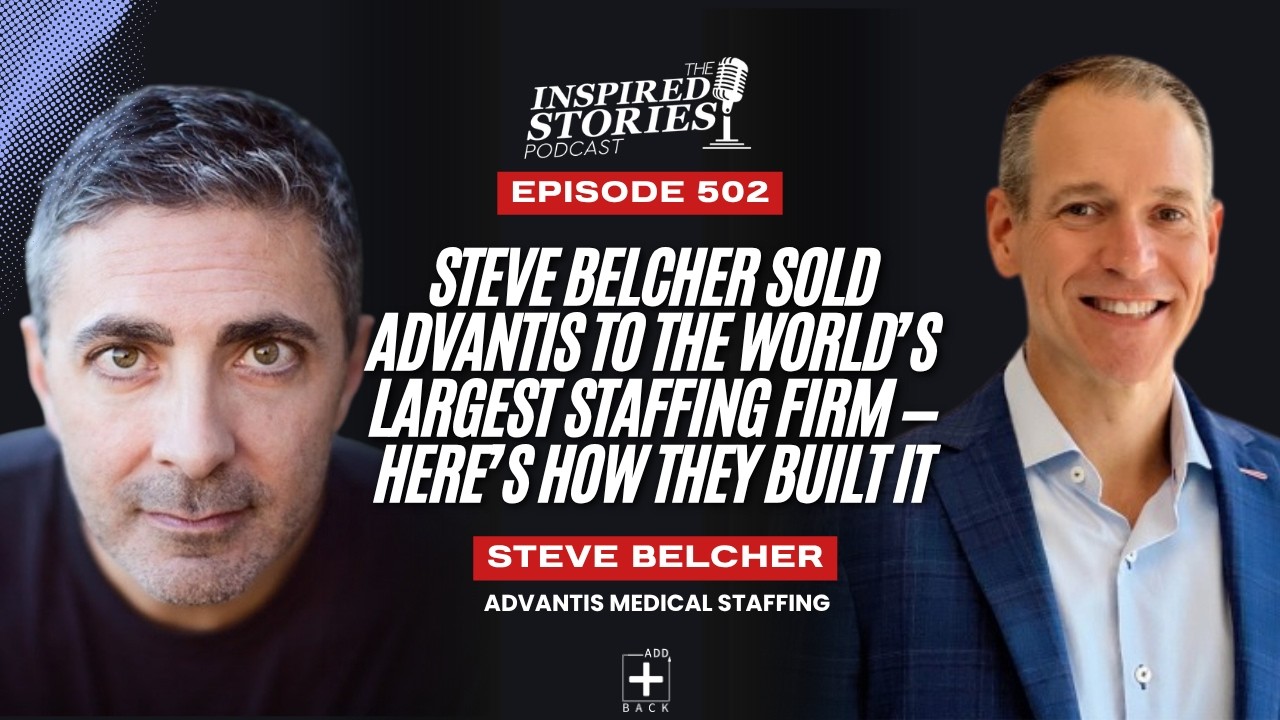
🎧 From Blue Collar Beginnings to Adecco Acquisition: Steve Belcher’s Staffing Journey
Steve Belcher, co-founder and president of Advantis Medical Staffing, built a Dallas-based travel nursing agency from a laptop and a cell phone to one of the Inc 5000’s fastest-growing staffing firms — then sold it to Adecco, the largest staffing company in the world. His story spans a lawsuit in the first 30 days, a 50% post-COVID revenue cliff, and a proprietary AI agent built before the term was trendy.
✨ Key Insights You’ll Learn:
Blue collar upbringing to Virginia Tech business degree
First staffing internship at 16 as a file clerk at Aerotech
Aerotech’s feedback-as-gift culture that shaped his leadership DNA
Opening a new market from scratch in Virginia Beach with no brand recognition
Launching Advantis Medical in 2018 with four partners and zero revenue
Surviving a first-30-days lawsuit with no revenue yet generated
Hockey stick COVID growth: onboarding 15 recruiters per month at peak
Post-COVID 40–50% revenue cliff and identity crisis tied to work
Building Emma, a proprietary AI recruiting agent two years ahead of the curve
Adecco acquisition thesis: platform company with technology, people, and process
🌟 Steve’s Key Mentors:
Aerotech Leadership: feedback culture, discipline sales approach, and blueprint for building staffing firms
Dan Pollock (Co-Founder): college-era critic turned business partner; wrote the letter that challenged Steve to grow up
Jimmy Tanner (VP): culture carrier during hypergrowth who modeled early-company behaviors
Raul (Director of Technology): built a custom ATS from scratch and drives AI innovation at Advantis
His Wife: primary support system through the industry downturn; held the belief when he couldn’t
👉 Don’t miss this candid conversation about what it really takes to build and sell a staffing company — from surviving litigation on day one to navigating a years-long industry free fall.
Listen to the full episode here
Transcript
Anthony Codispoti (00:00)
Welcome to another edition of the inspired stories podcast where leaders share their experiences so we can learn from their successes and be inspired by how they've overcome adversity. As you listen today, let one idea shape what you do next. My name is Anthony Cotaspodi and today's guest built a healthcare staffing company from the ground up. Then watched one of the largest workforce solutions firms in the world come knocking to acquire it.
What made them want it wasn't just the growth numbers, it was the way the company treated travel nurses. He spent years inside large staffing organizations, learning what worked and what didn't, all the while filing away a different vision. When he finally went out on his own, he built around that vision from day one, and the results followed. He is Steve Belcher, co-founder and president of Advantis Medical Staffing.
a Dallas based agency that connects travel nurses and allied health professionals with hospitals across the country. Since launching in 2018, Advantis has landed on the Inc 5000, earned top rankings from staffing industry analysts, and in early 2026 was acquired by a Deco, the largest staffing company in the world. But before we get into all that good stuff, today's episode is brought to you by my company, Adback Benefits Agency.
Listen, if you run a business, you are likely stuck in the cycle of rising insurance premiums. You're paying more, but your team is getting less and many people can't afford coverage at all.
We do things differently. We provide your medical staffing employees with unlimited access to doctors, therapists, and prescriptions that's always free for them to use. It even works great for temporary and frontline workers. But here's the part that surprises most people. Unlike every other employee benefit out there, our program puts more money into your company's bank account. As an example, we recently helped a client increase net profits by $900 per employee per year.
Results vary, but gains like that can change how a business is valued. And the consultation is free. So see if you qualify today at addbackbenefits.com. All right, back to our guest today, the president and co-founder of Advantis Medical Staffing, Steve Belcher. Thanks for making the time to share your story today.
Steve Belcher (02:22)
Yeah, thanks Anthony. Looking forward to connecting and chatting.
Anthony Codispoti (02:26)
Yeah. So before we get into talking about your work history and this big acquisition by a Deco, right? I this is this is big news, exciting stuff. Let's go back to the beginning. What was your upbringing like? What was the the home environment that you grew up in?
Steve Belcher (02:43)
Yeah, pretty humble beginnings. know, my, I was born in Richmond, Virginia. Mom's got a 10th grade education and my dad was a carpenter. So we grew up in a blue collar family with singly gum and college really wasn't something that was a topic at the dinner table. So I remember my ⁓ early on going to college visits and it was me going by myself and I looked around.
And this is a defining moment of my life. And I just realized, weird, parents are here with kids looking at colleges. Why am I here by myself? And it was nothing against my parents. They knew no different. ⁓ I didn't necessarily apply myself as much in high school. But then when I got to college, I was able to actually say, wow, if I put in the work, I can really excel here. ⁓ And I've got what it takes to do well.
Anthony Codispoti (03:38)
So that's interesting.
you know, folks, blue collar, your mom didn't quite finish high school. What was it inside of you that drove you into college? Because it doesn't sound like your parents were pushing you because it was experience that they weren't familiar.
Steve Belcher (03:54)
Yeah, I remember walking down the hallways in high school and you see all the banners and it's got the person's name where they're going. And that was my junior year. So it was a class ahead of me. And I literally that late started thinking about, okay, you know, I need to look at what I'm going to do. ⁓ I knew I wanted to get into business. ⁓ I'm probably the least mechanically inclined male that you will encounter. ⁓ So it's, I was like, okay,
Anthony Codispoti (04:22)
So you weren't gonna be a carpenter
like your dad.
Steve Belcher (04:23)
No,
not going to know my dad would bring me to job sites and I think intentionally give me the worst jobs like all right, you got to clean up this part of the job site. I was like, well, why don't you teach me how to do this? And I think he was doing that on purpose. He didn't necessarily want me to follow in his footsteps here.
Anthony Codispoti (04:42)
Got it. OK. And so there was something inside of you that's like, hey, I want more. I want to reach higher. I want to go for the stars. What was it about business in particular that you felt drawn to?
Steve Belcher (04:54)
You know, I had some friends, parents that ⁓ had inspired me and, told me, should get into finance. You should study business. This is the path. And I just saw the life that some of them had and said, OK, that's what I want. It was just the North Star around. I want that and I want to be able to give that to my family in the future.
Anthony Codispoti (05:15)
And so where did you go to school?
Steve Belcher (05:17)
I went to Virginia Tech and ⁓ studied business there and minored in leadership. And I was there during a really fun phase of Virginia Tech when football was good. So it was just an incredible time.
Anthony Codispoti (05:33)
Nice. And so you graduate and if I'm not mistaken, your first job right out of school was as a recruiter at a large staffing company, Aerotech. Is that right?
Steve Belcher (05:46)
Yeah, in fact, I started before that. ⁓ know, probably part of my story is I got my first job when I was 14 years old. And it was back then you had to get a work permit to work ⁓ at that age. And it was just because we didn't have a ton growing up. And there were things that I wanted. And I valued the dollar early. So, ⁓ you know, I started working and I got an internship with Aerotech just by chance and literally changed my life. ⁓
I started with them as a file clerk. mean, the basics of the basics there, and then got into recruiting really early. So as I went to college, it was an easy decision for me of like, okay, the people in this industry are young, they're having fun, looked like they enjoyed they're doing and they're making a lot of money. Like those check all the boxes that I wanted like right out of the right out of school.
Anthony Codispoti (06:42)
OK, so you got a job there as a 14 year old. Like you really almost kind of like a start in the mail room kind of a story. You go to college, you come out of college, you're starting there full time and you worked your way up from recruiter all the way to director of business operations. And you were there, you know, 10 plus years, I think. And so kind of curious to learn about and hear from you.
that climb, like what it takes for a staffing firm to be successful. What did you learn there about that arc that maybe you wouldn't have been able to see or understand otherwise?
Steve Belcher (07:23)
Yeah, now I didn't start there when I was 14. I just got my first job. ⁓ yeah, but it wasn't long after. I think I was 16 when I started in the file room. You know, that organization is special. And ⁓ what they've built ⁓ since 1983 has just been incredible. Multi-billion dollar business today. So I got surrounded by these amazing mentors that would
Anthony Codispoti (07:27)
⁓ okay.
Steve Belcher (07:52)
wrapped their arms around me and coach me and give me a lot of very, very tough feedback. They had the courage and they looked at feedback as a gift. And I started embracing that. So I think that was a lesson early on is like pour into people and develop them. It's one of those organizations that not only was it teach me to be a business person and teach me to be a better friend, a better man, how I showed up in different relationships.
⁓ in my personal life. So I'm just in debt to what they taught me along the way. On the staffing side, I think they have the blueprint that I think many companies try to emulate. You see a lot of people that have left that organization that have started other companies and they're thriving and you've seen others that ⁓ it didn't work out as well.
So it just, I think it shaped me and just gave me this lens and a blueprint around what we were trying to build and accomplish later.
Anthony Codispoti (08:53)
So what are some of the things that they taught you at Aerotech? You talked about that hard feedback cycle where they really treated that as a gift.
Steve Belcher (09:01)
Yeah, I I think that the fundamentals of recruiting ⁓ were right there. I mean, it was constant development and flying to Baltimore to do different trainings. But, know, I always tell people I like recruiting, I love sales. And, you know, I got into sales for after 18 months of recruiting, they had this very natural path, path to promotion, you get a recruiting and you get into sales.
And ⁓ I was a late bloomer. It took me longer than normal, probably twice as long as my peers. But over time I was able to climb the ladder and be the number one salesperson in the division I was in, which was a very large kind of flagship group. And ⁓ they taught me that discipline sales approach. Going out, getting in front of clients, and just the value of building relationships.
Anthony Codispoti (09:51)
Why do you think it took you twice as long as some of your peers?
Steve Belcher (09:55)
Yeah, you know, I was coming out of college, even though I'd done the internships, I just still lacked a certain level of maturity. And, you know, one of my it's crazy mentors that ended up being my business partner when we started Advantage Medical, ⁓ we met at Aerotech back in 2004. And he was one of the ones that gave me some of that really difficult feedback. In fact, he wrote me a letter one point just telling me how much I needed to grow up.
and how was showing up. And I kept that letter for, you know, probably close to 20 years. Like it's not been too long since ⁓ I can't get my hands on it. But it was those types of people that, you know, I just realized, wow, like there's people that are cheering for me and the feedback is meant to help me grow and get better. So I just think I was a little immature, but it was good. I needed more time to more time to bake actually was some of the feedback that I got.
Anthony Codispoti (10:53)
Okay. ⁓ Were you defensive when you were, you know, first receiving some of this feedback or were you just like a natural sponge from the beginning?
Steve Belcher (11:04)
I think if you think back to those blue collar days of how I was brought up, yeah, like right out of the gates, it was like, why are you attacking me? Why are you picking on me? Why are you singling me out? ⁓ Not realizing that the spirit of where this feedback was coming from.
Anthony Codispoti (11:18)
Got it. Okay. So from Aerotech, you moved to catapult physician staffing, you were president and COO, pretty significant jump in responsibility from your role at Aerotech. What was the hardest part for you about stepping into that?
Steve Belcher (11:35)
You know, I think the product knowledge and the industry, I'll never forget my first day at Catapult. So I had spent my entire career in staffing and thought I knew a lot about, you know, different verticals and staffing, but one that I did is a local tenant space, which is temporary doctors. And that's what Catapult physicians focused on. So my first day, we're standing at our meeting and the group is running and they said, we need a BE.
BCFMIME and I looked at the guy that recruited me and I was like, what in the world is that? And he's like, it's just like an emergency medicine doc. So, you know, it was, I think that was extremely intimidating as it was a smaller team of, you know, about 15 people. And, you know, those folks knew the space and I was like, all how am going to add value here without, you know, necessarily understanding the types of people that were placing? So that was difficult at first.
But I went back to my roots and I was like, okay, these people need to be developed and coached and poured into, they need systems and best practices. And that's kind of what I leaned on.
Anthony Codispoti (12:41)
Did you feel like a fish out of water trying to coach people when you were sort of asking some of the really basic like intro 101 questions about the business?
Steve Belcher (12:52)
Yeah, for sure. And where I asked them to trust me was, you know, hey, trust that I'm going to learn this business pretty quickly. But the blueprint that I keep talking about and referencing around, you know, how to build a staffing business at the end of the day, you know, sales and sales and sales, we can do this, the product knowledge will come.
Anthony Codispoti (13:15)
to talk to us about that blueprint that you've mentioned a couple of times.
Steve Belcher (13:19)
Yeah, I mean, I think a lot of it just comes down to it's in this business, it's people and culture and, you know, surrounding yourself with the right people and the mindset of being comfortable setting your ego aside and the next person that you hire, they can be good enough to be your boss and, you know, being okay with that. And I've kind of taken that approach for my entire career.
around, like just put great people in jobs, trust them, and, you know, kind of let them do their thing while you're coaching and guiding them along the way. And again, I think Aerotech did such a good job with like that blueprint and gave you that ownership of that specific market. ⁓ And I wanted to kind of bring that to a different industry.
Anthony Codispoti (14:10)
Okay, so let's talk now about the decision to go out on your own, Steve. I you were president, you were COO, pretty good firm, like, would have been comfortable to stay put, right? Probably, you know, some good benefits, nice pay. What made 2018 the moment that you wanted to go out on your own and start Advantage?
Steve Belcher (14:30)
Yeah, I we were on the temporary doctor space and, ⁓ you know, I looked at the industry and I was like, man, I think we should, we should look at, at travel nursing. You know, I've always had an entrepreneurial spirit my entire life from sixth grade ⁓ going to Costco or Sam's club and, you know, buying things and selling them ⁓ on the school bus. Like literally I did that ⁓ early on.
And, know, didn't necessarily understand margin and all the different things that I probably know today, but ⁓ I knew that if I bought this for 50 cents and sold for a dollar, I was winning. So that entrepreneurial spirit, when I was at Aerotech, one of the career defining moments for me, ⁓ I was 18 months in and there was a chance to move to Virginia Beach and pack up and leave everything that I was familiar with in my hometown of Richmond and open an office from scratch. ⁓
I learned a lot. Like I learned that I can live three blocks from the beach and you know, I can still work really, really hard and not be distracted. ⁓ so I think that that was a big, like just a finding moment of like going out on my own. And I had the capital backing up at the time of, you know, five plus billion dollar company. I think the thing that I underestimated was I thought everyone knew AeroTech's name. And when I got to Virginia beach and opened this office up from scratch, ⁓
you know, they'd had these long standing 20 plus year relationships with local agencies. Um, but that right there, Anthony just taught me, can, I can build something. I can do something from scratch. And, uh, it's cool. That office is one of the top offices in all of AeroTech. And when I left, continued to grow, which I think is a testament to like, you know, the strength of what we were building.
Anthony Codispoti (16:22)
What did you learn about what it takes to start something from scratch there?
Steve Belcher (16:30)
Rejection is you've got to be able to bounce back really fast. ⁓ You know, like I remember going to meetings and again, I thought that everyone knew this company's name and it really didn't help as much early on that I was anticipating. And it was, it was 7 a.m. to 7 p.m. normally four nights a week. The only night that that wasn't it was was on Friday. And I think
It taught me that like this business, although AI is evolving and changing it at the end of the day is an elbow grease business. And a lot of it is, it truly is what you put in, you get out. And I tried to instill that in my people back then. I try to talk about that today at Advanced Medical, but I think I learned that early on.
Anthony Codispoti (17:21)
So it sounds like before you made the move to Virginia Beach to open up the new office, the AeroTech name in Richmond was pretty well established. And that was a good lever for you to pull. You went into someplace, they knew the name, there was respect around that. That helped to put your foot in the door in some cases. Now you're in Virginia Beach, don't have that name recognition. What did you have to change, kind of brass tactics in your approach?
Steve Belcher (17:48)
Yeah, good question. mean, think a lot of it was some of it was volume, right? I needed more at bats ⁓ so that I could get in front of enough people. was like, OK, if I get in front of enough people, someone's going to say yes to me. And we slowly started building up ⁓ some brand recognition and getting some of the smaller clients. And then we became like a force to reckon with. They're probably easily the largest staffing company now in the Virginia Beach market.
as far as like market share and what they have. And you know, that market, I think there's 1.7 million people in the Hampton Roads, Virginia Beach area. It'd probably be considered a C plus, B minus market. And to see that they've turned that into one of the top markets in the country is pretty cool to see from afar still.
Anthony Codispoti (18:36)
What advice would you have for people in sales listening right now? You know, because it's a hard business, right? And ⁓ like you said, you just had to get more at bats. You kind of had to get that thick skin. But what did you learn that you could pass on to others who are listening?
Steve Belcher (18:53)
get in front of people. I know, and it's very challenging today with just people want to jump on a team, there is zoom call, but you know, actually spending time in front of someone and it doesn't have to be all business like there's still principles that hold true that people buy from people they like and people buy from people they trust. And you know, if you can have those two things and portray that in front of a client, you can go a really long way.
Anthony Codispoti (19:21)
So when you say get in front of them, you don't mean get in front of them like we're in front of each other on a screen. You mean go there in person, share some space with them, share some actual FaceTime, not the iPhone FaceTime.
Steve Belcher (19:32)
That's right. Yeah, literally. You know, spending time, you know, toward their facility, meet them, find out what makes them tick, find out how they're measured in gold and see how you can help them.
Anthony Codispoti (19:44)
Okay, so what was the actual process of starting Advantage? Did you get some backing? You had partner or partners? How'd you get that first client? Walk us through it.
Steve Belcher (19:54)
Yeah, so full circle. Dan Pollock was that first person in Richmond back in 2004. And we'd stayed in touch. He'd stayed in staffing. You know, his tour of duty at Aerotech was about half my length. I think he did about six years. And we've all stayed in close contact. And I called him up and I said, hey, I think I'm going to start my own travel and nurse recruiting company. And he was like, you won't believe this. We just had a board meeting at Advanced Global.
They're an IT staffing company that worked with like the, ⁓ know, big brands and Meadows, the apples of the world. He's like, we want to get into healthcare. We want to diversify. And, I was like, well, this could work. And he's like, you're great at staffing, Steve. And we're good at back office and we have the banking relationships and insurance. What if we did this together? So, I put a business plan together. I jumped on a plane. I flew to San Francisco. I had never been to San Francisco.
I'll never forget, you we sat in this like little yacht club right by the Golden Gate Bridge and I presented my business plan. And by the time we were in the parking lot, they had like an offer letter of like, we want to do this together. And it's what it looks like. I think they knew ahead of time that, know, just as long as I didn't, they didn't meet me in, you know, saying crazy that they wanted to do this, but, um, and there ended up being four of us. had two silent partners that lived in the San Francisco area.
Anthony Codispoti (21:23)
And so this was kind of under the parent company of the existing advantage. What was the name of the, the full company name?
Steve Belcher (21:31)
Yeah, Advantage Global. So we were a totally separate company, ⁓ separate EIN numbers. We just had a shared back office that we were able to leverage with each other.
Anthony Codispoti (21:43)
And tell us more about what Advantis Global did or maybe still does.
Steve Belcher (21:48)
Yeah, they actually they sold to a P backed staffing strategic, I think about three years ago. They do IT staffing for some of your really big brands. And they've worked with them. They've been around for, I think, 12 to 15 years started by Jeff and Brian and Jeff and Brian ended up being two of Dan and I's partners that we all helped capitalize. Advantage Medical was started in 2018.
Anthony Codispoti (22:16)
Tell us about the first customer. How'd you get them?
Steve Belcher (22:20)
Yeah. So, um, you know, I, I started this out of my house with a cell phone and a laptop and, you know, every day I would, uh, at the end of the day, I'd call Dan and I'd say, Hey, I just screened my first PCU nurse. And I mean, this business is acronym suit. He's like, what does that mean? And, know, I would explain to him what that means. And I was doing both sides. I was doing the recruiting and the sales and I would just split my time. And I called a hospital in Bakersfield, California.
And the lady that answered, she said, Hey, we use a third party to do all of this. She connected me with them and they gave me their hardest position. Like it was the purple squirrel of staffing and I had no idea how difficult this was. And I tried to work on it and all, although we never filled that job, we did end up filling a different, a PACU nurse for them. ⁓ And then someone in the operating room.
And that just literally opened up the floodgates and the timing of this Anthony couldn't have been better. You know, if you think about what happened in our industry, there was a global pandemic brewing that, you know, we had no idea about about 18 months after we started.
Anthony Codispoti (23:38)
And so, right. I've talked with some other staffing firms, medical staffing firms. And so I understand that right when the pandemic hit, they needed more nurses. They need more medical staff in general. Everybody did. And there were people who were backing out of the industry. And so you were right place, right time. I'm guessing you saw some real hockey stick growth curve there. But tell us what that was like as we started to come out of the pandemic.
Steve Belcher (24:06)
Yeah, yeah, was hockey hockey stick growth. think during our peak, we were on boarding 15 new recruiters, basically the first Monday every month. And it was just to keep up with with the demand. It was it was wild. I we went not overnight, but over, you know, a six month period.
we would add 75, 80 people in some scenarios. So we had to be really careful that the culture wasn't diluted. And we would do this exercise where we had a pitcher of water and a pitcher of blue water. And when you pour the other pitcher in, it starts to make that bright blue less blue. And we talked about if we're not careful, the keepers of the culture being like this management team, like how important it was. ⁓
And to do the things that they got to see, you know, myself and Jimmy Tanner, our VP at the time, the things that we were doing early, they had to carry that torch. ⁓ But yeah, post pandemic, it was quite challenging. ⁓ Probably three of the hardest years of my life. You know, you start to read your own press clippings a little bit and that, you know, we were the second fastest growing staffing company.
not in healthcare, but in the entire staffing industry. We're talking hundreds and hundreds of companies and we were number two.
Anthony Codispoti (25:43)
Sorry, we had a little glitch there. ⁓ So you guys were not only very fast growing in terms of healthcare staffing, you were the second fastest growing company in the staffing space, period. I mean, all medical staffing companies for the most part were going up and to the right during that early time of COVID. But what was it you guys were doing differently that allowed you to grow so much faster than everybody else?
Steve Belcher (25:44)
Thank you.
Yeah, I get that question often. ⁓ It's like all boats rise in high tide. And I do think that if you are a healthcare staffing company, you were growing in some way, shape or form during COVID. It was just a byproduct of what was happening. I think we focused on ⁓ technology. We've done a lot on the AI fronts. Now, not necessarily during COVID, but post COVID.
We built our own AI agents and did that before that was cool. ⁓ you know, we made some mistakes along the way. You know, I think at one point we had nine software developers ⁓ and we're doing a lot of this in-house. And it was not until we brought on our current ⁓ kind of director of technology that we have a much skinnier team and he's an absolute wizard. ⁓ You know, we hired him several years ago.
and the stuff that he's built for us from the ground up and the speed that he can do it and the feedback that he takes. ⁓ It's been incredible. It's been a huge part for us.
Anthony Codispoti (27:17)
Give us an example of
a piece of tech that he's helped put in place that you're really excited about.
Steve Belcher (27:23)
We built our entire ATS African tracking system from scratch. We were using a big box product that's most probably the most widely used. And we looked at that product and said, hey, this isn't necessarily built for healthcare. So the platform that we ultimately made was completely built for us, by us. I was able to have direct input and people on our team, a lot of the features and technology
It's come from people on our team seeing things and making recommendations like, what if we had this and Raul is able to go and build that, ⁓ not in months, but literally in days and weeks sometimes.
Anthony Codispoti (28:06)
Wow. Let's take a step back because I want to make sure that this is really clear for our listeners. Tell me what Advantage Medical Staffing does and who you do it for.
Steve Belcher (28:18)
Yeah, great. We place travel healthcare professionals on normally 13 week assignments in all 50 states. And they go for a variety of reasons. During COVID, it was mainly for money. You had clinicians that were making $7,000 a week at the peak. ⁓ And then now it's back to pre-COVID and people are traveling.
for the experience to build resume, for resume builder to get ⁓ to work at a hospital that maybe was on their list that they didn't want to move to a specific area, but they just wanted to see what it was like to work in a different ⁓ area, in different hospitals.
Anthony Codispoti (29:03)
Okay, so you guys are coming out of COVID. The industry is, most people like to say flattening, but you know, coming down from those peaks, you're seeing a bit of a drop. A lot of companies really struggled during that time to kind of normalize things again. Talk to us about what that time period was like for you and how you navigated your way through.
Steve Belcher (29:29)
Yeah, I remember there's a couple of defining moments and this one was during COVID. It wasn't after, but after the first initial wave of COVID that hit, you know, Washington and the state of New York, there was this ⁓ quiet period that a lot of people forget about after that big surge in March. And I remember in June, 2020, I was sitting there Friday family movie night was a tradition in my household with my daughters and
I got a phone call from someone in the industry and they were just like, Hey, it's bleak. It's bad. And you should consider pivoting. And I remember going back into the house that night and I was just sitting there kind of in all like, my gosh, like what are we going to do? I mean, I don't think the faucet had been turned off from the jobs. There were, had this big team and didn't have enough to, you know, essentially feed them with job opportunities.
So it was a lot of ⁓ reflection and conversations with Dan around like, okay, what are we going to do if this fails? And, you know, I remember that day vividly. I could tell you where I was, the weather, the temperature, what time it was. thankfully we came to one conclusion, I think, to find us and helped us post COVID. And that was we needed to have a portion of our business that was direct with the healthcare systems and not working through a third party.
But 81 % of the business in the travel nursing side is done through what's called a managed service provider, an MSP. And they kind of sit between the hospital and the agencies. And we value the heck out of that business. Some of our biggest relationships come from that group, but we just needed to have a buffer of some inventory that we could control. And we launched a direct group in 2020.
And I honestly think that your expert was COVID before we could survive.
Anthony Codispoti (31:31)
Okay. And so for people who aren't familiar, yeah, I explained this to the managed service provider model is they're the third party, you've got to go through them. And they're feeding job opportunities out to multiple staffing firms like yourself. Now you want to become a managed service provider in some markets. And so you go in and are you ultimately competing with some of the same folks that you know, you've been partnering with?
Steve Belcher (32:00)
Yeah, our goal wasn't to become a managed service provider. was we wanted to get there. There's a subset of health care systems in the US that you can work directly with where they don't have that middleman. ⁓ But this industry, Anthony, is unique. There are a lot of the managed service providers that we programs that we work on. They're staffing led. They are direct competitors. And because of the volume, they will
bring on a company like Advanced Medical onto those programs so that we can support them. So some of our biggest clients are our biggest competitors. And so unique coming from Aerotech, know, one thing that I think Aerotech did was it was almost, hey, competition is the enemy. There's nothing they can do necessarily to help us. And when you get into healthcare, that was one of my favorite parts about the industry.
You know, the amount of, you know, just connecting with other people and this altruistic, you know, hey, this is about patient care. And, our moms and dads just end up in these hospitals with these travel healthcare professionals taking care of them. So how do we get great travel clinicians to these hospitals? And there's so much more collaboration in this industry than anything I've ever seen in any other staff.
Anthony Codispoti (33:24)
I want go back to the technology because I think you had your phrase that we were building AI agents before it was cool. So before most people kind of knew that that was a thing and you guys wove AI and machine learning into what you call a talent cloud. For someone who's not familiar with the staffing world, what does that actually give the clinician that they wouldn't get from a traditional agency?
Steve Belcher (33:31)
Yeah.
I actually think it's more ⁓ serving to internally what it's giving our recruiters. ⁓ And that is streamlining the top of the funnel and what could, look, you know, it'd be a laborious task to go out and constantly build the top of the funnel. So we said, hey, how can we create a model that gives our recruiters ⁓
more at bats and more opportunity. And we've done that through an AI agent that we coined Emma. ⁓ She's probably two and a half years old. And what she can do is she can curate talent in our database and have conversations, which ultimately once a buying signal is there, a recruiter can jump in. And if a clinician wants a complete digital experience, they can have that. ⁓ If they want a recruiter to...
hold their hand along the way, you know, we offer that as well.
Anthony Codispoti (34:52)
So what does this look like from a user perspective? One of your recruiters, they have a buying signal, they've got a client who says we're looking for somebody. And so they go to Emma and they say, here's what I'm looking for. And it scours the database and it surfaces some options for them.
Steve Belcher (35:10)
Yeah, mean, there, in essence, what she's doing is she's a lead activation. So, you know, we've got a database of a half a million clinicians and she can go ⁓ after a curated list and activate that talent where in the past a recruiter would have to do that. So, you know, we've looked at that and we've had that for a couple of years now. And now we're looking forward and it's like, okay, ⁓
credentialing will be the next thing that we tackle. You know, it is how do we take the onboarding process for a clinician and make that much more, less cumbersome and much smoother because you know, that role, it's a lot of tasks that are linear that we think AI can just play a huge role in. And our credentialing team can focus on higher value.
conversations and relationships with the clinicians and guide the process versus having to follow up. think AI can help with that.
Anthony Codispoti (36:15)
Interesting. So activating basically that verb means you're texting them, you're emailing them. Maybe it's some sort of an automated call to say, hey, we've got this opportunity that's a fit for you. Are you interested? Are you available? And so that saves your recruiters from having to spend that time calling 10 or 50 people. ⁓ And then they end up just talking with the ones who raise their hand and say, yes, I'm interested in available.
Steve Belcher (36:22)
All
Yes.
That's right.
Anthony Codispoti (36:41)
Okay, and then what you want to move into is credentialing, which sounds like just confirming that they have the right licensure so that they can go and do a position in the state of Oklahoma, for example. Is that right?
Steve Belcher (36:56)
Yeah, know, they've got to go through a process to get on board at these hospitals that is multi-step. And this just automating some of that helping.
Anthony Codispoti (37:09)
Got it. Okay, so let's get to some of the fun recent news. Take me back to the moment when you first had a serious conversation ⁓ with a Deco about acquiring Advantis. How did that come about?
Steve Belcher (37:24)
Yeah, we, you we worked with a broker. ⁓ We knew we had two business partners that ⁓ they were later in their careers and they were ready for an exit. So as we started to look for a dance partner, you know, we looked at everyone. Right. And I think because of some of the companies that were bought at the height of the market during COVID, private equity was was very cautious. You know, we
We had some, we got in pretty deep with a couple of different private equity firms. And I thought ultimately that would be the route that we went. And, you know, Deco is interesting. Very familiar with the name, you know, the largest in the space. You can't be in the industry and not know them. And we had a conversation. And after the first conversation, you know, I was like, I will see if this progresses anywhere or goes anywhere. And I knew they'd be large and probably move a little bit slower.
⁓ But, you know, we had a conversation and they had a really good thesis on healthcare. They, you know, they were in healthcare five years prior. They sold that company in January of 2020. They had a non-compete that had expired and they were looking to get back into the space and find a platform company that they could, you know, have good technology, create people, good processes, and we fit that mold.
So that was June of 2025 was that first conversation.
Anthony Codispoti (38:58)
Okay, so clearly well out of the COVID cycle. But more importantly, it was outside of their non-compete when they had exited right before COVID kind of hit its peak. ⁓ And they saw you as a platform company. Explain what that means.
Steve Belcher (39:15)
Yeah, I think that, you know, hopefully over time we can ⁓ look to bring additional companies underneath the advantage. A deco healthcare umbrella and whether that's therapy or expanding into schools or or just increasing our wallet share by looking at traditional travel nurse and allied companies. You know, that would be because we have the technology. Hopefully we can bring on some companies that
would get synergies immediately and get more efficient by joining us.
Anthony Codispoti (39:51)
Thinking back to the acquisition process, what was one of the more challenging things to navigate during that time?
Steve Belcher (40:00)
I think it's the two things, the timeline of it is, you you think it's going to go so much faster and it's just drawn out. ⁓ And then the other thing that's really hard is, you know, going through due diligence and not being able to bring your team up to speed on that just for, you know, NDAs and everything you have going on while still running a business. You know, I was, you know,
leading different work streams for due diligence and then going and putting a recruiting hat on, you know, in the same day, you know, into the bullpen where I'd sit with our team, you know, literally 80 % of the time. So I think it was just challenging to juggle and manage both. ⁓ You know, we had, I mentioned a couple of private equity firms that we went pretty deep in and it was challenging when those fell apart and you know that they,
they got cold feet and just said, we don't think healthcare staffing necessarily has hit rock bottom yet. ⁓ you know, doubt starts to creep in like, man, or is this ever going to happen? Are we ever going to get a deal done? there was some uncertainty, I think just in general about the travel healthcare world and like, when do we hit that? If I got, you know, a hundred dollars for every time I was asked, like, have we hit bottom? You know, I think it'd be a really different situation. It was like just the constant topic of conversation.
Anthony Codispoti (41:24)
Hmm. How did you navigate that? Who were you relying on or leaning on for support?
Steve Belcher (41:32)
started to look at trends and data to really like navigate the rock, you know, when did you hit bottom? And a lot of it was around like, you know, job volume and starting to finally see some stabilization and even the two publicly traded companies. So we pointed to a lot of that to help navigate it.
Anthony Codispoti (41:53)
So big picture, has the travel medical staffing industry hit the bottom? Has it hit bottom and bouncing back? Where would you say it is right now?
Steve Belcher (42:03)
Yeah, ⁓ I can say with confidence and I'll point to some positive signs. We grew year over year in January, February, March for the first time in three years. And I don't necessarily think the integration is still happening with the Deco today. And it's been great to partner up with them. But a lot of that, I think, is just the tailwinds of what we were building coming into the year.
And I mentioned some of the peers and friendly competitors in the space. think a lot of people are experiencing this. I don't think it's astronomical growth or anything that's going to lead to a big pop right now, but just a good steady growth rate is probably welcomed by all in this industry.
Anthony Codispoti (42:52)
Yeah, I bet. So now that the deal has closed, what changes for you, your staff, your travel nurses and what stays the same?
Steve Belcher (43:05)
Yeah, for our travel nurses, absolutely nothing's changing. You know, they are still going to get, we had this philosophy where it's like treat the clinician like gold. And you know, that one of the things about a deco is they've prided themselves on having really high NPS scores. And that resonated with us like, okay, cool. So they value these folks like we do. And we just thought that was a differentiator in the space, you know, early on.
We just say, if we treat this person like gold, they're going to reward us by two ways, their loyalty and their referrals. ⁓ and in this industry, a clinician can jump from contact contract to contract every three months. So, ⁓ you know, that is something that during day one of orientation, Dan and I would stand in front of every single person we ever hired. And we would say, Hey, companies compete on price product and service. we've picked service, which I think is the hardest. And, ⁓ here's, know,
you getting a five star review on Google, ⁓ that's the quickest way to impress both of us and you treating that clinician great. So I think that's been a big part of
Anthony Codispoti (44:16)
Shifting gears on you now, Steve, what's one of the hardest things that you've ever had to overcome personally, and what did going through that teach you?
Steve Belcher (44:25)
You know, think, ⁓ hardest thing I, it's twofold. ⁓ I think going through some litigation, ⁓ early on in the advantage space, we, ⁓ we got sued literally within the first 30 days. And it was, we had produced zero revenue and I had three business partners that stuck it out with me, ⁓ early on. I always say, you know, getting sued will turn a man into a boy.
Uh, really fast. mean, it was a lot of sleepless nights and what's going to happen here. Um, and we made it through that, you know, and it actually came out stronger and that was really challenging. It really tough. And then the other one would be, you know, going through what we went through in the three years, um, and the downturn of the industry, it wasn't a like 10 % correction. It was a.
40, 50 % cliff. ⁓ And there was no end in sight. And sometimes it felt like a death spiral. And you were like, when is this going to stop? How do we stop it? And in my life, think anytime something like that normally would happen, I would just work hard. And that normally helped me get right out of that position and get back on track. And it almost felt like no matter how hard I worked,
it was, it just continued to drop and there was just nothing that you could do. and you feel, you felt helpless. I think, ⁓ I attached so much of my identity to my work. ⁓ so as that was spiraling, you just felt like other things were spiraling and, ⁓ that was tough. And, if I didn't have my wife of almost 18 years now, it was like my rock and support system, you know, to literally
give me pep talks and tell me that we were gonna do this and look what we've built at Advantis. I don't know what would have happened, but it was incredible just having her there. It's interesting to look back on it now. It's like, wow, we made it through that.
Anthony Codispoti (46:36)
Yeah. Going back to lawsuit in the early days, if you had known then what you know now, Steve, what would you have done differently either to have prevented or avoided the lawsuit in the first place or depending on the circumstances, maybe that's not the right question to ask. So what would you have done differently in terms of navigating that process?
Steve Belcher (47:02)
Yeah, we would, we got a very high powered, ⁓ expensive lawyer like right out of the gates. So I'm not sure if we necessarily needed that level. ⁓ But hey, maybe maybe that helped us end up on the positive side. The hard part for me was no one won in that scenario. You know, both of us took on massive legal fees, we ultimately ended up settling. So it
Trying to probably resolve that faster would have been something that I would probably lingered for the first 60 to 90 days of us having advanced medical. And it was a huge distraction. So that was the first time I'd ever been sued. ⁓ So that was just all learning for all of us. None of us had gone through anything like that before.
Anthony Codispoti (47:51)
Yeah, battle scars that
nobody really wants. And then, you know, the second one that you shared, and I appreciate you opening up about that, you know, business didn't just drop a little bit, just fell off a cliff. Right. And so when something really big like that happens, then it starts to feel like everything around you is spiraling down the drain. And it's hard to find a win, right? It's hard to find that reason to get out of bed every morning. And it sounds like
Steve Belcher (47:54)
That's right. Yeah, absolutely.
Yeah.
Anthony Codispoti (48:21)
Your wife was a big part of kind of helping support you during that time. What advice could you offer to folks who are presently going through something similar in their lives?
Steve Belcher (48:36)
I think the one takeaway for me that I think about often is, you know, this too shall pass. you know, it was, that's not saying every outcome is going to be perfect. And it doesn't mean that you're not going to fail. You know, I have a plaque that ⁓ I've probably had now for 15 years, my wife ironically gave it to me. And it says, what would you attempt to do if you knew you couldn't fail?
And, you know, just having the belief that, you know, I belong, I can do this, I can be successful. And even some of that positive self-talk and just knowing that the identity of what you've created with work doesn't always have to be completely attached. Like you can detach those things in your personal life. And I wish I would have done a better job of that, you know, like going through that and realizing that it's going to be OK.
Anthony Codispoti (49:34)
But it's so hard when you're going through that tunnel, isn't it? It's one thing to look back with the perspective and see, OK, I'm on the other side of it. I'm fine. Like, you know, we're all here and safe. But man, when you're going through it, it's hard to tell yourself anything different.
Steve Belcher (49:48)
Yeah, and that's, that's where I think the lesson is, you know, is I've now gone through that in staffing. ⁓ Why it's, you know, the, the 2008 recession, I was at Aerotech and it was ironically really similar, you know, rocket ship growth, those first three years of opening that office and then 2008 hits, you know, that area was hit really hard to, we weren't in any kind of bubble. So, ⁓ you know, we went through that and we made it through.
And then to have it again, now again, it's like, okay, there's twice and we've made it through both times.
Anthony Codispoti (50:25)
So Steve, tell me about the organization you're involved with called Feed My Starving Children.
Steve Belcher (50:32)
Yeah, that's just a group that ⁓ our local church group has done. And it's you're feeding children in Africa that ⁓ might get 300 calories a day. And you're putting these meals together that are sent overseas and they're passed out in villages. you know, enough calories to feed a family of like four. So just being involved in that feels good to give back and community.
Anthony Codispoti (51:00)
How did you first get involved with that?
Steve Belcher (51:03)
Our local church got us involved in that and ⁓ we've kind of spread that to some different friend groups now and we'll go back. Normally, you know, a couple times a year and kind of lead the charge and put together a group of people to go in there and volunteer. It's normally like three or four hours and it's hard work, but you know, if you think about the purpose behind it, you know, what they're going through in these different countries.
is much more challenging than us doing some manual labor for a little bit.
Anthony Codispoti (51:34)
As you think about the work that you're doing now at Avanis, what would you ultimately most like to be remembered for?
Steve Belcher (51:46)
Yeah, for me, I always want to be remembered as a leader that pours into someone. And when people are reflecting back on their career, they say that, you know, Steve helped shape, Steve instilled work ethic and, you know, modeled the right behaviors. You know, we have this philosophy that Dan and I have always preached. It's model, connect and evolve. And, you know, it's from a guy, ironically, in Richmond, Virginia.
that wrote a book called Lead Simply. And we have all of our leaders read it. It's about 50 pages. And it's just, hey, your job as a leader is to model the behaviors that you want people on your team to have, connect with your people by building relationships and involve them in the business and show them things that you wanted to learn when you were at that stage of your career. So when people are thinking about my legacy, I want them to say like, hey, Steve poured into me, developed and coached me and gave me some of that feedback.
albeit not fun every single time get a guy guy.
Anthony Codispoti (52:48)
Well, it sounds like something you picked up from AeroTech, right? That same feedback that was ultimately
helpful in you growing up, ⁓ you you're able to apply that same kind of philosophy to the folks that are working with you now.
Steve Belcher (53:02)
Yeah, for sure.
Anthony Codispoti (53:03)
What's something fun that you like to do outside of work?
Steve Belcher (53:08)
I'm an avid golfer, not a good one, ⁓ but you know, it's, ⁓ if I could play golf two days a week, I think I could work for a really, really long time. Right now I'd probably get out about once a week, ⁓ which I think is a lot more than I think a lot of my friends. My wife just realized is that that's my outlet, you know, to go out there. But I just think it's something that you can play your entire life.
And I picked it up much later, probably in my mid-20s. So I've been playing it now for 20 years, but I love it. It's a great outlet for me.
Anthony Codispoti (53:48)
I've just got one
more question for you today, Steve. But before I ask it, I want to do three quick things for the audience. First, I want to offer up contact information. The website is advantagemed.com. Advantagemed.com. We'll have that in the show notes for folks. Anything else that you want to throw out there in terms of contact info, Steve?
Steve Belcher (54:07)
Yeah, you can find me on LinkedIn. very active on LinkedIn, so feel free to send me a message, connect with me, and you know, be happy to reach out.
Anthony Codispoti (54:16)
Steve Belcher, Advantis Med for those folks who don't want to wait and look at the show notes because we'll have the LinkedIn link in the show notes for folks, but just look for Steve Belcher, Advantis Medical Staffing. ⁓ And if you're enjoying the show today, a quick comment or review on your favorite podcast app goes a long way towards helping others discover the show. So thank you for taking a quick moment to do that right now.
And as a reminder, if you want to get more medical staffing employees access to therapists, doctors, and prescription meds that as paradoxical as it seems actually increases your company's net profits, reach out to us at addbackbenefits.com. So last question for you, Steve, a year from now, what is one very specific thing that you hope to be celebrating?
Steve Belcher (55:01)
A year from now, we'll be ⁓ fully done with our integration with Adecco. That has been just a huge learning moment for me, is I've never gone through this. So I think that that will be behind us and looking to 2027, ⁓ the market stabilizing even more, all the data points are saying that we should start seeing some marginal growth ⁓ again. So I'm just looking forward to that being behind us.
Anthony Codispoti (55:30)
Nice. Steve Belcher from Advantis Medical Staffing. I want to be the first to thank you for sharing both your time and your story with us today. I really appreciate you being here.
Steve Belcher (55:40)
Yeah, thanks Anthony, this was fun.
Anthony Codispoti (55:42)
Folks, that's a wrap on another episode of the Inspired Stories podcast. Thanks for learning with us. And if one thing stood out, put that into action today.
Connect with Steve Belcher:
Website: advantismed.com
LinkedIn: Steve Belcher (Advantis Medical Staffing)