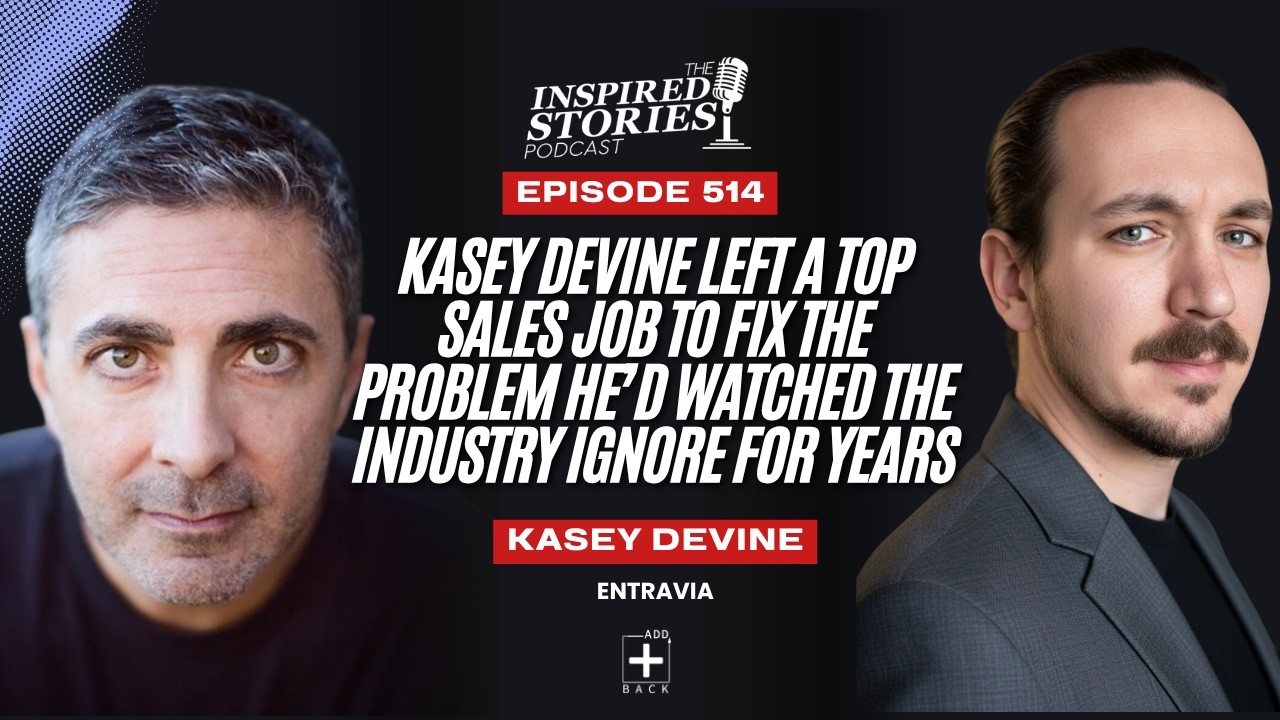
🎤 Kasey Devine Left a Top Sales Job to Fix the Problem He’d Watched the Industry Ignore for Years
Kasey Devine, founder and CEO of Entravia, spent over a decade mastering the workflows inside some of the biggest names in HR outsourcing — then left a top five national sales ranking at ADP to build the platform the industry never bothered to create. Six months in, Entravia has raised $2.6 million, won the Evergreen Award for Best PEO Shopping Platform, and is already threatening legacy workflows across a $414 billion industry.
✨ Key Insights You’ll Learn:
Cardinals ticket sales as the moment sales stopped being a dirty word
ADP training as a total transformation — from territory management to pipeline structure
The chamber of commerce moment that turned near-failure into a relationship-first sales philosophy
How to ask the one sidebar question at the end of every meeting that changes everything
The mortgage application that showed Kasey how far the PEO industry had fallen behind
Why Entravia pivoted from B2C shopping platform to white-labeled B2B infrastructure overnight
The general agency model and how it made brokers partners instead of competitors
Getting rejected by every VC, then getting a second look through one unexpected relationship
Why the cost of building software dropped enough to make this startup possible now
Browser-based bots that could compress a 9-week PEO evaluation into a single day — once the threats stop
🌟 Kasey’s Key Mentors:
His ADP manager and training program: built the entire foundation for how he thinks about territory, pipeline, relationships, and value creation
TriNet founder and ProCare HR founder: showed him what it looks like to lead a sales and marketing org with accountability and discipline
M25 and Cambrian Ventures: gave him the capital and credibility to move fast on a problem he already understood better than anyone
His mother: showed him what self-determination looks like when you have no safety net — and that nobody’s coming to save you
👉 Don’t miss this conversation about why helping people is the only sales strategy that actually scales, how a $414 billion industry forgot to make its product easy to buy, and what it looks like to bet everything on a problem you’ve spent your whole career watching go unsolved.
Listen to the full episode here
Transcript
Anthony Codispoti (00:01)
Welcome to another edition of the Inspired Stories Podcast, where leaders share their experiences so we can learn from their successes and be inspired by how they've overcome adversity. As you listen today, let one idea shape what you do next. My name is Anthony Kotusbodi, and today's guest spent over a decade inside some of the biggest names in HR outsourcing, hitting President's Club repeatedly, and then walked away from a top five national sales ranking.
To fix a problem he'd watched the industry ignore for years. He built a career mastering workflows that he knew were broken. There, he reached a point where he decided to stop working around the dysfunction and start replacing it. His name is Kasey Devine, and he is the founder and CEO of Entravia, a Minneapolis-based platform that gives professional employer organizations, PEOs, and insurance brokers a faster way to collect, organize, and act on client data.
Six months in, the company has already raised $2.6 million in funding, including a $550,000 pre-seed round led by M25 and a recently completed seed round. The company also earned the Evergreen Award for Best PEO Shopping Platform. And he's the host of his own podcast called How. But before we get into all that good stuff, today's episode is brought to you by my company, AdBack Benefits Agency, and you'll want to hear this.
Because it's hurting almost every business owner you know. Health insurance costs go up every single year, and businesses are furious about it. They're paying more, claims are getting denied, employees are opting out because they can't afford it, and it hurts turnover and morale. It's one of the most maddening problems in running a business, and everyone just accepts it. But you don't have to anymore. Now there's a program that gives your employees unlimited access to doctors, therapists, and prescriptions.
With no co-pays or deductibles to meet. And here's the part that really shocks most people. Unlike every other employee benefit out there, our program increases your net profits. We recently helped a client add $900 per employee per year to their bottom line. Results vary, but gains like that change how a business is valued. Be the hero advisor that introduces this to your clients today at Adbackbenefits.com.
All right, back to our guest today, founder and CEO of Entravia, Kasey Devine. Thanks for making the time to share your story today.
Kasey Devine (02:34)
Yeah, really appreciate you having me on and excited for the discussion with you, Anthony.
Anthony Codispoti (02:39)
So, Kasey, you started your career, call it that. You were young, but everybody starts somewhere. You were selling tickets for the St. Louis Cardinals and doing event sales for the Kansas City's Chiefs. I'm wondering how you went from there to getting inside the world of payroll and HR outsourcing.
Kasey Devine (02:58)
I'm still wondering the same thing, Anthony. If you could tell me, that would be great. But my my major back in college, I thought I was gonna be a history teacher, secondary education, and actually went to I decided that wasn't for me. I went to the business school and I didn't really like the advisor, and I went to the sport management department and did. And then I ended up in sport management and got funneled into sales kind of on happenstance. I met the the hiring manager for the Cardinals after class one day, and then that led into an internship.
With the Chiefs, but then what I was I was working in a full time capacity with neither of those two organizations and was working like seven days a week making no money and was thinking about the prospects of getting married and all of that and realized I guess I'm just in sales now. I went to market and landed in payroll and HR sales and basically never looked back.
Anthony Codispoti (03:53)
And so you didn't see yourself maybe being in a sales position before you had those early roles with the sports teams. How well did you take to it? Is it something where you're like, I've got the natural ability and the talent for this, or was it uncomfortable and you needed a lot of coaching and development?
Kasey Devine (04:11)
I it was uncomfortable. It was something that going into my first two experiences, I thought sales was a dirty word. and then there was actually a time when I was working with the Cardinals. I had helped somebody buy tickets over the phone and they they actually stopped me and they said, Hey, I just wanted to say thank you. I don't know you, but you helped me have a better afternoon at the ballpark with my grandchildren that I haven't seen in a couple of years. And I really appreciate you you making me look good.
And and I was like, that's what it's about. so but then ADP, part of the reason I went there was like, hey, great training program. It worst case, after a year or two, I can get back into the industry. No one's gonna fault me for getting really great sales training. it's just then it took to it. I I wasn't actually a top performer at first, although I I'm kind of a book nerd. So I got I won the training class.
And, you know, got payroll certified by the American Payroll Association and everything like that. So outside of that, it took me a second. Then when I figured out my groove, it really took off.
Anthony Codispoti (05:16)
So there was kind of this light bulb moment then when you were with the Cardinals, right? And okay. And so you realized sales isn't doesn't have to be a dirty word. This can be more of a consultative, helpful kind of a thing. and so then you're like, okay, maybe I could do sales. The ADP opportunity opens up when you're looking for, call it a big boy job, right? You want to get married and have a family and kind of evolve in life. Great training program.
Kasey Devine (05:20)
Uh-huh. Yeah.
Anthony Codispoti (05:45)
What was it that you learned there that you didn't already know from your shorter stints with the professional sports teams?
Kasey Devine (05:55)
Absolutely no respect of disrespect to the sport industry, but everything is the answer. Truly. I there wasn't, and I'm I'm saying this in shout-out to ADP because I'd interviewed a few different places for that kind of transition point. There wasn't a single interview step with that company where I didn't walk away and actually use it to help myself in my my actual job. So, so truly, I realized the entire thing from how you think about territory management, st
structuring a call in a way that makes sense, managing a territory and pipeline. I mean, quite literally everything I picked up there. So it was it was transformative. And in in that role, I was living in Kansas City. I'm originally from St. Louis. So I I knew really nobody and I was assigned a territory that was like suburban to rural in and I knew no one. And so it was a really big opportunity to say like, okay
Go out there and sell this thing you don't really understand. So you have to learn, you have to network, and you're selling payroll software to small business owners who are really busy and also love their CPA firm. And so, so it was it it taught me a lot about how business works. It also taught me a lot about relationships. And I'm sure we can dive into that, but I mean, everything I learned was was formed in those first six or so years.
Anthony Codispoti (07:18)
When was the moment where you started to feel like you found your groove and what changed?
Kasey Devine (07:23)
It was when I almost gave up. I had won the training class, MVP got a call from the head of sales. You know, I was really, really feeling myself. And for for a variety of reasons, the entire like reporting structure in my part of the sales organization was displaced. And I was feeling really down on myself and not hitting numbers the way that you would have expected somebody, you know, Rising Star to do. And I went to a chamber of commerce event and I I literally remember saying this, Anthony. I was like,
If I I'm just gonna go talk to people, I'm not even gonna say what I do. I'm just gonna meet people and try to help them out with something and maybe see if there's like another job opportunity that comes up, or I don't know. But you know, and then I remember there was this defining moment. Somebody asked, you know, well, what do you do? And I told him, and I was like, But let's not talk about that. Like, what are you working on in your business? How can I be helpful to you as I'm circulating around? And he's Well, you probably can't help, but
I just can't find time to work on my website and I really need a good website. And then the next day was a cold calling day office. I cold called five web design firms, got meetings with three of them because I potentially had a referral, learned about them, reported back to this business owner, made them happy. And then they ended up buying for me. And so did two of the web design firms. And I was like,
You have to help people. So that's where I I know it sounds really counterintuitive. from there on, the biggest lesson I ever had was why sales isn't a dirty word, going back to that lesson from the Cardinals. And it's like, you truly can just use your opportunity as a platform to to spread good words and help people and understand that you're not going to be for everybody. And from there, when I focused on bringing value to the other person as opposed to to getting them to buy my thing, that's when I not only found more clients, I found more clients that.
I liked and that liked working with me, which was everything was the difference there.
Anthony Codispoti (09:15)
So were you able to somehow formulize this approach?
Kasey Devine (09:20)
Mm-hmm. I was. So at the time ADP did a fantastic job of managing like channel partners. They had these like institutional relationships with some folks who could refer business to them. And you were assigned, you know, your own fiefdom within that. And I think that this I I was fortunate enough to see how that would work and to bring that into a hyper local level of okay, you gotta stay in front of people if you if you like them. And it's not just annoying them, but something of value.
Teach them something, bring them something, help them get business. making sure that you're always really clear on what it is they are working on so that you're actually communicating relevant information to them and making the relevant introductions. tracking so that everybody's on top of, hey, here's what I've done for you, here's what you've tried to do for me, here's the status of it. so it was, it was really systemat systematized. And I think that that kind of bled into my ethos.
Because that's now just how I think. It's how I manage relationships.
Anthony Codispoti (10:24)
Okay, so walk me through. Let's go back to this first aha moment with the what was the what did the gentleman do who was looking for the website design? What was his business? It's a plumber. Okay. and so you had that conversation. You said, okay, tomorrow I'm gonna cold call five web designers. And you called them with the intent of you said, Hey, I've got somebody who's looking for a web designer.
Kasey Devine (10:30)
Mm-hmm.
think he was a plumber.
Anthony Codispoti (10:53)
Would you be interested in in an introduction? And you made five calls, you narrowed it down to three people to connect him with. Am I understanding the process so far?
Kasey Devine (11:02)
Yep, exactly. That's exactly what I did. And so I cold called them. I was like, Hey, I'm Kasey. You know, you give the spiel. I I work on, you know, locally helping small businesses with payroll at HR and stuff like that. Listen, I'm not calling to try to sell you anything. I was actually at the, you know, insert city here chamber of commerce event, met a gentleman who owns a plumbing company. He was complaining about his website. I figured I'd try to help him out.
You know, could you tell me a little bit more about what you do? If they weren't complete jerks, I was like, listen, happy to make an introduction for you. I don't know if it'd be a good fit. You want to meet up for coffee? you know, maybe there's other folks I run into happy to share what what I do too, you know, and if you ask enough about people and try to help them, I promise if they're not complete sociopaths, they'll they'll try to do the same thing at some point. And I think that there's actually is that's not like a
I'm gonna give because I want something out of you. It's just it that's that's not what what what the intent there is. I think more of the understanding is that you you have your own circle of influence and your circle of knowledge, your network. It's never a perfect circle over somebody else's. So if you go through and you understand that even if I know someone really, really well, the likelihood that I know a hundred percent of their contacts is zero.
And so I can't be everywhere. I can't know everything. And so because of that, I'm going to use that to my advantage to help other people who don't have my network and my conversations. And then I hypothetically then gain value by saying, like, okay, you know what? That web designer is also part of a networking group that I can't afford to be part of, but knows this person who knows this person. And that's how the ball starts to roll.
And again, I was a complete stranger to the to the area, Anthony. I knew nobody. So it wasn't like I could just call on, you know, my high school buddy's dad who owns insert thing here. You know what mean?
Anthony Codispoti (13:05)
What a what a smart approach. a it's so interesting how it came at the moment you were about ready to throw in the towel on it and you just like, I'm just gonna have some conversations and just I don't know, maybe I'll find a new job here. I'm just gonna be a nice person. What a great way to approach life and business. I'm just gonna be a nice, hopeful person.
Kasey Devine (13:24)
Yep. That's the golden rule really does exist and it's true. If you treat others the way you'd want to be treated, they they in their own way typically get pretty close to that. And I think it not only like is a great way to grow a business, but it's a way that you can actually put your head on the pillow at night and know that you weren't a vampire. Yeah, you you actually added some net benefits to to the ecosystem and to the community.
Anthony Codispoti (13:51)
So you've had some different career stops along the way. At the end of 2020, you joined a group called TriNet, which provides HR solutions for small and medium businesses. And you took a single market territory and grew it into a nine-state region with some of the strongest new sales numbers in market history. I imagine being part of that growth has to be very exciting. were you using the same
Kasey Devine (13:57)
Yes.
Yes.
Anthony Codispoti (14:18)
approach that you had kind of stumbled across there at ADP and your sales approach at TriNet.
Kasey Devine (14:26)
I I would say so. So that first sales role was in Kansas City with ADP. I promoted, moved to Minneapolis. My wife was from St. Paul, and so I had run a team of salespeople doing the same thing I was doing, promoted again before the Tri Net move and actually went into the HR outsourcing division of ADP, s managing a sa sales team as well. So I I had I think hung my hat on helping others learn the systems that I had learned.
But then also doing the same thing of how I would manage a sales team to them. What are you working on? How can I help you, you know, servant leadership? It applies internally as well. So then with tr with when when it came to TriNet, it was a really challenging time. They just opened up the market a couple of years ago. and there were some challenges along the way not to air anybody's clean or dirty laundry. And it was the middle if you look at the the the stop, it was November of 2020. It's not like that was like a
A sure time full of optimism anywhere, especially in B2B sales. So yeah, it was it was a lot of teaching people how to do that. It was a lot of empathizing with folks as they went along the way of hey, these people are outside salespeople by try you know, by training. We have no idea when when some of the skills that we have are going to be able to be deployed again. And, you know, if we're able to pivot this, it's gonna be all right, well, we have to learn how to be really great inside salespeople.
and we have to learn from the best and and try to make the best of it. And that's that's what we did. We brought that same how can I help you approach, I'd say to any of our the internal partners we could. And we were really loud advocates for what it is that the market needed to be successful.
Anthony Codispoti (16:06)
Say more about how you took those your strategy for outside sales and tweaked it to work for inside sales folks.
Kasey Devine (16:16)
Mm-hmm. well, once you realize I I think there's there's always going to be opportunity in any any any anything that happens. Like if I I'm sorry, I answer every question really broadly to get to the narrow part. but like we like it or not, depending on how you look at the world, in the in the United States, we we operate in a capitalistic society, which means that at least in theory, we should be paid in relation to
Corresponding to how much value we've created for the group, right? So, so if you stay there in at least theory, you can understand that, well, everybody has something they're trying to do and they're trying to accomplish. And if you can create value, which is that helping them accomplish those goals, you should be able to in turn receive value in some way. So then when it was outside sales to inside sales, well, here's a lot, here's people whose
Families are relying on this transition and all the way up the chain, same thing. Well, everybody is dealing with the same set of problems. So complaining about them doesn't really do a lot. It's not gonna change anything. we're we're stuck at home. So it was like, all right, well, hey, if we're if we were able to learn from the folks who were doing inside sales at this company and other companies, hypothetically we could put at least get better faster than our peers. But also, like, let's see.
Let's see some some sort of positive. If you could say there was a positive from COVID, it was like outside sales people were spending a lot of time driving. you know what I mean? And it you could only really influence this sphere of people. Whereas in inside sales, you have LinkedIn, you have podcasts, you've got email marketing, you can actually influence a lot more people and you can get a lot more done. And I think that the one of the shifts was helping folks understand that and and adopting more of a a growth mindset versus a fixed mindset.
Anthony Codispoti (18:13)
But were you still I like I'm still intrigued by the concept that you stumbled across there at your early days at ADP? Were you coaching your folks to say, hey, you just talked to somebody who's looking for a website? And so now, tomorrow I want you to call five website companies and then go back and make some intros for them. Like, were you giving them that specific level of instruction?
Kasey Devine (18:21)
Yeah.
Yeah, yeah, and I'd say even more more specific, any of your listeners, you you have to kind of tweak this. But if you if you're if you're in some sort of business to business setting, if you're selling or not, like if you want to be a great meeting partner, you really need to understand how the person across from you makes money. You need to understand how they lose money.
And you need to understand what they care about in general, which is if you understand the first two things, you'll understand what they care about. but you also, if you could understand like what's going on these next two weeks, like hyper specific, then you can help them. So so I'll give you like the the the the macro trend is trying to understand how they make money and how they lose money. If if if you can do your research ahead of a call to understand those things, fantastic.
If you can structure your questions with genuine curiosity to understand the things that you don't understand, people actually do like to teach more than you'd realize. And so they're help they'll help you along the way if you're if you're showing genuine concern for for them and trying to understand things. But but if you if you did one thing, what the easy coachable thing you could add to is at the end of a call, you can be like, hey, appreciate it, appreciate this, Anthony. You know, this was a great time together.
Mind if I have just like a one minute sidebar completely unrelated? And it you know, it might be unexpected. So they're like, sure, what's up? And you say, Hey, Anthony, great call. Let's assume that none of that was valuable and you saw thought it was a complete waste of time. I don't know. I've talked to a lot of people on a daily basis. They probab not all people you know. If I did something for you or introduced you to somebody over the next two weeks.
And it and it made your day and it made this like thirty minutes the best thirty minutes of your week. Who or what would it be? And and before you answer, please don't assume I can or can't do it. Just answer the question.
Anthony Codispoti (20:37)
Hm. Okay.
Kasey Devine (20:39)
They'll answer. And then if you go try to do it, whether you can or can't, if you actually followed up on that with like, hey, I tried this, this, and this. I'm sorry it didn't work. Do you have any other suggestions or something? At least you're building the rapport and showing that you're there to help them. But a lot of the times you actually can do something to help them. And it's it's that effort that stands out even today. that is actually really great advice. I still think I'm the one giving it. But with in in defense of AI slop.
Can you imagine if somebody instead of like insert name here in a clay, you know, automation actually tried to help you with something, you would never forget it.
Anthony Codispoti (21:17)
I love that. so from TriNet, then you moved to ProCare HR, a smaller PEO that's focused on the healthcare and senior living space. You joined as VP of revenue. I'm curious what drew you to a smaller operator after helping to build something a pretty good size that you'd done before with with TriNet?
Kasey Devine (21:41)
Yeah, that was that was probably the hardest decision I've ever made in my career, honestly, Anthony. It was it was I I loved the people when I was at TriNet and loved the people I worked with, and I loved the team and what we had built together. And it was funny. One of my really good friends like set me up on a blind date interview with the the founder of ProCare HR. I had no idea it was an interview until this guy started asking a bunch of questions about my industry. I didn't even know like he worked for a PEO, and so I
Colored me shocked when he started asking really, really smart questions about what it was I did. And I was like, wait, I don't understand. I think the thing was was part of it was there, I'd say it was it came down to two things. Wanting to really push myself and time of life. Those were the two two parts. So wanting to push myself, they're backed by a really successful private equity firm and they had been before. And I'm sure if there is an exit, they will be again.
You know, I don't I don't want to speculate about that, but I really wanted to see like, hey, running it was to be VP of sales and then became VP of revenue, which was sales and marketing. That's like the thing I would want to do in my career. And can I do it? Like, what is my upper limit if I push myself? That was something that was really bugging me. I wanted to figure out because even though we were successful at TryNet and I worked really hard toward the end, I had it kind of on autopilot because I had really great people around me who
Taking coaching really, really well. And if you do that as a leader, you're gonna find yourself being pretty bored at at as which is a good thing. That was the first thing. Second thing was like we just had our first child, my wife and I, and the idea of working for a company who's 12 minutes from my house was really, really cool. So it was like, hey, potential dream job and national scope. When I do go into the office, it's like barely even a noticeable commute. And I get to report to the founder of a company and really learn.
this and see if I can run a sales and marketing org or what what could happen for my career. That's why I did what I did.
Anthony Codispoti (23:45)
Quick sidebar for people outside of the industry, can you explain what a PEO is?
Kasey Devine (23:51)
With the rest of the podcast's time, I sure can. imagine if you of course, of course, I say that tongue in cheek, I promise. it is so if if you think about a small business or any type of business needs to administer payroll, human resources, employee benefits, that kind of stuff, they have two choices really. They can go and go vendor by vendor by vendor to solve those needs, or
Anthony Codispoti (23:56)
Give us the reader's digest version.
Kasey Devine (24:20)
They can go to what's called a PEO, which is kind of like an all-in-one solution. And so you think about the per unit cost of shampoo is is cheaper, for example, if you go to Costco to buy 30 of them at once. it's kind of like that, except you only get the two bottles of shampoo you need. Now translate that to the back office of a a business and you have what PEO does.
Anthony Codispoti (24:43)
So basically it's a a way for somebody to outsource all or most of their HR functions. So the employees actually technically legally are employees of the PEO, and the PEO manages all that stuff the payroll, the workers' comp, the the benefits, et cetera. Okay.
Kasey Devine (24:50)
Yes.
Yeah. Yeah. You're co
employing those employees. You still run the company, you decide who to hire, who to who to fire, raises, all that stuff, but you no longer are uniquely have the liability or solely have the responsibility for being an employer.
Anthony Codispoti (25:20)
Got it. Okay. So let's go back to sort of this work trajectory because we're getting closer to the point where the idea for Entravia comes about. So you were, you know, we mentioned VP of Revenue at ProCare. And then at a point you came back to ADP and were running RD tax credit sales. All the while you're watching this problem of document collection up close. Describe for us what this problem was.
Kasey Devine (25:30)
Yeah.
Yeah.
Yes.
Anthony Codispoti (25:48)
And the impact that you saw it having on clients.
Kasey Devine (25:51)
I will. so the hardest thing when you're in some sort of professional service and you're in B2B, especially in the small business or SMB space, is to actually get the data necessary to be able to say, here's what I can do for you at what price. And and I'm saying that more broadly because if you're trying to quote outsource accounting, you can't say it costs this because you don't know what that business needs and does and their transaction volume and all that stuff. So
Broadly, that's like one of the hardest things. It's not finding them, it's not knowing that they have a pain or solving the pain. It's it's the alignment to make sure that I'm quoting you accurately. And so broadly, I've been seeing that for my entire career. Go back to learning with payroll. If you're gonna onboard a new client, you have to get all of their payroll information and their employee information, a direct deposit, all this stuff to make sure it's correct.
And then if you imagine in the PEO world, imagine all of that, but your health insurance information, your dependent information, your workers' compensation information, their f 401k plan, everything. And so it was really difficult because it was like, okay, I have this company who needs what I have and wants what I have, and I actually can be a really good fit for them. But now I have to ask them for the equivalent of an IRS audit in order to even see if I can work with them.
And that's where basically up to half of the sales processes would go to die. Because the whole reason they were interested in talking to you is because they're a ps, you know, very busy business owner that has limited constraint capacity and needs help. And then you're like, by the way, I'm gonna ask you to do the thing you like to do least and the thing that you have a bunch of pain on. I actually got this part of an idea because I realized
my industry writ large had fallen behind in ingenuity when it came to customer experience in comparison to the mortgage industry. And that's when I realized it was a problem. Not to like badmouth the mortgage industry, y'all are fine folks, but like mortgage isn't like cutting edge. And I guess either is what we do. I went to apply for a mortgage at one point and it was the second time I'd done so. The first time it was a dude suit and tie
Manual processes took a long time to fill out all of the application stuff, pull out all the relevant information from my payroll and retirement and investments and all this different stuff. The second time, no tie. And it was an online portal, web application, and there was some software that linked into all of those systems. So I didn't have to go log into everything. And it was like a 10-minute process. And that's when I realized that it wasn't just the way it was, that like if mortgage
which is more highly regulated, could figure this out, we could too. And I started looking around, even just passively. It's not like I was obsessing about it yet. But I was looking around, I'm like, nobody's actually solved it. And that was very curious to me as why.
Anthony Codispoti (28:56)
And what was the timeline for these ideas first starting to percolate?
Kasey Devine (29:02)
Mm. First starting to percolate not taking action on was when I moved into my most recent home, January of twenty-five. I was still really gainfully employed at ADP, loved it, had no intentions of leaving ADP. But that was the first time where I was like, that's interesting. You know what I mean? I had never really thought about necessarily running my own business though. And so
It was just kind of a thing to note. And then ironically, I was I was providing R and D tax credit services as an individual contributor. Again, time of life we were just having about to have at the time, our second child. And so leading a sales organization or team was gonna be a lot. And I I kind of wanted to take a step back and just sell for myself for a sec. And so in that role I had the privilege of only talking to innovative
founders of companies, typically like tech companies, software, medical device, because research and development tax credits are giving businesses money back for inventing things, for lack of a better term. There's a lot more to that. That's not a CPA answer. Don't quote me on that. But then I started like meeting these people who were then at, you know, you you talk to them and they'd ask, well, are you ever going to start something or what's what's what would you do? Or if you started a business, what would it be?
And then you also got to see that these people weren't like demigogues. They're just people who just kept pulling the thread. And that's when I kind of became convicted ahead of actually starting to work on this problem in December of 2025. I left ADP with no safety net at all outside of my savings and said, like, I'm going to go try to solve this problem. And I'm going to bet on myself because I think this is a problem we're solving. I think we actually can do it. And
And also taking a bet on myself if I if I did this for the amount of personal runway I had, and I failed, I also am gonna bet on myself that I could probably go get a sales job. it might not be as good as the one I had, but I probably could convince somebody to go let me generate revenue for them as I had successfully a lot of times in my career. So I was like, you know what, if I don't do it now, I'm never going to, and I just jump.
Anthony Codispoti (31:20)
Was there any thought to not just jump, but to kind of straddle the fence for a little while, keep your well-paying job with good benefits, and start to work on Andravi on the side?
Kasey Devine (31:34)
There's plenty of thought, but that also just isn't a reality. when you when you work for I think most, I don't I don't think ADP is unreasonable in any sense with this, but like when you're employed, a lot of companies expect you to just do that and to not have side projects. and so that was that was something I just wasn't really willing to to g engage in. Personal risk tolerance, but also like
That was the second time I'd worked for the company. I I worked for a friend of mine. I had a lot of friends there. And it's just like I'm not really willing to to cross pollinate. But but to your point, I thought about it a ton. It just was never something I was gonna do. You know? It would it absolutely would have been the easier route and less scary route, let me tell you.
Anthony Codispoti (32:20)
Just it wasn't practical, it wasn't reasonable given w your your situation. So, okay, tell us what does Intrabia do and who do you do it for?
Kasey Devine (32:30)
Yeah. So Entravia is a B2B tech company. and we take the PEO shopping experience and we make it as easy as shopping for a mortgage. If you couldn't guess, that's where it's coming from. So Yeah. Mm-hmm.
Anthony Codispoti (32:44)
So I've got a business, I'm looking for a PEO
right now, or up until this point, the only way for me to do that is to go around and visit a bunch of PEO websites, maybe take some demo calls, collect information, collect pricing, try to understand all the different options, and it's a very tedious process. But now within Entravia, what does the process look like?
Kasey Devine (33:03)
Exactly.
Yeah. So I kind of need to answer the question by telling you a little bit of a story. Otherwise, it's not going to make any sense. So so what we had, what I my vision was left ADP, bet on myself, started coding with you using some AI tools, and then hired a founding engineer to help me. and it ended up getting picked up. We could talk about that. But the idea was hey, what we'll do is we'll make this shopping experience exactly what you said, but make it more like cars.com.
And it was like, we'll go business to business because I know how to identify PEO business and people who are shopping companies who are shopping for PEO. I'll build this better mousetrap to help them do it. And then we'll help them shop through our platform. And there are referral fees in our industry that are recurring, kind of like a commercial real estate gets paid by not the person shopping. It's the per you know, like that model. So that was what we were gonna do. And then I popped out of the weeds in January. I was like, hey, this is what I'm up to.
And was inundated with demand in the exact opposite direction, which was wildly surprising. We were actually Yeah, we were we were inundated with demand from the PEO vendors themselves to use a technology like this. And from the folks we were competing against, which were insurance brokers and PEO brokers. They were all saying, like, hey, amazing idea. You know, I think we've all had a version of this idea for a while. If I could use this, I absolutely would.
Anthony Codispoti (34:10)
What do you mean in the opposite direction?
Kasey Devine (34:32)
And so to answer your question of what we actually do now and who it's for, we are like the operating layer of PEO transactions on the front end. So what I mean by that, we have a software that is makes it easy for a small business owner to collect the data and documents necessary to evaluate PEOs. We don't go directly to the business anymore. What we do is we actually white label our software and sell it to PEOs so that they can use it.
And we also have like a B2B2B model where we actually work as a general agency to use an insurance term that I can explain if necessary for brokers. So we provide our platform to brokers to basically productize PEO, just as if they were going to look at a ICRA or some other option for their clients.
Anthony Codispoti (35:25)
So a couple parts there that I want to unpack. So there isn't like me as a business owner, I don't go to Entravia put in my information, and then get to see the comparison of, you know, four or five different PEOs. Rather, if I happen to get connected with a PEO that's using your software, they would use your technical infrastructure to collect my data and then be able to give me pricing information.
Kasey Devine (35:47)
Mm-hmm.
Yeah, almost. So so you're you're correct. The other side of it is just that if you came to us, what we are you you absolutely can collect use our system, collect information, get side by side comparisons very quicker than you could any other way. The difference is an Entravia employee isn't gonna be the one helping you. We would connect you with a broker, probably what would be known as a PEO broker that operates using our platform.
And we would make that introduction, they would be the ones going into this. And and it's to give this specific reason why, in order to deploy the B2B2B model of having that middle layer, we couldn't also compete with the middle layer without making all of the middle layer angry. Brokers. Yeah, exactly. And and the benefits brokers, the workers' compensation brokers. Anyone who was like, I could go directly to the PEO manually with an Excel spreadsheet, or I could use Entravia.
Anthony Codispoti (36:38)
The middle layer being like the PEO brokers.
Kasey Devine (36:52)
We needed to make sure that we weren't competing with them in any way. So now if you come to Entravia as a business owner, we're just gonna connect you with one of those partners and you get the same experience. It's just we're not the ones doing it.
Anthony Codispoti (37:02)
That's really interesting, Kasey. I've been a part of so many businesses where over time, with more and more technology, I've seen the distribution layers flatten, right? So where some of those middlemen you know get squeezed out. so it's fascinating to me that you guys not only didn't do that, you baked into your process, including those folks, because why? You just saw that.
Kasey Devine (37:12)
Mm-hmm.
Anthony Codispoti (37:31)
Вітавтем не с куд суксід.
Kasey Devine (37:33)
No, it goes I'm I'm so glad you started the interview the way you did. Go all the way back to that chamber of commerce meeting. I realize that it's better to have friends than enemies. I'd rather have a bunch of folks using this platform that are stoked to do it, that are helping us. I'm from the Midwest. If you've ever read Mark Twain, you've read Huckleberry Finn and the idea like he got somebody else, other people to paint his fence for him.
Anthony Codispoti (37:42)
Mm-hmm.
Kasey Devine (37:58)
That's the idea where it's like I could I could make everybody angry and take on the world, or I can make anybody who's willing to be my friend my friend. And I'd much rather make a bunch of friends and maybe make a little bit less margin than argue with everybody and compete with everybody, personally.
Anthony Codispoti (38:17)
Got it. Okay. And so in addition to the PEO side of this, there's the insurance broker side of this. So yes, please explain a GA for folks and then how brokers use your platform.
Kasey Devine (38:29)
Yeah, so outside of what we a general agency in insurance is this entity that lives between an insurance broker of some kind and typically the carriers of those insurances. So there are a bunch of things GEAs could do, but let's just use like a basic health insurance model as an example because I think people would understand it. Let's say you were
You met somebody online who is an employee benefits broker and you really liked their content and you wanted to work with them. And they are in Tennessee, and you are a business owner and you are in Nevada. That Tennessee-based broker, for example, might not be appointed to do business in Nevada, but they work with a general agency who is. So they funnel that business to the general agency who works with all the carriers and brings back.
Here are the options that the broker now is offering. And how that works is the broker then is basically running their commissions or splitting the commissions in some capacity with the general agent because the general agent is performing services on their behalf. We took that concept into PEO, where we were like, hey, all right, there's there are these PEO brokers where all they do is shop for PEO. There are employee benefits brokers who sometimes shop for PEO.
There are property and casualty brokers who sometimes shop for PEO and a bunch of other folks who also make recommendations, CPAs, fractional CFOs, venture capitalists, private equity, all these people. And so you're like, all right, what if we acted as a general agency writ large? What if we said you can use our platform? We're not going to charge you a thing and we will negotiate the contracts and we will just earn an override. We're going to be able to have the ability to do that because the PEOs give us permission.
When why they give us permission is because volume. Let's go go back to economics. Hey, you can work with us, we'll have X amount of opportunities that come through you, through us if you allow if you provide this kind of a agreement instead of just going to business to business to business, it's cheaper for you, you get better visibility, all that kind of stuff. And so that's that's how we ended up negotiating them. And that's how we deploy our model mostly.
Anthony Codispoti (40:48)
So run through for me Case the different revenue streams in your mind.
Kasey Devine (40:53)
Yeah. Yeah. So we we basically do two things. We sell our well, I guess we always provide our technology white labeled. There is not currently a way that somebody would see that they're using Entravia with Entravia's logo everywhere. We provide this technology that looks like it's on behalf of another company. That those companies are one of two scenarios. You either
only sell PEO because you're a PEO vendor. And we white label this just like to use a CRM example, it'd be mycompany name.hubspot.com or mycompanyame.salesforce dot com. It's mycompanyname.intravia.co. And it looks like their technology and has their branding. We do that or we go to folks who refer businesses to PEOs. A lot of them are brokers of some sort because that's the number one referral stream for PEOs.
And we offer them an opportunity where they can get access to our platform. They don't pay us anything. And we are getting an override, a portion of their business above and beyond what they normally would get. so they they maintain basically the same structure of compensation they were gonna get from referring these opportunities to PEO vendors. And we get a a a cut above the top, for lack of a better term. That's how a GA works. What's funny is that's why I wanted to like simplify it. We always get paid by the PEO.
So either the PEO is paying us because they're using our software or the PEO is paying us because a broker through us brought them a deal.
Anthony Codispoti (42:26)
Gotcha. Okay. So you guys aren't very far into this. Like you said, you left your job at ADP, end of 2025. Here we are recording this middle of 2026. But you've already gotten pretty significant investment dollars. talk to us about how that unfolds because this is your first entrepreneurial venture. I I'm gonna guess then your first time going after investment, seed money. and you know, first time building a tech platform. So
Kasey Devine (42:40)
Yes.
Yeah.
Yeah.
Anthony Codispoti (42:55)
Why all the excitement? What are you guys doing that's gathered so much attention?
Kasey Devine (42:55)
Yeah.
I appreciate that. Yeah. I think part of it's macroeconomics and part of it's what we're doing. Macroeconomically, everybody thinks it's popular to say right now that AI is eating all the jobs and software is dead. That's not currently true. Currently. It is very much true that it can do anything, but it needs context to do anything. And so what's becoming increasingly more valuable are
industry specific, hyper niche, B2B vertical SAS, for lack of a better term, which is what I do. So it's like part of why I think it macroeconomically was great timing because it's like, all right, the the cost to develop software is significantly lower than it was even a year or two ago, which the cost alone was prohibiting most folks who had this idea from developing a minimum viable product and deploying it. So
You know, it's like here is a founder who is in the mid Midwest. So it's not super expensive to hire talent where I am. We can operate pretty leanly if we need to. I I know everything I think I need to know, at least to get from point A to point B of like exactly what needs to happen because I've been a buyer, I've been a seller, I've done all of those things. So I don't need to go exactly go interview a hundred or f a thousand people to understand their problem because I'm not
technical bringing trying to find a a problem that needs solving. I'm non-technical with a problem that needs solving. and so what ended up happening, we pitched a bunch of venture capitalists and were basically turned down by everybody at first. And that's really normal. go back to relationships matter. met I I'll I'll leave them anonymous just for their own sake. Not that they did anything bad, but just I don't know if they want PR or not. I met somebody who
was basically like a colleague of a former colleague who happened to know somebody else at a venture capital firm that had told me no before, that gate got a second look at it. And that's that second look was all I needed. it wasn't somebody I'd known for a long time. It's not like I come from money myself at all, but it was like helping the the value chain of how can I help you led to getting a second shot at somebody who said no.
And that somebody said yes. M25 was the lead of our pre-seed investment. They introduced us to the follow-on investor for our pre-seed, Cambrian, who decided to say yes. And then it kept going from there. And then how we got to seed, going backwards again. Remember how I said we were inundated with demand when I popped out of the curtain in January? It's like, well, we continued to run into a problem, raised a relatively small pre-seed. And it went back to the venture capitalists.
writ large again and was like, hey, we have this massive waiting list, and I have three people and not a lot of money. If you could you imagine if you gave me a little bit more money, what could we do against that waiting list? I can't handle it right now. And I guess I technically don't need the money because we could just chip away at it, but it'd take a long time. Or we could go really, really, really fast. And I think that would be better because right now in the age of AI, distribution is the moat.
If if you have an idea the the the defensibility of your idea is how you distribute it and how you make money, it's less so the software because software is now a commodity.
Anthony Codispoti (46:32)
Interesting. So M25, they led that pre seed round, but initially they said no. And your uncles, cousins, for the mer roommates, stepdaughter knew somebody at M25 and got you a second look. what did they say to get you a second look? What did M25 tell you was the reason they initially said no? And why did they ultimately reconsider and give you a yes?
Kasey Devine (46:37)
They did. Yeah.
Yep. Yep.
I think it's because I grew up mustache. I'm kidding. I'm kidding. this person it knows my industry and also knows them. And I think it was just it wasn't, it wasn't so much where I asked this person to go to M25 and you know j you know, cheer me on for them. That wasn't ever the ask. It was I had connected with them with no expectations, just like I told you I do, and told them we were fundraising. And
They happened to know people there and they told them, without me knowing, hey, I'm at this interesting company. You should take a look at it. And they this person was is in my PEO industry. So they came with some sort of credibility that this was a good idea because it wasn't a completely random person. that's how it all happened. I think they said no because I was way too early. Could you imagine if you were a banker if and you know, hey, can I get a six-figure check from you to
Open up a pizzeria, and then the first answer question is, Well, do you know how to make pizza? And they say, No, I'm not a baker by trade. You know, you know what I mean? It's like, well, okay, maybe you come up with a great pizza recipe that you learn online, prove it first. And I think that was that was the idea was go prove it. And so you had this introduct reintroduction combined with we we've proven it a little bit. We had more traction than nothing. And I think that was enough for them to be able to
sink their hooks into and and get a lot of belief around.
Anthony Codispoti (48:31)
So they didn't have experience in the PEO space. Your friend of a friend of a friend knew the PEO space and said, Hey, this is a good idea. It fits a need. It solves a problem. This is worth a second look. And in between that first conversation where they said no, and then when you re-engaged with them, describe the the small amount of traction that you had established and how you had gotten.
Kasey Devine (48:35)
Got a ton.
Yeah, I just started doing what I knew best, which was going out and helping people. So I would like build build the product using AI and then the engineers help after that. And I'd build pitch decks and doing whatever else I I knew from running sales and marketing at one point. You know what I mean? And and then I would also go try to help people. You know what I mean? It was like, hey.
I'm back in the PEO realm. Here's what I'm trying to do. Do you know of anybody who would like a second opinion on what they're doing, what their quote is, what what their vendor relationship is, or wouldn't mind trying out a platform. And then I got a couple of bats from going and doing it the old fashioned way. And that led into making them really happy, customers, because I was able to help them out and get a better solution, better pricing, whatever it was, which meant we were post revenue.
And it meant, you know, here were some businesses that actually did the thing, you know, and and we weren't it wasn't to completely an idea. It was an idea that was paying me something. Not a lot, but something. with an idea of all right, here's how I make that something bigger. And that that is something that if you if you're an early stage investor, now you can put your you can put some belief into.
Anthony Codispoti (50:18)
You know, I've been an entrepreneur for basically my entire adult life. And so I've had a lot of friends come to me and ask for advice when they've got a business idea. And, you know, the things that they want to talk about are, you know, do I need to talk to a lawyer, you know, CPA, you know, wh how what should my corporate structure be? And I'm like, listen, all those things may eventually become important, but what you need to do right now is you need to get somebody to give you a dollar for what it is that you're providing. And that's exactly what you did.
Kasey Devine (50:42)
Mm-hmm.
Anthony Codispoti (50:46)
Right. Cause it's one thing to tell people an idea and they're like, that's really interesting. It's another thing, whether it's a dollar or a hundred thousand dollars, get them to give you some kind of money to establish that they have a need to the point where they're willing to fork over some cash for it. So that's what you did.
Kasey Devine (51:03)
Yeah, that's exactly it. And then along the way, ask questions from all those people that you've tried to help. I know I need to be a Delaware C Corp if I want to accept venture capital. How do I do that? I w I found this isn't an endorsement. I'm just telling you how I did it of clerky.com. It's like I can't afford an actual lawyer, but I can't afford this startup site.
You know what I mean? And it's like, well, you probably need to start tracking expenses because if you do get a yes, they're gonna wanna see, even if it's small, they're gonna wanna see your books. So then I ha I hired Haven, which is a firm out in New York, does does CPA work for startups. It was a a cost I could afford. And they allowed me to ask them a bunch of stupid questions. You know what I mean? Like you start building this up and they're like, you need a pitch deck. It's like, well, I don't know how to build that, but Canva does. They have templates and I could ask Chat GPT for feedback and you know what I mean? You just start
Trying to solve problems. That's all.
Anthony Codispoti (51:56)
What were some of the other shortcuts that you learned? Maybe not even shortcut is the right word, but something where somebody who's early on with their own idea would be like, wow, that was super helpful. I didn't know that was something I needed to be aware of. I didn't know that that was a tool that was available or a service that I could use.
Kasey Devine (52:17)
Yeah, I think I think you'd be shocked at what AI actually can do. AI I is the answer. So if you you need to like you need to think through a basic business plan. That's one of the things I would say. If you were gonna start something out, I'm not saying it needs to be crazy, but like how are you gonna find make people aware of what you do when they are interested, how do you get them to how do you sell it to them? How do you service it? And then
what's the business itself that isn't you? And then like cr sub subfolder that out and start asking even any A AI bot questions. How my budget for I have this amount of budget total. How could I solve the problem? in the most cost efficient way. You know what I mean? And start having it tell you. a couple of the that was like a that was a lot of it. The other thing is I'm in Minnesota. there are a lot of great local and state
resources, a lot of universities have resources for entrepreneurship. Like there's if you if you actually are back your back is up against a wall and you think I have to solve a problem, you can find figure it out. But but this is a little bit maybe fuzzier advice, but I think if you viewed it through this lens, you'd be able to get pretty far, which is as early on, don't let perfect be the enemy of good.
Like having something is better than having nothing. And it's not perfect. You should be laughing at every single one of your processes a year from you starting. And five years from you starting, you should be laughing at a year. So, like, I have a spreadsheet that tracks my expenses, is better than I don't know what how much money I spent. You know what I mean? And you you need to view it in in terms of leveling it up. That's how I would give advice, and that's that would get you pretty far these days.
Anthony Codispoti (54:13)
I love, love, love what you said. Don't let perfect be the enemy of good. s people think that it has to be completely polished before they show it to anybody. And the reality of it is that it's gonna change. It's gonna iterate so many times based on the feedback that you get from people. And so don't be afraid to go out there when it's still got the rough edges and and and just get started with it. Get the feedback and keep moving forward.
Kasey Devine (54:40)
You're you're dead on. I'll make one recommendation if you've at all thought about this, or you maybe you're an entrepreneur, read or listen to a summary of Crossing the Chasm. it's a marketing book. It helps you understand how to market new technologies or new services or whatever it is. And what you need to remember about all of this is that you are actually early on marketing to innovators, not early adopters, innovators. And what that means is there are folks there are folks who genuinely enjoy taking risks.
And see that as the primary way of getting ahead. And so when you're the way you market to an innovator is different than early adopters, majority late adopters, et cetera, laggards. And so the point is, is you don't actually have to sell to everybody. And you're not actually probably trying to sell to Fortune 500. You're trying to find the person within a company, not even a company, the person within a company, if there is one, that is interested in innovating. And then your biggest weapon is that you can.
Iterate, you just said it, Anthony, faster than anybody else. And so it was cool because I'd have some messy slop of like there was one time I was running a demo early on, and I forgot that I had made it made it so you had to click and acknowledge a privacy policy to log into the platform. I forgot and on mid-demo I couldn't get into the platform. and I was the one who built it. So, but like hearing some feedback on screenshots I had in the next day.
That was wireframed. And they were like, whoa. So now you're getting them on the same side of the table. Don't think you're gonna go sub, you're not gonna sell this to somebody who wants something off the shelf. Even and I'm saying this of like service, it could be anything. It doesn't have to be a tech company. Find the innovators and market to them and then move on.
Anthony Codispoti (56:27)
And so the thing that you wireframed that next day was just the the the feedback that you had gotten from that meeting. So like, this guy's really responsive. He hurt us. Yeah.
Kasey Devine (56:36)
Yes. Yeah.
And imagine if that was what he did in a day, imagine what he'd do in a week or a month or a year. And this is really not great yet, but this is the worst it's gonna be. And cool. You know what I mean? Yeah.
Anthony Codispoti (56:52)
And I can see where he's going. Yeah.
So Kasey you guys earned the Evergreen Award for Best PEO shopping platform earlier this year. So for a platform that's been alive for a very short time, less than a year, why do you think you guys won?
Kasey Devine (57:12)
This this is gonna sound so snarky and I don't mean it to, Anthony. It's cause there isn't a p PE PEO shopping platform, in my opinion. Like we are we are we are upsetting email chains, PDFs, and Excel spreadsheets that are fifteen tabs long. Like there are some folks who have claimed to make one of these kinds of things, these PEO shopping platforms, but it's either professional service, which is a great fit for some folks. I'm not gonna knock them.
Anthony Codispoti (57:17)
Ha ha ha.
Kasey Devine (57:42)
Or it's like a JOT form with their logo on it, which works well for them, but it's not actually technology. And so I think being able to say, Hey, here's actually an innovation that moved forward was what what got that done.
Anthony Codispoti (57:57)
That's great. I love that answer. tell us about your podcast. How with a question mark? What you interview business leaders, you're starting this new business, you're building it from the ground up. Why why do that on top of everything else?
Kasey Devine (58:04)
huh.
Yeah.
So I I started it kind of on accident, just like I got onto sales on accident. I had one point, I'm gonna I'm gonna leave this person anonymous. I was told to start a podcast that didn't end up starting, and I bought all the equipment for it and was gonna do the thing and create a podcast. And then the r equipment was not refundable because it was all out of the box and set up. And so I now owned a podcast studio like in my basement.
And so I just was like, now I know how to do it. I have all this info. I talked to interesting folks. Maybe if I gave them going back to the ethos that like the chamber of commerce thing, would I be able to like interview some of my favorite people or people I meet at a chamber of commerce event and give them a platform to tell their story for free? And the answer is usually yes. Like business owners are interested in that.
What was a cool side effect is I got to meet a bunch of really interesting business owners and hear their story and get to understand them and understand their perspectives and ask them anything I wanted. And also I got their cell phone numbers. And that's how it happened. Honestly, I haven't, as you can imagine, with two young kids and a tech startup, I haven't been out of my house much networking.
So I haven't recorded new episodes because the way I record episodes, I meet somebody, they're interested and I say, Do you want to do a podcast? that's usually how it happens, but I haven't met a lot of people outside of my business recently.
Anthony Codispoti (59:44)
Well,
do you interview people that you meet through your business? Or
Kasey Devine (59:47)
Yeah. Yeah.
And I'd like to do more of that. We're just as you when you raise two point six million dollars from people, they usually expect you do something with it. And it's not usually hosting a podcast unless that's what you told them you were gonna do. So I'm just being cognizant of that. We will do it as like a marketing motion, but for now it's just gonna be when I meet people face to face, they have a story to tell, they're interested in doing some more marketing.
Anthony Codispoti (59:51)
So many hours in a day.
Kasey Devine (1:00:12)
I'll invite them on 'cause it takes like an hour of time and and does something to help them, which is win win.
Anthony Codispoti (1:00:17)
Yeah. okay, so where is Entravia going? What can we expect to see in the coming months?
Kasey Devine (1:00:26)
here here is the the place where you're you're either gonna listen to this in insert amount of years later and laugh at me, or you're gonna be like, I can't believe I didn't find a way to invest in entravia. I don't know. I'm pretty sure it's gonna be the the the the last one. Our pitch deck said, Hey, PEO is a $414 billion industry. It grows 15% year over year. I think it's growing. It's a $414 billion industry.
Anthony Codispoti (1:00:49)
Wait, sorry, give give that number again?
Okay, go ahead.
Kasey Devine (1:00:56)
largest industry you've never heard of, which is fun. It grows 15% year over year. my thesis is that the reason it's not growing faster is because it's too hard for their ideal customers to buy from. It's not because there's not enough vendors or not innovative enough vendors. There's actually over 500 PEO vendors in the country. And several of them are multi billion dollar companies that do really good work. So it's not that they're we just need 500 more.
I think and it's not that small businesses don't have it's not that small businesses have less payroll and health insurance and HR headaches than they did a year ago. Like that's clearly not the case either. So my thesis is that it's just too hard for small businesses to transact with the PEOs. Our goal is within five years, we've we have increased the growth rate of the industry by 50%. We've got it to 22%.
We've created over $270 billion in additional market cap for the players that that are PEO vendors. And because of that, we're over a billion dollars in rent.
Anthony Codispoti (1:02:03)
And you're gonna do this obviously through the platform that you already have today, but are there particular feature sets that aren't there yet that are on the roadmap that you wanna give voice to?
Kasey Devine (1:02:17)
Yeah. there both of them are actually there. One we're just not allowed to do yet because everyone's scared of it. Is that the actual answer? Yeah. Yeah, it's funny. we've gotten more threats over this. Everyone says that's really cool. Don't do it. so the first thing was like, okay, if you imagine there's a a a f a step function forward because if I'm a small business owner and I'm evaluating five of these PEO vendors, I don't need to have
Anthony Codispoti (1:02:26)
I gotta hear about this.
Kasey Devine (1:02:44)
fill out five different 12 tab Excel spreadsheets and email my sensitive data. I can put it in a HIPAA and SOC2 compliant platform once and I'm done. That's that's an innovation. The second thing we've we started rolling out and we're going to continue to make better is they can upload the small business owner can upload documents that are necessary and we scan them. Yeah you ever seen when you upload something into Adobe or you upload a check to your mobile banking it scans it and tells you what's on there?
We've done the same thing with NPEO documents. So it scans the documents you upload and we fill out the application for you, which is cool. No one has any gripes about that. The third thing is something that everybody else does, and we don't in our industry. they're they're browser based bots. And you can make them hip button sock 2 compliant, they're secure, but it's a it's a you you know how you you can tell an AI bot that lives on your browser today, you can open up
Google Chrome, go to Claude or ChatGPT or Gemini, and you can say, Hey, I want you to pull the these spreadsheets from my computer. Here's where the files are, and go do this thing and tell me when it's done. And it can do that. That can happen as a browser-based spot that isn't a large language model. So and you can train it. So our idea there, and we we proved that it did work, and we haven't expanded it since because we're sick of getting threatened. Is if I'm the small business owner.
And let's say I'm not even going to name a name. Let's say I'm on a payroll vendor and my employee benefits live in this other web portal. Hypothetically, you should be able to train a browser-based bot where the small business owner can just in my in our platform log in to that vendor. The bot is already trained on what to go do within that platform. It pulls out the documents for them, which isn't that revolutionary. It happens everywhere else. And then our idea is then you link it up to the parsing agent where you dump these doc.
documents in to the agent that reads the documents and it fills out the application for you and tells you what's missing. So that exists. We just need to stop getting threatened. Well, rightfully so to an extent, but I don't I'd also don't think they I they just need to catch up. The folks who own the platforms, because they're if you think about it like, yeah, and those are those could be PEO vendors, it could be payroll vendors, whatever it is, they're not keen on their if there isn't
Anthony Codispoti (1:04:44)
Incredible idea.
Who's threatening you?
Payroll platforms. Yeah.
Kasey Devine (1:05:07)
If if baseline is really confusing Excel files and PDFs, they're not keen on there being a technology that makes their makes it easy for their clients to evaluate their competitors. My argument back is, well, it makes it easier for them to evaluate you too. you know what I mean? So it's like it's not singling anybody out, but folks haven't gotten there yet. And so I think where we're deploying that technology now is where we have full permission to on internal tools for our clients.
Where like they have full permissions to insert system here and they want to power a related workflow, then they're happy and it's all private. So we're we're building the competency. But if we're able to, this is where I it's gonna sound like a quack. We're gonna take something that takes usually four to nine weeks to evaluate, and we're gonna make it the same day. And I'd like to make it within a week that you
I want instant quoting for PEO and I want to make it that no at least at the longest, a a week between I'm interested and I'm on board and it's live. Because all of the problem is just data communication back and forth because between this thing and this thing and this thing. If we could suck out the data, quote you, you decided what it is and it dumped into the the provider of your choice, which is technically possible, that's what we want to go to.
Anthony Codispoti (1:06:28)
Fascinating. That's really exciting. I'm gonna completely shift gears on you, Kasey. what's the hardest thing you've ever had to overcome personally and what did it teach you?
Kasey Devine (1:06:29)
Thank you.
Bring it.
It has nothing to do with business. I was raised primarily by a single disabled mother. And my father's been in my life, but wasn't physically present a lot of when I was growing up. And my mother fell into disability with non operable, non cancerous spinal cord tumor, for lack of a better term. And
Listen, man, like with within my life, you know, I was always kind of like the the teacher's pet for an extent. And, you know, even when I went to University of Missouri, which isn't Harvard by any means, but I got into the honors college and did this thing that it was it was it especially in my early like teen years, when I was when really impressionable, it was going through that. It was like, hey, I'm in you know, a divorced family. I my mother's struggling, you know, she almost died and is struggling every day with a with a
real disability and as a young man, my father isn't physically present and and a lot of the times isn't verbally present either. And so I think that like I say that's the hardest thing I've had to overcome, but I wouldn't be where I was I am today if it wasn't for that. Because I learned that nobody's coming to save you and that your problems aren't unique. Everybody has problems. You get to like what I learned from it, Anthony, is that like you
Dis you get to choose how you're going to respond to things and how what you're going to do. That doesn't mean you're always going to be successful. It doesn't mean that everybody should like go, you know, whack their mom upside the head with some rebar to make sure she's disabled so that they become a tech founder. I'm not saying that. You know what I mean? It's not it's not like that. It's it's that like you you learn self-determination, you learn responsibility. And listen, it's like you you come up with the reality that it's like I could either go become a nobody.
And go follow into alcohol and drugs and whatever else would be really an a a perfectly good excuse for for numbing pain and numbing a lot of injustice that has happened. Or I can take the next right step. And I'm not saying I've ever done this perfectly. I've had my own winding path. I used to have pierced ears and a sole patch and a tap out shirt and the whole thing, you know, like that kind of vibe. and I've still got married for all you single men out there. It's possible.
But it would be that, man. And and I I I really mean it. I wouldn't be where I am today. I wouldn't have my wife by my side. I we were long distance relationship, you know, kind of forced that to work and figured it out. But that figure it outveness is everything, man, because you're everybody's gonna get curveballs. And it's the pup the folks who figure out how to hit them and it's the folks who figure out like how to keep going when they swing and miss.
that are the ones that are really hard to knock out of the race. And the likelihood of you coming forth and having this brilliant idea or getting everything right all the time is like none. But it's really hard to defeat the person who never stops trying and is super resourceful.
Anthony Codispoti (1:09:50)
It's so interesting to hear that story. And as soon as you shared it, you immediately said, But I wouldn't be where I am today if I hadn't gone through that. How long did it take you to get to that point, to have that mindset?
Kasey Devine (1:10:07)
Yeah. it was always there because both my parents said that often. And when you're a kid, you don't hear that, you don't understand it. I actually it was it was I remember it really vividly. I was a teenager of some sort. I don't know if I was sixteen or seventeen or eighteen, but I was on my mom's driveway yelling at my dad about something.
While he was in town for some reason. And we were we were not in a good place. And I remember he he looked at me and he was like, son, my dad died when I was 12. And you're right about everything you just said about me. You have a choice. You get to have me as I am in your life or not. Up to you. You decide.
And I do think that that's a very limited mindset. It's not a growth mindset of being like I am who I am and I can't change it. And I will argue with him to the cows come home about that. But it it did make me understand. It's like, okay, I either can keep going this way or I can go this way. And I'm gonna try to make the best I can I possibly can out of the situation. It's not gonna be perfect, but like railing on somebody for, you know, it maybe I can bring this a little bit more concrete. you hear about like
the arguments between idealists and realists. I think realists get a bad rap from idealists because idealists are saying to realists, don't you want the world to be a better place? And what a realist's answer actually is, is yes, but we acknowledge it is the way it is. Whereas I think the critique of an idealist is you're not acknowledging that life is the way it is, the situation is the way it way that it is, and you can't get from point A to point B until you realize where you are.
Anthony Codispoti (1:11:55)
So which one are you?
Kasey Devine (1:11:57)
I'm a realist man. I am very much a realist. And like, I don't know. When you start realizing that like nobody's perfect, it gives you license to be uniquely who you are. when you realize that like you trying to be somebody else means that you're not gonna find the tribe of people who really are gonna dig what you're about, you start like very specifically, very bluntly, not meanly, but bluntly and directly calling out reality the way it is and trying to answer to ask questions to understand exactly how reality is, not how people want you to see it.
And I'm a realist, man. Like if numbers are bad on something within business, we're gonna talk about it. Not beat somebody over the head, but we're gonna acknowledge that they are where they are and we're gonna figure out where they need to go. Cause otherwise you can't fix it. there's a famous psychologist, Dr. Jordan Peterson. One of his rules for life is don't sweep the dragon under the rug. It only gets bigger. And I'm paraphrasing it. But you know what I mean? Like if you, if you if you realize you're five pounds overweight, ignoring that.
usually leaves you becoming 10 pounds overweight, not skinnier. so you know, you gotta you gotta wrestle with with reality, however painful it is, and realize that the pain is actually in the shame of of difficult situations is a gift that helps keep you from wanting to be there again. Don't run from the negative emotion. don't revel in it, but like it keeps you from doing it again, man. Learn.
Anthony Codispoti (1:13:18)
Fine.
I like that. Kasey, I've just got one more question for you today, but before I ask it, I want to do three quick things for the audience. First of all, if you want to learn more about what Kasey's doing, go to their website, entravia.co. E-n-t-r-a-v-i-a.co. It'll be in the show notes, but Entravia.co. And if you're enjoying the show today, please take a moment to subscribe wherever you're listening.
It also sends a signal that helps others discover our podcast. So thank you for taking a quick moment to do that right now. And as a reminder to all business advisors out there, your clients are bleeding money on health insurance. Do them a favor so big they'll tell their friends about it. Show them how to give their employees access to therapists, doctors, and prescription medications that counterintuitively increase the company's net profits. Real gains that can change how a business is valued.
Contact us today at adbackbenefits.com. All right, Kasey. So last question for you. A year from now, what is one very specific thing that you hope to be celebrating?
Kasey Devine (1:14:29)
A year from now.
I hope to be celebrating.
I know this is gonna sound so odd, but I hope to be celebrating just that we're still in business. And I know that sounds completely odd for saying that we want to be a multi billion dollar company and all of this. And I I'm not contradicting myself. Give me a sec here. The the failure rate of a startup to get to pre seed is real and you can look up what it is. And then the amount of startups that go from pre seed to seed drops again. And then the amount of startups that go from seed to series A drops again.
And so I see every every month, every quarter, every year that we are fortunate enough to be able to work on this problem and to collaborate and try to make to alleviate suffering in some small sense as a gift. And I hope to be celebrating that. And why I say celebrating it is because that's hard. Like, yes, we do want to go become a multi-billion dollar company, but even if we're well on track to do that in 12 months, I do want to celebrate the little things there too, which isn't so little. It's that there's a lot of ideas that were way better than ours.
That had way more funding than ours, that were way smarter than ours, that didn't make it as far as we did. So I want to celebrate that in the air.
Anthony Codispoti (1:15:43)
I look forward to celebrating that with you. Kasey Devine from Entravia, I want to be the first to thank you for sharing both your time and your story with us today. I really appreciate you being here.
Kasey Devine (1:15:45)
Thank you.
You bet. Everybody go go to add back benefits. I I need to learn more about it, but I can already tell it's cool and I've been in the industry for a long time.
Anthony Codispoti (1:16:01)
Thanks for the plug, Derek Kasey. Hey folks, that's a wrap on another episode of the Inspired Stories podcast. Thanks for learning with us. And if one thing stood out, put that into action today.
Connect with Kasey Devine:
Website: entravia.co