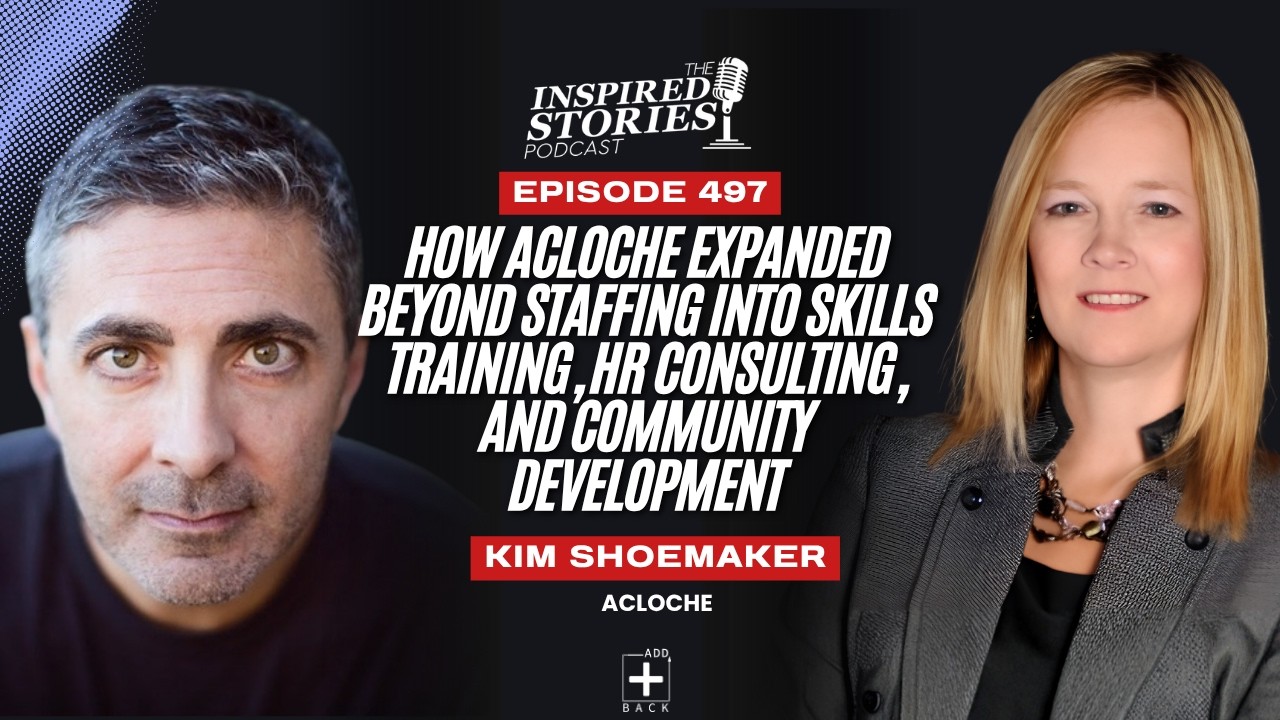
Kim Shoemaker is the CEO of Acloche, a Central Ohio staffing institution founded in 1968 that now places roughly 8,000 workers at any given time across contingent staffing, direct hire, and HR consulting. She joined the company in 1999 to run the accounting department and spent a decade learning every corner of the business before being asked by the board to step into the CEO role following the sudden passing of her mentor and predecessor in 2010. More than fifteen years later, she has expanded the company's reach well beyond traditional staffing into skills training, community development, and educational partnership work that most people in the industry aren't doing.
✨ Key Insights You'll Learn:
Joining Acloche in 1999 to manage accounting, then spending a decade absorbing operations, IT, marketing, sales, and HR
Mentor Bobbi Ruch taking Kim under her wing and coaching her into public speaking and strategic leadership
Stepping into the CEO role in 2010 after Bobbi passed away suddenly, managing grief and company continuity simultaneously
Moving offices roughly a year into the transition as a way to help the team physically move forward
Three lines of business: contingent staffing across all 88 Ohio counties, direct hire across North America, and HR consulting and training
Piloting a virtual skilled trade certification program with Northview Trade School offering HVAC, appliance repair, and machine operator courses
Running an eighth-grade career awareness program through BPA to teach resume writing, cover letters, and interviewing
Working with the College Board to pilot cybersecurity and financial AP courses at the high school level for college credit
Buying and building out a 1,500 square foot dedicated training center at Acloche's new Groveport headquarters in 2025
Over 30 years of NWBOC and WBENC women-owned business certification; 17 years of Acloche for the Cure at Susan G. Komen's Race for the Cure
🌟 Kim's Key Mentors:
Bobbie Ruch (Former CEO): Mentored Kim for a decade, brought her into strategic leadership, pushed her into public speaking, and built the legacy Kim continues today
Betty Lou (Founder): Acloche's founder and emeritus board member whose original vision set the company's community-first standards
Anserteam Network: National staffing organization Kim serves on the board of, expanding her view of how the industry can change public perception and workforce outcomes
Her Internal Management Team: Long-tenured leaders averaging 15 years who have helped Kim evolve from the one with all the answers to the director of an orchestra
Her Daughter: Told Kim directly that not every problem needs to be fixed, only listened to, a lesson Kim carries into her leadership and community work
👉 Don't miss Kim's account of being asked to take the CEO role while the entire company was still grieving, the letter from a woman who had been living in her car with two children, and why she believes the staffing industry is bigger than the movie theater industry but far less understood.
Listen to the full episode here
Transcript
Anthony Codispoti (00:00)
Welcome to another edition of the inspired stories podcast where leaders share their experiences so we can learn from their successes and be inspired by how they've overcome adversity. As you listen today, let one idea shape what you do next. My name is Anthony Cotaspodi and today's guest took over as CEO of a 40 year old company after her predecessor passed away and she had been inside that company for a decade already.
running the numbers, watching everything from the inside. She knew exactly what she was inheriting. That didn't necessarily make it easy. She stepped into the coroner office in 2010 with no playbook for what came next, just a deep knowledge of how the business worked and a clear sense of what it was supposed to stand for. What she has built since then is something well beyond what most people picture when they hear the word staffing.
She is Kim Shoemaker, CEO of Acloche, a Central Ohio institution founded in 1968 that now places roughly 8,000 workers at any given time across contingent staffing, direct hire, and HR consulting. Under Kim's leadership, Acloche has expanded to serve clients across North America, earned the BBB Torch Award for Ethics twice,
and most recently launched a virtual skilled trade certification program designed to close the widening gap between job seekers and the jobs that actually exist. What makes this conversation worth staying for is what Kim represents, someone who chose depth over speed, stayed with one organization for over 26 years, and has found a way to lead something bigger than herself without losing what made it worth leading.
But before we get into all that good stuff, today's episode is brought to you by my company, Ad Back Benefits Agency. And you'll want to hear this because it's hurting almost every business you know. Health insurance costs go up every single year and staffing companies are furious about it. They're paying more, claims are getting denied, employees are opting out because they can't afford it, and it hurts turnover and morale. It's one of the most maddening problems in running a business and everyone just accepts it.
but you don't have to anymore. Now there's a program that gives employees unlimited access to doctors, therapists, and prescriptions with no copays or deductibles to meet. Here's the part that really shocks most people. Unlike every other employee benefit out there, our program increases your net profits. We recently helped a client add $900 per employee per year to their bottom line.
Results vary, but gains like that change how a business is valued. And it works great for part-timers and high turnover environments too. Get your free consultation today at addbackbenefits.com. All right, back to our guest today, the CEO of Acloche, Kim Shoemaker. Thanks for making the time to share your story today.
Kimberly A. Shoemaker (03:06)
Thanks for inviting me, Anthony.
Anthony Codispoti (03:08)
So Kim, before you got into staffing, you were running the entire office operation for an underground construction company in central Ohio. You were managing everything from accounting to helping bid out jobs. I'm curious, what did running a smaller operation like that teach you about how business works?
Kimberly A. Shoemaker (03:30)
think it taught me a lot. mean, because that's where I had the opportunity to diversify my knowledge and my skills and kind of learn a lot. ⁓ Under their leadership, they taught me a lot about the accounting side of things, the receivable types of things. They taught me how does the underground construction affect our communities and how does that work and what that looks like. Honestly, it taught me how to work with other people. It taught me leadership. ⁓ I think it really taught me a lot. I was actually there for
about 12 years and through that I had grown in my personal life and in my work life and my career life and just learned a lot.
Anthony Codispoti (04:08)
Sometimes the most powerful lessons are positive experiences, where maybe there was a mentor who really coached you, of taught you a certain way to operate. Sometimes the lessons come from harder experiences, real big challenges that you had to face, whether it would be with a coworker or a customer. Pick one of those two categories there and talk to us about a powerful lesson that you learned at that time that you were able to carry forward with you.
Kimberly A. Shoemaker (04:38)
I think probably to control what you can control. I mean, we worked in a very small office with just a handful of women and it was sometimes challenging because every woman was trying to make a name for themselves, just kind of trying to figure out how they could give back and create content. And I just think controlling what you can control, I think there's a lot of times that we sit back and we think about, okay, I could do this, this, this.
But some things are without your control, so really kind of focusing on what you can control. And you can't control anybody else's behaviors. You cannot control the outputs from anybody else. Just really kind of really figuring out where you can make the best contributions and where your skills lie.
Anthony Codispoti (05:21)
So what was it that brought you to A Cliché in 1999 and what did you think you were walking into there?
Kimberly A. Shoemaker (05:28)
That's a great question. Never really where I thought I'm at now. That was never on the radar for me. ⁓ I think I just needed a change. I just needed something different. Like I said, I was at the other company for about 12 years and they needed something, a change. When I walked into Acclisay, at that point in time, we're a franchise. We're an Olston of Central Ohio. I was really brought in to help oversee the accounting department and it was just a little bit more...
more responsibility but really more focused responsibility was what I was walking into. ⁓ And then that changed. So here I am today. I really enjoy the accounting aspect of things, but I also really got to
Anthony Codispoti (06:04)
See you.
Kimberly A. Shoemaker (06:09)
gained the knowledge over the years. Like I really worked very closely with the IT department. I worked very closely with the marketing department and the sales department and we're an HR company. So I really learned a lot from, you know, from HR laws and regulations as well too. So walking in, I thought, I'm going to be able to run the accounting department and it's going to be a really focused ⁓ position. That's going to be a lot of a bigger scale than what I was already doing.
Anthony Codispoti (06:35)
So you thought you were coming in to do accounting, just more of it, a bigger operation. How was it that you got your fingers dirty in kind of all the other parts of the company? Is this just you sort of raising your hand like, ⁓ I want to learn more about this? Or was there some other dynamic at play?
Kimberly A. Shoemaker (06:55)
do enjoy learning and I feel like as humans we should learn something new every day. So I do think that there was an aspect to that where I was like, okay, let me help here. What can I do to assist here? I also think there was a very large aspect of the senior leadership at that point in time, specifically the CEO. I think at some point in time she took me under her wing and she really kind of brought me into the fold of.
of her vision of how she was, how she ⁓ wanted to see the company move forward and just some of the things that were going on in the company. She really kind of, you mentioned mentor, I think she really did mentor me.
Anthony Codispoti (07:31)
Was this Betty Lou, the founder?
Kimberly A. Shoemaker (07:33)
Actually, it was her daughter, Bobbi Rook. So Betty Lou was there. She was an emeritus when I first started. She was on the board. She was there kind of ⁓ dribbling around a lot of different things. But her daughter, Bobbi Rook, was the one that was running the company when I joined.
Anthony Codispoti (07:49)
and she was a good mentor for you. Can you give us a specific example, something she coached you and something she taught you?
Kimberly A. Shoemaker (07:59)
probably so much. So she brought in a lot of the management since she would bring in a lot of like management meetings and she would run a lot of these management meetings just to kind of talk about different management styles, different strategic plans on how we can grow certain areas of the company. ⁓ Really.
I am a very personable or person, I'm a very private person. And she kind of brought that out of me too and had me do public speaking. And I'm like, I don't really like public speaking. But I did. And she's like, wow, you're better than that than you think you are. And I was like, I don't know. I don't really care for public speaking. So I think those are some of the ways just kind of really being more tuned in to leadership management style and tuned into kind of spreading the word of backlash.
Anthony Codispoti (08:46)
So you mentioned the not being comfortable with public speaking, but you kind of got nudged into it. How do you feel about it today? Because I think that's one of those things where people feel like, either you're born for it or you're not, and you're just not going to pick it up.
Kimberly A. Shoemaker (09:03)
I don't really care for it, but I do it because this is my role. I have an opportunity a lot to do some sort of public speaking. I do know and I know you're not supposed to say, but I'm like, I know I do it because I have to take a thought process to think about, OK, what do I want to say next? And I do say, ⁓ my husband kind of counts me on that, too. And I'm like, it's just who I am. I mean, that's what I'm going to do. But I ⁓ don't really care for it, but I still do it because.
Generally, whatever I'm doing, have a passion for. I've been on a few boards, and I've done public speaking for the boards. And it's just something that you have a passion for. So at that point in time, it's kind of like you're just talking about whatever it is, the topic that you're trying to get across to somebody.
Anthony Codispoti (09:46)
So you still don't love it, but you do it because it's a means to the end. ⁓ Any advice for those folks listening who are like, I don't like to do it either, but I feel like it's holding me back in my career.
Kimberly A. Shoemaker (09:59)
Just do it. I mean, just do whatever you're passionate about. you know, I know that there's a lot of butterflies with a lot of people and a lot of nerves, but at the end of the day, you're just talking about something that you're passionate about. And you know what? You're going to go home to your family, to your loved ones. They're still going to love you. They're still not going to judge you. They're still going to be there for you. Just do it. And ⁓ once you get past that first couple of times,
I think you'll be more comfortable with it. just again, think about your loved ones and the family. They're never gonna judge you on it. Just do what you gotta do.
Anthony Codispoti (10:29)
You know, the other thing I would say is that the audience is judging you much less than you are judging yourself. They're not going to notice by and large the ums and the ahs or if you missed over a sentence in your prepared speech. We are our own worst critics, right? So we can get out of our head and say, you know, people aren't analyzing us as closely as we are ourselves. think that allows for a little bit of extra grace too.
Kimberly A. Shoemaker (10:56)
I think that's great advice because that is probably one of the things with me. I'm very, very hard on myself and I'm very, very critical on myself. And I think you're right. Nobody else is going to be as critical as I am or as whoever it is that is out there doing public speaking. Just get across the topic that you're trying to get across. And most people are going to find it interesting.
Anthony Codispoti (11:15)
Yeah. So Kim, you came in through the accounting department. You spent about a decade as a senior vice president controller. In my experience, a lot of CEOs come up more through sales or operations. What do you think the financial vantage point provided to you as an advantage that maybe coming up through a more traditional path wouldn't have?
Kimberly A. Shoemaker (11:43)
I think that's a good question. think coming up through the financial path, you clearly have a better understanding of the numbers and the profitability, which could be good, but it also could be a hindrance because coming up under the sales side of things or the operations side of things, you have a better knowledge of, you know, maybe the operations and not so much the profitability of it. And I think finding that
that balance because again, I think it goes back to some of the adage, you got to spend money to make money. And a lot of finance people are like, we're not spending anything. We've got to make money over here and finding that balance between, okay, well, maybe it is going to cost us a little bit right now. But in the long run, if we think of the long strategic plan, it's worth that cost. So it could be a hindrance, but it also could be helpful because then you can think the long-term picture financially where that's going to place your balance sheet at.
Anthony Codispoti (12:33)
Was that a difficult transition for you to make from being on the financial side and trying to pinch all the pennies and save all the costs to, you when you did eventually step into the big role, you know, now you kind of had this bigger picture vision of it's okay to spend money to make money.
Kimberly A. Shoemaker (12:50)
I think so. I think it held me back early on. But I also think before I got this role, I was in a taste of how do you do marketing? How do you do sales? How do you talk to your customers? What does the IT department look like? Because in my previous job, I was getting into experience of how do you bid on jobs. ⁓ So I do think that there was a lot of other factors that I do. But I do believe that that kind of held me back a little bit because it's like, it's all about the bottom line. And in running a company,
I don't want to discount that it is all about the bottom line, but it's more about the people. It's about the people that are working for us. How do we support them? How do we make them feel be successful? What tools do they need? And I think early on, it was probably a difficult transition for me to think about like, think about it like that.
Anthony Codispoti (13:36)
So let's talk about that transition. How did this move into the CEO role come about? What were the circumstances?
Kimberly A. Shoemaker (13:44)
Well, it's very unfortunate, but the previous CEO that I told you was ⁓ a mentor to me, she suddenly passed away. So at that point time, I think there was a lot of hesitancy within the company about what are we going to do? Like, what are we going to do? We were all incredibly grieving ⁓ and wanted to mourn that loss. And then how do we make this legacy that, you know, her and her parents built be continued?
So it was a very difficult, very emotional, very challenging time. And at that point in time, the board came in and just basically evaluated the executive leadership and unbeknownst to me, decided, hey, Kim, I think you're the best person to lead this company going forward. Would you accept this role? And I did.
I mean, really without much thought because I'm like, this company has so much to give back to our community. There is such a legacy here between again, Bobby and her parents of what they've already created. I'm like, yes, let's do this. Let's figure out how we continue this. you know, we're here, we're 16 years later and we're still going strong.
Anthony Codispoti (14:55)
So it wasn't like you were being positioned or groomed for this because it doesn't sound like, ⁓ you knew that Bobby was going to retire in five or 10 years. Let's sort of get the next person ready. You said she passed away suddenly. And so now you're thrust into this role kind of surprisingly. I don't know. You were surprised to be offered it. But you felt like you had a duty, it sounds like.
Kimberly A. Shoemaker (15:22)
Yeah, exactly. mean, no, I don't. There was never a ⁓ path for me to be where I'm at now. It was. I just assumed that she would continue the path and she because she loved what she was doing and it was it was a very unexpected transition.
And I did, I felt a sense of duty. I'm like, have so many internal employees here and we have so many people that were placed across our clients, across all of our clientele base. And like, I felt a duty, I felt a responsibility, but also I just felt honored that they would think that I could never replace her shoes, because I could never do that, but that I could create my own path to make this company strong and continue.
Anthony Codispoti (16:06)
Do you think any others were surprised that you were the one who was knighted for this?
Kimberly A. Shoemaker (16:13)
Probably, yes. I would have to say there was probably a few that were surprised.
Anthony Codispoti (16:14)
Yeah.
How would you describe the culture there before you took over and if it has evolved at all since then?
Kimberly A. Shoemaker (16:32)
Well, mean, the culture when I started with Acloche hasn't changed a whole lot. It was very customer centric. Like we're very strategic on how do we help with any type of workforce needs with our clients. And that's what it was when I started 26 years ago. And that's what it is again today. I think that we were very much, we would have consistent management teams where we would bring and collaborate with the managers on
each of the different geographical locations we are, each of the different divisions we are, and how do we collaborate? And that's still one of our core values today. So our core values are definitely we're customer centric, we collaborate, we're accountability, and we're innovative. And I don't think those are really changed much. I think they've maybe just gotten stronger over the time because on average we have about 15 years of tenure in our management team and about a 10 year tenure in our staff team. So I just think it's just grown and gotten a lot stronger.
Anthony Codispoti (17:30)
I want to go back to maybe like the first 12 months of that transition, because this is hard, right? You're in a new position. You, as well as the rest of the company, it sounds like Bobby was ⁓ well liked, well respected. Like this left a big hole. People are grieving. As you look back during that time, what were some things that you think that you did well in helping to...
manage all of that, the emotions, the grieving, the transition? And is there anything that you look back on now with the wisdom of having been in the role for many years that you're like, you know what, I might have chosen to do this different.
Kimberly A. Shoemaker (18:11)
⁓ I think what I did well was just step in and just learn what I needed to learn in order to continue keeping the company moving forward. I think it was very difficult. We brought in third party ⁓ companies to kind of help with the grieving process with the employees because they needed somebody to talk to. They needed somebody to work with to kind of process through the emotion of what they were going through.
I hope that I was very supportive with everybody and letting them grieve in their own time, process things in their own time, and really keep people on the path of what we were still trying to do as an organization. ⁓ I think there were a lot of...
people that were telling me to do this and to do that. I think there is probably some regret that maybe I should have done everything that they told me to do as far as making some changes and things. And I was just listening to people that I'm like, okay, well, let's try this. And I feel like if I would have...
known now what I knew then, I probably would have handled some of those situations just a little bit differently. But for the most part, I think we band together as a group to figure out how are we going to continue moving this company forward. And I think we were very successful about that. Around the same time, you said 12 to 18 months later, we had been at a location for a number of years, I think 12 years there, and our lease came up. And we're like,
I think we need to move. And I think that that was probably one of the big things that kind of helped us move past that because I think everybody was still looking at, you know, certain offices of where she was at and everything. And I think I'm happy that we did that because it didn't like just it didn't take away any of the grieving, but it it kind of helped us move forward.
Anthony Codispoti (20:08)
can see that. So, Kim, tell us about Acloche today. Three lines of businesses, the clients that you're serving, and the people that you're placing.
Kimberly A. Shoemaker (20:17)
Yeah, we like to talk about ourselves that we do anywhere from recruitment to retention. So we have in the state of Ohio, across the state of Ohio, we'll do contingent or staff augmentation. Everybody calls it something different. But basically that line of business, we can do anything with our client basis. Let's just say that they need some temporary coverage for somebody out. We can have somebody come in on a temporary basis to kind of help them with their workload. A big part of what we do in there is what we in our business call temp to hire.
So we go out and source and recruit for that ideal candidate for that position. And then they'll stay on our payroll for, I don't know, on average 90 days and making sure it's a good fit for not only the candidate, but for the client. And then when that good fit matches, they get transitioned over into our client and they become on their payroll. That's like our contingent staff augmentation side of the business, which is a very large part of what we do in the state of Ohio.
We also have an executive service or direct hire or recruitment services, headhunter, that's called a lot of different terminologies as well. Well, we work all across North America with our client partners and go out and source and recruit and find that right candidate for them. And they immediately go on our client payroll. So it could be anywhere from engineers to C-suite, lot of management, a lot of skilled positions, lot of machine operators.
⁓ maintenance tax. So it's across the border and that goes across the actually really in North America. We've got some clients that we help in Canada.
Anthony Codispoti (21:51)
And so sorry,
real quick on that second one, the kind of what I was thinking about is executive recruiting. But these aren't necessarily all like white collar jobs. You're talking about a lot of folks that are in the blue collar sector that you are doing direct placements for.
Kimberly A. Shoemaker (22:05)
We do both the white collar and the blue collar. yes, there are a lot of like, I mean, maintenance tech is one big one because that particular type of skill set is in high demand. So I think that that is a higher skill set that people are just trying to hire on. I mean, again, we do engineers. ⁓ We've got a lot of engineer positions that are open. So yeah, we do some blue collar and a lot of white collar as well too across North America. There's a lot of C-suite, there's a lot of management.
those types of positions. then our third, I'm sorry, it runs in the air. Our third category is our HR services division. So this is really helping other companies from any smaller companies that might not have an HR department. We've written policies, procedures, we've written SOPs, we've written handbooks, we've done audit on nine nines for them.
Anthony Codispoti (22:34)
Okay, runs the gamut. It runs the gamut. Yeah, go ahead. But yeah, what's the third category now?
Kimberly A. Shoemaker (22:58)
And then a big part of that that we do again across North America for a lot of our clients is leadership and sales skills training. So we're helping them try to retain their current workforce. ⁓ And we go in and we've got a whole list of a library of trainings that we do, but a lot of times we're customizing based upon the need of that client and what it is. Like one of the particular ones that we do is it's kind of called peer to boss. So I'm your peer today and now I just got promoted.
How do I become your boss? And I've been your peer for a long time because ⁓ there's a lot of nuances and new training that you have to have in order to be able to make that transition. That's just one example. But we do a lot of customizing for our clients and what type of training that they need for ⁓ their workforce.
Anthony Codispoti (23:43)
say a little bit more about that specific element of the training because it strikes me that ⁓ I don't know, perhaps you would have benefited from some of that as you transitioned into your new
Kimberly A. Shoemaker (23:53)
Absolutely, I think so. mean, again, you don't know what you don't know when you step into a role. And sometimes if I'm working right beside you, I've created some sort of relationship that might not be the same relationship I would have for you if I'm managing you. So it's a hard transition for a lot of people to go through. So it is one of the classes that we offer. And again, we kind of take that content and customize it to the situation too on what they really are struggling with and what tools that we could really help them be more successful.
Anthony Codispoti (24:22)
Give us one tip that's shared there in that course.
Kimberly A. Shoemaker (24:26)
One tip is don't take everything so personally. The relationship that you had, you were there to do a job to help everybody be successful. So if that person really wants to be successful, they're gonna take a lot of the knowledge that you're giving them and work and collaborate with you on what they need in order for them to be successful.
Anthony Codispoti (24:45)
historically what has Aclashay most been known for in those three different verticals and where do you see the biggest growth today?
Kimberly A. Shoemaker (24:56)
I think that's a great question because depending on who you ask, I get a different answer. Because I used to hear all the time that they didn't think that we would do, that they thought we just did logistic staffing for like light industrial warehouse, which we do. They thought, and then somebody else was like, no, you only do like office and clerical and healthcare. And we do that as well. So I think depending on who you ask, you're gonna get a different answer. I think for our...
for ourselves. think staffing and direct hire, that's what we're known a lot for. It's this HR services and the training that I think I would like to see that be a little bit stronger and get out there and help people with their own workforce and how we can strategize in order for them to retain their own employees.
Anthony Codispoti (25:41)
Why are you excited about the growth area specifically in the HR services part of what you do? Why do you think that there's so much blue ocean there, so many opportunities?
Kimberly A. Shoemaker (25:51)
Well, I think it goes back to the economy and the workforce that we have now. Everybody's trying to retain their employees more now because of the the deficit that there is with the workforce. I think we have a huge skills gap.
in a lot of different industries. mean, depending on what the job is, and we see this at Accolade, we've got a lot of open requisitions of jobs that people need that maybe the skill sets not out there. And then we have a plethora of resumes for different skill sets that the jobs are not out there because they're maybe little more too defined. So I think when you talk to our client partners, retention is something that they're really trying to hone in on. And I think we have some strategic.
plans that we can certainly help people with. I'm really excited also about the direct hire and the contingent. Don't get me wrong. I just think that there's within at cliche, ⁓ our verticals, there's a more opportunity in the training aspects of this.
Anthony Codispoti (26:46)
Are there specific geographies that you guys focus on?
Kimberly A. Shoemaker (26:52)
So for the contingent side, we do all 88 counties in the state of Ohio. We have bricks and mortars all across the state of Ohio and we have transient employees that work out there. have community engagement specialists and business development specialists that are boots on the ground in all of these different communities. When it comes to executive search, are direct hire. We're all over the United States. ⁓ So, and then with the HR services, we're working on some different things.
and like New York, ⁓ Pennsylvania, trying to kind of help in some areas over there as well too. So we're really all over North America, but from the contingent standpoint, currently we're in 88 counties of Ohio.
Anthony Codispoti (27:31)
Okay, across the whole state. So Kim, you've talked openly in the past about the negative connotation that staffing agencies carry in a lot of people's minds. What's the thing that Acloche does differently that you think actually helps to change that perception?
Kimberly A. Shoemaker (27:33)
Mm-hmm.
You know, that's funny. I was just meeting with somebody last week that said, I cannot get my team's buy-in because of this and that. And I'm like, well, give me some examples. Let me hear what your myths and misconceptions are so that I can talk about those. And one of them happened to be, we want our clientele to go straight to the employer because of the pay disparity, because when they go through temporary staffing or contingent staffing, they get paid less than what they would do if they go straight to the companies.
And I'm like, well, that's not always true. That's your staffing partner's responsibility to talk about the pay disparity with those corporations and making sure that there isn't something like that. ⁓ So I hear this all the time, or that you charge them a fee. We don't charge a fee either. Our job is to help connect people to complementary teams. That's what Ackleshe does. That's our passion. One of the things that we do
I think differently is that we really engage in our communities. I have specific community engagement specialists that are working with higher education. We're working with middle schoolers. We're working with ⁓ nonprofit organizations with their clientele that they're trying to get them to work. We're working with education companies where we're trying to help with the skills gap. We just recently piloted earlier this year a program where we're
⁓ offering virtual trade school training. And we have a course in appliance repair. We have a poison HVAC repair. And we just started a course in machine operator. We're hoping to get electrician and plumbering up in the next couple of months in the summer to really kind of help people that want to go down those paths, have the opportunities to go down those paths. And it's not just those skills trades. We're very passionate about that, but we're also
passionate about people who want to go college bound. We're working with the College Board on their piloting a couple of programs in the state of Ohio ⁓ for high school classes to get college credits. So cybersecurity and financial are two of them that we're working with to try to pilot those so that we can get them in the high school level to get AP courses for college credits. we're really kind of put ourselves out there with the communities that we're there to help.
We're there to help our next generation find whatever path it is that they want to go down.
Anthony Codispoti (30:11)
There's a lot to unpack here. You guys are a lot more than traditional staffing. So I want to go back to a couple of these things. What is it that you're doing with middle schoolers?
Kimberly A. Shoemaker (30:22)
We just actually did a program this last fall where we did a nine ⁓ to 10 week program for, it's called BPA, Business Professional. I forget what the A stands for, Association, I think, but it's a contest. So these eighth graders had a contest where they had to apply for an internship, write the letter, write their resume, and then interview for this internship program. And our team spent nine, 10 weeks with them on helping them prepare for what the letter would look like. How do you build a resume? How do you interview?
And I'm really happy to say that there was a handful of those that went to the state competition. And then out of the state competition, they just went to Nashville for national competitions. ⁓ And it's just, again, the eighth graders learning and understanding what it's like. Did you know that in eighth grade you have to pick all of your high school courses? Now, what eighth grader knows what they want to do in high school?
They can't pick high school courses, they just don't know. So it's kind of just educating them on options. What is out there, kind of giving them a preview of what's to come when you're talking about applications, whether it's college application or a workforce application.
Anthony Codispoti (31:32)
So let's talk about the virtual skilled trade certification program that you just rolled out. You're doing a pilot with Northview Trade School. And somebody can get HVAC or appliance repair certification within about 10 weeks for very reasonable costs, a few thousand dollars. Tell us more about how the idea for that came about, the specific problem that you're trying to solve.
Kimberly A. Shoemaker (31:59)
Well, we've been working on this and just noticing the skills gap for 10 years down maybe, if not even more. And ⁓ one of the things that we've really seen is like machine operators. In the state of Ohio, there's a lot of open positions for machine operators. There's a lot of need for HVAC group here. And we ⁓ met one of ⁓ these gentlemen and we kind of just sat down and said, what could this look like? What would this look like in order to get somebody
trained to be ready for those different programs. So they will walk out of there like EPA and OSHA certified. In the HVAC, there's another certification, but for most like the machine operator, they're getting actually OSHA and EPA certified and the NAIT certified on the ⁓ HVAC so that they're ready to be starting work and really kind of get hands on with clients that are looking for this type of need. There's a huge need for it. I don't know if you had to have your HVAC repaired at your home or your office, but
I mean, you're waiting weeks out to get somebody in there and in today's world you just can't do that.
Anthony Codispoti (33:06)
⁓ Now I want to talk about what you're doing with college boards, like actually working to provide college credits. Say more about this program.
Kimberly A. Shoemaker (33:16)
So the college board based out of New York reached out to us and they're trying to pilot a program in the state of Ohio where they really want to run these two programs, one for cybersecurity and one for financial and get them in the high school level for AP courses so that they can get college credit. So we're working with them in order to try to get this in front of state legislators to pilot this program for next year.
⁓ because cyber security is another industry that I think that there's a very, very large need for. So if we can get in front of high schoolers that might be interested in learning a little bit more about that and taking these courses, it might help, again, with that skills gap and their path to maybe getting some more people into that industry.
Anthony Codispoti (33:58)
And I'm sorry, say more about the group from New York that came to you.
Kimberly A. Shoemaker (34:02)
It's an organization called the College Board. So they're a national organization that kind of helps colleges in growing different ideas and different suggestions on how they do it. They're very much about higher ed and they're just looking at different programs. look at some little, they also look at public administration to kind of see how that they can change some public administration as well. But the program we're working with is just helping with these AP classes.
Anthony Codispoti (34:29)
And the overall bigger purpose of the college board is to sort of bridge more folks from high school to college and give them some ideas of career spots that may have good job opportunities for them.
Kimberly A. Shoemaker (34:44)
Yeah, I think that the purpose of the College Board is to bridge the college level with high schools and the public officials on different legislations that they can change and really kind of strengthening the college path. I think that's the main thing is how do they strengthen the college path for individuals that want to take that path.
Anthony Codispoti (35:03)
This is really interesting to me, Kim, you you've been working on this ⁓ skills gap issue for 15 years. ⁓ You know, going to the junior highs now, you know, piling the eighth grade career awareness program, partnering with the College Board on cybersecurity and finance classes. You know, I've talked with a lot of staffing firms, a lot of folks are, you know, doing really good things out there. But what you're describing here is really big picture thinking that ⁓ I haven't seen a lot of.
Obviously, you know, the scale of Acloche gives you some resources to be able to think about and pursue these things. But I'm wondering if there's something else that drives this either in your personal background, the way that you're wired, or maybe something that's deeper inside the company's culture.
Kimberly A. Shoemaker (35:51)
⁓ It's probably the way I'm wired to be quite honest with you. I mean, I think whenever I do something, I'm like all in. I'm going to commit my time and energy into something, I am just 100 % all in. I like to build. I like to connect. I really like to give back to our communities.
⁓ And I think I've embedded that into our culture here too. I mean, we are, I have said this to all of our teams. We need to embrace and embrace ourselves and embed ourselves into our communities. If we don't know what's going on with our communities, how do we make them better? How do we contribute to changing people's lives? So it's probably a little bit how I wired. It's probably a little bit how ⁓ it's just our culture. I mean, everybody here is so passionate about helping people.
and really kind of thinking very big picture, but then getting down into the weeds and saying, OK, well, how are we going to execute this? So I think it's maybe a little bit of both.
Anthony Codispoti (36:47)
So you're obviously helping the company think really big picture, know, pursuing these different partnerships. How do you see this idea of the community involvement, the being embedded in the community show up for some of your more frontline workers? What are the things that they're doing, like you said, to kind of get in the weeds and carry out that part of the company's culture?
Kimberly A. Shoemaker (37:11)
Well, I mean, I think that they're executing a lot of this. When we go back to the nonprofit organizations, that's my team. They're working directly with nonprofit organizations to help their clientele with ⁓ resume writing or interview skills.
or connections to people that might be looking for whatever skill that they have. They're also working with school systems. We have several different school systems that they're working boots on the ground with that they go and they do resume writing or interviewing skills or job placement. So I think I have.
a team of people that that's 100 % of their job. They go out there and they just do that where the rest of our team is doing it and they're helping fill in when they're doing like their placements and their job interviewing here. But I've got I've got team members that 100 % of their job is to be out in the community and making these connections.
Anthony Codispoti (38:06)
So most staffing firms, I think at least the perception is, they do something, they do it well, they're kind of a matchmaker, right? They help the folks that are looking for work, connect with the folks that are looking for workers. You guys have taken a zoom out and said, okay, what are some other things we can do? Offer the HR services, consulting, internal the companies to help with retention, hold on to those good folks that they've got.
zooming out a little bit more and saying, okay, there's this skills training gap and lots of different areas. How can we get involved there? wonder, tell me that, you know, the answer is no, but is there an additional layer of zooming out or is there something else sort of big picture that is in the works or coming from Aclashay?
Kimberly A. Shoemaker (38:57)
I think there's always something big picture in the works coming for AKLASHE. One of our core values is innovation. So we're always trying to figure out how do we connect people with complementary teams better, quicker, faster? And how do we make people know? Again, I want to go back to the staffing industry. How do we make people know that the staffing industry is here to help people and to help bridge those gaps when it comes to employment and get rid of a lot of those misconceptions?
that they have out there. So I think there's always something bigger and better coming out with that cliche. We're always looking to grow. We're always looking to partner with people. We want to work with our client partners on whatever their workforce needs are, whatever the solutions may be, so we can go in and be strategic with them just to figure out what is the gaps that they have with finding employees? What is the gaps that they have with ⁓ retaining their employees? And how can we be a resource?
to you and help you be successful so that you can get out your end product or your end service.
Anthony Codispoti (40:00)
So part of what I'm hearing you say, Kim, correct me if I'm wrong, is that obviously you're trying to advance the cause and the ⁓ notoriety and the reach of Aclashay, but I also hear you talking more broadly about the staffing industry and changing the larger community perception of that, ⁓ which goes certainly beyond your...
hired purview of being the CEO of Acloche, why is that important to you? To sort of think more broadly about changing this perception of the industry altogether.
Kimberly A. Shoemaker (40:39)
Well, I think, I mean, we are also a member manager of a national staffing organization called Answer Team. So we, that organization was founded in...
2008 and we became a member manager of that. So I sit on the board with that. I sit with questions about it. So I hear this as a national issue that everywhere people just have this misconception of this industry where the reality of this industry is bigger than the movie theater industry. mean, the billions of dollars that this industry contributes back to our economic growth.
is just not really understood very well. So I feel like it's just important for people to understand that there are resources out for them. I've talked to so many people like they have no idea what to do. I've either been working for my job for 26 years and I don't know how to find a new job or I've never had a job before. How do I find a new job? And I've seen how this industry can change people's lives and help better their lives. And I just really want to make sure that people out there see that, that it is an option to them.
Anthony Codispoti (41:41)
Sort of talking about big picture, and you briefly referenced this. ⁓ Just last year in 2025, Acloche bought its own building in Groveport and built out a dedicated training center there after years of having leased the previous location. I'm curious, what does that investment say about where you see Acloche going over the next decade?
Kimberly A. Shoemaker (42:06)
Well, I think that goes back to your question earlier about, you know, which area of the line of business do I see, you know, a lot of opportunity? And that's why we invested in this training room, because I do think that there's a lot of opportunity to bring people together again, to collaborate on different issues that they may have. And how do we be problem solvers for them to be able to fix that workforce need? So, yes, we did buy a building. are now in...
Groveport, that's our corporate headquarters, we still have offices ⁓ all over central Ohio, and we invested in a 1500 square foot training center here that seats up to 50, 60 people that we can sit in there and we can collaborate together and we can kind of help figure out, again, whatever workforce needs in, whether it's soft skills training, whether it's leadership training, communication training, ⁓ how do we help them be more successful in their job?
Anthony Codispoti (42:59)
So Acloche has held its NWBOC, Women Owned Business Certification for over 30 years. How has that shaped the clients that you attract and the way that you lead?
Kimberly A. Shoemaker (43:14)
Well, we're also WBENC certified, which is another national certification that I think we've been with that ⁓ for probably almost 30 years as well too. And we're also certified in the city of Columbus and in the state of Ohio, we several women certifications. I think it stands as a testimony to this organization.
that we are women owned and when we're working, we do a lot of work with the government entities as well too. So being women owned kind of helps, or it used to help with the diversification. So we have diversity spend that would kind of help put us there. I also just think it's a testament to women owned organizations that, I mean, we've been around since 1968 and I get to work.
every single day with women that are aspiring to grow in the best of their career. And I work very frequently with small women-owned organizations to kind of help how do we build them up and how do we become stronger as women-owned organizations.
Anthony Codispoti (44:16)
I love that. You've also been involved with the Susan G. Komen Columbus Hope Breakfast for years. Tell me about what this cause is about and why it's important to you.
Kimberly A. Shoemaker (44:29)
Well, I'm actually on the board. That's one of the organizations that I'm on the board with. I am on the board with Susan G. Coleman. This is actually this year is our second. ⁓
Annual Hope Breakfast. was piloted last year and this was the second one, but we've also been part of the Race for the Cure for a number of years. We started our own group called Aclashay for the Cure. 2010 was the first year that we did that. As matter of fact, that's going to happen this Saturday. So we're all gearing up this Saturday to go downtown Columbus and support the Race for the Cure.
I just think it's very unfortunate, but breast cancer touches everybody, whether it's directly, whether it's indirectly. And as a woman-owned and operated business, I think it's very important for us to, again, support other women and their challenges and their struggles and just kind of be there for them. I mean, it's a terrible, terrible disease, not that women only get that, do get this as well. And we just want to be there, again, to support our communities, to support our people.
⁓ in need so we're going to go down there again this Saturday and we've got a crew we do a shirt that says Aclashay for the Cure and we get together and we go do the 5k. I don't run but I do walk it every year I walk it rain or shine.
Anthony Codispoti (45:41)
⁓ Gosh, trying to, I think the path comes pretty close to my house. ⁓ I live in Victorian Village along Neal Avenue. So maybe we'll go out there and look for you guys. Sure, go ahead.
Kimberly A. Shoemaker (45:52)
It
starts and ends at North, is that North, North Bank Park right there? I think that's what it's called. It starts and ends there. So yes, this, I think the race starts about eight 30 if you're a runner and we're there until 11 o'clock. So it ought to be a good day. I'm hoping the rain holds out, but, but yeah, I think I've been part of this board for a few years now. We've been part of it for, you know, six, this will be our 17th year doing it. And again, it's just really kind of helping our community and helping give back.
Anthony Codispoti (46:06)
Okay.
So you've been CEO of Acloche now for more than 15 years, yes? Yeah. What's something that you believed or didn't believe about leading a company when you first took over back in 2010 that your mind has changed about?
Kimberly A. Shoemaker (46:27)
Yes.
Hmm. Okay. Probably a lot to be honest with you. I think what I believed then was that I had to have all of the answers. Like if people were coming to me and they wanted, I don't know, whatever it was, I had to be the one with all the answers on how to do that. And I think that is just not the truth of the matter. The fact of the matter is that a leader's job is to really ask questions.
to listen to what everybody needs and really create space for them to bring the skills that they have to the table and to really support them and give them the tools that they need to be successful and not always have the answers, but listen to what their answers are and collaborate on them on how we collectively are gonna move this company forward.
Anthony Codispoti (47:27)
Do you feel like you're more of a director of an orchestra now than maybe in the beginning, where there's all these talented people in the symphony there, and your job is to get them sort of moving together, like you said, rather than to pick up and play the instrument yourself or be the one that always has the answers for it? Is that my painting the right kind of a picture?
Kimberly A. Shoemaker (47:51)
Yeah, mean, I think that, yes, I would think so. I mean, there's a lot of times too I pick it up too because that's just the habits that I have. But that being said, I trust my team. Somebody said something to me the other day because I went away for the weekend and they're like, well, what do you do? And I'm like, well, I don't do anything. My team's doing it. I trust them. I don't need to do that. They've got it. They're handling it. And if they know if they need me, they know how to get a hold of me. So I think it's just, again, just stepping back a little bit.
setting that direction to your point on the band, but really setting a direction. Here's what we want to go and what we want to do and listen to their ideas on how we execute to get there and then work with them to get it done.
Anthony Codispoti (48:30)
Hmm. Switching gears on you now, Kim, what is the hardest thing you've had to overcome personally? And what did that teach you?
Kimberly A. Shoemaker (48:42)
I think every experience that everybody goes through teaches them something. And I think that throughout my life, there has been several adversities. But if I go back to what we started this conversation about in the first place is having your CEO suddenly pass away and having this ⁓ uncertainty of...
where this company was going to go, but really grieving somebody at the same time that you're saying, well, we've got to do something. We've got all of these jobs that we've got to protect. We've got all of these people that we need to continue to be employed. And juggling the emotions of that with the responsibility of trying to continue this organization, I think was a very, very challenging time. And I think
What I've learned from that is just adversity, really. I mean, you just do what you have to do. And you just focus on what the right thing is to do to move forward.
Anthony Codispoti (49:42)
Yeah, I wonder if this rings true for you at all. I know from myself personally, as well as listening to lots of other people's stories that when you had a really hard time, whether it's in personal life or business or a combination of the two, there's a natural human tendency to look for sort of the the the light switch or the easy button that's going to like quickly, you know, patch whatever this problem spot is. And in my experience,
it there's rarely an easy button to be found. It is just like I think what you're sort of saying here, Kim, is figuring out a way to put one foot in front of the other. Just make those very small incremental steps forward. Have some inertia. Get up and do something rather than waiting for sort of that easy button to arrive.
Kimberly A. Shoemaker (50:36)
Yeah, I think I'm also innately a fixer. I like to fix things. Somebody brings me a problem like, OK, how are going to fix that? And it was my youngest daughter at one point in time. She's like, Mom, I don't need you to always fix things. I just need you to let me vent and listen to me. And this was like, I don't know, a number of years ago. And I took that to heart. And I'm like, OK. So now I try to, again, take one step in front of other. What can I fix? What should I fix? When should I step back and just listen?
Even when I've got a team member, they might want to come in and vet. And I'm like, OK, am I fixing some? And I just got to think about it. I fixing something or am I just listening? Where am I going with this? So yeah, I think that was probably something that really was a hard thing to learn. And it probably still is. I struggle with it today because I'm like, well, I just I want to fix it. Let me fix it for you. And you just got to realize sometimes you can't do that. Like I could not fix the situation we're in. I just had to take one step and take another step and just say, OK, well, where are we going to go from here?
Anthony Codispoti (51:34)
So I don't know what the version of this question is for the work environment, but something I am trying to get better at with my wife is acknowledging, asking her actually, asking, do you want to be heard? Do you want to be helped or do you want to be hugged? Because I'm wired the same way that you are. She starts telling me about some problem with a friend or something at work. And I'm like, here's what you have to do. And I can tell that it's not landing and
And so then I take a step back and I'm like, I'm sorry, did you just want me to listen? Did you, did you need a hug right now? Like, what is my role here?
Kimberly A. Shoemaker (52:12)
I think I've come to the kind of says, how can I help you? That's what I'm like, how can I help you? And then there'll be like, oh no, I just needed to listen or oh, maybe we can do this or let me get back to you or whatever. like, just tell me how I can help you.
Anthony Codispoti (52:24)
I like that. ⁓ So in this role, Kim, that you have CEO of Acloche, what is it that you most want to be remembered for?
Kimberly A. Shoemaker (52:35)
Hmm. I would say just building something that matters, building something that really helped other people. I'm very much about, again, giving back to our communities, but building something that matters, that can sustain me, past me, continue to grow. And it really helps people in the end. I always go back to this one story that I remember that this woman came to us for help. She wanted a job.
And unbeknownst to us, she was living in her car with her two children. And we were able to place her at a job. And six months later, we got a letter from her. Not only was she thriving at that job, which we knew, she was no longer living in her car, she was living in her apartment. Her two young boys were enrolled into school.
And I think those are the stories that remind me every day why we do what we do, why I always am trying to give back to my community, why I'm trying to make my community better. And I just want it to matter.
Anthony Codispoti (53:38)
say more about that particular situation, the help that you were providing. Was it strictly we helped place her into a job that opened up all these other opportunities for her? Or was there something deeper there?
Kimberly A. Shoemaker (53:51)
Well, I think we just put her into a job. So she came to us, and again, we did not know that she was living in her car with her two. We didn't know any of this until this letter six months later. And when people come to us, we are working with them. Again, our goal was to connect people with complementary teams. So our job was to look at her, see what her skill sets were, what did we have to offer, place her in that job, and then we worked with her on there. We don't just.
walk away once we put them in a job, we check in with them. How are you doing? What's working well? What's not working well? ⁓ And we were continuing to foster that. And then at six months, she got hired on at that particular client. And I think that's what provoked the letter about you never know what you did for me. And I think as we walk through life with humans, we never know what interaction that we do that's going to help somebody at the end of the day, which is why we've always got to
Be our best, help people, not judge people. How do we help people and how do we make the most and again, just matter in life.
Anthony Codispoti (54:51)
beautiful. What's your favorite thing to do outside of work, Kim?
Kimberly A. Shoemaker (54:56)
I think my favorite thing to do outside of work is ⁓ obviously spend time with my family. I have four children that are all grown and living their own life. I have three grandchildren that are local here to me so I get to see frequently, which I love. And I really love just traveling. I just love exploring places and going to new places that I've never been before and kind of, again,
enriching in that culture and seeing what that's about and just kind of learning new different things. I just love exploring and love traveling. That's kind of my big thing this year, just traveling around the United States at just different places and finding things.
Anthony Codispoti (55:33)
What's someplace on that bucket list you haven't been to yet?
Kimberly A. Shoemaker (55:36)
Well, I can tell you where I just went. I've never even heard of this, but Holland, Michigan has Tulip Time Festival. ⁓ And it's just a little town on the ⁓ Lake Michigan side. And they have this Tulip Town. They apparently, they place a million bulbs every single year that then they dig back up every year of tulips. And it's just beautiful. We just went up there, ⁓ not this past weekend, but the weekend before.
Unfortunately, it was very cold, so a lot of the tulips didn't make it, but it was really such a cute little town. I heard recently, I know the city of Marysville here locally is renovating, and I heard that they're mirroring some stuff from Holland, which would be cool for me to see at the end. But it was really a cool little town. There was a lot of tulips there. ⁓
Anthony Codispoti (56:28)
a million
tulip bulbs. How do you do something like that at scale? Clearly there's machinery involved, right?
Kimberly A. Shoemaker (56:33)
I don't know. I think they just I don't know. I was talking to one of the local people that live there and they're saying every year and I'm like, well, why would you like pull them back up? Why don't you just leave them there? And they said because they're not good enough every year. We want the best of the best every year. So they pull them back up. So when you go to this tool at Time Festival, you can buy the bulbs that are there. And when season's over, they dig them back up and mail them to people. So who do?
Anthony Codispoti (56:56)
Wow, yeah.
Kim, I've just got one more question for you today, but before I ask it, I want to do three quick things for the audience. First of all, if you want to get in touch with Kim and Acklishe, we've got a few options. Go to their website, which is acklishe.com, spelled A-C-L-O-C-H-E. That's A-C-L-O-C-H-E, acklishe.com. Also, you can find them on all the social media platforms with the handle of Acklishe.
And there's a toll free number that is super easy to get the help that you need. So just call triple eight six zero eight zero eight eight nine. That's eight eight eight six zero eight zero eight eight nine. And don't worry folks, we will have all that in the show notes in case you missed it. And if you're enjoying the show, please take a moment to subscribe wherever you're listening. It also sends a signal that helps others discover our podcast. So thank you for taking a quick moment to do that right now.
And as a reminder, you can finally get your staffing employees access to therapists, doctors, and prescription medications that counter-intuitively actually increases your company's net profits. No co-pays, no deductibles, and net profit increases that change how a business is valued. You want happier employees and a stronger bottom line, even for your part-timers and those in high turnover environments too? Then contact us today at addbackbenefits.com.
So last question for you, Kim, a year from now, what is one very specific thing that you hope to be celebrated?
Kimberly A. Shoemaker (58:34)
I would hope to be celebrating a little bit more sales growth that we've got going on. We're really kind of focused on getting our name out there a little bit more and trying to help some different partners. And the way the economic is going on right now, I think there's a little hesitancy to really kind of move forward with employees. So I'm hoping that that changes. And I hope when we have a little bit more confidence in the economic world that we would be hiring more people.
Anthony Codispoti (58:58)
I love that. Kim Shoemaker from Acclashay. want to be the first to thank you for sharing both your time and your story with us today. I really appreciate you being here.
Kimberly A. Shoemaker (59:08)
Thank you so much for having me. It was fun.
Anthony Codispoti (59:10)
Folks, that's a wrap on another episode of the Inspired Stories podcast. Thanks for learning with us. And if one thing stood out, put that into action today.
Connect with Kim Shoemaker:
Website: Acloche.com
Phone: 888-608-0889