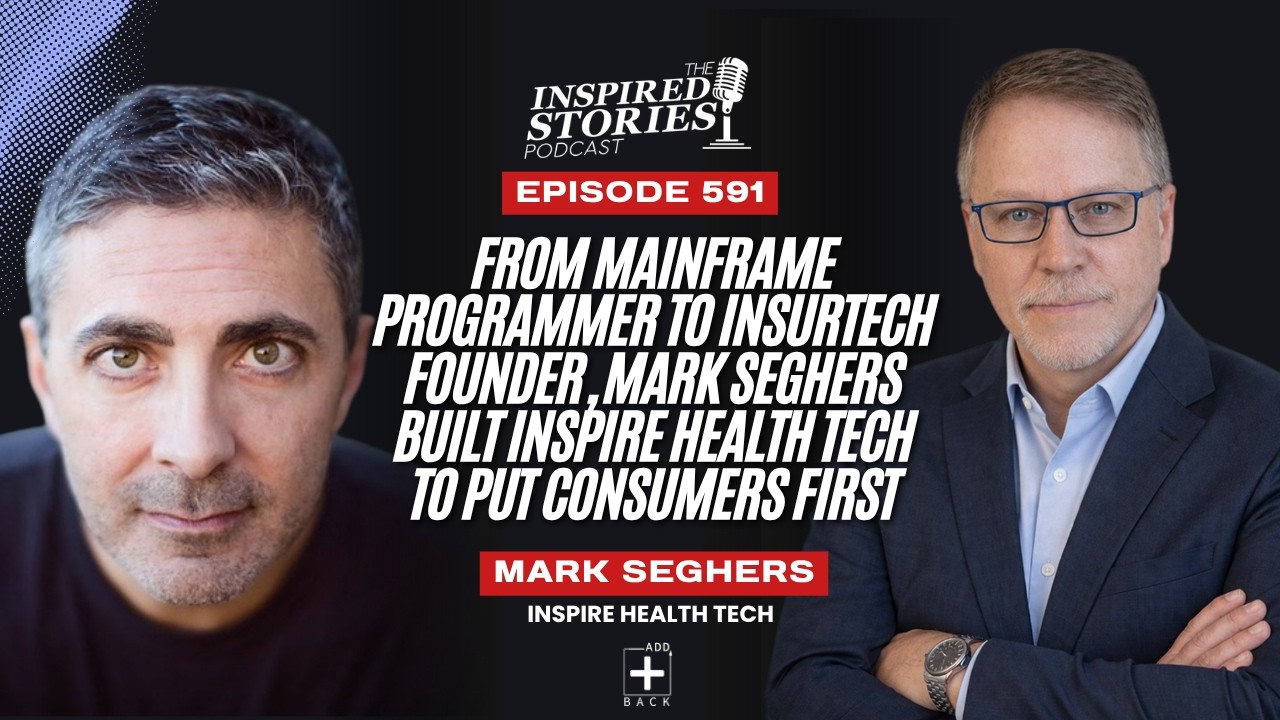
🎙️ From Mainframe Programmer to Insurtech Founder, Mark Seghers Built Inspire Health Tech to Put Consumers First
Mark Seghers, CEO and co-founder of Inspire Health Tech, has spent three decades in insurance technology, from building an insurer's first internet strategy to helping grow the company that became GoHealth. He shares why he believes consumers should find the right plan before they talk to an agent, how Inspire Health Tech's MetaPro projects out-of-pocket costs for Medicare and ACA shoppers, and why trust is the one thing that can't be automated. He also opens up about being let go, learning from broken trust, and teaching kids chess.
✨ Key Insights You'll Learn:
An outside-in approach to early internet strategy
Agent quote engines and the fear of missing out
How the ACA reshaped health insurance sales
The noise of shared leads
Plan before agent
Projecting out-of-pocket costs with claims-based profiles
Transparency of cost and quality in healthcare
Hiring people who challenge your ideas
Warm introductions over cold calls
Ethical capitalism and win-win business
🌟 Mark's Key Influences:
The founders of Norvax: young builders who brought him into a fast-growing startup
Milliman: the product that sparked the idea to flip plan matching toward consumers
A fellow panelist: the reminder that trust doesn't scale
His sons: the chess players who showed him what the game can teach
👉 Don't miss this conversation about building technology that serves consumers, agents, and carriers at once, and why honesty is the best long-term strategy.
Listen to the full episode here
Transcript
Anthony Codispoti (00:01)
Welcome to another edition of the Inspired Stories Podcast, where leaders share their experiences so we can learn from their successes and be inspired by how they've overcome adversity. As you listen today, let one idea shape what you do next. My name is Anthony Kotus Bode, and today's guest was one of the first five employees at a company that would go on to sell for $1.5 billion. Beginning his career as a mainframe programmer and an insurance carrier.
He then spent the next two decades founding and running insurance technology companies, including one that helped shape a state's early healthcare exchange strategy during the rollout of the Affordable Care Act. He also co-founded the Insurance Marketing Coalition, an industry group that has risen to prominence and credibility with a successful landmark case. His name is Mark Segers. He is the CEO and co-founder of Inspire Health Tech.
A Milwaukee-based insure tech company whose AI-powered product, MetaPro, matches consumers to Medicare and ACA health plans using a predictive claims-based algorithm. The company has a strategic partnership with top marketing companies to power personalized and unbiased plan recommendations on Insure.com and similar sites.
Mark also co-founded the Lead Quality Alliance, an industry group focused on raising standards in insurance lead generation. But before we get into all that good stuff, today's episode is brought to you by my company, Ad Back Benefits Agency. And if you're in the insurance business, this solves a problem that's been plaguing your clients for years. You already know the story. Health premiums go up and your client panics. Maybe they shop around or start cutting benefits.
Either way, you're the one explaining a price hike you didn't create and your relationship takes the hit. But there's a program backed by Bain Capital Insurance that you can bring into that same meeting that flips the script and frees up cash. It doesn't replace their group health plan, it fills in the first dollar gaps, and it can even cover part-timers who don't qualify for major medical. Employees get unlimited access to doctors, therapists, and prescriptions with no co-pays or deductibles to meet.
And the part that changes the conversation entirely, this program actually increases your client's net profits. We recently helped a client add $900 per employee per year to their bottom line. Gains like that, free up budget, your clients can reinvest into the coverages you're already discussing with them. Your client gets real relief, and you get to be the broker who delivered it. Addbackbenefits.com. All right, back to our guest today, the CEO of Inspire Health Tech, Mark Segers.
Thanks for making the time to share your story today.
Mark Seghers (02:49)
Thanks for having me, Anthony.
Anthony Codispoti (02:51)
So, Mark, in 1995, you were a mainframe programmer at Fortis, the company that would later
become Assurant Health. And you got handed the job of building the company's first internet strategy. You later went on to do something similar for American medical security as head of e-commerce in the year 2000. But thinking back to that job at Assurant, what did that actually involve when almost nobody in insurance had done anything like that before? How did you decide where to start?
Mark Seghers (03:20)
Yeah, that that's a great question. Well, you know, looking back in the early days of insurance, you know, it kind of sprung from insurance bulletin boards where agents were sharing things and you know, and and websites, you know, everybody had to have a website, insurance companies had to have a website. You need to sort of stake your claim if you can remember the days, right? So the early days were a lot of brochureware, right? We exist, this is what we do. And that's that's all websites really did. So
Being named to you know, head of internet for for Fortis Health, which became assurant, was was an interesting time, you know, and we were challenged because not because we couldn't find opportunities, but because there were so many new things out there and we really kind of had to figure out what made most sense to go after. It was sort of like, you know, too many possible directions. And so you know, I'm kind of a kind of
kind of a guy that likes to gather information before making a decision. And so I tried to kind of get close to the leaders, the functional leaders of the company and find out what was most important. Also because e-business was the thing back then and still still is, right? But we don't really isolate that term so much anymore. But it's really kind of an outside in perspective.
Deciding, you know, what's the what are the interactions that our most valuable stakeholders have with our company? And what are those moments of truth that we need to isolate? And you know, who are our most important stakeholders? What do they need most from us? What are we not giving them? Finding that gap and then using the new technology to sort of fill that gap. However,
at the time, you know, I came up with some recommendations for things we needed to do on the internet. And and this was Fortis Health back then. And it wasn't well met by the head of operations who who said and and I quote the internet is for nerds and porn addicts.
Anthony Codispoti (05:32)
Ha ha.
Mark Seghers (05:33)
And so you know that was you know I and
Internet was new, right? But well, I was also against a lot of resistance about what the internet was and what it could do for us as a company. So I moved on to AMS, American Medical Security, and then things kind of changed and I was able to do some more
Anthony Codispoti (05:53)
So, okay, so when you were first tasked with setting up the website there at Fortis, later assurant, you weren't really getting a lot of traction. Like you said, back in those days, there wasn't a whole lot super functional that you could do with the internet. It was more brochure wear, meaning this was just take what you've got in your brochure, throw it up on the internet so that people could go and read it. But then you got to do some things that involved more text.
More problem solving, it sounds like when you went to American Medical Security, is that right?
Mark Seghers (06:25)
Yes. And i I think it was helpful for me to have that first experience at Fortis or Shurin because, you know, I kind of saw I learned a little bit about the essence of strategy and also the internet itself was evolving quite quickly at that time. Everybody had a dot com. This was before the dot bomb, you know, and that blew up everywhere in in believe it was two thousand and one. but you know, two thousand, two thousand one was an exciting times. And we were able to
Save money, drive revenue, achieve differentiation. You know, those those are kind of the three pillars I think that we focused on. And saving money was was easy. You know, there were some low-hanging fruit like provider directories, you know, they're they're this thick to show all the doctors that are in network for you know for various plans, and they're obsolete. They were obsolete the second they were printed.
So, you know, just simply putting those online was it was a huge savings. but also I think the emergence of eBrokers at the time, such as eHealthInsurance.com and Simply Health, I think was another early one. but the the eBrokers were a thing that we needed to go after to not necessarily to make ridiculous gains and sales because things were all pretty new, but but to learn.
about that new environment and learn how to compete when the consumer, again back to that consumer perspective that's outside in on the internet, the consumer can switch from carrier to carrier, from marketplace to marketplace. You've got to be compelling and you have to be competitive. And it it sort of changed the game. So it was a lot more fun.
Anthony Codispoti (08:13)
So back in two thousand, refresh my memory on the timelines, was this a time where people could go and sign up for insurance online?
Mark Seghers (08:21)
No. it was a time where people could get quotes online. and you know, e health was one of the one of the pioneers back then for online health quoting. And so it
was really about consumers kind of, you know, seeing what was out there.
Anthony Codispoti (08:40)
Okay. So in 2003, you joined Norvax, which later became Go Hell. And this is the one we mentioned. You were one of the first five employees. You were VP of Business Development. And while you were there, the company grew to over 40 insurance carrier customers and thousands of independent agents that were using your quoting and lead technology. And this is all over the span of about two years. All this growth led to the company selling for 1.5
billion, that's with a B. And so I want to know what it was you guys were doing. How were you fueling such incredible growth?
Mark Seghers (09:17)
Yeah, well the the acquisition didn't happen until recent years, right? So but it did start us off on the growth path that that eventually did it lead to that notable exit. So the meteoric growth I think came from the original inspiration. Well, you know, we at as a carrier, there's a limited amount you can do really to change the world when you're just you have a handful of products that you manufacture for the market, right?
So with this, I was able to join these kids who had a a tool. I say kids, you know, they're fr they were fresh out of college and I was a family man, you know. but they started a thing that was pretty interesting, quoting for agents. So now instead of just e health out there, you know, grabbing national customers from backyards of every insurance agent across the country, our tool at
Norvax slash Go Health allowed every agent to have their own quote engine with the insurance companies that they each represented. This wasn't just to help them quote, but it was a call to action that the agent could put on their own website. So get a quote. And you'll still see that out there all over the internet, get a quote, as a call to action for consumers who want to shop. So that was the the big thing back then. And it led to carrier relationships as well, because we needed the rates.
And a lot of carriers, while they were, you know, initially hesitant, hey, wait a sec, we're not ready to have compete on price. That's not how we how we do things. And but ultimately we got their agents on board because agents needed a quote engine and they had a website they wanted quoting on that. So we sort of grew the grew it through the the brush fires, if you will, from bottom up by bringing in the top producers for a carrier.
Suddenly they the question was, well, hmm, I can either get on this quote engine and be be spreadsheeted as they called it, or I can just, you know, or my agents will just go somewhere else because all of all my competitive all my competitors as carriers are on this platform. If I'm not, I'm left out. So FOMO became a a a big deal for getting in the carriers that brought in carrier rep relationships, which brought in the tech.
Anthony Codispoti (11:39)
That's fascinating because it's always like a chicken and egg thing, right? Like who who do you get to come to the platform first to really drive things? And in your case, the the move, and it seems like it worked really well, is let's get the top insurance producers out there. Let's get them to come commit to our platform. And once they're there, then the carriers are like, Well, we don't want to miss out on being quoted when all these top producers are, you know, getting folks to come to their website.
And s and is that all this correct understanding then, Mark, so far?
Mark Seghers (12:11)
Yeah, it is.
Anthony Codispoti (12:13)
Okay. And then so then I the other part I wanted understand is what you guys were doing that was different in terms of because it sounds like up until this point, if somebody wanted to have a quoting, wanted to have quoting capabilities on their website, they had to build that functionality themselves. Not easy, not cheap. Now you had kind of a plug and play solution that any of the agents, any of the brokerage houses out there could use.
Mark Seghers (12:38)
Yeah, it was really it wasn't meant to drive the sale all the way through to the to to the close. It was meant to inspire curiosity and to act as a call to action to get the lead, to get that consumer information, right, that you could then use to nurture that person on an outbound basis from that point forward. So
Anthony Codispoti (12:58)
Gotcha.
Mark Seghers (12:59)
it was not only difficult, it was impossible for agents to do quoting.
Some of them did it, you know, bar napkins or they, you know, kind of method where they'd basically just paste a bar napkin on their site and so to speak, right? but we gave them a carrier approved way of getting those rates and making sure those rates were up to date.
Anthony Codispoti (13:22)
And so what did the quoting process actually look like? I'm a consumer, I come in, I I I put in my information. Am I getting a am I getting quotes real time? Or is it just capturing my information and then the agent contacts me right away with that information?
Mark Seghers (13:36)
Yeah, back then it was, you know, real time. You know, it was the consumer could actually get quotes and see the quotes right there. It was a promise fulfilled, as opposed to get a quote and then somebody'll call you and go through the process of giving you the quote. We were actually enabling real agent quoting at the time, which we were pretty happy with, and it enabled agents to compete with with the e health and the the the burgeoning e brokers that were coming out of
Anthony Codispoti (14:02)
These were individual plans that you guys were quoting or this is okay. Yep.
Mark Seghers (14:05)
Yes, yeah.
The old individual major medical mm hmm
Anthony Codispoti (14:09)
Yeah.
okay, so that's really interesting. So were you doing anything to help the agents drive the traffic to their sites or was that up to the agents, the brokers themselves?
Mark Seghers (14:23)
Great question. yes, our the first thing that Norbax did was they they enabled a local agent and they get got them a website and they did search engine optimization, right? SEO, it's everyone knows about it, it's huge still today. that was their first product was to drive people to the website. Then the then with the quote engine, that led to the leads business, which became a a real big calling card for go Norvax slash Go Health in the early days.
That's where kind of the leads business really started in the health insurance world was just sort of SEO and the fighting the fight for organic traffic and and pay per click in the early days of that.
Anthony Codispoti (15:07)
So back then you weren't doing the pay per click, you were doing your company was doing the SEO work. Okay. The the full gamma. do you
Mark Seghers (15:12)
We are doing all of it. Mm-hmm. Yeah. Mm-hmm.
Anthony Codispoti (15:16)
remember what was actually working in SEO back then? I know I'm asking you to dive into your memory banks.
Mark Seghers (15:21)
Yeah, man. We had we had brokers that got real good at it too. Some of sold some some really big keyword lists. It was all about monstrous keyword lists that they would that they would gather and become really good at finding the nuances and finding the the search engine terms, phrases that weren't being heavily overused. They would find the the opportunities and the niches and you know, and they they would go after those things and
and then just sort of catalog everything and get to the point where I had a a broker call me w too early in the morning sometimes saying, Mark, you gotta check out this new go to Google and type in health insurance quotes, man. Who's number one? Who's your daddy? You know, I'm like, Yeah, yeah. Y that's you, Ryan. Good job. You know. so it was it was a weird kind of world where you could still as a small guy get in there
And you know, make some waves and SEO.
Anthony Codispoti (16:21)
Yeah. So I want to talk about a little bit about your time at Quota. This was a provider of internet-based comparative insurance quoting technology. It would later
Mark Seghers (16:29)
Mm-hmm.
Anthony Codispoti (16:30)
be acquired by Word and Brown. But
Mark Seghers (16:33)
Mm.
Anthony Codispoti (16:34)
instead of relocating to California with the company, you chose to leave. But up until that point, Quota was one of the fastest growing insurance tech companies in the country. And so I want to hear a little bit about that build-up. What was the product you guys were building? How is it different? How are you scaling this up?
How how did you get momentum?
Mark Seghers (16:52)
Yeah, so after quitting Go Health for a number of reasons we don't need to get into. I I actually two years almost to the day I started with quote it. And we had a different approach. we went after carriers, and recognizing that you know each carrier obviously wants to sell the own pro their own products that they manufactured, right? But they also had a very valuable tool, and that was their lists.
And their their mailers that they already sent out to numbers of agents, you know, tens of thousands of agents they would send regular materials to. And so what we did is we just piggybacked on top of that and we said, Hey, carrier, you know, Humana, whoever, let's do a promotion. We we want to help your agents get a deal on our quote engine that includes, of course, you know, your products.
And so if you tell them about this deal, we'll give you this deal, and then you have to, you know, they have to be one of your agents, right? So they're like, yeah, that seems to make sense. So all these carrier promotions were driving a lots and lots of sales into quote it. And that was kind of a a neat way to do it. even though they were essentially recommending a multi-carrier quote engine to their agents, it there was sort of that
that discount really that carried through, right? And and they were kind of realizing that the world is multi-carrier, right? It's not this tool that's making it making me need to compete. It's the fact that it's a competitive marketing market that I need to exist within. And so everyone had to kind of get used to that. They couldn't not you know the internet forced sort of an open a sort of forced transparency of rates and materials and benefits.
And that ex continues to exist today, as we'll get into, I think. It's it's it's really, you know, information, right? And and once consumers have perfect and complete information, then the market becomes very different and and competitive in in new ways.
Anthony Codispoti (19:05)
Did you see prices start to come down during that time?
Mark Seghers (19:09)
n not really because I not for products, not not because you know, actuaries obviously have a lot to do with that and and you know, they they they have the reserves and all the pricing methodologies to to be competitive, to still carve out you know, a profit. And this is pre-ACA, right? It's before the medical loss ratio and a lot of the other constraints, they were still able to do a lot more things.
But there were some carriers that were very expensive that did it through distribution and and paying more commission, right? That wanted sort of a forced market. And a lot of that went away with the advent of the internet. And of course ACA pushed that even further.
Anthony Codispoti (19:52)
Let's talk about ACA, because in 2008 you joined
HBD, and this was to help build and launch its insurance, insurance agent quoting system. And this
Mark Seghers (20:01)
Yeah.
Anthony Codispoti (20:02)
is right as the passage of the ACA started upending the health insurance industry. Explain to us first how ACA changed the entire industry, and then explain how it changed your work specifically there.
Mark Seghers (20:18)
Yeah, you know, it was a tough place to be. when you look at the product itself in major medical, right? individual major medical. So this was pre ACA where people who weren't covered by their employers would have to buy health insurance. And for the agent, it was a really nice product. I mean, they could make two, three thousand dollars in one sale all up front.
Right. So the immediate commission for a product that played out later. It was just a great product. And and these call centers became the thing. HBD was a call center. You'd have four hundred people, agents, you know, a lot of them driving Ferraris and Maseratis, and because they were making literally because they were making so much money selling individual major medical. Not there's anything inherently wrong with that, but there were they were
largely compensated on submitted business rather than issued business. So they would just throw stuff up against the wall to see what's stuck. They'd be submitting all this business and a lot of it get clawed back. They still had their commission. So crazy time for insurance. And but then with the advent of the ACA, suddenly, you know, instead of making two two four two, three, four thousand dollars in one sale to a family, now suddenly you're making
forty, fifty bucks per month as that policy stays in effect. And it changed the game quite a bit and caused a a bit of an exodus of of agents that who left that business and went into other types of you know short term medical or life or other things. So it was a tough time to be in the health insurance technology business when the product itself had become standardized and not nearly so attractive from a
compensation stamp.
Anthony Codispoti (22:12)
And so what was it that you were doing there at HP D to adjust for this pivot in the industry?
Mark Seghers (22:18)
Yeah, well HBD was prior to that, prior to that shift and during that shift. And then we sold the software to Connector as a a big technology firm and that was right here locally in in Milwaukee. So I I joined them and that's when the ACA really hit. that's when you know I was had a broker markets for for insurance or I'm sorry for Connecture and
That was a tough time. That was a time where nobody wanted to talk about technology that helped them sell individual major medical because that product had changed so drastically.
Anthony Codispoti (23:00)
Did it have you thinking you wanted to get out of the space altogether?
Mark Seghers (23:04)
Yeah, you know, kind of. You know, I I was looking for the next new thing and I certainly wanted to help Connecture get the most out of that product. But yes, it was kind of a thing where I wanted to go where I
could do more for my company and for the industry that I worked in.
Anthony Codispoti (23:26)
And was that the impetus behind starting lead envoy in two thousand eleven?
Mark Seghers (23:31)
Yes. I started Lead Envoy with the idea and that idea continues today to help consumers. In a space where there's a lot of marketing and and sort of forced distribution on people with limited information, limited carrier selections and and you know, it was something I th thought that we needed to do some more things and that's when we we did the first algorithm to help
align consumers to to plans. And we kind of started getting into that tied to the leads business. But that that was where we got in I got into lead envoy. But I was also heavily supporting agents. We created the Senior Insurance Marketing Association or CEMA and the National Organization of Life and Health Agents. These were online places for agents to go to talk and to learn tips and techniques from each other.
Anthony Codispoti (24:27)
And then you bundled the three of them together and sold them to an MGA, is that right?
Mark Seghers (24:32)
Yes. I sold Nola and SEMA to a top FMO at the time. And that was that that that allowed me then to focus on my role at at Connecture.
Anthony Codispoti (24:46)
Okay. anything else we want to say there about the work that you were doing at Lead Onboy?
Mark Seghers (24:54)
Yeah, you know, I think I learned about the leads business at that time. And I I kind of learned a little bit about, you know, how the sausage is made, so to speak, right? it was it's not always an well, it's definitely it's a difficult business, hyper competitive business, but it stuck in my head, and I remembered it for later for now for Inspire Health Tech. It stuck in my head that the leads business had everything to do with squeezing the last penny.
out of every consumer lead. And, you know, even after you said thank you, you know, and agents are already calling the person, you're showing them other screens with other people to click, click on and link to. Every person sort of became a shared lead. And then when you so you inspired not only that person to go to multiple more websites, but you also grab the the lead information that you had and sold it out to so many other multiple websites
So, you know, w all you had to do was make the mistake of entering your your your name on the internet. And now, you know, you're you're being contacted by agents for months and months and months. I think that was sort of the noise in the leads business. It stuck in my head and in my opinion it it never went away. We're still seeing some of that today.
Anthony Codispoti (26:16)
But you wanted to do something different than that.
Mark Seghers (26:18)
Yes.
Anthony Codispoti (26:19)
So after nearly two decades in insurance tech, including four years on the executive team at Health I.O., the startup that was acquired by Milliman in 2020, then you started Inspire Health Tech in 2021. Talk to me about why what you wanted to do.
Mark Seghers (26:36)
Yeah, so we had a ho a health monitoring company called Health
IL to help people take manage their their health at home, which is something that I I'm also passionate about. but after its acquisition by Milliman, I was shown as a c when I was also consultant for Millman at the time, I was shown a product they had that helped insurance companies kind of see which consumers were better aligned to their product as compared to other products in the market.
And my experience in leads business kind of made a light bulb light up. And I said, why not flip that around? Why not help consumers see the market from a personalized perspective? Right? So help consumers see which plan is right for me. That's all anyone wants, right? That's you don't want to talk to 30 agents, you know, each selling different plans and then have to figure out which, you know.
Which agent, which care, you know, it's just a mess. And so I said, what if there were a tool that helped each consumer see, you know, how much is this going to cost me? Are my meds covered? You know, all all the the questions that a consumer has at point of sale, if they could answer that and then get connected to an agent who sells that plant. You could take away all that shared lead noise, get to one-to-one, right? And you could help the consumer.
with their decision, you know, supporting that decision. And it's the democratization of that decision support information that I thought really was the key, not only to helping, you know, helping consumers, which I care a lot about, but also to improving the leads business and help making the life easier for agents. It all kind of, you know, came together. The focus when I had with eBusiness on the consumer, that fickle consumer that you gotta serve and learn about.
The agent that you depend on who has a very difficult job, right? And they need better leads because they're buying a lot of garbage leads, right? So and then the carrier, they have the product they want to sell to the right fit people. This felt I felt could serve the entire industry and be that pure win win that everyone always looks for in business.
Anthony Codispoti (28:55)
So walk me through exactly what the platform does then. What how is it better? Is it sending the lead? Is it selling the lead? Is it helping with the quoting process? Paint paint the full picture for.
Mark Seghers (29:07)
Right. So this tool, which is called MetaPro for Medicare, and we also do it for ACA, it's called ACA Pro. this tool what it does is it aligns a consumer to the plan that's right for them. Period. Without
Anthony Codispoti (29:24)
So they come to your site to do this?
Mark Seghers (29:27)
it's well yeah, I'll I'll give a more complete answer. the the tool is called well our first idea was
We're going to create this thing, we'll call it Medicare Oasis, right? And it'll be the place for consumers to go. We'll build a brand, we'll drive consumers to it, and then we'll sell all the leads off to the winning, you know, carrier, either to an agent or to the carrier. So let them first align to the right plan, then connect them to an agent who sells that plan or to a carrier. That was a dream. We we decided though that the marketing expertise had become so nuanced.
And so it's kind of owned by only just select people in the industry are able to compete at that level with the SEO and the BPC. And so we said, let's just enable everyone, let's democratize this, let's be the Intel inside, if you will, for all of these marketers that are out there, right, trying to sell the consumers and trying to create leads. Let's help them create a better lead. Let's help them help consumers.
And so we decided to go B to B to C and be that white labeled engine behind consumer plan alignment.
Anthony Codispoti (30:43)
So if I'm
Mark Seghers (30:44)
So getting back to your question, how does it work? We're just we're just an API, right? So we're a data service. We need certain information about the consumer. Then we profile this person, project future claims, adjudicate those future claims through every plan available for that person to come out with the expected out of pocket for medical, for pharmacy, plus premium if there is one for medical Medicare, and other things, right?
So and also let's make sure your doctors and network, we're creating a tool that's personalized and unbiased, and we're making this tool available to partners that want to use it.
Anthony Codispoti (31:23)
The partners are agents who are out there, they've got no, okay.
Mark Seghers (31:28)
Yeah, yeah. Well, the agents are partnered in this, right? but norm normally this is we started with lead generators. We're helping lead generators create a better lead. When you think back to the Go Health days, right, where they got the call to action, get a quote, right? what we're doing is we're actually letting them say, Find the right plan for you. Personalized, unbiased tool.
Find the right plan and then we'll connect you to a an agent who sells that plan. So
Anthony Codispoti (32:00)
Okay, so there's a there's
a middle layer that sits between the customer and the agent, the lead generators. And they've got all kinds of mechanisms. Like you said, it's gotten really sophisticated, whether it's SEO or PPC, or they've got other ways that they're driving that traffic. And so they get somebody to come into their sales funnel and they collect some information about that person. Your tool takes that information and says, beep boop, beep boop, beep boop. This is probably the right product for you.
And so now what? Do you now do you connect them with an agent who can offer them that product or what what's what's the next step?
Mark Seghers (32:38)
Yeah, so what we're doing is we're enabling a new ecosystem. The whole idea behind the ecosystem is plan before agent. So as I mentioned, get the consumer aligned to the plan, connect them to an agent who sells that plan. So first there's a plan match, then there's an agent match. So our partners do do that agent match. So it whether the lead lead generator or an FMO.
So different partners exist at different points in the ecosystem. There are traffic generators that drive people to the sites that use our algorithm. Then there are those sites, which are usually lead generators, but it can be an FMO, it can be an agency. And then there's that lead that's created. But the new thing about this lead, it's not just consumer info. And Joe Blowout, 123, Pine Street, you know. It's it's also what plan did they align to?
Which plan did they select?
And that's new. So now that we call that a plan aligned lead. That plan aligned lead then can be sold for twice as much because that person has already gone through the process of picking a plan. So now
you send it to the agent. The agent doesn't have to be a hard salesman anymore. They can they they can just say, I see that you've aligned to the you know ABC plan, you know, from XYZ Carrier.
Let's get you enrolled. Let me answer your questions and let's get you enrolled. So it turns the agent into a subject matter expert. No longer do they have to be that hard salesperson, you know. no longer do they have to fight and battle. No longer do they have to try to switch people at switching time and get people away and squeeze the last dime out of every lead. Call centers can become smaller. The market becomes more efficient as consumers.
Are given the information they need to make the right decision.
Anthony Codispoti (34:41)
So there's a lot more of that information sharing that happens on your through your platform because it's saying, okay, based on the information you're giving us, we think
Mark Seghers (34:50)
Mm-hmm.
Anthony Codispoti (34:50)
these are the plan or plans that might be best for you. What do you think? And they say, yeah, like this is what I'm looking for. So then when you sell that lead, that person is already further down the path. And and and do you still end up selling that lead to multiple people, or does it just go to a single agent at them?
Mark Seghers (35:09)
person. So I've always believed that that's the right way to go is to that one-to-one connection. And you know, where an agent is connected with or I'm sorry, with a consumer is connected to one agent. And that process then happens. It's just much more efficient. And I think really the the plan recommendation is what people want. And that's what they're looking for from an agent. But
That's not the agent's fault that they can't provide that. Cause because it's impractical for agents to be appointed to sell every single carrier. There's an average of forty-three plans for every consumer in the United States. And you know, that's a lot of carriers for agents to be appointed to sell. The market doesn't work that way. So we're giving the market a tool it needs. And actually the agents can use this tool too. It doesn't have to be plan first, then agent.
If the consumer connects to the agent first, that's fine. The agent can use the same tool. And they can use it as a market informational tool for them. Now, maybe they'll they'll see that there are plans that are better for this consumer that they don't represent. In that case, they can explain that, you know, or they can just tell them about the first one that is. It's it's up to them, right? but it it's market information.
And the the one thing we provide that you can't really seem to get anywhere else is the idea of medical out of pocket expectation. Estimated medical out of pocket is something it's really hard to get. And that's why we have actuarial partners that help us get to that information. It's, you know, as I mentioned, that claims based process is is pretty deep and pretty complicated.
Anthony Codispoti (36:59)
Claims based process meaning you have access to their prior claims.
Mark Seghers (37:03)
We can if we need to go that way, but we don't do that do it that way. Our first approach said let's get this person's info, get to agree, and get to log into their their their Medicare information, or if they just turned sixty five, now they gotta go back to their under sixty five plan, get all the claim you know, the the authentications and the approvals and everything else was just ridiculous. From a point of sale, it was impossible. And most people don't know their Medicare number and
you know, how to log into their portal. So what we do is a method that has just about as good area under the curve, if you will, of predictive accuracy. And that's by profiling this person against similar individuals. And we get the claims from that matched cohort. Now we don't need to know this person's personal identification, PII. We don't need to know who they are, where they live, none of that stuff.
All we need is certain information about them. Gender, birth date, zip code, medical conditions is important, and prescriptions. And also let's make sure the doctors and network and that other stuff, right? And star ratings and supplemental benefits. And we can we create custom scores for different partners, different marketing partners. So they can place the carriers in the way that's right for the consumer based on the questions they want to ask.
Anthony Codispoti (38:31)
Interesting. So the the big data points that tell you what you need to know to match them up, age, gender,
Mark Seghers (38:36)
Mm-hmm.
Anthony Codispoti (38:38)
zip code. There's something about where they live that has an impact on their longevity or their their likely health factors. what else did you mention there that I'm leaving out? The their medications,
Mark Seghers (38:48)
Medical conditions.
Anthony Codispoti (38:50)
medical conditions and their medications?
Mark Seghers (38:52)
Right, diabetes, hypertension, asthma, you know, we the you hit our API, we give you the conditions that matter, and then those are check boxes and then auto fill on the prescriptions and then we're good to go. We use that information to profile them and to match them against similar consumers who are a little older. We grab all their their recent claims, which becomes expected claims for this person.
We adjudicate those future expected claims through every plan available. We come out with what they would have to pay out of pocket.
Anthony Codispoti (39:27)
That's fascinating.
Mark Seghers (39:28)
yeah, thanks. You know, it's it's I think a reasonable approach to estimate something that's very difficult to estimate. And, you know, a lot of these quote engines out there have tons and tons of details about all the plans. And that's always been the case, right? You know, I think regulations have sort of exposed the kind of transparency and the details of all the benefits.
It's hard to understand because we never have to think about insurance. We don't wanna think about insurance. Our tool boils it all down to a few what I feel are sort of super pertinent details.
Anthony Codispoti (40:02)
Now your website is inspireHT.com, which we'll reference again towards the end of the show. But let's say that I'm somebody listening and I'm of Medicare age, or I've got a loved one who's of Medicare age, and I'm like, Mark, this sounds brilliant. Like I love the idea of being able to go to an engine that tells me my expected out of pocket because like the the options are just so complicated. They're like I don't even know where to begin. Can I use your website for that?
Or can how do I find like one of your approved partners that's tapping into your back end?
Mark Seghers (40:39)
Sure, sure. well, our website needs to be improved and we should have links to our partners, but we don't. And a lot of times that you know, there's kind of a sensitive relationship we have with our with our partners where we're we're under nondisclosures, they each have different methods and different questions they ask and so on and so forth, right? But you know, they can go to one of our partners and and find that.
I think it really, you know, there's there's Quinn Street with Insure.com, there's Qualphone with MedicareHarbor.com, there's Lead Scores with Medicare Shopper.ai, we got seniorguide.net. There's so many sites out there. But what it all boils down to is just as a consumer, knowing the questions to ask. And and really that is number one, understanding the market and who's in your market.
but you know, I I I think it's really hard to get the information that that you need unless you go to a partner that can really project those future expenses and so you can make the right kind of decision. Umsure.com is a good place to go. Medicare Harbor is another good place to go. you know, those those actually consider the consumer and place put the plans in the order of what's right for that consumer.
There's several more but it's it's hard to, you know, kind of get into get into that. They each do their own market marketing.
Anthony Codispoti (42:13)
And you also have a very similar tool, but instead of geared towards Medicare, it's geared towards you know folks that are looking for ACA plans, the ACA pro.
Mark Seghers (42:21)
Yes.
Anthony Codispoti (42:21)
And I'm assuming it works the same way. So I enter in my information, my zip code, my conditions, my medications, and it does that same sort of claims based scoring to come back and tell me here's your expected out of pocket with each of the different options available. Is that right?
Mark Seghers (42:39)
Yeah, it's it's pretty similar. You know, I think with under sixty five people, obviously there's different things and that that matter. You know, you've got the maternity, smoking, you know, things like that to kind of enter into the picture in terms of assessment of of risk. And really and and we're not assessing risk, right? But what we are doing is we're profiling you against similar people and and then projecting claims forward.
And different things matter. You also get into workplace things like you know, musculoskeletal issues for you know, long haul truck drivers and factory workers and you know, there's a lot of things that that go into that decision that are different than the Medicare arena.
Anthony Codispoti (43:22)
Gotcha. So different questions, but roughly the same process and the same recommendation based on here's what we think your out of pocket will be on this plan.
Mark Seghers (43:34)
Yeah, I mean it's still it's still centered around the flagship idea of what am I paying?
Anthony Codispoti (43:41)
Yeah.
Mark Seghers (43:42)
and I think that's something that people are, especially in these days of ramping the costs ramping up crazy amounts every month, right? and though we're going to be seeing big increases in ACA coming again this
year. y there's arguments about how big, but it'll be big.
And so, you know, the the question of cost is is is a is an increasingly important one.
Anthony Codispoti (44:12)
Talk to us about why we're expecting such a big increase in the cost of ACA plants.
Mark Seghers (44:17)
Well, I think, you know, the the subsidies and you know, I I don't want to get too political here. but you know, the the subsidies are are changing and and you know in some cases going away and and it it makes it it makes it difficult for you know for people to people of limited means to to pay for insurance.
Anthony Codispoti (44:40)
Any solutions that are being cooked up from the insurance industry that you're aware of?
Mark Seghers (44:45)
There's a lot of them, right? Everyone's kind of chipping at different different things to try to get to it. you know, and without getting on too much of a soapbox or be getting too political. I think it all goes back to the the cost of health care. Everyone's talking about the shell game of who pays, you know? And nobody's talking about well, why is it so expensive?
That's the problem in healthcare right now. We need we need transparency of costs. We need transparency of quality. We need to be able to shop for a hip replacement and see up front the quality of the people involved and how much it's going to cost me. And once it becomes a real market, then we can start to actually, you know, cut away at some of these endemic.
profiteering things that are happening in the healthcare world. And so I think there was the demonization of health insurance plans and and certainly they made their mistakes, right? And that led to the ACA. But it's sort of like going after the price of gas by attacking gas stations. You know, it's it's there's underlying reasons why things cost so much. And we got to get at the the nature of healthcare and and
Ask questions like why is it so expensive as opposed to treating it like a given and then just figuring out, you know, that shell game of who pays, which is ridiculous.
Anthony Codispoti (46:21)
So what's the solution? And and why is it so expensive? I'm asking big questions here.
Mark Seghers (46:26)
Yeah. Yeah. It well, the the
reason it's expensive is for a lot of reasons and you know, I'm getting into a a different realm here, but you know, rampant obesity is is, you know, just the convenience of bad food and bad food is is really i ch generally cheap. Good food is generally very expensive. people are getting less and less healthy, which drives up the cost.
you know, that's one thing. just the lack of transparency is another. They can hide these costs and you know, you never see the bill. So you're never able to really manage things. You're not incentivized to really help manage costs. And you know, I think they need to r make things transparent. I think they need to incentivize wellness at the employer level and get people and that was with my health I owe career. You know, I I'm trying to chip away
at the things I think that matters. And you know, wellness is something that people need to take on and take responsibility for and be motivated to do so. And that's not an easy thing. And it's endemic right now for doctors, you know, they they have no time, right? Wellness is a conversation that takes time. And doctors right now spend two hours for every hour of care. They spend two hours on paperwork. And they don't really have
time to have these conversations about wellness.
They do have time to subscribe or to recommend a pill. And you know, I'm not sure that that's necessarily a solution.
Anthony Codispoti (48:00)
I want to talk about you and the FCC. So in two thousand twenty-two you co founded the insurance marketing coalition with Sean Green. And in twenty twenty five, the organization won a lawsuit against the FCC that eliminated their one to one topical rule. What was that rule and why did it need to be challenged?
Mark Seghers (48:23)
Yeah, well, yeah, be I'll be kind of careful here. you know, there's a lot of great people in the IMC, people that do things right, very honest, trustworthy people. And and so the insurance marketing coalition, I I had the idea for it. I thought we needed sort of a governing board, not governing so much, but more breast best practices, help leads companies be a little better, a little bit more consumer oriented and more compliant.
Right, and avoid fines. And there's a lot of reasons why. you align with the consumer and and you you start to do things right. And one of the new rules that the government had come up with was this one-to-one rule that that said that that each consumer must be recommended a one agent to be connected to, and then connected only to that one agent. And they were giving permission in advance to be connected to that one agent. And I thought
You know, it's like a lot of government regulations. Sometimes their heart's in the right place, but the inact the way it's done, the way it's enacted, is painted with such a broad brush that sometimes you punish the some of the wrong people. And sometimes it's, you know, it needs to be more nuanced because the government really understands the industry. And the government really doesn't understand the all the nuances, right? And that was a case with a one-to-one rule.
And so the IMC just said, well, you know, and there's a lot of big leads companies in in the IMC who said, we don't want this one-to-one rule. And when you think about all the lead sharing and all the, you know, making profit from a person's information, it's hard to give up that revenue stream. And it's reasonable that they would fight this. And you could also say, well, that's kind of choice, right? We're giving the consumer choice.
Now instead of talking to one agent, they can talk to five and pick the best one. So you could call that choice, you could call that noise. I believe that the one-to-one rule would have improved things in the leads business. And it was so close to being act being enacted that a lot of leads companies went through the steps of actually preparing and getting ready to do that exact thing. It became sort of a soft best practice.
And that's what I'm happy about. But the IMC decided and I I was outvoted. there a couple of us wanted to not do the lawsuit, and but we decided as a group to go forward with a lawsuit and they won and which got rid of it completely vacated the one to one rule. It would no longer exist. And so I decided
that I I I was going to resign my board seat and leave the IMC because that decision was not in alignment with my career path with with inspire health tech, which is to help consumers and you know, to find a way where we can all make money reasonably in a way that doesn't, you know, I don't know, doesn't upset the
The market doesn't make it harder for us down the road because consumers are afraid of entering their name on the internet anymore. There's just a lot of noise and a lot of damage that's done through oversharing and hyper prof profit is, you know, profit tiering. and and that's what all these regulations are meant to to fix. They're they're meant to serve the consumer who's right now still very, very confused about a very important decision.
So I left the IMC and and we started some other things.
Anthony Codispoti (52:10)
Started some other things. Does that include the lead quality alliance?
Mark Seghers (52:13)
yes, yeah. The Lead Quality Alliance is is exists to help companies who are aligned to the consumer and to to find a way forward with best practices towards better lead generation.
Anthony Codispoti (52:28)
Okay. I want to shift gears on you now. What's the hardest thing that you've had to overcome, Mark? And what did going through that teach you?
Mark Seghers (52:39)
The hardest thing I had to overcome
i this is in in business or is this just a big kind of life question?
Anthony Codispoti (52:46)
Wherever you would like to go with it.
Mark Seghers (52:48)
Sure.
I'll take the I'll take the the business route for now. I I think being let go from a from a position that I felt I had done really well at and I I had been let go and it was it was difficult but also energized me and you know I like change and I had to sort of
Come to grips with the fact that you know, I was still confident in my own abilities, but had to realize that sometimes your own abilities are not a match for what is needed by the leader of that company at that time. And, you know, so I think that made me, and I think everyone can kind of take this to heart, is that, you know, if you're a reasonably intelligent person with a set of ethics and you you believe in doing the right thing and and
getting your job done and working hard, right? All those basics, there is a job for you. And so what I did is I sort of not only stealed myself that, you know, make sure that this happened again, you know, it's it's just whatever, you find a better fit, right? But what it also does is it helps you imagine, always imagine, you know, what is the right thing for me to be doing where I can maximize my value to the industry.
achieve my own personal brand mission. And if that doesn't exist where I am now, then I need to consider other alternatives. So that that was a big thing for for me.
Anthony Codispoti (54:35)
So being let go from this position, but I'm kind of, you know, listening to your words, reading between the lines, it sounds like from an ethics standpoint, from a morality, from a value standpoint might be a better word, there just wasn't a great alignment there anyways. And so this was an opportunity for you to kind of hit the reset button and find something that fits you better.
Mark Seghers (54:58)
Yes, yeah, absolutely. and I think another another thing, and this was really one thing, but multiple times, you know, I think it's also just the whole trust idea, the notion of trust. when trust is broken, it's it's a jarring kind of thing. You think you know a person, right? And and you know, in the Midwest we're we tend to be trusting people, and when you are when you run into somebody, maybe a business partner.
Who turns out to be not trustworthy, that can be that can be a real difficult thing too. So I think it's important to always have a contract, right? Trust but verify, right? And make sure that the contract sort of handles anything that could possibly possibly happen to kind of keep everybody honest. And so I've become a lot more vigilant with contracts after.
You know, a couple of one thing in particular went co way south.
Anthony Codispoti (55:59)
do you want to give more space to talk about that? Any insights
Mark Seghers (56:04)
Well
Anthony Codispoti (56:04)
for others to gain from what you went through?
Mark Seghers (56:07)
Yeah, you know, I think
It's important that we and and this is also true back in my days in the carrier. It's important that we don't surround ourselves with buddies who are just like us. I I think a lot of times you you look for people that you want to hang with, people who can you can talk about the same things and laugh and party with, right? And it's only coincidental that those people are also the type of business people that you need to be around.
I would assert that sometimes it's the people that you don't want to hang with and party with, have a beer with, you know, go to the game with. sometimes it's the people you don't want to do that with that are actually filling in the gaps of of who you aren't, right? So my strengths are certain things. If I hire people with the same strengths and the same weaknesses, you know, and the same things that we're blind to, right, then you don't make a strong company.
You hire people that are shooting holes in what you present. Now they have to be open minded, they have to be reasonable with those holes. But I love whole shooters hole shooters because they keep me honest and they make sure that I don't run too far with a dumb
idea because I've got people thinking of things that I'm maybe a little blind to.
Anthony Codispoti (57:35)
To go back a bit to Inspire HT because you've you rattled off a handful of names, and some of them are pretty notable and very good partnerships for you to have, right? Quinch Street came in powering the personalized plan recommendations on insure.com. and I just wonder so there's a lot for listeners to learn from how do you go about forging those kinds of partnerships?
Were these just folks that you already knew from your decades in the industry? Was there s I don't know, did you just go knocking on their door? Did you ask a friend for an introduction? Like how did those partnerships first start to unfold?
Mark Seghers (58:19)
Yeah, you know, I when it comes to selling, you know, I'm I'm not I'm not a great salesperson as it relates to just, you know, pounding the phones and cold calling and you know, just not letting up on people and finding a million ways to get him to s cry uncle and take a phone call. I'm not right, I'm not so good at that. and I I honestly I don't believe in cold in cold calls. I think cold calls really
are sometimes the result of a lack of imagination and a lack of research and a laugh lack of doing the doing the grunt work to find a warm connection somehow. And that's easier and easier now with the advent of AI. I mean, you know, if you're not if you're not learning ev you know, a lot of the public stuff before you have that first conversation. And if you can't find two or three connectors to this person, you're just not doing the work.
It's easier for me to say having been in the industry a long time and and I'm I'm blessed with a lot of you know, I I know a lot of people and I know how to get there from here and I know how companies all connect. That helps a lot. But cold calls just frankly don't work and nobody has time for them anymore at all.
Anthony Codispoti (59:35)
And so these were relationships. These were folks you knew that knew them and said, Hey, can you get me connected? Here's the value proposition that I have and just would like a a warm warm intro so I can have a conversation.
Mark Seghers (59:47)
Yeah, you know, and I think I think trust is is key. I think, you know, for for all of my ideas, whether they've been good or harebrained or half baked or fully fully realized throughout my career, I I think I've tried to be honest with people and I've tried to tell them my thoughts and let them know what I I think risks are.
Help them find reasonable gaps, help find reasonable fits and good opportunities, right? And I think those things you create a reputation over time. And I think it's really important to c cultivate a a good reputation because it's it's hard to it it it you know once it's once it goes the wrong way, there it's hard to come back from that. And I think once it goes a good way, then you have some credits, so to speak, and people will hear you out on new ideas.
And and help you and talk to you. Even though there's no money to be made right now on that conversation, people will talk to you. So I would tell young t say say to young people, always be honest about things. And because people will remember that far longer than they will remember the company that you happen to be working for now. They'll remember you and you can carry that on to your next opportunity. You roll that personal brand.
Connect your personal brand to the next company. And your company benefits with that as an asset. And people and your conversations start further along than they would have otherwise.
Anthony Codispoti (1:01:27)
Love that. Honesty is the best policy. Agree a hundred percent. as you
Mark Seghers (1:01:31)
Yeah, but
Anthony Codispoti (1:01:33)
you get something else you want to say there, Mark. Go ahead.
Mark Seghers (1:01:35)
No, no. I I was just saying that I think, you know, a friend of mine on a in a panel, I was leading a panel at Contact.io, an excellent industry conference recently, and he made the point that trust doesn't scale. And I really love that. You know, we're getting into the advent of AI being everywhere, right? And we're using it for everything. And we should.
Because it's an amazing tool I I would not want to do without, right? But trust is a is a human thing. And we talk about AI versus human intelligence. Where does one stop and the other need to jump in? I think trust is the thing that we can't and should not try to scale. It's the trust that that moves boulders out of the way and opens minds. And it's not something that we can scale with a
with a clever agent out there pounding, you know, pounding people with you know, with well crafted sentences, you know, it's it's not what it's about. It's about being yourself and and being confident in who you are and having a brand that people can listen to and and care about.
Anthony Codispoti (1:02:54)
Mark, as you think about the work that you're doing now, what is it that you most want to be remembered for?
Mark Seghers (1:03:07)
Con I'd say ethical capitalism, finding the the win-wins and finding a way to make profit
while also helping people at the same time. I think I think that's possible and I think it's actually better. you you're building a brand rather than going after a
transitory opportunity and and grabbing money from it and that can be fine and I have nothing against making money. But the money should be paid for a service that is, you know, transparently has value and everyone recognizes the value. Everyone benefits from that. There's that business synergy. I think that is the magic. I always try to search for that. And
I I think we all should try to find those win-wins because I think that's where dramatic opportunity exists. It it's riskier probably, but I think the essence of every good opportunity is that it helps multiple people and there's no glaring downside of these people that are ta you know, this constituency group that's taking a big hit so that a different constituency group can benefit.
Seek the win wins. You know, find find something where everyone is it benefits and that those are the truly transformational and you know evolutional kind of changes that I think people can look for be becoming a part of. You know, I I think, you know, and this is a this is a privileged perspective. Not everybody can do this. There's a lot of people that that you know, work three jobs and you know,
just doing everything they can to put food on the on the table. God love those people. That's you know, but it it's when when I'm at a point now where I'm able to kind of think about those things and think about what I want to do for my last, you know, jobs in my career. Something that I I I'm good at, something I believe in, you know, and something that's risky, but it's a risk I'm I'm able to tag take right now. Not everybody's able to make that risk.
Anthony Codispoti (1:05:29)
What's your favorite thing to do outside of work?
Mark Seghers (1:05:34)
I teach little kids how to play chess. So I'm I'm a volunteer and I lead chess programs for elementary schools. So it's it's a ton of fun. It changed my kids' life and I've seen chess change the lives of a lot of little kids, giving them focus and helping them balance offense and defense and you know, thinking about the other person instead of just themselves all the time, right? They're thinking about what's this what could this other person do to me?
And they're thinking about from the other person's perspective. And then they're closing out, you know, those things. And then now they're thinking about their offense. But watch out for your king, you know, watch out for the things that matter in life, right? The analogies are just thick. And I think by learning chess and becoming a good chess player, like my son's master level, by becoming a good chess player, I think little kids can learn a lot of things, sort of not directly, and as a parent of a couple boys, I know.
You you the lessons that you try to force on kids are the ones that are just like, yeah, yeah, whatever and they reject. You gotta find those obtuse angles, right? And I think I think chess is sort of sort of you know, a tangential kind of, you know, they they kind of understand and then they translate those same things. And so I try to teach kids the importance of chess so that they get it in their heart and they're like, wow, this is great. And then I just get out of their way.
Anthony Codispoti (1:07:00)
Any recommendations for listeners? And I'm pointing to myself and how to get their kids to level up in chess? I my kids have shown some interest. They've they've played with kids at school and you know, I they understand kind of the core fundamentals, but in terms
Mark Seghers (1:07:15)
Mm-hmm.
Anthony Codispoti (1:07:16)
of taking that understanding and then really starting to understand strategy on a different level, what what do you have?
Mark Seghers (1:07:23)
Yeah, depending on the age of the kid. I think chess you should be started second grade, not younger. And it really depends on the kid, sometimes younger, sometimes kindergarten or first grade. But I'd say chesskid.com. Just like that. Chesskid.com. It's a great program. It's like forty nine bucks for unlimited use for a year, but it has levels in there that they can level up and they can watch their progress. And they get an online game with a kid anytime they want. It's sort of the
The little kid version of chess dot com it's owned by the same people.
Anthony Codispoti (1:07:59)
we actually used chesskid.com years ago when they were first getting started. So I'll second that. There was some great lessons in there. Now, before
Mark Seghers (1:08:05)
For sure.
Anthony Codispoti (1:08:06)
I ask my last question for you, Mark, I want to give folks ways to contact you and do a couple of other things as well. And so you can go to his website we mentioned earlier, inspireht.com, or if you want to reach out to Mark directly,
his email address is mark at inspireht.com. And for those of you enjoying the show,
Please take a moment to subscribe wherever you're listening. It also sends a signal that helps others discover our podcast. So thanks for taking a quick moment to do that. And as a reminder to insurance brokers, you can walk into your next client meeting with something better than a rate increase, a program that gives more of their employees access to doctors, therapists, and prescriptions, part-timers included. It adds thousands of dollars to the company's bottom line every month. It's backed by Bain Capital Insurance, so it's built to last.
Bring your clients that kind of win and they'll refer their friends to you at backbenefits.com. So last question for you, Mark. A year from now, what is one very specific thing that you hope to be celebrating?
Mark Seghers (1:09:09)
A year from now I hope to be
celebrating the
merger of my company to a larger organization that has the ability to reach millions of consumers with the tool that can help them find the right healthcare coverage. I personally do don't have the the reach, and that's why we're bringing our product to companies that do. But I think
Once we reach the right people who understand the size of this idea, I think this will be turned into a brand or several brands that will then carry that message on. Super Bowl ads, World Series ads. we're talking about the place where you can go to get personalized and unbiased plan recommendations and then be connected to an agent of your choice who sells that plan. So
My goal is that this reaches millions of people who can then make better and more informed choices about a very important decision in their life.
Anthony Codispoti (1:10:28)
That's exciting. Very cool. Well, hope to follow that progress. Mark Segers from Inspireht.com. I want to be the first to thank you for sharing both your time and your story with us today. Thanks for being here.
Mark Seghers (1:10:40)
Thank you, Anthony. I appreciate the time and the the excellent questions.
Anthony Codispoti (1:10:45)
Hey folks, that's a wrap on another episode of the Inspired Stories Podcast. Thanks for learning with us. And if one thing stood out, put that into action today.
Connect with Mark Seghers:
Website: inspireht.com
Email: mark@inspireht.com