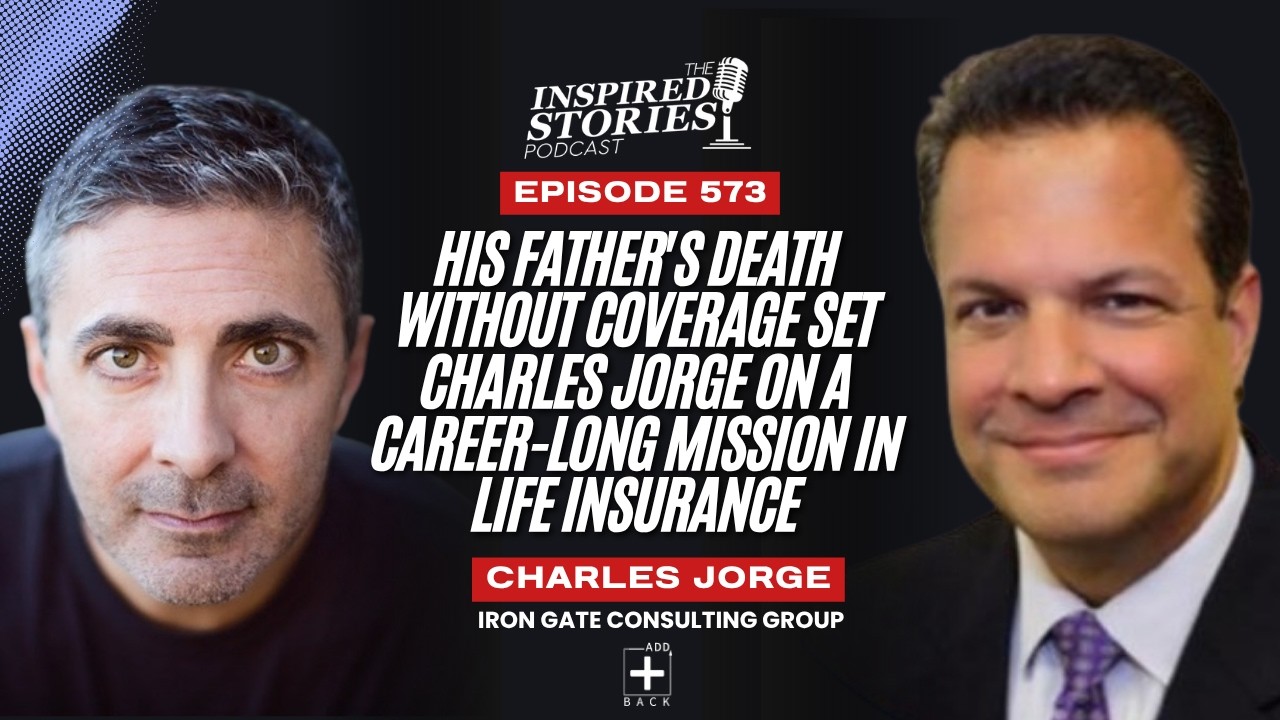
🎙️ After His Father Died Without Coverage, Charles Jorge Built a Career Protecting Others: The Iron Gate Consulting Group Story
In this episode, Charles Jorge, founder and managing director of Iron Gate Consulting Group, shares how his father's death without life insurance shaped a three-decade career inside global insurance companies before he built a firm of his own. Charles opens up about the collapse of a company he grew from nothing after board members misused its funds, rebuilding his confidence within months, and why he now focuses on serving overlooked "blue collar millionaires" and foreign nationals navigating US estate tax traps.
✨ Key Insights You'll Learn:
Entered the insurance industry straight out of college after an aptitude test with Prudential
Lost his father to cancer shortly after starting his career, without life insurance in place
Rose through senior leadership roles across multiple global insurers over three decades
Served as CEO of an international insurance company before discovering board members misusing funds
Rebuilt his confidence within three months by joining a company he still works alongside today
Traveled roughly 100,000 miles a year across Latin America before the pandemic reshaped his business
Founded Iron Gate Consulting Group in 2018 while still working overseas in Panama
Co-founded Ethica Alliance Group, one of the largest Hispanic-focused IMOs in the US
Specializes in helping foreign nationals avoid steep US estate taxes on American property
Focuses on "blue collar millionaires," business owners often overlooked by high-end planning firms
🌟 Charles's Key Mentors:
His Father: His death without life insurance became the defining reason behind Charles's career
Early Corporate Mentors: Taught him relationship-based advising and doing right by clients over quick wins
His Recruiting Interviewer at Prudential: Convinced him to enter the international insurance business straight out of college
His Current Business Partners: Owners of a 55-year-old firm who rehired him within months of a career setback
👉 Hear how a personal loss shaped a three-decade insurance career, survived a corporate collapse, and led to a firm built around the clients everyone else overlooks.
Listen to the full episode here
Transcript
Anthony Codispoti (00:01)
Welcome to another edition of the Inspired Stories Podcast, where leaders share their experiences so we can learn from their successes and be inspired by how they've overcome adversity. As you listen today, let one idea shape what you do next. My name is Anthony Cotus Bodhi, and today's guest spent more than three decades inside some of the largest international insurance companies in the world before walking away to build something of his own.
It's a move that only makes sense when you understand what he saw along the way. After rising through senior leadership roles across multiple global insurers, including a stint as president of a major insurance group, he reached a point where the next chapter had to be one on his own terms. Charles Jorge is the founder and managing director of Iron Gate Consulting Group, a boutique insurance and financial planning consultancy based in South Florida.
His firm specializes in advanced planning strategies, legacy protection, and wealth-building solutions for business owners and high net worth individuals. He is a multi-year million-dollar roundtable qualifier and a Limra Leadership Institute Fellow. This is a conversation about what it takes to bet on yourself after decades of building for someone else. But before we get into all that good stuff,
Today's episode is brought to you by my company, Ad Back Benefits Agency. And if you advise business owners on their wealth, this is a lever most of your clients don't know they have. See, here's the problem: your business owner clients are overspending on health insurance every year. That's money leaking out of the business, money that could be funding the very strategies you're building with them. There's a program from Bain Capital Insurance you can put in front of them that changes that. It doesn't replace their group health plan.
It fills in the first dollar gaps and it can even cover part-timers. Employees get unlimited access to doctors, therapists, and prescriptions with no co-pays or deductibles. And here's why it matters for your practice. This program actually increases your clients' net profits. See, we recently helped one ad, that's add $900 per employee per year.
Results vary, but gains like that free up capital your client can redirect into your planning and they raise the value of the business itself. Your clients get stronger and more valuable. You become the advisor who found the money and the one they tell their friends about. Learn more at Adbackbenefits dot com. All right, back to our guest today, the managing director of Iron Gate Consulting, Charles Jorge. Thanks for making the time to share your story today.
Charles Jorge (02:43)
Thank you, Anthony. Thank you for having me and looking forward to it.
Anthony Codispoti (02:47)
So Charles, take me back to the very beginning. How did you first get into the insurance industry? Was this a case of just falling into it by accident like I hear so often, or was this more intentional for you?
Charles Jorge (02:58)
It well, it was it's kind of ironic is actually the start. You know, when you get out of college, the only thing I've ever done is work in the insurance industry and got out of college and they say, Well, you know, go interview with everybody you can, polish yourself and you know, get ready for that one interview. And somebody invited me to interview with Prudential Insurance, you know, very good company here in the United States. And I went with no expectations, but
When I heard, and obviously the person that was interviewing me, recruiting me was very, very good. And he convinced me to go into the international business and into the insurance business. And eventually I went into the international business. So that's how it kind of got started. And the irony of the whole thing is that at that time, shortly after I got into the insurance industry, life insurance industry, my father was diagnosed with cancer.
And unfortunately, three years later he passed away. But one of the things that I always tell when I talk to agents, it's kind of my, you know, the Japanese word, ikigai, which is, you know, your your reason for being, is that unfortunately my father died without any life insurance. And the irony of it is that I was working in the insurance industry and I could not insure it.
To help my mother and my sister, who really were the ones that were impacted the most after he passed away. And he passed away very young, 58 years old. He was a smoker, unfortunately. So I got into it by accident, but at the same time, I think I got into it. I was kind of destined to be in it to really help other people realize how important the products that we offer in this industry are for people and for protecting the people that you leave behind, which is the ones that are mostly affected.
Anthony Codispoti (04:50)
And obviously this probably still holds true today with the products that you represent, but it would be really difficult, if not impossible, to get life insurance for someone who's received that kind of a diagnosis.
Charles Jorge (05:01)
Right. Exactly.
Anthony Codispoti (05:03)
Yeah, y you have to be more proactive about that, which is something
Charles Jorge (05:06)
That's true.
Anthony Codispoti (05:07)
in the position that you're in now you can advise your clients to do. Yeah.
Charles Jorge (05:10)
Mm.
Definitely. That's true.
Anthony Codispoti (05:16)
So it's interesting you talk about how you got into it. You were interviewing for different positions coming right out of college.
Charles Jorge (05:23)
Right.
Anthony Codispoti (05:24)
it almost 'cause I remember when I interviewed for jobs right out of college, I was trying to convince them why they should hire me. But
it sounds
Charles Jorge (05:30)
Right.
Anthony Codispoti (05:31)
like the prudential rep that you talked to was kind of turned the tables and was was selling you on them.
Charles Jorge (05:38)
Yeah, because i the thing is that when back they don't do that anymore, unfortunately. Things have changed a lot in the last thirty years. Back then you would get an oncology and you would take kind of like an aptitude test. And I don't know how I did it, but I I scored very well on the aptitude test. And after they do the aptitude test, they bring you in for the interview. And I guess 'cause I did well on that on that test, they really were pretty much after me. So and and you know, it was a different time.
some things have like I said before have changed tremendously in the industry. some for the good, some for not so good that we navigate today. But that was pretty much, you know, i and also felt good that, you know, somebody chasing after you. So that was that was better than you like you said, trying to beg somebody to to convince you to to hire you.
Anthony Codispoti (06:28)
And what's changed? They don't do the aptitude test anymore, or they're not recruiting at a college or?
Charles Jorge (06:32)
For the most part, yeah,
for the most part they don't do that. I don't think they recruit that much in college anymore. It's it's been a lot of the insurance companies have decided to really go more the independent route, not have and have independent brokers not have so much their own captive sales force as what they used to have. I remember when I first started Prudential, I was Prudential here in Orlando is when I got out of University of Central Florida. I was hired on.
Then they sent me to the Jacksonville Home Office. I don't even know if that exists anymore. That was 30 something years ago. and basically they sent us up there and for training for two solid weeks, eight hours a day. And basically we were told do not call anybody and tell them that you're in the industry, do not try to prospect, do not try to sell anything until you're done with this training. And that was that was the kind of times that we had back then, and and people were better trained today.
a lot of insurance companies don't train anymore. They kind of put it in the hands of the MGAs or the IMOs as they're called out there in the in the market. And unfortunately they don't do a good job of of training, and that affects really how the client is treated today versus how they were thirty years ago. I think it's it was a little bit better back then and and and that's something, you know, we'll talk a little bit about what what I do, but one of the things that we
definitely do is our our associates are very, very well trained and it's important for them to be trained before they even talk to any client because we want to make sure that they're doing things the right way. So that's that's I think one of the biggest important differences that you've had in the last thirty something years.
Anthony Codispoti (08:14)
What were some of the things that you experienced in your early training that maybe has been missing for a lot of groups today that you've now borrowed from and put in place for iron?
Charles Jorge (08:28)
Well beside beyond the training of of products, which is important, is is very important and and definitely they have to know products, it's there's two things that I think that are missing in most insurance relationships to today is number one the the how to apply the concepts. You know, for example, today we advise a lot of our clients to buy an index universal life, which is really one of the best products there are out there, whether
you agree with me or not, it's it's it is a a top product. And the the issue that you have is that most of the people that are out there offering in Index Universal Life don't really know how the product works. And Index Universal Life has so many different concepts that and there are IRS codes that make it advantageous, disadvantageous and others, and most of the the advisors out there don't really know how to construct.
an IUL, unless they're called correctly for for people. And the second thing I think that would be is lost a lot is that you know Limra has statistics. I don't know if they still have them, but back in my day when we first started, the average household bought anywhere from six to seven insurance products from you. So it was incumbent upon the advisor to build a relationship.
with these people. And today that's not really done that well or done at all in some cases. And and that's some of the things that we bring to the to the table. We wanna we we know that we're gonna have a 15, 20, 25 year relationship with our client, especially if they come to us when they're younger, they're up and coming, they're you know the what they call the Henry's high h high earners, not rich yet, as they they call them.
And we help them, you know, protect what they have today and grow with that and and make sure they're protected for the future and all and help them accumulate the assets that they have today. And that that takes a relationship to do that. And most most advisors out there don't do that. They're just one trick ponies, they sell one product, continue on to the next person. And we we hear it over and over again that people want that relationship more now than ever.
that that we're kind of disconnecting in terms of relationships because of social media, people want to know who their advisor is. They want to be able to trust that person and and that's something I think that in most cases is missing a lot from the industry today.
Anthony Codispoti (11:09)
So sounds like you've got, you know, your own group of agents there that now you get to consult, you get to mentor, you get to teach them. Who's somebody that was a great teacher or mentor for you as you were coming up through the industry? What did you learn from?
Charles Jorge (11:26)
Well, I I actually had you know several mentors and and some of them were not even in the insurance world. there were some that were and in in my in my career, a corporate career, because I started out in sales and then eventually went into management and then spent the last thirty something years. Well I left the corporate world about two twenty twenty two, like you said in the intro introduction. I have a lot of great mentors.
A lot of great mentors wh whose who what I espouse today I I learn from from them. It's it's creating a relationship, doing the right thing for the client. It's like I I I tell people I'm very, very happy that I sleep very well at night every night because I know that I do the best I can for my clients and I always take their needs into consideration whenever I make any kind of recommendation. Where unfortunately there's a lot of people that don't do that. They're just like I said, it's a it's a
Short term relationship, short term win, and those are things that I don't do. And that's kind of what my mentors over the years have taught me to do. And and and that that type of of doing things the right way took me from being a salesperson, sales associate, to getting into management and eventually, as you said, being actually CEO of two insurance companies, two international insurance companies.
that was a little bit of a a different path that I took, you know, kind of maybe 10 years into my into my career when I first started. But those are those those mentorships have helped me and served me well over the years. And I passed that on to people. There's people today that are are in very high positions in different insurance companies that were at one point worked with me and and I passed that on to them and and I can't give take 100% credit for the success they've had.
But I think I I helped a little bit along the line and and you kinda see it in the way they operate today that that they did listen to some of the things that I said during that
Anthony Codispoti (13:32)
Wanna go back to a product you just mentioned, Index Universal Life. Without getting super into the weeds, give a high level of why you're such a big fan of this product.
Charles Jorge (13:43)
Well, one of the things is is, you know, a lot of people today talk a lot about about term life insurance. And what's the biggest problem that you have with term life insurance is about Penn State did a a study a few years ago, I think. I use it sometimes in my presentation where about ninety-five percent of the term policies that are issued out there are never pay a claim. That's why some of the companies love them because they're cash cows, they never pay a claim.
And that's obviously what makes them inexpensive. But at the end of the day, what you're doing is you're really renting your insurance. IUL gives you the opportunity to have the benefits of of of the good things of having a term policy, but at the same time having all the benefits of a whole life policy without the expensive portions that whole life represent today. And there's still quite a few companies that offer whole life and and for the in the most part it's expensive. But what
In a nutshell, I tell people is if you can imagine inside of your life insurance policy, having a type of fund that is indexed to the S P five hundred, indexed to different types of investments. And when I say indexed, it means it's mirrored, it's not actually in the market investing where it's exposed to loss. It's gonna it's gonna give you performance like what you're gonna have in the market, and obviously.
One of the best things it's going to do is it's going to give you a floor. It's going to give you a guaranteed that if the market takes a turn, the SP five hundred, for example, you have in most cases either a zero or one percent floor. So you're not going to lose any of your investment, which was one of the biggest drawbacks that people had with buying variable life insurance, which was directly tied to like a mutual fund or a fund. And if that went down, it could impact no not only your fund, but impact also your death benefit.
IUL takes a lot of that risk out. On the flip side, it does have a cap. There's a cap on how much you can earn every year. So the market does very, very well. You you are limited by the cap, but the years that it's it's negative, you're going to be protective. But in long term, the the cash value that builds up in an IUL, it's it's going to have enormous benefits for people because.
In the future, you can take that money out and not pay any taxes on it. So if
Anthony Codispoti (16:10)
Take it out in the form of a loan.
Charles Jorge (16:12)
it take it out exactly in the form of a loan. And today, most of the IULs that are out there are gonna have something that, you know, twenty years ago insurance was very different than it is today. I tell people, you know, ten, twenty years ago, you're fifteen years ago, you were with a flip phone. Yeah, maybe you took a picture and sent Texas. But today you have, you know, iPhone seventeen and
Yeah, galaxy, I don't know, whatever number it is, and things have evolved completely. That phones do so many things. Life insurance is doing the same thing. Today, life insurance is going to cover you for a critical illness, a chronic illness, a critical injury, call cover you for Alzheimer's. There's cover you for dementia, and all those they call them living needs. So the insurance company is going to let you access the death benefit while you're alive for any of those.
catastrophic situations that can happen. So it's not just death insurance anymore. It's it's really truly life insurance because it's gonna cover everything that possibly can go wrong during your lifetime.
Anthony Codispoti (17:13)
And for those other thing
for those other things that it covers that go wrong, the dementia, the you know, I I don't know, I got sick with cancer. Is it the same kind of construct where I'm taking money out as a loan to be able to cover some of those life expenses?
Charles Jorge (17:27)
No, no, there's now
the difference there is going to be that whatever your death benefit is, they're going to advance the death benefit while you're alive. It's like they're going to give you your insurance now, your insurance benefit while you're alive. Under certain conditions for or certain diseases, it's going to vary a little bit for every different condition. But what it does for you is that you are looking at a win-win scenario in every possible aspect.
Like I go back to the term insurance. Why term insurance most of them don't pay anything is because your likelihood of dying really from the average, let's say the average male in the next twenty years is highly unprobable. But it's highly probable that you can get cancer, like my father did at fifty-five, or that you can have a critical injury, a car accident, have a stroke.
Or lots of different things like that, and and that the policy is gonna give you the benefits while you're alive to cover those type of things is is is a win win scenario. And I always tell people, especially with IUL, if in the next twenty, twenty five years that you're putting money into your into your policy, you turn sixty five, you're not gonna have to make any more premium payments. It's probably gonna be enough there to keep that policy for the rest of your life. And you will be able to take money out of it. So
If you don't get sick, you don't die in those first twenty, twenty-five years, the reward is going to be that you're going to receive a tax free benefit, like you said, in the form of a loan that you can start drawing from that policy. And maybe now I don't need that much insurance. My kids have grown up, my home my home is paid off, everything. But now the money that I put in has grown. It's earned a reasonable interest, competitive interest rate tied to the S and P or whatever index you use, and then
I'm gonna be able to draw that money out. So that's that's the big benefit that you're gonna have with a IUL.
Anthony Codispoti (19:29)
Yeah, very versatile product.
Charles Jorge (19:31)
Definitely.
Anthony Codispoti (19:32)
okay, so I want to talk about the decision to go out on your own because you worked thirty years plus inside of really big insurance companies. you had some really great positions, you know, CEO level. I I'm sure that you were well compensated for your work. Why the decision to go out and start something on your own? There's a risk involved with that. What what was the thought process?
Charles Jorge (19:54)
I I think really the the the most difficult time in my career and I think for most people was during the pandemic. Everything changed. The model how we were doing business for insurance companies had also changed. And it was almost to the point that after the pandemic ended, you almost had to almost like rebuild from scratch because there had been so much that
that companies had lost, even though there was a lot of interesting enough high insurance sales during the pandemic because people were seeing young people dying. I mean the in terms of increase in sales of people below forty was enormous. You were kind of looking at a situation where you have to kind of start from scratch. And that's when I kind of made the decision at that point. Do I start some sc from scratch for some money that I'm working for for a company that obviously I
may own own some small stock and be an executive for that company and start rebuilding for them or rebuild something for myself and have more v versatility and that's instead of representing one company because not all the one company is not going to be able to serve everyone, then I decided to to open Iron Gate well Iron Gate Consulting, which actually was open in two thousand eighteen.
quite quite a few years before that. I was actually opened it when I was working overseas in Panama. I was with an insurance CEO of an insurance company there. And I I decided to have a consulting firm, which was Iron Gate Consulting. And then when I got back to the States working for an insurance company based out of Florida, then that's when I decided to leave and and and said I'm gonna instead of looking for another corporate job and restarting again, I decided to
restart something for me, something that would be my my company.
Anthony Codispoti (21:52)
So you hang up your own shingle. How'd you get your first three clients?
Charles Jorge (21:57)
How to get my first three clients.
Yeah, the first three clients, I'm trying to remember here it was it was it was it was it
Anthony Codispoti (22:05)
'Cause getting that momentum right out of the gate, that's really important.
Charles Jorge (22:09)
was it was starting to call people that I knew and telling them that you know that knew what business I was in. And listen, I'm now making this transition. This is what I'm gonna be doing, this is how I'm gonna be helping people, you know. Just eventually the first three clients were just referrals. And and it it was a it was a tough start because
I've in in my career, either being as president or head of VP of sales for different companies, I always had I was on the rec like on the recruiting side, like I was 30 years ago, recruiting on the opposite side, recruiting salespeople to sell for me and training them. And I didn't have a lot of for for thirty something years, had some contact with the direct user of the products, but not that much. It was always handled to a broker.
an agent depending on the company. So it it took a little bit to change the the the the switch and put a different hat on say now I'm going to go talk directly to the clients, to the potential prospects and bring them in so not so much as the as the advisors. After that I did start recruiting advisors and and most of the business I do today is is brought in by advisors that work with me. I still have a lot of my own clients.
But that first step was hard. It because it was a a a a total change of of mentality. You're not in the corporate world anymore. You're not you're just the new guy on the block that you have to get started and and and starts from scratch. So so it was pretty soft.
Anthony Codispoti (23:43)
If you think objectively
about that time, do you feel like you made that transition well into sort of being on the front line again or well enough so that okay, you could get back to kind of the role that you were more comfortable and familiar with, which was recruiting other advisors?
Charles Jorge (24:01)
And at the beginning of I think any transition is tough. I would be lying if I would say it was easy. No, you you have to start a brand new one of the things too is as you mentioned, a lot of my career I was traveling to Latin America and to Asia and doing business in those countries. So one of the the first transition things, even though I had exposure to
to at how business is done in the United States, the different regulations, everything. I had to come back and relearn all that. So it was a learning process to get going. But I learned it quickly and I was able to apply quickly and I was able to transmit that to to clients that were working with me directly and I do today with agents that are working with our group. But
We we still do business in Latin America, still do business in Asia. Most of our business today is in the US. That changed a lot after the the pandemic. I used to fly a hundred some a hundred thousand miles a year through Latin America from Mexico down to Brazil and s and a couple of times to Asia every year, seeing
brokers that were coming to work with us and clients depending on if they had very, very important clients that they're trying to close. They said, well, we have somebody from the home office that's coming here to Brazil to see you and you're an important client and that's where I would get involved. But but the transition back to the United States was a little bit tough at the beginning, but you know, I was able to recuperate pretty quickly from there. But it's just growing pains and learning curves that we have to overcome.
Anthony Codispoti (25:43)
How hard is that mental switching as you're going into another country to help sell insurance? 'Cause clearly the laws, the rules have to be at least somewhat different. I'm gonna guess the scaffolding behind the products is similar, but key differences.
Charles Jorge (25:59)
It's it's
it's gonna be different in every in every different country, but the the US is very obviously very different from most of the world where it has a very robust middle class, middle upper classes where we do business here in the United States. And in Latin America, the business that we did was really to the top two or three percent of the population. That was so the the policies that we were selling with
different companies where we're talking about multi million dollar companies. They wanted mul policies, I'm sorry. And they wanted you know, obviously in in in hard currency, they didn't want any insurance that's going to be in their local currency that could be devalued. So but at the end of the day, most of the concepts are going to be very similar. You're going to have business owners that want to protect their business, especially if they have partners, what happens if one of my partners gets sick or dies? How do we have liquidity to
to have succession planning. there's estate planning in in lots of countries also, just like there is here in the United States. So if you the numbers are and the regulations are kind of relative and you kind of learn them as you go along and you investigate them and always have good resources to be able to usually we're working with local attorneys that were gonna guide us on what the regulations are to be able to offer these type of products. But at the end of the day it's all
It's yeah, if people wanna protect the things they wanna protect and and life insurance is really the the best and most efficient way of doing it.
Anthony Codispoti (27:37)
brought up a question for me as you were talking about, you know, they don't want it in their local currency because, you know, a lot of Central South American currencies, the they're not very stable. They they fluctuate
Charles Jorge (27:46)
Right.
Anthony Codispoti (27:46)
wildly. They have very high inflation rates. And I think about Argentina where I've got a number of friends. And and so what you're saying is that when they buy life insurance, it can be, I don't know what the right terminology is, but sort of grounded in US dollars. They can take their Argentine pesos
And buy a policy in US dollars and then when it matures or when they wanna access a loan, they can pull that loan out in USD.
Charles Jorge (28:15)
Yes, yes they can. Mm-hmm. Yeah. Exactly.
Anthony Codispoti (28:17)
Okay. So
Charles Jorge (28:18)
That's what they do. They'll convert their their pesos or whatever the country you know currency is and and convert it into dollars because they want to keep their reserve capital, so to speak, in US dollars. And a lot of them do it inside of life insurance because again, even though the regulation is gonna be different from country to country as a whole, most of the countries respect
Certain tax-free benefits that life insurance is going to be able to give that client. So they it does help them protect that money, avoid paying taxes while they're alive, and also their heirs or beneficiaries paying any taxes when they receive that benefit if it something happens. So that's pretty universal in most of the countries.
Anthony Codispoti (29:07)
Okay, so let's take a step back, Charles. Tell me in plain English, what does Iron Gate Consulting do, and who do you best do it for?
Charles Jorge (29:17)
The I would I would say what's one of the the things that we like to say that we do most is we educate the client. There is a lot of yeah, a lot of our clients come to us and have different s different s most of the time we're working with business owners or you know or or families that need assets to be protected or
whatever the situation might be. And one of the first things we do is is really educate them on what's out there to help them. And what are the options? What are the different things that we do? So I think in place of maybe when we working directly with an insurance company where we're going to offer a particular product and say, this is the product that we have, what we'll do mostly for those clients is we first do kind of a needs analysis of what their current situation is.
And what would be our recommendation? From there, we will find the product, the solution that serves whatever they need, whether it's going to be estate taxes, whether it's going to be protecting several members of a of a business from any type of issues they have in the future. And that's pretty much those are the first steps that we'll take, educate the client, then find the best.
product for the best fit that that goes from that. Very different from what I used to do when I worked directly with with one company, because they only had one set set of products. Here we we work with you know, anywhere from forty to fifty different life insurance and annuity companies at one point in time.
Anthony Codispoti (31:00)
So I'm curious to understand better how that needs analysis works because I could see a lot of scenarios where a client comes in and they think that this is their problem, or they think that this is the thing that they need. And through your knowledge, your discovery process, I'm gonna guess many times you're discovering that that's just maybe a kernel of the problem or a
Charles Jorge (31:23)
Exactly.
Anthony Codispoti (31:24)
kernel of the opportunity. So how do you start to unearth what it is that they really needed, what you
Charles Jorge (31:32)
Well, we do the ve we do a very simple needs analysis and we kind of if you can imagine Maslow's hierarchy of needs, like pyramid. We if our pyramid, which is the the financial security pyramid, is what we show the client. This is the the the base of the pyramid is going to be your ability to earn an income, whether it's gonna be from your business.
Or it's gonna be from a profession that you have, whatever the situation may be. And what are the different stages that you need to go through? First, you have your your your pyramid, you have your income that you can have. The next thing is the protection aspect. What are we doing to protect that income from things that could happen, like disability, illness, different things like that? The next stage is the accumulation.
And then after that we we start talking about legacy. Okay. What legacy do you want to leave? And we we basically go do a very simple we have five questions. those five questions, you rank them one through five. And one being what's the thing that really keeps you up at night? What's the thing that you're worried most about? And you're you're very surprised sometimes, but like you said, people are their priorities are one thing.
But their thought of what they should be doing is a completely different other. Sometimes we need to help them connect those two things. And those are those are things like for example, a lot of people go in and and meet a business owner and they assume right away, well, you know, you're going to need life insurance to leave something for your kids. And sometimes you'd be surprised the amount of business owners that and probably the ones that'll watch this podcast will probably giggle and laugh to themselves.
I'm not worried so much about what I'm leaving my kids. I want to make sure that my legacy, my business is protected, that the day I'm gone, this shingle is never going to change the name. It's going to be here. And that's pride for a lot of people. And that's a lot of business owners want to protect that more than even worry about what they're leaving for the kids. And look at look at Warren Buffett. How much did Warren Buffett leave all his money to a kid? No. He left every one of them.
Nice chunk of money to be okay, but most of his money, his priority was to create wealth and give it to charities that he's doing that, you know, actively now that he's retiring, he's probably doing accelerating that because of age. but a lot of but those are the things that we do. We sit with with you know clients, either business owners, professionals, and and see what is the top five priorities. How do they rank them? And based on how they rank that.
That's where we start saying, Okay, these are the pain points, this is what you're worried about, and this is how we can help you. And that's how we we kind of go in that direction.
Anthony Codispoti (34:24)
And is your tool belt
primarily consist of life insurance products?
Charles Jorge (34:29)
And we do a lot a lot of annuities. we work a lot. We we do I used to be series seven licensed and all that kind of stuff, and it was just for me. a lot of headaches and everything else. So we do have with our group, we have people that are affiliated that are kind of professionals that we outsource. If you wanna buy a hundred thousand dollars worth of Apple stock, I'm not gonna be the guy that's gonna do that for you. I'm not gonna manage it for you.
I'm going to pair you with a professional that works with our team that that does that for you. And he's going to manage it. I don't want to get the phone calls. Hey, Apple dropped 25%. What do I do? That's his, that's his Bailey Wick, as they say. what I'm going to where we do a lot of, especially with people who have 401ks, 403Bs, pension plans, everything else, we do a lot of rollovers into annuities, especially index annuities, fixed index annuities.
And I I I tell people that that's kind of like, you know, you're while you're working for the first until 6065 is like you're at the casino, you're you got that money in the 401k, you're betting and and it's going up and going up, but one day you have to cash your chips in. And the best way to cash your chips in and still be able to play the market and not risk your entire nest egg is with a fixed index annuity. And that's we do recommend a lot of those to people.
And and and and we often don't tell them, don't put everything a fixed index annuity. You know, if you will still want to play the market, we're gonna put you here with this person that's gonna allow you to buy the stock and sell, you want to day trade, whatever you want to do, do it with that chunk of money. But maybe 75% of your nest egg is in a protected index fund where if the market takes a forty percent turn or twenty percent turn, twenty-three or twenty-four percent turn like it did for pandemic and forty percent during two thousand eight.
housing crisis, you're not going to be seeing forty percent of your nest egg disappear. So that's that's the way that we help protect people. But we do both both of those.
Anthony Codispoti (36:37)
Who should call you, Charles? Like, describe your ideal client for us.
Charles Jorge (36:42)
I think ideal client is going to be I we work a lot interesting enough in with what I call blue collar millionaires. those guys that those are the guys that I really like to work with, but those are the guys that, you know, built their company from nothing. They're now multi-millionaires, either they're roofers, constru construction companies, lots of things. Those are the people that sometimes need the most help.
Because they're often ignored by a lot of the in vet the the high end planning firms 'cause they go for the lawyers, the doctors, you know, the multimillionaires. And a lot of those blue collar millionaires, as I call them, those people are the ones that have received the least amount of education and need the most to kind of help. I I have people that you know, I'm amazed at people that have, you know, ten, twelve, fifteen million dollar assets that come to see me and they're still doing their
their taxes on on turbo tax themselves. You know, and and and and those are the people that we can help. You know, we we get them also connected with CPAs that are affiliated with us to help them make sure that they have the right tax set up. Lawyers, especially if they need any kind of that's why we're called consulting, because that's not the only thing that we do. We don't just do financial services. We will help people be able to set up trust and and and different things that
to protect those assets. So those are the for you know, we work with a lot of different people, but I I feel that the people who are most in need and I think most appreciative of what we do are those people that say, hey, listen, you really took the time to help me protect what I worked so hard to build over the last twenty, thirty years, and now I feel better that something happens, my family is gonna be doing very well.
if I'm not around anymore and business is gonna continue because we've taken steps to not only minimize taxes but to protect everything. That's that's I think where our sweet spot kinda is with those type of clients.
Anthony Codispoti (38:53)
I wonder if we could go through a particular client, strip out the identifying information, but include as much specificity as you can, because I think a specific example can really help the audience kind of wrap their brains around what it is that you can do. Does one come to mind where you can walk us through here's what they came to us with, here's what we did for them, here's what the outcome was.
Charles Jorge (39:16)
Well, here here's something that we're seeing a lot of here, especially in South Florida. and probably people that are in California or maybe in in Texas are gonna see that. here, you know, it we have a lot of Latin American influence here. So, you know, in our in our practice we I'm bilingual, trilingual to a to a certain point, Portuguese. So we have, you know, advisors that obviously speak English, speak Spanish.
Speak Portuguese for Brazilian Portuguese to help that. But one of a lot of people were doing for many years and still doing, and I think it's slowed down a little bit because of the market, is usually what the typical foreign national wants to do is they want to come in and buy a property here. Okay. what most of them don't realize is that they expose themselves to enormous estate taxes.
You and I, we can we can if we're married, we talked about that before we got on, we can pass for now thirty million dollars of assets to our heirs and not have to worry about paying any state any state taxes, which is great. But the exemption that the typical foreign national that does not live here but owns assets in the United States is sixty thousand dollars. So let's say you come down here and you go and you buy a n one of these nice high-rise
condos on Miami Beach, it costs you a million dollars. They buy you know typical family buys it, they have a vacation home here and they also want it as an asset. And a lot of them are surprised that if tomorrow something happens, even to transfer to the wife, that because there is no exemption from from husband to wife, or vice versa, it could be extremely costly in taxes. We're talking about forty percent
Of the cost of the assets, especially if the children receive the asset and there is no protection in place. The only thing that they're going to be able to do is either get a big mortgage if it's paid off, or let's say a million dollar apartment, there's they got it paid off. Well, Junior just got the condo from dad that passed away, and now he's gonna have to take out a four hundred thousand dollar mortgage to pay the IRS. So we
Find that a lot and how do we help them very easily? One great thing that foreign nationals have that US residents don't have is that life insurance is not considered part of their of their US assets. So you
Anthony Codispoti (41:55)
Assuming that
they bought the policy outside of the US.
Charles Jorge (41:58)
No, even in the US, it's not life insurance proceed does not count towards a calculation for estate planning for non for foreign nationals who reside outside of the United States, even if they bought the policy in the in the US. So it's very easy for them. Usually for for U.S. residents, if we have to do that, we have to, you know, create trusts, put insurance policies inside trusts. Very complicated to do it estate planning. But here is basically a simple life insurance.
Is going to take care of that problem. Well, you do you buy a $400,000 life insurance policy. And in some cases, you can buy we have you know survivors partnership policies that we can do also for the husband and wife. So that the same thing is is in the US when we're transferring an asset, when the last person in that family, the the the marriage passes away and now goes to the children, that life insurance benefit kicks in and they can use that.
Pay the taxes and they don't have to either take out that huge mortgage or in a lot of cases they have to sell the the the asset to pay the taxes. And you know, when there's a fire sale, that million-dollar condo is not going to get a million dollars. You're probably gonna have to take eight hundred thousand for it because everybody knows you need to pay taxes. So now you have the eight hundred thousand dollars minus four hundred thousand dollars of taxes, so your net
You're going to receive from that transaction after paying taxes $400,000. So a million-dollar asset that you had supposedly for your family now dissipates to $400,000 because you did not do the appropriate planning. But we help a lot of people do that. And a lot of the advice that they get from realtors and even some attorneys here is incorrect. They tell them, put in an LLC and you won't have any problem. That's not correct. The IRS will find.
Out who is the owner of that property and they will be taxed. So that's part of the the help that we give to, especially to foreign nationals who are buying assets here on small business owners. We especially small business owners that have 50 employees or less, we we show them a lot of different things that they can do with life insurance to retain employees and to also give themselves benefits where they can take.
some nice write offs from their from their businesses and be able to fund those those benefits. So those are some of the other things that we do for for business owners that are are here, especially smaller business owners that want to get
Anthony Codispoti (44:37)
Why the fifty employee
threshold?
Charles Jorge (44:41)
most most of the time it's it's kinda we're a niche where we like to to work at because no nor most of the time we're we're we're talking about you know the an a f a huge percentage of of businesses in in the United States, you know, probably above the eighty five percent range or fifty or below. second of all, if you're dealing with larger companies, there there is going to be more levels of decision making to take a a decision.
And I think that again, I go back to the fifty or less, those are the people who need the most help, the most for to protect their assets and I think are the most appreciative when you take the time to help them and educate them with what are the things that they can they can do within the tax codes that we help them find those and and and and give them guidance on that.
Anthony Codispoti (45:34)
Explain to us what managing general agents are in this industry and how they're helpful for you.
Charles Jorge (45:43)
Well, managing general agents is going to be just to put it very very simple, is going to be a mini version of the Iron Gate, for example. That's going to be the the head of a team of other that has recruited other agents below them advisors, and they're usually in a position where they're managing a team. Some of them are their own standalone agencies, others are people who are in our structure.
And they have that MGA title because we give them a contract and they receive the compensation based on whatever their team produces. So that's a so it a a general agent or a managing general agent is just really size is different, but versus a personal producing agent is what we used to call them back in the day. which is would be, you know, a a one man operation or one woman operation that basically sells to clients by themselves.
But most of them are linked to some type of MGA or and then you get to the bigger, larger operations that are kind of nationwide operations, those are usually called IMOs, which are independent marketing organizations. and those are a lot of today that's one of the things that most of the insurance companies have relationships with those IMOs and the top contracts are with those with those and that's
some it's good for the insurance companies because they you know they can keep their costs low and they have someone else managing the distribution. Sometimes not so good for the industry itself because it it becomes a little bit almost like a little oligarchy. the the there's very very large IMOs out there that control a lot of the business and I am part of I'm a founder of an IMO. It's one of the largest Hispanic
IMOs is called Ethica Alliance Group. And and our group is is specifically focused. Most of the agents that we have are are Hispanic and we do work very heavily in you know the emerging markets. so we today my group is part of a larger group that's about two thousand advisors nationwide that are primarily not only to Hispanics but
the the the niche the focus is to to help have Spanish or in language speaking advisors that are well trained and that can help those those clients and particularly you know like Florida, Texas and California where there's a large Hispanic population.
Anthony Codispoti (48:28)
So your IMO focuses mainly on Hispanic agents serving communities in heavily Hispanic populations in the US, not outside the country.
Charles Jorge (48:42)
Yeah, in the in the US. Iron Gate in particular is very is a little bit different than the rest of the organization because we still do a lot of business outside of the United States with clients. You know, legacy type relationships that we had over the last thirty years, I have, and we still, you know, work those relationships. But we're now I would say that we're now more heavily focused on the US market.
And and actually
Anthony Codispoti (49:10)
And
Charles Jorge (49:11)
what what I was saying they the the sorry to interrupt you, but what what changed is where before during the before the pandemic I used to travel a hundred thousand miles to go see these very wealthy clients and and all these different countries. And what happened after the pandemic is that most of those clients now have decided to relocate to the United States, so a lot of them came here. So the business model changed tremendously. And it that's been very good for the US
Hispanic market because before a lot of those people did not have access to the US products, which are generally a little bit better than the than the international products, because the international products are gonna have a component of a little bit of higher mortality, because of, you know, accidents and and crime and different things that happen in in, you know, Mexico or Brazil and different things. So the the
All in all, the the typical client that we were insuring, we are still insuring in international park, they're health-wise, they're going to be very similar to the US because they have access to the US health and industry health, I'm sorry, hospital ac access to health care here. They can come fly in. A lot of them have international li health insurance policies where they can see
doctors here and they have their medical care done here and we do a lot of that business also. But where the mortality is going to change is when they're living up in the country where there's crime, more violence, and different unfortunately different things that happen that raise the average the lower, I'm sorry, lower the mortality of the average person and raise the mortality costs. So the US policies are going to be always much more competitive than the international
Anthony Codispoti (51:04)
So I'm curious to understand where present growth is coming from. Maybe rank them for me. GAs, advisors, I don't know. Like what what else is sort of in that mix?
Charles Jorge (51:19)
I don't have any statistics right now. What I can tell you is you know Limra just po published some statistics I was just using that. for my Pacific business. Okay, I thought you're talking infrastructure
Anthony Codispoti (51:28)
Sorry, meaning for your specific business, Charles. Like what's the most effective, yeah, growth lever for you?
Charles Jorge (51:34)
wise. the the the most folk the the higher growth is going to be yeah really with with the MGAs that are working with.
about the MGAs because we're we are one of the things that we're doing differently than some of the other homes that they've had before is that they're learning a lot of concepts that we train on that a lot of them said, well nobody ever talked to me about this at the other place I was. I didn't know. You know, they just showed me the products, how to quote it and just general concepts, but really getting into the nitty gritty of of being able to open doors
with these type of customers they they didn't have that before. So we're seeing a lot of of attraction coming our way in in and those channels.
Anthony Codispoti (52:25)
What are some of the big industry changes that are coming? Or maybe have come just very recently?
Charles Jorge (52:35)
well you know one one of the things that if we're looking in general
I think at right one one of the the the biggest things that we're seeing now is I think going back to annuity is is is the is the opportunity to be able to have money in fix accounts today that are going to be much more competitive than what you could get at the average bank with a C D or even with a money market. And and to be able and i if anything, you know, the the interest rates have became have become kind of stuck there.
little bit. They went down a little bit, went back up. But what we're seeing with a lot of especially in the fixed in a fixed products, not index products, the fixed products, we're seeing a lot of insurance companies offer longer terms of fixed of very competitive fixed rates that you're not gonna be able to get that in a C D or anything else in in the in a bank today because we're just seeing a trend and the banks are still going down down even though some some
like credit interest rates for purchases and stuff like that have been been stingy and haven't gone down, especially in mortgages. So that's just a great opportunity for for people these days to really lock in, you know, depending on how much you're doing, you know, above five percent for five years. those are some of the the attractive things. I think on the things that are continually changing with with AI.
Is that the ability of the insurance companies now to be able to underwrite a policy in a much more intelligent manner without being so invasive as they were before, you know, where they had you have you do EKGs and this and blood work and everything else, a lot, you know, most clients what's universal is that people, do I have to have a needle stuck in me and have blood taken out? Everybody hates that. So what we've seen is a lot some of the carriers that we're dealing with now, you know, up to age sixty.
some cases, which is pretty amazing because the technology that's out there, we can underwrite a five million dollar policy without taking a medical exam. So that's that's some of the things that that are are changing the industry and it's making it a lot easier. for
Anthony Codispoti (54:58)
And are they able
to accomplish that just by looking at your medical records, like drawing on those?
Charles Jorge (55:01)
They're able
you know, they're they what basically what they do with the AI today is in the underwriting intelligent underwriting systems is they kind of build the profile of what the perfect client would look like at that age buying this type of product. And they're gonna gather all that information, you know, your credit report, your motor vehicle report, they can, you know, look at, you know, how what type of prescriptions you're taking. A lot of databases out there, you know, unfortunately for for the people who are really into privacy
There's not a lot privacy. There's there's gonna be your information is gonna be somewhere. And the insurance companies, of course, with HIPAA, without violating HIPAA, you sign off, you say, Yeah, we're gonna go get all this information about you that's out there. You're giving us permission, they're gonna gather it and they're gonna take that and they're gonna t see this is your profile, and we're gonna compare it to that ideal profile. And if it if it varies
There's a deviation that's within, you know, whatever they are acceptable, they're gonna say, okay, we're gonna issue the policy, you know, just as as applied for. And in some cases, very good for for a lot of clients is before that if you want to apply, for example, for a preferred rating, you had to go through more hoops, take more medical exams and everything else. And now a few of the insurance companies, and it's great that they're doing this, is that if you apply as a standard
But your profile comes back a lot better standard e and actually falls into preferred. The insurance companies will give you the preferred rating without even asking for it. They and sometimes for agents that's a great surprise. Guess what? We got you twenty percent less than what we coded with. So the client's happy. And normally say, Well, you can do one of two things. You can take the the the reduction or just buy more insurance with what you saved. So those are usually the the offers that
So technology is definitely helping the insurance industry, especially with younger people, because younger people are, you know, they want everything. They're they're the DoorDash generation.
Anthony Codispoti (57:06)
Yeah.
Charles Jorge (57:06)
They want things like this. What it used to be I I mean, I remember it used to be forty, forty five days to get a policy issued when I first started. Now we have policies that are issued sometimes in twenty four hours. I've had policies that we submitted on Saturday.
Anthony Codispoti (57:19)
Okay, so here's my question for
you, Charles, is thinking about that DoorDash generation and thinking about how far technology and AI has come, can you envision a future in which AI replaces you or the folks that do similar work?
Charles Jorge (57:37)
If it's going to be strictly on term insurance, yeah, I could foresee that because it's just it just becomes a commodity. All term insurance is the same. Is it gonna pay, you know, it's gonna pay this, this, and that, it's gonna be for 10, 15, 20, 30 years, and and and you have that already. You you have websites that will do that. For the products that are a little bit more complicated, like IUL, whole life, annuities, everything else, still people need to talk.
I always I always I I remember back twenty, twenty-five years ago, I remember a great write-up with about Best Buys that Hewlett Packard, HP, as they're called now, was making this huge bet that they were going to continue and really focus on having the distribution of computers in Best Buys.
And Michael De Dell back then said, that's that's a failing strategy. And it everybody's gonna buy online. Well, twenty twenty-five years later, people are still buying computers in, and most of the computers are, I think I would venture to say a lot, I'd say are sold in retail outlets because it's a complicated device. There's I don't even know what the megahertz means or anything. I just know this is what I want to do with my computer.
Tell me which one fits better. There's gonna be always be the techies that are gonna go to Dell and say, Well, I get this, this, and that, because they know what the components are. There's always gonna be people that can do that. But the vast majority of people are buying computers that way in the retail. And I think it applies to insurance the same way, especially when it's we're talking about complicated concepts. They don't want to leave it to AI,
AI can make mistakes and they don't want to do it on their own because they want to ask somebody. Now, what what what has technology done? Well, before we used to do insurance the old fashioned way, we have either a client come here to my office or we go visit them, whichever one. I would say that about seventy percent of of the clients that I do business with, and a lot of them are across across the United States, we do everything in Zoom.
Everything. We take the application, we do the initial interview, everything. And there I have clients of mine that I have never seen in person. But in your call with me, Zoom has changed or or or Google Meet or whatever your preferred way of of beating
Anthony Codispoti (1:00:14)
Yeah.
Charles Jorge (1:00:15)
has changed things from and that's one of the good things that happened from the pandemic. People are more acceptable to being able to get on, you know, like a a a a dual screen like we're doing right now in this podcast.
and have a conversation about something as important and as complex as their insurance plan. So that's that's where I think the technology is going to enhance and make it easier for us to have relationships with people across all different type of geographic regions. but I don't think it's ever going to replace that human contact because people still want to have the questions answered to complex
Anthony Codispoti (1:00:59)
Charles, let me shift gears on you now. This is my big favorite question listeners know I love to ask. Cause I think we learn a lot from understanding how people get through hard times. What's one of the hardest things you've had to overcome personally? And what did going through that teach you?
Charles Jorge (1:01:17)
Well, I would say, you know, one of the the the second to the last position that I have where I actually was the president of the CEO, CEO of a health insurance company here based in in South Florida. It's a privately owned health insurance company. we I started with them five years prior to that. That was in two thousand nineteen and and we grew the business astronomically. It was
Very good product, and here we were doing business in the international market based out of South Florida. and everything was going great, and we started having some economic issues. And the problem was, you know, unfortunately it was a private company, and there was some members of the board and stockholders that were kind of using the company as their own personal piggyback. So when that
When I discovered that that was happening, obviously, you know, I I had to put an end to that relationship, but it was very, very hard because it was, you know, five years of sweat equity growing the company, growing it from nothing, basically a startup, to a a a a good size insurance company. And having to walk away from that and then immediately going to work for another company and getting hit with the pandemic, I would say that those were kind of the
toughest three years that I've I've had. And I think that would it probably both situations combined is probably what led me to decide this time I'm I want to control my destiny. So it was it was it was a very, very difficult time because as you can imagine I've been in in the international insurance business for 25 years or so. And my reputation was was on the line because of what
fortunate because of what some people were doing, unfortunately, unscrupulous people. and it was impacting me. And I I remember telling my wife, I think my my career is over. I don't know what I'm gonna do. who's gonna trust me? I was head of an insurance company and this and it went down in flames, not fault of my own. I should have seen some some red flags and you know sometimes we we don't see them on time. And that was
I think was one of most difficult things. But what it taught me is that you know, just just I went to work with another another company that I left like in twenty twenty two. Very very different owners, also a private company, privately held company. but complete different type of people, very, very serious, very ethical people. and their company is
is over fifty years old, by fifty fifty five years old. It was founded by by the the father of the brothers that are running the company now. They're a fantastic group of people. And and you know they they three months after this happened with this other company where I thought the the world was ending, they hired me. So, you know, and they they hired me in a in a good position. Unfortunately the the pandemic didn't help
whole entire situation
Anthony Codispoti (1:04:40)
Yeah.
Charles Jorge (1:04:40)
with the company. And that's why I said that we kind of had to restart again. But it gave yes, it gave me my confidence back.
Anthony Codispoti (1:04:42)
But it gave you your confidence to get back on your feet, that your career wasn't over.
Charles Jorge (1:04:47)
But at the same time it it's it it as I said, we had to start from scratch again because of the the pandemic because we had clients we couldn't talk to them. They we couldn't go travel and see them. I remember that, you know, at the in a certain two year period of time I probably did somewhere I I calculated, you know, close to a thousand
s meetings on a couple thousand meetings on Zoom wasn't the same thing because people weren't taking the decisions, making decisions like they are today via Zoom. So it was a new medium and and they said, well when the pandemic is over, come down and see me and we'll do business. Well wow, I can't wait another year to come see you. So that that was a really tough, tough time, but it taught me a lot of resilience and to believe in myself and to move forward.
And and and that's what kind of made the decision. If I'm gonna do this again, I'm gonna do it for myself, not for someone else. So that those were two I think difficult difficult situations. One out
Anthony Codispoti (1:05:48)
Yeah. I appreciate you sharing those.
Charles Jorge (1:05:51)
of c out of con not out of the out of my control, the other one you know, was caused by somebody else, unfortunately. But
yeah,
Anthony Codispoti (1:05:57)
Yeah.
Charles Jorge (1:05:58)
thank you.
Anthony Codispoti (1:05:59)
Before I ask my last question here, Charles, I want to do three quick things for the audience. First of all, anybody who wants to get in touch with Charles Jorge, visit his website, Iron Gate Consulting Group dot com. It'll be in the show notes, but Iron Gate Consulting Group dot com. If you go on the website, you'll see that there's a calendarly link there where you can schedule a Zoom call or a Google Meet, whatever your preference is with Charles. And if you're enjoying the show today, please take a moment to subscribe wherever you're listening.
See, it also sends a signal that helps others discover our podcast. So thank you for taking a quick moment to do that right now. And if you advise business owners on their wealth, here's a lever most of your clients didn't know they have a program that counterintuitively turns their healthcare plan into higher net profits, freeing up capital they can redirect into your planning and raising the value of the business itself. Backed by Bain Capital Insurance, so you know it's solid.
Bring your clients that kind of win and they'll pass your name along at backbenefits.com. Okay, so Charles, last question for you. As you think about the work that you're doing now, what is it that you most want to be remembered?
Charles Jorge (1:07:09)
I think what what my pride and joy has always been I think I I won't say vicariously, but I think seeing success my successes through other people. and that's always been I and part of my because I had very good mentors when I started in this business and who kinda took me through the business and they're still you know, some of them are still around and I this
Podcast probably reminds me that I need to reach out to them and say hello and thank them. I I like to pass that on to other people. And I think when I see people that have worked with me in the past in my corporate days, and also people who are working with me today, and I see that they're successful because of the guidance that I give them, not so much the the not only the the the
advisors that work with us but also clients that that are happy with what we done. I think that is I think that's what really brings the most joy to me is that I see that I help people. You have to in this business you have to be able to do it to help people. Not there's great money in it. You you can make a lot of money as an advisor, but really at the end of the day, if you help people and you do things right, you're gonna be prosperous.
your clients will be prosperous, your advisors will be prosperous and the company will be prosperous. And I think that's really what what I want you know people to remember me in the future for for having contributed that to the industry, to doing things right. And that's that's like I said at the a a little while ago, I sleep very well at night. I don't have any nightmares of people coming hunting me down for things I did wrong in the past. So I I love
I get a good eight, nine hours sleep every night with no with no nightmares. So I I like doing things the right way and helping.
Anthony Codispoti (1:09:07)
But Charles Jorge from Iron Gate Consulting Group, I want to be the first to thank you for sharing both your time and your story with us today. I appreciate you being here.
Charles Jorge (1:09:17)
Thank you, Anthony. I appreciate it very much and I thank you for the invitation to to be with you today.
Anthony Codispoti (1:09:22)
Folks, that's a wrap on another episode of the Inspired Stories Podcast. Thanks for learning with us. And if one thing stood out, put that into action today.
Connect with Charles Jorge:
Website: irongateconsultinggroup.com