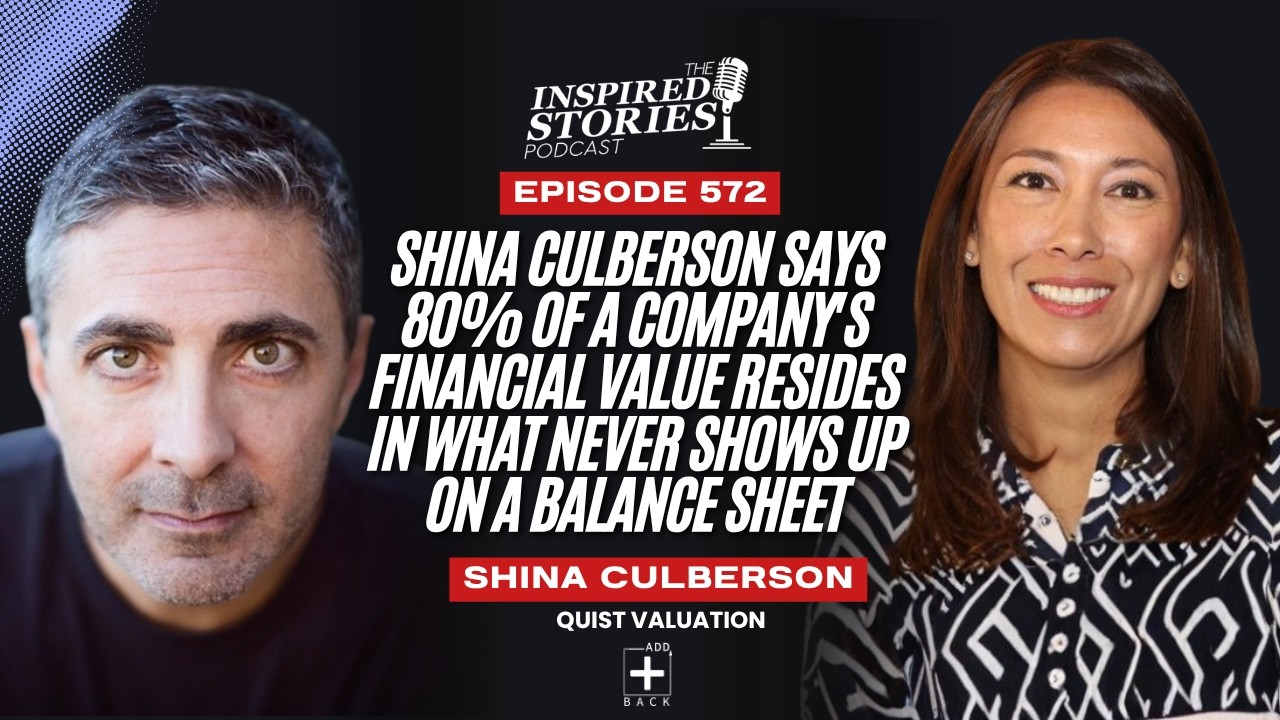
🎙️ From Biking Australia to Business Valuation: Shina Culberson's Journey Building Quist Valuation
In this episode, Shina Culberson, president of Quist Valuation, shares how a two-month bike trip across Australia, a canceled world tour cut short by 9/11, and a headhunter's cold call led her to become the third owner of an independent business valuation firm. Shina opens up about rewriting the company's mission so business owners could actually understand their own reports, the proprietary scoring system she built to measure the intangible drivers of business value, and her own lifelong struggle to delegate.
✨ Key Insights You'll Learn:
Studied economics and Japanese studies at Claremont McKenna College
Quit her first job at a Japanese bank to bike Australia's East Coast for two months
Analyzed European bank risk at Charles Schwab as the Euro and ECB launched
Took a Schwab sabbatical to Nepal that turned into nearly a year of world travel
Cut her travels short after 9/11 and relocated to Colorado
Joined Quist Valuation after a headhunter sought her out for her CFA charter
Learned that 80 percent of business value sits in six intangible capital categories
Built a proprietary Q Score, modeled after a consumer credit score, to measure business value
Rewrote Quist's mission in 2012 to make valuations understandable to business owners, not just regulators
Keeps about a third of clients as annual repeat business, some for nearly 20 years
🌟 Shina's Key Mentors:
Her Mother: An ER nurse working graveyard shifts whose independence shaped Shina's own self-reliance
The Headhunter Who Found Her: Recognized her CFA charter as a rare fit for Quist Valuation's analyst team
Quist's Founding Owners: Built the 1984 firm and the reputation Shina inherited and transformed
Her Longtime Multigenerational Client: A family business patriarch whose kept archive of reports affirmed the value of her work
👉 Hear how a self-described accidental entrepreneur built a proprietary scoring system to help business owners finally understand what drives the value of their own companies.
Listen to the full episode here
Transcript
Anthony Codispoti (00:00)
Welcome to another edition of the Inspired Stories Podcast, where leaders share their experiences so we can learn from their successes and be inspired by how they've overcome adversity. As you listen today, let one idea shape what you do next. My name is Anthony Codis Bodie, and today's guest quit her first job out of college to bike the length of Australia's East Coast. Years later, deep into a career at one of the country's largest financial firms, she quit again.
Turning a routine sabbatical into a plan to travel the world for good. That is, until September 11th, set her home early. That restart ran through a small Colorado mortgage bank and a headhunter's call built around one rare credential, ending at the door of a tiny independent valuation firm few people in finance had heard of yet, and one she would eventually own. Her name is Shina Culberson, president of Quist Valuation.
An independent business valuation firm founded in 1984 and its third owner. She holds the CFA charter and the Certified Exit Planning Advisor Credential. She teaches valuation for the Exit Planning Institute and has built Quist's reputation defending clients in IRS cases and valuing venture portfolios for firms like Kleiner Perkins and Sequoia. But before we get into all that good stuff.
Today's episode is brought to you by my company, Ad Back Benefits Agency, and you'll want to hear this because it's hurting almost every business owner you know. See, health insurance costs go up every single year, and businesses are furious about it. They're paying more, claims are getting denied, employees are opting out because they can't afford it, and it hurts turnover and morale. It's one of the most maddening problems in running a business, and everyone just seems to accept it. But you don't have to anymore.
Now there's a program from Bain Capital Insurance that gives your employees unlimited access to doctors, therapists, and prescriptions with no co-pays or deductibles to meet. And here's the part that really shocks most people. Unlike every other employee benefit out there, our program increases your net profits. We recently helped a client add, add $900 per employee per year to their bottom line. Results vary, but gains like that change how a business is valued.
You
can be the hero advisor that introduces this to your clients today. They'll be so happy they refer their friends to you. At backbenefits.com. Okay, back to our guest today, the president of Quist Valuation, Shina Culverson. Thanks for making the time to share your story today.
Shina Culberson (02:41)
Thanks for having me. I'm excited to be here with you.
Anthony Codispoti (02:44)
So Shina, you studied economics at Claremont McKenna College. What first drew you into the major? And what kind of career did you picture for yourself after graduation?
Shina Culberson (02:53)
Yeah, so so economics for me blended kind of the pro puzzle solving with side of math with the human side of social science. I always thought I would kind of go into international affairs or head towards a career in global finance where I could combine that sort of math.
orientation with kind of solving human social problems through an economic lens.
Anthony Codispoti (03:31)
Interesting. social science, not a term I come across a lot. Say more about what that means.
Shina Culberson (03:37)
Yeah, so you know, there are a lot of financial drivers, financial you know, there's economic theory that you would think would drive decision making, but there's a whole human social capital side of how things actually happen.
And it's that emotional, social, cultural impact where you have a disconnect sometimes between economic theory and how things actually happen in reality.
Anthony Codispoti (04:19)
And so would behavioral economics be a synonym for that? Got it. Okay. So that helps me. Okay,
Shina Culberson (04:22)
Yes, exactly. Exactly. Yeah.
Anthony Codispoti (04:25)
so take me back to your first job out of college. You are at a Japanese bank and you decide to walk away from it to spend two months two months biking the length of Australia's East Coast. What was behind that decision? What was driving you there?
Shina Culberson (04:42)
Yeah, so well, you know, I my first career out of Claremont McKenna was with a Japanese bank, Sanhua Bank, as you mentioned. And I had minored both in Japanese studies and in spoke Japanese, lived in Japan for a little while. And so the bank was great, took me through your classic sort of credit training program, which gave me all the hands-on financial analysis skills that I would use later in my life. But
At the end of the day, I have always had a bit of a wonderlust. I am a risk taker inherently. I really thrive with a lot of change and uncertainty. And so the thought of, you know, taking a break in my career, traveling with some friends across and biking up Australia for a couple months wasn't
panic inducing or stress inducing for me at all. It was more like, okay, this is just a fun sort of divergence and then we'll come back and do kind of the mainstream pathway towards career, but it just a fun opportunity.
Anthony Codispoti (05:55)
just a fun opportunity for you. Yeah.
Shina Culberson (05:58)
Yeah.
Anthony Codispoti (05:59)
And so Japanese studies, you spoke Japanese. Is there Japanese heritage in your background or this was just something that was interesting to you?
Shina Culberson (06:08)
it was just something that was interesting. I'm actually half Thai, so my my father's from Thailand. And but when I started at Claremont McKenna, I knew that I wanted to study a foreign language. And I went to Russian class, I thought, that's hard. I went to Chinese class, I'm like, that's really hard too. And then I I went to Japanese class, I'm like, I think I can do this. So
that's where I landed. And and in the time at the time, in the early late eighties, early nineties, there was a lot of I grew up in Los Angeles, there's a lot of Japanese investment in the United States as well. So it seemed to make sense at the time.
Anthony Codispoti (06:55)
You know, it's funny because the polyglots that I've talked to, those three languages that you mentioned, they reference as being some of the hardest. And so it wasn't like you went for like the easier romance languages. You're like, I'm just gonna
Shina Culberson (07:07)
Yeah.
Anthony Codispoti (07:08)
take a look at the hardest languages that are out there and then pick the least hard among them.
Shina Culberson (07:14)
That's right. And I always had again, I love to travel. I'm a big I've done extensive traveling and so I'm always thinking about how do I go to the far reaches of the world and kind of explore them.
Anthony Codispoti (07:27)
Fun stop. Okay, so later on you land at Charles Schwab Investment Management. This is the asset management arm of Charles Schwab. This is right as the Euro is being created. What's the most interesting part of the work that you got to do there?
Shina Culberson (07:45)
Yeah, so you know, this is getting to Charles Schwab Investment Management. I was a director there for their credit research team. And I and my team, we were specifically tasked with covering all of our international financial institutions and sovereign debt issuers that we invested in in the fund in the proprietary funds. And so this was really starting to blend.
this whole idea of global finance and global economics. So over in Europe at the time, all the financial institutions obviously had their local country-oriented central banks. And when the Europe Euro was launched and the European Central Bank was launched in the late 90s, everything
All the banking regulation was centralized. And so it really started to marry what I was talking about before. How do you take these strong individual cultural norms and create an oversight and regulatory oversight rules that everybody could agree to? Very challenging. So imagine you take a rules-oriented
German regulators, and then you take your French, Spanish, Italian regulators, and try to get them to see eye to eye about the sort of transparency, the regulation around managing all these banks under one set of rules. Very challenging. You know, those those French, Spanish, Italian banks tend to have there's a lot of
Not that Germans don't have a lot of pride, but there's a lot of pride. They they would have a lot of state-owned institutions that were supported through just kind of like cultural norms. And then you'd have these more hard-nosed regulated financial systems-oriented German s banks. So it was really fascinating and really got to blend, right?
Anthony Codispoti (10:04)
And you're supposed to step in there and yeah.
Shina Culberson (10:08)
That sort of cultural.
social piece of what we were talking about before and kind of rules-based credits for for banks.
Anthony Codispoti (10:19)
And so how are you navigating that? Are are they listening to you? Are they like taking your advice? Are they pushing you to the side? Like what's it like for you to be in those rooms?
Shina Culberson (10:30)
Yeah, so so you know, I wasn't there to dictate the rules, but I was there to assess our investment risk. We had at the time, probably two-thirds of our of our assets under management were exposed in some form or fashion to these European banks. And so it was really important that we understood.
Who was going to be the lender of last resort? What happened if you had a large national bank in France that ended up not having great asset quality? Traditionally, the the country would have supported it and held it up, but were the regulators in in Brussels going to have the same perspective as the historic, you know, regulators in France? And so it was really.
I was there to kind of suss out what that was going to look like and if we needed to adjust our sort of in investment theory or or exposure to those banks for the funds. but it it was really fascinating because you know there was a lot of your euphoria in the at the time. You know, everybody thought, we're all gonna get along under this one euro zone.
And it's gonna create these great economic benefits for trade. And we can see today, you know, some of it was not lasting. You got the UK who left the euro. So there's always always these underlying pressures that despite the euphoria at the time, you know, are going to be stressed and challenged and some of it doesn't doesn't endure.
Anthony Codispoti (12:21)
So aside from the UK exit, just quick sidebar and I want to get back to your story, how would you assess the success of the Euro?
Shina Culberson (12:32)
besides the the UK leaving, which
Anthony Codispoti (12:36)
And technically, I mean, they never adopted the actual currency, right? But th they left a lot of the regulatory and the trade, yeah.
Shina Culberson (12:40)
No, they didn't. They didn't. But they had the benefits of the trade years. Yeah.
I mean I think it's been
Okay.
Anthony Codispoti (12:52)
Okay.
You give it a C plus maybe? Yeah. Okay. All right. All right. Let's cut.
Shina Culberson (12:56)
Yeah, yeah. I i
again, it's a cultural thing that's still very hard to to it's gonna take decades to really have the same sort of trading system that you would seamless trading system that you would see maybe here in the United States.
Anthony Codispoti (13:14)
Well, they've had decades with it now, haven't they? Yeah. All right. Okay. We'll we'll
Shina Culberson (13:16)
They have, I know. Let's give them a few more hundred years. No, I'm kidding.
Anthony Codispoti (13:22)
keep rooting for better things to come. Okay, so back to taking sabbaticals, because Schwab had this program where you earned a four week sabbatical for every five years that you were there. And you ended up being there long enough that you accumulated two full months worth of time. So you and your husband decide to do what?
Shina Culberson (13:45)
Yeah, so we went on sabbatical. This was in October of 2000. We we decided to go to Nepal and trek around Nepal, going to Base Camp, Everest Base Camp, hiking around the Annapurnas. And so we went to Nepal for two months.
Realize it wasn't quite long enough. And at the same time wishing we we our sabbatical was longer. And then that dot-com sort of boom collapsed. And we had friends, this is back in the day where you had to go to internet cafes, and we had friends that were sending us emails saying, Hey, hope you're having a great time on your sabbatical.
The kind the world feels like it's collapse collapsing here. We were in San Francisco at the time. And you should either come back immediately so you can sort of figure out what to do with your career, or really just continue to live in ig ignorant bliss, right? As you're out on the on the road. And so we decided to continue travel. We we quit our jobs at Schwab.
and continue to travel for the next almost year around Asia. and Yeah.
Anthony Codispoti (15:19)
And real quick, sorry, Shina,
you know, the internet bubble popped and certainly in the Bay Area, but but it it rippled, you know, all across the country. But the type of work that you were doing wasn't really in that sector. Am I right or wrong?
Shina Culberson (15:38)
Well, it wasn't necessarily in that sector, but it it impacted the entire economy in general. And so when it comes
Anthony Codispoti (15:45)
Okay. Got it. Yep.
Shina Culberson (15:47)
to investment risk in general and what it was doing for markets, I mean i we felt it even though it wasn't my particular, you know, sector that I was following.
Anthony Codispoti (16:00)
Gotcha.
Okay. So you guys decide to travel in ignorant bliss for a while longer, almost for a full year, and then nine eleven happens and your plans change.
Shina Culberson (16:10)
And then 9-11
happened. Yeah. And then 9-11 happened. And literally, my husband and I, we were, I remember we were in Thailand and we were at the airport. We're like, okay, we're supposed to go home, but if we can find a flight to Australia, we're going to Australia. And if we can't, we'll just jump on our flight and and go back home. And it was a Sunday.
we couldn't get a flight to Australia. So we did just kinda end up going home. But it you know, nine eleven occurred and and so we thought, okay, we sh
Anthony Codispoti (16:47)
Sorry, nine eleven occurred
before you left.
Shina Culberson (16:51)
Nine eleven occurred well it occurred right after we returned home. Right after we returned home. So then nine eleven occurred and then we ended up relocating from the Bay Area to Colorado, where my husband grew up. Yeah. Husband had family in Colorado, yep.
Anthony Codispoti (17:10)
Okay. So husband had family in Denvers.
So you come back and I believe a headhunter reaches out to you, specifically because you have this CFA charter, which at the time you one of the few people in the Denver area that did, and h had an interesting opportunity for you. Tell us about that conversation.
Shina Culberson (17:35)
Yeah, so so when I got back to Colorado, I did we started a family, did a short stint at a mortgage bank, and then a hunter headhunter, as you mentioned, reached out to me because I held the charter financial analysts credential. And they were working with a valuation firm, Quist Valuation, who was looking for someone specifically with that credential that could come in and manage their analyst team.
And in my in in my career up until that point, I had been working with publicly traded companies, institutions, right? Fixed
Anthony Codispoti (18:17)
Big companies.
Shina Culberson (18:18)
income, I was also did work was on the equity side for a short time or equity side of the business for a short time. So but everything that was large institution, large companies publicly traded. Quiz valuation.
Focus it focused solely on privately held companies, closely held family-owned businesses. And honestly, it's been the most interesting job I've had in my entire career. Even though I I I talked to central bankers, I traveled internationally for my job at Schwab, which was fun in itself. But this part of working with
closely held businesses is really been fascinating to me, partly because you can we really get to see the inside personalities of business owners. We see how that is overlaid in the business that they're creating and growing. And you just don't get that sort of personal feel
looking at a large publicly traded company.
Anthony Codispoti (19:36)
Did you have any sense that you were going to like that aspect of it when you took the job, or what was it that initially attracted you to the opportunity?
Shina Culberson (19:47)
well I I think initially it was, you know, obviously it it spoke to my core capabilities of being, you know, financial analysis and securities analysis. but I I think, you know, Quiz has I we're not specialists here. We see
tons of different types of businesses. So that was the other appeal for for coming to an organization like Quist. It's, you know, in my past I was very focused on financial institutions, but here it's very broad-based. We work with lots of different types of companies, technology oriented, service oriented, manufacturing. So that that diversification and was really interesting. And I'm sure we'll talk about it a little bit later, but
you know, there's a core, there are core themes to how every business operates. And then this the specialty, the special sauce, right, is on the edge. so it's a really interesting analytical exercise exercise, I think, to go through like
Okay, what are the commonalities of all businesses? How do they operate? And then where how does that special sauce, the special flair of every business overlay and drive value? It's just so much more interesting than going through 10Ks.
Anthony Codispoti (21:22)
Okay, so we've teased it. Let's not
wait. What what are the commonalities and say more about the the secret sauce around the edges?
Shina Culberson (21:30)
Yeah, so so we s so one thing that people should understand is 80% of all business value is in the intangible drivers of a business. So if you just put the you know, if you looked at any company and you said, okay, what are their tangible assets on their balance sheet? Well
When you get to overall enterprise value, those tangible assets are typically on average only 20% of an entire value of a company, enterprise value of a company. So the yeah,
Anthony Codispoti (22:04)
Okay, that's surprising for me to hear.
Shina Culberson (22:07)
so the the remaining 80% are what we call these intangible drivers or capitals. And we break them out into six categories. So there's
Customer value, obviously customer concentration, diversification, satisfaction. There's the human capital piece of it, your employees, your leadership team. There is financial value, obviously your financial management, not just what is your revenue and what is your profitability, but how are financial decisions and management being conducted within the organization? Then there's what we call
social capital or things like your brand, your reputation, your market position. This starts to talk about your special sauce, like what is your value add to the marketplace and how do you compete? And then we and then there's structural capital. So structural capital addresses things like systems and processes.
Communication structure. How do you communicate externally as well as internally to create buy-in into the organization and have everybody be on the same page? It's kind of like that around culture as well. And then the other driver that we look at are is governance. So, how are decisions made within the organization?
It touches a little bit on culture as well. But we generally like so when I think about the intangible drivers of the business, we think about those six categories. And we we measure when we look at value companies, we're looking from a common framework of those six drivers in every business. How do they stack up?
Those are kind of the the nuts and bolts of what I would say have to be in every organization. And then you have some IP on the other, you know, other special sauce pieces that get overlaid.
Anthony Codispoti (24:23)
So when we talk about physical assets that the company has, when we talk about things like net profits, those are things that for me, they're very objective, right? Like this is a number, we apply a multiple to it, you know, we we know how to work with that. The other things, the other 80%, these six drivers, they're much more subjective. Like, how do you begin to assign
number values to those things that are so much more subjective.
Shina Culberson (24:58)
Yeah, so I I feel like we have a a very sort of special way that we've conducted our valuation process over time. So what we do is we ask a a a handful, a group of questions. We there's like 65 to 80 questions. We ask those same questions to every single business that we value.
whether they're in manufacturing services or distribution, they get the same questions. It allows us to aggregate them and analyze how owners and companies respond to those questions regardless of industry or sector. So we have over the over the decades really accumulated kind of our own sort of proprietary database about how companies
RSS across these com common drivers. It affords us to have our own proprietary sort of scoring system. And then that scoring system is translated into risk. So the higher for for us internally, like, the higher business scores across these categories, the the higher the perceived value, the lower the score, the higher.
the the risk or execution risk for that business. And so yeah, it's something that we developed back in 2012. So and it's been really it's been a a really great sub it helps bring the objectivity into that subjective assessment because we're able to see scores across companies, across industries, across size. And it just
Anthony Codispoti (26:50)
And
Shina Culberson (26:50)
helps our proprietary.
Process.
Anthony Codispoti (26:53)
That's really interesting. So is this an assessment that the client sits down and does themselves? Is this something you do for them or with them?
Shina Culberson (27:02)
Both. So yeah, both. We have for us as a firm we do certified valuations, which would I would describe as kind of a white glove custom valuation process and and and procedure. Owner is is teamed up with an analyst team.
And we go through those those questions, but in a one-to-one conversation. For those business owners who aren't ready for a full certified valuation, which is timely and costly to be transparent, we we do have online assessment tools and they're just assessment tools, but we we offer those same kind of foundational questions.
That business owners can then answer themselves and get a score, get an assessment of which drivers are are increasing value, which ones are detracting from value, and get recommendations on what to do to improve their value over time. So that is just an online kind of do-it-yourself assessment that we also offer. But it really we do that because I want
every business owner to have the opportunity to really assess the value of their company so they know where they need to go with their business over time.
Anthony Codispoti (28:34)
So I know right about now people are like, wait a minute, what's the name of the company? I want to go find this assessment tool. So QuistValuation, Q-U-I-S-T, quistvaluation.com for folks. don't leave us though. Stay here
Shina Culberson (28:49)
Yeah.
Anthony Codispoti (28:49)
for the rest of the interview. We still got more interesting things to talk about, but I know you want to check that out. and so this proprietary data set, this tool that you've built that's on top of this data set.
So I want to see if I'm sort of connecting the dots correctly here. You have all these data points from different companies. You've seen how they answer certain questions. And then is there a mechanism to sort of track what their overall financial performance is? And so you're tying their financial performance to the way in which they answer these questions and say, when we find companies that answer this block of questions this way.
We tend to see that their financial performance is better. Yes, no, directionally close. Okay.
Shina Culberson (29:35)
It close. Yeah, very
yeah. I mean the the assessment what we do is we want to give the business owner something that they're kind of familiar with. So I think everybody's familiar with their own sort of consumer FICO score. That's how I think about what we call our Q score. It's akin to like a FICO score. So you answer the questions, you get a score, you can take the assessment.
Over time, you can see how your score increases or decreases. And that score, just like your FICO score, is correlated to how much credit you can attain as a consumer, the business, the Q score is correlated with business value. So as you grow that score over time, the value of your business.
We demonstrate how the value of the business increases over time, or if the score goes down, how that shifts the value maybe downward for the company. and then so that's how we're using those comprehensive set of questions
Anthony Codispoti (30:49)
Okay.
Shina Culberson (30:50)
and how it's correlated with score and value.
Anthony Codispoti (30:53)
Got it. Okay. So you already have a sense of you want to be seeing this kind of an answer because that in indicates to you that there's less risk, there's better decision making, less reliance on the owner, et cetera, et cetera, et cetera. And so when we get those answers, we know that they have a a higher Q score, as you call it. Okay.
Shina Culberson (31:13)
Yeah, exactly. Exactly.
Anthony Codispoti (31:15)
Gotcha. Okay. And so when you take folks through, what did you say? There's sixty-five questions that
you kinda go through in this
Shina Culberson (31:23)
That's right.
Anthony Codispoti (31:23)
process and you're coming out the other side and you give them evaluation. Are there also recommendations then that are attached to that? Like, you would do really good if you had an employee handbook, for example. I don't know, just to throw it
Shina Culberson (31:38)
That's right. Yeah. Yeah. No, that's exactly what we do. So on the other side of the assessment is a prioritized action plan. And that action plan is tied to points and a dollar value. So business owners can see, gosh, just to take your example, you know, if I if I updated my employee handbook with
clear written rules and responsibilities, that would increase my score by 10 points, which is equivalent to X number of dollars. And so some based on our experience, because this is a proprietary system that we built. So based on our experience, not every recommendation is worth the same value or s score accretion. So the things that
People ask me this all the time, like what are the top sort of value drivers that are sort of we focus in on? So anything around citizens of processes and taking the owner dependency out of the business, things like that are always gonna score higher than let's say, you know, make sure there's your vision and mission statement is somewhere on the wall. I I don't know, something like that, you know.
Anthony Codispoti (33:03)
Yeah.
Do you think at all about how employee turnover affects the value of a business or is that outside the scope of what you do?
Shina Culberson (33:15)
Well, employee value is certainly one of the key factors that we consider that as we discussed, and it really directly impacts company specific risk of a business. So, you know, high employee turnover or challenges in even being able to employ people.
And or recruit people can really impact a company's value. So every engagement that we do, we take a deep sort of look at management depth, employee dependence, retention risks, and we translate that into how it's impacting company value.
Anthony Codispoti (34:09)
Wet the whistle for our listeners, low-hanging fruit, something that it's like this wouldn't take any or very much time or capital investment. Well well, time investment's okay, but not much capital investment. Here's something that you could do that would really move the needle for most businesses.
Shina Culberson (34:29)
Yeah. So I think I already alluded to this, but the single biggest value destroyer is owner dependency or key person risk. So if you're an owner and you can't go on vacation without checking in on a daily basis, that's a big red flag. the the the
One of the the solutions to that is then to focus in on documenting key systems and processes so knowledge isn't trapped in the owner's head and can be shared across a knowledge base that is accessible to employees.
Then to take that ball that we started, so lower key owner dependency, implements document systems and processes, then to move that ball forward is then to create clear rules and responsibilities for your employees. So having a real second layer of management, not just delegating tasks, but giving control and ownership to that delegated.
to that management team making them or giving real decision making to them. That those are all things that can with very little capital required really move the needle on valuation. And one of the things that I like to share with with business owners is the way to think about this is step one, we're trying to
recomm make recommendations that protect your existing value business value right once you can you protect that business value through lower independency document assistance processing having clear roles and responsibilities building out that second layer management then you can move towards creating value and creating value and scale in a business it often does require
Intense capital, time, resources, and it's risky. There's more risk involved. So the more you protect value, you create the foundation, the better positioned you are to create and scale value, which inherently is riskier. Hopefully that makes sense. But we we try to everything that we do is really system and process oriented in how we communicate with business owners, but that's sort of the
logical way that we explain it, protect value, then then it creates the path, the the glide, the glide path to creating and scaling value.
Anthony Codispoti (37:29)
So it seems to me that in that process, the hardest first thing is to get the owner or the key person to buy into this, right? Because the business has gotten to where it is in large part because they've carried it on their shoulders and they've done everything. They've been the point person, they've got all the relationships, they have the industry knowledge. And so it feels good, right? Like I'm I'm the important person here.
Once you get past that, assuming that you can get past that, and they see the value in, hey, what got me from where I started to here is not going to be what gets me from here to where I want to go, then what does that process actually look like? Because it seems to me like once you get a little bit of momentum with it and you can start seeing some results from that process, that it's like, okay, I want to do more of this. I want to free up more of my time. I want to get
more delegation in place. But how do you how do you kick that pebble down the hill to start?
Shina Culberson (38:33)
Yeah. Yeah, no business owner ever started a business because they enjoyed documented systems and processes, right?
Anthony Codispoti (38:42)
Well put. Nobody likes that kind of minutia. We like the big picture stuff, right? Yeah.
Shina Culberson (38:44)
business owners because they have
a product idea, they like to close the next big sale. they you know, not because of yeah, assistance and processes. So you know, it sounds a little boring, but you just kind of start one step at a time, right? I I think really thinking about
working on the business as opposed to in the business, how do you shift that your mentality and how do you shift your day-to-day a little bit so that your I for me personally, I know when I'm working on the business 80% of the time and only in the business 20% of the time, then I feel like okay, that's the right proportion for me for me. but it needs it, you know
But there are times we're entrepreneurs, right? There are times where I'm like 80% in the business and it just that's just not right. I can't grow or scale the business like that. So so you know, we just start having these conversations with business owners. We we start just to ask them and challenge them. Can you shift it 10%? What can you do in your day to day? And it's in who can you delegate to? Who's your second, who's your right hand man or or woman?
Who can come up and support and take one thing off their plate. And we're not consultants, we're business valuation specialists, but these are this is why I love what we do here at Quist versus being with publicly traded companies and my old job at Schwab is it really does afford us to have those deeper
more meaningful conversations where you can really get to the personal aspects of entrepreneurship and really think about how to advise the client from a purely from an evaluation perspective, how to move that ball forward and create value.
Anthony Codispoti (40:48)
I wonder if maybe you or any of your clients have employed mechanisms like this, because I've I've been through this process multiple times myself before in my own businesses. And with me, and a lot of what I do is I'll call it digital, right? I'm on my computer. The work that I'm doing is on my computer. If there's something I find myself doing on a regular basis and it's starting to feel tedious, I will open up.
one of many different screen share recording applications, and I will go through and explain on that recording what it is that I do. I'll send it to the person that I want to have take over that task and say, build this out, right? This is just me like taking 10, 15, 20 minutes to spew everything out of my brain. But it's going to drive me crazy as the big picture guy if I've got to sit down and go through each of these, you know, details and make the outline.
Do that for me and then try to execute that plan based on that. And if you've got questions, it tells me that there's gaps in the process. Thoughts on that?
Shina Culberson (41:54)
Yeah, I mean, I think doing I I was just talking to a value advisor that I work with, and he was sharing with me similar story to yours, like using the technology that we have available to us to capture systems and processes and how things are done. So he was working with in an HVAC company.
And the key sort of on-site manager for the HVAC company was like in his 70s. And there was like all this know-how in his brain. And so they fitted him with what are those like those metaglasses where he just went out and then
Anthony Codispoti (42:41)
Ha ha ha.
Shina Culberson (42:42)
they recorded everything through the metaglasses and he just talked through what he was doing for like a month.
And then they created all these SOPs around what he did, how he made decisions, and he just verbally just talked while you and they captured all that just through the recording of it while he was live on site at at customer locations. And so, you know, it's just one thing that you can easily do to take people who are working in the field and try to capture what they're doing, because you certainly don't want that.
all that know how, especially in someone who was at in his example was or his experience was in their seventies, right?
Anthony Codispoti (43:25)
Yeah.
I love that. I love that. 'cause I think people hear this and they're like, yeah, that makes sense, but I don't even know where I would find the time. And so it's like find the time the next time you're doing the thing and record it in some mechanism. And there's so many great like AI transcription tools that can take that now and basically
Shina Culberson (43:43)
Yeah.
There then another tip that I heard just this morning was someone was saying, Hey, Shina, if you would once a week, just once a week, record one thing that you that you are constantly and repeatedly asked to do. Or like, how do you do that again? What where do I find that again? If you just record take
One opportunity a week, by the end of the year, you will have 52 tasks that you no longer have to do. Right? And it seems so simple, right? So you it's just the discipline. But I was thinking to myself this morning when someone said that to me, I was like, gosh, if I gave that task not to myself, but to every one of my close team members and said,
By the end of it, we could have hundreds of just small tasks that were documented and a figured out and figure out a way to sort of automate them or get rid of them or delegate them.
Anthony Codispoti (44:48)
I love that because here it is, we're getting past this really hard part of you look at this giant mountain that you need to climb and now you're breaking it down into these like small one step at a time. I can I can do one this week. I can find time for that, right?
Shina Culberson (45:01)
Yeah.
And yeah, yeah, and you know, it all goes down to just to kind of bring it back to business value and business creation, you know, you're just trying to take the execution risk out of the business. It's
Anthony Codispoti (45:16)
Yeah.
Shina Culberson (45:17)
all about reducing execution risk.
Anthony Codispoti (45:20)
So you bought the Quist as an owner in 2010 and you became president in 2012 What's one of the biggest changes that you wanted to make at that time, Shina?
Shina Culberson (45:33)
Yeah, so it's I appreciate this question because when I started with Quist 20 years ago, our mission was to produce valuations that withstood the highest scrutiny. so what that meant was not necessarily the business owner.
But the accountants, the CPAs, the regulators, the SEC, those were really the ultimate audience that we were writing reports for them. And so the reports were very technical in nature, a lot of acronyms. Many times when we were reviewing them with business owners, our eyes were glazing over. And it was not
satisfying. I just it was just not satisfying. I'm like if the business owner or their client does not understand what we're saying, then how can we show like why would we think that there was any value in what we were producing? I think the regulators or the accountants thought there was value, but the business owner couldn't really understand you know the value of what we were doing. So when when
I became the majority owner of the company. I changed our mission statement to provide to perform valuations to provide actionable insights to improve performance, business valuation, and management decision making. Cause I wanted to shift that value back to the business owner for them, giving them the actual insights to actually.
make better decisions in their company. So fundamentally we're still valuation specialists, we're still analysts, we still do the fundamental you know nuts and bolts of valuation, but it's the presentation and how we present it it's in the presentation of those findings. It's how we break it down to more easy to understand, accessible, you know, action plans.
not talking over our clients, but really partnering with them, it I think it's made the whole, you know, everything that we do a lot more rewarding and a lot more meaningful.
Anthony Codispoti (48:06)
And accessible for the client, which is ultimately, you know, the the big point of it all, right?
Shina Culberson (48:12)
Yeah, yeah.
Anthony Codispoti (48:14)
So distill it down for us present day China. What does Quiz do and who do you do it for best?
Shina Culberson (48:23)
Yeah, so I mean, at the end of the day, we are business valuation experts. The only thing that Quiz does all day, every day, is business valuation. and we're working with business owners and their advisors. If anybody has worked with a business valuation expert before, they most likely were maybe part of a large accounting firm or maybe they're part of an investment.
bank or advisory practice, but really we we're not CPAs, we're not accountants, we're not business brokers, we're not advisors. All we do is kind of talk business value and business value creation.
Anthony Codispoti (49:09)
Okay. You've got a track record of successfully defending your valuations in IRS examinations. And this is a little bit of what you were touching on before, is your reports have withstood that kind of scrutiny. You wanted to make them more accessible to your clients at the same time. But what does it actually take to write a report that holds up under that kind of intense spotlight?
Shina Culberson (49:36)
Yeah. It's a great question because it it can you know, the IRS has very specific requirements and about a you know, probably about a third, a good third of our business is still in this kind of high regulatory sort of environment. but the IRS has very specific rules about what they want to see in IRS defensible reports. And it comes from a process.
and really standard standardized workflows in a call quality control sort of process that we've developed over time. But the report itself has to explain the story behind the assumptions and calculations. So our goal is always to create a cohesive story that an examiner, let's say an IRS examiner.
can understand it has a it's it's like writing a book there's a plot line there are chapters to this story but it all is in support of a conclusion that a reader can understand from the very first page to the last page of the report you know it's the way that we think about what we do internally is like we are
We are storytellers. I mean, we're not making up facts and circumstances, but we are threading through themes. We're and we're supporting our assumptions and calculations in those themes. And so that is it's a just a different approach than I think most people take when they think about evaluation report that is typically written in a very calculated formulaic.
perspective. So the highest compliment that we always get from our clients is one that is, hey, you really understand my business. You really
understand it. And most of us as entrepreneurs and business owners think that we are in a very we have a very unique business
there's no one else like us, you know. You know, every entrepreneur had I've heard the you know says the same thing, like, we're hard to understand, we're very unique, we have this, you know, this secret sauce, no one really understands us. Well, our goal is, you know, the business owner is to make sure the business owner has a clear understanding that we do understand their business.
Anthony Codispoti (52:16)
Hmm. It occurs to me that you're probably working a lot, not only directly with the companies themselves who want the valuation, but MA, exit planners, CPAs, yes, are these typically good referral partners for you?
Shina Culberson (52:32)
They're great. And and we're accustomed to working on teams. I mean, most of the time, nine out of ten times, we're working on a with a team of advisors that's supporting the business owner and their goals owner judges. Again, we are the valuation expert, we're not the accountant, we're not the advisory firm. We're you know, so we're yes, we're gonna expect there to be a whole sort of advisory team, loosely advisory team around that business owner to help them.
Anthony Codispoti (53:03)
Because you're again, you're coming up with a valuation, you know, from this sixty-five question process that you go through. From that, there are recommendations in there and things that they can do, but you're not beyond sort of providing them with the document, are you sort of coaching them on how to do those things? Or that that sort of falls to the the other advisor, like the exit planner or the CPA or whoever else was involved.
Shina Culberson (53:29)
Yeah,
so that is falls to the other members and on the business owners team and it's it kind of speaks true to my credential as a certified exit planning advisor. So the whole concept around the exit planning institute and being a certified advisor is it really is a team sport.
I don't think that anybody could claim to have, you know, specialized knowledge in every area that a business owner needs to be successful in either succession planning or ownership transition. So it really is a team sport, but you know, we're and we're really looking for the the right team member to come on to that business owner's sort of
team to to meet their needs. So yeah, we're full of recommendations and then we lean on other experts within our ecosystem to help with the execution with the business owner.
Anthony Codispoti (54:36)
You know, and one thing I find interesting about how you guys operate is that you keep advising roughly a third of your clients after the paid valuation report is delivered without charging anything extra for it. Walk me through that decision, how that works, why you do that.
Shina Culberson (54:56)
Yeah, so every year about a third of our business are annual repeat clients, and another twenty-five percent roughly are clients that we've worked with at some point in the past. so that's a pretty high percentage for a company like ours, and it really does trace back to 2012 when I shifted the the mission of the organization.
And again, the goal is never just to provide a defensible number, but it it is really to help owners actually make better decisions. And so when I think about our work, you know, we are offer free follow-up advice in really support of developing a long-term relationship with our clients. So every time I I talk with a prospect or a client, I always
You know, our goal is never to just be transactional in nature. My expectation is that we're gonna continue to work together now and long into our future. Our longest tenured client is nearly 20 years old. And the biggest compliment I ever got was I went up here in Fort Collins, north of where I live.
there's a family-owned business, third generation multi generational family-owned business. And the patriarch, when I the last time I was in his office, he's like, I have every single one of your evaluations. It's like binded.
But he's like, is this really like a historical chronicle? Yes, it helps us family. We have tremendous family harmony. Everybody's on the same page, but it also chronic kind of chronicles the history of the organization and our company and how we've grown up over time. That's a great compliment. I mean, I love that. and so to have that sort of relationship, long term relationship, we have owners reaching out to us for a whole
lots of different reasons. sometimes it's a recommendation for an advisor, sometimes it's just kind of pick our brain, how do we think about things? But we're rewarded in the in the longevity of that relationship.
Anthony Codispoti (57:22)
I really like that. I want to shift gears on you now, Shina. What's the hardest thing you've had to overcome, and what did going through that teach you?
Shina Culberson (57:32)
Yeah, so when I thought about this question, you know, I think about more of my own personal background. So I grew up as an only child in a single parent household with my mother who was an emergency room nurse that worked graveyards.
So I spent a lot of time as a child by myself, but it also made me fiercely independent, very self-reliant, and which I think was great when I was younger, but it's it's interesting to me how this has played out now as a business owner myself. I've had a really hard time personally.
letting go and delegating responsibility and not just be like, if I just work harder, I can grow the business. If I work harder, not if my team works harder, not if I delegate more responsibility, but if I just work more hours and every day, I can push the organization forward. And so it's been something that I've really had to
retrain my my brain to not be so sort of self-controlling like controlling and independent but really let go and really conscient it's it takes me a lot like other people maybe it's not so hard but I really have to be conscientious about building a team, how I want to communicate with them, how I want to delegate responsibilities, how am I going to build feel comfortable about
How do we hold each other accountable? because it it's really sort of going against a a deep rooted sort of foundational aspect of my personality and how I was raised. So yeah, it's interest it it's I hate to say it, but it's like those childhood traits are hard to it's hard to retrain the brain on those.
Anthony Codispoti (59:53)
Well, it's
so interesting because this is the exact problem that we were talking about earlier that you're trying to coach your clients on. You know, when there's that too much owner dependency, it creates a bigger risk for the business, for a potential buyer. And so it you're nodding your head because you understand how hard it is for your clients to do the very things that you're recommending because it's something you're struggling with yourself.
Shina Culberson (1:00:18)
That's right. That's right. And that's why I can relate so passionately with business owners about how difficult it can be. but I also know how important it is.
Anthony Codispoti (1:00:30)
What are some things you found that have helped you to take maybe even small incremental steps? Or if you're being completely honest, are you really stuck in this place right now where it is just hard to let go of anything?
Shina Culberson (1:00:44)
So for me, it is really about an accountability structure that I can feel confident in, right? It that's I think where the trust comes in in building a team. And so it's really having clear understanding of what's your role, what's my role, where do decisions get made, and then having the metrics in place.
to ensure not a lot. We only have a handful of metrics that we're that we're tracking internally, but it gives me the confidence to know that okay as an organization we're continuing to move forward. So some of the things that for for us personally we run all of our valuation valuation projects in a very systematic framework. It's six to eight weeks
We know exactly where every project should be every other every week. We have project management dashboard. I can look at it every morning and go, okay, we're everything's green, or maybe there's things that are red, you know, that are behind. But it gives us kind of a common framework as a team to go, okay, we can proactively address hiccups and challenges in the organization as as they come up.
As opposed to and so having that sort of transparency has helped in letting go. Like, I can come on this podcast with you, Anthony, and I don't have to be in the day-to-day because you know, we've got a a kind of oversight mechanism that can provide us transparency of where we are in the organization.
Anthony Codispoti (1:02:32)
Mm, I like that. What's the win that you're proudest of China that maybe most other people aren't aware of?
Shina Culberson (1:02:44)
now this is gonna sound very self-defeating, but I think when I took over ownership of the business, I was like, my gosh, I hope I don't crash this 40-year-old organization that I didn't even found into the ground like next week. It goes a l it goes a little bit to this sort of I think we were talking about it offline offline, but this
What did you call it? imposter
Anthony Codispoti (1:03:13)
Imposter syndrome.
Shina Culberson (1:03:14)
syndrome. Right. Do I really deserve to be here? Did I really earn it? I I think early on in my c career, someone called me the accidental entrepreneur, which psychologically it still stayed with me. I I never appreciate it, like I accidentally fell into it as opposed to earn it or deserve it. and so
you know, like I said, I've been with the organization 20 years now. I've owned it since 2012. And to me, I'm like, you know, it 14 years later it we're still going strong. So that's the the win for me because trust me, when I when I first bought the business, there wasn't that much confidence.
Anthony Codispoti (1:04:06)
Do you feel like that that noisy voice, that noisy negative voice, that imposter syndrome has quieted, or is it still on your shoulder every day?
Shina Culberson (1:04:16)
I
think it's still always there, to be honest. Yeah, I think it's always there.
Anthony Codispoti (1:04:20)
Yeah.
You know, I had a guest on who this was really powerful for me, and I'd be curious to hear if this lands for you. He reframed imposter syndrome as a superpower for himself. And rather as this sort of like weight that he carries around and like, you know, why do I question myself? Why do I die? He's like, it's the thing that kicks me in the rear end to get out of bed every day and just do a better job.
And realize that I can't rest on yesterday's accomplishments. I get to get up and do better today. I get to get up and do better today.
Shina Culberson (1:04:56)
Yeah, yeah, yeah. Well it's certainly a motivator. Yeah.
Anthony Codispoti (1:05:00)
Yeah.
just one more question for you today. And before I ask it, Shina, I want to do three quick things for the audience. First of all, if you want to get in touch with Shina Culberson, two ways. We already mentioned her website, quistvaluation.com, Q U I S T. And you can also email her Culberson, C U L B E R S O N at quistvaluation dot com. And if you missed those, don't worry, it'll be in the show notes.
Call person at quistvaluation.com. Also, if you're enjoying the show today, please take a moment to subscribe wherever you're listening. See, this is also going to send a signal that helps others discover our podcast. So thank you for taking a quick moment to do that. And as a reminder to all business advisors out there, your clients are bleeding money on health insurance. Do them a favor so big they'll tell their friends about it. Show them how to give their employees access to therapists, doctors,
And prescription medications that counterintuitively increases it increases the company's net profits. These are real gains that can change how a business is valued. So learn more about this product from Bain Capital Insurance at adbackbenefits.com. So, last question for you, Shina. As you think about the work that you're doing now, what is it that you most want to be remembered for?
Shina Culberson (1:06:28)
you know, I think I want to be remembered for creating an organization and a company that really provides the highest level of service for our clients. I want our clients to walk away with real confidence that they know how to understand their business, that and
that they can really create value for themselves as well. So we want successful outcomes for our clients. And and the best part is I get to practice, I I I don't just, it's not just me telling, advising clients on what to do in their business, but I get to practice that within my our own business every single day. yeah, so I think, you know, just thinking about that service,
White Love Service, the trust that we can build with our clients is you know, it's pretty simple in that way.
Anthony Codispoti (1:07:29)
I love it. Shyna Calberson from Quist Valuation. I want to be the first to thank you for sharing both your time and your story with us today. Thanks for being here.
Shina Culberson (1:07:38)
I appreciate it.
Anthony Codispoti (1:07:40)
Hey folks, that's a wrap on another episode of the Inspired Stories podcast. Thanks for learning with us. And if one thing stood out, put that into action today.
Connect with Shina Culberson:
Website: quistvaluation.com
Email: culberson@quistvaluation.com