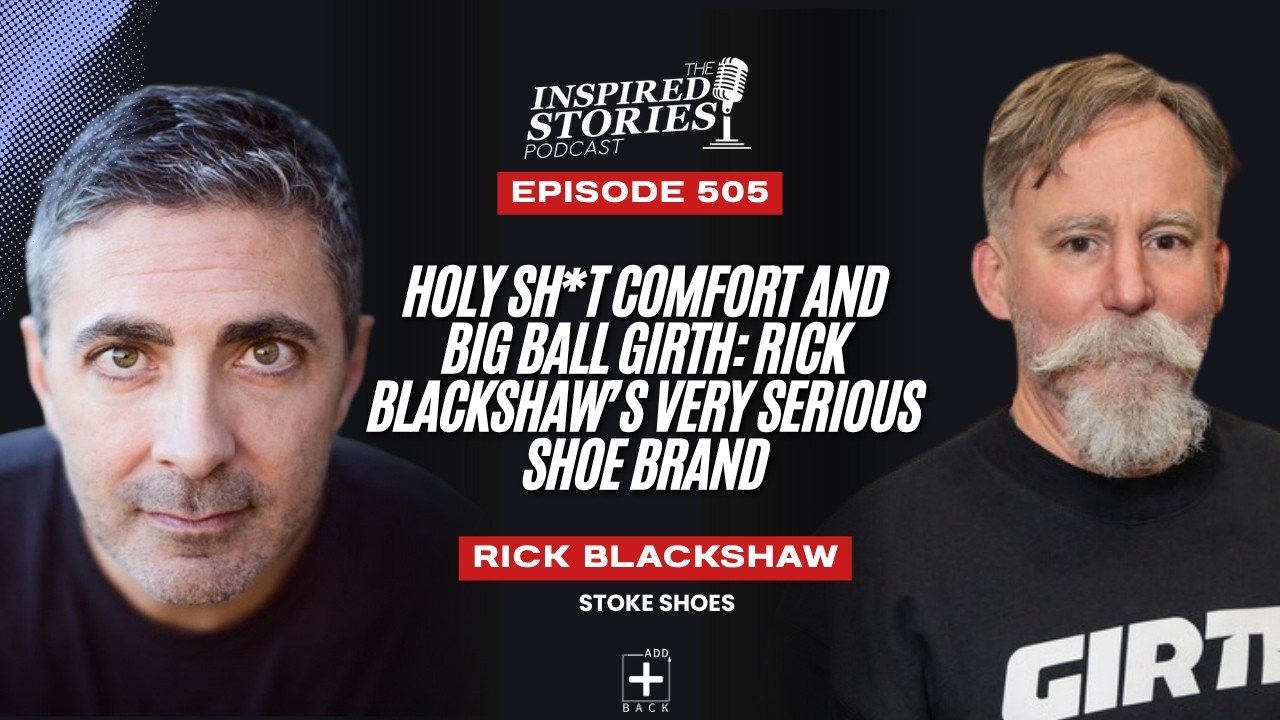
🎧 From Chuck Taylor to Hey Dude to Stoke: Rick Blackshaw’s Career in Footwear and the Brand He Built for the Guy Nobody Was Serving
Rick Blackshaw, founder and Chief Stoke Officer of Stoke Shoes, spent four decades building some of the most recognized footwear brands in the world — growing Chuck Taylor’s global revenue from $400M to $1.8B, doubling Hey Dude to over $1 billion, and turning around Keds with Taylor Swift. Then he had a conversation with his deathbed self and decided he couldn’t leave the one idea he’d been carrying for seven years unbuilt. Stoke is a sport casual brand built exclusively for wide and wider feet — the 75% of American men nobody in Big Sneaker was designing for.
✨ Key Insights You’ll Learn:
How Hey Dude was a $500M revenue startup with no systems, no racking, and no infrastructure when Crocs acquired it
Growing Hey Dude to over $1 billion and quadrupling market share in two years
What made Chuck Taylor the most popular footwear silhouette of all time — and how collaborations with The Clash, Metallica, and fashion brands kept the conversation alive
The focus group moment with Chicago high school girls that sparked the Brave Girl campaign — and led to signing Taylor Swift
Rebranding Sperry around sea-based adventure and discovery when the boat shoe fell completely out of fashion
Building CCM Hockey from zero EBITDA to top-decile profitability under private equity
The conversation with his deathbed self that pushed him to finally start Stoke
Why 75% of American men have wide feet and only 25% are buying wide shoes
The Mansplay midsole, Big Ball Girth, and Holy Shit Comfort — Stoke’s trademarked technology stack
Why 30% repeat purchase rates at 120 days in is unheard of — and what it signals about product-market fit
🌟 Rick’s Key Mentors:
His Teams at Each Brand: every major success came from assembling great people and building a culture worth showing up for
Taylor Swift (Keds Partner): showed him what it looks like to be so consumer obsessed that the consumer becomes a movement
His Deathbed Self: the imagined future version of himself that finally prompted him to stop deferring the Stoke idea
Retail Partners: validated the white space in men’s wide footwear and gave Stoke 400 doors in its first year
The Stoke Consumer: 30% repeat buyers in 120 days became the clearest signal that the product was solving a real problem
👉 Don’t miss this conversation about what it takes to build great brands, survive corporate politics, and finally bet on yourself when the idea won’t leave you alone.
Listen to the full episode here
Transcript
Anthony Codispoti: Welcome to another edition of the inspired stories podcast where leaders share their experiences so we can learn from their successes and be inspired by how they've overcome adversity. As you listen today, let one idea shape what you do next. My name is Anthony Codispoti and today's guests spent decades building other people's brands to billion dollar scale. He ran Chuck Taylor, CCM, hockey, Sperry and Keds. He took Hey Dude from acquisition by Crocs to over $1 billion in sales, quadrupling their market share. Then, at a point when most executives was settled into a comfortable next chapter, he decided to dust off his 40-year-old entrepreneurial studies degree and start over from scratch. He did it because Big Sneaker has been peddling the dream of elite performance and hipsterdom while ignoring the fact that 75 % of American men have wide feet. and four out of five don't use athletic shoes for athletic purposes. That insight became the engine for something entirely new. Rick Blackshaw is the founder and chief Stoke officer of Stoke Shoes, a sport casual brand built exclusively for wide and wider feet. In its first year, Stoke landed on shelves in about 400 stores. Rick holds an MBA from Morton and has spent his career at the intersection of brand building, operations, and culture. But before we get into all that good stuff, today's episode is brought to you by my company, AddBack Benefits Agency. Listen, if you run a business, you are likely stuck in the cycle of rising insurance premiums. You're paying more, but your team is getting less. And many people can't afford coverage at all. We do things differently. We provide your retail employees with unlimited access to doctors, therapists, and prescriptions that's always free for them to use. But here's the part that surprises everyone. Unlike every other employee benefit out there, our program puts more money into your company's bank account. As an example, we recently helped a client increase net profits by $900 per employee per year. Gains like that can change how a business is valued. Results vary, but the consultation is free. See if you qualify today at addbackbenefits.com. All right, back to our guest today, the Chief Stoke Officer of Stoke Shoes, Rick Blackshaw. Thanks for making the time to share your story today.
Rick Blackshaw: you bet Anthony, real excited to talk to you.
Anthony Codispoti: All right, so before we get into Stokes Shoes, let's talk a little bit about your background, your history, because it's pretty interesting. So you were at Crocs, as we mentioned in the intro, and spearheaded the acquisition of Hey Dude. Talk to us about what the state of Hey Dude was when it came into the fold and what you were able to do with it.
Rick Blackshaw: So great, great question. Hey Dude is I think something we referred to as a $500 million revenue startup when we kind of came upon it and bought it. Really had great traction with the consumer, great love, but it didn't have any systems. didn't have any processes, really no backend. There was a small team in Hong Kong making product and then there was a distributor in the United States who had a distribution center that literally had a bunch of boxes, no racking, no systems, no nothing. And that's kind of where we found it. And at the end of the day, it was then assembling you know, a great team to run it. We hired about 500 people over the space of the first year or so. We built out a million square foot DC, integrated it with Crocs, did a ton of research about the brand and, you know, how it was resonating with the consumer. And then focused on getting it into broad distribution in the US and ultimately we doubled the business in two years. And as you'd mentioned, Kudrupal share in this, the casual lifestyle businesses as it's noted in syndicated research.
Anthony Codispoti: There are so many things about that that are incredible. It was $500 million without really strong systems or processes. They didn't have the racking systems that seemed like it would be standard in even a much smaller brand. As you think about what you were able to do in a very short period of time, what do you think was the biggest growth lever that you were able to pull?
Rick Blackshaw: I think there were several, certainly it was, finding broader distribution for the brand in sporting goods and in family footwear, you know, chains that had 500 to a thousand doors. I think it was a tremendous amount of investment in marketing to broaden out the awareness. It's a $500 million brand that had 7 % aided awareness in the US. We were able to quadruple that, quintuple that. And that's important because I think if you're gonna be on thousands of shelves all across America, it's helpful if somebody's heard about the brand prior to that when they're walking in. That and then just building a great team and a great culture.
Anthony Codispoti: I'd like to hear about some of the other big brands that you worked on and I'm going to throw out the names. You tell me where we should start in terms of maybe which one has a more interesting story. I Chuck Taylor, iconic brand, CCM Hockey, Sperry, Keds. Where should we go first?
Rick Blackshaw: Um, well, let's take it. We can almost take it by, um, founding date. Um, let's start with Chuck Taylor, which in 1917 hit, uh, hit the American sporting goods scene, um, and grew over the period of, you know, a hundred years plus to absolutely. the most popular footwear brand of all time. If we think about probably pairs, right? And so in those hundred years, it probably sold over a billion pairs of the, know, singular style that we think of as Chuck Taylor that comes in an Oxford version. So a low and then a high top. And in the period when I was there, leading the Chuck Taylor business, we sold about 500 million pairs. and so we had a very steep ramp up from, you know, a brand that was doing 10 to 20 million pairs for the previous, 40, 50 years to I think our high point was about 75 million pairs. and so, a brand that had, I think. some great depth of meaning to the core consumer. We thought of this core consumers, the creative archetype consumer that might be drawn on their shoes, might be super into music or art, but the objective really was to bring it to a much broader consumer. And I think that it it as a brand, you know, found its way into youth culture. We did a lot of great stuff from a marketing perspective as well as a product perspective and, you know, quadrupled that business over time. And like I said, I think it's definitely the most popular footwear silhouette of all time.
Anthony Codispoti: Why do you think that is? What is it about this brand that has survived 100 years plus and sold over a billion shoes? What's been the draw to?
Rick Blackshaw: Well, I think some of it was really linking it strongly to creativity and thinking of it as a catalyst for creativity. At the time in the period from 2003 to 2012, if you saw any band that played in any stadium typically, two thirds of the guys were wearing Chuck Taylors, right? And so that connection to rock and roll was super strong. That's always been kind of a driving force of youth culture and a sense of rebellion and a sense of like, this is my generation shoe, even though it might've been your great, great, great grandfather's shoe back in 1917. It always kind of put its stamp on these generations and kind of stood out. And it was also simple and it was pure and it was excessively priced, right? And I think that that, even something like that I think is really important because it's really hard to sell tens of millions of pairs of shoes that are $200, right? And you look at the landscape. footwear now is, you know, things get more more expensive and a decent running shoe now is, you know, north of 160 bucks, right? And so I think something that is clocking in at $60 has a very, very broad triangle at the base of American consumption.
Anthony Codispoti: Yeah. So you were there from 2003 to 2012, you grew the global wholesale revenue from 400 million to 1.8 billion with a B. What were some of the biggest lessons that you learned there that would become helpful to you as you went forward into other shoe brands?
Rick Blackshaw: many, many fold. I always think of first half, you know, an incredible team, right? You don't, you don't do any of this alone. but an incredible team. And I think the point at which we started to hire, you know, really great people, we became a, a really great, brand, right. And I think, Certainly the marketing and the connectivity to rock and roll is important, but more important than that is creating product that the consumer loves and wants to buy more of, right? Because they know the silhouette and if you give them great options, they're going to keep coming back time and time again. And so we really focused on the shoe and what were the, you know, identifiable elements of its DNA, right? If you close your mind and thought about a pair of Chuck Taylors, you'd probably see a white toe cap, a toe bumper, a foxing stripe, a license plate, all those elements of DNA. We then decided what else could we do to the shoes? How could we iterate and how could we extend the Chuck Taylor franchise? And, you know, that alone that these iterations and extensions became a half a billion dollar business in and of themselves. And then, you know, the rest of the business was that classic Chuck High and and Ox. And we really worked hard to do some great collaborations in fashion, you know, with musical artists. you know, with all sorts of different cultural influences. And that kept the conversation going. You know, we did, did co-labs with, you know, The Clash or Metallica, or it could be Nigel Caborn at the very high end. It could be, you know, any number of different fashion brands, right? And it was always about doing great product and then making sure that the people heard about it.
Anthony Codispoti: And so these Co-Labs, you're working with somebody who's very popular in sort of their corner of the world, and you're doing a design that's specific for them, has kind of their name, their, I don't know, signature look kind of built on top of it.
Rick Blackshaw: Yeah, yeah, exactly. Exactly.
Anthony Codispoti: And it seems like that collab strategy became very helpful to you in your next stop when you went to Keds where you were president for a couple of years. Tell us about the state of the brand when you got there and then what the fun things that kind of unfolded in the couple of years you were there.
Rick Blackshaw: Yeah, absolutely. So, Keds was incredibly popular 20 years before I got there when a movie called Dirty Dancing came out. anytime that I talked to any woman that's between the ages of call it 30 and 60, they're like, yeah, I love that movie. Jennifer Grey, she was awesome. know, Patrick Swayze, blah, blah, blah. Right? And so, It was the most popular brand at that point in time of what we would call vulcanized footwear, right? Which is a hundred year old construction, which is how Chuck Taylor's made, which is how Vans has made, and which is how Keds was made. And so it was a $400 million business when dirty dancing came around in like the early nineties. And then it just atrophied from there. It shrank. 80 % to an $80 million business. Basically Chuck Taylor and Vans ate its lunch. And so I got recruited to come in there and I was thinking about like, yeah, I know, I know how to do this, right? You know, Chuck Taylor and Vans are, you know, male oriented ones about rock and roll ones about skate surf. Let's position this solely as a female brand. and as we started to go through the process of understanding the brand, we did a tremendous amount of primary research. And I remember we were in a focus group with a bunch of, high school girls in Chicago. And one of the girls said, you know, on my, I, I feel like on my best days, you know, I can, I can really make an impact in the community and my school. and I feel brave at those moments and. That was kind of the light switch that went on that said, we're going to make a brave girl movement. Right. And then from there, we asked ourselves who was brave girl number one. And at that point in time was Taylor Swift. And it obviously still is only maybe to a factor of 10 X what it was in 2013. and we signed a, a three year deal with her. she was our collaboration partner. We sponsored her tour. she was in all of our advertising and lo and behold, you know, she's one of the most popular, she's certainly like the most popular person on the planet right now. absolutely. But the love by her, or, know, her Swifties, and they. all of sudden said, okay, Keds is my brand. And we were able to double that business in a period of two years, which was remarkable because it was literally a dead brand that specialized in making cheap leather shoes for old ladies that you could find in Coles. And so, you know, it was a real turnaround. one of the things that we certainly realized was Taylor Swift is, I'm not, I was never like the hugest fan of her music, but came to, came to really appreciate how much she meant to her consumer and how much she loved them and, and, you know, a great performer, a great songwriter. And, you know, I think if you, can kind of apply that same lesson to your brands. If you're. consumer obsessed, if you love your consumer, you'll do great things by them. you know, obviously like talent also has to, to talent and set promotion also have to play a role. But, you know, she was, she was unbelievable as a partner.
Anthony Codispoti: So if I am hearing this story correctly, there wasn't anything wrong with the product itself. It was just the brand positioning, the perception of it in terms of consumer minds. And so you were able to turn that around with this new campaign, the Brave Girl campaign. And you had the bravest girl, the most notable one in the entire world, Taylor Swift, who was willing to be your partner in all.
Rick Blackshaw: Yeah, a hundred percent, a hundred percent. Though I'd say the brand, you know, if you think about like, these are people that liked dirty dancing 30 years ago, they age and their habits change and they wanted to buy comfortable, you know, leather shoes at a bargain in places that sell them and they're less expensive. Right. And so I think the distribution was a little bit off. The product was a little bit off. There was no margin in it. And we came back and said, well, we got to make it about what their core icon was, which was this simple vulcanized Keds champion. And that's what we rallied around. And there's a great margin story there and the ability to invest in it. And it all worked out very well.
Anthony Codispoti: Yeah, incredible increases in numbers. So you're there for a couple of years and then you take the president job at Sperry. Tell us the state of this brand when you came in and what your goals were there.
Rick Blackshaw: Yeah. So Sperry was a sister brand owned by Wolverine worldwide. and I think it was, the proverbial falling knife. And by that, mean, the boat shoe had this unbelievable run up over the six or seven years before, as a fashion item, right. And I think it, it signaled a little bit of like, accessible prestige and, know, preppy kids are wearing it and, and, it became a badge until such time as it didn't. and then it became very hard to sell boat shoes to consumers that just didn't want them. and so it, you know, kind of went from a hundred million of 500 million, and then all of a sudden the boat shoe fell completely out of favor. and I think also this idea of like, Prestige through buying things started to wane a little bit. You know what the consumer was telling us was that They were more about experiences than things and at the end of the day the real challenge there was to reimbue the brand with meaning we kind of built it up around this idea of You know the the what did we call it the the building, that's right. Finding a new brand voice around igniting the human spirit through sea-based adventure and discovery. Right. So it wasn't about a preppy boat shoe. It was about what you could do with your spare ease out in the wild. And it happened to be, you know, the 80th anniversary of the brand. sponsored 80 adventurers to go around the world. tell their stories, share it to their fan base. And then we really tried to diversify the product away from the boat shoes and did, you know, new sneakers, duck boots, things like that, and managed to hold serve and really increase the profitability of the brand over the next couple of years, which is very difficult when the thing that you're known for, all of a sudden the consumer just simply doesn't want.
Anthony Codispoti: So you were you had this campaign, the 80 travelers going around the world, which sounds like a lot of fun to put together and execute. But you're also trying to it sounds like you've got this weird balancing act where you're trying to keep true to, you know, the boat shoe identity of the brand. But recognizing that people don't exactly want that anymore. And so how can you still keep the flavor of the brand intact? but go into these different areas where the consumer tastes were naturally my.
Rick Blackshaw: Yeah, yeah. And it's one of those things that you think about the place you have in the consumer's heart and mind and wallet and the product that you're known for. And then you try and think of like, what's the closest thing in the closest adjacency that's actually popular, right? And so one of the things that was popular was, again, vulcanized footwear. And Sperry actually had a history doing that. It just didn't do it very well. So we focused on that. know, young girls like Sperry up until a point. And then they started buying, you know, in the winter time, LL Bean Boots. And we all of a sudden said, okay, we're going to go after that, but we're going to bring some color and some fun to it and some Taylor Swiftness to it. And really start to drive that and all of a sudden we had a business that was a hundred million dollars in that particular silhouette from nothing and all of sudden we were selling 2X what LL Bean was. And so we modernized the boat shoe because obviously sneakers were kind of trending and we created a million pair franchise in that first season through doing a modernized interpretation. So it's one of those things like you kind of think about what are the strings that you can pull and then you make great product because that's what the consumer's buying. And then, you you hope that it resonates and if it resonates, you really got to pour gas on the fire.
Anthony Codispoti: So it sounds like you're a fix it guy. You come into these brands, they're, you know, legacy brands. They've got some great history, but trends have changed and you come in to get them back on track. Was it the same thing when you became the CEO of CCM hockey?
Rick Blackshaw: yeah, I think it was pretty similar. CCM was a division of Reebok then Adidas. it was, you know, 1 % of Adidas's sales. and they decided to sell it to a private equity partner. So we had to carve it out. We had to, you know, establish its own systems and backends and things like that build its culture up. create an innovation center, really invest deeply in innovation, and then focus on what's the meaning that we wanna have in the player's heart, right? And this was all about, again, we did some focus groups. was a kid in Minnesota talking about like in his highest goals to go all out. for a whole game, but he realizes that's really difficult. And if you get some shifts where he goes all out, like that's a pretty good starting place. And so we built the brand around this idea of all out, which was about maximum performance, but it was also about bringing in more consumers that look different than the present hockey consumer to the game, right? And so it was this idea of, you know, getting everybody all out on the ice. and then we started to win in, in, you know, sticks. started winning protective. started winning helmets and low and behold, you know, we were the number two hockey brand. you know, it's a duopoly between CCM and, and Bauer. We started to close that gap. We had some of the best players in the world from Sidney Crosby to Connor McDavid to, Ovechkin. to McKinnon, like the best guys were using CCM. And, you know, so we really focused on that, that consumer who was a, you know, high end player that spends a lot of money on equipment. And we just made the best stuff for him. And, you know, the turnaround was basically a brand that made nothing for the last 10 years under Adidas to having top decile EBITDA percentages in the equipment business. So, you know, that was another one that was definitely, and then that was a brand that was started in 1897. So that was one from a couple centuries ago. And, you know, we hit we hit the right chords and really kind of knocked that out of the park.
Anthony Codispoti: So, you know, we've just we've talked about success story after success story. And obviously within each of those success stories, there are bumps in the road. Big, big bumps, small bumps. But I'm trying to understand where your Midas touch comes from. What is it? You know, and I heard you give credit to, hey, each time I go to these places like it's not just me, like there's a great team of folks that are making these things happen. But you're the ringleader, right? You're the head, the president, the CEO, the GM, whatever the title was. What is it that you think you're really strong at, Rick? Why have you been so successful at so many different brands?
Rick Blackshaw: Well, I would go back to the team and like being able to attract a good team. And I think some of that really is about the culture, right? You're going to work hard. You're going to be with these people way longer on the average day than your family. And you might as well like working with them. You might as well have fun. while you're working hard, think that's a really important thing. You got to understand what the objectives are, what the strategy is. You got to be able to communicate well up and down through the organization. I think that's super important. And then I think, beside that, being obsessed with the consumer is the surest way to find success. Because if you know more about that consumer, and how they think about your product or how they think about the category, then the next brand, I think you're going to win, right? And then it's a matter of, you have great creative talent from product? Are you focused on innovation? Are you feeding that beast? And then how you bring it to that consumer from a marketing perspective is a critical importance. Like those are the things I think that really can drive success.
Anthony Codispoti: So at some point you decide to take your talents and rather than continuing to go into these large brands and spruce them up, you want to go out on your own, do your own thing. That's a risky adventure. What was driving that?
Rick Blackshaw: I would say it kind of, first off, I had this idea for seven or eight years about this gap in the marketplace that nobody's talking to a 25 to 54 year old guy. Basically all the brands that I just mentioned were focused on 13 to 24 year old kids. Right. And, you know, kind of majority of it is. females because they drive footwear culture, right? That's sort of been the lore of the industry. 13 to 24 year old females drive footwear culture. They get guys on different silhouettes. And as I thought about it, I thought, well, what about the 25 to 54 year old guys? What about the fact that I've got really, my feet are super wide. I always had problems finding footwear. And anytime that we did a wide version of a core silhouette, it always became the highest velocity silhouette, right? And in this business, whenever anybody in footwear goes to an airport, all they do is look from the ankle down and see what everybody's wearing, right? And you come to realize that the only thing that people are for, they're like meat puppets for your shoes, right? That that's all that you look at. And you realize that first off, the average guy in America is five foot nine, he weighs 200 pounds. You'd mentioned before, three quarters of them have wide feet, a quarter of them are actually buying wide shoes. And so in addition to the fact that Nobody's actually talking to this guy. Nobody's making sneakers for this guy, right? Because athletic footwear has always been about, and this literally goes back to Chuck Taylor, containment, right? Chuck Taylor was built with a very narrow width last. And the idea behind athletic footwear, like if you ever played a field sport, you probably bought cleats that were half a size too small, right? Because you didn't want to have any gaps. And that's fine if you're 15 years old, but once you get over the age of 25, it's horrible for your feet, right? That's where neuropathy is for pain imbalance, you name it. It's just really bad. And so I kind of put all these thoughts in a blender and said, this is my, this is my opportunity. I know that there's a white space. Um, and, and also the other thing was, um, you know, having a conversation with my, uh, deathbed self and my deathbed self saying, geez, you you never did start that business that you were thinking about. That was kind of disappointing. And so I didn't want to, you know, get to the end of my life and say, Hey, I had this great idea. never executed on it. And so that's a super long winded way of saying, like, I saw, you know, patterns in the industry. I saw this idea of big sneaker lying and telling everybody it's about, you know, elite performance and buy these expensive shoes and you're going to 4 % faster and you're 10 K and knowing that, you know, 80 % of the time, like you said, people do not wear their athletic shoes for athletic purposes. They just simply want something comfortable. And so that was kind of the blender that it all went into and out of that came Stoke. And as we started down the process, we did some research, we did some fit and wear tests on consumers, we did some brand concept tests, and it stood out that people love these shoes, three quarters of the people put these shoes on were like, these are my shoes. They love this brand concept around Stoke and that it's for the everyday average guy and speaking to them with some sense of humor.
Anthony Codispoti: sense of humor. Why do you think you were the first one to really notice this giant market segment and go after it?
Rick Blackshaw: I mean, people make wide shoes, right? but nobody's focused on it. Cause I don't think it's sexy, right? Like there's this, you know, heterodoxy or, and in around the industry that you you're pulling forth this notion of, elite performance, right? Think of any, any athletic footwear brand. They're all trying to elite performance. Out elite performance themselves relative to everybody else or it's that it's if it's not that it's You know harry the hipster in brooklyn, you know the pickle maker, you know If you buy these shoes, you can be like him right like those are the the two expressions of brands and Like there's a whole swath of guys in the middle country that don't care about harry the hipster that you know are are going to buy a pair of running shoes, but they're not running a 10 K in them. And our thought process was let's appeal unabashedly to them, have some fun, um, and, and get after this thing and be so well differentiated versus everybody else. Um, and every retail we've ever been to has said, yep, that's a white space. Nobody's going there. That's open field running. And that's, you know, that's what it's turned out to be so far.
Anthony Codispoti: Talk to me about the fun and the sense of humor that goes with the brand.
Rick Blackshaw: Well, it's very male centric. We've trademarked different benefits. These are slip on shoes, it's slip on and stoke out TM. They've got big ball girth, right, which is actually a technical term, which is fun to say because inside of every guy is a teenage boy. and big ball girth, you know, it's a technical term. It's, it's the circumference of the ball of your foot to your fifth metatarsal. And that's important because there are wide shoes out there, but they're not wide in terms of the toe box volume and they still feel tight, right? They're only wide at the base of the shoe. so big ball girth, we also have this technology called man's play technology. Um, and you know, we, we have t-shirts that say, uh, things like, me about my mansplain. And, um, and the idea behind that is, you know, there's research that says the average guy, his foot grows half a size and half a width from morning to evening. And that's why Anthony, when you take off your shoes at the end of the day, you're like, Oh my God, this is so great. Cause your foot is expanded. And so this mansplain midsole. is different than just about every other athletic footwear out there, which is cupped in the forefoot, which means that there is a barrier with which your foot cannot expand beyond. But with this mansplay midsole, it's not cupped. It's flat in the forefoot, which for a really broad platform that it rests on, your foot can actually expand out even further than the upper. And then the last thing is
Anthony Codispoti: What does that mean exactly? Sorry to interrupt. Like, is it like a stretchy shoe?
Rick Blackshaw: Let me show you. Yeah, basically. if you look at the midsole, the farthest extremity of the shoulder.
Anthony Codispoti: And for people doing the audio version, switch over to video right now. Go ahead.
Rick Blackshaw: Yeah. So the, the, this man's play midsole basically means that there's no cup in this forefoot, right? There's nothing that, that makes it so that your foot cannot expand beyond this upper into and over the, this wide platform of the midsole. So if you go to soakshoes.com, it's got a more precise definition of it.
Anthony Codispoti: Yeah. Gotcha.
Rick Blackshaw: but needless to say, it's, really all about comfort. and then the last thing is this, power stack, outsold that we've got in basically it's a loaderometer. So it's squishy, but high energy return and it delivers what we call holy shit comfort. which this is what the consumer has, has dubbed it because what we hear most often when a consumer puts these shoes on is either. Holy shit, these are comfortable or they're more polite. They'll say, holy crap or holy heck. These are the most comfortable shoes I've ever worn. And this, this is not, we didn't make this up. This is literally just us recording all the responses. And that's what comes out on top. And that, and then, you know, these, shoes are basically half the price of a big sneaker. You know, they run 80 and $85. So we have people. The reviews that we got on our website are unbelievable. The consumers writing us at a, you know, an AA plus. It's all about comfort. It's about the value. You know, they're like, yeah, I threw out my hokas. They were twice as expensive and not, nearly as comfortable. And so it's, it's really been rewarding to see the consumer love of the brand. You know, we're 120 days in. About 30 % of our business comes from repeat buyers and the average guy that's repeating is about 3.2 pairs, which is unheard of for a brand that's been out there for 120 days and also is selling to men because men are simple in the sense that they find something they like, they wear it till it wears out and they buy another pair. And what we're finding is. These guys are buying different colors, different patterns. We have one guy that's about 14 pair, another guy that's about 12 pairs. So that's the kind of crazy fervence around this brand, you know, in four months, right? So we know we're nowhere on to something and we're building a cult in very rapid order.
Anthony Codispoti: People are so excited to get something that looks cool and fits them at the same time where these wide shoe options have not really been available up to this point. So you guys are just four months into the product being live and out there. What was the process of actually getting the brand off the ground? You've had this idea cooking for a while. Finally, you talk to your deathbed self. You're like, I gotta go do this.
Rick Blackshaw: Yep.
Anthony Codispoti: What does it look like? How do you take those first steps?
Rick Blackshaw: Well, there was a lot involved, right? And a lot of it is things that I had never done being a of a corporate guy, raising seed money, getting the trademarks, finding a third party logistics, the factory I'd used before and probably did hundreds of millions of pairs for me. So that part was kind of easy. It was the research, know, the extensive fit and wear tests to make sure these products work and the consumer likes them. It's testing the brand concepts digitally with 300 guys, seeing if the way that you think about this brand and the creative resonates with the consumer. And then it's, you know, a lot of it is also getting in front of the retailers and socializing this idea and saying like, you know, is this interesting? Like, what do you think? Like, what would you do differently? What do you think about the price points and, and, you know, kind of building that base of understanding of how they think about their footwear business right now. And does this have a place in it?
Anthony Codispoti: So you guys hit the ground running, know, 400 retail doors right out of the gate. Not very typical startup kind of a story. How did you pull that off? Was it, your track record? You had relationships into these places already?
Rick Blackshaw: Yeah, it certainly was both of those things, right? And I think we as a team have had some good successes. We built some big businesses with retailers. I think, you know, they love the idea. And, you know, I think it's just helpful to certainly have a track record. And then the other thing is the, the men's footwear business, in the U S isn't in great shape, right? Like if you think about it, the, largest brands, you know, Nike's been kind of struggling for, for a little bit, right? Adidas primarily has been strong on, the woman's side. you know, the, other casual brands out there have kind of been faltering a little bit. And so there was an open to listen and to see like, is this a solution? Is this something that if we get behind it, do we think that it can be something in the future that can drive our growth? And I think that that was generally, they put, listen to all the inputs, said, yeah, I think that this is a potential solution.
Anthony Codispoti: And so what was it like putting your initial team together? Were you pulling from folks that you had worked with in the past at the other brands?
Rick Blackshaw: Yeah, 100%. Everybody on the team right now has been with me from basically five to 20 years through multiple stops, multiple brands, folks that are fun to work with, great teammates, get along, and like a good vigorous debate. I think it's a lot of different inputs and then we kind of come to the right decision, get behind it and really drive as far and as fast as we can. And it helps if you work with people for a while, right? You've developed a shorthand and you kind of have a built-in culture to it as well.
Anthony Codispoti: What's behind the name Stoke Shoes?
Rick Blackshaw: Well, I think there's a couple things, right? Like if you're in the middle of the country, you might think of like, stoke is like, you're stoking a fire, right? If you're in the mountains or on the water or you're younger, like you're stoked about something, right? You're excited. Honestly, I was surprised that nobody had trademarked Stoke. Like I thought that was astonishing. And then secondly, we have a bolt as our logo and a bolt is maybe the most ubiquitous symbol, right? You put your watch down on your charger at night and you see that bolt, right? And that represents energy and that represents, you know, Stoke. And so there was definitely this sense of, I don't know, kind of serendipity that we could get it, we could get the bolt. And I would venture to say if a year from now we did an aided awareness test of the name and the logo, because they're both ubiquitous, right? People are always talking about how they're stoked about something, right? I think we will score very high. And I think that will be a benefit as people get to retail because you're like, yeah, I think I've heard of Stoke. Like that sounds familiar, right? that bolt logo that that looks familiar. and I think familiarity is definitely, definitely your, your friend.
Anthony Codispoti: So let's talk about your personal branding for those folks who aren't doing the video version. Rick's got this cool Colonel Sanders vibe going on. When did this start? How did this come to be?
Rick Blackshaw: well, the top part, I got into a car accident when I was in high school and I got like 30 stitches and broke my nose. And so I was like, I think I got to try and grow a mustache and it certainly didn't look all white and it was not this robust, but it kind of grew over the decades thereafter. and then the, the chin stuff. uh, is probably about three decades old. So it, it has accumulated wisdom, um, which leads to the fact that it does indeed look like Colonel Sanders or the other, the other, uh, it's funny. I went to a footwear event, uh, last week in the nation's Capitol and they had a, uh, Abraham Lincoln lookalike there that we were, you know, it's the 250th anniversary, blah, blah, blah. And We got to shake hands with this Abraham looking Abraham looking Abraham Lincoln looking guy. And he turned to me and said, do you do a civil war recreations? And he was like, you really should consider doing that. So I've got that going for me as well. So terms of between Colonel Sanders and civil war recreationist.
Anthony Codispoti: You gotta f- Well, you got some fallback options if what once once you take Stoke to a billion dollars and exit, then you've got your second life already planned.
Rick Blackshaw: yes yeah no doubt it's always a bad option Yep, yep, absolutely.
Anthony Codispoti: Where do you see the brand going here in the next few years? mean, you're just 120 days on market. you know, you're probably still just trying to, you know, catch your breath and get your arms around everything. But what's the vision?
Rick Blackshaw: I think that we have a very broad opportunity to capture the heart and mind of this 25 to 54 year old all American guy, the average all American guy. like I said, you know, the, the repeat purchase statistics are staggering. we're going to be, we started with casual athletic shoes. We're going to be doing casual shoes all under a hundred dollars. They're going to be a massive hit come the back after the year. I think there's opportunity. know, this guy spends a lot of time on his feet during the day. He needs something that's comfortable. He needs something that's wide. I think there's opportunity in, the work world and the slip resistant world. Um, I think women, um, probably about 10 % of our. buyers are women. And I think there's a, you know, they have the same foot morphology as guys do. And I think there's an opportunity there. And then I think there's a great opportunity internationally, because, you know, as I said, I always think of like, the line at McDonald's in Berlin is just as long as it is in Boston or Beijing, right. And so everybody's getting to be more powerfully built, they're getting wider feet. And the idea of easy on, thick and cushioned and wide is a applicable notion to probably 5 billion people on this planet. I think we've got some pretty broad and high aspirations for Stoke and we're off to a really great start.
Anthony Codispoti: Do you see then doing female specific designs to help grow that part of the market?
Rick Blackshaw: Yeah, I mean, I think,
Anthony Codispoti: Or do you think your existing designs have sort of that unisex appeal?
Rick Blackshaw: I think they do have that unisex appeal. And then, you know, we'll see where we go, right? I think, I always think of things in kind of concentric circles and wherever you find success, go the next, you know, go the next concentric circle out and see how that works, because you're more likely to have success adjacent to where you've had, you know, immediately adjacent to where you've had success. And I think with the women that are right now buying the Versa and the FOMO, is a, there's a court-based shoe and a running-based shoe. I think those are popular silhouettes for women as well. so I think we'll ease into it and find where we find gravity, commercial gravity.
Anthony Codispoti: I'm going to shift gears on you, Rick. What's the hardest thing you've ever had to overcome personally and what did it teach you?
Rick Blackshaw: Well, so I think one of the things as you go through corporate life, it's not always about the numbers that you put up. Sometimes there's personalities and you find yourself maybe at odds with different people and like a major league baseball or Premier League soccer, sometimes the manager gets taken out, right? And so I think I've had that happen a couple of times and I've got two sets of twins. I've got girls that are 28 and boys that are 25. And at the time that some of these things had happened, they were in high school, they were in college. You you find yourself at a hard spot. You know, you did an amazing job and for whatever reason, you're not doing that job anymore. And I think what I've always found is I always, I certainly do believe that the right opportunity finds you, right? And that you always come to something better than the last thing that you were doing for whatever reason, you you ascribe that to maybe the hand of a, you know, an infinite being. But I think what's important is just distancing yourself from what somebody thinks about you versus what you think about yourself, right? Like you got to know in your heart that you did great things, you created great results. There's just differences of opinion about where things want to go and usually it's your boss that controls that. And that in the end, better things are there for you. And ultimately, I'd also note that any place that I left at this point in time is a lot worse off than the heights that it was at when I was running it. just knowing that you got difficult times, just be, yourself, believe in yourself, find the most important thing is you got time to spend with your family. and that's an incredible luxury. And you're going to find your way to something that's even better in the next opportunity.
Anthony Codispoti: So when you found yourself in these positions, we just went through the list of brands that you've had the chance to spearhead. Was your firing, your dismissal, your transition, was this a very public thing? It's one thing when, I don't know, you're a CPA at this tiny firm in town and they let you go for x, y, z. It's another thing when this is like a big you know, famous, popular international brand. You know, did you find yourself with your name kind of getting dragged through the press at all?
Rick Blackshaw: Yeah, once or once or twice, I'd say. Once or twice.
Anthony Codispoti: That's got to add a different layer to what's already a very stressful situation.
Rick Blackshaw: Yeah, but I think, I think in the end, as you talk to people, when you explain it, they're like, yeah, this stuff happens. And again, we'll get the results, right. And I think that that's, that's what's more potent than somebody else's opinion of you. So, yeah.
Anthony Codispoti: And so I think your perspective is a really good one and a helpful one, right? I think what you said was you have to be able to distance what others think about you from what you think about yourself. That's a lot easier to say once you're kind of through the worst of it, right? You're on the other side, you're in a new position, you're doing well, and you're building your confidence again. But, you know, when you've just had that dismissal and telling somebody they think, yeah, we're gonna go a different direction. You can't help but feel, you know, your ego's been stomped on a bit. For folks listening that, you know, maybe they're in that space right now, they haven't gotten to the other side where they've had a chance to, you know, rebuild themselves in their ego and their image, what advice would you have for them? Kind of getting through that worst of the sticky part.
Rick Blackshaw: I think it's really important to catalog all the great stuff that you did. Right. So, so like take an objective measure of where the brand started, where it finished, what were the inputs that you brought to bear? and then just go to work and, and see what else is out there. Right. And, and take solace in the fact that. You did a great job and, and you know, like I said, people have conflicting opinions about what the proper future of a brand is.
Anthony Codispoti: are you guys using AI in any way at Stoke Shoes today?
Rick Blackshaw: literally everywhere from, from design to, know, analysis of our reviews, analysis of our ads, our, performance marketing efforts. you know, everywhere, every single place. And it's, I think it's, it's. The interesting thing is you've got a good sounding board, not always a great sounding board, but a good sounding board. And then you got to, think, not just run with that, but reason with it and say, does this make sense? So yeah, mean, it's, that's part of the reason why we've got. We're really a tight ship that we're running and we're unbelievably productive.
Anthony Codispoti: Rick, what do you most want to be remembered for in the work that you're doing?
Rick Blackshaw: well, you know, as I reflect what's going on with Stoke, and, the love and like these crazy reviews and people saying like, I, know, I had ACL surgery or I had a new hip or my back hurt forever. And now it's gone. Like we, are really doing a service for our consumer. Our consumer loves these shoes. They love the experience. They love the brand sense of humor. And I think there's really something noble about doing a great job for your consumer. And then I think for the folks at work at Stoke, like, I think just we have a great time. We work hard, but we have a great time and it's a great atmosphere. You know, it's a really awesome adventure, especially to, you know, learn new tricks as a wizened dog, you know?
Anthony Codispoti: I'm on your site now. Unfortunately, in this case, I don't have wide feet, so I'm not a good candidate like a big chunk of the population are. But I want to come on here and just kind of understand the buying experience from a consumer perspective. So there are different width measurements. There's wide and wider. And I also see this opportunity, this option to scan your feet. How does this work?
Rick Blackshaw: Yeah. Yep. So it's an app called Volumental, which on your phone you can get, and then it measures the dimensions of your feet. And then it will ultimately suggest the size it should be. The other thing you can do is literally take a piece of eight and a half by 11 paper and put your heel up against a wall and mark the length of your foot and then the width of your foot. And the one thing that one thing that I will bet is again, 25 % of guys are buying wide shoes, 75 % have wide feet. So most people, one out of two guys do not know they actually have wide feet because the last time they were on one of those little metal branch devices was probably when they were six years old, you know, going to their local shoe store, right? And just having, you know, shoes that are, that are wide, lets your feet spray out and it's way more natural, way more comfortable. So I would recommend that Anthony, you try that volu-mental or you get out. Absolutely.
Anthony Codispoti: Let's double check just to be sure. Maybe I think I don't have wide feet and I'm going to be surprised. All right. I'll take you up on that challenge. One more question for you today, Rick. But before I hit that, I want to do three quick things for the audience. One of them is I want to send them to Stokeshoes.com so they can find out if they've got wide feet or if they already know that they do get tons of options at really reasonable prices. I'm seeing a lot of these and sort of the
Rick Blackshaw: Absolutely.
Anthony Codispoti: what 70 to 80, $85 range.
Rick Blackshaw: at any $85 half, half the price of Hoka's and on's and Brooks and new balance and more comfortable.
Anthony Codispoti: Yeah, it looks like the soles of them are that, you know, real thick cushion that you're, you know, accustomed to with a Hoka, but the, you know, the advantage is that one, they're a lot cheaper and two, they've got that man's plane technology so that the shoe can expand for the wider foot.
Rick Blackshaw: Now you're talkin'.
Anthony Codispoti: All right. Also for the audience today, if you're enjoying the show, please take a moment to subscribe wherever you're listening. It also sends a signal that helps others discover our podcast. So thanks for taking a quick moment to do that right now. And as a reminder, you can get your retail employees access to therapists, doctors, and prescription meds that as paradoxical as it seems, actually increases your company's net profits. Real gains that can change how a business is valued. Contact us today at addbackbenefits.com. So last question for you, Rick. A year from today, what is one very specific thing that you hope to be celebrated?
Rick Blackshaw: What do I, I would say that the consumer continues to love this product. The easiest metric on that, you know, we got a 4.8 out of five for our reviews. It maintains that high level. And then our repeat purchasers go up and the amount of pairs that they buy, like those are, those are the metrics that I look at that say. We are satisfying our consumers needs. We're solving their problems and they're loving these shoes. Cause you can't advertise your way to that. You can't just be a clever marketer. You might be a clever marketer and get somebody to buy one pair of shoes, but if they don't like them, they're not buying anymore. And so I think it's reviews, it's repeat purchases and that depth of repeat. And we hope that that continues to trend, you know, insanely high. You know, the, the repeat and depth of repeat is as big as, you know, brands have been around that are for 10 years and had a billion dollars of sales and we're here at 120 days. Right. So I think maintaining that is really important. And that as we do new shoes, that we continue to have that, that same sort of a consumer response.
Anthony Codispoti: Love it. Rick Blackshaw from Stokes Shoes. I want to be the first to thank you for sharing both your time and your story with us today. Really appreciate you being here.
Rick Blackshaw: My pleasure, Anthony. Really appreciate your time as well.
Anthony Codispoti: Folks, that's a wrap on another episode of the Inspired Stories podcast. Thanks for learning with us. And if one thing stood out, put that into action today.