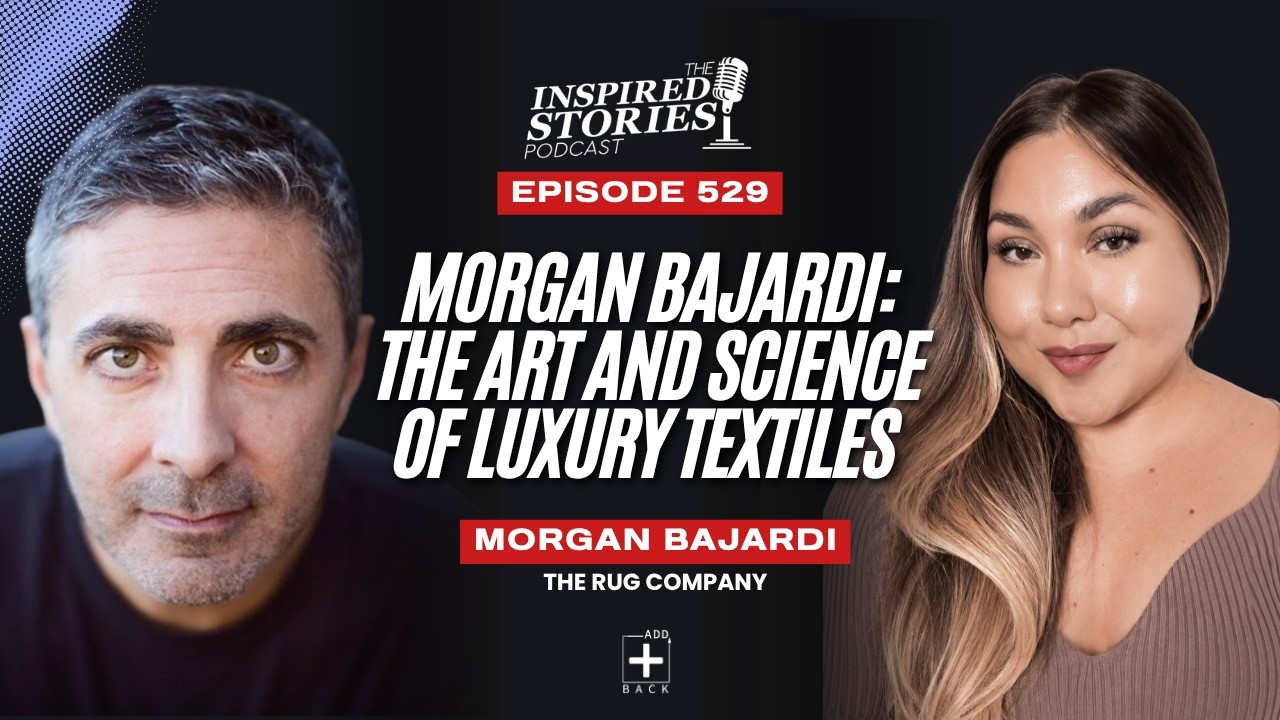
Morgan Bajardi, Director of Design Development at The Rug Company, has spent her career at the intersection of mathematics, ancient craft, and psychology. From programming Jacquard looms in binary at the California College of the Arts to studying engineered illusions at Central St. Martin’s to preserving hand-knotting traditions through one of the world’s most recognized luxury rug brands, her work is built on a single conviction: textiles are not background elements. They are carriers of memory, culture, and experience.
✨ Key Insights You’ll Learn:
How weave structures like four-end twills control flexibility, drape, and performance in everyday fabrics
Why Morgan designs in black and white first and introduces color only last
The binary logic behind Jacquard loom programming and how a bad algorithm can snap a loom
What Gestalt psychology taught her about designing for human perception and space
Why noble fibers like wool and silk outlast synthetic performance materials by centuries
The three dimensions of rug design: 2D pattern, 3D construction, and the fourth dimension of time
How she built a product design team and color infrastructure at The Rug Company from scratch
The Paul Smith collaboration and how she translated his brand evolution into construction and texture
Why she recommends filtering feedback through patterns of three before acting on it
What it means to reframe rugs as architectural and emotional elements rather than decorative objects
🌟 Morgan’s Key Mentors:
Leah Cook (CCA Textile Department): Pioneer in digital weaving who introduced Morgan to Jacquard programming and took her under her wing early in her BFA
Lisio Foundation, Florence: Where Morgan studied reverse engineering of historic textiles and learned how to read fabric at the thread level
Central St. Martin’s Faculty: Pushed Morgan to defend every design decision with a clear who, what, where, when, and why
Kelly Wearstler Studio: Fifty high-caliber designers across disciplines whose collaborative energy sharpened Morgan’s multi-medium thinking
👉 Don’t miss this conversation about what is actually happening inside every piece of fabric you’ve ever touched, why ancient hand-knotting traditions are at risk, and how one designer is using math, psychology, and craft to change how the world thinks about rugs.
Listen to the full episode here
Transcript
Anthony Codispoti (00:00)
Welcome
to another edition of the Inspired Stories Podcast, where leaders share their experiences so we can learn from their successes and be inspired by how they've overcome adversity. As you listen today, let one idea shape what you do next. My name is Anthony Cotus Bodie, and today's guest describes herself as a world-traveled master weaver on a life's mission to preserve ancient textile crafts, and somehow landed that mission.
Inside of one of the most commercially ambitious rug brands on the planet. She built her foundation at California College of the Arts, then crossed the Atlantic to study textile futures at Central St. Martin's. From there, she moved through New York and LA, shaping interiors at some of the most influential names in American design, before stepping into her current role leading design and development at a global luxury brand.
She Morgan Bajardi, Director of Design Development at The Rug Company, the London born brand founded in 1997 that pairs hand nodding traditions with bold contemporary art. With over 30 showrooms worldwide and collections that have earned placement in architectural digest and the rooms of award winning residences, the Rug Company sits at a rare intersection of fine art, craft, and commercial scale.
But before we get into all that good stuff, today's episode is brought to you by my company, Ad Back Benefits Agency. And you'll want to hear this because it's hurting almost every business you know. Health insurance costs go up every single year, and retailers are furious about it. They're paying more, claims are getting denied, employees are opting out because they can't afford it, and it hurts turnover and morale. It's one of the most maddening problems in running a business, and everyone just accepts it. But you don't have to anymore.
Now there's a program that gives employees unlimited access to doctors, therapists, and prescriptions with no co-pays or deductibles to meet. You don't change your broker, and here's the part that really shocks most people. Our product actually increases your net profits. We recently helped a client add $900 per employee per year to their bottom line. Results vary, but gains like that can change how a business is valued. Get your free consultation today.
at adbackbenefits.com. All right, back to our guest today, the Director of Design and Development at the Rug Company, Morgan Bajardi. Thanks for making the time to share your story today.
Morgan Bajardi (02:35)
Thanks so much for having me. I'm so excited to be here and kind of chat through my story with you. So let's dig in. Yeah.
Anthony Codispoti (02:42)
Well, let's jump into it, Morgan. Yeah.
So you completed a Bachelor of Fine Arts in Textiles at California College of the Arts, and then made the decision to go to Central St. Martin's in London for a master's in textile futures. First, explain for the layperson what we mean by textiles, and then talk about what first attracted you to the field.
Morgan Bajardi (03:05)
Absolutely. So textiles have always kind of fascinated me because they're something that is such a lived material. You're wearing a textile, I'm wearing a textile arc, you know, the spaces that we live are really covered in fabric and materials. And it's really how we are interacting with space. I started at the California College of the Arts in architecture with a fascination just in structure in general.
And when I discovered the textile department, it was really still structure within weaving, but at a micro scale. So it's still the exploration of math and science and algorithm, but within weaving itself. And it was a much more immediate kind of resonance because of the physicality of weaving itself. It was something that I could personally do.
Anthony Codispoti (03:58)
say more about the math, the science, the micro scale. How does all that come into play in weaving?
Morgan Bajardi (04:05)
Absolutely. So weave structures kind of control behaviors of fabric. Like if you look at a denim fabric, for example, that's a great example. It's a four-end twill. That's a really old weave structure, but it creates a diagonal. So every fourth thread is tacked down and you get floats in a diagonal, which means that it's flexible. So your denim actually moves and stretches when you put them on because of the weave structure.
If it was a plain weave, which is a basket weave, simple lay language, a simple under over weave structure, it would be very stiff and not movable. So the twill, which is actually a rise and run of one over four like algebra equation, is affecting the behavior of the fabric. So you can actually control behaviors and performance through structure and construction.
On so many different levels and textiles. That's something most people will literally never think about, and something I'm absolutely obsessed with.
Anthony Codispoti (05:06)
Okay. I was looking forward to this conversation, but I just got a lot more excited about it. I had no idea there was math and geometry involved in weaving, but it
Morgan Bajardi (05:14)
Absolutely, yeah.
Anthony Codispoti (05:15)
makes sense now that you explain it. And so when I buy a pair of denim jeans, they're not broken in yet and they're they are stiff. Why why are they stiff to start with then? Because you're saying that that weave structure should make them.
Morgan Bajardi (05:27)
Because they've gone through yeah.
Well, they've gone through a finishing process. So when you first wear a pair of dean jeans, it's stiff obviously, but as you move with the fabric, it opens up because of that weave structure. They've also done really interesting things with fiber blends in denim, particularly, where like they will add one percent polyester, for example. Polyester
heats and expands with your body temperature. So it actually causes the fabric to open up and make the fabric more flexible as you use it. But as soon as you take the jeans off and they cool off, it will shrink back to the original kind of shape. So that's like another little thing like people will look at the fabric blends in a denim and be like, polyester, why is that there? It's actually serving a purpose. And it's normally more two percent.
Anthony Codispoti (06:17)
And that polyester, is it like
a spandex type material that gives that stretch?
Morgan Bajardi (06:21)
It's blended
into the cotton. So they will do a blend and then the interaction because cotton will expand, like you it will shrink with heat, but the polyester allows the tensile like kind of property for movement.
It's really interesting. You'll notice
Anthony Codispoti (06:38)
Interesting.
Morgan Bajardi (06:39)
it when you wear, like, pay attention to the label and then how your experience of wearing the jeans. Like that will kind of change your understanding. Because people get really confused with blends. Because before, initially, they had started by just adding spandex, but the spandex would make the fabric stretch out and not shrink back. The polyester makes it shrink back.
Anthony Codispoti (07:03)
And why is the shrinking back
Morgan Bajardi (07:03)
Does that make sense?
Anthony Codispoti (07:04)
important to because it it keeps it shape longer, it keeps it
Morgan Bajardi (07:06)
Because the shape.
Otherwise you would have to wash and redry the gene.
Anthony Codispoti (07:12)
it's fascinating. I'm wearing a pair of jeans now.
Morgan Bajardi (07:13)
Isn't that so interesting?
Anthony Codispoti (07:14)
So for people watching the video version, they're like, why is Anthony looking at the floor? and
Morgan Bajardi (07:19)
Ha.
Anthony Codispoti (07:20)
and so I'm curious how, and and I promise we'll get onto your career and all the cool things that you're doing, but this is
Morgan Bajardi (07:25)
Yeah, no worries.
Anthony Codispoti (07:26)
a fun little aside. okay, so how does this this weave on my denim jeans differ from, say, like a pair of khakis that I've got?
Morgan Bajardi (07:38)
I mean a khaki is likely also in a twill weave structure. It could be in a plain weave, but the twill weave structure means that there's more floats of threads. So you're mostly seeing the weft yarn and the warp is kind of floating behind. So it's like more text textile terminology.
And then in terms of flexibility, it's because every warp thread is being tacked down, every fourth thread, but in a diagonal. So it literally creates that diagonal like shift.
Of the threads, which creates flexibility in a typically non-flexible kind of fabric. Or, for example, if you are cutting fabric on a bias, all of a sudden you have much more flexibility because that rigid grid has been shifted to the side, and so that tension can change. So that's why people cut things on the bias because of the way the fabric is draping. So there's like all
Anthony Codispoti (08:36)
What does that mean on the bias?
Morgan Bajardi (08:38)
On the bias means that it's been kind of shifted like 45 degrees. So you're not cutting it. when you look at fabric, you have warp and weft. So the length of the fabric is the warp and the weft is the width. And so the bias means that you've shifted the fabric so that the threads are not in across like this. They're gonna be like that. And then when you have the behavior like this, the fabric can go and flex like that.
So then it has this draping that you wouldn't otherwise get. Very
interesting. I'm obsessed with it. Yeah.
Anthony Codispoti (09:11)
Fascinating. Yeah.
How many people in the world have your level of textile knowledge? Would you guess?
Morgan Bajardi (09:20)
Very
rare. I ha I always tell people I have an odd obsession with textiles. It is so like so niche to me. I'm a forever learner as well. So I'm always researching and experimenting and learning more. My brain is constantly open to it. I would say it's quite rare. I probably have a few friends that are at my level of obsession, but it's deep. Yeah.
Anthony Codispoti (09:46)
do are you like fun at parties? People are like, Tell me about this thing that I'm wearing, or or am I being goofy in in how interested, intrigued I
Morgan Bajardi (09:53)
I'm definitely
Anthony Codispoti (09:54)
am?
Morgan Bajardi (09:55)
yeah, I'm definitely fun at parties. I don't tend to bore people with textiles as much because it is so niche. Other designers love it, but regular people are kind of bored by it, which I understand. I respect that, but
Yeah, it's just my personal obsession. It's like my life's mission. That's why I feel so passionate about kind of passing down what I know. At some point in my career, I'll definitely have to teach and really kind of preserve what I've learned.
Anthony Codispoti (10:23)
Okay. All right, let's get back to kind of your your timeline, your
Morgan Bajardi (10:26)
Yeah.
Anthony Codispoti (10:26)
story here. So we mentioned Central St. Martin's, the textile
Morgan Bajardi (10:31)
Uh-huh.
Anthony Codispoti (10:31)
futures program, and it sits at the edge of where the craft meets technology and speculation, right? Can you explain
Morgan Bajardi (10:39)
Mm-hmm.
Anthony Codispoti (10:40)
more about what that means? I'm understanding more of the technology piece now, after our conversation, but what is the speculation and how do how do these things all kind of come together?
Morgan Bajardi (10:51)
Well, in the Central St. Martin's program, it is very kind of self-directed in a way. So my kind of handling on futurism or technology is really sitting in the spot of understanding these classical techniques and finding kind of innovation within these different research modalities. So for my thesis, for example, I was combining pattern engineering.
Gestalt psychology and traditional textile techniques. And my thesis was called engineered illusions. So I was really kind of programming ways of seeing. So really understanding, like when you're a designer, you have to truly understand who you're designing for. And it sounds kind of silly to say, you're designing for a human, but humans are particularly programmed to experience things in a particular way. Your brain is programmed to understand space in a very interesting way.
You see l things that are light and bright hit your eye first, things that are dark and dull hit your eye last. You're trained to find faces. Your body is programmed in a very specific way. So I took kind of that modality, which you can really see documented in Gestalt psychology and translated that into pattern engineering to really change the way that you are perceiving space or perceiving.
Whatever you're looking at through pattern and textile engineering. So I was less focused on technology per se, and more focused on ways of seeing and perception because I really felt like that was the key to communication and understanding.
Anthony Codispoti (12:35)
It's fascinating to me that you're incorporating gestalt psychology into your work with textiles. I mean, when you explain it that way and the way that the mind, the eye, you know, tends to be drawn towards certain things as a as a general rule, like
Morgan Bajardi (12:52)
Mm-hmm.
Anthony Codispoti (12:53)
I get it. Like it that helps to connect the dots on why you're doing it.
Morgan Bajardi (12:57)
Absolutely. Absolutely. And A go ahead. Sorry.
Anthony Codispoti (12:59)
So go go ahead, Margan, Morgan.
Morgan Bajardi (13:04)
I was just gonna say, like I think when I'm programming things, what I realized from my experience at Central St. Martin's is pattern is really personality.
So it's the energy or the vibe. And then color becomes the emotional register. Color is so emotional for people. Everyone has a favorite color. Everyone has a color that really disturbs them in a way. I've seen that time and time again in my practice. And then the haptic or material becomes the the lived experience of the textile. So it's kind of like a threefold.
ethos and I really kind of carry that into just about everything I do. I first start in pattern visual hierarchy. I work in black and white. So I wanna understand what focus I want like the highlights on. And then I translate that into material and then I translate that into color because color is so emotional. I don't dare show color first because you will kill a product.
before it gets anywhere if the color is weird, because the person looking at it will have an emotional reaction to it. That's how important color is. And it also has like a physiological effect on people. So certain colors can literally simulate your thyroid, for example, like ultraviolet purple. It was studied to do that. So understanding color and like doing that last is kind of part of my ethos.
Anthony Codispoti (14:31)
So if you're coming up with a design, you do it in black and white just to see what somebody's reaction is to the pattern itself.
Morgan Bajardi (14:38)
Just
to the composition. Mm-hmm.
Anthony Codispoti (14:41)
that's fascinating. Are there
Morgan Bajardi (14:42)
Yes.
Anthony Codispoti (14:43)
colors that you find that are you mentioned the ultraviolet purple, other ones that are kind of more universally disdained?
Morgan Bajardi (14:53)
colors that people hate. mostly
Anthony Codispoti (14:55)
Mm-hmm.
Morgan Bajardi (14:56)
pe like people find yellow to be typically very irritating to the eye. So most people do not like yellow, which is really interesting. Purple is also very specifically a personal choice. It's not a universally liked color. It is it used to be considered kind of like a a neutral, like in the 90s, but now it's really like a personal choice. Like if you love purple.
That is like part of your identity. I've known lots of women who are just like obsessed with purple, but it's not something you typically see. It's like rarely ordered or faced in most like fashion or interiors, which is interesting. And then universally liked is green, but green is the color that we see the most in the world. So our eyes are kind of programmed to see the most versions of green. So like my spectrum.
For green is tremendous. So I'm always obsessed with green because there's so much nuance to my particular eyes. Whereas, like my spectrum for like mauve's and pinks is shorter, which is interesting. And everyone has different color and chroma sensitivities. So it's always interesting to have discussions about color because everyone is really seeing it through their kind of own lens.
Anthony Codispoti (16:17)
Does somebody's preference for particular colors indicate anything about their personality?
Morgan Bajardi (16:25)
Mm, I think it can. I think it can not necessarily personality, but I think it can be connected to like mood or emotional state. I've always gone through color phases where I'm like really obsessed with a color and I'll do a lot in that particular color and then kind of move on from it. But I do think that color is really connected to a emotional world, and I think that there is a lot of science behind like color therapy, for example.
Or like paint like you can look at healthcare as a great example of that. Like making sure that the spaces feel harmonious and serene can absolutely push forward healing environments.
Anthony Codispoti (17:06)
So
after London, Morgan, you moved to New York and you joined Wolf Gordon, which is a commercial wall covering and textile company. I'm curious what working at that scale of production taught you that you hadn't learned in school.
Morgan Bajardi (17:23)
Absolutely. I mean Wolf Gordon was an excellent foundation in commercial viability. So at Central St. Martin's, I was thinking very conceptually. And interestingly enough, Wolf Gordon had discovered my work when I was showing in Milan. And I actually did engineered illusions for Wolf Gordon. So I designed two wallpapers that
manipulate space. So one called tall, which gives the illusion of taller walls, and one called wide, which gives the illusion of wider walls. So I was taking that actual concept that I ideated during my master's program and had to turn it into production ready concepts for Wolf Gordon. So it was absolutely an education in working within the restraints of machines and creating solutions to patterns and working at a scale of
volume because previously I had been working on smaller projects or you know really conceptual things.
Anthony Codispoti (18:26)
and the materials that you were using, were they like traditional wallpaper materials or was it more of a fabric?
Morgan Bajardi (18:32)
So at Wolf Gordon, they're known for vinyl wall covering. So it's really performance contract and hospitality led. So it also gave me a great background in testing and understanding performance.
Part of the process and in regular interiors, you're not focusing on testing as much. It's not needed. There's not as many requirements. In wall covering and also contract upholstery, everything goes through rigorous testing because you're dealing with fire codes and large spaces, and these products really have to perform and hold up to those environments.
Anthony Codispoti (19:08)
And so then your pattern is getting printed onto the vinyl? And so how did
Morgan Bajardi (19:11)
Mm-hmm.
Anthony Codispoti (19:14)
you come up with a pattern that makes walls look taller or wider?
Morgan Bajardi (19:19)
Yeah, so it's just again leaning back onto the gestalt psychology, using geometry to create patterns that change like your perception. So if you're working, it's kind of tricky to explain verbally. I really need to show you visually, but so the tall wallpaper is exploring lines that expand and contract and
When you have something that is at a diagonal, your brain is naturally kind of straightening it out. So if you have lines that go this way and then this way, visually your brain is making sense of it and kind of like stretching it out. So playing with perception, but through pattern and aesthetic. So it's kind of tricky. It's like a hidden within the artwork itself.
Anthony Codispoti (20:11)
I've got to see a picture of this. Can you share
something with us at some point and maybe we can put it in the show notes for folks? Okay.
Morgan Bajardi (20:13)
Yeah, I will.
Anthony Codispoti (20:19)
okay, so you eventually came back to LA and you founded Studio Bujardi, your last name. So you're running this a alongside other roles for over a decade. What kind of work were you pursuing through your own studio?
Morgan Bajardi (20:34)
Absolutely. So Studio Bajarity is really my safe place for exploration without other people kind of looking in, exploring everything from woven jewelry that I made on the Jacquard Loom, engineering prints for fashion, bespoke wallpaper. It's kind of an you know, a lab for me to really explore and express and ideate before people really look at. I think it's just like a protected space for
like my embryonic ideas because I really think that those need to be kind of protected before I'm ready to to share. So it's really an exploration.
Anthony Codispoti (21:11)
So are you were you taking client work through there or this was just sort of like your fun space
Morgan Bajardi (21:15)
It's a combination of
Anthony Codispoti (21:17)
to
Morgan Bajardi (21:18)
yeah, it's a combination of self-directed work and taking on clients for bespoke projects that like know about me and want to work with me. So like doing custom wallpapers, for example, or printed upholsteries, things like that.
Anthony Codispoti (21:33)
Hmm. Okay, so then you spent four years as design director at Woven, which is a West Hollywood based textile and interior design firm. Before moving to Kelly Wor Worsler, big recognizable name in American interior design. Tell us about the progression of the work that you were doing at those two places.
Morgan Bajardi (21:57)
Absolutely. So
I'll start with woven. It was foundational in my education in rugs. It was kind of putting all of the pieces together of all of the different mediums I had studied. So one of the things I did when I first started was kind of reverse engineer every rug they carried to truly understand the construction. And I built that skill from studying at the Lysio Foundation, which is a weaving institute in Florence. So reverse engineering is a very particular
Skill set where you are looking at everything at the thread level and understanding the way that things are kind of put together. So I studied every single rug in their line to understand how it was produced and created a methodology for kind of programming rugs. And I created many collections at Woven. And I really love working in rugs, particularly because it's like a full thought.
For textiles. Mostly in textiles, you're working to create materials that other designers use to make their own objects. So in rugs, it's a full thought, which is a really beautiful story for a textile designer because it's really rare that you get to have something that is solely your art piece. You're often working in with other design cohorts in the industry.
Anthony Codispoti (23:21)
And so we've heard you talk about rugs and probably sure we're gonna talk a lot more about that as we get into the rug company. We heard you talk about wallpaper. what else have you done in your work up to this point in the timeline? Or are those kind of the mediums that you focused
Morgan Bajardi (23:37)
Well, we haven't really talked about my obsession and interest in jackhard weaving. So that was like so influential in my work. That really was a foundational learning. from CCA, I had a mentor who I absolutely love and adore, named Leah Cook. She was a pioneer in digital weaving and really kind of took me under her wing. So I learned a lot about jackard weaving, which is you know.
basically computerized textiles and it works off of a binary system, which is really interesting. So that's how I got into programming in math because when you work in jack hard looms, you are programming weave structures, but you also have to pay attention to the front and back of the fabric and combining weave structures. So using a lot of algebra to create, you're basically creating like a giant weave structure for
The loom to weave and you're working in a binary system, which basically means a zero and one, which in loom speak, that means thread up or thread down. So you're just creating like an order of operation. So there's a ton of math involved in that. And you have to understand the tensile properties of the threads, how the weave structures stack up. And you can break a loom through a bad program where you can like make certain parts of the warp.
have too much tension and they'll snap. So there's different technological things that are involved in it. So that was really my deep kind of education, the body of work that I created.
during my BFA at CCA was all Jack Hard weavings. And then from there, I studied, like I mentioned, at the Liceo Foundation in Florence. That's actually where they weave the Pope's robe. So it was like a true Renaissance education. And that's where I learned how to kind of reverse engineer things and really have like a deep understanding of how things are made.
Many textile designers say only focus on the surface or the pattern or the color. I am in the threads programming things and understanding how to program things to create those like illusions because all of the face of a fabric is really programmed. And I think people don't understand that or even think about it, which is interesting to me.
Anthony Codispoti (25:59)
So when you're talking about thread patterns, I think for most people we think about patterns on clothes and we think, it's the print, right? It's polka dots or it's stripes or it's whatever, but you're talking the the layer behind that. Like what is how is the thread overlapping, interlocking with each other?
Morgan Bajardi (26:19)
Yes. I'm talking about the threat
Anthony Codispoti (26:21)
Okay, and so
Morgan Bajardi (26:22)
button.
Anthony Codispoti (26:24)
the thread level. okay, and so jackhart weaving, you've described it as binary and you've used the word programming multiple times. And so this is programming, like I think about like a computer program, like you're writing the program to tell the the the loom how to weave this material.
Morgan Bajardi (26:41)
It's an algorithm. So when I'm done programming, the output is a bitmap file, which is just black and white pixels. And then that is what gets sent to the loom. So the number of pixels in the width is the number of warp ends. And then the number of pixels in the length is the number of weft passes. And I'm programming the interaction of those threads. And so you can do a lot of complex weave structures within
Within weaving, which is so interesting. And you can like
Anthony Codispoti (27:14)
What is a weft pass?
Morgan Bajardi (27:16)
weft means across the width. So warp are the threads that are physically on the loom, and then weft are the passes of the thread against the warp. So the weft is technically kind of passive. You're just passing that, you're passing that back and forth across the warp, and the warp is going up or down, depending on the code. So a zero or a one.
A zero means no action, one means warp up.
Anthony Codispoti (27:45)
You say warp up, is this just one thread going over another thread? Okay.
Morgan Bajardi (27:48)
One thread up.
But the warp threads have to like physically open for the weft to pass through. That's probably something people don't think about. They probably think that you're going over, under, over, under, but the warp is like opening up. And then the weft gets passed through, it closes, and then different warp ends open and then tack that weft down to create the structure. Kind
of complex.
Anthony Codispoti (28:13)
So how much of what you're describing
impacts the difference between, you know, the appearance of a three hundred dollar suit versus a three thousand dollar suit? You know, I see people wearing suits and I'm like, that guy's suit looks really nice. That one doesn't seem to I don't know, I can't put my finger on it, but it just doesn't seem to lay as well.
Morgan Bajardi (28:34)
Absolutely. I mean, that's a combination of tailoring and material. I think that textiles are like the unsung heroes of just about every craft. Like when you look at fashion, I think people make a lot of
decisions on what they're buying over how the fabric feels and how it lays over the fashion itself because you can make the same pattern in a lot of different materials and it will change the way that it reads. So a nicer material that lays beautifully and can stitch beautifully with whatever pattern will change how you perceive the garment.
Yeah, textiles
Anthony Codispoti (29:09)
Okay.
Morgan Bajardi (29:10)
are the unsung secret hero of so many things. It's such like an interesting craft to work in because of that. It's like you're always kind of behind the scenes working the magic. I don't know, it's interesting.
Anthony Codispoti (29:24)
You know, 20 years ago, my wife and I went snorkeling for the first time. I almost didn't do it because I was like, I don't know, I've seen National Geographic, like what's the big deal? And as soon as I stuck my face in the water, it was like a whole new world had been exposed to me. And I feel like that's what this conversation has been. You've opened up this whole new world of the textiles and the weave and you know, the importance of all that. Yeah, it's fascinating for me.
Morgan Bajardi (29:46)
That's awesome. Mm-hmm. It's so important.
Yeah. People don't under they don't they don't think about it. I mean, everyone experiences textiles every day, and that seems like such a lame comment, but like no one really thinks about it. Like they go to a fabric store and they buy fabric. They're not thinking that like someone designed it, programmed it, or made it. It's like not in the periphery of their
of their thinking. And oftentimes, sometimes they'll say textile. And some people are so not tuned in with it that they're mean they'll they'll be like, do you mean text on a tile? And I'm like, no, textile is like fabric. Like that's how niche it is, honestly.
Anthony Codispoti (30:28)
Yeah. Okay, so Morgan explain to us how the opportunity to join the rug company came.
Morgan Bajardi (30:35)
Yeah, so Rug Company came about. I was working obviously at the Kelly Worcelor Studio. I did a lot of really beautiful rugs there for the Rug Company, under like the crescendo collection. I just have a love of rug. So at the Kelly Worcelor Studio, I was focused on all different mediums, which was a great exposure.
But I realized like my true love was rugs because it is the true art pieces. And then the opportunity came up at the rug company and I couldn't resist because I really feel so passionate about getting to work with the mills directly and really bringing those products to life and supporting those craftspeople.
Anthony Codispoti (31:24)
And so talk to us about the work that you do there today.
Morgan Bajardi (31:28)
The work I at the Rec Company?
Anthony Codispoti (31:30)
Mm-hmm.
Morgan Bajardi (31:30)
Yeah. So when I started kind of my first
Big push was to create a product focused design team, which was absolutely important in creating beautiful execution of products. I also created a design infrastructure and color system for the brand to work into. And those are kind of like the invisible systems that work behind the scene. That it's like kind of like a set of rules, again, an algorithm that creates a beautiful output. So it's like the secret math behind the scene.
that really programs the beauty. So it's almost like reverse psychology, like when people go in the showrooms, everything is so programmed and so beautiful and so effortless, but it is such a science behind it.
Anthony Codispoti (32:19)
So as I understand it, you know, a big part of what goes on at the rug company is built on this hand knotting process that can take
Morgan Bajardi (32:27)
Mm-hmm.
Anthony Codispoti (32:28)
months and and involves artisans whose whose skills are genuinely rare. What
Morgan Bajardi (32:34)
Mm-hmm.
Anthony Codispoti (32:34)
is the significance of this hand knotting process? Why is this so important?
Morgan Bajardi (32:40)
That is such a great question. So the hand knotting process is really an original art form. It's an ancient textile craft. By designing these collections, we are kind of preserving that knowledge base, which I think is so important. I also think that there's a component of time when you get to the design process, because I know,
just because of like the lead times. So in rugs there is kind of like a three phase part of the process. So you start
In the in the 2D, which is the CAD and the pattern. And then when you program the materials and the construction, you're entering the three-dimensional world. And then when you get into the fourth dimension of time, when you're producing the rug, that actually affects the face of the rug. So the cadence and rhythm through which something is woven affects the way it looks on the face.
Does that make sense to you? It's a little confusing.
Anthony Codispoti (33:48)
a little bit, but wouldn't the product output be more consistent if it came from a a loom? It's like you program it and yeah, from a a machine,
Morgan Bajardi (33:56)
from like machine?
Anthony Codispoti (33:59)
sorry.
Morgan Bajardi (34:00)
it looks commercial. It it looks cheap. I think I guess like maybe I got a little off topic there, but the why the craft is so important is every part of the process is done by hand and that is perceived in the final output and the final quality. A lot of people would say like, you could do it commercial, but it looks cheap, it reads cheap, it will fall apart over time.
And these ancient textile crafts are preserving these heirloom quality rugs. So all of these like antique rugs that you see that are still around are made in the same kind of methodology. So if you like care for these rugs in a proper way, you can pass them down. So commercial made products are not better.
In my opinion. They're made quickly, they perform. A lot of people will say, performance is better. A little known fact about performance fibers is that synthetic fibers expire, so they'll perform to an extent and then they're future trash. And that's not something I like to support.
Anthony Codispoti (35:10)
When you say when you talk about performance, you mean how long the material lasts?
Morgan Bajardi (35:15)
Yeah. So if you look at like per performance materials like polyurethane or anything that you see outdoor or indoor performance fibers, they will perform to an extent and then expire. Like you'll start to see pilling, you'll start to see threadwear. They're not long wearing or
During fibers, most of the rugs that we produce at the rug company are made with noble fibers, which if cared properly can be passed down and maintained for centuries.
Anthony Codispoti (35:47)
What is an example of a noble fiber?
Morgan Bajardi (35:50)
Wool and silk?
Anthony Codispoti (35:52)
Cotton.
Morgan Bajardi (35:53)
If you cotton is a natural fiber, it will degrade over time because it is a plant fiber. So the most enduring fibers are protein fibers, which means that they're coming from an animal. So wool is sheared from a sheep. Silk is coming from a Bombay's Mori caterpillar, makes their little cocoon, harvests the silk from that. So those fibers are considered noble fibers.
Anthony Codispoti (36:22)
So couldn't you use a noble fiber like wool or silk in a machine and still get the same kind of performance you would from a hand woven process?
Morgan Bajardi (36:34)
That's a good question. You could get similar performance, but the aesthetic is not there. When you look at commercial or hand spun yarns, you kind of see like the tip of the fiber. It looks like a little round kind of dot. It feels commercial.
And it doesn't look as refined or elevated. If you are simply talking about performance, you could perhaps use a machine, but the hand not I think is superior to machine made. You can't get the level of detail in machine, like the a brush, the ombres, all of those things really need to be done by hand to achieve a beautiful surface.
Anthony Codispoti (37:15)
So for somebody like me who's not experienced or educated in this, if I'm looking at two rugs, one that has been machine woven, one that's been done by hand, what am I going to notice in terms of differences?
Morgan Bajardi (37:31)
Hm, I think you're gonna first notice the visual effects of the textile.
Then you're going to notice like the hand differences. So the hand quality of a hand woven rug is much softer, much more refined. The fibers go through an incredible washing that really brings the threads together as part of the finishing that kind of snaps things in place. When you're dealing in machine made, you're not going through that same kind of finishing process. So it will feel more commercial. It's not going to feel as expensive or elevated. You are going to see like the little twists of yarn.
in the machine spun. So you can see like worsted like you can see like the twists of the yarn and then it keeps those threads like separate. And then in a handmade rug, for example, they're hand knotting with hand spun yarn. And then they're hand knotting it together. And when it goes through fit finishing, it goes through a heavy washing where those kind of threads like bloom and become a
more harmonious pile so you're not seeing like the thread the same type of thread break that you're seeing in Machine Made.
Anthony Codispoti (38:43)
I need to come spend a day with you, Morgan. I wanna I wanna get a
Morgan Bajardi (38:46)
Yeah.
Anthony Codispoti (38:47)
like a tutorial up up close. I wanna see these things.
Morgan Bajardi (38:49)
I'll show you, you'll see immediately
the difference between machine made and hand knotted. It's really obvious when you have the samples in front of you. It's just tricky to kind of verbally describe the
differences.
Anthony Codispoti (39:01)
Yeah.
Morgan Bajardi (39:02)
Yeah.
Anthony Codispoti (39:03)
Well, you're doing a great job, but I I do think the visuals will be fascinating to be able to put my hands on it, have it right in front of my eyes.
Morgan Bajardi (39:07)
Yeah. Mm-hmm.
Anthony Codispoti (39:10)
So let's take a step back, kind of big picture. Tell us what the rug company actually does and what makes it different from other players in the luxury rug space.
Morgan Bajardi (39:22)
Yeah, so Rug Company is coming up on their 30th anniversary. I do consider them a heritage company. They're the first of their kind to really scale this craft at this level with global reach. So they're kind of the foundation, I think, for a lot of other rug companies that kind of popped up after them. They're the kind of originator of that idea. And I really think they don't flex on that enough.
Honestly. And they obviously have these incredible collaborations where, you know, we have this great interaction and we come up with beautiful products. I think they're also really known for that. And they're, you know, one of the first brands to really kind of own that methodology, which I think is cool.
Anthony Codispoti (40:09)
So talk to me about the different business lines manufacturing, retail, wholesale. How does all this come together?
Morgan Bajardi (40:19)
that's a little tricky question. So, I mean, they kind of cover so many different markets. Some of them are trade secrets, so I can't really talk about it, but it is a blend of core product collaboration and true bespoke. We have an incredible team of technical rug designers that really flex on creating.
rugs that are technically spectacular and beautiful for installation. That's something I think Rug Company doesn't flex on enough. So we have a huge team of designers that really are experts at executing rug design.
Anthony Codispoti (41:02)
You stepped into the director of design and development role back in February of 2025. So not quite a year and a half ago. I'm curious, Morgan, what did you find when you first got there? And what was it that you most wanted to change or kind of get your hands dirty with?
Morgan Bajardi (41:22)
Absolutely. So when I first started, there wasn't a dedicated product design team. So that was kind of the first big thing was putting that team together for product design and innovation. So that was hugely important to create a team that was dedicated to creating these specific product lines. And then the next major thing that I felt was really necessary was creating that infrastructure for design. So that architecture.
that I had mentioned previously of how we design into to create beautiful output, kind of that algorithm of research and theme, construction, color, et cetera, that all goes together to create the lines. So that infrastructure was not there when I started the framework.
Anthony Codispoti (42:09)
And how
many folks are part of your team now?
Morgan Bajardi (42:13)
I have two designers that I work with and we're all in different locations, which is really interesting. And we all kind of bring together different perspectives from the locations we're in because it is a global brand. You do have to think strategically about reaching all of the different marketplaces.
Anthony Codispoti (42:33)
So a rug that takes tell me if I get this right, twenty two weeks to make, yes. Compared to what for like a commercial rug, what what what's the time difference?
Morgan Bajardi (42:47)
it depends on the size of the rug. a hand knotted Nepalese rug, 100 knots, takes about 120 days to create. A commercial rug could take 90 days or shorter, perhaps 60 days at earliest.
in terms of time, as I was trying to kind of explain poorly earlier, the time factor in the handmade product really affects the face of the rug. And just trying to explain that to clients, I think, is really important. So giving them like eyes on like on-loom photos, seeing the process, everything is done by hand, as I mentioned before. So like we're
Harvesting fibers, so sharing the shape, that's all done, kind of mostly vertically integrated at the mills we work in. That's done. And then they have to spin it by hand. That affects the quality of the yarn. And then we have dye masters that we work with that match color. So it's a very kind of unique process to bringing the rug to life. Whereas in commercial, you would probably be limited to a specific yarn bank at the mill you're working with because they're
working in a commercial setting where their business is more scale and volume and they need to make things quickly. So you're limited in color, palette, materiality, and actual material expression. Whereas on the the way that we work, I can explore and experiment and innovate within that. Whereas in the commercial, it's like very fixed in what you can and can't do. There's not much innovation there.
Anthony Codispoti (44:37)
So
at Rug Company, what percentage of the products that you sell are things that you've ideated, created, sort of put out there online or on the shelf for people to buy versus people come to you and they want something custom bespoke?
Morgan Bajardi (44:54)
custom is definitely a huge part of the business, but a lot of it is off of standard products. So they're perhaps they're doing a custom size or a custom color. And some people do want absolutely bespoke products. That's a smaller percent of the business. But is it majority core product that is sold?
Anthony Codispoti (45:15)
So when you're trying to communicate to a customer the difference between a handwoven product versus one done by machine, what are they usually missing? And say more about how successful you are in helping folks close that gap.
Morgan Bajardi (45:36)
What are they missing in terms of like they're not I mean, most people have
Anthony Codispoti (45:39)
Like what do they what do
they misunderstand about the differences between what you do and what's done by a machine?
Morgan Bajardi (45:49)
Hmm, that's a good question. I think a lot of people go into the showroom and have an assumption on how things are made. They will have kind of like a made up idea in their head about how things work. So
Like I mentioned, they'll assume that like there is a we work with ARS palms, for example. It's a color system for rugs. So they will come in and think that all of the mills have all of those colors in yarn like ready to go. And they can just weave it, but everything is actually dyed to match. So kind of just really explaining the process. Every fiber also is coming in with a different natural base tone, like an untouched fiber.
So the dime master has to rework the recipe with that bass tone in mind to hit the color. So every time I'm in the showroom or speaking with a client, I try to drop those interesting facts to kind of take them on the journey of what it is for a rug to be produced.
So it's just kind of giving them insight into the process because a lot of people have an assumption about how things are made. So just simply kind of going through those basics does a lot to kind of close that gap and explain the process and explain why these are more expensive or luxury items.
Anthony Codispoti (47:11)
And how well do most people grasp what you're saying?
Morgan Bajardi (47:16)
They seem to grasp it pretty quickly. It's just that most people don't even have any working knowledge of it. Even the interior designers that you work with, it's not part of their kind of core training. But as soon as you kind of start taking them on that journey, they really get excited and are understand the pricing and understand the time that it takes to produce something of this caliber.
Anthony Codispoti (47:40)
So Rug Company, you've done collaborative collections with world renowned artists. Walk us through how one of those collaborations actually came to fruition and what your role is in shaping it from that first conversation all the way through to the finished piece.
Morgan Bajardi (48:00)
Absolutely. So I'm responsible for overseeing that entire process. So we love to absolutely start with narrative. I think that becomes the true north of the collaboration. I love researching whoever we're collaborating with and kind of figuring out the essence where the key points are really what needs to be kind of communicated in the final output or like the essence, if you will, of what I'm translating. And I kind of take those core ideas and
And my role in the collaboration is really translating that vision into a rug line or product. So it's a few different ways I do that. Those are kind of like trade secrets. But yeah, my role is really translation. And I manage everything from initial ideation to final output to the global stock order. So everything under that umbrella of workflow I kind of manage. And then I
innovate with the mills, I talk to the mills, I do a lot of that.
Anthony Codispoti (49:04)
Are
you able to talk about one particular collaboration that you've done?
Morgan Bajardi (49:09)
I don't think I am actually allowed to kind of dig into that. I wish I could.
Anthony Codispoti (49:14)
I wasn't
sure if these were the things sort of like sneaker collabs that get lots of publicity or if this is more hidden where just the end customer gets to know about that collaboration.
Morgan Bajardi (49:27)
we just launched a collaboration with Paul Smith, The Ratio Line. I don't know if you've looked at that.
Anthony Codispoti (49:34)
I have not.
Morgan Bajardi (49:35)
No, okay, I'll just give you a little insight there. So his traditional kind of rugs with the Rug Company were very full spectrum color. And I had done a lot of research on his brand and where it currently was, and he had had an evolution of fashion and color and palette and materiality. And I really wanted to speak to
his modernization of his brand. So he worked with their textile designer to have those patterns created. And then I worked with the team to translate that on the construction side to really bring a lot of texture into that. But if you look at his rugs, you'll see a extreme evolution from where he was to where he is now.
Anthony Codispoti (50:25)
It's clear in talking to you, Morgan, that you're very committed to preserving and passing down these ancient textile crafts. What is your opinion about the state of those crafts right now? The weaving communities, that knowledge transfer that you talked about before that's going to become important to you,
and
Morgan Bajardi (50:47)
Mm-hmm.
Anthony Codispoti (50:48)
the economic reality for the artisans today.
Morgan Bajardi (50:53)
I think with the artisans, there's both urgency and optimism. I think we're in a very tricky kind of geopolitical climate. So they're, you know, the traditional craft communities are definitely facing challenges around economics, but
And generational transfer, which is why it's so important to maintain this craft, because I have to give them a reason to continue to learn and pass down that information.
Anthony Codispoti (51:25)
Hmm. So Rug Company has a new CEO. there's an active state of growth going on right now. Where do you see the biggest opportunity to push the design work into territory that hasn't been explored yet by the brand?
Morgan Bajardi (51:42)
I
Would love to expand how people think about rugs. I would love to reframe rugs as not decorative objects, but as architectural and emotional elements that shape how spaces feel. I really believe that rugs are experienced and they're not just decorative objects. So I'd like to kind of change that narrative in framing through material exploration and construction.
Anthony Codispoti (52:15)
Morgan, what's the hardest thing either personally or professionally that you find yourself having to overcome?
Morgan Bajardi (52:23)
I think a key core theme has always been following my intuition. I think when you are innovative or different or creative or forward thinking, whenever you have a new or embryonic idea, you're always going to have people that question you or don't believe in you. I had many instances when I was a younger art student where
that really kind of crushed my spirit and I didn't follow my impulse. And as I've gotten older, I always trust my intuition and I proceed anyway. And eventually people come on board. So really just kind of maintaining that true north and really sticking to the intuition of it all and really listening to those guys.
Anthony Codispoti (53:11)
It's really hard,
is especially for maybe somebody who doesn't have your track record, right? 'Cause it you know, it's a natural human thing to doubt yourself, to question.
And what what would you say for somebody
Morgan Bajardi (53:21)
Absolutely. Absolutely.
Anthony Codispoti (53:24)
who's younger and coming up through the trade? What advice would you pass on?
Morgan Bajardi (53:28)
I would say
listen to all advice you get with a grain of salt. You don't need to take everything, every criticism, every comment on board as true. put it through your own filter and take what's useful and leave what does not resonate with you. Because sometimes people are reacting to a personal trigger about whatever your artwork is. When you deal in art, especially fine art, that was like my initial background.
People are so emotionally responsive to it. And so you have to understand that their reaction, it really belongs to them. And not every piece of feedback or criticism is useful and doesn't belong to you. Does that make sense? I feel like, yeah, that's kind of how
Anthony Codispoti (54:14)
I it
Morgan Bajardi (54:15)
I operate.
Anthony Codispoti (54:17)
so I talked with a screenwriter recently who shared with me that in his process, you know, he's working on a script, he shares it with five different people. And if each one of them come back with a criticism or a piece of constructive feedback that's different than the others, then
Morgan Bajardi (54:37)
Mm-hmm.
Anthony Codispoti (54:37)
he just tosses it out. He's like, that's one person's opinion. But if he gets all five people
kind of offering the same piece of advice, that is a a sign
Morgan Bajardi (54:47)
Yeah.
Anthony Codispoti (54:47)
to him that that's something that he should pay attention to. Is that
Morgan Bajardi (54:51)
Absolutely. I'd say that is a keen observation. I look for patterns of three. That's a general rule in feedback and in trend forecasting. You want to pay to or you want to pay attention to patterns of three. That's kind of you have enough data points where that feedback becomes important and something that you should action. I also had the experience in my master's degree of always listening to their feedback because I had such respect.
for them, like my mentors. And every time I would listen to their feedback, I couldn't argue why I did it because I was just listening to what they told me to do. And in design, you have to always have your who, what, where, when, why about what you're doing. And so I learned to always like if I was going to do anything, I need to do it wholeheartedly and really stand by everything I'm doing.
So I don't show anything I wouldn't personally back. So people will be like, I want to see everything. And I'm like, no, you see what I have approved before you get to pick from it. So that everything that you pick from, I've already personally backed. They don't get to see everything. I would say
Anthony Codispoti (56:04)
Fair enough.
Morgan Bajardi (56:04)
do your own edit first.
Anthony Codispoti (56:07)
No. Morgan, what is it that you most want to be remembered for in the work that you're doing?
Morgan Bajardi (56:14)
I love that question. I would love to be remembered for expanding the conversation around textiles and helping people see them not as a background element, but as carriers of memory, culture, and experience. I just feel like it's something that people don't really see or appreciate. And I feel like it's part of my kind of life's mission to open people's minds to that.
Anthony Codispoti (56:43)
Morgan, just one more question for you today. But before I ask it, I want to do three quick things for the audience. First of all, if you want to get in touch with Morgan and what she's doing, go to their website, therugcompany.com. It'll be in the show notes, but you can remember this one, folks. Three simple words, therugcompany.com. I'll say it one more time so it's burned into your brain, therugcompany.com. Go check it out. And if you're enjoying the show today, please take a moment to subscribe wherever you're listening.
It also sends a signal that helps others discover our show. So thank you for taking a quick moment to do that right now. And as a reminder, you can finally get your retail, manufacturing, wholesale employees access to therapists, doctors, and prescription medications that counterintuitively actually increases your company's net profits. There's no co-pays, there's no deductibles to meet, and there's net profit increases that change how the business is valued.
You get to keep your broker, you get happier employees and a stronger bottom line. Reach out to us today at adbackbenefits.com. So last question for you, Margaret. A year from now, what is one very specific thing that you hope to be celebrating?
Morgan Bajardi (57:57)
I love that question. I hope that I'm celebrating work that is deeply considered and continuing to grow creatively and creating more visibility for the craft of rug making and textiles in general.
Anthony Codispoti (58:14)
What do you think that would look like? How would you tangibly known that that you've you've made progress on that?
Morgan Bajardi (58:22)
You know, I feel like a lot of progress happens one-on-one. As I mentioned, textiles is like a very kind of secret kind of craft that most people don't know about. So any influence in terms of creating a beautiful collection, whether that's innovating on the construction level or simply mentoring people and getting people excited or on board about textiles, I think is always a win.
Anthony Codispoti (58:50)
Morgan Bajardi from Rug Company. I want to be the first to thank you for sharing both your time and your story with us today. I really appreciate you being here.
Morgan Bajardi (58:59)
thank you so much for having me. I've loved chatting with you today. It's been great.
Anthony Codispoti (59:05)
Folks, that's a wrap on another episode of the Inspired Stories Podcast. Thanks for learning with us. And if one thing stood out, put that into action today.
Connect with Morgan Bajardi:
Website: www.morganbajardi.com
Linkedin: https://www.linkedin.com/in/morgan-bajardi-51169030/