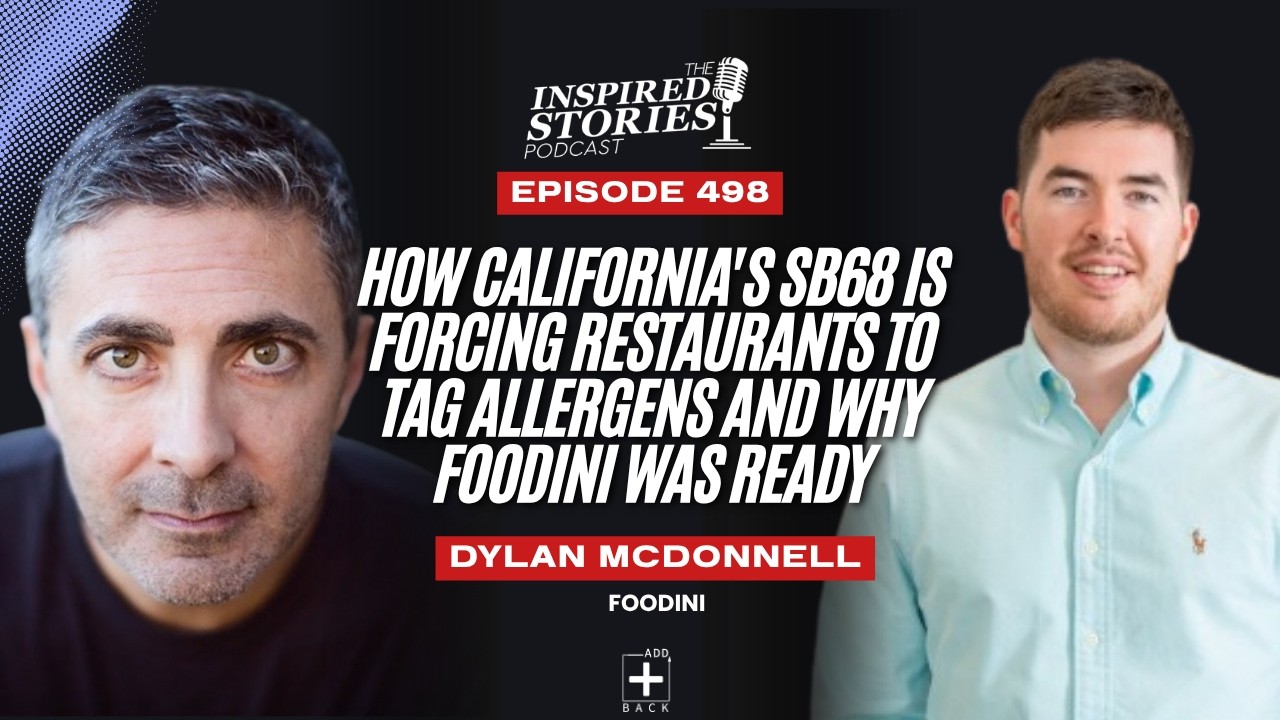
Dylan McDonnell is the founder and CEO of Foodini, an AI-powered dietary intelligence company that helps restaurants, food service operators, stadiums, and delivery platforms map allergen and dietary information down to the ingredient level. An Irish-born corporate lawyer who worked at Mercer in Dublin and Sydney before founding the company, Dylan built Foodini to solve a problem he has lived with since childhood: celiac disease and the constant stress of not knowing what is safe to eat when dining out. He moved the company to Los Angeles two years ago and has since helped pass California's SB68, the first US law requiring allergen labeling on restaurant menus.
✨ Key Insights You'll Learn:
Diagnosed with celiac disease as a child, spending years silently navigating meals in school, sports trips, and social settings with no safe options
Career path from Big Law in Ireland through Mercer's investment funds practice in Dublin and Sydney to founding Foodini in Australia
Early MVP: a consumer discovery app quickly revealed the real problem was the absence of structured ingredient data at the restaurant level
Pivoting from consumer-first to B2B-first after realizing the data coverage problem had to be solved before the consumer experience could scale
Building integrations with POS systems, recipe and inventory management platforms, and major distributors to pull ingredient data automatically
Training LLMs to tag menu items across 150 allergens and dietary preferences, with human dietitian oversight as a quality layer
Spending most of Q3 2024 working with California senators and assembly members to help pass SB68, signed by Newsom in October 2024
SB68 takes effect July 1, 2026, requiring chains with 20 or more locations to label menus for the top nine allergens
Six more states with legislation in progress: New York, New Jersey, Maryland, Michigan, Illinois, and Missouri
Integration with Major League Baseball's ballpark app to help fans with dietary needs navigate concession options at MLB stadiums
🌟 Dylan's Key Mentors:
His Parents: Glass-half-full, pragmatic personalities who modeled resilience and the perspective that in the grand scheme of things, a lost client is not that big a deal
FAIR (Food Allergy Education Organization): The nonprofit food allergy advocacy network that connected Dylan to the regulatory and community work shaping the legislative landscape
Mendoza Ventures (Adrian and Sennifer Mendoza): Early-stage fintech investors whose thesis and values resonated with Dylan and expanded his understanding of the startup ecosystem
His Head Dietitian (First Hire): Still with the company, she shaped the credibility and rigor of the dietitian-in-a-box model from day one, including early kitchen visits to photograph ingredient labels
👉 Don't miss Dylan's account of manually pulling products from restaurant refrigerators to photograph ingredient labels, the moment he realized the data infrastructure problem was even bigger than the consumer problem, and how a childhood with celiac disease quietly shaped everything that followed.
Listen to the full episode here
Transcript
Anthony Codispoti (00:00)
Welcome to another edition of the inspired stories podcast where leaders share their experiences so we can learn from their successes and be inspired by how they've overcome adversity. As you listen today, let one idea shape what you do next. My name is Anthony Cotaspodi and today's guest is Dylan McDonald, founder and CEO of Foodini. They are an AI powered dietary intelligence company.
dedicated to making menu data more transparent for people with specific dietary needs. Using cutting-edge technology, they help restaurants, delivery platforms, and large venues map ingredients down to the finest detail, ensuring diners can easily find meals that meet their preferences or restrictions. Dylan's team has pioneered a unique blend of AI-driven solutions and real dietitian oversight.
creating what they call a dietitian in a box. Dylan is going to tell us how he went from a corporate lawyer to channeling his personal passion for health into entrepreneurship. Along the way, he's been recognized as a speaker at South by Southwest and a mentor at Founder Institute. But before we get into all that good stuff, today's episode is brought to you by my company, Adback Benefits Agency. And you'll want to hear this because it's hurting almost every business you know.
Health insurance costs go up every single year, and restaurants are furious about it. They're paying more, claims are getting denied, employees are opting out, they can't afford it, and it hurts turnover and morale. It's one of the most maddening problems in running a business, and everyone just accepts it. But you don't have to anymore. Now there's a program that gives employees unlimited access to doctors, therapists, and prescriptions with no co-pays or deductibles to meet.
And here's the part that really shocks people. Our product actually increases your net profits. We recently helped a client add $900 per employee per year to their bottom line. Results vary, but gains like that can change how a business is valued. Get your free consultation today at addbackbenefits.com. All right, back to our guest today, the CEO of Houdini, Dylan McDonald. Thanks for making the time to share your story today.
Dylan McDonnell (02:19)
My pleasure, Anthony. Thanks for having me.
Anthony Codispoti (02:22)
So Dylan, you're originally from Ireland, yes? Okay, went to law school there, worked in a large multinational firm called Mercer, first in Ireland, then in Australia. What kind of work were you doing there?
Dylan McDonnell (02:25)
Yep.
Yeah, so corporate law by trade. So my kind of initial stint was in Big Law. More the majority of major tech companies. So the Apples, Googles, Microsoft's, Facebook's of the world would have been our kind of firms, clients, and then ended up specializing in investment funds. And that took me to Mercer initially in Dublin, as you said. And then I made a lifestyle decision to move to Australia. And ⁓ Mercer kind of transitioned me across to their Sydney office.
which was fantastic. like I said, yeah, investment funds related work.
Anthony Codispoti (03:09)
Okay. And is that kind of what led you into the investment work that you were doing with Mendoza when you were investing in some early stage startups or just kind of a complete departure from what you were doing before?
Dylan McDonnell (03:17)
Honestly,
it was more when I was in startup world and I was obviously speaking to a of funds with my founder hat on and then kind of just finding cool and funds that I thought had a good thesis on the investor side and yeah, that's kind where I discovered Mendoza.
Anthony Codispoti (03:35)
And what kinds of companies were you investing in there?
Dylan McDonnell (03:38)
Fintech is pretty much their specialty. They have a few others in other spaces, but Fintech is the majority. They're based out of Boston. So Adrian and Sennifer Mendoza are the two main kind of partners there. And they're just really, really great guys. Really, really clever. And like I said, really kind of resonated with the thesis that they had.
Anthony Codispoti (04:00)
Okay, so lawyer, ⁓ FinTech investing startups, and then Fudini. ⁓ Connect the dots for us. Where did the idea come here? How did that opportunity open up?
Dylan McDonnell (04:13)
Yeah, connected. It was definitely a random one in some ways, but will probably make more sense in a second. So celiac. I was diagnosed as a kid with essentially it's a form of food allergy. And so most of my life I've kind of had to navigate that that issue. And over time, I was getting more and more frustrated with how difficult it was just to find transparent information on what you can and can't eat when dining out of home. And so.
When I was in Australia, actually, started the idea just kind of kept permeating through my brain. And I started to do some more research on like how many people are impacted by this and are there there must be solutions somewhere in the world that are solved for this. And the market was huge and there were no solutions. And so I set about essentially trying to solve a problem that I have myself that being where can I eat and what can I eat when I get there when I have a food allergy or a dietary
Anthony Codispoti (05:09)
Okay, so this was something that you needed, it didn't exist. And how did you actually get started with building it? And in the early stages, was it just building a tool for you and maybe some friends who, you know, were struggling with the same things? Or did you go at it right from the beginning as, this is a business idea?
Dylan McDonnell (05:29)
A little bit of both, I would say. And of course, we've pivoted a lot since my initial idea, as is inevitable. ⁓ like, because again, as you said, I'm a lawyer, I was non-technical. ⁓ So probably a bit green, a bit naive as we all are, I think with our first startup or business idea. So I initially kind of hired an agency to help me like prototype and mock up and develop an MVP.
for what I kind of had a vision for, which was more consumer discovery app. And I would say, you know, was day one, I wasn't like, I'm gonna create a massive business, but I definitely had the layer of, I'm not doing this just for fun either. I think the lens was, I think this is a real problem and a real pain point, but I need to validate it by whether it was friends and or strangers at the time. And of course it was both consumers and restaurants that I needed to validate the problem with.
And so that's probably what that initial MVP did. was rocky. It was cheaply built. It certainly wasn't slick, but it helped very, very quickly validate for me that yes, all of these other people with food allergies have the exact same problems I do. In fact, a lot of them a lot more severely for people who are like anaphylactic and this can be life and death for them. I'm not going to die if I eat the wrong thing. I'll be quite sick, but you know, like food poisoning, I'll get over it. ⁓ For a lot of people, that's not the case. can quite literally.
Resultant in very very serious harm and then similarly it was like restaurants like how big of a pain point is this for you? How are you dealing with this today? And again that initial MVP helped me validate that this was something that they experienced and that they didn't have a solution for
Anthony Codispoti (07:11)
And so this MVP, the minimum viable product that you're talking about, just kind of getting out, you know, very bare bones, just so you had something that you could visually display and demo to people. So you get the feedback confirms that the problem exists both on the consumer side, as well as for the retailers or the restaurants. And so what was the next step for you from there?
Dylan McDonnell (07:32)
my job. That was the next step. I took it to be fair. had a few months in that kind of let's call it discovery phase. So that wasn't a week or two weeks. That was probably more like four or five months. ⁓ And then I had spoken to a number of investors at that point as well. I had kind of got validate, but my initial traction or proof points were enough to warrant like an initial call it family and friends round.
Anthony Codispoti (07:34)
Did you have funding lined up?
Dylan McDonnell (07:57)
and ⁓ family and friends slash small, know, very early stage investors. And the kind of commitment I met in those conversations was if I raise, and I think it was half a million dollar, wrong one, then I would quit my job. And I pretty much had most of those commitments soft circles. So I was like, all right, let's do this thing, quit my job, raise that money, started building kind of a very small initial team and got to work. And that was, yeah, that was the start.
Anthony Codispoti (08:26)
So how did you get the first paying client?
Dylan McDonnell (08:31)
⁓ first door knocking. I literally, and cause we'll, we'll talk a little bit more obviously about the product is now, but like back then it was a case of, just needed restaurants to test. Cause the thing for us was the consumer problem was easy. The consumers have the problem and they're looking for a solution. That was the data. The data was the problem. How do I get accurate, not menu data, not recipe, not just recipe data, not just inventory data, but all of it.
Anthony Codispoti (08:49)
Where do you get the data?
Dylan McDonnell (09:00)
piece it together so that could accurately tag allergens on menus and in such a way that I could customize it to the consumer because that's what we were doing. We were powering personalized menus for consumers across a raft of allergies and dietaries. And so we, know, when you don't have big paying customers already, you do what you do, which is walk the street, knock on restaurants, find like smaller businesses where you could run into an owner or manager who understood or resonated, offer them a heavily discounted pricing and just ask them to take a punt.
and try and assure them that they'll see value. That's exactly what I did. All founder led sales to begin with.
Anthony Codispoti (09:37)
And so the first client that you got, where was that? In Australia? Where were you living at the time? Okay. And so you go to them, you charge them probably a small amount of money. And how did you solve that problem of getting the data?
Dylan McDonnell (09:41)
Sydney? Yeah, in Australia and Sydney. Yeah.
Honestly, there was a lot of trial and error in those areas. That was a lot of the learning. think, again, we talk, I was, I'm still am to this day shocked at how bad the data infrastructure is in the food industry. A lot of the time, especially when it comes to things like allergies, like the data layer just isn't there. And so we were manually at the time having to like collate all this data, analyze it, input it into our system, which again was pretty rough and ready at the time.
and then use that to power the consumer facing experience. So honestly, there was a lot of scary learnings in those early on where we quickly realized why this didn't exist already. And it was because it was hard to get this data and hard to keep it up to date. And so we were literally going into, and my first hire was my head dietitian who's still with me. We were literally going into the kitchens of these small restaurants, into the fridge, pulling out items and looking at the labels and taking pictures and like,
We were doing it very rough and ready, but those learnings obviously stand to us to this day because we genuinely started to figure out the reality of how these kitchens were operating and why this data wasn't documented or didn't exist.
Anthony Codispoti (11:05)
So before we get to what it looks like present day, talk to me about one big pivot that you made early on based on something that you
Dylan McDonnell (11:18)
The biggest pivot was, I'd say we were spending a lot of time in the early doors focused on the consumer. I think it was kind of like thinking like, know, app, sexy growth users, like we want to get, you know, and we got, you know, we had a lot of users that were using the platform, but the problem was the coverage to the exact point you made. We didn't have enough data from restaurants. So consumers will go on. They would see the restaurants we had. It would be great, but it wasn't enough. Like you go on at a few times, you've seen everything. There's not enough to keep you coming back.
And we weren't getting restaurants at a quick enough rate to justify that kind of consumer experience that we wanted to power. And so the biggest learning and it probably took several months to figure it out was that we're not going to have a consumer business until we figure out how to scale the B2B side. We need that. That has to be the unlock. So and even looking at today, that is our focus. Our focus is predominantly B2B. We're B2B to see. And we still do have a consumer discovery app, ⁓ but
The main focus is on getting as much data coverage as possible on the food service and restaurant side, which over time will allow us to have an unbelievably compelling consumer experience, but it's just a tearing.
Anthony Codispoti (12:31)
Okay, so walk us through what Foodini looks like today. What do you do? Who do do it for?
Dylan McDonnell (12:37)
Sure, so we are a dietary intelligence company is kind what we call ourselves. So we essentially work with restaurants, food service, stadiums, universities, anywhere that serves food. We ingest their menu data, we ingest their product data, we ingest their inventory data. We've built out all the integrations on the backend with the relevant players in menus, in inventory and recipe management, in products via the suppliers and distributors. So we have a massive amount of
data already in our back end. So when we pull from an individual restaurant group, can, we've trained LLMs to automatically tag all that information with relevant allergy and dietary information. do 150 different tags. So not just your top nine, the whole raft of different allergens that people could be allergic to and preference diets like keto and paleo and low FODMAP and low carb and everything like that. And we essentially create that aggregated source of truth.
we, you know, the group can rely on. And then we power that personalized menu experience. And today that's primarily within the restaurants ecosystem. So that's a QR code on their menu, allergies dietary scan here. That's a button on their website, allergy dietary menu, click here. Both of them prompt a web app experience, not a web experience. And then we integrate into online ordering. So we can actually, you know, certain groups will leverage our API and pull out our data and our
decorations, let's call them, are filtering into their ordering experience so that it looks the same as what they currently have, but it just still has that personalization element and it still has all the allergen data in there as well. So they're kind of the three main ways that an end guest will access the data, which is ultimately the goal, is QR and venue, link on website, or a deeper integration into the ordering experience.
Anthony Codispoti (14:27)
And so from the customer perspective, let's say I've got a dairy sensitivity. And so I'm looking for something at my favorite restaurant that doesn't have any dairy in it. And maybe I start with the Fudini QR code that is, you know, in restaurant. Go ahead. Help me fill in the blanks here.
Dylan McDonnell (14:46)
Yeah, no,
no, exactly. Think of two different use cases. Before you go to a restaurant, do normally look at the menu?
Anthony Codispoti (14:55)
Sometimes, yeah, I do. Yes, I do.
Dylan McDonnell (14:55)
If someone says, you want to dine here on Friday night? Yeah, yeah.
I think the stat is I think 91 % of people look at a menu before they go to a restaurant, typically. And people with allergies, closer to, again, it sounds like a fake stat, but it's literally 99 % of people will check them. Because if you say, Dylan, you want to go to this sandwich shop, the first thing I'm going to have to check is, well, do they have gluten free bread? Because if not, I literally can't eat one thing in that place, right? So use case one is.
someone will go onto the restaurant's website to look at the menu to ascertain for that dairy intolerance, does it look like there's dairy free items here? When they see the allergy dietary button, they'll click that, say dairy intolerance, and the menu will auto customize to say, here are the items on the menu suitable for you, here's the items that could be modified to be met suitable for you and what that modification is, and here's what you can't eat because it contains these dairy including ingredients. So straight away now that consumer knows, great, they have seven things I can eat, let's go. That's use case one.
Use case two is kind of, sounds like more like you sometimes, Anthony, you walk in off the street to a random restaurant and you've absolutely no idea what's on the menu. And in that case, while you're lining up or while you're waiting at the table, you scan the QR saying allergy dietary, go through that exact experience. And by the time the waiter comes to the table or by the time you get to the top to actually place your order, you already know what you can eat and you order accordingly as opposed to current day experience, which is asking the question to a staff member.
who 90 % of the time doesn't know the answer, not because they're a bad staff member, but one, there either isn't the data for them to even know the answer, or two, they haven't been trained on it.
Anthony Codispoti (16:35)
So I'd be curious to hear more Dylan about what you've learned in terms of the most efficient way to get and ingest the data. You you guys aren't walking into coolers anymore, I assume, like taking pictures of ingredient panels.
Dylan McDonnell (16:46)
Yeah. Yeah.
Great question. And it's the integrations. So where we were, we had to figure out, okay, we can't, as you said, we can't keep asking chefs to provide us with recipes manually. We can't keep going into fridges and taking pictures of things. Where does this data live today that we can pull it from? So the menu, we can pull it from their online ordering providers. So that covers that. The recipes and inventory typically, and again, SMBs can be a little bit different and sometimes share their recipes around.
Excel or Google Doc or whatever. But once you kind of get into 10 plus locations, they almost always have a recipe or an inventory management system. And the tip that was built out more for cogs for cost of goods, souls and margin. And so a restaurant can understand waste and things like that. But crucially, it has recipes built out. And so we can pull data from there. And again, that's the next layer. And then the third layer is, but what products are in this? Because, OK, burger.
and it says burger bun in the recipe, but what brand of burger bun is that? Because there's 50 different brands and all of them have different ingredients and all of them have different allergens. We can't just say burger bun. We need to know it's Costco own brand burger bun or Cisco or US food. Maybe they use Corsair. Some of them have some of them have sesame seeds. Some of them don't. Some of them have this. Some of them have soy. Some of the it's literally can be fundamentally different. And so now we need the product level. And again, we
Anthony Codispoti (17:59)
Because maybe they use cornstarch in theirs and somebody's got a corn sensitivity.
Dylan McDonnell (18:14)
pull a lot of that data from invoices or from other places from the restaurant. And then also we're plugged into the product databases of the big distributors and suppliers so that we can actually get the list of ingredients for that product, which we then in turn tag. So it's like an onion, Anthony. There's layers to this ⁓ you need. And you can't do the job without all of the layers. ⁓ And so the more we
integrate with different systems where this data already exists, the more it streamlines the whole process. And that's what we've kind of had to spend a year or two doing is building out those relationships and building out those data integrations because otherwise, you know, we'd be moving at a rate of knots and that's not good enough in the modern era.
Anthony Codispoti (18:55)
This is fascinating. And so you started out probably with the smallest mom and pop shops just to, you get started proof of concept. Now it sounds like it's easier to work with groups that are a little bit bigger because they've got better software that's already tracking the information that you need in a digital way makes it easier for you to grab.
Dylan McDonnell (19:07)
Yeah.
Ironically, you said, the bigger the group, the easier it is for us. And as well, they have advantages that the smaller groups don't have. They have a lot more personnel to make sure. The reason a chain is a chain is because it's figuring out how to scale and operationalize. And a lot of that is their menu data and everything under the hood. So exactly to your point, the bigger the group, the easier it often is.
Anthony Codispoti (19:39)
And how do you account for or maybe this isn't really the responsibility of Fudini. ⁓ You know, they could have a gluten free bun over here, but it goes on the same warmer the same bun warmer as like a traditional gluten bun. Okay.
Dylan McDonnell (19:54)
Cross contact is what you're talking about. Yeah, yeah,
yeah. So a few, it depends. So some groups will say, know for a fact that our French fries are cooked in a fryer that contains ⁓ bread crumbs from the goujans. ⁓ And therefore we want them tagged as containing gluten. Great, we'll do that. ⁓ A lot of the time when it's more just like it could be cooked on a surface, which has a trace of something, we tend to stick more to the ingredients.
that are actually in it and just make sure that the disclaimer is front and center for the consumer that, you know, cross-contact risk is present here. Make sure you flag your allergy to the restaurant and depending on your level of severity, you need to make a judgment call, you know, as to whether this is safe for you or not. Because that's the one place where, you know, it's all well and good to say, the restaurants need to provide the data and they do. But ultimately, the consumer, like there's a big difference between someone who with the tiniest trace of a peanut.
is going to have a severe anaphylactic allergen and someone who's dairy intolerant and, you know, will need to have a gallon of milk before they have any symptoms. And so the consumer still has a responsibility to make judgment calls based on the best available information and based on their risk profile. And so what we try and do again is provide as much of that transparent information to allow the consumer to make an informed decision.
Anthony Codispoti (21:20)
Can the consumer start their dining experience at Fudini? Say, hey, I just, I don't know where I want to go tonight, but I want to find someplace that has the correct data. Can I start there? And you'll tell me, search by your zip code, et cetera.
Dylan McDonnell (21:37)
That's our consumer discovery app. So we have that product as well. You can download it from the app store. Our main coverage right now is in the LA region because that's home base for us. We're not pushing it aggressively just yet because literally to the point I said earlier, we're trying to get to a point, a certain density of coverage before it makes sense from a marketing standpoint to start putting dollars behind it and get it out there. But anyone who is listening, is resonating or has a
has this problem themselves or in the family, absolutely download our app from the App Store and check out the experience. It does exactly what you said. It allows you to create your dietary profile across 150 diets and allergens. And then it shows you where in your area has options for you and what options exactly when you click into the menu down to the modifier level.
Anthony Codispoti (22:27)
So you started in Australia, you just referenced that LA is home base now. Talk to me about the transition that took place there and when it happened.
Dylan McDonnell (22:36)
Yeah, so it happened two years ago. And I think for me, it was a recognition that if this company was going to be big, we had to be in the US. You know, venture wise, opportunity wise, all the big integration conversations and opportunities we're having just size of market, like everything pointed towards this needs to be in the US. There was also, we'll come to it from a regulatory standpoint, I was getting
hearing rumors of things that were happening and that might move the needle for us here. yeah, two years ago, I essentially made the decision I got to be in the US. This has to be a US headquartered business and we got to put all go to market efforts into the US. And that's what we've been doing for since, yeah, think about April 24, two years.
Anthony Codispoti (23:25)
So tell me more about the regulatory environment. What were the rumors you were hearing? Where do you see things going right now in the near future?
Dylan McDonnell (23:31)
Yeah.
So just for context, in Europe for the last over a decade, you cannot open in most countries as much as a hot dog stand without labeling for as it is there the top 14 major allergens. Standard. Every restaurant has it Ireland, UK, most European countries. Australia has a rule where you must have it documented. Doesn't have to be labeled on the menu in the way it does in Europe, but every kitchen has to have the binder of information. So if anyone asks, it's there. The US, nothing.
zero requirements around food allergens in restaurants. There's been nutrition requirements for about a decade. ⁓ And that's where if you walk into any chain with 20 plus locations, you'll always see the calories, like in any group, and you'll notice it the next time you go in. ⁓ That was the rule, nothing about allergens. And so from Australia, I had already started getting involved in FAIR, which is the food allergy education organization in the US. Think of it as the main nonprofit food allergy organization and a few others.
And I was just hearing mumblings that there was a movement to try and bring in regulation in line with what was happening ⁓ or what was standard in Europe. And obviously in my brain, I was like, well, if that happens, that's gonna be a massive change and create a lot of opportunity for us as well. so candidly, I'd say for most of Q3 last year, I was a political activist. I was doing a lot of work in California with senators and assembly members.
and trying to get to Newsome himself because there was a bill in progress ⁓ and it passed. So on the 13th of October, Gavin Newsome signed SB68, which for the first time requires restaurant groups with 20 plus locations worldwide where any one location is in California. Essentially if they have any California presence to label their menus for the major nine food allergens effective one July. So what's that seven weeks time? ⁓ So
That was huge because now every essentially mid-market and national group in the country has to do this exercise and not just do the exercise, but it has to be on their physical and digital menus. And so for the food allergy community, this is massive. This is the first step towards transparency as to what is in my food and is it, it, does it have the allergens that I'm allergic to or not? And can I see this easily and access this easily and you know,
our group's going to care and keep this up to date and try and keep me safe. I didn't mention 33 million Americans, by the way, with a diagnosed food allergy, one in 10. So it's a much bigger market than most people realize. It gets to about half the population when you layer on all the intolerances, all the preferences, all the lifestyle diets. ⁓ anyway, so that was the big one to pass. Since then, six more states have commenced action to
Anthony Codispoti (26:10)
Wow.
Dylan McDonnell (26:29)
replicate what happened in California with the major exception that every single one in current draft is all restaurants in the state, not just 20 plus.
Anthony Codispoti (26:39)
Regardless
of size, you be a single location and need to do this.
Dylan McDonnell (26:42)
single location
need to tag for the major nine allergens on your menu. And so this is coming. This is going to be again, like I said, it's been standard in Europe for over a decade. And now finally, the US is moving in this direction. And I believe in the next six, 12, 18, 24 months, and a large number of states are going to have implemented this form of regulation. And I think
very likely will be federalized after that in the same way that nutrition was. And I believe it's the right thing to do for the community. And I believe there's a ton of benefits for restaurants in doing this as well, outside of the fact that it's a requirement. So yeah, that's the update.
Anthony Codispoti (27:28)
Has this just opened the floodgates for your business?
Dylan McDonnell (27:32)
It has, I would say it has. It's not like we went overnight from getting a massive amount of inbound. We absolutely have got a dramatic increase in inbound and obviously people are a lot more receptive and a lot of the big tech players are realizing that they need this data as well ⁓ or want it and need it and because they can use it to personalize experiences within their marketplaces also. But honestly, for a while it was like a lot of awareness and education was still required.
You know, this is a good law. There's a lot of businesses in California who I honestly don't know how a lot of businesses do business in California. There's so many laws and regulations and a lot of them, in my opinion, are silly and make it really, really hard to do business. This is another one where I can imagine some operators are rolling their eyes and being like, oh, my God, another thing we have to do. And so. It's taken, I think, a few months for a lot of groups to actually fully.
realize and understand that they have something to do here and that there's a regulatory deadline. So a lot of what we've been doing is educating them around that. And now as we creep closer, we're seeing a lot more panicked emails saying, ⁓ crap, we're a few weeks out. We need help.
Anthony Codispoti (28:47)
⁓ What does that education process look like? Is this you run in ads online, you've got email lists where you're sending things out, you're sending physical mailers. How are you connecting with the folks?
Dylan McDonnell (29:00)
Yeah, email outbound, LinkedIn, Google ads. Again, less salesy, honestly, Anthony, more like, guys, there's a one July regulatory deadline and here's what you need to do to be compliant. ⁓ Especially in California, unfortunately, you know, look, like I said, this is the right thing to do. Full stop, in my opinion. And a lot of people, I think it's every 30 seconds, someone in the US goes to the emergency room with an anaphylactic reaction, which again, will just tell you like, this is not
a once a year incident, like people are literally getting really sick and worse every single hour in this country as a result of a lack of transparency of information. But you do also have a lot of malicious actors who spot laws like this and go after restaurants where they, know, what's happening with the Disability Act, you know, and all sorts of things. And so for restaurants, I honestly think the bigger risk is if they're not compliant with this in time.
you're gonna find these bad actors who are just gonna scourge California and look for anyone who's anything out of line, hit them with a lawsuit, and they're just gonna have to settle straight away, because they will be in breach. And that's just, again, I hate seeing those things happen when it's avoidable, and when, especially for restaurants that are trying to do the right thing.
Anthony Codispoti (30:16)
So Dylan, make the case, there's a restaurant in California that has some kind of a presence in California. They meet the 20 restaurant threshold worldwide and they need to do this and they need to do it quickly. What's the advantage to using Fudini over trying to do it themselves?
Dylan McDonnell (30:22)
Yeah. Yeah.
Yeah, well, I think that a number of advantages, but in the first place, it's really hard to do this exercise yourself. Like if you have a big team of in-house nutritionists and dietitians, like maybe, you know, the McDonald's or Starbucks of the world. ⁓ Sure, you're going to have more internal resource to throw at this, but it is an exercise that we've seen people try and do themselves and come back to us a week later and be like, actually, we had no, you know, the scale of having to figure this out ourselves and the expertise required, because there is expertise required. You have to understand.
allergens and not everyone has that. So I would say number one, it's we can very, quickly actually create that source of truth. It's the kind of thing we've seen groups try and do themselves and it's taken them six months and they've still gotten it wrong. Number one, number two, we're pretty cheap compared to a lot of ⁓ white glove consultants who obviously have done this manually over the years when they've been requested. Given we can use a tech forward approach, we can charge a lot less. But the more importantly, that's just the aggregation of data. It's how we actually present it to the consumer.
So the consumer who comes to our QR or our link has a completely personalized experience. It's not a PDF, 40 page PDF you're sending them to what a big matrix grid that they're trying to figure out like on their phone most of the time and they can't figure out their head from their elbow. We actually give them the information straight away in a way that's relevant to them based on their allergies, their dietary needs. Our data shows
Personalized menus drives more customers to your restaurant and drives more loyalty, number one. Number two, operationally, right now restaurants, whether they're caught by the regulation or not, they're having to answer these questions by word of mouth. It's the staff who are answering the questions. We see about a 60 % reduction in the number of questions being asked to staff when they implement our solution. Because again, most people just want the information from a source of truth. They don't even want to have the conversation with someone if they can avoid it. They're not trying to cause a scene a lot of the time.
Also, the majority of mistakes come from those word of mouth conversations. think a report came out last year, said 54 % of all allergic reactions happen in restaurants happen after the staff have been notified. And that just tells you, it's the simplest thing. A recipe could have changed yesterday. The chef put in a different soy sauce, but that wasn't funneled down to the server. The server now thinks it's soy free. It's not. Now someone is sick. ⁓ So.
It's the reduction in questions, it's the massive reduction in mistakes and risk and lawsuits and brand damage, and then the data. We can also tell a restaurant, well, last month, the next location, you had 2000 diet profiles created, 40 % were gluten-free, 25 % were vegan, 10 % were keto. You don't have any keto-friendly options on your menu. This is something you need to think about from a menu optimization standpoint, given your consumer base. Also, you can now tie this data to your consumer data profile, so your CRM.
So you can now, depending on how they integrate us, say Dylan is ex-customer, he's gluten free. Next time you're sending me a marketing email, you can be sure you're gonna personalize it to make reference to that and make sure you're marketing the gluten free items to me and not the cheeseburger without the gluten free bun that I can't eat. So there's a lot of benefits to restaurants for doing this the right way.
Anthony Codispoti (33:50)
What does a restaurant's tech stack need to look like in order for it to be a relatively efficient process to work with Fudini?
Dylan McDonnell (34:00)
Honestly, they don't need anything too crazy. Like there's only a handful of major menu operators. And sorry, that's the other advantage. When you do it with us, we propagate it everywhere. So because it's in our system, it powers the QR and venue, powers the digital link, it powers the kiosk, it powers first party online ordering. Everywhere the consumer interacts with the menu, the same source of truth is propagating it versus again today trying to update the information in 10 different systems is a complete nightmare and extremely error prone.
But sorry, to answer your question, it doesn't have to be that advanced at all. Like I said, we came from working with SMB. We still onboard restaurants to this day who send us a spreadsheet of recipes and a PDF of inventory. And almost always we can pull their menu from their POS or their online ordering because you you have your toast, you have your Olo, you have your, you you only have a handful of them and we can work with all of them. ⁓
It does not have to be that advanced, is the short answer to your question.
Anthony Codispoti (34:56)
What's the sweet spot for you in terms of locations? Like, is McDonald's a good fit or are they so big they're kind of doing their own thing and so you're kind of targeting a tear down?
Dylan McDonnell (35:10)
We're kind of mainly targeting like 40 to 2000. It's probably, you know, so a fairly wide range. Like we just onboarded a group this morning, 60 locations. You know, a lot of those groups are, they're big enough that, you know, they have really, really good data. They're excellent groups. You know, they're a hundred million plus in annual revenue, but they don't necessarily have, you know, an internal dietitian or nutritionist or someone who might've owned any of this space in the past.
but equally with the bigger groups we're talking to.
The ability again to personalize the experience to the consumer is really compelling because if you're a McDonald's or you're a Wingstop or you're a, you
someone of that scale, I think their eyes are being opened to the possibility of not just that the data aggregation is easier for them, they're big brands, but the personalized experience is critical and how the data side on the consumer side is kind of a lot more compelling than the data side on the menu items for them from what we've seen so far.
Anthony Codispoti (36:22)
So California's law goes into effect July 1st, 2026, which is probably about the time that this gets published. What are the other six states that are somewhere in process at the moment?
Dylan McDonnell (36:33)
New York, New Jersey, Maryland, Michigan, Illinois, Missouri.
Anthony Codispoti (36:38)
Okay.
Dylan McDonnell (36:41)
with a number of others getting ready.
Anthony Codispoti (36:44)
Yeah, and you've kind of got a pulse on this, you're sort of connected into each of the different states and sort of understand where their internal conversations are headed.
Dylan McDonnell (36:54)
I'm in this weird middle spot where I'm like, I'm a massive consumer advocate for, and that's a lot of the work I do at fair in terms of like the plight of this community and why it's so critical that this exists. But equally restaurants are my clients. And so I do massively empathize with restaurants as to why this has been hard traditionally and where, where the gaps can be in their organizations to actually do this the right way. And so, yeah, I think I'm trying to.
make sure that a common sense approach is followed and that requirements aren't dropped on restaurants that we know are not pragmatic or that, you know, aren't, won't be possible to fulfill or we'll put an overly difficult burden on them whilst at the same time making sure that or trying to help make sure that whatever does pass does actually protect the safety of consumers. And like I said, in tandem,
I truly believe that it drives more revenue to these restaurants because all these consumers will come back out of the woodwork and stop cooking their lunch at home every day. And I will say, you know what? I do know that's peanut and tree nut free. I can see it clearly. I am going to go down the road to that restaurant and eat there. Why not? That's the difference I think it will unlock for a lot of groups as well. And like I said, it's a lot of people.
Anthony Codispoti (38:04)
Yeah.
It seems to me like you will have your hands full for quite a while as more and more of these states come online and being able to help these restaurants out. But are you in a headspace where you can think about where you want this to go next stage, whether it's, I don't know, new technologies that you want to integrate or new services that you want to offer?
Dylan McDonnell (38:36)
100%. Like I, I'm all, it's one of the things as a founder, think you need to rein yourself in sometimes, you you wake up one morning like, ⁓ we should do this or we could do that or like, why aren't we? And then it's like, okay, let's take a deep breath for a second. We're knee deep in X, Y and Z. We need to make sure we nail that and cement ourselves as the, as the provider of X before I go chasing, you know, down every other opportunity.
There was a period of time, I swear to God, Anthony, every call we had, there was another idea. Why aren't you doing this in airports? Why aren't you in cruise ships? Schools and universities have the same problem. Nursing homes, my God, they have a huge issue because there is a client base where there are a lot of illnesses and a lot of allergies and the people there aren't trained across food allergies. Like we need help there. ⁓ Integrate with this, integrate with that. One thing we do do, which is pretty cool, is we're now working with stadiums.
So we're integrated with Major League Baseball with their ballpark app. We've actually started mapping MLB stadiums. ⁓ So think of the use case. have Oriole Park at Candombards was our kickoff. You have 100 concession stands in the stadium. I'm a massive sports fan, so I've kind of lived this. And you're like, well, where the hell can I go between innings or at halftime in a different sport to get something to eat? And I've been that person where I've been walking around like a headless chicken being like, for God's sake, like where?
And then maybe you line up and you get to the top and you're like, is that gluten free? And they're like, no. And you're like, and you're gone again. And now you're missing the game. And then you're like, ⁓ tell what I'm just not going to eat anything. me get another drink instead or something. I don't know. But point being, it is actually quite a compelling use case. And the experience is that the consumer creates the dietary profile. It's all in the MLB ballpark app, which they have already. And it says, here are all the concession stands in the stadium. And based on your profile in order, here are the ones with the most options for you.
where they are in the stadium and then exactly what options you can eat when you get there. So that's a kind of an example of a one where we deviated because it was, you know, it made a ton of sense and it's repeatable. But yeah, just trying to stay focused on the now as well as dreaming as, you know, not dreaming is the wrong word, but specking out what the future will hold as well. Yeah. ⁓ yeah.
Anthony Codispoti (40:51)
Yeah, what's your future vision looks like?
So Dylan, whether on the personal side or the professional side, or maybe there's a crossover there, what's one of the hardest things you've ever had to overcome? And what did going through that teach you?
Dylan McDonnell (41:07)
Interesting. Maybe I have two kind of answers, one more personal, one slightly more professional. think on the personal, look, touchwood, I've been also, I've been extremely lucky in my life. I think I haven't had any major tragedies around me and I definitely have been very privileged in a lot of my experiences. And so I'm, I think it's something I recognize and I acknowledge and yeah, I feel like.
there are a lot of people out there that have had a lot more hardship than I have. I think on the personal side, one that was tricky was the whole celiac side of things. So when I was a kid, I think my parents said it was when I was around four five years old, I just started getting sick all the time when I was eating food. And so it took them about five years to figure out what was wrong with me. And my poor mother was like baking, know, bringing me to all these doctors, baking like the best of quality homemade brown bread.
And sure, ironically, that was making me worse. again, 28 years ago in rural Ireland, like no one had a clue what gluten or celiac or and to be fair, and I was in the States a bit around that time as well. The American doctors weren't clicking it either. thankfully, finally, they figured it out and said, ⁓ celiac just can't eat gluten. And then it's like, well, what's gluten? And then you're you're going down that path. But that was tricky for obviously the relief of not being sick as often anymore. ⁓
But it was tricky in terms of there was no gluten-free options back then. And so whether it was in school, ⁓ trying to figure out lunches and it was one thing being at home where your parents could cook for you, but like any environment, whether it was a sporting weekend away or a school trip or a blah, blah, it was a disaster because like there was no gluten-free options. You're there with like carrot sticks or some other terrible item and like just can't eat the food and no one else understands that. ⁓
And there was definitely virtually no awareness of what even a food allergy was, the consequences of it at that time as well. And I'm the type of person as well, like I just want to get on and live my life. And I wasn't the type to like draw attention to it either. So there was definitely a good period of time between school, university, everything around life where you're just kind of silently suffering and just constantly trying to navigate. Okay.
we're going out for the day, but what am I going to eat? Do I need to bring something? Do I need to pre-make it and put it in my bag? Where are we actually going? Can I look up if there's places there? If there are places, what's on the menu? Will I be able to order something there? Or just this constant, call it a stress. And again, like I said, I'm not even anaphylactic. It's not going to kill me. But it's still very, yeah, call it stressful to try and navigate that, especially as a kid and a teenager. And obviously as time has gone on, it's got a lot.
that's obviously those experiences that have triggered what I do today. But yeah, that was definitely tough, I would say. On the professional side,
I one of the things, I always had it anyway, you I'm quite resilient, you know, it takes a lot to knock me, but by God, do you need it in the world of startups? You know, I think I was probably naive and green to like, yeah, well, everyone's saying it's a good idea. So obviously everyone's going to buy it and pay for it and it'll be easy and da da. And it's like, you know, that's just not the reality of the world we live in, even if, and we've had this where restaurant groups are like, this is.
And they're being genuine. This is fantastic. We really like it. But we've had a really tough year. We don't have any budget. We have five other burning fires with staff and this and that and the other. And this just can't be part of us right now. Let's talk next year. Like you have these things and you know, you have to be and same with investors like, know, you get a lot of investors where you invest a lot of time and it just falls over at the 11th hour. And so, yeah, I've definitely had to.
I'm glad that I kind of had that resilient bone in my body already, but if I didn't have it, ⁓ I don't know would we still be here today or I would have had to learn it very quickly because you got to have thick skin. You got to be able to take the losses with the wins and learn what you can from them and keep moving forward.
Anthony Codispoti (45:28)
Do you think you developed some of that thick skin as a younger kid going through the hardships of not knowing why you were getting sick and then even once you knew now you're an outsider and you don't know what to eat or where to eat and so I don't know like it just like you're getting these little tiny battle scars every single day.
Dylan McDonnell (45:50)
Yeah, probably. ⁓ Probably. I'd have to give my, I'd my parents get a lot of credit as well. Like they were definitely very, always glass half full type personalities, very pragmatic, very, you know, not overly dramatizing, know, small things like always look at the bigger picture, you know, once everyone's healthy and happy, nothing else matters, you know, that kind of... ⁓
life perspective, I think allows you to look at losing a client or perspective client as well, that's not that big a deal. I'm not, I'm not very sick. I can still walk out of my office and get a coffee. Like in the grand scheme of things, I'm a very lucky guy. I'm not going to let a little knock let me down onto the next one. Let's go. And I think I'd have to probably give credit to my parents for that kind of life perspective, but sure. I I'm sure kind of.
challenges that you have when you're in your formative years and overcoming those, whether that be mine, and I'm sure a lot of your listeners have had, like I said, 10 times worse. But when you come out the other side of that, you definitely build ticker skin. And that absolutely helps in business and in everything. Relationships, friendships, everything.
Anthony Codispoti (47:00)
What do you most want to be remembered for in the work that you're doing now, Dylan?
Dylan McDonnell (47:05)
that's good question. I think honestly, and this is one of the things that I love most about what we're doing and it sounds cliche and I'm not really a cliche or a type of guy for the best part, but we're genuinely making a difference. Like we, like I said, you have these 33 million Americans that have a diagnosed food allergy, many of whom it's a life and death issue. A lot as well, much more hard propensity in kids and teenagers and young people.
And we have genuinely moved the Neil from a regulatory perspective, from a tech perspective, from an awareness and education perspective on their plight and how restaurants and the food service industry needs to move and change to accommodate them. And I have seen it with my own eyes over even the last two, three years, that shift has happened, a big shift in a small amount of time. And I'm really excited.
to see what 12, 24 months looks like. And when I look back and say in, know, 2022, what I said with the world that existed then versus 2028, I truly think there will be a moment there where I'll be able to sit back and be quite proud of the impact that Fudini, not just me, my entire team had on moving that needle. And that I think would be pretty cool to be remembered.
Anthony Codispoti (48:25)
Dylan, I've just got one more question for you today. But before I ask it, I want to do three quick things for the audience. First of all, anybody who wants to learn more about what they're doing at Fudini, maybe get in touch with Dylan and his team, their website, super easy to get to Fudini.co. It's spelled food, I-N-I dot co, Fudini.co. We'll have it in the show notes, but you can go check it out right now while you're listening, Fudini.co. And if you're enjoying the show today, please take a moment to subscribe wherever you're listening.
it also sends a signal that helps others discover our podcast. So thank you for taking a quick moment to do that right now. And as a reminder, you can finally get your restaurant employees access to therapists, doctors, and prescription meds that counterintuitively actually increases your company's net profits. No copays, no deductibles, and net profit increases that change how a business is valued. Contact us today at addbackbenefits.com.
So last question for you, Dylan, a year from now, what is one very specific thing that you hope to be selling?
Dylan McDonnell (49:31)
⁓ Three more states having passed food allergy regulation.
Anthony Codispoti (49:38)
So there's six in progress. You're hoping that three of those have actually gone and passed it. Okay. That'll be easy for us to check in on. Dylan McDonald from Fudini. want to be the first to thank you for sharing both your time and your story with us today. I really appreciate you being here.
Dylan McDonnell (49:40)
Yeah. We'll have to them by then. Yep. Yep.
Yep, easy.
at all. Thank you so much for your time. I really enjoyed the chat.
Anthony Codispoti (49:59)
Folks, that's a wrap on another episode of the Inspired Stories podcast. Thanks for learning with us. And if one thing stood out, put that into action today.
Connect with Dylan McDonnell:
Website: Foodini.co