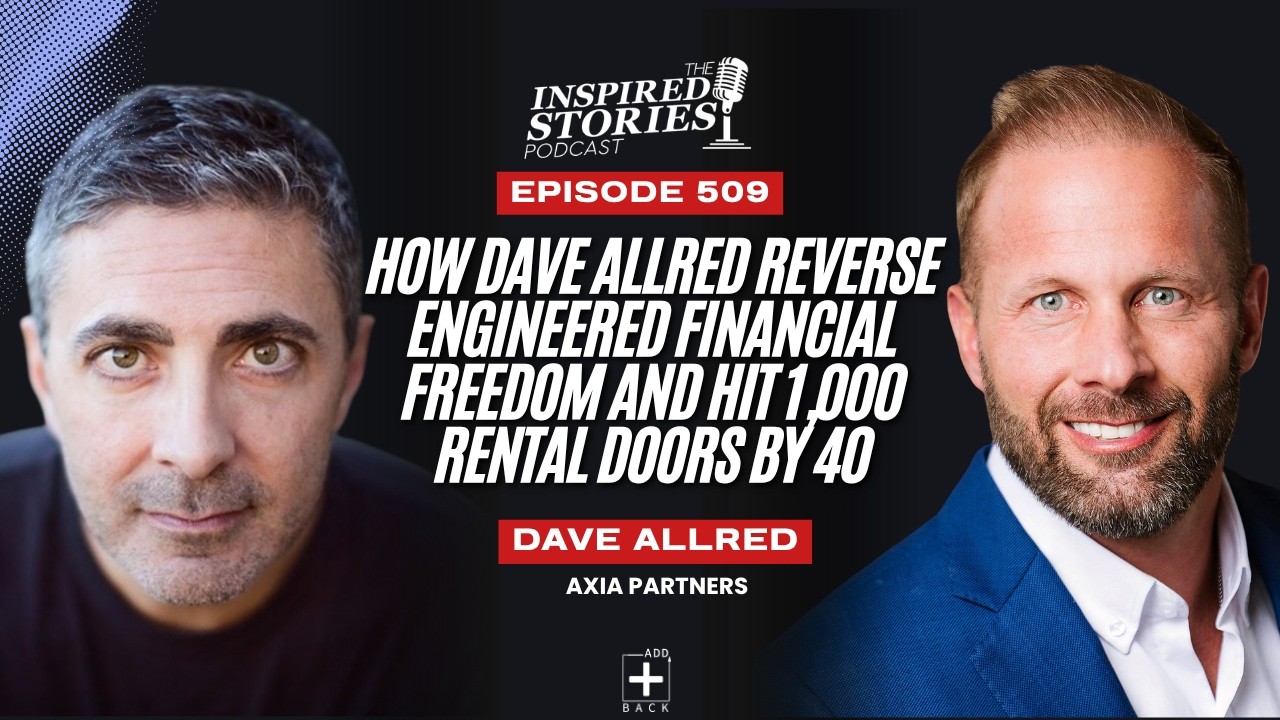
Dave Allred, founder and CEO of Axia Partners, grew up in a destitute household, was entirely on his own at 17, and built his first million by 26 after climbing through Vivint Smart Home as it reached multi-billion dollar valuation across 41 states. At 30 he sat down with a spreadsheet, reverse engineered what financial freedom would actually cost, set a goal of 40 rental properties by 40, hit it at 36, then reset to 1,000 doors by 40 and hit that too.
✨ Key Insights You’ll Learn:
Living in a semi truck cab at 17 and finding $120 a month rent with a collapsing roof
How Clint Ashton became the first person to speak possibility into Dave’s life
The three skills Dave says lead to seven figure income: salesmanship, recruiting, and leadership
Why freedom has been his core motivator from the beginning and how it has evolved
The lifestyle design spreadsheet with 10 tabs he created at 26 and still updates monthly
The financial freedom equation: reverse engineering passive income by a deadline
Power and proximity: how to get near the people doing what you want to do
Teaching all four kids to be employees, investors, and entrepreneurs simultaneously
How Axia Partners structures recession-resilient real estate funds for accredited investors
The legacy video he created for his father after losing his mother unexpectedly
🌟 Dave’s Key Mentors:
Clint Ashton (Teenage Boss and Neighbor): First person to speak possibility into Dave and rehire him after the pipe bomb incident
Todd Peterson (Vivint CEO): Modeled power and proximity at scale and taught Dave to seek the top 1-2% of any new arena
Ed Mylett and Andy Frisella: Reinforced 10x thinking and the concept of being the one who resets generational standards
Dave’s Business Coach: Connected the dots between Dave’s childhood freedom deprivation and his core motivator as an adult
👉 Don’t miss this conversation about what it actually takes to reverse engineer freedom, why leadership beats salesmanship as a long-term skill, and how one man used a Jerry Rice poster in a broken-down house to build a $50 million real estate firm.
Listen to the full episode here
Transcript
Anthony Codispoti (00:00)
Welcome to another edition of the Inspired Stories podcast, where leaders share their experiences so we can learn from their successes and be inspired by how they've overcome adversity. As you listen today, let one idea shape what you do next. My name is Anthony Codaspodi and today's guest grew up in a destitute household, was entirely on his own at age 17, and once convinced co-workers to help him build and detonate a pipe bomb.
This is where that story starts. From that beginning, he became a millionaire by 26, climbed the ranks of one of the fastest growing companies in America, then quietly set a real estate goal so specific it had both a number and a deadline. 1,000 rental doors by age 40. And he hit it. His name is David Allred. He is the founder and CEO of Axia Partners, a commercial real estate fund.
based in Lehigh, Utah that focuses on recession, resilient assets, multifamily housing, RV parks, self-storage, and industrial warehouses. He personally owns more than 1,250 rental units, has raised over $50 million in investor capital, and led sales teams across 41 states at Vivint Smart Home and Vivint Solar as those companies reached multi-billion dollar valuations.
What makes Dave's story worth your full attention is not the portfolio. It's the fact that someone with his starting point sat down at age 30, reverse engineered what freedom would actually cost, and then he built it. But before we get into all that good stuff, today's episode is brought to you by my company, Ad Back Benefits Agency. And you'll want to hear this because it's hurting almost every business owner you know. Health insurance costs go up every single year, and businesses are furious about it.
They're paying more, claims are getting denied, employees are opting out because they can't afford it, and it hurts turnover and morale. It's one of the most maddening problems in running a business and everyone just accepts it. But you don't have to anymore. Now there's a program that gives your employees unlimited access to doctors, therapists, and prescription medications with no co-pays or deductibles to meet. And here's the part that really shocks most people. Unlike every other employee benefit out there,
our program increases your net profits. We recently helped a client add $900 per employee per year to the bottom line. Results vary, but gains like that can change how a business is valued. Be the hero advisor that introduces this to your clients today at backbenefits.com. All right, back to our guest today, the CEO, founder, managing partner of Axia Partners, Dave Allred. Thanks for making the time to share your story today.
Dave (02:50)
Hey Anthony, appreciate you having me on. Looking forward to it. Let's jump in.
Anthony Codispoti (02:55)
All right. So Dave, you had a pretty rough upbringing and you were entirely on your own at the age of 17. What did life look like for you during that period?
Dave (03:07)
You bet. Yeah, so I grew up in a small town here in Utah and, know, it was a very low income, blue collar home. know, parents ended up getting separated three different times for about a year at a time, coming back together, trying to make it work for the kids. And when I was 14, my older sister ran away.
I remember hearing a noise in the room next to us and went in there and she was going out the window with two white garbage bags. And I started crying and I hey, I felt like she was ditching us. I kind of felt at the time. Fast forward about two, and I never saw her again for the next couple of years. A few years later, I was 17 and I decided to run away as well.
the window and I didn't know where I was going to go. I actually ended up finding a semi truck that was unlocked and you know, the backseat they have the cot for the drivers to sleep in. So I crashed there for a few nights, eventually found a home and it'd like $120 a month in rent. you know, the home was, you know, the roofs collapsing and windows broken and it was, you know, and really just living on ramen noodles and fast food and working night shifts.
minimum wage. little later my little brother, my best friend, he decided to get emancipated and moved in with me. And so it was just me and my brother, you really not even just trying to thrive but survive, right? Trying to get through it. And, you know, it was a challenging time. think we all have challenges in our lives, but this one was, you know, it very emotional. It was very difficult. And, you know, I remember
I had a poster in my bedroom actually and it was one of my favorite athletes, Jerry Rice, and on the bottom of the poster had a quote.
and said, you know, today I will do what others won't so that tomorrow I can have what others can't. And I remember just seeing that, you every day and really memorializing that as kind of a life motto. And I didn't know how I was going to do that. I just knew I was going to do whatever it takes, right? Whatever opportunity came up, I was going to give my very best effort to try to really reset the standard and to be able to change. I just knew I was
was
better than what the circumstances that I was in. And again, I had no idea how I was going to get out of that. know, fast forward a year or two, I decided to go on a two year service mission out in Peru and out of Cuba, Peru and learned a lot. Yeah. Yeah. Learned a lot out there.
Anthony Codispoti (05:42)
LDS.
Dave (05:47)
It came back from that experience and I was going to college, first person ever to go to college with my family and they had a recruiting booth set up recruiting college students to go out and knock doors, direct to home sales, selling home security systems in Chicago. So I jumped on that, next thing you I'm out Chicago and that was the hardest thing I'd ever done. It was so challenging, four month season, we started out with 22.
Anthony Codispoti (06:13)
Hey, hang on. Sorry to interrupt,
Dave, but before we get too far into sort of that next chapter in Vivint, I want to understand just a little bit more about what you were going through there as a 17-year-old and very young adult living on your own. What really strikes me as interesting, and I want to try to understand a little bit better, is where did this... Because a lot of people find themselves in that situation, and they don't get to the place that you
But even in those dark moments where you're feeling very alone and you're a young guy who just doesn't have a whole lot of independent life experience, where do you think this sense of I can do more, I can be more, I am more than my current life circumstances would show me that I am?
Dave (07:03)
know, Anthony, that's such a high quality question. You know, as a father of four, I've been actually trying to figure that out as well. So I my kids to have that, right? That drive, that real innate ambition and that self-belief. And I wish I had a great answer for you. I'm still trying to figure out, you know, why that is.
You know, what I can pinpoint was there was just so much emotional intensity from some of those experiences and the things that we had to go through that, you know, it gave me...
It's like it gave me an extra log to throw on the fire when it gets cold, or it gives me an extra tank of gas, an extra reserve tank of gas where when everybody else is burning out or they don't have, they want to quit, to be able to put that extra reserve tank of gas in. But where does that actually come from deep down is a great question.
I don't know. I don't know if that's somewhat genetic. I don't think it is. I think it's that poster in that quote. But I have always believed in the fact that we, I've always had a growth mindset versus this more of a fixed mindset where a fixed mindset is it is what it is. It's more of victim mindset. I can't change these circumstances. It's where I was born. It's the color of my skin.
parents, parented me, you those kind of things that a lot of times we just kind of feel like it is what it is, right? Whereas this growth mindset is, hey, I'm in the driver's seat, I'm in full control, I have extreme ownership over my own results and where I am in my life, and the future is really predicated by the decisions I make today, and I get to control that. And I think a lot people have our time with that mindset because it requires accountability for where we are today, right? So can be uncomfortable, but at same time,
It's also very empowering. But again, maybe where did I get that mindset from? I'm not really sure is the honest answer.
Anthony Codispoti (09:10)
Did your brother or sister have that same mindset?
Dave (09:14)
No, I've tried a lot actually throughout my life to help with that, but you know it's something that is very unique to me.
Anthony Codispoti (09:26)
Yeah, because I had wondered if maybe it was the hard life circumstances that created that within you. But, your brother and your sister were growing up in similar environments. And so I don't know, you just you got sort of the magic, the magic soup there. So then you go and so you live in a rough life, but then you decide that you're going to do a mission part of the Latter Day Saints, right? Part of the Mormon faith is a traditional thing to do.
And so your faith continued to be important to you during these really rough times. I mean, to the point where you're like, yeah, I'm going to go and even though I've got it rough, I know other people have it rougher and I'm going to go give my time and energy there.
Dave (10:08)
You know, I've actually never talked to us on a podcast, but happy to open up on it.
You know, frankly, yes, you know, I wanted to go do good. I wanted to be able to go, you know, share the message and to try to help bless other people in their lives. But a lot of that decision was even more so. You know, I saw a lot of these guys coming back from a two-year service mission in a much more mature, you know, well put together in a very mature grown up. They just evolved a lot through that process. And whereas a lot of my friends were just, you know, bad habits.
it's just more of a downward trajectory. And so a lot of it was actually more of a logical decision, like going back to, I'm gonna do whatever it takes to reset the standard. This was an opportunity for personal growth. I knew it was gonna be hard and challenging and uncomfortable, but I knew that at the same time I was gonna learn a lot from those challenges. And I think one thing that has been kind of instilled in me through maybe my teenage years and my younger years was this understanding that,
if I can become comfortable being uncomfortable, that's gonna serve me well in my life, right? And the iron sharpens iron and you've gotta go through it. Sometimes you gotta go through it, through the tough stuff to get to the good stuff. so, so it was actually more, I'll say maybe more, but it was very much also just a logical decision, kind of reverse engineering that, I've gotta get out of this rut that I'm in and I'm do whatever it takes to make it happen.
Anthony Codispoti (11:39)
Wow. mean, yeah, it is fascinating to me that you just seem to have been, I don't know, you have this concept of growth mindset baked into you from almost birth, right? You know, it sounds like the environment that you were in, this wasn't something that you were coached with, you know, you didn't have sort of the role model for that. But you said, hey, I'm in a rough spot. Here's an opportunity for growth. And even though it's going to be really hard, I'm to put myself in that position so that I have that opportunity to become a better person.
And go ahead.
Dave (12:12)
There is one other thing I just thought of, which is I had a boss.
You mentioned the pipe on the pipe bomb experience in the introduction, which I've also never talked about a podcast but Yeah, so I had this gentleman named Clint Clint Ashton and he really believed in me. I was 14 15 16 He gave me a job and he was the first person I felt really spoke possibility into me and he saw he Articulated to me that he saw something special in me and that he he knew there was greatness in
in me. He's just my boss and a neighbor. It meant so much to me to see somebody else that I looked up to as basically a mentor, a business leader that was speaking possibility into me. I want to give him some credit on this podcast, in fact, for having not just seen that, but having spoken that to me. It meant the world to me. think that a lot of people, especially when we were younger, we have so many limiting beliefs. have so many limiting beliefs.
and if we can just speak possibility in other people and help them see the potential and help them see the greatness that's in all of us, that means so much to people. times, that's all I really need, that spark of, you know what? Yeah, that resonates, I feel that. And so I'm very grateful for him and I think he did have a pivotal role in me being able to think bigger and to see more potential in myself.
Anthony Codispoti (13:45)
and tell us his name again.
Dave (13:48)
Clint Ashton.
Anthony Codispoti (13:50)
Clint Ashton, for everybody listening right now, and I'm giving this own advice to myself, look for opportunities to be a Clint Ashton in somebody else's life. Speak possibility to them. Open up new ideas, new doors. Let them know that you believe in them. Look at Dave here today. What a great starting point for that. OK, so let's hear about the pipe bomb story, and then we'll get back to the Vivint.
storyline there that we skipped over.
Dave (14:21)
Just
dumb kids, know, I think it's probably 16, 17. And we're manufacturing composite fiberglass.
light poles, right? That was my job making, I don't know, five or six dollars an hour. And we were just bored and they have all the materials sitting around. And so we decided to make a pipe bomb and figure it out. And we went outside and threw it over the fence into a cemetery. It was much stronger, like much bigger explosion than we had anticipated. You we all kind of run back into work, act like nothing happened. Next thing you know, the sheriff's department, the police department, I mean, it's a full on SWAT team.
like it's showing up on site. And so we all got fired that day, but Clint, my boss, you know, four or five days later, he was like, actually, Dave, everybody else is fired, but you know, I'm putting on probation, but I still want to give you the opportunity. So he let me come back on with the company, which again, I don't know why he did that, but you know, he just, believed in me, I guess. even though I think it was actually my idea, I think actually this is too much. I think I can't get incriminated.
Anthony Codispoti (15:08)
Okay.
Dave (15:32)
20 years later, right? I just want to make sure on this. I'm not sure,
Anthony Codispoti (15:35)
I have no idea what the statute of limitations
are.
Dave (15:39)
But yeah, so it's just a fun story there, kids being kids.
Anthony Codispoti (15:42)
Yeah. Kids,
yeah. Kids learning from, well, that was the last bomb that you made, I take it. Yeah, okay. Okay, so you went and you did the mission trip to Peru with your church. You come back and you find your way to Chicago where you're working with Vivint, nation's largest smart home company. Pick up the story there. Tell us about the work you were doing.
Dave (15:49)
It is,
Yeah, yeah,
it's going out that first summer and you know, it really challenging. Again, started with 22 reps in the office. By the end of the summer, there's only three of us left. And you know, midway through the summer, was failing. It such a hard job, right?
I just remember thinking daily, know, actually probably hourly, hey, you know, everybody else is quitting, maybe I should just quit. This isn't working out for me. But I remember thinking, you know, hey, at a minimum, I'm going to learn a lot that's going to serve me later in life, right? Whether that's salesmanship, psychology, personal mastery, time management.
know, negotiating, whatever else. And so I stuck with it because I knew I was going to learn from it, from the opportunity. And, you know, it's interesting. I made $31,000 that first year, which to this day is the most meaningful money I've ever made in my life. You know, it's more than my parents ever made. it was, it was, was so, it was such a big win for me. And, you know, was enough to come back the next year. I would have been in 2023.
Anthony Codispoti (17:08)
And what was the year? Give us an idea of the timeline.
Dave (17:15)
Sorry, sorry, 2003.
Anthony Codispoti (17:16)
that you
2003 you made $31,000 most meaningful money you ever met. Okay, go ahead.
Dave (17:22)
Yep, and that was enough of a win to come back the next year as a sales manager and you know, I created a team of 25 individuals. I went out to Denver and that year I was the top first year sales manager, made $157,000.
which was incredible to me because if you'd asked me when I was a kid or a teenager what the best case scenario would have been, would be making maybe $100,000 in a year, right? I did that my second year. But it's interesting, and that really set me on this trajectory where the next year I became a vice president and then made a quarter million, the next year maybe a half million, and started this really incredible leadership career that ended up being managing
121 sales teams in 41 states across the country. it was good.
Anthony Codispoti (18:15)
Yeah, like, because there was a there was an unlock that occurred at some point in this process that I want to better understand, right? You were everybody's quitting around you. You feel like you're failing. You're about to quit. But then you start to find some success. made thirty one thousand dollars in that first year. You come back the next year. You're making way more than that. What what happened? What what was the unlock period or unlock periods that took place?
Dave (18:43)
Yeah, great.
Such a great question. So first off, you know, going back to quitting.
I think I just realized, hey, this is setting a precedent for my adult life and my career, my business career, right? So if I'm going to quit, then that's setting, yeah, it's setting a precedent. And, you know, it's really interesting. If I would have quit, it would have completely changed the trajectory of my life, right? If quit mid-summer, I probably would have been, maybe I made $5,000, $10,000, and it would have felt like a big loss and a poor use of my time. And so I'm so grateful that I didn't quit. You everybody else was tucking
their tail between their legs and going home for whatever reasons. They missed their girlfriend, they weren't making money, you know, there's a lot of change in the company. But
But I didn't. The second thing would be that I realized that a core motivator for Dave already is freedom. And I'm grateful for having really figured that out early on in my career. And initially it was financial freedom, right? I never had money, any freedom around money. And so I was hyper focused on financial freedom. Once I achieved the financial freedom, then it really evolved to a focus on time freedom, our most precious resource.
Then it's evolved to today where it's a focus on lifestyle freedom. And so it's been an interesting evolution there But at my core it's freedom, right? I have a ton of freedom do life how I want to do it with people I want to be doing it when I want to do it and you know, I actually actually learned something at a From it with a business coach a few months ago and he he connected some dots there He's like, well, maybe that's because you know when you were young Yeah, I like to always say everything's based on your childhood, right? But you know, I was always grounded
I had very very little freedom and so potentially that's why it's such a core motivator for me today. I think it's a core motivator for most people as well. so that focus on freedom, right? So if I can reverse engineer, know, I want this for my life so what I need to be doing today, what are the habits I need to do, you know, what are the opportunities I need to follow, how do I need to show up personally to make sure I'm in alignment and in congruency with what I really care about the most, which is freedom. And so that was a big
part of it and the last one I'd share is you know that second year I learned
this concept, which is there's three skill sets that if you have these three skill sets, you should be able to make seven figure income because money follows value. So the three skill sets are salesmanship, which the first year I was just focused on salesmanship, which is really addition, right? You make a sale, you make X amount of commission. The second, maybe we'll call it a magnifier.
or a pillar is recruiting, right? So you can recruit other people, now it's multiplication. And the third one is leadership. And that's where really got fun for me, right? So the three skill sets to earning a seven figure income, I'd say salesmanship, recruiting, and leadership. And leadership is where I really kind of found my niche. And it's where it actually got fun, right? The salesmanship side of it, I've actually never really enjoyed it. There's nothing fun about that side.
But the leadership was amazing. So could start bringing in young people and helping develop them into leaders and seeing them develop other people. that ripple effect from leadership and personal development, leadership development is where it really got fun. And that's what I'm actually the most proud of throughout that 16 year leadership career.
Anthony Codispoti (22:24)
It's really interesting. So Vivint, just to sort of paint the picture here and what you were putting yourself through, this is door to door sales for home security and solar systems. Is that right?
And so they're taking a team of young people, moving them to a different part of the country so you don't have the distractions of family, girlfriends, friends going out at night. So you can be laser focused on what you're doing. They know that door door sales is really hard. And so there's going to be high attrition. But you built some battle scars going through this. You started to find a little bit of success. Sounds like you never really got into enjoying the sales, but you found a process that worked and where you really
found your jam was in leadership training, teaching people what it is that you had learned. Can you say more about specifically the leadership training part of it and how you either identify somebody who has the potential for that leadership or how you can teach it to just anybody that's willing to absorb it?
Dave (23:34)
Yeah, I think that leadership.
is, know, I always say that salesmanship is the most valuable skill set to have because everything comes down to sales. But if you ask me today, I change that answer has changed to leadership. Everything goes up or down from leadership, right? Whether it's in business, you know, as a father, as a husband, everything comes down to leadership. It's how change happens. It's influence. Leadership is influence. And so, you know, and I was never a great salesman. I was I was good.
I was above average for sure, but I was not great at that. Where I excelled was the leadership side of the business. And so a few takeaways there would just be going back to possibility. I feel like it's been really helping to bring out the individuals, like what motivates them, right? And so it's seeing down news, one on one performance interviews and really seeking first to understand before being understood. And so digging in at your core, what motivates you? Why are you here? What do you really want from this opportunity?
hone in on what it is that they really want, like truly want. And then if you can just make, you know, connect the dots there and hopefully, you know, make it a shortcut for them. That's where I found we get the best performance out of our employees and our co-workers. But what's interesting there is when you first ask somebody what they want, usually it's, hey, I want, you know, want money, or I want a sports car, I want to, you know, I want to get a home.
But when you dig a little bit deeper into it, it gets very fuzzy very quickly, very ambiguous, because most people don't really think a lot about what they truly want. know, an interesting stat is that most Americans spend more time planning out their annual vacation than they do actually planning out their life. And so it's getting really, really helping them to get clear on what the end game is and then just reverse engineering it to make sure that as a leader, I'm helping push them and keep them on the right path.
and creating the vision they need so they can, you know, eliminate some of those limiting beliefs and all the self-doubt and be able to show up in their best.
I think that's been a big part of my secret sauce, if you will. It's not a very conventional leadership style. But for me, found that's where not only that it resonates and it works, but also that people really appreciate that because it's more authentic. It's not just talking about KPIs and scoreboards and dollars and cents and whatnot. It's more human. And it's really trying to leave from the heart. with that being said, results matter,
sure performances are but I found that to be the most successful and effective way of leading.
Anthony Codispoti (26:18)
Yeah, in addition to making sure that the company numbers, the corporate numbers are met, you're getting down and personal with this individual and making sure that they understand what their life goals are, where they want to get to, and then helping them kind of map that. And I think that's tremendous. You're right. There's there's not a whole lot of folks that are introducing that part of it. So at the age of 26, go ahead, Dave.
Dave (26:42)
I was going to mention one more thing. I also realized early on after making that, you know, 157,000 my second year and then more the next year, I quickly learned that, you know, satisfied needs don't motivate. And so, you know, when you have that kind of in your bank account or your employees do, a lot of times you see a lot of complacency and we start to slow down a little bit and take the foot off the gas. And so what worked for me,
is I sat down on a Sunday and I remember very clearly, I turned into a four hour session, pulled up a spreadsheet, and like, what do I really want from all this? Why am I doing such a hard job? And what's the end game? And so I started on a spreadsheet, created 10 tabs, and I called it lifestyle design. And so there's 10 tabs here. It's my life mission statement, which includes my non-negotiables, my core values, my guiding principles. I even included my
own eulogy, which is an interesting practice of going really deep into what it is that really motivates you your core. What do want your family, your friends, your neighbors, people that you care about in your life to say about your legacy? It's a great way to be able to go deep in terms of what really truly motivates you as an individual. The second tab was my health, and then my time, and then money, and business, experiences, spiritual, et cetera, relationships.
And so these 10 different tabs, you the time was very rudimentary, but it's really become a North Star for me in my life. And so every month I sit down and I'll update that with any new information, a new book, a podcast, something that really resonates with me that I want to incorporate in my life.
It's really been a beautiful way to be able to live life with intention and purpose and to design the life and live it on with you know in on purpose versus by default and By the way, if any of your listeners would like to download that I decided to put on my website Dave all red comm it's a free download under the resources tab and And I also created a youth version last two years ago for my kids, which by the way, is my my favorite
things as a dad and so it's just a watered down version of that and all four of my kids have gone through it every summer and in writing exactly how they want to live their life how they want to show up in all 10 of those categories and I mean for me at least I feel like that's a that's pretty badass to have your kids know exactly what they want in writing it's gonna change with time right but I feel like that's been really a big key for me to be able to you know honestly say I don't have any real regrets in my life I have a lot of lessons learned but I don't have regrets in my life I if I know
what I really want, you know, it just makes the process a lot more, it's a shortcut. And, you know, it's also creates fulfillment because you know that as you work so hard or as you make these decisions, it's in alignment with what you really truly want in your life. Whereas most people just go through life kind of meandering based on how they feel, their motivation level, whatever fires they've got to put out that day. It's very emotional. And what I've learned is that motivation is just an emotion, right? Motivation is fleeting. And it's somewhat super
official. And so if we can really go deep and figure out we truly want our lives and then operate around that and reverse engineering our habits and our daily decisions in alignment there, that's where the magic happens.
Anthony Codispoti (30:09)
So you
mentioned your kids and so I'm going to ask a selfish question here because I've got two boys who are currently nine and 11. And I understand that you, you you're teaching your kids about the same things that we're going to get to. We haven't gotten to yet in terms of talking about what you're doing now with Axia Partners. But since you brought them up, you know, passive income, investing directly, like what does it look like to teach younger people, children, these types of concepts and skills?
Dave (30:38)
It's my favorite thing. It's my favorite thing, Anthony. I've absolutely loved it. You we never talked about finances, investing, tax strategy, any that stuff in my home growing up. But in our home, we talk about it all the time. And I think it's great to normalize that. A few quick examples. You all of my children ages 10, sorry, 11, 14, 17, and 20, they're all employees of my personal real estate firm.
personal real estate company, which is great way to involve in the company and participate versus just talking to them about it. It's also a great tax, some tax plays there, some tax strategy. We've also created, then with those wages I paid to them, it's a 60, 30, 10 split. So 60 % of whatever they make goes into savings, which is, and then 30 % goes into.
discretionary, can spend on whatever they want to. And then 10 % goes into our family foundation, the Aldridge Family Foundation. The Aldridge Family Foundation is basically the four kids are on the board of directors and they get to choose whatever charitable causes they want to support every year. And it's been a beautiful way of teaching the kids the more we give, the more we live and just the power of giving back and what good money can do.
But with that 60 % that goes into savings, each child has their own allocation, it's real estate, private equity, if they're doing stocks, if they're buying some Bitcoin or crypto. And so you get to choose how they want to allocate that. But it's been a great way to be able to teach them the principles of money. The first Sunday of each month we sit down and we go through a scorecard. My kids are very competitive. And so there's a scorecard of how much passive income each one of the kids is currently sitting at.
They all have real estate ownership with me. We used to do a simple JV or joint venture agreement where they can come in and partner with me on a fourplex or know townhome whatever else. You know and then also it you know with the young kids it's about gamification right so you got to make it fun you know it's it's a there's a lot of different ideas on.
Anthony Codispoti (32:45)
Yeah, I was gonna say some of these concepts
are a little bit too big for my kids right now. So how do you do that? How do you gamify it?
Dave (32:51)
Yeah.
Yeah, so I mean a few things on that note. So like a scorecard or a leaderboard is a fun way of doing that.
You know, another way of doing that is to, I there's a lot of great books out there and they have youth versions of it. For example, Rich Dad Poor Dad's one of the greatest books on real estate investing all the time. And they have a version for teens and also for kids. And so what I do with my kids is anytime they read a book that's, know, business, real estate, investing, personal development, they simply put a few of their favorite takeaways or their golden nuggets into a shared note on their iPhone with me.
and then I pay him $50 for a book report. so that's been an interesting way to be able to kind of make it fun. And then on Sunday nights, we'll share some of those takeaways that the kids have from these different books.
And maybe this isn't really applicable for the age of your children, but my oldest daughter, when she was 15, she really wanted to get a Tesla Model 3 for her first vehicle. And she asked like 20 times, and every time, absolutely not. It's a terrible idea. My insurance agent's like, Dave, that's a terrible idea. There's a chance there's a claim within the first year.
But then I realized, know, the higher quality response there is saying, hey, that's a depreciating asset. So show me how you're going to create enough passive reoccurring income to be able to pay for your monthly payment. And we can go from there. So she came back to me and said, OK, I want to sell some of this Bitcoin. want to sell my Disney stock and be able to invest into one of your fourplexes, real estate investment. This can create X amount of recurring passive income. And that will cover my lease payment.
from mom, I'll be the Uber driver taking us the kids to these sporting events and dance recitals, and she'll pay me 10 bucks an hour. And so ends up being so, so, so, so we did it, right? So now it's a true win, win, win, where she has all of her capital still invested in real estate, which is appreciating and creating cashflow. She has her dream car. Mom's got a full-time Uber driver, right? And I think it's just a great way of teaching, you know, the power of passive income and, and whatnot there. So.
Anthony Codispoti (35:04)
I love
that. Yeah.
Dave (35:06)
We could talk
for an hour, a whole podcast on this, because I really love this. Maybe, if I could share one last thing. Is that okay?
Anthony Codispoti (35:11)
Yeah, go ahead. Yeah, of course, Dave.
Dave (35:13)
know, entrepreneurialism. I think that kids learn so much from being entrepreneurs. last about a year and a half ago, I challenged my kids to create their own businesses. And so all four children launched their own businesses. You know, my youngest, she created a, she freeze dries candy in little bags and she goes out and knock stores and sells every eight dollars a bag. You know, my son vending machines for passive income.
Anthony Codispoti (35:36)
freeze dries
candy.
Dave (35:38)
Yeah, she'd go buy Skittles
and Milk Duds. She has like 15 different types now. And she freeze dries it.
Anthony Codispoti (35:46)
Why freeze
dry just because people like cold treats?
Dave (35:50)
Yeah, it's a trend right now.
Anthony Codispoti (35:52)
Okay. right.
Sorry, go ahead. That was totally irrelevant. But it piqued my curiosity. Okay, what are the other businesses your kids are doing?
Dave (35:59)
Yeah,
so vending machine business and then my two older daughters, they teamed up and they created a company called Adele and they sell consignment women's jewelry and hair products and whatnot in the mall.
and now they've scaled into three different locations across Utah. And so it's so fun to be able to see these kids, like the confidence, the self-esteem, and just how much they learn about marketing and sourcing product and sales and taxes and accounting, bookkeeping. The whole thing has been so amazing. I'm so proud of them for where they're at with that.
Anthony Codispoti (36:34)
That's really cool. Yeah,
I appreciate you sharing all that day. So let's go back to the age 26. You're a millionaire for the first time, which, you know, 10 years ago, right, somebody would have told you like, they're crazy, no way. And then at some point, you know, you're still at Vivint, you you asked the CPA, you know, hey, what are the wealthiest clients? You're looking at your clients, what are the wealthiest folks do with their money? And
The answer that they gave you was very instructive in what you were going to do going forward. Tell us about that.
Dave (37:11)
Yeah, so I made that $157,000. I was my CPA. And I said, hey, what are your wealthiest clients doing? I felt like I was wealthy.
And he said they're they're they're investing in businesses or investing in real estate. And I remember thinking, well, I know nothing about real estate, but that sounds interesting. And I'm going to become a student of the game. I'm just going to become a student of this. figured out and that was an immediate decision. And I just started spending a lot of time around people that are actually doing what I wanted to be doing. So some of the executive team at the company that they had real estate. So we were flying to different offices.
And a lot of times with our...
the owner he has on plane and had a chance just to sit with him and really bend his ear on what works, how he does it, the approach. And by the way, before I forget to share this, I really believe in this concept of power and proximity. Like if you can just be around the people that are doing the thing that you want to do, it's such a life hack. It's a cheat code, if you will. Because you can look at somebody in the eyes and see that they're actually doing the thing. It's really inspirational.
like, hey, this guy can do it. It can't be that hard, right? There's a way to do this and be able to learn real time what worked, what didn't work from them. So power and proximity has been huge for me in my life. But yeah, I decided to commit to it. I'm just going to figure it out. And I realized that what I love is freedom, and real estate creates this reoccurring passive income. I call it mailbox money. That's really hard to beat. I also knew I really hated paying more than I should.
for taxes and that real estate has one of the best tax advantages of any asset class I'm investing in. And third is I realized I hate to lose more than I love to win. And real estate has so much downside protection as a hard asset. And so I look at those three things, right? Freedom, cashflow,
not wanting to lose my money and not wanting to pay lot of taxes, real estate has made so much sense to me. And so I decided to dive into it. But at same time, I was still managing all these offices and these teams around the country, so I didn't have a lot of time. And so I made the decision to be a passive investor versus an active investor. Which, by the way, for anybody thinking about getting into real estate, that's a very important distinction. A lot of times people think they're going to be passive. They end up having to do a lot of management. Even if there's a management company, you have to manage
management company and as it being a lot more of an active process than passive. But for me it was just buying some town homes and then I bought some fourplexes. I ended up buying around think was 28 fourplexes around Utah, Idaho, Arizona. But where you know I just put some money into it and they build the whole thing and it was managed and it's very very turnkey.
So I could protect my time and energy focusing on building the business, recruiting, developing the leaders that I was at stewardship over. And so that's, yeah, that's how I got started.
Anthony Codispoti (40:18)
And you talk about building the business, you were still at Vivint. And so you were talking about wanting to continue putting your energy into building that business, right?
Dave (40:26)
Exactly, yeah, it's just a question.
I think a very high quality question is always asking, what is the highest and best use of my time and my God given talents?
And whatever that is is where you should really be putting the majority of your focus. Right. So for me, with real estate was more, this is a side hustle. It's something that's very passive at the time. You know, and fast forward and we share more on that story. It, you know, at age 36, I had hit all my goals and created this financial freedom. So as soon as I hit my financial freedom number, I retired from that leadership career and went full time into real estate. But I learned enough to be dangerous along the way.
to be able to be, you know, pretty competent and confident in my approach that time.
Anthony Codispoti (41:12)
And so you talked about the importance of power and proximity, right? Get to be around the people that are doing the things that you want to do and learn from them. And you were in a great position to be able to do that at Vivint because you were doing well. You got to be around some of the other executives, know, folks, you know, at higher levels than you that had more cash, more experience in these things. What a great opportunity for you. Maybe there's somebody listening right now that's like, I don't have access to that.
How do I leverage this power in proximity? What advice would you have for
Dave (41:49)
Try to create value first.
I think that, you know, a lot of times when somebody's randomly reaching out, okay, can I grab lunch or can I bend your ear or can I get some of your time? It's really hard, honestly. In fact, I would advise against that if it's, you know, somebody that's operating at very high level because those are really important resources, right, your time. And so the better way, approach, in my opinion, is to ask yourself, how can I create proactive value for this person, right? Maybe it's making an introduction.
maybe it's something you send to because it's on their social media posts or they're dealing with some issue.
Maybe it's a handwritten card, you know, addressing something. There's a lot of different ways to do that. And sometimes you do need to pay to play, right? So a lot of times it's been, I paid for a ticket to a real estate conference or my business coach or my business strategist, you know, they end up knowing somebody else that has that, that, so I get the proximity through having, you know, paid for a conference or membership or a mastermind even. Right. And so sometimes, you know, pay to play. I don't think that's,
anything wrong with that. But my best advice would just be is to try to create value first. The third thing would just be try to create an experience. You know I believe that experiences are the new economy and everyone wants cool experiences and memorable experiences. So if there's a way you can create an experience or value for that person then that's gonna it's gonna stick. It's gonna be more meaningful for them than just sending them a DM or text asking for some time.
Anthony Codispoti (43:29)
So at age 36, you make the decision to retire from your role at Vivint and focus on real estate full time. Is that when Axia Partners was formed?
Dave (43:40)
Pretty close, yes. So I retired and then I started doing what's called syndications where I would find some these big multi-family apartment complexes across the country and then I'd bring my friends in with me. So I would invest personally and then allow, know, invite some of my friends to come and partner with me on that deal.
And speaking of power and proximity, you know, when I, learned from my, CEO, Todd Peterson at Vivint, that anytime you go into a new arena, the best thing can do is try to find proximity to the very top one to 2 % of people operating in that space because those guys operate with excellence. And so I found, you know, two or three of the very best operators in the country. And then I partnered with them and co, co, co syndicated. If you want to co.
Co-sponsored some of these big deals and that was great for me because I could go to my friends my family Okay, guys, I'm investing in this one. It's a proven operator. They've got a track record You know, they have a lot of competency here and help remove that risk of loss because of their track record so I can tether my you know my my abilities with their proven track record and that was a big catalyst for me to be able to Accelerate this this journey because not only do I proximity now to that individual but also
also their team, right? So, you know, I just know who their legal team is and who their tax strategist is and who their funding partners or their creditors are. And now I have proximity to all of their circle as well as that individual. And that was huge for me. So I a few of those. My partners and I brought a Topgolf into Utah, here, which is really fun. Kind of a legacy project in our backyard. And started doing more more big, big commercial deals. And then in 2020,
I
had a few hundred different investors now at that time working with me and I was really proud of the fact that I've never lost a dollar investor capital ever in any of my investments or any times I've raised capital for the investments.
And so I fell in love with the fund structure because a fund is a vehicle where you have multiple different assets in one investment vehicle. And so it really helps to mitigate downside risk. It's a very powerful risk mitigation strategy. And so I decided to launch Axie Partners. And yeah, I'm happy to kind of explain more about what Axie does, but that's some of the journey that.
Anthony Codispoti (46:00)
Yeah, let's get an AXE in just a second,
but explain to me how it was that you got to a collection of a few hundred different investors there in 2020. It's a huge number.
Dave (46:11)
Yeah,
so when I was backing up when I was 30 years old, out doing this difficult job and I created something that I call the financial freedom equation and it's a really simple, it's gonna sound very simple but.
I sat down and I said, I've been talking about financial freedom for a long time, but there's a difference between wanting something and being committed to it. And so I pulled the spreadsheet up and it's reverse engineered. If I need to call it $200,000 a year in recurring passive income to pay for my family's cost of living, housing, gas, cars, insurance, everything.
you know, how many more years am I willing to commit to this? And I was 30 years old and I said, okay, I'm gonna spend the next 10 years focusing on this. So that means that, you know, every year I to create basically, you know, $20,000 of new recurring passive income, $200,000 divided by 10 years, 20,000 per year.
And then the next step for me was, okay, well, how many rental properties do I need in order to achieve that? And the answer was 40, 40 rental properties. And so when was 30 years old, I created this mantra of 40 by 40. So it was 40 rental properties by each 40. And that gave me that financial freedom. And so I just went to work on it. Like literally every Sunday I would sit down and I would review how we're progressing on this. And by the way, I think there's real power in writing down our goals. They say you're 42 % more likely
to hit your goal if it's in writing. And so, you know, it holds you accountable. It's also fun to see those incremental improvements along the way. And so 40 by 40, just went to work on that. I hit that goal when I was 36. And that's when I, you know, stepped out of that leadership career and went full time into real estate. I reset that goal to ownership in a thousand doors by age 30. And why a thousand? You know, there's a concept called HAG, Big Hairy Audacious Goals.
And I've always loved the principle that 10x is easier than 2x. And so sometimes when we just think a lot bigger, it actually makes it easier than just trying to double or triple. And so.
Anthony Codispoti (48:21)
And so as you're thinking
bigger, you like, need more investors to get there faster. Is that right?
Dave (48:28)
Exactly. mean everything just you just think so much bigger. There's a book called
the magic of thinking big. was out having lunch with Ed Mylett and Andy Frisello a few years ago in St. Louis and they were talking about this book and then I went back to Andy's house and his library had like 60 copies of this book and so he gave me a copy of it. Read that multiple times but it's a great book. I recommend it for your listener base. But yeah when you think bigger like that you just start to you know call it a lot of attraction call it reticular activation system call it secret you know the secret it's like you
start
thinking about things on a whole different level and that's what you attract into your life. And so I this goal for a thousand doors. I that goal actually the last month when I was four years old so they'll get that checkbox and it's about that time then like you know I want to do this at a bigger scale to create more impact for more people. You one of my personal mission statements is I want to help 1,000 other people create true financial freedom through passive commercial real estate investing and I also want to create direct value for at least 10 million
people throughout my life. And so by doing a fund, we're able to help create that at scale. Today we have over 500 investors. We're about four or five years in with the firm right now.
Anthony Codispoti (49:48)
Okay, so tell us about Axia Partners, what it is, how it's structured and what kind of investor it's built for.
Dave (49:55)
Yeah, you bet. what we do is we invest in commercial real estate that is recession resilient.
And so primarily that's multifamily, it's self-storers, industrial warehouse. And we really, really are excited about RV parks right now. And so the approach is tax advantageous, commercial real estate, it's recession resilient, it creates strong passive income. And so we do that through a fund structure. So generally it's a three to five year fund to help mitigate downside risk. And we pass through 100 % of the tax benefits to our investors. You know, we're targeting close to a dollar
for dollar and year one depreciation or tax benefits. so, yeah, so a lot of our investors are more so looking for really strong cashflow, looking for great tax benefits, and they're looking for capital preservation. And so everything that we acquire is is is what's called a value add approach where we're buying something that's a little bit older and needs some improvements made to it. And then our team will come in and ask a lot of strategic improvements to that. And maybe the best way to articulate this is
You know with our new fund it's called the AXI Distressed Opportunity Fund. We're focusing on multi-family value-add multi-family apartment complexes, but also destination RV parks and it's a really exciting asset class. And so Anthony just to kind of kind of summarize you know what it is that we do and why we do it. The reason why we love destination RV parks are for the following reasons. One, create cash flow right? It mitigates a lot of downs.
risk when you have positive cash flow coming in every month.
Two is phenomenal tax benefits, which all gets passed on to our investors. Three is we're in the early stages of the maturation pattern. And so some are like self-storage units and mobile home parks. Ten years ago, it was very fragmented, but now there's been so much money that's poured into it in the last decade. It's really hard to find great deals. And we're just starting to see that kind of capital roll into RV parks from the big private equity and institutional players.
And then also value add. So a lot of these are mom pop operators, I there's not, you know, super sophisticated. And so we're able to come in and add a lot of value with, know, pickleball courts, clamping, tiny homes, bogey arenas, know, cornhole restaurants, and add a lot of experience to that.
And then lastly is financing. So a lot of the time it's what's called seller financing. They want to retire and move off to Florida. And so we're able to just work out a note with them versus having to pay higher interest rates as well. So anyway, we're really excited about it. As for your question on a typical investor, it's just high net worth individuals, accredited investors, minimum investments of $100,000 up to multiple seven figures. And it just depends on the appetite.
of the investor, primarily it's just making sure we don't, you know, it's mitigating downside risk while trying to create as much yield as possible. And then last thing is we call it experiential investing. So it's this commitment to full transparency and helping show our investors how we do what we do, which has been really interesting for a lot of our partners that want to learn more about real estate without having to be active, right? So in this fund structure, it's completely passive without having to really spend
you
know a lot of time in the process. So it's been fun. We are looking to continue to grow the firm into a multi-billion dollar best in class investment firm and it's been an incredible journey. Super proud of the team so far and we're just getting started.
Anthony Codispoti (53:45)
Say more about the tax benefits because you brought that up multiple times and you pass along 100 % of the tax benefits to investors. Explain that for somebody who isn't familiar with the real estate space and what those benefits look like.
Dave (54:00)
Sure, you bet. And I'll have to give a disclaimer that this is not tax advice. Talk to your own CPA.
My legal team wants me to make sure I always put that out there. With that being said, I do feel like taxes are one of the most misunderstood, underappreciated benefits of real estate investing. I even share with this on here, even for me personally, with making really solid income, I haven't had to pay any federal taxes now for a long time. And it's because of what's called depreciation.
Right, and so we buy a property and you can depreciate a portion of that upfront and it's called cost segregation studies. So high level without getting the details. Generally when you buy a piece of real estate you have what's called a depreciation schedule where you get to take, you know, call it 1 29th of the entire
value of the property on a yearly basis. When you do what's called a cost segregation study, which means an engineer comes out of the property, they look at everything, know, light bulbs, the carpet, the appliances, the roof, they can depreciate a lot of that or accelerate that appreciation on the front end with a, you know, somewhere around call it 30 % in year one.
And so like light bulbs, you know, the carpets on a three-year depreciation schedule. So you get a lot of that tax benefit upfront. And with these RV parks, you know, again, this is not tax advice, but, you know, we're able to get somewhere around a dollar for dollar. So if somebody put a million dollar investment into this fund, we're targeting around a million dollars in losses, Like depreciation in the first year. Yeah. And so a lot of our largest investors actually come in more so
Anthony Codispoti (55:42)
in that first year.
Dave (55:49)
for those tax benefits and for the capital appreciation or for the cash flow because of the incredible tax benefits of, and especially in RV parks. There's a few reasons we won't jump into the details right now with that. and Anthony, that's what I love about real estate is, if you go buy a depreciating asset like farm equipment or oil and gas and whatnot, it's truly depreciating over time, right? Whereas with real estate, we're able to buy an asset that should
with time, especially with this whole value-add approach that we use. And so it's appreciating, but then we get the depreciation tax benefits regardless, while we're creating cash flow, while we're mitigating downside risk because it's actual real property creating real value.
Anthony Codispoti (56:37)
Love it. Switching gears on you, Dave, what's the hardest thing you've ever had to overcome personally and what did it teach you?
Dave (56:46)
the hardest thing I've had to overcome.
Well, in real estate, would be the four, my first fourplex. I read the book, How to Invest in Commercial Real Estate for Dummies, like those black and yellow books. And I thought I knew a lot about it. anyway, it's a whole story. yeah, I and then the 08, 09 hit and it was it wasn't fun. But, know, what comes to mind there is more on a personal note. And that is
about five years ago, my mom, so my mom and I, we had kind talked about childhood stuff a little bit, right? And I was in a Topgolf planning meeting with the city and I got a call from my dad that the mill service delivery, the mill delivery service to my mom's house, she's living in one of my town homes at the time.
had missed like three days in a row, or sorry, three mils in a row. And so we drove over and we had to get a locksmith to get the door open.
Family mom she had apparently gotten up at night. She had her back fused for some stuff and so she was anyway nighttime got enough and she's falling and hit her head on the on the cabinet and apparently I went into a know coma for I was unconscious for about a day and a half and a passing away, you know by herself on the and and and
And it was completely unexpected, right? And it was something that for me was really hard because when I mentioned previously, I don't have any real regrets in my life. That's probably actually not true. The one regret that I do have is...
I never had a chance to tell her, know, I expressed the gratitude for what she did do for us, right? And as a parent, you know, I know how hard it really is parenting. And I just wish I could have expressed to her, hey, you know, mom, I know you did the best that you knew how to do. And I love you for it I appreciate you for it.
And we only have two parents in life and when they're not here anymore, we don't get new ones. And so I just say, like anybody listening to this, it's the challenge would be is to make sure you show appreciation and tell them you love them while you still can. And that's just something that's hard for me because it was just like an ego, right? I never took the time to really express all that to her just because I still kind of resented some of those things from earlier on in life.
but I feel like we gotta give people grace, right? Nobody's perfect and I make plenty of mistakes as a dad and as a parent and as an adult. And so we just gotta get a little bit of grace there and make sure we can express those, appreciation while we have the chance to do so. And maybe one more thing I just share real quick is even with my dad, you he's got Parkinson's disease right now, about 11 years in and you know, definitely kind of on a downward trajectory right now.
And one thing that I this year, sorry last year for him is I created what's called a legacy video and it's a beautiful process.
hired a company to come in and spend a few hours to interview him. And they created a very well put together produced docu-series with eight different series that his life, right? So his parents, him growing up, lessons learned, how I met my mom, being a dad, lessons learned for our posterity. And so it actually fleshed out a lot of hard conversations within the family, but it's also an amazing way to be able to recognize him.
for all that he did do for us. And I think that's been a really, really interesting way to be able to help kind of resolve trauma. It resolves some of the generational patterns that a lot of us, you know, kind of hold on to.
was to be able to just talk about it and be able to create space and really focus on the positive and all the good things versus what humans, know, human nature is that we usually focus so much on all the bad things. In fact, like psychology is we spend three times more energy and time thinking about negative experiences versus the positive experiences. But again, that's something that we get to choose how we frame that in our lives and how we want to, you know, how we want to our lives. anyway, sorry for getting a little bit personal there, but that was what came to mind.
Anthony Codispoti (1:01:24)
Yeah, I appreciate you getting personal there, Dave. That's really helpful. You know, I can see how that would that would sting losing your mother and feeling like there were things left unsaid. It sounds like maybe that was the impetus to doing that video project with your father. But where did that specific idea come from? It's very creative. It's very unusual.
Dave (1:01:51)
And so, and I don't want to take too much credit for it. You know, it's, these guys did a great job that came and did it. But it really comes back to what I mentioned at the beginning of the podcast, which was, you know, this idea that, you know, I wanted, you know, I'm committed to resetting the standard. And when I say reset the standard, that's referring to, you know, success, impact.
legacy, but it's also resolving trauma, right? It's resolving generational patterns that I don't want my children to hold on to in their lives and my posterity.
And so at the core of it, was this commitment to reset the standard. Also, this concept of being, I won't say this humbly, but being the one, right? And Ed Mila talks about this, but every few generations in a family, there's this one person that comes in and they're able to completely change the game and reset standards and be able to just really up level a
lot of things and again it's just humbly but that's been something I've been trying to take taking that on as a mission and it's been really fulfilling for me to be able to work towards being the one for my family and my children to reach that standard and and yeah just completely change resolve a lot of that stuff and so I think at its core that's probably where this idea came from and the execution of it.
Anthony Codispoti (1:03:22)
I appreciate that. Dave, I've just got one more question for you today. But before I ask it, I want to do three quick things for the audience. First of all, if you want to get in touch with Dave, we've got a few ways. There's one website he already mentioned, DaveAllred.com. And the last name is spelled with two L's, A-double-L-R-E-D, DaveAllred.com. And that'll be in the show notes in case you missed it. But also then Axia Partners, AxiaPartners.com. You can go to that website, A-
XIA Partners, AxiaPartners.com. And Dave is very active on LinkedIn. So you can search for Dave Allred, Axia Partners, and the link for that will also be in the show notes. And then if you're enjoying the show today, please take a moment to subscribe wherever you're listening. It sends a signal to help others discover our podcast as well. So thank you for taking a quick moment to do that right now.
And as a reminder to all business advisors out there, your clients are bleeding money on health insurance. Do them a favor so big they'll tell their friends about it. Show them how to give their employees access to therapists, doctors, and prescription meds that counterintuitively increases the company's net profits. Real gains that can change how a business is valued. Contact us today at addbackbenefits.com. So Dave, last question for you. A year from now, what is one very specific thing that you hope to be selling?
Dave (1:04:46)
A year from now, one thing...
Yeah, I think the most important thing for me is to celebrating our 22nd year of marriage with the love of my life and making that our best year yet. Maybe also just being in the best shape of my life. I'm a closet biohacker. So those are two things I'm really passionate about.
Anthony Codispoti (1:05:10)
Love it. Dave Allroad from Axia Partners. I want to be the first to thank you for sharing both your time and your story with us today. Really appreciate you being here.
Dave (1:05:19)
Thanks, Anthony.
Anthony Codispoti (1:05:21)
Folks, that's a wrap on another episode of the inspired stories podcast. Thanks for learning with us. And if one thing stood out, put that into action today.
Connect with Dave Allred:
Website: daveallred.com
Website: axiapartners.com
LinkedIn: Dave Allred, Axia Partners