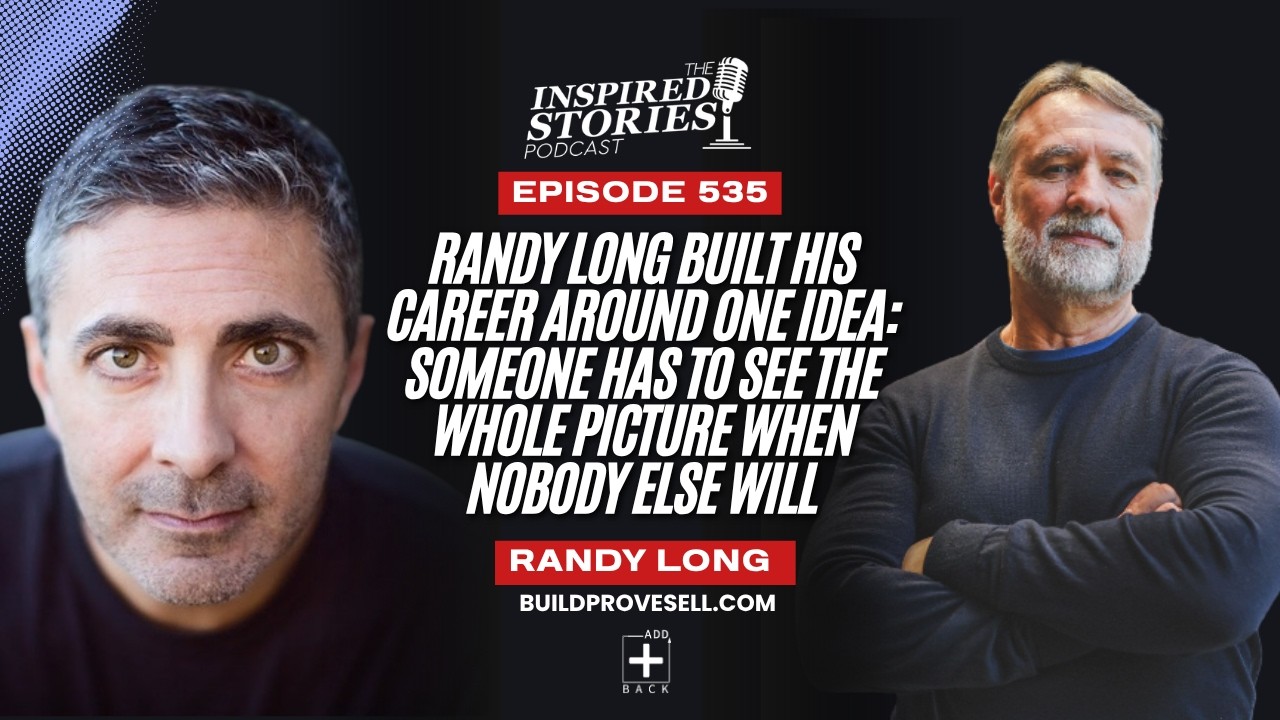
Randy Long, JD, CFP, founder of Build Proof Sell and Long Family Office, walked into a Wall Street brokerage in Newport Beach with no appointment and described a job that had never existed — only to find that the branch manager had a sheet of paper on his desk listing exactly those nine points. Four decades later, he has guided dozens of business owners through exits ranging from $2 million to $160 million, written two books on exit planning, and built a consulting practice with his daughter that sees the business, the family, and the future in a way no single attorney or accountant ever could.
✨ Key Insights You’ll Learn:
The alligator in the bathtub and the baked goods empire that campus authorities shut down
Walking into a Wall Street office unannounced and describing a job that didn’t exist yet
Why becoming a lawyer was the only way to earn credibility and cut through the silo problem
What the macro view of business ownership actually means and why most professionals can’t offer it
How a $2.69 million blue-collar company sold for $14 million in under four years
Why the business owner is almost always the bottleneck and how to convince them of that
Why Randy prefers strategic buyers over private equity and what that choice means for multiples
The difference between Braveheart Exit and Bulletproof Your Exit and who each book is for
Working alongside his daughter for twelve years and what that brings to clients with family businesses
A business partner dispute and his wife’s autonomic nervous system crisis hitting back to back
🌟 Randy’s Key Mentors:
His Grandfather: Entrepreneur with a paint contract at Disney World who modeled self-employment and brought home an alligator to boot
His Father (Pastor): Gave Randy the faith foundation that still anchors every major decision he makes
George Ball (President, Wall Street Firm): Took a chance on a 22-year-old who walked in off the street and put him at the center of a new concept called financial planning
John Brown (BEI, Denver): The exit planning pioneer who mentored Randy for a decade and helped create the credential that formalized the field
Alan Long (Daughter and Partner): The macro planner who became his partner and extended his reach across every client engagement
👉 Don’t miss this conversation about what it actually takes to see a business owner’s whole picture when everyone else only sees their piece, why the happiest people at closing aren’t always the ones with the biggest checks, and a story about a stranger at the door that Randy still can’t fully explain.
Listen to the full episode here
Transcript
Anthony Codispoti (00:01)
Welcome to another edition of the inspired stories podcast where leaders share their experiences so we can learn from their successes and be inspired by how they've overcome adversity. My name is Anthony Cotaspodi and today's guest walked into a wall street brokerage office straight out of college wearing his one and only suit, no appointment and no guarantee anyone would see him. The branch manager just happened to have a job posting sitting on his desk.
that matched exactly what Randy described. Two weeks later, he was in New York. That moment was just the first in a series of pivots that would take Randy from Wall Street to law school, from law school to a 30-year legal practice, and eventually to building something that combined everything he had learned across four decades. His name is Randy Long. He is a JD, certified financial planner.
founder of Long Family Office and founder and CEO of Build Prove Sell, a boutique consulting firm that helps business owners maximize value and exit on their own terms. He has guided dozens of owners through successful transitions worth millions of dollars and is the author of two books in the exit planning field, The Braveheart Exit and Bulletproof Your Exit.
But before we get into all that good stuff, today's episode is brought to you by my company, Ad Back Benefits Agency. And you'll want to hear this because it's hurting almost every business owner you know. Health insurance costs go up every single year and businesses are furious about it. They're paying more, claims are getting denied, employees are opting out because they can't afford it, and it hurts turnover and morale. It's one of the most maddening problems in running a business and everyone just accepts it.
but you don't have to anymore. Now there's a program that gives your employees unlimited access to doctors, therapists, and prescriptions with no copays or deductibles to meet. And here's the part that really shocks most people. Unlike every other employee benefit out there, our program increases your net profits. We recently helped a client add $900 per employee per year to their bottom line. Results vary, but gains like that change how a business is valued.
Be the hero advisor that introduces this to your clients today. AddBackBenefits.com. All right, back to our guest today, founder and CEO of BuildProveSell.com, Randy Long. Thanks for making the time to share your story today.
Randy (02:33)
Thanks for having me, Anthony. I'm looking forward to the time together.
Anthony Codispoti (02:36)
So, Randy, you grew up in a family with deep roots in small business and self-employment. This goes back generations. Growing up, is there a particular memory that you have watching your family grow, watching your family grow and go through all these businesses that had a big impact on you?
Randy (02:56)
Yeah, my grandfather was an entrepreneur. My father was actually a pastor. And then my uncles were entrepreneurs. And I worked with a lot of them when I was growing up. And so I had an inside view of the entrepreneurial world and how it lived. And then also sort of the faith side, if you will, which I got from my father and his work as a pastor. So I think I was an extremely blessed man growing up.
Anthony Codispoti (03:25)
Any particular memories that you have about some of the businesses that your family around you had and they were operating?
Randy (03:33)
My grandfather, when he was younger, used to have a paint contract with Disneyland. So one time he brought back a little alligator for me when I was a kid and I kept it in a bathtub. It kept growing. So eventually I had to release it. Well, yeah.
Anthony Codispoti (03:53)
Are you talking about a real alligator?
Randy (03:55)
Yeah.
Anthony Codispoti (03:55)
I thought you were talking about like a like foam toy or something.
Randy (03:57)
No, just a little,
little, little alligator. Yeah.
Anthony Codispoti (04:01)
So where did you live?
Randy (04:03)
I lived, I lived in southeastern North Carolina. We have alligators here. No, no, no.
Anthony Codispoti (04:09)
And he brought one back from California. You kept it in your bathtub.
Randy (04:13)
He was brought back from Florida. Forgive me. Yeah. I said, forgive me.
Anthony Codispoti (04:15)
Disney World. Okay. Got it. Sorry.
That's not the most impressive part of the story. It was that your grandfather brought back an alligator. You raised it in your bathtub and you
Randy (04:25)
Thank
Anthony Codispoti (04:26)
let it go. I don't know. Maybe that would, maybe that's the thing they do in the South. I'm just not familiar with it. Well, let's
Randy (04:32)
Not normally, no.
Anthony Codispoti (04:34)
go on to one of your early entrepreneurial ventures. You're in college. You're selling baked goods to athletes in dorm rooms.
And this was going along until campus authorities found out and shut you down. Tell us about
Randy (04:49)
Yeah.
Anthony Codispoti (04:50)
this experience. Where did you get the idea and how much success were you finding before you got caught?
Randy (04:56)
Yeah, well, I was a track athlete, so I was in athletic dorms. And I realized that at that point in time, there were no vending machines that were in the dorms. And so I came up with this idea that I would go to the, at the end of the day, I'd go to the cake, the little, they'd go around and pick them back up and replace them with new ones. So the ones they would bring back, they would sell me for like two cents a piece.
And I would sell them for, you know, 50 cents a piece. So my, cost of goods was quite low and I was doing, my margin was quite high. And so therefore about six months, I was living pretty high.
Anthony Codispoti (05:41)
So you were selling a lot of these.
Randy (05:42)
yeah, the football dorm was right next to, to ours. were basketball, baseball and track in my dorm. so everybody was hungry way late into the night. And so I did quite well.
Anthony Codispoti (05:54)
And then what happened? How did it all come apart?
Randy (05:57)
Yeah, the campus decided they were going to open their own stuff and they realized somehow it got back to leadership that how well I was doing and they decided to take me over.
Anthony Codispoti (06:09)
What was that conversation like?
Randy (06:13)
It wasn't really a conversation. They just showed up with, they put food in the dorms,
in the machines and everything. So, yeah, so eventually it took me out because they had more and better and easier access and I wasn't open all the time and all that kind of stuff.
Anthony Codispoti (06:33)
Got it.
Okay. But it's clear that the entrepreneurial bug was alive inside of you.
Randy (06:39)
yes.
Anthony Codispoti (06:40)
So I want to hear about the Wall Street brokerage office that we referenced there in the intro. You don't have an appointment. You show up, you're wearing the one and only suit and somehow you get them to offer you a job on the spot. Walk us through that day.
Randy (06:55)
Yeah, it was pretty bizarre. It was on Dubb Street, I remember the place that it was in Newport Beach. I knew what I wanted to do because I had already started studying for my, actually I had studied that summer when I was after school. I had studied for my series seven. I found some guy that had a little bitty brokerage firm that sponsored me.
So I already had my Series 7 and a few things like that. So I was serious like right away about it. And then so when I walked in, it wasn't that I had nothing or knew nothing. I had at least shown some initiative, if you will. And when I came in and I told the person, they took me back to the branch manager and said, here's a guy that's already ahead on this thing, you know. And they thought I was here to be a broker, but I sat down and I talked to the
to the branch manager and I said, here's what I really want. This is what I'm really looking for. And I laid out like nine or 10 things, exactly what I felt like I was sort of called to do, if you will. And the branch manager, he had an L-shaped desk and every time I would mention a point, he would lean over and he would look beside him and I thought, this guy is not paying attention to me. But I kept going, I went through my nine pieces and then when he was finished,
He picked up this piece of paper and he looked at it, looked at it and he looked at me and he said, he said, I, this is really hard to believe, but you literally told me all the points on this piece of paper. I'm supposed to hire somebody and have them have them in New York within three weeks. And you gave me every one of the pieces and this is a new position. So we've never had it before in this company. You described the position point by point and
This clearly is meant for you. I don't know how it is, but it sure is. He said, can you be in New York in three weeks? I said, I can be.
Anthony Codispoti (08:55)
Wow. And so what was
different about the things that you were asking for or the things that you said you felt called to do?
Randy (09:03)
Yeah, so that was 1983.
There was no, there was such a thing as financial planning, if you will, but nobody, know, it was like brand, brand, brand new. So, because I took some classes in personal finance, so my undergrad major was business administration, but I particularly leaned into, you know, all the personal finance kind of classes.
And so I knew what I wanted to do, but it didn't really exist. so that's why I was trying to explain it. And so Wall Street was just starting to get the
Anthony Codispoti (09:43)
No.
Randy (09:43)
idea that financial planning is something that they might have to embrace. And so when I described all the things I wanted, based on all of the classes and research and all the things that I had been working on for the past few years, that was the list that he had been given from New York of what this role was going to be.
So I essentially became the financial planner for the Newport Beach office.
Anthony Codispoti (10:10)
So you go to New York three weeks later. How did you find the work? What was your impression of it? How long did you stay there?
Randy (10:17)
I was there about a year, year and a half only, so really short. But I became the program that we were in. George Ball personally, he was the president of the company at the time. And he particular, this was like his baby. So on Friday evenings, he would have people over to his house. know, there were 20 of us across the country that were hired. overall, it didn't really go well.
because it didn't mix well with the brokerage, but my office was really successful. And so when I left, I put in my resignation and part of it had to do with my mother-in-law had some health issues and we wanted to have Valver placed in those days. They only lasted about five to seven years. And it was like, my mother-in-law said, I can't do that again. we decided we were going to move up and be with her while she was still alive.
That was a family call as much as it was more than it was a business call. But George called me up and wanted to know, you know, would I just come to work in New York under him? And I was like, George, I'm not going to be somebody that's going to ride the train into Manhattan, you know, every day for the rest of I have no interest in that. So thank you for the opportunity. I've loved it and I've learned a lot, but I have more.
higher callings here than just, you know, New York.
Anthony Codispoti (11:47)
So what did you move into next?
Randy (11:50)
Well, that's when I went up there and I started my little financial planning investment firm. And that was when I discovered, I really realized as I was working with the business owners there that I just didn't know. And I realized the lawyers had like zero respect for us that I was trying to work with. And I was already trying to apply my macro application of how I see the business world and the accountants and lawyers at that point in time.
didn't know what a financial planner was and had no interest in it really. I just, it was very, it was very early and you can't blame them, right?
Anthony Codispoti (12:21)
Well, but it sounds like this was still early days. Most people didn't understand what a financial planner was.
Randy (12:29)
I didn't blame them. So I just realized that I needed to go to law school myself. So I cut out the problem with the lawyer. So once I became a lawyer and I dealt with, know, then I had immediate credibility across the board.
Anthony Codispoti (12:41)
Sorry, I want to understand more about the disconnect that you were experiencing when trying to work with the lawyers and the accountants. So mean,
Randy (12:48)
Mm-hmm.
Anthony Codispoti (12:48)
it's a big deal to sort of shift gears like that, go from certified financial planner to I need to go back to, or I need to go to law school. Help me understand what was missing there.
Randy (12:58)
Yeah,
I think part of it had to do with needing a deeper understanding of tax and business tax in general is one of the things estate planning. as I, as I looked at from the, from the top down of the issues that I, I was in dealing with, with the business owners and the business and the transitions, you know, from generation to generation or business sales or business tax planning or liability issues or,
You know, insurance issues, I mean, they all, they all wrap together into an understanding of what a business owner has to go through, what he needs to learn besides being good at his business. There's all these macro level issues around him that he's, that he has to navigate, make decisions on, and then, you know, pull together his own team. so there's, there's a lot of responsibility, if you will, that a business owner has.
beyond just running his business, if you think about it.
Anthony Codispoti (13:57)
And you mentioned a couple of times the, what was the phrase you used? Macro view of business. Say
Randy (14:02)
Yeah.
Anthony Codispoti (14:03)
more about what your macro view of business means.
Randy (14:08)
Yeah. So over time, I came to realize that the business world, the lawyers specialize, accountants generally specialize, sometimes in fields, sometimes they're specialized in certain size businesses that they tend to work with. And so you get expertise at various levels and in various subject matters, both in the law and in accounting. And so as a business owner,
grows his business, he moves through the need for new professionals and understands that there's new problems and new opportunities and new risks, which he hasn't seen before, because when he moved up to this next level, he's got a new fresh set of issues he's got to deal with. my sort of big picture view, the macro view I call it, is that I see the professions largely as
siloed. So in other words, they work in their space and they try to do this.
Anthony Codispoti (15:12)
accountants
over here, attorneys over here.
Randy (15:15)
Yeah. And also, it isn't just attorneys, it's attorneys in estate planning and attorneys in tax and attorneys in, you know, they all have their own silos within the sky, silo of law, if you will. And that's largely true, the higher you get in accounting too, you know, you get more specialists at the further up you go. you know, it's understanding sort of the macro application of who's doing what, when are they needed, how are they needed.
Who's making the decisions about whether they should be brought in? So there's a big picture of where are we going? How are we getting there? What are the steps to getting there? Who are the professionals and at what point do we need them? So there's this whole sort of moving trajectory through a business owner's life, if you will, that if they're continuing to be successful and grow, they are running into new issues and new problems, honestly, on an ongoing basis.
Anthony Codispoti (16:11)
So you're pretty young still. How old are you when you're starting to form these thoughts? You're going back to law school.
Randy (16:17)
I'm 30, 32, right in there.
Anthony Codispoti (16:19)
Okay. And did you work
while you were going to school? That's a big burden.
Randy (16:24)
Yeah, I did it. I'm going to call school at night.
Anthony Codispoti (16:27)
Okay. Okay, so tell us what happens when you graduate law school. What direction are you going now?
Randy (16:33)
I
graduate law school and I decided I was going to work for a law firm for a year or two, just so that I could, I didn't want to be dangerous to anyone. You know, I'm particular about, I don't want to, you know, first do no harm. I wish we had more of that going on these days. But, so I decided to work with a law firm and I went with a...
smaller firm that was sort of entrepreneurial, if you will.
which was a great experience. I worked with them for a year and then, and because of my financial planning background, they had kind of picked me out to be the managing partner already early,
Anthony Codispoti (17:22)
Wow.
Randy (17:23)
you know, which I, because when I gave them my notice, they're like, no, no, you don't understand that, you know, the business guys, they're retiring soon and they, you know, the other side's litigation.
And they're like, no, they, they've identified you to actually become the managing partner in just a couple of years here. This is not a long track for you. This is a short track, you know, it was like, that's, that's not my track.
Anthony Codispoti (17:49)
That wasn't appealing to you? mean, is safety and security in that? No, pretty quick, no.
Randy (17:54)
No, no, I always wanted to be self-employed. I knew the work I wanted to do. And so I stayed, I stood pat on my, on my notice and, when I let, cause I had done, I drafted all of the estate plan, all of the living trusts and all of the estate docs for the firm, because no one was doing trust planning in those days because the lawyers were making too much money in probate.
in California, so,
but
Anthony Codispoti (18:25)
Hmm.
Randy (18:26)
I was convinced that living trusts were the way to go. So I drafted those and when I opened my own office, I did not build a practice that would do any probate at all. I wanted everybody to live in the living trust world. And so, and I was busy from the moment I opened, literally inside of the first hour when I opened my office in a little town in California.
One of the big farming companies I was working with called the office to find out where I was and they said he's left on his own. And so they forced him, he forced them to give, to tell him where I had gone and what I was doing. And so then he called me within the first hour and said, I know you can't be busy yet. I'm on my way over there. So it started like that.
Anthony Codispoti (19:19)
So for the lay person, explain the difference in approaches, probate versus living trust.
Randy (19:26)
Yeah, so probates are driven by wills. So it's will-based planning and a will basically has no... It's not alive until the moment of your death and then it springs into life and goes into action. But that action all occurs through the court system. And the court system has a... In California anyway, it has a probate schedule, fee schedule that tells you...
based on the size of the estate, how much money you can make. And so, you know, it was pretty good money actually. And I was uninterested in that fee schedule because I didn't want to be, yes, pretty good money
Anthony Codispoti (20:07)
Pretty good money for the attorney.
Randy (20:10)
for the attorney. And I'm a very independent person and I did not want anybody telling me when I needed to be at court and what I needed to be doing while I was there. Because I did, when I was...
When I worked for a year there, I did motions work, I did some bankruptcy work, and then I was also, I did a lot of the estate planning, but the interactions with the court largely was, there was a lot of time wasted there and I don't have time to waste.
Anthony Codispoti (20:41)
Okay. So maybe it's time to talk about BuildProofSell. We have more we want to cover there with Long Family Office. You tell me. No? Okay. So this
Randy (20:49)
Yeah. Yeah.
Anthony Codispoti (20:52)
is what about 11 years ago, you come up with the idea. Fourteen. Okay. Fourteen
Randy (20:54)
14.
Anthony Codispoti (20:57)
years ago, where did the idea come from? You you've been doing the Long Family Office for a long time, but you saw a new path that you wanted to head down.
Randy (21:08)
So there's a lawyer.
out of Denver that I worked with.
And I had gone to an estate planning meeting and there were like 600 lawyers there. And he got up and talked about the idea of exit planning. This was a long time ago. And after the meeting was over, not one other lawyer went up and talked to this guy. So when I came up and talked to him, he said, you're the only one interested in what I had to say. said, I am.
And so we became friends and he sort of mentored, he's an older, John Brown is his name out of Denver and he started BEI, which was the first and actually I'll call it the real exit planning credential if you will, because it's a lot of work to learn it and to accomplish it. And I encouraged John to create the course to be honest, because
He and I worked together for about 10 years on these exit planning cases. He mentored me and I had, he would work with me on some of them. Sometimes I would just call him and ask him things and other times he would actually work on the case with me. so eventually he started BEI and I kept on, and I moved back from California to the East coast. I live in Wilmington, North Carolina and my family was all from here and I grew up here.
And so I moved back here and slowly shut my law practice down in California. about 14 years ago, started with Bill Pruce cell as a DBA. Now we sort of rebranded a few years back based on some books we did and such. But I started doing exit planning about 14 years ago in that entity. And the reason I did that instead of becoming a lawyer in North Carolina and just doing it here,
is because I wanted to have independence and I didn't want to live under the rules of conflicts with regard to the legal industry. if they're, for instance, I have something I'm working on right now. So there's father, two brothers, and a company, right? So the company has a lawyer, the father has a lawyer, and the two sons have lawyers.
And so this is not a case that I started on early and it's one I'm only doing a little bit of advising to, but it still gives the, makes the point that I don't want the family to have to go out and look for everybody, go to their corner and come out fighting. know, if we can resolve issues between either family members or shareholders or whatever it is, you know, we'll do that easier and quicker and we'll try to find good solutions for everyone instead of having
someone trying to defeat the others, if you will, if you get my point here.
Anthony Codispoti (24:19)
Okay.
Randy (24:20)
And sometimes it's just, the other thing that is a problem for the lawyers and the accountant, they have so many clients, right? So when I practiced law, I had a few thousand clients. I, you know, the accountants have hundreds of clients that they all have to take care of. How much time do you think they can sit around and think about your business?
This industry, it's like transactional. I'm going to think about you and talk about you while you're in front of me and maybe I'll do some work, but when you're finished, I'm kind of cutting, you're on your own until
Anthony Codispoti (24:54)
Yeah.
Randy (24:55)
the next time you need me. And so that kind of, it's the model that we have and it's the way that you can get decent advice because they keep it quote unquote cheap because of the way that they do it. But the kind of work we do.
is we have, you know, 15 clients. And so we're always on thinking and working with them in the consulting side. Whatever it is, we've gone as low as seven and sometimes it goes up from there quite a bit.
Anthony Codispoti (25:28)
I want to go back to that first time that you heard about exit planning. You're in the room with the 600 lawyers. Nobody else shows an interest. Talk to me more about what it is that you were hearing in that speech and how it fit into this macro view that you had already been developing for decades.
Randy (25:44)
Yeah, he's the first person in my whole career that I thought this guy understands exactly what I'm trying to do. I've never, you know how you just have a, it's like a kindred spirit immediately, you know? So we had so much in the way that we viewed the world, the way that we viewed other professionals and not that we, not that we denigrate them. We think of them, you know,
incredibly and we're looking for the best and the brightest among those professionals for the pieces that we need for the clients, the cases that we're working on. So it isn't that we'd have some sort of disdain for lawyers and accountants and &A firms and all the different consultants that we use over the years. But instead it's a way for us to be in the room together, if you will, and everybody putting together the best minds.
and the best opportunities and the best planning so that, cause I know that they're going to work with me while they're there, but I know that when they're finished with my meetings and with this, they're going to move on to their next client. I'm not moving on. You understand what I'm saying here? We're
Anthony Codispoti (26:56)
I do.
Randy (26:57)
moving forward, but we're not moving on. So we're riding this wave for the client, if you will, as far as he wants to ride it.
Anthony Codispoti (27:05)
So package it up for me, Randy, present day, what does BuildProofCell do and who do you best do it for?
Randy (27:12)
Yeah. Build proof sell. I like to think of it for people as pre &A, so pre mergers and acquisitions or pre, it's either a pre sale or pre, if you're going to transfer it to the kids, for instance. So everybody doesn't sell. Sometimes it stays inside the company. I mean, inside of the family. So build proof sell essentially
We want the company to run in such a way that it's always ready for a sale. So we want to get the company ready for a sale. And when we get the company and the family, frankly, because there's a, family issues, there's tax planning issues in advance, there's estate tax issues. If we need to get ahead of all of those things, because if we don't get ahead of them, as I said, as you grow through the levels, you're creating new problems and new issues. So the earlier we can
conquer those things as you go through those levels, you don't have those issues pop up. If you understand what I'm saying there.
Anthony Codispoti (28:17)
Yeah. Talk.
Randy (28:18)
So, go ahead.
Anthony Codispoti (28:21)
I was going to say, talk us through what a typical engagement would look like.
Randy (28:26)
Yes, typical, a typical engagement would be, I used to say somebody 60 to 65 or something like that, but a lot of our clients are in their thirties and forties now and they're multiple, they want to buy and sell, mean, build and sell numbers of companies. And so they're learning as they go, if you will. But typically we, we've, we've taken clients as low as a couple of million dollars in value.
end is high and we, we've, I would say our sales have ended up somewhere between 10 and 180, 160 million. So we've sold a number in all those spaces, if you will. So I, I try, I like to work, I like to have some in sort of the, the thirds, if you will, some, some of the smaller guys that I have, and, I have Feelings for them, if you will, cause they're sort of, they're living the dream.
But they really have a great job and we're trying to turn it into a great company for them, with them. And so a little story inside of there. we took a, I won't say the kind of company it was, but a little blue collar company. was a couple, we had it valued as soon as we came in. It was a referral from a friend that worked for a company we were working with that was a larger company.
The company sold though about four years later. It was valued at 2.69 million. I remember it exactly. We use a firm out of LA to do all of our valuations so we know we're consistent on application and how we do it and all that sort of thing. But we valued it at 2.69. We sold it in just under four years for 14 million. And those people were the happiest people you've ever seen because they weren't sure, you know, they were older and they didn't know how to get out of the business.
And they were working themselves to death. And so it was one of those little cases where they could afford to pay us enough, you know, to take us on. And that's one of the cuts. you're usually, if you're not making yourself, you know, 250 or 300 or something, or half a mil, something in that range is sort of, I don't want you to be so worried about paying me that, that, you you don't, you're trying to rush things or all that stuff just gets in the way. So you just have to be big enough to pay me. I'll put it that way.
pay us. But once we're there, they were so happy. And I've been in the room where we had $148 million or $136 million or when it hits the screen. And those people aren't happier. They're not.
Anthony Codispoti (31:14)
How interesting.
Randy (31:15)
No, no, no, no. My experience is that the gratitude piece
And it isn't necessarily based on size. Unfortunately, I do think that the way people run businesses and the weight of it and how they start to see themselves, there's a little bit of the idea of pride that sometimes can find its way in once you build your company to a certain level. But I've always learned that there's always levels above you, you know, unless you're Musk, you know.
But everybody else has other people that have more successful businesses somewhere in there.
Anthony Codispoti (31:57)
And so
what are you saying, kind of the higher in exit value, the less
Randy (32:02)
Yeah.
Anthony Codispoti (32:02)
appreciation or gratitude for the experience? Is a general somewhat rule of thumb?
Randy (32:06)
I hate to say it, but there's a general tendency towards that. It's not certainly
not all the time, but it's a temptation, I'll put it that way.
Anthony Codispoti (32:15)
And so as we go back to this company that ended up exiting for 14 million, this older couple, they're ecstatic at closing. What were some of the biggest levers that you helped them pull to get there?
Randy (32:28)
well, the first one was we identified that the business owner himself, he was doing the bidding for the work for the, for the plant. And, it was like, you are the problem. We, your backend can handle a lot of more, a lot more volume. The way it's designed is actually well designed and the guy running it knows what he's doing, but you can't get enough bids out the door in time. So.
We told him we wanted to bring in a process engineer and redesign how he built his bid system. He's like, it's too complicated. Nobody else can do it. don't blah, blah. So it took us about, unfortunately, about six months to convince him that he really was the problem.
Anthony Codispoti (33:12)
Mmm.
Randy (33:13)
So we redesigned and his wife was, she was doing the accounting and he was the president and was the front end. And they were both working like 60 plus hours.
you know, a week, they were wore out. And so he finally kind of hit the wall. And then when I brought in the process engineer, it was kind of funny because we brought in a woman that was a process engineer and she was incredible. But she redesigned the front end. then once we moved him from about 60 hours a week to about 20, 15 or 20, and the business exploded and we hired somebody else to take over the bidding and we replaced her after we, had to
We changed the accounting system for her and redesigned how the books were kept so that it was prepared and was ready for when an &A firm came in, it was in a form and fashion that they recognized, yeah, these people know what they're doing. Everything is in order. We actually had them pretty up the plant. So we did the improvement on the plant level. brought in, gosh, new accountants, new lawyers.
We basically truthfully redesigned everything except the back end of that business.
Anthony Codispoti (34:27)
I want to go back to the bid process, re-engineering that you did. And I really want to zero in on this because this kind of thing comes up in small businesses all the time. Right? The founder, and I'm going to point to myself, I've been guilty of this before. They
Randy (34:44)
Yeah.
Anthony Codispoti (34:45)
get accustomed to, and they attach their identity to, here's the work that I do. And I'm the one who figured this out and it's complicated and I'm the only one who can do it. And so.
Randy (34:58)
Yeah.
Anthony Codispoti (34:58)
I've got a place, I've got a purpose. And convincing an owner that there's a better way, that there's somebody who could do this differently that would be more efficient is a really hard task. As you alluded to in sort of the six months that it took you to get there, can you get more into the specifics of how you got that person from A to B? And believing that now is the time that there is a better way.
Randy (35:25)
Yeah, fortunately what we did, you know, we say a lot of times that when we're brought into these cases, a lot of times the wives of the owners are, they're a little worried about us because the kind of work that we do, we know it's a very trusting position. We know more about their personal lives, their business lives, you know.
their net worth, their insurances. We learn pretty much everything that there is to learn about them within reason, pretty, like nobody's close. The accountant doesn't get as much as we do. The lawyers don't get as much as we do. The insurance guys don't get as much as we do. We get a lot. And so that kind of opening the kimono, if you will, is a scary process. It scares the women more than it does the men typically. And it's understandably.
But what happens though was once we're in, the women tend to be our greatest advocates because they realize, one of my pet thieves is that these business guys don't prepare to take care of their spouses. And I've had to take care of lots of widows in my career that husband didn't prepare to take care of their families and they died leaving holes everywhere. And so I am very big about making sure that...
The owner knows when we're brought in, I'm going to take care of his wife and she is going to be a very big priority, his wife and kids. I want that planning to be included in all of this other stuff we're doing or I'm not coming. Because I can't, I have this responsibility piece of me, my own sister-in-law, know, my brother-in-law died when he was 45. And so I know what it's like to, you know,
to have to live a long time out of what your planning was. And so I want the planning to be good for everyone. So I said, I want everybody a winner. And so went back to this point, the woman realized that I was actually, you know, super good for her and her family. And once she was convinced and she basically forced him to let us do the, I'll tell you this, years ago, I had one lady that was sitting in,
in a meeting with me, her and her husband. And the woman basically said, if you fire him, I'm firing, I'm leaving you. I'm not going through, this is not going any further until this is all resolved and he's resolving it. And if you won't, I was like, whoa, that
was
Anthony Codispoti (38:05)
Ha ha
Randy (38:06)
a little bit much for me there. But she kind of understood she was at risk and he wasn't honoring that. know, so it's a big deal to me that we're going to
We're going to try to do well for every stakeholder that's at the table.
Anthony Codispoti (38:22)
In that process, going back to this couple, the wife became a big advocate for you, basically said, you got to do this. At what point did the husband, did the male owner here align with what was going on or see the value in it or get on board with it rather than just get out of the way?
Randy (38:45)
Yeah, part of it was that we tried to make him understand that his situation isn't unique. That process engineers exist for a reason. What they do is they take complex problems and they systematize them so that they become simple flows. And also, so once he mentally kind of got the picture of what
what was going to happen. And then he also just himself became exhausted to the point where he's like, what I'm doing isn't working. I mean, it works, but it's not, I'm not going to ever get out of this if I don't change something. So the combination of him mentally coming to the point, but driven by the emotion of being worn out himself, the combination of them pushed him over the edge. And, you know, she came in and worked with them, you know, a week or so.
and cranked out an incredible new system and it was very, very successful. And
Anthony Codispoti (39:51)
in a week. The process took a week. That's incredible.
Randy (39:54)
when we sold that company, of course I liked another issue, but I liked to sell to strategic buyers, not PE firms. This is one of my other pet peeves. So we found a strategic buyer and that strategic buyer paid us double the multiple in the industry. But what
Anthony Codispoti (40:12)
Wow.
Randy (40:12)
they couldn't believe
So when we were going through the &A process, we had five or six bids and all of them wanted us to prove, said, build proof sell. We had to prove to them that our margin, our profitability was what it said it was because they couldn't, the industry isn't that profitable. And so we were right at double the average profitability of the industry and the firm that bought this guy, he didn't buy him for any other reason except
the front end of that business. He wanted the front end of that design. He wanted that. he also, and also, like I said, the guy that was running production in the back was himself a very bright guy. so he had, I don't know, 29 other companies that were in this field. And so he took that and applied it across all his other 29.
Anthony Codispoti (41:07)
Tell us about your pet peeve. Why do you prefer strategic buyers over private equity?
Randy (41:16)
The PE world has some good things in it, but I want my &A firm to do the best it can for me instead of selling over and over again to the same group of PE firms because I don't want any sort of regular deals going on. I want to know that my company has found the best buyer possible, regardless of any future.
business coming their way, if that makes sense. And I do think, and that happens in the specialization world, obviously, but I prefer to work with firms that will lean into the goal of selling to strategics. To me, the PE firms are in there to put a floor under the bidding process. I'm not.
I don't love, like I said, don't love selling to PE firms because the culture is, there's culture problems that typically come. There's things that it's, you just have to be super clear with the business owner what it is that they value in the sale. Do they value preserving their culture, preserving their customers, preserving their employees? How far do they want to go to protect it?
So, and you give up certain things sometimes when you do that, but other times you can get multiples that are way in excess of what the PE world would buy because they have a strategic buyer can take whatever it is that you have, if it's special and can apply that great thing across multiple other businesses and therefore afford to pay you more because they're leveraging the costs of that over all these businesses, not just on a standalone level. Does that make sense?
Anthony Codispoti (43:11)
Does. Yeah. Tell us about the books, Randy. Brave Heart, Exit, and Bulletproof Your Exit. What are these books about? Why'd you decide to write them?
Randy (43:21)
Yeah. The Braveheart exit sort of comes from my background, my own story about recognizing that. And I called it Braveheart because I'm British, know, Scots-Irish kind of a thing. so, and I did a tour of England and Scotland and it was called the Braveheart tour and I was a
bit of a fan of that movie and the things that go with that. And in my house, if I was at my house doing my podcast, I have a big family crest behind me when I do those podcasts. And my wife always tells me I should take that down because she thinks it might offend people. I'm like, I have never had anything but compliments about that. They love that thing, especially the men. At first I thought it was just going to be the men, but the women love it too.
Anyway, the Braveheart exit thing came from understanding that in America, right? America is a different country because we had people that had guts to leave the places where they were, had been for centuries. And yes, they came for two main reasons, right? The first one was religious freedom. The second one was freedom, freedom. And America, because there was no infrastructure,
No big landowners per se, no infrastructure. Everybody that came at some level was almost an entrepreneur. You know, there were more opportunities to become entrepreneurs in America than all of the other countries of the world pretty much put together. So there was this one big opportunity in America and the people with guts flooded over here and they wanted to land on their own two feet. They wanted to build businesses and to live lives.
and the way they wanted to live them, they wanted to worship God without having the state or the church force it down their throat one way or another. So I love that whole idea. And because to me, the heroes, if you will, in America were those, the guys that have to sign the checks every day, every week or every month, however it is they pay, they put their net worth, their fortunes, their risk level all the time. And I respected those people.
And I wanted to be one of them and I wanted to advise them. And so I wrote these books. The first one is a little long, a little too technical, honestly. And so the reason I wrote the second one was it's only like a hundred pages. I wrote it for the business owner that, you know, you could read it from LA to New York on a flight.
Anthony Codispoti (46:04)
short read.
Randy (46:05)
Yeah. So it's about a hundred pages. And I've had a lot of business owners read that a lot.
read that book or listen to it because it's also an audible. And so I wanted them to understand that I wanted them to be able to get a framework in a short time about what this is all about, what the pieces are, how do you, you know, it gives them a framework that they can hang things. So when you have discussions with them, they already have this predetermined understanding of the flow. The other reason I did it in particular was for the people that could never afford me or people like me.
Because they still have, if you've got a $500,000 business and you can sell that thing for 500, it may be the only retirement you'll ever see is how you handle the sale of that business. And you can't really afford to have my kind of, and I'm sorry about this, but you can't afford my kind of advice on a one-on-one basis for those levels of...
But if you read my book, you're gonna get incredible amounts of insight that will help you be successful even on the low end because of the simplicity of it.
Anthony Codispoti (47:12)
Pull out one tactic from that book that folks will get. Let's give them little bit a teaser.
Randy (47:17)
I would say one of the tactics is, which is important for the business owners if they can build the business apart from themselves. So we want our business owners to work in what we call their unique ability. So anything that they're doing that isn't just for them or just to them, first we want to move those things off of their plate. Sometimes they're doing, I have a client I'm working with.
I've been working with for a year or so. is an electrical firm, very profitable, but the owner was still running the books himself. Very profitable. I'm like, surprisingly profitable, but he's still riding a herd on the books. But he wants to sell in 18 months. I'm like, dude, we've got to divide and conquer all your roles and move them off of you one by one so that you have a business that's saleable because if you're
carrying too much weight and you try to sell it, nobody's going to pay you much for that business. So we want to, we want first of all, to move the business owner into his own, only his unique ability, everything else we push off. And then we find somebody else, a company that's capable of either keeping him a year or so for them to train the next level up, or that has that, that one unique ability they have in house already. And then that company can become a sellable company.
And he'll get multiples on it instead of just one times cashflow.
Anthony Codispoti (48:51)
The biggest difference between the two books, distill it down.
Randy (48:54)
The biggest difference between the two books is the simplicity and the size. So there's some things that the lawyers and accountants will understand inside of the other book that I leave out of this one. And they're fun stories. in the book, I use a lot of analogies of war. I love the history. I'm a history buff.
And so I picked pieces of history and I sort of intro with the chapter to make the point about why we need to do what we need to do. And these are people that either did this successfully or they failed at it and what the ramifications were that for that were going forward. So as an example, I think the first one, the Battle of Yarmouk.
You know, when Islam was on the rise and they had the big battle at Yarmouk, Europe only had put together, it was pretty early for Europe, and they put together finally a 30,000-sized army from the different countries and they came and they fought. And the weather conditions at the very end of the sixth or seventh day went against them and they ended up getting totally wiped out.
But they had zero backup plan. And so there were 4,000 miles of North Africa Christianity that was lost as a result of no backup plan. Right? So that's one quick.
Anthony Codispoti (50:35)
Yeah.
I want to talk about your daughter, Allen. She's been working alongside you for roughly a decade now.
Randy (50:43)
Yeah, 12 years, yeah.
Anthony Codispoti (50:44)
What's that experience been like? And I'm curious if it has informed the family legacy piece of the work that you do for your clients in any way.
Randy (50:57)
Yeah, I think that it's been a lot of fun for me. My kids, I have five children and they each kind of have pieces of me. But she is a macro planner like me. So she's got a CFP and she's a very good public speaker and she's very good. Yeah, she's really, and she's good in...
Some of the pieces I'm not as good like in teams, know, things like that she works inside of. So she's been, she's been a lot of fun to work with. We've just had a great time. The first some years, you know, so she was learning up and then eventually she really became a, she became a partner six or eight years ago. And so I don't do.
really any planning without her. when we work with the clients, they get both of us together focused. we're not, she doesn't just have her clients and I just have mine. That's not the way we work. it
Anthony Codispoti (52:05)
That does sound like a lot of fun. I'm sure she treasures that experience as well.
Randy (52:09)
is a lot of fun. And I have a lot, know, so I'm just a tax attorney and another financial planner and other things, engineer and on and on.
Anthony Codispoti (52:19)
Lots of successful kids.
Randy (52:21)
Yeah, she's the one that gets the macro planning piece from me and with me. So she has the most of that from me. So yes, and I think a lot of times the clients, especially if they have kids inside of their business, they like the fact that I have my daughter at the table because then she can interact with them and understand their positions and things like that. yeah, I'm living it. Yes.
Anthony Codispoti (52:44)
When it shows you understand their dynamic, because you're living it.
Randy, what's the hardest thing you've ever had to overcome and what did going through that teach you?
Randy (53:00)
So I told you that I had started my investment firm years ago. I moved back over here to Wilmington, North Carolina, which is where I grew up, from California back in 07. I still had employees in the law firm and in my long family office.
Over time, the guy that was working with me there, you know, kind of decided I wasn't there enough and he wanted those clients for his own. So we ended up having a, unfortunately, a bit of a split there, which cost me a lot of money.
And I had kind of had to not restart, but it sort of took the joy, honestly, took the joy out of growing the company and that sort of thing. for, and then on top of that, had my, my wife had a health issue that showed up due to heat. So she was five years ago in July. She
stayed outside and working in her garden too long and she, and I've never heard of this before, but evidently she got so hot and didn't get cooled down fast enough that it affected her, her autonomic nervous system. So blood pressure, body temperature, heart rate, digestive system. And so for the first like six months,
She was in bed the first two months. I was probably had her at ER eight times. It was terrifying truthfully. And, um, and so she's had this journey of, you know, trying to, um, slowly but surely recover. She's not, she hasn't fully recovered. Thank God she's gotten, you know, 80%, 70 to 80 % back, but, but, uh, it's still.
unpredictable when these things show up and they have affected her life. which, you know, I'm running, so I'm running, I'm running my two businesses and my businesses are, are there's they're remote businesses, if you will. So my clients are all over the country, you know. So I'm doing that and I'm taking care of my wife at the same time. So over that five years, it has been both.
You know, the business challenge of trying to save and regroup from, you know, and this was a business where I was the sole generator of the clients. So this person wasn't a generator of the clients, but they decided that they really should be theirs because they were doing the servicing a part of it. So it was just rough to go through for me. And I, you I don't see people, it's just not what I do. So.
life is too short to be involved in litigation for where I sit. anyway.
Anthony Codispoti (56:21)
Was there an outlet for you? Was there a place for you to go and get support? How did you work your way through that emotionally?
Randy (56:30)
Um, well, one of the things I did, I have a, I put a gym in my house so I could work out, um, you know, for 40 minutes a day or so to help me deal with stress that way. Um, and you know, I'm, I'm a Christian. go to, I, I, uh, am very, very big about my, my faith. It's, the most important part of my life. And so I leaned heavily on, the Lord during those, those times and still do.
so those, that combination, and, and the fact that, you know, my wife was still there, she wasn't dead, you know, so I still had the opportunity to be with her. And I'm just, I also think of myself as super fortunate because, if all of that stuff hadn't arranged itself, I would have never been able to, I was already working that way so that when she got ill,
I was able to continue working and take care of her. I just cut up my travel way back, you know, and the Zoom world showed up in time so that I could do that. So all of those things came together to make it possible. And so there were blessings in the midst of the difficulties. And then I have this crazy story. You know, there for a few years, I was like getting zero fellowship with anybody. You know how this is. You just, I just got totally isolated.
and a friend of mine, well, was looking, I needed to find a lawyer for one of the local people that we were working with. And I had my computer in front of me and I said, and this guy, saw this guy's website, he was a lawyer. And I said, I want to meet this guy. This guy has the guts to have his Christianity on his website, you know, as a lawyer. And so I told my wife, this is a Friday night. And I had been praying for about a month that the good Lord would show me some fellowship.
to get, you know, that I could have with other men. so that guy on Friday evening, I showed to my wife on the computer and then on nine o'clock on Saturday morning, the doorbell rang. And so I got up and I went to the door and that guy that I told my wife I wanted to meet, he was at my front door.
And so, and I didn't know him, never heard of him, just saw that picture of him on his website. He's at my front door at nine o'clock the next morning. And there's no solicitation in my neighborhood. I'm the HOA president. I opened the door and there's this guy and I said, and I called his name, you know, and I'll never forget it. He took two steps back because I called him by name and I
Clearly didn't know him because I was shocked that it was him, you know He took two steps back and he said I'm sorry. Do I know you? And
Anthony Codispoti (59:32)
Hahaha.
Randy (59:33)
I said well, obviously you're supposed to so could you please come in so I invited him in and And this is craziest thing but I sat down. I said, know, I just feel like I Feel like the Lord has sent you here and he said well I'm here to invite you to our Bible study on
on Friday morning. So I've been a member of that Bible study for a few years now. And my little brother's in that Bible study, as it turned out, which is kind of fun. And then he says to me, and then I said to him, why are you really here? I mean, because I said, you must be here because you must have a message from the Lord for me. And what is it? And so then he says that. And I said, well, what did you think you were here for? He said, well, I thought I was here to make sure you voted on.
Tuesday.
Anthony Codispoti (1:00:27)
That's an amazing story. Thank you for sharing that. Yeah.
Randy (1:00:30)
Isn't that crazy?
Anthony Codispoti (1:00:32)
So now, Randy, as you think about the work that you're doing now, what is it that you most want to be remembered for?
Randy (1:00:45)
Yeah, I want to be remembered for, of my clients in particular. I want them to remember that I wanted them to reach the place where they were thriving and that they ended up with a thriving business and life and relationships and had the ability to transition or sell so that their legacy, if you will, their financial legacy, their family legacy, because we tried to
We try to build families, you know, even in our estate planning, I'm very big about let's not build things into your estate plan that are going to cause conflict among your children as soon as you're gone or even now. So I'm always trying to think multiple layers in advance. I find that too often where lawyers, you know, build, they build in conflict upon the death of the owner or the family. so I'm always trying to, I want...
I want peace within the family. I want the family to thrive and I want the business to thrive. And I want them to also to learn if they sell, I want them to learn how to live with money and not let the money become the primary thing that defines them. So there's a big, you know, arc here that I'm working on, on that macro thing that I started with. It's a big arc. And I know that a lot, sometimes people will say,
You try to do too much. I'm not trying to do it all. I'm just trying to make sure it all happens. And I manage it, that process, because I know what it should be. And so, and then along the way, sometimes I get the chance to pray with my clients. I love that for them. You know, I want the good Lord to have impact on their lives, just like he has mine. And I want them to live. I want them to live their legacy, not just leave one.
Anthony Codispoti (1:02:39)
that. Randy, I've just got one more question for you today, but before I ask it, I want to do three quick things for the audience. First of all, if you want to get in touch with Randy Long, I'm going to give you two website addresses here, buildprovesell.com and longfamilyoffice.com. They'll both be in the show notes, but buildprovesell.com and longfamilyoffice.com. And if you're enjoying the show today,
please take a quick moment to leave a comment or review on your favorite podcast app. It goes a long way towards helping others discover our show. So thanks for taking a quick moment to do that. And as a reminder to all business advisors out there, your clients are bleeding money on health insurance. Do them a favor so big they'll tell their friends about it. Show them how to give their employees access to therapists, doctors, and prescription meds that counter-intuitively increases the company's net profits.
Real gains that can change how a business is valued. Addbackbenefits.com. Okay, Randy, so last question for you today. A year from now, what is one very specific thing that you hope to be celebrating?
Randy (1:03:50)
Another year of work. I love what I do. And people ask me all the time, when am I going to retire? I have no, honestly, no intention to retire as long as I'm still valuable and able to do what I do. I love what I do. And so a year from now, I'd love to still be doing it. And a lot of years from now, frankly. So yeah, I'm not looking to run. I'm looking to play.
Anthony Codispoti (1:04:19)
I love it. Randy Long from buildproofsell.com. I want to be the first to thank you for sharing both your time and your story with us today. I really appreciate you being here.
Randy (1:04:29)
It's my pleasure. That's a lot of fun. You're a great interviewer, by the way.
Anthony Codispoti (1:04:32)
I appreciate the kind words. Folks, that's a wrap on another episode of the Inspired Stories podcast. Thanks for learning with us today.
Connect with Randy Long:
Website: buildproofsell.com
Website: longfamilyoffice.com