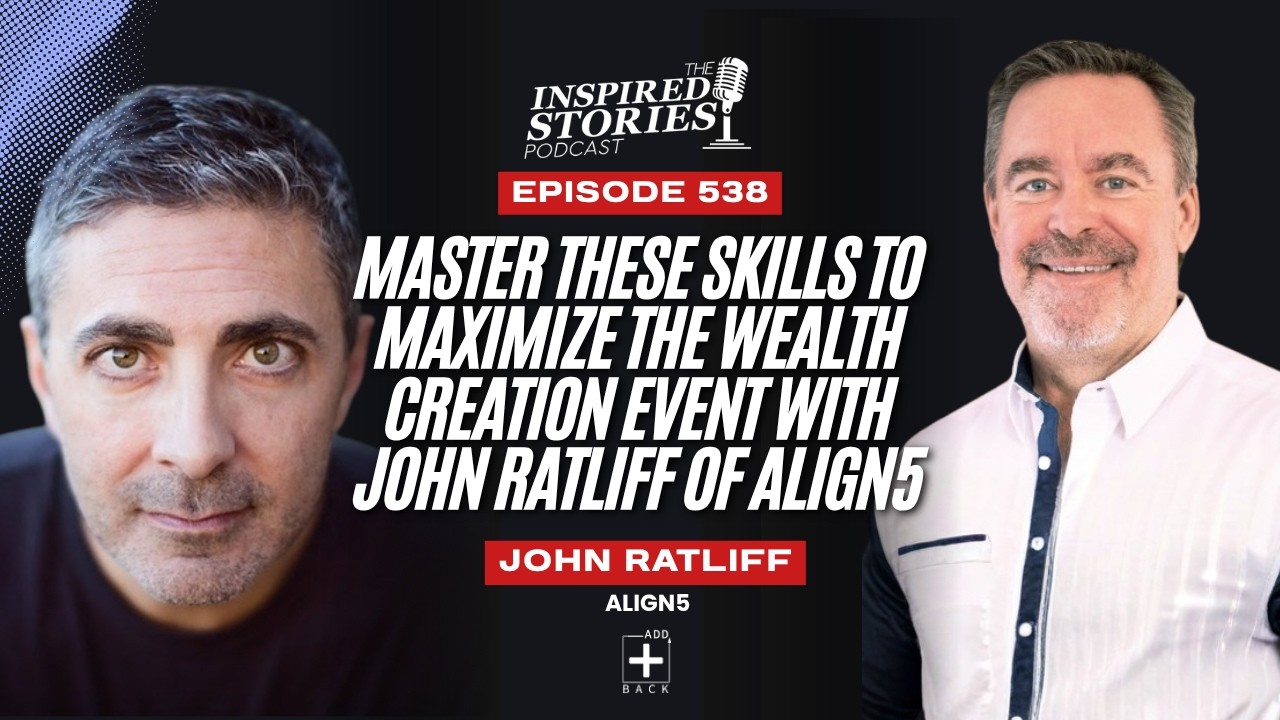
🎙️ From a Two-Bedroom Apartment to a Five-Times Industry Average Exit: John Ratliff’s Blueprint for Building and Selling
John Ratliff built Apple Tree Answers, a 24-hour telephone answering service, from a two-bedroom apartment in 1995 to 24 locations and 650 employees before selling it in 2012 at roughly five times the industry average multiple. Along the way he almost quit at 4 a.m. and yanked the plug from the wall. He got turnover from 110% down to 18% through a program that granted employee dreams. And he learned — by being on both sides of the table — exactly how buyers think and where leverage really lives in an acquisition.
✨ Key Insights You’ll Learn:
How accidental Class A office space became the foundation of a culture shift
The Dream On program: granting 250 employee dreams across 2008–2012 and what it did to turnover
The 4 a.m. moment John almost quit — and the wrong number that changed everything
Seven of ten entrepreneurs struggle with clinical depression — and what the OODA loop has to do with getting through it
The E-Myth visioning exercise that predicted his business six years out almost word for word
Why the entrepreneur most emotionally tied to their business gets the worst exit multiple
How an off-hand comment from a CFO instantly moved all the leverage in John’s favor
Selling a $25M revenue company for $75M by finding two buyers who both had to have it
Why industry-specialist investment bankers may actually work against the seller
Holganics: 300% growth, Fast Company’s most innovative ag company, and a Super Bowl ad in the works
🌟 John’s Key Mentors:
Michael Gerber (E-Myth Author): Set John’s foundational belief that the business is separate from the entrepreneur — and should be built that way from day one
Doug (Canadian Competitor at the Bar): Asked one innocent question about turnover that sent John on the journey that transformed his culture
His 23-Year-Old Friend: Wrote a $12,000 check when John couldn’t make payroll — the act of generosity that now defines why John works
Barrett Ersek (Holganics Founder): A 20-year relationship built on shared conviction that the hardest road is usually worth it
Michael Singer (Untethered Soul Author): A book that produced a moment on a commercial flight John still describes as physically lifting a weight off him
👉 Don’t miss this conversation about what it actually takes to build a culture nobody else is willing to build, why buyers overshare when they have to have something, and how a wrong number at 4 a.m. might have saved a company.
Listen to the full episode here
Transcript
Anthony Codispoti (00:01)
Welcome to another edition of the inspired stories podcast where leaders share their experiences so we can learn from their successes and be inspired by how they've overcome adversity. As you listen today, let one idea shape what you do next. My name is Anthony Cotus Bodie and today's guest built a telephone answering service from a two bedroom apartment and over 17 years did something almost no one in that industry believed was possible.
In a business where annual employee turnover routinely runs above 100%, he got it down to 18%. It didn't happen by accident. It came after a period of real struggle. A discovery that changed how we thought about leadership and a deliberate bet that if you took care of people in a way nobody else was willing to do, the business results would follow. His name is John Ratliff and he's the co-founder and managing director of Align 5.
a boutique advisory firm that helps growth-minded entrepreneurs scale and plan successful exits. Before that, he grew Apple Tree Answers, a telephone answering service company, to 24 locations and 650 employees before selling it in 2012. He now also serves as CEO of Gazelle's Pros and mentors founders through Virgin Unite, Sir Richard Branson's charitable foundation.
Anyone who has ever tried to build a culture will find something worthwhile from this conversation today. But before we get into all the good stuff, today's episode is brought to you by my company, Ad Back Benefits Agency. Listen, if you run a business, you're likely stuck in the cycle of rising insurance premiums. You're paying more, but your team is getting less. And many people can't afford coverage at all. We do things differently.
We offer a solution that provides your employees with unlimited access to doctors, therapists, and prescriptions that's always free for them to use. But here's the part that surprises most people. Unlike every other employee benefit out there, our program puts more money into your company's bank account. As an example, we recently helped a client increase net profits by $900 per employee per year.
Results vary, but gains like that can change how a business is valued. And the consultation is free. Imagine being the advisor that delivers incredible value by introducing this to your clients. See if they qualify today at addbackbenefits.com. All right, back to our guest today, managing partner of Align 5, John Ratliff. Thanks for making the time to share your story today.
John Ratliff (02:41)
Yeah, thanks for having me.
Anthony Codispoti (02:44)
So you started Apple Tree Answers, the telephone answering service that we talked about in the intro, in 1995, out of a two-bedroom apartment. What was the problem you were trying to solve?
John Ratliff (02:57)
Well, number one was moving out of my parents' house. So I was in a two-bedroom apartment. I was actually able to live there. That's only half kidding on that one. no, had right out of college, went to work for a little wireless phone store back when, you know, phones came in bags and did that for a couple of years and then went out on my own, opened my own store, then opened a second store.
and actually sold that business back to the guy that I'd worked for originally. And I was 24 at the time and needed something else to do. I sold the business and I had a check I thought was the biggest check I was ever going to see in my life and wanted to reinvest it in something else. And my landlord in the second store had this little paper based like exactly like Lily Tomlin on Saturday Night Live character.
answering service, know, women smoking cigarettes and writing messages on every stereotype you could imagine. It was, it was right there. but they were in the process of working with a guy to go from paper based where they hand wrote the messages to paper less. By the way, I'm dating myself 1995. Doesn't seem that long ago, but man, it sure is. and so I got to know the business by, by sort of osmosis through them. And when I sold the company,
you know, back then you couldn't really compete over state lines because of the way the telephone systems worked. And he said, Hey, you're in Delaware. Why don't you, you know, why don't you go down and open one of these Delaware? And I had this big check and nothing better to do. And so I did. And, uh, yeah, that was, I, that's how I accidentally totally stumbled into this opportunity. There was no, there was no business plan. There was no great, you know, master strategy. was, I need something to do. And this was kind
Anthony Codispoti (04:49)
And so the service that you were providing were for companies that had incoming calls and you're just taking a message and relaying it to the owners.
John Ratliff (04:57)
Yeah,
very simply back then it was, we acted as their outsource receptionist or we were 24 seven, 365. So we did a lot of emergency stuff after hours, you know, hospice organizations, apartment complexes that had maintenance people on call, home health care companies, kind of a really broad range, a lot of plumbing, heating and air conditioning companies that needed a 24 hour presence, but couldn't afford staff.
around the clock, we would step in for them either 24 hours a day or after hours. And then we'd have some basic instructions based on the type of call we took and then we could pass that along to the right person.
Anthony Codispoti (05:41)
Okay. And back in 1995, this is super early
days of the internet. So how are you promoting yourself? How are you finding new clients?
John Ratliff (05:51)
Yeah, we were, we were, I read a book in 1995 and the book was called how to make money on the internet. And literally one paragraph in one chapter was about the worldwide web. Like that didn't exist yet, which is crazy. Um, you know, it was about bulletin boards and email. And so really it was, it was hustle. was cold calling. It was get the yellow pages out and, know, and one by one kind of.
go see customers and call customers and a lot of word of mouth back then. We were a huge YellowPage advertiser. I was probably spending it at my peak, maybe a hundred thousand a month on YellowPage ads across probably, you know, 30 geographies, which in hindsight, it was a lot easier than today trying to figure out, you know, 300 channels of digital marketing. Back then it was called the YellowPage rep and in you went. Hopefully your listeners are,
or viewers are actually, you know, at least over the age of 30, because none of them under 30 can have any idea what we're talking about. Yeah, exactly. Yeah.
Anthony Codispoti (06:54)
They're going to Google what the yellow pages are right now, or they're going into ChatGPT.
OK, so 30 different geographies. So you weren't just in the state of Delaware?
John Ratliff (07:06)
No, were once deregulation happened in telecom, it kind of opened up and you could then answer call traffic in other markets. So we were southeastern Pennsylvania, New Jersey, Delaware, Maryland, a little bit in, in Northern New Jersey, but still all out of that one office. So.
Anthony Codispoti (07:29)
And so what
was the tech back then? Cause you know, there was no voiceover IP. You know, did you have to set up like physical phone banks in the geographies in which you were, so you were avoiding those expensive long distance fees.
John Ratliff (07:43)
Yeah. So there was an early version of T1s where you could connect two central offices together, and then do like a bulk call forwarding on those central office lines. So yeah, I think once deregulation happened, the Bell Atlantic and then the other carriers realized there were all these opportunities to, you know, add to their revenue base. And most of those were fixed fee connections. They were expensive as hell, but they were fixed fee connections. So you weren't paying.
usage
traffic across those lines. But yeah, a ton of work arounds in the beginning. I was a telecom
Anthony Codispoti (08:19)
Were you?
John Ratliff (08:20)
engineer more than more than an entrepreneur at one point in my career, just trying to figure out, you know, how to get connected.
Anthony Codispoti (08:27)
So were you building a better mousetrap? Were you just hustling harder than other folks? What was the key to the success here?
John Ratliff (08:34)
Yeah, so that, you know, again, I've talked about the stereotype of that industry when we first started and that really was the culture. was, it was cranky people that didn't want to be doing what they were doing. you know, basically taking calls for people and passing them along. And I think our early, even before we got serious about culture,
taking better care of our employees early on was always our secret sauce. But then ultimately we got really serious about it. And by the way, I say we, it was me most of the way that I just used the ubiquitous we, but yeah, I think it was always about the frontline employee for me.
Anthony Codispoti (09:21)
So let's talk about what it looked like before you got serious about culture. You
John Ratliff (09:25)
Yeah.
Anthony Codispoti (09:26)
kind of saw what the old school was, people chain smoking, angry to be there. And how were you changing that in the early days before you got serious?
John Ratliff (09:36)
Yeah, you know, one of the things that was kind of a simple thing, most of those, most of those offices were in terrible like class D office space. And I got lucky early on a buddy of mine was running a reinsurance company and a beautiful class a building and they had 5,000 square feet and they were using about 600 of it. And he said, Hey, if you want to relocate here, just pay us a little bit of sub lease.
You know, we'd love to have you guys here. So we accidentally ended up in class a office space early on and just the, that became a core theme for us over time. But just the difference in mindset when you're sitting in a, you know, a burned out supermarket for lack of a better term versus, you know, a nice class a building, I think changes your perspective a little bit and you can't smoke in the beautiful class a building. we got rid of that element as well. But,
Yeah, just I'm all about the mindset of the frontline employee. Like we did everything we could to protect that mindset because it's a really hard job. Imagine getting yelled at half the time and, you know, eight hours a day of, you know, call after call after call. It's it was a really tough.
Anthony Codispoti (10:53)
And they're getting yelled
at just because people are calling it when they're in a bad situation. They're sick, they're
John Ratliff (10:59)
Well, and
Anthony Codispoti (10:59)
hurt, they need something right away.
John Ratliff (11:01)
yeah, and oftentimes our customers would not want to deal with those problems internally. So they'd push a lot of those types of calls to us externally to let us deal with it. And, you know, oftentimes you were powerless to, you know, if, if, if you're in an apartment complex and it's a hundred degrees outside and your air conditioning broke and it's seven o'clock.
And the maintenance guy doesn't want to help you. You're going to call 50 times. And the maintenance guy is going to tell us 50 times, I'm not going out there. I'm at the bar. I'm doing this or that. And you're really in a tough spot because you're not, you're not the company that they're calling, but you're representing them, but you're in some ways kind of powerless to help. So there were days that were really rough in that business. And I know because I couldn't really afford a lot of employees in the beginning. I probably answered.
hundreds of thousands of these calls over my career. Yeah, this was not an overnight success by any stretch.
Anthony Codispoti (12:03)
So
the Class A office, that really helped in terms of attracting better folks, making this difficult job a little bit more palatable because you're in a good environment. What were some of the other big levers that you pulled to get that industry standard 110 % turnover rate down to 18 %?
John Ratliff (12:24)
Well, yeah, so we still had all the problems with turnover and we paid a little bit better than everybody else, but not a lot. My watershed moment came in, fast forward to 2008. We had done probably 10 acquisitions by this point. So we had a national footprint. I was burned out. I was sick and tired of the business. We had about
At that point, maybe 300 frontline employees and probably 75 salaried, you know, management level employees. The turnover at the salary level was like three or 4%. The turnover at the frontline level was about 115%. So you can imagine what a fun place that was to go to work every day. And so I had a really close friend in Canada. He had a business that looked almost, it was about two thirds of our size, but it was a mirror image.
the equipment that they use, how they thought about the business, the customers they served. But they were Canadian, we were American, we didn't really compete. so we were doing what you do at a conference in Canada with a Canadian drinking at the bar. And he said to me very innocently, hey, do you track your frontline employee turnover? And I said, yeah, we track it. And he said, what is it? And this was an operator that I really admire.
thought he ran a great business. said, what is it? said, it's about 115%. And he looks me dead in the eye and he goes, man, that's fantastic. And I thought,
Anthony Codispoti (13:56)
my gosh.
John Ratliff (13:57)
Doug, are you kidding me? Like, how could you say that's fantastic? It's miserable. He goes, he goes, well, you know, we're in Canada. It's really hard to fire people here and we're at 150%. He goes, you're beating the industry average. You're beating me. And I, and I looked at him. said, why do we tolerate it being this bad? It doesn't have to be this bad.
And
that actually set both of us, me kind of leading it, but it set both of us on a journey to solve the problem. And I came back and we used the scaling up methodology to run the business. And part of scaling up is every quarter you pick a theme for the quarter. And we were coming into our third quarter of 08 and it was time to pick a theme for the quarter. And I always let the team, the senior leadership team kind of help guide what the theme was going to be. But this time I was...
pretty certain. And I sort of guided them to this answer. I said, we've got to solve this turnover problem. And we did kind of a round robin brainstorm and lots of ideas on the wall. And the one idea that kind of landed, that turned into a program that turned into probably some of my best, my life's best work was we asked the question, what if we could create the Make-A-Wish charity model?
but do it internally for our team. That turned into a program called Dream On. Dream On ended up granting about 250 dreams over 2008 to 2012, and in a wide, wild range of different things. But Dream On in conjunction with creating and then getting really serious about core values, I think those two things,
hands down were the things that moved the needle the most.
Anthony Codispoti (15:48)
Give me an idea of what kinds of dreams you were granting.
John Ratliff (15:53)
So I'll give you some of the wild outlier ones. So we had an office in Puerto Rico that we acquired and we had a woman that had written a book of Spanish poetry and her dream was to get it published. So we published 2000 copies of her Spanish poetry book. had another, one of our rules when we bought a company was we don't terminate anybody. Everyone starts with a clean slate.
And we'll find a role with, even if you don't have a role and because of that rule and no one believes me when I tell them this, but we, we had a woman in Puerto Rico in her mid nineties and she couldn't really hear well. couldn't really see. So we didn't really have her take calls. She was more kind of the mascot for the office, but she came in 15, 20 hours a week and her daughter, believe it or not, who was in her seventies also worked for us.
And her daughter submitted a dream on behalf of her mom that her mom had never left the island of Puerto Rico in 95 years. And her dream was to go to St. Thomas, which by the way is 20 miles away to go to St. Thomas for four days. Sorry, 90 miles away. So we sent them to St. Thomas for a vacation for four days. We sent people on honeymoons. We bought two headstones along the way. We hosted a 40th anniversary party.
For an employee I'd never met and still to this day have never met for her parents. Birthday party, I mean it was a really wide, wild rain, wild.
Anthony Codispoti (17:23)
Yeah. I mean, this is extra
money coming out of your pocket. But if you reduce that employee turnover, because not only are you making that person that you did that, you know, created that dream for and brought it to reality. Now people are talking about that. Right.
John Ratliff (17:39)
Yeah.
Anthony Codispoti (17:39)
And that just that just creates this cloud of very positive energy.
John Ratliff (17:44)
Well, we, you know, we stopped measuring the ROI. Our only KPI was how many can we grant? because of the ROI was, and we didn't do it for ROI. did it cause we felt like it was the right thing to do to try and recognize, you know, people. And this is a big thing for me with entrepreneurs. Like, you don't have to like your employees. You don't have to love your employees, but man, you have to respect the fact that they're showing up every day to take your vision. The entrepreneur's vision.
and turn it into reality. And I think that deserves literally the utmost level of, of, you know, human decency and respect. So that's really where this came from. And obviously the knock on benefits where we did solve the turnover problem. And, it had, it had a lot of really fundamental sort of value drivers for us, but we stopped measuring the ROI. And, you know, the other cool thing we used to amex points, I use personal relationships. I had a buddy in
Mexico who found out about the program and he happened to own a resort. said, listen, if you ever want to do a honeymoon, I'll donate the, you know, the seven nights at the resort. Like it created this movement. there's at least a hundred companies today that I've told this story a million times that have programs like, or identical to dream on. And I'm yet to have anyone come back to me and say it didn't work or it wasn't one of the most impactful things we ever did.
Anthony Codispoti (19:10)
That's so cool. Okay, so this helps to solve the turnaround or the turnover problem. The
John Ratliff (19:17)
Yeah.
Anthony Codispoti (19:17)
business continues to grow. You're making a lot of acquisitions. And then at some point you decide that you want to sell. Talk us through that process.
John Ratliff (19:27)
Yeah, it was more, you know, I had always kind of had the mindset that I read the E-Myth early, early on in my career. think one of the most important business books ever written, Michael Gerber, the E-Myth Revisited. And so I had the mindset early that the business was completely separate from me. Like it wasn't an extension of me. wasn't part of my ego. And I always thought about it separately. So I always thought about it as a saleable asset.
Um, but we had in our, we had done 24 buy side acquisition. So we knew that that part of the market pretty well. And then a publicly traded company called Stereocycle. can tell the story now because they've since been sold to waste management and they no longer exist, but, um, well, they still exist, but not as a publicly traded. They're inside of waste management now. But so Stereocycle was doing medical waste recycling and
they decided that they wanted to vertically integrate as much as they could with their customer base. So they were going to start buying medical call center companies. About a third of our business was medical home health care, that kind of stuff. And their early thesis was they were going to buy medical only. So I had a couple of competitors that would only do medical. They wouldn't do commercial. And they rapidly realized that market was pretty small. So they changed their thesis to medical and commercial.
call center companies, specifically answering service style call center companies. Um, and they had a fortress balance sheet and a ton of cash and really wanted to make a major splash in rolling up this space. We were the platform company for them. had 24 locations. We had figured out, you know, they had bought 250 medical waste recycling companies, but they didn't understand how to buy call center companies. And we did.
So they paid probably five times the industry average multiple. And that was the moment where.
Anthony Codispoti (21:29)
Cause you're going
to be the platform that they do bolt all the other acquisitions onto because you guys were so
John Ratliff (21:33)
Correct. Yeah.
Anthony Codispoti (21:34)
strong operational.
John Ratliff (21:36)
Exactly. Yeah. So it was one of those like, this is a once in a generation moment. And it would have been crazy for us to look past it. So they reached out proactively to us. We had already engaged an investment bank and we're contemplating going to market based on the fact we thought they were going to reach out. And yeah, it took us about
probably about nine or 10 months to get the deal done. But that was the driver.
Anthony Codispoti (22:08)
So couple
of interesting things there. The first one is I almost never hear the version of the story that you just told in that as the entrepreneurs, the founder of this business, you were not emotionally attached to this, right? You did not stake your identity
John Ratliff (22:24)
Yeah.
Anthony Codispoti (22:26)
to this. I mean, even if you go into that with the that's what I want this to be, I want to just view this as a sellable asset. That's really hard to do.
How were you able to make that disconnect?
John Ratliff (22:41)
Yeah, you know, again, it was like reading the E-Myth and kind of thinking, I mean, the whole premise of the E-Myth is your business as something separate from yourself. And then you think about how do you create it to be replicable? And it was those, it was those two thoughts that really drove a lot of my early thinking about being an entrepreneur. I think
Gerber puts it in such an elegant way, it makes perfect sense that you should think about your business separate from yourself for a myriad of reasons. But the most important to me, and now in my work in &A, the more tightly integrated the entrepreneur is to the business, whether it's emotionally, psychologically, or tactically, or strategically, the less that business is worth in the marketplace.
Because if a buyer, and I always like to walk in the shoes of a buyer, if a buyer looks at a company and the entrepreneur is so attached to it that they're integral, then all the risk is on the entrepreneur getting disenchanted post transaction. Whereas if you look at another company where the entrepreneur is simply the creator of it and the, you know, the modeler and then gets out of the way and lets it flourish on its own, if I'm going to buy that company, I know that I can use
my strategic capabilities to take that company further because it's not tied to one individual. So that always just resonated with me early on. It was probably just the way it was explained in the book. And listen, there were times where, you you're proud of this or proud of that and your identity is attached to this or that. But in the long run, I always thought about it separate from me.
Anthony Codispoti (24:31)
Yeah.
John Ratliff (24:32)
I did go through a period early on before we had done our first acquisition where, I mean, it was 24 hours a day, seven days a week, 365 days a year. I had some dark, dark moments in that business. And there was a period of about four or five months where I was so burned out, I just completely checked out. And you're not going to believe this and no one ever believes this when I say it, but, I...
thank God she's recovered now and she would corroborate the story. But I literally let a heroin addict run the business for five months. And I don't mean like a heroin addict. mean, someone that had a true addiction to heroin and everyday addiction to heroin. I was that burned out on the business. I just I couldn't do it anymore. I didn't get out of bed for like two months. So there were it was really easy to be detached when
it had created that much pain and strife in my life. Now, we got that turned around, thank goodness we started doing acquisition. That was an early part of the story, but yeah, it was just never attached to me.
Anthony Codispoti (25:43)
Let's, if you're comfortable, let's talk a little bit more about the, this dark period here, because
John Ratliff (25:47)
Yeah.
Anthony Codispoti (25:48)
this is the part of the story that most people don't share. And so all the other entrepreneurs or business leaders out there who crawl through this dark tunnel think there's something wrong with them, that they're broken,
John Ratliff (25:59)
Yeah.
Anthony Codispoti (26:00)
that, you know, why is this happening to me kind of a thing? And it's not entirely that unusual. So what do you think was the trigger or was it a slow slide? And then.
Talk to me about what it took to come back out of that.
John Ratliff (26:15)
Yeah,
so there's a couple, I'll tell you about the darkest moment of all first, if you're interested in that.
Anthony Codispoti (26:21)
I am.
John Ratliff (26:22)
it was two components. The business was 24-7, 365. So it never turned off, ever. And in the early days, if somebody called out, it was me. If a customer had a problem at two in the morning, it was me. It was always me. To this day,
We had pagers back then, there were no cell phones. And there was a ringtone on this one pager, this one alphanumeric pager. If I hear that ringtone today, 20 plus whatever years later, my heart rate will immediately jump 40 points and I will go into a PTSD moment. It was that, so it was that bad. And then it took us seven years to get to a million in revenue and.
profitability. So I had like an unbearable. In fact, I'm pretty certain if I wasn't in my early 20s, I could not have stomach the financial strain and stress that this business created for me. So it was really those two things. But add on top of all that sleep deprivation because of the 24 seven. So my moment was sometime. And I don't remember. We started. I started in 95.
I don't remember most of 1997 and I don't say that tongue in cheek. Um, but it was sometime in late 1997 and we, uh, I had, I had a weekend employee, so I would work like 16 hours during the day. And then I had an overnight employee on the weekends and so I could sleep. So I worked all day. Friday. She called out Friday night. So, and I had.
I had a buzzer next to my bed. So I had a little twin bed, this giant buzzer that when the phone would ring, this buzzer would go off and make all these sounds to hopefully wake me up so I could stumble out, answer the call, and then hopefully go back to sleep. My upstairs neighbors loved me, by the way. So Friday night, Saturday all day, Saturday night, calls out again, and Sunday all day, and it's...
It's Monday morning, it's about 4 a.m. And I've slept maybe two hours in a row since Friday. I mean, I was like beyond delirious. And 4 a.m., the buzzer goes off. And I'm like, I can't do it anymore. I got out of bed and I had to walk. had a little, what would have been in the, if it was a residential apartment, it would have been the coat closet. That's where all of our telephone equipment was.
And I had to walk by that on the way to the desk to sit down, to put the headset on and answer the phone. And like in a zombie state, I actually walked into that coat closet and I grabbed the telephone switch and I was literally going to yank it off the wall. Like I was that level of done. And you know, know that saying people say my life passed before my eyes, like right before a near death experience.
I had the version of that that happened in business. So I put my hand on the switch and literally like a movie playing and fast forward. Like I saw all these things happen, but at the end was a good outcome. And I don't know why. I don't know where it came from, but I knew in that moment, if I just stick with this, it's going to suck for a really long time. But if I can stick with it, the outcome at the end is going to be worth it.
And I was, I had this like, and I wouldn't call it an epiphany. It was probably like a fever dream, but I let go and I'm like, all right, I'm, I'm gonna, I'm gonna figure this out. And then because every story needs a great, funny anecdote. And I, on my kids' lives, this is absolutely true. I go out and I sit down and back then we had a company called Delaware Express. They did early morning airport runs all the time.
So they got a lot of calls four or five in the morning, where's my shuttle? So I sit down, I put the headset on, I answer the phone. Good morning, Delaware Express, how may I help you? And honest to God, the other end of the line goes, sorry, man, wrong number, and hung up. So I almost gave it all up for a wrong number, but I'm still pretty convinced that that maybe came from somewhere else, I don't know.
Yeah, that was my watershed moment. And listen, it sucked a lot for a lot of years after that, but I would always be able to go back to that and say, you got to stick it out. So.
Anthony Codispoti (31:08)
So what did you change going forward?
John Ratliff (31:11)
You know, I think I changed my mindset more than anything else. You know, I hustled a little bit more. One of the things that happens, I think, to entrepreneurs, when you get depressed, and seven of 10 of us have struggled, really struggled with clinical level depression, me included, for sure. I think when you get depressed, you kind of go into almost a shell or defeatist mode, or, you know, can't do it anymore.
And the business doesn't care. It doesn't stop. And it's, think it's in those depressive moments where we're at the highest risk of losing them. And I think after that experience, I was able to moderate up kind of my energy levels and, and not get in those like downward depressive cycles the same way. And was able to be thoughtful, but to stay in motion. And I think it's when we freeze.
You know, we talked about this a lot during COVID. I was, I ran or owned the scaling up coaches organization during COVID. And we noticed there were three responses that entrepreneurs had during COVID. The first response was go into motion, just do something. I don't care what it is. Like, and we all had those friends, right? That were, you know, scrubbing packages in the garage and like they just had to like, you know, they were calling everyone they knew and setting up zoom calls and let's have happy hours.
They didn't know what the hell they were doing. They just needed to be in motion. And then the second group just froze. Deer in the headlights. their brain couldn't make sense of the patterns. So they just, they literally got totally stuck. But the group in scaling up and the group that, that hopefully I was in and I felt was the most successful was the group that went into observation mode. Like, and, was really curious about what was going on.
And you know that group and if you follow the OODA loop, I don't know if you're familiar with the OODA loop from John Boyd, fighter pilot. The OODA loop is observe, orient, decide and act. observe your surroundings. take in all the data points that you can. No bias. That's the key in the observe mode. Like don't bring your, you know, six years ago experience to bear, no bias. And then orient yourself.
to what you observe pattern wise. And that's when you start to bring your bias to the table, your past patterns. And then the D is make a decision and then immediately take action. And then as soon as you take action, go back into observe mode again. And I think it's that discipline to be curious and not be stuck. And prior to that, putting my hands on the switch, I was stuck.
and I didn't see any patterns and I didn't think there were any ways out and I was depressed and I was frozen. And then after that, and I wasn't in frenetic motion, but I was curious about like, how can I make this work? How can I make this bigger than what I think it is? And I will go back to the E-Myth around the same time. Have you read the E-Myth? I keep talking about it, yeah.
Anthony Codispoti (34:28)
Yeah, it's
been years, but it was a great book.
John Ratliff (34:30)
Yeah,
it's always great to go back and reread too after, you know, after years, but, he has you do an exercise in there called strategic aim where you look seven years in the future and you write in first person present tense about what your business looks like seven years in the future. And that was one of the things that I did as part of this, like after the, after the epiphany moment. And he, he challenges you write it bigger than you think it could ever be.
And I did, I wrote some grandiose crazy. There's no way this, we were at one location losing money. And I talked about, have 15 locations and 400 employees. Like it was nuts what I wrote. And I put it away and, and we, it was in a drawer somewhere. And about six years later, my CFO was cleaning out her filing cabinet and it was in like a plastic sleeve. found it. She's like, have you read this?
And I'm like, what the hell is it? She goes, I don't know. You wrote it. You dated it. It's like six years ago. And I read it and it was almost a verbatim literal description of what the business was six years out. And I think it's that like, again, like the life of an entrepreneur is constantly trying to trick ourselves into higher States of productivity and being because it's so. I won't curse. It's so bleep and hard to be an entrepreneur that.
We're like constantly trying to find these ways to, you know, to elevate ourselves. And visioning is one of the most powerful tools there is. And somewhere in the back of my mind and the reticular function of my mind, I set that seven year vision, forgot all about it. And then it just sort of, you know, came to be amazingly.
Anthony Codispoti (36:21)
Yeah, it's it
kind of strikes me that, you know, that epiphany moment that you call it that fever dream was like, you know, a visit from the ghost of Christmas future. Right. And
John Ratliff (36:31)
Yeah, I use that analogy all the time.
Anthony Codispoti (36:33)
and it's sort of, you know, flip the switch inside of you. It gave you a different perspective. You're bringing a different energy to the day. And it also allowed you to observe more, right, to analyze more.
to sort of take a little bit of a deep breath and be like, okay, let's think a bit more strategically. And from there, not that it was quick or easy from that point, but that gave you just enough to come out of the dark tunnel and start putting a bigger plan in place.
John Ratliff (37:06)
100%. And that, you know, again, not to overstate the whole visioning piece of it, but I really do believe like in how we work when we, when we set a kind of a mindset around the future, think our brains subconsciously go to work finding those patterns in the world in ways that, you know, physics is trying to explain, but we still don't really understand yet. I think that's as
As an early stage or mid stage entrepreneur, think one of the most important things you can do is call it painted picture or vivid vision. There's different ways to do it. Strategic aim from EMETH, but in vivid detail, writing about what you see in the future, even if half of it doesn't come true, I think it draws you into patterns and pattern recognition of things that propel you in the right direction.
So I'm a huge, huge fan of pattern recognition.
Anthony Codispoti (38:03)
So you think there's
some kind of a metaphysical kind of thing that takes place that when you do that visioning that it helps it to come to fruition.
John Ratliff (38:14)
I really do. you know, we can, and again, some people believe in different things in different ways, however you think about energy. But if you look at how physicists, theoretical physicists, they're some of the leading thought leaders in spirituality and energy are physicists because they understand quantum entanglement. Quantum entanglement is a particle light years away that moves in sync with a
particle on earth. They don't know why it works or how, but they know they're connected. And, you know, I always joke, we believe in wifi. Like right now we're on wifi and we're having this conversation. And if you went back a hundred years and tried to explain this to someone, they think you are a heretic. I do believe that there is energetic things that happen in exchange, but even if you set all that aside and say, no, that's too woo woo, I don't believe in that.
Every one of us has had the experience if we're going to try and buy a blue Audi SUV and that's the car we want, all of a sudden we see blue Audi SUVs everywhere. We've all had that experience. That's simply recognizing patterns that we weren't seeing before because we made a decision about the future. We want to own a blue Audi SUV and now our brain is tuned into those patterns in the world.
So if we set a future vision that we want our business to look like, smell like, sound like, tastes like X, we are subconsciously then tuning into those patterns that draw us more in that direction. No different than noticing a car that you didn't notice the day before, because it wasn't on your radar. So we can go either side of that argument. I'm pretty far on the one side, but we can go. I've had too many. I'm a massive fan of probability.
I've had too many things happen in my life that cannot be explained in any way, or form by probability. There has to be some other reason.
Anthony Codispoti (40:19)
And John, I think it would
be so fun to explore more of those, but we haven't even talked about a line five yet. So I'm
John Ratliff (40:25)
Yeah.
Anthony Codispoti (40:26)
gonna jump ahead. So you guys, you grow this business through a lot of acquisitions, very experienced on that side, did more than 20. Now you're on the sell side of the acquisition. What surprised you about being on the other side of the table in that process?
John Ratliff (40:42)
a
million things. You know, it's interesting and I've done a ton of work now in &A and there's a mindset among buyers, you know, the golden rule, he who has the gold makes the rules and buyers naturally and sellers naturally feel like there's a power imbalance and because the seller has the check and the cash,
and the buyer has the asset and wants the check or the cash that the seller has all the power. And the most fascinating part of me in my transaction and then every transaction I've worked on subsequently is at any given moment in a deal, there's leverage and the leverage is very, very rarely equal. It's almost always on one side of the ledger or the other.
And the ability to track and understand where the leverage is at any given moment is one of the most important skills that an entrepreneur and you, don't want to rely on your bank to do it. You don't want to rely on your attorneys to do it or your CPA or like that is a skill that we should hone as entrepreneurs is tracking and understanding how to move leverage in any interaction, any transaction that we want to be a part of.
and not in a destructive and manipulative way, but in a way that protects ourselves. You know, we had, and we got lucky early on, the CFO, we sold to an S &P 500 company and the CFO at the second dinner that we were at in a very casual conversation slipped up and said, I have $2 billion in cash that I am mandated to deploy in M &A over the next five years, which,
instantly. And I sat there and didn't blink or flinch, but that instantly moved the leverage massively onto our side of the equation. In one sentence, he gave away.
Anthony Codispoti (42:53)
You felt very comfortable
going for a higher value because you knew he was under pressure to deploy this capital.
John Ratliff (42:57)
For certain, for certain.
Yeah, and he played that card for no reason whatsoever. And if he understood, there's an assumption that, and this is a favorite one of mine, there's an assumption that in publicly traded big entity companies, they're somehow more sophisticated than the lowly entrepreneur that's just gotten it out. I'll tell you Anthony, and I'm now certain of this.
that especially scaling up methodology based entrepreneurs that really get it at a deep level are better operators than any public company operator I've met yet. And I've met a ton of them. So there's this implied like, you know, it's the rule of gross tonnage and maritime, like they're the, they're the big entity. They must be more sophisticated. I must be less sophisticated. Forget that, like throw that out. And they gave away leverage so fast. And then we were able to,
use that throughout and I've used it in every deal I've ever worked on in a very subtle and non-manipulative way but there are little things you could do especially with private equity but there are little things that you could do along the
Anthony Codispoti (44:08)
Give us an
example. What's a little thing you can do with private equity?
John Ratliff (44:12)
All right,
I shouldn't say this out loud publicly, but I'm just going to say it. I've never, all right, we're, we're going deep on this one. I've never sat across the table from a private equity team yet that didn't think they were the smartest people in the room. Not one time, every time. And meanwhile, it's not even their money, right? They raised it from investors, but
The level of institutional arrogance that almost always shows up with deep pocketed buyers, particularly private equity, is one of the easiest things in the world to exploit if you understand how they're thinking. And there are very subtle ways you can do it, but they believe early on that they have all the leverage because they have the big check. What they're missing is,
There's three or four other private equity firms with equally big checks and they don't get paid until they get a transaction done. And if you can just get them to understand that they're not the only big check at the table and let them believe they're the smartest people in the room and the entrepreneur is probably really dumb. And if they're genius matched up with this dumb entrepreneur comes together, think of the amazing upsides.
Think of how undervalued the business is today because this dumb entrepreneur, clearly not as smart as all of you, like he's left so much on the table. Your genius matched with his stupidity has a massive upside to it every time, every single time. And I just offended every private equity person that's ever gonna watch this. and yeah, every time.
Anthony Codispoti (46:02)
every time. Okay, so let's talk about
John Ratliff (46:04)
Sorry,
we may have to edit that part out. I'm totally kidding, but yeah.
Anthony Codispoti (46:07)
We'll talk about that. So okay,
you, where's the idea come from to start a line five?
John Ratliff (46:15)
So,
you know, Align 5 originally was just contemplated as a holding company. of the weird things, for any of your audience that's contemplating exiting a business, the one overriding piece of advice I always give is for one year, nothing other than, and this isn't investment advice, this is just advice, nothing other than an index fund, S &P, I don't care, and...
like treasuries or something bonds. No, no car washes, no private islands post exit. Yeah.
Anthony Codispoti (46:51)
You're talking about post exit, post sale.
John Ratliff (46:54)
Nope. No private islands. No, you know, your friend's sister-in-law's cousin has a startup. Like you, you get drawn in, especially if you've had a great exit in a big pile of capital, you get drawn into all this dumb stuff. I made every dumb mistake. Private all of them, the 60 foot yacht.
Um, and I created this unbelievably complex world for myself post transaction. The other weird thing that happens if you're a middle market entrepreneur, typically you have people on your team that are doing a lot of personal stuff for you. Like I had an EA, my CFO like ran my personal financial life and that all went away. So I had now all of a sudden I had like exponential complexity and no team around me to help.
So Line 5 originally started just as a holding company to manage all of that mess. And then I had a really, really successful ability to help the investment bank drive our strategic value. We sold, like I said, for about five times the industry average, multiple. And the owner of the investment bank actually said to me, hey, would you be willing to help some other entrepreneurs in this? So I became a...
managing director was STS Capital with STS Capital and Align 5 was the holding company under which we did that. Ultimately, we started to run some smaller transactions through Align 5. We started to advise entrepreneurs through Align 5, but that was the, that was kind of the early days of Align 5 was really holding company. And then ultimately some of the &A activities and strategic consulting activities that I was doing outside came under Align 5.
Anthony Codispoti (48:38)
So present day, what does a line five do and who's the right kind of entrepreneur for you to be working?
John Ratliff (48:45)
Yeah. So we have a couple of things. We have a coworking space outside of Philadelphia called Align Space. So Align Five operates that business. We will take on a handful of clients a year where we help them essentially get their story together and get ready for exit. So we bring in a team. We'll bring a scaling up coach. We bring who I consider to be the greatest deal attorney I've ever worked with. He was my deal attorney. He does all the
kind of financial and legal diligence side. And if you're going to do estate planning and stuff, but more than anything, he just gets the business kind of in the right mindset and ready. And then I help craft the story for go to market and ultimately what strategic buyers might value. That's sort of my superpower. So an entrepreneur that's 12 to 36 months out contemplating like what might it look like to get ready?
Because normally what happens is you're either thoughtful about it and you plan ahead or you have some disaster. call them the sixties, death, divorce, disenchantment. There's other ones, but some, some watershed event happens and then you have to go to market and sell. we're big believers in getting out in front of it. Even if you're never going to sell the business, all the work that you would do to get it ready for sale is the same exact work that you would do to.
run it forever, but run it in a way that doesn't totally require you. So that's our, you know, I could give you a size ranges, but it's more about mindset. We like lifelong learners that want to grow. You know, if you've got 50 to, you know, 5,000 employees, you probably fit our thesis, but it's less about size and more about mindset.
Anthony Codispoti (50:34)
and probably industry or geographically agnostic.
John Ratliff (50:36)
Agnostic.
Yeah, totally on purpose. And another, I'll just give you a sidebar. If anyone's considering hiring a bank, an investment bank or an advisor to go to market, and we don't take companies end to end to market anymore. So this isn't a commercial at all for me. But if you're, we will help you select an advisor, but we don't run the deals end to end. But if you're considering an advisor,
the
obvious choice is to go with the industry specialist, right? You know, that this advisor handles, you know, food companies, we're a food company. That's who we should be talking to, which makes sense at an intuitive level until you really dig in. You're going to work with that advisor once that advisor might be gone to the same 30 buyers over and over and over. So it's really hard for them to go to a buyer that they've done four other deals with and say,
By the way, this one is worth three times the industry average, even though the other four we brought you were worth the industry average. So I'm a big believer you want your banker to be industry agnostic so that they're meeting the buyer at the same time you are, not a buyer that they've worked with four other times because they're working for that buyer, not for you.
Anthony Codispoti (51:55)
So the work that you're doing, John, is to get the business ready to the point where they can work with an &A advisor, a broker, you know, kind of.
John Ratliff (52:03)
And then we'll stay with them at that point and we'll work as a third party with the advisor. But yeah, we don't do the, I'm a deal strategist. That's like my superpower. So you show me five strategic buyers and a seller, and I will tell you the exact reasons all five of those buyers are interested in that company. And they're, every buyer, different. Every buyer has their own strategy. Like I see that, like I see the line on the, on
wall behind me. We just don't.
Anthony Codispoti (52:35)
And you see it just
by knowing the profile of that company or do you have to speak with them first to sort of suss it out?
John Ratliff (52:41)
We do a deep dive on that. We call them Rembrandts in the attic or assets and capabilities. So every company is at its simplest form, a collection of assets and capabilities. And those assets and capabilities have a different value proposition for any given buyer. One buyer might be trying to break into the Fortune 500 and they've got a middle market.
stronghold, but they can't get into the fortune. 2,500 we'll say. And if a seller has really good relationships in the fortune 2,500, that's worth something different to that buyer than a buyer that already has fortune 2,500 customers. So I see patterns really well, and it's a pattern recognition exercise. you listen to the, and buyers will overshare. So when you, I believe when you sell a company,
You get a collection of buyers that would say, it'd be nice to own this business. And then you get a subset, we'd like to own this business. And then you get a subset of those buyers and say, you know what? We'd love to own this business. And then you get a subset of them that say, we have to own this business because it fits a thesis, fills a hole, creates an opportunity, whatever it is. You get multiple deep pocketed buyers that say, we have to own this business. That's how you get triple.
industry average multiples. But it's hard to do. It's hard to move a buyer along that continuum. And you move them along the continuum with the right questions, seeing the patterns, helping the buyer sometimes. But like, there's an assumption among sellers that the buyers see the value. Sometime in my role as an advisor, I actually have to educate the buyer why there's a strategic value driver there. They don't always see it.
So you want your advisors looking at the patterns from both sides and saying, okay, why would this buyer in particular value these assets and capabilities? What could they unlock with these assets and capabilities that nobody else can?
Anthony Codispoti (54:51)
Give us an example of a value that you were able to help a potential buyer see that wasn't immediately obvious to them.
John Ratliff (54:59)
Yeah. So I helped, I ran actually this transaction. it was, it was a company, a professional services company, and they did, integrations of primarily IBM has a product called Trirega, like Bank of America uses Trirega to manage their real estate portfolio. And just like a Salesforce.com implementer, these guys implemented big real estate software.
applications, boring professional services. were worth seven times EBITDA on their best day. In fact, Hoolahan Loki, who's a major investment bank, their banker said to me, you'll never get more than eight times for this business. They were pissed that they didn't get the deal, but you'll never get more than eight times for this business. And I said, well, we'll see. So we ultimately through an exhausted process,
got down to two buyers that said, have to own this business. One buyer was an Alaska native corporation, the Chugach Corporation. Now, you probably don't even know what Alaska native corporations are. I didn't either at the time, but when we ran the pipelines in the 70s through Alaska, Nixon created this special category of company called Alaska Natives. And one of the key features of that business
they can do no bid federal government work up to a certain amount. So that was their capability that they had. And then on the other end was a major commercial real estate brokerage company, one that you would recognize the name of. They had tried and failed three times to build this capability and they just couldn't figure it out. They were about to lose their biggest customer in Manhattan.
And they told us in the process that that customer alone was $15 million in margin that they were going to lose if they weren't able to buy this capability. Now, my client was a $25 million company with $3 million in EBITDA, but his capability was worth $15 million in margin to one of the buyers. That was, and just for one of their customers. So they were a multi-billion dollar real estate brokerage, Chugach. So I get the two of them.
And the Chugach told us that my little $3 million EBITDA client, they saw a path to a hundred million a year in new revenue just on no bid federal government work. When two buyers have to have it, they will overshare, overshare, overshare. Guess where all the leverage goes when they start to overshare, by the way. So we got these two into a bidding war and it's a long story and it ended with one backing out. We use that to leverage the other, but long story short.
We sold the company that Hullahan Loki said would never trade for more than 24 million for 75 million because we knew the relative needs of both buyers. And they both said, we have to have it. Here's why we have to have it. I was able to reverse engineer what have to have it was worth. And that's how we sold it. Now, the funny part to the story was I knew we could have gotten further than 75 and
My client who's still a really, really close friend of mine saw him last couple of weeks ago, actually today. He was, he's like 75 is enough. Like we're good. We're good. like, so he was having lunch with the buyer probably a month or two after. And I had said to him, I said, I think they would have gone to a hundred. And so he has lunch with the buyer and he said, he said, Mike, I gotta know. Like, would you have gone any further? And Mike looked at me he's like, are you sure you want to know?
He goes, and I bet him a dollar that it was a hundred. He goes, I have a bet riding on it. He said, well, I had authority to go to 95. I think I probably could have gotten the board between 105 and 110 because we knew the value of the problem we were solving for them. So that's
Anthony Codispoti (59:06)
Yeah, that's fascinating.
John Ratliff (59:08)
the key. I think in M and A is walk in the buyer's shoes and ask yourself, what could that in particular buyer do?
with my assets and capabilities. That's the whole key. And sadly, most &A advisors don't ask those questions that way.
Anthony Codispoti (59:28)
So here's my question, John, you obviously had a nice exit that we talked about. I'm sure that there's been other things along the way. I get the sense that there's enough cash there that probably don't need to work. Why do you do this?
John Ratliff (59:42)
you know, I mentioned to you early on, I, I had some people show up in my life at the exact right moment. I had a 23 year old friend of mine when I couldn't make payroll, literally write a $12,000 check. Now I was able to pay them back. We're still friends today, but I just, every, every time I needed something, somebody showed up for me. And if I can wake up every day to be in service to entrepreneurs, that's my way of, I never say give back. Cause I don't feel like I really
took anything, but if I can pay it forward that way, then that's a successful great day for me. you know, I mentioned before we started, I chair the board of an agriculture technology company that has line of sight to really have a dramatic impact on solving soil health, which is a crisis around the globe. And in doing so also solving climate and the sequestration. So,
That's my day job and I wake up every day totally on fire about that. That probably consumes now. I just moved to executive chair because there's so much work to be done.
Anthony Codispoti (1:00:52)
What's the name of the company?
John Ratliff (1:00:53)
It's called Holganics. H-O-L-G-A-N-I-X. So I moved to executive chair at the beginning of this year. That's consuming about 50 hours of my week, but that's not work. That's a total labor of love and really, really important.
Anthony Codispoti (1:01:08)
And this is basically
like a probiotic for the soil that farmers use to grow crops.
John Ratliff (1:01:16)
Yeah,
exactly. it's a, we're basically, figured out how to take mother nature and stabilize all the good microbiome that is missing on the farm and concentrate it, stabilize it. And then the farmer just sprays it over the top and it reproduces down into the soil to rebuild the microbiome of our soil. Our soil is in really, really, really bad shape across the globe.
Anthony Codispoti (1:01:45)
just because
of over farming and.
John Ratliff (1:01:48)
Because of the practices we've used, trying to get the last drop of yield out of an acre of ground. We've really done a disservice to, especially the American farmer, we've done a disservice to farming around the world. There's major, major companies with really expensive inputs and farmers are, a really successful farm is three or 4 % to the bottom line if they're lucky.
we've, and in doing so we've kind of pushed them to the brink of, you know, over fertilizing, overuse of chemicals just to get the yield enough yield so they can break even or make a little bit of money. we're trying to reverse that trend. are reversing that trend. should say.
Anthony Codispoti (1:02:38)
That's pretty exciting. We might have to
John Ratliff (1:02:39)
Yeah.
Anthony Codispoti (1:02:39)
have you back and talk about that one another time. But for today, I've just got one more question for you, John. Before I get to that, though, I want to do three quick things for the audience. First of all, if you want to get in touch with John Ratliff, go to their website, align5.com. And that's align, as in being aligned with your goals, being aligned with your values. So A-L-I-G-N. And then the number five, not spelled out, the
John Ratliff (1:03:02)
Yeah.
Anthony Codispoti (1:03:03)
number five, align5.com.
And if you're enjoying the show today, please take a moment to subscribe wherever you're listening. It also sends a signal that helps others discover our podcast. So thank you for taking a quick moment to do that right now. And as a reminder, you can be the advisor that delivers a huge value add by showing your clients how to give their employees access to therapists, doctors, and prescription meds that counter intuitively increases their net profits. Real gains that can change how a business is valued.
contact us today at addbackbenefits.com. So last question for you, John, a year from now, what is one very specific thing that you hope to be celebrating?
John Ratliff (1:03:45)
Wow,
that's great. A year from now, we will be in production with our marketing agency to create the Super Bowl commercial for 2028 to celebrate the American farmer.
Anthony Codispoti (1:04:05)
This is a big launch. This is a big deal.
John Ratliff (1:04:06)
Yeah,
to celebrate the American farmer as the hero of climate change, not the villain. That's our, that's our b-hack at Hoganics. And we think, we think there's a Super Bowl commercial in 2028, January or February of 28, celebrating the American farmer as the hero of climate change.
Anthony Codispoti (1:04:27)
I love that. I love that VHag. John Ratlett from Align 5. want to be the first to thank you for sharing both your time and your story with us today. I really appreciate you being here.
John Ratliff (1:04:38)
Yeah, this was great. Thanks for having me. I enjoyed the flow of the conversation.
Anthony Codispoti (1:04:44)
Folks, that's a wrap on another episode of the Inspired Stories podcast. Thanks for learning with us. And if one thing stood out, put that into action today.
Connect with John Ratliff:
Website: align5.com