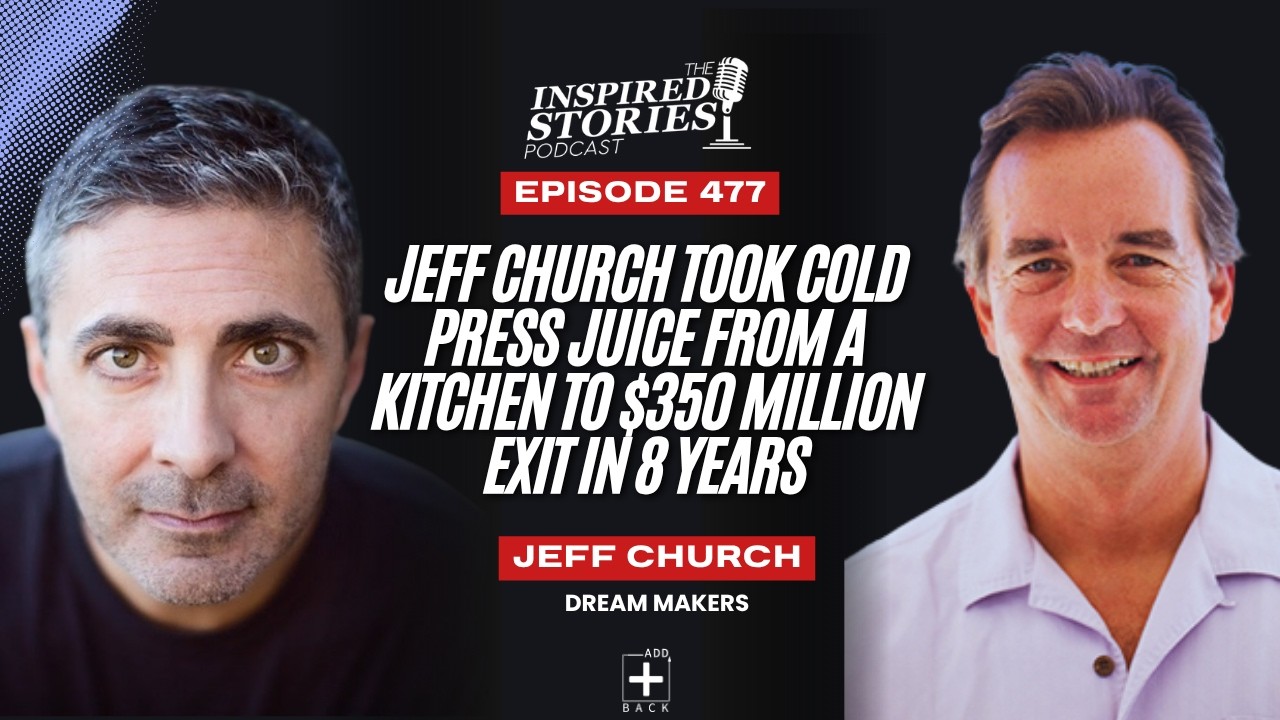
🎧 From Cold Press Kitchen to $300 Million Exit: Jeff Church’s Entrepreneurial Journey
Jeff Church, co-founder of Suja Juice and founder of CPG Founders Group and Dream Makers, scaled a cold press juice concept from a San Diego kitchen to $300 million in five years — then kept building. Across eight companies, more than $275 million raised, and nearly $700 million returned to investors, Jeff’s career is defined less by exits than by the hard-won clarity that came between them.
✨ Key Insights You’ll Learn:
CPA roots at Ernst & Young to running a failing subsidiary at age 27
First consumer brand: Lynx outdoor grills acquired for $9.5M, sold for $35M in three years
Nika bottled water: philanthropy-first model that taught why mission alone doesn’t drive repeat purchase
Meeting Eric, the 20-year-old making dark green juice with three ingredients
Whole Foods relationship-building and landing in the cold press category from day one
Trucking his own product from San Diego to Long Beach for the first three months
Post-COVID Coca-Cola exit: $40 million in debt expiring in four months
Building Babu, a curated CPG large language model trained on 6,000 of Jeff’s own articles
Proto protein soda launch at Sprouts: 10 grams of whey, zero sugar, three grams of fiber
Why fear of mediocrity eventually overtook fear of failure — and the football moment that unlocked it
🌟 Jeff’s Key Mentors:
His Father (CFO Background): instilled love of numbers and business fundamentals from childhood
Jessica (First Sales Rep): connected Suja to Whole Foods and became the brand’s first hire
Early Whole Foods Buyers: collaborative retail relationships that shaped product development from day one
Senior Operators and PE Network: ongoing peer pulse checks that inform current coaching and investing work
His Kids: challenged him to start Nika and sparked the entrepreneurial plunge that led to Suja
👉 Don’t miss this candid conversation about addiction, IQ tests, failed companies, and what it actually takes to build something worth exiting.
Listen to the full episode here
Transcript
Anthony Codispoti (00:00)
Welcome to another edition of the inspired stories podcast where leaders share their experiences so we can learn from their successes and be inspired by how they've overcome adversity. As you listen today, let one idea shape what you do next. My name is Anthony Codaspodi and today's guest took a cold press juice concept from my home kitchen to $100 million in revenue in five years, then watched itself for 300 million.
Outsiders often assume that kind of growth is like riding a smooth rocket ship up into the right of the financial graph. Those who have been through it can tell you that is never the case. The path included hard pivots, companies that didn't work out, and the kind of pressure that either breaks founders or forges them. What came out on the other side was something more interesting than just another exit story. He is Jeff Church.
co-founder of Suja Juice, the cold press beverage brand that became one of the fastest scaling consumer packaged goods companies in recent memory. Over a 35 year career, he has led numerous companies, raised more than $275 million and returned nearly $700 million to investors. Today he runs Dream Makers and Team Church where he coaches and invests in the next generation of CPG founders. But before we get into all that good stuff,
Today's episode is brought to you by my company, Ad Back Benefits Agency. Listen, if you run a business, you're likely stuck in the cycle of rising insurance premiums. You're paying more, but your team is getting less. And many people can't afford coverage at all. We do things differently. We provide your retail employees with unlimited access to doctors, therapists, and prescriptions that's always free for them to use. But here's the part that surprises most people.
Unlike every other employee benefit out there, our program puts more money into your company's bank account. As an example, we recently helped a client increase net profits by $900 per employee per year. Results vary, but the consultation is free. See if you qualify today at addbackbenefits.com. All right, back to our guest today, founder of Dream Makers and a whole bunch of other stuff, Jeff Church. Thanks for making the time to share your story today.
Jeff Church (02:14)
Anthony, nice to be here. Thanks for inviting me.
Anthony Codispoti (02:17)
So Jeff, you started your career as a CPA at Ernst & Young, one of the most prestigious firms in accounting. You were an auditor, &A associate, and you had to have been learning the ropes early on for the work that you would do later in your career. What was it about this kind of work that really appealed to you?
Jeff Church (02:35)
I grew up, thanks, Anthony, I grew up in the Midwest in Cleveland. My dad was an accountant by background himself and had become a CFO at a company. And I worked at this company over the summers, you know, growing up as a kid. And really began to understand, you know, I guess I had that I fell in love with the same love for numbers, can sound very crazy to a lot of people. But I do find that founders, know, typically there's about 50 % of founders.
that are really numbers oriented. There's probably 50 % that aren't and the 50 % that are, probably half of them don't wanna do with the numbers. So you're not alone out there if you're one of the 25 % that likes the numbers and the other 75 % really don't like the numbers.
Anthony Codispoti (03:19)
Okay, so you moved from the CPA &A world into becoming president of a Ricoh International. I saying that correctly? Yep. So a manufacturer and marketer of diversified electrical, industrial construction, railway products. You became a minority shareholder and steered the companies through some really impressive growth, but you were still pretty young at the time that you took that role. Talk to me about how you really grew your skill sets and understanding of business while you were
Jeff Church (03:27)
There we go. Yep. Yep.
I think, you know, I was young. was 28 just out of business school and running my first company. Well, actually, my colleague of mine from business school and I spent a summer there. was the end of the summer, the CEO of the parent company, the company had about 30 subsidiaries, asked us if we wanted to stay on. And we already had jobs on Wall Street, already picked out and, you know, accepted and everything. And he asked us at the end of the summer if we'd be interested in staying on and implementing what we said these great consulting, you know, projects that we did over the summer.
And we both knew long-term we wanted to be in general management and not in finance necessarily. is great, I really wanted to be in being the person running the business. And so did my friend Steve. So we thought this is a good way to short circuit that and get real leadership experience early on. And after about two months of being there, they let go of the CEO of the subsidiary and asked me at 27 or 28 years old to step in and be the CEO of the subsidiary.
which from an experience standpoint, couldn't have been better at that young age, but I'm sure they wouldn't have given it to me if it was a really good company, but it was a company that wasn't doing very well. ⁓ so I think maybe they felt like I wasn't gonna screw it up too much and ended up, the business didn't make it, but spent two years, I call it rearranging textures on the Titanic. But like it was going down, regardless, I was just made it a little less painful, think, going down, but learned very early on that.
If I'm most everyone was everyone was older than me that was reporting to me that I had to have a different sense of management style. I couldn't come across like kind of fist pounding or, you know, know, table pounding or I had to really earn their respect because they were all older than me and they are automatically thinking who's this young kid that's our boss now. This doesn't make any sense. So I really had to I think I learned a lot of different levels. Social, you know, just social entrepreneurship and the ability to really be
and think through those cultural things that are super important with businesses.
Anthony Codispoti (05:51)
Can you give us a specific example of how you approach things differently because of that age gap and needing to sort of finesse your way a little bit differently?
Jeff Church (06:00)
I think I just, I moved my bar up. You know, we all have our bar that we kind of boil at. And, you know, I just had to move my bar up because I, if I came across too much, if I boiled and blew too early, like we all have our spot, right? You know, I come home from the day of hard work and my wife has got the hardest job of all managing the kids. You she's ready to blow down here. You know, I'm way up here. So, you know, you have to, I think you have to adjust that because you can't treat, you know,
55 year old person that's been there for 20 years the same way you're treating a 22 year old person that's their first job out of wherever. You just gotta approach people just like you would a kid. You can't approach them all the same. You can give them the same things, but you gotta approach them differently.
Anthony Codispoti (06:45)
kind of know your audience sort of a thing. Yeah. So this company that they turned over to you to run at 2728 didn't end up making it was already in pretty bad shape. You make the landing maybe a little less painful. What did that do to your own mental psyche? Were you attached this like attached to it and sort of like this this held you down? This was like a weight over you? Were you like, Hey, I get it. I'm ready to move on.
Jeff Church (06:47)
Yep.
I mean, no, didn't. I didn't. It didn't weigh me down in the sense that because I didn't feel like I created it. I feel like I came in to help fix it and I did help fix it. We were able to sell parts of the business off, ⁓ you know, but but, you know, it was a militant labor union that had ⁓ it was a really high cost, you know, product. So I kind of learned at that time, you know, look, if you're in a commodity product, you want to be close to where your market is, you to be close to where your manufacturing is, your shipping.
heavy product all around the country, it's not gonna make sense. we were, know, a company that was based in New Jersey, you know, bringing its inventory in from the Midwest, shipping it back to the Midwest. So it just had a whole bunch of systemic, you know, failure points in it. It just wasn't gonna make it. But ⁓ from a two year, three year, you know, post business school learning, it couldn't have been a better experience for me to get all those experiences. learn them, I think we learned the most when things were the most, you know.
challenging to us, which isn't always the most fun, but those are when we really push ourselves to learn the most, I think.
Anthony Codispoti (08:19)
So true. Then at some point, you started bringing your skills into the consumer market space and it seems like you never left. What was your first bridge into this world?
Jeff Church (08:31)
I bought a company in, I think around 2004 called Lynx Professional Grills. It was the first consumer product that I ever had and I loved it. I mean, most of the time, the products that I have had over the years have been like things that are in the ceiling, in the ceiling tiles. You pop off the ceiling tile and you'll see a bunch of fasteners and connectors and stuff like that. So a lot of the first part of my career stuff was much more industrial and those companies were more buyouts. So those were, you know, using the assets of the company.
to use as collateral and as leverage to be able to get a bank loan to then buy the equity out and put our own equity in. And then over time, as you pay that debt down, you create value through what's referred to as a leverage buyout. They're really big in the 80s and the 90s and the early 2000s. And then banks and lenders got much more conservative on what they want to lend capital to because we hadn't had a recession in a very long period of time.
It went much more to more traditional things, the way that startups are done, where it's much more, you don't get a lot of bank debt until you're profitable. But I was looking for a brand to buy and I try to find things, I call them feather duster turnaround. So not a deep turnaround where you gotta change the route to market, you gotta change management, you gotta change the product, you don't have any money. Those are things that people can make a lot of money on. The founder of...
The guy who came in who'd been running Celsius, the energy drink company for the last 15 years, came in at that exact time and he was a turnaround guy. And he turned it around and built what's a $150 billion business out of it. But this company, Lynx, was an outdoor gas grill company, like a Viking. And I just loved it. It was a beautiful looking product, but they just made it too expensive to make. And it was going to be $15,000 to buy. And how many people are going to really buy that?
but I really liked the quality of the brand. So I acquired it through a leveraged acquisition and immediately fell in love with working with the consumer. Because you're at a cocktail party and you're telling somebody about your product, it's up in the ceiling and their eyes are glassing over and you're like, okay, I'll get another drink or something. But when you're talking about consumer products, everybody has an opinion, everybody has an interest and frankly, I like getting everybody's opinion. What do you think about this? So with the gas grill,
Anthony Codispoti (10:42)
You
Jeff Church (10:57)
company that was at the time in the early 2000s where guys really liked the heavy, big stainless steel hoods, but women thought they were really heavy, which they were, and they're pretty macho, so they didn't really need that. So I created the first lift assist spring that basically allows you to have this heavy hood, but you can lift it literally like with a finger because there's this lift assisting spring that's on the inside. We created the first sear zones that you would have, like you see the Ruth Chris when you're having a nice steak made.
where they're searing it on the outside first where they're searing the juices in. We created the first one of those inside. I took all the expensive stuff to China to have it, all the guts kind of made in China and basically took a product that wasn't making any money and made it a nice profit margin that kick started the growth. And I bought it, I think for like nine and a half million dollars. We sold it for three years later for about $35 million. Paid down a bunch of the debt.
You know, they don't have to be big deals. They can be little deals if you do them right.
Anthony Codispoti (12:00)
where did the ideas for the product innovations come from?
Jeff Church (12:03)
I think that's me. mean, I just am a product innovation guru at Suja. When we launched Suja, ⁓ we launched an average of a new SKU. It could be a flavor enhancement, so not that big of a change, or it could be a completely new product line. But over the course of first 10 years, we averaged a new SKU every nine days. ⁓ We did our own manufacturing, so we could do that. But I'm a big kind of test and learn person where
Anthony Codispoti (12:27)
Wow.
Jeff Church (12:32)
I like to test, test, test until the market tells me that it's working through repeat purchases. I'm going to keep tweaking and testing because I always have a plan B kind of going aside my plan A just in case plan A doesn't work or because maybe plan B is going to be better than plan A.
Anthony Codispoti (12:51)
So you had a good experience with Lynx, came out with some innovations, had a nice exit. Where and when did the idea for Suja come about? Were you working on that in parallel or did that happen after the Lynx exit?
Jeff Church (13:03)
Now, and that's kind of one of the interesting things about my career, ⁓ Anthony, is that I haven't been, ⁓ I've been very industry agnostic. So I've been willing to go wherever the best opportunity I felt like was given to me and very geographic agnostic too. Up until doing some of the startups that I've done over the last 15 years, I haven't lived in the city where my business has been, which is a bummer because I'm traveling already a lot to begin with.
Then on top of that, I have to travel to the main business unit. So it's not the most family-focused approach to take. during the startups, even though I was working even more, I was at least in the city where my kids were being raised and where we raising our kids. But I met, ⁓ my kids were in middle school and I wanted them to understand how lucky they are to live in such a beautiful country that we live in here in the United States.
all the great things that we have. And sometimes that gets lost in translation, you know, for different people have different angles on different things. And for me, I just I just know having traveled a lot, how lucky people are to live in this amazing country. My wife's an immigrant from Morocco, so she even more understands it than I understand it. And, you know, we just knew that we couldn't tell them that you guys are really lucky kids because that doesn't work that way. Right. So we took them to Africa and we took them to Indonesia for a summer.
And we did do the photo safari thing, but we really spent the vast majority of the time going through with NGOs and learning with the NGOs. I wanted to see what NGO resonated with my wife and I wanted to see which NGOs resonated with our kids the most. did they really kind of, because we thought if we could kind of engage ourselves with one of them, then we can kind of do stuff over there. They'll be engaged. They'll begin to see how lucky they really are. And they found one group called Free the Children out of Canada. ⁓
It's all about kids helping kids out of poverty ⁓ and for education, for microfinance with the women. So we started doing projects over there. And my kids said to me, dad, you're an entrepreneur. Why don't we create a business where we sell a product in the United States and we give all the profits away like a Newman's own ⁓ to bring clean water, education, and microfinance to people all around the world. And I said, OK. Probably should have thought twice. ⁓
Anthony Codispoti (15:25)
How old were your kids at that point, Jeff?
Jeff Church (15:30)
you know, 12 to 16 age range, so the right age for that kind of thing. And I probably should have picked sunglasses that have a much higher profit margin than bottled water. since we were bringing clean water to people overseas, they thought that let's do a bottle of water in the US. So created a bottle of water company called Nika, which in Zulu means to give. And we started selling that at local natural food stores.
Anthony Codispoti (15:34)
Okay, good, all right.
Jeff Church (16:00)
at street fairs, at all kinds of different things. Eventually got it into retail. What I did learn, unfortunately, was people talk very vocal that they wanna give back sometimes and they say they wanna do all these things environmentally. We had recycled PET, so the bottles were already bottles before, so made a good story from an eco standpoint. But what I found in the end is that people kinda wanna do their own charities, they wanna do their own stuff like that. They just want the best price for the best value.
that they're gonna get for you from your product. ⁓ I call it the short arms syndrome where people, may have deep pockets, but they have short arms so they can't get to those deep pockets. But we started NECA and ⁓ we did it for three years. We brought clean water to about 35,000 people overseas. Great experience for my kids and my family. But the business wasn't really driving the profits. It was more my wife and I being philanthropic.
Anthony Codispoti (16:38)
I can't quite reach him.
Jeff Church (16:56)
⁓ But right around that time as we were kind of shutting that down, I met a young kid, his name was Eric, and he's making these amazing dark green juices. And I'm a Midwestern meat and potatoes guy, and I'm thinking, there's no way I'm gonna drink this juice and like it. I mean, to me, like an O'Dwaller, a Naked was a healthy product. ⁓ And finally I tried it, and it did stop me in my tracks, and there were only three ingredients in it, apple, kale, lemon.
And I thought if I can drink something that has kale in it, then anybody on the planet can drink it. I think that's kind of what we found is that people really do like, they come in a little bit on the sweeter side, but over time they go to the less sweet side, what they want to buy. I just felt like kids aren't gonna want to give all their kids, my kids aren't gonna want to give their kids Coke and Pepsi products they're gonna want to give them. Or they're giving them now, Ollie Pop and Poppy and things like that.
are fairly new on the scene. So I wanted to try to be in that space.
Anthony Codispoti (17:57)
So I like this story about it's called Nika, the water company. Yeah. And, you know, I've been in the CPG space myself. I have other friends who have and tried the philanthropic approach and it same kind of experience where ⁓ I think people like they their first priority is what's best for my pocketbook. And if they're if it also happens to match up with the philanthropic story, great.
Jeff Church (18:01)
Yeah. Yeah.
Anthony Codispoti (18:26)
then they're comfortable talking about it. But if they've got to pay a little bit extra for it, not so much. And that's exactly what it is that you're describing there, right?
Jeff Church (18:35)
And I
do really believe in, you're right, I do really believe in this whole social entrepreneurship and that, you know, it's businesses that, and when people start caring, that's when we're really gonna be able to make a difference here. And I think that it's happening, I think you're seeing it. I mean, I think a lot of for-profit businesses got involved in the water crisis and, you know, Matt Damon got really involved in it. A lot of people got really involved in it and it made a big difference. Cause when you get a mass of people, you know, the entrepreneur can have the spark of the idea, can have the disruption element.
but it's really the masses that have to kind of come in eventually to really make that a sizable, systemic, kind of seismic shift, if you will, in culture and behavior.
Anthony Codispoti (19:16)
So you find this juice, it's this dark green juice, only three ingredients. You love the taste. You're like, I can do it. Anybody can drink this. But how did you actually go about growing it and scaling it? Were a lot of the retail relationships that you developed while you were with Lynx helpful in this, or are they completely different channels?
Jeff Church (19:35)
It was a different channel, but part of the interest level from the NECA standpoint, the bottled water that we created was I'd spent time trying to get in front of all the Whole Foods buyers. And they were like, it was like pulling teeth to get in front of a Whole Foods buyer. This is 2012. When you're talking about bottled water, because vitamin water had been done 12 years earlier and it was just late. But eventually I got a...
a six minute meeting where I flew across the country to meet with a buyer. And she told me, look, it's a good product, but you're just coming in too late. You gotta find a product where you're coming in early. So fast forward about six months later, I met this kid, Eric, who was making these green juices. And I thought, ⁓ okay, well, this is early, because I didn't even know what it was. And I met one of the other gal, her name is Jessica, she became our first hire. And she'd been my rep for NECA.
at a broker, sales broker, and I told her about it. She said, you're cold press juice, you, Jeff, are doing cold I'm like, yeah, said, that, so this is amazing, cold press juice, it's amazing. basically what it is is it's pressing through pressure, and it's getting, you don't get the pulp stuff, which has some good fiber in it, but you're able to get, all these molecules are able to go in your bloodstream much smaller, and then you're able to get, actually arthritis is really a lack of hydration.
And, you know, by using cold press juices, you can get them into all these nooks and crannies into your body. And they're really it's amazing, you know, what what it can do for like arthritis and stuff like that. But people don't really realize that. So, you know, we started to learn the benefits of it. He could make these amazing tasting juices. But at Whole Foods, I was able through Jessica to get connected into some of the Whole Foods buyers. Now, this time, instead of, you know, badgering my way to get a six minute interview across the country, they welcomed me and us in with open arms and said, yeah, come on in.
here we're just developing the product line. These are the flavors we have with another brand. We like your flavors. Would you be willing to consider a raspberry lemonade instead of a strawberry lemonade because we already have a strawberry and we think it'll grow the category that much bigger. I said, yeah. So we were very willing to be transparent. We were very willing to be flexible. I do think that there's in any business understanding and developing ⁓ incredible ⁓ customer collaborative.
relationships is really important. And it's kind of like going to office hours when you're in college or whatever. know, teacher puts it up there on the board, but nobody goes. So, you know, nobody gets the benefit of it. You know, and it's a little bit like that with this. It's like people just don't know how beneficial it is to have these collaborative, you know, retailer, you know, customer relationships and whatever space you're in. It just gives you the jump balls. If you heard the analogy, you who does the jump ball go to, which person gets it or not.
If it's a tie, you know, it goes to the home team typically because they have a slight advantage. And that's what you want is you want those jump balls going to you a little bit.
Anthony Codispoti (22:37)
And so why do you think you were able to get a seat at the table this time? You were just newer to the category. You had what it was they were specifically looking for.
Jeff Church (22:46)
We had what they had just launched, Whole Foods had just launched the category, the cold press juice category by launching a company called Blueprint Cleanze and Evolution Fresh a few months earlier. And they were both taking off and one was on the East Coast and one was on the West Coast and we were on the West Coast. they met us and they're both good brands, but they viewed us as being very transparent, very down to earth, very...
SoCal, beach-ish, chill kind of culture, which we'd had that, but we also had the crazy culture too. And so I think they wanted to see who was gonna really take off out of those three brands, but they felt like there was enough space, the category was big enough to have three brands in it. So they weren't really concerned about it. And from our perspective, all of a sudden now I had Whole Foods in the first 30 days helping me create the product and all that. Funny story though.
The product did take off on day one and I got a call from one of the store managers like the first week later and you know, he said, hey, Jeff, you know, the product is selling great. We can't keep it on the shelves. But funny thing happens is like you take your finger and you go and you go up like this on the label and you go like this and the whole label smudges off. I'm like, oh no, what happened? And I didn't realize that you had to put this varnish on through the person who's putting the label on.
They really should have seen it, but it's my fault, it's my brand, so it looks bad on me. And I was so stressed about it, but he said, don't worry about it, it's all good, we're getting new products again on Monday, so no issue. But sometimes the things we worry about really aren't big worries to begin with. But they were really great and they welcomed us in. And then what happened is two months into launching Suja, both Blueprint Cleanse and Evolution Fresh got acquired by larger companies.
And oftentimes as businesses do and they get acquired, they kind of go off the rails and they come back, but they come back a year or two later and they're kind of fractions of themselves because the founders are gone. And that spirit of core is kind of gone now. And big companies do dumb things. mean, we use a kill step called HPP, which is pressure instead of heat. They're very expensive, two and a half million dollar machines. And when the company that bought, ⁓ Blueprint Cleanse bought them,
and they diverted their HPP machine to another subsidiary of theirs. We'll talk about bringing your new company you just bought on, having them have like a big burn to their butt about you as their new owner. That's certainly not gonna help things, right? Deferring basically your amazing kill step that they were gonna use. So people do dumb things. And that was where I started to really learn that there is this thing called luck and timing. And luck and timing, I feel like I can get a business to 70%.
successful, but that final 30 % is really luck and timing and it's really hard to handicap those two things.
Anthony Codispoti (25:44)
This HPP process was critical to the space, right? Because you wanted to be cold pressed because there were benefits to that as well as perceived benefits. People were willing to pay that premium price. And your competitors, when they got acquired, that sounds like it was one of the things that they pulled out of their process.
Jeff Church (25:57)
Yeah.
They didn't pull out of it, but they just let them keep using tollers, know, which are third party where you like when we started in San Diego, I drove the truck every day for the first three months because we had to drive a truck from San Diego to Long Beach with the van on the West Coast, you know, in the middle of the day, that could be a obnoxiously four hour drive for 75 miles. And then I would drop the product off in Long Beach, pick the product up from the day before, drive it back down to San Diego.
You get to learn a lot about your business when you're hanging out there with all the other truck drivers waiting for the product. So I actually did learn a lot. think I was probably the only CEO that was actually dropping the product off as the driver, but you get to learn a lot by doing that.
Anthony Codispoti (26:46)
I have to say that's a surprising part of the story, I think, for lot of folks. You ended up selling this for $300 million and at one point, you're the guy that's trucking the product around.
Jeff Church (26:57)
for the first three months. And part of me wanted to do that too. Anthony was gonna have these kids that were young at the time and I wanted them to know that, I think being an entrepreneur sometimes is glorified and sensationalized and it's so cool. get fly around these jets and you get all this time on your hands. And since I've been on my own, I've never worked harder than even just being at a company like Asujia, I've never worked harder than today.
I mean, it's just, you know, you just have to work hard at these things. I think I've always believed that a secret to a successful 40 hour work week is to work 80 hours, which may not sound that appetizing to people, but I wanted my kids to understand that there's a dark side of it. I just had a knee replacement the year before and I'm getting up and down on the lift gate, you know, lifting product into there and just want them to see that.
Anthony Codispoti (27:49)
I love that. I'm so glad that you shared that. Can you give us another example, whether it's Suja or one of your other companies where people would be surprised to hear what you, Jeff Church, were doing? Some of the hard grunt, like getting your hands dirty kind of work.
Jeff Church (28:04)
Well, I one of the things I pushed at SUJA pretty hard was that ⁓ I thought, you know, let's, and I'll tell you Anthony, first and foremost, I'm not the sharpest tool in the shed. I'm a smart guy, but I'm not a brilliant guy by any means. I'm a very much a mediocre IQ person that has, you know, pretty high EQ, you know, type, know, type stuff, but I have to work really hard to get what I, to get what I get. I always had to work really hard and really hard in school and.
And I created, at a certain point I thought, I've had all these successful businesses. You you always see these things pop up, you know, take your IQ. And I figured, okay, I'm going to try it. And this is like 30 years later. I knew I had a very, you know, for me, a mediocre IQ was like 100. I got 98 to 102, somewhere in that range. you know, I didn't think it was very good. It's probably on the lower end of the average.
the average side of it. And I thought, okay, all these years and all this experience, I bet it's gone up to like, I bet it's 120. So, you know, but before I did that, I ⁓ said, my HR person said, we were having trouble getting ⁓ the right people hired in, and we were hiring good for culturally, but not like sort of critical thinking. So somebody suggested, let's create a little test, and you got to at least score over a base level of the test.
And you know, or we won't, you just won't. It's just a bar that we'll use. And I said, OK, well, let me try to test. I did the test and I didn't score over the baseline. I went back to our HR person. said, I think we got to rethink the test here, guys. I didn't get over the baseline, so that knocks me out. But you know, but I'm not the smartest guy. And I went and took that IQ test and it was still the same damn 98 to 102 range. And I'm like, what the heck? You know, but like but but what I realized is I think if you're
If your IQ is within a range, let's say, I don't know what it is, 80 to 120 or something like that, or 90 to 130 or 100 to one, I don't know what it is, but if we're within the same range, then that's not your limiting factor or your driving factor. That's gonna be your table stakes to be in the game. Then your driving factor is gonna be your EQ. And once you're able to do your intellectual curiosity, things like that. Now those I'm really high on, but on the blocking and tackling of that, I mean.
You know, don't believe your own ether too much, I guess is kind of the message I'd say. You're not as good as you think you are, and you're not as bad as you think you are when you're in this little space.
Anthony Codispoti (30:28)
Yeah.
You know, I'm glad that we kind of went this direction with the conversation because I want to get your input on this. You know, a lot of folks that I talked to and I've had this perception in the past myself think that these great business leaders, these, you know, powerful entrepreneurs that you see, like they're just born that way. Like they come out of the womb, just sort of pre-wired for this success. What's your take on that? Having been through the cycle yourself, having met a lot of other entrepreneurs, what's your thought?
Jeff Church (31:03)
I I grew up very much thinking that way, because I had the Ted Turner's and the Bill Gates and the Steve Jobs and these people. those people have got to be born brilliant or born like that. I'm like, so I actually didn't even think about being an entrepreneur. I never thought about being more than a manager for a long, long time until I started to really kind of see that and understand it. And then I began to realize that, you know what?
At a minimum, they're mentored. They're mentored by the people that have been important to them in their lives and unimportant to them in their lives. But, you know, I think there are certain traits that are, you see commonality across these traits. Successful entrepreneurs, I mentioned one of them a second ago, intellectual curiosity. I think, you know, being intellectually curious is one of the most important, you know, traits to have. If you can ask why about a particular topic.
three times, you can go further than most people will ever write about. Why do you think that? I do this with my kids all the time. It's like, why? And then they'll give me some half-brained answer and I'll give them, well, why do you think about that? Why is that? Why is that? And then they'll ask me, and I'll give them another why. And most of the time, people can't get to the third why. So they don't really understand what they're explaining. So for me, it's like,
You know, these people, you know, the other trade I think that is a commonality trade is, you know, the perseverance and tenacity, you know, willing to, if the going gets tough, not willing to quit, you know, going to strap everybody on my back right now on the company and I'm going to climb up to the top of that hill. I'm going to plant that flag at the top of that hill. I mean, those are the things to me that are important trades, but whether you're a, you know, social studies major or whether you're you know,
humanities major, whether you're a business major, I don't think any of that stuff mattered. think it's those traits that matter. And then being, I think, a fairly quick study, you know, and I think as with anything out there in the front, having the ability to take rejection, you I mean, you're going to go out and you're going to raise money. over 30 years of doing this, I'd say at least 45 percent of my time has been spent on raising money. And it's not a muscle that I'm particularly great at using.
I'm not the gift of gab, not the greatest salesperson. So I have to know my material really, really well in order to feel confident in selling and know that like, you know, I'm going to make 20 pitches and I'm going to get four people that don't just like look like they're completely uninterested in falling asleep. And then I'm going to get those four, I'm going to two that want to be interested in talking after they see a deck.
I might get one that I continue dialogue on with, but if you don't have those kind of numbers in your pipeline, you're gonna come up dry at some point.
Anthony Codispoti (34:09)
Yeah, I love all of that. ⁓ The grit, the resilience, the determination, the curiosity, these are all really important elements to being successful. And you know, so with the SUJA brand, had a $300 million exit phenomenal. ⁓ And you've continued to stay in the space incubate a lot of other brands. And I understand you've just had a brand new product hit the shelves just in the past week. Can you tell us about this?
Jeff Church (34:33)
Yeah.
Yeah, it's a product called Prota. You can see it here, Prota, P-R-O-D-A, protein soda. Protein sodas are new. ⁓ There have been protein in like drinks like Ensure and stuff like that, but that most of that stuff's kind of junk and ⁓ it's in more of a dairy fashion. This is actually a protein soda and it's ⁓ 10 grams of whey protein isolate in a can of soda.
So if you're familiar at all with Alipop or Poppy that have kind of blown up here in the last couple of years as being kind of a reinvention of soda, know, you know, but basically, I mean, Coca-Cola and Pepsi and those guys all have about a 40 billion dollar soda market. It used to be about 60 billion and 20 of it over the last 20 years has gone to energy drinks. Well, now there's these protein sodas that are coming out, which are you don't taste the protein because it's clear whey protein. So at least in ours, you don't taste the protein. We have
We're selling it at Sprouts nationwide across the country. Just launched, it's at $3.49. So you get your soda. What you find is there's about 50 % of Americans, adult Americans that drink soda. And there's about 75 % of adult Americans that trying to get more protein in their diet, whether it be because of, know, GLP-1 or whether it be because they're exercising more and they just need more muscle mass, you know, whether they're getting older. And it's hard as we get older to get.
protein and that was the reason my partner, Matt, started this was that we co-founded it together, but his grandmother needed more protein in her diet and she just couldn't take the pills and couldn't take the chalky packets. So he kind of created this drink and my background with Suja having had the experience of being and building and scaling a beverage brand very quickly, ⁓ I felt like this was a product that I'd like to be attached to too.
after I was working with Matt for a while, we decided to become co-CEOs and co-founders together. And that's available on Amazon as well.
Anthony Codispoti (36:36)
Proto, P-R-O-D-A. Are you guys like real early in this curve? You're not the first brand doing protein soda or are you?
Jeff Church (36:45)
No, we're not. There's probably five or six brands out there joining. Target has two other brands. One's called Whey. Another one's called Clear Protein. I think we're unique in that ours really doesn't taste like the chalky. You don't get the chalkiness. Now saying that people are probably going to go out and try it they'll I've got chalkiness. ours is going to be far less if there is a chalkiness taste to it. Ours also has three grams of fiber and it's zero sugar. So it's kind of part of this. It's like you're getting the benefits of the soda.
but you're really also getting the benefits of a need state that you might be having to deal with somewhere else, like a protein, for example.
Anthony Codispoti (37:23)
Okay, now I'm even more excited now that you said it's got zero grams of sugar because I'm hearing this and I'm like, I kind of want to ask Jeff if there's a lot of sugar in this but I don't want to rain on his parade because in order to make it taste good, but clearly you've got you know, some probably natural sweeteners in there that are doing the job instead.
Jeff Church (37:27)
Yeah.
No.
We do.
have have monk fruit and stevia, but I know there are some stevia haters out there. They're all natural, of course, but but you know the stevia we're using is called Reb M. It's the highest level stevia on the market. It doesn't even have to be mentioned as stevia on the ingredient panel, actually. you don't, you know, knock on wood. I don't think you taste the you taste the stevia and it, know, I'm as I'm saying that someone's going to say that it did, but it's very subtle. you know, the formula that we're using
but a formulator with me for two or three companies now. And she does an amazing job of balancing out the different ingredients so that you don't get that chalky taste to it. ⁓ So we're excited about it. also gonna be pushing it in gyms, in fitness studios and stuff like that too.
Anthony Codispoti (38:25)
Exciting stuff. So tell us about Dreammakers and Team Church. Who are these platforms built for and what does the work actually look like?
Jeff Church (38:32)
Yeah.
So after I, so I've had eight companies, Anthony, in the last 25 years, and five of them have been what I call home runs, and three of them have been, you know, brutal failures, sprinkled gasoline on the wreckage, you know, kind of things. And although that's a decent batting average, it's only the ones that don't work that you tend to think about at 3 a.m. when you get up, you to go to the bathroom in the middle of the night or whatever. Those are the ones that you keep thinking about, should it go to what,
And you can't do that, but you do do that as human nature. It's just kind of our nature. I really love the CPG space and I love teaching. been teaching, I taught at Michigan State a long time ago and ⁓ I loved being a TA in the accounting department. And then I loved speaking at business schools over the years. ⁓ so it's always been in my DNA to teach and like explaining things. I always am helping people with founders when they've had questions. So I thought.
But also like the space and want to make money in it as well. so I thought, why don't I create a coaching business, a platform that allows people, allows me to share the thousands and thousands of mistakes that I've made and help people avoid those mistakes so that they don't have to spend their own nickel on my mistake that I made. And just really essentially improve early stage founders odds of success. So I work with people that are generally in consumer goods.
but pretty much anything, but generally consumer goods, consumer packaged goods in particular, food, pet, beauty, those kind of areas, but also just general consumer as well in general. But I work with those people on a month to month basis to help them identify the top three things that are challenges for them or roadblocks and help just knocking them down. If it's fundraising, it'll help them put a program together, create a model, build a business plan.
really get in position to be able to fundraise. They obviously have to do the fundraise themselves, but I'll help them through the process. know, if they're trying to reduce their burn rate, I'll help them reduce their burn rate. If they're trying to get into retail distribution, you know, I've got connections all throughout the country, you know, with retailers, so I'll help them with that. And then just kind of systematically knock a few of those off. then over the longer run, have them involved on a more of a retainer basis to, you know, again, month to month, but...
optionality, but really, you know, I bring a speaker in every month, really high quality speaker, about the founders of Poppy last year, last night we had the former FDA, heads of the FDA on ⁓ our program. And then I also have two group meetings with the group. ⁓ I find there's a lot of benefit in the peer dialogue between people, because if you're someone that has got a product and you need you're looking for an apple and you're reaching out for an apple and somebody's coming to you with an orange.
It really doesn't help you that much, even though they're both fruit. But if somebody's coming to you with an apple and you need an apple, they're gonna gobble that up super fast. And that's what I'm trying to do is have people that have apples when somebody wants an apple and an orange is when they want an orange. And so I do this all through this monthly program. And then also have a WhatsApp group that's free that if you wanna connect in with me at jeffatteamchurch.co, you can and I'll get you into it. But it's for founders only and it's a...
And so I don't invite service firms into it. It's just founders and you can ask questions about other founders. You know, if you're doing a photo shoot in Brooklyn next weekend and you're looking for a photographer, you type it in there and there's a couple hundred people that maybe somebody's, you know, just done one and they have somebody that they can recommend. And then the other one that I'm probably most excited about is I created a tool called Baboo. It's B-A-B-U. And the, if you want to go to it, it's ask A-S-K B-A-B-U. ⁓
⁓ It's a chat GBT that I created and curated. just for CPG. So, or just for consumer. Now it'll still work like a normal chat for anything else, but basically I uploaded about 6,000 of my ⁓ consumer articles, podcasts, books, different things that I've done. And ⁓ then I worked with a group out of India to create a large language model for me that basically taps into
the back end of a large language model. Right now it's Claude that we're tapping into on the back end. And with them, ⁓ it goes through my server first when somebody enters a prompt. And then it goes through the internet through Claude, for example, or chat GBT. And then it brings back a response that is usually about 25 % more enhanced than what you would get on just a normal chat GBT because it's taking part of that from the information that I provided it. And that just went live in a free beta.
So it's free for the next 45 days in a beta format. And I have these things called gurus in there that are basically agents that allow you to run up to 40 different types of programs on your consumer brand. So a fair amount going on.
Anthony Codispoti (43:39)
Okay, so askbabu.ai
is this chat tool that's specific to the CPG space that you guys have custom built. The coaching platform that you were talking about before, ⁓ how can folks learn more about that? Where do they go?
Jeff Church (43:55)
Yeah, the easiest thing to go would be to go to...
⁓ It's actually CPG, CPG Founders, F-O-U-N-D-E-R-S, group.com. And that's the company that actually sits above everything.
Anthony Codispoti (44:18)
Jeff Church (44:20)
Anthony Codispoti (44:23)
CPT founders group dot com. OK, we'll have that in the show notes for folks. Yeah.
Jeff Church (44:26)
Thanks, I appreciate that. Or
jeffateamchurch.co. can always reach me in.
Anthony Codispoti (44:30)
And so what is Team Church? What is Dreammakers? What are these exactly?
Jeff Church (44:33)
Well, so Dream Makers
is eventually going to be a private equity fund that I'm raising. So I'm going to raise about $50 million of institutional capital. And part of this program that I put these founders through is pretty robust. As part of it, there's also this boot camp that has about 500 slides and a slide presentation that I've created that I narrated, actually. It's about 30 hours of soup to nuts consumer goods.
you know, idea to exit, you know, type stuff. ⁓ you know, most of the people that I work with work with me for at least a year. ⁓ And ⁓ by doing that, I really do think I'm helping increase their odds of success. So, ⁓ you know, I've gotten some, you know, green light on from a handful of people, more money to raise, but that I can take some of these people that are coming out of this program after the year and have gone through it and I can show that the process to...
investors that they've gone through that I can have a higher probability of leaning in with investment capital with those people. So it's kind of my internal way of vetting people. Yesterday we finished a pitch slam that we had with four brands and the winning brand got a $10,000 investment from me into it. And I'm not a judge. We have judges that are independent. They're all private equity type people. you're pitching the people that you want to be pitching to to begin with.
But that's kind of an example of letting the process identify which ones they think are the best businesses and then investing a little bit more heavily in those businesses. So that's where Dreammakers is gonna be. BaBu is gonna be the Chat GBT, LLM. And then the CBT Founders Group is gonna be the coaching group.
Anthony Codispoti (46:26)
Okay. So, and as I look at your LinkedIn page here, Jeb, I see you're involved with a bunch of different brands and they all seem to have kind of this common thread of being in energy, adaptogenic, protein, like some kind of like functional beverage space. There's also a line of gummies that kind of fits into that as well. Why are you so excited about this space in particular?
Jeff Church (46:46)
Mm-hmm.
I think it's the most amazing space on the planet because with all the technology developments and improvements that through extraction methodologies, both in terms of how to do them more clean, how to do them more efficacious, there's no reason today that anybody should be consuming something with 60 grams of sugar in it with no functional benefit to the product. I mean, if you want to, because you can, you don't have to do that. I and I can put two products in front of you.
that you equally sweeten one that has 60 grams of sugar and another that has zero. And you won't be able to tell the difference. I mean, that's how good these extraction methodologies and a lot of that stuff is getting. So it used to be that you couldn't get something like ashwagandha into a product because ashwagandha has got a very harsh sensory taste to it. And you just can't get much into it without the taste going. And if you don't have the taste, people, you know.
93 % of consumers buy for food or beverage product by based on taste. So if you don't taste good, then people aren't gonna repeat. And the single most important factor in all CPG consumer goods is really repeat rate. How quickly and what percentage of your consumers are repeating on an annual basis. And if the answer is 5%, you got the wrong product because your product isn't repeating enough. It's gonna cost you too much money for you to acquire new customers.
you're either gonna run out or you're gonna run out of money to be able to do that with. So getting ⁓ these things right is just really important. And I think it's never been easier and better than today. for me, it's like anybody that's drinking a 70 gram, it's just habit, right? I do the same thing with a bunch of things in my life that I know I can switch out and I'd be a better person, I'd be healthier for it. I just haven't put the brain matter in to make myself do it. ⁓
but it works and it's happening. I think, you know, in my kids' kids' generation, they're certainly not gonna be, you know, they're gonna wanna be putting stuff that we call ladders or layering in, where you're layering in multiple benefit states into one product. It's definitely something that's on the increase.
Anthony Codispoti (49:05)
Yeah, in a previous life, I had a functional tea brand myself and we worked with a great factory, but they were really old school where it was like form first, right, or the function first, and the flavor was a secondary thought once I could help them understand exactly what you're talking about, like, we can sell anything once, but that repeat purchase isn't going to come unless they really like the flavor. That's when the products we did with them really started to take off. It's such an important
Jeff Church (49:32)
Yeah, and if you're an
early stage founder and you're getting feedback from friends and family about a product that you have, you're making, I'm gonna tell you, I'm fortunate right away that 50 % of what you're getting, you have to kind of throw out because human nature is we don't want to tell people, especially people we love, we don't want to tell people bad news. if you have a four year old, you can put it in front of and have that person try it. Then you'll get a real good answer.
on what people think, your four-year-old nephew or cousin or niece or whatever, then you'll get a good answer. parents, relatives, family members, maybe if you've got some distant cousin in New York City, maybe they'll give you a really good critical answer. for the most part, people won't give you critical answers. But I would still tell them, tell me the truth. It does me no good if you don't tell me the truth. But even with that, people won't tell you the full truth. The way you can get the full truth.
is go to people that don't know you and ask them. And you can do that through things called a HUD. You can look it up, H-U-T, but it's a home use test where you send like 20 different people product and they give you a little score, maybe you give them a $15 gift card or something to buy something with and they send you back the scoring. And if you don't get an eight out of 10, then you should go back to the drawing board with this product. You have to be demonstrably objective.
in this process and not breathe, not kind of, you know, kind of precondition the responses either. mean, blind taste tests are the best.
Anthony Codispoti (51:08)
Jeff, are you still involved in product ideation and innovation at these different brands?
Jeff Church (51:14)
I am, yeah, not Suja, but the other ones that I am. I and I really, really involved in the beginning and always trying to be the person. A lot of times you find with people in the natural community is that they really want that efficacy. They really want that, or they want that story, that environmental pitch, that environmental story, where they want that, the impact they're doing on the bees or that we're using tree bark as our source for.
you know, whatever. you know, a lot of people tend to make the product not taste very good in the beginning and ⁓ or make it really expensive, you know, so that if the product in the markets, five dollars per bottle or per can of it, you know, they're at fifteen dollars and they're saying, yeah, we're making a we're making a good margin. We're making a good margin, but you're never going to sell a product or you might be down here at five dollars where the market is, you know, but you're losing three dollars a product.
and probably neither one of those are the right spot you want to be in. You probably want to be 20 % above where the $5 is. So it's your premium, so you can kind of drop down into the, and where the mass is at when you're on promo, but you can come back up to this higher level and try to sell the premium qualities of your product. You can always drop your price, but it's really hard to bring your price back up.
Anthony Codispoti (52:36)
Jeff, what's the hardest thing you've ever had to overcome personally and what did it teach you?
Jeff Church (52:43)
mean, probably the hardest thing that I've had to overcome is part of the reason I left Suja after being there as a CEO for 10 years and loving it and hiring every single person of the 380 people that we had and getting to know a lot of their families and the business that I loved and built literally from square one through four manufacturing plants. And we had a person even name their first born Junie because they came together working at Junie and...
and I got married and had a kid. So you get all those really good things in knowing what you're doing. But probably the hardest thing for me has been, I left there in part because I needed to go fix my body and fix my mental psyche and I had to go to rehab. it was a hard, I could have stayed and done it at SUJA. Now that this is five years ago, six years ago, but after going through all that now,
They're going public this summer and I don't have anything to do with them now. I did very well with it, so I have nothing but positive things to say and, you know, bleed suits of colors all day long and I want them to have all the success in world. I want my grandkids to go into the store and go, my grandpa made this product, you know, a long time ago. So that's what I want. ⁓ But I do stay really involved in, you know, all the other ones that I'm involved in. But having to go to ⁓ rehab was hard because I...
I had to kind of admit to myself and people around me that I let myself get too into this rut here that you can get into as a founder. And ⁓ you get all the cool things, but you got to be okay with the crappy things of the rehab type stuff. A lot of founders that probably another trait I see in a lot of founders, not a generalization, but just a trait I see is those people that have kind of addictive personalities. You have to have...
a little bit of a screw, a little bit loose in your head. If you're go leave a really nice paying secure job and take that entrepreneurial plunge and you you gotta have something maybe not working a little bit right in there. ⁓ So I don't know, I find that, you know, at least for me anyway, my addictive personality are some of the things that make me great at what I do, but there's also another side to it, you know, as well and it's not an excuse, but it's just something that, you know, I've had to work through and know that.
because of how the family I grew up in and how I came and all that. That's just something that's on my list of watch house that I have to be sensitive to. I probably, you can kind of lose yourself a little bit in these startups when you're doing them. And it was very stressful. Coca-Cola said no to us. And after being an investor in us for three years and largest beverage company in the world decides to basically discontinue you. And you're out there with $40 million in debt.
it's expiring in four months and your team not knowing whether they have jobs tomorrow or not. It can add a fair amount of stress. I found, for me anyway, one of my secret powers though is I guess my ability to be able to handle that stress. Because I've come, I kinda came to this conclusion as to how can I handle that when I know how stressful it is and that I'm down to X dollars left and I'm gonna have to start rationing payroll.
All that, and I've come to understand that because I've realized that things that money can solve aren't real problems in life. It's the things that money can't solve. A sick kid, ⁓ you know, I had an explosion in a factory early on in my career in one of those three companies that didn't make it, and we had a fatality. All the money in the world can't correct that situation and that fatality. That's the stuff that stresses me out.
My kid's sick and I can't get him fixed. That stresses me out. Whether I have a business that doesn't make it, yeah, that'll bother me. And believe me, that'll bother me. And that'll be what I think about it through the end of the morning. But it's not a real true problem, Anthony, right? mean, you learn that, I think, as you get a little bit older. It's the people around us that we love. Those are the things that matter the most.
Anthony Codispoti (56:58)
Do you think you achieved some of this perspective and clarity having gone through the addiction cycle and the recovery process? Or was this a part of your makeup from before?
Jeff Church (57:10)
I I think it, don't think that that had much to do with it, although I'm sure it had something to do with it. I had a lot of experiences when I was a kid of things that I lost, not like life, you know, threatening things like losing a parent or anything like that, but like, know, ⁓ trying to get my lifeguard certification, not failing at that, know, running for class president, you know, coming in second for that, a whole bunch of other things that.
were non-inconsequential in the game of life, things, but things that I lost that early on. And so I, you know, I always had a bit of a, you know, I gotta work a little bit harder than the next person, you know, to try to do this. I gotta find the angle here where I can, you know, have an edge here. I mean, so I always had that kind of, you know, mindset maybe because of that. But my real quick story is going, is when I had this entrepreneurial jump to...
take the plunge and go on and take the plunge of it and go in. I was, it was literally 20 years earlier. I was a football player on my high school team. We had, we lost all the games my first year being a junior and all but the last two games my senior year. And we were down by like four points with like 20 seconds to go. And I was a receiver. I already caught a touchdown pass. I already had a pretty good game. we were, quarterback was rolling out in the end zone. I was rolling out.
and across the end, in the back of the end zone. He didn't see me and I had the split second to raise my hand and have him see me and have him throw me the ball and maybe catch it and be the hero, but also maybe drop it and be the goat. Or do I not raise my hand and see if he just sees me? In a split second that felt like an hour, I didn't raise my hand. He didn't see me, he got tackled. We lost the game. We lost the next game. We went 0 and 20. And for the next 20 years, I literally thought about why was I so much of a wussy that I couldn't call, I couldn't like, you know.
raised my hand, what was wrong with me? And I literally have dreams about it. And then when I was starting to go off on my own about 20 years later, you know, and I felt like I was blindfolded, talking on, standing on top of the diving board, being told to jump. But I'm being told to jump by my mom, my wife, and my sister, my only three real fans in the world. And my mom would tell me, you played a great game, Jeff, and we lost 59 to nothing, or something like that. So it's like, that's really like, not really the compliment. was...
I was looking for, but I just felt like I was blindfolded, not knowing there's water in the pool. But one night late, I was channel surfing and I was watching a bunch of senior citizens, and they were going around the room. They were asking the interviewer, what did they wish they'd done differently in their careers? And every single one of them said they wished they'd taken more professional risk, that they felt like they had the goods, they had what it took, they had very successful careers, but they felt like they could've...
really jumped socioeconomic levels. They could have really let it go. And that just clicked with me. And it clicked with me that here's what happened. I was more afraid 20 years ago of failure than I was about mediocrity. Whereas fast forward today, I was more afraid of mediocrity than I was about failure. I didn't mind failing today. I just didn't want to wake up and be mediocre 10 years from now. I wanted at least to have taken the shot and know that I can't look back and regret.
I didn't take the shot. And it just all made sense in that like split, you know, whatever it was, second or, when it all came together, that 20 years ago was just more afraid about failure because I didn't want to be viewed as a failure. I didn't want to be viewed that way on the bus. It was so childish, but it was all to go through that learning process, guess, on our own at our different times. But for me, that was helpful.
Anthony Codispoti (1:00:53)
It's almost like, yeah,
sorry, Jeff, it's almost like you wouldn't have had this fear of mediocrity today. If you hadn't been carrying that disappointment of the fear of failure in yourself that you had for the last 20 years, like this has been eating away at you so much. You're like, I don't care. Maybe I will fail, but I don't want that feeling anymore. I am willing to risk failure for the opportunity at greatness.
Jeff Church (1:01:07)
Yeah.
Yeah, think that's better said than me, much more succinctly.
Anthony Codispoti (1:01:24)
So tell me about the book that you're just wrapping up. What's it called? What's it about?
Jeff Church (1:01:30)
Yeah, it's ⁓ called the art of the startup. And it's a one part entrepreneur memoir, kind of my eight stories ⁓ and really lessons learned from those eight stories. And then one part ⁓ tools for entrepreneurs, for anybody that's kind of pre-revenue to $20 million in revenue or so. And just tools that have worked for me, along with a bunch of your QR codes that feed back to.
programs and stuff that are in my stuff. And then it's the third part, kind of the Suja story, that I really wanted to write. I've written a couple other books in the past and I've been wanting to do this for a while. Also wanting to have a way for people that want to learn more about some of the tools and stuff that have worked for me, but maybe don't have the money to go through a program or something like that. can just do the book and I'm probably not going to sell any copies because I'll give them all away anyway. But if you can't afford one, I'll give you one.
Anthony Codispoti (1:02:31)
Just one more question for you today, Jeff, but before I ask it, I want to do three quick things for the audience. First of all, anybody who wants to get in touch with Jeff Church, Jeff, what's the best way?
Jeff Church (1:02:42)
You can just email me at jeff, J-E-F-F at teamchurcht-e-a-m-s-u-r-c-h dot c-o.
Anthony Codispoti (1:02:50)
Jeff at teamchurch.co and we'll have that in the show notes, folks. And if you're enjoying or LinkedIn, we'll find that link and we'll put that in the show notes too. And if you're enjoying the show today, please take a moment to subscribe wherever you're listening. It also sends a signal that helps others discover our podcast. So thank you for taking a quick moment to do that right now. And as a reminder, you can get your retail employees access to therapists, doctors,
Jeff Church (1:02:53)
Yeah, or LinkedIn. Or LinkedIn is fine, too.
Anthony Codispoti (1:03:19)
and prescription meds that counter intuitively actually increases your company's net profits, real gains that can change how a business is valued. Contact us today at addbackbenefits.com. So last question for you, Jeff, a year from now, what is one very specific thing that you hope to be celebrating?
Jeff Church (1:03:38)
I helped to be celebrating that we were able to get my protein soda to have the same velocity levels that Poppy and Ollie Pop have at Sprouts.
Anthony Codispoti (1:03:49)
And the early indications were just a week in, but look good. Promising. Yeah.
Jeff Church (1:03:54)
Yeah,
number four brand out of 62 brands right now. So good start, but we need your help. please let us know what you think about it too.
Anthony Codispoti (1:03:59)
on stuff.
There you go, folks. Jeff Church, I want to be the first to thank you for sharing both your time and your story with us today. I really appreciate you being here. Folks, that's a wrap on another episode of the Inspired Stories podcast. Thanks for learning with us. And if one thing stood out, put that into action today.
Jeff Church (1:04:11)
Thank you so much, Anthony. Appreciate it.
🔗 Connect with Jeff Church:
Website: cpgfoundersgroup.com
Email: jeff@teamchurch.co
AI Tool: askbabu.ai