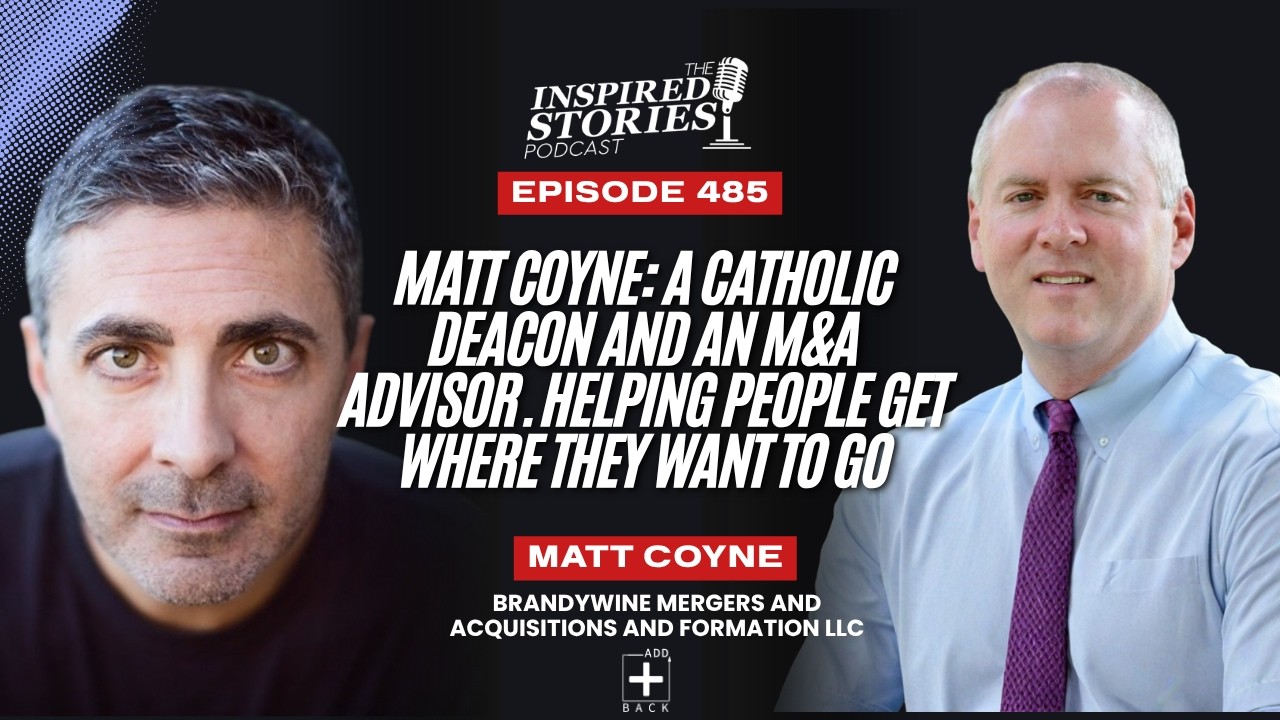
From GE Finance to M&A Advisor: Matt Coyne's 25 Years on the Front Lines of Business Exits
Matt Coyne, founder of Brandywine Mergers and Acquisitions and Formation LLC, spent a decade inside Fortune 100 companies before stepping away to help privately held business owners navigate the most important financial transaction of their lives. A deacon, author, and recovering alcoholic with a disarming honesty about all three, Matt shares what he has learned from hundreds of deals and why most owners leave an enormous amount of money on the table when they finally sell.
Key Insights You'll Learn:
GE Financial Management Program: high-pressure training that shaped a career-long view of finance
Watching a 30-year GE veteran face public humiliation for missing numbers at 25 years old
Leaving Precision Castparts after a brutal Sunday review in Yorkshire and never looking back
Starting Brandywine M&A in 2001 with a lifelong friend and zero corporate safety net
The identity crisis that follows handing over 500 employees and an executive title overnight
Why small business M&A and corporate M&A are entirely different animals
Most common seller mistakes: weak books, customer concentration, and waiting too long
The M&A Mastery Program: eight-week coaching for wealth advisors and business owners
Why owners need their wealth advisor articulate in M&A before any deal conversation begins
How sobriety, faith, and a seven-year deacon program reshaped Matt's approach to life and work
Matt's Key Mentors:
Dennis Damerman (GE CFO): Walked into a room of new hires, shook Matt's hand, and asked about his wife by name; demonstrated that personal leadership scales
Tom (GE VP): After being publicly dressed down, told a 25-year-old Matt to decide what he wanted his career to be; one of the rawest honest lessons Matt ever received
Frank (Business Partner and Lifelong Friend): Pulled Matt out of burnout with a partnership offer and helped him build Brandywine from scratch
Lisa (Wife): Held him accountable through recovery, supported the deacon program, and kept the faith when he couldn't
Tim Ferriss (Author): The Four-Hour Workweek prompted Matt to write his own book and think differently about information as a tool
Don't miss this conversation about what business exits really look like from the inside, and why the owners who get what they deserve are the ones who started the conversation years before they were ready.
Listen to the full episode here
Transcript
Anthony Codispoti (00:00)
Welcome to another edition of the inspired stories podcast where leaders share their experiences so we can learn from their successes and be inspired by how they've overcome adversity. As you listen today, let one idea shape what you do next. My name is Anthony Cotus Bodie and today's guest spent seven years studying theology at a Catholic seminary while simultaneously running one of the most active boutique &A advisory firms in the mid Atlantic.
He built a career that started inside the Fortune 100, left the safety of that world to bet on himself, and spent two decades in the trenches with owners making the difficult decision to sell their businesses. He wanted to help business owners stop leaving enormous amounts of money on the table. His name is Matt Coyne. He's the founder of Brandywine Mergers and Acquisitions and the &A Mastery Program at Formation LLC. Based in suburban Philadelphia,
Matt has spent more than two decades advising privately held business owners through the sale of their companies, with a specific focus on manufacturing, distribution, and professional services firms. He is also the author of Straight Talk from the Front Lines and the creator of an eight-week coaching program that has helped owners and advisors around the country approach their exits with clarity and confidence. What makes, edit.
What makes Matt's perspective rare is that he has seen this moment through multiple lenses as a Fortune 100 finance executive and as a boutique advisor. Now, before we get into all that good stuff, today's episode is brought to you by my company, Adback Benefits Agency. Listen, if you run a business, you're likely stuck in the cycle of rising insurance premiums. You're paying more, but your team is getting less, and many people can't afford coverage at all. We do things differently.
We offer a solution that provides your employees with unlimited access to doctors, therapists, and prescriptions that's always free for them to use. Here's the part that surprises most people though. Unlike every other employee benefit out there, our program puts more money into your company's bank account. As an example, we recently helped a client increase net profits by $900 per employee per year. Results vary, but gains like that can change how a business is valued.
and the consultation is free. Imagine being the advisor that delivers incredible value by introducing this to your clients. See if they qualify today at addbackbenefits.com. All right, back to our guest today, owner of Formation LLC and Brandywine Mergers and Acquisitions, Matt Coyne. Thanks for making the time to share your story today.
Matt Coyne (02:47)
Thanks for having me, Ethan, I appreciate it.
Anthony Codispoti (02:49)
So Matt, you started your career inside of GE's financial management program right out of school. What did you learn there that proved valuable to you as you move forward in your career?
Matt Coyne (02:59)
What's funny, people ask me how I get into that program. I was a marketing major. I didn't do very well in finance in college. In fact, one of my professors asked me if I paid attention, you know, during his class because it didn't show on my tests. And he said, you seem like, you know what you're doing, but I don't know if finances for you. Well, I took this interview on campus with GE. I was a happy guy. It was like November. I was getting married in July.
to my sweetheart, my dream girl, I'm still married to Lisa. God bless her, she's still hanging out with me. I was graduating, I was skiing, I was having a good time, and they asked me what I wanted to do in life, and I said, I wanna provide for my family, and I'll do whatever you want me to do, and go wherever you want me to go. When you interview someone, you want someone who looks a little bit joyful, and I think that was a good place. So they hired me and sent me to Wisconsin, which was interesting.
loved Wisconsin, but we had a choice between going to Boston to work for Raytheon or at their financial management program, which is strange, or GE's financial management program in Wisconsin. we, and I made the decision to go with GE because GE was the place to work back in 89. So I remember my first day, my very first day, we had class on a Wednesday night, no, Monday night from like, I don't know, like six to eight. That was part of the financial management program. had four different jobs.
six month rotations for two years. They put you through a very structured program, but at night you had class like you were doing master's level finance. And just before the class in walks Dennis Damerman, the CFO of G that we had studied in school. He walks across the conference room, shakes my hand and says, congratulations, Matt. I hear you just got married. How's Lisa? And I was out of my mind. I'm like, that is crazy.
Like this guy knows me. mean, the way that GE treated you, like at that particular time, Jack Welch is one of his expertise and Damanh Memosa's right hand man is that they made you feel special, man. They made you feel like you were really good at what you did and it helped performance. Welch would spend all day writing handwritten notes. We get handwritten notes from the top execs on stuff we did. And like, we just fed off of that. And it was a very high, they called us high pods, high potentials. And we thought we were, we just were like, wow.
We're so smart, you know, we weren't really that smart, but boy, that made you feel smart. And that was good. There was something about leadership. really felt like from that moment, I felt like this company cares about me. I mean, okay, somebody gave him my name and told him that. Like, I guess I knew that, but I was like, just to see it, it's really powerful, powerful lesson in leadership for sure.
Anthony Codispoti (05:38)
So you think that they hired you because you were a happy guy and you said, hey, I'll do what you want. Not because you had any sort of special mastery of finance at the time.
Matt Coyne (05:42)
I think so.
Definitely not. I had a 3.3 GPA and I'm from the University of Vermont. What they saw was a kid who wanted to come and work and they were trying to hire people that they could train, but that had a work ethic, you know, that they felt that they wanted to work alongside of. And I think that's really important if you're interviewing. So anybody who's interviewing out there, I know we're talking about business owners, but when you're either hiring people or interviewing people, do you want to work with this person?
Like, and they hired people that they thought that they could shape in and they didn't want MBAs. They wanted undergraduates that they could teach finance. I took some of the same classes. I actually use the same accounting book at GE that I used in my junior year in college. The difference was in GE, we did the whole book in six weeks that I did in a year in college. So was an intense, intense program. Um, and you got an 85 or you're out. Now that was pressure.
Anthony Codispoti (06:42)
Okay, it's a high bar.
Yeah. So.
Matt Coyne (06:45)
since I got an 84.6
on one of my classes, but fair enough. I think they rounded up because they didn't want to fire me, but fair enough. Thank you, G.
Anthony Codispoti (06:53)
So you had a great experience kind of out of the gate with GE and you really appreciated and absorbed a lot of that personal touch, right? These handwritten notes, the CFO who came in, that you'd never met before, that you'd studied and, know, case studies in college comes in, congratulates you on your recent marriage, makes you feel special. Let's go to a challenging work experience at GE and what you were able to pull away from that in terms of all this.
Matt Coyne (07:20)
One of the things about GE back in the day was that they would promote people really quickly. So remember I started when I'm 21 and by the time I was 25, three of the managers above me had been taken out. So it was like this de-layering of the organization and one guy got fired. And so I found myself at 25 as the acting vice president of finance for the GE medical system service division, which had a $700 million revenue, annual revenue, which in 19, like in the early nineties was pretty significant.
And I'm working directly for the vice president of finance. when you go to a bank, everybody's a vice president, but at GE there were like 150 at the time. Like if you were a GE vice president in the early nineties, it was a significant accomplishment. So I'm working for a named Tom and he's the guy, he's 61. He had just run GE Appliances before he was the CEO of GE Appliances. He came over to build up the medical system service business. And I'm just a kid. And so
I'm doing like my role. was running financial planning and analysis at the time, but my boss got fired. So now I'm like the boss and I have like 22 employees and I'm literally I'm 25 way out of my. So we get called into the CEO's office. We've missed our numbers and I watched this guy who I looked up to as a seasoned, very seasoned professional and he just got destroyed by his boss in front of me. I remember John Trani with his arm around him. Tommy.
Look at the wall and we're looking at a white wall. Look at the wall, Tommy. Do you see him? Those are all the vice presidents of GE that have ever missed their numbers. Do you see them all? And I'm sitting there like, I don't belong in this meeting and I'm just watching this experience. And I remember Tom taking me outside afterwards and he said, I'm sorry you had to see that, but I'm glad that you did. Cause you have to make a decision with what you want to do with your career. And that's what happens when you get to the top. And I was like, wow.
That's an experience right there. I'll never forget that meeting. I was just sitting there like, wow. But I had the insight into the, know, the stakes are high in the corporate world. GE was one of the top performers. We didn't miss numbers at GE in the early 90s. We never missed numbers. And when you miss numbers, you're on the street. So all this guy had been working to GE for like 30 years. And I thought he's within a whisper of being on the street. Now he wasn't going to starve, but it was an intense time. Really, really intense. I feel like my corporate career, which lasted only about 10 years,
felt like 20 to 25. But experience that were very common. Let me put it that
Anthony Codispoti (09:52)
Yeah.
And so did that encourage you to find your way to another opportunity more quickly?
Matt Coyne (10:01)
And GE, if you were in finance, you either went on the corporate audit staff or you did not. So as you came through the financial management program, so let's say you went through the financial management program and you were, you know, you did your first few years in a finance role. Then some people became, if you were like the Green Berets or the Army Rangers, they went off to the audit staff where they would for three to five years live out of a suitcase, travel around and be GE's internal audit staff. And they were like, they truly were like the next echelon up. Well, I'm married.
I'm not living out of a suitcase, so I didn't go on the staff. And about eight or nine years into it, I was up for a promotion to run ⁓ a European ⁓ operation from a finance perspective. I spoke French. I'd worked in France. This was my thing. went to G Appliances specifically for this job. And when came, push came to shove, they put another guy in there ahead of me and they told me very simply, you never carried a bag. And that was word for you weren't on the audit staff.
And I'm like, okay. So I've maxed out. I could, and by the way, the guy's wife cried for a week because she was being sent to Europe. My wife is like dying to go to Europe. It was just one of those things where I realized it's time to keep my eyes open for opportunities. And then one came along and I took it.
Anthony Codispoti (11:15)
And so
the next place that you stopped was that Thermo Fisher or is that precision?
Matt Coyne (11:19)
Yeah, it was Fisher
Scientific back at the time. Yeah. And they recruited a finance people, ⁓ primarily out of like GE's financial management program. PepsiCo had a big program. Ford had a big program. So these programs, they were very smart. They would wait to the kids that went through those programs at a few years under their belt and then they would pick us off. So a lot of the people that worked at Fisher were experienced people like me that had been through financial management programs. And I remember being there about a week and
having what I would consider a panic attack, thinking like, my gosh, I left GE. Like what? The safety and the comfort. And I think the term is like leaving the safety of the corporate net. It's hard for people to do because you felt like, especially like, look at what I mentioned, my first story. Like I felt like GE had a plan for me until I kind of outgrew it. ⁓ And now I'm out on my own.
Anthony Codispoti (12:07)
Did you sorry
real quick Matt, did you outgrow it or did you become uncomfortable with what you had witnessed in terms of the the intensity or the brutality of big corporate America?
Matt Coyne (12:20)
It was time to get out. Let's put it that way. It was probably time to get out. It was a tough life. I knew that, I mean, I remember working at the office for 48 hours straight. I mean, we didn't have like cell phones and the opportunity to go, you know, to work from home when we were doing like our budgeting cycles and we were doing our three and five year plans. worked in financial planning and analysis. You know, I worked right under the CEO. You know, we were just there all the time and I knew that lifestyle had to change. So my wife wasn't a
you know, offended by the fact that someone came and offered us a chunk of money to go try it somewhere else. What I realized on the outside was that, you you're much more of an, it's more like being a free agent. I became a free agent and that's that's a hard thing to do. Even though working in that organization was difficult, it was predictable. And I had a lot of stock options and there was a plan. I just, I felt like it was time for a change. And most, a lot of people did, a lot of people like that did. However,
Now I'm in a new place where I have to reestablish myself and it was that was pretty rough as well. ⁓ Yeah.
Anthony Codispoti (13:22)
Because
people didn't know who you were and what you were capable of? Is that what you're talking about?
Matt Coyne (13:25)
I learned quickly that when someone promised you stock options, you should get it in writing. So I had a lot of GE stock and was one of those, don't worry, we can't give you stock options when you come right over. We will take care of it when you get here. You know, we just need a board meeting to happen and then we can vote on your stock options. Then it was going to be one of those stock for stock kind of like exchanges. Cause GE stock was pretty hot at the time. And one quarterly meeting went no result. I didn't get to it next quarter.
Didn't get to it. The third quarter they announced a five for one stock split and everybody got rich. Except for Maddie. But you know what? Fair enough. Lesson learned, right? If you're a business owner out there in the world, you have contracts in place. have things, you know, it's. You can be naive in the world a little bit, and it's helpful to have advisors around you who know what they're doing. And if I had had an advisor, let's put it this way. If I go into a lawyer and say, can you look at my employment agreement? What should I get? It would have been a different outcome.
Anthony Codispoti (14:01)
Painful.
The importance of having the right folks by your side at the right time. Yeah.
Matt Coyne (14:28)
Yeah,
I just was in a nudge. I'd never been outside of GE. I never knew that you had that there were such things as labor lawyers. What's a labor lawyer? Why would you need a labor lawyer? Anyway, but I spent a couple good years with Fisher and then I got a phone call from a guy that I work with in Paris named Steve. He was now the CEO of Precision Cast Parts. He was the CEO of GE Medical Systems Europe. And he said, I'm looking for finance talent and I have a nice position, but it's in a place called Wexford, Pennsylvania. And I said, Steve, I don't know if you realize I live in Wexford, Pennsylvania.
Anthony Codispoti (14:33)
you were coming right out of college. Yeah.
Matt Coyne (14:58)
It was a random call from a guy that I worked. He was in Seattle and I was in, I'm sorry, I in Portland, Oregon and I was in Pittsburgh. The last time we saw each other was in Versailles. So it was interesting. And I went to work for him and that was, it was a good experience, but that was my last finance job. After that, I took the job there with the idea that I could get into operations and eventually I did.
Anthony Codispoti (15:19)
And then at some point you decide to leave the corporate world and start Brandywine Mergers and Acquisitions in 2001. What was behind that?
Matt Coyne (15:29)
My partner who's still my partner and best friend, his father passed away while we were in college and he had access to a little bit of capital and he wanted to buy a company. you know, we worked, I was the prep cook and he was the dishwasher in high school. You know, we had trust and friendship going a long way back. And I was one of the few friends that he that he had that actually had had a job. Some of our friends were still kind of figuring their way out. And he said, come on, I want to buy a business. And he got me at the right time.
I was at a review on a Sunday morning. How many people have reviews on a Sunday morning at 10 o'clock with the CEO of Precision Castparts in ⁓ Yorkshire, England, where I was running a foundry. And it was so bad. It was just, it was personal. It was vindictive. It was one of those reviews like, why am I doing this? Like we had done very little wrong. It was just one of those things that it was not going to be a good review from the start. And I walked home from the, I walked home from the founders, like a three.
three mile walk, four mile walk, just to kind of clear my head. I got home and there was a message on the answering machine from Lisa, who was back in the United States, where she was introducing our fourth child who had just been born to family. And she said, I found a house in Downing Town I really like. I called her back and I said, buy it. We're coming home. And that was it. So Frank was trying to get me to leave the corporate world because I think he felt that my life would be better if I was able to break away from this and to build something with him, which we've done. ⁓
And so he wasn't my idea. Let me put it that way. Now we started a company called, we started Brandywine as a, as a business brokerage. He determined that there weren't a lot of people in our space that were professional helping business owners find companies. And he said, why don't we just do that? You know, mergers and acquisitions, you know, finance, he'd done work in sales. It will just be like commercial real estate agents for business, business owners.
Anthony Codispoti (17:01)
So you bought an existing business, brandy wine or something? No.
Matt Coyne (17:26)
I'll be honest with you, I'd have done anything at that point. I needed like a year to detox. was 33 years old and I felt like I was burned out. I was literally burned out in the corporate world. And a lot of people know what that feels like. I just had a partner who had the resources and the wherewithal to say, let's do something for ourselves. And that was the hard, hard, hard thing to do. I went from, talk about it, one of your questions was about like one of the hard things you've done professionally.
I gave up all the position power that I had overnight. I had 500 employees, an executive secretary. You know, I was kind of like somebody in the corporate world. was the youngest vice president in history of the company, blah, blah, blah. All that stuff that people pat themselves on the back for, but I was fairly miserable. I was never home. We had five seats at the kitchen table for six people. Check that out. Right? Do as I say, not as I do. I was always working. And so I show back up here.
Anthony Codispoti (18:20)
that says something.
Matt Coyne (18:25)
And now I'm back in America. I'd move back. ⁓ And. I don't have any employees like I don't have a title. I had prospects and I think Frank and I were going to build a good business, but I'm like, I'm a nobody. And I remember that feeling like it wasn't so articulated much, but I just remember feeling like. Well, what do I do now? Yeah, and it was was a bit of it was a bit of a it was a bit like midlife crisis like, but it was good. It was good to like.
Anthony Codispoti (18:45)
It's like an identity crisis.
Matt Coyne (18:53)
stripped that off. I remember the detox was like a year, at least a year. It took at least a year for me to answer my phone. Like it was a good thing and not a bad thing. Because in the, ⁓ when I got a work call back in the day, so we made aerospace parts, like an airplane crash is like, did we build the jet engine parts that are in that aircraft? You know, we, met, we had a scrap problem. had, we had a hydrochloric acid leak at the plant. You know, it's like, what is the, what is the problem that's on the other end of this phone?
Anthony Codispoti (19:02)
Why? Because what were you expecting bad to come through those calls?
Matt Coyne (19:22)
It's just saying like, hey, I got your letter and I might be interested in talking to you about selling my company. I'm like, ⁓ that's a good thing. Like the phone ringing is prosperity.
Anthony Codispoti (19:30)
Yeah.
For you, it
had just been all about putting out fires. And it was like, what's this next fire? Now it's business opportunities coming through, but you had a little PTSD that you had to.
Matt Coyne (19:36)
Pretty much.
I would say a little PTSD when that phone rang. ⁓ But you're like on the treadmill, like on the treadmill. I remember like three months after I left the company, I knew we had like a budget review and I called one of my guys in the morning and he's like, Matt, what are you doing? Why are you calling me? So because I had it in my calendar today is like the budget review. And he's like, you don't work here anymore. Like that's not in a bad way. He's like, you don't have to worry about this anymore. But it was like to unplug was really hard. And I think people have done if you're if you're going to step off the corporate
treadmill. ⁓ It's very, it's a very big jump. And it's quiet out there. And it makes the voices in your head quite loud. You know, you have a lot of time to think but it's ultimately it's been the best thing I ever did.
Anthony Codispoti (20:25)
So we understand that you've got finance and operations experience. We touched on that. But it sounds like you also had ⁓ &A experience in your previous roles before starting Brandywine with your friend.
Matt Coyne (20:35)
Yeah, one of the things about GE's finance people, we always got involved when there was an acquisition. So when I went from GE Medical Systems to GE Appliances, and I sat outside the CFO's office with a group of five or six finance people, financial planning and analysis, and we kind of ran all the numbers. And whenever there was an acquisition to look at, they would hand us the SIEM, the Confidential Information Memorandum, and we'd evaluate it. So we learned M &A, well, we learned it like in school.
They taught us the mechanics of &A, but certainly we learned ⁓ deals at very large level. Like the largest deal I ever did. People, when I started working, it's so funny. I'm not like talking to guys that have really, really small businesses, like five employees. And they say, well, how do you think you can handle my company? I'm like, well, I did an asset swap of RCA for a French X-ray company. Will that work? You know, it was one of those things. So we knew as finance people, we were like put on the deal team. Like if there was a deal happening, you get
pulled out and assigned to it. So I had worked on several deals, although I wasn't a deal person per se. Our business development specialist at GE Appliances worked across the hall for me and his job was to look at the competitive landscape, buy companies, do that type of stuff. by the time I got, and Fisher Scientific was very much built through acquisition. were very much merchant bankers, I would say would be the term that they were. And they put together a nice ⁓ portfolio of companies.
So I was very familiar with it before I got into it, but from a corporate level, which is very different, very, and I can't stress this enough, corporate acquisitions and small business acquisitions, mergers and acquisitions are entirely different animals. It took me a while to figure that out.
Anthony Codispoti (22:03)
Okay.
Is that just because corporate's doing a lot more due diligence or what are the key differences that you see?
Matt Coyne (22:22)
So we looked at a company called Gaggenau, which was a German refrigeration company. And, you know, there was a conversation that was had between Jack Welch and their CEO. We were sent, you know, a stack like that, an offering memorandum that had like 250 pages of everything you'd ever want to know about that company. 10 years of audited financials, everything, everything, every full disclosure that we evaluated. And then we took back to our board.
and said, you know, this will be our pitch for it. You this is how much we'd offer for it. And they would go and put a letter of intent together and negotiate from there. But then when you get to a small business, now you've got someone who has 10 employees. No one's ever seen their books. You know, the process starts very quietly. There's a confidentiality agreement. And then there's a disclosure of a confidential information memorandum, which is quite skinny, which doesn't include people's names, doesn't include, you know, some of the secret sauce of the business, because the owner's never done this before. So it's more of like a peel back the onion.
easygoing, know, that's not not too much information. It unfolds, whereas corporates like it's other people's money, it's public businesses, all that type of stuff. And that's what a lot of people learn in business school. In fact, we're putting in a new system right now and all the system, you all the all the sample programs that are in there, their sample acquisitions in their ones like Airbnb, you know, YouTube, like.
These are these are not acquisitions that I'm going to be involved with. Might like, you know, Joe's mechanic shop, you know, type of thing. And so it's a very different animal. And people want people who try to buy small companies that have a business school background are ill equipped to do it because no one explained to them the rules of the road when you're buying a privately owned business, a family business where you're going to learn about the family's income, which they don't like to talk about, how they've handled their taxes.
that one of their kids has an addiction and that's why he's on the payroll and we keep him off on the side. All that stuff that comes out is such a different animal. It's other people's money where I've never saw anybody cry at a corporate closing, but I've witnessed many men cry because their life's over. I was sitting at the one, I sitting on one side of the table. In between was the father and the son was on the other side. And the lawyer said, and this is back when we used to have closings in person, but the lawyer said,
Anthony Codispoti (24:21)
Why?
Matt Coyne (24:35)
We're all done guys. Congratulations. And the father said, well, I guess that's it. My life's over. He said it like that. And I'm like, and his son just broke down. And he's like, dad, your life's not over. said, I've lost my marriage over this. I lost one of my sons over this. And now I lost this. I'm thinking, my God. And so we're trying to be like technical, worried, unwrap some warranties and the schedules and all the technical stuff of M &A. But here's a guy that thinks he's.
ending his professional life. has no use anymore because that's where he derived his personality. His identity, there's the word identity. His identity was with the business and now it was gone. And he sold it to someone he didn't, he sold it at a price he didn't want to sell it at because he hadn't paid attention to it. And it's like one of those things. Like that outcome could have been a hundred times different if we had known him five years earlier.
Anthony Codispoti (25:08)
his identity and his worth from.
And what would you have done differently for that guy?
Matt Coyne (25:28)
We had to help his son prepare for the sale. His son was running the business and his dad was just stopping everything he wanted to do to bring it into the next level to do the things he needed to do. Simple stuff like they didn't have monthly financials. They were on a cash based accounting system. You know, their point of sale system was hugely outdated while all of their competitors were moving ahead. There was something, it wasn't, it's not rocket science. It's discipline. You know, when you work in the court,
Anthony Codispoti (25:55)
and a fresh perspective.
Matt Coyne (25:57)
And yeah, when you work in the corporate world, someone tells you like, we're going to do this and you do it. ⁓ It may be right. It may be wrong, but you do it when you're a business owner. You say, I'm going to do it. And then you say, I'm going to do it. And then you never do it. And you find out that now you have to do it because you have cancer. And that's that's most of our most of our transactions. The two deals we have under contract right now, both of the owners are deceased. We they were alive and we met them.
they're deceased now. And that's like, yes, the businesses are good and we're gonna, we're gonna sell them. I hope we sell them pretty soon. And, but it's a, it's a tremendous burden on the people that are left behind to manage it. ⁓ And they could have done something different. mean, okay, they, you know, they, they both were sick and it caught up on them quickly. ⁓ But they, they weren't quite ready, you know, and every business owner was out there that's had a friend that's lost a friend.
That's usually when people come to the tables like, listen, I watched my friend pass away at a young age. I don't want to do that to my family. You know, some people have been talking to me and I'm listening. Like everybody gets inquiries from private equity groups. If you're a business owner, you get them every day. Okay. Always people saying they want to buy your company, want to buy your company. And most people just ignore them. There comes a time when you start to listen and say, well, let me see what's here. And then the conversation start. And when that conversation starts, even if you're not ready right then,
Now you're talking to guys like me talking to guys like you saying, you know, there's some things you can do to prepare for the day when you do want to. And, a lot of people don't get to that conversation without some outside force kind of making them get.
Anthony Codispoti (27:33)
So you talk about watching owners leave a lot of money on the table over and over again. What are some of the most common and costly mistakes that you see?
Matt Coyne (27:44)
Quality of the books and records, that's first and foremost. People don't really run their businesses with a good relationship with the numbers. And I say that one of the things I learned at GE was that the numbers tell the story of your business. It's like keeping a diary. Some people say, well, I'm gonna write in a journal every day because I wanna do that. No, and very few people do. Well, your business journal is written every day.
You're transacting. You buy something for a dollar and you sell it for two, and then you pay your people and you have insurance and all that type of stuff that, you have to look at that. You have to understand it from the outside perspective. And if you if someone takes a hard look at their business, that's OK. What is someone going to think about my company? They're going to say, well, I have two customers. That's problem, right? Those two customers have made me a very wealthy person, but if one of them leaves, then the person is kind of in trouble.
So when you look at that and you say objectively, sit down with a consultant, sit down with your accountant and have an objective look at it say, you know what, probably over the next few years, we might want to diversify out a little bit or our single biggest expense is insurance. Have we looked at our insurance? Has anybody looked at it or do we just renew with the same broker we've had forever? We don't even spend any time on it. It's that type of stuff to actually step back and act like a business owner, to look at your P &L and understand your P &L, understand your balance sheet.
How do you make money? How do you prove it? Where do you make money within your company? Now you say, okay, we make money by painting commercial buildings, but which ones make us money? Which ones don't? The businesses that are very successful understand the answers to those questions and they're no better business owners. They're no smarter, but they did take the time to bring in a part-time CFO. They did take the time to say, we're gonna do monthly operating reviews with my key staff. I'm gonna talk to my key staff and say, listen, I'm 68 years old.
I'm not, but let's say I'm 68 years old and I'd like to be able to sell this within the next three to four years. And if we can do this really well and build this business up, you're all going to benefit from that. And I'm going to put that in writing. I'm going to get you. Everybody here is going to have an employment agreement and I'm going to ask everybody when a deal happens, I want you to help me with the deal. When the deal happens, you'll get a bonus of X and six months after that, if you stay around or a year after that, if you stay around, I will pay you another bonus for for staying around.
Anthony Codispoti (30:06)
You know
Matt Coyne (30:06)
Little things
like that make all the difference in the world. But did you see like like we're actually talking about it? Like, you know, I one of the things you asked me, I have I had a problem with alcohol, which we'll talk about until I start talking about it like it didn't fix itself. Right. You can keep it until you start talking about you do want to sell. You have the right to sell. You started a business. You have the right to sell it someday. And you should be happy about that. And frankly, your people should be happy about that.
Anthony Codispoti (30:20)
Hmm.
Matt Coyne (30:34)
So don't be afraid to talk about it. But if you're try to sell it in secret, ⁓ that becomes a problem. So it's just open to the concept.
Anthony Codispoti (30:44)
You know, it strikes me, Matt, that one of the reasons probably business owners are unprepared for this type of transaction is most folks will only ever do it once in their lives. Right. And so they don't have the experts around them to go to or, know, that are talking in their ear. Right. We like we've got an attorney that, you know, can help us when we need contracts reviewed or if we get into some kind of trouble. We've got accountants, we got CPAs to help with.
you know, the all the numbers side of things. But somebody in your role is not generally embedded into their day to day lives.
Matt Coyne (31:24)
They've never done it. Almost all my clients are first time sellers. So I've been doing this for 25 years and I've had hundreds of deals, but they're all first time. And that's one of the things I have to remind my guys like this is the first time they've ever done it. Like we're starting at A, not X. We're starting at A with everybody. But the worst thing that happens to business owners is they actually try to do it and they fail. When I say that, like somebody comes to them and they look like a really good.
could be a good perspective fit. You know, it's spring, I'd rather be playing some golf. And here's a guy who comes in, he's talking a good game. He flew all the way out to see me, we have a confidentiality agreement in place. He wanted me to send me, I sent him all kinds of numbers. And then nothing. It's been like three months, and I'm not hearing anything. And, you know, after four months, the guy's like, yeah, unfortunately, our investment committee wasn't interested, but thank you.
And now the guy's like, well, that was a fricking waste of my time. I spent all this time, all this money. I paid my accountant to put all this stuff together and I got nothing. Well, that's like, you know, a rifle shot. We might introduce a business to fit to 50 different parties until we find the right one. But you're counting on like one person and owners get jaded and they're like, screw it. I'm not going to do it anymore. And now not only are they not going to sell, now they're actually averse to the process. Now they're not even open to it anymore because I've done that before. It's all nonsense. The guy strung me out and
I'm not going to spend my time on that. I'll just give it to my kids. Now we're back to the irrational thing. At first, you're not going to give it to your kids. You're not going to give it to your employees. And that's a whole other discussion. But now you've got someone who just feels like they've been burned. And when business owners feel like they've been burned, they don't go back. That's how they became successful.
Anthony Codispoti (32:57)
Bye.
And so why does a business owner not
want to give it to their kids or their employees?
Matt Coyne (33:08)
Well, people say they want to give it to their kids, but that's a really, really hard thing to do. I have seven kids and none of them are really want my business. And that's, that's fine. That's not on them. That's, and if, if I feel bad about that, then that's on me. You know, they're out there. My job as a parent is to like give them the opportunity to do things in their lives that they want to do. If somebody shows up and really wants to run my business, they could come and learn it, but I'm not necessarily, if I give my business to my kids, then what am I going to, you know,
I'm giving up the opportunity that I could be selling it on the outside. Most business owners, where they get to is they sell the business to a family office, a private equity group, and they make sure their kids are, if their kids are in the business and their kids are really good, their kids then can get a minority position and maybe a leadership role in the entity going forward, which is great. Kids have no debt. They've got a great position now. They've got a great salary. They have some ownership in a big company. It's all good. It's all good. There's ways to do that. And we spend a lot of time with people.
trying to help them understand the options. But the idea of just handing it over to your kids, that's not, we don't see that a lot.
Anthony Codispoti (34:13)
Got it. So what kind of company is a good fit for Brandywine?
Matt Coyne (34:18)
We're really good at manufacturing. American manufacturing is obviously seeing a bit of a resurgence. ⁓ We talk, we talk the talk really well in manufacturing. We do a lot of work in the trades and we have a lot of electrical contractors, mechanical contractors. There's a lot of activity going on there. And I think there's also a very, good swell of, of need. Certainly the electrical space, we're talking about, you know, AI and data centers and all that type of stuff. It's really hard to find good tradesmen.
out there. those companies and a lot of those owners are retiring and a lot of that stuff is consolidating. So the trades are big for us professional professional services. We just finished up an architectural firm. So anything that's even in the medical space where there's an owner who is running an organization that's not just like one person. ⁓ It's hard to sell one person practice. We don't do a lot like we do any professional service for us. We're industry agnostic. So it's an owner.
It was a company that has something that makes them special where they're profitable. The profitable is really important. Turnarounds are really, really rough. ⁓ And most people. For our it's more like EBITDA is like one to three million in earnings is kind of where we're targeted, which turns out to be, you know, five to fifteen million dollars. The way that make a differentiation about who does what in my space.
Anthony Codispoti (35:25)
particular revenue range that's a fit for you.
Matt Coyne (35:41)
You have investment banking firms Goldman Sachs, January, Montgomery, Scott, which typically do deals like down to 3 million of EBITDA. ⁓ EBITDA's earnings before interest tax depreciation, amortization is basically at the end of the year. What's the pre-tax cashflow? Most investment banks kind of will come down to 5 million of EBITDA or 3 million of EBITDA. And their deals are much larger. You know, the ones you read about in the paper kind of thing. So those are the big deals. We are.
And then on the other side, there's Main Street business brokers who will sell bars, restaurants, know, mom and pop shops that are doing maybe a quarter million dollars a year in pre-tax profit. In the middle, there's a group on M &A brokers and that's what we are. So we exist between the investment bankers and the business brokers and we do deals that are kind of one to three million EBITDA. We get a lot of referrals from our investment banking friends and we send when two deals are too big for us, we send them up to our investment banking friends. You know, if you have a company that's doing $10 million in EBITDA,
You know, want a firm that has 50 people in house counsel, you know, a big firm that has their own research department, but you're going to pay them $250,000 upfront to do the deal. Right. That's, that's big time. Those are big time and A deals for us. ⁓ you know, we'll do deals that are too small for them at a million five of EBITDA. It's just too small. doesn't fit their overhead. It doesn't fit their infrastructure. They're regulated by the sec. The sec allows us to do what we do. ⁓
you know, for businesses of our size and they're happy with that because we serve the client. Like our clients can't afford Goldman Sachs. Nor would Goldman Sachs spend a lot of time on some of my clients. So that's what we do.
Anthony Codispoti (37:18)
So Matt, tell me about ⁓ formation and the &A Mastery program that you built with your son, Kalen, during the pandemic. What is this?
Matt Coyne (37:27)
So
yeah, that was, we built an eight week intense mentoring program, teaching, we started teaching financial advisors what we do. And we did that, ⁓ we hosted on a platform called Kajabi. It's an online program. There's probably 40 short videos in there. And what we did was we broke it down at eight weeks. First week you watch maybe three or four videos at your own leisure. And then we have a one hour one-on-one call with me. ⁓
And we kind of go over that, what they learned in those videos and apply it to their practice with the idea that we wanted financial advisors to be articulate in the world of ⁓ &A, not that they become an &A advisors, but they're articulate in the process so they can ride alongside of the business owner. So when the business owner, I'll give you an example, we do a whole session on confidentiality agreements. I know it sounds boring, but let's say you're the business owner. Okay. You finally made the decision to engage an &A advisor.
They've this offering memorandum, which basically lays you bare. It talks about the past five years of your company, about the bad year you had, about the recovery you had. Doesn't give away the secret sauce, but now you're going to go out to strangers and tell the story like you've never told anybody before. And the first person they go out and they reach out to, we send our confidentiality agreement out and the guy wants to change it. And they're like, what the heck?
Is this guy, he wants to change the confidentiality agreement? Well, he's a private equity group and he sent it to his lawyer and they're going to edit it. I need the financial advisor to tap on the business owner on their shoulder and say, listen, it's okay. That's part of the process. It happens all the time. They don't trust the &A advisor because we're just in it for a fee. All right. But they do trust their wealth advisor. And the fact that their wealth advisor knows what's coming next is incredibly important. So I've worked with a number of wealth advisors who now focus exclusively on selling
Sorry, working with small business owners that someday, you know, they're going to manage their investments along the way, maybe pick up their 401k, that type of stuff. But ultimately, when the time is right, they have raised their hand and said, when you're ready to sell, I'm your guy. I know people. I know the process. Call me first. You know, be very confidential, but call me first. And they're also able to say, by the way, in your wealth plan right now, Joe, if you sell it, if you sell it to multiple, I think your business is worth you can retire today.
And that's just like, that's power. when we, so we did that with, during COVID with a lot of financial advisors, we still do with a lot of a, a handful of financial advisors, maybe four or five at a time. It's all independently paced. It's all one on one. And now we've expanded that to a business owner version because some of those guys say, Hey, I want to take my business owner through this guy really wants to sell someday. And he's, and he's one of those guys who wants to study the process. Now you don't need to do it as a business owner, but business owners like to understand the process.
So it suits them. So we take business owners through it as well.
Anthony Codispoti (40:24)
That's really cool. And
they can find out about this course or learn more about it or sign up where.
Matt Coyne (40:30)
It's a formation-llc.com or if they type in &A Mastery Program, it'll get there. Or look at MadCoin. It'll probably get you. Well, you'll get MadCoin. You never know what you're to get back, but you'll find me there.
Anthony Codispoti (40:43)
Coined is spelled C-O-Y-N-E for anybody listening, C-O-Y-N-E. Tell us about the inspiration for writing your book, Straight Talk from the Frontlines.
Matt Coyne (40:46)
That's right. Thank you.
Tim Ferriss, do you know Tim? Yeah, I read the for work week like a lot of guys many moons ago, which is an impact on my life for sure. And I'm in the information world. And I just said, well, I'm going to write a book. And I wrote a book that the first half of the book tells people how to ⁓ sell a business. And the second half of the book tells them how to make it more profitable. And I have given I generally give it out. I can I do sell it. It's hard to find.
Anthony Codispoti (40:55)
Yeah.
Matt Coyne (41:22)
It's like $30. It's a very expensive book, a la Tim Ferriss, right? But I end up giving it out to a lot of wealth advisors as a conversation start with their clients. So I've got 10 of them on there. Anybody who's a business owner, they just hand them out to. And it's funny, people read it. The print is like massive. It's a quick read. It's relatively straightforward. And I'm happy to share it with anybody who wants to reach out to me. I'll send them a copy of the book. It's a nice tool.
to demystify the process. Talks about how businesses are priced. It's really, it's an introduction to the sale of a business. I, people will sit on the beach and read it. People will call me and say, hey, I was on the beach and I read your book. I'm like, first off, you need to get a hobby. If you're reading my book on the beach, where they're like, no, you were talking to me. And that's like the best thing to hear is like, you were talking to me. I wrote it like I was sitting across from a business owner who has no idea how a business sells and just trying to give them the ins and outs so they can start to.
run their business differently than maybe someday they'll do better. It's not like they're going to use me. we're re Brandywine's a regional player. Okay. I clients up in Syracuse and things like that. But, know, the idea of having straight talk is a book is I can help people kind of beyond same with AM &AM Mastery program. It's helping people outside and beyond because I just don't feel good about the how poorly people do when they go to sell if they haven't had this information.
Anthony Codispoti (42:46)
And so folks want to reach out to you directly. It's formation-llc.com, the best way to do that.
Matt Coyne (42:52)
formation-llc.com is my website and they can reach me there or my email at Brandywine is also good and it's mcoin. So it's m-c-o-y-n-e at b-m-a-1 like boymaryapplethenumberone.com. Reach out and I'm happy to shoot you a copy of book. Friends and family copy of the book if it'll help you, that's fine. I am trying to get more of these books in the hands of people because I've seen, I originally wrote it to just sell it.
right, to make money off selling it. But I it's been much more ⁓ of a tool to use with my wealth advisor friends where they can start the conversation. And what the story is, is like you need to work with your wealth advisor to put together your wealth plan, because I can get someone seven million dollars for their company, but until they know how that fits into their overall wealth plan, they're not going to take it. mean, seven million dollars may be enough for them to live on the rest of their lives. It may not. I don't know how to answer that question.
I know how to tell you what your business is worth, but I don't know what you have otherwise. And that's the strength of having a good wealth advisor that can incorporate that. If you're a wealth advisor and you don't know the value of your client's business, I feel like you're missing part of your fiduciary responsibility because that is a big asset and you should know how to price it.
Anthony Codispoti (44:00)
You work very closely with these folks.
So let's shift gears for a moment, Matt, and talk about one of the hardest things you've ever had to overcome personally and what that taught you.
Matt Coyne (44:20)
I mentioned a little earlier, so I tell people I crammed a lifetime of drinking into 20 years. ⁓ So I try, it's one of those things after I left the corporate world and had a lot of free time on my hands, I kind of got lazy. I could hang out, play some golf, do whatever. I think you get that, my drinking had become a problem. Let's put it that way. ⁓ I come from, it's a problem in my family.
My brother is a very ⁓ well-known golf writer and he's in recovery and he writes about it a lot ⁓ And power to him because he shares his story and helps a lot of people doing that. So I'm very proud of him for that ⁓ I don't talk about it as much but there came a time in my life when it was time to stop I remember I quit drinking once for about a year and a half and I did that successfully because I told my mother That I was quitting drinking and I knew she told me accountable. Well that only held up for so long
Then the second time I told God, and when I quit drinking, I joined a group in Ireland called the Pioneers. ⁓ And there, it's more of a faith-based recovery program. It's been around for a lot longer than any other recovery program. But the idea is that you offer up your, ⁓ you give up drinking as a, almost from a positive perspective, that you're doing that for other people who can't, and offering that up for them. And it's a really beautiful,
way to approach it. And so for me, it starts kind of a trigger of events. You know, I, one day I was drinking two bottles of wine and the next day I stopped and I've never had a desire to drink it ever again. And I've never, and I know this is, not, I don't want to set people down the wrong path, but I've never been to a recovery program. Um, it just, it's like a bad, you were in a bad relationship and the other part of the relationship moves out of town. It just one day went away.
And I've preached on this a couple of times, but for me, like three years later, I had the opportunity to go to the seminary and start to study to become a deacon. feel like for me personally, I feel like that was part of God's plan for me because the guy that I was could never have gone through the seven year program that I went through. I feel like that there was some path being cleared for me. So I'm getting real theological there and spiritual, but that's.
That's my story. given up drink. I spend a lot of time in France. We have an apartment in Paris. I'm there by myself. It's hard to surround yourself with more alcohol than going to Paris. And zero interest. Zero. Which is strange.
Anthony Codispoti (46:55)
Was there
a spiritual or religious side to you before you gave up drinking?
Matt Coyne (47:03)
It was starting. I've always been, I'm a cradle Catholic, you know, always my wife, you know, made sure we always went to church on Sundays and I give her credit for that. We raised the kids in the faith and you know, regular dude going to church with kids, you know, same, same thing. And was always a positive. It was always positive for me, positive. But then, ⁓ you know, one thing after the other, you know, my son had some, some health issues and, ⁓ really we thought he was going to lose his hearing. He didn't. That's another story for another day, but his surgeon was a deacon.
And I'd never met a deacon. Well, I'd met deacons, but I never really knew one up close. And then I met a guy in business. He had seven kids. He's in finance. I have seven kids. I'm in finance and he's a deacon. And so I just started meeting these people in my life and things started to line up in life that were, it kind of pointed me in that direction. So I feel like that that's when it's, I started going to church more often, started to go to church daily. Like, it's funny when people ask you your like vocation story, most people are like, you know, I don't know what really changed. was slow and steady.
Anthony Codispoti (48:02)
Yeah.
Matt Coyne (48:02)
And that one day you find yourself in an opportunity and it's your time to say yes or no. So we said, I said yes and Lisa supported me and then, you know, there I am back in graduate school.
Anthony Codispoti (48:13)
So was there a trigger that last time to say, okay, I'm ready to quit now.
Matt Coyne (48:20)
21st wedding anniversary, I've been out playing golf and I came home and it was time to go out to dinner and I couldn't drive the car. So I couldn't go to dinner with my wife on our 21st anniversary and I looked at her and I said, we're we're done. And I'll tell you, there's actually a very, very interesting story alongside that. We had been in Paris like two or three years earlier.
We didn't have a place in Paris at the time, it's our we lived in France when we worked in France So we're very familiar with Paris and we have friends there and we've gone there a lot and I remember we sat at a restaurant and We were on this trip and we'd actually had a fight at least I don't fight very much but we had a fight the night before because I was just plowed and I told her at that table I said, I don't know how I'm gonna do it. But someday I'm gonna get I'm gonna sort this out Well today we own an apartment on that street
and that restaurant was right next to a fountain called the Fountain de Mars. And when I open up my windows, I hear that fountain.
Crazy. just the way it worked. That's the way it worked for us. And I hear that fountain every time I hear that fountain. I remember that night I told Lisa, I don't know how I'm going to do this. But and she's like, I trust you well. And, you know, I feel like that's like it's just crazy. You can't write this. You can't make this stuff up. That's how that's how good that is. Every time I walk by that fountain, I walk by it every day. ⁓ And that's how that's how that worked out for us. So, I think there is a spiritual element. I don't have the individual strength to do what has happened.
But right now, mean, people know me as Deacon Matt at church. I have to remind them that there are people out there laughing hysterically. When they look at me, they're like, dude. But I mean, that is our faith. I'm Christian. That's our faith. We're people of resurrection. And so I love a good resurrection story. Someone who was down and got back up, that's the great story. yeah, wasn't going in the right direction. I think there were times when Lisa would have thought that this wasn't going to last.
something had to change and I feel like someone reached in and pulled me out and here I am. So it's good.
Anthony Codispoti (50:25)
So how can
others learn about the same recovery program that supported you?
Matt Coyne (50:29)
So the pioneers are based out of Ireland. It's actually called the Pioneer Society of the Sacred Heart of Jesus. It's obscure. They can just go to the internet and look it up. And the idea of you take a pledge, back in the day, go back 100 years, A guy's drinking way too much in Ireland. His mother grabs him by the ear and takes him down to the church and says, you're gonna take the pledge. And they will go down to the parish priest and they would take the pledge that we're gonna stop drinking.
And so this kind of became a thing in Ireland. There are 400,000 pioneers in the world today. Most of them are older and they're generally in Ireland. But like I have, there's a pin, you wear a pin on your lapel when guys used to wear jackets. If I go into a pub with that pin on in Ireland, nobody offers me a drink. It's just pure respect. It's like they realize that, you're fighting something and yeah, would you like a soda kind of thing, it's soft and which is nice. And that's just, it's been a, it's just way of respect. But I think
If you are a spiritual person and you link your spirituality to recovery, I think it's helpful. doesn't, I'm not saying that's what works for everybody, but I think in recovery you go with what works. And for me, this has been what works. Plus, you know, I, I made the pledge in a spiritual way to stop drinking and now I'm a deacon and I have a congregation of 6,000 families and I preach about my, my issues.
And it's funny, I go to weddings and I drink, I do drink non-alcoholic beer, which is God bless the millennials for inventing this stuff because it actually tastes better than the Odouls we used to have. God, that was horrible. But like Heineken Zero is like I found that like two years ago. like, God is good because this tastes like Heineken. I haven't had a beer in a long time and this is really good. But I have to be careful because people see me holding a beer and they look at me. And I'm like, it's a zero, zero. It's all good. So I have to be careful about that because.
When you're in a position where, especially as a minister, are like, your life is their life to some extent. They're along the journey and I try to be open with my journey. I remember sitting down at the chair the first time I preached about drinking, about my experience. ⁓ I sat down at the chair and the pastor just ⁓ looked at me said, I think that's the kind of homily that's going to help some people. And I'm like, OK. Because I felt like I was putting myself out there.
It was the right thing to do. The gospel passage, it's one of those things where the spirit's like, you need to tell this story with this gospel. And so I tell it. ⁓ I just I don't shy away from it that's what comes to me. I don't like go out there and wear it on my sleeve. But there's times when you have to do that. This week I preached about, you know, online hostility because it was Palm Sunday and the crowd and the way the crowd reacted to Jesus crucifying, crucifying. That was a crowd effort. They were anonymous.
And so I brought that into, you online hostility. it was, you you get the opportunity to do that in what I do and I don't shy away from it, but it's funny, you know, I I don't have two different lives. And you asked me a question about how they come together. Like how, how like my, my ministerial life and my investment banking life come together. You'd be surprised how much they overlap. I'm dealing with big, most of my clients who are business owners, they're not selling because it's the right time to sell.
They're not selling because they had a seven year plan to sell and now they've got all the capital in place. No, they're selling because they can't do it anymore, but they're afraid of what comes next. And people are in the same place on their faith journey. Like, what's it all about? Who am I? Where am I going? What am I going to do with my time? There's all these same big picture questions. The technical stuff of ⁓ &A, we do all that.
From business owners perspective, they need to make the decision to take the leap. And that's kind of faith. There's a big leap of faith in there.
Anthony Codispoti (54:22)
So Matt, what do you most want to be remembered for in the work that you do?
Matt Coyne (54:28)
Just helping, I want people to get what they deserve. People work hard, life is hard. And when you put all the effort in, I just hate to have people leave their business on bad terms. What I want them to know is what it's really worth. I could offer my house for $10 million, but it ain't worth $10 million. I need to know what it's worth, and then I will feel okay if when I sell it, I get what it's worth.
So it's important to understand reality of this is what it's worth and I got it. And when someone leaves on those terms, they're at peace. ⁓ If not, if they're always looking over the shoulder, like I could have got more, I should have got more. If my kid had worked harder, my employees, they let me down, that guy got married and moved away and I lost a lot of money. If there's a lot of bitterness that can come with separating from a business, there's no need for it. This should be a good thing. This should be a good thing.
But it does take some time. It does take a little bit of planning to get there. Now, for some people, takes no planning. I'm working with a guy right now when he was 35. Guy walked in the door and offered him three times what his business was worth. And he said, here are the keys. You know, that does happen to some people. That does happen to some people. And when it does, please, please say yes. It's almost everybody I work with has that story. Well, there was this guy that came to see me back in 76 and he wanted to get on. I'm like, well, that was in 1970.
Anthony Codispoti (55:55)
That's more the outlier.
Matt Coyne (55:57)
Yeah, yeah, and they didn't do it. I wasn't ready
if you're a business owner that business you built if you you know If it's worth two million bucks and someone wants off you three million take the three million and start another business I mean, I mean, okay, there's all these personal stuff, but a lot of business owners like I don't want to do this again I'm like, well you did it once you can do it again depends. It's it's worth the conversation It's just worth the conversation because I have some friends who used to have video stores Right, they were killing it
Killing it, kept it, kept it, kept it. Why, I'm into video store a little while. I know if you used to go, Anthony, if you go to video stores, but we don't do videos anymore. So there's a natural life cycle to a business and it is just that. It's a business. It's an entity unto itself. It has a value that changes over time. And you started it. You should never start a business that you don't know how to sell. Nobody should ever invest in a stock they don't know how to sell.
Anybody gets in to buy it, puts their money in a CD, they can tell you how long the CD is for because they know when they're going to get out. It's all about the out, except for when people start a business and then the business becomes their life. And then the business becomes their jail if they're not careful.
Anthony Codispoti (57:05)
Matt, I've just got one more question for you today, but before I ask it, I want to do three quick things for the audience. First of all, anybody who wants to get in touch with Matt, we mentioned before formation-llc.com and your email address again, please, Matt.
Matt Coyne (57:19)
It's mcoin, C-O-Y-N-E, at BMA1.com.
Anthony Codispoti (57:25)
And we'll have both of those in the show notes for folks if you missed it. Speaking of the show, if you're enjoying it today, please take a moment to subscribe wherever you're listening. It also sends a signal that helps others discover our podcast. So thanks for taking a quick moment to do that right now. And as a reminder, you can be the advisor that delivers a huge value add by showing your clients how to give their employees access to therapists, doctors, and prescription meds that counterintuitively increases their net profits.
Real gains that can change how a business is valued. Contact us today at adbackbenefits.com. So last question for you, Matt, a year from now, what is one very specific thing that you hope to be celebrating?
Matt Coyne (58:07)
So funny, this, you know, we had all this spiritual stuff. I'm just gonna be straight forward. We want to have a good year. We want this year is a tremendous opportunity for my firm. Last year was really tough year in M &A. We had a lot of uncertainty. Our market doesn't like uncertainty. And we had some clients that we had kind of going into, you know, letters of intent, going into closing where...
The rug was pulled out from under so I'm just you know, I'm my wife's over in Paris now. She's spending some time over there. My youngest child is doing his junior year and ⁓ in Paris Junior Junior High School year in Paris with her. So I'm just working. You know, as they say, I had a friend who used to come in the office on Friday, Friday to me say sales is working. Sales is working. And you know, we're all working. I'm like, he said, you know, he said, that's what happens. We're sales guys. We're working. I remember coming to the door. Ed Nader. God bless them.
But sales is working, right? So we're working and we're enjoying it. I mean, we've been given the opportunity. We've got a lot of really good clients. So I'm hoping this is a banner year. I have a couple more years. I want to retire too. I'm a business owner. I want to retire too. I have my plan. I have my plan. We need to get some deals done. So that's what we're working on. But so that's in a year. That's what we're focused on. From a bigger perspective, you know, as I get to my time in retirement, I just want to be able to.
to help people live a better life, especially I have a unique niche in business owners to help business owners go from the transition where they were successful business owners to being successful non-business owners and to make that transition. There's a lot of them out there. My goodness, there's a lot of baby boomers out there that need to have some of these conversations with their advisors. So please, if you're hearing this, go to your wealth advisor, reach out to me somebody, let's start the conversation on.
on what it's going to take, educate yourself so that you are the one who is ready when the time comes. When you get that call, you know it's a good call and you take it. Takes a little work though first.
Anthony Codispoti (1:00:03)
Love it. Matt Coyne from Formation LLC and Brandywine Mergers and Acquisitions. I want to be the first to thank you for sharing both your time and your story with us today. I really appreciate you being here.
Matt Coyne (1:00:14)
And he said that they enjoyed our time.
Anthony Codispoti (1:00:16)
Folks, that's a wrap on another episode of the Inspired Stories podcast. Thanks for learning with us. And if one thing stood out, put that into action today.
Connect with Matt Coyne:
Website: formation-llc.com
Email: mcoyne@bma1.com