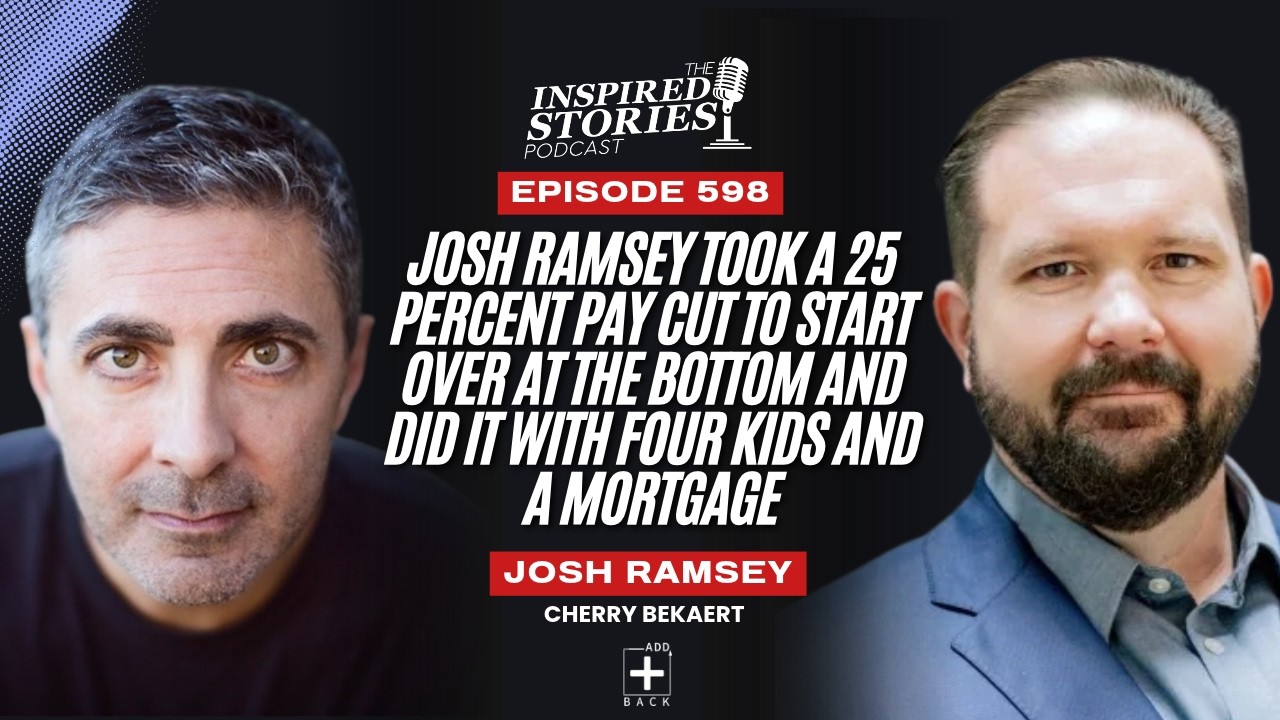
Josh Ramsey, CPA and Managing Director at Cherry Bekaert, taught himself Excel in a casino count room in 2000 because nobody else would, got promoted off the back of a spreadsheet nobody asked him to build, and spent the next decade earning a degree at 34 with four kids, a mortgage, and his father’s passing three weeks before his first day at Cal State Long Beach. The career pivot that followed — a 25 percent pay cut to start over as a staff accountant at a public accounting firm — paid off across nearly 12 years of fractional CFO work, MA advisory, and deals ranging from Friday cash crises to COVID-era add-backs bigger than the EBITDA itself.
✨ Key Insights You’ll Learn:
Building an Excel spreadsheet in a casino count room in 2000 that earned him a promotion nobody expected
Why practical coursework at a community college stuck when a traditional four-year path hadn’t
Going back to school full-time with four kids, a mortgage, and his father’s death three weeks before transfer
Taking a 25 percent pay cut to start at the bottom of a public accounting firm and why it was the right call
Why public accounting’s pyramid structure rewards long-term builders in a way private accounting never can
What the Friday cash crisis call actually looked like and why the fix took six months, not a weekend
The 13-week rolling cash flow as a triage tool and the human psychology of walking business owners down the mountain
The COVID-era food packaging deal where the add-back exceeded the EBITDA — and how they sold it
What consistently adds value to a deal: transition plans, clean financials, and knowing your walk-away number before you go to market
The $10 million financing lease gotcha that hit 90 days after close because nobody read the agreement right
🌟 Josh’s Key Mentors:
Romy (Cage Manager, Gardens Casino): Recognized the count room spreadsheet for what it was and promoted Josh into accounting — the first domino
Jeff Richardson (Founding Partner, RKE): The man Josh kept showing up to meet at Beta Alpha Psi events until he finally just asked for a job
Charmaine (RKE Consulting Partner): The first person who showed Josh what the consulting work actually looked like and matched it to his skill set
His Wife: Stepped in completely when his father died three weeks before his first day of university, managing the estate and the household so Josh could keep moving
👉 Don’t miss this conversation about what it actually means to start over with everything on the line, why the hardest part of a cash crisis isn’t the math, and how a casino count room in Torrance, California turned out to be the best accounting school Josh Ramsey ever attended.
Listen to the full episode here
Transcript
Anthony Codispoti (00:00)
Welcome to another edition of the Inspired Stories Podcast, where leaders share their experiences so we can learn from their successes and be inspired by how they've overcome adversity. My name is Anthony Codespodi, and today's guest watch a business nearly die, not from a bad market or a flawed strategy, but from a cash crisis that hit on a Friday and needed a lifeline by Monday morning.
He
spent his first years in finance, not in a corner office, but in a casino count room, counting chips by hand and teaching himself Excel because no one else would. That self-taught foundation launched a career that wound through gaming, audit, private industry, and eventually into the world of buy-side and sell-side MA advisory. His name is Josh Ramsey.
He was a CPA and managing director at RKELLP, recently acquired by Cherry Beckard. They are a full-service public accounting firm serving middle market businesses across tax, audit, and financial consulting. Over nearly 12 years at the firm, Josh has worked as a fractional CFO, built cash flow models, guided business owners through ERP rollouts, and led due diligence engagements for companies up to $70 million in revenue.
And you recently joined Jerry Beckard as a CFO advisory partner, which we'll talk more about. But before we get into all that good stuff, today's episode is brought to you by my company, Ad Back Benefits Agency. And you'll want to hear this because it's hurting almost every business owner you know. Health insurance costs go up every single year, and businesses are furious about it. They're paying more, claims are getting denied, employees are opting out because they can't afford it, and it hurts turnover and morale.
It's one of the most maddening problems in running a business, and everyone just seems to accept it. But you don't have to anymore. Now there's a program that gives your employees unlimited access to doctors, therapists, and prescriptions with no copays or deductibles to meet. And here's the part that really shocks most people. Unlike every other employee benefit out there, our program increases your net profits. We recently helped a client add.
$900 per employee per year to their bottom line. Results vary, but gains like that change how a business is valued. You can be the hero advisor that introduces this to your clients today. They'll be so happy they'd refer their friends to you. AddBackBenefits.com. All right, back to our guest today, the managing partner at RKE, now the CFO advisory at Cherry Beckert, Josh Ramsey. Thanks for making the time to share your story today.
Josh Ramsey (02:45)
Pleasure. Thanks for having me, Anthony.
Anthony Codispoti (02:48)
So Josh, as we mentioned in the intro, you started out in a casino count room, counting chips by hand. take me back to these early days. How did this opportunity first arise? And what were you doing in that initial role besides just counting chips by hand?
Josh Ramsey (03:05)
so I had prior to that been working in construction and and construction and you know winter can be on on and off. my friend's mom was a director of human resources at a local card club and asked me if I if I wanted something to kind of fill the void. So this had just recently opened and and one of the open positions just happened to be in the count room. so
Going in, it was obviously something I had never done and never thought I would end up doing. But I think what I took away from that, the foundations of accounting in general, you know, kind of accuracy, controls, and other things that kind of translated into
things that would actually help people do down the road. I never thought that it would translate into a career in finance or accounting. It was just something to to to get a paycheck at the moment.
Anthony Codispoti (04:07)
Fill
the void in between the construction jobs. So
Josh Ramsey (04:11)
Mm-hmm.
Anthony Codispoti (04:12)
tell us about the spreadsheet that you built to solve a problem that nobody else tackled. What did you build? What happened after you showed it to someone?
Josh Ramsey (04:21)
So we had used so it's a the count is a very manual process, like you you receive a box, you dump it out, you count, there's two people that that are in the process, you know, one person counts and then you record it on a sheet, someone comes and verifies that a third person is recording it, and at the time the person was recording it manually on paper.
So there was a lot of calculator tapes, a lot of manual addition. you know, it would get frustrating where, you know, at the end you were you're trying to balance because you'd have to count all the chips and and everything would have to tie out. And if it didn't, the entire team, no one could leave until you were done. So figured there could be a better way. we had they had just put a computer in in the count room and so that we could have email. And I started playing.
Anthony Codispoti (05:15)
Sorry, what what
year are we talking about? Just to kind of frame the tech what was going on.
Josh Ramsey (05:18)
two thousand.
Anthony Codispoti (05:19)
Okay, go ahead.
Josh Ramsey (05:21)
So I started playing in Excel.
and kind of intrigued me. So I bought a copy of Excel at the time, you know, when you go buy physical copies of software. and then took it home and started playing around and just, you know, I had used graphing calculators and, you know, trig and and algebra and and whatnot in high school. Syntax was relatively similar. So built out something that I thought might work for recording the count and it'd be, you know, because it was a spreadsheet, it was, you know, we kind of had the running
tally and it was a lot easier to see where things went wrong. I showed it to the cage manager at the time, a gentleman in the name Romy, who eventually moved into the accounting manager role about a year later. So that kind of that when I showed him that he he was overseeing the account room he promoted me to a lead position. so I started you know basically I was the the the
relief supervisor on the supervisor's off days. When he moved to accounting, he offered me a position in the accounting department to come and audit the work that I had effectively been doing, which was the gaming count.
Anthony Codispoti (06:38)
So he specifically promoted you because the spreadsheet that you built? Like that was
Josh Ramsey (06:43)
Mm-hmm.
Anthony Codispoti (06:43)
kind of the light bulb moment for him. It's like, Josh has got some skills here.
Josh Ramsey (06:47)
Mm-hmm. Mm-hmm.
Anthony Codispoti (06:50)
Okay. And so then you move from the account room to audit to staff accountant to supervisor over the course of, you know, a decade there at Gardens Casino.
Josh Ramsey (07:01)
Mm-hmm.
Anthony Codispoti (07:02)
Was there a point along the way where you were like,
Like this is my career path. Like I I want to continue driving in this direction, finance, accounting, et cetera. Or was it not that well thought out? You were just kind of taking it a day at a time and like, okay, I've got a job, the paycheck keeps increasing as I get these promotions. I guess I'll stay here.
Josh Ramsey (07:27)
Yeah, I won't I wouldn't say it was like a deliberate climb up the ladder, but yeah, it was more of I
Kept learning things. I, you know, kept because of curiosity and and just kind of interest, kept taking on more responsibility. And, you know, I had gone to school and I was I was just going to school to take accounting courses. Like I had no, wasn't, you know, like in the back of my head, I was like, you know, a degree seems like a lot of work, but I can take things that will help me today. So I went and took a series of accounting courses. I think after I went through two of them, they promoted me to staff.
Accountant. We had a changeover in management where we had an entire new team come in from Vegas.
And they had different expectations and you know a different kind of want for the reporting. So I took the opportunity and and you know was able to perform and they basically continued to bestow upon me additional responsibility and and promotions.
Anthony Codispoti (08:36)
So it's interesting to me, because a lot of people I know that go to school in the first place or go back to school, it's really with the idea in mind that they want the certification, right? They want the
Josh Ramsey (08:48)
Mm-hmm.
Anthony Codispoti (08:48)
diploma that lends credibility, that you know, is sort of checking the box for employers. That wasn't, it seems like your thought process. Like you said, you like, like, you know what, this class would probably help me with with the work I'm doing right now.
Josh Ramsey (09:04)
It just seemed like, you know, it seemed like such a long, far off goal. I mean, you know, when I was in high school, I I always thought that I would, you know, was gonna go to college and and for some reason I didn't do it straight out of, you know, I I went to JC and just didn't seem to stick. Right. So I ended up, you know, again, doing construction and other things and it was kind of let it fall by the wayside.
Anthony Codispoti (09:29)
And so what do you think was different when you decided to go back and start taking classes? Was it just that you had something practical to apply it to?
Josh Ramsey (09:38)
Mm-hmm. Yeah, so I mean I think feel like, you know, when you go to school, there's a lot of general education, which, you know, it is enriching, right? I I also think back on some of the classes I took very fondly. but it wasn't necessarily applicable to what I was doing, whereas this was directly applicable. and, you know, it helped me get a better understanding because, you know.
To be honest, like a ahead of the new team coming in, our our finance department was pretty weak. Like we were delivering, you know, financials more or less annually as opposed to monthly, which we what we ended up going to was like a cadence where we had a full monthly close. where you know we had auditors coming in and we were doing interim procedures where they would look at stuff on a month. They could come in at any month and and audit like through that period, which was a huge change from what we had done before.
Anthony Codispoti (10:33)
Hmm. And you feel like the classes were helping prep you for that change, or were there even some mentors either inside the company or maybe external that were being helpful to you in the process?
Josh Ramsey (10:46)
It was a little bit of both. the the work helped me with the class. You know, there was a a couple of professors that I took for multiple classes that, you know, they I always enjoyed the professors that were more practical. And I feel like you get more of that at a JC, like people that actually actually worked in some sort of industry and had real life experiences that translated into what they were teaching and they made it more relatable. so and and then kind of vice versa, right? So the
things I learned there that I could take to to work, apply them directly. And you know, I and I did have some some good mentors at the time that you know kind of continued to to help push things along.
Anthony Codispoti (11:29)
Hmm.
So you've gone back to school, you're sort of chipping away towards this degree, working full time, you end up finishing your degree at the age of thirty-four. There's a lot
Josh Ramsey (11:39)
Mm-hmm.
Anthony Codispoti (11:40)
of other things going on in your life at this time. Happy things, sad and challenging things, kind of walk us through this time period.
Josh Ramsey (11:49)
Yeah, so I I was again I was just kind of taking classes here and there and then the director at the time, you know, kind of voiced her opinion that or her her
intentions that she was going to be retiring in a in a number of years. And it like I had worked with a couple of so the next level above me was a manager the the but in order to get that position it required a degree. So I had recently remarried and one of the the things that you know we discussed kind of ahead of ahead of you know getting married was that I was going to go back to school and I was going to, you know, actually finish my degree at this point. So I've
first started you know again I hadn't had a probably a two or three year lapse in taking any courses. I went and just took one like Spanish class. I think it was a five unit Spanish class at night. and then the next semester I went to three classes. So I had you know a 7 a.m class that I went to twice a week and two two night classes from like seven to ten. So that was kind of the first like okay I'm I'm working you know 40 to 50 hours a week and taking you know almost the full load of classes.
after that semester or during that semester, I submitted for a transfer to two of the Cal States locally and ended up going to or getting accepted at Cal State Long Beach, which was nice because it was like 15 minutes away.
Anthony Codispoti (13:16)
As opposed to how how
far you've been traveling before.
Josh Ramsey (13:20)
so I mean my I was f fortunate in my commute in that I think I was five minutes from my office.
So I could ride my bike or drive my car and and arrive at the same time effectively. so you know, it's like a 15 minutes round trip to Cal State Long Beach from there, which worked out because I would, you know, on days where I had to have 3 p.m. class, I could go into work at like 5 a.m., be out, you know, 1 30, 2 o'clock, go straight to to class and then, you know, do my day.
Or you know, I had seven or eight a.m. classes where I could go there and then be back to work at like nine o'clock and then just kind of work over to make up my time. Pretty
Anthony Codispoti (14:02)
You're you're burning at both ends right now. Yeah.
Josh Ramsey (14:04)
much. So yeah, so the the at that point when I was accepted and and transferred over,
I had mapped out what it would take to finish, which was about four years. So I had I think a transfer in about sixty ish units. The accounting program was I think like a hundred and twenty-five. some of it was stuff that, you know, I had already taken.
So I in California you're required to have 150 hours, credit hours for a CPA license. And I think when I had mapped it all out, I landed about 156. So the nice thing was I didn't have to continue on to get a master's or or something like that to fulfill my my requirements to get a license, which was the whole point of going back to school. that certification is really kind of what helped drive a little more value as an accountant.
So I think at that time, you know, it's
We you know, I had we had four kids. So I had w you know, when I married my wife, I had one, she had three. so we had a four kids and a mortgage and I so I didn't really have the benefit of of, you know, stepping back and working less. I just had to to figure out how to make it go. And, you know, full time tuition or part-time tuition, it just didn't make sense to not kind of do a basically a full load of classes.
Anthony Codispoti (15:35)
The cost
difference wasn't that much between full time and part time. And y
Josh Ramsey (15:39)
Mm-hmm.
Anthony Codispoti (15:39)
like you said, you got the family of four, the mortgage, like you gotta do what you gotta do here.
Josh Ramsey (15:44)
Yeah. So just put my head down and and just kind of continued to go. at the time that I had transitioned to to Cal State Long Beach it was also kind of a tough time in that
my father had you know it's it was kind of a bittersweet time where I had told him you know it was like I I showed him that I had gotten accepted and you know that was something that you know in high school my parents always wanted for me like that I was gonna go to school. unfortunately he passed away I want to say three three weeks or so before I actually started. So he never had seen me finish. but you know it
It was again like I said, bittersweet, like it was starting something new. but it, you know, on top of everything else, it added a lot of stress kind of at the onset. but there was really no option but to just kind of put my head down and go.
Anthony Codispoti (16:39)
I mean, how did you get through all of this? Right. I mean, there's you've got so much going on, right? Your father passes away. I mean, there's good exciting stuff going on that you're going back to school, but you're also stretched so thin in terms of time, just mental bandwidth. What was your rock? What did you do to to kind of get through all this?
Josh Ramsey (17:00)
so
Again, you know, my wife my wife and I had it was like this was the plan. she stepped in and and the amount of support from both like a me perspective and then, you know, my dad had a house full of things and and lots of stuff to take care of. She kind of s stepped in and and really took all of that. Like, I, you know, I did what I could, but she made sure that I had the time I needed to
to kind of push what I had set out to do forward. you know, I I even at work, like at the time, I remember I took like three days of bereavement and then it was like the monthly close. Like I just went in there and just like shut my door. you know, worked worked in tears through the the monthly close and kind of moved through
you know, the you know, going to classes and everything else, but like I said, there was just nothing there was really no other option.
Anthony Codispoti (18:02)
I wonder if not having the time to really properly grieve when your father passed, did that resurface at any point in any way later on?
Josh Ramsey (18:16)
there's been moments. you know, f life never really slowed down, but yes, there has been moments where I was like, you know, there's things that
Because of what I was doing, you you always regret like, what if I had not been doing this and I had more time to kind of you know spend with my father? his health had kind of taken a slight turn, like know, and it was a very drastic, you know, quick turn when it happened. but it's like, you know, what if I had taken more time to do this? Or but ultimately you can, you know, regret doesn't necessarily benefit you. you know, he was happy to.
See me moving along and and kind of doing what he had hoped I'd do. So it that was kind of the comfort that I took in it.
Anthony Codispoti (19:07)
So you end up getting your degree.
Josh Ramsey (19:09)
Mm-hmm.
Anthony Codispoti (19:09)
this helps you move along further in your career there at the Gardens Casino. and after you're there for about eight years, you decide to make a pretty big change. you move into a new company, RKE, but you this isn't a promotion. It doesn't even seem like it's a lateral move. It seems like you're taking a pretty big step back in terms of.
role
and responsibility. Walk me through the thought process and what was going on at that time.
Josh Ramsey (19:43)
So at the casino I had I mean we were audited by everybody, right? So I had I had plenty of interaction with the public accounting industry. So you know, we had our own internal auditors, which was required by the Department of Justice. the city, because we, you know, our
The reason that you know the a city would have a card club is it's a huge revenue generator. So they would have people come in and audit us for that. So, you know, I was accustomed to producing information for public accounting, but I'd never really considered going into it. it just seemed like a lot of hours and you know there's a lot going on and you know I wasn't really on my radar. while I was at Long Beach,
There was a, you know, I mentioned I was doing morning and night classes. There was one class that I just couldn't escape or I couldn't fit into a morning or a night. and it was business calculus. And so working in a casino gave me the ability, because it's a you know seven-day, 24-hour operation, even in finance, to switch my schedule. So I ended up moving my days off to Monday and Wednesday and work the weekends.
And during that time, there's a an on-campus organization, which is a for it's beta alpha side. It's not like a cool Greek fertile fraternity where you're all parting. It's it's an accounting-related, you know, business fraternity. and what that the primary outlet for people to go into that is public accounting. So it's you know, there's it's on all the campuses, and
what they do is they have events and and while you have your local like here we have the cdtf a which is a sales tax you'll have the IRS you'll have the franchise tax board they'll come out you'll have some other kind of ancillary accounting but primarily the folks that come and exhibit which is something I do frequently now are public accounting firms. So I went to
a meeting beat alpha psi and there was the the woman that drug me there so her name was Judy I I had worked with her in the group. Yeah basically he was like I
Anthony Codispoti (22:04)
Drug you there.
Josh Ramsey (22:06)
was just sitting outside she's like come along. I had had a class with her and she was a similar like we were both you know probably early 30s at the time so older than most students and she's like hey come along so went and I listened to the spiel and it seemed interesting. So
I joined and I went to what the what's called a Meet the Firms event.
So you go and you come in and it's as you would imagine, like you think it's like a huge job fair, but everybody's in suits. I guess a lot of job fairs people are in suits, but so it's mostly accounting firms. And at that meet at that event, one of the introductions that was made to me was a man named Jeff Richardson. So Jeff Richardson is the R and RKE. So at the time, the managing partner and one of the founding partners. spoke to him.
And woman named Charmaine who
is now one of my close friends and and you know is two doors down for me. and got to learn kind of about the firm and what they do. And I thought that one, the clients seem interesting, right? So it's kind of all closely held middle market companies. the approach meaning like kind of a holistic service model where you're you know solving problems that that you know that keep people up at night.
Jeff was a tax partner, but again, very like kind of holistically consultative. But Charmaine worked in consulting. And I thought that what she did and what my skill set was from private accounting would be like, I was like, this is what I would like to do. So I continued pursuing, you know, across multiple events. And Arcade had hosted what what they call like a firm tour. So they would, you know, bring in
folks to kind of meet the professionals and see the office and talk and you know, where there's like a buffet and and finally I was you know, I think I'd known Jeff at that point for met him at a couple of events or whatever, and it's like, do do you have a job? Like I it's cool, like I keep coming to meet you guys but
Anthony Codispoti (24:16)
He was waiting for you to ask, huh?
Josh Ramsey (24:18)
I guess so.
so I think that was a Thursday. On Monday I had in a my f first interview, which was at the time very I think it was like six people. I met I think I interviewed with two partners, two senior managers, and then like two seniors took me to lunch. It was like six or seven people that I interviewed with.
Anthony Codispoti (24:42)
And so at this
point, do you understand that making a change would mean essentially starting over or or does that come later in the process?
Josh Ramsey (24:48)
Not yet. I mean,
Anthony Codispoti (24:49)
Okay.
Josh Ramsey (24:50)
so it's like you don't I didn't know what what it would eventually be. so the offer I received was for a staff accountant, which was like basically starting at the very bottom. which, you know, based that based on the comp compensation at the time was a pretty drastic pay cut, probably twenty five percent from what I was making at the time. And you know, keeping in mind I had a mortgage and I had four kids. it's it was
A pretty drastic, you know, change in terms of like lifestyle. We had, you know, we were always good about saving. so spoke with my wife and and just like the potential upside of the opportunity versus the the cut in pay at the time. And you know, we we knew that we could make up the difference for a while. so just kind of dove in headfirst.
Anthony Codispoti (25:45)
It's really interesting. You know, there's so many people that I've met over the years. Changing jobs is an opportunity to move up in position, responsibility, and pay.
Josh Ramsey (25:56)
Mm-hmm.
Anthony Codispoti (25:56)
There's so few people that I know of who have been in your shoes where you've got a pretty good job, right? You're in a pretty good spot. And you're like, I'm going to make a change and I'm going to take a drastic pay cut and I'm going to start over at the bottom of the totem pole again.
Josh Ramsey (26:11)
Mm-hmm.
Anthony Codispoti (26:12)
I mean, it seems
Josh Ramsey (26:13)
Yeah.
Anthony Codispoti (26:13)
like it worked out for you, but I don't know, if there are other people listening out there that I don't have been presented with a similar situation or had a similar thought, what advice would you give to them?
Josh Ramsey (26:28)
I mean I I think hopefully that they're in a position where they can one like weather the storm financially and two you know that they've kind of vetted the opportunity or you know really feel that there's definitely an upside to it. in this case, you know, I had
I had been kind of recruiting and talking to people for a number of years. And I spoke to, you know, again, I told you I was audited by a number of people. so I'd spoke to some of the public accounting folks that that I worked with and just kind of discussed what the general traject trajectory would be. I knew if I stayed where I was, I would have, you know, kind of a a pay bump, assuming everything kind of went as planned. but
Ultimately in private accounting. So one of the difference between public and private kind of one when people ask me about the two and why I've you know it's usually the opposite. Most people flee public accounting to go private. the only way to really kind of move up, right? It's it's generally, you know, you might have a CFO, a controller, an accounting manager, and maybe a couple of staff accountants. Like the person above you needs to retire, find another job, or or die, right? Like it's like there's no way to kind of move up in an individual organization without
One of those things happening, right? Because they're not going to have two CFOs, probably unless a massive company have like multiple controllers or whatever you're gonna do. so your options are to kind of job hop, right? So you move to different industries and and find new opportunities which allow you to kind of move up.
In public it's a little different in the sense that like as the the pie gets bigger, you know, the pyramid just kind of continues to get wider and as as you build, like there's no real limit to how far you can go up. also in private, you know.
you're kind of more of a cost center, right? You're an administrative department where you're kind of a necessary evil and in some cases a very understaffed necessary evil. whereas here like we are the product and we are the salespeople. So you know that generally lends to better opportunities and better compensation.
Anthony Codispoti (28:48)
So
RKE was acquired earlier this year by Cherry Beckard. but is RKE still sort of operating in similar, same fashion in terms of client services, what it does, how it does it.
Josh Ramsey (29:03)
Yeah, so we're still here. at acquisition. So when I started, we were like, I think 35 or 40 people. at acquisition last year, we were a hundred and sixty-ish people. kind of hard to get a finger on what the actual number was. so we still continue to serve the same the same way and the same clients. So I mean, we're what four or five months in at this point.
We still approach the client service the same way. we're still serving the same people. so gener it's all closely held businesses in the middle market.
Anthony Codispoti (29:41)
And
what are you doing for them? What break it down. What do you do? How do you do it? What do you do it for?
Josh Ramsey (29:43)
So yeah. So so
the practice has generally been kind of more ta I mean tax centric and tax focused, right? Cause pretty much anybody with a business needs tax services. What I do is what's like fractional CFO and controller work.
So what that is is kind of s augmenting or supplementing the existing accounting function. So I kind of mentioned in many cases, most accounting departments are either understaffed or, you know, when it's they're they're may not necessarily have the skills.
to get past certain things. So like as a business potentially goes to market or you know they've they you know experience tremendous growth where they're looking to get you know institutional debt or you know take on some sort of investment their reporting is not typically up to par. So what we do in most cases is we come in so that there's a friction point of some sort of a need, right?
they are unable to satisfy a bank requirement in terms of reporting their
going to sell and they're not there or whether that's in the immediate future or you know they're like, hey, I'm at the point where I'm ready to transition out. I've spoken to an investment banker or someone else and they're just, hey, I got to get my my ducks in a row. Otherwise there's some potential to lose some enterprise value because I'm you know on outdated legacy systems. my accounting fun, you know, my reporting is not up to not up to par whether that being like it's not gap.
it's just you know completely wrong. you know we've seen I've seen companies that of of pretty substantial revenue that you know use their financial package more as a checkbook than an actual you know actual way to tr to track the performance of the business. So you know that you have these owners that they they have a pulse in the sense that they know kind of how the business is doing and they are you know like there's cash in the bank like I continue to print cash I can you know I can
take distributions, I can live my lifestyle. so they know they're doing well, but ultimately when you know you you're presenting to a bank or an investor or you know a potential buyer that that's not what they're looking for. They're used to seeing things in a certain fit and form so that they can get comfortable that they're able to lend you cash or invest cash or purchase you and what they're buying is what you're telling them it is.
Anthony Codispoti (32:28)
So
I wanna go back to the story that we referenced in the intro, right? You've got somebody who comes to you on a Friday, big cash crisis, they need a lifeline by Monday morning, you figure something out. What can you tell us about what happened?
Josh Ramsey (32:45)
So this particular client, this was in the transportation, specifically the trucking industry. we have you know being close to Port of Long Beach have a decent amount of transportation clients, primarily Dreyage, which is like the first and last mile type transport. So like they're picking up containers off the ship and taking them to warehouses where they get, you know, kind of where they break down the containers and put them into different
trailers or you know what it's it's basically kind of very short runs for the most part. the
Call was originally received, you know, a month or so before kind of holiday time that there was you know some potential issues. and like a lot of things, you know, people try and do the best they can to to to take you know take care of their their problems. And and then when the call came, it was like at that point on the Friday, it's like I'm like on the brink. so we went in on Monday, assessed kind of what's going on and
And a lot of business owners, you know, this this business had been in in service for a while. You know, this is their baby. Like it's the largest asset they own. They've poured their heart and soul into it. So it's it's kind of you know, it's kind of like a disrobing, like, hey, like here's all of my skeletons.
I I I really need your help. And that, you know, I think a lot of people it's hard to get to that point where it's like, you know, I've done everything I can, but I I can't like I can't fix this. so it's as much as and it's an accounting exercise and kind of looking at things, it's there's like a human aspect and and kind of yeah, I feel like we're part-time psychologists here and there.
Anthony Codispoti (34:36)
I was gonna say you're like a life coach, yeah.
Josh Ramsey (34:38)
Yeah. So and that, you know, it's just coming in and kind of just
prioritizing like so when you get to like the the common tool when you get to a position like that is what we call like a 13 week cash flow which is like a quarter right and it's usually a rolling cash flow where you go through and it's like hey here's all my obligations and at this point you know when when you get a call like this usually there's things that have already been deferred so it's like hey what can I push off and it's okay well this one's already been pushed off for three months or however long it's been and
Anthony Codispoti (35:12)
This
one meaning debts, expenses that need to be paid.
Josh Ramsey (35:14)
Yeah, so
whether that's landlords, you know, in this case you have equipment financing and and other things, you know, like what can you move around? who
who can still give and and who who's unwilling to push any further. So and and you know, working with the owner, they they know who these people are. So it's like it's just basically making a schedule of it. And it's literally then it comes down to a week by week. Hey, what are we gonna collect this week? What can I pay this week? and you know it's not an exact science. Sometimes the collections don't come so you have to to move things around. So it becomes an exercise of communication both with the owner and with the creditors of like
Like,
hey, you know, we we we promised this. can I give you half? And I'll give you half next week. And and it when you start the process, it seems like you're never gonna get out. And and interestingly enough, it's like, you know, I think we threw out about six months is what it would take to get it going. had a meeting with the same business owner yesterday, and you know, it was a completely different meeting, right?
You know, it's it's certainly close to about the six month mark where kind of what we said would happen would, you know, assuming you know there are ob obvious assumptions like we have to kind of make more revenue, we have to do these things, we have to make these cuts. and they did their part and like completely different meeting, right?
Anthony Codispoti (36:42)
And so
what's interesting to me in this story is the way that I told it in the intro, and the way I had it framed in my mind is you guys found out about the problem on Friday, you come in Monday with this, you know, click my fingers kind of a snap my fingers sort of solution. You know, you found them some sort of new line of credit that just solved everything. But no, this was like a lot of very intentional, deliberate and hard work, lots of steps that had to be taken along the way to get this all cleaned up.
Josh Ramsey (37:10)
Yeah. So I mean we did get that line of credit that I mentioned or that you mentioned, but it I mean that's like, you know, any bank like turning something, that's like a four to six week like process. So it's you know, again the triage in advance of that. and getting, you know, finding the right lender. So we we spend a lot of time. So in addition to just work,
kind of one of the things we encourage and one of the things that I've done throughout my career is we network with a lot of other service providers. So those primarily being bankers, lenders, investment bankers,
wealth advisors, you know, other and then other kind of ancillary services where you build a Rolodex of things that will fit from a size perspective, an industry perspective, a personality perspective, and and basically become somewhat of a matchmaker in that regard. So in this case, I kind of already had
someone in mind that I brought in and you know he was able to turn it as f quick as possible and you know was a solution when others weren't there.
Anthony Codispoti (38:23)
I'm curious, Josh. You talked about how, you know, not only do you guys handle the the the finance mechanics of what's going on, but there's a the personal, the human element. So in this particular case, with this story that we're talking about, what is it that you say when you walk into the room with the owner for the first time? Like it do you immediately just turn into, you know, you put your finance hat over here and you put your human hat on and you're like, hey, we're gonna figure this out. Like you're just okay.
Josh Ramsey (38:54)
so you come in and you kind of evaluate, I think in a lot of these engagements when it's like a triage situation, it's like evaluate current state. Like one, you know, obviously you you need to make the owner feel comfortable. It's like you're not the first person that's been in the situation, you're not the first person that we walk through the situation. you know, it's a a lot of reassurance.
when they feel that there's there's you know that they're at a point where it's kind of an untenable situation. you know and you rely on you know things that you've kind of worked through in the past.
everybody again, you know, they're it's everyone's gonna have a different reaction. You know, some people might be a little more standoffish and and you just kind of read the room and kind of go, you know, with your gut with how you think you can can maneuver the situation. there are times when people, you know, they they want help and you can't really give it because they're unwilling to kind of work with what you're what you're prescribing.
And I threatened I don't know.
Anthony Codispoti (40:04)
Let's hone in on that for a second. Sorry.
like what is the resistance? You're coming in to help and they're saying, Nah, I don't think so. W wh why?
Josh Ramsey (40:15)
sometimes they're just unwilling to to do the things that you're you're suggesting. It's and it's whether it's from a a pride standpoint or a you know, they're not willing to kind of, you know, I mentioned kind of the disrobing where it's like they're not willing to open up. you know, they if they're unwilling to to kind of do what you think is necessary, like it's not it's not really a good match.
So, you know, I've haven't really had too much of that in my career. I think I've only had that I can remember off the top of my head, one client where, you know, I I was brought in to do something and they were just completely unwilling and I just went to the partner and just said it's just not a match I'd I'd like to be taken off this account.
Anthony Codispoti (41:02)
You know, in some respects I kind of get it. I mean, in your line of work, you're mostly dealing with the owners, right? Alphas, right? These are the guys or gals that have had the idea, they've birthed this, they have fought through everything to get it to where it is. You know, it takes like a strong personality to do that. And then to turn around and say, I need some help, you know, at some point later down the line, that's a really hard thing to do from an ego point of view, right?
Josh Ramsey (41:29)
Yeah, I mean sometimes it's, you know, more direct approach and sometimes it's walking them down the mountain to, you know, come to the conclusion that you believe they should come to. Right. So it's it's it's kind of a different approach for each person.
And that's just something you hopefully develop kind of throughout your career. And some people are just really good at it. And some people it takes a little work. I feel like sometimes it's been work, but I've had a lot of, you know, the benefits of being here, you know, again, like when you're the CFO, right? You're kind of the the the the last line whereas here I can walk to one of dozens of offices and bounce an ID off somebody.
And you know, throughout my career, kind of from staff up, one of the things that I enjoyed was you know, I would be on these calls, we're you know, we're you know, sitting with partners and talking to clients in similar situations. And what I always found to be
know it's like I'm so lucky to be here in the sense that like these folks are paying hundreds of dollars an hour to listen to this person speak and that person is paying me to sit here and listen. so you know it's their investment in you in the sense that like they're hoping one day that you know their staff is going to be their partner.
You know, if not that doesn't happen as much as you'd probably like it to. but the the the goal is so that they can continue to build their skills and and hopefully you know go out and and kind of help serve the clients that that are you know paying paying a substantial amount of money for their services.
Anthony Codispoti (43:22)
Yeah.
So Josh, you've worked on deals where more than half the EBITDA being presented to buyers was a theoretical adjustment. What
Josh Ramsey (43:32)
Mm-hmm.
Anthony Codispoti (43:33)
does that mean exactly, theoretical adjustment? Give us some examples.
Josh Ramsey (43:37)
So for someone who's never like bought or sold a business, especially in in it I mean you s I'm I imagine on on on large deals you're you're gonna have similar probably less, you know what I mean, less how would you say?
kind of top side adjustments to it to a set of financials. There's a concept where a lot of businesses trade on EBITDA, right? So EBITDA is just a a financial formula where it's you start with net income and you add back interest, taxes, depreciation, and amortization, which are all kind of accounting concepts. and they're typically additive, meaning it makes net income bigger.
In these, like a lot of these closely held businesses, there's a number of adjustments in the financials, whether they be owners putting personal expenses through or one-time things. So examples of one-time things might be you know, they had a lawsuit settlement, they spent money on an initiative that was kind of to enhance the business going forward.
And and all these things you kind of go and you and and you they're termed addbacks, right? So they're they're not normal course of business expenses. So you recast the financials historically, adding these numbers back. And what that does is it increases EBITDA. And usually the valuation of a business is kind of a multiple of that in most industries. So this particular the one you referenced was
kind of COVID era, which was there was all kinds of interesting things happening. this one had what we considered to be a big lift. so they were in the food packaging industry and when everyone was home, you know, you had DoorDash and everything just just took off, right? So their their main business being to go containers, you know, they effectively over a period of two years like doubled their revenue.
But along with that came with some other hurdles. So they they imported most of their goods from either Dubai or Taiwan. and shipping at that time, I don't know if you if everyone recalls,
Anthony Codispoti (45:58)
yeah.
Josh Ramsey (45:58)
like on the coast, I could look out, you know, I'd drive down PCH and you'd see I mean I we would we would because there was nothing else to do, we would, you know, grab something and sit on the beach and like eat breakfast.
Anthony Codispoti (46:10)
Watch the container ships stacking
up.
Josh Ramsey (46:12)
And
we would like try, you know, every every weekend or every two weeks or wherever about there, we'd count the ships, like how many can you see? And you're like, is that a ship like that way out there? You know, and you get easily into the 20s, which is not common. so between sitting outside the port waiting to get loaded and everything else, the cost of shipping was extremely high. so this particular business, you know, that they
were bringing stuff in and and their cost to land goods, which we would consider like the drayage, that we talked about the trucking company, so drayage, so the the transportation, the container ship, port fees, all these other things are what we call like landed costs. So their landed costs were historically about 20 cents on the dollar. rolling into the peak of COVID, that amount had exceeded about 60 cents.
Right. So they were able to pass on a decent amount of these expenses to their to their customers. However, what it did was it drove up cost of goods. and if you think about that, like what used to cost me a dollar twenty, now it costs me a dollar sixty.
That lift in cost was temporary in the sense that like it was more of a bell curve. as you kind of came out of COVID, it went down. And and thankfully for us.
Anthony Codispoti (47:38)
But did the did
the company keep their prices to their customers up?
Josh Ramsey (47:43)
f a decent amount of it, yes. And that's always also a component of the negotiations 'cause that you know, they had the term was COVID lift, right? One, it's just overall revenue, is it gonna stick? And two, were the price increases sticky. so that was a component and for the most part it did. some of it was surcharge, meaning so surcharge typically, you know,
larger entities would be like, hey, I know this is like temporary, like I want it to be a surcharge, so it's something that comes off invoice. but you know in other cases it just ended up being a straight, straight price increase. the add back that you mentioned was as we were coming out of this, so you know literally going into COVID, there was interest in potentially selling this business. And then at COVID everybody was like, don't know what's gonna happen. The world's gonna end, I'm not gonna buy.
I think this one actually went out like three times for for a bid. and the last time when we published our Q V
Which was the quality of earnings, where it's like you go and basically document like, hey, you use bank statements to trace back revenue, expenses, and it's presented to the buyer. so they have some comfort over the fact that the numbers are, you know, relatively correct. and included in that is a bunch of analysis. When it's product-based, it's usually some sort of gross profit analysis. And included in gross profit was the landed cost for COX. So
Anthony Codispoti (49:17)
And how did the
buyers or potential buyers receive that information?
Josh Ramsey (49:23)
So we basically did a lot of algebraic gymnastics to figure out like what would this look like going backwards. And so the goal was like, hey, what would this business look like from a gross profit perspective if we never received this huge lift in in cost of goods primarily from shipping? so we
established at the time we were we were watching kind of the the prices fall and then we had they would they would basically lock in containers at a certain rate you know on like a 90 day forward and they had a price and we took we were like okay we think it's gonna be this
And we basically rolled it back. So I wanna say I think that the kind of native EBITDA was or like the the financial EBITDA was about seven million. And the add back for all of the things that we had pushed back was like eight million dollars. So effectively more than more than what was in the financials, right? So it's
Sending that to a buyer and saying, like, hey, I think it's more than 100% more than what you see if we had, you know, recast this back.
Anthony Codispoti (50:39)
You had to get some pushback, right?
Josh Ramsey (50:42)
they were like, okay, well, how about we just wait and see? and thankfully for us, it actually was better than we had recast. I think we went down to like 23 cents was our our recast going backwards. And at one point it was down to like 19 or 20 cents. so
At that point, they were comfortable to move forward. and then they consummated the deal. So, but it was it was it was a pretty well ride.
Anthony Codispoti (51:09)
That is wild. Yeah, if I'm in the buyer's shoes, of course I'm pushing back, you know, like
Josh Ramsey (51:14)
Yeah.
Anthony Codispoti (51:16)
I don't think so. I'll I'll do the wait and see. Yeah.
Josh Ramsey (51:17)
You're like, Yeah, I'll I'll wait and you show me your card. Yeah.
Anthony Codispoti (51:22)
what is something that you see that consistently adds more value to a deal than what the sellers would expect? Something maybe they typically aren't thinking about until you bring it up.
Josh Ramsey (51:38)
I think a a lot of times well there's a couple of things. One, I don't know if they they don't think about it, but like having a transition plan, so having having people in the business that allow you to step away. outside of that is investing kind of early in the the finance function to make sure that the numbers are
accurate and hold up under scrutiny. and especially if you're looking like private equity or you know it's not a strategic where you're tucking in is like do you have the systems that are kind of set up for the future when I say systems like financial systems, operating systems, and the you know kind of the
policies, procedures, and people to like keep that moving so they can produce like quality reporting and run the business in a manner that's efficient, kind of post-close.
Anthony Codispoti (52:38)
You were talking, you know, we just went through the conversation about the theoretical adjustments. They're essentially addbacks, right?
Josh Ramsey (52:44)
Mm-hmm.
Anthony Codispoti (52:46)
and those can show up in lots of different forms. You obviously walked us through the one example, but a lot of times business owners will run maybe things that are a little bit more on along the lines of personal expenses through their business as a way, you know, to get that tax write off using those those pre-tax dollars to
Pay for those things. Are those things that you're typically able to successfully add back when you're putting a deal together? or do you try to come in a few years in advance and tell the sellers that, hey, we're gonna have to make some behavior changes here? You can't run all of these personal expenses through the business anymore.
Josh Ramsey (53:29)
it's kind of both. you know
Right, wrong or indifferent, you know. a lot of people feel the benefit benefit of being a business owner is the opportunity to like to run a couple of of things that are either business like or in some cases you're just like that's pretty wild, through their business and and and let let Uncle Sam and the state cost share in it with them.
Assuming you have support for gosh every day.
Anthony Codispoti (54:03)
Cot cost share with them. I haven't heard it put like
Josh Ramsey (54:10)
in assuming that you have support, I mean I've seen like we we were called in for one the business up in Northern California that did aerospace stuff. And he was a big model T collector. so I think he was running quarter million dollars or something of of
of model T and and and you know
Anthony Codispoti (54:34)
Yeah.
Josh Ramsey (54:34)
car restoration expenses through which he had receipts for. I mean we had we we were it was a late
Anthony Codispoti (54:39)
But was this a car restoration company?
Josh Ramsey (54:41)
now they rebuilt jet engines for foreign militaries. yeah so we we went in there and yeah the the buyer looked at the the
the invoices and receipts and you know provided you can substantiate what it is, there's generally not pushback. But it you know, outside of personal stuff, like again, there's a lot of one time things. you know, or you know, if we the the frequent one is, you know, you have your spouse on payroll.
And you know, there's a lot of tax advantaged retirement plans that you know people will put in place and you know, some cases that can be half a million dollars a year between both your retirement and theirs. so it's kind of all things that wouldn't go forward. you know, charitable deductions you can add back. is they private equity group may not be as benevolent or you know, have the same
interest in in you the things that you do. there's frequently, you know, if it's related party rents, sometimes it's not market, you know, from a tax perspective, like ultimately you're picking up income expense on both sides. but there's timing differences that can be utilized with depreciation and things like that. So you know, the especially if the business is taking on your
your lease or leasing the property that that the owner owned. they're gonna want to take it to market. And of course, if I'm taking it to market, I want to make sure that on the historical I'm getting benefit from it in my EBITDA. there's yeah, there's a there's a lot of different things that that can be added back. And I think that's one of the things if you are going to market, like it is worth
having people that are accustomed to going through these types of transact transactions, whether from you know, the the CPA side, the attorney side, like having a good MA attorney, making sure that your agreement is pinned out so that there's not a gotcha. I mean we've seen some solid ten figure gotchas. Yeah, we think about that six.
Anthony Codispoti (56:55)
Gotchas. Give me an example of one.
Josh Ramsey (56:59)
No, maybe not that high. Seven, seven eight figure. there was
Let think about this. So how your numbers are characterized. So usually the most of these agreements are kind of boilerplate. So you know, I mentioned a lot of these businesses are, you know, the finance function is
Again, someone that may not be classically trained. It's someone that just, you know, is an office manager and they've just kind of somebody taught them something and they've been maintaining the books. a lot of these agreements read like, hey, it's in accordance with GAAP, which has, you know, it's a standard structure. There's accruals, customary accruals, there's there's cutoff, there's things that need to be properly recorded. I think the biggest one, again, we were brought in really late was they have
A lot of these business or these deals are cash free, debt-free. And what that means is every dollar, whatever is characterized as debt, you as the the seller keep, and every dollar you keep. so in this case, they had a number of leases that they were expensing through the business. and whether they caught it in diligence or not, you know, they ended up transacting.
And the debt wasn't, you know, you could have potentially put in the agreement like except for this or except for that. but they tricked they handed over the balance sheet and they went back and all of these leases were not operating leases, they were financing leases, which is effectively a form of debt. So cash-free, debt-free, there was like ten million dollars of finance leases on the books that they ended up having to come out of pocket for 90 days down the road.
And and so it's like when you're brought in last minute and you don't have time to like make sure that that they've gotten all their ducks in a row, that was a huge gotcha for them.
Anthony Codispoti (58:58)
That
is a big one. What do you see? I mean, you've been inside a lot of deals, right? Across different industries, different sizes. The ones that transact well, but they go to market, they find a buyer, they get a good value. What's the common thread that you see in them that is typically lacking from the businesses who don't?
Josh Ramsey (59:22)
I th I mean obviously preparation. Like if if you know it's coming, you have the time to kind of get a get get your financials in order so that when you send it out, 'cause usually you send some sort of a financial package out.
Whether that's, you know, you're you're working with an investment banker and they put together some sort of a sim and they, you know, they take your numbers and it goes out for a narrow or wide release, depending on what it is. and people base their initial offers on the financials they've received. So if when they start digging in, there's some erosion in profitability or things like they they'll retrade you down. And
I've seen a lot of deals where, you know, people get a number in their head, but it was based off incorrect information where, you know, they they just end up, you know, owners will walk away because they had they already had that money in their mind and that's what they want to, you know, they want to walk with. I think another thing is, you know, outside of being prepared and having having all your information together is knowing kind of what you need to walk away.
You know, for many many business owners, it's their largest asset and they probab may only transact once. So, you know, the fear of am I gonna have enough, right? So it's when you have that constant, you know, distribution or paycheck or whatever it is that's kind of carrying you through, you know, how much do you need to do the things you want? Do you
You know, what is what does retirement look like to you? Do you have some you know benevolent gifting you want to do as part of this as well? so what we typically do kind of if we have if we have the runway is one, we help them get the financial part together, but then two, it's like, hey, what do you think this is worth? Like, what do you what do you you know, have you talked to anybody? and we'll model it out and look at the tax treatment because you can sell a business as a stock sale or an asset sale, and what is the difference in
proceeds between those two. And then when you look at it, okay, this is my after-tax dollars that I can potentially walk with. Do they have a wealth advisor or somebody that can advise them on like, hey, is this enough? Like if I were to model out, am I going to get, you know, $50 million, $20 million, whatever it's going to be, is that enough for what I want to do and the lifestyle I want to live?
So I think doing all that in advance, as opposed to you know kind of going at it unprepared.
getting an amount and and then you know then you've realize at the end you've spent a ton of money on advisors. you know, you've had investment bankers out there or, you know, whoever else kind of marketing this deal. And then you ultimately get to a point where you're like, this just isn't enough to walk away. So I think spending the time up front to figure out what, you know, that your numbers are good, that you're gonna get enough.
is is probably some of the best advice I can give to somebody who's going to do this.
Anthony Codispoti (1:02:39)
In the work that you're doing now, Josh, what do you most want to be remembered for?
Josh Ramsey (1:02:46)
you know to be honest, like I just want from a client perspective is is to be thought of as somebody that you know was able to advise and you know they feel that that when they were put in a situation where they were in a time of need that I was able to to help carry them over you know whatever the problem was. I feel like I've been pretty lucky with that.
Another thing that, you know, we I feel like I've had a lot of mentors here. kind of both in school in my prior prior role at the at the casino and here. I like to kind of make sure that I've passed that along. whether that's the folks that work here or, you know, I I think I mentioned earlier we have a lot of interns. So I try and be really involved with the on-campus recruiting. I felt like, you know.
When I was trying to figure this out, it was nice to have somebody that kind of gave me
Gave me an idea of what this looked like. from my perspective, having worked in private and public, I helped to like give people the contrast of what my experience has been. and you know, I I try and spend a lot of time kind of coaching people and and and ultimately like their circumstances and what they what their desire is, what's gonna take, you know. Not everyone is gonna continue down this path to be a partner. The people that I graduated with from school and in beta alpha side, there are
Two of us that are still in public accounting. both of us are partners. she has she ended up the Judy, the one that that I told you, dragged me to the meeting. so she worked at KPMG, BDO, Moss Adams, a couple of the other larger firms, and then ultimately started her own firm with someone that she worked with. And you know, she's
Like, you know, she's she's really happy with what she's doing. she's growing and it's kind of exciting to see that going. some of the other folks are, you know, in their like headhunting and doing talent acquisition in the finance and same thing, like all three of us still go back to the university. We still talk to people and kind of help you know, people make the decision of is this what they want to do and coach them.
based on our experiences to be as successful as possible.
Anthony Codispoti (1:05:15)
Josh, I've just got one more question for you today. But before I do that, I want to do three quick things for the audience. First of all, if you want to learn more about what Josh is doing now, you can go to the new company that just acquired them, Cherry Beckert's website, cbh.com. Just three simple letters, cbh.com. Also, if you're enjoying the show, a quick comment or review on your favorite podcast app goes a long way towards.
Helping others discover our show. So thank you for taking a quick moment to do that right now. And as a reminder to all business advisors out there, your clients are bleeding money on health insurance. Do them a favor so big they'll tell their friends about it. Show them how to give their employees access to therapists, doctors, and prescription medications that counterintuitively increases the company's net profits.
It's a fiscally sound business strategy that can change how a business is valued. Contact us today at AddBackBenefits.com. So last question for you, Josh. A year from now, what is one very specific thing that you hope to be celebrating?
Josh Ramsey (1:06:21)
Hmm. you know, I wish, you know, I I sincerely hope there's great things in the career and and and everything else. But so I mentioned I had four kids. so all four of my kids are in or have been in the military. I have one that's not in currently. he recently got out. And they all they started transitioning, I think like 2020. And in that period, I've only
We've only had the opportunity to have all four of them together twice. usually it's you know, it's it's either summer or winter. this summer, you know, one of one of our kids is deployed. so it's it's always seems to be something like that. One is deployed or they're on s you know, something's going on. so I sincerely hope
whether either it's this winter or by next summer, about this time, that you know, we we have an opportunity to all get together. So,
Anthony Codispoti (1:07:22)
Nice.
Josh Ramsey (1:07:23)
you know, work is great, but ultimately the all of it is really kind of for naught if you don't get some of that family time. So that's really what I hope to be celebrating.
Anthony Codispoti (1:07:32)
Love it. Love it. Josh
Ramsey from Cherry Beckert. I want to be the first to thank you for sharing both your time and your story with us today. Really appreciate you being here.
Josh Ramsey (1:07:42)
thank you for having me. it's been a pleasure and thank you.
Anthony Codispoti (1:07:46)
Folks, that's a wrap on another episode of the Inspired Stories Podcast. Thanks for learning with us. And if one thing stood out, put that into action today.
Connect with Josh Ramsey:
Website: cbh.com