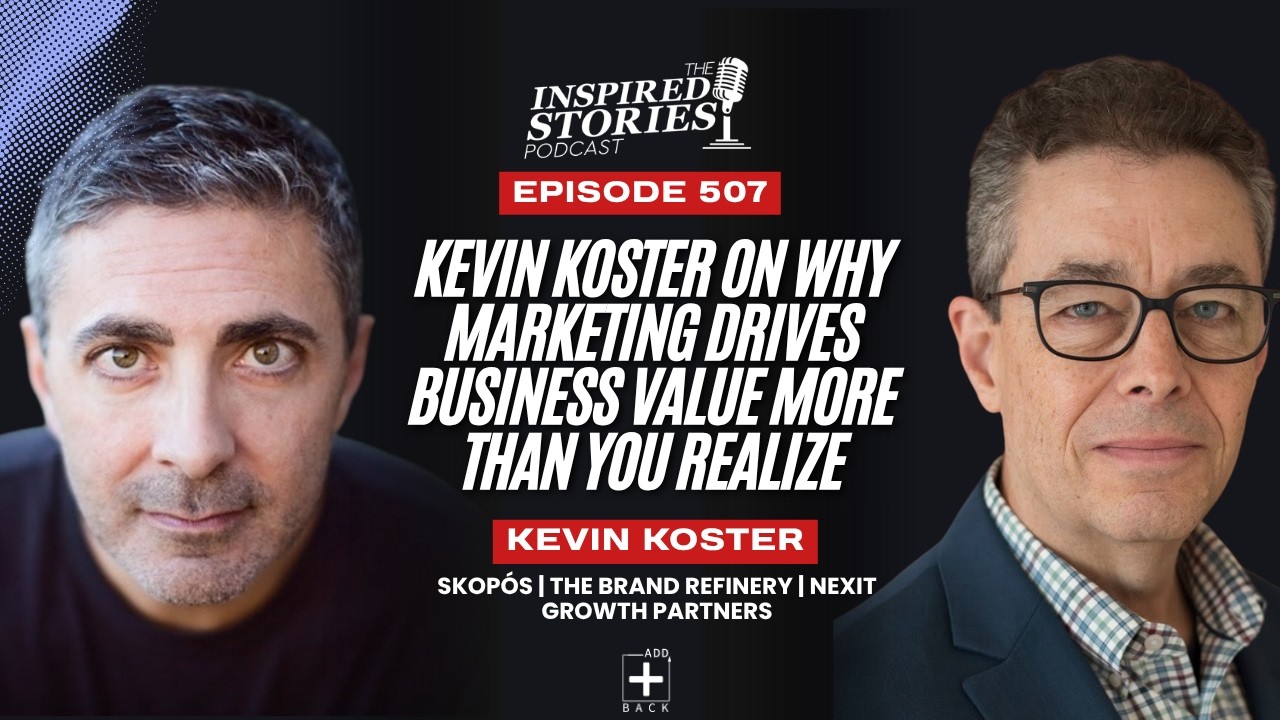
🎤 The Accident That Redefined Marketing: Kevin Koster’s Mission to Fix Business Value
Kevin Koster, President and Chief Brand Officer of Skopós, The Brand Refinery and founder of Nexit Growth Partners, watched two business owners die in the same accident — and only one company survived. That moment set him on a 20-year mission to prove that marketing, done right, is the most powerful driver of business value that most owners have never measured.
✨ Key Insights You’ll Learn:
Two owners, one accident — what separated the company that survived
Why most businesses are worth half what the owner thinks
Marketing controlling five of eight business value drivers
The $10M swing from a 20-minute assessment and 90-minute meeting
Owner concentration as the #1 killer of transferable business value
Recurring revenue and true delegation as value-building levers
The roofing company conversation that sparked the Nexit vision
20-to-1 ROI guarantee on business value assessments
Entrepreneurship through acquisition and how MBA buyers find unprepared sellers
Building Skopós on purpose-first positioning, not lead generation
🌟 Kevin’s Key Mentors:
Dave Sandweiss: Founded Sandweiss Advertising modeled conservative brand-first client service, and unknowingly built a transferable company
John Warrillow: Author of Built to Sell and creator of the Value Builder System used as the backbone of Nexit assessments
Kansas City Star leadership: Shaped Kevin’s creative sales instincts and exposed the dysfunction of rigid corporate systems
Times Mirror Corporation: Forged his competitive instincts in a brutal Southern California newspaper market fresh out of college
👉 Don’t miss this conversation about what business owners almost never calculate, why the marketing industry is missing the biggest opportunity in front of it, and how one tragedy launched a career-defining mission.
Listen to the full episode here
Transcript
Anthony Codispoti (00:01)
Welcome to another edition of the inspired stories podcast where leaders share their experiences so we can learn from their successes and be inspired by how they've overcome adversity. As you listen today, let one idea shape what you do next. My name is Anthony Cotaspodi and today's guest watched two businesses go through the same tragedy and only one survived. The difference had nothing to do with revenue, marketing or talent.
It came down to whether the owner had built something that could exist without him. That moment sent him on a decades long mission to rethink what marketing is actually for and eventually led him to build an entirely different kind of firm than the industry had ever seen. It also led him to discover that most business owners are sitting on a number they've never calculated and won't like when they finally do.
He is Kevin Koster, President and Chief Brand Officer of Scopos, the brand refinery, a Kansas City marketing firm he has led for nearly 40 years. Now, Kevin holds certified exit planning advisor and certified value builder credentials and recently launched Nexit Growth Partners to help business owners measure and grow the transferable value of their companies before it's too late. His clients have seen tens of millions in sustained growth.
often while cutting their ad budgets. This is an episode about what it really means to build something that lasts. But before we get into all that good stuff, today's episode is brought to you by my company, Ad Back Benefits Agency. And you'll want to hear this because it's hurting almost every business owner you know. Health insurance costs go up every single year and businesses are furious about it. They're paying more, claims are getting denied, employees are opting out because they can't afford it.
and it hurts turnover and morale. It's one of the most maddening problems in running a business and everyone just accepts it. But you don't have to anymore. Now there's a program that gives your employees unlimited access to doctors, therapists, and prescriptions with no co-pays or deductibles to meet. But here's the part that really shocks most people. Unlike every other employee benefit out there, our program increases your net profits. We recently helped a client
add $900 per employee per year to their bottom line. Results vary, but gains like that can change how a business is valued. Be the hero advisor that introduces this to your clients today. Addbackbenefits.com. All right, back to our guest today, managing partner of Scopos, the brand refinery, and Nexit Growth Partners, Kevin Koster. Thanks for making the time to share your story today.
Kevin Koster (02:50)
Thank you for the opportunity.
Anthony Codispoti (02:52)
So Kevin, you started your career in newspaper ad sales at Times Mirror Corporation. This is a publishing and media company back in the early 80s in California. You actually helped start a newspaper in college kind of going back. I'm curious what drew you into the newspaper publishing work.
Kevin Koster (03:13)
A job offer. Coming out of college, my degree was actually in broadcast management and I received the offer from the Times Mirror Corporation, which owned the LA Times. The job offer was at a small suburban daily they had in Orange County and it was freshly admitted college graduate opportunity to get paid to go out and as a young.
college graduate to Southern California where I'd never been before. So I thought, this is perfect. And Times Bureau Corporation owned a chain of radio and television stations. So in my master plan, it was just going to prove my worth and then make some inner company transfer and a good back to my broadcast oriented career.
Anthony Codispoti (04:03)
So what kind of work were you actually doing when you started there?
Kevin Koster (04:07)
It was newspaper sales. were starting a series of free distribution weeklies, sort of building a perimeter, you kind of like the Russians did after World War II. This defensive perimeter of free weeklies to try to keep the Orange County Register from infiltrating into what they considered their territory. So was really the LA Times was using us at this little suburban dealer as the expendable.
troops to go out and defend Orange County, was, this is the early 80s. So was just beginning to hit its, hit its strike. Irvine, California was mostly Orange Groves.
Anthony Codispoti (04:46)
And what,
when you say like you were like a defense barrier, what does that mean exactly? Like you guys were trying to be the most popular, freely available newspaper so that everybody wanted to advertise with you and then you guys aren't getting competition for those ad dollars? Is that what you're talking about?
Kevin Koster (05:09)
Yeah, pretty much. think it was, they wanted to, so the LA times of course owned LA proper. And then as Orange County, south of LA began to grow and sort of develop its own identity, you know, the Orange County register was growing with it. And I think people in Orange County sort of said, Oh, we're Orange County. You know, LA is up there and LA of course, that's where all the money was going. So they wanted to be down there and they were, they were struggling.
And they had bought this daily back in the early sixties. So just almost as a hobby. And so now they were using it as, we've got this property. Let's establish a footprint with these free distribution weeklies because then we'll have those ad relationships and things which we could then funnel into our daily, which in turn will then can funnel into the times. And it was all about who owns the relationships in those markets. And if they walked in as the LA times, nobody gave them the time.
day, but they walked in as some local free distribution newspapers like, yeah, you're, you know, you've you're right over here in Costa basis. Sure. I'll talk to you. And so it was a, we're one of the little, you're just like us and yeah. So.
Anthony Codispoti (06:18)
You're one of the little guys. You're like me. Yeah.
And so what did working there teach you about selling ads?
Kevin Koster (06:32)
It taught me
Certainly competition. I grew up in Kansas City. was a one newspaper town. Actually it was two newspaper towns, but they were both owned by the same company. it was basically, they had already blocked out everybody. But it was a ridiculously competitive situation. And as a young college graduate, okay, I didn't know any better. You know, it was just.
It was like boiling the frog. was, you know, the frog gets thrown into the water. The water is 180 degrees. He just assumes that, this is what normal water temperature is like. I need to learn to adapt to it. it, it hardwired me to do whatever it took to get the job done because, you know, we were mostly commission based and I'm out there by myself, no family, relatives.
I was very fortunate, found a really reasonably priced apartment, you know, from an elderly couple that was just looking for somebody with a full-time job that they could trust. Right. So I'm really lucky there, but still, if, if I didn't, if I didn't succeed, I didn't eat and the, my territory was an Irvine California, which again, at the time was just, I mean, it's a massive city now, but at the time it was
just beginning to grow, mostly orange groves. There were three distribution newspapers just in Irvine because everybody knew that that was going to be the core, know, whoever owns Irvine owns Orange County kind of feeling at the time. So I could literally walk through a shopping center and they were all master plans. So there was no just random, all the commercial was in one spot. All the residential was another spot.
I could walk in and make a pass to that center and sell four or five ads and pass a competitor coming the other direction. We'd be very friendly to each other. was kind of like the old cartoon with the sheepdog and the coyote that blow each other up all day, then have lunch together and punch. It was like that. And I'd get back to the office and find that half the ads that I had sold had been canceled before I got back because she said,
Oh yeah, Kevin was just in here and we were going with him on this, on this deal. says, what, what do you charge you? Oh, it was like 600 bucks. Okay. I'll do it for three. And it was just this, Oh, okay. Well then I got to go back. And then I also learned from that experience, the difference between having a large corporation as your backer that even though you would think they have the resources, their ability to move quickly and respond.
was not what you would think. Whereas my competition, you know, with the lady that I was competing against had a very intimate, shall we say, relationship with the publisher of the newspaper. And so it's like, okay, you know, she could go to the publisher and say, Hey, I need to be able to cut my rate in half to take all these ads away from, from cost her. Okay, sure. Yeah, whatever. And I'm going back to
You know, my boss who has a boss who has another boss who then has to go to the publisher and then go up to LA and they're going that, we own you. That's right. We own you guys. We forgot. We're focused on our Dallas property today and we really don't care that Kevin lost a $300 ad. So
Anthony Codispoti (09:59)
Yeah.
So maybe this helped to fuel some of the reason why in 1983 you moved back to Kansas City to join the Kansas City Star, the major daily paper there. And maybe because of the lack of competition, you tell me you went from, you know, zero dollars in your book of business to a million dollars in revenue in under three years. And this is back in the early 80s. How did you pull that off?
Kevin Koster (10:32)
I think it goes back to what we were just talking about in terms of that's just how I was forged coming out of college. I didn't know any better. was like, Oh, this is what you have to do. Okay. Well, you come back to a town with a monopoly and it's just a different, and everybody's just sort of sitting around waiting for the phone to ring. Not, not everybody, but you know, but a lot of people in that mindset.
There was an entitled, you know, we're the monster in the market. We've got, you know, 500,000 readers on Sunday and everybody and their brother should be, you know, they're lucky we let them advertise in our newspaper. I mean, it's something of an exaggeration, but there was some of that. And, you know, I didn't have accounts, you know, was basically my accounts for anybody that isn't already under contract in the newspaper or hasn't already run with somebody, which isn't a whole lot. And so.
You had to turn over rocks. had to network more. You had to go to chambers more. You had to find out who was opening. I knew I could beat anybody to a new business because everybody else was going to wait for the new business to pick up the phone and say, have to advertise to the star. But it was...
Anthony Codispoti (11:48)
You came from a really competitive
space. You had that drive, that hunger. You were used to competition. So you're there for a few years, but at some point you realized that the clients needed something that the paper couldn't give them. Tell me about what was going on in the few years that you were there and kind of the thought process that was involved.
Kevin Koster (11:53)
I was just used to it. I was just used to it.
I think it was a combination of things. I left California because Times and Mirror sold the Daily and we were bought by a chain of shoppers out of Connecticut. I first of all, knew that that oil and water was never going to mix successfully. Moreover, I lost my super, you know, my great plan of, this would be easy. I'll just hop over to the broadcast side. Well, now there was no broadcast side.
And so I knew my future was over there and then there happened to be an opening in Kansas city and they were, was, they were starting up a business publication and I just happened to have unique skills having started three at the tender age of 22, 23 at this point. And so it was easy to come back and, and, and get the job. then, uh, but going through that process in the back of my mind, I was still thinking,
Okay, but this isn't a pathway to getting into the broadcast space either, but it kind of allowed me to come back, tread water a little bit while I figured out, you know, my next step. And along the way, a couple of things happened. One, I was the first person that the star hired on straight commission in their 106 years of business. It was kind of an experiment.
Well, the experiment worked really well until I was really successful. And I'll spare the long version of the story, but I was basically told that the ones, my first big monster sales stolen out of the competition national rate, which was twice as much as a local rate. They couldn't pay me any commission on it because it was on the, because I'd sold it for.
at the national rate, which is like hundred bucks an inch instead of $40 an inch, which anybody who watches it will say, okay, how does that make sense? Well, apparently my commission was going to come out of the retail budget and my revenue was going to go to the national guy's budget because I sold it at the higher national rate. And so my retail guy didn't want to pay commission on it because he wasn't getting the revenue for it.
I'm going, how is this my problem? Right. But it was endemic and I thought this isn't, yeah. And I won that one battle, but then I was told, yeah, don't do that again. Okay. This is right. Don't sell, don't sell. you next time, yeah, we can't, it was easier for them to tell me don't sell the same full page ad for twice as much than it was to fix the system. And that was, this is not a longterm.
Anthony Codispoti (14:49)
Don't go and make us a bunch of money anymore.
Yeah.
Kevin Koster (15:07)
I can't deal with that. And there were some other things similar to that. Again, the people themselves were great, but the system was so codified that they didn't even sometimes even realize what they were saying. again, the whole conference said, do you guys not listen to what you're saying? And it was like, no, we are, know, it's the system. We have to respect the system. So anyway, along that same time, I had met a gentleman,
and he'd become a client because nobody wanted to work with him. his name was Dave Sandwise and he was the in-house advertising promotions manager at Dan's Mark Hotel. They're doing great work out there, but he was a stickler. He was, if you screwed his color up, he was gonna tell you that you screwed the color up. was no subjective. Well, it's still kind of red. You know, pink is in the red family. It was, it was, there was none of that, which I agreed with.
But everybody else there, again, being a little bit more entitled of, okay, why is this guy giving me a hard time? know, nobody wanted to work for him. I was, again, just trying to build a list up. So I said, shoot, I'll take, he can't be any harder than some of the people I worked with out in Southern California. And I was able to fix stuff for him, which was just basic accounting things.
being able to read an invoice and nobody wanted to help with. it's just little things like that. We built up a really good relationship. In a couple of years into it, he called me one day and said, he was doing a lot. did a ton of radio. and so he called me one day and said, Hey, I've grown this more than my, can't handle it by myself anymore. Do you know anybody? you know any media buyers that
You and you're, you work with a lot of agencies here at the star. And I said, uh, well, yeah, I do, but I think you should hire me. And it's like, Oh, I can't afford you. And I said, well, let's talk. You know, we don't know, you know? And so at this point, I'd already decided I need to go somewhere. Here was a guy doing a ton of radio, which I enjoyed doing. It wasn't going to be owning a radio station, but it was getting into that space doing, you know, working with radio and TV stations, which again gets back to where my.
Anthony Codispoti (17:29)
That's what Yeah, you've been wanting to get into the broadcast side of things.
Kevin Koster (17:32)
I'd want to get into
it anyway. And who knows what was going to happen there? You know, maybe I might end up jumping from that into a radio or TV station or something.
Anthony Codispoti (17:40)
So you ended
up taking a big pay cut to go there.
Kevin Koster (17:43)
Yeah, it was about 50%. I'd finally hit my stride, but I knew that that stride was going to take me somewhere I didn't want to be long-term. Because at some point it was going be up or out. I said, I can't manage these people and ask them to do stuff that... Because they were asking me to do stuff that I couldn't do in terms of asking clients, ask some bank that's running... These are days of 14 and a half percent CDs, which will make some people watch this go...
Whatever happened to that? But yeah, was the banks were advertising 14 % CDs and I'll say, well, you need to go and sell them in the lawn and garden section. What? How's that? Well, they could do like a loan for landscape improvements. It's like, no, no, no, no, no, no, no, no, no, can't, no, I'm not doing that. And so it was, yeah, it was time to go. It was time to get out. So.
Anthony Codispoti (18:36)
So tell
us about the work that you were doing there at San Weiss.
Kevin Koster (18:40)
it started out, he was working out of his apartment back before it was fashionable. but it was, it was just him and I would show up at eighty 30 and work in his living room. and he would, he was the account manager, account lead, the lead sales guy, but I had more sales experience than he did. So part of it was going to be, Hey, I can go and do those initial calls. So it's not the president of the company.
making the cold call, it's somebody else that then brings the president in later and all of us. So, well, exactly. And it also gives him the ability to say no, or say, I'm not going to do it for what Kevin quoted you kind of stuff. So we were able to, you know, there was, it created a little bit of a buffer for him. It also allowed him to focus on what he was really good at, which was the market positioning, especially the creative and doing creative. Our creative was very simple, but it sold.
Anthony Codispoti (19:14)
makes you guys look bigger, more established.
Kevin Koster (19:37)
We never did dialogue spots. was not about, we never entered award competitions. It was about, look, you got a product where identify why this product is good for somebody, why it'll make their life better. We'll be very matter of fact and direct with it and have a dialogue conversation with the person listening to it. So he did that. I negotiated the airtime.
Anthony Codispoti (19:55)
So for your clients, you
were doing the radio stuff, you were doing print stuff, you were helping them come up with the creative and then buying the media for them.
Kevin Koster (20:07)
Right. We would first position them. It's like, yeah, don't be this. That's position you over here. Here's how we'll communicate it. And then we had a reputation for being very, very good negotiators. He'd come from a radio station. His best friend was one of the top producers at the top station. So he knew where all the bones were buried in terms of how low somebody could go and,
when you might get a better deal here or there. And so we were able to negotiate things that most other agencies didn't know existed just because of our inside experience and that, course, then we'd pick up a client and all of a sudden, wow, this works twice as good as anything else I've ever done. And then it kind of snowballed from there, which is great. But that's, I mean, that's why you do it in the first place.
Anthony Codispoti (20:56)
So talk to me about the kind of growth that you guys saw over maybe like, let's call it the next 15 years.
Kevin Koster (21:05)
it was very deliberate and I would say conservative. You know, Dave never really, he wanted to have a nice little boutique shop. You know, his mind, the perfect life was let's get six, seven, eighty accounts that are more loyal than a, than a Beagle that because we generate such great results for them, they'll never leave.
because why would I ever leave these guys? These guys have double, tripled, quadrupled the size of my business. As long as I'm around, they're around. so he wanted that vision of, as long as you do that, the clients will never leave. Which is true to certain extent in so far as I average client tenure is two to three years, 18 months, two years, three years in the industry.
Yeah, I've still got clients. I still have this first client ever signed in 1988. You know, so we've got, it's, we just, we wouldn't lose it. We'd lost them. You know, I've never, you know, knock on wood. I've never had a client call up and say, and talk to me and say, Hey, we're moving on. We're going to hire somebody else. Cause it's not working ever. Uh, we've lost them, but you would lose them because they retired.
or they sold the store or they got bought out merged to somebody else or we were working with a marketing director and the marketing director moved to another market and somebody else came in, they had their own people or whatever. So we would still had to deal with the fact that there was still gonna be churn, but we never lost one because what we were doing wasn't working. Right.
Anthony Codispoti (22:53)
because you weren't being effective.
So how did your understanding of the marketing space evolve in that first 10 to 15 years that you were with Sandwice? And if you could also at the same time, Kevin, talk about how you guys were growing into the digital space as that was starting to...
Kevin Koster (23:16)
Right. Again, the growth was very, it was very deliberate. It was very, you know, controlled. was also, the majority of it came from expansion from existing clients. And so for example, we landed a client early nineties in Kansas city. was part of a, it was a heating cooling distributor that was in five or six markets.
And so we landed Kansas City. Well, then Kansas City started out pacing the other five or six. so systematically over the next few years, we picked up Omaha and Wichita and Tulsa and Des Moines and, then eventually got in with the manufacturer themselves because they had some markets. So then we ended up in three or four of those. so, which course creates some vulnerability from a customer concentration standpoint.
But at the same time, mean, was billing was great. And we got in during the mortgage, big mortgage boom before in the late nineties, early two thousands, we picked up one and that turned into three or four related ones, or they grew in other markets as they grew and we grew with them. So most of the expansion came from that. As far as the marketing space itself,
There really wasn't a lot of the epiphany, you will, far as compared to how I look at it now. All of that came after 2005. But prior to that, in terms of digital, we were early adopters of that. I remember still having an email address before you could pick your own.
Uh, you know, 74132.523 at Compuserve.com. Um, you know, remember dial up when I remember being excited when 2400 bought became 4,800, you know, dial up. mean, so, you know, and there in the initial.com boom prior to 2000, it was. mean, really at the local level, there wasn't a whole lot going on yet. There was no such thing as.
Anthony Codispoti (25:14)
You
Kevin Koster (25:39)
I Google didn't exist yet. There was no paid search stuff. was all a question of, okay, everybody wants to buy their name.com. And there was the big scramble for URL real estate in those early days.
Anthony Codispoti (25:58)
You mentioned 2005 and an epiphany that kind of came after that point. This is when David Sandweiss, the founder, tragically died in an accident. And I had to imagine a very difficult time emotionally for you and everyone else who knew him. Say more about what took place during that time.
Kevin Koster (26:24)
Um, it was one of those, I mean, uh, beyond the obvious, you know, way you described the question, you know, kind of made me reflect a little bit. It's like, you know, there really wasn't time to, to grieve the way you normally would because it happened on, it was a Monday morning, very early. He had just dropped his wife off, uh, for a workout.
It was heading back home to shower and come into the office and was T-boned by a school bus that lost the brakes, went out and went careening through an intersection. And so I get the phone call and at that moment you're thinking, okay. Um, and you look around, it's like, I was the number two and we had three other employees, I think at the time. And it's,
It was so quick. You didn't have time. It wasn't like Dave's really sick. You know, it wasn't like he's been hurt. We don't know. He's in an ambulance. It was just boom. And, and I think in hindsight, perhaps thinking about this for the first time, I'm grateful for that because it was black and white. You knew what you had to do. You had to first bring the team in and say, okay, here's what happened. And then you say, okay, what's he grabbed his calendar. What's going on this week?
The other thing you think about is, okay, I was the client lead at by this time, probably an 80 % of our clients, I was the lead. So I was less worried about that. was more worried about, he still did the creative. And so we had a radio spot scheduled to go that afternoon that he was supposed to be producing. And so,
You looked at things like that in terms of, you know, what has to be done right now. his name was, mean, the Sandwys advertising. So his name was on the door and the other concern was. We've got all these radio, TV stations, media vendors and others that are going to, they'll be polite for the first week or two. They're not going to, they're not going to, the accounting department's not going to call.
you know, the day of the funeral and say, Hey, really sorry to hear about Dave. should I be worried about, you know, the checks? And so one of the things we did that week, the funeral, I think was Thursday. I had to, I delivered the eulogy. So that was Wednesday's project. And so you were just, you were just too busy to think about it. And then Friday, it was, we're going to, we brought the bookkeeper in, got
with his widow and said, I want permission to do this. I've got access. can see the check. We've got the money. I want to send these checks out before their accountants, before all these station accountants all over the country start calling up because A, I don't want to deal with phone call. B, I don't want to put them in the position of having to make the phone call because they don't want to make it and send a message very loudly that we're not going anywhere.
I said, cause this will, this will nothing else. It'll buy me a month to figure out, you know, what we're going to do. But that morning, that Monday morning, I got the call about eighty 35. Once I got everything stabilized at the office, I drove over to the house. And of course she was home. Family was beginning to gather and she saw me walk in the door and she saw me. She's sitting at the table with her mother.
She gets up, she walks over, gives me a big hug. First words out of her mouth, whispered into my ear were, am I going to have to go back to work?
And which obviously it was not what I was expecting, you know, to hear, but, I just said, absolutely not. said, you know, Dave was very frugal. He was very conservative in terms of, you know, our money, you know, with, I don't know exactly what he was making. I've got an idea. And clearly of something they didn't talk about, she just left it to him to manage stuff so she could manage the house. had.
twin daughters that were I think 12 or 13. So she focused on them and he took care of the money part. And I said, there's no way he doesn't have a big pile of money stashed away someplace.
Anthony Codispoti (31:12)
Yeah, I want to see if I've got this story right. As I understand there were actually two business owners involved in that accident. Is that correct, Kevin?
Kevin Koster (31:18)
Mm hmm. Correct. There was
a, they were side by side in the intersection and the school bus, I get you have a big school bus coming down a hill, went through there about, I don't know, 60 miles an hour maybe. And just, they all went, you know, flying off the road and he was in the car next to Dave's car and they're both dead at the scene and he was, his was, he had a law practice.
Anthony Codispoti (31:48)
So as I understand it, one of those companies ended up surviving and growing, the other closed within months. And so I want to kind of move from the tragedy into better understanding the epiphany for you that started to unfold here, what you learned in the aftermath of this about what separates those two different outcomes. One company survives, the other one doesn't.
Kevin Koster (31:48)
And so.
Right.
Right. Dave had prepared for his transition. He, and it wasn't, you know, it wasn't necessarily because, you know, he'd read some book that said, you have to prepare for your transition or else it's not going to end the way you want it to end. it was, he had been working since he was 13, you know, and his uncle Lou's clothing store, and he had the same work ethic that I did, you know, but
you know, from this different, different background, but we ended up with that same do whatever it takes, however many hours, you know, whatever. And his, he saw his daughters that were becoming teenagers and he said, you know, I've worked eighty hour weeks, my entire life, I'm going to start taking some time off. Well, the only way he could do that is to delegate and have somebody else he could trust that could take the stuff off his plate. So I would, was taking these things off.
of his plate so he would free. didn't have to come in like he had been coming in before. And if we were in the process of getting to where he wanted to have the flexibility that if he wanted to take a one month vacation, he could do it without having to check in every 20 minutes to see if the place had fallen apart or something. So he had unwittingly made the company able to transition to a new owner.
which obviously eventually did, whereas the other business was just a job with helpers, somebody doing a practice and doing what I like doing and had some people to help them out. But there was no business outside of the owner. And so, you know, all those jobs were lost and what I had no idea. I didn't know them. So I have no idea what happened to family, there was insurance or anything like that.
Anthony Codispoti (34:04)
Yeah.
How long did you remain involved then with Sandwice and how did the idea to start Scopeless, the brand refinery come about?
Kevin Koster (34:20)
well, I immediately see immediately within months, couple of months, I guess, because the widow, Dave's widow didn't want to have anything to do with it. She had, I've known nothing about it. I want to mess with this. And so we need to figure out a way to transition ownership so she wouldn't have to mess with it. And, which is an interesting process in and of itself because it was a real, and I love this woman.
You know, she was, I knew her well and she had, I learned my first lesson in terms of how business companies are valued based on the fact that, you know, she was, we were talking about numbers as far as what the company was worth. And somebody came in and said, it was, you know, we, independent party came in and said, it's worth absolutely nothing because Kevin,
If he wanted to be a jerk about it, he has all the client relationships. The people who stayed with us that Dave had believed, they knew me. was just a question of, know, and they all rallied too. They were, again, we had such good client relationships that even the ones he had leads on was like, what can I do to help? In fact, that one spot that was being produced that afternoon.
they said, okay, we can reschedule this. No, this is, no, your campaign's supposed to start on Wednesday. We gotta get this spot done. No, can't have that. No, no, that's okay. We've got the studio guy we worked with forever. He knows what to do. You guys have done this, this routine a bazillion times. The three of you guys can get this done. I don't need to be there. You know? And so they got that done. And so everybody rallied behind us. So I literally could have given her nothing.
And just walked across the street and thrown up, you know, my sign and, and have at it. But I couldn't do that just because I knew Dave would never have done that had the rules been. Been reversed. so, she, yeah. So we ended up working out, you know, I thought the term that we were both real comfortable with, I felt I was doing right. Bought it out.
Anthony Codispoti (36:41)
So you essentially bought it out from her and
then just put a new name on what you were doing.
Kevin Koster (36:50)
Right. I kept it. It's, mean, the official name is it's Sandwise Costa still to this day. We have a DB eighty Scopos, the brand refinery. did that in 2014. That was kind of an evolution. We evolved the original model to do more, to get, take deeper dives into brand positioning work. I had discovered by this time, I'm what 15 years into it. No.
Yeah, no, 20 years, time flies, 25 years into it at this point. And still with some of these client relationships, and I noticed that the conversations that we were having differed a lot from the early ones, where in the early days, we'd work with these young startups, and they'd be talking about how, know, gosh, I was up at three o'clock in the morning, I have an idea, what do you think about it? You know, I was up all night working on this, what do you think? You know, and so this is,
this entrepreneurial energy that, know, know, sleep is for losers. You know, it just, and they didn't have that anymore. And they'd be talking about, yeah, I'm still get up at three o'clock in the morning, but it's because Joe didn't show up for work or because I got some guy that, you know, you know, came to work, quit after two days, is now suing me for something, you know? And it's, I thought, man, you got, we're just.
You know, it's this has to, this is going to impact all the way down the line. And so we developed a process. Scopos is a Greek word for purpose. And so it was, it's a process to allowed those business owners to kind of rediscover their why they're, you know, why they're doing what they're doing, you know, more than this is about the same time. think Simon Sinek start with why it came out about the same time that we sort of had the same epiphany.
And so ours was a little bit different and so much it to more, it started with the owner and the personal thing that needs to radiate out. You can't come up with some artificial why and then reverse engineer yourself into it. So that's where that whole name thing came from. And then we help people find their core purpose as it related to A, something that the owner could get excited about at three o'clock in the morning, but also
Anthony Codispoti (39:01)
Got it.
Kevin Koster (39:12)
It had to be something that the marketplace could get equally excited about. Otherwise there's no reason to do it.
Anthony Codispoti (39:20)
So package it up for us, Kevin. What does Skopos do and who do you do it for?
Kevin Koster (39:26)
Skopos is on the surface, a traditional full service marketing and advertising firm. But our approach starts with the why. There's the people, process, purpose. Those are the core of a brand and we help business owners discover that. First, help them position and then from there we do all the usual stuff. We still negotiate our time cheaper.
do the media placements. We've got digital partners. In the early days, we kept it all in house, but it is, I thought, I don't want to offer anything unless I can offer the best version of it. And I don't have the bandwidth to stay ahead of stuff, like an SEO where last week's best practices are obsolete, you know, this week, right? So I've got partners where they obsess about that stuff the way we obsess about the stuff we do.
So we offer the full range of execution for that. And then the other piece that we've added in the last 10 years, which just recently we've kind of spun it off, kind of kicked the kid out of the basement, so to speak, into its own freestanding entity, is focusing on the owner in that end game. You know, the top line, bottom line, goal line, revenue approach.
and help them educate them first and then help them rethink their marketing strategy as a succession and exit strategy. They're positioning their business as a saleable asset as opposed to a really nice high paying job with lots of helpers that they can't sell because it's either owner dependent or it's too easy to duplicate or whatever.
Anthony Codispoti (41:22)
This is a really unusual combination, Kevin, and you're kind of chuckling because you're like, Yeah, I know. Like, I don't typically see this line of thinking from folks in the marketing world.
help me understand, like put all of this together for me, how a guy with such a great marketing background now has certified exit planner certifications and you're doing this whole big picture exit planning, prepping for the ultimate what's next.
Kevin Koster (41:59)
I think at its core, I've always been a very curious person. I'll give a shout out to the University of Kansas School of Journalism that taught me how to, you know, dig deep and if you don't get the answer, keep digging. But also, in our agency experience with our clients, we always had the answer that would solve whatever problem they had.
And we were able to, I was confident we go, if we do this, you'll see X, you know, if we do X, you'll see Y. And I had a meeting with, well, plus I had my obviously unique experience with the transition of our firm with Dave's, with Dave's crash. And so I got the experience that marketing people don't normally go through that experience, which at the time it was just get through it.
But it filed away and was always sort of in the back of my mind and kind of waiting for that moment to become relevant, I suppose. And I had a meeting with a prospect that was, if it was a referral, guy said, yeah, it's probably been a very good referral, but I he's getting screwed by radio stations. And if you can help him out, that'd be great. And I went out, it was really small. said, you know, yeah, you could just do this yourself. You do this, this, call this guy, tell him you talked to me.
and that he needs to do X, Y, and Z. And it's, oh, man, thanks so much. And we were, as we were changing, it was a second generation roofing company. And so I asked him, I said, we're just making small talk. said, do you have a third generation ready to take over? He said, no. said, really? You got you and your brother, you know, you don't have anybody that wants to take over the family business. He said, no, my brother never married and my son's afraid of heights. And that's kind of a problem in the roofing business. So what are you going to do? So what we thought about selling it.
And, but we decided not to because the guy, friend of ours, he was a business broker said that we could only, we'd get half of what we need to get out of it. And I go, well, how does that work? Of course in my, my experience was, okay, the business was worth zero. And it was a question of, okay, what, what could Kevin do that is more than zero, right? But still justify it. And I go, well, you guys have this successful second generation.
roofing business. So you got employees, you got this, you do this. And so it's gotta be worth something. How can a business be worth half? It's in my mind, businesses are like houses. You know, maybe you put some flowers in front when you want to sell it, but a business is a business. There's a bunch of makeshift. That was a very limited understanding that I had. He starts talking about deductions for this and owner dependency and they don't have codified systems and processes and
And as he was describing it, thought, well, this sounds like something that's a franchiser would do. And always I knew that as I had a client that had just franchised a fence company. So I'm thinking, and I knew what he spent to develop the franchise materials for this fence company. And so I okay, well, you're a million short. I said, for about $250,000 to $300,000, you can have a company come in.
codify all those processes for you. Basically take all your secret recipes and put them into a cookbook. Then you hire somebody, hand them the cookbook and say, here, run my business for two or three years. Show that you can grow it without us making all the decisions. If you find something that's not in the cookbook, let me know. I'll put another recipe in there. That sounds simple, but what do you think? And of course this guy.
you probably knew as much as I did. He was still reeling from the fact. don't know for some reason, he said, gosh, I think that would work. I'm thinking, so you're just going to spend a quarter of a million bucks to make a million bucks. Who wouldn't do this? Right? So I left there thinking, wow, I need to look more into this. And that's because I was bothered by the fact that I couldn't myself do it for him. I didn't know how to do it. Didn't know whatever. But I thought, this has got to be thousands of business owners.
that are going through the same thing. They think they're worth this and then they find out that what they thought was growing a good business was actually, yeah, growing a good business as long as they wanted to work in it, but it wasn't growing a good business that they could ever, it was a job, it wasn't an asset. And so I just started reading and the more I got into it, eventually I discovered some things and some books or whatever that I shoot half the.
half the things that influence business value or marketing. But nobody in the marketing space is orienting the marketing effort toward that. It'd be somewhat akin to, you you want to go on vacation, you're in Kansas City and you decide you want to go on vacation someplace. Well, you generally speaking, before you pile the kids up in the car and back into the driveway, you already know where you're going.
But business owners don't, they just don't, want to go on vacation. I want to grow the business. I want to grow the business. I want to hit this number. The next one, I'm to hit this number. And so it's like getting in the car. I want to go 200 miles today and I want to go 200 miles tomorrow. Okay. And the next day, Oh, and the weather's really nice. Let's go South. Cause the weather's nice. You start drifting South and eventually you end up at the beach. You don't want to go there or you get to the beach and then you find out after you're at the beach, the kids wanted to go skiing. Well, that would have been good to know about, you know,
Anthony Codispoti (47:44)
Ha
Kevin Koster (47:45)
two weeks ago before we got to the beach. So it's, you start with the end in mind and work your way back.
Anthony Codispoti (47:52)
So obviously you already have the marketing background that drives what four, five, six of the eighty value drivers in a business. And so what you then learned how to do is all the other stuff to get the business ready for some kind of a transition, whether that means selling it or just having somebody else besides the owners run it. Am I kind of understanding the big picture of all this?
Kevin Koster (48:18)
Right. And it's understanding what those other factors and drivers are and being able to at least coach the owner from an educational standpoint, say, here's where you are today. Here's where you could be if you'd answered this question with D instead of A. You would have scored higher, which would have translated into a probable value of this versus that.
And so if some owners say, okay, that's all I need to know. I know how to get from point A to point B. Thanks for the heads up. Others want coaching or I don't know how to hire for that position, or I don't know how to delegate this part of it, or I don't know how to break this function from this department to somebody else. And we could do a little bit of that, but there are other people out there that have way more coaching and consulting experience than we do. I bring those people in, in those situations.
What we're really focusing on right now because it's easier for me to scale and also I can help more people this way is I just want to do the assessment part. A lot of people don't get valuations done because they think the only way you can get a valuation done is pay some guy 10,000 bucks to come in and do a deep dive and have lots of meetings and pull five years of reports and all this stuff.
We have assessments that can get really close and get the owner that information in 20 minutes. I mean, I've seen a full battery of stuff be done in 20, 30 minutes and they know how much, how much is the business worth? What do I need it to be worth? Cause sometimes it's, great. It's worth 3 million bucks. That's a good number. Okay. Well you need to be worth six because you've never figured out how much money you need to retire.
He didn't do a 401k cause your mindset was why would I invest in the stock market when I can invest in me? I'm much more predictable. And so $3 million isn't a good number for you. Well, you don't want to find that out when you're ready to hand the keys over to somebody and you say, Oh, what's this withdrawal rate nonsense that I've never heard about before. So we bring all those pieces together for the business owner again, within in less than an hour can have.
They know what the number needs to be, how much of that their business is going to make up, how much of the chips they've already taken off the table make up. And then you can put together a plan to say, here's how I get from point A to point B.
Anthony Codispoti (50:56)
And that plan includes ideas that you can do to increase the revenue, to decrease costs, just to help get closer to that number, right? Give me an idea of some of those growth levers that you like to pull.
Kevin Koster (51:07)
Right.
Right. we'll identify it's kind of like taking the assessment we use was developed by a guy named John Warlow, who wrote the bestselling book, Built to Sell. And he developed a system called Value Builder System. it's taken their assessment as a little bit like an ACT for college. You you're trying to get a scholarship and say, wow, you're great at English, but man, you should have paid more attention in.
in chemistry class because your science score sucks. And so you're not going to get a scholarship. So let's hire you a science tutor and retake the test. It's very similar to that model. And so we'll come in say, Hey, wow, you know, your customer satisfaction scores are off the chart. You got hundreds. Everybody loves you. They're raving fans, but that's because you out-service everybody because you're selling a commoditized product, which is a deduction and you're the lead salesperson.
That's a problem or you've got, and your largest account is 35 % of your business. Cause that's the guy that left your old employer with you when you started this business 30 years ago and you've grown this thing together, which is great. But if I ever wanted to buy your business, I'm not going to buy it unless you agree to work for me. So I don't lose this account. So it's pointing those things out and helping them. Okay. Well, what do I do about that? Why you're wrapped up?
hire some salespeople, we're gonna have to bring in some new, preferably some people that can bring in a book of business to help reduce your owner concentration. We look at helping them develop a recurring revenue model. The number one, the number one problem that most small business owners deal with from a quantity standpoint, like eighty out of 10 of them, perhaps.
is owner concentration. They're too involved the day to day. They say they delegate, but you know, as I, as I say in a book that I'm finishing up, it's that, yeah, you say you delegate, but in what you, and theoretically, yes, you can take a three week vacation and you sort of check in, you go, is anything on fire? No. Okay. Great. Thanks. See you. But the business isn't moving forward. You know, when you're truly owner independent, if you're growing 5 % a month,
and you take off a month, it still needs to grow 5 % because you've got other people out there keeping the momentum going, selling new business, prospecting, looking for new opportunities. we look at true delegation, true owner independence from the business. So see that it's truly an asset, because 50 % of business owners don't sell on their timeframe.
Anthony Codispoti (53:56)
So you've got a very unusual guarantee that you've built into your NEGZIT assessments. Tell us about that, Kevin.
Kevin Koster (54:04)
We offer a 20 to one ROI guarantee on our assessments that if I think the assessments range from approximately 1500 on the low end of about 4000 on the high end. We will guarantee that regardless of the assessments that you do, we will find 20 times that amount in value improvement opportunities that are relatively low hanging fruit.
And that is does not include sales growth. So on existing revenue. So let's say if if you're putting $500,000 to the bottom line, we'll show you a 20 at least 20 to one value growth still selling 500,000 are putting 500,000 to the bottom line. Because it's easy. Oh, yeah, double the size of your sales. You'll double the value. Well, that's easy. Anybody can do that.
Anthony Codispoti (54:56)
wow. Okay.
Yeah.
Kevin Koster (55:03)
but it's all about getting the multiple up. We had a client that was worth, it was doing three and a half million dollars, and had multiple of around three, so it was about worth 10 million. We showed him a couple of things. He had a customer concentration issue, sales concentration issue, and a couple other things. He worked in those really hard for two years. Two years later, he'd gotten his EBITDA from a three and a half to a five, to five million. So he was...
In his mind, he was worth 15 million. He said, no, you're pushing closer to 25. He goes, that's impossible. Where you come up with that? Well, because you did these things, a buyer is willing to pay you a five multiple now instead of the three. So that 5 million is times five, not times the old three. had three and a half times three, now it's five times five. So he made an extra $10 million.
Anthony Codispoti (55:53)
that forward revenue is a lot more
stable, a lot more reliable, less risk-baked into it.
Kevin Koster (55:58)
Exactly. he's
out of the picture. I all this extra revenue came from new people that he'd brought in. So yeah, he made extra $10 million off of a 20-minute assessment and a 90-minute meeting.
Anthony Codispoti (56:16)
It's pretty efficient. Who are the companies that are the best fit for you? Size, industry, geography, any other qualifiers?
Kevin Koster (56:25)
Geographically, they can be anywhere. The math works from coast to coast. The value builder system we use is international. It's in pretty much all the English speaking countries of the world. Anybody over a million dollars grows, the floor for floor would be a million grows because at that point, well, first of all, you'll be really squeamish about
you know, spending money on, you know, on assessments. so a million dollars on the floor. We've got clients now that are, you know, low nine digit in, in revenue. Uh, we're just now developed. had one client, uh, they got rolled up by private equity and we maintained it because of just how the thing worked out. They've been rolled up a second time and now we're beginning, now we're learning, you know,
accidentally really certainly wasn't planned, but we're in the middle of this, this second roll up and we're seeing how these principles, you know, how we're bringing them to the table and how they react differently to it, you know, in terms of, okay, that's important, but now we're looking at it. This is more important to the private equity guys than this, whereas this was more important to the individual owner before they sold because the goal, the end goal is different. The end game is different.
Anthony Codispoti (57:53)
Tell us about the book that you mentioned that you're working on. What's it called? What will people get from reading it?
Kevin Koster (57:59)
It's called winning the value game. it's basically for business owners to first tell them there is a game that's being played, whether you know about it or not. That value is determined by a lot. At the end of the day, your business is worth exactly what somebody else is willing to pay for it and not what you think it's worth. In our experience, businesses are worth about half of what the owner thinks it's worth.
The first one assessment I ever did was worth a quarter of what the owner thought it was worth, which are very painful and bothering conversations to have. It's like a doctor walking in and saying, you better get your affairs in order. So it's about, it's about educating small business owners as to how the outside world sees their business and what options are, how the value drivers work, how
what they can do to influence them. It talks about this relatively new phenomenon called entrepreneurship through acquisition. There's all the top business schools, Harvard, Stanford, Wharton. They're MBA programs. have ETA tracks where these guys who are extremely well-funded because A, you have to be relatively well-funded just to show up at Harvard or.
Stanford and their alumni are very well funded. And so they're training these NBA guys to go out into the market and find businesses that are well run, well done. They've got their great businesses, but they're owner dependent. And they come in there. They, it's, it's, it's literally the business version of we buy ugly houses and the house flippers were to come in. you got a great little business. Nobody's ever, I need to get 5 million. Well, nobody's ever going to give you 5 million for.
You'll be lucky to get, I'll give you two and a half, which is more than anybody else is going to do because they're all going to want you to work for them for five years. And I don't because I've got people that I can bring in and take care of that. do all the stuff that we can teach the owner to do themselves, either through the book or through the other tools we have. They they'll do all the stuff. And then five years later, they're going to flip it for what the original owner wanted to get out of
And we're saying, why let them do that when you can learn what they learned and do it yourself? But you have to have a runway to do it. And while I've seen businesses we worked with, you know, double in a couple of years, those are the, mean, it's great when you can do that if you're committed to doing it. Yeah. But most business owners who still have a lot of dirt under their fingernails, they're too...
Anthony Codispoti (1:00:45)
That's the outlier.
Kevin Koster (1:00:53)
They get pulled off point too much. This guy, the guy went from 10 to two, was a $50 million business. He had a lot of people there that he could deploy to make this happen. So normal owners, you need two, three, five years to get from point A to point B. But first you have to know where you are. You have to have that note, guess, don't go by what your buddy, the CPA told you, get the numbers again. It's not that much. It's quick.
It's painless other than fine. The only pain is finding out the initial shock of, yeah, you know, your business is probably worth half of what it needs to be worth. But now, but once you know that you can run with it and fix it.
Anthony Codispoti (1:01:37)
Kevin, as you think about the work that you're doing now, what do you most want to be remembered for?
Kevin Koster (1:01:48)
Probably.
at the ultimately, and I hope I have time to do this. If I, if I get this, the, the next set to kind of take off and get people and get momentum with it where it's like, man, we got to get our numbers, get enough owners past the point where you're not afraid to get your numbers. It's a part of what we have to do. And then they start to understand that marketing is the single biggest driver, not just.
running ads, that marketing touches five or six of the eighty drivers that determine your eventual value. I want to start a certification process to teach other marketing people because I'm not the brightest bulb in the box. I mean, I had some circumstances to where I had an emotional first experience, obviously with it. I had the experience sitting up there at the roofing company and I was born with a lot of curiosity and I figured it out. But.
It's like, okay, this is easy to teach. And so if I want to be able to certify other marketing people who say, I want to differentiate myself in the marketplace as well. I look all the digital marketing firms there are now. Anybody with a Facebook account can decide tomorrow that, I can get paid for doing this. Great. I'm now a digital marketing expert. And so long as you know more than the plumber or the attorney or whomever you're calling, they're going to see you as an expert.
But so there's thousands, I want to be able to differentiate those guys and educate owners. when they have all these people promising them the moon of, I'm going to get AI to search you and find you over all your competition. said, that's great. What are you going to do to help me get to my end goal of grow the business to this point and help me manage these other drivers that marketing touches and help me.
Increase the enterprise value of my business because marketing is the foundation of all of that if you get a blank stare say thank you for your time and Shoo them on their way and I want to I want to raise the bar in the industry to say this is the rule we should be playing and you either play it or or get out
Anthony Codispoti (1:04:11)
Yeah, I see that marketing is a means to a much bigger end and the you have the much bigger end in mind. You can sort of deliver that full big picture. Kevin, I've just got one more question for you today. But before I ask it, I want to do three quick things for the audience. First of all, let people know how they can get in touch with you. What's the best way for that?
Kevin Koster (1:04:33)
Sure. The easiest way would be to visit either one of the websites. It's nexitgrowth.com, N-E-X-I-T growth.com and just fill out the contact form and I'll get that. And they go find scoposworks.com, S-K-O-P-O-S-W-O-R-K-S.com, which is the agency side. Same thing there, contact form, or they can find me on LinkedIn.
Anthony Codispoti (1:05:02)
We'll have links to all that in the show notes for folks. If you're enjoying the show today, please take a moment to subscribe wherever you're listening. It also sends a signal that helps others discover our podcast. So thank you for taking a quick moment to do that right now. And as a reminder to all business advisors out there, your clients are bleeding money on health insurance. Do them a favor so big they'll tell their friends about it. Show them how to give their employees access to therapists, doctors and prescription meds that
counter intuitively increases the company's net profits. Real gains that can change how a business is valued. Contact us today at addbackbenefits.com. So last question for you, Kevin, a year from now, what is one very specific thing that you hope to be selling?
Kevin Koster (1:05:51)
I would love to be celebrating the fact that the Nexit project, the Nexit growth has served more clients through assessments than the agency has in 40 years.
Anthony Codispoti (1:06:10)
Wow. I love that. We're going to check back in on that. That's a fun goal. Kevin Costner, I want to be the first to thank you for sharing both your time and your story with us today. I really appreciate you being here.
Kevin Koster (1:06:22)
Well, thank you. I've really enjoyed it. I appreciate the opportunity.
Anthony Codispoti (1:06:26)
Folks, that's a wrap on another episode of the Inspired Stories podcast. Thanks for learning with us. And if one thing stood out, put that into action today.
🔗 Connect with Kevin Koster:
Website: nexitgrowth.com
Website: Skoposworks.com