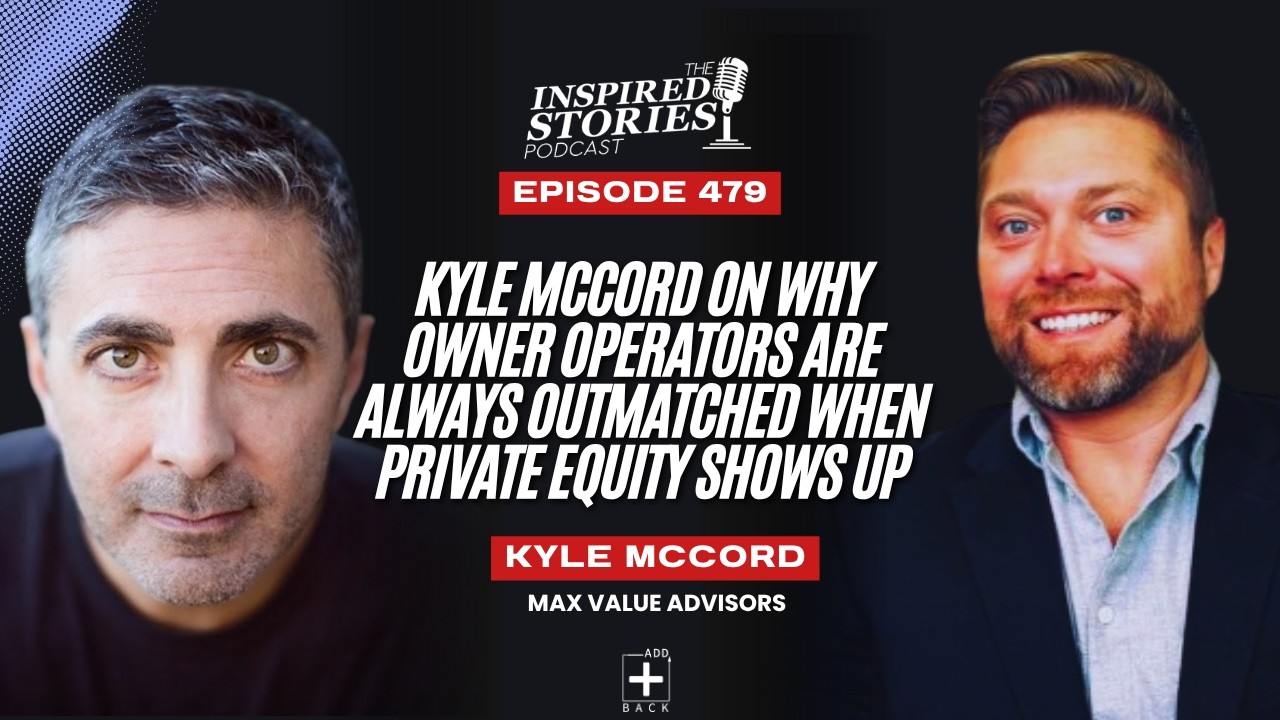
🎧 From Emancipated Minor to Exit Advisor: Kyle McCord’s Journey to Max Value Advisors
Kyle McCord, founder and managing director of Max Value Advisors, spent over 15 years inside commercial banking watching business owners get outmatched by private equity at the closing table. That pattern became his obsession — and eventually his company. Today he works with lower middle market businesses doing $5 to $75 million in revenue, helping them scale, acquire, and exit on their own terms.
✨ Key Insights You’ll Learn:
Emancipated at 16, toured professionally as a musician before enrolling at Indiana University
15-year banking career across First Merchants, KeyBank, and BMO Harris in commercial lending
Front-row view of how private equity firms outleverage owner operators in every transaction
Why the lower middle market ($5M–$75M revenue) is underserved and where the real opportunity lives
Four core service programs: Assessment, Acceleration, Accountability, and Advisory
Sophisticating financial reporting as the first step toward increasing company valuation
Why calling an exit advisor when you’re ready to sell is already too late
The mindset shift from employee to entrepreneur: taker to giver
Specialty contractor, light manufacturing, and private medical practice as core focus industries
Building Max Value Advisors in Tampa Bay with a goal to double revenue in year four
🌟 Kyle’s Key Mentors:
His Grandfather (Pastor): only father figure in his life; modeled faith through adversity and showed what it looks like to carry others through hard times
Tour Manager: introduced Kyle to college and the idea of investing in education over the stock market
Exit Planning Institute: provided the CEPA credential and structured framework for exit advisory work
Commercial Banking Mentors: gave Kyle the underwriting discipline and scrutiny that anchors his advisory methodology
Private Equity Partners: educated Kyle on how buyers evaluate targets and what makes a business acquisition-ready
👉 Don’t miss this conversation about growing up fast, building something from scratch, and why the gap between a good business and a great exit is almost always a planning problem.
Listen to the full episode here
Transcript
Anthony Codispoti (00:00)
Welcome to another edition of the inspired stories podcast where leaders share their experiences so we can learn from their successes and be inspired by how they've overcome adversity. As you listen today, let one idea shape what you do next. My name is Anthony Cotaspodi and today's guest spent over a decade inside commercial banking, watching business owners approach the finish line of their careers with companies that were worth far less than the work they put in.
Not because the businesses were bad, because no one helped them build intentionally toward an exit number. That gap became an obsession, and eventually it became a company. He left the institutional world, earned his certified exit planning advisor credential, and launched Max Value Advisors to solve the problem he had watched play out hundreds of times from the other side of the table. His name is Kyle McCord.
and he is the founder and managing director of Max Value Advisors, a consulting firm built for privately held lower middle market businesses doing between five and $75 million in revenue. He has facilitated over $1 billion in acquisition funding and built a methodology that works across scale, acquisition, integration, and exit. But before we get into all that good stuff, today's episode is brought to you by my company, Ad Back Benefits Agency.
Listen, if you run a business, you're likely stuck in the cycle of rising insurance premiums. Paying more, but your team is getting less, and many people can't afford coverage at all. We do things differently. We offer a solution that provides your employees with unlimited access to doctors, therapists, and prescriptions that's always free for them to use. But here's the part that surprises most people. Unlike every other employee benefit out there, our program puts more money into your company's bank account.
As an example, we recently helped a client increase net profits by $900 per employee per year. Results vary, but gains like that can change how a business is valued. And the consultation is free. Imagine being the advisor that delivers incredible value by introducing this to your clients. See if they qualify today at addbackbenefits.com. All right, back to our guest today, the founder and managing director of Max Value Advisors, Kyle McCord. Thanks for making the time to share your story today.
Kyle McCord MAX Value Advisors (02:25)
Hey, thanks Anthony.
Anthony Codispoti (02:27)
So Kyle, you spent over 15 years in commercial banking, including roles at BMO Harris and KeyBank, two major institutions focused on commercial lending. Tell us about the work you were doing and the types of business owners that you were working with at the time.
Kyle McCord MAX Value Advisors (02:42)
Yeah. So, you know, I, I love the American dream and, and, ⁓ entrepreneurs are the embodiment of the American dream, right? usually risk takers, creative type people, ⁓ very particular, you know, and somehow all of that.
translates into them either founding or acquiring a business and, and, and attempting to scale it, right. And a product or service that's gonna service, the community, right. I'd be, a value to the community. And those are my people, just in, in, they're my favorite people to hang out with. They're my favorite people to work with. and so,
I, you know, solving the problem of, of utilizing capital to scale those companies, was my specialty. And so I really enjoyed coming along, business owners, building relationships with them and helping them scale their company, utilizing capital.
Anthony Codispoti (04:00)
What types of business owners were you working with? These super small businesses, medium sized.
Kyle McCord MAX Value Advisors (04:07)
Yeah. So I actually started before key and BMO. Um, I started with a community bank, uh, called first merchants, which was probably my favorite bank to work with. Um, and I've always worked in the lower middle market space. So it's when people say, Oh, you work with small medium sized businesses. Um, banking is very specific.
And the lower middle market is basically that it's actually defined as 10 million to 200 million in annual revenue. I say five to 75 just cause that's my sweet spot, but that is still lower middle market. And you might think to yourself, well, $200 million in annual revenue, that doesn't sound like a small business. Well, in the world of finance, that, that still is, you know, what would be considered a small business. So
not necessarily, I think what the average person thinks of a small business, they think of more of like a main street business, right? Something that they would see on main street, like a retail shop or, or something like that. ⁓ the, but as finance, the finance world defines it, the lower middle market is kind of your, ⁓ you know, 10 to 200 million in annual revenue. So where I find my sweet spot is five to 75 million in annual.
So that's the size of business, but the types of businesses are typically the same as you would find attractive to a commercial bank. These are primarily cash flowing business, right? So if you're a bank, you
Anthony Codispoti (05:48)
meaning profitable.
Kyle McCord MAX Value Advisors (05:50)
⁓ yeah, profit, profit and cashflow are two different things, but, yes, profitable is important, right? Because if you're going to borrow money, you not need to repay it. ⁓ and there, I do specify that because there are, consultants that specialize in what's called turnarounds. ⁓ and I, I don't necessarily do turnarounds. ⁓ a lot of people will, some consultants will
look for turnaround opportunities so that they can negotiate some equity, right? That's not necessarily what I do. I look for companies that are, taking them from good to great, right? ⁓ are successful to significant is kind of what we, yeah.
Anthony Codispoti (06:34)
Mm.
Okay. So
before we kind of get to the point of the idea to start Max Value Advisors, tell me a little bit more about what was going on when you were working inside the banks, because you had this front row view of how companies were valued when they needed financing or they were going through a transaction. Was there a pattern you were seeing in the owners who came up short?
Kyle McCord MAX Value Advisors (07:03)
Absolutely. So that, that is really that pattern is what led me to start max value advisors at the bank over that over about a 10 year period. I worked with two types of different clients. One were the business owners themselves, right? And I come alongside a plumber or a small manufacturer and I would help that owner operator grow their business through capital, right?
The other type of client that I was quickly, is a growing market was private equity, right? These private equity firms would raise capital and they go buy these plumbing companies or these small manufacturers, right? So the guys I'm working with, the private equity companies are buying them. And, ⁓
I immediately saw some that they were out leveraged by the private equity guys because the private equity guys had a better finance skillset than the owner operator. know, a plumber, he might be a great plumber, but when it comes to the world of financing or even purchasing or selling a business, you know, that guy could be a great plumber, but he's never sold a business before. So,
Anthony Codispoti (08:21)
These private equity guys
have bought and sold dozens, maybe hundreds of businesses for the plumber. This is the first time they've ever done it, maybe the only time it'll.
Kyle McCord MAX Value Advisors (08:31)
You nailed it. So it's kind of like selling your car back to the dealership. You know, it's like those guys, they really know.
you know, what something's worth and they, they structure these multiple deals a day, know, private equity is structuring multiple deals a year. And so typically that plumber is out leveraged, right? and in knowledge and everything else, right? So, ⁓ that is, that is the media opportunity I saw. The other thing is that oftentimes the, you know, the owner operators, what I'll call them because
you can an owner operator defined by anybody that primarily operates the business, you know, so for instance, a doctor that owns a private practice, you know, that's an owner operator as well. Anybody that's focused on production style work is an owner operator. So a lot of people don't realize like what a plumber and a doctor would have in, in, you know, in common. But in my world, in the world, I look at them as, they're an owner
Anthony Codispoti (09:33)
in common owner operator.
Kyle McCord MAX Value Advisors (09:38)
operator, you know, they have a cry here.
Anthony Codispoti (09:41)
And so in the same way that the
plumber could be a really good plumber, but not accustomed to how to do a business transaction, same is true of a dentist. Great dentist, but they haven't gone through the transaction process before.
Kyle McCord MAX Value Advisors (09:48)
That's exactly,
exactly. So yeah, you, so that's kind of where I, as when I was a banker, I looked, I was, I was really involved in the developing a relationship with that person and being a trusted advisor, you know, that could come alongside them and help them think through things. You know, my clients as a banker,
your job is like taking people out to lunch and going golfing and things like that. I'm a terrible golfer, but I was a great advisor because I love helping people. You know, I love helping people. love talking through ideas. And the more I did that, you know, with these owner operators, the more I realized that they had a good opportunity.
I had a good opportunity to help position them for an exit with some of these private equity guys. And so...
I'm working with the owner operators and then I'm learning as much as I can from the private equity guys, ⁓ how they look at a target that's attractive. ⁓ What is their due diligence process? That was a big thing, right? Is speaking with the private equity guys. So what my function at the bank was when I would work with private equity is they would look at a target. So they would find like a plumber or a manufacturing facility or something along those lines.
And they would submit the deal to me. They would say, hey, we want to buy this company for, let's call it for easy math, $10 million. We want to put 5 million of our money in and we want the bank to put the other half in. So I would have to underwrite that deal, scrutinize it, look at it as if I was buying that company too. So I would, exactly. And then,
Anthony Codispoti (11:38)
You were going through a similar process to the PE guys.
Kyle McCord MAX Value Advisors (11:43)
you know, I was following the traditional banking underwriting methods and practices that I had learned through banking. And then I go back to the private equity guys and say, Hey, what do you see? Why do you want to buy this company? You know, ⁓ why are you going to take the risk? What do you think you can do to build it? And what, pieces of information are you going to require from them to figure out whether you can do that or not? Right.
And so that was an education in and of itself to me over that 10 year period.
Anthony Codispoti (12:16)
You knew the banking side of it because you worked in the banks, they'd been taught their ropes, and now you're learning the P.E. side of it, maybe a little bit of a different angle, a little bit of a different viewpoint. You're seeing how the business owners are outmatched because they just don't have the experience that the private equity guys do. And so you say, I'm going to leave my comfortable job at the bank and I'm going to start an advisory firm to help these guys out. Is that kind of how it happened?
Kyle McCord MAX Value Advisors (12:42)
Yeah, pretty wild move, right? So yeah, the private equity guys, you know, they're looking at a company to buy so that they could scale it, right? They want to buy a $10 million company because they believe that they can make improvements and sell it at 50 million, right? So the way I worked with a lot of owner operators, a lot of blue collar businesses, and so I'll,
I like to use the analogy of a house, right? So ⁓ basically what, if you were going to buy a house, right? For call it $400,000.
You would be looking, walking through that house, looking at what improvements you could make so that you could sell it for $800,000. Right? Is it in a, is it in a good location with a good school system? Does it have the what's called the uncontrollables? Right?
Okay. It's in a good location. It has sent a good school system. You know, there's, there's other things being developed around it, you know, shopping and those. Okay. What are the controllables? What are the things that I can do to create, to create value in this house? Well, I can add landscaping. can remodel the kitchen. I can put a new coat of paint on it, things like that. So a private equity company looks at a business the same way, right? What are the uncontrollable market factors that
that
are creating upward momentum and then what are the things I can control? And that was all very new to me, right? Because I'm working for the bank, I'm looking at companies and basically asking the question, can they pay me back plus interest? That's all I wanna know. And banks are very conservative, right? They're not risk takers. But you learn scrutiny through the bank.
Whereas working with private equity companies, you really look to look at the opportunity or you learn to look at the opportunity for growth. So that's the difference there.
Anthony Codispoti (14:52)
Okay, so you start Max Value Advisors in late 2023. Walk me through the early days. How'd you get that first client?
Kyle McCord MAX Value Advisors (15:01)
Man, this is, ⁓ that's such a good question, Anthony, because, know, the, the, I think the wall, when you were an advisor or you work for like, you know, a big corporate company, there's always this kind of invisible barrier between you and a, and a, and an owner operator or you and a business owner.
And it's kind of comfort. They look at you as like, Hey, this guy's smart, but they've never done what I've done. They've never taken that giant Lee buffet, developed a product or service from the ground up.
and then proving it to the market through a purchase of an employee. I'll tell you what, was the biggest thing is knocking that wall down was the biggest thing. so when I...
Anthony Codispoti (16:03)
When you say knocking that wall
down, you mean just taking that first leap saying I'm going to do this? Yeah.
Kyle McCord MAX Value Advisors (16:08)
Yeah, it's scary.
It's a scary leap. It's a giant leap of faith.
Anthony Codispoti (16:14)
Did you leave your banking job right away or did you start doing this on the side?
Kyle McCord MAX Value Advisors (16:20)
I mean, the actual work, I was doing it with the bank for a while.
Yeah, no, you, there's no, when you work for a bank, you can't do any sad jobs. You can't even buy stock without them proving it. So there's so many rules and regulations. So I knew that I had to make a clean cut and go do that. So yeah, I had several relationships. ⁓ I had, ⁓ you know, in, the market, I was well established in the Indianapolis market.
Anthony Codispoti (16:37)
And
Kyle McCord MAX Value Advisors (16:53)
⁓ which is where I'm from. And, I told a few of my mentors, Hey, I'm going to leave and I'm going to start my own company and I'm going to help business owners do two things. I'm going to help them, ⁓ scale or sale. Right. And that simple message was enough to get the attention of a couple of people. One was a, ⁓ somebody who wanted to sell their business. And one was somebody who wanted to, to scale.
through ⁓ capital and through acquisition. And then one was one that needed to be structured to be acquired. yeah, it was a, I wish I could tell you a little bit more about that time. We could probably do a whole podcast on leaving the bank and the first couple of customers.
but I'll give you some, the general highlights is that that time period was September, 2023 to about, think we started the engagement February, 2024. So, you know, four or five months there. Um, and there was a lot of praying involved. Um, there was a lot of development, you know, um, of just canceling out all the noise sitting down.
and creating what I, taking it from a knowledge base to a digestible product and process to follow. And that was, that was huge. During that time, I also, I got to give it to the exit planning Institute. You know, they did a really good job of packaging. ⁓
you know, the process by which you would lead somebody through. ⁓
that exit plan. on the exit side, they were, they were tremendous. And, uh, I, I'm still am a SIPA. So I certified exit planning advisor. I'm actually going to the summit in Nashville. I leave Sunday. So this is one of the last things I have to do in the office here in St. Peter's root Florida before I head there. But yeah, there was, there was a lot of time, a lot of faith required, a lot of prayer and a lot of just relief.
building ⁓ over that time period to connect with those owners and show them the process before they said, okay, I'm ready to commit to this process. And yeah, we got started.
Anthony Codispoti (19:33)
Yeah, and I'm so glad that
you shared about those difficult first several months before you got the first engagement because this is typical. This is really common when you're starting a new business, especially in your situation where you couldn't do it concurrently with the bank, right? Because a lot of people like, hey, I'm going to start on the side, keep my regular job. can, you know, start to put some feelers out there, maybe get a couple of side clients. You couldn't do that. You needed the clean break.
And those first few months can be quiet. They can be, and that silence can be deafening, right?
Kyle McCord MAX Value Advisors (20:11)
⁓ it's, I mean, it's, it, you have to go through a transformational process during that time. And I've, I've seen so many people not be able to make the leap and I was four.
The requirement of me having to leave the bank to do that, I think was a blessing and a curse. One, the curse is that it is a shock to your system. I mean, it is like jumping in ice cold water or something like that. ⁓
you know, you're throwing yourself right into the fire and it's very overwhelming to go from a hundred miles an hour of the world of high finance to basically zero. I'm in my home office like, boy, I hope this works. ⁓ but the blessing is
I think it's almost impossible if you don't do it that way. I see a lot of people kind of dabble and try to dip their toe in and get used to the water of entrepreneurship and get used to the world of advisory. And it's like, those people never make it. The other thing, and this might be, if I don't say anything else on your podcast, this is probably the most valuable thing I've said thus far. And it might say the whole time. The biggest shift.
that you have to go from employee to entrepreneur is you have to go from being a taker to being a giver. And what I mean by that is your value prop has to be so strong. You have to know and believe in your heart and in your mind that what you're giving that person is so valuable.
Anthony Codispoti (21:42)
Mmm.
Kyle McCord MAX Value Advisors (21:58)
They just don't know it yet. And every single opportunity is an opportunity to prove that value.
You know, somebody needs to, the level of communication has to improve dramatically from employee to entrepreneur. And when I say giver and taker, know, giver and taker, what I mean is, Hey, when you're an employee, you know, you start talking to a company, you say, what do you do? It's like, well, I'm a banker, you know,
I specialize in providing capital, whether that be working capital, their acquisitions, and you go through the whole spiel. And then the next thing is how much are you going to pay me? Right? What's my compensation package look like? So I can get out of bed and put pants on and do my hair and show up to the million dollar office.
You know, and it's just like you're kind of conditioned as an employee to think about it as what am I getting? And you get a salary before you even prove yourself, you know, that might, you know, upset. It's a different, completely different mindset. You got to know that what you're giving them is, is.
Anthony Codispoti (23:07)
It's a different mindset as an entrepreneur.
Kyle McCord MAX Value Advisors (23:16)
is worth millions and they're gonna slowly kind of understand that over time. And if you don't have the patience for that or you don't have, I meet so many advisors that feel like they're being disrespected because the client doesn't understand how valuable they are. It's like, buddy, you're just, know, that's all I need. Yeah, yeah.
Anthony Codispoti (23:35)
That's on you. got to demonstrate that value. Let's talk
about some of the value that you deliver. You've got these four core programs, assessment, acceleration, accountability, and advisory. Talk to me about your process.
Kyle McCord MAX Value Advisors (23:47)
Yeah.
Man, love developing that right there. And that kind of what we just talked about led me to loving developing these, what I call service products because I offer services, but I need to make it tangible enough for these owners to understand the process and the product and what it's like. And so they're scripted programs of everything I know about, uh,
those areas. And so you see the different outcomes. So the different outcomes are scale acquisition, integration exit. Those are usually why somebody comes to me. Nobody comes to me and says,
Anthony, just, really need to take an assessment today. You know, that's like, well, that's a means to an end. They want to know the outcome and the outcome might be that, ⁓ well, I want to, I've got a great plumbing company or I've got a great HVAC company. I want to go acquire more. I say, okay, great. Let me know where you're starting from, you know.
Let's go through this assessment to kind of to get some data on your company to see what other companies you might be a good match for so the assessment is a series of assessments that Lead you to a different outcome, right? Then acceleration is once we have gathered all that data
We, in the assessment process, we've figured out what your value is because it also ⁓ includes evaluation. And so we're going to accelerate the value of the company.
⁓ And we do that through operational improvements, right? So we're in the assessment, we're determining what operational improvements we need to make. And in acceleration, we're making those operational improvements and we're measuring the increase of the valuation, right? ⁓
Anthony Codispoti (25:55)
Let me pause you right there, Kyle. Sorry to interrupt.
Give us an example of one or two of these operational levers that you can pull to help increase their valuation.
Kyle McCord MAX Value Advisors (26:04)
Great, great question. So a lot of the things I see in the lower middle market are consistent across the board. And it doesn't matter if they're a doctor or they're a plumber or they're an HVAC company. So one of the places I start is just their financial reporting, right? A lot of these companies have a bookkeeper, maybe they're...
They're on QuickBooks, but they have some level of bookkeeping. But are they actually doing a financial reporting package review? Like if you work at Google or Amazon and you work in the finance department, you're putting together, you know, monthly and weekly sometimes these extensive financial reporting packages to give to your C-suite.
and that C-suite is giving them to the board of directors. And then the board of directors is packaging it all and showing the investors, hey, this is what the company's doing and this is how much money we're making and this is where we're going next quarter.
are these lower middle market companies, you know, they don't necessarily have those conversations. They, they look at, know, what's our account fable or receivable? Do we have enough money in the bank account to cover stuff? I'm not sure. Go talk to Sally that works in accounting. You know, that's kind of how it works sometimes. So, ⁓ the first thing I do is really look to sophisticated their financial reporting, right? Because if I'm a business owner, I've got to,
I've got to be looking at those finances and then seeing what story they're telling so I can make decisions based in that information.
Anthony Codispoti (27:50)
And so are you replacing their bookkeeper? Are you teaching the bookkeeper how to do some of these additional reportings that you think are necessary and helpful to them? What's your process there?
Kyle McCord MAX Value Advisors (28:02)
It both, it depends on the desires of the owner operator, right?
I always want to work with people. I'm a developer. a, you know, I love this. I love to see people achieve, you know, ⁓ my, my whole mission, if you look on my website, there is to maximize your value personally, professionally and purposefully. And that goes from the owner down to the janitor of the company, right? I, I love working with people to help them maximize their value. So if Sally's working in bookkeeping,
I'm happy to work with her, you know, and, and, and see what we can get, um, as far as a more sophisticated reporting package goes. A lot of times there's just not the skillset that is needed. And so I will outsource, um, a professional accounting firm and give them, you know, high level expertise for a low monthly payment. Um, and, uh, yeah.
Anthony Codispoti (29:07)
And Kyle, give us an example of something that having that detailed financial reporting allows a business owner to do a decision that they can make that they were ill-equipped to do before.
Kyle McCord MAX Value Advisors (29:18)
Yeah. So the number one thing is make investment decisions, right? At the point that if you own a company and you're making, you're doing five to 10 million a year at that point, hopefully you're not, if you're, if you're a plumber, you know, maybe you're going out on calls still, but hopefully you're not the one in the trenches with the pipe wrench, you know, ⁓ and probably making higher level decisions. and
you need to kind of look at the company and see where am I going to invest in? Do I need to invest in more employees? Do I need to invest in some marketing? Do I need to invest in this or that? And that's, that is your job. My, my number one job when I work with an owner operator is to get them to take off their operator hat for a minute and put on their investor hat. That is like, if you talk to any of my clients, they'd be laughing right now because I use that.
Anthony Codispoti (30:14)
You do that visual, you take the ball cap
off and.
Kyle McCord MAX Value Advisors (30:16)
I'm a very
visual guy. ⁓ that every operator I've worked with is super talented, as a super talented operator and high, high level. They know everything about their craft. And I want to empower them to be able to make investment decisions, right? That's why we need the financials. What story is the financials telling?
Anthony Codispoti (30:41)
And so your job is to come in and either help them scale or sale, maybe a combination of the two, clean up their operations. And you're doing this in the, what did we say, five to 75 million, or is it 10 to 75?
Kyle McCord MAX Value Advisors (30:56)
Five to 75 million, I would say is my sweet spot.
Anthony Codispoti (30:59)
geographies or industries that are better for you?
Kyle McCord MAX Value Advisors (31:03)
No geographies pretty much anywhere. Right now I'm heavy in where I'm from, which is the Great Lakes area, Indianapolis. I've got clients that all over there in that Indianapolis, Chicago land area, Ohio, ⁓ Midwest Great Lakes. ⁓ North Carolina is a hotspot. ⁓ We just did an exit for a company.
in South Carolina. That was a fantastic exit. A 12, 12 plus million dollar exit in South Carolina. So the Carolinas are a great spot and I am now I'm sitting right now and the new
office in St. Pete, Florida. So Tampa Bay has been, you see the hat, has been just a great spot for us to land. And we love the Tampa Bay community. We've got several clients down here that are doing extremely well. And that's, that's where I'm located currently.
Anthony Codispoti (32:08)
And I've heard you mentioned plumbers and dentists just as examples, ⁓ industry agnostic or you specialize.
Kyle McCord MAX Value Advisors (32:12)
Yeah.
⁓ I used to say industry agnostic, but there are definitely industries ⁓ that we focus on more now. So first and foremost would be specialty contractors.
These think of the trades. These are dirt world type of businesses. ⁓ Your big ones are HVAC plumbing, electrical. ⁓ I've worked with concrete companies. work with car carpenters, any specialty subcontractors I love because there's a ton of value there and the guys are usually pretty business savvy. ⁓
and want to scale the company. And then there's new generations always coming in. So those are great. The next ⁓ area would be manufacturing. Light manufacturing ⁓ is always good. ⁓ And we work with a few companies in that area, a couple aerospace companies, a furniture manufacturer.
So those are phenomenal asset heavy companies. But yeah. And then it really, say, I, I work specifically with owner operators, right? And so you would find private medical practice in that category as well. We've done well with several private medical practices. So those are, those are the three areas where we really specialize, but more and more
It is those dirt world blue collar companies. cause you know, AI isn't replacing those or doctors anytime soon.
Anthony Codispoti (34:02)
Yeah.
Let's shift gears here, Kyle. Be interested to hear about big personal challenge that you've had to overcome in your life. What it taught you.
Kyle McCord MAX Value Advisors (34:09)
.
So I think that that specifically is what uniquely positions me to do this work. So if you wanna go way back to the beginning, I'm actually an emancipated miner and had some challenges growing up, pretty rough upbringing ⁓ at one point.
You can't really say it was a high school dropout. I just, I wasn't sure where to go. When I was a kid, I was facing some challenges and ⁓ moving around a lot. I wasn't sure if I was going to stay with ⁓ my, my mom. I've actually never met my dad, my mom and my family unit there.
or if I was going to go live with my grandparents. So I was constantly kind of being shuffled around family. I lived with my aunt and uncle for a little while and it was very unclear what was going to happen. So it forced me to grow up really quickly. I became an emancipated minor at the age of 16. If you're not familiar with an emancipated minor, it just means you're your own legal guardian.
So funny story, I just went to the public library, got some books on how to emancipate yourself. I read them, I studied them, probably harder than any test I had ever studied for in high school. And I emancipated myself in the courts. I think I, I think I, I mean, the internet had just come around, so I think I looked it up. I've always been pretty tech savvy, so I looked it up.
Anthony Codispoti (35:47)
How did you even know that that was a thing?
Kyle McCord MAX Value Advisors (36:00)
⁓ And then I was, ⁓ shortly, mean a month or so after that, so I'm a musician and I had been playing music since I was 10 years old and I got a job playing guitar in ⁓ a band and I was off to the races. I was touring, I went to South America, I went to England ⁓ and yeah, so I left high school to do this work.
And it really opened my eyes. It showed me that there was a whole new world out there that you could take your skill set no matter what it was, you know, and you could earn money with it. So, I mean, I was a young entrepreneur even at that point.
And then oddly enough, when I had some money saved up, so I was about 19 years old, I'd been doing it for about three years and I had about $30,000 saved. And I started thinking, man, now that I have this money, I need to figure out how to invest it.
So we, the tour bus that I'm on stops at Starbucks every morning and people get coffee. And I couldn't fathom paying like, you know, five bucks for a cup of coffee. So I'd always keep my money. Well, this day, instead of buying a coffee, I bought a copy of the Wall Street Journal.
And I start reading through the wall street journal, like, what am I going to invest my money in? You know, I know nothing about investing. And one of the tour managers comes up to me and says, Hey, what are you doing, Kyle? I said, I got to figure out how to invest this money that I have saved. You know, I, I'm a musician and they say, you know, you never know where your next gig is coming from.
And he said, well, Kyle, you know, if you put your money in the stock market, it goes up and down. You know, you could lose your money. ⁓ he goes, what if you invested in a college education? And I was like, I don't know if I could get in. Like, I don't, I don't know. you know, how, where did, where I would even start.
So we get back to Indiana and he takes me to the ⁓ Indiana University IU's campus. And if you've never been, it's this beautiful campus. It just looks like something out of a storybook or a movie. And I start thinking, man, what would it be like if I went to college?
And it actually turned out to be kind of a perfect schedule because college kids go to class Monday, Tuesday, Wednesday, Thursday, and a musician typically plays like Thursday, Friday, Saturday, Sunday. And so I started thinking, man, this would be possible. You know, if I went to school, what would I study? And, ⁓
And they asked me that, you know, when I went to the admissions, uh, which that's a whole funny story in and of itself, cause I didn't even know what an admissions counselor was. But, um, they asked me, you know, what would you study? Would you study music? And I'm like, Hey, I'm already a professional musician. That's how I'm paying for this. You know, I'm like, I want to study business, you know, I want to learn how to make this money work for me. I want to learn, you know, more about the music business. And I think I will land somewhere as an entrepreneur.
And that seed just got planted and I was like, yeah, I need to get a college.
Anthony Codispoti (39:30)
And so you wanted to go to college because you had a little bit of a nest egg and you wanted to figure out how you could put that money to work for you. That's what kind of started that bug if you'll call it. Yeah. Okay.
Kyle McCord MAX Value Advisors (39:37)
Yeah.
Exactly.
Yeah, visit the business school. Like it was, I guess it was like, I could read this copy of the Wall Street Journal or I could, was, that five bucks was an investment in education, you know, and then I just, I took that to the next level. Kind of like what I do with everything.
Anthony Codispoti (39:57)
So can we go back to kind of the rough upbringing, right? You're bouncing around mom, grandparents, aunt and uncle at 16. You're like, I'm flying the coop. I'm going to be on my own. I'm emancipating myself. I mean, at a young age, you know, I mean, at any age, what you want at your core is stability. But especially when you're younger. And it sounds like that's something well before the age of 16 that you didn't have. I mean,
Kyle McCord MAX Value Advisors (40:10)
Yeah.
Anthony Codispoti (40:27)
The comment you made was, I don't feel like I really dropped out of high school. I just didn't know where to go. I mean, that says a lot right there. Is that something that you kind of still carry with you today?
Kyle McCord MAX Value Advisors (40:33)
Thank
I think so. mean, you know, the number one success trait amongst business owners, investors, so on and so forth is risk, risk appetite. So if you're looking for, if you're constantly adjusting for comfort or ⁓ seeking comfort, ⁓
I don't know if you're ever gonna be successful. I'm not saying it's bad. Hey, I live in Florida and the weather's really nice and I've got some comfort in my life now. I would say being comfortable with risk and having a high risk tolerance and always pushing myself, that definitely comes from the way I grew up.
Anthony Codispoti (41:30)
You got real comfortable with being real uncomfortable a lot.
Kyle McCord MAX Value Advisors (41:35)
Yeah. Yeah. In the, don't know if I, I don't, I don't know if I got comfortable being uncomfortable, but, I will say that it definitely, you're looking for ways to push yourself constantly. I mean, my company's called max value advisors, right? Because I'm constantly looking for ways to maximize everything I do.
⁓ I have, my programs are called acceleration. I that's a constant theme in my life. So it's like, once you've gotten comfortable with a certain amount of risk, that's when you know, it's time to, you know, push the envelope a little bit more. I mean, I, I'm in one of those situations right now where it's like, I've, I feel like I need to push to the next level and,
Not everyone's wired though.
Anthony Codispoti (42:31)
What does that next level look like for you, Kyle McCord and Max Value Advisors?
Kyle McCord MAX Value Advisors (42:37)
Yeah, well, it's first and foremost about the clients, right? I live for the clients. And so we have an engagement down here with a great platform company and we are structuring them to make some acquisitions right now and do a roll up. ⁓ And so I'm really excited about that work.
Um, I think just making the move to open the office in, Florida and build this community is, is, is huge. You know, I, I, I made that move in December, um, uh, moved the office down here in January of 2025 and then December of 2025, uh, I moved down here. And because I believe in investing in, the commu in the business community, you know, I'm part of a great church down
I'm part of a great business community that's supportive of each other and I want to grow businesses down here. And so I have the opportunity to do that with a nice client base. My largest client base is here in the Tampa Bay area. ⁓ And so, yeah, we're going to accelerate as much as we can.
Anthony Codispoti (43:56)
Do you ever think about getting involved on the buy side, being an equity partner yourself?
Kyle McCord MAX Value Advisors (44:02)
Yeah. So, the way I structure my fees, you know, this might be helpful for some of your advisors that may be listening to show is, ⁓ I try, I try to diversify ways that I get paid for services. And a big thing I believe in a success fees, right? So if you have a big, ⁓ you know, I would say.
you're accomplishing a big milestone ⁓ or big rock, you know, or big goal aspiration. ⁓ You can tie a success fee into that, especially if there's a transaction amount. And that's what I tend to do is I put a transaction fee. ⁓
in their, or sorry, the success fee, and it usually comes out of time of the transaction, where I take a percentage of the deal. And so they can either pay me straight cash for doing that and remain 100 % owner, or they can pay that success fee in the amount of equity. And a lot, a couple of them have chosen to do that. And those are...
That's like the best compliment you could ever get, right? Because they say, Hey, we see you as a long-term value, valuable partner in this. And I mean, there's nothing that could be better than that.
Anthony Codispoti (45:28)
And so the folks that are paying you in equity, those are the folks that you're scaling, not selling, right? Because if they're selling, what's the point of giving you equity of a company that's not going to be theirs anymore?
Kyle McCord MAX Value Advisors (45:40)
Right. And they wouldn't be able to give equity in that case. So typically, yes, that's with a scale partner.
that you would get the equity side of things. In the exit, mean, they can give you the exit, the equity prior to, right? with, this is probably good to talk about. So exit clients, people think, okay, I'm gonna call Kyle when I'm ready to sell my business. That is definitely not how it works. Don't do that. It's best to work with me, I would say, know, three to five years.
before you're looking to sell or transition to family or something like that. Hey, if I can get 10 years, I'll take 10 years. know, as long as a runway as you can give us, the more we can accelerate the value of the company.
Anthony Codispoti (46:35)
you've got more of
a chance to pull out of those operational levers.
Kyle McCord MAX Value Advisors (46:39)
Exactly. We're, we're, you know, I think go back to the analogy of the house. It's like, you know, if you want to slap a for sale sign out the side today, you're going to get what you get. Right. But if you give,
contractor a few months, you know, if you give them one month, you'll get, you maybe you'd be able to raise the value a little bit. If you give them six months, you know, we can finish a basement, right? we can do a lot of work to improve the value of this home. We can put a pool in, right? ⁓ there's, so it's similar with the business. It's like,
You know, if you give the shortest amount of time I'll do now is 18 months, you know, you know, if it's some companies we can get there in 12, but I would say 18 ⁓ months to three years is typical. If I can get five to 10 years, even better.
Anthony Codispoti (47:35)
Longer runway is better. Kyle,
what is the thing that you most want to be remembered for in your work?
Kyle McCord MAX Value Advisors (47:45)
I mean, maximizing value personally, professionally and purposefully. I think the purposefully part is the most important part, you know? ⁓ I mean, I'm definitely a man of faith, you know? And I think that doing the character...
that I bring into the business community is really important. The accountability, one of my products is called accountability. You know, I'm a believer in big faith, man. Like I think it takes a lot of faith to be successful in taking risks that you need to take in business. ⁓ and my faith in God is a big part of that. So I would say that's probably number one and number, number two would be maximizing value personally.
professionally and purposefully along with that number one.
And then, you know, number three is I want to do cool stuff. ⁓ you know, I, I'm excited by, ⁓ when I sit down with these business owners, there's part of the, one of the reasons why I love them so much is they're big dreamers and big doers. You know, I think the number one thing between a trait of a successful person is, is they're a dreamer, but they're also a doer. And that's where you get the, if you go to my website, you'll see the tagline. It says,
where strategy meets execution. And I'm big on that. I've worked for consulting firms. I got started in management consulting. And one of the things I didn't like about it was it's very strategy heavy. I mean, they'll give somebody a hundred thousand dollar PowerPoint presentation. And I'm just like, spend.
Spend a good enough time on the strategy to make sure it's solid, but the majority of the time should be spent on execution here. I want to get in there side by side at the same table as the business owner. That's why I've become friends with a lot of the business owners I work with just because we're executing together and you can't help but to build a bond and a relationship with someone that you're...
you know, changing the business community and the world around you alongside.
Anthony Codispoti (50:05)
How did you find your faith? Was that something you grew up with or did it come later?
Kyle McCord MAX Value Advisors (50:09)
⁓ That's a great story. So my grandpa, I told you I had a rough upbringing. Well, my escape was my grandparents. My grandpa was a pastor.
but he's not like a pastor that you probably have ever met. This guy, I'm telling you, he wore a leader suit like everywhere he went. He had hair like Elvis, he sang like Elvis, ⁓ and he drove a Corvette. He's just a cool dude. ⁓ And I thought he was the coolest, know, he bench pressed like 400 pounds, big hulking guy, just a cool guy. And I spent, he was a real,
the only father figure in my life, the only male ⁓ figure I had. And so I spend a lot of time with him and more so than any one of those like ⁓ eccentric things I just mentioned about him, his faith was number one. His faith in God, mean, get emotional talking about it. ⁓ He, you know.
He, I saw him deal with so much adversity and go through it, because of his faith in God. ⁓ he is always quick, you know, to be able to pray for you when you needed it. ⁓ just.
⁓ that was my influence. you know, I went through a lot of ups and downs in life. ⁓ you know, trying to get to those points and you can look and at the bottom of every valley there was God and at the top of every mountain there was God. And you know, I think a lot of that is perspective. I feel sorry for, ⁓ some of those can't see God in those moments, but you know, if I, if I'm able to help anybody see
that I wanted to. ⁓
Anthony Codispoti (52:07)
Why did you get emotional
talking about that?
Kyle McCord MAX Value Advisors (52:11)
man, it's hard not to, you know, when I think that's, you know, we just got done talking about how execution is, is, is important. Like being there and going through the highs and lows with a business owner is the most important thing.
Right. And, ⁓ you know, if I look back, the most important people in my life were there through those, you know, my grandpa was one of them. My grandma was there praying every step of the way. ⁓ God was there with me and I can, I can talk, I can, I can give you a handful of other names of people, whether it be mentors or, or peers or people that were there alongside me, carrying me through. That's what I want to be for these business owners. You know, you're going through a transformational process,
you go from a $10 million company to a $50 million company and you're going to go through some stuff. mean, newsflash, you don't go, you don't go from 10 million to 50 million without some struggle, without some sleepless nights, without some, you're going to change personally. You're going to evolve. You're going to grow. You're going to maximize. You're going to accelerate all those words that I use. I use them on purpose, you know, and ⁓
I'm that guy. I'm going to be right there with you in the trenches. I'm going to be the phone call when you're crying because you're scared. And I'm going to be the phone call when you're crying because you're so happy that everything worked out. I mean, I'm, I'm that guy and I love being that guy.
Anthony Codispoti (53:48)
Kyle I've just got one more question for you today, but before I ask it I want to do three quick things for the audience First of all anybody who wants to get in touch with Kyle McCord for max value advisors go to his website right now max value advisors comm No funky spellings. No dashes max value advisors comm and if you're enjoying the show Please take a moment to subscribe wherever you're listening
It also sends a signal that helps others discover our podcast. So thank you for taking a quick moment to do that right now. And as a reminder, you can be the advisor that delivers a huge value add by showing your clients how to give their employees access to therapists, doctors, and prescription meds that counterintuitively actually increases their net profits. Real gains that can change how a business is valued. Contact us today at addbackbenefits.com.
So last question for you, Kyle, a year from today, what is one very specific thing that you hope to be celebrating?
Kyle McCord MAX Value Advisors (54:49)
year from today. One year from today.
I hope to...
Anthony Codispoti (55:10)
Could be personal, could be professional, maybe it's both.
Kyle McCord MAX Value Advisors (55:14)
Okay.
It, I gotta say it begins and ends with my clients. So, ⁓ we have.
I am in the process right now of launching a roll up, right? So it would be a few completed acquisitions ⁓ with that acceleration client down here. ⁓ It would be the automation and ⁓
we're rolling out a brand new platform for all of those products that will be ⁓ guided. It was just really nice. ⁓ So that's exciting. ⁓ We have an aggressive goal to double our revenue by
this time next year. So we're in our third year, which is awesome. ⁓ We have a goal to double our revenue in year four and triple the revenue in year five. And we have the platform to do that. ⁓ The other thing would be to have solidified my home base here in the Tampa Bay area. ⁓ actually put an offer in right on a house right before I...
I
got on this podcast. And so the, ⁓ to move the home base down here is, a big, big goal. I hope to accomplish that well before this time next year. ⁓ hopefully I'll accomplish it this weekend actually. But yeah, man, I've got a number of ⁓ big aggressive goals. ⁓ but yeah, those are, those are some of the highlights. think.
Anthony Codispoti (57:03)
Love it.
Kyle McCord from Max Value Advisors. I wanna be the first to thank you for sharing both your time and your story with us today. I really appreciate you being here.
Kyle McCord MAX Value Advisors (57:13)
Yeah.
Thanks so much, Anthony.
Anthony Codispoti (57:16)
Folks, that's a wrap on another episode of the Inspired Stories podcast. Thanks for learning with us. And if one thing stood out, put that into action today.
Connect with Kyle McCord:
Website: maxvalueadvisors.com