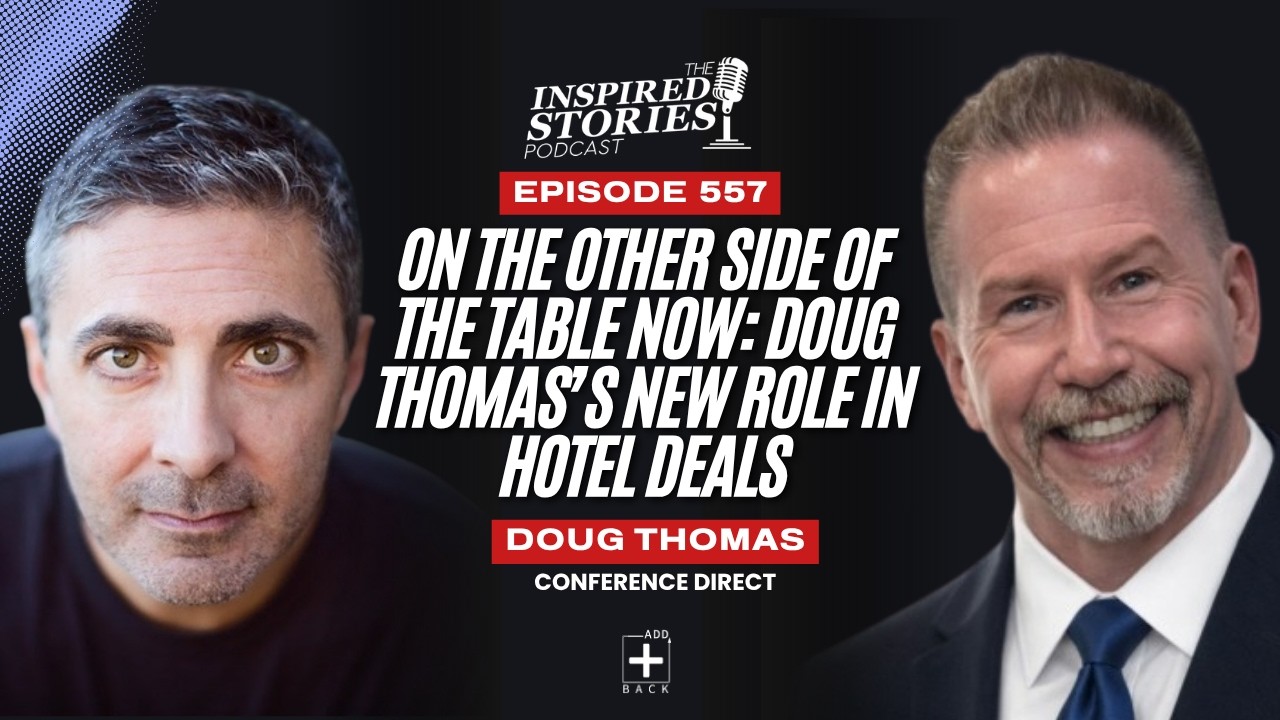
🎙️ From Hotel Sales to Conference Direct: Doug Thomas's Journey on Both Sides of the Negotiating Table
In this episode, Doug Thomas, Global Account Executive at Conference Direct, shares how COVID wiped out his sixteen-year hospitality career overnight, sending him into his garage to build a fitness training business from scratch. Doug opens up about the physical toll of training clients through a Florida summer, the accidental site visit that brought him back into hospitality, and how he now uses insider hotel knowledge to catch hidden fees on his clients' behalf.
✨ Key Insights You'll Learn:
Started on a hotel front desk after a short-lived college football career
Helped pre-sell Rosen Shingle Creek before it broke ground in 2004
Spent sixteen years with Rosen Hotels across sales and leadership roles
Lost his job when COVID shut down convention hotel sales in 2020
Built a personal training business in his garage within a week of the layoff
Trained six to eight clients a day through the Florida summer heat
Returned to hospitality after pitching fitness equipment to former colleagues
Rejoined Rosen Shingle Creek in an associate director of sales role
Joined Conference Direct in 2026 to manage a longtime client's portfolio
Saved a client $21,000 by challenging improperly taxed cancellation damages
🌟 Doug's Key Mentors:
Leslie Manacini: Rosen's first director of sales who modeled deeply personal client relationships
Leona Baylarian: Taught him fierce client advocacy from the third-party perspective
Mike Ditter: Longtime client and Conference Direct veteran who recruited him into the firm
Harris Rosen: Founder whose rags-to-riches story shaped the culture Doug worked within for 16 years
👉 Hear how a hotel sales veteran lost everything to COVID, rebuilt his life training athletes in his garage, and found his way back to hospitality on the other side of the negotiating table.
Listen to the full episode here
Transcript
Anthony Codispoti (00:01)
Welcome to another edition of the Inspired Stories Podcast, where leaders share their experiences so we can learn from their successes and be inspired by how they've overcome adversity. As you listen today, let one idea shape what you do next. My name is Anthony Codus Bodie, and today's guest spent more than two decades building relationships on the hotel side of the negotiating table, then walked away from that world to spend his days coaching people through strength training.
He helped open one of Orlando's largest convention hotels, stayed with that company for 16 years, then stepped into an entirely different industry before eventually returning to hospitality on the opposite side of the deal. Doug Thomas is a global account executive with Conference Direct, where he now represents meeting planners in hotel contract negotiations and site selection.
He spent over 15 years with Rosen Hotels and Resorts, including a role on the pre-opening team for Rosen Shingle Creek, one of Orlando's major convention properties. He's also a certified strength coach who built his own training business working with athletes and adults on foundational movement. But before we get into all that good stuff, today's episode is brought to you by my company, Ad Back Benefits Agency. And you'll want to hear this because it's hurting almost every business you know.
See, health insurance costs go up every single year, and hotel operators are furious about it. They're paying more, claims are getting denied, employees are opting out because they can't afford it, and it hurts turnover and morale. It's one of the most maddening problems in running a business, and everyone just seems to accept it. But you don't have to anymore. Now there's a program from Bain Capital Insurance that gives employees unlimited access to doctors, therapists,
And prescriptions with no co-pays or deductibles to meet. It works for your part-timers. And the part that really shocks most people: our product actually increases your net profits. We recently helped a client add, add $900 per employee per year to their bottom line. Results vary, but imagine what could be done with the extra cash flow. Get your free consultation today at adbackbenefits.com.
All right, back to our guest today, Global Account Executive at Conference Direct, Doug Thomas. Thanks for making the time to share your story today.
Doug Thomas (02:24)
Anthony, thank you so much for having me.
Anthony Codispoti (02:27)
So Doug, early in your career you were a sales manager with the Orlando Orange County Convention and Visitors Bureau, which
Doug Thomas (02:33)
Was.
Anthony Codispoti (02:34)
promotes the region to meeting planners and conventions. What drew you to the hospitality industry in the first place?
Doug Thomas (02:41)
So it's interesting. and I love my time with your Orlando C B. I was I was attending University of Central Florida. my illustrious football career had just ended. very, very short career, to be honest with you. It's very funny. But so yeah.
Anthony Codispoti (02:58)
Wait, pause. Tell us about the football career.
Doug Thomas (03:01)
Yeah, I spent one year on the on the on the UCF football team. I walked on as a quarterback. I played behind Dante Culpeper, who became an all pro
NFL
player, right? but I had one year of eligibility. And so I I decided to to go out for the team, ran the scout team and and had a great time doing it. And in one year it was over. So I was honestly, I was just looking for a job. And my all of my jobs when I was younger were in food and beverage. So I was always dirty. I was always, you know, you get done with your shift, you always smell like some sort of food.
So I wanted a professional job. So and I wanted to wear a suit. So I decided to apply all over Orlando while I was still in school. you know, to to work on the front desk of a hotel. And I was hired at the at the Sheraton, Orlando North, which is in Maitland. And so I was hired on the front desk after they tried to make me a bellman, but I said no, I want be on the front desk. And so I I got to wear a suit and I was cool with that. And so
Five years later I left as the associate director of sales at that ho at that hotel and joined the Orlando Convention of Visitors Bureau, which is now Visit Orlando.
Anthony Codispoti (04:19)
Okay. And something about that work that you fell in love with that kept you in the hospitality space or it was just a job for now and one thing led to another?
Doug Thomas (04:27)
No, you know, it was a it was a job at first and then I just sort of fell in love with it. I found myself with the opportunity to help people. And you know, my my co workers thought it was kind of, you know, silly. But I'm like, you know, I I feel like I could help people in this role. And I I went from there. I had an opportunity to enter into the sales department at the at the hotel and I I decided to do it. It was corp it was corporate transient sales, so it was going around to the local businesses and
promoting the hotel. And it was in a in a corporate center in Orlando where there are lots of corporations around. And much of what fed the hotel was corporate transient. So I that's how I started my sales career. And then I kind of worked my way up into a leadership position at that hotel. And then I sort of maxed out my opportunities there. And then so I left for the Orlando Convention of Visit.
Anthony Codispoti (05:22)
And that was a time where you join Rosen Hotels and Resorts. This is a family of independently owned hotels.
Doug Thomas (05:29)
Yeah, so I I joined the Orlando CVB and I was there for three years. I sold the in the entire destination for primarily the the the the convention hotels in orlando as well as the the convention center. at the time it was two thousand one through two thousand four. nine eleven happened shortly after I was there, so it was a very important time in in our hospitality industry.
to get past that and through that and and get out and travel yourself to make sure that you know you weren't gonna promote something that you weren't going to do yourself. So shortly after 9-11 happened, I was on flights to to destinations, again, promoting the the travel industry, but also mainly promoting Orlando as a destination for meetings and conventions.
So
Anthony Codispoti (06:19)
Okay.
Doug Thomas (06:20)
and so that was through 2004
I was recruited at the end of 2003. I was on a sales trip with the with the pre-opening team with Rose and Shingle Creek. And it was a phenomenal property. Like you saw the plans of it, and there really wasn't much there there really wasn't a property like this in Orlando at the time. And
Anthony Codispoti (06:44)
What made it
unique?
Doug Thomas (06:46)
The the size, the meeting space, the meeting space layout, like it is a meeting planner's dream. It is when you look at at the space, it has the wait, well, at the at the time it was the largest ballroom in the country at ninety five thousand square feet. but you looked at two hundred and fifty thousand square feet all under one roof. The way that it was designed, the load in, the load out was fantastic. Just meeting planners took a look at it and they're like, Is this for real?
The challenge was that Rosen Hotels didn't really have a hotel of that caliber in their portfolio at the time, because it was going to be a luxury property. It was going to be a four-diamond property. Their properties were very useful, but they were the two convention properties that they had were connected to the convention center, which they they still are today. they were more convention center and and convention properties. This was a
Beautiful 1500 room, 250,000 square foot resort surrounded by a beautiful golf course. It was right in the heart of Orlando. So it was there wasn't anything like it.
Anthony Codispoti (07:55)
And so you were getting involved with this
before it was actually completed. The doors weren't
Doug Thomas (07:59)
Yeah.
Anthony Codispoti (08:00)
open quite yet.
Doug Thomas (08:01)
Correct. Yeah, no, actually it was just a concept. So when I joined, the golf course was was completed. Rosen Hotels, and really honestly, everyone should look up the story the the the the story of Harris Rosen, because he's he's a phenom he's an icon in Orlando. Harris Rosen had had purchased two hundred and fifty acres in Orlando by the Convention Center. built a golf course.
Donated 20 of the acres to the University of Central Florida built to build the Rosen College of Hospitality on the same property. And then I joined. and then six months later the the resort broke ground. So we broke ground in August of 2004 and the property opened in September of 2006.
Anthony Codispoti (08:53)
And so in that time that you're working there, those couple of years before it opens, you're just pre-selling it? Like what is your role? Yeah.
Doug Thomas (08:59)
Yeah, exactly. Yeah,
my my role is is pre pre pre-sales. So my role is to sell the sell the dream, honestly. So it is it is to bring people in. We had a sales trailer that was off of Universal Boulevard, where the where the the parking lot is now. We had we had one, then two, then three sales trailers that we had. We had mock-up guest rooms that we would bring people through. The the first building on the site was the golf clubhouse.
And
it was built in the same style as the hotel. So what we would do is we would bring people into the sales trailer, kind of give them the the we had a a model that we would we would sell from. And then when we had the mock-up guest rooms, we would bring people over to the mock mock-up guest rooms, but then we would bring people over to the to the golf clubhouse where you could kind of see the style of the hotel. And when you're there, like
You could be anywhere because the the grounds are gorgeous. You're you're surrounded by the golf course. So it was very it's just picturesque.
Anthony Codispoti (10:05)
And so when people are planning their events, how far in advance are they typically looking? Is it that two year plus window? is that
Doug Thomas (10:12)
Five, six possibly.
Yeah. So it it depends on the size of the of of the of the of the event. If it's a citywide event, you know, citywides can plan ten plus years out, right? if it's a large if it's a large event, they should be planning three to five years out. Yeah.
Anthony Codispoti (10:32)
Okay. And you
end up spending sixteen years at Rosen altogether. I I mean
Doug Thomas (10:36)
I did. Yeah.
Anthony Codispoti (10:37)
it's an industry where you typically move around for opportunities of ad advancement, but what was it that kept you anchored there so
Doug Thomas (10:46)
It's it's the ownership model, Rosen Hotels. It it's an incredible company. totally tied to the community. when you like again, if you look at the story of Rose and Hotels and and Harris Rosen, started the company in in in 2000, or I'm sorry, in in 1974. he was actually fired from Disney, put his life savings into a hotel that was going out that was actually going to be bank owned during the oil embargo.
it's a true you know rags to riches true American story where he just worked constantly. He did he worked seven days a week, he he built a eventually seven hotel sort of empire in Orlando. so Orlando or Rose Hotels consists of seven hotels now. So four of them are limited service.
Three of them are convention properties. And it's a it's it's I think the company's fifty-two years old now. Mr. Rosen unfortunately passed just over a year ago. but his legacy it transcends. It's it's he has incredible people working for him. And but it's it's it's just a great company. And it it's a great company that that had loyalty on both sides.
Yeah.
Anthony Codispoti (12:10)
Hmm.
So Doug, in my experience, there's two really powerful teachers in our work careers. One can be really good mentors, and the other can be really hard work experiences that we had to navigate and overcome. I'd be curious to explore each of those with you. First, any really good mentors that you were able to learn from during your time?
Doug Thomas (12:33)
You know, I never really had a mentor, someone to take me under their wing. I've had influences and or in influencers. and certainly, in fact, I I would say that the the first director of sales, and marketing of Rosen Hotels, Leslie Manacini, literally the the best salesperson I had ever met. In fact, when, you know, I was in my late twenties when I started with with Rosen and
I had never experienced sales on that level. It was sales on an optimum, like a just a personal level that I had never even thought of before. Before it was work and then you leave work and you're done. This was sales like having clients over to your house and making dinner for them. And just as as personable as possible you could make it.
I learned a tremendous amount in sales from from Leslie. she was she was fantastic, just just a phenomenal salesperson.
Anthony Codispoti (13:39)
I I'd
love to hear a little bit more about what you learned from Leslie, like that getting real personal, inviting folks over to your house for dinner is is a great one. What what
Doug Thomas (13:47)
It
Anthony Codispoti (13:47)
else did you pull?
Doug Thomas (13:49)
yeah, it was just really just everything was personal. Everything was personable, everything is personable. It was you know
It was bringing your clients in to a family atmosphere. And that's what we all emulated. And that's what we all tried to do. And so, but it was my first experience in seeing it. And I had you know, my learning curve was it was was pretty dramatic at that point in in in this in this process because I had gone from just basic, like I said, basic sales from you know a a small hotel to
You know, the Orlando Orlando C V B, which is very, very business like to this really all-encompassing world where everything is personal and everything is personable to you know to your clients. And it was it was definitely an eye opener for me and and something I I learned a lot from.
Anthony Codispoti (14:53)
Any others during your time there that influenced you in really positive ways?
Doug Thomas (14:58)
Yeah, absolutely. So I learned that from the third party perspective, in which, you know, the the client advocate, which which what I am right now, I've learned great things from some great people. one of them is Mike Ditter, who is is the reason why I'm at at Conference Direct right now, who's a a a client of mine for for about fifteen years. But one person who comes to mind is
Lenor
or Leona Baylarian who I worked with early on in my in my career at Rose and Hotels. Actually worked with her in pre-opening. And she would just she was just anyone who crossed her or crossed her client, she was like a bulldog. And just if you were however, she was totally loyal to.
everyone who she worked with from an understanding perspective. So for instance, she would if if you explained yourself properly and appropriately and and and really position the hotel's position position it well she would go back to her clients and explain you know this is this is why we're doing it this way so but over the years we developed
a a fantastic relationship and I learned a lot from her from the client advocacy standpoint because again she was absolutely on it and would protect her clients like you wouldn't believe. And so you know just a tremendous respect for her. Yeah.
Anthony Codispoti (16:36)
Yeah.
so I wanna understand a little bit about because we're gonna eventually flip to how you're kind of on the other side of the table today. Tell
Doug Thomas (16:46)
Yeah. Mm-hmm.
Anthony Codispoti (16:48)
me what it's like being on the side of I don't know if negotiating table is the right word, but you know, when
Doug Thomas (16:56)
Yeah.
Anthony Codispoti (16:56)
you're representing the hotel, you're representing the conference facilities there and you're trying to have
Dialogue and negotiations and conversations with the folks who might book their meetings there. Explain to me a little bit about what that dynamic is like.
Doug Thomas (17:12)
Well, I first of all, I love it because it's very intuitive to me. So I'd explained to a sales manager recently that when I was at the hotel, I was having the same conversations with the hotel if a client if there were challenges with a client that I'm having now. Because as a sales manager for a hotel, in you know, a conference convention sales manager.
You are constantly riding the fence between representing the hotel and representing your client. You're repping is representing your client to everyone internally. So I'm having the same conversations, I'm just now doing them on the other side. And the biggest challenge for people who are not in the industry is understanding the role of the hotel sales manager because people just don't know what they do. Like if I if I told someone
that
I'm a convention sales manager with a hotel, they just don't understand the concept. And and so that was one of the challenges when I was, you know, during COVID, when I was looking for a job, is people just didn't relate to, you know, the experience that I had.
Anthony Codispoti (18:23)
Is there like a tug of war that goes on there? Like you sort of have two masters, yeah.
Doug Thomas (18:25)
One hundred percent. Yeah,
one hundred percent. Yeah. So if you think of a hotel, so convention hotels are huge investment opportunities, right? So with tons of investors, now Rosen Hotel is different because it's it's a family owned organization still, but most of your hotels are investment properties and there are
There's there's a lot of responsibilities and there's a lot of pressure on the hotel to perform. And so it all comes down to the sales manager. And so the challenge is that there's revenue streams at hotels that are ever changing. Think of phone, you know, the the phone charges you used to have at a hotel. Think of the the the the movies that you would rent on a TV that that no longer longer exist, right?
So those revenue streams as they go by, new revenu root new revenue streams need to be created at C mention.
Anthony Codispoti (19:28)
Mm. Why did the movies go away?
Doug Thomas (19:31)
people just stopped renting movies. Now everyone has
Anthony Codispoti (19:33)
Okay.
Doug Thomas (19:34)
their own devices and yeah, I don't you know, some people don't even turn TVs on at at a hotel anymore. Everyone's, you know, watching on their iPad or or whatever, they're connected that way. Yeah, of course.
Anthony Codispoti (19:43)
Yeah. Okay,
so we talked about some really great mentors that taught you some things. Now let's
Doug Thomas (19:48)
Yeah.
Anthony Codispoti (19:48)
hear about challenging work experience that taught you something.
Doug Thomas (19:53)
there's always challenges at you know at a hotel. some of the challenges are created by the hotels, some of the challenges are created by groups. you know, hotel you're selling dates, right? And those dates are are perishable. So the challenge from a hotel perspective is you're always putting the jigsaw puzzle together. So from a from a sales manager's perspective.
you have to effectively not only find pieces of business to fit into a puzzle piece that has been created by other groups, but it's also then massaging groups and it's also then having to move groups to fit groups in. So it's not only can you sell your hotel, but how creative can you be in massaging the space, the available space to fit a group in?
Anthony Codispoti (20:50)
Hmm. How about like a specific challenging instance? Like I I get that that's sort of a big picture kind of an ongoing challenge, but I don't know, any particular instances, periods of time, maybe one client experience where it was like, my gosh, like this was just a disaster, but I learned something from it.
Doug Thomas (21:12)
yes, I I had a group that needed to shift dates, and it was an extremely valuable piece of business for the hotel. And they the dates in which they they could only take one set of dates. So it was a piece of business that the hotel didn't want to lose, but we needed to shift three separate groups to make this happen.
And it was we made it happen, but there's always and that's gonna go into the challenges or in into why the third parties are are so important. Because from the from the other three groups' perspectives, you know, all of a sudden you get a call from the hotel saying, Hey, I need to shift your dates. And what can we do to make this happen? So it's one of those things where you know you can negotiate a
a 20 page contract and get get everything's everything's all set and you know put your dates on your calendar and nine months out the hotel calls and says hey what can we do to to make this happen so but yeah in this particular case there were actually three groups that that needed to move we all we managed to do it we actually flip were able to flip dates and pick up the the same three groups place them on the week before
in the exact same space that we had because we moved we moved a full house group from one week to another.
Anthony Codispoti (22:46)
I can't even begin to imagine what those conversations must have been like. Yeah, I know that you've booked this, I know everybody's set aside time for it, people have probably bought their plane tickets, but
Doug Thomas (22:56)
Right. And it's it's a challenge. And that's that's one of the things where, you know, when we talk about third party party representation, that's one of the things that that goes, you know, it goes so far into it. you really need someone on your side that's going to be your advocate in that situation. But you know, the the it's the other thing, it's the understanding from the hotel's perspective as to why they're doing it and why why it's so important that we
We look at all of our resources and we see if we can make it happen or see if we can make it work with the hotel. But the hotel has has everything, you know, everything to lose. So they're going to reach out. And and the problem wasn't started by the hotel. The problem was starting with with the group. And it could be that the that the CEO's son is graduating on that particular day or or over that week and he can't attend. So they have to move the entire program by one week.
Anthony Codispoti (23:48)
Is that what happened in this instance?
Doug Thomas (23:50)
it may have been.
Anthony Codispoti (23:51)
May have been. Hypothetically, possibly, potentially. Wow.
Doug Thomas (23:52)
It may have been. Hypothetically, yeah, absolutely. But yeah, so so the this
the schedule from one person can can change the dynamic of entire group.
Anthony Codispoti (24:03)
Yeah.
Doug Thomas (24:04)
And you know, these are these are multi-million dollar groups. So like, you know, when when people you know, when you talk about sales managers and their roles, the groups that they're bringing in on the surface are are, you know.
Could be a million dollars plus in the guest rooms, could be a million dollars plus in the food and beverage. And that doesn't that doesn't at all account for all the ancillary revenue that that that is associated with.
Anthony Codispoti (24:31)
So yeah, you gotta jump through those hoops to try to save it. Okay, so after sixteen years with Rosen, right?
Doug Thomas (24:39)
Yes.
Anthony Codispoti (24:39)
you step away. Talk to me about what was going on that time period and how you ended up in fitness sales.
Doug Thomas (24:46)
Yeah, so COVID. COVID, so you know we learned about COVID at the end of of 2019, right? And by the by March of 2020, everything was shutting down. So there were some hotels that that were still able to operate as as as normal. a lot of the the the hotels on the coast,
lot of the the core the lot of the the the transient hotels were fine. or not fine, but they opp they still operated. But for convention hotels, they ceased to exist. So it was we went from operating three convention hotels at near capacity to just nothing. Like you could just just d you know
bowl right right through the right through the hotel, right? So you know, when that happens, and when everything, when the world just kind of shuts down, we go from our office setting, we go to to work in remote full time. we're still busy because we're now moving groups. So now these are force majors. So all of our groups that are coming in now in the next six months or so, we're actively working and trying to find dates for them. We were extremely busy over this time period. But
There was no revenue coming into the hotels, in fact.
Anthony Codispoti (26:14)
You were extremely
busy and trying to re jigger the schedule, but you weren't busy hosting people. And how how did you even know
Doug Thomas (26:17)
Yeah. No. We weren't. We weren't there's no revenue.
Anthony Codispoti (26:22)
when to try to reschedule them too? Like there was just the uncertainty of
Doug Thomas (26:26)
But that was it, exactly. So and and there's there's you know, inside of the year, there's relatively little availability because everything is is is kind of booked up. So you have to go outside of that. So a lot of people's conferences were just canceled for that particular year, or they went with a an online format. So they would we would have to look to okay, maybe it's 2021, maybe it's 2022.
Some of these programs, as we as we mentioned, they're they're booked maybe three or four years out. So a lot of these programs actually went to 2024 from 2020. So we we as a sales team were very, very busy, but there were there was no revenue coming into the hotel. So the the hotel made a decision that in in July of 2020, half of the sales force was let go. So
So
I was all of a sudden I was out of a job. And not only was I out of a job, but the industry had gone. It wasn't like I could just walk across the street to the to the Hyatt or the Hilton and apply there or what have you. The entire industry was shut down. So I was all of a sudden completely not only was I out of work, but I I I didn't know what to do. And as I mentioned,
Anthony Codispoti (27:46)
Th there was nothing available in your field.
Doug Thomas (27:49)
no, there there wasn't. And and people
Well, okay, so the whole world was was kind of shut down anyway. So so what I did was I actually created my own company within a week. I was up and running with trainer Doug LLC. now I will also go back to towards the end of twenty nineteen. And the really how this opportunity came about was I I was volunteering my time
At the local high school as a as the strength coach for the for the high school baseball team. My twin boys, Jackson and Carson, they were baseball players, or they still are baseball players, and they were freshmen on the team at the time. And I was approached by the coach and asked if I would put together a a strength training program for the baseball team. They hadn't had one. So I jumped at the chance and I worked with a a local physical therapist who was also
in in the sports world, he was actually a a physical therapist in for you know for sports in the sports field. So we worked together, we put together a program and I spent almost every weeknight up at the school and you know teaching these kids from the very basics and then working them up. So we it was very movement based. We would we would teach we would teach movement, we would t teach back positions, and we would we would just start from the very basics.
And then w work them up to to working with weights. So what happened was when when the world shut down in in in March of of twenty twenty twenty, I was asked I have my own gym in my garage. At the time it was half of my garage. Now it's all of my garage. so but I was asked to to provide personal you know lessons, wait. So and I
I I said no at the time. So in March I said no because although the although the schools were shut down, we were very, very busy, as I mentioned, in in sales, and I didn't want anything to distract me. I was very, very fearful for my job, as everyone else was. But that I I decided not to do the the the personal lessons at that time until I was laid off in July of twenty twenty and I said, Okay, I'm now in business for myself.
Anthony Codispoti (30:11)
And that's gotta be like a huge mental fracture for you. I don't wanna put words in your mouth, but excuse me. Yeah,
Doug Thomas (30:18)
It was devastating.
Anthony Codispoti (30:19)
you you lose the anchor of your identity. You you lose the
Doug Thomas (30:22)
Yeah, it was it
Anthony Codispoti (30:23)
comfort of the thing that you were really good at.
Doug Thomas (30:26)
Absolutely devastating. And so I I jumped into the personal training and the strength training. And because I had volunteered my time teaching 40 plus athletes, it absolutely saved my ass because those were the same, those were my first clients. My first clients were
were the the the athletes that didn't have a a high school to go to, you know, in in person anymore. They they saw the benefits that we had had over that time period. and those were my first clients. So within the first month I had I think fifteen full time clients.
Anthony Codispoti (31:13)
Wow.
Doug Thomas (31:13)
Yeah.
Anthony Codispoti (31:14)
And was that enough to pay the bills or just kind of maybe cause you to pull from your savings a little bit less?
Doug Thomas (31:21)
well y yeah, well and that's it. I mean you'd you're not gonna make as as much money as and certainly just just starting out, right? So but it was enough money to to to to pay bills. And my wife is c in a completely different industry. She's a she's a she's an attorney, so but it was it was certainly enough for us to to get by and for us to, you know, make make decent money for for the next year. Now this was you have to picture though, this is in
July and August in Orlando, and I am in my garage, which which
Anthony Codispoti (31:56)
Ha ha ha.
Doug Thomas (31:57)
you know I have a big fan, but I'm still in my garage, right? I'm wearing a mask the entire time. I'm bringing in athletes. I am after each of their sessions, I'm spraying down and waking wiping down equipment. There was no way that anyone could have gotten sick in my in my in my facility because
First of all, I was super careful. But secondly, like like the line bill, like if if they'd gotten sick, like it would have ruined me from from doing this. Like I I'm like, there's no way. So I'm I'm having six to eight training sessions in the heat in August. Like it was it was tough. It was very challenging.
Anthony Codispoti (32:41)
Was it the physical or the mental aspect of it that was harder?
Doug Thomas (32:43)
Both,
both, but the physical drain, I mean, I I probably lost I don't know, fifteen to twenty pounds in in that in that summer season. I mean, I I would literally get done with my last session in August and just like walk right into my pool in the back. I just I'm like I was just exhausted. It was just it's tough. Especially in and you know, it's funny. when people say the hottest part of the day is three o'clock.
I learned firsthand that the hottest part of the day is actually three o'clock. Yeah, you got to know exactly when when 100%. Yeah. And
Anthony Codispoti (33:18)
You got evidence to back that up. Yeah.
Doug Thomas (33:21)
so it was it was challenging physically, but you're just driven. Like there's there's no way that you can fail.
Anthony Codispoti (33:29)
Yeah, you gotta provide for your family, right?
Doug Thomas (33:30)
One hundred percent. Absolutely.
Anthony Codispoti (33:32)
So then in February of twenty twenty two, so you're doing this about a year and a half,
Doug Thomas (33:38)
Mm-hmm.
Anthony Codispoti (33:38)
your old job becomes available at Rosen Hotels. I kinda go go ahead and tell me like how how did that open back up and and what were your feelings like when when they approached you?
Doug Thomas (33:49)
Yeah, so actually it's it it's it it is an interesting story because I first in August of the following year, twenty actually throughout the summer of twenty twenty one, I was looking for a sales job. I wanted to do something in addition to the training because again, summer, it's challenging. There's there's no doubt that it takes a physical toll on you. So I wanted to do something in addition to it. I looked for a sales position.
I wanted to go back into sales. And so I thought that selling fitness equipment commercially could be the perfect thing for me. So I was there was a company called FitRev that is it's a distributor out of Tampa, and I I applied with them and I was I was hired with with FitRev in September of of 21. And
What's interesting is that actually brought me back to hospitality. So what happened was I was hired for the Orlando area. It was a it was a large area where I was hired from, or hired to. And I had I had I had no I I didn't even think about going back into hospitality. I I I honestly I thought that I was just done with it. But I was selling fitness equipment commercially and hotels have fitness equipment. So I made red I made
I made appointments with the three GMs of the convention properties with Rosen Hotels, coinciding with a date in which one of my former clients was going to be in the hotel. By the way, that client is actually a client of mine today. but I I this
Anthony Codispoti (35:30)
And you did this intentionally or this just happened to
Doug Thomas (35:32)
in I did this intentionally because I wanted to see my client. She was I was very, very close with her. she's actually a a client of Conference Direct.
of Mike Ditter who brought me in the conference direct. But I wanted to see her and we we still had a a great connection. So what I did was I made appointments with the three GMs, introducing myself as their their their sales rep for fitness equipment. Now I'm like, look, you guys aren't purchasing fitness equipment now, but when you do, you know me, you trust me, you you know what I'm talking about. So I I really want to be
you know, I I want to be your your sales rep for fitness equipment when it's time. So I went around to the three hotels. Now at the one hotel, the Rosen Plaza, the Rosen Plaza, the the longtime director of sales and marketing was had had announced her retirement. So the general manager at the Rosen Plaza asked me if I would be interested in applying for that job. And I said yes.
So I said, yeah, that would be great. He said, here's what I'm gonna do. I'm not gonna open up to the outside. He said that we have some internal candidates. I'm gonna open up to the outside for only one person for you. So please, I'll let you know when I do it, and you apply, and we'll we'll go from there. So that's what happened. So I applied for that for that position. And I went through the interview process and they hired someone else, not me. So, but what as luck would have it.
The person that they hired, the intern the internal candidate who I I know really well and I love and she does a great job. But the internal candidate had been at Rosen Shingle Creek, took the job at the Rosen Plaza for the director of sales position, which opened up the associate director of sales position for Rosen Shingle Creek. My old territory was available. It was a natural fit for them to reach out to me and said, hey, listen.
We would love to bring you back into the family. What what can we do? And that's that was the start of the conversation that brought me back in. Yeah.
Anthony Codispoti (37:39)
Okay. And so you spend
a few years there, and then
Doug Thomas (37:43)
Yeah.
Anthony Codispoti (37:43)
earlier this year the opportunity for Conference Direct comes about. How does this unfold?
Doug Thomas (37:49)
Yeah,
so I had a longtime client, Mike Ditter, who is a a legend in Conference Direct. He was one of the first, the first people within Conference Direct. I think he started in in either 2000 or 2001. And really well-respected, phenomenal gentleman. He was my client for 14, 15 years. And actually the the client that I had visited on that date was our mutual client.
And when you talk about challenges, over the course of that amount of time, there's a lot of challenges that arise. And the best way to create trust in someone that you work with is to go through challenging times. So it was challenges not only on the hotel side, but also on the group side. We'd gone through COVID and everything else. And so there was a bond, a friendship, and a trust that was built between Mike and I. So about
Two years prior to turning in the resigning, Mike Mike sought me out. He's like, Hey, I'm gonna come into town for this, you know, can we play golf? Can we play golf to to talk I want to talk about something? And by the way, my wife's coming in town. Can we have a a dinner date with your wife? And so it was on the golf course where he he he presented the idea of I wanna bring you into conference direct. I
There's I've some you know changes. I I want to take a step, not a step out, not not a departure, but take a step up. I want it, I I need to shed the day-to-day activities. I need someone who I can trust to come in to manage my portfolio and to work with his longtime assistant business partner Jenny, who's phenomenal, to to come in and and really manage the accounts from a higher level.
And so after communication and after conversations for about a year and a half, we we decided, yeah, we're gonna pull the trigger. And so so as of March of 2026 is when I resigned and I joined Conference Direct. And it's Conference Direct, there's over 500 associates with Conference Direct. The vast majority of them have significant hotel experience.
It's not uncommon for someone in the hotel industry to join Conference Direct. However, it is really uncommon for someone to walk in with a portfolio to manage because it's all commission-based. And that's the thing, is that everything that we do for our clients is we don't charge our clients. It's all it's all based on we are we are paid by the commissions that the hotels pay us for the business that that we present.
Anthony Codispoti (40:43)
You're almost like a travel agent in a sense, then.
Doug Thomas (40:46)
Yeah, think of yourself as like if you are shopping for a home and you need a real estate agent, right? You're not gonna pay the real estate agent, they're they're paid off the proceeds from the home. that's that's sort of like what I do, but I'm but in the in the convention space.
Anthony Codispoti (41:00)
Okay, so break it down for us. What specifically does Conference Direct do and who are your target clients? Who do you do it for?
Doug Thomas (41:09)
Yeah,
it's a great question. so we will we work as an extension of our clients. So we don't come in to take jobs or anything. We work as an extension. Our clients, most of our clients have meeting planning departments or meeting planners that honestly don't have the time to go out and effectively source for their programs, put together their RFPs.
source their programs to all the hotels that that they're interested in, collect all the responses, negotiate on the client's behalf, then when it then work with the clients to narrow down the the choices, go back to the hotels, negotiate again, set up site inspections. We do the site, we we coordinate the site inspections, we do we we
create site itineraries. Many times we we travel with our clients for the site inspections. In fact next week I'm in Dallas, I'm in Denver, and I'm in I'm in San Diego traveling with my clients. So we do that and and then when it's time to get into the negotiations of the contract, we negotiate the contracts. So we negotiate the the most favorable terms from a
from a value perspective as well as from a liability perspective. And I think the liability perspective is even more important than than the than the value. But we're promised the lowest rates that that the hotel can provide. they are commissionable rates. The commission comes to Conference Direct. and throughout the program, after the contract is signed, we're still representing our clients if any challenges arise, if our clients have to cancel.
a a meeting. We we pick it back up and we will negotiate with the with with the with the con with the hotel at that point. through the end of the program, at the end of the program we provide the client working with the hotel, we provide the client with all of their history reports, history on the guest rooms. We run we we we work with the hotels to run audits to catch all the guest rooms. Maybe people booked around the block. They didn't book within the room block. all that information is is is is excuse me.
extremely valuable when you're looking for the next hotel. yeah.
Anthony Codispoti (43:40)
So you mentioned something about liability being really important. What kind of liability are you talking
Doug Thomas (43:46)
So from a hotel's perspective, when you're purchasing a set of dates, they are taking those dates and they're taking them offline. So the hotel is going to hold you accountable if you don't perform. So there are not only cancellation damages, we're trying to negotiate them in a way in which they're as as palatable as possible if you cancel your program. So typically if you cancel your program farther out,
the the the liquidated damages are less than if you if you cancel closer in because a hotel has a chance to to to resell it. there's also attrition for guest rooms as well as attrition for food and beverage. So for instance, say if you say you book a thousand room a thousand room night program, your attrition may be eighty five eighty ninety percent meaning that you have to pick up eighty
To 85 to 90% of your guest rooms, or you'll pay a penalty in liquidated in liquidated damages back to the hotel for not performing. so those are the guest rooms. Food and beverage is much the same way. So you'll have a food and beverage minimum nine times out of 10. The food and beverage minimum could be $250,000. You have to spend at least $250,000 in banquet revenue. In banquet, yeah, in banquet revenue.
in order to meet the obligations of that contract. If you do not, there's food and beverage attrition.
Anthony Codispoti (45:19)
Okay.
Doug Thomas (45:19)
So there's
a there's a yeah, so you know the hotel and and it and it it's totally understand and it's it's we have total respect for the hotel in that they have you know, their their dates are perishable. They only have one chance to sell those dates, so they have to they they have to be compensated for those particular dates.
Anthony Codispoti (45:37)
Yeah. Lots of nuances to this that as an outsider I I didn't know. Like I understand that
Doug Thomas (45:41)
Yeah, one hundred percent.
Anthony Codispoti (45:42)
they're blocking off the rooms, but I had no idea that there's a penalty if you don't book enough of those rooms. And, you know, the food and beverage minimum. I guess that makes sense too, right? Like you're not just there to use up the meeting space. They've also got the kitchens, they've got the, you know, all the the kitchen staff and the wait staff that like, hey, we've got to keep them employed as well. So we need you guys to
commit to not just the space but the services that are available.
Doug Thomas (46:09)
100%. And the challenge from a hotel's perspective is even if you cancel and you owe liquidated damages to the hotel, that goes to the hotel's bottom line. That doesn't keep people working. So that doesn't keep the kitchen staff, banquet staff, that doesn't keep these individuals working. They have to, if no one's in the hotel, what are they doing with the outlets? They're they're shutting down the outlets, people aren't getting their hours. So it's that's the challenge with the damages. It it it helps the hotel from a bottom line perspective.
But the the sales staff has the pressure on them to sell the hotel to keep their people
Anthony Codispoti (46:47)
Yeah. Who's an ideal client for you? And I guess maybe I'm thinking about in terms of size. Would I be correct in thinking that at the much bigger sizes they've got somebody like you internal on staff? And so maybe like your target client is sort of mid to smaller size.
Doug Thomas (47:10)
Actually
it's all over the board. And and the reason why is because clients can your clients can vary and and your your you know a lot of clients will hold small meetings, they'll hold small board meetings or or you know, maybe a you know, your pharmaceuticals will have investigator meetings and and such like that. But they'll also hold the big sales conventions. So they're holding you the ideal client is is a client that's holding
you know, all you know, different types of meetings. Incentives are huge, right? so there's you you the ideal client is a client that holds meetings in different capacities in different sizes.
Anthony Codispoti (47:53)
So not just
one big annual meeting, but no, we've got meetings in Philly once a quarter, we've got meetings in Chicago twice a year, just kind of spread.
Doug Thomas (48:03)
Yeah, I that that's an ideal
in a way. I wouldn't say that's an ideal, an ideal client. I would say that's an ideal account, right? An ideal account would be one that holds, you know, different types of meetings. ideal ideal clients are clients that that will just work with you and and and work with you in a in a trusted way, bring you in as as a trusted partner. The more that you know about the the organization and their goals and objectives, the the more effective I can be in delivering that.
Anthony Codispoti (48:33)
And are you working primarily then in the Orlando market? Or I mean you mentioned
Doug Thomas (48:37)
No.
Anthony Codispoti (48:37)
before that you're traveling and your clients have gotta, you know, be wanting to go all over the place too. So your your
Doug Thomas (48:43)
Yeah, we we just so
Anthony Codispoti (48:44)
reach is the entire country?
Doug Thomas (48:46)
Correct. It well, actually world, right? Because so I I mentioned Mike Ditter. He has he has an account base that just finished a large citywide in Copenhagen. I just negotiated contracts in Costa Rica and Mexico City. we're we're over the we're all over the world. And and what's great is our conference directs associates are all over the world as well.
And so there's a different perspective. I may not know much about Costa Rica, but we have individuals that have contracted and booked and and and you know and experienced Costa Rica and they can give me firsthand experience.
Anthony Codispoti (49:32)
People internal to conference direct.
Doug Thomas (49:35)
Yeah, absolutely. Yeah. So we all we all share. So if anyone needs anything, you know, with Orlando, because I know Orlando so well, I can speak intelligently about Orlando, but I may not know about, you know, Sioux Falls or, you know, another I may not know you know, Calgary, where one of our clients is is headed next week. So but someone in Conference Direct or many people in Conference Direct do, and they can give you great insight.
Anthony Codispoti (50:02)
And so when a client works with you, obviously they're getting a lot of these project management skills, is what I'm gonna call them. Like just knowing how to navigate this world, knowing how to make sure that the contracts are best in their favor. Are they getting any kind of price incentives? Like, are they does this end up being a net financial positive win for them?
Doug Thomas (50:28)
One hundred percent, absolutely. the the biggest thing about conference right, the biggest
Biggest strength of Conference Direct is the buying power. Is that we have 500 associates. We are booking millions of room nights, all brands, all destinations, and we share the information, and the hotels know it too. So for instance, Conference Direct has an annual meeting where it's in May, where just about
Every hotel, every brand is represented. We have national sales managers. So your your Marietts, your your your Hiltons, your Hyattes, they all have national sales managers who represent the collection of hotels. Many of them have national sales managers only for Conference Direct. Their job is to sell specifically to Conference Direct. That's how big and powerful of a brand it is.
And that's why when, you know, I bring the expertise and the experience, I bring a lot of that on an individual basis to my individu to my clients. But without the buying power, I couldn't bring all of that power to to to them on on a daily basis like I do.
Anthony Codispoti (51:50)
Okay, so let me just make up a scenario here. Let's say that I'm the head of the Kentucky Restaurant Association and I hire you because I've got a meeting. If I had been going to a hotel and conference facility myself, they may have given me one set of rates, but now I come back and I'm being represented by Conference Direct. There's a whole new set of rates available for me because, like you said, there's just that buying power. They know that you're sort of such a big core customer yourself.
Or is it not quite like that?
Doug Thomas (52:19)
So
it's a it's a great question. I wouldn't necessarily concentrate on the rate in that in that scenario because there has been there's been history, right? You worked with this with this one particular hotel and there's a rate history there and we respect that. However, the additional, the the value adds, the concessions, as well as the liability, these are real world
values that I can bring to the table that exceeds the rate. But what we're gonna say is that your rate isn't isn't going to increase now that the rate's commissionable. Because you know, as a hotel year for 20 plus years, there's no way that I would ever do that, right? So I mean I would be I would be cutting off my my my head if I were to increase rates because they were commissionable. So that doesn't happen. So but there's just a a different world of
negotiations that happens when you bring in a a conference direct. But but yeah, I was gonna
Anthony Codispoti (53:22)
But and we've touched go ahead. Go ahead.
Doug Thomas (53:25)
say, but in addition to that, we can also open up an avenue which you didn't even you you didn't even anticipate. So instead of going back to the same hotel, we can bring many options to the table. And the options, bringing the options to the table is is really beneficial in
making the original hotel play ball, right? Because now they understand, this isn't just this isn't just a a a rinse and repeat. We actually have real real competition for this now. Now we need to sharpen our pencil.
Anthony Codispoti (54:02)
Hmm. you talked a little bit about some of the things that you're focusing on in those contract negotiations. I'd be curious to hear about other things that an outsider like myself wouldn't be familiar with. You mentioned, you know, you threw out words like concessions and value add. Talk to me about some of the things that you're sometimes or maybe frequently able to help your clients get.
Doug Thomas (54:25)
Absolutely. upgrades. upgrades could be, you know, to you know for for their VIPs or what have you, to two different levels of of of of rooms. there are food and beverage discounts, there's discounts in A V, there's discounts in internet, there's discounts in rigging, there's discounts in electrical, there are you know, hotels, as I mentioned before.
Hotels are constantly adding new revenue sources. I we have a we worked recently with it with a hotel that all of a sudden decided that they're gonna charge for water stations in the foyer space. So, and and that was something that sort of popped up until we got involved and we we negotiated that away. But there's there's there's additional revenues revenue sources all the time for branding. Like for instance.
if you were to have a have a meeting in a ballroom, the the foyer space outside of the ballroom you could put branding on, but now you're gonna have to pay for it because hotels are gonna charge you to to put branding on you know in certain areas of the hotel. So we can negotiate that kind stuff.
There's there's also electronic branding that that they have. You just ever walk in a hotel, you see the beautiful signage throughout the the the convention space, the LCD screens and stuff, those are those are available, but they're available for a hefty charge. So honestly there's not much that that isn't negotiable. In addition to that, you also have the resort fees. So I'd you know, in addition to paying
$350 night, you're also paying $55 a night for a resort fee. We can negotiate those down. We can, but the first thing is identifying it and understanding that these are these are the questions that we need to ask because most people don't understand and they just they don't know that that there's these fees for this and that.
Anthony Codispoti (56:33)
Mm. What's the moment when a client most needs an advocate like conference direct?
Doug Thomas (56:40)
Well,
we had a real life sc scenario about a month and a half ago. One of our clients needed to cancel a contract. And it was it was out out of their out of their control. It wasn't a a situation where they they could have reverse course. It was it was a a challenge that they had. And so the cancellation damages were already in the contract. Essentially, if if they canceled it on this particular date, then they would owe
Let's say $85,000. So they owed $85,000 on this particular date. So I communicated with the hotel. We do have mitigation in the contract. So for instance, we have what what's called, we we negotiate what's called resale. So for instance, on the dates that someone cancels, if you have resell in the in the contract, if the hotel sells into the room block, then the group's gonna be credited back.
For the rooms that they sold into it. So you collect the reports afterwards, in which if the hotel sold 50% of the room block, they'll receive essentially 50% of the paid cancellation damages, they'll receive that as as credit. But that's one of the things that we we negotiate in our contracts as well. But in this particular case, the they owed $85,000. Now there was a a clause at the bottom of the cancellation clause that that said a line at the bottom that said that.
applicable taxes and fees would be applied to set amount. So the the bill that we got from the hotel was $106,000. So I reached out to the hotel. I'm like, all right, well, we have the cancellation damages that are $85,000. It's listed, it's clear as day. You're charging us $106,000. So what exactly what is this for? And they're like, taxes. You have you owe you owe money on taxes. So now liquidated damages.
in some capacity, in some states, it is taxable. But you can't charge it as though it's room. So for instance, if you ever stay in a in a guest room, right, sales tax could be 7%, but your your taxes on guest rooms are anywhere from like 12 to 16, 17%, depending on what it is, because they tax guest rooms separately.
Well, we're not these aren't guest rooms in which we're staying in. These are these are liquidated damages that were negotiated. So we fought the hotel on it. It took us a week, but I was asking the hotel, please provide us with the with the statute that says that you actually have to check tax liquidated damages. And a week later we received an apology from the hotel as well as a twenty
$1,000 reduction in the cancellation damages from the hotel.
Anthony Codispoti (59:35)
Wow.
Doug Thomas (59:36)
So it goes further into the hotel industry and hotels and how they how they declare profits and how how they how they report back revenues within the hotel as to why they would want to put taxes on it. It wasn't just a mistake. It's that hotels
want to report, if you want to report it as room as guest room revenue, you know, to to make, you know, when you're reporting back to your shareholders and and your owners, you know, when you want to use it as as such, you can put it in that bucket, but now you have to tax it as such. And so what we had was a hotel that was applying taxes because they wanted to apply the monies to particular buckets. I recognized it, I identified it, I challenged it.
And we saved our client twenty one thousand dollars.
Anthony Codispoti (1:00:32)
What a great example there that you pulled out. Thank you for sharing that, Doug, because it it highlights that there's these layers of complexity that again, I I
Doug Thomas (1:00:41)
Correct.
Anthony Codispoti (1:00:41)
keep referring to myself as an outsider to the industry. I had no idea that that was a thing, but you know, as you, somebody who's been now on both sides of that table, you've been in the industry for years, and it sounds like most of the people at Conference Direct fit that description.
You've got this insider's knowledge, you're like, I understand what they're trying to do, but that's not the correct way to do it, so we're gonna
Doug Thomas (1:01:05)
Absolutely. Yeah, that's that's exactly right. It's the experience. It's the experience of of being in a a large hotel. It's the experience of being in the in the hotel industry for a very long time. You understand part of what we do, right? And you know, when you bring that experience, you just I I look at it at from their lens and I can empathize. I just can't allow it to happen, right? Yeah.
Anthony Codispoti (1:01:35)
Get it.
Doug Thomas (1:01:36)
Yeah.
Anthony Codispoti (1:01:37)
how are you using AI in your
Doug Thomas (1:01:39)
I
use AI as an assistant. I do. I I over the years, the you know, the one thing that I knew that I was gonna really miss is that, you know, I had fantastic assistants when I was at Rosen. And I use it as as an assistant. I know I I I use it intelligently. I don't I don't put, you know, your personal information or anything in it. But I have a I have a paid version of of AI. I run a lot of scenarios through.
I also use it to organize data. You know, we have a lot of data that's out there, right? And AI is a wonderful tool for organizing data. It's also, I have actually created my own contract language. And I've I used AI in assisting me to do it because there's a there's a uniformity that I wanted to have throughout my language. And
When we pull contract language from different, you know, from different parts of our life and different different industries, and when we pull it in because it was great language, it it just needs to be tailored and uniform. And so I used AI in in as an assistant in in a in helping me establish my preferred language to where I can share that with hotel.
Anthony Codispoti (1:03:01)
What's your tool of choice?
Doug Thomas (1:03:03)
chat GBT. Yeah.
Anthony Codispoti (1:03:06)
As you think about the work that you're doing now, Doug, what is it that you most want to be remembered for?
Doug Thomas (1:03:12)
just I just want to remember for being a great person honestly you know I love to help people out I go to you know I I had that experience with you know as a the strength trainer and the personal trainer I still help people out today I just had a a lesson at the gym about a week ago I didn't charge for it I'm not in interested in in in that aspect I just
I someone it just someone arose that they could, you know, a sixty-nine year old woman that could use some assistance. And I'm like, you what? Let me meet you meet you at the gym. We spent about an hour and a half together. it was extremely helpful helpful for her. And I just I really going back to why I wanted to work on the front desk at at that Sheraton, I just felt like I could be of help and of of assistance. I feel like I am a tremendous asset to my clients.
it's something that I have a passion for. I also have a passion for teaching as well. So I had a a recent sales presentation in which I was on the presentation was the was the meeting planner, the head of a meeting planning department with one of their executives. And the head of the meeting planning department really wants to work with conference director because she sees the the value in it. And she said on the call, it was someone that that I'd met.
At the end of my Rosen days. And when I brought her in for a site inspection for Rosen Shingle Creek, you know, she's had they have a challenging, a challenging format. And I explained to her why she doesn't receive a lot of availability with the hotels that she needs of because of their size.
And it's not because they don't want to work with her or or the the or the organization. It's not because they're not valued. It's because of the rooms to space ratio and the number of days that they have, the number of peak days. And there's there's there's there's formulas that convention hotels use. As they, as I mentioned, they're putting together the jigsaw puzzles. So if you have a program that's a one single night peak program, but yet they need meeting space for like four or five days.
It doesn't fit well in convention hotels. So we talked, we talked through it. And she said, you know, Doug is the first person that actually sat me down and talked to me about and taught me why the hotels, why we get turndowns and and why we don't find a lot of availability. I love the teaching aspect.
Anthony Codispoti (1:05:57)
How do you get most of your clients? How does somebody in a position like yours, like you said, you it's commission based? How how are you finding folks? How are they finding you?
Doug Thomas (1:06:07)
some some of it's word of word of mouth, right? And now so the best is word of mouth, right? The best is when you have a satisfied client that is referring someone. actually the same client who I just mentioned that that we had a sales presentation for, she was referred to by one of my longtime clients at Rosen Hotels, who I absolutely adore. And we have a great relationship, and she referred me as a hotelier that that that she should speak with.
And so and that's how we were we were contacted. But I do soliciting. I do, you know, we I have I have tools in which I understand where, you know, what groups are meeting at at at different hotels and this and that over the years. I have I have RFPs that I've collected. I understand what what groups are holding what what programs and so I'm I'm soliciting as well. you know, the challenge is there's a lot of third parties out there and I won't I you know
I worked with a lot of third parties, mo mainly third parties when I was with the hotel and not the end users. And I have a lot of respect for I'm not gonna try to steal their business. But some of the end users, it's it's obviously I I have a a vast database of of of clients that's that I can I can go out to. But you know, it's sales. Sales is introduction, follow up, follow up, follow up, follow up, follow up.
follow up, follow up, right? And so it may not be a client for two to three years, but that that was the world that I lived in back with in my hotel day.
Anthony Codispoti (1:07:40)
Just one more question for you today, Doug. But before I ask it, I'm to do three quick things for the audience. First of all, anybody who wants to get in touch with Doug Thomas, two options here. We'll have the link to his LinkedIn profile in the show notes. But if you search for Doug Thomas Conference Direct on LinkedIn, you're going find him. And also his email address, Doug.thomas at ConferenceDirect dot com, will also be in the show notes. Doug.com.com
And if you're enjoying the show today, please take a moment to subscribe wherever you're listening. It also sends a signal that helps others discover our show. So thanks for taking a quick moment to do that right now. And as a reminder, you can finally get your hotel employees access to therapists, doctors, and prescription medications that counterintuitively actually increases, increases your company's net profit starting in the very first month. No co-pays, no deductibles.
A lot of part-timers qualify too. Learn more about how to have happier employees and a stronger bottom line with this Bain Capital Insurance product at backbenefits.com. So, Doug, last question for you. A year from now, what is one very specific thing that you hope to be selling?
Doug Thomas (1:08:56)
Great
question. I was I was essentially brought on to to conference direct to manage Mike's Mike Ditter's portfolio. So the first thing I want to do is I I want to take his portfolio up. I I want I want to take the management of of those accounts up a level. I'm committed to it, right? Next is I would love to have five solid accounts on my end.
So not only am I managing Mike Mike's portfolio, but also I'm building my port mike portfolio as well. I want to have five accounts that are active that I am a trusted advisor and partner with.
Anthony Codispoti (1:09:43)
Love it. We'll check back in on that. Doug Thomas from
Doug Thomas (1:09:44)
Yeah. All right, man.
Anthony Codispoti (1:09:45)
Conference Direct. I want to be the first to thank you for sharing both your time and your story with us today. I appreciate you being here.
Doug Thomas (1:09:52)
Anthony, thank you so much. This was awesome. You're fantastic.
Anthony Codispoti (1:09:56)
I appreciate the kind words. Folks, that's a wrap on another episode of the Inspired Stories podcast. Thanks for learning with us. And if one thing stood out, put that into action today.
Connect with Doug Thomas:
Email: doug.thomas@conferencedirect.com
LinkedIn: Doug Thomas, Conference Direct