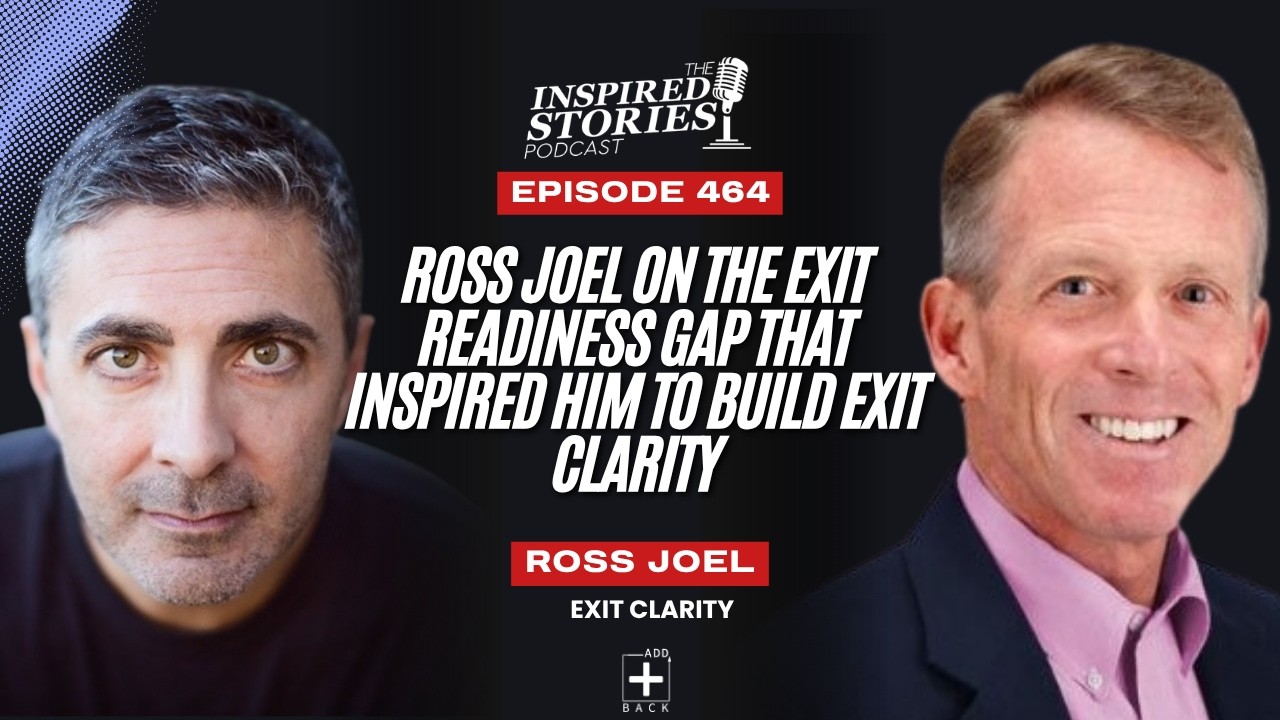
Ross Joel is the co-founder and chief sales officer of Exit Clarity, an AI-powered exit readiness platform that gives business owners the structured, buyer-side intelligence they almost never see before going to market. He built that platform out of hard personal experience: 30 years growing BroadcastMed from a one-man video production shop into one of the largest healthcare media companies in the country, surviving four failed sale attempts over fifteen years, including one deal that collapsed on the actual day of closing, before finally selling to private equity in 2020.
✨ Key Insights You'll Learn:
TV news anchor at NBC affiliates in Vermont and Connecticut before pivoting to entrepreneurship
First business: a children's aviation VHS video whose competitor released the same concept in the Wall Street Journal the week before launch
Pivoting to corporate video production, landing a worldwide pharmaceutical employee orientation as the first big win
Narrowing to healthcare as a vertical after 40% of clients naturally skewed that way
Broadcasting the first live surgical procedure on the internet, anywhere in the world, with ten days to figure out how
Today Show, New York Times, Wall Street Journal, and Boston Globe coverage that drove BroadcastMed's national profile
Hiring a director of finance who uncovered employee theft within the first two weeks on campus
Four failed sale attempts across fifteen years, including a deal that collapsed on the morning of closing
Selling to private equity in 2020, then overseeing three acquisitions in three weeks as CEO post-close
Exit Clarity: 120-question assessment, 35-page personalized report, AI-powered improvement dashboard built with his son
🌟 Ross's Key Mentors:
His Wife Patty: Pushed him to leave the television station and try the business, and has been his anchor through every business cycle since
His Brother: Best friend and father figure, eleven years older, whose death two decades ago Ross still feels every day
His Director of Finance: Came from outside the media industry and brought the financial discipline that BroadcastMed had lacked for years
His Son (Exit Clarity Co-Founder): Caught the entrepreneurial bug after a decade at Intuit and built the software platform that scales what Ross was doing in one-on-one calls
Sellers He Has Advised: Helped Ross understand how much the lower middle market seller doesn't know going in, and confirmed that the mission of Exit Clarity was genuinely needed
👉 Don't miss Ross's account of spending the money in his head before the ink dried, the phone call on closing morning that ended a five-month process, and what he wishes he had known before any of it.
Listen to the full episode here
Transcript
Anthony Codispoti (00:01)
Welcome to another edition of the inspired stories podcast where leaders share their experiences so we can learn from their successes and be inspired by how they've overcome adversity. As you listen today, let one idea shape what you do next. My name is Anthony Cotispodi and today's guests spent 30 years building a healthcare media company from nothing. Survived four failed attempts to sell it, including one deal that collapsed on the actual day of closing.
He started to spend the money in his head before the ink ever dried, and then it was gone. Those failures didn't break him though. They educated him in a way no advisor ever could. By the time he finally got his deal done in 2020, he had a hard-won map of exactly where and why lower middle market exits fall apart. His name is Ross Joel. He is the co-founder and chief sales officer of Exit Clarity.
an exit readiness platform that gives business owners and M &A advisors the structured, unbiased intelligence buyers use, but sellers rarely see. Before exit clarity, Ross founded BroadcastMed, selling to private equity in 2020 and then grew it into one of the largest healthcare media platforms in the country, scaling it to roughly 300 employees and $80 million in revenue.
Earlier in his career, he worked as a television news anchor at NBC affiliates and holds a master's degree in journalism from New York University. But before we get into all that good stuff, today's episode is brought to you by my company, Ad Back Benefits Agency. Listen, if you run a business, you're likely stuck in the cycle of rising insurance premiums. You're paying more, but your team is getting less and many people can't afford coverage at all. So we do things differently.
We offer a solution that provides your employees with unlimited access to doctors, therapists, and prescriptions that's always free for them to use. But here's the part that surprises most people. Unlike every other employee benefit out there, our program puts more money into your company's bank account. As an example, we recently helped a client increase net profits by $900 per employee per year. Results vary.
But gains like that can change how a business is valued. And the consultation is free. Imagine being the advisor that delivers incredible value by introducing this to your clients. See if they qualify today at addbackbenefits.com. All right, back to our guest today, the co-founder of ExitClarity, Ross Joel. Thanks for making the time to share your story today.
Ross Joel (02:41)
my pleasure. Absolutely happy to be here.
Anthony Codispoti (02:44)
So Ross,
going back early days, you were a TV news anchor at NBC affiliates in Vermont and Connecticut before pivoting into healthcare media. How did that work behind the desk, behind the camera, in front of the camera, behind the desk? How did that work lay the foundation for what was to come?
Ross Joel (03:02)
Yeah, I actually, you know, I to grad school in broadcast journalism was my focus. Got out of grad school and got my first job in television. And honestly, I'd always aspired my kind of my dream was I wanted to sign off Ross Joel, CBS News London. I always wanted to be a foreign correspondent. And ⁓ the pathway to getting to any kind of network job started in local TV. And so I started in a small market in Vermont.
as a field reporter and then got to taste what it was like to be on the anchor desk and really enjoyed it. It was a very, very, you know, a fun job for a young guy right out of grad school. But, you know, I ended up meeting the woman and, you know, we ended up moving from Vermont back to Connecticut where we were both from. And again, same routine, was a field reporter, then an anchor.
And ⁓ ultimately I got a taste of the anchor desk and that was where I believed the financial rewards were going to come. And ultimately I was an average TV news anchor, no better or no worse than anybody else. But I found the business very frustrating because I always found that here I'd gone to grad school, I felt like I was truly trained as a journalist.
but it seemed so much in television news, like your career was dictated by how you parted your hair and was your tie straight. And it exasperated me because I thought that there were people I could outperform. And so ultimately, I just, after a while, got tired of chasing fire trucks for a living. We had the first of our children and it dawned on me, people in television news, especially local, they don't progress within a television station.
to develop their careers, usually what happens is they progress and then go to a larger city. And so there's a lot of movement, a lot of moving in that business. the power, yeah, exactly. I just finally realized, if I end up a three o'clock, or I'm sorry, a six and 11 o'clock anchor, I'm gonna be going to work at three in the afternoon and coming home at midnight. I'm never gonna see my kids. I realized the foreign correspondent thing probably wasn't gonna be much better for my lifestyle if I could achieve that.
Anthony Codispoti (04:56)
can be pretty disruptive for a family, right?
Ross Joel (05:17)
And so I just thought, you know, there's gotta be something else. And what that something else was, a guy had created a video for children. And again, I had the first of my two and he created a video on fire trucks and fire stations. And a second one on construction sites and construction workers, nothing other than a handy cam, you know, back in the old days, the big handy cams that he had just put to natural sound and a little bit of music, no script, nothing just
trucks moving around, guys digging. ⁓ And he marketed in the Wall Street Journal and, as I had understood, made millions. And I thought to myself, he's selling them parents who had little kids and they wanted to put a video in the television and have the kids just rezone out for an hour or a half hour and be entertained by big trucks and machines running around. And was, again, there was a, what was it? It was the big purple dinosaur. ⁓ God, God.
Anthony Codispoti (05:56)
Who's he selling the video to?
Okay.
Barney. Yeah.
Ross Joel (06:15)
Barney, thank you, Barney
was a phenom at the time. so kids' videos were really the rage. And it was all VHS tapes. so I thought, well, my kids seem to love going to the airport and watching airplanes take off at the end of the runway. And I thought, okay, maybe I got a model there. So I wrote a story about a little boy who goes on his first airplane flight and he's afraid to fly.
and he meets the pilot of his flight who takes him back in time and teaches him the history of aviation. And long story short, that was my really introduction into the idea of maybe starting a business. And I can tell you much more about how that bombed, but yeah, it was my introduction to entrepreneurialism.
Anthony Codispoti (07:05)
You
were trying to follow a similar playbook to the one this guy was using with the fire trucks and you know the ads in the Wall Street Journal, but this.
Ross Joel (07:10)
Yeah, exactly. Yeah. And what happened,
well, what happened was I was, I had produced the video, it was ready for Christmas release. you know, got it all packaged, it was ready to go. And it was just, just before Thanksgiving. And as a news reporter working at the television station, this was a side hustle. ⁓ I would read the newspaper, multiple newspapers every day. And, you know, the Tuesday before Thanksgiving, I open up the Wall Street Journal.
as part of my daily routine. And what do I see? A full page ad by Mr. Firetruck, Mr. Construction, releasing his brand new video on airplanes. And I was, my gosh, was, I was, ⁓ yeah, was not a good morning. It was definitely not a good morning. So we took it to market. You know, I've, you know, I've probably got a couple of thousand of them sitting in a garage somewhere still, but
Anthony Codispoti (07:54)
the sick feeling you must have had in your stomach.
Ross Joel (08:08)
It didn't succeed from a financial standpoint, but it did succeed in giving me a taste of what entrepreneurialism was. I did not grow up, know, I've got to run my own business and I'm, you know, selling newspapers when I'm four years old and I got a paper route. And that was not me. I was not that born to build a business, at least I didn't think it was.
Anthony Codispoti (08:34)
And so, but it taught you a lot of good lessons, gave you a taste of entrepreneurialism. And then from this, the idea for broadcast med sprouted.
Ross Joel (08:36)
Thank
Yeah, ironically, the television station that I was working for at the time was owned by a giant publicly traded media company. And they, when they found out that I was doing the side hustle, which was pretty uncommon at the time, they came to me and basically said, you're competing with our parent company. You know, was a multi-billion dollar company and I couldn't sell five of these things. They basically gave me an ultimatum and said, you you can either stay here or,
try your business. I had a wife and two children and I was pretty nervous about the idea of not having a steady income. And my wife, to her credit, she said, you don't like television news, you don't see it as a career. If you're gonna try something, this is the time. You've already planted the seed.
You got to go for this because she said, you know, you'll regret it in six months if you don't you'll regret it and so ultimately I planted the flag and Started right off, you know out of the door right, you know left the television station, you know March 31st of 1994 and Essentially April 1st, you know had my LLC in place or my S Corps and off I went and I started selling corporate the concept of producing corporate videos
seemed like kind of a logical step and started to sell a couple of smaller contracts to small organizations, but at least got a little bit of traction.
Anthony Codispoti (10:16)
And so what exactly was it you were doing? You're going to these corporations saying, hey, we can make a marketing video for you, put it on VHS tapes that you can distribute to prospective clients.
Ross Joel (10:25)
Yeah, it was actually all kinds of corporate videos across all kinds of industries at the time. We weren't specializing, but it was, geez, I remember doing a video for one company. They had a lot of employees who traveled and we did a safety video for how to be in a hotel and traveling by yourself, especially if you were a woman. ⁓ And we did videos on ⁓ sales initiatives and we did, it was almost all internal videos for one company.
very big pharmaceutical company, was kind of our breakthrough. We won the bid to produce their worldwide employee orientation video. And we traveled all over the world for a month and a half and produced this incredibly great 10 minute video that was really cinematic and it was phenomenal. But we didn't make any money because we didn't manage the budget. We spent as much as we made. So.
Here we had this huge budget and at end of the day, we had nothing left to show for it in terms of the financials.
Anthony Codispoti (11:28)
And you're saying we so this wasn't just you, you had some folks that were working with you.
Ross Joel (11:31)
I had a colleague
back in the day who helped with the production of content and he was really focused on the operational side of things. And then I was really focused on product development and sales and marketing. When we first started, I wanted to be a producer, a video producer because I had been in television production. at the end of the day, I realized as a single man operation or one and a half
you know, person operation. When I was producing, I wasn't selling and I'd end up at the end of the day having finished this terrific video and I was back to zero. I had to spend the next six weeks, 10 weeks hustling to try to find another customer. And so ultimately there became an inflection point much further down the line where I ultimately ended up really focusing on the sales and marketing side of the business.
Anthony Codispoti (12:26)
And so how far into it were you before you could afford to bring in enough folks to handle the production side that you could focus full-time on business development?
Ross Joel (12:34)
It was a couple of years,
yeah, a couple of years into it. we ultimately, I ultimately hired a guy who was a, it was our first and only employee and he was an editor and videographer and kind of a jack of all trades. So that was probably two years in and he worked with us for, you know, it probably another year or so, um, before we hired one more person, but then it was a kind of an ebb and flow. We, you know, we had hired a person, but then business didn't expand. So we had to let that person go.
that one original, that first employee, he did hang with us until we started to really scale the business.
Anthony Codispoti (13:12)
what was it that changed that allowed for that big scale? Was it focusing on a particular industry where there's some other operational things that you get like a big break for a giant customer?
Ross Joel (13:25)
You know, that's a great question. was kind of a step by step thing. wasn't well, there was one inflection moment and I will describe that, but there were some progressions beforehand that I thought about. One of the things was, you know, we were a corporate video company. I didn't want to do wedding videos. I did draw the line at that, but we would do any. I don't, I mean, it's a wonderful business if that's what you are focused and love to do, but it didn't feel like.
Anthony Codispoti (13:45)
that's seen beneath you, is that why? Or a little too pedestrian?
Ross Joel (13:53)
the kind of space I wanted to be in. It just was a little bit too local. I did want to do things that sort of had a chance of spreading our company's wings. Again, here's the guy who wanted to be a foreign correspondent. So I did kind of aspire to having a business that was more than just backyard of my neighborhood enterprise. And so one of the things I started thinking about was how to differentiate our video production company.
One of the things I thought about was should we specialize and focus on an industry and try to own all video production and be the go-to for a specific industry? we had kind of naturally evolved the company and naturally evolved to having a fair number of healthcare clients. I think partly because we were in the Northeast and there are a lot of ⁓ healthcare companies and we had gotten some early wins with pharmaceutical company.
a number of hospitals regionally. And so I'd say probably 40 % of our clients were skewing towards healthcare. And so I decided randomly, I'm going to plant the flag. We are now today, a healthcare focused video production company. Now we still kept doing work with the other companies outside of the space, but we didn't. And where I focused my sales energies,
Anthony Codispoti (15:12)
but in terms of how you promoted yourself going forward.
Ross Joel (15:18)
was focused solely on healthcare. And it was a little scary because you start to think, well, I've been this diversified portfolio of clients. I think focusing on an industry is probably the right thing, but I didn't really have any evidence other than my gut that that was true. So it was a little nerve wracking.
Anthony Codispoti (15:39)
What was it in your gut that was telling you that this might be good for you to narrow down into a niche?
Ross Joel (15:44)
Because, well, healthcare is always an issue. It's always a concern. There's no ebb and flow in terms of the need for healthcare. That was number one. Number two, my wife was a nurse. Number three, my sister was a nurse and her husband was a surgeon. So I had some familiarity remotely with healthcare. ⁓ Having said that, I hate the sight of blood, particularly my own. And so it wasn't like I had this...
clinical calling myself. It just, felt like a good and credible and sort of, you know, altruistic niche if I was going to focus on one. And it turned out that we had scored our biggest new contracts in the healthcare space. know, again, that anchor was that ⁓ employee orientation video that we did, even though we didn't net any profit, you know, it was an exciting opportunity and the scale of it was exciting. So it was intriguing. In parallel,
and this really was the inflection point, the internet was really starting to percolate. When I started in business, the internet was virtually nonexistent. mean, email was, again, virtually nonexistent. I would communicate via fax and phone. There was AOL, there were a few nascent tools, but it was pretty rudimentary. But along towards the end of the 90s,
the internet was really starting to percolate in big time and, you know, fortunes were being made. And I started to read about a hint of video delivery online. Now this is pre YouTube. YouTube is five years away. So this is, again, really, really, really early, but there was a guy who I'm sure you know, Mark Cuban, who had a company that was very much focused on streaming video.
And I was very intrigued by this and I thought, well, you know, maybe there's an area and a chance for us to be in early on internet and video. And so one of my healthcare clients, was a hospital. I had been pitching her on a concept of doing a television weekly television series on healthcare focused on community health. Couldn't quite get it over the hump, but I had this whim. went into her one day and I said, you know, would you ever consider, you know, broadcasting?
something live on the internet. And I said, in fact, I just read that you all at this hospital, Hartford Hospital in Connecticut, are broadcasting via satellite a surgery to the Society of Thoracic Surgeons Conference in Miami. You're already doing it via satellite. What would you think if we did a tag team where we took the satellite feed and encoded it for delivery on the internet?
Anthony Codispoti (18:34)
And with Mark Cuban's
technology at the time, this was possible.
Ross Joel (18:37)
Yeah, something called real video was the concept, was the business. And Windows had Windows Media as well, but it was very unsophisticated. ⁓ But she thought about it a little bit and she said, can you do that? And I said, ⁓ yeah, absolutely we can do that. And she said, well, yeah, let's give it a try. So I walked out of her office.
I called and to my colleagues who were on the production side who had been tinkering with online video. And I said, you know, we can we got this gig. Can we do this? And they said, you know, sure, I think we can. And so we had 10 days to figure out essentially whether we could in fact do this. And miraculously, we did. It was a definitely a
Cross your fingers, hold your breath, cross your arms, anything you can do, any rabbit's foot. Yeah, basically, anything, good luck charms, make sure you bring them. And it turned out to be the very first live surgical broadcast on the internet anywhere in the world. Yeah, it was pretty, and I didn't even know that at the time, but it went well.
Anthony Codispoti (19:34)
Hold on to the duct tape.
How about that?
And, and sorry, I got, I got to pause here just for a second, Ross,
because I want to point out the boldness of what you did. You, you brought up the idea with, well, stupidity would have been if you couldn't have pulled it off. The, it's bold now looking back because you made it work, but you went in, you're like, we should do this. This would be great. And then when the client said yes, that that's when you went and figured out like how to actually make it, you know, all come together and you did it in a really short period of time.
Ross Joel (20:00)
Stupidity might be a better word, but no.
Well, I didn't know the expression at the time, fake it till you make it, but there is some of that, know, and when you're starting a business, yeah. And so, but I remember the experience vividly at the time, broadband, basically the only people who had broadband were, you know, giant institutions, know, huge corporations and it was very restricted and, you know, video gobbled up what bandwidth there was. And so I remember,
Anthony Codispoti (20:23)
10 days.
You were living that.
Ross Joel (20:53)
recalling that about 85 % of our audience was dialing up via dial. And so I, it was barely, they barely could. mean, 85 % of the audience was seeing this incredibly pixelated, buffered, know, blurry experience. So it wasn't this, you know, it wasn't what we're experiencing today. But we pulled it off and it went seamlessly. And so we ended up
Anthony Codispoti (21:01)
my, how were they actually able to watch streaming video?
Ross Joel (21:23)
deciding to pitch the hospital on doing a surgical series now, because they've gotten so much PR. And they thought it was a great idea, a way to promote their clinical expertise and their surgeons. And ⁓ so we started now to introduce this concept to other hospitals in other markets. And we got some early wins, including Brigham and Women's Hospital in Boston and Mass General in Boston.
And now we were starting to get some broader notoriety. And ultimately the guy who wanted to be on network TV, but could never get a job in network TV, got a call from the today show and we got featured in the on the today show. it was a three or four minute piece about how we had launched this surgical series at the time we had branded it. ⁓ our live as an operating room live and we were doing, you know,
routinely surgeries from hospitals all over the country and then started to do surgeries for medical device manufacturers and then it just, it really started to take off.
Anthony Codispoti (22:31)
Did
you feel like when you got on the Today Show, like, I've made it, I've arrived, like, you know, it was some sort of a capstone experience for this little kid who had this dream.
Ross Joel (22:41)
It was pretty exciting. I didn't go, I wasn't in the studio. They had prerecorded this thing. So I, you know, I wasn't in New York at the time, but I will say sitting in my, you know, TV room that morning watching, you know, at the time it was ⁓ Matt Lauer who introduced the piece. You know, it was pretty extraordinary, you know, to see our little company.
you know, our name in lights, as it were. And yeah, it was pretty exciting. And then we ended up having a tale. We ended up on the front page of the New York Times, front page of the Wall Street Journal, Boston Globe. We got mentions in CBS News. ⁓ We were even featured in Al Jazeera, if you can believe it. ⁓ So it was pretty extraordinary.
Anthony Codispoti (23:26)
And it sounds like a lot of this new work that's coming in for the live broadcast of the operating procedures, sounds like it's recurring work because you're producing a series. It's not like a one and done kind of a thing. So I'm going to guess like you said, this was the big inflection point that allowed this flywheel to really get moving. You guys build up to, we were talking about it in the intro, you know, a point where you had over 300 employees, $80 million in revenue. Like you guys were really cooking.
Ross Joel (23:53)
Yeah, but it didn't go from A to B in a straight line. know, we went up, we went down, we went up, we went way down, we went, you know, fairly high up. And it was not a smooth trajectory from, you know, where we started to this, to this point where we, you know, we're at, you know, 80 million in sales.
Anthony Codispoti (24:14)
What were the cause of some of those dips?
Ross Joel (24:17)
you know, honestly, I think the biggest thing was we didn't pay attention to our customers and we didn't listen to them carefully enough. And we also didn't keep our eye on competitors. So what happened was we had this really nice run over two, three years where we were growing, not, not ginormously, but we were making for us, we were making real strides. ⁓
And one of the things about doing these series and at the time, the scope of the production of these programs was enormous, both in terms of the logistics and the expense. It was not like today where you can use your cell phone. know, it was back then, we literally would roll in the equivalent of a full-scale television production unit into a hospital operating room.
Sometimes if the buildings were too tall around and we couldn't get a signal out, we had satellite trucks. had this thing, Boston Red Sox fan. We had this box that we would roll into the hospital that we called the Green Monster because it was giant and it took up incredibly ⁓ large amount of space. I used to joke that here these surgeons were doing minimally invasive procedures. I used to say,
We are maximally invasive when we come in to broadcast your minimally invasive procedure. So we'd have multiple cameras. We'd have at least four five people on site. They were extremely expensive to produce. So hospitals were spending a tremendous amount of money. Productions were really, really good. And as the internet capacity got better, the delivery became better and the quality of the user experience got better. But the production...
And the results, the definitive results from a marketing standpoint that the hospitals were seeing, started to tip away from what was in our favor. ⁓ I kept advocating with my team, these folks are not in the business of television production, they're in the business of clinical delivery and.
trying to make money in a business that is ⁓ healthcare focused and for the public good, but still have to make money. I said, I don't think that they really want to keep up with the arms race of production quality. I think we have to start thinking about cheaper, less intrusive ways to do these programs. Still maintain our margins, but reduce the expense, our production expense and reduce the cost of the customer. But we had some real traditionalists on the production side.
who believed that the clients really were paying for quality, that these highly known brands, these great hospitals were very focused on making sure that the production quality equaled their brand quality and their reputations. And so it was a yin and a yang. I wasn't absolutely right, they weren't absolutely wrong. And the debate went on and while the debate was going on, other people...
in other companies started to realize that there was a business opportunity here and they started to nibble at our lunch. And there became a competitive factor that we had not had or had to deal with. And so that caused us to flatten and then even at one point started to dip in our revenue. And we had vendor contracts that we had made as long-term contracts because we were forecasting that we were doing all these programs.
Anthony Codispoti (27:40)
Yeah.
Ross Joel (28:01)
And in a matter of months, things really turned around and not in a good way.
Anthony Codispoti (28:07)
Were you guys able to bring it back or was this the point where you're like, let's entertain a sale.
Ross Joel (28:13)
Well, the kind of all at the same time, if I rewind once we got all that PR today show New York Times, and this was before we were still on an upward trajectory, but we're still small. our top line is, know, million and a half in revenue. So we're really small. ⁓ But we're running a solid business. At least we think we are. get approached hugely because of the PR. We get approached by a ⁓
number of companies interested in having conversations about whether we're interested in selling. It never crossed my mind, you know, selling the business. I mean, really, ⁓ I thought we were way too small. But I had a family member who was very experienced in selling public companies. And ⁓ he suggested that, you should see what they have to say. The internet is a bizarre phenomenon now. know, people are making...
Anthony Codispoti (29:10)
And what was the year
that you started having these conversations?
Ross Joel (29:12)
I want to say, you know, I get a little fuzzy as I get older, but it was early 2000s. I want to say 2002, 2003, somewhere in there. Yes. yes. Yes. Yes. And we never took a dime of outside capital. I never took any outside money. you know, we were bootstrapping it all the way and making a decent living, you know, not a crazy one. was a nice lifestyle business. But we got approached and so we ultimately ended up hiring a small
Anthony Codispoti (29:18)
Okay.
So we had come out of the dot com crash. We were on the other side of the worst of it anyways, okay?
Ross Joel (29:42)
⁓ boutique investment bank. And when I say boutique, they were primarily focused on selling family owned businesses. ⁓ This was my family owned the business, very closely held. So worked with this firm and they took us to market and we ended up getting a couple of ⁓ LOIs from publicly traded companies. One was a worldwide ⁓ advertising conglomerate and the other one a huge
media publishing company, ⁓ very well known and very well respected. I felt sort of the synergy with the media company. And ⁓ so we decided to move forward with their LOI and we started Diligence. And we were two weeks into Diligence and they basically came back. And I remember that the CEO of the company came back to their sponsor, as I came to find later and basically said,
Are these guys a gotta have or a nice to have? And the sponsor admitted that we are a nice to have. And in light of the fact that our finances were a mess. mean, our top line, again, a million and half, our bottom line was a nickel. I mean, we just were not well run from a financial standpoint. I didn't have a financial...
Anthony Codispoti (31:01)
You guys weren't charging
enough for your services or just, you you couldn't manage the expenses in a way that worked for you.
Ross Joel (31:07)
All of the above, I think it was more of the latter. I think we just weren't managing our costs very well. you know, accounting, know, accounting, were doing internally and we had some outside consult, but we didn't have a finance person day to day looking at our numbers and our operations. And so when that blew up, you know, the big takeaway was
we're big enough now, we need a financial person. And so I went out and started looking for a finance person and ended up hiring a director of finance who came in about at the same time, we are now starting to flatten off and trail off. So, know, kind of a bummer for him. comes in, you know, sort of at a, you know, downside time, but he was a phenomenal addition and he was exactly what we needed at that time.
Anthony Codispoti (32:04)
What was
he able to help you do? Give me just one example.
Ross Joel (32:07)
He came in and he, ⁓ first thing he did was an audit of everything. He audited all of our processes. He audited all of our expenses. mean, hate to say this, he uncovered that we had an employee who was stealing from us and a person who had been with us for years and we had no idea. we had to confront the employee and it was the end of a friendship and a
and a long-term employment relationship. I mean, this guy uncovered that within the first two weeks of being on campus. ⁓ He was phenomenal. He was ⁓ incredibly disciplined and had no experience in the media business. He had worked for a business that sold concrete, know, jersey barriers, basically. But he was so regimented. Later, it became, you know, almost too regimented at times. ⁓
Anthony Codispoti (32:44)
now.
Ross Joel (33:06)
But I will always tip my cap to this gentleman. was instrumental to our success. He also started to think about us operationally too, and started to look at not only how the finances impacted our business within the financial silo, he started to look at how the operational connection to finances worked. And that was a real eye-opening experience for us too.
Anthony Codispoti (33:32)
So let's fast forward to 2020. ⁓ There had been four failed attempts to sell the business spanning roughly 15 years. You finally get a deal done. What was different about that transaction compared to the ones that had fallen apart before?
Ross Joel (33:50)
Well, the second time we went around was 10 years after the first time and thought, okay, our financial house is in order. We're running a better business. Our top line is higher. Our bottom line is really pretty solid for a small company. Let's maybe give it a go again. And so we hired another investment bank, a small one that focused on the media industry. Went to market and this time instead of the two, bless you.
Instead of the two bids, we ended up getting three. And we ended up taking one of the bids and it was a private equity firm. And I was an operationally a pretty, had become pretty sophisticated for a small business owner. You know, I had learned and survived in advance and learned a lot of lessons. The one thing I always regret is I did not have a mentor. So all of everything I did, I learned by doing. And so I'm sure I made a lot of mistakes operationally along the way.
that I could have avoided if I'd had that stewardship. the process of trying to sell a business as I got into real extended due diligence was much more involved than I ever expected. I thought it was like a house. You put your company on the market, a couple of buyers throw in bids, you take one, they write you a check, you get a small little inspection and off you go. Ah, no.
Even with a small company, the diligence process was unbelievable, intrusive, time consuming, head scratchingly detailed where you'd say, we are what we are. We're a $5 million company. it's like, what the heck here? What are you guys looking for? But the diligence process went on and on and on. And our investment banker
He, like many of the people I had dealt with, talked to before, had pretty much given me the impression that if you're a business that does not hit 10 million in top line revenue at least, you're basically a unicorn in the &A world. take anything you get. You have no leverage. And I had never heard at the time of lower middle market, by the way. I'll get back to that. But...
you know, basically our banker was saying, you know, hey, you these guys, you know, it's, it's a time, it's a process and it's taking them longer than it should, but you know, we don't really have a fallback plan here. And so, uh, the can get getting kicked. know, we need another version of your P and L, you know, we needed an updated balance sheet, but you know, Bob's got to look at the balance sheet and he's on vacation for two weeks and it ended up five months. We get to the morning of close.
And I get a phone call thinking it's to execute the deal, the close, and it's the sponsor who calls me and says, you know, I'm really sorry, but our investment committee voted to pass on the Morning of close. I'm expecting a call to execute the close. Instead, call it. Yeah, it was.
Anthony Codispoti (36:52)
Wow.
What a kick. What a kick in the gut. So you've
been through these failed transactions multiple times. You finally get the deal across the finish line in 2020. And at what point did the idea to start your own exit planning firm, &A firm, exit clarity, where did that come from? Where did that, where did that sprout?
Ross Joel (37:19)
Yeah, I mean, I made so many mistakes along the way. When I sold the company in 2020, I stayed on as CEO for two years and actually had the experience of overseeing four acquisitions during that time. We actually did three acquisitions in three weeks. Yeah, it was a pretty extraordinary and very much an eye-opening experience to sit on the buyer side of the table and to experience kind of dealing with what maybe I had been in the eyes of buyers.
So, you know, it was a very, very, you know, again, eye-opening experience. When I retired, you know, within three weeks, I was, you know, I can't play. I'm a terrible golfer. I love it, but I stink. I can't do this every day. I'll drive myself crazy. So I started doing some guest lecturing at some colleges with which I had a connection. Then I started doing some consulting with some of the entrepreneurial labs those schools had. ⁓ And then I,
reached back out to the investment bank that had sold my company. And I said, you know, hey, if I can ever be of service, you know, happy to be. And they invited me to come and present at a conference of ⁓ &A professionals in the Northeast. And I spoke to them and I had a really, really good experience and they got really good feedback. And so they asked me and I agreed and was very enthused about consulting for them.
and did so for about a year and a half. And I would sit in on those calls that they were having with potential sellers of businesses, not as a testimonial to them, but really more as an advocate and a Q &A person for the seller. They were using me as sort of a differentiator. Look, we're not trying to just sell you. We want to help you understand what it's like to go through a process and Ross can help you. And I got incredibly
incredibly good vibes from that. I felt like I was really doing something important, you sharing with other people all of the mistakes that I had made and I made them all. I made them all. ⁓ And so I was talking to my son about this, how gratified I was. He was working at Intuit. He had a 10 year career at Intuit. He loved it. And he was instrumental in leading the launch of their QuickBooks Live and TurboTax Live products.
You know, young guy at the time, 32, you know, unmarried, now married, caught the entrepreneurial bug from his father, I guess, and decided that if I'm ever going to start a business, I've got no children, you know, I've no debt. This is the time. And he came up with the idea of, can we scale what it is you do in these phone calls and reach more business owners who need that consult? And
Thus was born the exit clarity platform. He built this software platform that helps business owners and I think it's a pretty extraordinary tool. Very mission.
Anthony Codispoti (40:24)
So this is you
and your son working together, but this isn't a traditional exit planning firm. What's the software part of that?
Ross Joel (40:31)
We're not an exit planning firm. We're not a consulting firm. We are not a deal firm. We're not a deal marketplace. This is a software that essentially serves several functions. It is an assessment tool. ⁓ It is algorithm driven. It is AI powered. It is human influenced. But it gives business owners a very, very quick and deep and personalized assessment.
of where they really are in the journey towards selling. gets into factors, not only your finances, but it gets into deep dives on where you are mentally and emotionally in preparation for a sale. Do you have a transition plan for the day after you've sold the business? Have you thought about not just what the headline price of the business needs to be, but what your takeaway cash value is? Do you expect and understand what the
process of going through diligence will be. Does your business really rely on you completely and wholly as you may from an ego standpoint want it to, but from a buyer standpoint, you can't let it be solely dependent on you because that won't transition to new owners. So this tool gets into those kind of variables for a business owner all from a buyer's lens.
And then it has a follow-on tool that gives you a dashboard to exercise and execute on the improvement plan that's been recommended to you by the software. You need a better transition plan. Your team is good, but you need a COO. Here's what you are looking for in that COO, and here's a list, job posting description for that job. And this tool produces those kinds of resources.
Anthony Codispoti (42:23)
And so who specifically is this for? It's for the business owner that's looking to sell and what market and what size of business.
Ross Joel (42:31)
Yeah, it's for business owners who eventually want to sell. They could be anywhere from, you know, 12 months to 12 years away from selling. I mean, I theorize that every business is ultimately built to potentially be sold, whether the actual execution occurs or not, or it's handed down to a family member. But even businesses that don't get sold should be built, I think, with the idea that they're building values that could sell, because those are stronger businesses.
There are businesses that aren't reliant upon what's up in my head only. There are documented processes and procedures that other people can execute. There's a plan, there are financials that any financially savvy person can look at and understand. ⁓ So it is really built for lower middle market businesses, really primarily three to five million on the top line, five really, and a million on the bottom line up to
50 million on the top line. Certainly, it's appropriate for businesses that skew up to higher to 100 million, but the real sweet spot is five to $50 million business owners. And those who want a business improvement plan from what would be a buyer's lens and then want a pathway and a tool to execute that improvement plan.
Anthony Codispoti (43:53)
So how much does exit clarity cost the business owners to use?
Ross Joel (43:58)
different tiers, but the starting tier is a $6,000 a year subscription. And that allows them to take and go through the assessment and they can do the assessment every day if they want to. But the deep assessment is 120 questions. It produces a 35 page report for the business owner. Then once they have that, they use the ongoing tool, which we call exit clarity pro. And that is the do the dashboard and the tool set that
gives them tasks to execute. Based on your assessment, here are your priority tasks. Here's what you should be working on this week. You get weekly ⁓ updates on what you've done and how you've progressed on your tasks. It challenges you with, you haven't done, you need to do. There's an AI agent, so you can ask questions. She's, a little confused about what does adjusted EBITDA mean? What other things can I add to?
Adjusted EBITDA and it'll fire back answers to those questions that you can save and use for your future use It'll even produce for you First drafts of confidential information memorandums the SIM or the book that in theory you would take to potential buyers So it's a very comprehensive tool. It's it's a tool I sure wish I'd had when I was going through this process ⁓
Anthony Codispoti (45:21)
Well, that's why you built the tool, right? You saw the mistakes
that you made. You saw all the gaps in your knowledge and the support and the lack of a mentor that you sort of endured. And it's like, how can I prevent others from falling into those same pitfalls?
Ross Joel (45:26)
It totally
It really is very mission driven. mean, I'll give you one footnote to one other tool that we haven't launched it, but we are building is an advisor evaluation tool. One of the things I struggled with was how to select an investment bank to help me. know, when you're a $5 billion company, JP Morgan, Morgan Stanley, ⁓ Goldman Sachs, you know those brands, Carlisle. When you're lower middle market.
You're getting pinged by business brokers, by boutique investment banks, by midsize investment banks. They're all telling you the same story. How do you evaluate and determine which is the one that is the right fit for me? so again, we're looking at all of the ways we can help business owners be better informed and execute a process that helps them avoid, again, all the pitfalls that I made.
Anthony Codispoti (46:36)
Now, does exit clarity just serve the seller side or is there a tool base for the buyer side as well?
Ross Joel (46:44)
There is a buyer side to it as well. We really believe that we are positioned as a neutral third party assessment tool. We don't work for the seller. We don't work for the buyer. We are an honest, candid place for you to get a reality check. Same thing for buyers. We are there not to be a part of your deal, not to advocate that you're necessarily the investment bank that the seller works with.
but to give you both line of sight into whether there might be a fit. So we licensed the tool to investment banks and private equity firms who use it essentially as a qualifying tool. They don't get the deep dive on all of the improvement plan, the nooks, the crannies. They get overall scoring on where the business owner is in multiple categories. So essentially on a scale of one to 10, they'll get an overall
sense that this is a go, fix or wait company. And they'll see the scoring again on a scale of one to 10, they scored 7.2 overall, but they were a 3.5 in owner intent. They've got a 5.5 out of 10 in their team and transition, but their financials, they're at eight and a half because they've got great recurring revenue and 65 % of their revenue is...
ARR. So, you those are the things that influence the overall score. And that's what the investment bank gets to see whether is this a company that maybe is worth us talking to and trying to advance them all with.
Anthony Codispoti (48:27)
And so the investment banker is uploading data that they have, right, from each of the prospective companies that they're looking at.
Ross Joel (48:36)
They are identifying companies that they're interested in through whatever resources they've used, through whatever research they do. And then they are providing to us a list of, or they're sending out the direct correspondence to those business owners themselves. But it's going out as a, Anthony, you're a company that we think, or we're sending out, Anthony, you're a company that...
has been identified by one of our network of potential buyers as a company that they'd like to see and learn more about. At the same time, this tool will give you a pathway for evaluating where you are in a buyer's lens on the value of your company. It'll give you an improvement pathway. There's value in this for you, whether you work with these guys or even ever get an introduction to them. The investment bank gets the overarching
category scores, they don't get the 10 page or 35 page deep dive, they just get an overview of what the scores in the different categories were.
Anthony Codispoti (49:39)
But it sounds like most of your
client, your sellers, they're coming to you because the buyers have said, hey, we're interested in exploring an acquisition in order to be considered in our process, use the exit clarity tool and that'll help move our conversation.
Ross Joel (49:57)
They are right now, but we ultimately, I ultimately feel more of a gravitational pull towards having this be primarily for business owners. ⁓ That's again where my mission and my passion is, is helping the business owner first and foremost. ⁓ And I think that what we're also thinking now is that a great way to distribute this would be working with accountants and ⁓ &A lawyers.
and exit planners, wealth managers who have clients who may eventually want to sell and have them just be a distribution channel. know, hey, Bob, you know, I've been your accountant for 10 years, you know, and you've got a tremendous amount of equity tied up in your business. You ought to consider using this tool, exit clarity, to assess where you are, both, you know, personally and emotionally, as well as operationally and financially.
where I believe our ultimate scale will come. ⁓ But again, if we can serve a constituency on the, again, the investment bank and private equity side and do it without undermining our neutrality and our credibility with our business owner, then I think we certainly would like to do that too.
Anthony Codispoti (51:11)
So you've talked a lot about ⁓ how your mission, your passion is really to support those business owners, the smaller, the middle market part of the spectrum who just haven't, they don't have the sophistication, the experience, they don't have the support that the sellers, sorry, the buyers certainly do. ⁓ You've talked about in the subscription for ExitClarity, part of what the sellers are getting are the business owners, because they may marry now.
may or may not sell, right? But part of what they're getting is access to this improvement plan. Can you give a little bit of insight into some of the elements that they'll find inside of that improvement plan?
Ross Joel (51:53)
Yeah, mean, again, it's dashboard centric and they, you know, that their overarching score, at least at the current point that they've executed the assessment is all in that dashboard. And then based on it's really the framework is 11 different categories. And it goes through, as I said, financials, operational sophistication, team transition, owner intent, et cetera.
And each of those categories have subcategories with deeper dive in why you scored, what you scored. And then recommended tasks that you can do, execute, that you should execute, and a timeline and a prioritization of those tasks to improve those things. it gives you a, okay, your ⁓ owner intent, you were here and here are the priorities, but the first thing you need to do
your financials need the immediate attention. And here are the four things you should do and a reasonable timeframe for you to get those done is in the next three weeks. And it then will give you recommended steps for evaluating the accountant and what you should be talking to the accountant about. And it'll do that across all of the 11 categories. It will then even build you a plan. if you...
You know, again, sales and marketing is an area where you really need to work or better yet team transition. You've got three people who have been with you 20 years and they're great. They really probably aren't of the level of sophistication that can take your place. You need, as I said earlier, it'll build you an uplift plan that says you need to hire a COO who has these qualifications and experiences.
Here's a job description for your posting. And then here are the things that you need to do with your existing team members to try to level them up. And here are the operational tasks that you need to assign to them to get them to illustrate that they are up to that challenge.
Anthony Codispoti (53:57)
So Ross, how much
of the interaction with the business owner and exit clarity is strictly through the software versus how much do you guys need to hand touch parts of these evaluations, these assessments, these improvement plans that you're providing?
Ross Joel (54:17)
Remarkably, 0 % needs our touch. mean, quality assess, we quality check randomly to make sure that the content and the reports and the assessments are still staying within our parameters. Because it is a, know, an LLM, it's a large learning module where it does change and it ideally improves as it does more of these. But, you know, again, I think AI is an extraordinary tool.
at least at this point, if guided by a human touch, I don't think AI by itself, maybe eventually it will, can do this with no mandate. And so we do do quality assurance, but in terms of the baseline tool, it is all software, obviously informed by human. ⁓ However, we do have leveling up tiers that do include
human coaching so you can add on tiers of monthly calls or quarterly calls and have human touch with our small right now stable of other business experts, people who've gone through what I've gone through. Maybe not with as many pitfalls as I have, but they basically have gone through sales.
Anthony Codispoti (55:36)
That's pretty interesting. Where is this going?
Like what's coming for exit clarity that we haven't already talked
Ross Joel (55:44)
you know, I, I think that the, ⁓ I think that the next set of tools will potentially be for portfolio companies within private equity, ⁓ would be for, CEOs of companies that are adding bolt ons. Again, as hard as my career was in terms of selling my business, probably the most challenging thing that I ever went through was integration.
of bolt-on companies that we had acquired. That was, to this day, the thing that I still would suggest I did a less than great job at. ⁓ So I think that a tool that can help CEOs of portfolio companies that are scaling, not only with integration, but with marketing and sales planning and strategy.
Again, when you acquire companies, they come with their unique personalities, not only organizationally and from a human resources standpoint, but they come with their own organizational strategies that they've had for years and years and years. And now you're trying to coalesce those all into a singular strategy in theory. That's incredibly challenging. you know, without a mentor, I was
doing it based on what I was reading and the research I was doing, but I don't think I was doing it fast enough and effectively enough. I don't think I had time or room to be ⁓ making mistakes along the way. So I think that an ancillary part of our tool set will be for, again, acquisitions and integrations for PE and portfolio companies.
Anthony Codispoti (57:31)
It's a natural development. Yeah, I can see that making a lot of sense. Switching gears on you Ross, what's the hardest thing you've ever had to overcome personally? What did it teach you?
Ross Joel (57:43)
⁓ you know, I thought about that question a lot when you sent that along to me yesterday. That's probably one of the most difficult questions that I've ever had, to tell you the honest truth. And I'm not dodging. ⁓ I've led an incredibly fortunate life, which is not to say I haven't experienced all of the emotional ups and downs and pitfalls that every human being does.
My life is perfect in the grand scheme of, I think it's perfect because I've worked hard to make it perfect, my perfect. I can't point to, ⁓ to suggest that some of my business failures is on the level of some of the challenges that other human beings deal with every day, it would be.
insincere and I think offensive. I've had my health. I've got a wonderful family. Those are the things that I feel most blessed at. But hey, I've had bouts of, I don't know that it would fully qualify as depression, but certainly emotional despair over business and loss of family members who've passed. And my brother was
my best pal in the world. was 11 years older than me, kind of a father figure and a brother. And losing him was incredibly difficult and it happened two decades ago and I still feel it every day and I think about him every night and ⁓ I miss him with every fiber of my being. We used to talk multiple times every day. But on the flip side, I've got my health, I've got an extraordinarily wonderful wife.
and children and, ⁓ you know, as I said, not every moment of my life is perfect, but I like to think that my life is perfect.
Anthony Codispoti (59:50)
Yeah, you
know, and I appreciate how you framed that in. You've had your ups and downs as has everybody. But in the grand scheme of things, you have a lot of gratitude for the life that you've lived, that you continue to live today. But it doesn't diminish the pain, the the struggles that you've gone through. know, anybody who's who's who's run a business, they know how lonely that is. They know the roller coaster that's involved there.
going through the sale process, four failed attempts in 15 years, that can really knock the wind out of somebody. the passing of, it sounds like one of your best friends, your brother, two decades ago, taken from you way too early. As you think about some of these struggles, the passing of your brother, the ups and downs of the business, what would have been some of the things that you've been able to lean on for strength during those times?
Ross Joel (1:00:49)
You know, I am a ⁓ very family-centric person. My family means everything. They're the only thing that matters to me in life, really, at the end of the day. And they're incredibly loyal and loving and devoted, and I feel incredibly blessed. That is what I have leaned on. I have really wonderful friends, a small circle of friends. I'm not one of these guys who goes in and owns the...
cocktail party and you know, is the people, everybody gathers around. That's not my thing. Somebody said, described me as an introverted extrovert or an extroverted introvert. That was it. Cause I think I am a little more introverted, but it's been my family. It absolutely has been my rock. My wife is, you know, has been incredible. Patty. Yeah.
Anthony Codispoti (1:01:41)
What is her name? Patty. Hats off to Patty. Just
one more question for you today, Ross. But before I ask, I want to do three quick things for the audience. First of all, to get in touch with Ross, Joel, and ExitClarity and learn more about what they're doing, their website's super easy. ExitClarity.io. ExitClarity.io. It'll be in the show notes, but it's super easy to remember. ExitClarity.io. ⁓
And if you're enjoying our show today, please take a moment to subscribe wherever you're listening. It also sends a signal that helps others discover our podcast. So thank you for taking a quick moment to do that right now. And as a reminder, you can be the advisor that delivers a huge value add by showing your clients how to give their employees access to therapists, doctors, and prescription meds that counterintuitively increases their net profits. Real gains that can change how a business is valued.
contact us today at addbackbenefits.com. So last question for you, Ross, a year from now, what is one very specific thing that you hope to be celebrating?
Ross Joel (1:02:46)
My wife is gonna punch me for this because she likes to stay very much in the shadows. know, honestly, in a year, we'll be celebrating our 40th wedding anniversary.
Anthony Codispoti (1:02:56)
That's awesome. So 39th has just happened recently.
Ross Joel (1:03:00)
I guess April 10th.
Anthony Codispoti (1:03:03)
My birthday, I'm gonna remember that. I'm reach back out to you guys in a year. I love it. Yep, Ross Chole from ExitClarity. wanna be the first to thank you for sharing both your time and your story with us today. I really appreciate you being here.
Ross Joel (1:03:04)
⁓ Yeah, there you go. Thank you very much.
It's been a pleasure. Thank you very much.
Anthony Codispoti (1:03:18)
Folks, that's a wrap on another episode of the Inspired Stories podcast. Thanks for learning with us. And if one thing stood out, put that into action today.
Connect with Ross Joel:
Website: exitclarity.io