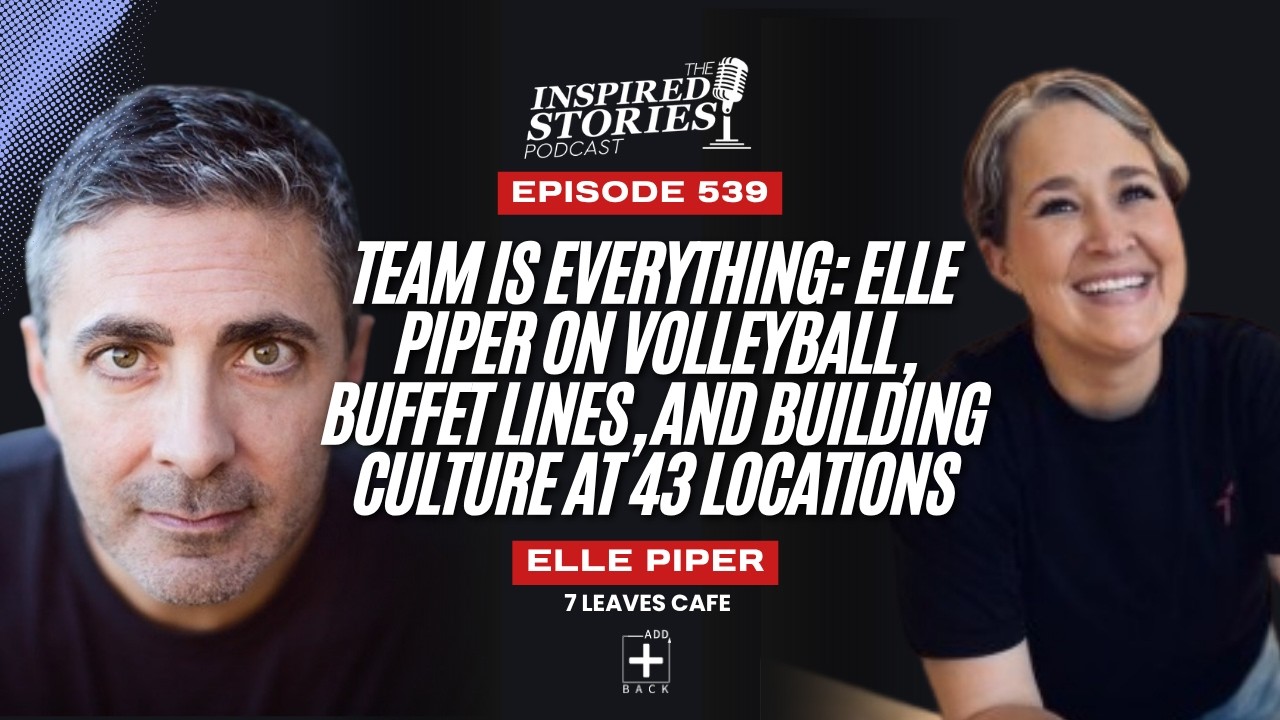
Elle Piper, Senior Director of Operations at 7 Leaves Cafe, came up through buffet-style multi-unit operations at Soup Plantation, watched the brand serve 1,600 customers a day and then go dark overnight during the pandemic, spent six months unemployed before landing at a Vietnamese coffee and tea brand she’d never heard of, and spent the next four years building the operational infrastructure that helped take it from a family-run concept to 43 locations across California, Nevada, Texas, Arizona, and Georgia.
✨ Key Insights You’ll Learn:
Growing up one of four sisters and how a six-person family system translated directly to a volleyball court and then to multi-unit operations
What patience actually means when your four units are outperforming a nine-unit district in volume
The anti-role model lesson that started at Panera and shaped how Elle leads today
What it felt like to communicate the end of Soup Plantation to a team of people for whom it was the only job they had ever known
Joining 7 Leaves six weeks into the pandemic and what the second wave on Christmas Day looked like
Why every store manager at 7 Leaves used to think they were on their own — and the bi-weekly structure that changed that
What a culture crash is and why it happens before a new location opens its doors
How the menu changes depending on the community — and why Brazilian lemonade is on its fourth limited time offer run
Using AI to build a coaching tool that teaches store managers how to have crucial conversations the Simon Sinek and Brené Brown way
Aphantasia, and why Elle asks interview candidates what happens when she says spaghetti and meatballs
🌟 Elle’s Key Mentors:
John Haywood (CEO, Soup Plantation): Showed her what steady-state consistent leadership looks like at the top — not through direct interaction but through observation
Simon Sinek (Author and Speaker): The mentor she’ll never meet whose work on collective commitment and purpose shapes how she leads every day
Dr. Becky Kennedy (Parenting Expert): The framework that helped Elle break a cycle with her oldest son and teach herself to lead with curiosity instead of reaction
Gabór Maté (Physician and Author): The lens through which she learned to give herself permission for the past and to stop blaming the adults who did their best
Sunny (7 Leaves CEO): The person who hired her when she was almost out of hope and whose mission of being the change you wish to see became the operating system for everything she does
👉 Don’t miss this conversation about what it actually looks like to build culture inside a brand at 40-plus locations, why the store manager is the most important person in the company, and how a volleyball player from Southern California ended up as the operational backbone of one of the most interesting beverage brands growing in the country right now.
Listen to the full episode here
Transcript
Anthony Codispoti (00:01)
Welcome to another edition of the Inspired Stories Podcast, where leaders share their experiences so we can learn from their successes and be inspired by how they've overcome adversity. As you listen today, let one idea shape what you do next. My name is Anthony Codus Bodi, and today's guest walked into a brand built on the back of a tiny little Saigon T shop and was handed a question most operators never have to answer. How do you grow something fast without
Breaking all the wonderful things that made it worth growing in the first place. She came up through the grind of multi-unit casual dining, moved into a regional role at a Southern California brand, and then spent four years earning the keys to something much bigger. The path from senior regional manager to senior director of operation at one of the country's most talked-about beverage brands is a story about what happens when someone bets on culture as a competitive advantage.
Her name is Ellie Piper, and she is the Senior Director of Operations at Seven Leaves Cafe, a handcrafted coffee and tea brand that started in 2012 and now serves more than a million drinks a quarter across California, Nevada, Texas, and beyond. She oversees operations, HR, branding, and product development for a company whose motto, Be the Change You Wish to See in the World, is not just on the wall, but baked into the Howlback.
Whole thing runs. Now, before we get into all that good stuff, today's episode is brought to you by my company, Ad Back Benefits Agency. And you'll want to hear this because it's hurting almost every business you know. See, health insurance costs go up every single year, and restaurants are furious about it. They're paying more, claims are getting denied, employees are opting out because they can't afford it, and it hurts turnover and morale.
It's one of the most maddening problems in running a business, and everyone just seems to accept it. But you don't have to anymore. Now there's a program that gives employees unlimited access to doctors, therapists, and prescriptions with no co-pays or deductibles to meet. You don't change your broker, and here's the part that really shocks most people: our product actually increases your net profits.
We recently helped a client add $900 per employee per year to their bottom line. Results vary, but imagine what could be done with the extra cash flow. Get your free consultation today at adbackbenefits.com. All right, back to our guest today, the Senior Director of Operations at Seven Leeds Cafe, Ellie Piper. Thanks for making the time to share your story today.
Elle Piper (02:46)
Of course, thanks for inviting me.
Anthony Codispoti (02:48)
So, Ellie, before Seven Leaves, you spent nearly five years as a district manager at Garden Fresh Restaurants, which operated the South Plantation and Sweet Tomatoes buffet style chains. What did you learn running multi-unit operations at a large legacy brand?
Elle Piper (03:08)
It's a great question. yes, Sioux Plantation, long live Sioux Plantation. Brand closed down with the pandemic. I got a chance to start off as a general manager there and move into multi-unit operations. and you're everything is the best answer
Anthony Codispoti (03:26)
Ha ha ha.
Elle Piper (03:27)
to that. it's there's there's such a unique personal and professional journey that someone has an opportunity to go through when they move from
single unit responsibility, which a lot of us have grown that way organically in the food and beverage industry, to being responsible for driving results through others that is tied to your name on every scorecard, a report card, anything that everyone's going look at, the disk or crawl up is your name, but you're driving the results in the leadership through others. I would say if I had to summarize it in one word, patience.
Anthony Codispoti (04:05)
Mm-hmm.
Elle Piper (04:07)
And it's carried even more so into learning patients with at Sioux Plantation it was high volume here in Southern California. So I I had four units that at times had higher volume and impact to the company than another district manager who had nine units, carrying that over to leading now where I'm at currently through others, through other layers through elevation, that patience is just as important.
Anthony Codispoti (04:37)
And a lot of these powerful lessons in my experience can be taught either from really challenging work experiences, right? You learn how to overcome those and they forge your beliefs and how things should be approached, and or from really powerful mentors who kind of show you the ropes without having to necessarily experience a lot of that pain directly yourself. Let's pick a powerful mentor. talk to me about
Elle Piper (05:02)
Yeah.
Anthony Codispoti (05:03)
a a mentor that was helpful to you during those times.
Elle Piper (05:06)
powerful mentor, very true. at Sioux Plantation, what I've realized the most powerful mentor was our CEO, but it wasn't always through like direct interaction or oversight on a daily basis. It was getting a chance to observe him. And his name is John Haywood, and he was the CEO, the last little bit of Sioux Plantation, because they were purchased by
development like investment company the last little part of its tenure. just observing someone being steady state and being consistent. And I apply that today to that level of mentorship to how it's showing up in my role now. but on a day to day basis back then it was just peer development. everybody, whether they're a general manager, district manager, whatever it is, or even a team member right now in any store,
You gotta have some some peer partnership. You gotta know that somebody's in the same trenches and going through things with you. And that was where a lot of my mentorship came from at Soup Plantation.
Anthony Codispoti (06:12)
Okay, how about a challenging work experience?
Elle Piper (06:16)
I've got plenty. That's that's how we all get here, right?
Anthony Codispoti (06:17)
Yeah, let's just pick one. What what's the first one that comes
to mind?
Elle Piper (06:26)
What allowed me to choose this industry instead of going to school to be a teacher. So it was even pre-subplantation. I originally was had every intention of being a secondary education teacher, coach volleyball, all that great go home with your kids type setup. but I was I was just a cashier. the first brand that I worked for was Panera. and the challenging work experience was observing.
People in strategic leadership positions not necessarily living the vision and the values of a company. So those types of dynamics where it's just like, that person's supposed to be my regional director, but this is how they behave. Maybe let's not do that. So as I got a chance to promote and and grow up, it was more so just I'm very, very passionate and hyper focused on human behavior. so those types of interactions where it's like, okay.
I don't always remember exactly what they did or said in a meeting, but I remember how I felt leaving it. And those uncomfortable experiences are what shapes a lot of Goyam today.
Anthony Codispoti (07:33)
So it sounds like you pointed out something I think is interesting. It's something I try to teach my kids, or 10 and 12, is that you know, oftentimes in life we will have great teachers who show us what to do. And you know, you mentioned a powerful mentor for you. And then you also made reference to a lot of times we experience people that teach us things that we don't want to do. They're great examples, sort of the anti-rule model.
Elle Piper (07:58)
Correct. Absolutely. And both are powerful.
Anthony Codispoti (08:03)
you know, you said something before we went live with our interview that I want to dive into. You were just talking about sort of your vision had been you want to be a a secondary school teacher, you wanted to, you know, coach volleyball. And team sports is something that's really important to you. And I think what you said to me was team sports is a big part of the reason that we are talking today, you and I. What did you mean by that?
Elle Piper (08:25)
Mm-hmm. There's
good.
Team is everything. and I think that that in part came from a growing up in a family system of six, so parents and four girls, and carrying that over to a volleyball court where there's six girls. team, team is how you get anything done. Simon Sinek is a mentor I'm never gonna meet, that I apply as a mentor, and I I love the way that he just communic communicates, articulates, and puts the vision and the purpose out there that.
i is everything is through collective commitment, collective partnership and a collective willingness to to buy into something. And playing competitive sports, you're all bought into wanting to win. but if you take what just happened in the World Cup on Sunday, when people show up through siloed contribution.
compared to a collective partnership where there's a lot of psychology and behavior built into we are all going to do this, you see very different results. and being someone that grew up through team sports, I experienced both of those. And my fondest memories is looking back and knowing what that felt like when everybody truly wanted to be a part of something because they cared about the person next to themselves, compared to when people wanted to be a part of something because they cared about themselves.
Anthony Codispoti (09:57)
Hmm. You know, you were talking about the work that you were doing there at Soup Plantation and how you went from single store management and what I understand, tell me if my words are com communicating this correctly. You are more you are in a role of more of the doing. Whereas when you go
Elle Piper (10:18)
Mm-hmm.
Anthony Codispoti (10:19)
into like a regional manager role, it's more of coaching and leading other people to to be.
in the role of doing, yes?
Elle Piper (10:27)
A hundred percent.
Anthony Codispoti (10:29)
And and what was it like for you to make that kind of a transition? Did it come naturally? Was there good leadership coaching that was involved? Or was this kind of like stubbing your toe on the job and figuring out as you go?
Elle Piper (10:44)
Both. I think the stubbing the toe was much more of a a a personal experience. It wasn't one that necessarily was always witnessed by others, but definitely stub my toe of
You you have to trust that others have the ability to deliver on the same results that you could yourself. So the first part is trust. And then two, you have to trust yourself that you can create the system that allows them to. And if you know how to do something, that's great. But can you teach it? and that was a little bit of the initial fumbling through and then allowing others to be a part of that teaching process with me. the at the time the
director of training and development for the company was someone that I worked directly with. And that was a a huge benefit. because there was there was safety, there was trust. I knew that I had something to fall back on. but at the end of the day, a lot of it probably was self-built through trusting the general managers that I worked with of like, hey, we can figure this out, but let's do it together. Let's do it as a team.
Anthony Codispoti (11:49)
I mean clearly you were doing something very well because like you said, your group of what did you have, four stores, five stores?
Elle Piper (11:55)
Yes, for and you know, there's a word that I haven't used yet today in as far as like what was being done well. It was care for customers. my my passion of like the two foot rule if you're gonna walk by someone, you're gonna acknowledge them, you wanna serve them. And when you have a buffet, you're walking by a bunch of people, just modeling and emulating that I'm gonna walk by people and make sure that they're noticed and that there's a there's a reason why they're here. They care about the product.
So that being the the shared commitment, the shared focus on a daily basis with myself, the general managers and people we worked with. And the more that you're kind of willing to put yourself out there as that weirdo, that awkward person that's constantly acknowledging someone and has energy and is bought into what you're doing, the more a little bit that they start wanting to do it to or wanting to teach it to.
Anthony Codispoti (12:46)
So yeah, tell me how you translate that two foot rule, you know, from sort of traditional like sit-down dining to more of a buffet style environment.
Elle Piper (12:55)
Well, I learned it at Panera, so I will give them credit for that. They did they did have a lot of those good pieces at the time of where the company was at in place. my best answer for you is by having somebody in place that likes to follow rules. I I I'm a rule follower to the core where it's needed and when it's needed, and when there's stuff in place that just is simple and makes sense, it's it's easy to do. And
You have to make sure that you're working with or recreate recruiting or training and developing people that are just as committed to, okay, these systems and processes, these are beliefs, this is what we're gonna do. And you have to have managers and daily oversight for making sure that we act on what we believe. tacit approval is a very, very dangerous thing, both in the physical sense and also in the behavior and belief sense. And it's
You just have to be committed to it. It has to be something that constantly gets talked about on a daily basis, in meetings, in one-on-ones. customer feedback is a huge part of it too. They let you know if if you're doing it or if you're not.
Anthony Codispoti (14:08)
And that customer feedback that you get, what is this through the suggestion box or how does that come through to you?
Elle Piper (14:14)
yes, so at Sioux Plantation it was through a database and it
You the first part of your experience at Sioux Plantation was 40 feet of vegetables and salad before you even get a chance to like really pay and know what your experience is and what you're doing. And a part of what the operational model was somebody being at the front, freshing toss salads and welcoming everybody in. and you can't just have anybody do that. You can't. You have to make sure that it's somebody that is, as I've learned here at Seven Leaves with our who we get a chance to be mentored and developed by.
You have to have people that are maniacal about customers and wanting to talk with people, be in those positions. I believe that most people can do it, but you have to teach them why. You have to give them space to feel uncomfortable and not feel like people are gonna judge you and just put themselves out there and say hi.
Anthony Codispoti (15:11)
So before we get to talking about seven leaves, talk to me what happened at Garden Fresh as you went into the early part of the pandemic.
Elle Piper (15:21)
Closed. so if and I have a few points in my life where I I know how old I am, but I kind of judged my life by three critical events, both when both my children were born, and then the pandemic because of how it impacted my life. we serve the highest volume here in Southern California, and we went from serving like 1600 people a day to 350.
We felt it. We knew. the writing was on the walls of it it went from February the CEO sending out like a weekly memo in our newsletter of like, yes, we're aware of this, to four weeks later our stores were closed. And then four weeks later we own Forlow and then we we knew that the company wasn't gonna survive. it was business built off of volume and being able to be face to face standing next to people.
Anthony Codispoti (16:22)
What was that like for you?
Elle Piper (16:25)
It was a huge personal journey. Yeah. Well, I was, you know, honestly, more
Anthony Codispoti (16:25)
You're in a leadership position. Yeah, you're you're going through it yourself personally. I mean
Elle Piper (16:30)
importantly, I was in a leadership position at home. I was the at the the time I was the I was the parent that was working. I was the provider for a family of four people. so it was it definitely had some some hard journeys through it. and I ended up being unemployed for six months before I got a chance to be hired at Seven Leaves. A lot of
Learning lessons through relationships that were built built at Sioux Plantation. It was hard for a lot of folks. Sioux Plantation had a lot of tenured people. At the time, our VP of operations who hired me into the company, she had been there for 30 years. It was her first job as a teenager. And there's countless people and names that I can tell you of that that was what they know. That was what they did. So one, those relationships are just gone overnight.
People try to text or say, hey, let's go meet up. but work allows you to be in that spot where it's convenient to talk. And that was removed. And then for myself at home, I had two children watching me. seeing how all the adults in the whole world is reacting to it. Fortunately for me, my children were younger. They were five and three at the time. but they still very much so were impacted by what happened the first year of the pandemic. and then I was too. I needed to stay busy.
I grew a pumpkin patch. I taught myself how to mow a lawn. I needed to do something.
Anthony Codispoti (17:56)
Were you responsible for communicating to any of the employees what was going on, or is that not really
Elle Piper (18:02)
We were in part yes. we we were in part of letting people know once it was gonna be their last chance to like go to the store and physically get anything there. I mean ever our our food was fresh. Our central commissary that provided for most company was actually located in Fullerton, which was by my home store. it was communicating, let everyone know, freeze the soup, because that's gonna be the last you have of it. this is
Half mean to answer the questions of what it looked like for final pay and there was a lot of the the awkwardness that the district manager level was a a part of working on with the teams.
Anthony Codispoti (18:44)
Scar you?
Elle Piper (18:47)
Impacted. Impacted. again, I mean it wasn't it was an unprecedented situation for the whole world. but I at that point had developed an understanding and being able to differentiate who was a point of authority. And at this it it's almost it is gonna bleed into seven leaves because so much of the learning lessons actually came then going into a company while the pandemic was happening.
Superplantation did a really good job just providing the facts for what they could and for what their level of scope and responsibility was for. And that's hard when you're closing 97 units that are is nationwide. but they stuck to the facts on what they were responsible for, what information they could provide. And for myself, with where I was at, I understood that Sioux Plantation wasn't responsible for the pandemic. But that was because the company communicated well.
And at the same time, six months later, when I got a chance to come into Seven Leaves and go through like the second spike of the pandemic while being here, I really learned the importance of strength and communication. And the demographic that works for Seven Leaves is much younger than what the multi-generational span was at Sioux Plantation. And for a lot of the team members that we get to lead and work with here, they just wanted answers in what was going on with the worlds and what was going on with them.
and I got a chance to work with and see where Seven Leaves could work on differentiating point of authority for what's going on with the pandemic and also what a company's responsibility is in making team members feel like safe and secure. while the whole world is literally turned upside down.
Anthony Codispoti (20:21)
That second wave, it's been so long. Was that like the Delta that happened in the f the the late summer or fall?
Elle Piper (20:26)
That second wave.
Now that's a scarring moment.
Anthony Codispoti (20:30)
Yeah.
Elle Piper (20:30)
I still we had a store. we were get we had a health inspector in our store on Christmas Day because we had a report how much of an outbreak we had at that one location. and I was the person walking with the health inspector on Christmas Day because more than half the staff it it happened, it spread. that that was very interesting because I don't think even
Health agencies, no one was prepared for what it looks like to get everybody through close contact cases and all of that. I my brain actually almost completely files w all of that away in such a blur because of how much happened in about an eighteen month span.
Anthony Codispoti (21:13)
Yeah. It's brutal. Maybe we won't pick at that scab too much longer. Instead, why don't you tell us about how the opportunity
Elle Piper (21:19)
Yeah.
Anthony Codispoti (21:20)
to join Seven Leads came about?
Elle Piper (21:22)
it came from not being employed. no, I just I shared this with the owners and I worked directly with Sunny, who's our CEO. He actually shared it at one of our yearly galas two years ago that I I was probably just about losing goal and not getting an opportunity to get a lateral move into another company, the food and beverage. I mean, all most industries were completely rocked during that time.
I was just about losing hope in feeling like I was gonna need to go back to a general manager position. maybe for some of the chains where they're popular and they were thriving. but it would have made me not really have time to be a mom. a lot of places when a general manager is in that position, you have to be there for lunch and dinner, just very strict schedule rules. But that was what was gonna be needed for me to be able to support a family.
Seven Leaves was one of my last opportunities of in my head at the time. I told myself of trying to get a district manager position. And my family kind of joked. They're You don't treat boba. What are you what are you why are you applying to this brand? but I think there was a little bit of serendipity that involved at the time the company had a need. They did need a district manager, but it was one of their first real times through a handful of people of starting to explore and look for external hires.
very family owned and operated business for almost 15 years now. But at the time, if we go backwards, they were just nine years young. And a lot of people that had worked or scaled through the positions were family or cousins or had started off at the sub store level and building the support office was very new. and I got an opportunity hired. I joke around that it's because one of the owners had soup plantation coupons still and we connected about that.
Anthony Codispoti (23:17)
Mm-hmm.
Elle Piper (23:19)
But I there there was a need for both them and it worked out to where there was need for myself and made the decision to come work here.
Anthony Codispoti (23:29)
Okay, so I've never had I'm a Midwest guy, I've never had the privilege of visiting a Seven Leafs cafe. Paint me a picture. What is the customer experience? What's going on when I watch it?
Elle Piper (23:39)
that's a great question. Ideally, you're walking in and you're smelling some fresh coffee and tea getting seeped and brewed because we do have a lot of artisanal focus on our craft. you're not really gonna see any sorrow bottles or pumps. we in bulk in the back brew and seep coffee and tea that's goes into to buckets for the volume that we need. And for our refreshers, we're making those pitchers fresh.
you're gonna see a team member that's gonna welcome you in and ideally get a chance to connect with you and just see how your day's going, or compliment your glasses, or notice that you're wearing a band t-shirt. being the change that you wish or strive or aspire to see in the world is a huge part of our mission and our purpose for being here. founded on a company of of immigrants that's got a chance to come here and to be that change from what they
first saw in their first few years of life in a in a country that was impacted. and they to this day want to pass that on to their customers here of just being a little change in someone's day, creating a moment. And I can tell you personally, from having grown through different aspects of food and beverage or serving people a hamburger, there's something special about people wanting a coffee or a tea.
It's not more than it just being a daily consumable. There's just something so enjoyable about getting a a chance to provide for someone the coffee that they want or need during that time of their day. Or some of our sweeter type drinks. our mung bean is built off of a traditional Vietnamese dessert. it's it's almost a pleasure getting to be a part of someone's day in that moment.
Anthony Codispoti (25:23)
So there are lots of coffee and tea shops around, but this one, Seven Leaves, has not only done well, it's grown incredibly fast. Why? What is it
Elle Piper (25:34)
Yeah.
Anthony Codispoti (25:35)
that is being done so well?
Elle Piper (25:37)
Great question. a family commitment and perseverance in wanting to share with the world what they experience and truly enjoy about a daily a daily consumable. right now we're at 43 units. That does include some of the franchise model as we're gonna continue to grow and shape what our future is in in having the franchise side.
We blew up in the Little Saigon area. The Little Saigon area in Garden Grove, California. And 15 years ago, there wasn't much of the model of what we were then and what we are now, but there is a lot now. The Little Saigon area is extremely saturated. There is more mom and pop shops coming or other chains coming from other countries here. And we're looking of just holding our own and remaining the footing of what we are, of the quality.
Vietnamese iced house coffee that is our number one bestseller, while also growing into other corridors and other demographics of what they're looking for and how we can fit their needs. And we have learned a lot in the past 15 years through that. Different cities, demo different demographics are teaching us a little bit of identity of what we we can be.
Anthony Codispoti (26:59)
What are some things that you've learned, maybe some new product offerings by going into different geographies and learning from
Elle Piper (27:08)
that our menu product mix changes drastically depending on who's drinking our drinks. so we started off in Little Saigon, so we were serving more Asian culture-based communities, and we're gonna sell a lot of herbal tea there. Herbal tea is a very traditional drink, especially the way that we craft it and we make it. And when you go to another demographic, you might serve 10 cups of herbal tea that week.
Because they don't know what it is. And we got a chance to educate and teach them it, but they absolutely love our refreshers. It's it's something that's more culturally aligned and how they connect with. And we want to get a chance to like share some of the global offerings and it's not always just being Asian roots. Brazilian lemonade is on its fourth limited time offer run for us as a company. And it's a customer favorite. And it's a recipe that really respects the roots of Brazilian lemonade.
And we look forward in the future getting to do that more with with different product offerings.
Anthony Codispoti (28:09)
And your refreshers are these are it's kind of a fun name for herbal teas, yes?
Elle Piper (28:17)
different teas and then also a Roybus tea that is not caffeinated. That's a a really great option that children love. It's my youngest son's favorite drink. And then also a green tea. Our summer mint is my personal favorite drink. And it's just such a a yummy cup of summer.
Anthony Codispoti (28:31)
Yeah, I'm looking at your website here, which for folks who are interested is sevenleavescafe dot com and the seven is just the number, not written out, just number seven leaves stack. And yeah, you go to the refreshers and some of these are are fascinating. The Brazilian lemonade. yeah, there's lime juice, there's creamy condensed milk,
Elle Piper (28:51)
Mm-hmm.
Anthony Codispoti (28:51)
like these are like creative concoctions.
Elle Piper (28:54)
They are. And if you talk to any team member, I walk into any store now. there's just a joke about how much lime did you zest today. Because it's a it's a very handcrafted approach of how we make each of the refreshers is a is a picture recipe internally. And there's a lot of specific care and timing and measurement that goes into each of the drinks.
Anthony Codispoti (29:17)
So you mentioned, you know, learning and figuring out kind of what the corporate direction looks like going forward. You've got corporate locations. It sounds like franchising is on the new ish side, yes.
Elle Piper (29:31)
it's been around for several years and now it's where do we continue to grow in scale? Is it just corporate wide or is it with just limited franchise exposure?
Anthony Codispoti (29:40)
And that's a conversation that's actively taking place. You don't you don't have the answer for me today. Yeah.
Elle Piper (29:43)
Yeah, for the past few years. Our two Nevada locations correct.
Yeah. Our two Nevada locations used to be franchise and we reacquired them back for that territory.
Anthony Codispoti (29:52)
Okay. so should people contact you who are interested in franchising or yet to be determined? Okay.
Elle Piper (30:00)
Yet to be determined. I mean, where there's
a will, there's a way. So I I never really put doors on anything, but we're still figuring out what that right model looks like.
Anthony Codispoti (30:10)
Gotcha. okay, so talk to me about what the landscape looked like when you first joined the company there in kind of late twenty twenty.
Elle Piper (30:21)
Yeah. I mean it was in the pandemic and so that that had one element of interesting that I know we already covered. the best way I can describe it is you don't know what you don't know. And that's where the company has been and that's where we're working on growing out of is having that context and the understanding of standardization and fundamentals and foundation so that we do know and that we can serve our team and customers well.
And when I talked on patients earlier, I still share this with anybody that's new to the company or I get a chance to interview and work with today. There are things I saw my first day of training in a store s almost six years ago, it'll be September, that I still haven't had a chance to fully mold or impact yet. But it's because it's not impacting a customer or team member, and we'll get there. And it's a bit an element of we'll get there and prioritizing truly what is needed.
So, core value number one here is to serve customers or those who are. So, by no way did what I just say, I don't want it to get mistaken for, okay, well, we're taking our time. No, it's just when leading an organization and building systems and infrastructure, the time to move change and to have it be done in a sustainable way where you're not going to lose your customers or your team members has to be methodical and it has to be meaningful. And sometimes priorities shift and change.
And that also came from the mindset of I I do give a lot of credit to the the first company I worked at in this industry at Panera, but by the time I worked there, they had over thousands of stores. They had a lot of time to build and get to get to where we they needed to. and we're 15 years young here. We joke around teenage years of figuring themselves out. And we are working on ensuring that the customer is the center, the team is being cared for and being
feels that level of service as well. and taking it with what is operations needs to be able to do their jobs well. And it requires a lot of systems and standardization and making sure that our leaders can thrive and create other leaders themselves and not just promoting people that know how to make prep and how to get prep done really fast.
Anthony Codispoti (32:37)
What was the first big project that you wanted to undertake when you joined the team?
Elle Piper (32:46)
To one, will jokingly talk about cash management. And Bob Farrell has a book. he I I happen to work for Ferrell's at one point too, Given the Pickle. And there's this great little story antidotally in there of pot roast. And I look forward to I I encourage you to look it up. In short, it's just the the context of asking, hey, why do we do that that way?
And then somebody goes asks somebody else, hey, why do we do it this way? I don't know. It's just how we've always done it. That was a little bit of our operational systems and processes, or even how just a manager's job was approached. but in a much more meaningful way, connection. Just as much as COVID was impacting connection at homes and schools, it was impacting it in the workplace. One for team members feeling a little bit scared to serve a customer.
But it was also impacting the customer as a team. So all meetings were Google Meets and everything ha needed to happen rightfully so. but one of the things that I feel the strongest about getting a chance to celebrate today compared to where we were at six years ago was every store manager thought they were on their own. No one got a chance to really like see and understand that, hey, me too. Yeah, all that happened to me too. Like, let's connect, let's let's feel
sometimes needing to trauma bond, but also at the same time, let's build some systems and let's work some of this stuff out together. And one of the first things that I started to put in place as a district manager, because I had had it modeled for me and got a chance to come put it here was connection as a team.
Anthony Codispoti (34:26)
And what does that actually look like in practice? Because I on the surface, like you know, terms like trauma bond, that was that kind of had me chuckle. I hadn't heard that before. And this human connection, big fan of it, right? This this is where
Elle Piper (34:37)
Yeah. Yeah.
Anthony Codispoti (34:39)
healing takes place, this is where fellowship takes place, this there's so much value in that, but how do you coach
Elle Piper (34:44)
Well, that's a great word. Yeah.
Anthony Codispoti (34:46)
that and how do you I don't know, how do you how do you weave that into?
Elle Piper (34:51)
You have to have the expectations
in place. No, I love your questions and I love the word fellowship. most things can get done. And two words that I know that my team's probably here for me as a repeatable is expectations and accountability. So we had to create the expectation that you have to meet and you have to meet bi-weekly and you have to do this at your meetings. And yes, like the business mechanics looks on a surface level that that was the point of what it was for. Let's talk about cubs, let's talk about hiring, let's talk about these things.
But for me on the much deeper end, it was the behavior and the mannerisms of just expecting, okay, twice a week, I'm gonna meet at this table and I'm gonna sit next to my peers and I know what to expect from my supervisor and I know what to expect from them, and I know what my part is and I can be accountable for what those next steps are. It was just foundationally building the systems and the processes of that for both the it's it's much more natural at a corporate support office level.
And it deserves just as much to be that way at the store level when our store managers are the most important people in the company to us. They're the brand ambassadors. They're the shapes, the shapers of the culture. and getting a chance to put a lot of energy and focus there and teaching that the focus needed to be there when it hadn't always been.
Anthony Codispoti (36:06)
I think the big unlock, if I understood what you were just saying, big unlock for me was you can because you can't really formulate people forming a bond, right? Like you can't
Elle Piper (36:19)
Correct.
Anthony Codispoti (36:21)
you can't make people be friends, but what you can do is put the the structure in place so there's more opportunities for those points of contact so it can happen naturally on its own from there, right?
Elle Piper (36:35)
You frame that perfectly. Absolutely. You have to give people the opportunity to do it. It's no different than kids on a playground. Like if a kid's inside their house, they're not really gonna create have friends, but if you put them around peers or take them to the park, you're given them the opportunity to create meaningful impact.
Anthony Codispoti (36:51)
Gotcha. Okay. So Ellie, you were promoted from senior regional manager to director of operations and then to senior director in a span of about four years. Which of those changes for you was the most challenging and how did you navigate?
Elle Piper (37:09)
It's a great question. the first two to three months as a director promotion, and that's just because a little bit of hindsight. at the time two of my previous peers were our previous director of operations and our previous director of marketing, and they both were at times in their career and journey where they actually ended up leaving this company around the same time of myself getting promoted. And my first promotion was to be a little bit more strategic in being
HR and training focused to be a service to operations with having come from operations and understanding people and systems. our CEO's vision on it was for me to be able to serve those support office positions and people to really take care of our stores. that was short-lived just off of timing and company needs and I even remember to this day getting a chance to be talked about well, do you
we would like you to be the director of operations. We understand it's happening fast, but it's not happening just because we need someone we need you. We need you in the position. But during those three months was was some great trial and error of just because someone doesn't have the operations title doesn't mean that the stores aren't everything and all that matters.
And it was a little bit of getting used to not being at the stores every day and needing to be at the office more because that's what is needed of me to serve the stores. that was a really good lesson the first year, but the second year I kind of got to mature on it more of I always am going to come alive when I'm in the stores. It's my passion. I love to talk to customers, hold the door open for them, give them a sample of a drink. but there's so many other people that we can build and shape to do it well.
And to care about it. And that's what my level of responsibility to the company is for. And my partner in crime now that I get a chance to work with, got to promote her as a district manager and then now our regional operations manager last year. she is fantastic at it. And she is the best role model out there to be teaching our district managers and our store managers, and she it just emanates from her soul. And I believe that we can continuously look and find and develop those people.
in each of the support department roles that they are needed at, or in any position in general, you you can find people that are passionate and you can also give them the opportunity to be passionate. And that's where I see a lot of my responsibility in being.
Anthony Codispoti (39:44)
So let's talk about your responsibility because if I if my notes are correct here, you now sit over operations, HR, branding, product development. You're nodding along with all of these. I y am I missing anything?
Elle Piper (39:56)
Yeah, I
got yeah, got so training and supply chain. I do work directly with each of the people responsible for these departments. That's correct.
Anthony Codispoti (40:04)
okay, got it. You are not the direct director for each of those. You oversee all of those. Okay.
Elle Piper (40:10)
I have been when needed. When there's gaps and we
haven't had the right people leading them, I I do definitely I I am a part of it with each of those teams. but my responsibility is making sure that we are leading it right and I'm directing the strategy. but tactically on a daily basis, I wouldn't be serving anybody if I was tactically doing it every day.
Anthony Codispoti (40:34)
That that makes lot more sense. I want to talk about the company's motto. Be the change you wish to see in the world. You know, when you're small, you know, little mom and pop, maybe a couple locations, I feel like that kind of a motto is probably easier to infuse into the company's culture. When you get to be bigger, 40 plus locations, how do you keep this from becoming just like a a placard on the wall? Like, can you give me
an example of how that motto would be visible to a customer who walks into a location on a Tuesday afternoon.
Elle Piper (41:10)
No, that's such a great question. and it's true. We all have to aspire for our vision, our purpose, and our values to not just be words on a wall. and it comes from ensuring that you have the right people in the right states that have the willingness to be responsible and invested in that purpose and that mission. we actually recite our mission statement at the start of meetings, and we sometimes actually do it holding hands and just we recite our mission statement. And we've been doing it for several years throughout different
types of meetings and formats of what we're doing. You have to repeat what matters. So no different than telling your family you love them before you leave the house. You're repeating what matters because you choose to. And we we have to do that with what we're doing as well. And to connect it much more realistically of getting to like picture or understand what I'm talking on.
Our team members in each store were trying to create their own culture and their own community. We just opened our La Mirada location last week, and yes, it's serving the city of La Mirada and the surrounding communities, and we're so excited about it. but we have this process called culture crash, right? Before a new store is going to start their training at their store, we come together for a two-hour meeting, and it's just as much as just just talked on why we do store manager meetings.
Yes, it's to talk about some expectations. We introduce our five core values. We do a little skit to kind of just like get that little bit of discomfort out of the way before they show up and start training and meeting 20 coworkers and they're awkward and uncomfortable. It's just to get that little bit of ease out of the way. but I got a chance to speak with our our new staff and our new team and I had one of my sons with there with me, and it's a privilege to even get to have them in that environment with me. In just talking on what
this means to them. Yeah, I need them to understand our service standards. I need them to care about our house coffee, all of that great stuff. But what I chose and focus on talking on was I hope this matters to you guys. I hope you meet a friend. I hope you learn that you can show up to work and trust that the person next to you cares about you and that they want you to matter. And to make a lot of this full circle, that's why I chose to stay in the hospitality industry instead of pursuing my teaching credential.
So much of that age group between 18 to 20, they just leave this entire system in the US as showing up to most days throughout the year in believing that their teacher cares about them, that someone outside the home cares about them. And then they go to college and that just completely is broken. You don't know who your professors are. You maybe you dorm, maybe you don't dorm, but you don't have this sense of security that someone sees you, they value for you, and they care about you.
And that's what I look forward to a lot of places that get to be someone's first time job actually caring about what their role and responsibility is and caring for other people. that's how we get a chance to be the change.
Anthony Codispoti (44:09)
Mm. I like that a lot. I tell me about the fundraising program that you guys do. It's tied to an organization that's supporting children and families in Cambodia. Why this particular organization? What
Elle Piper (44:22)
Yeah.
Anthony Codispoti (44:23)
do they do?
Elle Piper (44:24)
You know, such also serendipitous timing of getting to talk about that. So it this year is really unprecedented for us. We haven't necessarily always won promoted or fully connected with like philanthropic. in the past we've done small little fundraising with the goodwill, we can food drives, that type of stuff. but this actually is connected to our owners and it's not something that they've always
wanted to kind of promote out there like, hey, look what we're doing, because that's not what it's about. Actually, three of the owners right now are on a mission trip there for iHumane missions. And it's giving back to the roots, for them specifically. And it beyond it just being giving back to the roots, I mean, those are real people in real need of care and love and health. And it's our first time
putting it in our customer's purview and path of we we have the opportunity to give back, then are you willing to give back with us?
Anthony Codispoti (45:28)
giving back to the roots, tell me more about the roots. Wh where did the idea for the company come about?
Elle Piper (45:36)
depends on which person you talk to. No, I'm just kidding. Kwang. this this is all Kwang's mission and vision and purpose and idea for it's a lot more convenient here with where with where we get the opportunity to live. my commute to work, I had a bunch of options of where I could have stopped to get my coffee and tea, but for some of the streets in Vietnam and other parts of Asia,
That's that one person's whole business is the cart or the boat or the setup where they are handcrafting a coffee or tea. And that's how they get an opportunity to go home and take care of their family. so there's a lot of the the true at-heart human side to it. and where what service I have to offer the world today and the service you have to offer the world today.
has grown through modernization. There are plenty of other countries where it hasn't had the opportunity to. And that's what the company ties the two together.
Anthony Codispoti (46:41)
Mm. So is Quang Cambodian, Vietnamese, w or traveled to one of these
Elle Piper (46:45)
They're they're Vietnamese.
Anthony Codispoti (46:47)
places or
Elle Piper (46:48)
They they came here from Vietnam when they were young children.
Anthony Codispoti (46:53)
Okay. you know, we're talking about some of the growth that you guys have experienced, you know, in states now, like Arizona, Texas, Nevada, Georgia, maybe others to come. you know, it's it's one thing when you do sort of a hub and spoke, right? Where I've got a location here, and maybe, you know, a few miles away I open up another location. You've got a little bit of brand recognition there. But when you guys move into a totally new market where people
haven't heard the Seven Leaves Cafe name before, how do you guys think about cracking into that community and letting them know we're here, come check us out and and start to gain some traction?
Elle Piper (47:32)
Yeah.
well, for ourselves personally, corporate wise on our own adventure with it, our one Arizona location is completely everything you just said. If we only have the one unit still in Phoenix and we need to work on our brand and market expansion both in Phoenix and Nevada, you have to you have to do more work that you've already done in other neighbors and other communities. we we have the opportunity where a lot of
Our footprint in Orange County and now bleeding into LA. our history speaks with the present. And when you go into a new community, you have to tell your story. You have to put your product out there, you have to have the service ready for it. I do, I mean, anybody who knows business, I mean, the business model is definitely a lot healthier and sustainable when you grow a market and you have multiple units out there.
And our most successful franchise partner has done just that. Northern California is franchise and they have six locations up there and they get the benefit of the community knowing the brand more than just the one store.
Anthony Codispoti (48:44)
How about some future projects you've got in mind? What do you guys what do you Yeah,
Elle Piper (48:49)
there's lots of future projects.
Anthony Codispoti (48:51)
what's one you're really excited about?
Elle Piper (48:54)
menu innovation. So our menu has been for the most part a very consistent menu. If we just talk on my time in the past six years, there's only been up until two years ago, there was only one core drink product that became a constant on the menu. We do start doing limited time offers. so we have a a holiday version of our house coffee that's delicious. so kind of creating a little bit of that cadence of what
We want to be while also answering to what consumers look for. So seasonality and change. But we are working on some menu innovation that's updating some of our core products and speaking to a lot of that customer feedback. But it's a little bit of slow burn for what the customers see with how much craft and consistent needs to get perfected for these products. Outside of that, we did meaningfully change our core menu and how we talk with customers.
We didn't always have lattes. Lattes have only been part of our product mix for two years now, and there's a huge benefit there in how it speaks to different customers. our Spanish latte is very yummy and is climbing in where it falls in product mix and how customers seek us out instead of another competitor.
Anthony Codispoti (50:14)
Hm. How about AI? How are you guys using AI in your work currently?
Elle Piper (50:20)
you could come live here and talk with us about AI. It is a huge part of our driving force for the support office. And with the lens of how do we use it as a partner, how do we use it as a tool? How do we use it to better each of us in our roles so that maybe some of those things I mentioned, I saw six years ago that we could get to, maybe AI is going to leverage how we can accelerate some of the needs of the business, needs of serving team members.
needs of developing the soft skills through our storm managers and making sure that they feel equipped to have crucial and hard conversations. Because honestly, that's like 60% of the job. I know that's an arbitrary number, but it really is just having hard conversations with peers above, below customers. and it's something that meaningfully has to get taught. And not all parts of our industry or companies always see that it that that has meaningful value.
But we do. One of the projects that's been given myself and others is using AI as a through a a home base that's a coaching tool programmed with our thought process on shaping crucial conversations and using people like a Simon Sinek Brene Brown as inspiration to teach these managers how to have a good conversation with a team member when they just need to give them a little bit of feedback and making them feel strong and equipped.
And it's not removing myself, the district manager, or anybody else. We're all a part of that development in that role. But what if we can give them one more tool that makes them feel a little bit confident going into a meeting? And so that's just a part of how we're using it.
Anthony Codispoti (51:56)
So what does that actually look like in practice? Is that
is that like a like a role playing scenario? Like I know I need to go talk to an employee and maybe I've gotta let them go or I've gotta give them some really hard coaching
Elle Piper (52:07)
Yeah.
Anthony Codispoti (52:08)
and I don't know like what to say or like what feedback to expect from them and then how I respond to that.
Elle Piper (52:16)
So in part, yes, scenario training is one of the biggest things that it ends up being part of like an MAT program anywhere I've worked or I've seen. And this is a little bit scenario training, not just like, okay, how do you do labor? It's not that type of scenario training. It's people scenario training. And the more that we give them the opportunity of knowing that that's gonna be part of their job,
allows us to one, help them thrive and also create space so that this can be a career and our store manager tenure can be longer because they feel confident. And we do have a benefit. Most exit interviews I've had a chance to be a part of over the past few years, everyone leaves saying that they're going to miss the people. And two, I've been surprised by they say that they learned communication skills.
Anthony Codispoti (53:01)
wow. Okay. restaurants. Yeah.
Elle Piper (53:06)
And we're using AI in many other ways too. But A AI
we are very we're AI forward for what it can do. We're I mean, it's it's a group of entrepreneurs that started a company. So there's a lot of innovation in AI.
Anthony Codispoti (53:17)
Yeah. talk to me about hiring, recruiting, retention, because you know, the the kind of industry that you're in turnover is notoriously high. hard to find good folks, hard to hold on to them. What's your approach to this?
Elle Piper (53:34)
Yes, it is. And that is true. For the team member level, which is majority of our company, we actually have very good attrition. We end up finding a lot of team members that are gonna be full-time college students. Most of them, ironically, are going into a field of service, wanting to be a nurse or like a radiology tech. And our schedule and what we have to offer them fits their needs of life. So ideally they're gonna be with us for a few years.
learn some personal and professional skills and get a chance to go thrive in their career. Or for some of them, we're lucky enough to do what happened to be in my career. We teach them that this is a career too, and that this is a service and this is meaningful work. And that is one where there is more challenge in the the turnover and making sure that the business model is there, the compensation, the training to allow them to have these skills. We are continuously increasing at the tenure of a store manager.
What used to be maybe a year is a few years now. And I look forward to it being even longer. And I know that that can happen if we give them the opportunity and we have the the systems for them that way. yeah, go ahead. No, go ahead.
Anthony Codispoti (54:41)
What do you think is sorry,
sparked inspired a great question there. What what do you think has been helpful for you guys in getting from that one year average tenure for a store manager up to a few years?
Elle Piper (54:54)
Being reflective and completely introspective and honest about what was not working. And actually even behaviorally, and I I'll be honest, my focus in learning how much I am fascinated by human behavior has really come from being a mom. And it serves me both at home and it serves me at work. we actually used to have it in an interview question and I I started to like pay attention. I was like, why do we do that? Why do we do that?
was w do you commit to being in this role for one year? And while there's beauty in that of like wanting to have a commitment and set expectation, we also learned that it kind of gave the managers the idea of like, okay, I'm gonna do this for a year. And I started to ask people, I was like, so you said you did it for a year. Like, why is that such like, talk to me, help me understand? You're like, Yeah, well, you asked me to commit for a year, so I did my year. So now I'm moving on to something else. And I was like, it doesn't have to be that let's let's have a conversation.
Anthony Codispoti (55:49)
You
were unintentionally framing the expiration date.
Elle Piper (55:53)
Yes, that that was a huge part of it. So that is just one example I can give out of plenty of us needing to be introspective. What is causing this? How do we change it?
Anthony Codispoti (56:04)
Hmm. Elliot, what's one of the hardest things you've had to overcome personally and what did going through that teach you?
Elle Piper (56:15)
I have a handful of things that pop up. what is actually the most meaningful one that I can be vulnerable and honest about. so I have two children and I grew up and I la I look back and I laugh on it now. I have adult understanding today, but as a child I did not have the understanding. my hat my dad and I bumped heads. And my mom would joke around about me just like being
Pick straight out of like, I am my dad. I I am him, and there's a reason why him and I bump heads. and I started to catch on a few years ago that it very easily could have been the same for myself and my oldest son. And my youngest son had a different, we have a different flow in a way of communicating with each other. And a few years ago, I really got introspective and deep and have dove in through a lot of like.
Books and podcasts, I find a lot of meaning from people like Dr. Becky Kennedy and how she talks on parenting and leadership. I needed to change that cycle. Looking back on it now, I have no fault at all. I love my dad, my children, and I actually live with my parents. I absolutely love the impact and the relationship my dad gets to have with my two boys and that they get to have with him. But for my oldest son, Riggs and I, I needed to change.
And I needed to get more curious about what was causing our communication friction and what he needed from me and what reactions he did or did not need from me. And I he's a preteen, he just turned 12. So it by no means is every day perfect or beautiful. But we've gotten to such a stronger way of getting to communicate or to connect, or to where he is able to open up on his emotions or like his level of sensitivity and and feel safe and trusted.
And the main thing that stopped was my reactions. And to this day now, I've gotten to a spot of teaching my children to even how we can work on their reactions. We're human. We need to feel the feels. It's gonna happen. But how we choose to feel the feels, we are responsible for. So the the analogy that I've started to use for them, I was like, okay, so one of their friends recently had surgery. I was like, okay, how do you want the surgeons to have reacted in that room when he like needed emergency surgery?
Do you want them to freak out like you just did? Or would you like them to have a little bit of level of, okay, I'm gonna be calm. This is what is needed for me. This is what I need to do in this situation. So here's where we're gonna go about this. And this is just idea and concept. And the more days we can do more of this and less of overreactions, then the stronger we can be in our family system. And none of that would have been possible without me just having an O L moment of like.
Ellie, he is reacting because you're reacting. He he is eight years old. He is learning this because you are modeling it. How can you do different? and why I love Dr. Becky Kennedy is because she tells parents to tell themselves it's not gonna be every moment that's perfect, but in that tough moment, okay, I'm a good parent that's just having a hard time, or at work, I'm a good leader that's just having a hard time, and how we can even communicate and talk with ourselves through that.
And I appreciate that my children are giving me that permission as their mom to fail forward.
Anthony Codispoti (59:36)
That's amazing. I appreciate you sharing all that. I'm curious as part of this process, did you was it helpful or did you feel the need to go back and try to change the relationship with your father?
Elle Piper (59:48)
That is a great question. It's not necessarily change, but to give it permission to have happened. Someone else that I'm inspired by is Gabor Mate, and I love how much he talks on we're all have an inner child and we're all gonna, it's gonna be with us everywhere. Can't blame the parents. My parents are actually two people that broke all things that they grew up in their watching in their own households. They were broken. There was abuse, there was alcoholism, and my parents.
really created a good family system for myself and my sisters. Not not every moment was perfect. In 20 years, my children are gonna let me know not everything mom did is perfect. But we are trying to put our best in honest fit forward every day that's not malicious, that is well intended with care. So I have had to go back and give myself permission that that was what that's how it was with my dad and I. And I just more than often than not, I was just repeating what three older sisters said.
But then I got in trouble for it because I was younger. So I'm I'm going back and and assessing and and creating spots there. At the same time, with there being a few things that, yeah, my dad and I have had more honest conversations on and his also understanding of me. I'm different. I'm told all the time how weird I am. And I just I have aphantasia, so I don't see in my head. I literally just experience the world for what's around me. And I think it's why I hyper focus on human behavior and mannerisms and
No one would have known that when I was eight years old. That just that's not something you ask your children of, hey, do you see in your head what what's going on up there? so the I even talking to you
Anthony Codispoti (1:01:23)
What do you mean by that? Like close your eyes and like do what do you like do you
Elle Piper (1:01:28)
right now, so I I I use it as a meat cue with a lot of the the team members or interviews that I'm on. I ask people when I say spaghetti and meatballs, what happens in your mind? So for you, when I say spaghetti and meatballs, what happens in your mind?
Anthony Codispoti (1:01:42)
I don't know, I think back to dish my grandma used to make. I'm not see I'm not seeing something now.
Elle Piper (1:01:45)
Do you see it? Okay,
so you don't visualize either. So most peop or
Anthony Codispoti (1:01:50)
I mean, I I
don't know, I see an idea of something, but like I Yeah. Like do I close my eyes and do I actually
Elle Piper (1:01:54)
Okay. The concept. Okay. But do you can you actually picture it?
Anthony Codispoti (1:02:00)
s no. Like a picture doesn't pop
Elle Piper (1:02:02)
Okay.
Anthony Codispoti (1:02:03)
up in my brain.
Elle Piper (1:02:04)
Okay. Well then you from and I am not someone that's a professor, just from my learnings with the people that I interact with, you are one of a few. Most people I talk to can yes.
Anthony Codispoti (1:02:13)
So most people close their eyes and they'll see that thing.
Elle Piper (1:02:16)
So the answers I've gotten is they can see what their mom used to make. They picture it on a red and white checkered Italian cloth. They can I have people that have smelt garlic when I say it. Just our human sensory and the way our brain processes, our memory and our recall.
Is so fascinating. And what I've learned the past few years as I've like really dialed in on this is the next time you're in a meeting room with 10 people, you now have to think about how 10 of those people are thinking. One of the guys in the office, he can't hear in his head. He can see, but the idea of like someone like getting a song stuck in their head, he's like, What do you mean? How does that happen? So for myself and my regional manager, her name is Monica, we both to have affantasia, we don't see in our mind.
It just it doesn't happen. So when someone's like going through a store rendering or we're talking about like future stores, we're like, Okay, you have to show us the actual rendering. I can't picture it in my head. and I I didn't know that for the longest time. I just learned a few years ago. Yeah.
Anthony Codispoti (1:03:13)
interesting.
So I would I want to go back to modeling this behavior for your kids, right? So you understood
Elle Piper (1:03:19)
Mm-hmm.
Anthony Codispoti (1:03:20)
that a big part of why your son was reacting is because he was learning that from you. You were reacting
Elle Piper (1:03:25)
Yes.
Anthony Codispoti (1:03:26)
to a tense situation. Your emotions are escalating. And so he's just repeating that same thing. Okay, so now you're aware of that. Now you're trying to correct your own behavior. Certainly easier for you, not easy, but easier for you to do than your own child.
But now you're at the same time trying to, you know, teach your kid to have a different reaction in the moment. And it's not enough that you've just changed your behavior. How do you start to teach him to change his behavior?
Elle Piper (1:03:56)
By really making sure that they're appreciated when they get it right. Children so much so need to hear more often than not, like as much as possible when they got something right. And as parents, we have to be paying attention. Sure, we all have emails they know when I say, Hey, I'm on my phone because I have Slack messages. I I communicate it and try to narrate and let them know what's going on. But when they get something right, so my younger son is really working on not reacting to his brother trolling him. And the other day he looked at me, he's like, Okay.
I know what he's doing. I'm not going react. I have to celebrate so much that moment. And not like giving like some false flowers or some fake trophy, just making it genuine for him to understand, hey Griff, I totally recognize what you just did. I know what your brother's doing. I know what older brother siblings do. They definitely want to pick at. My sisters always wanted to get on my nerves and see if I could react. And then I was the one that got in trouble. I was like, Griff, you chose not to. And it's been really hard for you to choose not to. Thank you for choosing not to.
And y you have to catch the good moments.
Anthony Codispoti (1:04:59)
I love that. And I'll probably take the last couple of minutes of this podcast interview and stick it on my desktop and replay it for myself and my wife. There's some things in there, gold nuggets for us.
Elle Piper (1:05:11)
Thank you for that.
Anthony Codispoti (1:05:12)
absolutely. as you think about the work that you're doing now, Ellie, what is it that you most want to be remembered for?
Elle Piper (1:05:20)
Hmm. Human care. Human care. And just as much as we need folks that are gonna be the architectures of their time that are making those beautiful buildings that get to house us all, we need the architectures that that see the human for the human. And I think that none of it is new or special. It's been around for as long as civilization has been. There's a reason why fat culture exists.
we love narrative, we love story, it's how we process, it's how we live and thrive. And if we could give ourselves more permission to talk on that and to make space for it, that would be great. And I just choose to care. Yeah, yeah.
Anthony Codispoti (1:06:10)
Love it. Ellie, I've just got one more question for you today. But before I ask it, I want to do three quick things for the audience. First of all, anybody who wants to get in touch with Ellie Piper from Seven Leaves Cafe, I'm to give two options. First, there's the company website, which we mentioned earlier, Seven Leaves Cafe. Don't spell seven out. Just type in the short version. Just type in the number, sevenleavescafe.com. It'll be in the show notes, as will Ellie's LinkedIn profile.
You can go and search for her right now. If you look up L E E L L E Piper and Seven Leaves Cafe on LinkedIn, you'll find her. But we'll give you the direct link in the show notes in case that's more helpful for you. Also, if you're enjoying the show today, please take a moment to subscribe wherever you're listening. See, it also sends a signal that helps others discover our podcast. So thank you for taking a quick moment to do that right now.
And as a reminder, you can finally get your restaurant and cafe employees access to therapists, doctors, and prescription meds that counterintuitively actually increases your company's net profits starting in the very first month. Works for anyone over age 18, a lot of part-timers qualify, no co-pays, no deductibles, and you can keep your broker. So you can learn more how to have happier employees and a stronger bottom line at adbackbenefits.com.
Okay, so Ellie, last question for you today. What is one very specific thing that you hope to be celebrating in a year from?
Elle Piper (1:07:47)
permission as I'm continuously working on getting a chance to lead or impact or develop or nurture others, being more and more honest and vulnerable and giving myself permission to share my self journey with that and knowing that it's it's safe to do that. And I am no I'm not naive to to think or believe that a lot of what we try to to chase or to offer the world, that it's stuff that we internalize that that we
Do we want to? And knowing that it's okay to give myself permission for a lot of those same things and to receive.
Anthony Codispoti (1:08:22)
I love
that. Ellie Piper from Seven Leaves Cafe. I want to be the first to thank you for sharing both your time and your story with us today. Really appreciate you being here.
Elle Piper (1:08:31)
Thank you for inviting me.
Anthony Codispoti (1:08:34)
Folks, that's a wrap on another episode of the Inspired Stories Podcast. Thanks for learning with us. And if one thing stood out, put that into action today.
Connect with Elle Piper:
Website: 7leavescafe.com
LinkedIn: Elle Piper, 7 Leaves Cafe