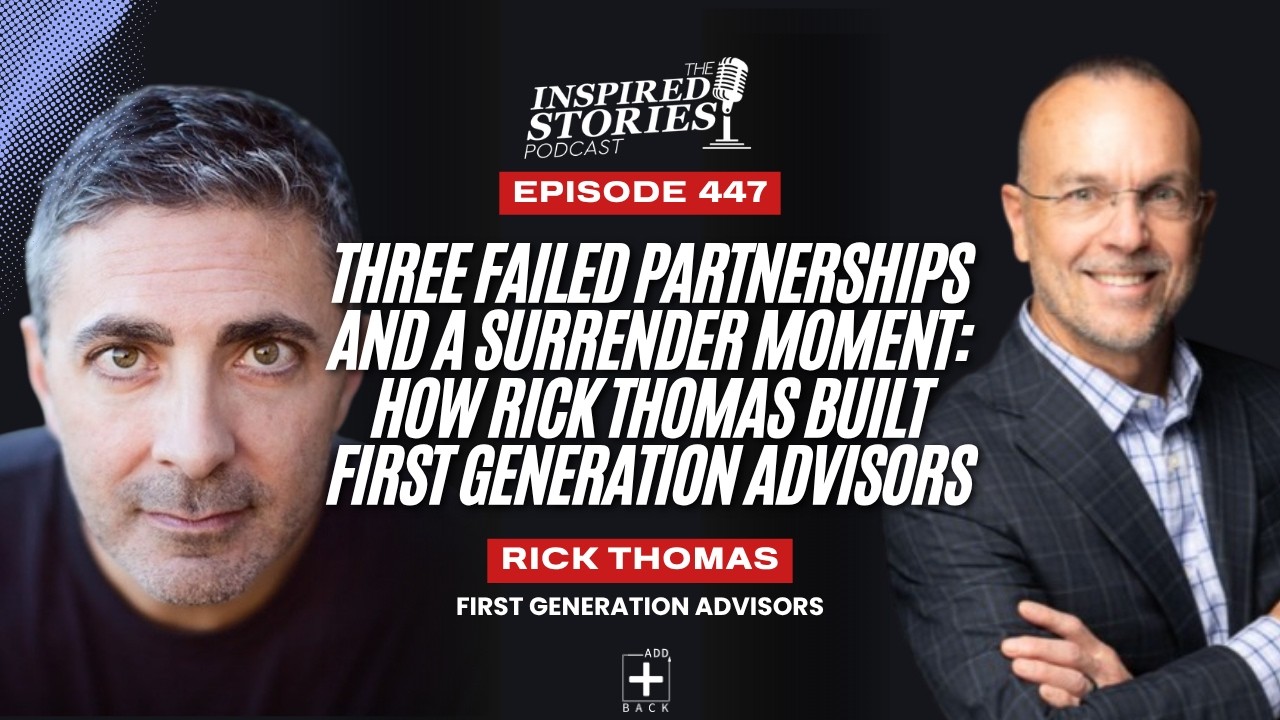
🎙️ Exit Planning Theater and the Truth Below the Waterline: Rick Thomas on What Most M&A Advisors Won’t Tell Founders
Rick Thomas, founder of First Generation Advisors in Washougal, Washington, grew up crossing borders before he could ride a bike — through Venezuela and West Africa as part of a family Peace Corps program — and spent his adult life watching what people do when there’s no safety net. He carried that lens through 13 years in manufacturing, through leadership consulting, financial advising, and three failed partnerships that eventually led to a surrender moment on his knees, alone, that changed everything. Today he works with lower middle market founder-led businesses on growth strategy, exit readiness, and the things no one on the deal team will tell you about selling a company you built with your life.
✨ Key Insights You’ll Learn:
What growing up in Liberia and Venezuela taught Rick about joy, contingency, and the human condition stripped bare
Why Rick calls most exit planning ‘theater’ — and who is actually being served by it
Confirmation bias in M&A: how cocktail napkin valuations hijack founder decision-making
Why the highest transaction value is often the wrong choice — and what gets left off the balance sheet
What happens to founders emotionally after the sale and why most are never warned about it
The iceberg analogy: what the M&A world sees versus the 90% of the founder experience that’s underwater
Why three failed partnerships were all the same lesson in different clothing
The surrender moment in 2007 — down to $1,000 a month, marriage in counseling, everything at risk
The wood pile principle: what a country boy from North Dakota taught Rick about building anything
How Rick is now building AI agents to grow First Generation Advisors while working fewer hours
🌟 Rick’s Key Mentors:
His Mother (Puerto Rican, Bridge Between Worlds): Gave Rick his first experience of cultural duality and the resourcefulness that comes with it
His Country Boy Business Partner (Manufacturing): Introduced the wood pile principle — leave it higher than when you started, every single day
Portia Nelson (Author, My Life in Five Chapters): Her poem on recovery gave Rick language for the cycle he kept repeating with failed partnerships
His Wife: Stayed through the hardest years, the counseling, the near-bankruptcy, the reinvention — the only partner who never left
His M&A Strategic Partners at Pilot Wealth: Introduced him to the world of exit advising through a 2012 conflict resolution project that changed the trajectory of his business
👉 Don’t miss this conversation about the difference between a transaction and a transformation, why smart founders get outmaneuvered by advisors who see their exit as a capital placement event, and how a man who watched children play soccer with a milk jug for a ball came to understand what actually matters.
Listen to the full episode here
Transcript
Anthony Codispoti: Welcome to another edition of the inspired stories podcast where leaders share their experiences so we can learn from their successes and be inspired by how they've overcome adversity. As you listen today, let one idea shape what you do next. My name is Anthony Codispoti and today's guest grew up crossing borders before he could ride a bike as part of one of the only family units ever deployed through a short lived Peace Corps program. He spent formative years in Venezuela and West Africa, including a day on the beach in Liberia where he stumbled upon a drowned fisherman in the surf. He was only six years old. That early experience of sitting with hard realities, of seeing life and business stripped down to their essentials never really left him. He carried it through a 13-year run inside a manufacturing company, through years of leadership consulting, through investment advising. and eventually into a solo venture built on a conviction that most exit planners are performing theater for their clients. His name is Rick Thomas. He is the founder and managing member of First Generation Advisors, a lower middle market consulting and &A advisory firm based in Washougal, Washington. He holds a CM &AA certification and a Series 65 license and has guided clients, including Stoller Wine Group, cascade engineering technologies, and lenity architecture through growth strategy, succession planning, and exit readiness. Rick is someone who learned early that the clearest view of any situation comes from outside the box you were handed. But before we get into all that good stuff, today's episode is brought to you by my company, AddBack Benefits Agency. If you run a business, you're likely stuck in the cycle of rising insurance premiums. You're paying more, but your team is getting less, and many people can't afford coverage at all. We do things differently. We offer a solution that provides your employees with unlimited access to doctors, therapists, and prescriptions that's always free for them to use. Here's the part that surprises most people, though. Unlike every other employee benefit out there, our program puts more money into your company's bank account. As an example, we recently helped a client increase net profits by $900 per employee per year. Results vary, but gains like that can change how a business is valued. And the consultation is free. Imagine being the advisor that becomes a hero by delivering over-the-top value to your clients. See if they qualify today at addbackbenefits.com. All right, back to our guest today, business advisor and founder of first-generation advisors, Rick Thomas. Thanks for making the time to share your story today.
Rick Thomas: Hey, absolutely, Anthony. Happy to be here.
Anthony Codispoti: So Rick, you spent your earliest years moving between California, Venezuela, and West Africa as part of a family Peace Corps program, not the typical way to grow up. What do you think that kind of early mobility did to the way you read people in situations of life?
Rick Thomas: Right. No. It was highly influential. We live in a bubble here in the US. And I would say most of the population in this world resides outside this country. And most of the diversity that resides in this world lives outside this country. Now, certainly I was exposed to a fair amount of cultural diversity just within my family. My mom was Puerto Rican. My dad was a white guy from New Jersey, but we would spend time in the Caribbean, you know, off and on and exposed to, you know, Caribbean culture and whatnot. But to live in a Peace Corps program, you basically live at the economic level of most of the people that you live around. So we lived very, very meager circumstances in Venezuela and then also in Monrovia, Liberia. And those experiences, I saw a lot of human suffering. But probably more surprising than that for me was I experienced a lot of joy and gratitude even amongst the suffering that I witnessed. And that has always stuck with me. And it actually, it's something that I saw again about 10 years ago, I did some relief work in Haiti, a friend who has a mission there. And after one of the hurricanes that blew through, went down there and was doing relief work where people literally living on the beach hour to hour. And yet they still had the ability to express joy and gratitude and laugh, even though they didn't have any idea where their next meal was coming from or whether they would have shelter that day. That impacted me.
Anthony Codispoti: Where do you think that comes from? Because I mean, a lot of us, we've got roofs over our heads, we've got plenty of food in the refrigerator and the pantry. We're just, ah, I'm angry about this and that, and I didn't get the raise at work. Where does this come from?
Rick Thomas: Right. Yeah. I think it's the, what I would call the real human condition. And I think in a life of plenty that most of us live in this country, don't, we have a lot of noise and interference getting in the way of really understanding what the human condition is. And yes, there are tough times, there's hard times, there's pain, there's loss, there's grief, there is suffering. And yet we don't see that that is part of it, but not the entirety of it. And to experience the other aspect of it, to me was just an illustration that we are way more than what we experience. in a life of plenty.
Anthony Codispoti: So let me see if I'm getting this. If we're stripping away sort of the extra noise, then it's easier to understand that there's just joy in being alive.
Rick Thomas: I can enjoy being alive and joy in being around others that, you know, where there's a shared value in community and certainly family and loved ones. That is a powerful thing and it can overcome even some of the most difficult circumstances.
Anthony Codispoti: Hmm. want to see how long I want to spend on this because it's really fascinating to me. Can you maybe paint a picture for folks and give us an idea of some of the stark differences in your living conditions there than what we're accustomed to here in the States?
Rick Thomas: Hahaha! So the one that comes to mind is, I coached my sons, both my boys were in soccer and one of them, I coached his team for a couple of years. And it was always about, and it was a lot of fun. I had a great group of parents. We made it about the kids' experience and learning how to play a team sport. But a lot of it was about, certainly about the competition. But about, do we have the right uniforms? Do we have the latest shoes, latest gear and everything? Well, on one of these relief trips to Haiti, I got ahold of the league and I said, hey, any of the gear that you're throwing away and get rid of, can I just box that stuff up? And I want to take it to Haiti with me. So I did. We took a huge four by four by four box full of this old uniforms and balls and shoes and cones and stuff. And I took it down to this parish that we're visiting out in a place called Les Anglais, which is way out on the end of the boot in Haiti. And we're spending time in this church community where literally, again, the children don't know whether they're going to eat that day. And we go out there and they're playing soccer. football as they call it, with center blocks for goal posts and a milk jug, a gallon plastic milk jug with a rock in it to give it some weight for the soccer ball. Okay. So, and I, and I, I have this on video somewhere. It's, it, it, it's overwhelming every time I see it. So, we gave all the gear to the pastor and, and at one point during the day, I took a ball out there and I had it over my head and I'm running out to the field. And literally probably 500 to a thousand kids mobbed me. And I finally just threw the ball out there because I thought it was just going to get run over. And for probably the rest of the afternoon, not one kid in that place thought about being. because they were just overwhelmed with the fact that they had a soccer ball that, you know, they kick around that was full of air. And then we brought out the cones for the goal posts and then we brought out some jerseys and it was, yeah, it was off the charts. So.
Anthony Codispoti: So when you don't have much, simple things can make a big difference.
Rick Thomas: absolutely simple things. The things that we throw away on a daily basis are treasures to somebody else.
Anthony Codispoti: I love that story. Let's talk about your time in Liberia, which you've written about. Is there a moment from that time period that comes back to you when you think of the kind of work you do now with business owners who are facing their own difficult crossroads?
Rick Thomas: the, I, it, it, so we, we lived next, we lived on the beach in Monrovia and, and you alluded to one experience that I had, cause I used to go up and down to the, the beach to visit a buddy of mine and his parents were with USAID. And USAID lived a lot better in much better circumstances than the Peace Corps family. So I spent a lot of time at his house because he had a pool of everything and we didn't. But we lived next to a village and the kids running around in the village, a lot of them had herniated navels. And a herniated navel happens when you know, somewhere in the birth process where they clip the umbilical cord, doesn't quite, it either gets infected, it doesn't quite, it's not done correctly and it's herniated navel looks like a bump. The navel will be protruding. And it can be a dangerous situation because if it gets wounded in some way and there's a lot of blood flow, a child could bleed to death and it had happened. I didn't actually see it, but I had heard about it happening. And I think about that because when you live in circumstances where literally life and death is at every moment, and certainly we have that in our life, you every time we drive a car, you know, It's it's there's the odds are that somebody is going to be in a fatal car accident and and yet With all the safety devices and whatnot a lot of it's been mitigated away, but it's still a risk Whereas the risk in their situation is every day that in that circumstance a child could be playing and fall and and and and rupture this herniated navel And there are not medical facilities that could respond in time like we have them. And I guess that comes to mind because I think as business owners, we can get very complacent about the circumstances that we are in and not believe that at any moment things can change. And how do we think about how the business is prepared for that? Now, in more recent times, we've been exposed to this on a broad scale, you know, what they like to call a black swan event, that affected everybody. businesses, you know, were either, you know, some were positively impacted, a lot were negatively. I had clients that were in the real, the, restaurant space and we're devastated by this. had a niece that lost her restaurant actually. So I think those experiences stay with me and as I am doing my advisory work, you know, one of the things that we do, we spend a lot of time on is contingency. because it's very easy to get into a binary mindset to think that either, I'm always going to be successful or I'm out of business. And it's rarely that simple. There's a whole kind of, it's almost like a pachinko, pinball machine, you know, where the ball is kind of pinging back and forth between different circumstances. And we don't think about the implications of those and the contingencies that we have to be thinking about. I guess the, in a more sophisticated analysis, they would call the scenario planning and just what are the scenarios that we can plan around. And they're all going to be wrong, but it's not about whether it's right or wrong. Is it more right than wrong? And.
Anthony Codispoti: Interesting. And you think you're sort of wired to look for these potential pitfalls and set up the contingency planning because of the environment that you spent time growing up in where there were a lot more opportunities for ultimate failure, if you will.
Rick Thomas: Yeah. Certainly, I think it was informed by that and at a very impressionable age. as we'll maybe or likely talk about later, it was informed by my family dynamics. And then, you know, trying to run and grow a manufacturing business in the early 90s. And then NAFTA, then the dot-com bust, and then the Great Recession. It's just one hit after another. And it's not a matter of if these things are going to happen. They will happen. How have we thought through how we will deal with circumstances? And does our behavior align with the mindset of being prepared?
Anthony Codispoti: Now, let's talk about the time with the manufacturing company. You spent 13 years as the vice president and a partner at Polycast, a high quality supplier of injection molded plastic parts, Long time at one company. What did that stretch teach you about running a business that may have been hard for you to learn or understand any other way?
Rick Thomas: Right. Right. it taught me the value of which historically has not come easy for me. I, I have been, most of my life, a horribly impatient person, which tells you how amazing my wife is because she has been patient with me as she's waited for me to grow up. patience with, working with a family that
Anthony Codispoti: Okay.
Rick Thomas: wonderful people and yet we were our very different thinkers. Very different thinkers and learning the value of influence as opposed to being right or wrong and finding alignment which can be really really challenging especially when the stakes are high and the emotions are high. yeah.
Anthony Codispoti: Say more about what did you how did you put it? More about influence than being right or wrong.
Rick Thomas: Yeah, there's a tendency, at least I find that there's a tendency when, there is a lack of agreement on how we are approaching a particular topic to just say, look, either you make the decision or I make the decision. And, and there, while that can be done that I find that rarely works well in the long. because we haven't learned anything for me. I, it, I haven't learned that, how a different decision may be the better way to go. and how that may inform the decision making process, which I think is often more important to understand in the actual decision itself. This actually led into a deep dive I did a while back around decision science and how we make decisions and what are the biases that get in the way of making a fully informed decision. this was during my time as a financial advisor, one of my business partners was big in behavioral finance. And it's a fascinating, fascinating world.
Anthony Codispoti: Say more about those biases that you've come to understand.
Rick Thomas: Yeah. So the first and foremost is confirmation bias. And there's a really interesting, yeah. it's confirmation bias is just, you know, it's a belief that we have. And a lot of this is around a decision that we're making that is informed by our kind of mental framework. And we will look for confirmation of that belief.
Anthony Codispoti: Explain what that is.
Rick Thomas: subconsciously. So and ignore everything else. And so here's a very, very simple example of this is that I buy a red car. All of a sudden I begin to notice how many other people are driving red cars. And the decision I make is, is we, there are a lot of people that like red cars.
Anthony Codispoti: and maybe ignore data to the contrary.
Rick Thomas: and red cars are the choice. That's the right color to have. And this is all happening in the background in our of our operating system. And we look for validation. We get validation by seeing a reflection of the choices that we make. When in fact, that is just one particular choice of a multitude of choices and outcomes. And yet we tend to eliminate all the others. We don't see all the other colors of cars and we see the red cars. It's very oversimplified.
Anthony Codispoti: And so in business, yeah, well, it's great to start with a simple example, because then we can build upon it, right? And then in business, this comes into play because you get honed in on one option, one choice, right?
Rick Thomas: Yeah. Well, so let's talk about exit planning and selling a business. Okay. The outcome that virtually everybody is focused on is I need to get the most, the highest transaction value for this business. Because that's why we did this and getting the largest payoff for this is the right choice. But that is just
Anthony Codispoti: Right? That's why we did this.
Rick Thomas: one of many outcomes. And if we're only looking at the binary outcome of we got the highest transaction value or we didn't, then we're ignoring the other choices that can have as big or bigger impact on whether this was a good decision or not. And again, confirmation bias will lead us to only look for usually in conversations at the country club who got the highest transaction value for their business and what was their multiple. And it's, call that cocktail napkin valuation, right? Well, Joe got 10 X for his business. That means I have to get 10 X or better.
Anthony Codispoti: And so what are some of the other things that people are ignoring that they should be paying attention to in closing a deal?
Rick Thomas: Yeah, absolutely. So, and this really speaks to the segment of clients that I work with, which are typically first generation founders. And there could be, you know, a second or third generation, but these are family founded businesses. And there is a deep connection that those families have to those businesses. You know, the founder experience in a business is life transforming. It will imprint that experience on that person's life forever. They'll never forget it. And the, we were talking about earlier about what shows up when you, when you look at the tip of the iceberg, what most people don't see is everything below the waterline. That experience is imprinted on that founder's life. And the transaction value rarely, in my opinion, recognizes the true value of what that experience was below the water line. And I can't count how many founders that have gone through a sale process and not experienced deep and lasting regret.
Anthony Codispoti: So I could speak personally to that myself, but let's hear it from somebody who's witnessed multiple clients go through it. Where is that regret coming from?
Rick Thomas: Hahaha! Yeah. So, first and foremost, it's, it's the, separation, the emotional separation from something that they have, founded and fostered and nurtured and, and, and, spill blood for it. It almost is like it's a, it's a family member and, and the exchange of that. deeply personal thing for a certain amount of zeros before the decimal point doesn't feel equitable. Maybe equitable in the bank account, but not equitable at a deeply kind of soul level. There's the transaction feels imbalanced. And Now you, and then added onto it is what happens to the business after the sale and how is it managed and how are the employees still engaged or not in the mission of the business? And the client relationships that that founder had developed and fostered and fought hard for, where those go. And oftentimes, especially in a third party sale to a financial buyer, those are just numbers in a spreadsheet. Nothing more. Nothing more.
Anthony Codispoti: Yeah, having been through multiple exits myself, I can say it's painful to watch something that you've built, then not be treated with the same level of care and respect in which you had built it. And in multiple instances, companies that I've exited have then been, excuse me, driven straight into the ground and no longer exist. And perhaps for me, though, even the bigger pain point was losing that sense of purpose. This was the thing that I was meant to do. This is why I got out of bed every day to create this and to coach my team. And now that's gone. Where do I fit into the world without that connection? I see you nodding your head. You notice this from your clients as well.
Rick Thomas: Absolutely. The biggest rationale I hear from a founder that is beginning to think, man, I should probably begin to think about selling this business is usually because somebody has told them, one of their advisors have told them, look, you need to think about taking some chips off the table. Your risk scenario is all in the business. And from a mathematical point of view, perhaps they're right. But that's just one aspect of looking at it in balance to what you were just talking about from a sense of purpose and why the business even existed in the first place. It's something that often doesn't show up on the balance sheet.
Anthony Codispoti: Yeah. So kind of jumped ahead a little bit. And I think that's all right, because I like what we're talking about now. I do want to at least give voice to, you you launched a company called Activate Leadership, a consultancy where you were focused on leadership and operational development. You did that for eight years and made another pivot into wealth management, pilot wealth management. Maybe.
Rick Thomas: Yeah.
Anthony Codispoti: Tell us sort of about the collection of these experiences that you're picking up along the way and how that contributes to what you're doing now at First Generation Advisors.
Rick Thomas: Well, the first thing I have to confess is that there was never a master plan that it was going to go this way. Not in the least. The only thing that I can draw from this, the conclusion, is that I proved one thing right. And I heard a long time ago from a speaker, I think, a motivational speaker, and they said, you know, For a healthy career, one should learn how to repot themselves every seven years. Kind of like a plant. Replant yourself in a new garden every seven years. And I remember writing that down. Now, I'd never intentionally said, okay, over seven years, I'm going to make a pivot. But as I look back on it, it's kind of held true, give or take a year. I'm a highly curious person. And for me, I love the challenge of learning something new and how to grow it. Once it gets into operational scale, I get bored. And, so once I, I guess, I don't like to think of myself that way, but I kinda, I think there's some, that's fair. I received that.
Anthony Codispoti: You're a startup guy. You enjoy that excitement and that uncertainty and like, I've got to figure this out. And then once it's figured out, you need the next puzzle to figure it
Rick Thomas: Absolutely. Yeah, I guess I always like to say it's the engineer in me. I can't help not, try to solve the problem. And the bigger and the hairier problems to solve, the more I relish the challenge, which is why I'm finding myself being drawn into enterprise work because large entrenched companies are facing massive disruption. And, and the costs for change and pivot for large and trenched organization is, I mean, there are a lot of zeros before that decimal point. So how do we pick through that carefully and bring along large organizations of culture, of expectation of people in, that process? I find that kind of problem solving fascinating. Fascinating.
Anthony Codispoti: So tell us how this path came to be where you're starting out first generation advisors. What was the objective? What do you do? Who do you do it for?
Rick Thomas: Yeah. Yeah. So it actually, it came out of kind of the destruction of my last partnership. and, and I like to say, if I've learned that I'm good at anything is failed partnerships. Cause I've had three failed partnerships and after exiting the last one, I had this existential moment looking in the mirror and saying, well, Rick, you know, well done. You've just failed in your third partnership. And then almost immediately I heard myself saying back to myself, so this means it's time to partner with yourself. And there's a whole lot more to unpacking that, but I'll just leave it at that for now. So it was like, okay, I'm ready to do this myself. I don't need to do this with anybody else. Now the, the, the, the name came about, you know, when I was trying to think, well, how am I going to rename my firm now that I'm not part of pilot anymore. And this is actually part of some ideation we had gone through at pilot and in thinking about. do we rebrand and who are we most successful with? And it really didn't go anywhere. But one thing I pulled out of that exercise was who is the client that I just absolutely crush it with? And what if I named my firm after that client? And so how I answered both questions was first generation. First generation founders. There's something about that founder experience that I can so empathize with. And I've experienced that myself, but I, I, I appreciate the experience and I see the 90 % of what they've done below the waterline in all its glory and in all its ugliness. And I can, I can. empathize with lot of that experience. And so that's what became the name of the firm.
Anthony Codispoti: And so what is it that you do today and who do you do it for?
Rick Thomas: Yeah. So the, the, the, primary client is still in the lower middle market. And depending on who you ask for, who you ask that the numbers, but it, you know, my sweet spot is an enterprise value between 25 to a hundred million, still founder led. And that could be a second or third generation founder. it, it's not so much. Were they the first generation that founded this, but do they have that first generation mindset and kind of approach to the business and humility of the business? That's who I absolutely, it is the sweet spot for me. Now, again, I got this growing enterprise segment because, but really that's kind of the heart of the business is the first generation founder, 25 to 100 million multi-unit operation. And this is both in the manufacturing world, which is where I grew up and cut my teeth in, but I work with professional service. And it's much less about how the P &L and the balance sheet is structured and more about the nature of who they are and who they see themselves as in the business.
Anthony Codispoti: And is your primary focus then on getting them ready for an exit? Or could it be just anything in terms of strategy and operational improvements?
Rick Thomas: Yeah, it's, it's more about how do we grow this enterprise? How do we continue to grow? And how do we continue to grow in the face of massive change in the marketplace, massive change in, competition in, economics. and now there's so many other drivers that are part of that list of things, but it's really around growth strategy. Now exit planning. began to become a thing because of just sheer demographics. Most of my clients began to age out. them approaching an exit was just another strategy problem to solve. And I began to, my first exit planning exercise was back in 2012. And that's how I actually met my two business partners at Pilot. and we did a joint project. was a phenomenal project and we decided to merge and create a business model out of it. It was very, very successful.
Anthony Codispoti: Let's go back for a second. You said there's more to unpack in the story of deciding to partner with yourself. You comfortable saying more about that?
Rick Thomas: Hmm. Yeah, I'm happy to share. What I'm pausing on is can I make some sense of this that somebody can follow? Here's the part of the family story that's below the water. my father was bipolar and the chaos that we experienced, in our family as a result of his mental health was anybody that is listening to this, has somebody that has a bipolar diagnosis. know what, they know what I'm talking about. It's chaos, tremendous creativity. tremendous charm and also tremendous chaos and he was self-medicated. you know, whether it was prescription drugs or whether alcohol or whatever. And growing up in that dynamic, there was a term that I learned, I think when I got out of high school and went out on my own called ACOA, adult child of an alcoholic. And I began to learn about family systems theory. and how these dynamics show up. I offer this to help answer your question about this existential moments sitting in front of the mirror, because at that point I had seen these dynamics play out over and over and over. And it's really frustrating to continually make the wrong choice. In fact, there's a great poem that was written by Portia Nelson called My Life in Five Chapters. It was about her experience of recovery from alcoholism. And it's worth looking up and reading it because it tells about the experience of continually going down dead-end streets and actually knowing that you're making this conscious choice, even though it's something you don't want, yet you are predisposed to do it anyway. And, and so when I'm having this existential moment in front of the mirror, I am also asking myself, can I make a different choice here that is not predisposed to end up in a dead end? And, and it's one of those moments of doubt where you're like, am I ever going to figure this out? So at the same time that I'm saying it's time to partner with myself, it's both a lament and a desire and a yearn for something different. because of all the choices that I find, these patterns that show up that had gotten in the way of me making different choices that could have been so much easier.
Anthony Codispoti: were some of these choices in terms of the business partnerships, just choosing the wrong partners, the way that maybe you carried yourself through that partnership, some combination or something else altogether.
Rick Thomas: I think it was something else though. Choosing the wrong partners was kind of an outcome of something else that was showing up, which is not trusting myself enough that I knew how to do this, that I had to believe the story I told my, the story I was telling myself is that if I have somebody else in the business that I believe is a faster, better, stronger, younger. that when I screw this up, I'll be okay. As opposed to saying, I will figure this out and I can actually do this better. Which was the outcome after every failed partnership. What did I learn in this? What I learned is I could have done this better. And yet I would never trust that enough not to go out on my own, but to get into another partnership. So again, the cycle repeats.
Anthony Codispoti: you felt inadequate in order to be able to go and run the business on your own. So, okay, I've got to bring somebody else in, I've got to have a partner in this. And after you repeated that pattern long enough, you were finally able to break the cycle with first generation advisors.
Rick Thomas: Yes. Yes. Right. So, so back to our discussion about confirmation bias. This is where a confirmation bias plays in, in a very insidious way. Because the confirmation I was looking for is that, this didn't work out. You don't know how to do this. Even though that was actually an indication that I did, the partnership wasn't working. It was time for me to go out on my own.
Anthony Codispoti: And how long have you been on your own now?
Rick Thomas: Um, since 2019, six and a half years, it's been phenomenal. My, have experienced more, uh, uh, joy, more, uh, what I would call success, both, uh, personally, professionally, clients, family, then I had experienced in the prior 14 years.
Anthony Codispoti: Okay. So it's gone pretty well. So you have a phrase for what most exit planners actually do. You call it exit planning theater. Walk me through that. What do you mean by that?
Rick Thomas: going pretty well. So it's a great catchphrase. for a founder and most founders, they're heads down in the business. And at some point they look up and oftentimes it can be something that forces them to look up a health issue, divorce, disability, you name it. Or at some point they just realize, you I I don't have the energy for this anymore. And they look up and they're like, I got to get out of this business. And, you know, it's June. got to make sure I get it done by the end of the year. And, and they'll, they'll be attracted to exit planning. It's like the flashing neon light. Let's just implement this framework and, and we'll get this done. And Many, I want to be careful, many of the exit planners that I came across really didn't understand what exit planning was about.
Anthony Codispoti: What are they missing?
Rick Thomas: What they're missing, well, let's talk about first what they're focused on. They're focused on a transactional outcome because most of the exit planners that I met are financial advisors. So what this exit planning is for them is nothing more than a channel for capturing assets after the liquidity event. So this is a transaction. And by the way, the higher the transaction, the better, because that means more assets for them to manage after the. Now, I want to be careful that not all financial advisors work that way. But I would say by far the majority of financial advisors that I met that are exit planners, they are very much in that mode.
Anthony Codispoti: And so explain the problem, Rick, of financial advisor slash exit planner wanting to maximize the value of the exit.
Rick Thomas: Yeah, so again, who can argue with the balance sheet? You know, if somebody gets a high transaction point and that financial advisor was part of the advisory circle and they end up managing a good significant, if not all of the portion of that wealth and they're generating that for the benefit of themselves and the client, who could argue with the balance sheet? And yet all the things that we were talking about earlier about what's most impactful for the life of the client, both if they do sell and after the sale is there, there is, that is not part of the equation, that financial analysis, that balance sheet viewpoint.
Anthony Codispoti: So give us a specific example, Rick, of a trade-off that can be made. I could have made an extra million dollars, but I chose not to because I got this instead out of the whole deal.
Rick Thomas: Right. Well, a lot of it has to do with who's the buyer and is even though a financial buyer, let's say it's a third party sale. And the financial buyer is offering the greatest transaction value, usually with a second bite of the apple. So they can even grow that further with a roll up. transaction down the road. What that leaves off the table is the potential buyer that is much more aligned with the culture of the business, is much more aligned with the employees having a similar role and voice and experience in the business that they've had under the founder. And there are buyers out there that will absolutely acquire a business in that mode that are not looking to just stage this for the next trade up, which a lot of financial buyers, that's the game is acquired a business, improve the economics and trade it up because the larger the multiple, the greater the
Anthony Codispoti: So Rick, when you talk about owners getting distracted by shiny objects that get in the way of the exit process, is that what you're talking about? The focus on the total cash value and that sales multiple?
Rick Thomas: Yeah, certainly that that's probably the biggest shiny object, but then it's all the things that they begin to envision what that now will afford for them. And it could be, you know, it's, it's this imagined life that they have of material success and fill in the blank. could be anything.
Anthony Codispoti: What are you seeing going on in the &A market today?
Rick Thomas: Well, at what, so there's several things, were several things that were dynamics that were happening before we got to today that are important to understand. the middle market, let's say it's 200 million and up to about a billion. The middle market, in my opinion has been bought out and that's where most of the acquisitions have. happened coming out of the great recession and PEs have created acquisition platforms. once those middle market companies were largely, you know, it became very saturated in terms of the people playing and that they began to push down into the lower middle market and looking for small add-ons for these platforms. So there is a lot of activity chasing it down kind of the size spectrum of these businesses. And a lot of people, and especially in a low interest rate environment, which we had up until just a little after COVID, a lot of money around or still a lot of dry powder around, but certainly back then. It made for some really unsustainable valuations. Unsustainable valuations. Now, lead it into the current marketplace where the first big shock, and this is what killed the deal that I was helping our client on, were tariffs. And it wasn't just the tariffs in and of themselves. It was the uncertainty of what was tariff policy? How can we understand what this looks like going forward? And the uncertainty about that trade policy created a massive contraction. Massive contraction, both for people that, you know, A financial buyer does not like uncertainty because they're always planning for the downside risk. And with that uncertainty in trade policy, the downside risk premium became really expensive. So all of sudden deals that looked reasonable before then became very unreasonable. as I mentioned, there was a lot of money sitting on the sideline before there's still a lot of money sitting on the sideline now. And, P E's are getting pressured to either place the money or the, limited partners are pulling it back. And so funds are getting a lot of pressure. So they are making acquisitions just for the sake. of placing the money and not necessarily did the deal really justify the economics. And I've had a PE representative tell me this is happening. He admitted that they are making crappy acquisitions just to close out a fund so they can keep the limited partnerships happy and open up the new fund.
Anthony Codispoti: and get their fees. Get their management fees. Wow. So I want to better understand what kind of levers you're able to help your clients pull. What are some of the things, maybe pick a specific client. Don't give us the name or any identifying information and tell us here was the situation. Here's what I was able to do. Here was the after effect.
Rick Thomas: and get their fees. Yeah. Yeah. The one that comes to mind the most is one I worked on probably about 10 years ago and it was a partnership. I actually was brought into the partnership not to help with growth strategy, not to help with exit planning. was conflict resolution. And I was referred in there by one of my strategic partners, marketing partners in the marketplace. that said, Hey, these guys are about to lawyer up and sue each other. And we think that's going to be a really bad thing. Can you go in and help them before they, they do that? So I just said, look, don't know if I can be any impact at all. but let's give it a shot. And, and I went in and did a, you know, kind of my, my assessment sat down with the, with the owners and What it was probably more than anything about was helping them recontract what their expectations were with each other and what they were trying to build. And it was just a matter of one thing leading to another that led to, okay, if this is truly what we want to build and, we've re kind of recontracted with each other, where we see each other in the business, then what does that strategy look like? And it just rolled into a strategy engagement. And then it was a matter of, saw that their plan early on was to exit. They're very clear about this. It was a healthcare business and they saw where the market was going. It's like, if we don't get out, we're going to get crushed. So they just happened to be... approached by a large private equity firm that was rolling up their types of businesses. And they said, how do we approach this? Now, I was not a lead on that. This was early on when I was doing this work. And but I played a role in helping them really kind of strategize how they approach this. And we brought some resources to the table to really help them think this through. And the outcome, while it wasn't perfect in terms of some of the other things we were talking about in terms of purpose and what did they really achieve, what they thought they would achieve for one of the partners? Absolutely. For one of the other partners, he still acknowledges, I miss that sense of uncertainty that made sure that I was bringing everything I needed to bring. to the table that day. And so while he certainly got the payoff in the balance sheet in the bank account, he misses that, like that sense of uncertainty was how he missed that dynamic. The other partner was like, man, I get everything I needed. I'm living life right now and enjoying it.
Anthony Codispoti: What do mean by that sense of uncertainty? You're just talking about the thrill of the chase and having to figure something out? Is that what you mean? Okay.
Rick Thomas: Yeah, yeah. When it's high stakes is we don't know how this is going to go. And I think it's a bit paradoxical that the thing that we chase ultimately, say we collectively, you know, in our business culture is we want that certainty in that payoff that undermines the very thing that was kept us motivated and ambitious to drive and build this business. And that doesn't go away. That need for that.
Anthony Codispoti: Yeah, it's how some of us are wired.
Rick Thomas: It's how some, it's the people that are successful. It's the blessing and the curse of being a high performer. That doesn't go away once that transaction is finalized.
Anthony Codispoti: Yeah. Rick, I'm gonna ask my favorite question in the interview, but I wonder if we've already hit upon it. The hardest thing you've ever had to overcome personally and what it taught you.
Rick Thomas: Um, so I, I have a few ways of looking at this. Probably the first thing that comes to mind is, is starting my advisory business back in 2005. mean, here we're here. Here was the reality is I'm the sole always have been the sole income earner. And at the time, is there my early forties? Um, I had a wife and three kids at home, I had a mortgage to pay, all that stuff. And yet I had this deep conviction about what I wanted to create, what I wanted to build, so much so that I pulled $100,000 out of my HELOC and said, let's go. And it started out smoking. And then... I learned the invaluable lesson of, you know, getting business is actually not the hardest thing to do. Getting repeat business. Now that becomes really interesting. Repeat business that you can anticipate, that you can create value for and begin to plan on. It took a few years to get there. And this was between 2005 to 2008. I had what I call my surrender moment in late 2007 when I had lost my second client. I was down to just probably income at about just over a thousand bucks a month and expenses a whole lot more than that. So, you know, it doesn't take a genius to do that math. It was really stressful on my marriage. You know, my wife and I were in counseling and I had this kind of moment where it was like, okay, I think I'm losing a business. I may be losing my marriage and I sure as hell going to lose a house and all this. thought, I'm not sure what else I can lose. And I'm down on my knees just weeping like, okay, God. I don't know what else to do. I don't know what else to do. So I call it that surrender moment because what do you do? What's the next thing you do when you're kneeling down on the ground? You get up. That's the only next thing to do. And that became kind of the analogy for where I was in the business. I had no choice but to get up. And I began doing some planning that I'd never done before. And the phone started the ring.
Anthony Codispoti: So what were the levers that you were pulling? So I love this story, right? You got on your knees, you're praying, I'm broken, I'm lost, I don't know what to do. No idea, I surrender. And then the only thing that you can do once you've been down on your knees, other than just fall down on your face and not, you got back up. But then what started to change? What were you doing to affect that change?
Rick Thomas: Yep. Yep. Yeah. so there's a few kind of. I don't know what you call it, colloquialisms that come to mind. I worked with a guy, we had acquired a business in the manufacturing business. We had acquired a small competitor and he was a guy that grew up in Bibingi, North Dakota. Country boy.
Anthony Codispoti: Never heard of it. If it's in North Dakota, it's small and even smaller. All right.
Rick Thomas: out in the middle of nowhere. And he said, and it's really cold in the winter time. He said, Rick, he goes, you learn pretty quickly. There's a few simple things that you do to keep yourself alive. And one of them is you make sure the wood pile is higher than when you started today. And I thought of that and I still think about that because at the time when I got myself off the ground is like, what do I need to do? Whether I think this is going to make a difference or not. What do I need to do to make sure I did everything to leave the wood pile higher at the end of the day than when I started? And you know, at that point in the business, when you're still trying to get You know, as the real estate world calls the sphere, building the sphere is you got to, it's all outbound. And I just started calling people and having really inexpensive coffee dates because I couldn't afford much. And it was just conversation after conversation. And, you know, that, that led to one of the. Uh, channel partners that I developed, uh, they were an HR company and they were interested in having somebody come in and do some training on leadership and whatnot. So I started doing training seminars for free or next to free. And, and I started getting phone calls from that. That, you know, somebody sat in on a seminar. It's like, you know, I really liked how you did this. Would you come in and do this for my team or Hey, I'm, having this issue or whatever. It was a variety of things. And that just created, began a snowball.
Anthony Codispoti: of that. What do you most be, what have you remembered for in the work that you're doing now?
Rick Thomas: I think what's most important to me is that I had a meaningful relationship with the client. That I could literally walk away from that engagement and whether it was continuing or not and say, I made a friend and we made a friend with each other. And I'm grateful for that friendship. Because to me, I have the blessed opportunity now to pick and choose a business that I engage with. And while there's certain requirements that I have in terms of, is it something I haven't done before or close enough that it's still a challenge? But a lot of it has to do with who are the people on the other side of the table? Are these people I want to know? And if there's not that opportunity, I said no to the largest project I've ever said no to last year. And it was, I still wonder about it. And the person across the table, great person, but the company was not the type of company that I felt like, yeah, it may look good on the website, but really is it something that I really feel good about? I couldn't really. answer that for myself. So I said no.
Anthony Codispoti: Was it just the wrong industry or something else there?
Rick Thomas: Yeah, there's, it would be difficult to describe it and not say too much, but just not enough, not enough of the right things to say, hey, this is a really good fit for both of us. Yeah. Yeah.
Anthony Codispoti: Okay, enough said. Yeah. Rick, I've just got one more question for you today. But before I ask it, I want to do three quick things for the audience. First of all, if you want to get in touch with Rick Thomas, his website, very easy to remember first gen advisors dot net first gen advisors dot net. You can also find him on LinkedIn, Rick Thomas, first generation advisors, and we'll have links to both of those things on the show notes. If you're enjoying the show today,
Rick Thomas: Thank you.
Anthony Codispoti: Hey, please take a moment to subscribe wherever you're listening. It also sends a signal that helps others discover our podcast. So thank you for taking a quick moment to do that right now. And as a reminder, you can be the advisor that delivers a huge value add by showing your clients how to give their employees access to therapists, doctors, and prescription meds that counter intuitively increases their net profits. Real gains that can change how a business is valued. So contact us today at addbackbenefits.com. So Rick, last question for you. A year from now, what is one very specific thing that you hope to be celebrated?
Rick Thomas: well, I'll keep it simple from one perspective. I heard it said once that every day this side of the pavement is a good day. So a year from now, if I'm still this side of the pavement, yeah, you know, there's not a lot to complain about. Yeah. Yeah. So aside from that, so I, I, one of my
Anthony Codispoti: As long as you're not pushing up daisies, you're a happy guy, huh?
Rick Thomas: business challenges that I challenge myself with is how to continue to grow this business and yet allocate less time to it every week. And so when, when I had my 60th birthday, I went to, I gave myself the gift of a four day work week. And when I get to my 65th birthday, I'm to give myself the gift of a three day work week. And yet that doesn't mean that I'm shrinking the business. I still expect to grow the business, but how I do the business. and the tools and the systems and processes and the thinking about how I go about that, I want that to be exponential, even though it doesn't consume me more time. So a year from now, I would like to be much further down the road in succeeding in that effort.
Anthony Codispoti: What does that look like, bringing in more consultants? Is this like turning it into digital courses, what you offer?
Rick Thomas: Yeah, no, it's, it's, um, so I'll just say I have been spending the better part of this last year on learning how to build AI agents. And so I have built a number of AI agents that are, um, in my domain and allow me to be so much more efficient with the business.
Anthony Codispoti: That's exciting. We should have led with that. That's fun stuff. We're to have to have you back on and do a follow up episode on that. Hey, Rick Thomas from First Generation Advisors. I want to be the first to thank you for sharing both your time and your story with us today. I really appreciate you being here.
Rick Thomas: Yeah. Perhaps. Yeah. Yeah, perhaps. Yeah, it was a lot of fun. appreciate the questions and the discussion.
Anthony Codispoti: Folks, that's a wrap on another episode of the Inspired Stories podcast. Thanks for learning with us. And if one thing stood out, put that into action today.