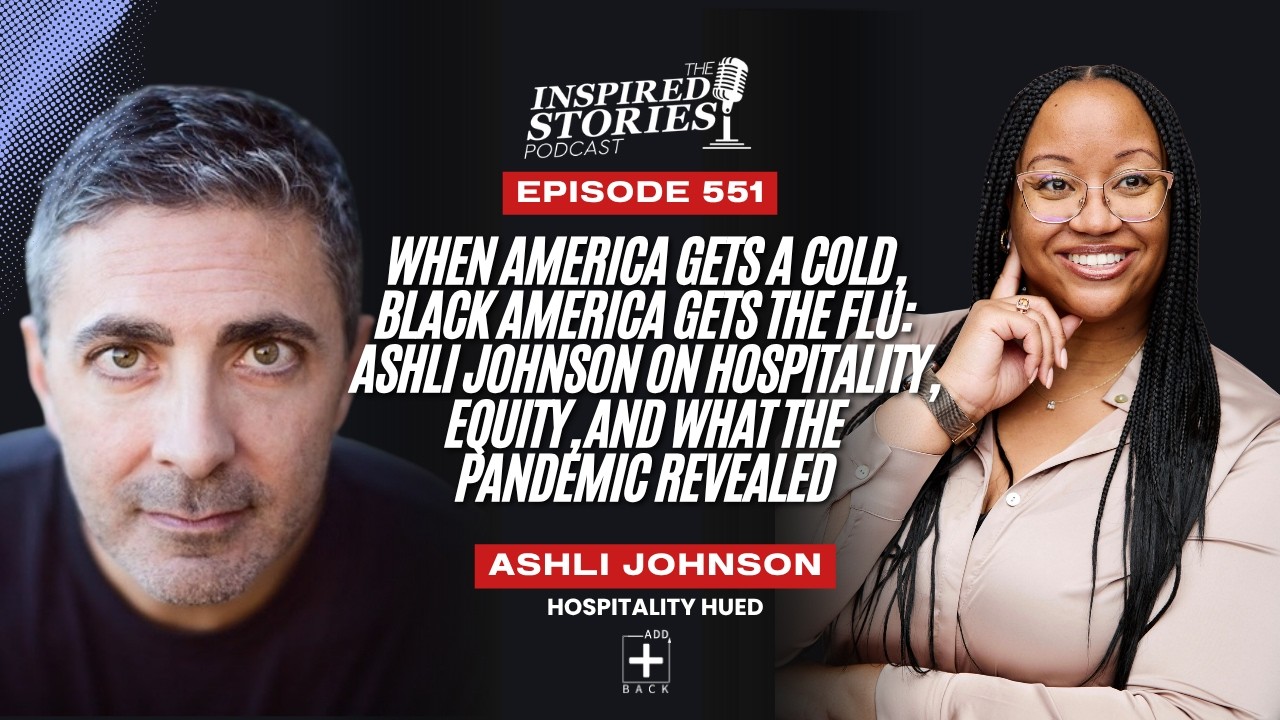
Ashli Johnson, founder and CEO of Hospitality Hued, grew up as a military brat who loved every move, studied at a school that launched its hospitality program mid-semester of her freshman year, and built her early career by reverse-engineering the resumes of executives she’d never met. She spent a decade advising Disney, Marriott, and Hilton on service strategy, built an academic center at Howard University from the ground up, was fired after raising equity concerns at a hospitality college the week after George Floyd was murdered, and then turned a single Manhattan happy hour with 80 strangers into one of the most energizing annual gatherings in the industry.
✨ Key Insights You’ll Learn:
What Department of Defense schools are and why they created one of the most diverse childhoods possible
The classified ad in an industry magazine that Ashli called as a sophomore — and why she didn’t know what black hotel owners were
How Leo Campbell at Lowe’s Hotels taught her why the Saturday golf outing matters as much as the early morning
Valerie Ferguson’s impact on Ashli’s career before they ever met — and what happened when they finally did
HLT 100: the program she created in 2015 to put top minority hospitality students in rooms with executives who looked like them
Honor Hour: why she planned it, what it was supposed to be, and how people showed up without knowing exactly why
The pandemic’s disproportionate impact on Black and brown hospitality workers — and why tech got the talent that hospitality lost
What happened when she raised equity concerns at the University of Houston the week after George Floyd was murdered
What Hospitality Hued does now: the annual summit, Hued Honors awards, co-located events, brand ERG partnerships, and the whiskey education trip to Uncle Nearest
Why nobody loses their voice at a Hospitality Hued summit — and why they usually don’t want to leave
🌟 Ashli’s Key Mentors:
Her Father (Marine Corps, Food Service): Took her to culinary competitions at CIA and Johnson & Wales, opening her eyes to what a hospitality career could look like
Her Mother (Career Social Worker): Planted the seed of being of service and pouring into community that still runs through everything Ashli does
Leo Campbell (Lowe’s Hotels): First industry mentor who explained the game — and why the after-hours dinner matters as much as the early morning work
Valerie Ferguson (First Black Woman to Chair AHLA): A career Ashli studied from afar for years before they met — the proof that the role was possible
Sheila Johnson (Co-Founder, BET; Salamander Collection): The person Ashli learned how to make outsized business decisions by watching up close
👉 Don’t miss this conversation about what it means to see someone who looks like you doing something you didn’t know was possible, why the pandemic hit Black and brown hospitality workers harder than anyone wants to admit, and how a fired academic built the most joyful gathering in the industry from a single happy hour with 80 strangers.
Listen to the full episode here
Transcript
Anthony Codispoti (00:00)
Welcome to another edition of the Inspired Stories Podcast, where leaders share their experiences so we can learn from their successes and be inspired by how they've overcome adversity. As you listen today, let one idea shape what you do next.
My name is Anthony Cotuspodi, and today's guest spent nearly a decade advising major hospitality brands on service strategy. Then walked away to build an academic center from scratch at a historic university. Two years after building it, she left that too. Then she planned a single happy hour in Manhattan in November of 2019 just to see who would show up. 80 people did, and while none of them could tell her exactly why they did.
It opened the door to something special. Her name is Ashley Johnson, founder of Hospitality Hewed, a community built to advance black and brown leaders in hospitality. She previously served as Chief Experience Officer at Urbane Hospitality Group and founding executive director of the Marriott Sorensen Center for Hospitality Leadership at Howard University. But before we get into all that good stuff, today's episode is brought to you by my company.
Add back benefits agency. And you'll want to hear this because it's hurting almost every business you know. Health insurance costs are going up every single year, and hotels and restaurants are furious about it. They're paying more, claims are getting denied, employees are opting out because they can't afford it, and it hurts turnover and morale. It's one of the most maddening problems in running a business, and everyone just seems to accept it. But you don't have to anymore.
Now there's a program that gives employees unlimited access to doctors, therapists, and prescription medications with no co-pays or deductibles to meet. You don't change your broker, and here's the part that really shocks most people. Our product actually increases your net profits. We recently helped a client add $900 per employee per year to their bottom line. Results vary, but imagine what could be done with the extra cash flow.
Get
your free consultation today at adbackbenefits dot com. All right, back to our guest today, the founder and CEO of HospitalityHued, Ashley Johnson. Thanks for making the time to share your story today.
Ashli Johnson (02:24)
Thank you so much for having me, Anthony. It's great to be here.
Anthony Codispoti (02:27)
So Ashley, you grew up moving every couple of years in a military family. And most kids, other kids you knew, would cry when they had to leave, pick up their, you know, leave their home, leave their friends. But you actually loved it. What made you different? What made you the one who is excitedly asking, where to next?
Ashli Johnson (02:48)
Dare I say I've always been the people person, was always very excited to meet new teachers and make new friends, both at school and in the neighborhoods that we lived in. And so I always sort of saw it as an opportunity to come to sort of like continue building upon friendships, not necessarily like leaving a friend per se. So I was the queen of like, you know, having a pen pal and keeping in touch with folks even after I departed.
from them.
Anthony Codispoti (03:20)
interesting. Because even if you're a people person, still you've got a secure base there at home. But for you, it wasn't like it was a goodbye. It was a you know, now we've got just a different way that we're gonna stay in touch.
Ashli Johnson (03:34)
Exactly. And you know, the beauty of being a military brat is that there's a pretty high chance that you're going to run into some of those same friends maybe a little later in life. Your parents may end up getting orders to the same base. And so even though I may be leaving you in fourth grade, I may see you again in seventh grade, that sort of thing. So
Anthony Codispoti (03:56)
Because a lot of your friends that you're making they're also the children of military families. Got it.
Ashli Johnson (04:02)
Absolutely, absolutely. Growing up, most of my sort of K through 12 education, it really wasn't until the second half of high school that I attended public school. so K through probably eighth or ninth grade, I always attended Department of Defense schools. So all military kids in one place. So guaranteed I would see them again somewhere along the line. Yeah.
Anthony Codispoti (04:27)
I didn't know that was a thing. So there
are schools run by the Department of Defense, and it's only children of service members.
Ashli Johnson (04:36)
Exactly. Yep. The schools were on base. so you didn't necessarily have to go far from home, but as you can imagine, a large military base, thousands of families, so there were elementary, middle, and high schools on a lot of military installations. Mm-hmm. Yep, and even
Anthony Codispoti (04:51)
And that's still a thing today. Okay.
Ashli Johnson (04:54)
I think diplomats even have some specified schooling for their students as well.
Anthony Codispoti (05:01)
And as you went from the dod schools into public school and high school, did you notice any differences?
Ashli Johnson (05:08)
huge culture shock. growing up, I think I just assumed that the world was super diverse, as you can imagine, going to school or being educated on a military installation. All of the classrooms are super diverse. All of your teachers are super diverse. oftentimes
you know sometimes we would get students from other countries maybe their parent was maybe a diplomat or maybe was doing some sort of contracting work with with the military at your location and so i had friends from all over the world and they had great stories we were stationed here or stationed there and so it was always just a big melting pot of people and experiences and so
When I finally went to public school, which I had wanted and dreamed about for so long, by the time I actually got to public school, I was like, What do you mean? You've known everyone since kindergarten. Like you
Anthony Codispoti (06:06)
right.
Ashli Johnson (06:06)
all have been together all of this time or you lived at the same address all of your life. very, very different, for sure. but you know, that military training kicks in and you get very comfortable very quickly. Yeah.
Anthony Codispoti (06:23)
Okay. Well, and your
dad's last role in the Marine Corps was in food service. And he used to get invited to judge these culinary competitions at schools, like the Culinary Institute of America is CIA, really
Ashli Johnson (06:36)
Yeah.
Anthony Codispoti (06:37)
big one. I'm curious what watching that did to your sense of what a career in food and hospitality could look like.
Ashli Johnson (06:46)
Yeah, so I think particularly being exposed to schools like CIA or Johnson and Wales University at a younger age, I certainly thought, you know, in my mind school was for being super focused and it being very academic. And it never dawned on me that you could go to school to study a business that you love or that you enjoy. And I thought, wow.
Kids get to cook for fun and it's considered school. Like this is great. How do I sign up for this? I always enjoyed eating more than cooking. so culinary school was not necessarily my path, but it definitely opened my eyes to opportunities in hospitality because I was already fascinated with travel and tourism in different destinations, just based off of virtue of how much we moved and how much of the world I saw growing up.
Anthony Codispoti (07:44)
So you initially started college as a business major and then when you were there, your school announced a hospitality program, I think d your first year, the second semester. And
Ashli Johnson (07:55)
Yeah.
Anthony Codispoti (07:55)
so what made you so certain that that's what you wanted to do?
Ashli Johnson (08:01)
So, Anthony, you know, when you first get to college, you declare a major, but really you got about two years before you actually get into the bulk of those classes that are hyper-focused on your particular major. And so business, while I liked it, I still was not super clear on whether I wanted to go the finance route or in accounting or whether I wanted to do supply chain management.
And so when I read the announcement that a hospitality program was coming to my school and it was gonna be led by at the time they had sort of poached the academic leader from Virginia Tech's program, I thought, this is great because I love everything about hospitality. I can learn about it all and I won't necessarily have to choose a particular function of it right now. and so I knew for sure that that's really what I wanted to do.
Like, this is all of this is interesting to me, all of this is fun. And I thought, wow, if I can make a career out of this, I've hit the jackpot.
Anthony Codispoti (09:03)
Yeah. W
why were you so drawn to hospitality in general, even at this point where you're not
Ashli Johnson (09:07)
Yeah.
Anthony Codispoti (09:08)
sure kind of where you want to specialize?
Ashli Johnson (09:10)
Yeah, so I always describe myself as sort of like the the hospitality nerd even as a kid. I love stopping at a like a rest area off the side of a highway or interstate to collect all of the collateral to see all the tourist destinations and loved using like an atlas and was like, my goodness, there's a hotel here that I've never seen or never heard of. If we were taking a road trip across country, I was always thinking
let me choose the hotel, right? and this is like back when obviously we were not making hotel reservations online. It was just like you blew into town, you saw a place that said they had some vacancy and and you went in there and, you know, and and got a room.
And so I knew that that was super exciting to me and I knew that that had something to do with hospitality. And so I thought, man, if I can really understand how this all works, like how is it that something that we love and enjoy travel?
eating as I got older, wine and spirits, etc. If we can make that into a career, I was like, yeah, this is this is super cool. The other thing, you know, when I think about it, Anthony, is that obviously my father was in was in the military, and so military service and him leading his Marines was always sort of like a a a thread throughout our household. but my mom was also a career social worker. And so that sort of notion of
being of service and pouring into community I think was just always a part of my upbringing and so I think hospitality was a natural fit.
Anthony Codispoti (10:58)
So as I'm looking
at your background here, obviously hospitality is a big part of it, but so is higher education. explain to me how these interests, these worlds overlap.
Ashli Johnson (11:14)
So, of course, education was always a huge theme in my household growing up. I always think back to like I never thought that there was an option of like not going to college. It was just always the expectation was set. but I think after I got into industry, continually I would run into I would say maybe I'm 10 plus years out of school, I was continually running into young people.
Who were sort of frustrated with their newfound careers in hospitality, sort of after they've graduated from a hospitality program. And I was hearing a lot of stories of
I'm going to do something else. Like I spent four years getting this hospitality degree. I then got a job. It wasn't at all what I expected. I'm going to work in banking or something else. And I could never quite put a finger on what that was. and I saw that there was definitely an opportunity in higher education to really bridge the gap from theoretical understanding of hospitality and what it actually looks like in practice. Because I think a lot of classroom
Understanding that students had was that I'm just gonna go work in this restaurant and things are gonna go exactly how it's lined out in the book here. It doesn't quite prepare you for that angry guest or the chef that calls in sick at the last moment. And so that experiential piece I think was somewhat missing. And I thought, wow, maybe I can give back
To these students by actually bringing relevant industry experience to the classroom. And so I was invited to speak on the campus of lots of schools, and I was always puzzled. Like I would run into a student that's a senior and they couldn't tell me what they wanted to do after they graduate. I'm shocked, right? eventually I was yeah,
Anthony Codispoti (13:13)
So how did you help bridge that gap? Like what were you able to show them?
Ashli Johnson (13:17)
yeah. So
I thought back on this because I heard from a former student last week, I believe it was, and she said, you know, I was reviewing my notes from your, I mean, this young lady has been out of school probably 10 plus years at this point. she said, I was actually reviewing the notes from your class the other day. And so I always was intentional about, hey, there's a textbook for this topic that I'm teaching, but if it was printed,
It's already obsolete, right? Our business changes so quickly. And so
Although I would use or maybe leverage some framework from printed text, I always made it a point to A invite industry into classroom, B, I always made sure that students had to be abreast on current trends and news that's actually happening in industry. and of course, all the programs that I worked in required actual in-the-field experience. and so all of that makes it far more.
tangible for students to understand what the what the expectation of industry is once they actually get there, such that they can hit the ground running and start performing immediately. There's not
a big gap there of I thought it was this and now you're saying that it's something else. This wasn't what I was expecting. We were losing a lot of talent in industry. And so when invited by a university not just to be a guest speaker but to actually join faculty, I jumped at the opportunity.
Anthony Codispoti (14:55)
I wanna switch into some of your corporate work because you ended up spending close to eleven years at Urbane Hospitality Group. You're working on service strategy and training with brands like Disney, Marriott, Hilt.
In our work, oftentimes there are two things that can lead to powerful learning experience, powerful building blocks for us. One can be very challenging work experiences that then teach us a different way to do things. And another can be mentors that we meet along the way. Can you explore and talk about one of your mentors during that time at Urbane that was really helpful for you and your developer?
Actually.
Ashli Johnson (15:43)
Yeah. So I'll actually start a little bit before I got to Urbane Hospitality Group. I went to a small liberal arts state school. Like as we previously talked about, the hospitality program was very new. It was not one of these traditional and super well-known hospitality programs that I attended undergrad. And so I didn't exactly have
mentors in a in a formal sense. but what I learned early on is that because I went to school in a you know a super small market and all the rest of these things, I made it a point to
research and study other people's careers so that I could sort of learn from them. And so let's say I was reading an industry publication, I learned about this person. Oftentimes it would sort of highlight in there, this person was just named senior vice president of X, Y, or Z. And in previous roles, this is what they did. I would sort of reverse engineer what was happening there.
okay, so I see that this person is an alum of this school. Did they study hospitality or did they study finance maybe? After they finished school, they did this, that, and the third, and then this is how they landed there. And so I sort of like almost like created these mentors in my head. These were real people, but I didn't know them, right? I didn't have any access to those, to those folks.
Anthony Codispoti (17:17)
But you were using the framework of their
careers to model your own after.
Ashli Johnson (17:21)
Exactly, exactly. once I finished undergrad, my first job straight out of school, I was at corporate management training for Lowe's hotels, and there was a gentleman there by the name of Leo Campbell.
Who very quickly was like, hey, hey, hey, come on, come on in here. Let me explain to you how this all works, right? Although I felt like I had decent relationship working relationships with folks, he really set me down and walked me through, hey, this is how the game is played. Right? These are some tactical things that you should be doing now. You should be doing these things outside of the hours of work. You should be focused on doing these things within the hours of work, et cetera.
etc. and he also exposed me to a woman named Valerie Ferguson. Valerie had
An incredible career in hospitality, was the first black woman to chair the American Hotel and Lodging Association. She did so many phenomenal things. and worked for multiple organizations, even the Walt Disney World Company. And so Valerie was one of those folks that I had just only seen from afar, I had only read about or heard people speak about. And it's so interesting. I probably met Valerie for the first time.
maybe five years ago. and it was sort of like a a love at first sight sort of thing. I was like, my goodness, Valerie, please let me tell you how impactful you've been on my career. Let me tell you who I am. She's like, I know who you are. And I thought
Wow, right? Maybe I've been doing something right. That this woman that I've never even physically met, spoke to over the phone, et cetera, et cetera, even knows who I am. I thought, wow, maybe I'm doing something right, but moreover, she's been doing all the right things enough for me to be able to to
to sort of take notes.
Anthony Codispoti (19:20)
Why had she why
and how had she been so impactful on your career up to that point
Ashli Johnson (19:24)
Yeah.
Anthony Codispoti (19:24)
without you ever even having met each other?
Ashli Johnson (19:28)
Yeah, so here's the thing, Anthony. I think I didn't fully know what was possible for me in hospitality until I saw somebody else do it. So although maybe I was involved in organizations and associations and tried to be in all of all of the right places, I can re- I remember when she was named chairwoman of AHLA and I thought, I never even thought that that was like
It couldn't have I I I never even thought that I could aspire to that. And
Anthony Codispoti (20:01)
Why?
Ashli Johnson (20:02)
so when I saw I think because I hadn't seen anybody else that looked like me in the roles. it was sort of like almost exactly. Yes.
Anthony Codispoti (20:10)
You're a woman, African American, it just that didn't seem like your
place.
Ashli Johnson (20:16)
at all even though I'm in these spaces I'm seeing these things happen I am more than familiar with past in present chairs of organizations like that it just never dawned on
Anthony Codispoti (20:29)
Okay.
Ashli Johnson (20:30)
me because I was often the only in the space yeah yeah
Anthony Codispoti (20:34)
And
I want to go back to the earlier mentor who introduced you to Valerie and and he's telling tell me the name again, I'm sorry. Leo Campbell. And so
Ashli Johnson (20:39)
Leo, mm. Leo Campbell is his name. Uh-huh.
Anthony Codispoti (20:44)
Leo's telling you certain things that you should do inside of work, certain things you should do outside of work. What were some of those tips that he provided?
Ashli Johnson (20:52)
So very simple things. I think one that immediately comes to mind is I can recall very early on, it's like, hey, after work, we're all gonna head out to happy hour. And I'm thinking, no, you know, I'm young and I probably should not be out socializing. I shouldn't be mixing personal and professional, is how I was seeing it in my mind.
And Leo helped me to understand, no, these are opportunities to build relationships with folks outside of the office, right? Is it it isn't about being inappropriate or mixing your social life with your professional life, it's about there are decisions and relationships built based upon how close
or how much time you've maybe spent with someone. And so I didn't understand the importance of, you know, a Saturday golf outing or you know, an after hours dinner, or hey, why don't we go grab another drink after dinner? And I was always like, no, I'm gonna go home and get some sleep and then I'll be the first one to the office again tomorrow. It's like that's great. Like that's one way to work hard. But the importance of really cultivating those
relationships I did I didn't have any frame of reference for that I was just like I should do that okay
Anthony Codispoti (22:18)
That feels like playtime. I'm
serious here. I want to get to work. Yeah. But that's that's
Ashli Johnson (22:22)
Yeah.
Anthony Codispoti (22:23)
how you forge a lot of those relationships, right? You break bread together, maybe you share a couple of drinks. Yeah, you really get
Ashli Johnson (22:26)
Exactly. Yep.
Anthony Codispoti (22:28)
to know somebody on a personal level. And as you got to know Valerie on a personal level, right? She went from being this figure that you admired from afar and like, man, she's doing it. You know, I can do those things. Now you've met each other. Talk to me about how.
that relationship continued to evolve in a way that helped you to grow.
Ashli Johnson (22:50)
Yeah. So I think Valerie's sort of example, right? Just her lived experienced example of her being a leader in this industry, how she's been strategic in in sort of accepting promotions or deciding if she was going to leave an organization to join a a new one is valuable in its own right. one one name that that I did not mention earlier is that of Sheila Johnson.
And so very similarly, it's just like I've just seen this person from afar. I've read her about I've read about her in books and magazines and seen her on TV and this sort of thing. And you know, I I met Sheila probably before I even met Valerie. And Sheila Johnson is this larger than life figure, not literally because she's kind of tiny, but
You know, she is, you know, a black woman billionaire in America. It's it's like her Nobra. It's like, how do you how do you get to this place in space? And so for her to have drinked and executed the vision on salamander, the salad what is now known as the Salamander Collection, for me to be able to sort of a forge a relationship with her.
And B to be able to ask questions about how did you make this decision? What made you continue to push forward when you got so much backlash? Or it seemed almost like insurmountable. Being a billionaire certainly helps, right? But how do you make these business decisions? And so it has been extremely helpful for me to just be able to sit in her presence and see how she works. And so that has been.
To me, it doesn't it doesn't feel like sort of like traditional mentorship, but it has been exponentially as valuable as as sort of traditional mentor mentee relationships have been over the years. So I would say, you know, if there is a you know Ashley's Mount Rush amore, certainly both Valerie and Sheila Johnson
are
Anthony Codispoti (25:14)
Yeah.
Ashli Johnson (25:14)
are are are carved in the side of the mountain.
Anthony Codispoti (25:17)
You know what's
what's interesting is I hear you talk, Ashley. I'm I'm trying to connect dots to my own experiences. And it in
Ashli Johnson (25:24)
Yeah.
Anthony Codispoti (25:24)
some respects I can, in some respects I can't. You know, I've benefited hugely from sitting with people who think bigger than I do, who are far more successful than I am, and seeing how they think about a problem, how they approach it, how they don't think about incremental gains. They think about, you know, these huge leaps and
been hugely valuable for me. That part I connect to. The part that's harder is as a white male, I don't look at positions in the world and think that's not accessible to me because of how I look. I might think
Ashli Johnson (26:01)
Sure.
Anthony Codispoti (26:01)
of it just because I don't have that experience or, you know, I I don't think big enough. and so say more about that mental boundary, that barrier
for you that has existed and and why and how you've gone about trying to break it down.
Ashli Johnson (26:23)
Yeah. So I can recall being an undergrad. I was on a summit a summer internship. I was fanning through a magazine on my lunch break, of course, an industry publication, right? Because what else was I reading? and came across sort of like a small classified ad, and it said something to the effect of black hotel owners are having a conference. And I thought
What does that mean?
I I did not immediately associate it with African American hotel owners are convening. because
Anthony Codispoti (27:05)
What did you think it meant?
Ashli Johnson (27:07)
I I didn't know. I thought maybe is there a hotel brand called Black Hotel? Like I literally had no frame of reference for what this meant. Because no, no. Mm-mm.
Anthony Codispoti (27:17)
You couldn't think that there was a group of African Americans that owned hotels.
They could wow. Okay, please continue.
Ashli Johnson (27:25)
Never never
even crossed my mind because you know at that time undergraduate education is like, hey, this is how you anticipate a guest need. this is how you calculate food costs. even when it came down to like career fairs or or career opportunities, it's like, hey, you can go work for Marriott. In my mind, every Marriott Hotel was owned by Marriott International.
This was my rationale. So I'm thinking, why would there be black hotel owner? Like I I had no clue that this was a franchise business. No idea. It was not taught to me. we never sort of like discussed this. I think there was maybe some some talk about management companies or third party management companies, but it it just the the connection never crossed my mind that wow.
Maybe there are maybe there's a woman hotel owner out there somewhere or a black hotel owner out there somewhere. So I see this little classified ad. There's a number. I call the number and the CEO of this organization answers the phone and I say, Hi, my name is I'm
I'm a sophomore at the school at the University of West Florida and I'm studying hospitality. And I saw this ad, like, what does this mean? And so Andy Ingram explains what this is, and I said, wow, like could I maybe volunteer at this conference? And he's like, sure. And so I make the journey to Miami, Florida for this conference, and
I was blown away. Like this side of the business, I had no purview into at all. So it wasn't like the room was only filled with black people. There were brand representatives. And I'm speaking to people, I can remember meeting a team of people from Choice Hotels, and I was like, So, like, what like what do you do? And they're like, we sell franchises. And I was like,
Huh? Like like w wait, you're selling what exactly? Like all the only frame of reference that I had for a sales role was like you're selling a banquet space or like selling a few rooms. I mean, I'm a kid, right? And so not only being exposed to brand functions that I was unfamiliar with, like owner relations or franchise sales or
feasibility I had I had no clue about any of this. but the icing on top is me seeing a black person say, I own five hotels. I own ten hotels and like how did this happen? Like my mind absolutely blown. That absolutely changed the game for me. Right? Because I thought my entire aspiration should be to be a general manager in four years. I should
start working at the front desk and then I'll just like work my way up and eventually, maybe, hopefully, prayerfully, I'll become a general manager one day. Like I thought that that was the goal, that was the intended pinnacle of studying hospitality.
Anthony Codispoti (30:45)
This this blows my mind that this was such an eye opener for you. But I'm
Ashli Johnson (30:50)
Yeah.
Anthony Codispoti (30:51)
trying to put myself in your shoes. And I guess you didn't have any peer models growing up, like people to look to
Ashli Johnson (30:56)
No. No.
Anthony Codispoti (30:58)
that say, they look like me. That that's attainable because somebody else that's that's like me has done that.
Ashli Johnson (31:05)
Yeah, no, it's particularly not in the hospitality space, right? I had family members that were entrepreneurs in very different industries. So I knew that it was possible to own your own business, but I didn't I had zero frame of reference for what that could look like in the hospitality space.
Anthony Codispoti (31:27)
So while we're on this thread, tell me about HLT one hundred. This is
Ashli Johnson (31:32)
Yeah.
Anthony Codispoti (31:33)
something you founded back in two thousand fifteen to identify and develop minority hospitality leaders. How did you cook up this idea?
Ashli Johnson (31:44)
In my observations of college students, often I would come across someone who I just felt like was super high achieving, could really do phenomenal things in the industry. and when asked, hey, what are your plans after graduation? They would say, I'm a server at this restaurant and I'm gonna keep working there after I graduate. And I would think
Are you kidding me? There's so many different opportunities. Like you could like you really could do something phenomenal. And so HLT 100 stood for hospitality leaders today. Because you know, oftentimes programs for future leaders, it's like we're looking for leaders for tomorrow. My thought was, no, we need to invest and develop these these young people today, so that they can sort of immediately be impactful. And so
I just like dri I'm crazy, Anthony, if we've not already been over this. I thought I'm going to find top performing students at schools across the country, all kinds of schools, most of them hospitality majors, some business majors in there, but but obviously have an interest in hospitality. And so what I felt like I could give them was
some of that game that Leo Campbell gave me and expose them to concepts and possibilities much earlier in their careers. And so that's essentially what happened. So I would walk them through essentially like a professional development program remotely. This was long before the days of of Zoom and you know we were
I think we were probably using 1-800 free conference call. No, we I don't even think we were on Skype. Yeah.
Anthony Codispoti (33:34)
Skype? Okay.
Ashli Johnson (33:38)
We're just using the free conference call lines. and similar to some of the assignments that I would give my students in the classroom, I would assign them. and then over the summer, towards the end of the summer, because you should be interning, right? At the beginning of the summer,
I would gather this group of students, 25 students a year, and essentially put them in a room with executives that they would ordinarily or otherwise not have access to. Oftentimes executives that look like them. So I can. Exactly, exactly. Yeah, yeah.
Anthony Codispoti (34:16)
So you're you're doing the same thing for them that that Miami event did for you, opening their eyes that this can be you. This is what you can aspire to.
Ashli Johnson (34:26)
And created it in such a way that it was really centered around the students. As you can imagine, if I invite a C-suite level executive to speak to an audience of a thousand people, it's probably gonna be an extremely scripted conversation. They have a speech written out, they're gonna stick to that. but in front of a group of 25 students.
You can get very vulnerable and very real about what your experiences have been, what you've seen, what are the hurdles, and hey, answer questions in a very sort of conversational way. And so I can remember the first year that I did this, so many students were like.
I had no idea that there were black people that were CEOs of banks. I never even considered, you know, I I know that I like numbers, but I just thought that my goal should be to be an accounting manager or or an account payable manager. That was my ultimate goal. But now I realize that I could be a a regional senior vice president of revenue management. amazing how just that that exposure.
opened up a completely new world. And so those students today are vice presidents themselves. and so it it has been phenomenal to see them grow and end up in very different places and spaces. I can remember there's a a student Christian LeBlanc who was
He was like a culinary whiz, right? He did pastry, he did he's great in the kitchen, phenomenal cooking chef. He had gone to culinary school. And I said, Hey, there are other aspects to this business that I think you can really be great in. And so he works for Rockbridge now, and has a master's in hospitality in real estate from Cornell University. I met him as an undergraduate student that really wasn't thinking about
alternative lines in the business. He was just thinking, I'll be in the kitchen, you know, indefinitely or at working at a front desk indefinitely. And so I'm so, so proud of how quickly they've sort of ascended through the business because myself and you know the folks that agreed to come speak to them were intentional about sort of planting those seeds. Yeah. Yeah.
Anthony Codispoti (36:51)
Yeah. How rewarding that must feel for you. So let's go to
November of twenty nineteen. this is
Ashli Johnson (36:57)
Mm.
Anthony Codispoti (36:58)
when you decide to host that that happy hour in in Manhattan. you called it the honor hour. Why that name? What were you thinking? What was the purpose of all of this?
Ashli Johnson (37:12)
Yeah, so again, over the course of our career, I attend a lot of conferences. I've been really honored to be an invited speaker at just about every industry gathering possible. I grew weary of being the only person that looked like me on stage and often wondered why are there only three women in the room or
Two black or brown people in this entire room of 800, 1000, 2,000 people. And so I thought, wow, maybe there's just not, there has not yet been a space carved out specifically for this group of people. I know that we exist in industry, right? You go to any hotel, restaurant, I see people.
But also I'll note that oftentimes when I was in a particular market attending a large industry event, I'm always chatting with folks, Anthony. So I, if I run into the GM of the hotel, I say, I'm in town for XYZ conference, and they would say, What's that? And I'm thinking, what do you mean? You work in the business, you live here in this market, this huge thing is here in this market. What do you mean you don't know about it?
Right. And so I thought, yeah, maybe I can do something about this. I don't have to be the only person in the room. I don't have to be the only person in proximity to to power or possibility or opportunity. I can create the space. And so honor hour was my thought of, hey, there is an opportunity for me to honor someone in that particular market that I felt like everyone should know.
This also came out of me often being in a market and two people that I feel like should know one another had never crossed paths, right? So if there were two black general managers in the market, why what do you mean you don't know the other? There are two women DOSs in this market. What do you mean you don't know this other person, right? You should.
And so that's where honor hour came from. Every honor hour there's always a guest of honor, right? Someone that maybe you've read about, heard about, but never really had the opportunity to meet or cross paths with, that person's gonna be at this honor hour. So come on down, grab a little and a beverage and connect with this person, but also connect with other people that are in that particular market. And so in Manhattan,
There were so many folks that worked in the hospitality space. I even had two people come to me and say, hey, we work directly across the street from one another in the same role in the hotel, never knew the other person. And I thought, that's so bizarre, but so glad you're here. Now y'all are connected. Let's let's sort of keep in touch. So that's where the honor hour idea sort of spun from.
Anthony Codispoti (40:14)
And so you had eighty people show up to the first one. we made the comment in the intro, tell me how accurate this is that a lot of people are like, I'm not even really sure why I came, but I felt drawn to this, yeah.
Ashli Johnson (40:26)
Yes, yeah. I always share that hospitality hued is really just me facilitating community, right? People are
Based upon their identity, already a part of the community, but there hasn't really been a space that is facilitated or cultivated for them to come into. And so I think that that's why folks were like, hey, I don't really know what this is, but but someone sent me the flyer, or I saw it somewhere, or I saw it on LinkedIn, or whatever the case was at the time. And
I don't know. I just sort of felt drawn to coming here. And now that I'm here, what is this? And how can you sign me up? I wanna be a part of this. I wanna I wanna be in the room. I very much enjoyed
meeting folks that do the same work that I do. No one understands the hospitality business better than the next person in the hospitality business. and so it just sort of grew from there. By the time we had the second hospit hospitality hued honor hour.
We had folks that were flying in from other states to attend. and so I thought, okay, yeah, we're we're on to something. There's a there's a space here that has not been consistently carved out, if ever carved out before for black and brown or what I like to call the most underestimated population of hospitality leader.
Anthony Codispoti (41:57)
It strikes me you're like the mycelium of the black and brown hospitality world, right? This
Ashli Johnson (42:04)
Yeah, yeah.
Anthony Codispoti (42:05)
this n network connector that like all these
Ashli Johnson (42:08)
Uh-huh.
Anthony Codispoti (42:10)
all these people have existed in these roles, but
now you're connecting
Ashli Johnson (42:12)
Yes.
Anthony Codispoti (42:13)
them together. You're letting them know that hey, we're we're all here and we can be better connected and support each other. And so
Ashli Johnson (42:17)
Mm-hmm. Yes. Yeah.
Anthony Codispoti (42:21)
you plan that second out honor hour.
In Houston this time, right? You're going to a different part
Ashli Johnson (42:27)
Yeah.
Anthony Codispoti (42:27)
of the country and you start telling people to save the date. We're going to do it in October
Ashli Johnson (42:32)
Mm-hmm.
Anthony Codispoti (42:32)
of 2020. And then what
Ashli Johnson (42:34)
Yeah.
Anthony Codispoti (42:34)
happens a couple weeks later? COVID hits, right? The country shuts down. So what did you do
Ashli Johnson (42:38)
Yes, yes.
Anthony Codispoti (42:41)
with this idea that seemed like there was some energy and some momentum behind it when the world just hit the pause button?
Ashli Johnson (42:50)
Yeah. I think the pandemic obviously was a shock to everyone. What we felt like maybe would only last for a couple of weeks, a month, tops, turned into something much larger. and obviously I knew that I sort of had to put this on pause because of the dramatic impact that the pandemic had, particularly on the hospitality industry. And so so many
of this underpop this underestimated population were impacted by the pandemic. And so
While I didn't, you know, I yes, there wasn't much to be done during this time. I, you know, hosted some webinars and that sort of thing. But so many folks were losing their jobs and feeling like I'm not gonna come back to hospitality, which was honestly just heartbreaking to me. But I totally understand it. You've got a family to feed, you need to you need to make money to sustain yourself. And so
when I thought about when I thought about the impacts of the pandemic, I don't know if you've ever heard anyone say this, Anthony, but it is often said, particularly in the black community, that when America gets a cold, black America gets the flu, right?
Anthony Codispoti (44:17)
No.
Ashli Johnson (44:17)
It could it could turn for black America any economic shift. while it affects America
having a cold, black America get can get the flu. And so as you know, the flu can advance to pneumonia. It could it could get really bad. You may not live to tell the story.
Anthony Codispoti (44:37)
And what's what's the thinking
behind that saying? Is it why why does black America get hit hard?
Ashli Johnson (44:45)
Mm-hmm. Because of honestly, systematic racism, because of black people operating at an economic disadvantage. And so when I think about that through the lens of hospitality, hospitality is super diverse. Where are most underrepresented minorities in hospitality roles? They're in lower level, entry-level, maybe mid-level leadership roles.
Those were the first and second waves of jobs being eliminated in hospitality, right? I don't, I mean, obviously I know tons of folks in hospitality. There were, I mean, obviously, hospitality brands, they made it out out of the pandemic. It might have been a little rough, but they made it. Most executives made it out of the pandemic, often with their same jobs.
either they stayed in the role throughout the pandemic, or maybe they were furloughed but had an idea of when they would come back, this sort of thing. I think that black and brown folks were so disproportionately affected by the pandemic in hospitality because we often operate in those lower-level roles. Those were the first eliminated, right? And so that sort of just
Anthony Codispoti (46:07)
People who are already
kind of living on the edge, paycheck to paycheck. Yeah. Okay.
Ashli Johnson (46:11)
Exactly, exactly.
And so when I thought about, hey, where do we really need to be focused here? It's like we need more folks that look like me in executive level roles, in positions of ownership, because those weren't the folks that that sort of lost their way in the pandemic. And so that just sort of drove home the reality for me as it related to
black and brown people that work in this business, I knew that I couldn't, you know
just drum up some event idea. First of all, we lost so many folks in the pandemic. because they were like, hey, I'm working in a new industry. I found a new job. Or you know, I heard so many stories about folks that were like, hey, turns out I'm making more money in the gig economy, or I've become an entrepreneur as a result of this. hospitality was already kind of hard for me. but now I see, you know, I and I've said this somewhere before, Anthony, that
I'm not sure that hospitality did a good enough job of attracting everyone that we lost back to hospitality. We lost a ton of the workforce, and you know where they went? They went to banking, they went to tech, because tech did a heck of a job in recruiting those folks. Hey, you have all these phenomenal transferable skills. Come be a program manager at Google.
It's like, and for a hospitality person that's maybe been doing this for 20 years, it's like, wow, you won't go home on time. And you've got stock options. And and and a guest isn't like, you know, threatening my life every other day. This is the most, this is the greatest thing. It's such a, it's a, it's a a lower stress, higher gain type of equation. And so I'm always saying, I think technology got a lot of our talent coming out of the pandemic.
Anthony Codispoti (48:08)
Okay. So to
Ashli Johnson (48:09)
Yeah.
Anthony Codispoti (48:10)
continue the timeline of how hospitality hued evolved here,
Ashli Johnson (48:15)
Yeah.
Anthony Codispoti (48:16)
my guess, my understanding is that it kind of went on the back burner for a while, right? You
Ashli Johnson (48:22)
Mm-hmm. Yeah.
Anthony Codispoti (48:22)
end up taking a role as the VP of education at the largest hotel owners association in the world.
Ashli Johnson (48:30)
Yeah.
Anthony Codispoti (48:30)
then you are tapped to build the Marriott Sorensen Center for Hospitality Leadership at Howard University.
And then in twenty twenty four you stepped down from that role and you plan to rest. You were just, you know, you'd been kinda going, going, going, you were gonna take a a
Ashli Johnson (48:47)
Yeah.
Anthony Codispoti (48:48)
break, but that didn't happen. Tell us why.
Ashli Johnson (48:53)
It did not. you know, I thought it was gonna be really great, Anthony. I was gonna like finally take that vacation that I've been threatening to take for 10 years. but my phone kept ringing with folks saying, Hey, I need support, I need help.
and oftentimes those calls were about navigating in maybe a a circumstance internal to their own organization. Perhaps they were looking for their next opportunity. perhaps it was an organization saying, Hey, we really want to get this equity and inclusion piece right. What are your thoughts on this? it was organizations calling for
sort of thought partnership about establishing employee resource groups to serve black and brown employees. And I thought the need is still there, right? Industry came back after after the pandemic. and the need was was the need still very much existed for community to be cultivated and facilitated for black and brown leaders, owners, executives in the business.
Anthony Codispoti (50:09)
And so people keep tapping you, they keep calling you, and you realize there's a need there. And so was it just immediately obvious that I need
Ashli Johnson (50:13)
Yeah.
Anthony Codispoti (50:17)
to pick back up with what I sort of the initial vision of hospitality hewed, or were you not really sure kind of what the next steps looked like?
Ashli Johnson (50:26)
Yeah, I knew that, you know, initially that this was a part of the vision starting back in twenty nineteen. and I knew that this was
an answer for all of all of the the inquiries and the questions that I was receiving at the time. of course I thought about hey is there a particular organization that could do this? Is it could it maybe be more beneficial for me to
you know carve out a role within a company that could do this for an entire industry. And I was like, likely not, right? And so I knew that doing hospitality cube full time was the best use of my time and talent and a hundred percent what the what the industry needed at the time. And even now.
Anthony Codispoti (51:20)
And so how did you kick it back up? What were some of the first steps that you took?
Ashli Johnson (51:26)
Yeah, first things first, I I went back to the honor hour idea. So we hosted honor hours in Atlanta, Miami, and Los Angeles. some of those honor hours had turned into sort of honor brunches, you know, with sometimes the brunch is the answer or breakfast isn't is the answer. and no, nope.
Anthony Codispoti (51:48)
And y are you charging people to attend at this point, Ashley? Where's the
funding coming from? How are you paying your own bills?
Ashli Johnson (51:56)
Ashley Johnson's bank account. That's a
Anthony Codispoti (51:58)
Wow.
Ashli Johnson (51:58)
great inquiry. Yeah. But true story. there there was there was not a charge for any of this. I think at some point maybe we maybe it was like twenty dollars or something like that to attend something, but you know, obviously exactly.
Anthony Codispoti (52:14)
That doesn't even cover your costs.
Ashli Johnson (52:16)
Exactly. So and I also knew that an in-person summit needed to happen to bring all of these folks together from across the country. While very powerful to get folks in a particular market together.
Also super powerful to bring people from multiple organizations, multiple markets, together in one place. And so our first in-person hospitality huge summit, we're now going to our third year. it was really just a transformational time. there were so many people that I and I still hear about that summit today, about
I never even thought that my career could go in this direction. I never considered being intentional about diversifying my supplier my supplier list or my vendor list. and I think people really
putting into practice what it means to be in community with other people, right? It's not just, hey, what can I take from this community? But people also just showing up with their own gifts and talents and saying, hey, I was once where you are. Let me help you walk through this. All of that magic together in one room is is really, really powerful.
Anthony Codispoti (53:42)
So paint a picture for us today, Ashley. What does hospitality hued do and who do you do it for?
Ashli Johnson (53:51)
Yeah. So I always affectionately say that hospitality hued, our community is for black, brown and anyone that's down for the cause of elevating black and brown leaders in the industry. And so that leaves the room always very diverse. there are all kinds of someone asked me a few years ago, it's like, are it's only black and brown people that can come? I'm like, there are all manner of people that come to hospitality hued. and
Yes, our you know, probably most popular event every year is the summit. and I call it a summit and not a conference because there are so many hospitality conferences out there in the landscape that this summit has to be different.
And and it's different because I'm intentional about the way that we craft the room, about who's in the room, about what we can all agree upon to create a safe space for people to truly share and be candid and honest about their experiences, candid and honest about asking for what it is that they need. I'm always reminding folks like the the resource that you need is in this room, right? But but we've gotta talk about it in order to bring that to bring that to reality.
And so that's our that's our largest event each year. We also host something in March called Hewed Honors, which is an industry awards ceremony that is elevating and celebrating black and brown.
hospitality leaders. And so as you can imagine, there's a nomination process for General Manager of the Year or Executive of the Year or Emerging Leader of the Year. But we also highlight and celebrate the equivalent of what I would say is like a lifetime achievement award. So there are five folks each year that are honored for the phenomenal work that they've done over the course of a career.
because honestly our names are not called enough, they're not elevated enough. and so we hosted that earlier this year in Atlanta and literally a sold-out crowd, a packed room, and people are
I mean the joy that fills the room is it's it's like tangible. You feel like you could just like hold it in your arms. And so in addition to that, we also have various programs that we run throughout the year. So maybe it's a book talk with with an industry author. perhaps it's a Black History Month celebration. We work with a lot of the employee resource groups of larger brands, maybe we'll partner on something like that. We've done a really cool whiskey education event in Tennessee.
only
learning about you know the the large marquee brands like Jack Daniels which we all know about
But also learning about the barrel maturation process, like things that can just help you in your everyday life. So we spent time both with the team at Jack Daniels and also with the team at Uncle Nearest. And so we do corporate visits, smaller dinners, and this sort of thing, just making sure that people have an opportunity to connect. And often we do this by co-locating some of these events, receptions, honor hours.
Around larger industry events that maybe aren't super populated with folks that look like us, but we always find a way to find one another and tap into the local market wherever that may be, if it's New York, Philadelphia, Chicago, Miami, LA.
Anthony Codispoti (57:43)
So people have told you, Ashley, that they'll leave your summit without needing recovery time. And anybody who's ever been to a summit or a conference, like you get back and you're just wiped out. It's just, you know,
Ashli Johnson (57:54)
Yeah.
Anthony Codispoti (57:55)
just it's just intense and like you're always on. Like, what are you doing differently in your events
Ashli Johnson (57:56)
Yeah. Yeah.
Anthony Codispoti (57:59)
with that programming that people leave and they don't need that recovery time? They actually feel their charge.
Ashli Johnson (58:05)
Yeah. Well, you know
Anthony at first meets the eye. I would say it's because we have really great conference food and the afternoon breaks may come with a boozy popsicle or a banana foster station that's you know on fire and you know, ice cream sundae stations and this sort of thing. it could be the phenomenal breakfast that we have. We do not believe in a in a continental breakfast that hospitality Hued So sometimes it's that.
Some may say that it is the dance breaks in between sessions and panels. And we don't allow anyone to not participate. Some people would say that it's the competition, the fiery competition of who has on the best sneakers every day because we're not doing the typical black and brown suit and the hard bottoms, and you're just exhausted by the end of the day because you had on this too tight suit.
all day. it is some of that. it is, you know, some of the I think the sort of like fun that we have at the a welcome reception. It's not uncommon that perhaps a wine that we're featuring at that welcome reception,
The vineyard owner of that particular label is present, right? So it just it's a very different vibe at Hospitality Heat, I would say. But moreover, I think that we have done a really great job of eliminating the need for code switching. We encourage people to come in the room as their full selves. come in the room vulnerable.
Every speaker that we have, of course, you know, there's always speaker prep and a couple of calls in advance and this sort of thing. but I'm always encouraging speakers to to be as unscripted as possible, to be to be as real and candid as they are comfortable or can be. and what this leads to is moments with a speaker and two people in the audience, or
speakers being able to actually spend time with folks in the room. And you know that even if you're attending this conference with you know we often have organizations that send 10 people, 20 people, 5 people that you may know, we're offering an experience that you're not gonna get at an at at any gathering that is hosted by your brand.
but also that like you're you're in a really safe space that you don't have to worry about this haunting you afterwards. usually around November of every year, Anthony, I lose my voice. I can count it on a calendar because leading up to maybe like the week before Thanksgiving, I'm usually on a run of like three to four different conferences. I've done so much talking.
on stage and in one-on-one conversations, I know that I'm gonna lose my voice every November. Nobody's losing their voice from laughing too much or
Anthony Codispoti (1:01:29)
Ha ha.
Ashli Johnson (1:01:29)
enjoying themselves at Hospitality Hued and feeling like they've truly been seen, right? And so usually, you know, you get done at a conference, you're like dying to get back to your hotel room for two seconds to, you know, come down, just just taking a mental moment for yourself.
Usually folks don't need that that hospitality Hued They're like, What's next? It is. it is.
Anthony Codispoti (1:01:51)
Yeah. It sounds like a good time. So you ask
folks to show up to your events with the openness of being vulnerable. I'm gonna ask the same of you right now, Ashley. What's the hardest thing
Ashli Johnson (1:02:02)
Absolutely. Mm-hmm. Yeah.
Anthony Codispoti (1:02:06)
you've had to overcome personally and what did going through that teach you?
Ashli Johnson (1:02:10)
Yeah, you know, I when I think about professionally and even in my personal life, I have a really tough time being misunderstood, like my intentions being misinterpreted. And so I can remember a time at the onset of the pandemic, maybe a little into the pandemic.
But it was like we were dealing with a pandemic, but we were also dealing with this national crisis behind the murder of George Floyd. And at the time I was working at a university, and George Floyd happened to grow up just a few blocks away from this, from this institution. And so,
We were dealing with a lot as leadership of this college. students were confused on what to think, what to believe, their safety in coming to class, wanting to, you know, young people are always at ground zero when it comes to advocating for themselves and and making sure that their voices are heard.
And I thought about I was at the University of Houston at the time, and I thought about
What are we gonna do in this moment? Right? the University of Houston at the time probably still is one of the most diverse universities in the country. Houston's one of the most diverse cities in the world. the college there, the hospitality college, we were preparing to celebrate 50 years of the college. And I was the first and only black person.
let alone black woman to ever serve in the dean suite of that college in 50 years. When I looked at our board structures, we had two boards, one in Houston, one in San Antonio. I mean, our boards, our boards, advisory boards at the time were fairly large: 20, 25 people, 30 people on a board, one black person between two different boards. When I thought about you know, students.
student demographic very diverse all kinds of students international students black white Puerto Rican Asian everything in between but when I looked at faculty no full-time black faculty members in the entire college and I thought we've got an opportunity here team leadership team we should be thinking about being intentional about recruiting faculty members that that
students can identify with. we should be intentional about who we're inviting into our classrooms to be guest speakers. we should be intentional about the types of employers that we expose our students to. All of these things. Alumni of the year award. We've been giving out alumni awards for you know more than 50 years. There's never been a Black Star alum that won this. We have all kinds of alums.
And so you know, obviously it's it at the time very sensitive topic. And I'm talking like the George Floyd had very recently been murdered. and I said to the leadership team, less than 10 of us on the leadership team, I said, hey, I think we have a really solid opportunity to be a leader here.
amongst hospitality programs. I wasn't really speaking from the university level, I just the college. and that was
Taken as not as I intended it. It was taken as, do you feel discriminated against? I'm like, no, I didn't, I didn't say that. I said, hey, maybe we can revisit some things, maybe we can provide some services to our students to help them make sense of what's happening in the world around them.
That ended up being a very tough time for me because that was completely misconstrued by the leadership of the college.
Anthony Codispoti (1:06:43)
So they weren't on board and they received what you were saying as some sort of an indictment on how you were being treated. And there wasn't an explanation
Ashli Johnson (1:06:52)
Mm-hmm. And I didn't I didn't
Anthony Codispoti (1:06:54)
that could sort of recalibrate that for them.
Ashli Johnson (1:06:57)
No, no, no, no. Now, in all fairness, I will say not all of my colleagues felt that way, right? many of them reached out to me individually to say, hey, you're right, we need to take another look at this. Hey, you're right. We can be one of the early hospitality programs to really get a handle on this. Hey, you're right. but ultimately, the leadership of the college was like, What's going on here? Now
maybe a week or two after I expressed this to the leadership team of the college, the president of the University of Houston said, Hey, the university is not going to sit by Iderley and let this happen in our city.
without us being of support to the city. And so the University of Houston laid out an incredible plan to support students, to support faculty, to support staff. We opened up the doors to, you know, just larger convening spaces on campus for the mayor of Houston to host public town halls because again, George Floyd was from this area.
offered all sorts of counseling and therapy services and i i have to give a ton of credit to president renew who was just phenomenally leading at that time but specific to the college not much changed not much shifted and not long after that
Positions, well, one position was eliminated in the name of saving the bottom line of the college and it was mine.
Anthony Codispoti (1:08:39)
Wow. Wow. The slap in the face. Well,
Ashli Johnson (1:08:42)
Hmm. Yeah.
Anthony Codispoti (1:08:46)
I guess the the silver lining of all of that is we probably wouldn't be having this conversation about the work that you're doing now had that not happened, but
Ashli Johnson (1:08:52)
No. That's true.
Anthony Codispoti (1:08:57)
still what a gut punch.
Ashli Johnson (1:09:00)
Yeah,
I think it I think it was more of a shock because I thought, no, I'm wanting all of us to come together and kumbaya and do good things. And and I thought, wait, I'm not I love my job here. Love the team that I had, love the students there, had a phenomenal board of industry local industry leader, local and national industry leaders. and for a while I felt
like I said, very much understood, but also like deeply offended. Like I would I didn't say anything harshly or I'm saying, hey, we should be hospitable in this moment to
Anthony Codispoti (1:09:41)
Yeah.
Ashli Johnson (1:09:42)
all of our stakeholders. and that was that was very tough to understand at the time. I'll add one other quick thing on to here, Anthony.
A large industry media group around this time asked me to moderate a conversation on the importance of diversity. Actually, it was the importance of inclusion more specifically. And so they had assembled a small group of people, very diverse.
to speak from the perspective of being a member of the LGBTQIA community, a part of the Indian American hospitality community, a part of the Black community, et cetera, et cetera, all as it relates to hospitality. And even in this time, again, the country's like on fire. We don't know what's going on.
And some folks listening may remember this. This was you know, a produced sort of segment, but we're using Zoom Live. And that topic was going swell for about five or ten minutes into the conversation before it was hijacked. I think they were calling them like Zoom pirates at the time.
And in very public forum, I was called out of my name and called very racially triggering derogatory terms in front of industry colleagues,
Anthony Codispoti (1:11:20)
My gosh.
Ashli Johnson (1:11:21)
faculty members, people from all over the country that were tuned into this thing. And I thought,
Okay, obviously we're gonna have to end this call. Of course, there was nothing that we could do at the time, right? You remember, you remember back when we had like everybody's little Hollywood Square, right? There are you know probably 60, 75 people on this call. And I just remember thinking, how can we think that this topic is not deserving of solution?
immediate solution when of all the things that could have been hijacked that day or ever, this was the topic that was sort of singled out. And so you know that obviously over time inspires the work. but you know it's it's a it's a point of embarrassment for sure, but also
Anthony Codispoti (1:12:15)
Yeah.
Ashli Johnson (1:12:16)
an opportunity to have
You know, I had some really meaningful conversations coming out of that because so many colleagues from across the country that were on the call were like, I've never experienced, you know, I've only heard stories of people being accosted or someone saying something racially triggering to someone. I'd I never they had never seen that or heard it, you know, in real life or to someone that that they knew.
And so, you know, these moments build us, right? Even if even when they feel uncomfortable in the moment, they were building blocks for me, and certainly reminders of the importance of the work that I'm doing now. So I count
Anthony Codispoti (1:13:08)
Wow.
Ashli Johnson (1:13:09)
it all joy. Yeah.
Anthony Codispoti (1:13:11)
For you.
one more question for you today, Ashley. But before I ask it, I want to do three
Ashli Johnson (1:13:15)
Yeah.
Anthony Codispoti (1:13:16)
quick things for the audience. First of all, if you want to get in touch with Ashley Johnson, learn more about what she's doing, go to her website, hospitalityhued.com. Hospitalityhued, H-U-E-D.com. It'll be in the show notes, but hospitalityhued.com. And if you're enjoying the show today, please take a moment to subscribe wherever you're listening.
It also sends a signal that helps others discover our podcast. So thank you for taking a quick moment to do that right now. And as a reminder, you can finally get your hotel and restaurant employees access to therapists, doctors, and prescription medications that counterintuitively actually increases your company's net profits starting in the very first month. There's no co-pays, no deductibles to meet, a lot of part-timers qualify, and you can keep your broker.
So learn more about how to have happier employees and a stronger bottom line at adbackbenefits.com. Last question for you, Ashley. As you think about the work that you're doing now, what is it that you most want to be remembered for?
Ashli Johnson (1:14:21)
I would like to be most remembered for
The lives and careers that I've positively impacted through the work that I've done over the years and certainly through the work being done through Hospitality Hude. It always warms my heart for someone to remind me that a pivotal moment took place at a Hospitality Hude event or because of a connection made through Hospitality Hude. I know that those little sparks make
all the difference in the world. So that's what I want to be most remembered for.
Anthony Codispoti (1:15:02)
Ashley Johnson from Hospitality Hewt. I want to be the first to thank you for sharing both your time and your story with us today. Really appreciate you being here.
Ashli Johnson (1:15:09)
Thank you
so much for having me. This is great. Thank you so much.
Anthony Codispoti (1:15:13)
Folks, that's a wrap on another episode of the Inspired Stories Podcast. Thanks for learning with us. And if one thing stood out, put that into action today.
🔗 Connect with Ashli Johnson:
Website: HospitalityHued.com
Social Media: Linkedin/in/ItsAshliJohnson
IG: @HospitalityHued