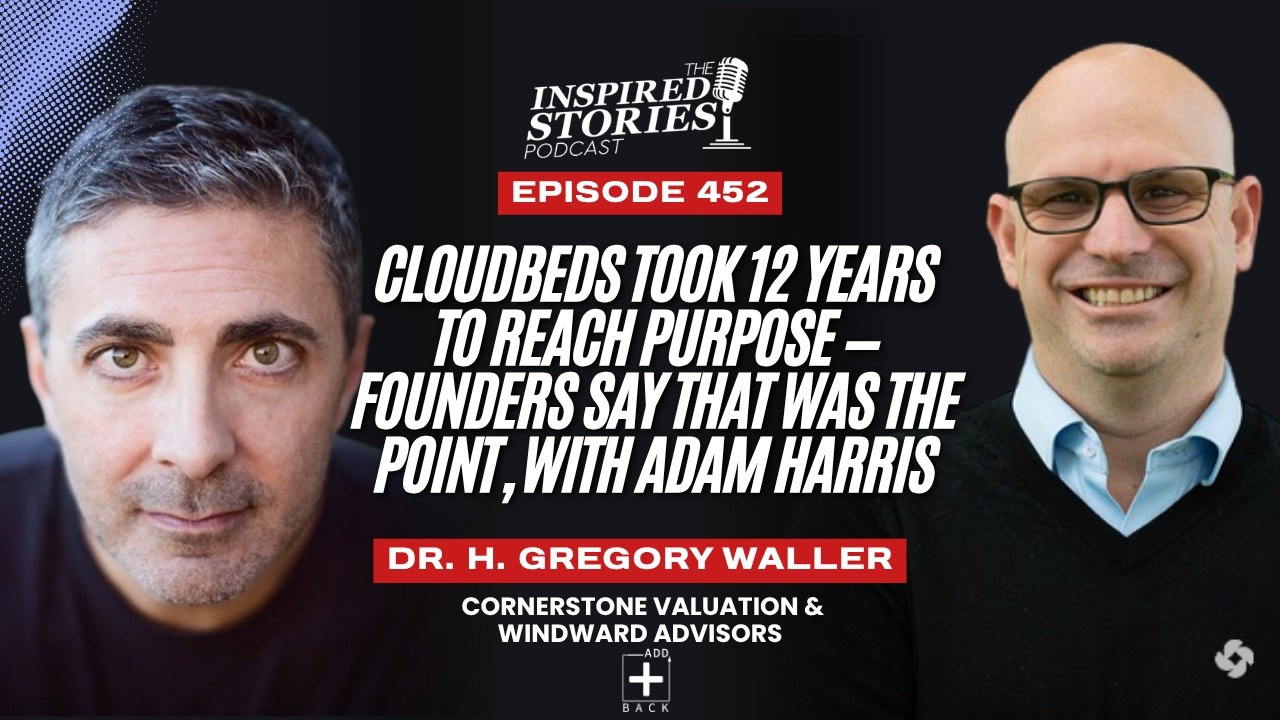
🎙️ From a Brazilian Napkin to 150 Countries: Adam Harris and the CloudBeds Platform
Adam Harris, co-founder and CEO of CloudBeds, built one of the world's leading hospitality management platforms from a single insight — that independent hotels deserved better tools and a seat at the table. From an early pivot in Brazil to acquiring seven mission-critical assets and processing $15 billion in annual room sales, Adam's journey weaves together finance discipline, hospitality purpose, and technology as the bridge between them.
✨ Key Insights You'll Learn:
Career path from Wall Street analyst to hospitality tech CEO
Original CloudBeds idea: connecting travelers to unlisted Brazilian properties
Pivot from booking platform to full hotel management after World Cup
Acquiring MyAllocator, going global overnight in 60+ countries
Unified platform replacing 14 of 19 average hotel browser tabs
Signals product: causal neural engine forecasting demand at 95% accuracy up to 180 days
Remote parity principle: eliminating two-class employee dynamics
Two reductions in force and the fiduciary tension of building with heart
Neurodivergent diagnosis at 12 — retraining the brain as competitive advantage
No exit strategy: building by chapter, driven by purpose over transaction
🌟 Adam's Key Mentors:
Richard Valtr (Co-Founder): Shared founding vision and complementary technical leadership from day one
MyAllocator Team: First acquisition that forced the pivot from transactional to SaaS and launched CloudBeds globally
Early VC Partners (Peak Spans, Cultivation Capital): Provided institutional credibility and scaling capital during formative growth
Adam's Father (Surgeon/Hearing Expert): Modeled turning a deficiency into a life's work; inspired grit and hard-work ethic
CloudBeds Team (750 People, 44 Countries): The daily reason to build — celebrated as the real milestone
👉 Don't miss this wide-ranging conversation about purpose-driven entrepreneurship, the intelligence layer reshaping hospitality, and why the best hotel tech is really about amplifying humans.
Listen to the full episode here
Transcript
Anthony Codispoti: Welcome to another edition of the inspired stories podcast where leaders share their experiences so we can learn from their successes and be inspired by how they've overcome adversity. As you listen today, let one idea shape what you do next. My name is Anthony Codispoti and today's guest is Adam Harris, co-founder and CEO of CloudBeds, a hospitality management platform that brings everything lodging businesses need into one easy to use cloud solution. Cloudbed gives hostels, hotels, and vacation rentals tools for reservations, payments, revenue, and guest management all in one place. The company now supports tens of thousands of properties in 150 plus countries, integrates with over 400 travel partners, and processes around $15 billion in annual room sales. Under Adam's guidance, CloudBeds has been highlighted by Inc. Magazine and Deloitte for rapid growth, while he himself was named one of San Diego's young influentials. Before starting CloudBeds in 2012, Adam co-founded Ticket Socket and held finance roles at Think Equity Partners and A.G. Edwards. He also serves on the boards of Computers to Kids, Zesty and Connect San Diego and holds Series 7 and 66 licenses. But before we get into all that good stuff, today's episode is brought to you by my company, AddBack Benefits Agency. Listen, if you run a business, you're likely stuck in the cycle of rising insurance premiums. You're paying more, but your team is getting less. And many people can't afford coverage at all. So we do things differently. We provide your hospitality employees with unlimited access to doctors, therapists, and prescriptions that's always free for them to use. But here's the part that surprises most people. Unlike every other employee benefit out there, our program puts more money into your company's bank account. As an example, we recently helped a client increase net profits by $900 per employee per year. Results vary, but gains like that can change how a business is valued. And the consultation is free. See if you qualify today at addbackbenefits.com. All right, back to our guest today. the CEO and co-founder of CloudBeds, Adam Harris. Thanks for making the time to share your story today.
Adam Harris: Thanks for having me.
Anthony Codispoti: So Adam, before we get into the work that you're doing today with CloudBeds, I want to understand just a little bit about the path that brought you here. see, you know, Rose is a financial analyst in your past, director of finance for the Keating Hotel Group, which gave you a foundation in the hospitality industry. And I see an exit from at least one tech company. So there's this kind of confluence of entrepreneurship, tech and hospitality. Was this sort of the master plan? Or were you just kind of figuring things out one step at a time and it all sort of came together in cloud beds years later?
Adam Harris: You know, I, I'm a big sports fan. I've always been into competitive sports. I think the best analogy for my early career was no huddle offense as I sort of bounced between, plays in my early days. know, finance, I always loved the sort of system and style of what Wall Street represented. And if it taught me one thing and one thing only, The enemy of good decisions is emotion. And when you fall in love with a deal or a human, you're done. You're done. You're toast. Your heart beats for that deal or that person. And hospitality ultimately taught me that business is personal. So there's this yin and yang there. There's a very different style. Your upset customer is still there in the morning. The only other practice in the world that I could ever think of is medicine, right? You are as a doctor or a nurse, you see your patient in the morning. That's a very interesting exchange. so finance gave me discipline. Hospitality gave me the purpose and tech ultimately gave me a tool to build between the both between two of those passions.
Anthony Codispoti: Very elegant. I like that. So let's think about the time at Keating Hotel Group, right? This gave you that foundation. But the finance work came first, right? The hospitality came later. Okay, so let's talk about the finance. Maybe pull out a story there that showed you this lesson. How did you put it? The enemy of a good deal is emotions.
Adam Harris: Yeah. So, you know, look, I mean, when you're young and you're working at an investment bank, your hours are pretty hard. They're long, they're arduous, they extend over the weekend. And I think what ultimately happens, and it wasn't one deal, it was many deals, you saw the interaction between the entrepreneur or the business leader, the private equity firm or the venture capital firm, and then ultimately the prize. When you see dollar bills, you're an entrepreneur. When you see dollar bills or if you sold a business, you know this, right? You start to fall in love with the outcome more so than what is actually the journey. And I think what happened for us, at least for myself, working from 4 a.m. to 10 p.m. for over two years of my life, taught me grit, a little bit of hard work, a little perseverance, but the prize was way bigger than the transaction. But what got caught up in that journey was all of the emotions. And so you lost sight of the prize. And let me bring this to cloud meds a little bit. Because when I was working in finance for the private equity firm that owned the Keating, You know, it was very transactional. We were trying to acquire more hotel assets or more land to do more hotel assets. It wasn't a concept. It wasn't a purpose. We weren't trying to take over the world. We were trying to deliver better hospitality. was purely financial gain. And that ultimately made me fall out of love with what we were doing in and around that space. But let me come back to CloudBed. So when you start, I remember this. I remember this every single time we started a business. We're like, oh, look at the opportunity. It's so big. if my wife is building a new app right now and she's like, there's so much opportunity here. And I was like, I get it. But we need to take a step back and flip it. Yes, there's opportunity. But let's talk about the milestones because the first milestone that you and I are going to celebrate when I help you launch your app is going to be, is it done? Is it live? Is it downloadable? And then the next prize is do we have a user that says this is good? And then do we have two and then four and then eight and then 16 and then so on. And what oftentimes happens is you as an entrepreneur look at Jeff Bezos or Mark Zuckerberg and we see the 0.01 % outcomes. And we're like, wow, that would be so cool. And society always teaches us to say, something is a little bit better, the grass is always greener and we're always striving for better and more. But what you have to understand as an entrepreneur, you have less than one in 10,000 chance of actually getting to a million dollars in recurring revenue as a SaaS business. It's even harder now. And then you get to 10 million, it's one in 100,000. And you get to 100 million, it's one in a million. And so like the statistics are very much against you. You have a better chance of getting hit by lightning or bit by a shark. than actually hitting real milestones that are baked into the entrepreneur journey of building a company. And so when Rich and I, my co-founder and I, realized that the celebrations and the journey with our team and customers was way more fun than the milestones because the milestones were so fleeting. We'd hit it and then we'd be on to the next. Or we raised a little bit of capital and then we had to go operate off it. We've just really shaped our journey around purpose much more so than the transaction. And that's been an amazing eye-opener for us over the years. Now, it took us some time.
Anthony Codispoti: Were you, sorry for talking over there, Adam, but were you able to start CloudBeds with that concept, that framework in mind, or was it something that you developed as you had hit some of those milestones?
Adam Harris: So it's a little bit of both. Now, CloudBeds has scaled into something much bigger than any of the other businesses that we had founded or created. They're really successful. This is a multi-global. You shared some of our accolades around how much revenue is running through us. We're a category leader in our space, close to 700 employees in 144 countries. So very big, very established, almost quarter billion dollars in capital behind us. like, yeah, little bit different pressure and a little bit of different sort financial engineering comes into play as an operator at this stage. But no, like I would say, Anthony, you're right. Like early on, we had already learned a lot of lessons. We were already in a financial position where we could take some risk, but we were also learning the journey. of taking a venture-backed company and going through those phases of expansion, which is very different than when you're fully profitable and you're at scale and you're using dials and levers to sort of optimize for leverage. But nevertheless, yeah, mean, the early journey of CloudBeds was very much the napkin. We had an idea, it was on a napkin, it came from a challenge. But then it was very easy for us to connect the dots into how we're going to celebrate this, how we're going to build the team, how do we scale. And then through that scale, there was a lot of course correcting along the way. So it was always self-improving. One of our core values is Kaizen. It's a Japanese philosophy of 1 % improvements every day. that was kind of caked in early on.
Anthony Codispoti: So tell us about the napkin. How did this idea come about? What was the challenge that you guys were responding to?
Adam Harris: Yeah, so Rich was in Brazil, found this beautiful Posada. Posada is like a boutique hotel along the beach. He had the Western Union money to a stranger to book it. That was the impetus. mean, imagine this is 2012, right? So, know, internet is very real. There's cross-border transactions happening. But
Anthony Codispoti: What year are we talking about?
Adam Harris: That was a first. That was a first for us as individuals who love to travel. And that was the moment. And so we built OG Ficar, which means where to stay in Portuguese. And it was about connecting travelers to unlisted properties across Brazil for one catalyst only. that was World Cup came, big players hadn't really organized and individuals needed to connect to rooms. And so... After the World Cup came and went, all the big players showed up with real money and the classic pivot or die moment happened. We're like, wow, we can't compete with booking.com and $100 billion of assets that they have under their enterprise value. We need to rethink this. And what we saw was, oh, we don't need to be this listing site. We can actually go to the full management of these hotels and actually lift them up and start to connect the dots across their experience. that was a huge moment for us, but the purpose had never changed. We just found a better vehicle for it.
Anthony Codispoti: So the idea started in Brazil. And so you were supposed to be, in the original concept, you were like a booking.com, an Expedia.com kind of a thing. Like a plat-
Adam Harris: Correct. We were a connection to help a guest find a hotel that had a room that was a
Anthony Codispoti: Okay. And so then the world cup happens, then big players are like, okay, now we see Brazil for some reason they hadn't before big country in South America. And now we're going to move in there. And you're like, okay, we've got a pivot. And so the pivot is, is it roughly what into what cloud beds is today?
Adam Harris: Yeah, I mean, think what we started as was just the distribution side of what a hotel needs to do to find a guest. And that shifted into how do we help a hotel run their business? And that's everything from the operations side, sure, selling a room, what that guest experience is, and then ultimately, how do you make more money on behalf of the hotel through intelligence layers? And that all came from one data model. We're both technologists as leaders and so it was very easy for us to see how this product envisioned into something of a platform, as you said earlier. And what was really timing in our favor was competitors were just bolting on things together. They were just like... either acquiring things and kind of like loosely bolting them on and paying, here's our suite of solutions. And then, you know, you just had others who had less aspirations and they're like, here's our PMS or here's our platform. And like, you can connect to all these partners. We saw that totally different. We saw Vertical SaaS in 2012 as an opportunity. We saw, we saw a software system is going to go deeper and wider and what they could deliver. And, and there was rumblings. from the investor community that these were going to be big business models. And so we early on started to see the unified platform as the differentiator. And so we came into a market that never had unified platforms ever and started the uphill battle of pushing a boulder and introducing CloudBeds way. And here we are today.
Anthony Codispoti: Say more about the unification piece. Can you give us one specific example of how what you guys were doing was more integrated and easier for the hotel rather than the bolt-on solutions that existed?
Adam Harris: Yeah, so I mean, the average number of tools that a hotel uses or tabs in browsers, as we like to call it, is 19 in 2026. 19 to run their property. Our unified ecosystem takes about 14 of them off the shelf and combines them into a single username and password. And as a result, we have organically grown into one of the biggest platforms in the world. For a reason, our system lifts revenue. year over year on behalf of the hotel. There's more coordination amongst intelligence and pricing rooms to how we do the guest experience. And the left hand starts to talk to the right hand. So what's going on on the operations side and then what's on the guest side starts to bridge into a very strong cultural exchange between those two parties. what that leads to is, you know, every word you can think of in the space, a team that's motivated to drive more purpose for our hotel year and ultimately their guests. And now we're introducing data products like signals that are driving accuracy that this industry has never seen before. And it kind of means that we're the pace setter in the race. And that's kind of fun.
Anthony Codispoti: Tell us about the signals product. What is this accuracy that's being delivered? What is the usefulness of the data?
Adam Harris: Yeah, so, you know, look, I... The best way to describe signals is CloudBeds is in this really unique place where because we sell rooms on behalf of our hotels, because guests interact with our tools every single day, because operations interact with our tools every single day, and then we have partnerships with all the major brands in the world, we have all these different signals. coming in, is the impetus of the name. From guest review data to search traffic on the internet to what LLMs are sending in terms of traffic form to how rooms are being sold on distribution sites. It is a monument of data. A lot of it's proprietary to us and then there's a lot of third party data that we have partnerships that are unique to us as well. And so when you bring all that together, AI really can only act on what it can see. That's the biggest issue with AI. AI is very good at pleasing, but it will make stuff up very quickly if it doesn't have enough context or data to accurately provide the input. So when we built signals, we're like, wow, we have all these signals, all these data models, all these single models. And we designed in a way where you have booking and rates and guests and channels and reviews all in this one place. And as a byproduct, we can run millions and millions of permutations on that data, Anthony. And the way the best analogy is, when you see your Google Maps traffic being really red or really orange or really green, well, that's a causal engine working behind the scenes. It sees cause and effect of a lot of devices in one cluster using or around a certain location. Or another example would be Uber when they surge demand price you. for coming out of the Staples Arena after a basketball game, right? So they see high concentration of people trying to get a ride and so they surge price. So that cause and effect behavior is actually a neural machine learning model. It's been around for 20 plus years, but it's never been applied to hotels. And so we actually took a team of data scientists and we said, we think we have enough data. between our proprietary and our third party to do a causal neural engine. And as a result, we can forecast a demand curve of a hotel up to 180 days at a 95 % accuracy in some cases. That is about 10 absolute points higher than anything in our system in terms of forecastability. It's like monumental lift. in terms of accuracy, well, that's like a crystal ball, Anthony. If I know what my forecast is going to look like, if I know that in 36 days, my occupancy is going to be 82%, well, I might staff differently. I might buy supplies differently. I might price differently. I might sell my rooms differently. My whole commercial strategy gets upended. And I now have tools that I can deploy. And that's that institutional knowledge layer or what we're calling signals is our domain. Domain Ready LM and it's there to make recommendations and it's badass.
Anthony Codispoti: So are you able to do this for any of your hotels or only where you've got enough concentration of clients that you've got sort of the quantity of data that you.
Adam Harris: Every single hotel is in a one. Okay, so we designed the model so that each hotel has its own each model. We take 10 mathematical models and it converts itself into one depending on the region. And you brought up a great observation. So first of all, you nailed it. Never get asked this question. But some hotels might be in a market where there's tremendous amount of pressure from events, right? Others might not see a lot of those events. Some might have a lot of competition, some might not. And so depending on all those attributes, the model adjusts itself to complement not only said property, but also said model market. And that might mean we lose a little bit of accuracy because of those factors. We might gain a little bit of accuracy because of those factors too. But every single individual gets their own model and that is very unique. very enterprise and more importantly, it can come down all the way down to the smallest of hotel. So we're really excited about the flexibility here.
Anthony Codispoti: So this is really interesting. So I'm seeing multiple value propositions, right? There's the fact that folks don't need to use all these bolt-ons. What did you say? You went from 26 tabs to 14, or to 12, okay.
Adam Harris: 19 to 14, 19 to 40, but it feels like 26. It feels like 20.
Anthony Codispoti: Yeah. so, right. It's just easier if you've got one tool where everything's integrated and you can access the data and it talks to each other better. Now this, and sorry, I was trying to write down the phrase for it, but then you were explaining it. It just blew my brain, the causal neural network, neural engine. And so being able to have that forecast data is enormous too. Are there other components here that...
Adam Harris: Causal neural engines, yeah.
Anthony Codispoti: Like when you go in to talk to a new client or a new prospect, like what does that presentation look like? Like, you know, give me sort of that elevator pitch.
Adam Harris: I'm the worst at this elevator pitch, by the way, but I appreciate you putting me on the spot. So if I was putting my sales hat on and I was walking into a hotel, I think the elevator pitch was very similar to what I'm saying and what I said earlier, which is, look, we live in a world where data is so fast and it gets captured or it doesn't, and there's context or there's not. And when we can ask, a new technology information, and we can ask a new technology for an output, and it can give us an observation and then the context and an explanation at a PhD level reasoning, there's something here. So when we thought about all the data that lives in cloud beds and what those data points connected or isolated reveal, we realized there was this tremendous visibility that a hotelier was lacking. And most of the models that are there to help price a room or package or how you think about selling was heuristical, meaning it was a point in time looking backwards. So imagine a photograph. It's nostalgic. You see yourself as a child. I just saw one of me dressed up in my soccer gear for my school pictures. Why my mom allowed me to wear my uniform for school pictures. I don't know, but she's like, It was a fight I wasn't willing to take that morning, but I literally saw this yesterday, and it brought back a lot of memories in time. Well, if I'm gonna make decisions on memories in time, I clearly needed a haircut that day. I don't know if I had a soccer game that afternoon, because I don't have any context except for what's in that picture. Fast forward, a causal neural engine is like a motion picture leading up to that moment, as well as whatever follows, okay? So we can get all that snapshot of that data, but we can then start to piece it together so that you actually understand why Adam, as a cute little kid with a bowl cut haircut, is in his soccer uniform for school pictures. And we can understand what led up to it and then what's going to follow. And then we can run permutations against that. The beautiful thing is there's no human on the planet that can run a million permutations an hour. It's not possible, right? And so if I can give you trust in the system and show you that, hey, on this day, Anthony, you probably should increase your rates, or you should probably add more advertisements, or you should send an email marketing campaign to this segment of customers who always come to your properties to try to help adjust customer lifetime value or capture a cheaper acquisition of that guest. Yeah, you should turn that light switch on today. Where we go with that is a totally different arena. I mean, we're talking about things like, hey, should I take customers from a corporate account versus a leisure account? How do I buy my breakfast supplies? All of those things will come next. And for us, what's exciting is signals is invisible. We make it visible through user experiences, but it's really invisible. It's just a backbone infrastructure that's taking lots and lots of data, running it against hospitality models and advanced math models. And it produces something that you and I, as probably less experienced in the revenue intelligence layer of a hotelier, can actually transcribe that into a decision. So that action layer, so we went from system of record, we're just storing data, to system of action, which that intelligence orchestration unlocks the real input and output that people are asking. So it took us 12, 13 years. to finally see purpose. Like we were always after this, but it took us all this scale and all this data and all this perseverance to finally get to a moment where I'm like, actually can hand the keys back to the hotel and you're like, here's your brand new Ferrari. Let's go take it for a test run because it's really powerful under the
Anthony Codispoti: you So before the causal neural engine that you guys had the idea for and have implemented, the real sales pitch was, hey, we're going to take away a lot of those tabs and we're going to give you a more integrated solution. And you guys started in Brazil. You had that pivot. And then how did you get that first client with the new platform?
Adam Harris: typical sales motion, right? You gotta call them. You gotta talk to them. You gotta survey them. You gotta be in front of the face of the customer. I don't speak Portuguese, so that was not my role, but there were other individuals inside our early company that helped unlock getting those first customers, but there's a story here, okay? And there's a very pivotal moment in our journey that was the make or break of... our story. about two years in, we just started doing the pivot to let's build the SaaS application, this platform that hotels serve versus the place that a guest just finds them. And our head of sales went to my co-founder and said, hey, we need a channel manager. the two technical founders with no hotel experience were like, what's a channel manager? And they're like, well, that's how you sell rooms online across all the major OTAs. like booking and Expedia and things like that. was like, okay, so it's like a switch. Like network switch. You plug one line in and then it expands it and goes to other. Yeah, that's good way of describing it. like, which one? What are the channel managers? We didn't know any of this stuff. And so they're like, well, there's this one called My Allocator. It's based in the UK and it has lots and lots of customers like the ones that we are now serving in Brazil. Let's go partner with them. Okay, so I introduced myself to the leadership team. Within three days, we had an actual &A call. They were saying, hey, would you guys be open to us joining the team because we like what you're doing, you like what we're doing? And we had just raised $2 million in capital. Well, three weeks later, we only had a million of that capital because we actually wrote a check and bought my allocator. and it was bigger than us. My alligator was like two or three times bigger than us in revenue. It forced our entire model to go from transactional to SaaS. It was a one-way door moment, if you've ever heard that analogy, and we were fully committed. And CloudBeds went global overnight. We had 60 countries at the end of 2014. And to build something last, you got to take some exorbitant amount of risk and walk through a door and know that it's going to shut behind you. And that was our commitment to the MyAllocator thesis. But what we learned in that moment was a really valuable lesson. So MyAllocator was not just connected to CloudBeds. It was a resource for about 15 of our other competitors that were early. Okay. They were all connected into it and they were all using it as distribution on behalf of their hotels. And there were some very good established partners there. was part of the reason why it had grown. It was cheap, good tech, reliable, and it had other PMS partners. The moment we bought it, I controlled a very valuable resource because all these hotels needed to sell online. And over time, us owning that pipeline meant that we had exorbitant amount of viewership on what's going on at our competitors, as well as we had pricing control over them. And none of those 15 competitors exist today as a byproduct of that. It was our control. seized that. I was about to say we see some oil fields, that might be too soon. But the reality is we control the very valuable resource overnight.
Anthony Codispoti: So did you just cut them off or what happened to them? Why did they not survive?
Adam Harris: We didn't need to cut them off. We didn't need to cut them off. What we did is we changed pricing. And over time, when you use one of those applications plus my allocator, my allocator became a cost center. They had to pay for the subscription to that service as well as us. But when they came to us, they didn't have to pay for that service twice. We could give it away for free. We could lower it in half. And so there was an arbitrage in... how we delivered our SaaS fees versus a competitor, and they were always higher. We always had a slightly competitive advantage in price, which for small hotels at that time was very important. There was an elasticity there. But the other thing was, because we control the asset, it meant we unlocked data. So we were the ones sending rooms to booking.com. So we were the ones who were getting to know Booking and their team. Some of our best hires came from that team early on. And so over time we started getting more more accolade, more and more reach, more and more resource. The greatest lesson in my life has always been never close doors. You never know when you need to access a resource. And in this case, like, we wanted to continue to grow. We wanted the seat at the table. We always talked about that we wanted to bang our hands on the table on behalf of the hotelier because the hoteliers that we were serving were independents and they didn't have a seat at the table. The groups that did were the Marriott's and the big brands of the world and the OTAs. And so here we are, this little company getting a seat at the table, becoming a top 10 distributor of rooms online. That's pretty cool.
Anthony Codispoti: So did you acquire any of these competitors that were starting to drift off? No, you just kind of let them fall by the wayside and pick up their customers. Okay.
Adam Harris: We let them drift off into the abyss. We won over time with better product. We scaled as a byproduct of that. did we do it perfectly? No, that's part of the journey. That's part of the fun. But we definitely were pretty disciplined in our approach. And we did that seven times again over time.
Anthony Codispoti: did what specifically seven times? Acquired like a my allocator?
Adam Harris: We bought seven other, yeah, we bought seven other assets over time that were very mission critical to the ecosystem of hoteliers. And that allowed us to bridge more of those tabs into a unified ecosystem. We did it early. So by the time we got to today, we were way ahead of our competition and unified unification. And as a result, we can do more things on behalf of that consolidated data model.
Anthony Codispoti: So when you started in Brazil, working mostly with small independents, obviously you've expanded to dozens of countries now, over, what did we say, 150? Are you still working mostly with independents or do you have some of the big chains in there too?
Adam Harris: 150, yeah. No, so we love independence. will happily work with big brands, but we see that this is a rising tide lifts all boat moment for the independent ecosystem. And so we're big fans of helping hoteliers that whether they're a group of independent hotels or a micro chain of hotels or just a mom and pop that's running their family business, we're here to help them.
Anthony Codispoti: And do you need feet on the street in all of the geographies that you're located or doing business in?
Adam Harris: Different models in different regions, depending on what is required of us. But I would argue we've always been hyperlocal. So we want to feel like that market. We probably took a chapter out of other larger businesses that operate in our ecosystem as examples of how they did their go-to-market motion. But, you know, For us, it was how do we connect on a human-to-human level? Hospitality is a human industry, right? So we needed to put our humans in market where possible.
Anthony Codispoti: Wow, fascinating. And so you've mentioned that there's been some investment. What can you say about your partners?
Adam Harris: Meaning the investors who have invested in us. Yeah, no, look.
Anthony Codispoti: Are these like, you know, friends and family is this like big institutional, you got private equity involved?
Adam Harris: We got a little bit of everything, bud. Like we had the friends and family early on who took a huge bet. We've made them a fortune. We had our early stage institutional investors, the peak spans, the cultivation capitals of the world. Those were early stage VC, traditional VC in the Bay Area mindset. We then added groups that were like the Vikings and the soft banks of the world. big, big funds with unlimited capital behind them. That was the scaling motion, right? Those were the big resources. So, you three days before lockdown with COVID, Viking gave us $80 million. At the height of the market in 21, we raised $150 million. And those gave me resources to take what was a very fast growing company and leverage that into a very profitable company. still growing just as fast but now profitable and with operating leverage. And that was a very big motion because we went from a world where lending or the lending rates were pretty much free, right? Like if you think about 21, interest was nothing. And then we've gone into a high interest environment, which is why mortgages are higher. And so like you now are forced to show profit or forced to show operational leverage. So this has been a journey. I mean, like what was going on in 2012 to what was going on today has been a couple of roller coasters, but it's been fun. And I think what has got us here is Rich and I absolutely frigging love our team and love that we get to lead them, love that they are here to make us stronger. ultimately we saw that. If we did right by them, they'll do right by our customer and that will ultimately do right by our shareholders. And that model worked for us from day one. So it's been a very humbling roller coaster. How about that?
Anthony Codispoti: I want to understand the culture of the company a little bit more, right? You love working with your team. You've mentioned that multiple times here in our conversation, but you've got this widely distributed team, not just like half the teams here, half is in, you know, Vietnam. It's like they're spread across dozens of countries. Like, how do you think about, I don't know, developing and then maintaining a company culture across such a
Adam Harris: Yeah. Yeah.
Anthony Codispoti: a wide geography and a diverse set of folks.
Adam Harris: So we've always been fully remote since day one and in in to a crime, I would even argue, maybe too far at times. Our investors actually told us to open an office in Nashville. This was our early stage. Friends and family like just open an office and we push back. Our P &L made the case. And I think the biggest challenge at scale is presence. So it's like you don't have that physicality. the kind where every person feels heard regardless of time zone or title because you're all in an office. You're all showing up at the same time and you're roughly leaving at the same time too. And so the hardest lesson that we had to learn was remote parity. Okay. Concept that we created, which was like the moment you create two classes of employees, those in the room and those on the screen, you have to recalibrate immediately. So What I wish I had sort of known sooner is small local office for gatherings, not for work. It's for each other. So what I meant by that when you have to create parity of like, let's say you have two individuals who happen to be at the small office in Spain and they show up in the conference room and they're on screen and you're the only one on Zoom. that doesn't create an equality of that meeting because those two walking in the room could be talking about the subject. Those two leaving the room could be talking about the subject and here you are just turning off your computer and there's isolation there. And so we forced everyone back to the computer. If you are all not in the same place, don't meet in the same room. Meet on the same Zoom experience. And so we really, really were in tenfold. We had employees who were taking it
Anthony Codispoti: interesting.
Adam Harris: 10 and a half hour round trip bus ride to meet teammates.
Anthony Codispoti: That's a gigantic waste of time.
Adam Harris: And we said, gigantic waste time. So we said, the human instinct is there, but we got to redesign this. That's not fair. so remote done right returns the commute to the person, not the company. And it only works if you trust your people and hire people worth trusting. So for us, like one of the... The models that I live by is like you have three buckets. You got life, you got work, and you got health. Health is self, call it that. And you get 24 hours a day to align the marbles in each of those buckets. I know people who wanna work harder and spend more time working. I know people who, I don't know how they do it, but they live more. And then I know people who don't take care of themselves at all. And that's a choice that we have to make, but you get to balance that. And what we try to do is give as much time for life and self as possible so that they're healthy, happy, and hungry every time they show up to work every morning.
Anthony Codispoti: So I myself have managed remote teams for years and it's a blessing most of the time. I get access to some really great folks that I wouldn't have otherwise. But it also does raise questions of, that person really being as efficient as they could be? Are they really getting stuff done? Like not everybody has an easily measurable output. How do you think about this? Or do you think I'm overthinking it?
Adam Harris: Yeah. It goes back to that gap, that bucket, right? You have emotional payroll when you get an interaction with an employee, okay? And what I mean by that is, if I have an employee who does not want to participate fairly with my exchange, they give me their time as a form of equity and I give them compensation back. for work product. And if that exchange ever becomes inequitable, it ends. If they no longer believe that I'm giving them an environment that makes them happy, makes them successful, makes them compensated fairly, they're going to leave. If they're not doing the work product that I need, then I'm going to ask them to leave. And that mutual exchange going back to the three buckets that I described earlier is all about emotions. It's whether or not you're in or out. And if I'm in and out, And I love it's that black and white. And so for us, like, it's never about trust, trusting the team. It's about, can we create an environment where all the various people, manager down, peer support, reinforces what we're trying to do. And that gets back to that purpose that we're sort of driving for. Do I believe that we probably have individuals who are underperforming? Sure. At any given time, I underperform. It's human nature. You have good days, you got bad days. But overall, this company screams in productivity. And if anything, we can do more in productivity with tools. What we talk about is not how do we get rid of humans. It's how do we amplify humans always. And in a world where you're seeing big massive rifts going around like It gets every operator to think, wow, Claude Code can make an engineer five times more productive. Do I need as many engineers? Do I need as many support people? Do I need as many salespeople and so on? And so we run formulas around that exchange. Are we getting the right output? And it becomes a mathematical decision for us with a very heavy personal connection there as well. But I've done... I had to make two rifts in this company. They're not easy. They're the hardest decisions I've ever made in my life. But I work for this business. I'm a shareholder of this business and I'm the fiduciary of this business. And so I have to put a different hat on them occasionally.
Anthony Codispoti: When you say two riffs, what do mean by that?
Adam Harris: We've had two reductions in force over time, depending on the moments in history, whether it was driven by behaviors and the macro stuff that I can't control. I'm not proud of those moments, but when Block and Jack Dorsey cut 40 % of their team or Oracle starts their rifts or Amazon or Facebook or whatever, mean, these are organizations looking at the bottom 10 % and saying bottom 10 % has to right, or bottom 20 % has to go. And I think they're looking at systems to try to determine output. It's not a fun, this is the least favorable moments of running a business, but it is a business at the end of the day.
Anthony Codispoti: Yeah, there's two things that are sort of butting heads there, right? You love your team, you love leading the team and building this with your team. And then you're also talking about, you know, hey, there are opportunities for us to make ourselves more productive, more efficient, more cost efficient, right? And that's, so I'm going to mix my metaphors, you got things bouncing, but you've also got this tug of war that's going on between the two sides. Yeah.
Adam Harris: Yep. Yep. Totally. And I always go back to my fallback statement, which is it's my job to create environments for everyone to be successful in. It's their jobs to take those environments and make it successful for their peers. And if there is too much blow or too much noise or too much, we call them sea anchoring, where something's dragging along and holding us back like I have to fix the environment. I have to do that on behalf of the organization. And those are moments. They're moments. Anthony, you'll appreciate this as a founder. At one point in time, this was many, many, many, many, many years back. I actually don't even remember when it was, but like five plus years back. we were re-architecting some of our main systems and we were dealing with a little bit of a availability issue in a reliability of application. We were just completely rebuilding plumbing and upgrading systems and whatnot. And we had like three weeks of just a little bit too much downtime. It was bad. And one of them happened on Christmas morning. No joke. Okay. I remember getting the phone call at 5 a.m. And the next week we all happened to have in all hands. And we started talking about what does these outages mean in perspective of the world. And we framed it like firefighters. And I didn't know this, but firefighters train every single day. But in a course of the year, an average firefighting team only puts out 16 fires a year. So the rest of the year, they're disciplined around what are we going to do when we get our moment. And I guarantee you when that bell rings, they're fired up. They're practiced, they're trained, and they have an execution plan. And so when we started putting that lens against what just happened at the company, I was like, guys, these outages are like a three out of 10 in terms of a blip. Adam dying in a bus, like a car accident, getting hit by a bus is like a five, rich five. Like Amazon going offline and taking all the world's systems offline for a day. Yeah, that's like a nine. That has serious economic impact. But like these little moments, we need to just start flipping the lens and approaching it as if we are trained, disciplined and ready to help our help our customers. And so we just we shifted mentality always around that environment. If the environments are there to be successful, we're good. We got this in good, bad and ugly. And, you know, COVID hit cloud beds. We lost 35 percent of our revenue in three weeks. By the end of the year, we had already pivoted and we grew 13%. That was astonishing when you couldn't stay in a hotel anymore. So it wasn't a pivot actually. We just listened to our guests. We listened to the guests. We listened to our hotels and we figured out how to serve humans in hospitality in that moment. And we did some of our best work and it was a catalyst for, one of the catalysts for the business.
Anthony Codispoti: What was the pivot? And so was it just that the hotels were coming back online towards the end of the year and that boosted the revenue again? Or were you guys introducing new services?
Adam Harris: It actually, there's new services. was, kept building. was hotels were like, well, I have a lot of free time on my hands all of a sudden. Like I'm going to revisit all of my systems. And we gained a lot of customers at the end of it. The proudest moment there was hospitality helps. We launched a nonprofit. We put 55,000 frontline workers. in safe rooms away from their families because at that early days of COVID, you didn't know if you could go home. You didn't know if you could take off all your gear as a police officer, a firefighter, an EMS or whatever, a doctor, and like go sleep in the bed next to your loved ones. So they would isolate. These doctors would sleep in hotels. And these hotels had no way of connecting. So we worked with Amazon, we worked with states, and we put 55,000 frontline workers into hotel rooms. And that was an amazing. amazing moment for our company.
Anthony Codispoti: So cool. Adam, what's one of the hardest things you've ever had to overcome and what did going through that teach you?
Adam Harris: So, two things. One is I grew up with a father who was deaf in one ear. And I would always have to sit on his right side to enable conversations. And sometimes I saw that as awkward, as weird, as strange. And then at the age of 12, I was diagnosed with a learning disable. I was neurodivergent. And it was... a really friendly reminder that deficiencies also become skills. So my father, being deaf, turned out and took a career in hearing. He's now one of the world's leading experts in hearing, and he's a surgeon, fixes ears all the time. He taught me that those skills are overcomeable, or those deficiencies are overcomeable, hard work and grit. And so for my life, my early years, I had to retrain how I learned. And I had to work extra hard at every subject that I needed to absorb because my brain wouldn't just connect the dots like a normal brain would or a neurotypical brain would. And so over time, it became this masterclass in like brain re-engineering. And by the time I was in college, I had photographic memory. I could see things in dots and connect the dots in analytical ways, which is why I love finance. but I never lost that you're gonna have to work harder. And so for me, was the way my brain works taught me how to work harder, to never back down, to run through walls for my team. And then all stemmed from my dad and watching him and hearing his stories and like going through, which was probably a very hard upbringing for himself in a time that he didn't have all the skills. Now, What's crazy is to bring this full circle, he could have fixed his issue as a surgeon today when he was 16 and had sudden hearing loss. you know, I love that moment because my son has the same sort of learning behavior that I do. And in like seeing him navigate it, it is almost like full circle for me because I can kind of. walk them through and coach them and say like, bud, you got the same memory as me. We just have to train you how to use it. that's something where my team, sure I probably drive them crazy from time to time because my brain bounces everywhere as part of its process. But that was my moment. And God, it was a very hard one when you're 12 years old.
Anthony Codispoti: You know, and it's interesting that you got the diagnosis when you did, because I talked to a lot of business founders that later in life were diagnosed with learning disabilities, dyslexia, severe ADHD. There wasn't a name for it. They didn't know when they were younger. They just they naturally had to adapt how they move through the world in order to be able to to keep up. And as they strengthen that exactly like you're describing, as they sort of strengthen that coping mechanism, if you will, it became more of a superpower for them. And so I'm curious, know, as you who somebody got a younger diagnosis, what did that process look like for you? How did you retrain your brain? And how will you think about helping your son do the same?
Adam Harris: Yeah, so it's interesting. There was medicines that you could take that would help you slow your brain synapse down, things that would treat ADHD and others. First of all, it was so early. It was so new. mean, was Jesus 30 years ago. So from my perspective, what is today is very different than what we know or what we knew then. What I found is I was not an auditory learner. I was a visual learner. And that was the first thing that I had to do was just take copious amounts of notes. I had to write it down to then relearn it. So I would make lots of flashcards. I'd do PowerPoints. I would just learn, take anything I could and throw it into something that I could actually look and read and move my finger across it. It's a weird way to learn. Small population, a small part of our population learns this way. The other thing, and it's also why, Anthony, I love AI. It's because it's so visual interaction. Like it's such an amazing tool for the way that I work. The hardest thing was feeling different and overcoming societal pressure to fit in, to know that those coping mechanisms didn't look the same for every single one. So for example, like I'm born ambidextrous. I'm left-handed natural, but I learned to write in throw, in bat, in golf, in tennis and everything right-handed because my dad's right-handed. He didn't know how to show me left-handed, right? But I'm naturally better at left, like I eat left-handed, I use chopsticks left-handed, but I write right-handed. My handwriting's horrible for that. And so like it would have actually been I'm using the wrong hand I'm using the wrong like side of my brain in certain practices and so like I still write right-handed, but I've had to like Retrain the practice of connecting dots and that's my son's issue. It's called a praxia. It's like you have to like Retrain the the neural pathways and once you establish them they're there but for kids and for me if you learn them the wrong way you're never breaking them
Anthony Codispoti: Because you're using the wrong hand.
Adam Harris: It is like a routine that is like in concrete. So you have to like break that down. I learned that so that we now apply that in a similar manner. But like that's where dyslexia comes from and ADHD. And so like all of those same patterns happen. Even autism, for example, they all share very common sort of neuro typical or neurodivergent sort of methods. I'm fascinated with the brain. synapses. I now look at neurotropics and things like that on how to biohack myself to just bring a sense of calmness. I will work 24-7. No one will get me to stop unless I physically come down. I have to emotionally come down. It's typically my wife or kids going, hey, dad, come do something with me. Because otherwise, I'm just a tinker. My brain is running 24-7. So look, I wouldn't change anything. I love it. I love it about myself, but it took 44 years to get there.
Anthony Codispoti: But what does that process look like? Like give us a specific example of a training that you did or that you will encourage your son to do as he gets older.
Adam Harris: Yeah, so first all, physicality. You need to keep yourself in shape, brain and body. So we do a lot of physical exercise. We do a lot of sort of like things that are would be very obvious, like grabbing a ball, dropping a ball, and then being able to go like this and rotate your hands or throwing it against and catching across the midline. So a lot of midline training. I do it still today. I do jiu jitsu. I love it because it's a mental, the mental strategies there just as much as the physicality. So trying to connect the mental decision-making with the physical decision-making is something that we really instill. I do it every day with my child and it even led me to build an app for my child to help me do this, right? So for him, I didn't have, like for him, can, I know this. I didn't have any of that. So it took me doing my own research and having access to incredible medical practitioners because of my father's connections at the hospital and access. I think there's so much rooted science in my family. I know six doctors just in my immediate family. Like medicine is real and science is real. And so like, The research has instilled in me. So I heavily researched my whole life. I looked at different things that I could take to slow my brain down. I didn't like to be like prescription drugged. I never liked it. It made me feel different. I lost sleep. So I had to create a routine. I had to create balance. And I'm religious about it, like religious about it. But it also means I can't do certain things. I can't get into traps. I've never done drugs in my life because I'm too afraid my brain will wire to liking them. And so I have to do other things to create that good feelings in similar ways. But yeah, man, it's wild. The brain is a computer. It's so fun to play with.
Anthony Codispoti: So what's the future of Cloud Beds look like? Where are you guys going?
Adam Harris: Yeah, you know, look, I... I... I feel like one year from now, all of that science and all that math and all that decision making that we are having conversations with about where hospitality goes in the age of AI, in the age of macro friction with things that are going on politically, life looks different for all of us. And that's exciting and terrifying. And when we listen to the expert researchers in AI, some of which have recently rage quitted and are leading lives of poetry, a little scary, to others saying like, we need to fall off cliffs. We need a better understanding. We need the systems, the trained systems. And like, we are very early in the day. Like, we could create a superior being here. Scary. We could end society, maybe, scary, or we could better off every single human being on this planet because of this product and actually allow individuals to live life to its fullest. Like I wouldn't care if any of our adversaries cured cancer. I'd be the first in line if I had cancer to want to have access to that. So if we as Americans create some of this service, we should give it to the world. And if the Chinese or the Iranians or the North Koreans or whoever create those types of advances that make humans live longer, live happier, less pollutants, more food access, better environment, whatever it is, we need to harness that together. And so I'm holding out. I'm holding out for the alien invasion that brings us all together so that we can finally get this planet on the right path, but Cloud Bids is going to unlock all of this technology that is at our fingertips before any other brand. And we are going to deliver solutions for our hoteliers that make their life easier and ultimately drive better value for the guests. And I'm a traveler. been to 62 countries in the world. I want that. And every day I talk to hoteliers who want that too on behalf of me as the traveler. And so we're going to put 750 people in a room and we're going to drive toward that every single day. And that's the celebration I want most.
Anthony Codispoti: So can you give us a little peek behind the curtain? What's a specific example of a new feature function benefit that's coming from Cloud Beds? What are we going to see in the next 12 months?
Adam Harris: There's so many, I'm trying to choose very carefully. You threw me at a, I didn't think you'd ask me this question, one. But two, the conversation has gone in so many different directions. I feel like I need to give you a really big win here, but then I'm also trying to be mindful of some of the things that are coming out in what's under embargo. How about this? We have so much tech coming in the world of distributing rooms online that we want to help our independent hoteliers win some of that back more efficiently. Okay. And most consumers don't know this, but the average cost of a hotel to a hotelier to acquire you as a guest and support you is about 40 % of their revenue. So if you pay them a hundred dollars, $40 is going into cost and support. And super majority of that cost and support is going to a third party. So when you book through booking.com, you charge anywhere from 18 to 25 % in commission to that hotel. OTA spent $20 billion a year trying to get you, Anthony, to go to their websites to book on behalf of a hotelier. And I want to take some of that back. And I want to shift that back. to educate you as the consumer to say, don't go through them. You can use those for resource or whatever you wanna do. But I need you, I need you to go direct as often as possible. And we have a bunch of tools in tech that are gonna unlock ways that guests can find you more efficiently as a hotelier. And it won't be one, it will be many. And I think what's gonna be beautiful part of that is it's a real big number. and we can absolutely connect the dots. And the best part about that is if we connect the dots and we bring the intelligence systems together, you as the consumer will actually spend more at the hotel here, at the hotel and get better experiences for that. Because I'll be getting able to personalize down to what you and your family or your business travel needs are. And I cannot wait for that moment. for this industry. It's very human. It's very human.
Anthony Codispoti: Exciting. We're going to have to have you back on to tell us more details about that as it rolls out. But last question for you. And before I ask it, I want to do three quick things for the audience. First of all, to get in touch with CloudBeds, their website, very easy to remember, cloudbeds.com. We'll have it in the show notes. But cloudbeds.com, can learn more about what they're doing. If you're enjoying the show today, please take a moment to subscribe wherever you're listening. It sends a signal that also helps others discover our podcast. So thank you for taking a quick moment to do that right now. And as a reminder, you can get your hospitality employees access to therapists, doctors, and prescription meds that as paradoxical as it seems, actually increases your company's net profits. Real gains that can change how a business is valued. So contact us today at addbackbenefits.com. So last question for you, Adam. And you kind of hinted at this, but I'll open the door in case there's anything else you want to throw in there. A year from now, what's one specific thing that you would hope to be celebrating?
Adam Harris: Ugh. So. probably two things. One that cloud beds is synonymous with being the unified hotel management layer, as is Kleenex is the way we think about tissue. Not just the best, but the one that everyone goes to ultimately define the category. And then personally, That is all 750 people that are in rooms with me occasionally. That's what our team asks for more than anything, and that's the celebration, right? So like when you are approaching leading a large bucket of humans, it goes back to those milestones that we talked about earlier, but It's then shifting that to how milestones mold into purpose. And so we have a belief system that there is a no exit strategy here, right? Just more to build. And so we always tell our team that, this is just another chapter and we're going to keep writing chapters until we can't write any more chapters and there is no exit here. It's just build more. and let's keep going and that's purpose and that gets me up every single day and to be honest with you, 14 years in, I have never had more fun at Cobbets.
Anthony Codispoti: Adam Harris from CloudBeds, want to be the first to thank you for sharing both your time and your story with us today. Really appreciate you being here.
Adam Harris: this has been fun. Thanks for the great questions.
Anthony Codispoti: Folks, that's a wrap on another episode of the Inspired Stories podcast. Thanks for learning with us. And if one thing stood out, put that into action today.