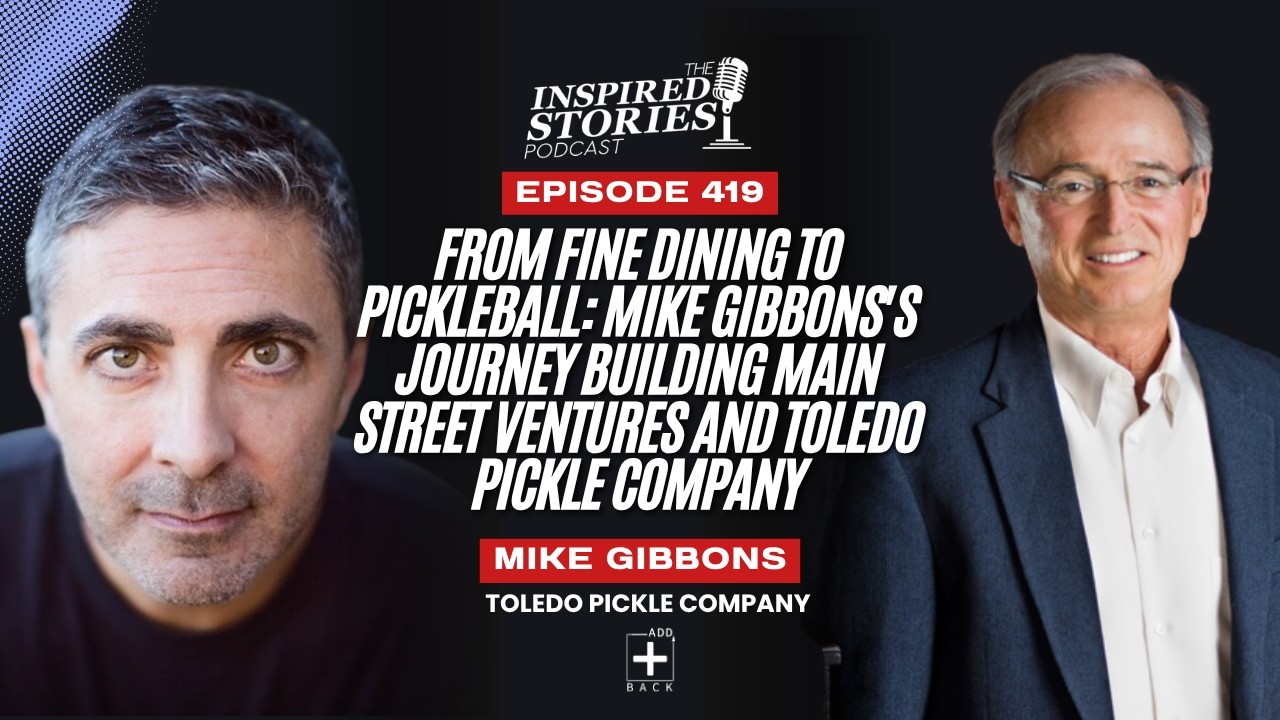
🎙️ From Fine Dining Empire to Pickleball Pioneer: Mike Gibbons's Journey Building Toledo Pickle Company
Mike Gibbons, co-founder of Toledo Pickle Company and former president and CEO of Main Street Ventures, shares his journey from starting as a college student at a Charlie's Crab restaurant in Ohio, through building a 26-location fine dining empire across five states over 45 years, to breaking ground on a 40,000 square foot riverfront pickleball and entertainment facility in July 2024 and opening its doors six months later. Through candid stories about partnering with his director of operations to sell the company so his partner with cancer could exit with dignity, drawing the entire Toledo Pickle floor plan on the back of a placemat in Texas, getting a pilot's license to overcome his fear of flying, and a granddaughter who covered her senior night tribute with every encouraging text he had ever sent her, Mike reveals what happens when decades of hospitality discipline meets a genuine love for the city you have called home for 40 years.
✨ Key Insights You'll Learn:
Founded Main Street Ventures in 1981, grew to 26 locations with a shared operating system.
Planted four restaurants on one Ann Arbor corner, using downtown revitalization as strategy.
Sold Main Street Ventures in 2019, protecting Toledo Chop House investors.
Built Toledo Pickle in six months—40,000 sq ft, now a catalyst for riverfront revival.
Designed courts with 25 ft spacing, doubling as social space with affordable food and drink.
Made managers owners of the bottom line, with six‑figure earnings.
Offered tuition reimbursement tied to grades for employees working 20+ hours.
Balanced revenue 50/50 between courts and food, with seasonal shifts.
Overcame fear of flying by earning a pilot’s license, now 2M+ Delta miles.
Organizing a September pickleball tournament to raise $250K for Alzheimer’s research.
Dieter Bohm: Operations veteran whose discipline balanced entrepreneurial instincts.
Dennis Saris: Partner who got sober, brought Dieter in, and changed the business trajectory.
Kevin Gadeko: Director of operations Mike helped buy the company, showing true succession.
Mike’s Father: Reminded him during divorce that “all things pass.”
Granddaughter Ava: Built her senior night tribute from every encouraging text he sent.
👉 Don't miss this conversation about what it actually takes to revitalize a downtown over four decades, why great operators make their managers owners of the outcome, and how a man who was flunking retirement ended up building something the whole city is talking about.
Transcript
Anthony Codispoti: Welcome to another edition of the inspired stories podcast where leaders share their experiences so we can learn from their successes and be inspired by how they've overcome adversity. As you listen today, let one idea shape what you do next. My name is Anthony Codispoti and today's guest is Mike Givens, co-founder of Toledo Pickle Company, where he also leads the restaurant and bar operations at this dynamic venue. Toledo Pickle Company is a 40,000 square foot riverfront pickleball and entertainment facility in the Vichula neighborhood of Toledo. They bring together through sport, good food, and playful energy. Guests enjoy 10 indoor and two outdoor pickleball courts, a rock climbing wall, arcade games, and the waterfront restaurant called Stay Out of the Kitchen Grill. Since opening in January of 2025, the complex has been hailed in local media as a key spark for the Glass City Riverwalk revival. Mock edit. Mike brought more than two decades of hospitality expertise to the project. He also serves as president and CEO of Main Street Ventures, a group known for award-winning restaurants across the Midwest. Now, before we get into all that good stuff, Today's episode is brought to you by my company, AddBack Benefits Agency. Listen, if you run a business, you are likely stuck in the cycle of rising insurance premiums. You're paying more, but your team is getting less. And many people can't afford coverage at all. We do things differently. We provide your restaurant employees with unlimited access to doctors, therapists, and prescriptions that is always free for them to use. But here's where you really need to pay attention. Unlike every other employee benefit out there, our program puts more money into your company's bank account. As an example, we recently helped the client increase net profits by $900 per employee per year. Gains like that can change how a business is valued. Results vary, but the consultation is free. See if you qualify today at addbackbenefits.com. Now, back to our guest today, the CEO and founder of Aledo Pickle Company. Mike Gibbons, thanks for making the time to share your story today.
Mike Gibbons: It's my pleasure.
Anthony Codispoti: So before we talk about the Toledo Pickle Company, I wanna learn about the work that you did before with Main Street Ventures, company that owned and operated fine dining and high-end casual restaurants for over 45 years across five states. What was the, yeah, go ahead.
Mike Gibbons: So Main Street Ventures was founded in 1981. I had two partners, Dennis Saris and Dieter Bohm. And the three of us had actually all worked for the C.A. Muir Corporation. I don't know if you're familiar with them, but they had a restaurant Columbus called Engine House Number 5 was one of their places. And I started with them when I was in college. I went to Xavier in Cincinnati and I worked for Charlie's Crab, which was in Montgomery, Ohio.
Anthony Codispoti: Remember.
Mike Gibbons: So I worked there, got my degree. I was a pre-law student, minored or majored in political science. And when I graduated, they were gonna move me to Ann Arbor. And I thought, well, this is a chance. I planned on going to law school, then I'll at least have them pay for my move and I'll get up there and go to law school. And I was promoted pretty quickly there. I became the general manager of the Gandy Dancer, which is the old train station in Ann Arbor, it still exists. and went on to be a district manager with them and worked for Dieter Bohm. Dieter was vice president operations for the Muir Corporation. Then in 1979, I left and joined Dennis Saris, who was another former Muir employee. And we teamed up and started opening restaurants. And we had three places and Dieter was trying to get me to come back to Muir. you know, I was a young guy then I was 28, 29 years old. And I said to Dieter, because he'd always said, you know, when I'm 40, I'm to make a decision on whether I'm going to go out on my own or not. Dieter was probably 42 or 43 at this point. And in fact, he just turned 90. And so so I said, Dieter, why don't you join us? And we kind of laughed about it because, you know, we couldn't afford somebody like Dieter, not our payroll. And and he and Dennis had never gotten along. They were kind of Dennis was a shoot from the hip guy and Dieter was a very button down, black and white, this is, you know, this is this. And so there was kind of the personality difference. They liked each other, but there were there were different people. And I was somewhere in the middle. And and I mentioned it to Dennis. I said, you know, I had I had lunch with Balm today and I mentioned this to him. He goes, what the hell do we need him for? And at this point, Dennis, this was so many years ago. It's interesting to think about it now. Dennis was an alcoholic and He had gone into rehab and he got out and he started thinking more clearly. And he says, you know what, if we want to do something, it would be great to bring someone on with some experience that we don't have. And so Dieter joined us in 1981 and we formed Main Street Ventures. And really the rest of its history, I mean, the whole thing was the three of us sitting down talking about what we wanted. And what we looked at was where the market was for our businesses. And if you think about what happened to the cities many years ago, and I look at it now and see it happening again, but the developers were looking for cheap land, a shopping center. You couldn't build a shopping center downtown, so you went out to farms and you built a shopping center. And then what did that do to the cities? It gutted them. So we saw that opportunity is back in the city. So we came up with our company named Main Street because we wanted to go back into the Main Street and bring people back downtown. And we really started in Ann Arbor and Ann Arbor had a mall that had really hurt their downtown. And we ended up with six restaurants in downtown Ann Arbor, where five were in downtown and one was just a little off the beaten path. But that was that was how the company was formed. And the vision that we had in the late 70s and early 80s was to to help revitalize the downtowns. It was an opportunity to get cheaper rents than you would get in the mall. And there was plenty of parking because everybody was at the mall. So Ann Arbor was the smart place to start. That's where Dennis and I both lived there. Dieter lived in Grosse Pointe. So we set up our office in Ann Arbor and started doing that. And then the other thing is we didn't want to open one concept. And we didn't want it to be a cookie cutter. We wanted things to be different. We wanted to, we had four or five real seafoods at one time. None of looked the same. The menu was similar, but we wanted people to say, let's go see the new real seafood, because it's not going to be exactly like the other ones. And so we did the same with, we did seafood, we did steak, we did Italian, and those were the big things that we did. And we tried to do, even when we did. what I'd call the American grill type restaurants. We tried to make it a notch above anything else that was out there. And so we opened Italian, we had Grazzi, Polly O, Zia's. We had several real seafoods. We had several chop houses. And that was, that's what we stuck with. And we felt like in Ann Arbor, we had four restaurants on one street corner. And we felt like, you know, if we don't compete with ourselves, somebody else will. And so we wanted to kind of corner the market on that, give people some options. So we had two Italian restaurants and once right across the street from each other in Ann Arbor, Grazzi and Paglio. And Paglio was less expensive, more family friendly. Grazzi was very high end, more northern Italy. Paglio was more southern Italy. so we just kind of from there, that's how we grew. We built the concept and when somebody said, wasn't it complicated? Well, the operating systems were the same for all of them. The only difference was the recipe book and the menu and the way they looked. But when you look under the hood of a car, the engine's the engine. And that's what we had. We had the operating system that worked that we could structurally put any restaurant in.
Anthony Codispoti: So at its peak, how many different concepts, how many different locations?
Mike Gibbons: We had five concepts and 26 locations.
Anthony Codispoti: and what does it look like today?
Mike Gibbons: There still are the five concepts and I think they probably have 22 locations now.
Anthony Codispoti: And what is your involvement in it, if any?
Mike Gibbons: Well, I sold Main Street Ventures in 2019 and my partner Dieter retired in 2000. As I said, he's he just turned 90. Dennis was ill. Dennis had esophageal cancer and he had his esophagus removed and he was doing fine. And but it came back and he said, Mike, I got to get out. And so I said, all right, we're going to sell. If you're going, I'm going. And so. Probably he was in the hospital at that point, but I was working with my director of operations who'd been with me at that point 14 years, Kevin Gadeko. Kevin, I had hired from Carrabba's and he had been with me 14 years. And I said, Kevin, you ought to buy the company. He says, well, I don't have the resources. I said, well, let's find them. And so we went out, we found people to invest. One of the key investors, guy named Bill Martin. who is a wealthy, wealthy man who lives in Ann Arbor. He owns the Bank of Ann Arbor. And he actually was the interim athletic director at one time at University of Michigan. He did it for a dollar a year. but smart, smart guy, smart businessman. And he is he and his son. And and I think six or seven other people, including Kevin and some of the district managers, all invested and bought the company. And so I had two restaurants that were relatively new at that point. One was the Toledo Chop House and the second was Grazi in Midland, Michigan. So we didn't have EBITDA. So I kept those until EBITDA was established. They bought Midland and I didn't really want to sell Toledo because I had investors in that one. I was the primary investor, but I had Well, anytime I had investors, was friends and relatives. And so I wanted to keep that, make sure that they got the return that I hoped they'd get. And so I've kept that and eventually I think they'll probably want to buy it. But while I'm still in good health and everything, want to be the one that makes sure that our investors are taken care of.
Anthony Codispoti: I can appreciate that. Good heart, good man. So what first sparked your vision for creating this professional style pickleball facility?
Mike Gibbons: Well, I was, as my wife says, was flunking retirement. I was a little stir crazy and I had gotten active in pickleball and my son-in-law and my daughter were real active. We played a lot of pickleball and I live in Toledo, but we played in Sylvania, Ohio and people always said, well, what are we going to do in the winter? Gosh, we like to play. like to play. So. Brian and my daughter, Jenny, were in Texas and they saw some pickleball complex and they said, you got to see this place. It's fantastic. And so I went out, I looked at a couple of places in Kansas City. I looked at, I looked at a couple of places in Texas. I saw that it was going on in different, in different spots. And I wanted to do a little more than what they were doing. I just want to build pickleball courts. I wanted to make something that would be differentiating. And so. I created what I call a family entertainment center. And so we've got 10 indoor pickleball courts, two outdoor pickleball courts, rock climbing wall. We've got a patio outdoors. There'll be there'll be 300 feet of docks going in this summer. And so you can pull up in your boat. We've got fire pits out there and a bar out there. We've got a stage out there. We get entertainment of some kind every night from karaoke to bands to whatever. You know, there's always something going on, something entertaining. The 40,000 square feet is on one floor. got another 10,000 square feet outside, another six or seven thousand square feet upstairs. And so there's a little something for everybody. And then what happens is the entire place is a restaurant. Doesn't matter where you sit. There's a QR code on the table. You take your phone, shoot the QR code, you order the food, magically appears a few minutes later. So we can be serving a thousand meals. And it just it just. No matter where you sit, we know where you are. You can move from one table to the next and we can still find you and bring in your food. And so it's it's been amazing. And I think the biggest surprise to us was the number of events that are occurring. I hired someone to be my marketing director, management or membership, marketing membership and catering. She was so busy, she's now the catering director and and. She's, you the events plan or everything else. And we're having I don't want to exaggerate. We'll have an event every day of the week, though. And some days it might be two or three smaller ones. There are events that we never dreamed would happen, but it's like an after prompt for one of the local high schools. They took the building from 10 10 p.m. to 3 a.m. and came in and played pickleball and had a blast. And so one high school told another one, now we've got two more signed up for this year. So it's just been, it's been great. They do a big golf tournament in Toledo every year. And so last July we had 700 people in there for this, the golf gala, they call it. And they had a big silent auction and people playing pickleball. And we had a band and entertainment. It was just, it was just a lot of fun.
Anthony Codispoti: Well, when you do something, you don't go half. You went all the way. I mean, this is a giant facility, lots of courts. The restaurant side of things, you knew that space really well, right? You had been in that space for years. The pickleball, the family entertainment center part of it, this was new. What were some of the things that surprised you or that were unexpected challenges on the
Mike Gibbons: Sure. Yep. Well, the interesting thing is putting together that staff because they're really, there's no pickleball pros per se. There's some really good players, you know, it's in Toledo. Columbus, I know has their own professional team now. And although there is a guy from Toledo who plays on that team. So, and I knew most of the pickleball players in town. And the thing that's always a challenge, pickleball players are cheap and they'd be the first ones to say it. It's not like golfers or even, yeah, even tennis players. They'll join a club. It's there's I can remember when I was building this place was late on a Friday afternoon. And this guy pulls up in this black Porsche SUV and he's he's. I think Indian, I know him really well now, Sam, but he came up and he said, what's going on here? And I said, well, we're building a pickleball club and restaurant, blah, blah, blah. And he says, can I get a tour? You know, I'm just leaving, you know, it's late in the afternoon, the construction shut down for the day. He says, is there someone that can give me a tour? said, Sam, come on, I'll show you around. So I walked through and he goes. Wow, he's going, this is big. This is really big. Says, you're to have a sauna? I said, no, I'm not going to have a sauna. You're going to have showers? No, I'm not going have showers. Well, what's it going to cost to join? And I said, well, there's different tiers of membership. So that's so expensive. And I said, and he said, why would you charge so much? I said, well, let me ask you something. I love your car. That beautiful Porsche. He says, yeah, it's really nice. I said, why don't you drive a Kia? He goes, well, what do you mean? says, a Porsche. A Kia's not a Porsche. said, Toledo Pickle's not just pickleball. There's a lot more to it. And the funny thing was, after all that, and I thought I'd never see this guy again. He was the first member. He's there every day. And so it was interesting. that really was kind of the hurdle we were facing. And we knew that was going to be a challenge.
Anthony Codispoti: Ha ha ha ha ha.
Mike Gibbons: Although you don't have to be a member to play and that's a challenge to people. have to, you know, constantly reinforce that, you know, you don't have to join you come in and play any time you want. You can pay, pay for court time. We have discounted times, you know, early afternoon, we don't get a lot of play. So we're looking to fill that, that those time slots, you know, every night it's packed every morning it's packed, but you know, there's time, there's times in there where, you know, we, we reduce the rates and you know, it's like Uber does with their. There are times of rush hours and everything. Yeah, surge pricing. you know, those are some of the challenges. But I think the the place itself turned out so much better than I expected. you know, there was an artist that we hired to do a mural on the building. And I had not met this guy. And he and I have gotten to very close friends. And I'm working with him on a lot of projects right now. Guy named Dean Davis.
Anthony Codispoti: surge pricing, yeah.
Mike Gibbons: who did the mural at one end of the building. And I was so impressed with that. said, Dean, I want you to do some stuff inside the building. So at one end of the inside, there's a guy up there playing pickleball. And at the other end of the building, there's a woman hitting the ball back and forth to him. And it's dynamite. I mean, you look at it, go, wow, that is impressive. It's all done with spray paint. It's just amazing. You got to see it to believe it. And so he's done all my signage in there. And now I'm working with him on with the Metro Parks is doing a walkway through the city of Toledo. So I'm working with Dean and we're doing 100 works of art on the walkway, whether it's going to be a sculpture. And I'm helping him raise funds to get this done. He's going to oversee it. We're getting involved with the School of Performing Arts in Toledo for some sculpture and some painting. But there'll be a lot of different things going on down there. So it'll be more than just a walkway. It'll be an art walk.
Anthony Codispoti: Why did you get involved with that? Was it specifically because of the work that you were doing with the artist at your facility?
Mike Gibbons: Well, yeah, that was part of it. And I'm a fan of Toledo. I've lived there since 1984. And I think Toledo is a gem. It's a great place to raise a family. And I've just been passionate about that. I've had four restaurants downtown, and I had one in one of the suburbs. And I think we've been a small part of a catalyst to drive the downtown forward. And then another big one was ProMedica. which is the health system in Toledo and ProMedica moved their headquarters downtown. And when they did that, I put a restaurant in their headquarters, the shop houses in ProMedica. And it was interesting because the CEO of ProMedica, guy named Randy Osterhahn here and I have pretty good friends. And we were at a wine dinner in what was the old key bank building that ProMedica was buying to put their headquarters in. And on the first floor, it's just massive, beautiful first floor, all glass, plate glass, looking down the river. And I'm standing there drinking a glass of wine and Randy walks over and says, it'd be a hell of a place to a restaurant, it? I said, God, Randy, it really would. He says, OK, you're doing it. And that was that. That was a done deal. was like, say, I'm not talking to anybody else. I want you to do it. And we worked the deal and it's been great. So I've been passionate about the downtown. That was really the answer I was trying to get to.
Anthony Codispoti: Yeah. Yeah. And you've talked about how Toledo Pickle has been a real game changer for Toledo. Mayor talks about it all the time. Why do you think it's been such a big catalyst?
Mike Gibbons: Yeah. I think it shows that people are not afraid to come downtown now. There's a baseball team down there. There's a hockey team down there. I'm working with another group to bring professional soccer down there. Toledo Pickles down there in the Vistula area. There's a thing called Ostrich Town, which is restaurants, a little bit of an environment. It's starting to grow. It's starting to expand out into the whole area. And it's just bringing, it's breathing new life into downtown.
Anthony Codispoti: What was at the location before you put Toledo Pickle there?
Mike Gibbons: Okay, now this really is kind of a funny story. I had two restaurants across the river. I had Zia's and Real Seafood Company. we put those, the mayor back then was a guy named Cardi Finkbeiner. Cardi's, you probably have heard of Cardi, if you paid any attention to the news. He was the one who said, well, let's put the deaf people by the airport. It won't bother them, you know, when they're talking about it. He was famous for being a gaff master. I hope he never sees this podcast. But anyway, he called me and my partners and I went down and we looked at several places in the city and they had a old storage warehouse where they kept trucks and salt and sand and everything for winter conditions. And he wanted to turn this into a restaurant space. And he says, this is a crime what happened here. We've got this beautiful waterfront place. And we store salt in there. He says, this is crazy. So they moved it all out. And what did they do? They built on the other side of the river, they built a 40,000 square foot building. And they put the salt, the sand, and the trucks in there. And that was what was in this space. So when we took it over, it was interesting. In retrospect, now I would have taken the building down. It would have been much easier to deal with because it was a shell building. kind of a 10 frame building with columns. But the interesting thing was that the columns were 60 feet apart from the wall and 30 feet apart from each other, which is the exact size of a pickleball court. So it worked really well. so. We moved the salt trucks out, but what we had, we had to cut the skin of the building around eight feet up because it was all rotted out and we had to, we had to tear up any concrete that was entered to put new concrete down. And so there were, were a lot of hurdles getting that done, but it was, it was a joint partnership. The city was involved. The Toledo Metro parks were involved in Toledo Pickle was involved. And although that seems complicated, we worked really well together. Everybody wanted the same thing. Everybody wanted a good outcome. So now you've got, but when you're building, you've got a contractor and you've got the Metro Parks has a vision, Toledo Pickle has a vision, the city backed out. They left it up to us and it was a lot of coordination and it took a lot of time, a lot of thought. But I think the the end result was better than any of us anticipated.
Anthony Codispoti: think what's interesting if I've got my notes correct here, Mike is that you broke ground in 2025. You opened your doors in 2025. Am I right there?
Mike Gibbons: Yeah, well, we broke ground in July of 24 and we opened in January of 25. So it took us six months from start to finish.
Anthony Codispoti: That's an incredible turnaround time for a facility that size.
Mike Gibbons: It was it was crazy. Yeah, it was crazy. Yeah.
Anthony Codispoti: How did you pull those rabbits out of those hats? That's not just one rabbit. That's a whole bunch of them.
Mike Gibbons: Well, right. Yeah, no, was it was really good planning. And, you know, it's interesting. We use a design company. I've used them for years. Design Collective and they're in Columbus and they had done restaurants for me. And I went to I went to Brent and said, hey, look, I want to do this pickleball club. He said, we've done some of that. So he and I went out to Texas to look at a couple of places together and we sat there. at one of these places and I took a took in the back of a placemat. We drew this place up and it I don't want to it looks exactly like that drawing, but it's pretty close. We had it pretty well figured out. And the thing that could have happened there is the there's the one third of the building is where the championship court in the restaurant are the kitchen and everything. The other the other two thirds, there's the 10 courts. There's a reception area. But we could have put 12 courts there. So we put lengthwise and widthwise. And if we did that, there would have been a four foot walkway between the courts. Didn't want that. That's not for gathering. It's not for socializing. So we put three courts running lengthwise and six courts running across. And then we had 25 feet between them. And so in there, I've got trees. I've got You know, lights, I've got places to sit, tables and chairs. And so you can be playing pickleball. can order a beer and sit down between games. You can order a hamburger. We set up a menu, the most expensive. There's nothing on the menu over twenty dollars. And, know, this was this was coming out of a tough economic time, as you know. And what I wanted to do is come up with something where family could go down there and feed their kids, have a pizza, do whatever. and not spend a fortune to do it. And doesn't cost much more than going to a movie and you've got a lot more activity and things the kids, the kids down there, they're having a blast.
Anthony Codispoti: So how would you describe the revenue split? Membership, food and drinks and I don't know, maybe like these events that you're talking about. You got one a day and.
Mike Gibbons: So we have two systems in there, one for the courts and one for the food and beverage. And it's about 50-50. But what happens in the winter, the court revenue goes up and the food revenue goes down a little bit. In the summer, food revenue goes up and court revenue goes down. If I thought about it, I might have figured that out in advance, but I was just worried about getting the place open and we're going to and I'm going to figure it out as we go. But it's been interesting. December, this past December was our biggest month ever. And it was almost exactly 50 percent split. Food and beverage, then we had merchandise and then we have, you know, I call arcade games, but it's it's the basketball, it's the skee ball. There's still some active energy there and we we lease those machines, somebody runs that, they just give us a check at end of the month.
Anthony Codispoti: interesting setup. Tell us about the story behind the restaurant name. Stay out of the kitchen grill. What's behind that?
Mike Gibbons: Okay, so I was building the restaurant in my mind before I ever started construction. And I was talking to the lady who'd been my marketing manager at Main Street Ventures. And she wasn't really happy with the new company. And so I talked to her and I said, hey, what would you think about doing something different? And it turns out her... husband was a chef for us for many years. And now he works at University of Michigan in the culinary department. And I said, what about Alan? Would he be interested in doing the menu with me? And she said he would love it. So I hired him to help me develop the menu, gave him the parameters, told him what I was looking for. I don't want anything over $20. I want it to be a value oriented menu, but I want it to be interesting. I was sending them all sorts of items. I'd like to see this. I'd like to this. And, and He came up with a menu and one day just out of. He sent it to me and says, it says, OK, here's your menu for this stay out of the kitchen grill. And I said, I love that, you know, and that was it. He was just kidding around. And the kitchen, do you play do you play pickleball? OK, so do you know what the kitchen is in pickleball?
Anthony Codispoti: just a name he came up with. I don't I have not had the pleasure yet. I had forgotten that. Please explain for the audience, because I had forgotten.
Mike Gibbons: Okay, so the, yeah, the kid, when you're playing pickleball, you're not allowed to go into kitchen. And so unless the ball bounces in the kitchen, you can't go in the kitchen. You've got to stand outside that line to play the ball. And so you all, yeah, it's a zone on the court. It's called the kitchen. The real name is the non-balley zone, which means you can't, you can't stand in there and hit it out of the air. So.
Anthony Codispoti: It's a zone on the court that's called the kitchen.
Mike Gibbons: So this thing and Alan had played pickleball and knew the game and it was kind of a joke when he said it. you know, so that's it. It came up and it stuck. And then we're talking about the bathrooms. And so. Instead of writing men and women, we put a jar of pickles on one and an empty jar on the other side. So it's pickles, no pickles. And Dean, the artist, drew this up for me. We put it on the wall in there. And people love it.
Anthony Codispoti: That's funny. What was a particularly big challenge in the opening process that you had to...
Mike Gibbons: You know, there's always hurdles. Trying to get the permits, the city of Toledo doesn't really have a department that does their own plans anymore. So they have to send them out to be done. So that's a challenge. You know, you run it, and most of the challenges we were little challenges. weren't any big challenges because everybody wanted it to get done. And everybody was helpful. You know, when you're doing construction, you always have problems with contractors. So we had our problems with those, but we had some great subs. The electricians were just great. I really enjoyed working with the guys. The plumber was a one-man show, guy named Smoothie. I don't know where the name came from, but whenever something came up, I'd go over and I'd say, Smoothie, I got a problem. He said, what is it? And I'd tell him, says, you don't have a problem. I'll take care of it. And it was just the way it was. But there were some things where the concrete that was in there, we had originally thought we're gonna be able to keep it, but it was two feet thick and it was cracking. And so we had to remove it all. And then another thing we had been reading about, are surfaces, so you can't play on concrete because if you hit a pickle ball on concrete, it just skids. So typical. Typical quartz are asphalt with an acrylic, five-layer acrylic paint job on top of it. Asphalt softer than concrete. So if you're on concrete for a long time, it's tough on you. But we'd read about these cushions that they'd put down on the court and then they'd paint over it. We couldn't find any to try and I didn't want to do it without trying it. And finally we found a place in Chicago. We called the owner. He says, yeah, come on over. And my son-in-law and I got up on a Sunday morning, early in the morning, drove to Chicago. played the owner and his contractor, played pickleball with them for about a half an hour. And I said, we gotta have this. It was so fantastic. It's almost like as soon as you walked on it, you felt comfortable. So, yeah, yeah, yeah. It doesn't change the way the ball bounces or anything else, but it's better on your body. And so people will say, yeah, gosh, if I go play.
Anthony Codispoti: feels even better than a typical pickleball court. Okay.
Mike Gibbons: pickleball outside. I'm sore when I'm done, but if I play it to leto pickle, I don't have that same soreness. So it's just a little bit of, I don't even know that it's a cushion, if you walk off concrete and step on it, say, God, it feels pretty good. It's a big difference.
Anthony Codispoti: Mike, every successful business has a great team behind it. What's your approach to attracting and retaining great talent?
Mike Gibbons: Well. You know, I remember one time my dad said, and he, I thought my dad was a great businessman. said, if you pay peanuts, you get monkeys. He says, pay people well. And when we formed Main Street Ventures, we made all the managers owners of the bottom line. So if, if you, every, every manager shared in the profits. And so if they did well, they did well. And so did we. And so we had general managers making 125 to 200 thousand dollars a year. And it was it was a pleasure to write the bonus checks at the end of the year. And everybody say, boy, isn't that tough to get forty thousand dollars or fifty thousand dollars? Somebody said, I can't wait to write the check because they earned it. And that means this company did really well. And so I think that was part of it. We didn't have much management turnover. The other thing we we we set up programs for retention. So there would be times we'd have 15 to 20 people going to college on our dime. So it was we had a tuition reimbursement program for kids who were students. And all they had to was work 20 hours a week to comply. And then if they got an A, they got 100 percent of the money. If they got a B, they got 90 percent. If they got a C, they got 80 percent. Below a C, they were on their own. And so I wanted to do well. but The way it worked, you applied for this before you start taking your class, you got the class approved. And then 60 days after you got your grade, no later than 60 days after you got your grade, you'd get reimbursed. And that kept people around. That was a good program for us.
Anthony Codispoti: think I've heard of that in the restaurant space before. That's incredible.
Mike Gibbons: And then I think the other thing that we were really known for was our training programs. And, you know, you train for a week before you got on the dining room floor, and then you shadowed for a week. And it was, I think people, because they had to work so hard to get the job, they really appreciate it and they weren't going to lose it. It was important to them. And we made them, we made them very knowledgeable. They knew what they were doing by the time they got on the dining room floor.
Anthony Codispoti: question might be a little premature. You guys have just opened your doors, having lots of success, turning the dials, you're right, trying to get everything just, you know, aligned correctly. But what's the future of Toledo Pickle? Like, where do you want to take this? What's what's some growth opportunities for you down?
Mike Gibbons: I think the revenue source that we see in the events is going to continue to grow. It's becoming, it's building on itself. It's kind of a snowball thing where somebody says, boy, I had my kid's birthday party down there. It was fantastic. And so I can see that piece of it becoming bigger. I think we can draw better and better entertainers down there that are going to draw more people to it. As I said, I'm working with a group. part of a group that's bringing professional soccer to Toledo. And if I have my way, it's going to be about 300 yards in Toledo Pickle, and it will be on the river as well. And then between and this is all part of the Metro Parks walkway still. And then part of that will be about a thousand apartments. And so. People who live in apartments don't cook at home. So Toledo Pickle is the perfect place for me to go have dinner. And so I see a lot of see a lot of opportunities again with with the growth, with the development, with things that are going on in Toledo. You know, we opened with about 100 members. We're at 260 members now. We're going to cap it at 300. And, you know, we're developing leagues. We're going to do. interleague type stuff where Ann Arbor, there's a club in Ann Arbor. We're to do some back and forth there. I've got some friends in Canada that own a club and they said, hey, why don't we send a group up there for a week? We'll have a group come down. So some things like that. We'll have some interleague play. Right now we do, you know, we have women's night, we have men's night, we have different leagues. We have mixed play. You know, there's just anything we're doing tournaments. got a big tournament in September. This was interesting because this little old couple came in. I said little old couple, they're probably my age, but came in and they were talking to me about pickleball. Lovely people. I instantly liked them and they wanted to do a fundraiser for Alzheimer's and wanted to know if I would be interested. said, I'm more than interested. I'll help you do it. And so I'm on the, I'm on their committee and that's going to be in September and they're trying to raise a hundred thousand dollars for Alzheimer's. And I think we'll raise 250,000. And I think it's, it's a doable thing, but it's been, it's going to be really well planned. They're very, very good at what they're doing and they're both, you know, active pickleball players and everything. I've got a meeting with them tomorrow. We meet once a month on that. And we got a really solid committee. And so we're looking for advertisers and we're looking for players. And so it'll be a three day event, a Friday, Saturday, Sunday. And there'll be people from all over coming in for it. It'll be great. Yeah, it's September. Let me look real quick.
Anthony Codispoti: You have the date set. of why you're looking, I'm also gonna ask, why did you raise your hand to get so involved?
Mike Gibbons: I think it's a fantastic cause. My wife's mother died from Alzheimer's and it's the 18th, 19th and 20th of September. You know, I think it's one of most insidious diseases there is. I've seen what it does. I saw how hard it was, not just on her mother, but the whole family. It's just devastating what people go through. And so I just jumped on it. I just thought it was great. The other thing that I've found through the years, you know, when we used to open restaurants, we'd have a friends and family night. That would be the big opening party. Well, that didn't do us any good, you know, because we said, oh, it's wonderful. Yeah, it was wonderful because it was free. So then then what we decided we're going to we're going to open, we're going to do a fundraiser for whatever. Lord University or something. So what what I did for our restaurants was every manager picked two charitable causes. And I didn't really I don't want say I didn't care what they were, but I I had to sign off on them. But. It could be the American Cancer Society, American Heart Association. It could be a local whatever, a local kindergarten. But you got behind us and we helped them raise money for their cause. And it was, you could do good and do good. So I set up a thing called the Night of the Vine for St. Francis High School. And the president of the school was the father. I always call him Father Olashewski, think. And he and I had breakfast. And he said, you know, he's trying to get me to write a check. And I said, I can write you a check or I can help you raise some money. And he says, what do you have in mind? I said, we do a lot of wine dinners. And he said, well, what about a wine auction? I said, well, I've never done one of those, but I think we could. So we've raised over two million dollars for them doing these wine auctions once a year. We raise about 200,000 a year and it's been it's been great and interesting. We sell tickets to it. We cover our cost, but they're making a lot of money. So it's I said you can do good and do good and and that everybody wins. And so we've really tried to balance that. And I think I think I think business should be a catalyst for good in the community no matter what.
Anthony Codispoti: that.
Mike Gibbons: and restaurants, it's easy to do that with. It's easy. People like to be part of it.
Anthony Codispoti: So tell us about the work that you're doing to bring professional soccer to Toledo. Are we talking MLS level? Is this a different level? And how are you involved? OK.
Mike Gibbons: It's USL, USL. so I'm right now, we have a group of investors and there probably are three or four of us that are really active. We have a franchise agreement with USL and the challenge is they say, if you want this to work, you need to build a stadium for this purpose. So that's what we're working on now. And if we can get that done, then we're. We're home, I don't want to say home free. We're across another big hurdle. So we're pretty close to that.
Anthony Codispoti: So what do you think that looks like? Is that like the city chipping in some money? Is it private investors coughing up some?
Mike Gibbons: I don't want to go too deeply into it because some of it's, but there is money out there that's available for this. The city doesn't have any money to do it with and the county doesn't really have any money to do it with. So there are some state funds, there's some private funds and there's some ways to get it done and to show a return to wherever it came from.
Anthony Codispoti: yet to be determined. Okay. What's a particularly big challenge, personal or professional, that you've had to overcome in your life? And how did you get through that?
Mike Gibbons: Uh, well, I've had my share. One of the, one of the kind of a silly one was I was afraid of flying. And so as our company grew, I had to fly. So I went and got a pilot's license and learned to fly. And that's how I overcame my fear of flying. And so I figured, well, God, if I, if I can do this, anybody can do it. so, you know, I just didn't see how they got that big thing off the ground.
Anthony Codispoti: You don't do anything half.
Mike Gibbons: And once I really understood the aerodynamics and, you know, all the thrust and drag and all that kind of stuff, it made sense to me. that helped me. I'm still a little afraid of heights, but I overcame my fear of flying. And now I've got...
Anthony Codispoti: So let me ask you this, when you have to buy a watch, do you learn how to build one yourself? Because, I mean, you really went in.
Mike Gibbons: No, not to that degree, not to that degree. But now I've got over two million miles with Delta, so I'm over it. That was one. think I think the other one restaurant business is is hard on your home life. I went through a divorce that was painful and that was that was hard. And I can remember the day it was final. I was on my way to visit my parents who were living in Williamsburg, Virginia at the time.
Anthony Codispoti: Yeah.
Mike Gibbons: And I got in the house and my dad and I are sitting out back and I told him it was done. And he said, all things pass. He says, I know, I know you're hurting now, but it's, it's okay. It's going to be okay. And he was right. And I didn't think I'd ever get married again. And 15 years ago, I met a fantastic person and we're happily married ever since.
Anthony Codispoti: What is her name?
Mike Gibbons: Sandra. I don't want to get it too confusing because my first wife's name was Sandra. I got... She was married to a golfing buddy of mine who passed away. And I catered the wake and she kept trying to pay me and I wouldn't let her pay me. And one day she said, would you like to play some tennis? She was into tennis. I said, sure, I play tennis. And so we started playing tennis and...
Anthony Codispoti: How did you meet Sandra?
Mike Gibbons: And we just hit it off. We have so much in common. We do everything together. We play pickleball together. She's just a lot of fun. And we enjoy our lives together.
Anthony Codispoti: So before you met your wife, your second wife, and you were going through the pains of that divorce, what were some things that helped to get you through those days?
Mike Gibbons: work. You know, I think it, I really did. threw myself into the work. the problem was that's probably what was the cause of it in the first place. I worked, I didn't have a good work-life balance. And, you know, it's interesting because I was involved, I was involved in everything. I was involved in the Michigan Restaurant Association. I was involved in the National Restaurant Association and some of those things. you feel like you're doing good things and you probably are, but they take time and you have to figure out how to balance that. And so I don't think I was good at that. I'm better at it now. I like to stay busy, but I have good perspective. I've got two great kids. They're not kids, they're adults. I have eight grandkids. And I'm a much better grandparent than I ever was a parent. And I'm involved in their lives. You know, they're good relationships with all the kids. And my oldest granddaughter is an engineer. She lives in Charleston, South Carolina. Her birthday was Valentine's Day. It kind of cheated her. But and then I have a granddaughter who's in law school at Belmont and she's coming down next week. So, you know, it's great. You know, I stay involved with them. The kids, the two are still in high school. One graduates this year, was a soccer player. This was one of the most touching things that ever happened in my life. Ava is her name. Ava is a fantastic soccer player. She was all conference, all city, all state, all Midwest region. But after every game, I'd send her a text and I'd say, Ava, I really love the way you did this. I love that. This was a great move. you know, she just was elegant on the field and she'd look like she was barely moving and she'd be flying by everybody on the field. She was just so quick and so committed to being good. And she's very shy and very quiet. So I'd send her little text and she'd give me a little heart back or a thumbs up or thanks. So I didn't know it was affecting her. And then one day, senior night, the day before senior night, and she didn't, her mother didn't even know she was doing this. She did this, I don't know what she did it on, on what program, but whatever they do. And the first thing it says, so you can't make it to the game tonight. That's OK. My grandpa will be there. And you know, it's funny because this is what it looked like. I don't know if you can see this, but that's her in the middle. And all of those things around her, those are all the messages. I saw that. And even now I get choked up when I see it. I just didn't know it had that kind of impact on her. And at the bottom, it says, Grandpa, my number one fan. So.
Anthony Codispoti: Okay, all of the messages you'd sent her. You got me teared up on that one. That's really cool. And I think it's a great reminder for folks to put out those kind words, those words of encouragement, that support for folks. Even if you don't get this glowing response back, it's having an effect on people. You're touching their hearts in ways that has a lasting effect.
Mike Gibbons: Yeah. Yeah. You know, it's interesting even at our age when I play pickleball, you always play doubles, at least down here you do. You know, I'm one of the older guys that play, but I am always supportive of my partner, no matter how good they are or what. And so everybody wants to play with me, not because I'm so great, but just because I don't get mad. If you miss a shot, that's okay, you're gonna get the next one.
Anthony Codispoti: I love it. What do you think is your superpower?
Mike Gibbons: I think my wife might be. Yeah, think, I think she's changed my life. She really has.
Anthony Codispoti: so.
Mike Gibbons: You know, think it was a situation where all of a sudden I just felt like someone had their arms around me all the time. Someone really cared. And I think it's been very special. So I feel very, very loved and blessed. Yeah.
Anthony Codispoti: You feel loved, you feel protected. love that. What's your favorite thing to do outside of work? And don't say pickleball.
Mike Gibbons: Well, that's one of them. You know, I work out every day. I like to go to the gym. I'm kind of a gym rat. And I like to play golf. I used to play a lot of tennis, but I got a bad hip. I'm getting a hip replacement in April. And so I'm going to be out of pickleball for, you know, I say three weeks. The doctor says three months. So we'll see. We'll see. But
Anthony Codispoti: Ha ha ha. months. Yeah.
Mike Gibbons: Yeah, I stay busy. I'm on lots of boards. I'm currently the chairman of the Toledo Community Foundation. I'm on one of ProMedica's boards. I'm on their investment committee. I've been on the boards at Lawrence University for years. So I have a lot of things I'm on down here. I live in a golf community, so I'm on their house committee, which is... Those are all thankless jobs, but somebody's got to do them and everybody has to take their turn.
Anthony Codispoti: Ha Good man Mike. Hey, I've just got one more question for you today. But before I ask it, I want to do three quick things for the audience. First of all, you got to check out Toledo Pickle. Go to Toledopickle.com. Toledopickle.com. Do I need to say it again? Toledopickle.com. It'll be on the show notes, but it's such an easy website to remember. Toledopickle.com. Also, if you're enjoying the podcast, please take a moment to subscribe wherever you're listening. It sends a signal that helps others discover our show. So Thank you for taking a quick moment to do that right now. And as a reminder, you can get your restaurant employees access to therapists, doctors, and prescription meds that, as paradoxical as it seems, actually increases your company's net profits. Real gains that can change how a business is valued. Contact us today at addbackbenefits.com. So last question for you, Mike, a year from now, what is one very specific thing that you hope to be celebrating?
Mike Gibbons: My mother's 100th birthday.
Anthony Codispoti: Your mother is still with us.
Mike Gibbons: She, we celebrated her 99th birthday, February 8th, and she's still living independently. And I would, you know, I keep, I keep kidding her cause she gets a little smaller each year. said, you're never going to die. You're just going to disappear. And, and, but she's got a great sense of humor. She's got her wits about her. She gets upset if she forgets something, but I forget lots of stuff. keep telling her that. And, She'd still be driving if I didn't take her car keys away from her. And she's the mother of eight. I'm the oldest of eight kids. all eight, well, my sister passed away last year, but the seven kids were all there for the birthday party. There were about 50 of us there. And she's a special lady. Rita.
Anthony Codispoti: What is her name? Happy birthday, Rita. Love it. Well, Mike Gibbons from Toledo Pickle Company. want to be the first to thank you for sharing both your time and your story with us today. I really appreciate you being here.
Mike Gibbons: It's been my pleasure, Anthony. Thanks. Good talking to you.
Anthony Codispoti: Folks, that's a wrap on another episode of the Inspired Stories podcast. Thanks for learning with us. And if one thing stood out, put that into action today.