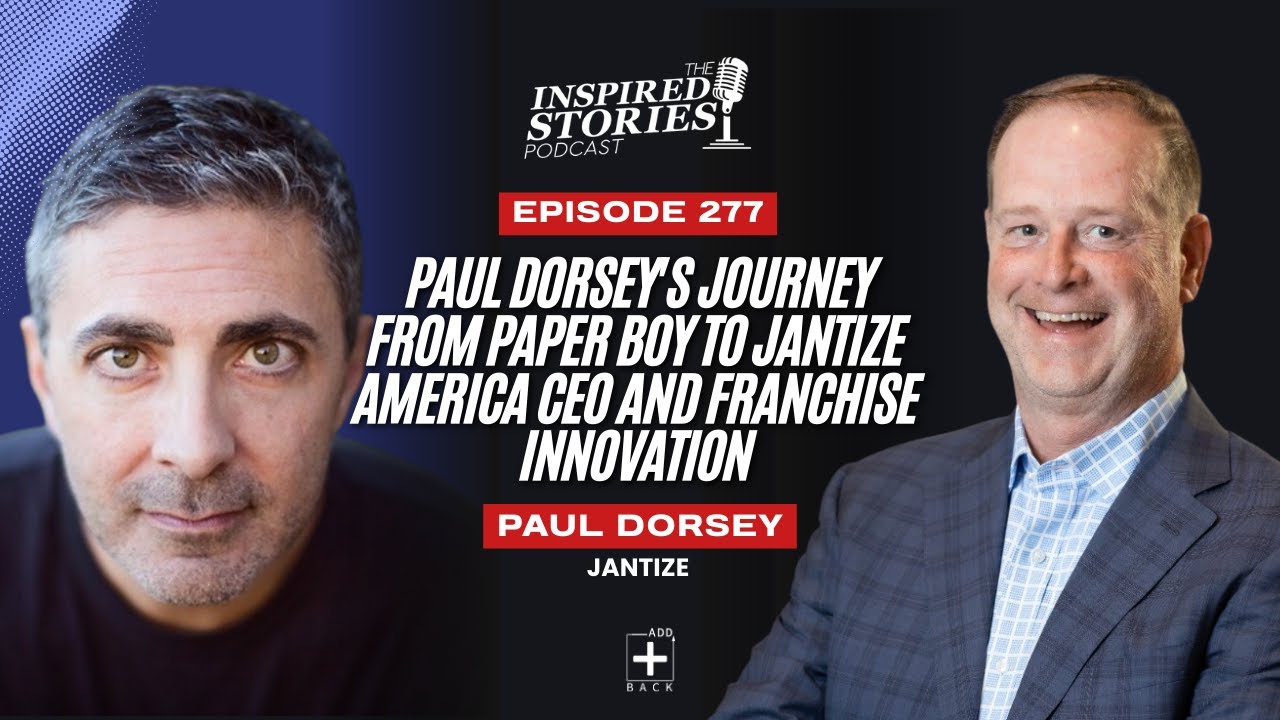
🎙️ From Paper Boy to Franchise CEO:
Paul Dorsey's Mission-Driven Journey in Commercial Cleaning
In this inspiring episode, Paul Dorsey, CEO of Jantize America, shares his remarkable transformation from paper boy entrepreneur to franchise industry leader. Through authentic storytelling, Paul reveals how early entrepreneurial experiences delivering newspapers and selling fireballs shaped his understanding of business ownership and residual income. He discusses his journey through outside sales, learning the power of systems and scripts, and ultimately building a unique franchise model that prioritizes franchisee success over corporate profits. Paul's story takes a profound turn as he shares how a life-threatening health crisis led to his spiritual awakening and transformed his business philosophy to "mission over commission," creating a Christian-based franchise system focused on serving others and building transparent relationships.
✨ Key Insights You'll Learn:
- Paper boy entrepreneurial foundation building early leadership and delegation skills
- Outside sales mastery through systematic approaches and following proven scripts
- Franchise model innovation with area developers handling sales and master territory management
- Technology infrastructure development including proprietary JanView software for billing and operations"
- Next janitorial company" positioning strategy for long-term relationship building with prospects
- Business partnership challenges and importance of majority ownership structure in ventures
- Spiritual transformation from health crisis leading to mission-driven business philosophy
- Transparent franchise relationships prioritizing franchisee success over corporate revenue maximization
- Commercial cleaning industry stability and recession-proof nature of essential services
- International expansion opportunities and franchise registration compliance requirements
🌟 Paul's Key Mentors:
- Terry Brady (Jan King Manager): Taught Paul about KPIs, systems, and professional sales accountability
- Jack LaPointe (Jan Pro Founder): Introduced Paul to franchising concept and business ownership principles
- Jerry Grabowski (Jantize Founder): Original franchise creator who provided platform for Paul's innovations
- His Parents: Instilled strong work ethic, sharing values, and "if someone needs it more" philosophy
- Six Brothers and Three Sisters: Provided early leadership training through family dynamics
- Church Community: Provided spiritual guidance and Biblical foundation for business mission
- Franchise Industry Veterans: Various franchise attorneys and industry professionals who educated Paul about regulations
👉 Don't miss this powerful conversation about entrepreneurial evolution, faith-based business leadership, franchise innovation, and how personal transformation can reshape entire business philosophies while serving others.
🔗 Connect with Paul Dorsey:
Phone: 704-503-7141 Website: jantizefranchise.com (for franchise opportunities) Website: jantize.com (for cleaning services)
📄 Transcript Available:
Paul Dorsey's Journey from Paper Boy to Jantize America CEO and Franchise Innovation
📺 Watch on YouTube:
Inspired Stories Podcast by AddBack Benefits Agency
🌐 Our Website:
The Inspired Stories Podcast
📄 Special Thanks to Anthony Codispoti & AddBack Benefits Agency:
AddBack Benefits Agency - Providing innovative employee benefits solutions that improve employee well-being while optimizing your bottom line Website: addbackbenefits.com
#FranchiseDevelopment #CommercialCleaning #AreaDeveloper #MasterFranchise #Entrepreneurship #BusinessOwnership #FranchiseSystems #JanitorialServices #SpiritualBusinessLeadership #FranchiseInnovation #ResidualIncome #TerritoryManagement #FranchiseSales #BusinessPartnerships #InspiredStoriesPodcast
Transcript
Anthony Codispoti: Welcome to another edition of the Inspired Stories podcast, where leaders share their experiences so we can learn from their successes and be inspired by how they've overcome adversity. My name is Anthony Codispoti and today's guest is Paul Dorsey, CEO of Jantize America. They have been providing commercial janitorial services for over 28 years with a mission to develop long-term relationships through high quality cleaning and exceptional customer care. Their commitment to being trusted custodians for businesses nationwide has helped them earn a place in Entrepreneurs 2025 Franchise 500 list, recognizing their growth and success across multiple locations. Now under Paul's leadership, the company focuses on supporting franchisees, emphasizing an affordable path to ownership and a high success rate. Paul's background includes years of experience in franchise sales and business development, where he has served in various roles at prominent franchise systems. This journey has given him the expertise to guide new entrepreneurs as they grow within the Jantai's network. His story will inspire anyone looking to turn big dreams into real results. And before we get into all that good stuff, today's episode is brought to you by my company, AddBack Benefits Agency. where we offer very specific and unique employee benefits that are both great for your team and fiscally optimized for your bottom line. Imagine being able to give your employees free access to doctors, therapists, and prescription medications. And here's the fun part. The program actually puts more money in the employees' pockets and the company's too. As an example, one recent client with 450 employees boosted net profits over $412,000 a year. Results vary for each company, and some organizations may not be eligible. To find out if your company qualifies, contact us today at addbackbenefits.com. All right, back to our guest today, CEO of Jantai's America, Paul Dorsey. Thanks for making the time to share your story today.
Paul Dorsey: Is there sound effects in the background, Rana? Wow, because that were some accolades, man.
Anthony Codispoti: was all you. let's get into it and let's hear more.
Paul Dorsey: Did that right off of chat.pt or did you go to my website or LinkedIn, right?
Anthony Codispoti: We did our research. I've got a crack team that's behind all this.
Paul Dorsey: It all sounds good, but I'm just a regular guy, right?
Anthony Codispoti: Well, let's hear about that regular guy kind of coming up through the ranks. How did you first get your start in, I guess, both the cleaning industry as well as the franchising space,
Paul Dorsey: Andrew I want to make sure that we're crystal clear Anthony that I'm not in the cleaning industry I am I am a franchise or III sell and support actual area developers or master franchises who buy major territories like a football city whether it be Tampa or Cincinnati or Charlotte or Atlanta those area developers then sub franchise and they
Anthony Codispoti: Okay.
Paul Dorsey: award local unit franchisees within their territories. So we have seven, eight ARIE developers, couple hundred, I don't know, 350 or so unit franchisees up and down the East Coast from Sarasota, Florida, all the way up to Springfield, Massachusetts, where my brother runs a territory up there. So I'm, and then going to the franchise, I think of myself more of an IT guy. We had our area developer call. have our own Jan man, our chat BT, where all the dynamic is there. We have our own Jan view proprietary software, but the franchisees, the area developers can look at their billing, their credit, the collections, their training, all these things set up. So going for even more than a franchise or I think of myself as an IT company.
Anthony Codispoti: So this is really interesting. So the model here is that you've got, what'd you say, seven or eight of these master area developers?
Paul Dorsey: Yeah, that terminology to master franchise area developer regional director. They there a number of different names for that guy or that gal who
Anthony Codispoti: Is that person sort of acquiring all the master rights there or they're actually an employee of the franchisor and then it's their responsibility to sell out the rights?
Paul Dorsey: They're purchasing the territories. The territories are $75,000 to $95,000. So if you want Tampa or you want Dallas, then I'll teach you how to create residual income streams by awarding the local unit franchisees. So my area developers don't actually pay royalties. They collect.
Anthony Codispoti: Interesting. So they're not the ones who are at your master area developers. They're not hiring the crews. They're not going out and finding the customers. They're finding people who want to buy a smaller section of their territory and set up their own business to go find the clients and hire the cleaners.
Paul Dorsey: Wow, you've done your research. Yes. So the area developers put an ad on Google or online or franchise.com and says, be your own boss, own your own janitorial business. The customers are guaranteed from that. They meet with the area developer. The area developer needs a small office, small executive office with a conference room that they can meet with potential unit franchisees. And don't get me wrong, there's rules and regulations and franchising. governed by the Federal Trade Commission. But in a nutshell, the unit franchisees pay the area developers an upfront commission for X amount of business. And the average initial investment is say, I don't know, 15, $20,000. Well, Robert Chess in Raleigh, North Carolina, two hours and a half up the road where my 94 year old mother lives independently. Robert has actually awarded 100 unit franchises in Raleigh, North Carolina.
Anthony Codispoti: a hundred individual franchises within one metropolitan area. So what does the geographical, you know, geofence look like for an individual franchise in the city of Raleigh?
Paul Dorsey: Yes. I want you to go a little bit higher. So it's 128 billion, but with a B, $128 billion a year industry. And that was before COVID. Now it's probably even more because everybody's using somebody to clean that medical facility, to clean that logistics center, to clean that gym, to clean that office building, to clean that convenience store, to clean that restaurant. There's so much business out there. And that would go back to the area developer hires two sales guys. The average sales guy is out knocking on doors, bringing in the customers for the unit franchisees to service. The unit franchisees are great customer service and great operational people. They do no sales. The area developer is a sales and marketing machine.
Anthony Codispoti: Interesting that area developer has to bring in all the business for franchisee
Paul Dorsey: And then my office in the back of the house taking care of all the billing, the credit, the collections, those hassle of eggs. So everybody has a vested interest, whether it's 10,000 or it's $70,000 to make sure that customer is totally satisfied.
Anthony Codispoti: interesting. Okay, so you're also, not only are you taking the sales component off of the plate of the individual franchisee, you're also taking off the billing and the collections part of it, which is a huge administrative headache.
Paul Dorsey: It's again, it's all automated. It's AI 10 years ago. I know more about AI and automation than most of the IT guys do.
Anthony Codispoti: Okay, so what does it mean to have an individual franchise in the city of Raleigh? It's not like I've got this five block area then, right? It's like, I'm just another one of the people that the master area developer is sending business to, is that right? And I could be working in any part of the city.
Paul Dorsey: The unit franchisees do not buy a territory, they buy customers. So you could literally have one unit franchisee cleaning the Toyota dealership and right across the street you have a different franchisee, Suzy, cleaning the Ford dealership.
Anthony Codispoti: Okay. Say more about, because you said, you know, I really view myself as an IT person. Say more about the technology infrastructure that you guys have in place.
Paul Dorsey: The Jan view takes care of all the billing the credit the collections It's a proprietary software that I've been working on for the probably past 10 years with different IT Wranglers from Wells Fargo QuickBooks where I've merged all so the Unit franchisees could log on their cell phone and see all their customers who's paid what's paid? What's the deductions? There's training videos. There's everything else they need to use to run their business on the Janview app. It's the only one in the industry.
Anthony Codispoti: And you've been in sort of the industry for a bit, right? You came up with JanaKing and Jan Pro Systems. What were the experiences like there and how that helped kind of shape the approach that you take there at Jan Tides?
Paul Dorsey: Well, it's a common sense approach. I came up in the newspaper business. I was a paper boy, right? Delivered over 500 papers every day in Springfield, Massachusetts. Now, it wasn't just me and my dad in the back of the station wagon. Well, I hired Coie and Tom Stang and McFarland and Frazier, gosh, I remember, and Stangy and all the rest of the guys, they would all deliver 25 papers. Springfield Republican would go collecting. That was the best part. 12 years old or 15 years old and going, my going collecting tonight on Friday night. And all the neighbors would pay me 10 cents a paper times five days a week or 20. Then I'd give Coie and Stanger and Frazier and Smitty all 15 cents. So I was making 10 cents in all the papers they do. I mean nothing about business or royalties, but it certainly did the same thing with the bubble gum. We'd go to Rice's Fruit Farm and buy by the fireballs for a bag for $2 and I'd sell a meat tube for 25 cents at the playground. So it kind of goes all back to are you born a leader or can you train a leader? Are you born an entrepreneur or do you train yourself to be an entrepreneur? So it goes back to, you
Anthony Codispoti: You were born. You were born a leader.
Paul Dorsey: Well, with six older brothers and three older sisters, you'd think so,
Anthony Codispoti: So you were the youngest of 10. Okay. And so you took your share of Lincoln's.
Paul Dorsey: Yes. And they all work for me now, just so know.
Anthony Codispoti: They're all in the business.
Paul Dorsey: They all work for me now, right? The lawyer, the CPA, all those guys are now working for the entrepreneur.
Anthony Codispoti: Okay, that's fun. Okay, so how did the opportunity to join Jantis come about?
Paul Dorsey: I was then waiting tables and bartending. Another position throughout college where I took as, that was my business. And I also realized somewhere along the line where, gosh, I could make 15%, we used to work our butts off. Like your water would never go low when I was waiting. And we were lucky to get 15%. That was a great tip. But nowadays it's automatically 32%. Well, hey, whoa, Tip was supposed to be to ensure prompt service. So I was waiting tables. Even those tables I took as my own business. I had four tables each night, right? And sometimes I had to pay rent or I had to do what I had to do to pay my bills. And I never forget one night I had the four tables that were actually in the middle of the dining room at Barley and Rye down in South Charlotte. And each time the hostess would walk over to my table with a four or a six or two people, she'd say something to them. And then she would actually point to the window where there was booths. And then people would go to the booth. So one night I got to her and I listened because I really needed to pay my rent that next week. And the hostess said to the customers, the guests that were coming to dine, do you want this table? Or would you rather have the booth over here? 95 % of the people all went to the booth. Again, my rent was due. I had to go to the, I told the hostess at the time, forgot her name, Lisa, can you go over and try this? Go to the booth and say, do you want this booth? Or would you rather have this nice table with the chandelier signing? And then what happened? 95 % of the people wanted to sit under the chandelier in the middle of the restaurant. They didn't want the squeaky booth. So another aha moment that it's how you present or the questions that you ask the people is where you get the answers. I know I didn't answer your question. I told a silly story, but that was certainly the process behind it. So I was waiting tables. saw an ad or of course, was like, Paul, you should be a sales guy. Sales guy? What is that? I am a sales guy, I'm Perrier water and steaks. I saw an ad in the Charlotte Observer in the Sunday paper and it said, outside salesperson. I went, interviewed, was interviewed, was off to the job and they said, I actually said, what's an outside salesperson? And the manager said, well you go outside and you knock on doors. And they are going to pay me. They're like, we're going to pay you $350 a week plus commissions. And of course, then I'm like, what's commissions? And they said, what's tip at the restaurant? But it's not 15 % on $100. It's 15 % on $1,000. Wow. That's a commission.
Anthony Codispoti: It's like getting a
Paul Dorsey: Low and behold. Not only was I interested because guess what Anthony, there was no cell phones. Right. I don't think we even had a pager. And again, I was.
Anthony Codispoti: You were interested. This is very interesting. What are we talking about? Like late nineties, early nineties? Yeah.
Paul Dorsey: was in early 90s, maybe later. And I said to myself, so wait, you're going to pay me to go outside and I could play golf? No one would know. I could go to the mall. I could sleep in. No one will know. And I still remember Terry Brady, the manager of that location, said to me, I won't know tomorrow, Paul, but I'll know in 30 days.
Anthony Codispoti: Okay. Good point.
Paul Dorsey: Well, Terry was a professional and Terry know his KPIs, key performance indicators. So if I follow the KPIs, Kerry knew I was going to close deals. First year, I sold over a million dollars worth of commercial cleaning contracts in Charlotte, North Carolina.
Anthony Codispoti: What was your goal? What was the?
Paul Dorsey: I had no goal. I wanted to pay my rent and play golf on Friday.
Anthony Codispoti: What was the goal the company set for you? What was their expectation?
Paul Dorsey: $3,000 a month worth of new business month after month after month. $3,000. Yes.
Anthony Codispoti: So you surpass that by a fair margin.
Paul Dorsey: Yes.
Anthony Codispoti: Okay. And why, what were you doing that was so impactful? I
Paul Dorsey: So effective. Then I learned what a script and I learned what a system is. Save yourself time, energy and money. Follow the script, follow the system, follow the brownie recipe and those brownies are delicious. If you deviate from the recipe of those brownies, they taste like bad.
Anthony Codispoti: And so what did you learn about that system? What was maybe a component that kind of surprised you at the time where you look back on it now and you're like, yeah, like that's really common sense. And it was so critical to me closing those deals.
Paul Dorsey: You need to put the effort in and let the cookies bake in order for them to come out like nana's. And if you go back to remember Nana's cookies, she didn't just stick them in the oven and pull them out. She had to let them cook for a while. And whether it was a timer on the stove or a little timer on the side, you had to let the process work. You had to let the process create because nothing good happens overnight. But you also have to follow the process. You have to knock on 25 doors a day. You have to call 25 people. You got to go to a chamber meeting. You got to do all the things that's set up in the process that's proven success. going back to the franchise. Whether it's McDonald's or Jiffy Lube or Jantize America, we all have a step by step by step system. Save yourself time, energy and money if you follow the system.
Anthony Codispoti: So I want to go back to that cookies in the oven kind of analogy. So are you saying like, hey, you met with somebody today, you sort of explained, sort dropped off a car, whatever sort of that first step is. Maybe you're not like calling them again right away the next day. Maybe there's like a waiting period, like you follow up in a week or two weeks. Is that what I'm hearing you say?
Paul Dorsey: What we say at JanTes America is we don't want to be your janitorial company. We want to be your next janitorial
Anthony Codispoti: say more about that. Why is the word next so important there?
Paul Dorsey: Cause everybody's using somebody, right? Whether it's a podcast or whether it's health benefits or whatever this everybody's using somebody and I'm happy with my guy, but I might not be happy with them tomorrow or the next day or 12 months from now.
Anthony Codispoti: So you wanna come up with a way or you have come up with a way to sort of stay top of mind with these people that are already using somebody else so that when eventually their current provider makes them unhappy, that you guys are, let's call Jantais. Those are the guys that we're gonna give the next shot at.
Paul Dorsey: Yes.
Anthony Codispoti: Okay. And how do you do that? Is it like a monthly follow-up or you mailing them things or what's that process?
Paul Dorsey: Yes, it all goes back to the IT and the process and the AI that we have set up through our CRMs and other systems. And whether it's a phone call or it's an email or it's a George stopped by with some donuts or whatever it is, yes, we want to be the next janitorial service.
Anthony Codispoti: Got it. so you're doing outside sales and which company was this at the time? Is this Jenna King?
Paul Dorsey: It is. It was.
Anthony Codispoti: And so you were there for, I don't know, maybe five or six years. And then you moved on to be the sales director at Jan Pro Systems. Tell us about that.
Paul Dorsey: I would have never left Janie King. I would still be working at Janie King, maybe in Dallas with Jim Cavanaugh and Jerry Crawford, who still a great friend who passed away. Janie King is actually the world's largest franchisor. It's not Subway, but it's just not sexy to say, Janie King. Janie King, God bless them, they have an airy developer. They call them master franchises. in every single major city of the world, going back to this concept, works to have Airy Developer ever be working at their strengths. I was at Janie King and I sold a great account. It's called the Cameron Brown Building. And anybody who's listening and knows Charlotte, they know the Cameron Brown Building was the old lawyer's office. It's still down there, but it's dwarfed by about
Anthony Codispoti: Wow.
Paul Dorsey: I don't know, 40 stories now with all the other buildings around. Cameron Brown building was a contract. It cost $50,000 a month to clean that building. We scrub the floors, we dump the trash. Again, you're changing labor for dollars, labor's for dollars. They gotta pay somebody. Also the other story, hey, the Panthers or the football team, they can go on strike. The Hornets or your basketball team, they can go on strike. But if the janitors and the trash collectors go on strike, you're gonna have problems, right?
Anthony Codispoti: and we've seen it. We've seen it before. mean, are cities across the world where you'll see that there are major strikes in this area and things deteriorate pretty quickly. People don't like their trash piling up.
Paul Dorsey: It's not sexy. It's not glamorous, but it's the millionaire next door the guys who get involved and understand the concept Never would have left Jannequin so that 40 at that time I was also a straight commission guy No one was paying me 350 bucks a week anymore. I was if I don't eat I don't If I don't close I don't eat but I was closed in ten fifteen thousand dollars a month where the business month after month I was supposed to get 100 % of the first month of everything that I closed. The deal was closed, customer started up, and I went to my managers and I said, pay me. Well, they didn't pay me. And they made up all this silly excuses and this and that and blah, blah, blah. And they jerked me around. They didn't pay me. Like, come on, man. I'm doing all this business. You're not going to pay me? What's that? Mention, if the managers and if that master franchise back in 1990 or whatever it was, would have sat me down Anthony and said, Paul, I wanna teach you a business. There's a thing in business called cash flow. And you just sold that account for 40,000 bucks and we're gonna resell that account to the franchisees, but I'm not gonna have any cash flow in for two or three more months. And then I could pay or let me pay you 10,000 now and keep your and then a 10,000 tomorrow or 10,006 months from now. and then you'll have a book of business all set. But instead of educating me and sitting me down and teaching me about cash flow in business, they wanted to try to screw me over.
Anthony Codispoti: Relationships don't last very long and that kind of foundation.
Paul Dorsey: But again, it goes back to the whole transparency that you go to a big franchise conference and the title is transparency for all, but then they're hiding all this crap behind the mirror or behind the curtain. Guess what? The same time, here's how small the franchising or your industry or the car dealership or anything is. The next day, ring, ring, my phone rang and it was Jack LaPointe, the founder of Janthro. Hey Paul. I'm open in office in Charlotte, I want you to run it.
Anthony Codispoti: before? okay. He just knew of you by reputation.
Paul Dorsey: Yes. What? And then Jack sat me down and he said, says nothing. It says little to do with the actual cleaning of those buildings or you knocking on doors. This is more about awarding those franchises. Let me show you how we award these unit franchises. At that time, I thought McDonald's was actually owned by Ronald McDonald's and all the corporations. I had no idea what a franchise.
Anthony Codispoti: Alright, so this is your first introduction to the franchising world.
Paul Dorsey: They're not changed. thought Applebee's, I thought all the things were... No, they're not changed. They have owner-operators and I learned all about franchising. Of course, now there's been all those movies and more people are generally educated than the others. But it does go back to your misconception, just because I have jantized them, I sure it doesn't mean I'm in the janitorial business. The guys at McDonald's, they don't buy those McDonald's because they love the hamburgers. or they go back there and flip the fries, they buy those because they're money-making machines. Just like an area developer or a master franchise, you want to build a money-making machine that builds residual income streams.
Anthony Codispoti: Okay. So you were at Jan Pro Systems where you learned about franchising for the first time. were there for probably about five years and learned all about sort of the franchising concept. And then somehow the door opened up for you to join Janties. Is that what came next?
Paul Dorsey: And I would have never left G &PRO.
Anthony Codispoti: And did they hose you too on your payments?
Paul Dorsey: Nobody was, no, no, no, no. I never, I learned about business ownership, but I was just an employee still. continue even in franchising, you have all these employees trying to sell ownership of something that they could never buy or would never wanna buy themselves. So it comes kind of like a little oxymoron. What do you mean? You wouldn't buy that doggy daycare franchise. Why are you trying to sell it to me? Which is the salesman's creed. I would never sell anything to anybody that I didn't think was the best for them. Jack Lapointe, Jan Pro, taught me about business ownership. Even though I was doing it already as a paper boy and a waiter and a bartender and a sales guy, I never really understood and wanted to get into the equity of the business for the long haul or the short haul. Jack or Bob, give me 2%. Give me 3%, give me 4%, give me something that I have a vested interest because this is what I'm selling. But the carrot was continually dangled in my...
Anthony Codispoti: It was just, it was on that stick that just kept moving out further and further so you couldn't get to it.
Paul Dorsey: Well again, that's funny. Is it the carrot or the stick? Does everybody know what that means? The character of the stick. Explain.
Anthony Codispoti: The carrot is the inducement, the stick is the sort of the negative punishment.
Paul Dorsey: the stick is just used so you can never reach it. You never get hit by the stick, do you?
Anthony Codispoti: you're talking about it in different way. Yeah, so the stick is holding the carrot out in front of you in this metaphor. And so, yeah, you're trying to get after it, but the distance between you and the carrot doesn't ever close. so that's why you looked for other pastures and found jantais.
Paul Dorsey: Some people think the stick is made to spank them on, but it's not. You can't spank somebody in order to get something if they don't want it. So that carrot and the stick analogy, did I use it or did you use it?
Anthony Codispoti: I think I botched it up first, Let's set the record straight. The carrot was dangled in front of you and you couldn't get to it, and so what happened next?
Paul Dorsey: No matter how hard you hit me with the stick, I could never get it. But you never want to be hitting the mule or the person with the stick because that doesn't work. And it goes back to that the person has to want it themselves is the analogy of the carrot and the stick.
Anthony Codispoti: So how did the doors open up for janties?
Paul Dorsey: sick of making money for everybody else and not having ownership of it my own. So I started searching around and searching around and learning more and more and more about franchising. I spoke to a lot of franchising guys back in the days. It was called a Uniform Franchised Offering Circular, UFOC. I had to speak with some franchise attorneys and they had a fear factor. It's going to cost me a couple hundred thousand dollars. my firstborn child and if I do anything wrong I could go to jail. And I think some of that stuff still goes along today. So in my search, I found Jantize America and Jerry Grabowski, the founder in Livonia, Michigan, where Jerry made his millions already with the dot com bubble of the early 90s. Remember that?
Anthony Codispoti: do.
Paul Dorsey: Jerry had Jantai set up more like that franchise or franchisee model where the unit franchisees would come and invest that $20,000. They would then get a truck or a van and they would also learn how to do their own sales and marketing. Jerry that I met, I was like, Jerry, there's a better way to do this. We could do it this way. We put that area developer in there. We have everybody working in strengths. said, all right, Paul, if that's what you want to do, you can do it in Charlotte. Prove me wrong. Well, again, I opened the Charlotte territory and I sold 45 unit franchises within a short time period.
Anthony Codispoti: How did you do that back then? Was this like early 2006?
Paul Dorsey: Sunday paper. We had little classified ads in Sunday papers or the weekly or the reminder or whatnot. Yes. And then 2006, that was probably Craigslist. Free ads on Craigslist and all those other things that are no longer successful. 2016, we did award another territory in the Tampa area and myself and those two guys, Chris and Dean, we went to Jerry and said, hey man, we wanna buy you out. You're sitting up in Lavonia, nothing's happening, we wanna grow this thing, we're gonna do this, that, and the other thing, bring in that technology edge that I was working on and we bought out Jerry.
Anthony Codispoti: and then you were able to put this model in in a lot more geographical locations in the US.
Paul Dorsey: wouldn't that be nice? No, man. I had not one, but I had two partners. As of today, we don't sell any franchises where it's a 50-50 split. There has to be somebody with at least 51 % and somebody with 49%. I mean, business and partnership, it's like a marriage. And now they say 60, 60, 60.
Anthony Codispoti: Okay.
Paul Dorsey: percent of all marriages fail. God bless you. I've been married for 25 years coming next Tuesday. The highs and lows, more highs than lows of marriage, two kids, but partnerships are.
Anthony Codispoti: Thank you.
Paul Dorsey: And then I want to say there was a going back to Nana's cookies. Somebody's hand was always in Nana's cookies, getting more and more cookies. And I'm like, come on, man, your wife's getting paid $70,000 a year to answer phones. And I'm like, is he right? So there becomes some, and I ended up buying out Dean and Chris and then moved everything back to Charlotte, started the national expansion. 2016, 2018 is when we started to launch and bring on more Aerie developers. in those other tiers.
Anthony Codispoti: And so what territories do you have right now? Where can we find you guys?
Paul Dorsey: Serious hit of Florida. Atlanta Greenville Spartanburg, which is a small market but it doesn't matter the size of the territory because guy has 70 unit franchisees down there and does you know six seven hundred thousand dollars a month worth of nightly janitorial services then we go to Charlotte Greensboro with Bobby Roberts and Raleigh jump up to Springfield Massachusetts Hartford my brother Mark runs that territory over to Tarek in Nashville, Sean in Louisville, and Norma in Colorado Springs.
Anthony Codispoti: What is a typical sort of life cycle for a new master area developer? They come in, they put some money down with you. How long before this kind of is looking pretty rosy to them?
Paul Dorsey: I don't want to make any earnings claims, although I would say 12 months and we have some benchmarks and things then they could talk to the other guys. Yeah, because going back to the system, it's not a one man show. It's a full time job to start to sell the unit franchises or award the unit franchises. And then you got to hire two sales guys out doing what Paul did 20 years ago, knocking on doors. Average sales guy still in his race should be ringing on three to $5,000 a month worth of new business. month after month after month. So at the end of 12 months, I want the area developers doing at least 70, maybe closer to $100,000 worth of monthly facility services. Thus, the area developer then collects a 9 % royalty because they are a franchisor in their territory and a 7 % management fee or we call it support fee now, can't manage anybody. So 16 % of the gross revenue stays with that area developer. So 12 months break even, 15 months profitable. And then you could grow up, could again, just, I have a calculator and do not want to make any earnings claims because there are rules and regulations. But you can talk to the other area developers, look at our franchise disclosure document and get all that information.
Anthony Codispoti: Okay. And if somebody is interested in exploring being one these area developers, how do they go about doing that?
Paul Dorsey: I mean, they could call me on my cell phone or they could call John and Fran Dev or Karen or Lavonia. The number here at Jantai says 704-503-7141. Although we also have a website, jantizefranchise.com. And this is very important too, Anthony, because the end user, whether they're getting that oil changed or they're getting that hamburger or they're getting their building clean or they're getting their hair cut, They could care less about franchising. Matter of fact, some people get upset if you're a franchise because their father bought a franchise or their father bought a distributor or they heard some horror stories about something else. So we really separate the whole end use customer, jantize.com from the whole employee ownership at jantizefranchise.com.
Anthony Codispoti: Gotcha. So jantizefranchise.com is where somebody can learn more about it. And who are the kinds of people that you're looking for? What are their backgrounds typically? What are the personality traits? What do you like to see?
Paul Dorsey: You. right? An entrepreneur who's kind of maybe doing his own thing for a while. He understand he's out there, you know, getting business. He doesn't have any reoccurring revenue streams and wants to understand residuals in the territory. And he can file. I don't want you to have any sales because we were sales trainers. I want you to have a step by step by step system for success.
Anthony Codispoti: So you're not looking for sales background, you're looking for more of a business background.
Paul Dorsey: Empire Builder. It's an Empire Builder, yes.
Anthony Codispoti: And so this is somebody who maybe doesn't have sales experience, but they've got really good people skills.
Paul Dorsey: Guy Loewswick, Greenville Sparkberg, no sales experience. Now he's the chairman of the area developer council. And he's hired like three sales guys in Greenville. He's got operations, he can manage people, yes. People factor.
Anthony Codispoti: Gotcha. Yeah, that's important. Can you share an example, maybe of an innovation or a method that you've introduced since buying your partners out that has really improved the quality or efficiency in either the operations kind of for cleaning people or just the overall franchise model?
Paul Dorsey: Well, again, our motto is if it's dirty, clean it. And your mom taught you how to clean. We're not doing any high level clean room hospital cleaning. And don't get me wrong, there's airborne pathogens and all those things that the franchisees are trained upon. But our biggest is going back to what I mentioned before, the Jamdew proprietary software. So when Jerry and Chris were here, they'd have, did someone still pay? Did someone still pay? No, look at the Jamdew report. right there. It updates at seven o'clock every night. Every time the customer pays, Jamdew updates. So everything's there. So it goes back to the transparency of accounting.
Anthony Codispoti: Yeah, the technology that you've layered in there for the collect, filling pieces, it sounds like it's a huge efficiency gainer. Where do you see this going? Where's Gentile's going in the next, call it five years?
Paul Dorsey: Of course.
Anthony Codispoti: What's the future plans?
Paul Dorsey: And as I mentioned too, the goal in the future is to jantize Taiwan. And that's who was in my office last week. Because I don't care whether you're in Toledo or Tampa or Taiwan, wherever there's an entrepreneur who wants to be his own boss, whether there's an empire builder who understands scalability, this concept works. Because whether you're in Tampa, Toledo or Taiwan, there's so much business out there.
Anthony Codispoti: See, you're already looking international.
Paul Dorsey: mean, Canada's international.
Anthony Codispoti: Are you there?
Paul Dorsey: in negotiations with some guys in Canada now. Although when we get confused with the area developer and master franchise, I believe that'd be a true master franchise to take over the whole country of Canada. We would change the flag to a maple leaf here and do some different things. He has Canadian currency, so the Jandu would have to be set up differently and stuff too. And he would then award the local area developers who would set up the unit franchisees. So yes.
Anthony Codispoti: So that's some different considerations as you move into different countries. But you've already got your eye on that kind of expansion.
Paul Dorsey: And we already have the legal team and the support and the systems set up to do it again in Toledo or Tampa. I would rather grow in the Southeast because I keep mentioning Tampa or 15 area developers in Florida. So there's a huge opportunity. No California, not going west unless there's a West Coast guy.
Anthony Codispoti: Is it
Paul Dorsey: It's just do with them. Yes, but then again, there's some strict franchise rules and regulations. There's franchise registration states. We're in the Southeast and we're still shaking hands and doing business because we're good, honest Bible Baptist guys who are going to take care of and be ethical. But there's other times and franchising too. I just sold 100 franchises in California. Well, no, you didn't. You can go to jail for that.
Anthony Codispoti: Why would you go to jail for selling 100 franchises? yeah, they get different rules there.
Paul Dorsey: because they weren't registered. Yes, the different rules of franchise registration states are similar to the selling stocks and bonds. You've to be licensed. They have brokers now. There's franchise brokers. you're going to some... No, not in these states. can't. You have to have your real estate license. You can't sell that house. You're going to go through these classes.
Anthony Codispoti: Take a little bit of a detour here. The spotlight's on you, But I want to hear, because we've talked about.
Paul Dorsey: was talking about you, Yes, the sun is creeping right right.
Anthony Codispoti: It's, yeah, you've got a halo around your head there. But I want to hear about a challenge, personal or professional, that you've had to overcome in your life. Maybe something that, you know, almost took you down. What was that? How'd you get through it? What did you learn coming through the other side?
Paul Dorsey: Which one do want first? Sometimes they all kind of mingle.
Anthony Codispoti: whatever comes into your head. Exactly.
Paul Dorsey: Business challenge is the area developer, the master franchise, the concept is so unique. Even if you get online in Google master franchise or area developer, there's less than like half a percent. But if you Google franchise, you're going to have all these other things. So the terminology is not used because you don't know what you don't know. So. whatever is the opposite analogy of preaching to the choir, I'm spreading the gospel to unknown. And people are actually buying other franchises, whether it be the fence franchise, or it may be the cleaning franchise, or it may be the restoration franchise, or it may be the power washing franchise. And they don't even know the area developer or the master franchise is available to them at a lower cost with much, much greater return. on the residual royalties. They don't know. And how many guys I spoke to and there's maybe some other videos out there, like, if I only knew this. So again, it's psychiatry that you don't know what you don't know. And you don't know what I don't know and I don't know what you don't know. I don't know if I'm ready to share any of my personal.
Anthony Codispoti: Well, let's go back to focusing on the business one then. how do you work through that? How do you address that?
Paul Dorsey: I continue to speak with guys like you who may have a different audience that may be thinking of entrepreneurial strip and whatever it is. Maybe it's a franchise, maybe they're starting their own restaurant business, maybe they're going to do a lemonade stand. If I can help anybody in your audience with my 20 years of experience and what I've done, even setting up a franchise disclosure document that the lawyer still charged all this X amount and then they copy and paste up. So you have to know more about franchising than the lawyers know about franchising and it comes from reading books and listening to tapes and the education factor that you put into your position.
Anthony Codispoti: You mentioned reading books. Do you have a favorite? A book or a podcast? Something that has been really helpful.
Paul Dorsey: The stories is my favorite part, right? I've been listening for years now. Been so inspired, I called in. It's like, I want to inspire some people,
Anthony Codispoti: I love it. We're happy to have you here.
Paul Dorsey: But no, man, I'm a big, know, the audible's been out, so I'm listening to books all the time. The first one that came to my mind that you mentioned was certainly the Robert Kiyoxi, Rich Dad, Poor Dad series, which I think I read that 10 or 12 years ago. I still go back to that. You know, you get more about reading the book than you do listening to the audibles, but there's still a lot of stuff you can listen to. It's called Automobile University. Don't sit there and listen to the sports talk radio or the news talk BS. Put an audible tape on about business and listen to it or motivation or whatever it needs to be. Yes. Leaders are readers.
Anthony Codispoti: I like it. What's your superpower, Paul?
Paul Dorsey: I'm just so, I'm so transparent and I'm so confident. And so I was actually called blunt because I questioned some of the things that they were doing. And I came and I don't know if it's no fear or no care. There may be a little bit of both in there too. And I was in the meeting. I bluntly asked them, please explain this to me. What are you going to do from there? Here's a great example too. As a franchise convention. And this was the fran- Franchise, transparency in franchise. I was honored to be on a panel and up there was the ice cream guy, the sign guy, the restaurant guy, and I think I was up there. And somebody, was a broker meeting and one of the brokers said, can I see, can I see, it was a UFOC, so it has been dated. Can I see the UFOC? Ice cream guy says, well, no, no, you gotta sign off on it. You gotta make sure through and you can't see it. The sign guy says, well, I'd send it to you, but it has all my secret recipes in there and the financials and everything else I don't wanna send. And the pizza guy said something else, but oh, you gotta go through it. You're a broker, you can't have it, blah, blah, blah. And I said to the guy, what's your email address? On the stage, at billsmith at aol.com. And I pulled up my Blackberry and I sent it to him.
Anthony Codispoti: Hmm.
Paul Dorsey: And at the podium was one of the franchise attorneys from the IFA, the International Franchise Association. And they looked at me and they said, you can't do that. Why?
Anthony Codispoti: Why is everybody else hesitating? And why did that attorney kind of wag his finger at you?
Paul Dorsey: I don't know. I looked at him and said, gosh guys, I just did. And I'll be at the bar having a beer if anybody really wants to get transparent in this convention for the rest of the weekend, because I can't deal with this BS. Because there is too much BS and sales, and no one wants to tell anybody thinking I'm going to hurt your feelings or step on your toes, whether it's right or wrong. And you know what? That might even be some of the issues with the country we're having right now. That's a lot.
Anthony Codispoti: And that specific example that you have there, like, okay, so each of these different franchisors, they don't want to share it it's got some secret sauce or something they don't want to share. But was there a legal reason that you're not supposed to share it without collecting some information from people?
Paul Dorsey: know because they're and scared again go start your own janitorial franchise what do you want to know if you can do it better than me god bless you
Anthony Codispoti: That's what they're afraid of, Somebody's gonna take your blueprint and... Yeah.
Paul Dorsey: Yeah, he's gonna steal my mom again. My accent. I think going back to how well I was raised with all my brothers and sisters. I left my bike outside one night and we got all up. So I got I got to wake up. I got to get my bike. I left it outside, mom, at the bus stop or something. And my mother said, Paul, if your bike gets stolen, that means that person needed it more than you. What can get another one might not be the Schwinn. but it might be something else. And ever since that day, it's like, I don't care. If you want anything of mine, you don't ask and I'll give it to you. My brothers are like that too. So again, I think it goes back to how people were raised and maybe it was a different.
Anthony Codispoti: It was your upbringing. That's an interesting anecdote there.
Paul Dorsey: You seen that comedy too or the guy remember when you know people would come ding dong ring the doorbell poppins. Hey poppins here make some coffee everybody would hang out and stuff for an hour or so. I mean now someone rings the doorbell he's ducking under the couch. I'm not here.
Anthony Codispoti: Well, yeah, we have to text somebody before we call them. Hey, I was thinking about calling you. It's now a good time. And then you call them to ask, hey, can we come over to visit? Yeah, don't. Nobody does the pop in anymore. That would be unusual. You're popping in. Paul's still a popping inner. Yeah. How about, you know, looking back at maybe something in your past where, man, at the time it felt like a mistake. felt like a misstep.
Paul Dorsey: popping in.
Anthony Codispoti: But now when you look back on that moment, it's like you've got some gratitude for it. It pushed you in a different direction. It propelled you to do something that wouldn't have happened otherwise.
Paul Dorsey: Well, I don't recommend this to everybody. But I was married for six months and I came home and told my wife, hey, honey, I quit my job and bought a franchise today. Can I get on your insurance for a little while?
Anthony Codispoti: How'd that conversation go over?
Paul Dorsey: Well, now, as I mentioned, it's being 26 years later and she's been a full-time mom taking for our kids for the last 18 years. So I think it's worked out pretty well.
Anthony Codispoti: But did it really feel like a mistake at the time?
Paul Dorsey: Scary.
Anthony Codispoti: scary. Yeah.
Paul Dorsey: But then I also learned later in life too, mean, fear is a liar.
Anthony Codispoti: say more about that.
Paul Dorsey: Well, again, I think there's a great song too. Fear's a liar though. The fear's your psyche, your Holy Spirit's gonna tell you or not, hey, this is fear. can't do that. All the bad things are gonna happen and not stay positive, which goes back to business ownership. Yeah, there's gonna be ups and downs, but you gotta stay positive. And I've come up with that too. I've been saying it so long with, how you doing? It's great. Everything's great. And then as you say it's great, you become great.
Anthony Codispoti: Fake it till you make it.
Paul Dorsey: Yeah, and it works.
Anthony Codispoti: What's the best decision you've ever made for your business?
Paul Dorsey: besides the podcast with you.
Anthony Codispoti: Yeah, that's the obvious one. What's the number two?
Paul Dorsey: The best decision that I ever made for Jantize America in the business is our mission statement. And our mission statement is, we're a Christian company. Everything I do is to try, I had to put the word try in there later on, to try to honor and glorify God. We want to build mutual, transparent relationships with my franchisees, area developers, vendors, customers, employees. We want to be honorable, yet profitable. and we make mistakes and we realize mistakes, we want to fix them right away. That's probably one of the most proudest things. And if I could teach that and have all the franchisees and all the franchisees, employees continue to understand that we're in it for the mission, not the commission, then more and more and more and more things come. So if you're worried, oh, this account's only, you know, 35 % profit in this one. No, workmanship, whether you're making five bucks or 500,000 bucks, your workmanship never changes. So it's the mission. You gotta be in it for them and not in the commission. And you can tell really quick the sales guys who are in it for the commission. And I used to be one of those when I waited tables and needed my, or the guys who are in the mission, because I have a sincere desire to help other people. And if. I can help somebody else get what they want, whether it be start a genitalial business, whether it be start a franchise, whether it be something else, then more and more people are gonna help me get what I want. And that's just how the world is. Because all these-
Anthony Codispoti: Where does the driver for this mission come from? Where's this fire? How did start?
Paul Dorsey: I got saved when I was 36 years old, man. And Jesus said, hey Paul, this is what I want you to do. And all those guys were getting screwed at these other places because they weren't making any more money than they should be. This is where you can make a nice living and take care of your family and your friends. And this is where you do. So I really believe it's a passion of mine that I've been placed in this position as a guardian, which is the name of my LLC, to guard over and watch over. some of these franchisees and some of these janitor guys who being taken advantage by others.
Anthony Codispoti: How did you get saved? What was that process?
Paul Dorsey: Yeah 1988, diagnosed with polycystic kidney disease. I was always a good guy. It didn't matter where I went to church. I had a great upbringing. I was a very good guy. I knew about God and Jesus in my head. And I knew and recited all the prayers in the Catholic Church and never missed a Sunday as a ritual thing that I continue to do. Well lo and behold, I had this health situation near death where I was on dialysis and they had a chance to sit down and start to think about the afterlife and what am I really here for? So I started to read the Bible and as I started and read with the book of John, it started to come alive and all these questions that I had were like answered to me through my heart. Lo and behold, professed my faith in Jesus, believed that He died on the cross for my sins and has saved me. And ever since then, don't get me wrong, I'm a sinner, said a cuss word the other day, had a beer at the golf course, so I all make mistakes. But it goes back to Jesus died for those sins for me 2000 years ago, and I believe that. And because of my belief in that, all these other things happened. that have put me in this position today. And you're reminding me of that now on this call too. Because there's been other times where I wouldn't say anything. Here's a story for you. We were cleaning the Charlotte Knights baseball seed, it was $16,000 a month. And Jeff, one of my unit franchisees was down.
Anthony Codispoti: Yeah.
Paul Dorsey: John wasn't happy. There was peanuts on the floor. Hey, Jeff, we gotta make some change. We met with the GM, John, at the Knights Castle. Jeff was in the conference room. I was in the conference room. And John looked at his books and said, Jeff is your unit franchisee. He has to go or I'm gonna cancel. Paul, gotta get somebody else in here this weekend. John left the room. Jeff's like all upset. Give me one more chance, one more chance. And I hear his voice. Like, does this guy know Jesus? I'm like, man, I don't have time for that right now. voice in my head again, Paul, gotta tell him about Jesus. I'm have time for this. I'm in the middle of Knights Castle. I got a $16,000 a month business that I gotta save. And then I asked Jeff, it's like, Jeff, you ever met Jesus, man? This isn't about this. Jeff professed he asked Jesus to come into his heart that day in the Knights Castle. Wow, that was Memorial Day or the day two days before Memorial Day, whatever that was 2005 or 2006. You know what happened the next Monday? Jeff was in a tragic accident. died. So the Spirit moves me in ways that people think are crazy sometimes, even in this conversation. But if I don't listen to the call of Spirit, well then I'm not who I say I
Anthony Codispoti: That's powerful story. I appreciate you sharing that, Thanks. And this all started for you with a health scare that had you thinking about larger purpose. Why am I here? What's the afterlife? And it started you reading the Bible and something opened up inside of you.
Paul Dorsey: Again, I've had more and more, I got investors coming in at the end times like, oh, you could be charging more. You could be charging 25%, 30 % royalties like those other guys do. It's like, I don't need anymore. And then I did an inner city mission on Saturdays. I'm the Bible Quiz Show guy. We drive these broken down buses and the broken around ministries and we tell people about Jesus. And that's what life is all about. And that's why I'm in the position. So I'm able to tell those stories.
Anthony Codispoti: But
Paul Dorsey: Yeah, it is. You're gonna make me cry,
Anthony Codispoti: there something more you want to say about that? You have another story along these lines? Okay. We'll wrap up with one, a bit of a softer question. You and I reconnect a year from now, Paul, and you're really excited. You're celebrating something big. What's that big thing you're celebrating one year from today?
Paul Dorsey: No, I'm good. Because of this podcast that we've had today, I'm able to express my relationship with Jesus in a better way without having to think I'm going to offend you or anybody else. Because at the end of my day or the end of my life, that's all that really matters. And if it's a year from now, I hope I'm able to tell more people that story and perhaps have a like impact or plant a seed with some others to go read the book of John like I did or to look at some other things so they too can have that same relationship as I. Kind of like the Schindler, it reminds me of that Schindler List movie, Is there one more? could sell my phone. Is there one more? I'll sell my computer because it doesn't, I don't know, all this other, it just doesn't matter.
Anthony Codispoti: Paul Dorsey from Jantize America. He's in it for the mission, not the commission. I want to be the first to thank you for sharing both your time and your story with us today. I really appreciate it. Thank you. Folks, that's a wrap on another episode of the Inspired Stories podcast. Thanks for learning with us today.