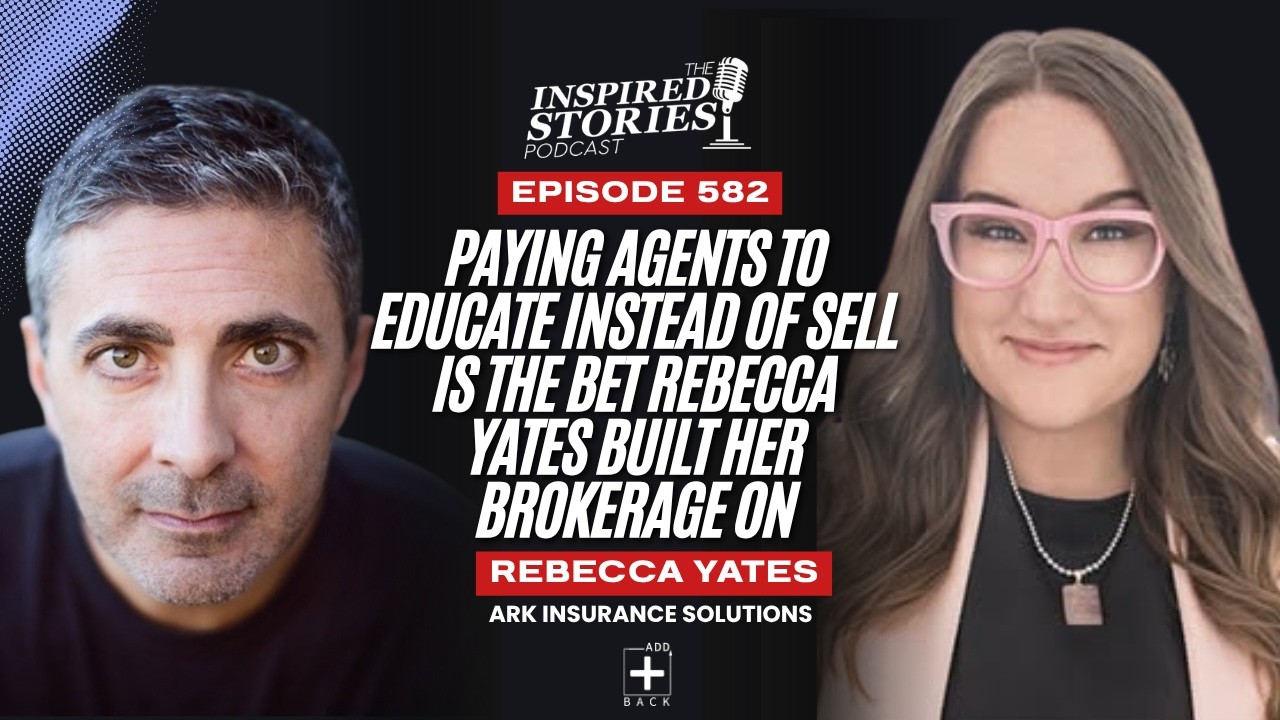
🎙️ A Father-in-Law's Insurance Payment Saved a Life and Changed Rebecca Yates's Entire Career Path
In this episode, Rebecca Yates, founder and CEO of ARK Insurance Solutions, shares how a family health crisis changed her mind about insurance forever and set her on a path to building one of Utah's most trusted independent brokerages. Rebecca opens up about surviving a very public personal crisis as a young single mother, walking away from an employer who told her to stop helping clients, and the years of advocacy work that quietly reshaped how millions of Americans access coverage through healthcare.gov.
✨ Key Insights You'll Learn:
Watched her ex-husband's medical bill spiral toward a million dollars with no insurance in place
Changed her mind about insurance after her father-in-law's premium payment covered the entire bill
Spent nine years and eight months being publicly harassed following a highly publicized personal crisis
Left her second industry job after being told to stop helping a client fight an unfair rate increase
Launched her own brokerage in 2009, just as the Affordable Care Act was reshaping the industry
Has served on the CMS Broker Advisory Group for Healthcare.gov since 2017
Helped close a six-year regulatory loophole that let 850,000 more people qualify for subsidies
Co-founded a software company, Max Methodology, to help independent brokers stay compliant and competitive
Pays her agents higher commission splits and renewals to reward client education over fast sales
Crossed her agency's first million-dollar revenue year, a milestone only 2% of women-owned businesses reach
🌟 Rebecca's Key Mentors:
Her Father-in-Law: Paid the insurance premium that covered a near-million-dollar medical bill and changed her view of the industry
Her Mother: Took her in during her hardest years and showed up for her consistently through a public crisis
Her In-Laws: Provided steady childcare and support that let her rebuild her career as a single parent
Colleagues on the CMS Broker Advisory Group: Partners in years of advocacy work that reshaped healthcare.gov's systems and protections
👉 Hear how a near-catastrophic medical bill turned a skeptic into one of the health insurance industry's most active advocates for consumers.
Listen to the full episode here
Transcript
Anthony Codispoti (00:00)
Welcome to another edition of the Inspired Stories Podcast, where leaders share their experiences so we can learn from their successes and be inspired by how they've overcome adversity. As you listen today, let one idea shape what you do next. My name is Anthony Codespodi, and today's guest spent six years working inside corporate health insurance before deciding the entire system needed to be built differently.
She bet her career on a philosophy her competitors called bad business. Measure agents on how well they educate clients, not on what they sell. She launched her own brokerage in Salt Lake City within weeks of the Affordable Care Act, rewriting the rules of the industry, growing it through a decade of shifting regulations until she found herself in rooms where national health policy was actually being shaped. Her name is Rebecca Yates.
Founder and CEO of ARC Insurance Solutions, an independent brokerage serving individuals, families, and employer groups across Health, Dental, Vision, and Medicare Advantage. Rebecca has served on the CMS Broker Advisory Group for Healthcare.gov since 2017, sits on the Utah Rare Disease Advocacy Council, and was recently named one of Insurance Business America's elite women of insurance for 2026.
And earlier this year, the Wall Street Journal turned to her for a firsthand look at how rising premiums are forcing families to make impossible choices about their coverage. So the question is how a broker who refused to chase commissions built one of the most trusted health insurance brokerages in Utah by breaking the industry's own rules. But before we get into all that good stuff, today's episode is brought to you by my company, Adback Benefits Agency.
And this solves a problem that's been plaguing your health insurance clients for years. You already know the story. Health premiums go up and your client panics. Maybe they shop around or start cutting benefits. Either way, you're the one explaining a price hike you didn't create, and your relationship takes the hit. But there's a program backed by Bain Capital Insurance that you can bring into that same meeting that flips the script and frees up cash. It doesn't replace their group health plan, it fills in the first dollar gaps.
And can even cover part-timers who don't qualify for major medicals. Employees get unlimited access to doctors, therapists, and prescriptions with no co-pays or deductibles to meet. And here's the part that changes the conversation entirely. This program actually increases the client's net profits. We recently helped a client add. Add $900 per employee per year to their bottom line. Results vary, but gains like that don't just help.
their bottom line, they free up budget. Your clients can reinvest into the coverages you're already discussing with them. Addbackbenefits.com. Okay, back to our guest today, the CEO and founder of ARC Insurance Solutions. Rebecca Yates, thanks for making the time to share your story today.
Rebecca Yates (03:02)
so excited to be here.
Anthony Codispoti (03:04)
So let's go to 2004. You started as an account manager at Taylor Benefits Insurance Agency, a group health insurance agency. What was pulling you into the insurance world at that point?
Rebecca Yates (03:17)
actually that's funny. Got a big backstory behind it. I was in the middle of going through divorce. my husband had been arrested on national television for molesting fourteen year old girls.
Anthony Codispoti (03:28)
Wow.
Rebecca Yates (03:29)
Quite the shock as a young married person with a little baby to come home. I was pregnant with my second, and my entire world fell upside down. I lost my my privacy, my job, my house, my religion, everything fell off a cliff. And he went to prison and jail for a little while. And when he got out, I was still technically married to him and wanted my company I was working for was based in Ohio, wanted me to move to Ohio.
And he found a little law that blocked me from leaving. So I found myself in a position where I was going to be an unemployed single mom. And he he got out of jail and I called and said, I'm taking you off my health insurance. I've been carrying you for the whole time you've been going through this, but you need to go get your audience. He said, Great, I'm gonna go work for my dad. He started his own company, we're gonna get insurance. And I Perfect, my open enrollment's here. I'm taking you off July 1st, January.
And July third he rolled his four wheeler and almost died.
And at the time I had been looking at different jobs. I'd been offered a job at Taylor Benefits. And I had originally was not going to take it because I had worked in property and casualty for a very short period of time. And the agent I was working for was some doing doing some things I found out later were unethical. And my opinion of health insurance or all insurance brokers was that they were unethical and just out for the money and shady, and I didn't believe in it. And I had been selling emergency medical supplies. So everything I sold.
In the back of an ambulance, I knew if I'm selling a trait kit, literally gonna save someone's life. Right? I have to be able to sell something I really believe in and I'm passionate about. So I was in this strange place where I was looking for work, trying to decide what to do. I'd been given this offer and I wasn't gonna take it because I didn't believe in insurance. I was like, that's that's not real. I don't, I mean, I've never had them successfully pay for anything I do. Like this is I had a very negative feeling towards insurance as an entire industry.
When my husband rolled his four wheeler, my mother-in-law called me, and this was on July third, and said, I don't know if I should call you or not, but he might die. So you should bring your daughter to the hospital and meet us there. That's all I got told. I showed up and he's a wreck, literally in pieces. The the four wheeler rolled over, ripped his whole stomach open, broken his back, his neck, his helmet had been smashed into pieces.
And the doctor pulled me aside and said he shouldn't have lived. If he hadn't had a motorcycle helmet on, he would not have lived. And I'm holding our three-year-old. And the nurse pulls me over and she goes, So you're the wife? And well, sort of. We've been separated for like two and a half years, so I don't I don't know. She goes, Well, welcome to Utah. It's a common state. So you he doesn't have insurance, he just told us. He also doesn't have a job, and because he just got out of jail, he doesn't have any resources. So
You are gonna be responsible for this bill. And right now it's about a hundred thousand dollars today because they had to lifelite him. We anticipate it's gonna be about a million dollars by the end of the week. I am twenty five.
She looks me straight in the eyes. it's 24 actually. Looks me straight in the eyes and says, How do you want to pay for that? I'm gonna pull out some kind of credit card. And I I was like, I can't. And I had worked so hard when everything fell apart to not file for bankruptcy, to I mean, I'd had to short sell my house, I'd done all of these things to really come out of it without starting completely over. And I thought bankruptcy is my only choice.
That's all I've got. And my wonderful father-in-law said, Hey, let me call my broker. And he called his insurance broker and he said, Hey, I I know you gave me a quote for health insurance. And because we got max rated because it was for the before the ACA was in effect, right, or existed, he declined it because he could either make payroll or he could pay for health insurance. And she said, Will you have a quote that's valid until July 6th?
Remember this accident was on July third.
So my father in law chose to pay that premium for me, or for my my ex-husband, right? And the insurance company covered the entire bill.
And I was like, Suddenly, I think I believe in insurance. That's crazy. And I called up Doug and said, Yeah, I think I'll take this job. I think I believe in it. I think I can sell this now. I understand it.
Anthony Codispoti (08:04)
Rebecca, I gotta tell you, in all the years and the hundreds of episodes I've done, that is the most mind-blowing origin story that I've ever heard for entry into a career. There's so many layers to unpack there. take me back, because I'm interested, you know, before we kind of get to the insurance industry, which is what with what we want to spend the bulk of the time talking about today.
Take me back to finding out that your husband is, I don't know, a sex offender and how you're dealing with that, how you start to try to put the pieces of your how it falls apart, how you try to put it back together, where you went for support.
Rebecca Yates (08:53)
I found out because his grandmother saw him on television. None of us knew he was being investigated. We had no idea that any of this was happening. And before he was arrested, he had confessed to the police. So it's not like there was a debate. Although he kept trying later to be like, they coerced me, I didn't do it. But he did confess. He pled guilty, all of those things. But I knew nothing. Here I am with a little toddler.
Barely pregnant, barely pregnant enough, I hadn't even told him. Right. And I was at my allergy shot, actually, getting an allergy shot. And my mom was with me. And my mother-in-law called and she said, Why didn't you tell me? And I said, What are you what are you talking about? And she said, Well, have you talked to him today? And I said, Yeah, about 3 30. And she goes, Well, or at three o'clock or so. And she goes, Well, 3 30, they hauled him to jail. And I was like, That can't be right. They've got the wrong person. There's no way. And she said,
His face was on the screen, his work was on the screen, and his car was on the screen. It's a hundred percent him. And of course, he can't call us. None of us have any idea what's going on. It's a horrific feeling where you're just sick to your stomach and you you don't have any way to even get in touch with him. And so we just had to wait for him to call. But by then, what had happened is the girl's parents had called the media.
Because they had been told that he was gonna get off with just a slap of the hand and a misdemeanor. And she said, absolutely not. And it was one of the first times that the media had gotten a hold of a story like that. I couldn't, by the time I got home, the media was in my front yard. And I was like,
Anthony Codispoti (10:28)
Wow.
Rebecca Yates (10:29)
Nope, gotta go. So I spent the next several days bouncing around, really leaning into my family. but for nine years and eight months, when I'd go in public, I would get harassed or talk to about it or
do an enrollment meeting and have somebody be like, you're not related to that guy, are you? It was crazy. And I learned very quickly who my people were.
Anthony Codispoti (10:53)
Nine years and eight months. What happened at nine years and nine months?
Rebecca Yates (10:57)
That well, nine years and eight months was the last time someone randomly approached me in the grocery store to tell me that he had assaulted them in college as well. And that
Anthony Codispoti (11:07)
It's wasn't a one time thing.
Rebecca Yates (11:08)
no, it was constant.
Constant. And we had he I met him when I was 17. He was my first kiss. Okay. So we'd been together through all of those pieces. And these were people that knew us both, and no one had told me what had happened to them, right? nobody communicates when you're dealing with a sociopath, that's their job, is to keep everyone separate.
And it was a really life-altering type of structure. And I was very, very lucky that I had a mother that let me come home and let me stay with her and really showed up for me. My in-laws were amazing, amazing. They would take my daughter every Saturday night so that I could have a night off. his family was so supportive and wonderful. And I felt very, very lucky to have the people around me that I did. But I also shed a lot of
There were a lot of people that I lost in that period.
Anthony Codispoti (12:07)
Because they somehow blamed you, thought you had to know or what?
Rebecca Yates (12:12)
I had some people say, We always knew he was he was gross and he was a predator and how did you not see that and or one of my favorites, you must have been involved, you had to have known. How could you not know? I also had people that were like, He's obviously innocent and those girls are like manipulating the entire system and I was like, They're fourteen.
They're they're kids. Yeah. So
Anthony Codispoti (12:35)
So the this whole big crazy situation leads to you changing your opinion on insurance, taking this job at Taylor Benefits. Did this become a
a helpful way for you to kind of move through some of what you were dealing with, get you some independence, get you moving forward, you're nodding your head. Let let me hear it from you.
Rebecca Yates (13:00)
Well, the beauty of this industry, and I know this, is the flexibility as a single parent, because I was a single parent suddenly overnight, right? I and you don't get child support when someone's in prison. In case you're curious, that's not how that works. Also, fun fact, where I live, their debt transfers to you. So there were debts I had no idea he had existed. So I had a lot of financial stress and strain at the time. And going into this type of a role and in this industry, I was able to have
flexibility for schedule. I was able to make enough money to pay what we needed to survive. I feel so, so lucky that I fell into an industry that can support me like that. And later when I had my second daughter and she was special needs and I spent one day a week, if not more, in therapies with her, I just was counting my blessings that I had landed in this industry because it gives you the ability to take care of your family and take care of your clients. And all that time, along all of those ways,
working with people in their health insurance, you see people at their worst. They've just been diagnosed with cancer, they're going through a divorce, or there's so many horrible, horrible things happening and being able to solve that for them was really healing for me too. You know, where you're like, things are really hard in my life and I can't fix them right now, but I can help you get health insurance to make sure your kid gets their cancer treatment that they need in Texas. That's something I can do. Right. So there was a lot of
tangential healing that it created for me where I was able to really lean into being able to problem solve on that side when I was in a period of time where I couldn't problem solve in my personal life.
Anthony Codispoti (14:37)
give you a sense of purpose.
Rebecca Yates (14:39)
Mm-hmm.
Anthony Codispoti (14:39)
Yeah, a sense of being able to help others while you're still feeling rather helpless yourself.
Rebecca Yates (14:44)
Mm-hmm, very much.
Anthony Codispoti (14:45)
Yeah. And so you're there for about five or six years, then you and and were you doing mostly individual policies? Were you doing group? No.
Rebecca Yates (14:56)
No, I I did self-funding. I did large group, small group, individual, basically anything they needed. If I didn't know it, I learned it. Except Medicare,
Anthony Codispoti (15:05)
Okay.
Rebecca Yates (15:06)
because I don't want to learn Medicare.
Anthony Codispoti (15:10)
So in two thousand nine then you moved to Gallagher Benefit Services. okay.
Rebecca Yates (15:14)
Well, the company actually sold. They
sold to Gallagher. And that was a very difficult transition. the person I was working for ended up having a nervous breakdown during that period. And it it got very, very unsafe and uncomfortable and unhealthy for me to be there. which now as I've owned my own firm and all these things, I have a lot so much empathy. And I had a lot of empathy then too, but I also needed to take care of me.
Anthony Codispoti (15:40)
Yeah.
Rebecca Yates (15:40)
my it was so stressful that my appendix started leaking and I was I had sepsis. My appendix leaked for two years and I almost died. my daughter found on the floor. No, I was
Anthony Codispoti (15:49)
Y you didn't obviously you didn't know this was what was happening for those two years.
Rebecca Yates (15:53)
doing every test known to man. I was I was so so sick they couldn't figure it out and it was because my appendix never actually got big. It just kept leaking. So I knew a lot of that was being driven by how much stress I had at work. And I was like I have to find a different solution.
and then when I started when we moved over to Gallagher and I started getting told that that was as far as my career was gonna go or that I should stop helping people because we were never gonna make the money back on them, I was like, this doesn't align with any of my values at all. This new company is not where I wanna be.
Anthony Codispoti (16:28)
Okay, say more about that. What what were they telling you to stop helping people?
Rebecca Yates (16:31)
So for example, we
had a we had a client, just a couple people, tiny little group, and the mom, the poor sweet mom, called me just in tears. And her daughter had done this really foolish young thing where she'd run off to Vegas and married this guy, and then they had, of course, consummated the marriage. And then we're gonna get it annulled and never tell her. That was it was a thing for a minute in Utah that people were doing, which was just stupid. But she got pregnant.
So this was before all of the ACA pieces ran in, right? So at the time they were on a policy that if they got married, they had to come off. But the mom was never told. So all of a sudden, when she's four or five months long, she comes to her mom and says, By the way, I'm pregnant. And of course, the insurance carrier says, Mm-mm-mm, you should have been off of here the second you got married. And because that was four months ago, you don't get to be on Cobra. So we were in a position.
That was really difficult where because she was already pregnant, we couldn't get her other insurance, right? We were trying to get her qualified with the state, but she made just a little bit too much to be on the state assistance program. She was a hairdresser and was doing really well, which was great. But then the carrier came back with a 26% rate increase and justified the rate increase with, Well, there's a pregnancy. And I said, You can't have it both ways.
Anthony Codispoti (17:52)
Mm-hmm.
Rebecca Yates (17:54)
Either you let her stay on this plan and you keep the 26% or you drop the 26% because there's not a pregnancy.
And they fine, we'll cover it. And they went and covered her birth. But that was the case that my leadership told me, stop helping them. And I went, That is not, that is not what I'm in this industry for.
Anthony Codispoti (18:13)
So is this in April twenty ten you decide to go out on your own?
Rebecca Yates (18:17)
I actually left in October of 2009. And
Anthony Codispoti (18:22)
Okay.
Rebecca Yates (18:23)
we went through some legal steps clearing up my non compete. In essence, I didn't bought my book of business from them at the end of all of it.
Anthony Codispoti (18:31)
okay.
Rebecca Yates (18:32)
So I was able to start with a bit of a base. Unfortunately for me, the numbers that were represented weren't real. And we had one of the clients sell to a venture capital firm shortly thereafter. So I mean things didn't go quite according to plan, but they never do.
Anthony Codispoti (18:45)
Yeah. Okay. tell me how the Affordable Care Act factors into everything that went on around the time that you're starting your own firm.
Rebecca Yates (18:56)
Because I was starting my own firm, I didn't have resources to lean on. I didn't have attorneys. I didn't have any of those things that Gallagher would have had where I could just only know a little bit about it. Because I was on my own, I had to learn it. I had to read the thing, which I don't know if you've read it, but it was 2800 pages or so.
Anthony Codispoti (19:14)
Did you read the whole thing, Rebecca?
Rebecca Yates (19:16)
Nope, I did not finish. I got through the first fourteen hundred and then I was like, I know enough now to be dangerous. And the reason I stopped was because by the time I got that far, they were already changing it.
And I went, I'm okay, I'm I'm stuffing useless information into my brain. But because that hit at the same time that I was going out on my own, I was forced to get really deep in the weeds in a way that I would never have done if I was still working with a firm.
Anthony Codispoti (19:43)
So let's take a step back for a second for those that are listening that, you know, maybe they've heard the ACA, the Affordable Care Act, but they don't really know what it means or the significance of it. Take us through the reader's digest version
Rebecca Yates (19:56)
Yeah.
Anthony Codispoti (19:56)
of why this was such a big deal.
Rebecca Yates (19:59)
This was a massive deal because it completely changed the way that we purchase health insurance. Prior to this bill, if you wanted to buy a health insurance plan, I would come to your house and sit on your couch and I'd pet your dog, and then I would ask you 40 very invasive questions, are you a psychopath? How much does your wife weigh? And if you said yes to any of them, you probably weren't gonna get insurance. We had no guaranteed issue, no guaranteed renewal. If you marked that you had a scar in your hand,
From a climbing accident, they'd be You're uninsurable, bye. So there was a lot of people running around that just didn't have insurance at all. And when the Affordable Care Act came out, they said, You can't do that. Everyone gets insurance if they buy it in this window of time. And that was massive. The other thing that really changed was previously they could put a cap on the policy, like a million dollars a year. Remember how much the four wheeler was when it rolled over? Yeah, that was like
2004, imagine how much that little experience would be now. Well, they used to have million dollar caps. Okay, what happened when people went over the million dollars? We had bake sales and all kinds of ridiculous stuff. Well, that removed that cap. The other thing it did was in group guaranteed issue for that. So if you're a certain size and you come in and say, I want to buy insurance, they can no longer do what they did to my father-in-law, which is, somebody in your group is sick, we're gonna rate you up all of this ridiculous amount.
Everyone gets the same price. So it stabilized our market and our ability to get access to people and help them get coverage in ways that we've never been able to do before. But it was a big, big legislative change.
Anthony Codispoti (21:39)
At what point or did it ever for you settle down? As you said they kept changing it, you got halfway through the twenty eight hundred page document and you threw in the towel on that document because things kept changing and but you still continue to go deep on this.
Rebecca Yates (21:56)
Well, it hasn't stopped. just what two weeks ago, the federal government got sued again for a marketplace integrity rule they released and they lost. So everything that we had been working on building for systems and processes from that rule that they released is now getting backed out from the court. it's constant. It's something I didn't realize early in my career how much our industry changes constantly and how much regulation affects it.
I think when you work for another firm, it's really easy to get a little removed from that process. but now that I've seen how the sausage is made, I I don't feel like I can get my hands out of the mix.
Anthony Codispoti (22:34)
And so give us big picture then arc insurance solutions present day. What do you do and it who do you best do it for?
Rebecca Yates (22:43)
So we are a full servage boutique style brokerage. We are very hands-on. We're the person that's gonna be in there helping you when your claims go sideways and do all of those things. And like you mentioned in the introduction, all of my friends that own big firms are like, don't do that. That doesn't, I don't care. That's not how we're gonna work. Because our healthcare system is confusing and it's broken. And our job is to help people navigate a confusing and broken system. And then I spend all of my volunteer hours working on fixing it, all of them.
That's where it goes. Right. And that can be
Anthony Codispoti (23:14)
What do you mean you
spend all your volunteer hours on fixing it? What does that look like?
Rebecca Yates (23:18)
So I volunteer on the healthcare.gov advisory board and I've done that for it'll be coming up on nine years here. I've been on multiple task force and committee requests. We just did a listening group. I helped with the listening group and think tank for the ICRA development back in 2020. All of those things are not paid. I've if I get asked to fly to Washington, DC for a meeting, it's all in my own dime. I also volunteer at a state level for the Rare Disease Advisory Committee.
our council and that means we go through every piece of legislation that our state's looking at to analyze how it's going to impact people that are living with rare diseases and the rare disease communities. So I do a lot of advocacy in changing what the healthcare system works like. And we've had a lot of success in it.
Anthony Codispoti (24:05)
Give me an example of one thing that you've been able to help affect change on.
Rebecca Yates (24:09)
Well, have you heard of the family loophole for healthcare? So on the individual side, if an if somebody went to purchase a plan through the ACA on healthcare.gov and their employer offered them a health plan that was classified as affordable. Previously, that meant no one in the family could get a subsidy on healthcare.gov. And it was a mess, and it took us six years to figure out how to fix it.
But we were able to get a regulation change and fix it. And eight hundred and fifty thousand people were able to get enrolled the following year as a direct result from that one change.
Anthony Codispoti (24:50)
So what does that actually look like behind the scenes? who are you talking to? What's actually taking place to make this change a reality?
Rebecca Yates (24:58)
It's a lot of looking at regulation and code and then partnering with our contacts at Health and Human Services or CMS, depending on who we're working with. I partner a lot with our agency associations like NAVIP and HAFA. And we find we get a group together of really smart people and then see how we can problem solve it, right? Hey, we've got this issue we can't get resolved. It comes up in our meeting, and then we start digging and figuring out what needs to get corrected. Because so much of our code
gets put onto the books. And unless it's a problem for somebody, it just sinks to the bottom, right? It's down here in this level where people aren't touching it daily. And so they forget that those rules exist. So being able to go and dig down into all of this information and find a way to make it possible is what we've spent most of our time
Anthony Codispoti (25:45)
And so the federal agencies themselves have the power to make these changes, or does it have to go through any kind of congressional approval?
Rebecca Yates (25:54)
Sometimes. So part of our barrier with fixing the family glitch was they kept telling us it had to go through an act of Congress. And we had a very, very smart member on our team that was able to find a way in the regulations path where we didn't have to. But it took a really long time to find, right? And then we had to convince everyone that he was right. And he was, right? But it took us a really long time to get them to understand why we felt like it was that way, how this was gonna work, what that looked like.
And get them to sign off on it, of course. And then every year they do a notice of benefit payment parameter where they can make those changes. They're allowed to. but then those can also be combated. So there have been times where we've worked with Congress. just last fall, I did a multiple meetings with the GAO, the Government Accountability Office, the Senate Health Committee, and the Ways and Means Committee report that just came out, actually, which was kind of wild. There's been a quite a few changes on the individual side in relation to that.
Anthony Codispoti (26:50)
before you tell me about one of the big changes that's happened on that side, I'm curious if you've started using AI to help you in these processes now. You're smiling, you're all perked up, yes,
I I
Rebecca Yates (27:02)
I love my guy.
Anthony Codispoti (27:03)
could just feed in this twenty eight hundred page document and ask it questions and have it feedback to me. W okay, so t tell me how you're doing.
Rebecca Yates (27:11)
But it's probably gonna be wrong, just just to be real. I'm taking a course right now at MIT on AI. I've learned so much and recognizing because I would I would put it in and test it and be like, you're not right there. That you didn't get that interpretation right. That's and as I went back and started to learn that large language models are really just predicting the next sentence, they're not actually smart. And so when you're putting legislation in, it has a lot of limitations. It's super useful.
But there's a lot of limitations to it too, because you can't trust what it spits out all the time. If you don't have the temperature set to zero, you could be getting something it just made up. it's hallucinating over there. So it's a really tricky one to use with the legislative pieces. we've had I've been working on going in and building my own structures so I can point the LLM to specific places like the CMS site so that I can trust it more. Because if it goes out to the generalized internet, I'm gonna get all kinds of garbage.
Anthony Codispoti (28:09)
Okay.
Rebecca Yates (28:10)
Yeah, I love it.
Anthony Codispoti (28:13)
how do you use it in your agency?
Rebecca Yates (28:15)
Ooh. So I actually ended up starting one of the things that came from being on the healthcare.gov board is I was much more in tune with regulations and what was not being done in our industry correctly. And there were quite a few changes that came out. I could not find a software that was going to meet those needs. And so I ended up a couple of years ago starting a software company with a partner of mine. And we built our own system to take care of the health insurance.
CRM side, contact side, and compliance. So when we have to send out a consent document on the individual side, we can do that. We can even drop an AOR into the group side. We can send a census out and it comes directly back into our CRM without having to worry about encrypt attachments and it's crazy. And we've been using our AI through that process because we've had to be really, really careful. And everything is HIPAA compliant SOC2 and all of those fun things. But our big thing that we're doing right now that I am so, so, so excited about
We are about to release an AI commission module reconciliator. And it's so cool. You can drag and drop like the PDFs that the carriers give you. And then because we just got an integration with Held Sherpa, our CRM is live with Held Sherpa, and it will be able to crash check everything that's on that commission statement and tell you what those commissions are. It's huge.
Anthony Codispoti (29:32)
And tell me what the process looked like or currently looks like before making this switchover. tell me the pain points that you're solving.
Rebecca Yates (29:42)
So one of the pain points on the individual side, because you've been in this industry long enough to know, right? Most softwares are built for one very specific use. There's a property and casualty software, there's a group health software, there's but there's not an individual health software. So one of the gaps in the market that we really saw was on the individual health side, the government required that you provide a consent document to the consumer that they sign before they work with you. Then you had to go through the entire application.
Take a copy of the application, send it to the consumer, and then have them sign off on it again before you hit submit.
There was no easy or compliant way to do that. It didn't exist because we never had a need for it before. Right? And trying to find a software that I could use as an add-on and change it to, we couldn't guarantee that it was going to be HIPAA compliant. So we had to start.
Anthony Codispoti (30:34)
So so you built your own and it's something you're using internally. is the plan also to resell this to other agencies?
Rebecca Yates (30:42)
We we built it with the express intention to share with other agencies because I believe extremely strongly in helping the small independent broker channel survive. I have spent too much of my career watching people get sucked up into these big firms or these VC structures. And once they do that, individual Medicare, small group, they don't want to do them. And that entire support structure disappears for those clients. And we are seeing a huge decline in independent brokerages. And I am on a mission.
to support independent brokerages and help them stay in the game and find ways for them to co market together, to co to do a lot of I just lost my brain.
Shared services where they can come in and do payroll together potentially instead of having to all go out and get their own. my tech stack is so crazy. If I can share that with other people and we all come out better, great.
Anthony Codispoti (31:34)
How did people learn more about this? How do they is there a website's obviously there's we'll get to the website, but a ark dash in s dot com is your agency. But if people are interested more in hey, I'm an independent broker, I I wanna learn more about your tech stack and these payroll services and other things, where do they go?
Rebecca Yates (31:51)
So our software
is called Max Methodology and it's just Max Methodology. It's CRM and it's I should have that website memorized, but I purposely keep a little bit of distance from it because I am a broker and I want it to be clean.
Anthony Codispoti (32:09)
Got it. Maxmethodology dot com.
Rebecca Yates (32:11)
Mm-hmm.
Anthony Codispoti (32:12)
But to be talking to somebody other than Rebecca. Yes. Okay.
Rebecca Yates (32:15)
Yes, you'll be talking to my business partner Marshall
or or our assistant Sloane. Right. So I I purposely step back a bit and we kind of use my agency as a test bunny to roll out new things and go, hey, this is what we're doing, let's try it out, and then we'll roll it out to our clients. And it makes the the system is so integrated with the long term goal being you have one single source of truth.
Anthony Codispoti (32:40)
Mm.
Rebecca Yates (32:40)
It integrates with your email. It integr if somebody sends me a message on Facebook, it shows up in their contact string and I can see in order everything they've ever said to us. It's auditable. It protects the broker in case we ever have a problem with CMS. You can pull all of your consent documents without having to hope that Help Sherpa is saving them for you and they haven't cut off your access, right? Like I love so many of our EDU partners out there are wonderful and they're doing a wonderful job. But as an independent agent, it's really important that I keep track of everything that I have.
And I can go back to anyone if they have questions, right? I don't know if you've ever, you've done this long enough, you've probably had a call from the DOI where they're like, somebody's upset. They said you're not actually their broker. And then you've had to go back and pull all of the documentation and go, hmm, I think they just forgot. Here's all of their stuff. And because we have such clean documentation, we've never had a problem. We've always been able to go back and answer any question that's come up. Well, the federal government's auditing people really heavily right now.
And so being able to have a way that provides an audit trail and make sure that's all stamped and protected and you're able to seamlessly pull that out and go, Nope, here. Yeah. Really important.
Anthony Codispoti (33:47)
I'm looking
at the site right now. It looks pretty cool. what does it
Rebecca Yates (33:51)
Mm-hmm.
Anthony Codispoti (33:51)
say? Built for insurance agents, by insurance agents, maximize your health insurance agency. And the pricing is very reasonable for the feature set that you're talking about.
Rebecca Yates (34:03)
Well and we are about to roll out a whole bunch of new features and we're probably gonna increase the price because of it. So I would I would lock in sooner rather than later, but you didn't hear that from me. I don't I don't have permission from my partner to share that.
Anthony Codispoti (34:13)
All right, Mac. okay. We'll just move on, pretend like nothing to see. Not nothing nothing was said here. So
I want to get back into something we mentioned in the intro, and it's obviously come across in other parts of our conversation since then, but you measure your agents not on how much they sell, but how much they educate. Did I sum that up roughly correctly? What does that mean? How do you do that?
Rebecca Yates (34:38)
So we we expect a lot of times when people are working in small group or individual, they want a speed turn, right? They want how fast can I get them in and how fast can I get them out? Our philosophy has always been how fast can I get them to being able to use this in a way that it's actually helpful to them. So it is not uncommon for us to set an hour-long appointment to meet with an individual, which commonly people are like, You're losing your shirt. yeah, but if I sit down and I teach them how to do it the first time, that first hour, that first year.
Now they know how to use their plan and it's gonna cut my service work the entire year and the next renewal. And we're gonna give them all of the resources that they need to understand what they're buying and make sure that they use it correctly, right? We don't get calls about, my gosh, my premium wasn't what you said it was gonna be, because we spend a lot of time making sure they understand everything they're buying. We do all that work up front. So it was counterintuitive at first when I came out and every high business coach I hired was like, what are you doing? You're insane.
So I'm gonna do what feels right to my soul, which is making sure people can use it when they buy it.
Anthony Codispoti (35:42)
Explain for me where this comes from. Like are you sort of born with this nurturing, caring nature? Because this keeps showing up in our conversation, right? It shows up in the way that you approach, you know, these individual insurance clients. It shows up in the way that you donate your time to affecting legislation in positive ways. Or was this something that was triggered by some of the really stressful life events that you went through?
Rebecca Yates (36:10)
I think I've always been a really empathetic person, but whenever you go through events like I've gone through in my life, it does definitely increase your ability to connect with people and to find understanding in their journeys as well. Right. So I do think that I was kind of naturally there, but also had a lot of life journey and I work on it. It's there are things where I want to be quick or flippant or
Let it go and I have to intentionally go, that doesn't line up with my goals. That doesn't line up with my values. We're not gonna do that. We're gonna take some time and do this better or say that more nicely. Right? Like working on very intentional growth because I think perfection is not real. It's not something you can chase or have, but improvement is, right?
Anthony Codispoti (37:03)
So you pay your agents based on how much they educate, not how much they sell. How does that actually get measured?
Rebecca Yates (37:09)
They do get a commission split. our commission splits are higher than other places to compensate for the fact that they're gonna spend more time with their people, right? And then we provide a lot of education. We actually I have a third company. How much time do we have? Just kidding. Where I'm
Anthony Codispoti (37:24)
Let's do it. Let's hear about it.
Rebecca Yates (37:26)
building out an entire education program for agents because right now, if you take a person who's been selling individual plans or Medicare plans, they don't know how to sell group plans, they just there's not a good place to go learn that.
Right. And we were building it internally for our agents to help them because okay, you complete these educational pieces, then you can go in and educate better along those lines, right? and so we've been working on helping them all get to any of their personal goals and finding the balance between these are our non negotiables. We do what's right for the client no matter what. There's never a question about it. If that's what's right for the client, we're doing it.
And we always, always, always take the time to make sure they're educated, right? And then as a result, we change our split so that the people that are involved in our agency have a lot more ownership and you know, not hate skin in the game. I think that's the worst phrase ever, but it's probably apropos for what I'm talking about, right? Where they've got a lot more investment in showing up and taking care of them. And because we pay renewals, which a lot of people don't, there's a lot of incentive to keep people
in there and educating and taking care of their needs along the way, right?
Anthony Codispoti (38:37)
Sounds like you've built an agency that individual agents would be excited to work at. You're paying higher splits, you're paying renewals, you're paying them extra when, you know, they they're putting in a lot more time on the education component.
Rebecca Yates (38:52)
That's that's a part we're still building out, but yeah, it's I want this to be a place people want to work. I mean, I'm my average employees have been here for 15 years. And I think it it we build a family environment here, right? We every year we do a retreat with our entire team. We spend, you know, two to four days together. We do education, of course, but also we bring in coaches, we talk about life, we do all of these things and we do a lot of creating community and building.
Anthony Codispoti (39:20)
How would you describe your ideal client? Talk to me first on the individual side and then on the group side.
Rebecca Yates (39:30)
Hmm, I mean on the individual side, we love to help absolutely everyone. I spend a lot of my time working with a contract with the state, actually, where we serve people that are living with HIV and AIDS. And I've done that for almost 10 years now, and we are now negotiating to work with other states in that as well. So my personal passion is helping people that have these really unique rare diseases and helping them get through the system.
for my team, they're they're very much we want to help everyone that's got a pulse type scenario. Our big goal is find a solution. If somebody calls us, it doesn't matter. We're not exclusively chasing low income, we're not exclusively chasing mid-income, we're not doing any of that. we just want to be a resource and help people when they need it. On the group side though, I love, love, love partial self-funding. I think reference-based pricing is so cool. I was I was one of the first people to bring it to the state.
I love the the whole problem solving and ingenuity that comes when you're working in large employer is one of my favorite things to do, right?
Anthony Codispoti (40:37)
Say more about that for folks who are uninitiated, reference based pricing, self insured. Kind of explain the difference.
Rebecca Yates (40:44)
So
when people are self-insured, instead of if you have a group that in Utah is under 50, for example, and they come to me and say, I want insurance, I am happy to help them. They're usually startups. I love startups, they're so much fun. Because you can sit down and go, Do you want to go down the individual path or the group path? And because we're equally versed in both, we can really sit down with these entrepreneurs and have that conversation and get them the right direction, right? And innovate and really go where we need to go. But if you're not coming in it with an educational eye, you won't get that information and you can't take the time to do it.
So when we're working with small employers, they're in community-based rates. And those community-based rates are going to be predescribed. You're this age, you live in this area, this is your rate. Everyone that signs up at that same time gets that same rate and it's guaranteed, right? When you start getting into larger groups, or even now we've got a lot of hybrid self-funded models that are like level funding, which is a it's like a little baby step towards it. In those environments,
you are able to come to a carrier and say, my group is really healthy and I would like to get a discount for being really healthy. I'm gonna fill out this health questionnaire and the insurance carrier says, Cool, now we're gonna do a situation where you are going to be self-funded, meaning you're gonna pay your premium is going to pay the claims and the insurance carrier is going to pick up the back end. Now in a level funding structure, you have a potential to get money back if it goes really well. Everybody does stay really healthy. Everyone in the group runs marathons and blah blah blah blah blah, there's a chance you'll get a check back.
if in as you get a little bit larger, you can move into structures that are self-funded or partially self-funded, where you take on more risk, you say, Okay, I'm gonna give a what we call a spec, a deductible for each employee, and I'm gonna cover that amount, and then the insurance company is gonna cover about that, but you can take the risk both directions. You may have to pay more, but you may get more back. Right? Risk is like that. And if you're really big like GM.
You do full self funding or you don't involve a reinsurance carrier because you take in enough premium to cover the risk. That was the quickest summary.
Anthony Codispoti (42:49)
That was a really good summary
of that. Yeah. I think we're gonna put that on a quote card because that's that that's that's a good explanation. and so then on the group side, it sounds like because I hear you get all excited talking about I love working with startups, so you know, smaller groups under fifty, but then you're talking about these, you know, different variations of self-insured plans, you know, these are bigger groups. So it sounds like you kind of run the gamut from, you know, the individual person.
the small company to, some of the bigger employers too.
Rebecca Yates (43:20)
Yeah, well as a fellow entrepreneur, I love the journey, right? And so if I get to stay in the journey with them, when they're, I'm leaving my job, I need an individual plan. now I'm starting a company, we've got employees, we need to move to group. it's I love, love, love going on that journey with
Anthony Codispoti (43:34)
So let's talk a little bit about the journey of your business, where you are now, where you'd like to go.
Rebecca Yates (43:40)
We just cleared our first million dollar revenue year, which only two percent of women-owned businesses in the US ever get to. And I am so
Anthony Codispoti (43:48)
Congratulations.
Rebecca Yates (43:52)
I thought we'd get there a lot faster. But you know, for a small firm and for me having so many needs at home to take care of my my youngest daughter, it I'm dang proud of it. My team worked really hard and we help a lot of people.
Anthony Codispoti (44:07)
That's awesome. Take a bow. You should feel proud. okay, so where do you want to go? What does the future look like? other lines, just more agents? Like what are you thinking?
Rebecca Yates (44:19)
So we are expanding our lines. We just opened an office in Alaska and we've opened an office in Texas. So we we are regularly spreading into new markets. We're looking at some acquisition opportunities as some other agents are deciding to age out but don't necessarily want to sell to these big mega places. They want to still have that local presence and protect their staff and do all of those things. Long term building out an entire path to keep the local independent.
Brokerages local and independent, right? That's where we're going. And we are bringing on new agents right now. actually, like I said, just interviewed a really great sales manager, and I am so excited to have him on board because he's gonna take us and help us do that. Because I I know you know this, you're always wearing all the hats when you're the owner of the business, and for the first how many years you have to hold on to all the hats and moving into a journey where I can start.
handing some of those hats off and they're gonna take it further than I ever could because they didn't have that many hours. And I didn't have that skill set. That's that's really where we're going. I my goal when I started this company, and I'm a little embarrassed to admit it, but 2009 was right after the giant economic fright. I don't know what we want to call it, recession. Whatever words we're whatever
Anthony Codispoti (45:35)
I think recession is a fair word.
Rebecca Yates (45:37)
words we're using right now, it was an economically scary time.
And for a single mom to jump out on her own was also incredibly scary. So when we first started it, one of my huge goals, because I was naive and I didn't know any better, was getting to a million dollars. And the reason I wanted to get to a million dollars was because in my brain, then I could provide 10 jobs that were gonna pay a hundred million a hundred thousand dollars a year. And I still wanna go and create jobs because no one was gonna get us out of that economic downturn but us, right? Sixty-five percent of all Americans or something are
employed with small employers, we are the backbone of our entire economy. And so driving to create more jobs and more opportunities and giving people that may have a complicated home life like I did, an opportunity to go out and really take care of their family and become their best and do what they dream of doing is what I want to do. I want to build the path that's easier for other people and make and take care of our clients along the way, right?
Anthony Codispoti (46:37)
You've got a good heart, Rebecca. That's just keeps shining through in this conversation. What are you looking for in an agent? Like what's a good fit for you?
Rebecca Yates (46:46)
I am significantly more likely to hire a teacher than I am to hire a sales agent.
If they come to me and they've had some kind of educational background, I'm like, cool, I can teach you to sell things. That's fine. I'm much, much more interested in having somebody come in that has real heart and cares about our consumer and understands how important. Because in our system, what we do is how people access their health care. And if we don't do it right, then they don't get their health care. And that can be fatal. It is such a sense of responsibility, and I only want to bring people into my team.
that understand that sense of responsibility and take it seriously and are more interested in that sense of responsibility and care for our community. And that's why I'm more likely to hire teachers.
Anthony Codispoti (47:32)
Mm. I like that.
As you think about the work that you're doing now, Rebecca, what is it that you most want to be remembered for?
Rebecca Yates (47:44)
gosh.
I really want to be remembered for being a good mom. My babies are my whole life. Right? And I
Anthony Codispoti (47:55)
We have two.
Rebecca Yates (47:56)
I have two. babies isn't really fair because my oldest is twenty-five now, but my baby's about to start having babies.
Anthony Codispoti (48:02)
Yeah.
Rebecca Yates (48:04)
but I think as a as a single parent and as an entrepreneur, it's really easy to feel insecure about being able to be there for your kids.
Right. My life dream as a young person was not necessarily being this business person that was I'd never wanted to own my own business, in fact. and I think it's really easy when you're self-employed to feel like you've given away part of the relationship and the love with your kids in exchange for some of these things. And I feel very lucky that I very intentionally have worked hard to keep a good relationship with my kids and to
build that relationship and to prioritize them and my family and keep those things together because you can have all the money in the world. But if you're alone, it's not useful. You don't care.
Anthony Codispoti (48:50)
Yeah.
You said something earlier I want to come back to. You made a point of you just hit a million dollars in annual revenue for the first time. Very exciting. And the follow-up point was only two percent of women-owned businesses ever reached that threshold. I'm curious if you think that it's been harder for you to get there to that threshold because you're a
Rebecca Yates (49:12)
In my particular case, it's been harder because I'm a single parent and a single parent with a special needs child. I do think in where I live in Utah, there is a disadvantage to being a woman in this industry, where I have definitely lost some cases, partly because I always have looked younger than I am. Right? And I think it was a more of a credibility issue and less of a female issue. It is something that happens.
And it is definitely something I think because we are so often pulled in so many directions that it is hard. I don't know if you've seen the graphic where there's people running on the track and the women have got a washing machine put in front of them. And I often thought it would be so helpful if I just had a person that was at home taking care of all of the things at home so I could send all my attention over over here. And so I don't know if for me, I don't feel like it's a sexism situation necessarily. I think it's a
domestic divisions situation more than anything. And that can go both directions.
Anthony Codispoti (50:15)
And I can see that. there are days where I'm great. I I've got a wonderful wife. We've got two kids. we're both very involved in parenting. And there are days where I don't have the headspace to deal with whatever the kids need in that moment. And it is such a relief knowing that I can say to my wife, I I need to tag out in this moment. Can you handle this? And in those moments.
thinking back to them now, if I didn't have that ability to tag out, it man, it creates a stress. It creates a a physics problem where I can't be in two places at once. And so
Rebecca Yates (50:55)
Often.
Anthony Codispoti (50:56)
what do you do? You you have to default to taking care of the kids and, you know, the other stuff has to wait. So
Rebecca Yates (51:02)
I really do think if I had not had kids or if I had in I would have gotten to the million faster. And I don't even care because the kids were worth every
Anthony Codispoti (51:12)
You'd feel more empty though. Yeah.
Rebecca Yates (51:15)
second the journey and the length of that journey was worth it. I mean, I I talked to friends of mine that started around the same time and they've now sold their agencies off to these big firms and they're doing all of those things and I'm like, that wasn't my path.
And I'm okay with it not being my path. I chose in to my family all the time, and that meant I went slower. Right. And as my youngest, who just started high school this week gets up and out and starts really. I mean, for a kid that was non-verbal autistic, that they said would never live on her own. For now, she's in advanced honors classes, she's on the high honor roll, she's gonna start driving. I mean, she's amazing. She's amazing, and she's gonna fly.
both of my girls are gonna fly and do just fine and then I can really turn on the steam. Yeah.
Anthony Codispoti (52:01)
I love that.
I want to come back to because we started to touch on this before, but you were starting to mention some big changes that have either just happened or maybe are about to happen in the group health space in particular. Can you share some insights with us?
Rebecca Yates (52:16)
gosh. so I'm gonna have to get my brain to narrow down into the marketplace integrity and how it's going to impact some of the changes, in particular here, the way that they're handling AVA therapy for autistic kids, for example. Previously they were given kind of a carte blanche and people were able to utilize those services to the full extent that they needed them.
But as that was happening, they discovered that a lot of people were abusing it. And so the the administration in power now has come in and said, we are gonna tamp down on that, we're gonna lock it up, we're gonna make sure people have prior authorizations that they justify and they're really gonna clean up some of those things. Well, being in group, you know how expensive AVA therapy is. I know for my daughter, one of her highest use years, we were running around four hundred and fifty thousand dollars. But it and we were doing forty five hours of therapy a week.
But it changed everything. We went from a potentially nonverbal, non-contributing person to society to someone who's gonna fly, right? But I do think that the fact that there's been so much fraud in it, they are now coming in and making some serious changes to how, not just on the insurance side, they're going to those carriers, the people that are providing the ABA therapy as well and making changes as far as certifying them to even provide and practice. So I think we're going to see a lot more, I know we are.
And we already are seeing restriction on some of those benefits, which is two-edged sword, right? We've got to keep those costs down and we want to get rid of the fraud, and all all of the fraud needs to be gone a hundred percent. But when we make it more difficult for people to access their care, you know this. The second there's any kind of a pushback or a difficulty, people just won't. And we are going to have people that fall through the system because of it.
Anthony Codispoti (54:06)
Yeah, you wanna put those safeguards in place to catch the fraud, but that just by its very nature is gonna create those friction points that just makes access to care harder, yeah.
Rebecca Yates (54:15)
Yes.
And I think that's where education comes in. We have to really actively educate our consumers on all of the sides and say, it's still available. You have to go through these steps. And as a broker, being able to come in and say, Hey, I am aware of this. This is how this is changing. And because I know someone in your group is using this benefit, we need to talk through how they can still access it, right? I think that's where coming in with an education
perspective in our industry is really critical.
Anthony Codispoti (54:48)
What's the win that you're proudest of that maybe most people don't know?
Rebecca Yates (55:01)
I'm really gonna have to think about this one. I have a lot of things that we do quietly in the background. when I first joined the healthcare.gov board, it could take me nine and a half hours to do an application on healthcare.gov. And now it's 14 minutes. And that was years and years and years of input and revision and change and showing up for their tech team and testing things and ridiculousness and
there were a lot of aspects to that improvement along the way. But I think overall helping to improve the systems at healthcare.gov is one of the things I'm most proud of. They don't t promote or tell people who's doing this or what's happening on the back end, right? Like it's not something that the the average person will ever know that I was involved in. And that's okay. But when they come to me and they Well, yeah, but now I can get a subsidy on healthcare.gov, even though my and I'm like, mm-hmm.
Anthony Codispoti (55:54)
You're welcome.
Rebecca Yates (55:55)
Right. Like there's so many, there's
so many pieces. one thing that I worked really hard on and just came to fruition this year was they are changing the way that people are authorized to access information inside of healthcare.gov. So I don't know if you know this. I don't know how much you've worked in individual, but the entire time healthcare.gov has existed, if a broker, you had a broker license and you were appointed, you could go in and put in a first name, last name, and a date of birth and pull up the entirety of somebody's information.
Yeah. And people were doing that and they were scraping information from healthcare.gov.
And we have been fighting and fighting and fighting and fighting to get that closed because that's been the biggest issue. That was the main point when I met with the GAO was you are the problem. You keep saying that brokers are the problem, but they're only able to commit the fraud because you leave the back door open and you need to close the back door. Right?
Anthony Codispoti (56:55)
Did they close it?
Rebecca Yates (56:56)
They just did it's going live this fall. They're putting in a a virtual handshake in essence.
I got called rude on the call. Nothing like getting called rude in front of Congress. Super fun. but I was like, not not to be awful, but my Netflix account is more secure than my healthcare.gov account. If somebody goes into my healthcare.gov account and changes my phone number or my email, I will never know. But if you touch one thing on my Netflix account, I get 10 notices. Right?
Anthony Codispoti (57:23)
That's wild.
Rebecca Yates (57:24)
And so the GAO came out and formally recommended that they make these changes.
Just a few weeks ago. They sent me a preview copy of the reports because we helped them with it and that was crazy. Yeah. Well, I don't know. A lot of agents are mad about it because now they have
Anthony Codispoti (57:38)
Bravo. Well done. That's something more people should know about. All right, I've just got y
Rebecca Yates (57:45)
an extra step, but it's going to cull so much fraud from our industry, which is what we've
Anthony Codispoti (57:49)
Yeah.
Rebecca Yates (57:50)
been asking for for a really, really long time. this is
Anthony Codispoti (57:53)
Yeah.
Rebecca Yates (57:53)
the one thing we have to fix to get it to stop.
Anthony Codispoti (57:57)
Rebecca, just one more question for you today. And before I ask it, I'm going to do three quick things for the audience. First of all, to get in touch with Rebecca Yates, go to our website, ark-ins.com. So arcinsurance, ark-ins.com. And if you're enjoying the show, please take a moment to subscribe wherever you're listening. It also sends a signal that helps others discover our show. So thanks for taking a quick moment to do that.
And for insurance brokers, you can walk into your next client meeting with something better than a rate increase, a program that gives more of their employees access to doctors, therapists, and prescriptions, part-timers included. And it adds thousands of dollars a year to the company's bottom line. It's backed by Bang Capital Insurance, so it's built to last. Bring your clients that kind of win and they'll refer their friends at backbenefits.com. Okay, so last question for you, Rebecca.
A year from now, what is one very specific thing that you hope to be selling?
Rebecca Yates (59:02)
I hope to be celebrating working part time.
That's where I want to go because the last few years of high school, they're very time intensive. I don't know if you've got kids or how old they are, but I want to be so present for my youngest daughter on this last part of her journey in school. I really and when I say part-time, I want to get to 30 hours a week instead of 60. And I'm working very actively to get to the goal where I have more time. I have a mother that's got early stage dementia.
And I care for her as well. She lives with us. And I want to set up my entire company to help everyone in it thrive and do it in a way where I'm still able to show up for my family as those time needs go up in the next few years and keep that balance. I hate the word balance because I don't think it's real. I think it's a wave. You're always flowing in and out, right?
Anthony Codispoti (59:55)
Well, I'll be rooting for you to cut your hours in half to just thirty and be able to spend more time with your family. I think those are great goals to have. Rebecca Yates from ARC Insurance, I wanna be the first to thank you for sharing both your time and your story with us today. Appreciate you being here.
Rebecca Yates (1:00:10)
Thanks for the invite. Appreciate it.
Anthony Codispoti (1:00:12)
Folks, that's a wrap on another episode of the Inspired Stories Podcast. Thanks for learning with us. And if one thing stood out, put that into action today.
Connect with Rebecca Yates:
Website: ARK-ins.com