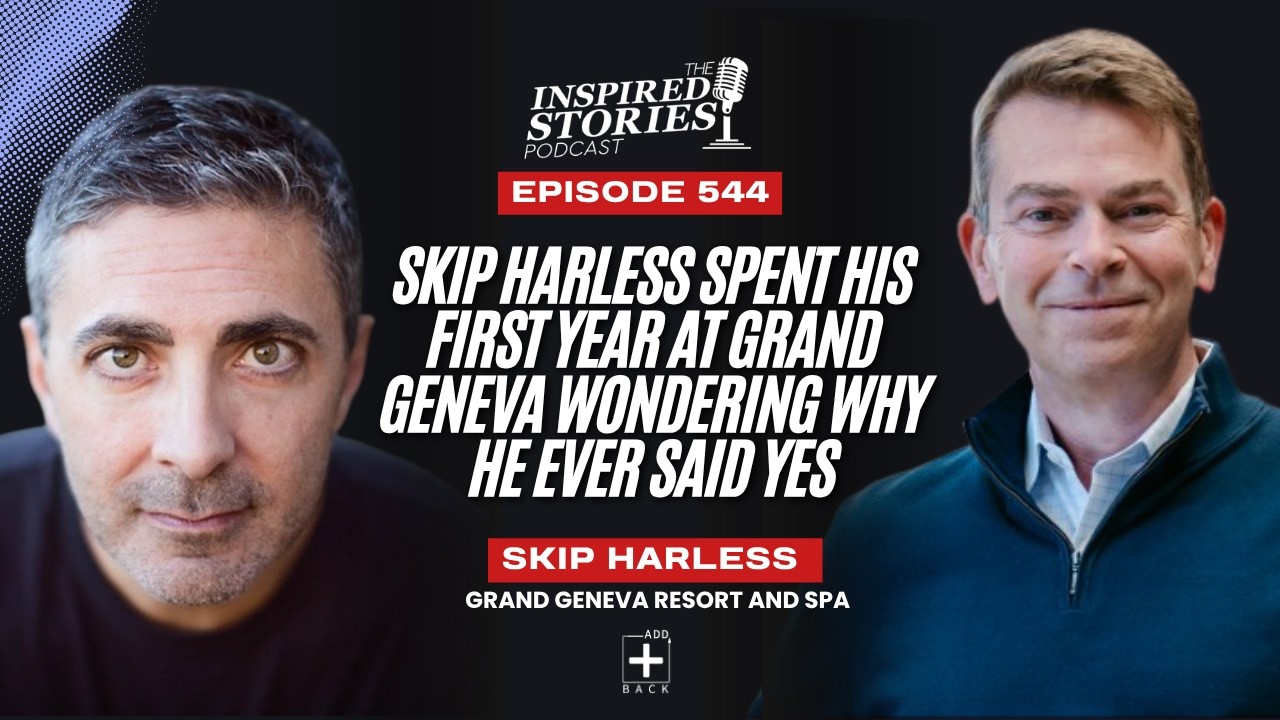
Skip Harless, Managing Director of Grand Geneva Resort and Spa, graduated with a fine arts degree from Texas Tech, took a personality test, and walked into every hotel in Dallas until one of them hired him. Thirty-five years later, he runs a 1,300-acre resort in Lake Geneva, Wisconsin that started as a Playboy club, earned the number one spot in the 2025 Condé Nast Traveler Reader’s Choice Awards, and has posted three back-to-back record years — after a first year that nearly broke him.
✨ Key Insights You’ll Learn:
How a fine arts degree and a personality test called What Color Is Your Parachute launched a 35-year hotel career
Lesson one at a 1,600-room Hyatt during the air traffic controllers strike: lean into your team, not away from them
The GM who taught Skip the art of details — and what a daily 5 PM transformation at a Colorado ski resort looked like
Walking into Grand Geneva in 2022 to a property slammed with post-COVID demand and nowhere near enough staff
Building a 170-bed associate housing facility from scratch as a recruiting tool for international interns
Why the middle manager is the most overlooked level in hospitality — and the 30-minute lunch training sessions that changed everything
The executive team fight that almost derailed the strategic planning session and became the turning point for three record years
Managing 16 direct reports and 1,200 peak-season employees across 1,300 acres — and the scheduling system that keeps him connected
The glamping ridge overlooking the entire property that could open as soon as next summer
Why luxury guest expectations post-COVID are higher, not lower, despite everything that happened to service quality
🌟 Skip’s Key Mentors:
His First Hyatt GM (Dallas Fort Worth Airport): Put him in a management development program with no experience and gave him the foundation he still builds on
The Detail-Obsessed Hyatt GM He Worked With Twice: Opened a luxury ski resort from the ground up with Skip and taught him how to curate every sensory detail of a guest experience
His Wife: The long-distance sounding board who held him together by phone from another state through the hardest year of his career
The Jade Point Consultant: Guided a 16-person executive team through a two-and-a-half-day strategic planning session that turned a big fight into alignment and launched three record years
👉 Don’t miss this conversation about what it looks like to question every decision you’ve ever made and then find your footing anyway, why the fight that almost fractured an executive team became its greatest strength, and how a fine arts student from Texas Tech became one of the most decorated resort managers in the country.
Listen to the full episode here
Transcript
Anthony Codispoti (00:00)
Welcome to another edition of the Inspired Stories Podcast, where leaders share their experiences so we can learn from their successes and be inspired by how they've overcome adversity. As you listen today, let one idea shape what you do next. My name is Anthony Cotuspodi, and today's guest runs a 1300-acre resort that started its life as a Playboy club. The property has had more reinventions than most careers.
And the person leading it has a story that mirrors that same pattern of transformation. Over 35 years in hospitality, Skip Harless has navigated the kind of industry upheaval that closes most properties and ends most careers. What kept him moving forward tells you a lot about what separates the people who made it from the people who don't. And Skip is the managing director of Grand Geneva Resort and Spa in Lake Geneva, Wisconsin.
A AAA four diamond destination with 358 rooms, two championship golf courses, a water park, and a ski hill. Under his watch, the resort earned the number one spot in the 2025 Condi Nast Travel Readers Choice Awards. And he was named Innkeeper of the Year by the Wisconsin Hotel and Lodging Association and received the 2024 Leadership Excellence Award from Marcus Hotel and Resorts.
But before we get into all that good stuff, today's episode is brought to you by my company, Ad Back Benefits Agency. And you'll want to hear this because it's hurting almost every business you know. Health insurance costs go up every single year, and hotels are furious about it. They're paying more, claims are getting denied, employees are opting out because they can't afford it, and it hurts turnover and morale. It's one of the most maddening problems in running a business, and everyone just accepts it.
But
you don't have to anymore. Now there's a program that gives employees unlimited access to doctors, therapists, and prescriptions with no co-pays or deductibles to meet. You don't change your broker, and here's the part that really shocks most people. Our product actually increases your net profits. We recently helped a client add $900 per employee per year to their bottom line. Results vary, but imagine what could be done with that extra cash flow.
Get your free consultation today at adbackbenefits.com. All right, back to our guest today, the managing director of Grand Geneva, Skip Harless. Thanks for making the time to share your story today.
Skip Harless (02:33)
Thank you. I'm so happy to be here. Thank you.
Anthony Codispoti (02:36)
So, Skip, you have a bachelor's in fine arts from Texas Tech. And
Skip Harless (02:41)
I did.
Anthony Codispoti (02:41)
I'm curious how a fine arts degree becomes the launch pad for a 35-year career-running luxury resorts. Take me back to the moment that you started on that.
Skip Harless (02:53)
I love it. So not normal. that wasn't necessarily the intention when I got that degree. but you know I found that I really needed something stable, I think, you know, really. more so than what fine arts would provide. I wasn't a starving artist type, I'll say that. so I just
you know, kind of well, have you heard that book, What Colors Your Parachute? It years and years ago. I mean years ago. I did that. And it's kind of a personality test that helps you identify your strongest characteristics, but then how they would apply to different kinds of of jobs and careers. And I did that and flash, flash, flash hospitality came up to the top. And so I just
I just I was in Dallas at the time. I went to every single brand and non-brand was represented in that Dallas area, and I just started going in. That was back in the day when you actually walked in to interview or to apply. And I and the rest is history. I just I jumped in and it just clicked. And all the things that I love about
Directing and shaping your experience and all the senses that we try to touch and you know working with people to bring that out of them, all those things. It just it translated like butter. It was amazing. And yeah,
Anthony Codispoti (04:38)
So what was
Skip Harless (04:39)
so I just love it.
Anthony Codispoti (04:40)
what was the first stop for you then? Where was your first hotel employment?
Skip Harless (04:43)
Yeah, my very first job
I picked my job based on the experience of the human resources process. And you know, some places I had to go around the dumpster and through the back hallway or whatever. And and anyway, at the Hyatt, I was with Hyatt Regency, Dallas Fort Worth Airport. Really great, warm greeting and really nice environment. and I just said I wanna
I want a job to start as a manager or be trained as a manager. And they said, Well sure, we can do that and just kind of swept me up and took me through the process and that's where I started.
Anthony Codispoti (05:26)
And so was that a
normal entry point? You didn't have to start working, you know, at the front desk or something more entry level?
Skip Harless (05:32)
You know, not necessarily. I mean, I think a lot of people do do that in this business. but I did have some quite a bit of customer service experience before I came there through college and post college, you know, different things. But so I think that just translated and also maybe a little luck, you know, they needed somebody at the time and they had a really great
management development program. and so yeah, they they welcomed me into that and that is where I started. Into his sixteen hundred rooms and just one of the most challenging hotels I've ever worked in. But I had zero experience so I didn't know any better.
Anthony Codispoti (06:23)
Tell me about one of those challenges.
Skip Harless (06:26)
well I was a first time manager assistant manager at the front desk and this hotel was split into two two towers and we they had two front desks and two kind of two of everything and I was often the only manager working at the time and so we would I would get calls
back and forth to talk to upset customers or handle challenges and I I just had a golf cart and I would zip across to the other side and jump right in and but you know that was back when we had the air traffic controllers strike that happened right around Thanksgiving, if I remember correctly. And we suddenly went from
Dead slow to
packed, you know, full house. All all the all the flights cancelled
Anthony Codispoti (07:28)
Beyond capacity.
Skip Harless (07:30)
and everything and lots of people were on vacation and so yeah, I had to I had to handle a lot of of challenges.
Anthony Codispoti (07:40)
And you were s
and you were still pretty early in your career. Can you think
Skip Harless (07:44)
yeah. yeah.
Anthony Codispoti (07:45)
about something from that experience that you learned that has stayed with you to today?
Skip Harless (07:52)
Yeah, you know, I think that as a manager you you can't have that attitude like I'm supposed to know everything. I I leaned into my team. I counted on those agents who'd been there for several years or whatever. You know, I I'm not I'm not gonna stand there and act like I
I'm the manager and I know everything and I think that was a a real start to a ki a key to my success is really working with the team and not trying to manage them. If that makes sense. So
Anthony Codispoti (08:35)
Hmm. Was that something you were
taught or just sort of discovered on your own?
Skip Harless (08:39)
You know, I I think I I I I discovered that on my own, honestly. I don't think I had a choice at the time and I really didn't know what to do and I didn't have a lot of resources available to me at the time, other than my team, you know, and I had good relationships with them and you know, I don't I didn't wasn't trying to be their boss or be better than them. We just we worked together and
It just it just made it happen. And
Anthony Codispoti (09:11)
Yeah.
Skip Harless (09:12)
I carried that forward in I still to this day I feel like that. I I talked to my to my management team, my leadership team, just you know, nobody's better than anybody else. We're all in this together and you know, we need to we have to work harder, I think, to make sure that our employees know that, that that's not we're here for them, really.
We're here to support them and to lift them up and to get them what they need and not to try to boss them around. Yes indeed. Yes indeed.
Anthony Codispoti (09:47)
More like a servant leadership kind of approach. And so how do
you communicate that from the top down? How do you communicate that type of philosophy to your other managers as well as to the frontline folks?
Skip Harless (10:02)
Yeah. it it's a lot. You know, you have to it you have to do a lot of repetition and we we we have leadership meetings where we talk about these kinds of philosophies. I work for a company and really proud of the fact that Marcus Hotels and Resorts really does have that as a philosophy but believes it. a lot of companies have that, you know, put your employees first and but
This is really truly part of the culture in the company. And that's a great reason that I I love being with Marcus, but but we have to you know, we have to have examples and role play and and be really simple about it and we have to talk to the employees a lot.
we start in orientation and we tell you know, the management team is here for you. We don't have separate jobs. We we're all in this together. And it's just it takes a while, you know, takes a while to really get that to develop. You have to coach on the fly too, you know, you can see it in action. go talk to that manager and just say, Hey, you know.
Anthony Codispoti (11:27)
Talk us through a coachable moment that you've seen recently.
Skip Harless (11:31)
Yeah. we just we just had that this past weekend, this big holiday weekend for us. And you know, we we were had some adversity with a huge storm that came through and power was out and that sort of thing. And and I had sit and talk with one of our restaurant managers for a few minutes because she was
She was really frazzled by the whole thing and really, you know, kind of didn't know what direction to go. And so consequently, the staff picks up on that, you know, and and you know, I don't think I had to sit with her and just tell her, you know, it's not we don't have to we don't have to pretend like we can't cook, we don't have lights. You know, what we have to do is say, here's here's what we can do.
Here's what our options are. And you just gotta get your you gotta talk to the team and just make sure they understand what's available and that everything's gonna be fine and we're just gonna tell the truth. And you know. So it's just one of those you see it in action and it has a lot more impact, I think, when you're catching people in the moment rather than you know, a big lecture in a in a meeting.
Anthony Codispoti (13:00)
You had the opportunity to help be the calm in the eye of the storm. And
Skip Harless (13:06)
Yeah.
Yeah. Inside I I might not have been quite so calm, you know, but but yeah, it you know, it's it's definitely something that we have to do when when adversity hits. And and it often does. I mean this business is it's things happen and you know, we have to stay calm and just kinda look ahead and try to figure out what what we're gonna do next. Most people are
are dealing with what's right at the end of their nose. And so I just always am trying to think about what where we're gonna go next. How are we gonna what happens if the power doesn't come back on for five hours? What are we gonna do? You know.
Anthony Codispoti (13:46)
Well, and in little moments like that you get the opportunity to be a mentor to that person. I'm curious to hear about maybe a really powerful mentor for you coming up through this industry.
Skip Harless (14:01)
Yeah. I had many, honestly. But one in particular stands out to me. a general manager that I worked with actually twice, at two different properties, both with Hyatt and
I you know, that's where I that gentleman is where I learned the the art of details in this business, particularly in, you know, when you're when you're providing a more luxury type experience in resorts or high-end hotels or restaurants, that sort of thing. And he was I I've never seen anybody that was more detailed and it
It was it was off-putting at first, and then it was kind of shocking. And then as I started to really understand what he was doing and what he was talking about, it it was such a difference maker for me. And so then I had the opportunity to work with him again, opening a
a resort from the ground up. And we we curated all of those details of the experience together. And my gosh. You know, it was it really it taught me so much about how to see those and how to to to develop those and and then explaining to the team the why.
You know, and what's behind it. 'Cause I I needed that way back in the beginning. So I knew I knew that that was really important for the team. Otherwise they all think he's so picky, you know. So picky. Yeah.
Anthony Codispoti (15:46)
Can you Yeah, right, right. You have to understand the big picture. So can you give us
examples of some of the details that this mentor helped to point out to you that maybe you were overlooking
Skip Harless (15:56)
Yeah, so the f
Anthony Codispoti (15:58)
at the time?
Skip Harless (15:58)
yeah, so the first time we worked together was in a really beautiful, very exclusive ski resort in the mountains of Colorado. And the ski environment, you know, people get up in the morning, they have their breakfast, whatever, and they're out the door. And then it's quiet for a while. But then Opera Ski is is all about the vibe and
So we would completely transform the feel of the property at that time when everybody's starting to come off the mountain and we wanted to capture them for food and beverage and to to stay, you know, in our in our property with us, even if they weren't sleeping there. so yeah. So we had, you know, managers would put on their sport coats at five o'clock sharp and all these candles would be lit.
And all the lighting had you know changes, the music changed. We had like this entire list of things that transformed at that time so that everybody knew it was opera ski and it had that it had that feel. And I don't know how many guests really truly understood that, but it worked. You know, and before you know it, it was
seven o'clock and people were still enjoying their time and they just it it would just keep them there and keep them
Anthony Codispoti (17:34)
And so you could tell it worked just because you could see people were still enjoying the space together. So you had created this, I don't know, cocoon
Skip Harless (17:40)
Yeah. Yeah. Yeah. Still in there Yeah.
Anthony Codispoti (17:45)
of an environment that everybody just felt welcomed in.
Skip Harless (17:48)
Yeah. They take their ski boots off. Some of had slippers to put on, some of them were instilled in sock feet, you know, whatever. But it just, you know, enjoying cocktails and company and food and beverage and fire pits and you know, the whole thing. It just we even had a we'd have a staff person who was on the team who started at four thirty every day to be outside by the fire pit by five.
For Opera Ski and he was just a storyteller. And he was from that region. He grew up and all he did was come out and just regale people with history and stories of the area. His name tag even said storyteller. Yeah.
Anthony Codispoti (18:33)
So you joined Grand Geneva in March of twenty twenty-two, which is an interesting time to step into a new leadership role at a major resort, right? Still going in going through COVID. What did you walk into on day one? Paint me a picture of what the property looked like and what in your mind needed attention the most.
Skip Harless (18:55)
Yeah. well post COVID this place was slammed. And we're just hour and a half north of Chicago. So everybody wanted out of the city. They wanted they wanted to go up north we say in Wisconsin. They wanted to get outside, they wanted fresh air, they wanted out.
And so this place was slammed. So the the thing that I walked into was slammed business without enough staff or resources. Yeah. And that that's where we were.
Anthony Codispoti (19:43)
And what did you do? How do you begin to fix that problem when everybody is facing staffing shortages at the same time?
Skip Harless (19:50)
Yeah, so we built I convinced the owners to build a an associate housing facility. So we brand new from the ground up, 170 beds, it's fantastic, you know, with community spaces and workout and you know everything. And so we use that as a recruiting tool and we went after international interns, we went after
domestic college interns, you know, for leaders who are moving to the area to start their career or continue their career. It's a place to land to figure out the area and, you know, all those things. It was just the most valuable tool. many other things that we had to do, of course, but that was probably the most impactful.
Anthony Codispoti (20:44)
And so the folks that live there they get this rent at a very reasonable rate or it's included
Skip Harless (20:50)
Yeah.
Anthony Codispoti (20:50)
as part of their benefits.
Skip Harless (20:52)
No, we do charge. we have a full time management staff there and there's laundry facilities and you know, all that stuff. But and we do charge, but it's not you know, it is reasonable and it comes out of their check. It's just not it's included or it's basically paid for and deducted out of their wages. And yeah, it's it works. Yeah. And it's right across the street.
Anthony Codispoti (21:17)
What a nice perk. How long did it take to construct
that facility?
Skip Harless (21:23)
Year and a half. Yeah. Year and a half.
Anthony Codispoti (21:24)
Yeah. And this is just for
employees of the resort.
Skip Harless (21:29)
Hundred percent. Just for employees. Yeah. Yeah.
Anthony Codispoti (21:33)
so we
referenced in the intro how Grand Geneva has this interesting story as the Lake Geneva Playboy
Skip Harless (21:42)
Yeah.
Anthony Codispoti (21:43)
Club Hotel goes back to nineteen sixty eight. Does that previous history shape the identity of the place in any way today? Does it come up in either positive or negative ways in customer conversations? Okay.
Skip Harless (21:56)
Yes and yes.
every now and then, you know, the further and further we get away from it, the less there's any negative. And the negative is really small and minor. In most cases, it is just either very curious and interested to learn, or I was here, my parents brought me here, yes.
You heard me. I meet so many people that say they came as kids, their parents brought You know, there's just there's a history. so that from that perspective, it comes up really often. I I talk to guests all the time. They're fascinated, they're interested, they want to know more about it. people that lived in the area that, you know, tried to sneak in when they were
teenagers, you know, all kinds of things. But generally it's very positive. you know, there are some times where it you know, I I can't even imagine, for example, nowadays how a parents would ever decide to take kids to a place like that. You know, I mean it just wouldn't happen. it wouldn't it wouldn't exist probably anyway today, but even if it did, I don't can't imagine a parent
would take their kids there. But it was just just the way it was, you know, in those in those days. It was accepted and
Anthony Codispoti (23:31)
And so what is the transformation like? How does it go from being this Playboy Club hotel to what it is today?
Skip Harless (23:39)
Yeah. Well, there was an interim company that really tried to reposition the property as a family resort. So they went like literally from one extreme to the other extreme and it just it didn't it didn't work and things really kind of started falling into disrepair. And Marcus bought it out of of that state and
just put a lot of investment in, obviously, but also really worked hard to change the change the brand and change the narrative about the property. And that was that's been over thirty years at this point. And it you know, some people do obviously remember or they're interested or they're they're fascinated by that Playboy history, but
There's no sign of it really anymore. And so it's a completely different place now.
Anthony Codispoti (24:44)
Yeah. So you're really glad I brought
it up again.
Skip Harless (24:48)
What's that?
Anthony Codispoti (24:48)
So you're re really glad I brought it up again. It's a the part of the history
Skip Harless (24:52)
no, it's fine.
Anthony Codispoti (24:53)
that you're ready to move away from.
Skip Harless (24:55)
No, it's fine. You know, honestly, I say this all the time. you know, we don't necessarily publicize it a lot, but we don't hide from it either. I mean, it is it is part of the history and it is unique and it's it's interesting. And if you're fascinated by that, then most any associate can tell you a lot about it. and I have a lot of memorabilia as well. I'm I'm actually in the process of trying to
set up a a little behind the scenes sort of museum where any associate if you want to talk about it or you're interested in it, I could take you there and show all of that to you if you were wanting to. But it wouldn't necessarily be out in in the public for everybody to see. So yeah.
Anthony Codispoti (25:45)
Gotcha. Okay,
so you come in in 2022, the place is slammed, you have a staffing shortage. So you convinced Marcus, the owners, to build this housing facility, which was a great hook to get both international as well as you know, college kids in working there. What was the next big project that you undertook in your time there?
Skip Harless (26:12)
Well, we've completely renovated the property. so that was a huge project. I mean and a lot of people say renovation and they just put up new drapes and and new carpet. This was, you know, rip it out down to the studs, full full renovation. so along with that we really needed to
to lift up the associates and they they had been beaten down pretty pretty good through that
Anthony Codispoti (26:46)
Because of the renovation
or through COVID or both?
Skip Harless (26:49)
through COVID, coming out of COVID, you know, they were just there were so many people here and it wasn't really groups. You know, we do a sixty-five percent of our businesses groups, and when we had that mix, we do a lot better. but it was one hundred percent leisure and it was, you know, not necessarily our always our typical customer as well.
So it just it was really challenging for the team. It was hard on the property. So we're renovating the product, but we had to sort of renovate the service attitude as well. And so that was probably my biggest priority was really working with the team to to settle into a really great service culture again and not just
Crank in volume.
Anthony Codispoti (27:51)
And so how do you do something like that? I I can tell from talking to you and the research we've done, like Marcus Hotels in general talks a lot about a people-first culture. And
Skip Harless (28:02)
Yeah.
Anthony Codispoti (28:02)
so how are you trying to reintroduce some of these service-minded principles at a time when people are just, like you said, beat up and worn?
Skip Harless (28:13)
Yeah. Well, you know, when we're when we finally got fully staffed and that was, you know, probably a year and a half, two years into it, at full tilt we're eleven or twelve hundred employees. And it is like honestly, it's like turning a aircraft carrier. And so it's a slow and steady one bite at a time.
process. but we, you know, it's a lot of talking, it's a lot of sharing of of ideas. It's a lot of listening. you know, I started doing round tables and got other leaders in with me as well to do round tables and to listen to, you know, first I have to
hear them and empathize and then help to try to lift them back up out of that and and solve some problems and fix some things that they tell me about and earn their trust and it's just, you know, it's a process. You can't just flip a switch and and make something
Anthony Codispoti (29:25)
It's not like
one big thing that you did, it's lots of little things in the way you show up every day.
Skip Harless (29:29)
It's a lot of little
things. I will tell you though, you know, having the right people on the team, particularly in the leadership team, putting the right people in the right seats on the bus was a huge piece of it. And my goodness, it is way too big for me on any any given moment to do all by myself. And this this team
really gelled and we were we were in it together and that's where it has to start. and then you're right, it's just it's it's one bite at a time. It's one bite at a time.
Anthony Codispoti (30:11)
Can you think of
one of those bites, one of those small steps, one of those small conversations that you had that sticks with you because you think it really made an impact on that person or the group of people?
Skip Harless (30:24)
Yeah.
Think I think the one of the biggest things we were trying to resolve was we had a quite a quite a bit of turnover at the the leadership level and the lower mid mid level managers not the executive level and so
So we started just having training shorts, we called them or little they were so busy. And so we'd do thirty minutes or an hour and grab your lunch and come to this and just, you know. And so we just broke things down into really simple concepts. and we just focus on one at a time, you know, and how do we how do we get
the how do the leaders get that from the team? And I think that probably it was was the moment where we really started turning things a little bit with the leadership team. Like we're investing in them. and 'cause there's sometimes a I can't I think kind of a forgotten level. We always focus on the frontline or, you know, the the associates that are getting the job done.
or I'm focusing on the executive team that's overseeing each of the divisions, but that middle level manager really needed our attention. And so I think that I think that was probably one of our biggest turning points because that's who works directly with the employees and we we really had to make sure they understood what we were trying to accomplish and how to do it.
You know, and we you just can't assume that they know any of those kinds of things, you know?
so
Anthony Codispoti (32:31)
And I imagine
another big challenge that a a a facility like yours runs into is you said at the peak, you know, peak season, you guys are eleven hundred to twelve hundred employees. What does that go to during quiet season, low season? Maybe half?
Skip Harless (32:47)
no. Mm mm. No. Eight eight fifty. Yeah. Yeah. you're you're absolutely right. yeah.
Anthony Codispoti (32:51)
Okay. Okay. Still a bit of a swing there and you know, your head count. Does that create some yeah.
Skip Harless (33:00)
That that seasonal influx yeah is is a huge challenge.
Anthony Codispoti (33:06)
And what is
bus busy season for you guys? Is it the summer months? Is it like people come in for skiing or?
Skip Harless (33:10)
Yeah, like pretty
much Labor Day through early Yeah.
Anthony Codispoti (33:16)
Okay.
People are coming to see the the leaf changes. They wanna the the fall season, yeah.
Skip Harless (33:23)
Yeah, yeah.
And then we do a lot of group business in the the fall as well, September and October and early November. So
Anthony Codispoti (33:33)
Okay, so
paint a picture for us. I've never had the pleasure of being at the Grand Geneva Resort. what is it like from a customer experience? What do I notice? What do I see? What do I do when I'm there?
Skip Harless (33:45)
you know, I think the most incredible part of this resort is the land. It's absolutely beautiful. And the approach to the resort from Chicago or wherever you're coming from is mostly very flat lands. And then you get to this area which was really it's kind of part of the Kettlebaraine, and so it was scraped by receding glaciers.
And so it's you know, there's just really interesting changes in elevations that go down into lakes and ponds and rivers and and then it's wooded as well. So I I think the I think it's about the land. The land is spectacular, it's beautiful. No nothing you can see if you're in a big city.
but beyond that, you know, it's the it's the Wisconsin hospitality that I think really does it. It's the it's the people and the experiences that the people bring to our visitors. It there's nothing like it.
Anthony Codispoti (35:04)
Tell me a little bit more about the facilities themselves.
Skip Harless (35:07)
Yeah. So we have the main lodge, which you mentioned, we have three hundred and fifty-eight rooms. and then we have a sister property on campus, which is the Timber Ridge Lodge and Water Park, and it has an indoor water park and is really catering to families and that sort of thing. we have now three golf courses. You mentioned we have two, but just
Not even two months ago we opened our third golf course, which is actually a a short course. It's really unique. special. Short courses are kind of popping up all over the place, but it's not really a par three. We don't have pars. It's eleven holes. You know, the yardage is could be as maybe as low as sixty up to a hundred and thirty yards. There's one hole that's a h nothing but an entire green.
so it's it's just a fun atmosphere. It has a great little patio and place to hang out and great vibe. So it's a fun approach to golf. we have a great spa and fitness center, rock w rock climbing wall, that sort of thing. we do our ski hill, which skiing is a big deal. Opens mid-December and goes all the way till mid-March usually.
We do let's see, what else did I did I leave out?
Anthony Codispoti (36:39)
Sixty two thousand square feet of meeting space.
Skip Harless (36:42)
Yeah, meeting space, sixty-two thousand square of meeting space. So we we do a lot of group business. We do weddings, probably eighty to a hundred weddings a year in all that space. lots of outdoor event space as well on top of that sixty-two thousand. horseback riding,
Trails, mountain bikes, yeah, you name it. There's fun stuff to do. And then there's a lot
Anthony Codispoti (37:07)
It's lot. Yeah, there's a lot going on there. How do you see
Skip Harless (37:11)
right there in town too, that's at actual Geneva Lake.
Anthony Codispoti (37:16)
Talk to us about the town and and how Grand Geneva Resort fits into that.
Skip Harless (37:20)
Yeah, we're I mean, there are our partners. They're you know, that's for many, many, many years, hundreds of years. People have been coming from Chicago to Lake Geneva. so it has a great it's a high quality lake, first of all. Very deep, spring fed, fresh, clear water, mansions all the way around from Maytag to, you know, all the all the
wealthy Chicagoans that built their mansions here around the lake. A beautiful, quaint little town with great dining and really unique and special shopping and it's very walkable. twenty one mile, I believe, trail that goes all the way around the lake. And this is so unique. It's literally in the backyards of all of those
mansions. So you can you can take a stroll around the lake, along the lake shore, and you're also looking at right up close in the backyards of all these mansions. It's pretty cool.
Anthony Codispoti (38:32)
So
you're managing director of this ginormous sprawling property. You know, we've got the water slides, the three golf courses, the ski hill, you know, tens of thousands of square feet of meeting space.
Skip Harless (38:47)
Yeah.
Anthony Codispoti (38:48)
I mean, this is a a large, complex operation that you're overseeing here. Walk us through how you actually think about all those moving pieces at your facility on any given day.
Skip Harless (39:04)
How I think about them. Yeah, I literally schedule time to make sure that I get to different areas at different times. it you know, I I'm a firm believer in managing by walking around and seeing people and so that's a that's quite a challenge in a place like this.
so I I literally found myself having to schedule. I I can't go more than two days without getting to see the golf team or getting all the way out to see the grounds crew or you know, stopping by the ski hill, or running over to Timber Ridge and saying hi to everybody. You know, I have to I have to put it in there or my time will vanish and next thing you know it's been a a week and I haven't seen somebody.
Anthony Codispoti (39:59)
So
you're really trying to get that grassroots connection on a regular basis. It's not like once a
Skip Harless (40:04)
yeah.
Anthony Codispoti (40:04)
month I'm gonna get out to each area. It's like you're trying to do this multiple times per week.
Skip Harless (40:10)
I do. Yeah, I do. And, you know, there's some sometimes where it's longer and more quality time and other times I'm just making sure that I'm visible and I'm saying hi and how are things going and you know. so I just I think that is a really important factor in this particularly in this business, you know, to just see and be seen and get out and talk to people and
Be available if they have things they need to tell me.
Anthony Codispoti (40:44)
What are some of the exciting new projects that are either underway or coming soon?
Skip Harless (40:50)
Yeah. We're working on I'm so excited about this. We're working on a glamping operation. we have so much of the thirteen hundred acres that is still available. A lot of it is you know, protected land. It's either wetlands or that sort of thing, but we have some key areas and one of them is that could be developed still. And one of them is up on this beautiful ridge with a stand of pine trees.
looks out over the entire property. so we're we're working on plans to try to get a glamping operation in there.
Anthony Codispoti (41:31)
When do you think the first guests might be able to take part in this?
Skip Harless (41:36)
Well, if we if it all goes as planned and on schedule, maybe even as soon as next summer.
Anthony Codispoti (41:41)
Okay. And this would be mostly a spring, summer, fall kind of an operation?
Skip Harless (41:48)
No, that's interesting you asked that. We're really thinking about trying to be twenty four sour or you know, year round. so it's a little more cabin like, which is a big thing in Wisconsin, particularly more up north in the north woods. so we're just kind of creating that experience for a little bit closer than going all the way up into northern Wisconsin.
Anthony Codispoti (42:17)
So Grand Geneva recently earned the number one spot on the twenty twenty five Connie Nass Traveler Reader's Choice Awards. What is something Grand Geneva does really well that other luxury resorts might overlook? Something that helps tip the scales in your favor.
Skip Harless (42:39)
Hmm.
well besides all the things that I talked to you about of really putting our associates first, I think, and making sure that they are happy to take care of our guests and to show their care and their concern. I think we we put a lot of effort into the experience. And so for example
I don't think anybody does the holidays better than Grangy Neva. We you come here from the Sunday before Thanksgiving until mid dis mid January. And we are
the holiday place and people come for year after year and generations there it's a tradition that they come to Grand Geneva for all the holiday lights and all the decorations and the detail that we put into that experience and the things that we change so that it's not exactly the same all the time, but still rooted in tradition. I think that's
That's an example of of how we try to curate the experience for the guests that they just love, that they wanna they wanna keep coming back and they they have memories that live with them.
Anthony Codispoti (44:09)
Do you find
that the expectations of a luxury guest today in twenty twenty six are different from what they were, say, pre-COVID? And if so, what have you seen change?
Skip Harless (44:25)
pre COVID. Yeah, I think
Yeah, I think
Maybe I would think that maybe people were a little more accepting that service wasn't as good, but I think it's actually the opposite. I think, you know, coming out of COVID, I personally even myself, I experienced some of the most challenging, maybe some of the worst service. and
So I think we're all just a little more critical. And I gu our guests are very they have very high expectations of the interactions that they have with associates. I mean, it hasn't changed that they want a really nice facility and they want the bed to feel comfortable and they want everything to be clean and, you know, all that stuff. But I think their expectation of of the kind of service delivery that comes from the associates is
Is definitely elevated. Yeah.
Anthony Codispoti (45:38)
Elevated. It's interesting because
I think I probably went through a similar experience to a lot of folks in the time during COVID, the immediate aftermath, where you know, if you go to a restaurant or a hotel or any place and the service, the product wasn't quite what you were expecting, you kind of shrugged your shoulders and you were like, Well, it's hard to get people to even show up to work, right? The fact that I got a burger on my plate just that says something right there.
Like th I should just be grateful for that. Go ahead. You're agreeing with me.
Skip Harless (46:07)
Right. Yeah. Yeah, you would
think I think you would think that based on that experience that there was would be more tolerance for a little bit lower level service quality, but I I don't think it is. I think it actually did the opposite. They really, really notice when it's there or when it's not there. and so the expectation is it's going to be there, especially if you're charging a lot.
Anthony Codispoti (46:39)
So
probably different expectations at the level of resort of Grand Geneva than, you know, maybe your holiday in express. Yeah.
Skip Harless (46:47)
Yeah. yeah.
Anthony Codispoti (46:49)
That makes sense. tell me some exciting ways that you guys are using AI in the business.
Skip Harless (46:56)
fascinating. You know, the first place that we really jumped into it is in marketing. and that is just an ever changing environment. And you know, when you try used to try to figure out the algorithms of of organic search and, you know, all that kind of stuff, it it's it's completely flipped that on its ear. And so we're really
We're really trying to do a lot with marketing and be able to come up in AI correctly with the correct information and have AI be able to find the right information easily. there's a lot of work that you have to do in order to make that happen through your website or other materials that are out there. but we're also using it behind the scenes to
in you know, just I think just in general everyday communication and writing and that sort of thing. But probably that's at this point right now, that's probably the extent. so I would say that sounds to me like we're scratching the surface.
Anthony Codispoti (48:11)
Are you interested in going deeper?
Skip Harless (48:16)
Yeah, I mean I don't exactly know how how we would. so but yes, absolutely. Absolutely.
Anthony Codispoti (48:26)
Let me shift gears, Skip, and I'd like to hear about one of the hardest things you've had to overcome and what going through that taught you.
Skip Harless (48:38)
so it's funny because we've kind of talked about this a fair amount already, but I can just pinpoint this right for you. I came to Grand Geneva and I at that point over thirty years of experience in a wide variety of hotels and resorts and
people and that sort of thing. And I I honestly I think I got to the point where I wondered why the heck I decided to come here. You know, I I literally I questioned my decision. I thought I'm not gonna be able to do this. I really did. I thought there is no way I there's not enough time in the day. I don't have there everybody wants a piece of me.
I don't have the strength and the energy to do this. You know, I I really, especially in that first year, I thought I'm not gonna be able to do it. And that was the first time that that had ever really happened to me. And it, you know, it was really it was soul searching. It was it was scary for me because I thought, you know, seriously? You know, I mean it's just it's just a big
Resort, but
Anthony Codispoti (50:06)
What was
the core of the difficulty for you, Skip? Was it that you guys were so short staffed?
Skip Harless (50:11)
No, no. That's just I mean that's that can happen anywhere on any given day. And to be honest, that was pretty as long as I got the in support of the owners and the investment, you know, and many other things that we did too, but we could solve that one pretty easily. It was just literally it's a very small community. And so this is a very important large business.
in the community and I mean I everybody you know I needed to be everywhere all the time and not to mention trying to get around to see everybody at this property and I think they were just really hungry for for change and for somebody to listen to them and it was it was just
overwhelming. It was too much sometimes. It it literally took me out some some days.
Anthony Codispoti (51:13)
So
it was more the fact that maybe they'd been thirsting for some strong leadership. And once you got there, everybody needed you. You needed to be everywhere to try to fix things and get them to the standard that you expect, that Marcus expects. Am I on the right path here?
Skip Harless (51:36)
Yeah. Yeah. And yeah, and it's just very spread out and it's so broad and just trying to manage your time and yeah, it was yeah, it was really I thought, what have I gotten myself into? You know, I
and I'm a I need to be on boards with the local destination management organization and the chamber and hotel and lodging association and the economic development. You know, just there's you know, we're the probably the major other than the county itself, maybe the the most
a major employer in the county and you know, there's just th there's a lot of that that was coming at me, not to mention everything in the in the property too. And so it just it was a a lot to balance.
Anthony Codispoti (52:44)
As I talk to you today, Skip, you're there's an enthusiasm and excitement that comes from you and talking about Grand Geneva and the projects
Skip Harless (52:52)
Yeah.
Anthony Codispoti (52:53)
you've undertaken and what's coming for the future. So clearly it seems you've worked through those feelings, but how did you do that? What was that path like?
Skip Harless (53:04)
Yeah. it was some some sleepless nights, that's for sure. a few gray hairs. I did not have any gray hairs when I got here. but you know,
I I think it was the realization that you just can't be you can't be everything to everybody every day all the time. And so I had to I had to really personally be okay with that. And that is not what has been my calling card, you know. I
I like to please people. I like to get out and be everywhere and and I just I had to grapple with that and figure out how to to be okay with that in myself and then be confident enough to tell people, you know, I've got to schedule. You know, I I can't be it can't be just on the fly. I've got to schedule and
it's just the fact, you know, and so I don't know, you know, it just
Anthony Codispoti (54:26)
Was
this a process that you mostly went through internally yourself? Did
Skip Harless (54:31)
Yeah.
Anthony Codispoti (54:32)
you have some mentors, some coworkers, your
Skip Harless (54:35)
Yeah.
Anthony Codispoti (54:36)
spouse maybe that you went to, your faith that you know was helpful in your support in supporting you through this time?
Skip Harless (54:41)
Yeah, I talked I definitely talked to my wife a lot. it it to double the challenge with that, my youngest son was becoming a senior in high school. So we decided we made a specific decision for that first year and so many months for me to just come here by myself and for them to stay back.
And allow him to finish high school, which I also realized was part of my challenge because I didn't I didn't have my wife right there, you know, to just s be a sounding board and to talk to about those things. So we ended up a lot on the phone a lot. And I I looked for specific windows of time where I could get back home or I could get them here. And that that was probably the
the thing that helped me the most was just being able to to talk it out and have somebody there to to work through.
Anthony Codispoti (55:47)
Was there a turning
point for you where you finally felt like, okay, I got this, I'm good, and I actually enjoy this?
Skip Harless (55:56)
Yeah. yeah, well we you know we when we solidified the executive team, which is the the group that reports directly to me, and we had this strategic planning session together, you know, and and we had a huge like major
fight and it shocked some of the people. and nobody nobody physically, you know, but we just we we really had some passion and arguments and and a fight. We we just flat flat out had a big fight. And but we came back together and we you know, I told everybody, I was like, you know, families fight. So
That's okay, you know, and and we all came back together and I think we got a lot closer than we had been before, and we got aligned. And and then I knew and I could see that every one of them was just as driven for our success. And all of a sudden it just popped. And we we've had three back-to-back record years.
for the resort, the awards started coming. You know, when you start seeing those success, the signs of success and things start popping, you know, that I just got I got so excited and and I haven't stopped being excited ever since. But I think that that was the day. That was the day when we had that big fight and then we had to come back together and and hug it out.
Anthony Codispoti (57:53)
So
talk me through that. The big fight happens. And then
Skip Harless (57:56)
Yeah.
Anthony Codispoti (57:57)
how did you get everybody to hug it out and have this not be something that festered as a sore wound forever, but actually became this positive inflection point? Because that
Skip Harless (58:09)
Yeah.
Anthony Codispoti (58:09)
there's some magic that happened there. That's not usually how these things go.
Skip Harless (58:13)
Yeah. Well I must admit I had some help. it's every year when I go into the new year, I always if we're not doing a renovation or you know, we've opening a new business unit or we always have to have something, right? I I feel like that's what really drives our energy. It's we're we gotta be working on something. And I was going into that year not knowing what that something was gonna be.
So I turned to a consultant that I had heard about. And they specialize in working with hotels and hotel companies. And so I'll I'll admit it, I we had help. But she guided us through a strategic planning session over two and a half days that
Just I mean, it was beautiful. It was beautiful. And it happened to come this can't this happened to come right after the fight.
Anthony Codispoti (59:17)
And this was this was before the fight, this was after the fight, this was okay.
Skip Harless (59:24)
So
Anthony Codispoti (59:25)
And she kind of
gave you a blueprint that you could use to move forward. And part of it was
Skip Harless (59:30)
Yeah.
Anthony Codispoti (59:31)
working through these differences.
Skip Harless (59:32)
Yeah. And yeah, we you know we
We're with such a large group. That's one big challenge because we have so many different areas. Normally an executive team that I experience in hotels usually three or four, maybe five people. We're sixteen. And so it's very difficult. And we're also very specialized, you know, so the way the sales guy thinks versus the marketing person versus the food and beverage operation, everybody has a different
perspective and we just found we found common ground and we found respect for each other and we I think we just clicked we just we just gelled and we I think everybody realized that we couldn't achieve the real true success without each other and if there was
If there was somebody that was alienated or left out or not pulling their weight or picked on or whatever, you know, it just it wasn't gonna work. so and she helped us see that. I mean, you know, I'm sure she'd done this a million times, but for us it was it was really important. It was really valuable. It
Anthony Codispoti (1:00:52)
Transformational, it sounds like.
Skip Harless (1:00:53)
was. Yeah.
Anthony Codispoti (1:00:55)
So as you think about the work that you've done, that you're doing now, Skip, what is it that you most want to be remembered for?
Skip Harless (1:01:08)
I really hope, I always hope that I'm creating inspired new leaders. You know, I that's what I really hope. I want I want the front desk agent to get excited about this business that really just gets pulled into it and turns turns that into a career. And that I think is I I love that.
when people grow and develop and and find that this is the industry that they love like i did so if i if i can inspire that if i can share that that's that's the best part to me and i i feel like there's a there's a trail all across the country of people that i i know about that i've
had the chance to work with and I think pretty sure most of them anyway would say that they you know that they got the excitement
that I was trying to convey and they're carrying that on with everybody else.
Anthony Codispoti (1:02:29)
Yeah, that must be really rewarding for you. What's your favorite thing
Skip Harless (1:02:32)
Yeah, it's great.
Anthony Codispoti (1:02:33)
to do outside of work?
Skip Harless (1:02:36)
I you know what? I'm I'm kind of like a I'm a little bit of a hermit sometimes. I like to I like doing yard work and I like doing you know, just mowing the lawn and
Taking care of the garden and hanging out with my family. What I loved I don't get to anymore 'cause I'm an empty nester now, but one of my favorite things on the weekends was to watch my kid play baseball, you know, and just yeah. So but I I I enjoy my quiet time and you know, 'cause my job is so big and broad and out there and talkative and you know, so I I really enjoy just
Anthony Codispoti (1:03:21)
Come back inside and recharge. Yeah, I get it.
Skip Harless (1:03:21)
Yep, yep.
Anthony Codispoti (1:03:25)
Skip, I've just got one more question for you today. But before I ask it, I want to do three quick things for the audience.
Skip Harless (1:03:31)
Yeah.
Anthony Codispoti (1:03:31)
First of all, if you want to learn more about Skip and what they're doing at Grand Geneva, go to their website, grandgenieva.com. We'll have it in the show notes, but two simple words, Grand Geneva.com. And if you're enjoying the show today, please take a moment to subscribe wherever you're listening.
It
also sends a signal that helps others discover our podcast. So thank you for taking a quick moment to do that right now. And as a reminder, you can finally get your hotel employees access to therapists, doctors, and prescription medications that counterintuitively actually increases your company's net profit starting in the very first month. There's no co-pays, no deductibles, a lot of your part-timers qualify, and you keep your broker.
So learn more about how to have happier employees and a stronger bottom line at adbackbenefits.com. Last question for you, Skip. A year from now, what is one very specific thing that you hope to be celebrating?
Skip Harless (1:04:33)
my youngest son graduating and starting his life with he's engaged, so I want him to graduate, get married, and take off in his life and I I joke, get off the payroll so that I
Anthony Codispoti (1:04:52)
Yeah.
Skip Harless (1:04:53)
I can start deciding a time that I might retire as well. So yeah.
Anthony Codispoti (1:04:59)
Where is
he graduating from? Okay, go Big Ten.
Skip Harless (1:05:01)
Purdue. Yeah.
Anthony Codispoti (1:05:05)
The Skip Harless from Grand Geneva, I want to be the first to thank you for sharing both your time and your story with us today. I really appreciate you being here.
Skip Harless (1:05:12)
Yeah, thank you very much. It was enjoyable.
Anthony Codispoti (1:05:15)
Folks, that's a wrap on another episode of the Inspired Stories podcast. Thanks for learning with us. And if one thing stood out, put that into action today.
Connect with Skip Harless:
Website: grandgeneva.com