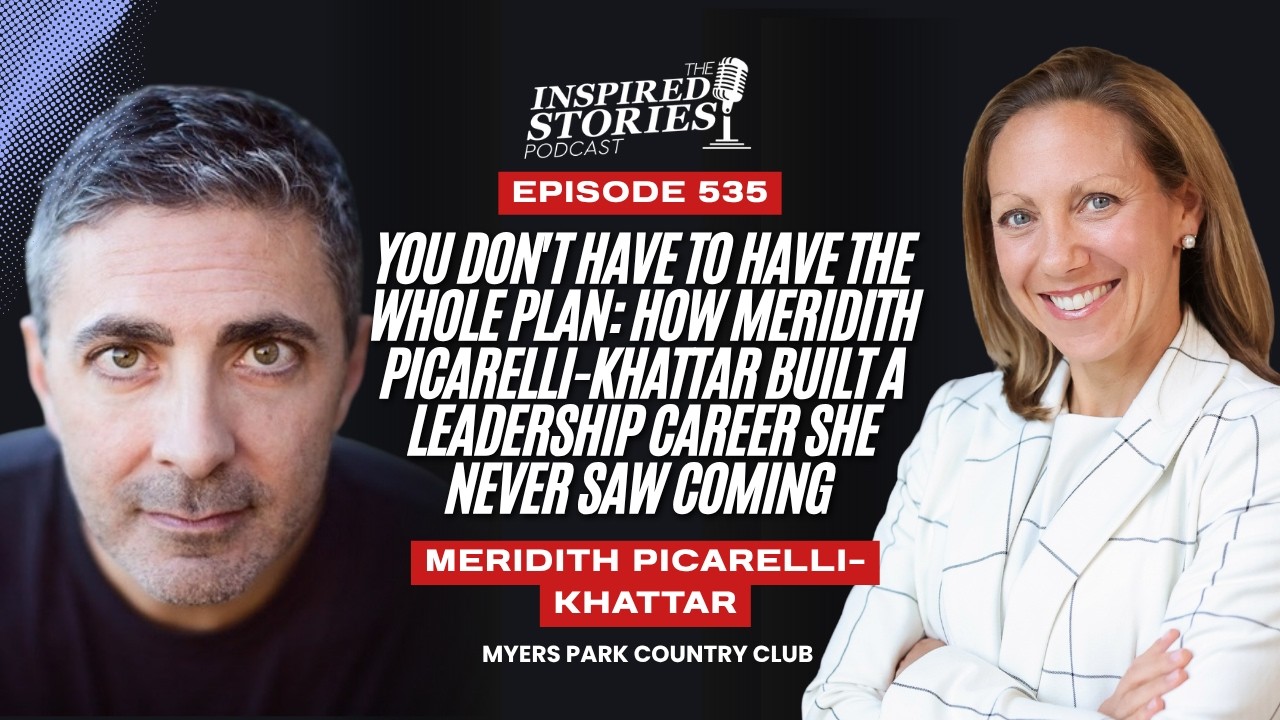
Meridith Picarelli-Khattar, General Manager and COO of Myers Park Country Club in Charlotte, went to college for physical therapy, stumbled into restaurant work to fund spring break, and found herself still there after graduation — until the restaurant closed without warning and forced her to figure out what came next. A resume sent to dozens of places landed on the desk of a GM at Round Hill Club in Greenwich, Connecticut, and the rest was a 20-year arc through private club management that nobody planned, two advanced credentials, an adjunct teaching career at NYU and Sacred Heart, and a seat at one of the most prestigious clubs in the Southeast.
✨ Key Insights You’ll Learn:
Pulling into a private estate by mistake on the way to her first job interview at a country club
What her first GM did the night she moved in that set the template for her entire leadership philosophy
Why she pursued a master’s at NYU and two CMAA credentials in an industry she entered by accident
Teaching private club management at NYU, Norwalk Community College, and Sacred Heart University
The heart-to-heart with her board president that stopped her cold and reshaped her first year at Myers Park
Why a bus with no passengers isn’t leadership — it’s just someone driving alone
How Myers Park members can use the club multiple times a day without it ever feeling like a destination
The golf course renovation closing for 10 months and what the club is doing to keep members engaged
What it took to build executive presence as a petite woman in a male-dominated industry
The quality over quantity framework she applies to the one hour a day she has with her four-year-old
🌟 Meridith’s Key Mentors:
Her First GM at Round Hill Club: Showed up with groceries the night she moved in, enrolled her in CMAA education, and taught her what it meant to welcome someone into a community rather than just give them a job
Her Board President at Myers Park: Delivered the honest feedback that she had pulled out of the station without her team — the most useful thing anyone said to her in her first year
Her Network of Female Club GMs in Charlotte: Three of four local club managers are women, two of them firsts in their clubs, and they collaborate openly on challenges no male counterpart has to think about
The Endurance Racing Community: Where her competitive instincts go so they don’t run her work life — and where she learned the difference between destination and process
👉 Don’t miss this conversation about what it actually looks like to lead a club people come to belong to rather than be impressed by, why slowing down was the hardest and most important thing she did in her first year, and what a card signed by a GM means to a part-time rackets employee who’d never met her.
Listen to the full episode here
Transcript
Anthony Codispoti (00:00)
Welcome to another edition of the Inspired Stories Podcast, where leaders share their experiences so we can learn from their successes and be inspired by how they've overcome adversity. As you listen today, let one idea shape what you do next. My name is Anthony Cotus Bode, and today's guest spent two decades mastering the art of running private clubs before being handed the keys to a century-old institution.
That has been shaping Charlotte's social fabric since 1921. The path to leading a five-star operation with over a hundred years of tradition and expectation behind it is rarely a straight line. And the pressures that come with stepping into that seat are ones most people never see from the outside. Meridith Piccarelli Qatar is the general manager and chief operating officer of Myers Park Country Club.
One of the most prestigious private clubs in the Southeast. She holds both the CCM and CCE certifications, the highest credentials in her industry, and brings more than 20 years of executive hospitality leadership to a role that she assumed in late 2025.
But before we get into all that good stuff, today's episode is brought to you by my company, Ad Back Benefits Agency. And you'll want to hear this because it's hurting almost every business you know. Health insurance costs go up every single year, and country clubs are furious about it. They're paying more, claims are getting denied, employees are opting out because they can't afford it, and it hurts turnover and morale. It's one of the most maddening problems in running a business, and everybody just accepts it.
But you don't have to anymore. Now there's a program that gives employees unlimited access to doctors, therapists, and prescriptions with no co-pays or deductibles to meet. You don't change your broker, and here's the part that really shocks most people. Our product actually increases your net profits. We recently helped a client add $900 per employee per year to their bottom line. Results vary, but imagine what could be done with the extra cash flow.
Get your free consultation today at adbackbenefits.com. All right, back to our guest today, the general manager and COO of Myers Park Country Club, Meridith Piccarelli Guitar. Thanks for making the time to share your story today.
Meridith (02:26)
Yeah, thank you for having me, Anthony. I'm excited to be here.
Anthony Codispoti (02:29)
So Meridith, take me back to the beginning. What first pulled you into the world of private clubs and hospitality?
Meridith (02:36)
Well, the first thing I'll share is that none of this was the plan. I went to college and in hopes of studying physical therapy, I was really fortunate to play field hockey at the collegiate level and just found out I was terrible in science and anatomy and physiology. I started working at a restaurant in college with some friends to make money for spring break. And a number of years later, following graduation.
I was still there. And then one day we came into work and the restaurant had closed without warning. And so that really forced me to pivot. And it was really a turning point in what I was going to do next or what I was going to do even following graduation. My resume after applying to what it felt like dozens of different places towards New York.
landed on the desk of the general manager of Roundhill Club in Greenwich, Connecticut. And I was really fortunate to be invited for an interview. And I remember the drive down that day almost as clear as yesterday. And I was driving down the road to get to the club and wasn't really sure where I was going. There was no ways at that point and pulled into what I thought was the club. But it was an estate.
Someone's private estate and they told me to get back in the car and keep driving. and as soon as I did that and I pulled into the club, I thought, well, I don't really know if I belong here. And I don't really know if this is something for me. And you know, years later, it was, you know, I feel so fortunate that the general manager took a chance on me. he didn't just give me a job, he invested in me. he encouraged me to
seek professional development. He shared what the Club Management Association was about, you know, provided educational resources for me. And, you know, this wasn't really a career that I found. I I feel it found me. And then I just really chose to embrace it.
Anthony Codispoti (04:47)
And so as you're pulling into that parking lot after making a little detour and and you've got that feeling of self doubt in you, was there something specific about the club opportunity that felt like maybe you didn't belong or I don't know, maybe is this more of your personality where there is you know, like a lot of people, we just doubt and question ourselves.
Meridith (05:11)
I think it just felt I was driving into this really big unknown and to an industry that I didn't know. I never thought there was an industry called the hospitality industry that you could move into as a career. I was working in a restaurant, really just I enjoyed it. I enjoyed meeting people and providing this, you know, wonderful, we called it a wow experience for the guests at the time. And just
realizing how those experiences could really make someone's day or make them have a connection with you. And I just was really nervous that I was coming to a completely different environment and I wasn't sure if I was going to be able to you know, meet or deliver the caliber of expectation that, you know, maybe that environment was looking.
Anthony Codispoti (06:02)
What was the role that you were hired into there?
Meridith (06:05)
So I was hired as an assistant manager and I ended up doing a couple of different roles and just went into we had a very small team. I was an assistant manager, but then I was also running the dining room. We had absence of a manager. And so I really just jumped in. I started on the Friday morning of men's member guest. I walked in at 6 a.m. and I just kind of jumped in open wide, not really knowing what I was getting into, but
I worked, you know, as hard as I could and I tried to absorb as much as I could to really just learn.
Anthony Codispoti (06:39)
And it sounds like you had the benefit of an amazing mentor starting out there, right? Somebody who's really coaching you up, offering you new opportunities, pointing you towards resources and education. Talk more about how that not only helped you in the moment, but set the foundation for you going forward in in the field.
Meridith (07:01)
Or yeah, I think one of you know my first not only interview, but my first experience with just moving there was I was offered the position and then asked if I could start in a week. And I was going to be living on property. And so it wasn't a challenge of where I was going to live. It was, you know, how I was going to move there. So I managed to pack everything up and relocate in a very short period of time. And when I went to move in, there were some flowers and a card.
in the apartment. And then my general manager came with a bunch of groceries to really welcome me to the club. And and that I think is what I've really carried forward because it wasn't, it was no longer just about a job, right? I was being really welcomed to into a family and welcomed into a community that it was almost he wanted to make sure he was telling me that he was going to right I was going to be taken care of. And
In turn, right, that was what I was going to be asked to do for our membership to make sure that they were cared for, to create this wonderful community and create wonderful experiences when they were at the club. And and so through that, right, and he also opened my eyes into our professional development, our local association, the Connecticut Club Managers Association, where we had monthly educational opportunities, and then through our national.
professional organization called CMAA. and you know the club was paying for me to attend professional development for my growth, right? And so I was able to grow but also then give back to the club. So I wasn't just taking at some point I was able to give it back.
Anthony Codispoti (08:44)
So was it during your time at this first club? And I'm sorry, remind me of the name of this club. Round Round
Meridith (08:49)
Roundhill Club in Greenwich, Connecticut.
Anthony Codispoti (08:51)
Hill Club. So was it it during your time at Round Hill Club that you started to see that, this could actually be a career path for me? Yeah.
Meridith (09:02)
Yeah, I and I absolutely loved it. I loved the environment. I loved what we were able to do for the members, really the fun experiences and and no day was different. I am not meant to be someone who sits at a desk all day. I enjoy interacting with people and you know, those experiences allowed me to do a lot of different things in a lot of different roles.
Anthony Codispoti (09:25)
Yeah. Speaking about doing different things, you know, as I look at your resume here, among the different stops that you've had in a hospitality, I see a handful of adjunct professor roles at places like NYU, Norwalk Community College, Sacred Heart University. tell us about this. How does this fit into the hospitality story? What what what kinds of things were you teaching?
Meridith (09:51)
Yeah, so I was really fortunate to have those opportunities to actually teach private club management. And so for me, it was a way to give back to students and to young people, you know, learning about hospitality and almost teaching them about an industry that I knew nothing about when I started. and at the time I thought they already had one step ahead of me because I hadn't gone to undergraduate school to learn about hospitality and private club management, but I wanted to.
you know, spark something in students to think about, I can have a career right in private club management and what a wonderful industry it could be. and so that's what I really enjoyed, you know, connecting with students and I love mentoring and I love just being able to give back because that was what was given to me. And I feel that that's something you need to, you know, you give back in turn.
Anthony Codispoti (10:44)
I'm curious to get your viewpoint on this. I talked to a lot of folks in the restaurant space, and one of the things that they really love about the industry is that there's the opportunity for people who haven't had access to more formal education, maybe have had kind of a rougher upbringing, that if you're willing to put yourself in there, work hard, you know, show up every day and grow, that man, there are great career opportunities there for you.
Дію філда саме або клуб experience.
Meridith (11:18)
I do. And I think a lot of us, right, and many of us, we don't start as general managers. You don't start as COOs or assistant general managers, right? You start at some level in the industry and you show interest and dedication. And it's our roles to develop people. And I think that's what a lot of club managers do well, is we look internally to develop. And you know, one of my philosophies is
I'd rather look internally to develop and to promote someone than have to go outside. Right. If I do a good job, right, if I am doing my job right, I'm gonna find internal candidates that we're gonna promote up into different roles to expose them into different responsibilities. So then if their goal is to become a general manager one day, right, we're gonna help them get.
Anthony Codispoti (12:07)
Nice. we're gonna talk about Myers Park where you are today in just a moment, but I wanna hear a couple of stories about some of the work that you were doing before. So as you think about the different stops that you've had at clubs along the way, can you pull out one example, a story of a really heartwarming or uplifting experience you've had? Maybe it was an interaction with a guest.
A vendor, a coworker. We already heard about, you know, that first manager at Round Hill, which was great. Maybe there's an another story you can share with us.
Meridith (12:45)
Yeah, early on in my career, and there's so many, and so it was hard to think about which one, but that first role, it was really learning how to create, you know, wonderful experiences for members. And how do you do that in genuine ways without it seeming very cookie-cutter or staged? And so we had a young family that would come in every weekend with their two-year-old daughter.
and their parents. And if you have young children, you know that kids don't like to sit at a table for very long. and these days we have devices, but those days it was coloring and that gets old pretty quick. I have a four-year-old. We have a hard time sitting down for formal dinners. and so I would engage with the family a lot, and I started bringing the little girl into the kitchen to make her own ice cream sundae at the end of right if she could eat her lunch.
And kind of sit there for a period of time. I'd take her into the kitchen so she could kind of choose her ice cream, choose her topping. and so it became just this routine experience and something that started so simple, right, and maybe helped the parents have, you know, a moment of peace to themselves or have this little girl have something to look forward to, you know, became became a memory that they have of the club, right? And of me, you know, still to this day. And so
It's those little moments and they're more genuine moments that just kind of happen that, you know, I learned and that's really how you deliver a great experience. You can do it in a lot of different ways, but sometimes the smallest moments are ones that really make the difference.
Anthony Codispoti (14:26)
I love that
story. my boys are a little bit older. They're ten and almost twelve now. They still don't like to sit at a table. It's
Meridith (14:34)
Mm-hmm.
Anthony Codispoti (14:35)
certainly much better than it was when they were two, three, and four. And man, what a great thing that would have been, you know, if somebody came over and said, Hey, you know, let me take them to the side here. That's really nice. I like that story. Okay, so now I I'm gonna turn it a little bit and I wanna hear about one of the more challenging work experiences.
that you went through and going through that, you know, what you were able to learn.
Meridith (15:02)
Sure. Yeah, I'll be honest. You know, one of the most challenging experiences is one I brought on myself. You know, and it happened here when I started at Myers Park. I started the week of Thanksgiving and I was so excited to be here. I was so energized and probably a little too energized. You know, I came in listening. I pride myself in not, you know, making big changes in the first 90 days and even in the first year. You like to do a lot of listening, but I was also moving fast.
we were making some changes, we were setting direction, right? That's what I thought. A new general manager and what I should be doing. and then my president sat me down in you know, the beginning of this year for heart to heart and said, you know, the team felt like they had missed the bus. And that stopped me cold because part of my leadership philosophy is around the book, The Energy Bus. and
As a leader, right? That's the idea that you set the direction, you drive the bus, and people choose to get on or off the bus. And I believe that deeply. But that was the moment that I realized I had pulled out of the station without even letting them get on the bus. I was so focused on where we were going and I was so excited that I forgot to bring people with me. And you know, a a bus with no passengers isn't leadership. It's just someone driving alone. and so that
you know, conversation was really humbling. And, you know, I had two choices. I could say, you know, one, this this isn't gonna work for me, or I could, you know, sit down and and really think through how I was going to move forward and how I could gain trust with the team so we could move forward together. and so, you know, trust takes time to build. And so we've kind of started to slow things down and start to build that trust. And I know that
You know, once I have that trust, you know, everything will happen in in the time it's meant to.
Anthony Codispoti (17:00)
So it this is really interesting to me. I want explore it for a second because you know what you're describing, you've been in the industry now for years. You've had a number of stops, and we've skipped over them in this conversation, but you've been in club management for years. A lot of great clubs that you've worked at. So you've got the experience, you've got the know-how. This isn't your first time interacting with people. You're stepping into this role at Myers.
And you've got all these great ideas and this big energy, and you want to go, like you said, you want to go fast. I you know, all kinds of great things I want to do. and you went a little too fast, right? Like you you you forgot to kind of get the the team to go with you. Now, the part of the story that I find really interesting is there's so many people that at that point in their career would say, the problem is with everybody else. I know what I'm doing, I've done this before.
You guys need to get on my bus, or you know, I'll find other people who will. But you didn't take that approach, right? You is hard and and this this is not human nature, right? Like the the reflex is to say the problem is with everybody else, but you looked inward and you said, This is an opportunity for me to grow and to change. Tell me a little bit more about how that felt and how you took yourself through that process.
Meridith (18:19)
Yeah, it it was hard. I mean, after hearing that, right? I take a lot of pride in leading others and I don't do things for myself. Decisions I make, it's for the best intention of the club and the staff. It's right, it's never about me. And so I thought, wow, like this is really hard. Maybe that maybe I'm not maybe this isn't the right fit and maybe there's something wrong. And and then I had to think, I I talked to a couple kind of mentors and coaches that I've worked with and
I was able to kind of work through the feeling of, okay, well, maybe I hadn't done this and approached it this way. And maybe I had just disregarded this. And and in some approaches, right, how I approached it, this situation may have worked, but it's just it's not working in this environment, right? And it's a little bit too fast. And we're also in a southern culture and things move a little bit slower. I'm from the Northeast. I've always so the pace has to change a little bit. And so that's.
You know, one thing that I learned and I I had to, you know, just sit with it a little bit before I could come back and figure out how I wanted to approach it because it wasn't that the team didn't like me or didn't want me there. They all wanted to be on the bus. They just felt I left this station without them. And you know, so I had to just do some reflecting. And we've kind of slowed things down a little bit. And I'm trying to do more listening before, you know.
we make a decision on how to move something forward.
Anthony Codispoti (19:49)
I was gonna ask you what were the sort of the big differences you made, but you just hit on a couple of them right there, right? You slowed down, you're listening more before moving forward. Any other tactical, operational things that you've adjusted?
Meridith (20:05)
I think it's just it's listening more. It's listening more not only to the management team, but listening to the staff. I'm listening more to the membership. You know, I guess you always think that when you step into a new role, people want to see results immediately. And that's not always the case. And I think in some organizations they do, but you know, one of the key things I was told right when I was interviewing that nothing was in essence broken, right?
And we know there's always room for improvement. And I I love improving things. And so I got so excited to look at any low-hanging fruit and what we could do to like help have those small wins. And it was just, you know, it went a little overboard. And you know, I think the team's all for continuous improvement, but in a in the speed of right, in a different speed.
Anthony Codispoti (20:59)
No, I get that. Well, let's back up a little bit then. How did the opportunity for you to join Myers Park come about? Tell me about the interview process.
Meridith (21:08)
So I that's a great question. I had never been to Charlotte prior to coming here for the interview, and I probably would have not considered relocating kind of more south than than where I was in Maryland, prior to a couple of you know key things and and that have that happened over last year. So early in last February, my boss, who was the general manager of the club I was at,
For 22 years. I wasn't there for 20 years, he was there for 22 years. He provided his resignation and he left in early June. And at that time, I had put my name in to interview for that role there. I ended up going through the interview process. I was the interim general manager at the time, and then it was decided there was a different candidate that was the better fit. and so
I was in a really hard place because over the time period I was there for the last five years, I had interviewed for a couple of general manager jobs and they weren't the right fit. And so when that, I guess I'm very big on signs and I will get a direction. And I thought that was right my direction. And when it didn't come to fruition, I started to really think about right, am I meant to do this? Right. Am I meant to go back to being a general manager again?
Is there a different opportunity I need to look at? And I got a call in early August of last year for this role. And they from a recruiting firm and asked if I would be interested in learning more and what I like to interview. And so I said, sure, I'd love to learn more. And I took an interview while I was at a day conference in Atlanta. And by the time I got to the airport, I was asked to to come in for an in-person interview.
And so it was really exciting to kind of see a different part of the country. I I had not been to North Carolina or to Charlotte and just really embraced it. And I got here and it everyone was just so friendly and wonderful and warm and it just the pace felt slower than the DC area. and so it just it felt really like the right fit and the board,
of governors were aligned with, you know, things that I look at at high performing boards and the staff was all really excited and really passionate and motivated and enjoyed what they did. And it just felt like a really good fit at the time.
Anthony Codispoti (23:44)
Yeah. Nice. it you know, it starts out as a real stinger, right? You know, y this place that you were the interim manager at, like you you knew everybody, right? You were doing the role, you were, you know, ostensibly doing it well. And they're like, we're gonna go a different direction. Well, man, that's a real kick in the teeth. But a door closes, a window opens, you you get a new opportunity.
You mentioned, you know, one of the challenges when you first came in is you had all these ideas, things that you wanted to do, and you got moving a little, you know, East Coast speed fast for folks. Give me one or two of the things that you were most excited about to do, you know, once you got there.
Meridith (24:28)
Yeah, one of the ongoing conversations that we had had throughout my interview process was working to develop a strategic plan for the club. And so working with a consulting firm to really take the club through a strategic planning process. and then just some kind of governance and committee restructuring and and so forth, and then just really trying to learn about the club and
make small tweaks from here and there. But you know, I think strategic planning, the club was also and we're also starting a golf course renovation at the end of this year. And so that was really exciting to be a part of. We did a similar renovation with the same architect that we're using at my previous club. And so that was exciting and attracting for me to kind of help take the club through that process.
Anthony Codispoti (25:22)
So for somebody who's never been to Myers Country Club before, describe it to us. What's the member experience like?
Meridith (25:31)
Yeah, so we're very much a community club. And and when I say that, we are literally in the community of Myers Park and the club was built first and then homes were built in the community all around. And so a lot of our membership lives within walking distance of the community. and you know, at its heart, we're really a neighborhood club. I love the fact over COVID, the club added a coffee truck, and so members walk.
Over to get coffee in the morning. They walk their dogs over. We have dog treats for them. They use the fitness center. And so there's a lot of different touch points. We also have very active golf membership as well. We do over 40,000 rounds a year, which is huge for one golf course. But, you know, it's not a place, you know, that people are going to become to we're not trying to impress you, right? It's a place where you come to belong.
we're really a community. The staff know your name. they know your kids' names. It's a multi-generational club. and so you have members that have grown up here that have kids are now members, and which creates really wonderful environment. And then you have members that move to the city of Charlotte and, you know, just love being a part of more of a kind of casual and down-to-earth club.
Anthony Codispoti (26:50)
So you take the reins in October of twenty twenty-five. take us back to the first week and you're on the job.
Meridith (26:56)
Yeah, so
I I actually started just the week of Thanksgiving in November.
Anthony Codispoti (27:00)
Okay.
Meridith (27:01)
And so the morning that I started, we had a turkey trot here at the club. So I wandered over and I met members and some of the staff for our little turkey trot. and then we planned right the entire week and I met 800 members on Thanksgiving Day. So I stood at the door and I it was a revolving
Anthony Codispoti (27:18)
Wow.
Meridith (27:20)
door of introducing myself.
and then just really this overwhelming, like warm welcome. It was, I've never felt anything like it. And still to this day, members and staff, right? The warm welcome I've gotten. We're so excited to have you here. you know, whatever we can do to help. And it's just been really wonderful. but it was a very busy week here at the club. But
Anthony Codispoti (27:42)
Wow, it's beautiful. Yeah.
Meridith (27:46)
wonderful to see the staff kind of execute, you know, and put on a really great Thanksgiving event for our members.
Anthony Codispoti (27:52)
I wanna do a quick diversion into some of your personal interests because you mentioned playing field hockey at collegiate level. So you're a pretty good athlete, yeah. Yeah.
Meridith (28:02)
I guess so. I
guess I was. Yeah. I was really fortunate to play through college and then coached a couple of years after before I relocated to Greenwich.
Anthony Codispoti (28:12)
So most collegiate athletes I talk to, even you know, some high school ones as well, there is a strong like competitive spirit there. Tell me how you're you're smiling and you're nodding. Tell me how that competitive spirit shows up in your work.
Meridith (28:32)
I
I'm not gonna I like to be the best. I I I think I right so I do endurance sports on the side, and that takes care of my competitive spirit and my personal life. when I'm at work, it's not as if I'm competing with other people. I like to do things well. I like continuous improvement. You know, when you're an athlete, you're always working on yourself, right? And you learn that.
Right, or I have learned it's not so much the destination, it's not so much that race or that one game, right? It's the journey and how you get there in the process. And so I like to look at it from a leadership perspective is okay, we're here, and what does our process look like to get here? And how do people grow personally, professionally, right? And how we grow whatever we want to do in that process. So it's almost like you're never at the destination.
you're always trying to continuously improve and get better each time. right. We're never trying to just win the game. I mean we have events that we want to do right top notch. And those are really big wins for us. But we don't typically compete with other clubs. we have an interesting saying in the industry is that and and we're all we very much share. So we take we love sharing ideas. We just tweak them for how our clubs do things differently.
Anthony Codispoti (30:03)
that's interesting. So you've got almost like you're on like an unofficial mastermind, like a support group of other folks that do the same kinds of things.
Meridith (30:11)
Yeah.
Everyone's very collaborative. you can take somebody else's idea and you can make some changes to it and make it your own at your club because every club is a little bit different. So you're it's not as if you're competing with the hotel down the street or the club down the street. We all have different personalities. we all get together the managers in the area to kind of talk about some big topics or challenges we're having. So we can all, you know, more so help each other or collaborate as opposed to being competitors.
Anthony Codispoti (30:40)
Can you give me an example of an idea that you borrowed from somewhere else and tweaked it to make it your own?
Meridith (30:47)
Hmm. I think there's been a lot of great ideas over the years, but we take inspiration also from, and I've taken this more having a small child when doing family events, right? Inspiration from maybe outside of activity activities that you go to, but one activity we I did at one club was you know, kites for kids. We saw another club that did it so you could buy these.
plastic kites and kids can design them and then they go fly them on the drying driving range. And so you create an afternoon event and then you have dinner to follow. And so, you know, that's just one small event. But I I think there's, you know, unique things that you learn from all different industries. And you know, taking my son to places or taking him to different programming, I see things a little bit different ways. And
try to pick up some different events and activities, you know, when you go to farms and, you know, what activities do they have for, you know, the Halloween events and and can we do something similar here?
So that's kind of fun. Inspiration.
Anthony Codispoti (31:53)
Yeah, th those don't sound like
fun. I think my kids would have enjoyed those. so give me a little bit of insight what the role of GM and COO entails.
Meridith (32:05)
Yeah, you know, it is I'm really the steward of the member experience and the employee culture. And, you know, I see this role as really the culture holder for the entire club and setting the example of how, you know, the mission and the vision align, you know, with where the club is going. Right. Additionally, right, operating all operating departments responsible for financial oversight.
I really, you know, leading the entire operation, right? Or leading the directors that report to me so they can lead their operation. You know, my philosophy is not simply just to manage an operation. I want to build a culture where people feel valued, challenged, and really inspired to do their best work. I feel it's our job to give the team what they need to do their job, right? And teach them and train them and then get out of the way.
Anthony Codispoti (33:04)
was like a servant leadership kind of a role, like how can I support you so you can do your job?
Meridith (33:10)
It is. And and I'm really a strategic, I'm a strategic partner with the board, partner with the board of governors and work with them really closely to look at where the club is going, how we want to get there, not from a strategic standpoint, but also financial standpoint. And so it's kind of neat. It's it's business, it's people, it's culture. It's
Anthony Codispoti (33:32)
Yeah.
Meridith (33:33)
a lot of different different components in the role.
Anthony Codispoti (33:35)
Meridith, you hold a couple of certifications, CCM and CCE. What are these credentials and what did you learn going through the certification process?
Meridith (33:47)
So the CCM is a certified club manager designation, and both certifications are through CMAA or the Connecticut Club or the Club Management Association of America. And CCM is about right now, it's probably a five to six year long process. And so it really demands rigor across all the different competencies that if you were to be a GM, you're overseeing.
And so club governance, interpersonal skills, leadership, accounting, external governmental influences, HR, membership, marketing, food and beverage facilities, and golf, sports recreation, and IT. And so all those different competencies, you are gaining knowledge over the course of a number of years. You're taking a very large exam. You have to have a certain amount of credits through professional development,
courses over the course of that time to even sit for the exam.
Anthony Codispoti (34:49)
So this isn't just like
checking a box. This is like this is like
Meridith (34:53)
Ha ha
Anthony Codispoti (34:54)
college level stuff here.
Meridith (34:56)
It is. I always say I feel like the CCM is a master's in kind of club management. And then the CCE certified chief executive really hallmarks the professionalism of and augments the CCM. So for individuals that are the most senior leader in their organization for a period of time, have mentored, right, showed active mentoring, you know, for other managers below. And so there's another set of credentials to kind of achieve that CCE designation.
Anthony Codispoti (35:26)
Mm-hmm.
Meridith (35:27)
Yeah. And both and both have, I think, right, they're professional development for our organization. And you learn, right, really how to do a general manager or COO job kind of from both of them and more so from the CCM.
Anthony Codispoti (35:41)
So how long does it take to actually go through the certification process?
Meridith (35:45)
Yeah, so they've changed the requirements, but I believe the CCM is about six years. and then it was that you had to be the general manager or chief operating officer at your club for five plus years, having a certain amount of credits and then some additional credentials.
Anthony Codispoti (36:02)
this is serious. The more I hear about this, this isn't, yeah, college. Like you said, it's master's. This is, I don't know, PhD level stuff. Like that, that's some serious time commitment there. we heard a little bit about you know, the golf course redesign that you guys are working on. Tell me more about any recent or ongoing facility improvements there at Myers Park.
And I'd be curious at the same time to hear more about the decision making process that takes place when trying to decide what new projects to take on and then how to fund them.
Meridith (36:43)
Sure. So prior to me starting at the club, they had identified a golf course renovation project as many clubs are. And as you see with aging infrastructure and buildings, you'll have to invest more to keep it playing in the same way or looking the same way, you know, over time. And so the club had engaged an architect called Andrew Green.
Who is working with a number of different courses. And we actually worked with him at my previous club. And he does a lot of restoration renovations on Donald Ross courses. And we had engaged him and kind of working through the contractor process prior to starting. And so we actually break ground November 30th, December 1st for our project. So our golf course will be closed for about 10 months.
We have some bridge work that we're doing. We actually have a creek that runs through the golf course. And then we're also doing the halfway house at the same time. And so the golf course project is pretty much set and we have some pre-meetings on a weekly basis. We're still working through the scope of the bridge work and then the halfway house. but those were kind of put on, I won't say the calendar. put on the calendar, a budget was built for those prior to when I started. And
we're just going back to really refine those numbers now before we start the process of the renovation. And then
Anthony Codispoti (38:12)
Sorry, real quick, what is the halfway house in the context of your club?
Meridith (38:15)
so
sorry. So the halfway house is actually in the middle of the golf course. And so serves food and beverage, has
some restrooms. And so it's almost it is. it does. It's typically you're right, halfway through the course between nine
Anthony Codispoti (38:21)
Has a very different meaning than it does outside of the the club world. Okay. Got it.
Meridith (38:28)
and 10. And so if it was in the middle of the course, people had restrooms and food and beverage. So ours is called the halfway house, probably could have a different name, but accessible through multiple holes, kind of in the middle of the golf course.
Anthony Codispoti (38:40)
Gotcha. And sorry I interrupted part of your answer the previously.
Meridith (38:42)
No, no worries.
and and through right to develop any future projects at the clubhouse. I was fortunate a number of years ago, the club renovated the clubhouse and has been active in doing some renovations and doing some rebuilds. And so looking forward will take the strategic planning process that the club's going through to identify, you know, we
Part of that process is doing a survey of the membership. And so that'll help inform us of what's important to the members moving forward. And so we haven't given them an option of do you want A, B, C, or D? But if members are saying we need more space for youth programming or across the street, we could build a larger fitness and wet wellness center, right? We'll work out, you know, a 10-year kind of capital plan and look at how we finance it over time.
that's probably one of my goals coming out of this strategic plan from an internal standpoint that we can have so we know and can plan for which projects come next.
Anthony Codispoti (39:45)
And so the financing tools that you're looking at is traditional bank loans and then, you know, repaying through, you know, membership dues and the you know, the revenue that you generate there, is other things that I'm not
Meridith (39:55)
Yeah, so we have
Anthony Codispoti (39:56)
thinking of.
Meridith (39:57)
yep, we have three ways. We have you know, initiation fees and and we have what's in the bank, we have bank loans, and then we have assessing membership. So kind of those are the three levers you would say we pull to fund any projects that we do.
Anthony Codispoti (40:15)
you mentioned that the golf course is gonna be closed for ten months. I have to imagine this is a big deal for your membership. How are folks reacting to that news?
Meridith (40:27)
It's hard because I know the course was playing really well this spring and this summer. And so I think it's hard for members and for anyone, right? When you're going to shut something down that they use so actively. And so what we've tried to do is partner with some local clubs and provide tea times at other clubs. There's some other clubs in the area that have done projects. And so we've reciprocated on that now and try to provide some.
you know, golf experiences for the membership so that they have options. It's likely not as many options as what they have available today. but at least it's an option of you can take a big trip and play, you can play an hour away, you could play 15 minutes away. and so we'll give them those opportunities there. And then we actually have a meeting this afternoon with the team to talk a little bit about what we're gonna do to keep members here at the club. And, you know, one of the ideas I have is we've got a
Racket's facility kind of across the way of the golf course and we've got a big green grass area. So we've talked about building a nine-hole putt-putt course there or putting bocce over there. So there's that doesn't take the place of the golf course, but it just gives an additional amenity or something else for members to do, you know, to come to the club.
Anthony Codispoti (41:44)
So does the entire course actually need to be shut down the whole time or could you shut down a few holes at a time? So maybe they still get to play nine or twelve, you know, while the rest of it's under construction. Yeah, it doesn't
work that way.
Meridith (41:56)
Yeah. Un unfortunately
the the whole course does need to close because all the holes will be affected. So and then there's kind of a construction portion and then there's a growing period of all the grass after it gets started. And so there's just transitions of
Anthony Codispoti (42:08)
of course, it needs to be done in phases.
Yeah. It's not like you're constructing one building and then another building. Yeah, they all have to go through the grow season, which okay. Then I get it a little bit more. you know, I mentioned restaurants, you I I get to talk with a lot of folks in restaurants and I you know, I also talk with folks in the club space too. And I understand hiring is just, you know, a huge challenge across the hospitality world in general.
What are you doing at Myers Park to attract and then keep people? It goes beyond the typical playbook.
Meridith (42:45)
Yeah, so for I feel fortunate what the club was doing before I got here is so private clubs typically are atypical to restaurants where you typically receive a higher wage. And so there's typically clubs are non-tipping. So the club acknowledged that kind of coming out of COVID, it was really challenging to find good staff. And so reworked the model, and we actually have kind of a tipping pool, and so members can tip and it goes into the pool.
for our restaurant staff, kind of front of house staff and bartenders. And so I think that's really helped keep
retain and attract good people here to the club. you know, from a benefit standpoint. I also think our HR team does a really wonderful team. So we recognize pay is important to people, but that's typically not the top of what people say is important to where they work. And so there's a lot of additional benefits that we offer. And yes, we offer the regular health insurance and dental insurance, but there's some additional programming to help staff kind of guide them through choosing doctors.
finding care to make it easier rather than just going to maybe, you know, your United Healthcare website to find doctors. additionally, we do different educational programming on a monthly basis and utilizing our strengths internally. And so we have team members like the chef will do, how to make you know, a soup base. could we one program that staff can sign up for, another one could be on plants and our horticulture.
horticulturist will come and we'll kind of work through a program. we do a lot of different events. we try to, you know, we do something special for Mother's Day or for Father's Day and really just try to show them that they're appreciative. something that stood out to me was when I got here, I got handed a whole bunch of cards to sign. And I said, well, what's this? And they said, well, this is this person's birthday. This is their anniversary. These people have graduated college, right? And some have little gift cards. Some just, and so you're getting
Like this really nice touch of like everybody is writing, you know, something special to congratulate you. And you know, you you don't think that means a lot, but I had a staff member that works over in a rackets facility part-time. And he's I was over there one day early on and he said, you're Meridith, you signed my graduation card. I was so excited to meet you. And I thought, wow, I right you don't think that you make a difference in just signing a simple card. But I thought, you know, it's very thoughtful and
I think it goes back to the culture of like who we are and and what we try to build here. and it's more than just a job, right? It's it's building a community and the culture.
Anthony Codispoti (45:33)
It's a nice touch. I'm curious, you've got I know, every club, you've got older members, you're always trying to bring in new members, younger members. Do you notice a difference between what younger and older members want from a private club experience?
Meridith (45:51)
Yeah, absolutely. I think and also the challenge, right? We're a multi-generational membership. And so you have to figure out what your members with kids my age want versus members who have maybe been members here for 40 years want. And it's always something different. everybody always wants good food, right? Food and beverage is an amenity that everybody uses at a club. So whether you play golf, whether you play rackets, you know, or use the pool.
Not everybody does that, but everybody eats, right? So food and beverage is always a top priority. But right, your older maybe demographic doesn't want a restaurant with loud noise. And your younger demographic wants a really fun atmosphere and bar-like environment. right. Or young families want family programming, but they also want adult-only programming. And so it's really just listening to the members. And I feel fortunate since I've had my son, I put myself in.
Right, that different position of right, if I was a member of a club, what would I want from my experience? Or how do you how does the club fit into my life and does it make it easier for me to use the club? Right. What challenges are we trying to take away so that people can come just use their club and enjoy themselves?
Anthony Codispoti (47:08)
What in your mind would be, I don't know, the average time, let me rephrase that. Your typical member, how frequently are they coming to the club?
Meridith (47:24)
Probably almost every day. So we
Anthony Codispoti (47:26)
Every day.
Meridith (47:26)
have we have fitness and wellness facilities. So if they like to work out and they live in the community, they'll come here to use our gym. Then they may go home. And I always say if you have kids in summer camp, you may come back here to drop your kids off in summer camp. You may then pick up a coffee on your way out. Then you may come back to get your kids from summer camp. And then maybe they're going to swim swim practice at the pool. And then you're eating from our shark shack, which is our kind of pool side cafe.
right, that that's your member that maybe uses the the entire day as a full experience, or you have members that come over and they play golf, and then they're stopping at the turn for food and beverage on their way out to play on the course, and then they're coming back over and having a cocktail, and then maybe their wives are coming to join them for dinner. Right. So we have a lot of different touch points and ways we make members use the club, I think, accessible and easy. And sometimes again, we have members just coming over to grab a coffee.
And heading out to work.
Anthony Codispoti (48:26)
Well, that's really cool. Because like you were describing before, a lot of your members live very close by. Yeah. shifting gears on you now, Meridith, what's the hardest thing you've had to overcome and what did going through that teach you?
Meridith (48:43)
So I can't see it now, but I'm five feet tall and I'm a woman. And in this industry, it's very male dominated. And early on, it was yeah, I went back to get my master's at NYU because I wanted some sort of accreditation to the industry I wanted to be in. I wanted to be looked at at the top of the pile. I didn't want to have to compete.
although you're right, you always compete for jobs, but I wanted to be able to stand out. And being petite, right, and a female, I've always had to have ways to kind of figure out how I was going to have a bigger executive presence. and so I've always kind of taken the stance you dress for the job that you want, not for the job that you have. And I think through that I've learned to have this bigger kind of presence than kind of what I, you know, look like.
you know, because throughout my career I've been told you're you look too young, you're so young to be a general manager, you're so small, right? Or people like to hug you because you're small and petin and a woman. And and right all through this time, I'm just trying to be seen as professional, right? I want to be seen as professional. I I want to be on par with any other person that would be in a similar role as as myself. And so I've always had to ha find ways to like.
grow myself. And I think for me, getting my CCM, getting my masters, getting my CCE and trying to learn as much as I can and be the best I can be has kind of helped give me the confidence that I can have a seat at that table and I feel comfortable doing it, even if I'm seated at a table with all men. Right. I know what I know. I feel confident in myself. I feel confident in my abilities. And so that's a lot of I think what I've just had to work through to feel
comfortable and confident to be able to A be the leader I am today, but also take a seat at the table with, you know, others that, you know, may not look like
Anthony Codispoti (50:50)
So you mentioned before that there's a network of club managers that you guys can you talk, you go to each other. Are there other women in this network that are club managers and have you had private conversations with them about the same kind of thing?
Meridith (51:09)
So I feel really fortunate in Charlotte. I'm actually, there's kind of four clubs we all get together with, and three out of four of us are women. two out of three of us just assume these roles and are probably the first. I think all of us are the first female general managers. the other two, the one of the other clubs I worked at, I was the first female general manager. And you're starting to see more women as GMs. And I don't think it's for a lack of
Us trying. I think right the industry is starting to change a little bit. But I also think women get to a certain point in their career and you have to figure out do you want to have, can you have a family and do this role at the same time? And I think that's, you know, something maybe our male counterparts parts don't really have to think about so much. But I've not had that I've had that conversation with some other female GMs, not our group here, but
I feel fortunate to be in good company in in Charlotte.
Anthony Codispoti (52:10)
Talk to me a little bit about how you mentally and tactically approach that balance of, you know, having a professional career and, you know, being the mother to a young child.
Meridith (52:24)
You know, it's not easy and it always feels like a juggling act. And it always feels that one of the balls are gonna fall. and so you're constantly trying to kind of keep things up in the air to make sure you're there for your family and your, you know, child, you're there for your team, you're there for your club, and then you carve some time out for yourself. so I think it's always a juggle. There are days where, you know.
I'm home late or I'm at the club for a longer period of time. And so then I try to find another day that gives me a little leeway to come in later or to leave a little bit early to spend time with family. but I also right on my one day off or my days off, unless it's an absolute emergency, right? I'm not really responding to emails and I try to be really present. and so that helps, I think, turn my brain off from work to trying to focus on family and
my son keeps me very humbled. I mean, when I'm with him, I'm mom. He does not care about what my
Anthony Codispoti (53:27)
Ha ha ha.
Meridith (53:28)
role is, what I do. you know, he's still like learning, but I think it's, you know, you're you're just mom. And I think it's helped me detach from work, becoming a mother and yeah, just finding some things that I like to do on the side.
Anthony Codispoti (53:45)
Yeah, I do think that, you know, here we are in 2026. You like to think we're a bit more evolved, and I think we've certainly made progress in my lifetime. But I do think that there's a different standard's not the right word that I'm looking for, but expectations that come for professional moms than professional dads. And I look no further than my own family, right? So you know, I work, I'm a dad, I'm involved, very involved in parenting.
But there was no question that I was going back to work, right? Well, going back. I never stopped working. with my wife, there was a lot of mom guilt, right? Like she had, you know, she got a master's degree, she's a speech therapist, she's, you built her career, she's become very good at it, but she had a lot of guilt in like, I should want to stay home with them, right? As as a mother and a caretaker.
I feel bad that I want to go back to this career, this job that I'm really good at where I help people. And there was a lot of, you know, discussion sort of getting her comfortable with that that she didn't need to have in the other direction, right? Nobody had to get me comfortable with it. And I see you kind of nodding your head. You you went through something similar.
Meridith (55:00)
Yeah. You know, I I knew I had to go back to work. I did take 12 weeks off, but I think what I underestimated was I just jumped right in thinking I could do and have the same schedule, everything as prior to me having my son. And it was I was hit in the face real quickly with that. And you know, one of the first couple of days I I had to pick him up from daycare and you're rushing out and you you just felt like you're always in a rush.
And he was sleeping by the time we got home. And I thought, I go to work and I have an hour a day with my infant, right? A child that I've waited a long time to have. And gosh, is this how it's going to be? And it's most certainly been this evolution of how do we find time here and there and and how do you make the moment special? So I had a friend tell me a l when I first had my son, you know, it's quality over quantity. And so when you're present in the time that you have.
Right, that sometimes outweighs if you had a full day with him and you're not paying attention. And so I try to put down my phone and I try to just be really present and give right that him the attention he needs and get that connection because I think it's hard. And and then there's the mental load on top of all the other things you're trying to figure out that you have to do, you know, outside of work. there's most certainly that that tug.
Anthony Codispoti (56:26)
As you think about the work that you're doing now, Meridith, what is it that you most want to be remembered for?
Meridith (56:34)
you know, I want to create workplaces that people feel respected. They feel you know, I'm helping others discover their potential. I'm building leaders, I'm building community. you know, I ultimately want to leave and I'm not looking to leave anytime soon, but any organization stronger than when I found it. And just to feel like I've had a positive contribution in, you know, wherever I've been. you know.
Leadership is not really measured by the success that you achieve in yourself. It's measured by the success that continues long after you're gone.
Anthony Codispoti (57:10)
Like that. I've just got one more question for you today, Meridith. But before I ask it, I want to do three quick things for the audience. First of all, to get in touch with Meridith and the club, go to their website, Myers M-Y-E-R S, MyersParkscc.com. Again, MyersParkscc.com. It'll be in the show notes, but it's Y E R S, MyersparkCC.com.
And if you're enjoying the show today, please take a moment to subscribe wherever you're listening. It also sends a signal that helps others to discover our podcast. So thank you for taking a quick moment to do that right now. And as a reminder, you can finally get your country club employees access to therapists, doctors, and prescription medications that counterintuitively actually increases your company's net profits starting in the very first month.
No co-pays, no deductibles, a lot of part-timers qualify, and you can keep your broker. Learn more about how to have happier employees and a stronger bottom line at adbackbenefits.com. Okay, Meridith, last question for you: a year from now, what is one very specific thing that you hope to be celebrating?
Meridith (58:27)
I, yeah, I think there's going to be a lot of exciting things here happening at the club. And I hope to be celebrating that I have a team that trusts me and is on the bus, you know, to move forward. And we've got, I think I mentioned strategic plan that we'll be rolling out and we'll be in the middle of a golf course project. And I hope to have members really excited to come back to the club when we reopen the course and for our team to figure out, you know, how to keep our
environment attractive to members to come to the club, whether we have a golf course or not.
Anthony Codispoti (59:04)
I like that. Meridith Piccarelli Guitar from Myers Park Country Club. I want to be the first to thank you for sharing both your time and your story with us today. I really appreciate you being here.
Meridith (59:16)
Yeah, no, thank you so much. It's been an honor. It's been great to be with you all.
Anthony Codispoti (59:19)
Folks, that's a wrap on another episode of the Inspired Stories Podcast. Thanks for learning with us. And if one thing stood out, put that into action today.
Connect with Meridith Picarelli-Khattar:
Website: myersparkcc.com
Social Media: https://www.linkedin.com/in/meridith-picarelli-khattar-ccm-cce-5515241b/